SUBDIVISION ANGIOSPERMAE CLASS IV. MONOCOTYLEDONEAE (continued 3)
Reading edition
Disc cup- or urn-shaped. Stamens 4-30. Bracts jagged. Leaves, at least those of the uppermost branches, broad (ovate or broader). Buds terminal and lateral, covered by several scales.—Species 6. North and East Africa. They yield timber, dyes, and medicaments. “Poplar.” Populus L. Disc reduced to one or several scales or teeth sometimes cohering at the base. Bracts entire. Leaves narrow or rather broad (linear to ovate). Buds lateral, covered by a single scale.—Species 15, two of them only naturalized. They yield timber, plaiting-, stuffing-, and tanning-materials, and medicaments. “Willow.” (Plate 28.) Salix L.
ORDER MYRICALES
FAMILY 48. MYRICACEAE
Trees, shrubs or undershrubs. Leaves undivided, without stipules. Flowers in simple or compound spikes, unisexual, without a perianth, but usually with 2-6 bracteoles. Stamens 2-12, usually 4. Anthers opening by two longitudinal slits. Ovary 1-celled. Ovule 1, erect, straight. Styles 2, united at the base, thread-shaped, stigmatose on the inside. Fruit a drupe. Seed with a thin coat and a straight embryo, without albumen. (Plate 29.)
Genus 1, species 25. Tropical and South Africa, Canary Islands, Azores. They yield bark for tanning, wax, and edible fruits, and are also used in medicine. Myrica L.
ORDER JUGLANDALES
FAMILY 49. JUGLANDACEAE
Trees. Leaves alternate, unequally pinnate, without stipules. Flowers in spikes or catkins, monoecious, with bracteoles which are adnate to the ovary in the female flowers. Perianth 3-4-parted. Stamens numerous. Anthers opening by two longitudinal slits. Ovary inferior, 1-celled. Ovule 1, basal, straight. Styles 2, united at the base, stigmatose lengthwise. Fruit a drupe with an incompletely septate stone. Seed lobed, with a thin coat, without albumen.
Genus 1, species 2. Cultivated in North Africa. They yield timber, tans and dyes, edible fruits (walnuts), oil, sugar, and medicaments. Juglans L.
ORDER FAGALES
FAMILY 50. BETULACEAE
Trees or shrubs. Leaves alternate, undivided, stipulate. Flowers monoecious, in spikes or catkins, with a perianth of bract-like segments or without a perianth. Stamens 4. Ovary 2-celled at the base. Ovules solitary in each cell, descending, inverted. Styles 2. Fruit a nut. Seed 1, exalbuminous, with a membranous coat.—Genera 2, species 2. Extra-tropical regions. (Under CUPULIFERAE.)
Male flowers without a perianth, with 2-parted filaments and hairy anthers. Female flowers with a small perianth and a jagged involucre free from the bract but adnate to the fruit. Fruit large. Female spikes bud-shaped, solitary. Leaves folded at the mid-rib in the bud.—Species 1 (C. Avellana L., hazel). Cultivated and naturalized in North-west Africa. Fruits edible. [Tribe CORYLEAE.] Corylus Tourn. Male flowers with a 4-parted perianth, simple filaments, and glabrous anthers. Female flowers without a perianth, enclosed by a 5-parted involucre formed by the connate bracts and bracteoles. Fruit small. Female spikes cone-shaped, at length woody, arranged in racemes. Leaves
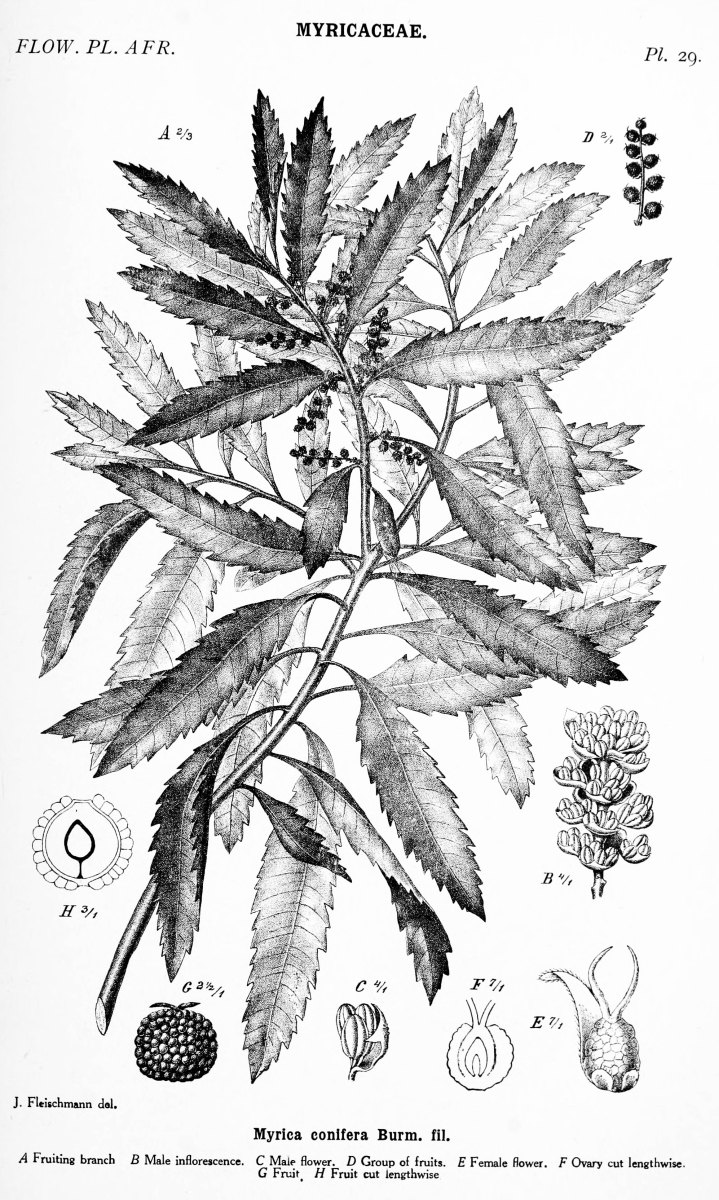
MYRICACEAE.
FLOW. PL. AFR.
Pl. 29.
J. Fleischmann del.
Myrica conifera Burm. fil.
A Fruiting branch. B Male inflorescence. C Male flower. D Group of fruits. E Female flower. F Ovary cut lengthwise. G Fruit. H Fruit cut lengthwise.
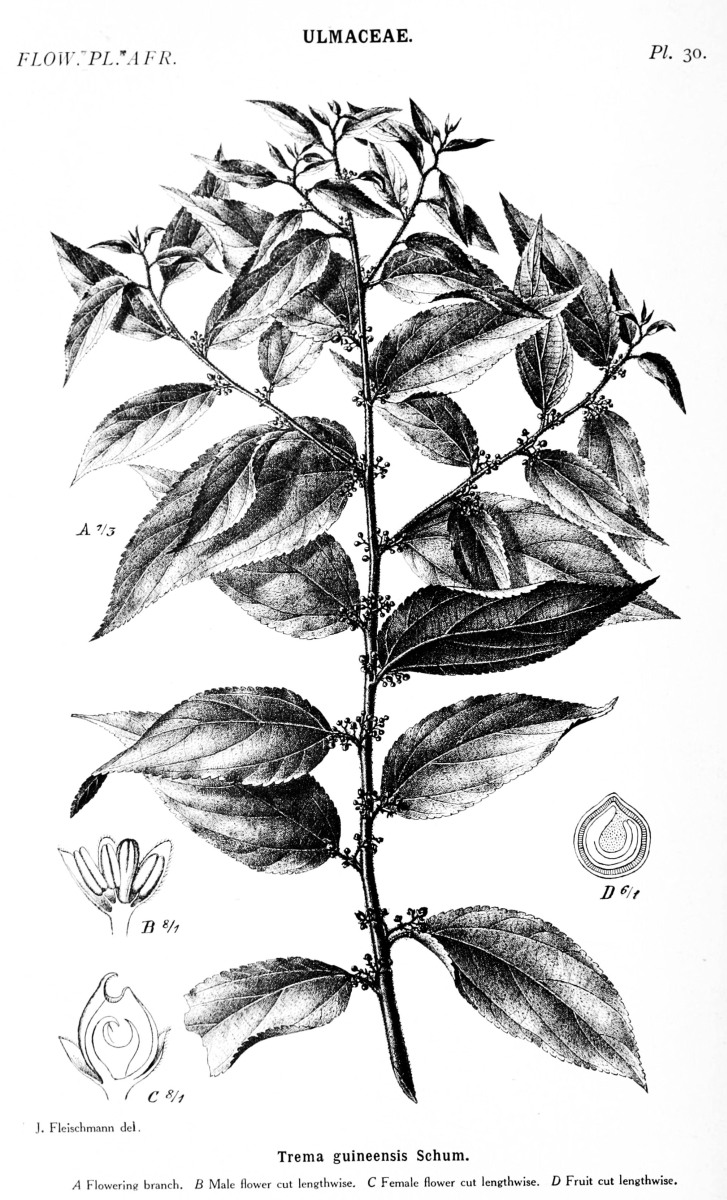
ULMACEAE.
FLOW. PL. AFR.
Pl. 30.
J. Fleischmann del.
Trema guineensis Schum.
A Flowering branch. B Male flower cut lengthwise. C Female flower cut lengthwise. D Fruit cut lengthwise.
folded along the side-nerves in the bud.—Species 1 (A. glutinosa L., alder). North-west Africa, also naturalized in South Africa. Yields timber and bark for tanning. [Tribe BETULEAE.] Alnus Tourn.
FAMILY 51. FAGACEAE
Trees or shrubs. Leaves alternate, undivided lobed or pinnately cleft, stipulate. Flowers in spikes or catkins, monoecious. Perianth-segments 4-7, bract-like, more or less united. Stamens 4-20. Ovary inferior, 3-6-celled at the base. Ovules 2 in each cell, descending, inverted. Styles 3-6. Fruit a nut surrounded by a cup-shaped involucre. Seeds without albumen.—Genera 2, species 9. Extra-tropical regions. (Under CUPULIFERAE.)
Male flowers in fascicles arranged in erect spikes. Female flowers in clusters of 3, surrounded by an involucre. Filaments long. Styles 6, thread-shaped. Fruit enclosed in a prickly involucre. Leaves serrate.—Species 1 (C. vulgaris Lam., chestnut). North-west Africa. Yields timber, bark for tanning, and edible fruits from which starch and oil are prepared. Castanea Tourn. Male flowers in simple, pendulous catkins. Female flowers each surrounded by an involucre. Filaments short. Styles 3, rarely 4-5, flattened. Fruit seated in a scaly, cup-shaped involucre.—Species 8. North-west Africa; one species also introduced into South Africa. They yield timber, cork, tanning and dyeing materials, chemical and medicinal drugs, starch, and fodder; some have edible fruits. “Oak.” Quercus L.
ORDER URTICALES
FAMILY 52. ULMACEAE
Trees or shrubs. Juice not milky. Leaves simple, stipulate. Flowers axillary, solitary or in cymes. Perianth simple, with 3-8 segments. Stamens as many as and opposite the perianth-segments, rarely more, straight in the bud. Anthers opening by longitudinal slits. Ovary superior, 1-celled, very rarely (Ulmus) 2-celled. Ovule 1, pendulous, inverted. Styles or stigmas 1-2. Fruit a nut or a drupe. Seed with a membranous coat and with scanty albumen or without albumen.—Genera 5, species 35. (Under URTICACEAE.) (Plate 30.)
1. Stamens twice or thrice as many as the perianth-segments. Stigma 1. Flowers dioecious. Perianth much enlarged in fruit. Leaves opposite. Species 1. Abyssinia. [Subfamily BARBEYOIDEAE.] Barbeya Schweinf. Stamens as many as the perianth-segments. Stigmas 2. Flowers monoecious polygamous or hermaphrodite. Leaves alternate. 2 2. Fruit a compressed, winged nut. Embryo straight; cotyledons flat. Flower-clusters in the axils of scale-like bracts.—Species 1 (U. campestris L., elm). North-west Africa. Yields timber, bast, tanning and dyeing materials, and medicaments. [Subfamily ULMOIDEAE.] Ulmus L. Fruit a more or less globular drupe. Embryo curved; cotyledons folded or rolled inwards. Flower-clusters or solitary flowers usually in the axils of the leaves. [Subfamily CELTIDOIDEAE.] 3 3. Stipules united. Leaves entire, penninerved. Spiny shrubs. Flowers unisexual. Perianth-segments of the male flowers valvate in the bud. Embryo with narrow cotyledons.—Species 4. Tropical and South Africa. Chaetacme Planch. & Harv. Stipules free. Leaves usually 3-nerved. Spineless shrubs or trees. Flowers usually polygamous. Perianth-segments imbricate in bud, at least at the apex. 4 4. Embryo with narrow cotyledons. Perianth-segments imbricate at the apex only. Flowers almost sessile.—Species 10. Tropical and South Africa. Some species yield timber, fibre, tanning and dyeing materials, and medicaments. (Sponia Commers.) (Plate 30.) Trema Lour. Embryo with broad cotyledons. Perianth-segments imbricate. Stigmas feathery. Upper flowers upon long stalks.—Species 20. Some of them yield timber, bast, tanning and dyeing materials, oil, medicaments, and edible fruits. “Nettle-tree.” Celtis L.
FAMILY 53. MORACEAE
Juice usually milky. Leaves stipulate. Flowers unisexual. Perianth simple or wanting. Stamens as many as and opposite the perianth-segments or fewer, 1-6. Anthers opening by longitudinal slits. Ovary 1-celled. Ovule 1, pendulous, inverted or curved, rarely erect and straight. Styles 1-2.—Genera 26, species 260. (Under URTICACEAE or ULMACEAE.) (Plate 31.)
1. Stamens of the male flowers bent inwards in the bud, subsequently bent backwards. Ovule pendulous. Leaves folded in bud. Stipules not leaving a stem-clasping scar. [Subfamily MOROIDEAE.] 2 Stamens of the male flowers straight from the beginning. 14 2. Flowers in lax cymes consisting of one female flower and several male ones. Perianth with a distinct tube. Stamens 4. Style 2-cleft. Trees. Leaves undivided.—Species 1. Madagascar. [Tribe FATOUEAE.] Bleekrodia Blume Flowers arranged in spike- raceme- or head-like inflorescences or collected upon flattened receptacles. 3 3. Flowers on flattened and more or less expanded receptacles, rarely in spike-like inflorescences; in the latter case, as usually, male and female flowers in the same inflorescence. Stamens 1-4, usually 2. [Tribe DORSTENIEAE.] 4 Flowers in spike-, raceme- or head-like, unisexual inflorescences (containing only male or only female flowers), rarely female flowers solitary. Stamens 4. Trees or shrubs. 7 4. Flowers in false spikes containing male and female flowers or male ones only. Perianth 4-partite. Stamens 4. Trees. Leaves undivided.—Species 1. East Africa. Sloetiopsis Engl. Flowers on flattened receptacles. 5
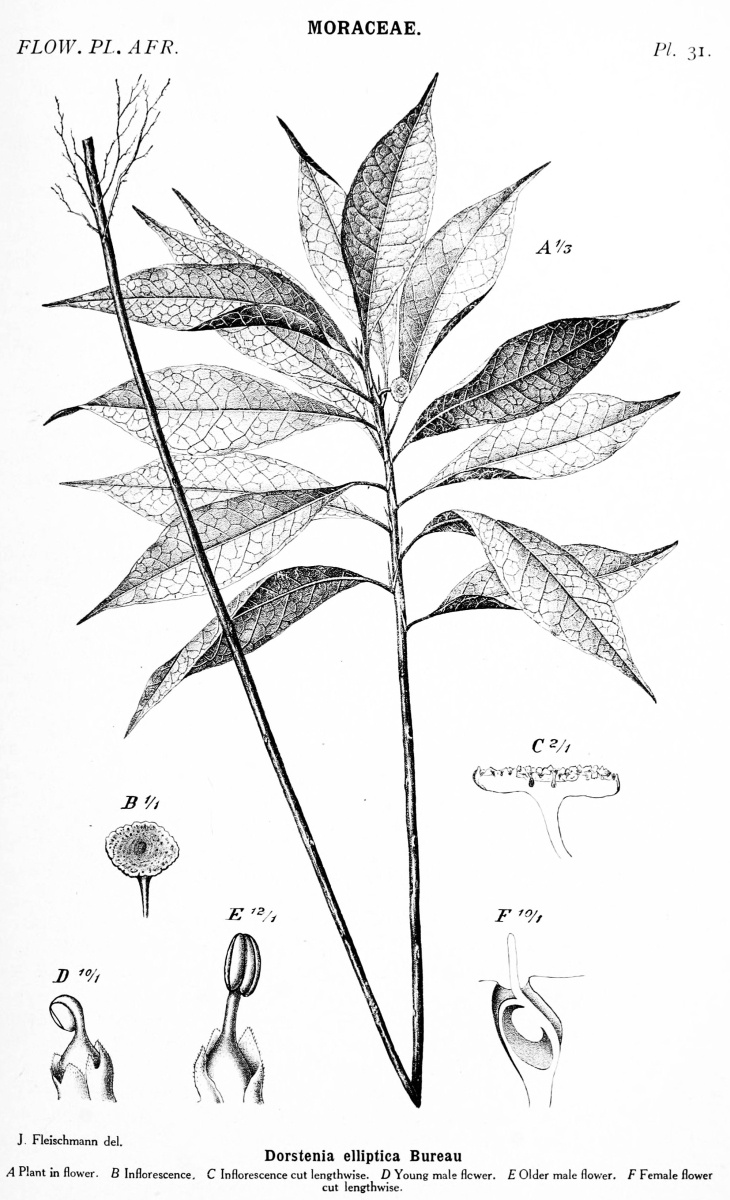
MORACEAE.
FLOW. PL. AFR.
Pl. 31.
J. Fleischmann del.
Dorstenia elliptica Bureau
A Plant in flower. B Inflorescence. C Inflorescence cut lengthwise. D Young male flower. E Older male flower. F Female flower cut lengthwise.
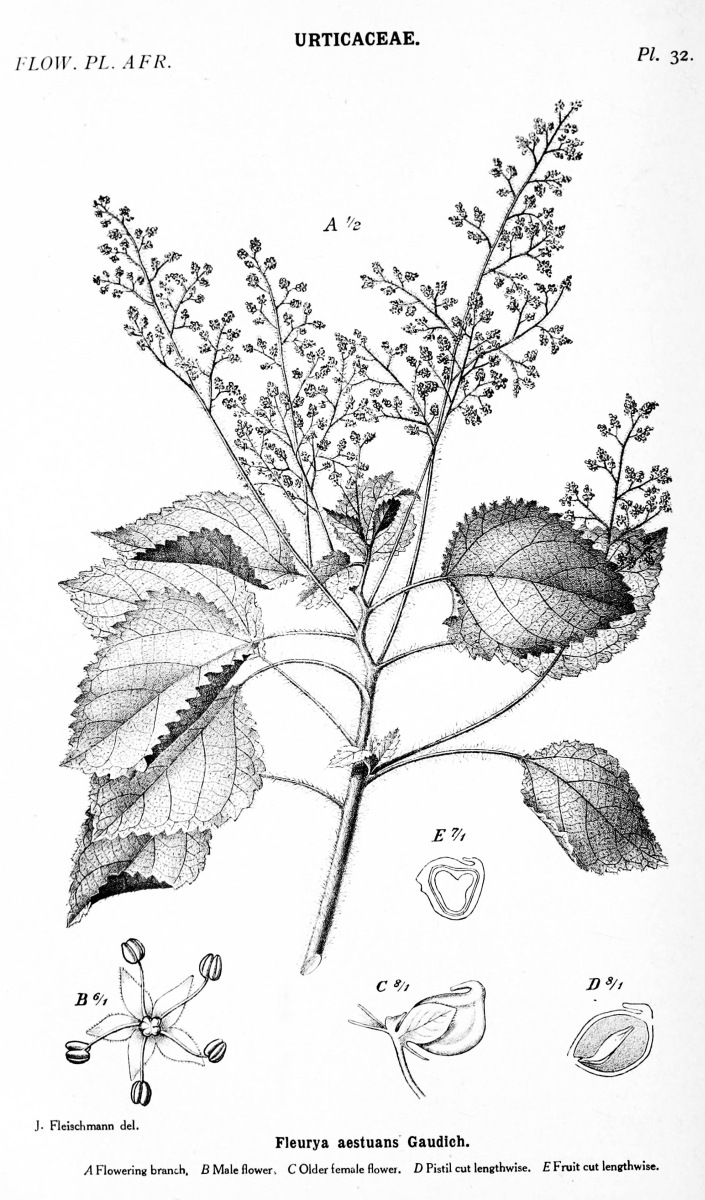
URTICACEAE.
FLOW. PL. AFR.
Pl. 32.
J. Fleischmann del.
Fleurya aestuans Gaudich.
A Flowering branch. B Male flower. C Older female flower. D Pistil cut lengthwise. E Fruit cut lengthwise.
5. Inflorescences unisexual, the lateral containing many male flowers, the middle one a single female flower. Receptacle covered on the outside by imbricate bracts. Male flowers with a 3-4-partite perianth and 3-4 stamens. Female flowers without a perianth. Trees or shrubs. Leaves undivided.—Species 2. Central Africa. Mesogyne Engl. Inflorescences bisexual, containing many male flowers and one or several female ones, usually provided with bracts on the margin only. Perianth 2-lobed or wanting. Stamens 2, rarely 1 or 3. 6 6. Receptacles top-shaped, subsequently cupular, bearing many male flowers and a single central female flower. Pericarp membranous. Shrubs. Leaves undivided.—Species 5. Central Africa. Trymatococcus Poepp. & Endl. Receptacles expanded, often divided into linear segments, bearing many male flowers and several female ones. Pericarp crusty within, fleshy outside. Herbs or low shrubs.—Species 50. Tropics. Some are poisonous or used medicinally. (Plate 31.) Dorstenia L. 7. Female flowers solitary, axillary; male flowers in spike-like inflorescences. Perianth 4-toothed. Trees. Leaves undivided.—Species 1. Island of Réunion. Used medicinally. [Tribe STREBLEAE.] Maillardia Frapp. & Duchartre Female flowers in spike- or head-like inflorescences. 8 8. Female flowers in head-like, but sometimes elongated (oblong) inflorescences, the male in spike-, raceme- or head-like ones. Style simple, with a thread-shaped stigma, rarely with an abortive side-branch. Trees. [Tribe BROUSSONETIEAE.] 9 Female and male flowers in spike-like inflorescences. Perianth of the female flowers divided to the base. Style 2-parted, with thread-shaped, equal or subequal stigmas. [Tribe MOREAE.] 12 9. Male flowers in head-like inflorescences. Perianth of the female flowers 4-lobed. Spinous plants.—Species 1. East Africa and Madagascar. It yields a dye-wood and edible fruits. (Under Plecospermum Trecul) Cardiogyne Bur. Male flowers in spike- or raceme-like inflorescences. 10 10. Male flowers in lax, raceme-like inflorescences. Spinous plants. Leaves entire. Perianth of the female flowers deeply 4-cleft, persistent and enclosing the fruit.—Species 1. Cultivated in North Africa. The wood is used for joiners’ work, the leaves as food for silkworms. Maclura Nutt. Male flowers in dense, spike-like inflorescences. Spineless plants. 11 11. Perianth of the female flowers deeply 4-cleft or 4-parted. Fruit wholly, or for the greatest part, enclosed by the perianth. Leaves undivided.—Species 2. Central Africa. They yield timber. Chlorophora Gaud. Perianth of the female flowers shortly toothed. Fruit overtopping the perianth. Leaves usually lobed.—Species 1 (B. papyrifera Vent., paper-mulberry). Cultivated in North Africa. Used for making paper; the fruit is edible. Broussonetia Vent. 12. Stipules united. Leaves entire, with numerous transverse nerves. Ovary subglobose. Seed with leaf-like, folded cotyledons. Shrubs.—Species 2. Madagascar. Pachytrophe Bur. Stipules free. 13 13. Leaves entire, penninerved, leathery. Ovary compressed. Seed without albumen; embryo with thick cotyledons. Trees.—Species 2. Madagascar. Ampalis Boj. Leaves toothed, 3-nerved at the base. Ovary ovoid or subglobose. Seed with copious albumen.—Species 3. Cultivated and naturalized in various regions. They yield timber, food for silkworms, edible fruits (mulberries), dyes, and medicaments. Morus L. 14. (1.) Ovule erect, straight. Trees. Leaves folded in the bud. Stipules leaving an annular scar. [Subfamily CONOCEPHALOIDEAE.] 15 Ovule pendulous, curved or inverted. Woody plants with the leaves rolled inwards in the bud, or herbaceous plants. 16 15. Leaves divided into 11-15 segments. Male flowers in false heads arranged in cymes; perianth with a distinct tube. Stamen 1. Female flowers upon a flattened, ovate receptacle. Style long.—Species 1 (M. Smithii R. Br.). West Africa to the Upper Nile. Yields timber (cork-wood) and edible fruits. The aerial roots contain much water. Musanga R. Br. Leaves undivided, 3-lobed, or 5-7-parted. Male flowers in false spikes or heads arranged in cymes; perianth divided quite or nearly to the base. Stamens 2-4. Female flowers in globose or subglobose false heads. Style short.—Species 8. Central Africa. Some species yield timber or edible fruits. Myrianthus Beauv. 16. Flowers in cymes arranged in spikes or panicles. Fruit dry. Herbs. Leaves palmately lobed or dissected. Stipules free. [Subfamily CANNABOIDEAE.] 17 Flowers upon a globe-, club-, disc-, or cup-shaped receptacle. Herbs with undivided, lanceolate, penninerved leaves, or more frequently shrubs or trees. Leaves undivided or lobed, coiled in the bud. Stipules usually united and leaving a stem-clasping scar. [Subfamily ARTOCARPOIDEAE.] 18 17. Stem twining. Leaves opposite, lobed or the upper ones undivided. Female flowers in catkins. Embryo spirally twisted, with narrow cotyledons.—Species 1 (H. Lupulus L., hop). Cultivated in the extratropical regions. It is used for making beer, as a vegetable and a fibre-plant, and in medicine. Humulus L. Stem erect. Leaves opposite below, alternate above, dissected. Female flowers in panicles. Embryo curved, with broad cotyledons.—Species 1 (C. sativa L., hemp). Cultivated in various regions. It yields fibre, oil, and an intoxicating drug (hashish). Cannabis Tourn. 18. Flowers enclosed within a pouch-shaped, usually bisexual receptacle provided at the top with a small opening surrounded by bracts. Embryo curved. Shrubs or trees.—Species 160. Some of them yield timber, bast-fibres, bark for clothing, india-rubber, shellac, vegetables, medicaments, and edible fruits (especially the figs, from F. carica L.) which are also used for making brandy and a substitute for coffee. Some species are poisonous or serve as ornamental plants. [Tribe FICEAE.] Ficus L. Flowers collected on a globe-, club-, disc-, or cup-shaped receptacle. 19 19. Receptacles more or less cup-shaped, containing many male flowers and a single central female one. Stamen 1. Embryo straight. [Tribe BROSIMEAE.] 20 Receptacles of two kinds, some containing only male flowers, the others only female or many female intermixed with several male. Shrubs or trees. 22 20. Perianth distinctly developed. Ovary free. Herbs or undershrubs.—Species 3. Equatorial West Africa. (Including Cyatanthus Engl.) Scyphosyce Baill. Perianth not distinctly developed. Ovary immersed in and adnate to the receptacle. Trees. 21 21. Receptacles covered with peltate bracts on their whole surface. Male flowers with, female without bracts.—Species 2. West Africa (Congo). Bosqueiopsis De Wild. & Dur. Receptacles bearing bracts on the margin only. Female flowers with, male without bracts.—Species 6. Tropics. Some yield timber and dye-stuffs. Bosqueia Thouars 22. Male flowers on a discoid or concave receptacle bearing numerous bracts on the edge or the whole surface; female flowers on a similar receptacle or solitary. [Tribe OLMEDIEAE.] 23 Male flowers on a globular or club-shaped receptacle bearing bracts at the base only and between the flowers, or destitute of bracts; female flowers on a more or less globular receptacle. [Tribe ARTOCARPEAE.] 24 23. Male inflorescences many-flowered, discoid; female 1-flowered. Male flowers with, female without a perianth.—Species 3. Central Africa. Poisonous, used medicinally, and yielding timber and fibre. Antiaris Leschen. Male and female inflorescences many-flowered, more or less concave. Male flowers without, female with a perianth.—Species 2. Cultivated in the tropics. Yielding india-rubber. Castilloa Cerv. 24. Inflorescences without bracts at the base. Flowers monoecious. Stamen 1.—Species 2. Cultivated in the tropics. They yield timber, bark used for making cloth, bast-fibres, mucilage, starch, edible fruits, and medicaments. “Breadfruit tree.” Artocarpus Forst. Inflorescences with some bracts at the base. Flowers dioecious. Stamens 1-5. 25 25. Female flowers surrounded each by two rows of very unequal bracts or perianth-segments, not intermixed with male flowers.—Species 1. Equatorial West Africa (Cameroons). Acanthotreculia Engl. Female flowers surrounded by subequal bracts and intermixed with some male flowers.—Species 9. Tropics. Some species have edible seeds from which also oil and meal are prepared. Treculia Decne.
FAMILY 54. URTICACEAE
Juice not milky. Leaves usually stipulate. Flowers unisexual, rarely (Parietaria) polygamous. Perianth simple, with 1-5 segments, sometimes wanting in the female flowers. Stamens in the male flowers as many as perianth-segments. Filaments broadened at the base, bent inwards in the bud. Anthers attached by the back, opening by longitudinal slits. Ovary 1-celled. Ovule 1, erect or ascending, straight. Style 1 or 0. Fruit indehiscent. Seed with a thin coat and a straight embryo, usually albuminous.—Genera 20, species 150. (Plate 32.)
1. Stamen 1. Perianth of the male flowers entire or divided in 2-3 segments, of the female entire 4-toothed or wanting. Stigma linear. Herbs or undershrubs, rarely shrubs. Hairs not stinging. Stipules free. [Tribe FORSKOHLEAE.] 2 Stamens 2-5. 4 2. Flower-clusters without an involucre and not surrounded by woolly hairs. Female flowers with a perianth.—Species 4. South and East Africa. (Didymodoxa E. Mey.) Australina Gaudich. Flower-clusters with an involucre and usually surrounded by woolly hairs. Female flowers without a perianth. 3 3. Involucral bracts free or united at the base only. Stem rough. Herbs undershrubs or shrubs.—Species 5. Forskohlea L. Involucral bracts united high up. Stem smooth. Herbs or undershrubs.—Species 5. Tropical and South Africa. Droguetia Gaudich. 4. Stipules absent. Leaves alternate, entire. Plants without stinging hairs. Female flowers in glomerules surrounded by an involucre; perianth 4-cleft. [Tribe PARIETARIEAE.] 5 Stipules present, very rarely rudimentary, but then leaves toothed. 6 5. Stem herbaceous. Flowers polygamous. Stigma spatulate and recurved.—Species 8. Some are used in medicine. “Pellitory.” Parietaria Tourn. Stem woody. Flowers unisexual. Stigma linear.—Species 1. Canary Islands. Gesnouinia Gaudich. 6. Plants with stinging hairs, very rarely (Fleurya) almost glabrous, and then stigma linear-oblong and shortly papillose and perianth of the female flowers 3-4-partite. Perianth-segments of the female flowers 4, rarely 1-3. Embryo with orbicular cotyledons. [Tribe UREREAE.] 7 Plants without stinging hairs. 12 7. Fruit straight. Stigma penicillate. Leaves opposite. Herbs.—Species 10. They yield material for spinning and paper-making and are used as pot-herbs and in medicine. “Nettle.” Urtica Gaudich. Fruit oblique. Leaves alternate. 8 8. Stigma more or less capitate. Perianth surrounding the fruit fleshy. Shrubs or trees, rarely undershrubs.—Species 20. Tropical and South-East Africa. Urera Gaudich. Stigma linear or oblong. 9 9. Perianth of the female flowers reduced to a single, sometimes 2-parted, large segment, more rarely consisting of 2 unequal segments. Herbs with punctiform cystoliths.—Species 3. Tropics. Girardinia Gaudich. Perianth of the female flowers with 4 segments, of which 1-2 are sometimes rudimentary. 10 10. Cystoliths linear. Annual herbs. Fruit gibbous, as long as or longer than the perianth.—Species 7. South and Central Africa. They yield fibre and fish-poison. (Plate 32.) Fleurya Gaudich. Cystoliths punctiform. Perennial herbs or woody plants. 11 11. Fruit as long as or longer than the perianth, smooth.—Species 3. Central Africa. (Urticastrum Heist.) Laportea Gaudich. Fruit much shorter than the membranous perianth. Shrubs.—Species 6. Madagascar, Mascarenes, East Africa. Obetia Gaudich. 12. (6.) Stigma penicillate. Perianth of the female flowers 3-partite, rarely 4-5-partite or rudimentary, free from the ovary. Embryo with orbicular or ovate cotyledons. Cystoliths linear. Herbs or undershrubs, rarely shrubs; in this case leaves penninerved. Stipules connate. [Tribe PROCRIDEAE.] 13 Stigma filiform, rarely capitate and somewhat hairy, but then shrubs with 3-nerved leaves and perianth shortly toothed and adnate to the ovary. Perianth of the female flowers 2-4-toothed, entire, or wanting. Embryo with elliptical or oblong cotyledons. Cystoliths usually punctiform. Mostly woody plants. [Tribe BOEHMERIEAE.] 16 13. Leaves opposite, but sometimes the pairs consisting of unequal leaves. Herbs. 14 Leaves alternate or subopposite, i.e., one leaf of each pair very small, stipule-like. 15 14. Flowers on a disc- or bell-shaped receptacle.—Species 1. Abyssinia. Lecanthus Wedd. Flowers in glomerules arranged in panicles.—Species 35. Tropics. Some are used as vegetables or textile plants. (Adicea Rafin.) Pilea Lindl. 15. Flowers on an expanded receptacle. Perianth-segments of the female flowers linear or lanceolate. Herbs. Leaves unequal-sided.—Species 15. Tropics. Elatostema Forst. Flowers in glomerules or heads without an involucre. Perianth-segments ovate. Shrubs or undershrubs.—Species 3. Tropics. Procris Juss. 16. Female flowers without a perianth. Stigma filiform. Shrubs. Leaves alternate. Flowers in axillary glomerules.—Species 1. Naturalized on the Island of Mauritius. Phenax Wedd. Female flowers with a perianth. 17 17. Perianth of the female flowers free or almost free from the ovary, dry or membranous in fruit. Stipules free or nearly so. Stigma filiform. 18 Perianth of the female flowers adnate to the ovary, more or less succulent in fruit. Stipules evidently united. Leaves alternate. Shrubs or trees. 19 18. Stigma persistent. Perianth surrounding the fruit neither winged nor ribbed. Leaves toothed.—Species 7. Tropical and South Africa. Two of them (especially B. nivea Hook. & Arn., ramie or Chinese grasscloth plant) are cultivated as textile plants. Boehmeria Jaqu. Stigma deciduous. Perianth surrounding the fruit usually winged or ribbed. Leaves usually entire.—Species 10. Tropical and South Africa. Pouzolzia Gaudich. 19. Stigma filiform, deciduous.—Species 3. Madagascar and Mascarenes. Pipturus Wedd. Stigma capitate, more or less penicillate.—Species 1. Abyssinia. Debregeasia Gaudich.
ORDER PROTEALES
FAMILY 55. PROTEACEAE
Shrubs or trees. Leaves alternate, rarely (Brabeium) whorled. Stipules none. Flowers in heads, spikes, or racemes. Perianth with 4 petaloid, valvate segments, usually surrounded by excrescences of the receptacle. Stamens 4, opposite the perianth-segments. Anthers opening inwards. Ovary superior, 1-celled. Ovule 1, ascending and inverted, more rarely pendulous and straight, very rarely ovules 2. Style simple, with a small stigma. Fruit a one-seeded nut or drupe. Seed exalbuminous.—Genera 13, species 400. Southern and tropical Africa. (Plate 33.)
1. Stamens inserted at the base of the perianth-segments; anthers stalked. Perianth regular, divided to the base. Flowers unisexual or polygamous. [Tribe PERSOONIEAE.] 2 Stamens inserted on the middle or the upper part of the perianth-segments; anthers usually sessile. Perianth more or less deeply divided, but rarely to the base. [Tribe PROTEEAE.] 3 2. Receptacle with a short cupular excrescence at the base. Ovule pendulous. Fruit a drupe. Flowers in fascicles arranged in racemes. Leaves whorled, undivided.—Species 1. South Africa. The fruits are edible and used as a substitute for coffee. Brabeium L. Receptacle with 4 scale-like excrescences at the base. Flowers in spikes arranged in racemes. Leaves alternate, 2-lobed.—Species 1. Madagascar. The wood is used for torches, the seeds yield oil. Dilobeia Thouars 3. Flowers unisexual, regular. 4 Flowers hermaphrodite. 5 4. Male flowers in spikes or racemes, female in heads. Bracts narrow.—Species 3. South Africa. Aulax Berg
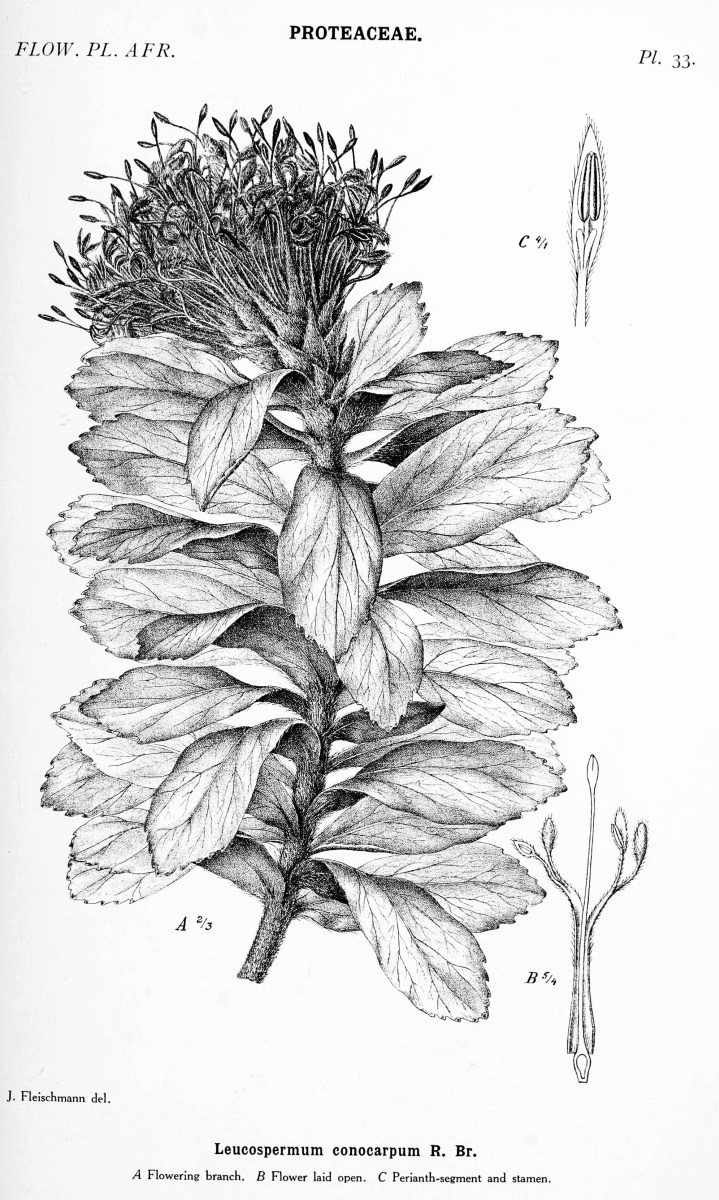
PROTEACEAE.
FLOW. PL. AFR.
Pl. 33.
J. Fleischmann del.
Leucospermum conocarpum R. Br.
A Flowering branch. B Flower laid open. C Perianth-segment and stamen.
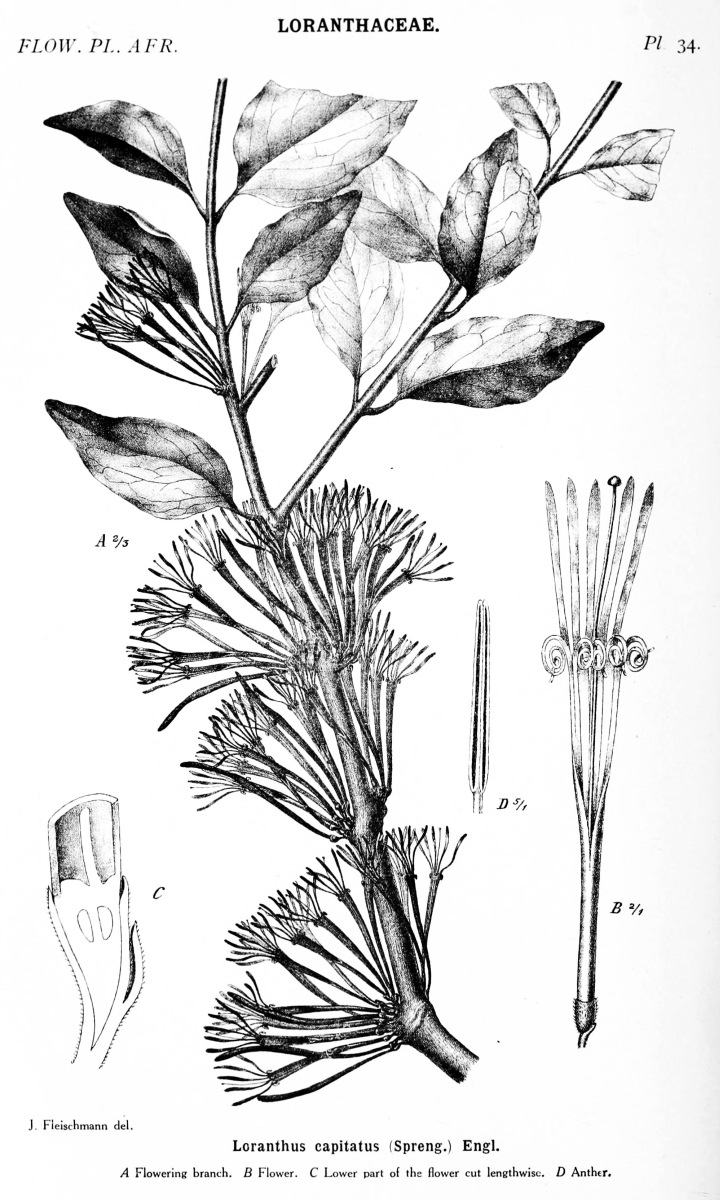
LORANTHACEAE.
FLOW. PL. AFR.
Pl. 34.
J. Fleischmann del.
Loranthus capitatus (Spreng.) Engl.
A Flowering branch. B Flower. C Lower part of the flower cut lengthwise. D Anther.
Male and female flowers in heads. Bracts broad.—Species 75. South Africa. Some species yield timber or medicaments; the silvery-haired leaves of the silver-tree (L. argenteum R. Br.) also form an article of commerce. Leucadendron Herm. 5. Flowers regular or almost so, disposed in heads which are sometimes reduced to a single flower. Perianth-segments united below, free and recurved above. 6 Flowers distinctly irregular. Perianth-segments more or less united, except the hindmost, which is separated from the others. 11 6. Leaves, at least the inferior, more or less divided. 7 Leaves all undivided. 8 7. Heads arranged in sometimes very short spikes, 4-flowered. Ovary glabrous or almost so. Fruit sessile.—Species 15. South Africa. (Nivenia R. Br.) Paranomus Salisb. & Knight Heads solitary or arranged in corymbs or heads, usually many-flowered. Ovary hairy, usually woolly or hispid. Fruit short-stalked.—Species 70. South Africa. Serruria Salisb. 8. Heads solitary, 4- or more-flowered. Fruit sessile.—Species 20. South Africa. (Including Orothamnus Eckl.) Mimetes Salisb. Heads arranged in spikes, racemes, or umbels, 1-6-flowered. Fruit with a short stalk. 9 9. Flowers somewhat irregular. Stigma lateral, or very oblique, or seated in the centre of a disc-like expansion of the style-apex. Heads in lax spikes or racemes.—Species 25. South Africa. Spatalla Salisb. Flowers regular. Stigma terminal or nearly so, conical or club-shaped. 10 10. Style more or less lateral, not constricted at the base. Perianth-tube 4-angled. Inflorescence cylindrical.—Species 5. South Africa. Spatallopsis Phillips Style terminal, constricted at the base. Perianth-tube short, not 4-angled. Inflorescence globose.—Species 12. South Africa. Sorocephalus R. Br. 11. (5.) Anterior perianth-segments separating above. Anthers oblong or ovate. Style deciduous. Fruit glabrous. Flowers in sometimes oblong heads, usually yellow.—Species 40. South and East Africa. Some species yield timber and bark for tanning. (Plate 33.) Leucospermum R. Br. Anterior perianth-segments united almost to the top into a lip. Anthers linear. Style persistent. Fruit covered with dense hairs. 12 12. Flowers in spikes or racemes. Anthers obtuse.—Species 15. Tropical and South-east Africa. Some species yield timber. Faurea Harv. Flowers in heads. Anthers usually with a prolonged connective.—Species 130. South and Central Africa. Some species yield timber, bark for tanning, or medicaments. (Leucadendron L.) Protea L.
ORDER SANTALALES
SUBORDER SANTALINEAE
FAMILY 56. SANTALACEAE
Terrestrial plants, sometimes parasitic on roots. Leaves undivided, exstipulate, sometimes scale-like. Flowers regular. Perianth simple. Stamens 3-6, as many as and inserted on the perianth-segments, equalling them or shorter. Anthers stalked, 2-celled. Ovary inferior, rarely almost superior, 1-celled. Ovule 1, basal, or ovules 2-5, pendulous from the apex of a central or subparietal placenta. Style simple or wanting. Fruit indehiscent. Seeds without a testa, with copious fleshy albumen; radicle of the embryo superior.—Genera 6, Species 140. (Plate 34.)
1. Ovary superior. Ovule 1. Style absent; stigma 2-lobed. Stalk of the fruit fleshy. Shrubs or trees.—Species 1. Madagascar. Used medicinally. [Tribe ANTHOBOLEAE.] Exocarpus Labill. Ovary inferior. Ovules 2-5. Style present. 2 2. Perianth-tube above the ovary coated by a disc on the inside, or wanting. Placenta thick, straight. Ovules recurved. Stigma 3-4-parted or 4-5-lobed. Fruit a drupe. Shrubs. [Tribe OSYRIDEAE.] 3 Perianth-tube above the ovary not coated by a disc on the inside. Placenta thin, usually flexuous. Ovules straight. Stigma entire or obscurely 2-3-lobed. [Tribe THESIEAE.] 4 3. Leaves, at least most of them, opposite. Flowers in panicles which are sometimes composed of false umbels, 4-6-merous, hermaphrodite or polygamous. Stigma 4-5-lobed. Embryo with very short cotyledons.—Species 2. South Africa. They yield timber and tanning material. (Rhoiocarpus A. DC.) Colpoon Berg Leaves alternate. Flowers in false umbels, which are often arranged in racemes, or the female and hermaphrodite solitary, 3-4-merous, dioecious or polygamous. Stigma 3-4-partite. Embryo with long cotyledons.—Species 8. North and East Africa to Natal. Some species yield fragrant wood (African sandalwood), tanning and dyeing materials, and medicaments. (Plate 34.) Osyris L. 4. Flowers dioecious. Perianth-tube above the ovary very shortly campanulate; segments usually with a tuft of hairs in the male flowers. Anther-halves elliptical. Style short.—Species 6. South Africa. Thesidium Sond. Flowers hermaphrodite. Perianth-tube above the ovary campanulate or cylindrical; segments with tufts or rows of hairs. Anther-halves usually oblong. Style long or rather short. 5 5. Fruit a drupe. Flowers axillary, solitary or in glomerules. Undershrubs.—Species 7. East and South Africa. Osyridicarpus A. DC. Fruit a nut.—Species 120. Thesium L.
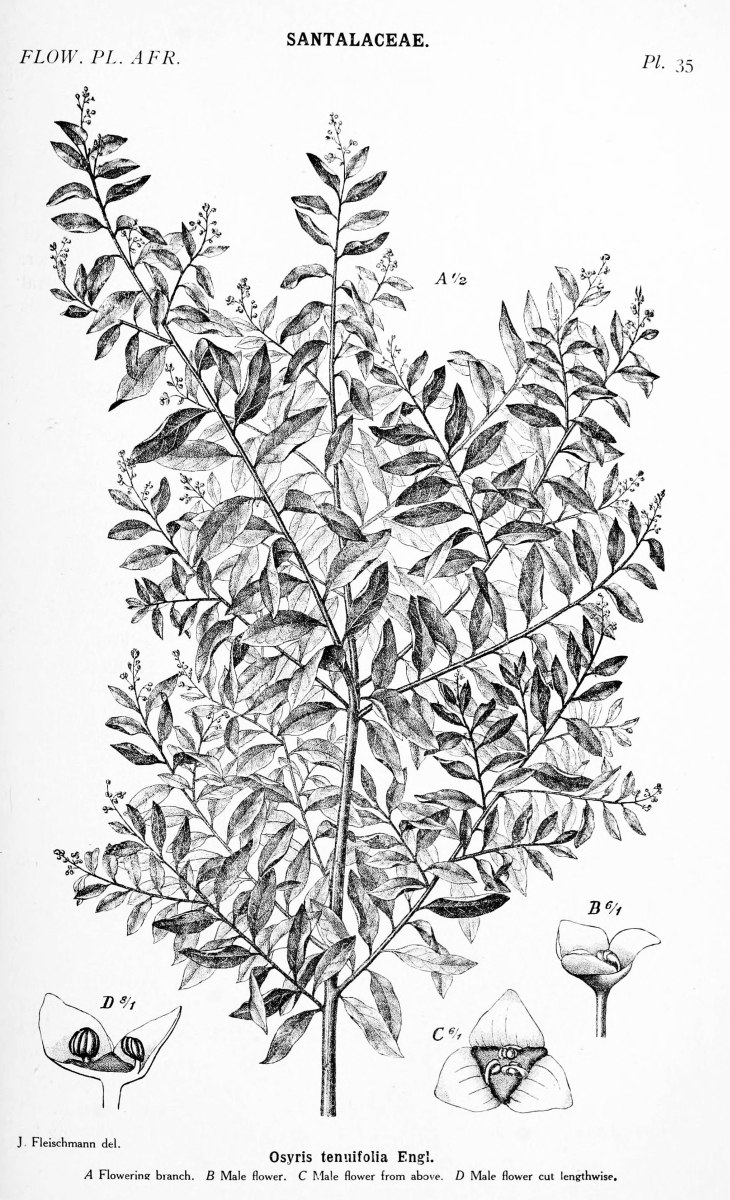
SANTALACEAE.
FLOW. PL. AFR.
Pl. 35.
J. Fleischmann del.
Osyris tenuifolia Engl.
A Flowering branch. B Male flower. C Male flower from above. D Male flower cut lengthwise.
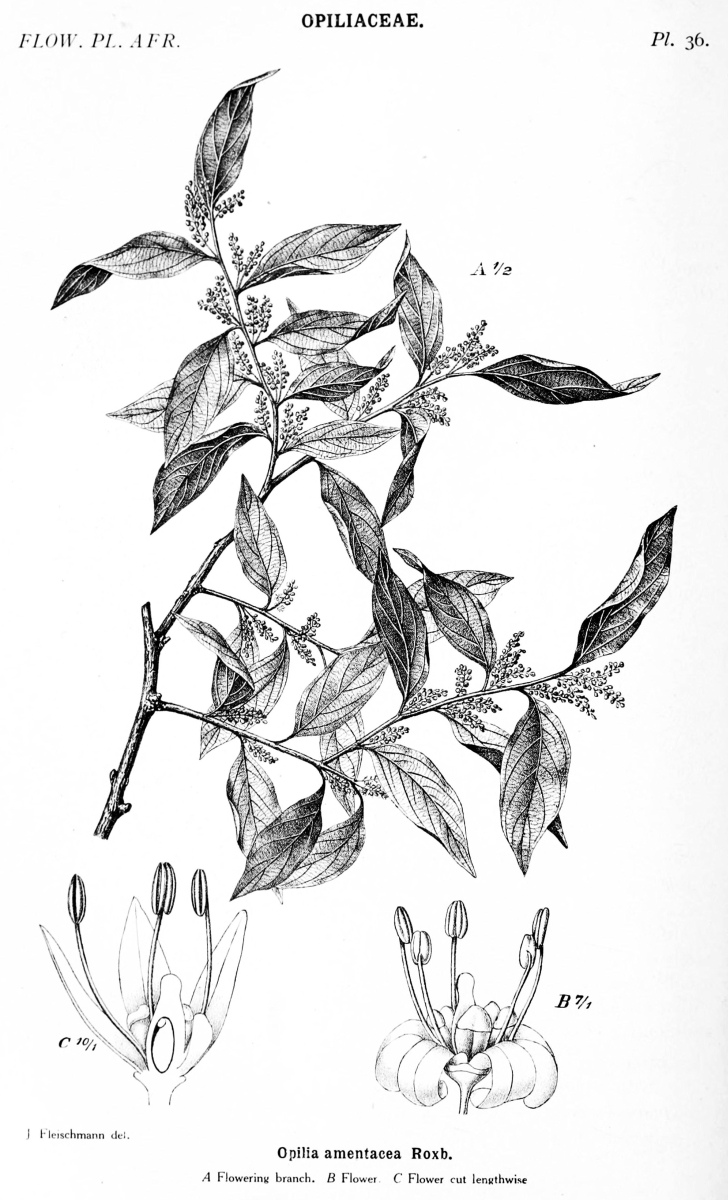
OPILIACEAE.
FLOW. PL. AFR.
Pl. 36.
J. Fleischmann del.
Opilia amentacea Roxb.
A Flowering branch. B Flower. C Flower cut lengthwise.
FAMILY 57. OPILIACEAE
Shrubs or trees. Leaves alternate, entire. Flowers in spikes, racemes or umbels, regular, hermaphrodite. Calyx (or calyx-like excrescence of the receptacle) entire or obscurely 4-5-toothed. Petals (or perianth-segments) 4-5, free. Stamens equal in number and opposite to them, free or adnate at the base. Disc present. Ovary superior or nearly so, 1-celled, with a thick central placenta. Ovule 1, pendulous from the apex of the placenta, with no coat. Style simple. Fruit succulent. Seed without a testa; albumen abundant; embryo large, with superior radicle.—Genera 2, species 15. (Under OLACINEAE.) (Plate 35.)
Axis of the inflorescence with cushion-shaped swellings at the base of the pedicels. Flowers in short racemes or umbels. Receptacle broad, cupular. Disc lobed. Petals with inflected tips. Filaments short. Anthers broad.—Species 5. Central Africa. Rhopalopilia Pierre Axis of the inflorescence without swellings. Flowers in racemes. Receptacle small.—Species 10. Central Africa to Delagoa Bay. (Groutia Guill. & Perr., including Urobotrya Stapf). (Plate 35.) Opilia Roxb.
FAMILY 58. GRUBBIACEAE
Shrubs. Leaves opposite, narrow, entire, leathery. Inflorescences axillary, cymose. Flowers regular, hermaphrodite. Perianth 4-partite, with sepaloid, valvate segments. Stamens 8, almost free from the perianth. Anthers 2-celled. Ovary inferior, 1-celled or at first incompletely 2-celled. Ovules 2, pendulous from a central or subparietal placenta, straight, with no coat. Style simple; stigma 2-lobed. Fruit a drupe. Seed 1, with a thin testa and fleshy albumen; embryo straight, with inferior radicle. (Under SANTALACEAE or HAMAMELIDACEAE.)
Genus 1, species 4. South Africa (Cape Colony). Grubbia Berg
FAMILY 59. OLACACEAE
Shrubs or trees, rarely undershrubs. Leaves entire. Flowers regular. Calyx usually small. Petals or corolla-lobes 3-6, nearly always valvate in bud. Anthers opening by 2 longitudinal slits. Ovary superior or nearly so, rarely half-inferior or almost inferior, 1-celled, usually septate at the base, rarely 2-5-celled to the top. Ovules 1-5, pendulous from the apex of a usually free placenta, inverted. Style simple. Fruit indehiscent. Seed 1, with a small embryo and abundant albumen.—Genera 11, species 70. Tropical and South Africa. (Plate 36.)
1. Ovary superior, 1-celled, sometimes septate at the base. Ovules 2-3, with no coat. 2 Ovary superior, 1-celled with 4-5 ovules, or completely or nearly completely 3-4-celled, or more or less inferior. Ovules with 1-2 coats. 5 2. Filaments united into a long tube. Stamens 4-5, as many as and opposite the divisions of the corolla. Disc 4-5-lobed. Calyx enlarged in fruit. Flowers in racemes or panicles. [Tribe APTANDREAE.] 3 Filaments free or nearly so. [Tribe OLACEAE.] 4 3. Flowers 4-merous, unisexual. Ovules 2. Calyx cupular, not splitting at the time of maturity.—Species 1. West Africa. Aptandra Miers Flowers 5-merous. Ovules 3. Calyx splitting into 3 segments at the time of maturity.—Species 2. Equatorial West Africa. They yield timber and oily seeds which are also used in medicine. Ongokea Pierre 4. Ovules 2. Stamens 5-10. Calyx not enlarged in fruit.—Species 6. West Africa. Ptychopetalum Benth. Ovules 3. Stamens 6-12, of which 3-6 are fertile. Calyx enlarged in fruit.—Species 40. Tropics. Some species yield timber. (Plate 36.) Olax L. 5. Stamens as many as and opposite the petals, 4-6, free or nearly so. [Tribe ANACOLOSEAE.] 6 Stamens 2-4 times as many as the petals. Ovary superior, completely or almost completely 3-4-celled. 9 6. Ovary superior, septate at the base, with 4-5 ovules. Flowers 5-merous, in panicles.—Species 1. Island of Mauritius. Stolidia Baill. Ovary inferior or half-inferior. Flowers in axillary spikes, racemes or fascicles. 7 7. Flowers 6-merous. Calyx entire or toothed. Ovary very incompletely 2-celled. Ovules 2.—Species 1. Madagascar. Anacolosa Blume Flowers 4-5-merous. Ovary completely or almost completely 3-4-celled. Ovules 3-4. 8 8. Flowers 4-merous. Calyx shortly toothed. Ovary 4-celled. Fruit a drupe.—Species 2. Equatorial West Africa. Strombosiopsis Engl. Flowers 5-merous. Calyx deeply divided. Ovary 3-celled. Fruit a berry.—Species 7. Central Africa. (Including Lavalleopsis Van Tiegh.) Strombosia Blume 9. Stamens 3-4 times as many as the petals, 12-20. Calyx entire, not enlarged in fruit. Juice resinous.—Species 1. Equatorial West Africa. Yields timber and edible oily seeds. [Tribe COULEAE.] Coula Baill. Stamens twice as many as the petals, 8-12. Calyx 4-6-toothed. Juice not resinous. 10 10. Anthers globose. Ovary incompletely 3-celled. Style short. Petals 5-6. Calyx much enlarged in fruit. Leaves with milky juice.—Species 3. West Africa. [Tribe HEISTERIEAE.] Heisteria Jaqu. Anthers linear. Ovary almost completely 3-4-celled. Style as long as the ovary. Petals 4-5. Calyx not enlarged in fruit. Leaves with watery juice.—Species 3. Tropical and South-East Africa. They yield fragrant wood, bark for tanning, edible fruits, and oily seeds, and are also used in medicine. [Tribe XIMENIEAE.] Ximenia Plum.
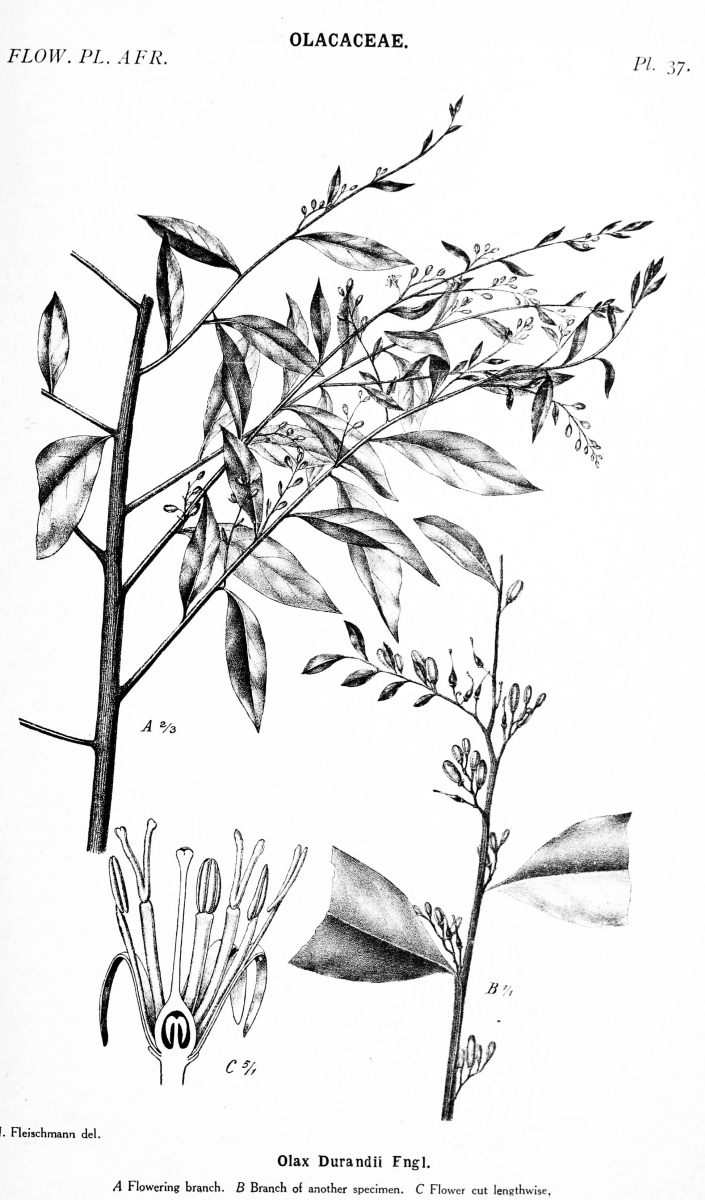
OLACACEAE.
FLOW. PL. AFR.
Pl. 37.
J. Fleischmann del.
Olax Durandii Engl.
A Flowering branch. B Branch of another specimen. C Flower cut lengthwise.
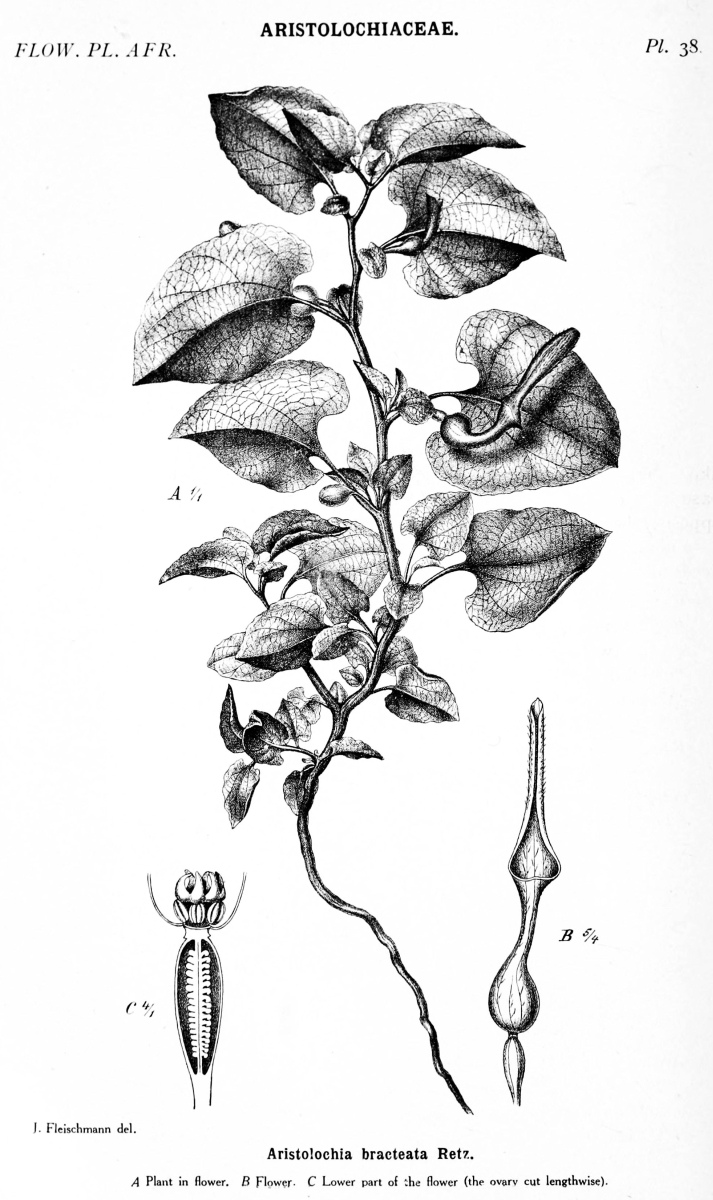
ARISTOLOCHIACEAE.
FLOW. PL. AFR.
Pl. 38.
J. Fleischmann del.
Aristolochia bracteata Retz.
A Plant in flower. B Flower. C Lower part of the flower (the ovary cut lengthwise).
FAMILY 60. OCTOKNEMATACEAE
Shrubs or trees. Leaves alternate, undivided, without stipules. Flowers in axillary racemes. Petals 5, valvate in bud. Stamens 5, opposite the petals; filaments short. Disc obscure. Ovary inferior, 1-celled, with a free filiform placenta and 3 pendulous ovules. Style divided into 3-5 two-or three-cleft lobes. Fruit woody, surrounded by the fleshy receptacle. Seeds with a thin coat; embryo minute, situated at the apex of the 8-furrowed albumen. (Under OLACACEAE.)
Genus 1, species 3. Equatorial West Africa. Octoknema Pierre
SUBORDER LORANTHINEAE
FAMILY 61. LORANTHACEAE
Shrubs, parasitic upon trees. Leaves undivided, exstipulate, sometimes scale-like. Perianth simple, with 2-6 valvate segments, often surrounded at the base by a calyx-like outgrowth of the receptacle. Stamens as many as and opposite the perianth-segments and inserted on them. Ovary inferior, with 1-4 indistinctly developed ovules. Style and stigma simple. Fruit succulent. Seeds albuminous.—Genera, 4, species 300. (Plate 37.)
1. Receptacle with a calyx-like outgrowth surrounding the base of the perianth. Flowers usually hermaphrodite. Anthers usually stalked and opening by two longitudinal slits. Style more or less filiform. Leaves well-developed.—Species 250. Tropical and South Africa. Some are used medicinally. (Plate 37). [Subfamily LORANTHOIDEAE.] LORANTHUS L. Receptacle without a calyx-like outgrowth. Flowers unisexual. Anthers sessile. [Subfamily VISCOIDEAE.] 2 2. Anthers adnate to the perianth; cells several or many, opening by pores. Placenta basal. Flowers in clusters of 3 or more.—Species 50. Some of them yield bird-lime or are used medicinally. “Mistletoe.” [Tribe VISCEAE.] Viscum L. Anthers seated on the perianth, but not adnate to it; cells 1-2, opening by longitudinal or transverse slits. Placenta central. Leaves scale-like. 3 3. Anthers 1-celled, opening by a transverse slit. Perianth of the male flowers 2-5-parted, of the female 2-parted. Flowers dioecious, solitary.—Species 1. North-West Africa. [Tribe ARCEUTHOBIEAE.] Arceuthobium Marsch. Bieb. Anthers 2-celled, opening by 2 longitudinal slits. Perianth 3-parted. Flowers monoecious, disposed in rows.—Species 5. Madagascar and neighbouring islands. (Bifaria Van Tiegh.) [Tribe PHORADENDREAE.] Korthalsella Van Tiegh.
SUBORDER BALANOPHORINEAE
FAMILY 62. BALANOPHORACEAE
Succulent herbs without green colour, parasitic on roots, upon which their root-stock is seated. Leaves reduced to scales. Flowers in spadix-like spikes or heads, red, unisexual. Perianth in the male flowers of 3-6 segments, in the female 3-lobed or wanting. Stamens as many as and opposite the perianth-segments, sometimes one of them abortive. Ovary inferior or naked, 1-celled. Ovules 1-3, pendulous from a central placenta or from the apex of the cell or adnate to the wall of the ovary, without coats. Style simple, sometimes very short; stigma entire or lobed. Fruit a drupe. Seed without a testa; albumen copious; embryo small, apical, undivided.—Genera 4, species 6. Tropical and South Africa.
1. Fertile stamens 2. Female flowers with a 3-lobed perianth. Ovules 3. Stigma 3-lobed, borne on a long filiform style. Spadices oblong, solitary.—Species 2. South Africa. [Subfamily MYSTROPETALOIDEAE.] Mystropetalon Harv. Fertile stamens 3 or more. Female flowers without a perianth, but the base of the style sometimes surrounded by a tubular outgrowth of the receptacle. Stigma entire or sessile. 2 2. Stamens free. Anthers globose, many-celled. Ovules 3. Stigma sessile. Spadices panicled. Root-stock not resinous.—Species 1. South and East Africa. [Subfamily SARCOPHYTOIDEAE.] Sarcophyte Sparrm. Stamens united. Anthers 2-4-celled. Ovule 1. Style and stigma simple. Spadices solitary. Root-stock resinous. [Subfamily BALANOPHOROIDEAE.] 3 3. Anthers 3-6, linear, 4-celled. Ovary linear. Ovule adnate to the wall of the ovary. Perianth-segments of the male flowers linear. Spadices hemispherical.—Species 2. Tropics. [Tribe LANGSDORFFIEAE.] Thonningia Vahl Anthers numerous, 2-celled. Ovule free, pendulous.—Species 1. Comoro Islands. [Tribe BALANOPHOREAE.] Balanophora Forst.
ORDER ARISTOLOCHIALES
FAMILY 63. ARISTOLOCHIACEAE
Leaves alternate, entire or lobed. Flowers axillary, solitary or in clusters, irregular, hermaphrodite. Perianth simple, corolla-like, with a distinct tube. Stamens 5-24, adnate to the style. Anthers opening outwards or laterally by longitudinal slits. Ovary inferior, 4-6-celled. Ovules several or many in each cell, pendulous descending or horizontal, inverted. Style or stigma 6-lobed. Fruit capsular. Seeds with a small embryo and copious albumen. (Plate 38.)
Genus 1, species 30. Some are used medicinally. Aristolochia L.
FAMILY 64. RAFFLESIACEAE
Parasitic herbs, partly immersed in the tissue of the plants upon which they grow. Leaves reduced to scales. Flowers terminal, solitary or in racemes, regular, unisexual. Perianth-segments 4 or more. Stamens 8 or more; filaments united into a column. Ovary inferior, 1-celled with 4 or more parietal placentas, or several-celled with axile placentas. Ovules numerous. Style simple; stigmas situated beneath its thickened apex. Fruit a berry. Seeds minute, with a hard testa, oily albumen, and undivided embryo.—Genera 2, Species 4. (CYTINACEAE.)
Ovary 1-celled, with usually 4 slightly projecting parietal placentas. Ovules inverted. Anthers affixed beneath the thickened apex of the staminal column, opening by transverse slits. Perianth-segments free. Flowers solitary.—Species 1. Southern West Africa (Angola). (Under Apodanthes Poiteau). [Tribe APODANTHEAE.] Pilostyles Guill. Ovary more or less completely 6- or more-celled; placentas parietal, but much projecting, sometimes uniting in the middle. Ovules straight. Anthers laterally affixed to the thickened apex of the staminal column, opening by longitudinal slits. Perianth-segments united below. Flowers in spikes, racemes, or panicles.—Species 3. North and South Africa and Madagascar. They have edible fruits and are used medicinally. [Tribe CYTINEAE.] Cytinus L.
FAMILY 65. HYDNORACEAE
Fleshy, herbaceous, leafless root-parasites with a creeping root-stock. Flowers solitary, regular, hermaphrodite. Perianth simple, fleshy, tubular, with 3-4 (very rarely 5) valvate segments. Stamens as many as and alternate with the perianth-segments, inserted in the tube; filaments united; anther-cells numerous, linear, opening by longitudinal slits. Ovary inferior, 1-celled, with many placentas hanging down from the top of the cell. Stigma sessile. Fruit succulent. Seeds with a hard testa, copious albumen, and undivided embryo. (Under CYTINACEAE).
Genus 1, species 8. Tropical and South Africa. Some are edible or used for tanning. Hydnora Thunb.
ORDER POLYGONALES
FAMILY 66. POLYGONACEAE
Leaves alternate, undivided or pinnately cleft, provided at the base with a stem-clasping sheath. Flowers regular. Perianth-segments 3-6. Stamens 4-50. Ovary superior, 1-celled. Ovule 1. Styles 2-4, free or united at the base. Fruit a nut. Seed with an abundant, mealy albumen and a usually lateral embryo.—Genera 9, species 120. (Plate 39.)
1. Stamens as many as perianth-segments, 6, rarely 4; occasionally fewer than perianth-segments, and then stamens 4-5 and perianth-segments 5-6 in the male, 6 in the female flowers; in this case stem herbaceous and flowers monoecious. [Subfamily RUMICOIDEAE, Tribe RUMICEAE.] 2 Stamens more than perianth-segments, rarely equal in number, but then 5. Herbs or undershrubs with hermaphrodite or polygamous flowers, or shrubs. 3 2. Perianth at the time of maturity firm, tubular, tightly clasping the fruit. Flowers unisexual. Annual herbs.—Species 2. North and South Africa, also naturalized in the Mascarene Islands. Emex Neck. Perianth at the time of maturity more or less membranous, not tubular and not clasping the fruit very tightly.—Species 45. Some are used as vegetables, for tanning and dyeing, or in medicine. “Dock.” Rumex L. 3. Seed with ruminate albumen. Shrubs with 5, 7-10, or 20-50 stamens. [Subfamily COCCOLOBOIDEAE.] 4 Seed with homogeneous albumen. Herbs or undershrubs, more rarely shrubs with 6 or 12-18 stamens. [Subfamily POLYGONOIDEAE.] 5 4. Flowers unisexual. Perianth-segments 4 or 6, the outer deciduous. Stamens 20-50. Erect shrubs or trees.—Species 1. West Africa. [Tribe TRIPLARIDEAE.] Symmeria Benth. Flowers hermaphrodite. Perianth-segments 5, united at the base into a tube becoming two-winged in fruit. Stamens 5-10. Mostly climbing, tendril-bearing plants.—Species 3. West Africa. [Tribe COCCOLOBEAE.] Brunnichia Banks 5. Stem woody, shrubby. Leaves small. Stamens 6 or 12-18. Filaments united at the base. [Tribe ATRAPHAXIDEAE.] 6 Stem herbaceous or woody at the base only. Stamens 8, more rarely 5-7. Filaments free, but sometimes inserted on a ring-shaped disc. [Tribe POLYGONEAE.] 7 6. Perianth-segments 4, the inner much enlarged in fruit. Stamens 6, the outer with a callosity at the base. Stigmas 2. Fruit glabrous. Embryo lateral. Leaves ovate or orbicular.—Species 1. Egypt. Atraphaxis L. Perianth-segments 5-6, not enlarged in fruit. Stamens 12-18, with a hairy appendage at the base. Stigmas 4. Fruit bristly. Embryo axile. Leaves linear or subulate.—Species 1. North Africa. Calligonum L. 7. Perianth-segments of the hermaphrodite and female flowers united below into a narrow tube. Flowers polygamous.—Species 17. Central and South Africa. Some are used as vegetables and for making bread. (Including Raphanopsis Welw.) (Plate 39.) Oxygonum Burch. Perianth-segments not united below into a narrow tube. 8 8. Seed with broad, folded cotyledons. Perianth shorter than the fruit. Leaves cordate.—Species 1 (F. esculentum Moench, buckwheat). Cultivated as a cereal or fodder-plant. (Under Polygonum L.) Fagopyrum Gaertn.
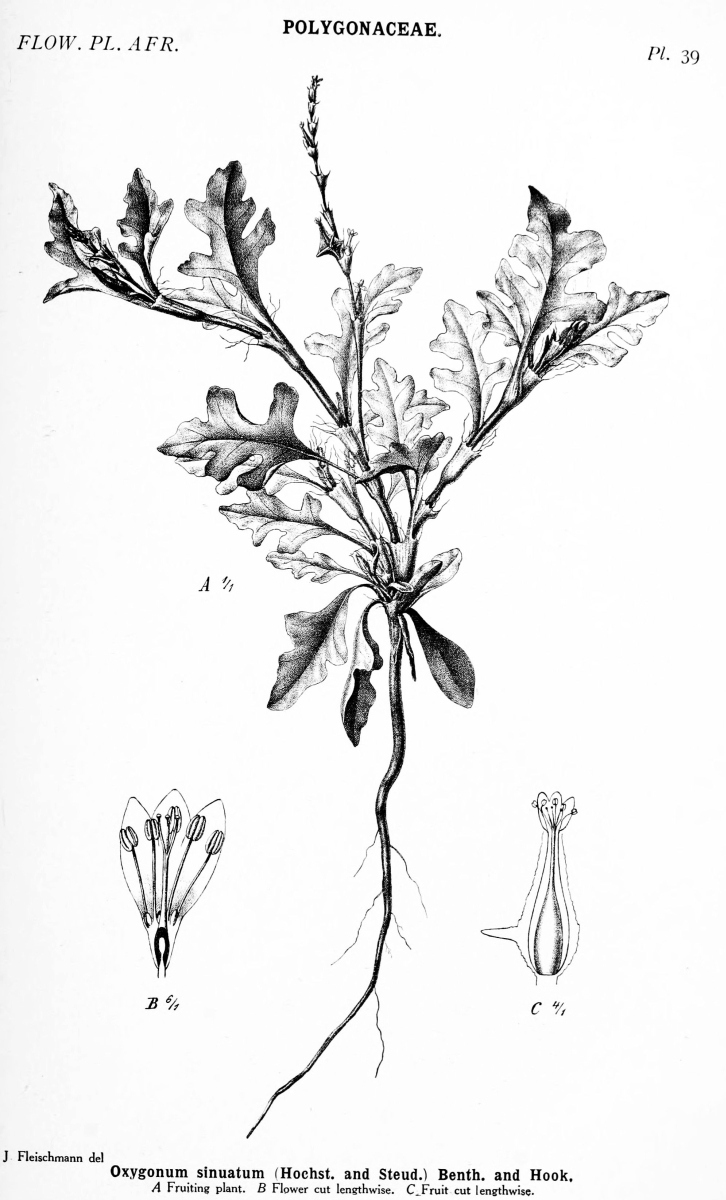
POLYGONACEAE.
FLOW. PL. AFR.
Pl. 39.
J. Fleischmann del.
Oxygonum sinuatum (Hochst. and Steud.) Benth. and Hook.
A Fruiting plant. B Flower cut lengthwise. C Fruit cut lengthwise.
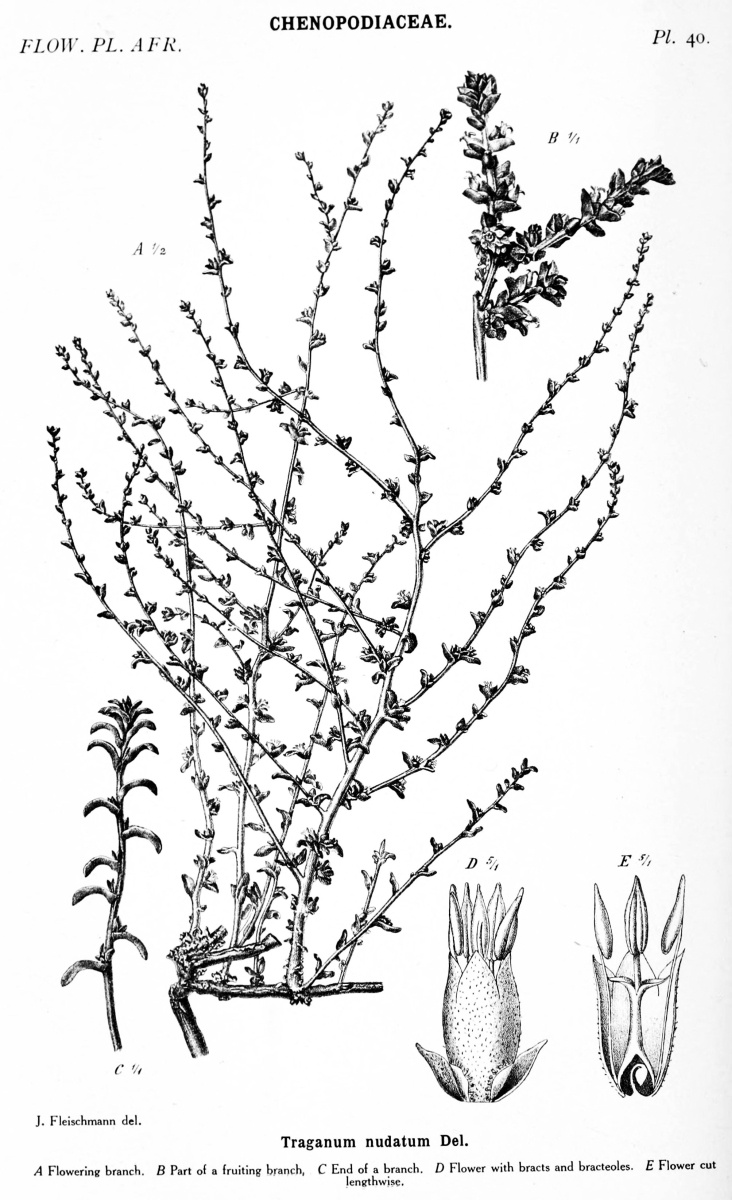
CHENOPODIACEAE.
FLOW. PL. AFR.
Pl. 40.
J. Fleischmann del.
Traganum nudatum Del.
A Flowering branch. B Part of a fruiting branch,. C End of a branch. D Flower with bracts and bracteoles. E Flower cut lengthwise.
Seed with narrow, not folded cotyledons.—Species 50. Some are poisonous, others serve as ornamental, medicinal, or fodder-plants, or yield tanning and dyeing materials. Polygonum L.
ORDER CENTROSPERMAE
SUBORDER CHENOPODIINEAE
FAMILY 67. CHENOPODIACEAE
Stem erect, ascending, or prostrate. Leaves exstipulate, sometimes wanting. Flowers inconspicuous, greenish. Perianth simple, of 1-5 imbricate segments, herbaceous or membranous, persistent, rarely wanting. Stamens as many as and opposite the perianth-segments or fewer, inserted on the receptacle or the base of the perianth. Anthers attached by the back, opening inwards or laterally by longitudinal slits, curved inwards in the bud. Ovary superior, rarely (Beta) half-inferior, 1-celled. Ovule 1, on a basal funicle, curved. Stigmas 2-5. Fruit dehiscing by a lid or indehiscent. Seed with a curved, peripheral embryo.—Genera 26, species 120. (SALSOLACEAE.) (Plate 40.)
1. Embryo spiral. Albumen wanting or separated in two parts by the embryo. 2 Embryo more or less ring- or horseshoe-shaped or folded together. Albumen wholly or partly enclosed by the embryo, rarely wanting. 11 2. Bracteoles small, scale-like. Perianth herbaceous or fleshy. Stigmas thread-shaped, papillose all round. Leaves glabrous, fleshy.—Species 10. Some are used as vegetables or for making soda. (Including Chenopodina Moq., Lerchia Hall., Schanginia C. A. Mey., Schoberia C. A. Mey., and Sevada Moq.) [Tribe SUAEDEAE.] Suaeda Forsk. Bracteoles equalling or exceeding the perianth. Perianth usually membranous. Stigmas papillose on the inside. Leaves usually hairy. [Tribe SALSOLEAE.] 3 3. Seed horizontal. Disc usually inconspicuous. [Subtribe SODINAE.] 4 Seed vertical. Disc usually lobed. [Subtribe ANABASINAE.] 6 4. Perianth 5-lobed, hardening to the top and wingless in the fruit. Filaments flattened. Disc inconspicuous. Embryo in a conical spiral. Shrubs with continuous branches and alternate leaves.—Species 2. North Africa to the Sahara. (Plate 40.) Traganum Del. Perianth 4-5-parted or of 4-5 free segments, not hardening or at the base only and furnished with a horizontal wing in the fruit. 5 5. Branches jointed. Leaves scale-like, opposite, connate in pairs. Shrubs. Perianth-segments free. Anthers blunt. Disc lobed, enlarged in the fruit. Embryo in a flat spiral.—Species 2. North Africa. Haloxylon Bunge Branches continuous. Disc usually inconspicuous.—Species 20. Some of them are used as vegetables or in medicine or furnish soda. “Saltwort.” (Including Caroxylon Thunb.) Salsola L. 6. Perianth of 2 inner and 3 outer segments of which two are in front and one behind. Fruiting perianth winged, not hardened. Seed compressed dorsally. Flowers solitary, more rarely in clusters, and then branches jointed and leaves opposite. 7 Perianth of 3 inner and 2 outer segments of which one is in front and one behind. Fruiting perianth more or less hardened. Seed compressed laterally. Branches continuous. 8 7. Branches jointed. Leaves opposite, sometimes reduced to scales. Filaments awl-shaped. Style short.—Species 5. North Africa and Nubia. Some yield soda or are used medicinally. Anabasis L. Branches continuous. Leaves alternate. Spinous shrubs. Flowers solitary. Filaments flattened; connective pointed. Style long. Pericarp membranous.—Species 1. North Africa. Noaea Moq. 8. Perianth-segments united at the base, wingless in the fruit, but one of them sometimes produced into a prickle. Style long. Shrubs. 9 Perianth-segments free, winged in the fruit, at least some of them. Style short. Disc lobed. Leaves alternate. Flowers in clusters. 10 9. Leaves opposite. Flowers in pairs, hermaphrodite. Disc indistinct.—Species 1. Sahara. Nucularia Battand. Leaves alternate. Flowers in clusters, polygamous. Disc lobed.—Species 2. North Africa and Northern Central Africa. Cornulaca Del. 10. Inner perianth-segments not winged in the fruit. Stamens with a 2-lobed connective. Shrubs.—Species 1. North Africa. (Under Halogeton C. A. Mey.) Agathophora Fenzl Inner and outer perianth-segments winged in the fruit. Stamens with a blunt connective. Herbs.—Species 1. North-West Africa (Algeria). Used as a vegetable or for making soda. Halogeton C. A. Mey. 11. (1.) Branches more or less distinctly jointed. Leaves little developed, glabrous. Flowers in clusters, usually of 3, arising in the axils of scale-like bracts or apparently sunk in hollows of the rachis and collected in cone-shaped inflorescences. Stamens 1-2. [Tribe SALICORNIEAE.] 12 Branches continuous. Leaves well developed, usually hairy. Flowers solitary or in clusters, more rarely in spike-like inflorescences. Stamens 3-5, more rarely 1-2. 16 12. Bracts and upper leaves alternate. 13 Bracts and upper leaves opposite. 14 13. Perianth slightly flattened from the side, 4-5-toothed, surrounded by a wing-like border. Stamens 2. Ovule with a short funicle. Micropyle of the ovule and radicle of the embryo inferior. Low shrubs.—Species 1. North-West Africa (Algeria). Kalidium Moq. Perianth flattened from the back, 3-toothed, without a wing-like border. Ovule with a long funicle. Micropyle and radicle superior or ascending.—Species 2. North Africa to Nubia. Yield soda. Halopeplis Bunge 14. Bracts free, peltate, deciduous. Perianth 3-parted. Stamen 1, inserted in front. Ovule on a long, curved, almost ring-shaped funicle. Micropyle and radicle superior. Shrubs.—Species 1. North Africa to Eritrea. Yields soda. Halocnemum Marsch. Bieb. Bracts united, persistent; flower-clusters apparently sunk in hollows of the branch-joints. Perianth 3-4-toothed or -cleft. Stamen 1, inserted behind, or stamens 2. Ovule on a short funicle. Micropyle and radicle inferior. 15 15. Seed smooth or tubercled; embryo curved; albumen abundant, lateral. Stamens 2. Stigmas 2. Shrubs.—Species 3. North and Central Africa. They yield soda and are used in medicine. Arthrocnemum Moq. Seed hairy; embryo folded together; albumen scanty and central or wanting.—Species 4. Sea-coasts. They yield soda and are used in medicine. Salicornia L. 16. Flowers unisexual, sometimes intermixed with a few hermaphrodite, of two kinds, the male and hermaphrodite with a 3-5-parted perianth and without bracteoles, the female without a perianth, but with 2 sometimes united or 2-parted bracteoles. Stamens 3-5. Leaves glabrous, mealy or cottony, usually hastate. [Tribe ATRIPLICEAE.] 17 Flowers hermaphrodite, sometimes intermixed with similar unisexual ones, all with 4-5 perianth-segments. 19 17. Bracteoles small, narrow, free, unchanged in the fruiting stage, not enclosing the fruit. Flowers monoecious. Stamens 5. Shrubs.—Species 2. South Africa and St. Helena. Exomis Fenzl Bracteoles large, broad, usually united and hardening, completely enclosing the fruit. 18 18. Bracteoles united nearly to the top, hardened in the fruit and sometimes prolonged into 2-4 prickles. Flowers dioecious. Stigmas 4-5. Stem and leaves glabrous. Herbs.—Species 1 (S. oleracea L., spinach). Cultivated in the extra-tropical regions. It serves as a vegetable; the seeds are sometimes used for making bread. Spinacia L. Bracteoles free and herbaceous, or more or less united, but not nearly to the top, and at length hardened. Stigmas 2-3. Stem and leaves clothed, when young, with bladdery hairs, afterwards mostly with a close minute whitish pubescence.—Species 20. Some are used as vegetables, for making soda, in medicine, or as ornamental plants. “Orache.” (Including Obione Gaertn.) Atripex L. 19. Ovary half-inferior. Perianth-segments connivent in the fruit. Fruit dehiscing by a lid. Herbs with a fleshy taproot. Bracteoles usually present.—Species 3. North Africa and Cape Verde Islands; one of them (B. vulgaris L., beet) also cultivated in South Africa and Madagascar. The latter species yields sugar, vegetables, fodder, and a substitute for coffee and tobacco. [Tribe BETEAE.] Beta L. Ovary superior. Fruit indehiscent, rarely dehiscing by a lid, but then perianth-segments spreading in the fruit. 20 20. Flowers with bracteoles, solitary. Perianth membranous, unchanged in the fruit; segments erect. Stigmas 2. Ovule on a long funicle. Pericarp membranous. Herbs or undershrubs. Leaves subulate, rigid, pungent.—Species 1. North-West Africa (Algeria). [Tribe POLYCNEMEAE.] Polycnemum L. Flowers without bracteoles. 21 21. Perianth 4-5-lobed, membranous. Leaves narrow, clothed with thin hairs. [Tribe CAMPHOROSMEAE.] 22 Perianth 5-parted, rarely 4-parted or 5-lobed, more or less herbaceous. Leaves usually broad and clothed with bladdery hairs. 25 22. Perianth unequally 4-toothed, scarcely changed in the fruit. Stamens 4. Seed erect. Embryo horseshoe-shaped. Flowers in spikes. Undershrubs.—Species 1. North Africa. Used medicinally. Camphorosma L. Perianth 5-toothed, 5-lobed, or 5-cleft. Stamens 5. Seed nearly always horizontal. Embryo ring-shaped. Flowers solitary or in clusters, in the axils of the leaves. 23 23. Fruiting perianth unchanged and unappendaged. Undershrubs.—Species 3. North and South Africa. Chenolea Thunb. Fruiting perianth winged, gibbous, or prickly. 24 24. Fruiting perianth gibbous or prickly.—Species 2. North Africa. (Echinopsilon Moq., under Chenolea Thunb. or Kochia Roth). Bassia All. Fruiting perianth with one or several wings.—Species 3. South Africa to Hereroland and North Africa to Nubia. Kochia Roth 25. Fruit not enclosed in the perianth, dehiscing with a lid. Perianth-segments spreading, linear-oblong. Stamens 5, much shorter than the perianth. Stigmas 2, short. Leaves elliptical or lanceolate, entire, glabrous. Undershrubs.—Species 1. North-West Africa (Algeria). Oreobliton Durieu & Moq. Fruit wholly or partly enclosed in the perianth, indehiscent. Leaves usually broad, toothed, and mealy or glandular-hairy.—Species 25. Some of them yield edible seeds, dyes, and medicaments, or are used as vegetables or ornamental plants; several are poisonous. “Goosefoot.” (Including Blitum L. and Roubieva Moq.) [Tribe CHENOPODIEAE.] Chenopodium L.
FAMILY 68. AMARANTACEAE
Leaves without stipules. Perianth more or less dry, simple, of 1-5 imbricate segments. Stamens as many as and opposite the perianth-segments or fewer. Anthers attached by the back, opening inwards by two longitudinal slits. Ovary superior, 1-celled. Ovules erect or suspended from a basal funicle, curved. Fruit dehiscing by a lid or indehiscent. Embryo surrounding the mealy albumen.—Genera 32, species 200. (Plate 41.)
1. Anthers 1-celled. Ovule 1. Herbs or undershrubs. Leaves opposite. Inflorescences head-or shortly spike-shaped. [Subfamily GOMPHRENCIDEAE, tribe GOMPHRENEAE.] 2 Anthers 2-celled. [Subfamily AMARANTOIDEAE.] 4 2. Stigma 1, capitate. Fertile stamens alternating with staminodes.—Species 7. Some are used as ornamental plants, others are noxious weeds. (Including Telanthera R. Br.) [Subtribe FROEHLICHINAE.] Alternanthera Forsk. Stigmas 2-4, subulate. [Subtribe GOMPHRENINAE.] 3 3. Filaments entire.—Species 1. Central Africa. (Philoxerus R. Br.) Iresine L. Filaments fringed, toothed, or 3-parted.—Species 1. Tropical and South East Africa. A weed, sometimes used as an ornamental plant. Gomphrena L. 4. Ovule 1. [Tribe AMARANTEAE.] 5 Ovules 2 or more, very rarely ovule 1, erect; in this case filaments united below into a membranous tube and flowers hermaphrodite. [Tribe CELOSIEAE.] 32 5. Ovule erect. Radicle of the embryo descending. Filaments free or united in a ring at the base. Flowers unisexual, polygamous, or hermaphrodite but intermixed with sterile ones. Leaves alternate. [Subtribe AMARANTINAE.] 6 Ovule pendulous. Radicle of the embryo ascending. [Subtribe ACHYRANTHINAE.] 9 6. Perianth spreading. Filaments united at the base. Stigmas 3. Fruit a berry. Shrubs. Flowers polygamous, in spikes or racemes.—Species 1. Canary Islands. Bosia L. Perianth erect. Herbs or undershrubs. 7 7. Flowers unisexual or polygamous; no sterile ones. Filaments free.—Species 20. Some of them have edible seeds or are used as vegetables, in medicine or as ornamental plants. (Including Albersia Kunth, Amblogyna Rafin., and Euxolus Rafin.) Amarantus L. Flowers hermaphrodite. Partial inflorescences consisting of one fertile and two sterile flowers. 8 8. Sterile flowers comb-shaped. Filaments free. Style short; stigma 2-lobed.—Species 1. Tropical and North Africa. Used as a vegetable. Digera Forsk. Sterile flowers wing-shaped. Filaments united at the base. Style long; stigmas 2.—Species 1. Northern East Africa (Somaliland). Pleuropterantha Franch. 9. Flowers solitary in the axil of each bract. 10 Flowers in clusters of two or more; usually some of them sterile. 20 10. Spurious staminodes (sterile processes) interposed between the fertile stamens. 11 Spurious staminodes wanting. 18 11. Perianth densely covered with silky or woolly hairs. 12 Perianth glabrous or scantily hairy. 15 12. Perianth-segments firmly leathery, silky-hairy, 3-nerved. Shrubs. Leaves alternate, fleshy.—Species 1. South Africa to Damaraland. (Under Sericocoma Fenzl). Calicorema Hook. fil. Perianth-segments more or less membranous. 13 13. Branches jointed. Leaves very small, opposite, ovate, acuminate. Undershrubs.—Species 1. Southern West Africa (Hereroland). Arthraerua Schinz Branches continuous. 14 14. Perianth-segments silky, more or less thickened and hardened at the base, 1-nerved. Flowers small. Ovary hairy. Stigma capitate.—Species 8. Southern and Central Africa. Sericocoma Fenzl Perianth-segments woolly, not thickened. Flowers very small, in dense spikes.—Species 10. Some are used as vegetables or as ornamental plants. (Ouret Adans.) Aerva Forsk. 15. Spurious staminodes minute, narrow, acute, unappendaged. Perianth-segments brownish-red, stiff-leathery, large, oblong, 3-nerved. Inflorescence head-like, ovoid. Leaves usually alternate. Undershrubs.—Species 1. Southern West Africa (Angola and Congo). Mechowia Schinz Spurious staminodes more or less quadrate, fringed or appendaged. Leaves opposite. 16 16. Spurious staminodes fringed below the top. Perianth-segments erect, oblong, blunt, thickened below. Flowers erect, spicate. Leaves small, sessile, linear-oblong. Herbs.—Species 1. Southern East Africa. (Under Pandiaka Hook. fil.) Argyrostachys Lopr. Spurious staminodes fringed at the top or prolonged into appendages. Perianth-segments pointed. Flowers usually bent downwards. 17 17. Perianth-segments red or yellow, elliptical, hardened at the base, faintly 1-5-nerved. Shrubs or undershrubs.—Species 7. Central Africa to Transvaal. Centema Hook. fil. Perianth-segments white, green or brown, lanceolate, stiff-leathery, usually 3-ribbed.—Species 30. Some of them yield a substitute for soap or are used in medicine. (Including Achyropsis Moq. and Pandiaka Moq.) (Plate 41.) Achyranthes L. 18. (10.) Stamens 1-2. Perianth-segments 3-5, membranous, woolly, 1-nerved. Herbs.—Species 1. Tropics. Nothosaerua Wight Stamens 4-5. 19 19. Outer perianth-segments densely clothed with silky hairs, faintly 3-nerved. Style slender. Shrubs.—Species 2. Northern East Africa (Somaliland). Chionothrix Hook. fil. Outer perianth-segments glabrous or scantily hairy, with 3 strong ribs. Flowers greenish.—Species 15. Central and South East Africa. (Including Psilostachys Hochst.) Psilotrichum Blume
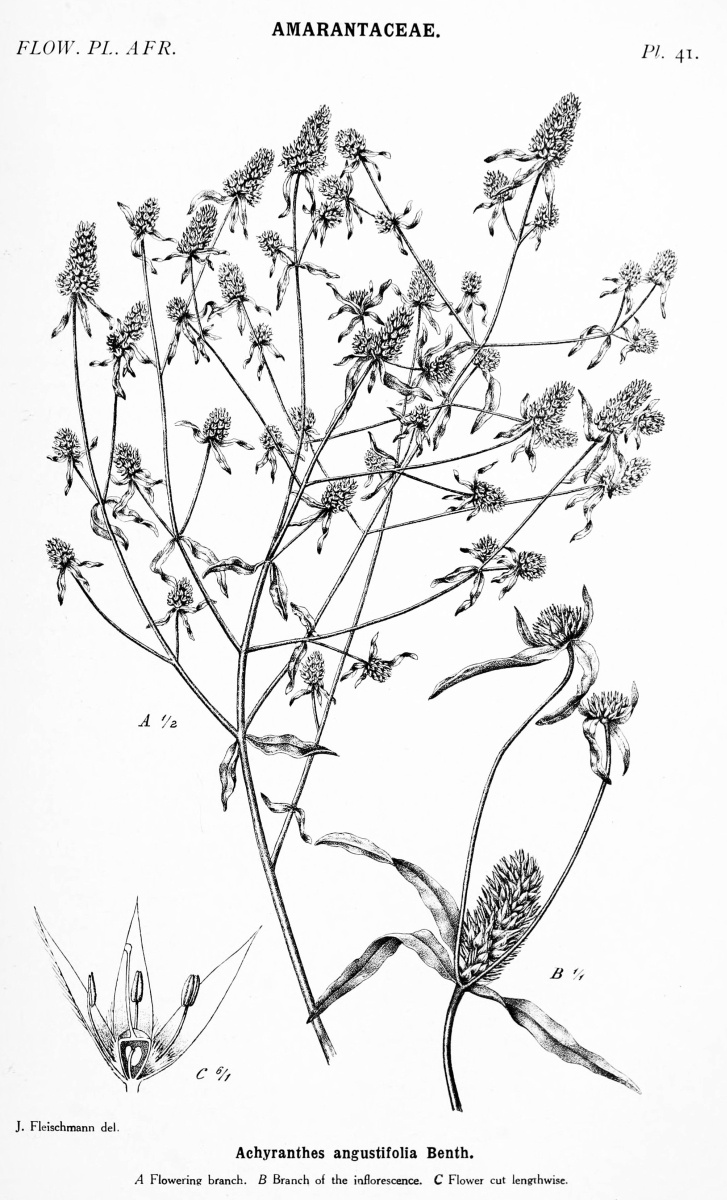
AMARANTACEAE.
FLOW. PL. AFR.
Pl. 41.
J. Fleischmann del.
Achyranthes angustifolia Benth.
A Flowering branch. B Branch of the inflorescence. C Flower cut lengthwise.
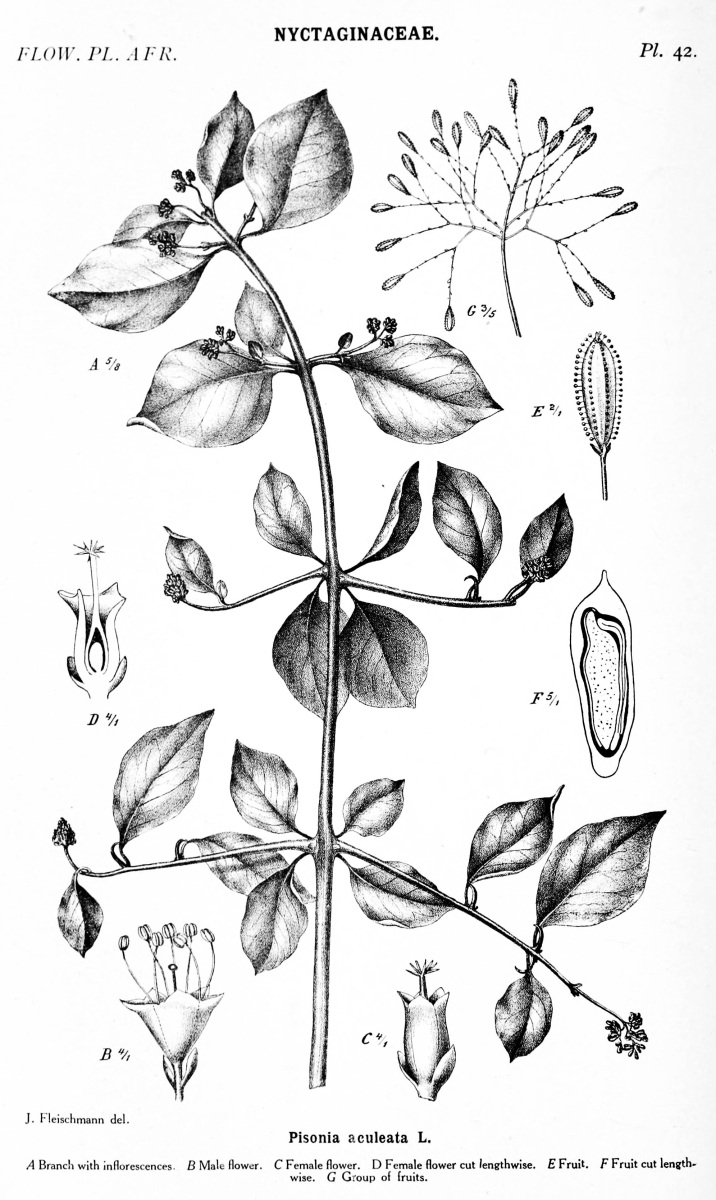
NYCTAGINACEAE.
FLOW. PL. AFR.
Pl. 42.
J. Fleischmann del.
Pisonia aculeata L.
A Branch with inflorescences. B Male flower. C Female flower. D Female flower cut lengthwise. E Fruit. F Fruit cut lengthwise. G Group of fruits.
20. (9.) Spurious staminodes interposed between the stamens. 21 Spurious staminodes none. 26 21. Spurious staminodes small, entire. Ovary hairy. Either perianth clothed with long silky hairs or leaves alternate. 22 Spurious staminodes usually quadrate and fringed, more rarely narrow, but then perianth not clothed with long silky hairs and leaves (as nearly always) opposite. 23 22. Ovary with a horn-like appendage.—Species 6. South and Central Africa. (Under Sericocoma Fenzl). Cyphocarpa Lopr. Ovary without a horn. (See 14.) Sericocoma Fenzl 23. Partial inflorescences consisting of 3 fertile flowers without sterile ones. Perianth hairy. Erect shrubs.—Species 4. South and Central Africa. (Under Sericocoma Fenzl or Cyphocarpa Lopr.) Sericocomopsis Schinz Partial inflorescences consisting of fertile and sterile flowers, or of 2 fertile ones only. 24 24. Stem woody, climbing. Leaves ovate. Sterile flowers reduced to long tufts of hairs. Perianth glabrous. Spurious staminodes narrow, entire or toothed.—Species 2. Equatorial regions (Uganda and Cameroons). Sericostachys Gilg & Lopr. Stem herbaceous or woody at the base only, erect or ascending. Sterile flowers usually reduced to spines. Spurious staminodes usually broad and fringed. 25 25. Perianth-segments thickened and hardening at the base, yellow or red. (See 17.) Centema Hook. fil. Perianth-segments not hardening.—Species 15. Tropical and South Africa. Some are used in medicine. (Desmochaeta DC.) Cyathula Lour. 26. (20.) Partial inflorescences consisting of 2 fertile flowers without sterile ones, and arranged in globose heads. Perianth white, with silky hairs. Ovary hairy. Shrubs.—Species 1. German South-West Africa. (Under Marcellia Baill., Sericocomopsis Schinz, or Sericocoma Fenzl). Leucosphaera Gilg Partial inflorescences consisting of fertile and sterile flowers, the latter sometimes reduced to bristles or spines. 27 27. Perianth-segments thickened and hardened at the base, yellow or red. Ovary glabrous. (See 17.) Centema Hook. fil. Perianth-segments not hardening. 28 28. Sterile flowers consisting of hooked spines.—Species 6. Tropical and South Africa. Pupalia Juss. Sterile flowers consisting of not hooked spines, bristles, or hairs. 29 29. Partial inflorescences consisting of 2 fertile and 2 sterile flowers, the latter reduced to bristles or spines. Ovary hairy. Herbs or undershrubs.—Species 10. Southern West Africa to Namaland. (Under Sericocoma Fenzl). Marcellia Baill. Partial inflorescences consisting of 1-3 fertile and 4-6 sterile flowers. Ovary glabrous. 30 30. Partial inflorescences consisting of 1-3 fertile and 4-6 sterile flowers, the latter reduced to branched spines. Collective inflorescence interrupted below. Style very short. Herbs.—Species 2. South Africa and German South-West Africa. (Under Marcellia Baill. or Sericocoma Fenzl). Sericorema Lopr. Partial inflorescences consisting of 3 fertile and 6 sterile flowers, the latter reduced to long simple spines or bristles. Style thread-shaped. 31 31. Sterile flowers elongating in the fruit into yellow spines. Herbs.—Species 1. German East Africa. (Under Marcellia Baill.) Kentrosphaera Volk. Sterile flowers elongating in the fruit into yellow or brown, rather soft bristles. Shrubs.—Species 3. East Africa. (Under Marcellia Baill.) Dasysphaera Volk. 32. (4.) Perianth-segments spreading. Style short, with 2-4 stigmas. Fruit succulent, baccate. Herbs or undershrubs. Leaves ovate.—Species 1. Tropics. Deeringia R. Br. Perianth-segments erect. Fruit dry. 33 33. Fruit opening lengthwise. Style very short, with 2-3 stigmas. Filaments united at the base only. Leaves narrow. Shrubs.—Species 1. Madagascar. Henonia Moq. Fruit opening by a lid. Herbs or undershrubs. 34 34. Spurious staminodes longer than the stamens, 2-lobed. Style short. Leaves narrow.—Species 10. South Africa and southern Central Africa. Hermbstaedtia Reichb. Spurious staminodes shorter than the stamens or wanting.—Species 30. Tropical and South Africa. Some are used as vegetables or as textile, ornamental, medicinal, or fodder-plants. (Including Lestiboudesia Thou.) Celosia L.
SUBORDER PHYTOLACCINEAE
FAMILY 69. NYCTAGINACEAE
Leaves entire, toothed, or lobed. Flowers regular. Perianth simple, but often surrounded by a calyx-like involucre, 3-6-lobed, valvate or folded in the bud, persistent. Stamens with the filaments united below; connective narrow; anthers opening laterally. Ovary superior, 1-celled. Ovule 1, erect, inverted. Style 1, lateral. Fruit a nut, enclosed by the enlarged and hardened perianth. Seed albuminous.—Genera 5, species 30. (Plate 42.)
1. Seed with a straight embryo. Shrubs or trees. Leaves opposite. Flowers in corymbs, inconspicuous. Involucre consisting of 2-3 small bracts. Perianth tubular or campanulate, 4-5-toothed. Stamens 5-15.—Species 6. Tropical and South-east Africa. (Plate 42.) [Tribe PISONIEAE.] Pisonia Plum. Seed with a curved embryo. Herbs or undershrubs, rarely shrubs or trees, but then leaves alternate or fascicled and flowers in fascicles. Stamens 1-10. [Tribe MIRABILEAE.] 2 2. Stem woody, spinous. Leaves alternate or fascicled. Flowers in fascicles. Stamens 5-10, unequal. Ovary oblong. [Subtribe BOUGAINVILLEINAE.] 3 Stem herbaceous or woody at the base only, not spinous. Leaves opposite. Flowers hermaphrodite. Ovary ovoid or globose. [Subtribe BOERHAVIINAE.] 4 3. Clusters of flowers surrounded by an involucre of 3 large, coloured bracts. Fruit not winged. Leaves scattered.—Species 1. Naturalized in the tropics. Ornamental plant. Bougainvillea Commers. Clusters of flowers without an involucre. Fruit winged. Leaves fascicled.—Species 2. South Africa, southern West Africa, and Madagascar. (Including Amphoranthus S. Moore). Phaeoptilon Radlk. 4. Flowers large, surrounded by a calyx-like, 4-5-cleft involucre.—Species 1 (M. Jalapa L., marvel of Peru). Naturalized in various regions. An ornamental and medicinal plant. Mirabilis L. Flowers surrounded singly or in clusters by some early deciduous bracts.—Species 20. Some of them are used as vegetables or in medicine. Boerhavia L.
FAMILY 70. CYNOCRAMBACEAE
Herbs. Leaves undivided, stipulate, the lower opposite, the upper alternate. Flowers monoecious, the male in groups of 2-4 opposite the leaves, the female in axillary clusters of 3. Perianth of the male flowers 2-3-parted, valvate in bud, of the female tubular, 2-4-toothed. Stamens 10-30, free; anthers linear. Ovary inferior, 1-celled. Ovule 1, basal, curved, with the micropyle turned downwards. Style simple, basal. Fruit a drupe. Seed with a curved embryo and cartilaginous albumen. (THELIGONACEAE, under CHENOPODIACEAE or URTICACEAE.)
Genus 1, species 1. North Africa. (Theligonum L.) Cynocrambe Gaertn.
FAMILY 71. PHYTOLACCACEAE
Leaves alternate, entire, without stipules. Flowers in racemes or spikes, bracteolate. Perianth 4-5-parted, herbaceous or membranous, coloured, imbricate in bud, persistent in fruit. Stamens 3-33, hypogynous. Filaments free or united at the base. Anthers affixed at the back, opening by two longitudinal slits. Carpels superior. Ovules solitary in each ovary-cell or in each distinct carpel, basal, curved; micropyle turned downwards and outwards. Seed with an annular embryo surrounding the albumen.—Genera 5, species 15.
1. Style 1, undivided. Ovary 1-celled. Stamens 4. Anthers linear. Perianth 4-parted. Flowers in racemes. Leaves elliptical. Undershrubs. [Tribe RIVINEAE.] 2 Styles 2 or more, free or nearly so. Perianth neatly always 5-parted. 3 2. Flowers irregular. Fruit nearly dry. Species 1. Tropics. Used medicinally. (Mohlana Mart.) Hilleria Vell. Flowers regular. Fruit succulent. Species 1. Naturalized in the tropics. Used as an ornamental and a dye-plant. Rivina Plum. 3. Ovary solitary, 1-celled. Stamens 3-5. Anthers ovate or globose. Flowers in spikes. Leaves linear.—Species 4. South Africa and southern West Africa. (Including Lophiocarpus Turcz. and Wallinia Moq.) Microtea Swartz Ovary solitary, 2-16-celled, or several separate ovaries. Stamens 6-33. Leaves lanceolate, elliptical, or ovate. [Tribe PHYTOLACCEAE.] 4 4. Carpels 2. Stamens numerous. Fruit dry, capsular. Climbing shrubs.—Species 1. Madagascar. Barbeuia Thouars Carpels 5-16. Fruit succulent, baccate.—Species 8, five of them spontaneous in tropical and South Africa, the others cultivated and sometimes naturalized in various regions. They yield vegetables, dyes (chiefly from Ph. decandra L.), a substitute for soap, and medicaments; some are poisonous. “Poke.” (Including Pircunia Moq.) Phytolacca L.
FAMILY 72. AIZOACEAE
Herbs or undershrubs, rarely shrubs. Leaves entire, toothed, or lobed. Flowers regular. Perianth usually simple. Stamens 3 or more. Ovary usually several-celled. Ovules curved or inverted. Fruit dry. Seeds with a curved embryo and a usually mealy albumen.—Genera 20, species 480. (FICOIDEAE or MESEMBRIACEAE). (Plate 43.)
1. Perianth divided to the base or nearly so, free from the ovary. [Subfamily MOLLUGINOIDEAE.] 2 Perianth with a distinct tube sometimes adnate to the ovary, simple. [Subfamily FICOIDEAE.] 11 2. Ovary solitary, 1-celled. Ovule 1, suspended from a basal funicle. Style 1. Stamens 5. Perianth simple. Flowers in panicles. Leaves whorled.—Species 7. South Africa. Adenogramma Reichb. Ovary solitary but 2- or more-celled, or several separate ovaries. 3 3. Ovary 2-celled. Style 2-cleft. Inflorescence cymose. [Tribe LIMEAE.] 4 Ovary 3-7-celled, or 3-5 separate ovaries. 5 4. Perianth of 4 thin-membranous, fringed segments, surrounded by bracts. Stamens 4, much exceeding the perianth. Fruit capsular. Flowers in false spikes. Leaves stipulate.—Species 1. South Africa. Polpoda Presl Perianth of 5 herbaceous entire segments, to which 3-5 petals are sometimes added. Stamens 5-10, not or scarcely exceeding the perianth. Fruit separating in two nutlets. Leaves exstipulate.—Species 15. South and Central Africa. (Including Semonvillea Gay). Limeum L. 5. Carpels separate. Ovules solitary. Perianth simple. Flowers in cymes. Leaves opposite.—Species 5. Some of them are used as vegetables or in medicine. Giesekia L. Carpels united in the ovarial portion. 6 6. Ovary-cells one-ovuled. Stamens 5. Perianth simple. Flowers in panicles.—Species 5. South Africa and southern West Africa. Psammatropha Eckl. & Zeyh. Ovary-cells several- or many-ovuled. 7 7. Petals or petaloid staminodes numerous, united at the base. Stamens numerous. Flowers conspicuous. Leaves exstipulate, fleshy.—Species 1 Orygia Forsk. Petals none, but the stamens sometimes intermixed with staminodes. Leaves stipulate. 8 8. Styles linear or slightly club-shaped. Stipules membranous, entire. 9 Styles obovate or wedge-shaped. Stipules fringed or sheath-like. 10 9. Ovules with a long funicle. Seeds crowned by an appendage of the funicle. Pericarp firm.—Species 3. Used in medicine. Glinus L. Ovules with a short funicle. Seeds without an appendage of the funicle. Pericarp thin. Stamens 3-10. Glabrous herbs with narrow leaves.—Species 10. Tropical and South Africa. Some species are used in medicine. Mollugo L. 10. Disc cup-shaped, lobed or divided. Stamens 3-5. Stipules fringed.—Species 17. South Africa, Madagascar, St. Helena. Pharnaceum L. Disc none. Stipules sheath-like. Leaves thread-shaped.—Species 4. South Africa. Hyperstelis E. Mey. 11. (1.) Ovary superior. Petals none. 12 Ovary inferior. [Tribe MESEMBRIANTHEMEAE.] 18 12. Fruit transversely dehiscent, circumscissile. Leaves opposite. [Tribe SESUVIEAE.] 13 Fruit longitudinally dehiscent, loculicidal or septicidal. [Tribe AIZOEAE.] 14 13. Ovary 1-2-celled. Ovules solitary or few, basal or subbasal. Pericarp thick in the upper part. Seed-coat wrinkled.—Species 10. Some of them are used as vegetables or in medicine. (Plate 43.) Trianthema L. Ovary 3-5- rarely 2-celled. Ovules numerous, axile. Pericarp thin. Seed-coat smooth. Flowers red.—Species 6. Tropical and South Africa. Some of them have edible seeds, or serve as vegetables. (Including Diplochonium Fenzl and Halimus Rumph.) Sesuvium L. 14. Stamens 4-5. Ovary-cells and styles 3. 15 Stamens 8 or more. 16 15. Ovary-cells 1-ovuled. Filaments long. Fruit roundish. Shrubs with silky hairs. Leaves all cauline, opposite or alternate, imbricate, triangular-ovate, without stipules. Flowers axillary, yellowish.—Species 1. South Africa (Cape Colony). Plinthus Fenzl Ovary-cells several-ovuled. Filaments short. Fruit linear-oblong. Glabrous herbs. Radical leaves lanceolate to ovate, with fringed stipules; cauline leaves whorled, filiform. Flowers in cymes, whitish-green.—Species 2. South Africa. Coelanthum E. Mey. 16. Stamens numerous. Ovary 4-5-celled. Styles 4-5. Ovules 2 or more in each cell. Flowers yellow.—Species 12. Some of them have edible seeds. Aizoon L. Stamens 8-10, rarely more, but then ovary 2-celled and styles 2. Ovules 1 or 2 in each cell. 17 17. Stamens 10 or more. Ovary 2-celled. Styles 2. Ovules basal. Stem glabrous.—Species 4. South Africa. Acrosanthes Eckl. & Zeyh. Stamens 8, rarely 10, but then ovary 3-5-celled, styles 3-5, and stem hairy or warty. Ovules pendulous, 1 in each cell.—Species 20. South Africa to Angola. Galenia L. 18. (11.) Petals (or petaloid staminodes) numerous. Stamens numerous. Ovary 4-20-celled, with many basal or parietal ovules. Fruit a capsule.—Species 330. Some of them have edible fruits or seeds or serve as vegetables, as ornamental or medicinal plants, or for making soda. Mesembrianthemum L. Petals (or petaloid staminodes) none. Ovary 2-8-celled with one pendulous ovule in each cell, or ovary 1-celled. Fruit a nut or drupe. Leaves alternate. 19 19. Ovary 1-celled. Styles 4, two of them shorter than the others and without a stigma.—Species 1. South-west Africa (Namaland). Anisostigma Schinz Ovary 2-8-, very rarely 1-celled. Styles as many as ovary-cells.—Species 35. Southern and Central Africa. One species (T. expansa Murr., New Zealand spinach) is cultivated as a vegetable in various regions. Tetragonia L.
SUBORDER PORTULACINEAE
FAMILY 73. PORTULACACEAE
Herbs or undershrubs, rarely shrubs. Flowers regular or nearly so, hermaphrodite. Sepals 2, free or united at the base, imbricate in the bud. Petals 4-6, free or united at the base, falling off very early. Stamens as many as and opposite the petals, or fewer, or more numerous. Ovary usually superior and 1-celled. Ovules basal or affixed to a free central placenta, curved, the micropyle lateral or inferior. Style 2-8-cleft or parted, rarely (Portulaca) undivided. Fruit a capsule or a nut. Seeds albuminous; embryo more or less curved.—Genera 6, species 35. (Plate 44.)
1. Ovary inferior or half-inferior. Ovules numerous. Fruit dehiscing by a lid.—Species 12. Some are used as vegetables, fodder-, medicinal, or ornamental plants. “Purslane.” [Tribe PORTULACEAE.] Portulaca L. Ovary superior. Fruit dehiscing by valves or indehiscent. [Tribe CALANDRINIEAE.] 2 2. Ovary 2-celled with 2 ovules in each cell. Style-branches 2. Stamens numerous. Shrubs.—Species 2. Madagascar. Talinella Baill. Ovary 1-celled with 1, 3, or many ovules. Style-branches 3. 3
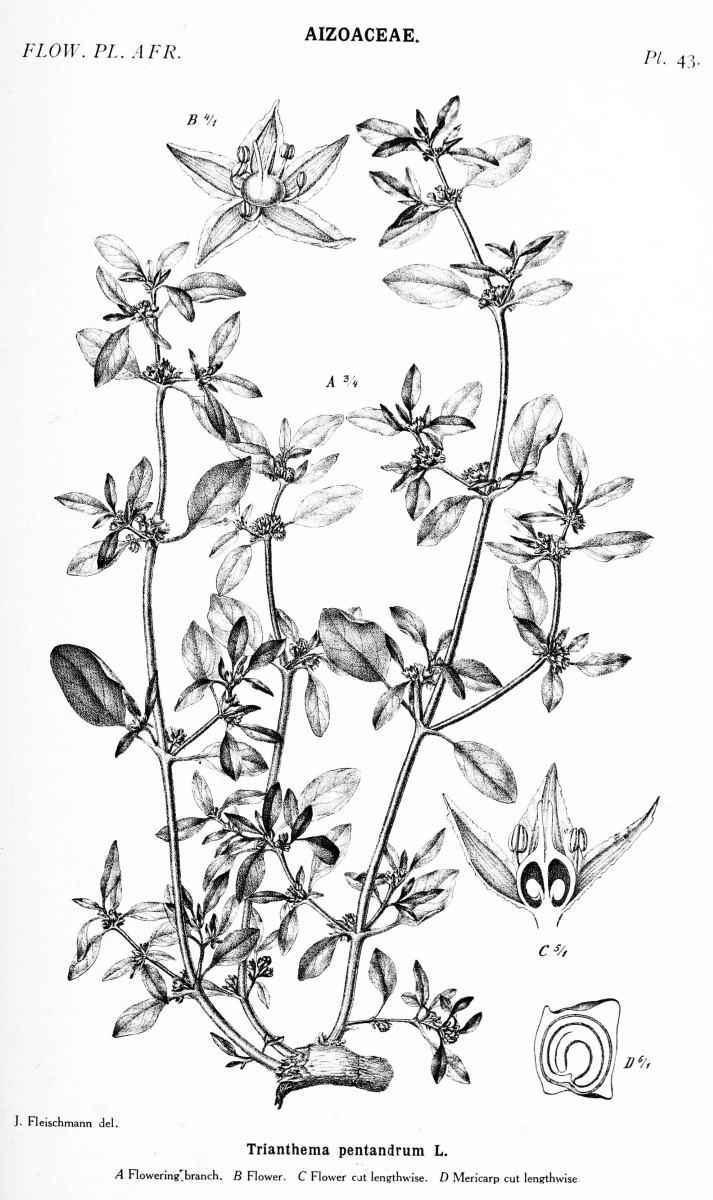
AIZOACEAE.
FLOW. PL. AFR.
Pl. 43.
J. Fleischmann del.
Trianthema pentandrum L.
A Flowering branch. B Flower. C Flower cut lengthwise. D Mericarp cut lengthwise.
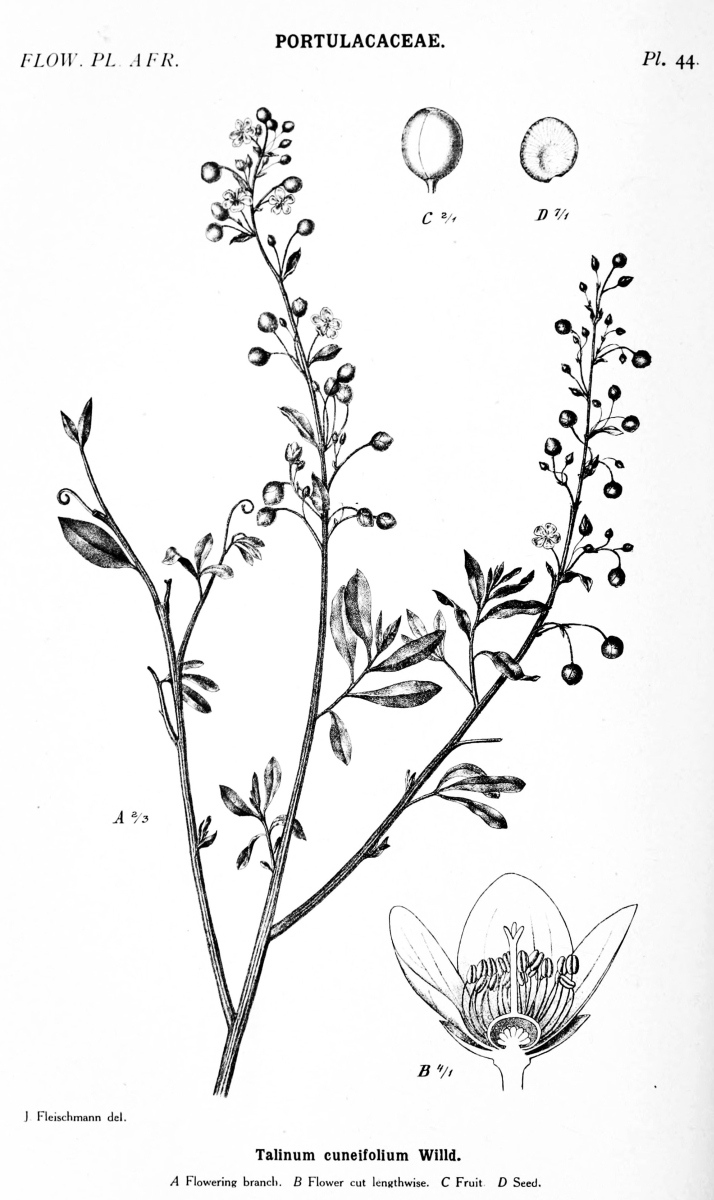
PORTULACACEAE.
FLOW. PL. AFR.
Pl. 44.
J. Fleischmann del.
Talinum cuneifolium Willd.
A Flowering branch. B Flower cut lengthwise. C Fruit. D Seed.
3. Ovule 1. Stamens 4-7. Petals reddish. Fruit indehiscent. Shrubs.—Species 3. South Africa. Used as ornamental or fodder-plants. Portulacaria Jacq. Ovules 3 or more. Stamens 3 or 8-30. Fruit 3-valved. Herbs or undershrubs. 4 4. Ovules 3. Stamens 3. Corolla 5-cleft, slightly irregular, white. Calyx persistent.—Species 1. North Africa and subantarctic islands. Used as a vegetable. Montia L. Ovules numerous. Stamens 8-30. Corolla of 5 free or almost free petals, regular. Calyx deciduous. 5 5. Stipules present, but sometimes reduced to a tuft of hairs. Embryo slightly curved.—Species 15. South Africa. Some are used as ornamental plants. Anacampseros L. Stipules absent. Embryo ring-shaped. Funicle of the seed with an appendage.—Species 4. Central and South Africa. Used as vegetables. (Plate 44.) Talinum Adans.
FAMILY 74. BASELLACEAE
Glabrous, twining herbs. Leaves alternate, broad, entire. Flowers in spikes, racemes or panicles, regular, hermaphrodite. Sepals 2, adnate to the corolla at the base. Corolla 5-cleft or 5-parted, imbricate in the bud, persistent. Stamens 5, opposite the corolla-lobes and affixed to them at the base. Filaments straight or bent outwards in the bud. Anthers 2-celled, turned outwards. Ovary superior, 1-celled. Ovule 1, basal, curved; micropyle inferior. Style 3-partite. Fruit indehiscent. Seed albuminous; embryo curved or spirally twisted.—Genera 2, species 4, Tropics. (Under CHENOPODIACEAE or PORTULACACEAE.)
Flowers sessile, in spikes or panicles. Filaments broadened below. Stigmas entire. Pericarp membranous. Seed subglobose. Embryo spiral.—Species 3, two spontaneous in East Africa and Madagascar, the third cultivated in various tropical countries. They are used as vegetables, in medicine, and as dye-plants. Basella L. Flowers short-stalked, in racemes. Filaments thread-shaped. Stigmas forked. Pericarp somewhat fleshy. Seed sublenticular. Embryo semicircular.—Species 1. Cultivated in various regions and naturalized in the Mascarene Islands. Used as a vegetable or an ornamental plant. Boussaingaultia H. B. & K.
SUBORDER CARYOPHYLLINEAE
FAMILY 75. CARYOPHYLLACEAE
Herbs or undershrubs, rarely shrubs. Leaves undivided. Perianth usually separated into calyx and corolla. Stamens 1-10. Ovary 1-celled or incompletely 2-5-celled, superior, rarely (Sclerocephalus) half-inferior. Ovules on basal or central placentas, with a distinct funicle, curved or inverted. Seeds albuminous; embryo usually curved.—Genera 45, species 280. (Including PARONYCHIEAE or ILLECEBRACEAE, ALSINACEAE, and SILENACEAE.) (Plate 45.)
1. Sepals free or united up to the insertion of the stamens. Petals not distinctly clawed, sometimes wanting. Receptacle concave or small and rather flat. [Subfamily ALSINOIDEAE.] 2 Sepals united beyond the insertion of the stamens. Petals present, usually clawed. Receptacle stalk-like or small and flat. Styles free. [Subfamily SILENOIDEAE.] 35 2. Fruit indehiscent or irregularly bursting at the base, rarely at the top. Ovule 1, rarely ovules 2, and then sepals 5. Petals usually scale-like or wanting. Leaves stipulate, rarely exstipulate; in the latter case styles 2. 3 Fruit opening from the top by teeth or valves. Ovules numerous, rarely 2, and then sepals 4, very rarely ovule 1; in this case leaves exstipulate and styles 3. Petals usually perfectly developed. 16 3. Flowers in clusters of 3, the middle one hermaphrodite, the side flowers male or rudimentary. Stamens nearly hypogynous. Style 1. Ovule one. Embryo almost straight. Leaves opposite, stipulate. [Tribe PTERANTHEAE.] 4 Flowers all alike. Stamens perigynous. 6 4. Stamens 2-3. Staminodes and petals absent. Sepals 5. Stigmas 3. Clusters of flowers on a rather thin stalk, with entire involucral bracts. Shrubs.—Species 1. Canary Islands. Dicheranthus Webb Stamens 4-5. Clusters of flowers with pinnately divided involucral bracts. Herbs. 5 5. Sepals 4. Petals and staminodes none. Stamens 4. Stigmas 2. Clusters of flowers on a much broadened and hollow stalk.—Species 1. North Africa. Pteranthus Forsk. Sepals 5. Petals or staminodes 5. Stamens 5. Stigmas 3. Clusters of flowers on a rather thin stalk.—Species 1. Northern East Africa to Egypt. Cometes L. 6. Leaves exstipulate. Petals none. Styles 2. Ovule 1. Herbs. Leaves opposite.—Species 3. North Africa, Abyssinia, and South Africa. [Tribe SCLERANTHEAE.] Scleranthus L. Leaves stipulate. [Tribe PARONYCHIEAE.] 7 7. Ovule 1. 8 Ovules 2. Undershrubs. 15 8. Style-branches, stigmas, or stigma-lobes 2, very rarely 1, and then style very short. 9 Style-branches, stigmas, or stigma-lobes 3, very rarely 1, but then style elongated. 13 9. Stem woody, shrubby, nodose. Bracts brown. Sepals mucronate. Petals 5, thread-shaped. Style elongated. Stigmas 2.—Species 1. Island of Socotra. Lochia Balf. fil. Stem herbaceous, rarely woody at the base; in the latter case sepals obtuse. 10 10. Flowers in globose heads; involucre becoming prickly. Sepals prickly beneath the tip. Petals wanting. Ovary adnate below to the calyx-tube. Fruit bursting at the top.—Species 1. North Africa and Cape Verde Islands. Sclerocephalus Boiss. Flowers in fascicles; involucre not prickly. Petals thread-shaped or wanting. Ovary free. 11 11. Sepals blunt, green. Style very short; stigmas 2. Embryo curved. Stipules small.—Species 10. North and South Africa, Abyssinia, Cape Verde Islands. Some are used in medicine. Herniaria L. Sepals more or less hooded, with a dorsal point beneath the tip. 12 12. Seed with a straight embryo. Stigma 1, entire or 2-lobed, nearly sessile. Stamens 5. Petals thread-shaped. Sepals white. Leaves in false whorls; stipules very small.—Species 1. North-west Africa. Used in medicine. Illecebrum L. Seed with a curved embryo. Stigma 1, two-lobed, or more frequently stigmas 2. Stipules large or rather large.—Species 15. North Africa and northern Central Africa. Some are used in medicine or yield a substitute for tea. Paronychia Juss. 13. Sepals awned. Petals awl-shaped. Style long, with 3 stigmas. Low shrubs with knotty branches. Leaves narrow.—Species 1. North Africa. Gymnocarpos Forsk. Sepals blunt. Petals scale-like. Style long with 1 stigma, or short with 3 stigmas. Herbs. 14 14. Style long, with 1 stigma. Leaves whorled, obovate.—Species 1. Island of Socotra. Haya Balf. fil. Style short, with 3 stigmas. Leaves opposite or alternate, narrow.—Species 3. North and South Africa and mountains of East Africa and Madagascar. Corrigiola L. 15. (7.) Petals 5. Stamens 5. Embryo curved. Leaves linear, fleshy.—Species 1. Nubia. Sphaerocoma Anders. Petals none. Stamens 1-2. Embryo straight or almost so. Leaves lanceolate, flat.—Species 2. South and Central Africa. Pollichia Soland. 16. (2.) Styles united below. [Tribe POLYCARPEAE.] 17 Styles free from the base. 22 17. Sepals 4, concave, minutely toothed. Petals none. Stamens 3. Ovules few. Style short; stigmas 2. Flowers solitary, axillary, with two bracteoles. Leaves very small, densely crowded.—Species 1. Island of Kerguelen. Lyallia Hook. Sepals 5. Stamens 3-5. Ovules numerous. Stigmas 3 or 1. 18 18. Petals none. Sepals keeled, entire. Stamens 3. Leaves linear. Stipules dark red at the base.—Species 1. North-west Africa (Algeria). Ortegia Loefl. Petals 5. 19 19. Petals 2-parted.—Species 1. Tropical and South Africa. Drymaria Willd. Petals entire, notched, or 2-toothed. 20 20. Sepals with a tooth on each side. Leaves awl-shaped. Stipules cut up into bristles.—Species 1. North Africa. Loeflingia L. Sepals entire. 21 21. Sepals keeled. Style short, 3-cleft.—Species 6. Some are used medicinally. Polycarpon Loefl. Sepals rounded on the back. Style long or rather long.—Species 25. Some are used medicinally. (Polycarpia Webb, Polia Lour., including Robbairea Boiss.) (Plate 45.) Polycarpaea Lam. 22. (16.) Leaves with scarious stipules. Ovules numerous. [Tribe SPERGULEAE.] 23 Leaves without stipules. [Tribe ALSINEAE.] 25 23. Ovary incompletely 3-celled. Ovules basal. Styles 3. Stamens 5. Flowers white. Leaves oblong or ovate.—Species 5. North Africa and Madagascar. Telephium L. Ovary completely 1-celled. Ovules central. Flowers in raceme-like cymes. Leaves linear or subulate. 24 24. Styles and fruit-valves 3.—Species 10. North and South Africa, Abyssinia. Some are used medicinally. (Lepigonum Fries, Tissa Adans.) Spergularia Pers. Styles and fruit-valves 5.—Species 4. North Africa; also naturalized in Central and South Africa. Used as fodder. “Spurry.” Spergula L. 25. Ovule 1. Styles 3. Stamens 10. Petals none, but usually 5 thread-like scales opposite the sepals. Fruit 3-valved to the middle. Leaves subulate. Flowers in clusters consisting of fertile and sterile flowers.—Species 1. North Africa. Queria L. Ovules 3 or more, rarely (Buffonia) 2. 26 26. Petals 2-parted, 2-cleft, or distinctly notched. Flowers solitary or in panicle-like cymes. 27 Petals entire, minutely toothed, obscurely notched, or wanting. 28 27. Fruit globose. Styles 2-3, rarely 4-5, alternating with the sepals.—Species 6. Extra-tropical regions and mountains of the tropics. Some are used medicinally. “Stitchwort.” Stellaria L. Fruit cylindrical. Styles 5, rarely 3-4, opposite the sepals.—Species 20. Extra-tropical regions and mountains of the tropics. Some are used medicinally. Cerastium L. 28. Petals minutely toothed. Styles 3. Ovules numerous. Fruit cylindrical. Seeds peltate, compressed dorsally. Flowers in umbel-like cymes.—Species 1. North Africa. Holosteum L. Petals entire, slightly notched, or wanting. 29 29. Styles as many as the sepals, 4-5. 30 Styles fewer than the sepals, 2-4, very rarely 5. 32 30. Styles opposite the sepals. Stamens 8. Fruit opening at the top by 8 recurved teeth. Leaves lanceolate.—Species 1. North Africa. (Under Cerastium L.) Moenchia Ehrh. Styles alternating with the sepals. Stamens 4, 5, or 10. Fruit opening to the base in 4-5 valves. 31 31. Stamens as many as and alternating with the sepals. Petals none.—Species 2. Subantarctic islands. Colobanthus Bartl. Stamens as many as and opposite the sepals, or twice as many. Leaves subulate.—Species 7. North Africa, high mountains of Central Africa and subantarctic islands. Some are used as ornamental plants. “Pearlwort.” Sagina L. 32. Styles 2. Ovules 2-4. Stamens 2-4. Sepals 4. Fruit opening to the base in 2 valves. Seeds 1-2. Leaves subulate.—Species 5. North-west Africa. Buffonia L. Styles 3-5, rarely 2, but then (as usually) ovules more than 4. Sepals nearly always 5. 33 33. Valves of the fruit entire, as many as styles.—Species 8. North Africa and northern East Africa. (Including Minuartia L., under Arenaria L.) Alsine Wahlenb. Valves of the fruit 2-toothed or 2-parted; in the latter case apparently twice as many as styles. 34 34. Seeds with an appendage at the hilum. Flowers white.—Species 2. North-west Africa. (Under Arenaria L.) Moehringia L. Seeds without an appendage. Stamens 10.—Species 10. North Africa and northern Central Africa. “Sandwort.” Arenaria L. 35. (1.) Calyx with an odd number of ribs. Petals usually with contorted aestivation. Styles or stigmas 2. [Tribe DIANTHEAE.] 36 Calyx with an even number of ribs. Petals usually with quincuncially-imbricate aestivation. Styles or stigmas 3-5. [Tribe LYCHNIDEAE.] 41 36. Calyx with scarious stripes between the lobes and with 5-35 ribs. 37 Calyx without scarious stripes, with 15-55 ribs. 38 37. Seeds peltate; embryo nearly straight. Leaves linear.—Species 2. North Africa. (Including Dianthella Clauson). Tunica Scop. Seeds reniform; embryo curved. Leaves lanceolate, oblong, elliptical, or ovate.—Species 2. North-east Africa to the Island of Socotra. The roots are used in medicine and as a substitute for soap. Gypsophila L. 38. Petals with scales at the base of the blade, which are sometimes reduced to hairs. Calyx not surrounded by bracts. 39 Petals without scales at the base of the blade, but usually with a winged claw. 40 39. Flowers small. Calyx tubular, 15-ribbed. Petals notched; scales small or reduced to hairs. Stamens 5-10. Fruit linear. Seeds with an anterior hilum and a straight embryo. Leaves linear.—Species 1. North Africa. Velezia L. Flowers rather large. Calyx 15-25-ribbed. Petals with wing-like outgrowths on the claw and with scales at the base of the blade. Stamens 10. Seeds with a lateral hilum and a curved embryo. Leaves lanceolate.—Species 4. North Africa. They are used as ornamental or medicinal plants and yield also a substitute for soap. “Soapwort.” Saponaria L. 40. Calyx ventricose, acutely angled, with 15-25 ribs, not surrounded by bracts. Petals minutely toothed. Fruit ovoid. Seeds with a lateral hilum and a curved embryo.—Species 1. North Africa. The roots are used as a substitute for soap. (Under Saponaria L.) Vaccaria Medik. Calyx tubular, with 35-55 ribs, surrounded by two or more bracts at the base. Seeds with an anterior hilum and a straight embryo.—Species 25. North and South Africa and mountains of Central Africa. Many of them are used as ornamental plants or for the preparation of perfumes. “Pink.” Dianthus L. 41. (35.) Styles 5, alternating with the sepals. Ovary and fruit completely 1-celled. Petals without scales at the base of the blade. 42 Styles 5, opposite the sepals, or 3-4. Stamens 10. 43 42. Petals with a two-winged claw. Stamens 10. Styles hairy. Ovules numerous.—Species 1. North Africa, also introduced into South Africa. The seeds are poisonous and used in medicine. “Corncockle.” (Githago Desfont., under Lychnis L.) Agrostemma L. Petals with a wingless claw. Stamens 5. Styles glabrous. Ovules few.—Species 3. Northern East Africa and Cameroons. Uebelinia Hochst. 43. Ovary and fruit completely 1-celled. Calyx more or less inflated, 10-20-ribbed. Petals with scales at the base of the blade. Fruit opening by 6-10 teeth. Seeds tubercled.—Species 6. North-west and South Africa. Some are used as ornamental plants, or as a substitute for soap. (Under Lychnis L.) Melandryum Roehl. Ovary and fruit divided into cells at the base. 44 44. Fruit a berry. Calyx shortly and widely bell-shaped. Petals greenish-white, with a recurved 2-cleft blade provided with two scales at its base. Styles 3. Stem climbing. Leaves ovate or oblong.—Species 1. North-west Africa. Cucubalus L. Fruit a capsule, opening by 6 or more teeth.—Species 75. North and South Africa and mountains of Central Africa. Some are used as a substitute for soap, as vegetables, in medicine or as ornamental plants. (Including Eudianthe Rohrb.) Silene L.
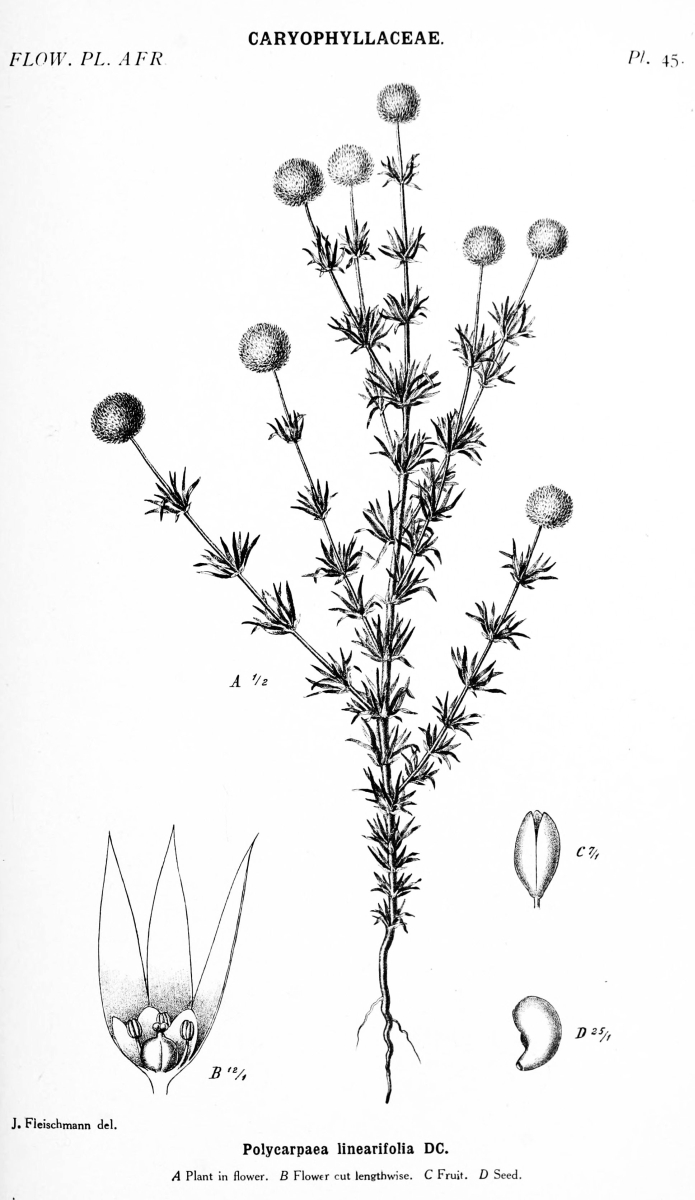
CARYOPHYLLACEAE.
FLOW. PL. AFR.
Pl. 45.
J. Fleischmann del.
Polycarpaea linearifolia DC.
A Plant in flower. B Flower cut lengthwise. C Fruit. D Seed.
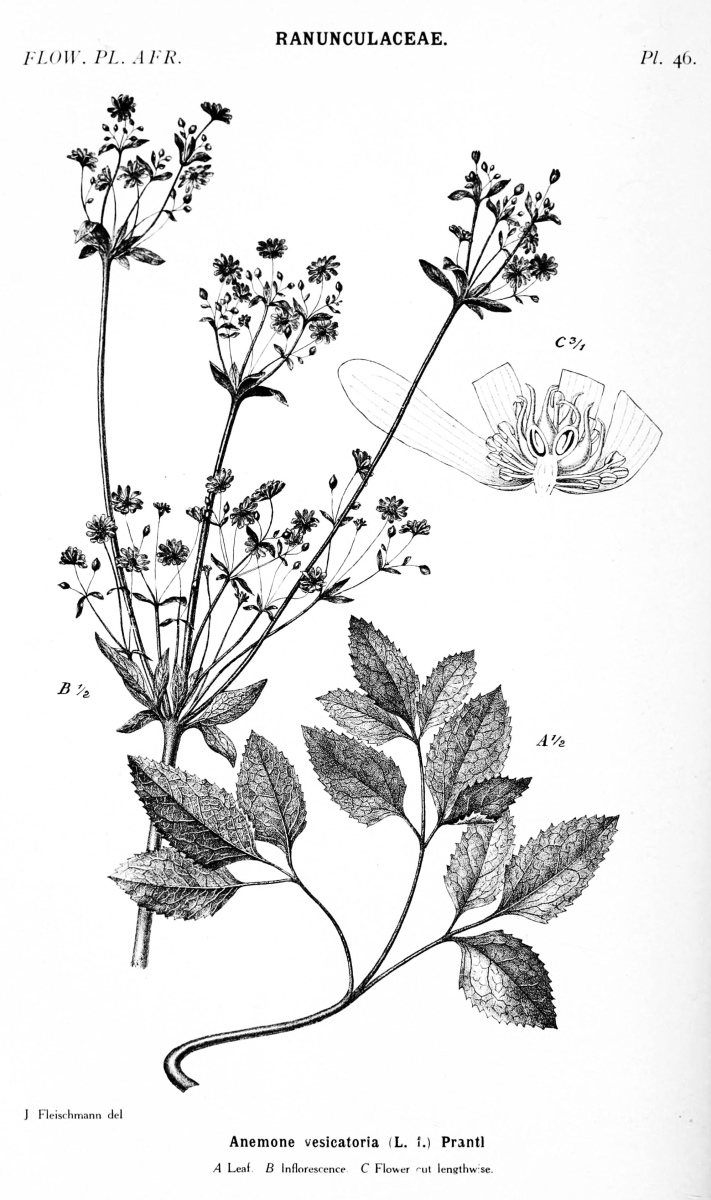
RANUNCULACEAE.
FLOW. PL. AFR.
Pl. 46.
J. Fleischmann del.
Anemone vesicatoria (L. f.) Prantl
A Leaf. B Inflorescence. C Flower cut lengthwise.