ORDER RANALES (continued 8)
Reading edition
Genus 1, species 1. Naturalized in Madagascar and Mauritius. An ornamental and medicinal plant. Martynia L.
FAMILY 212. OROBANCHACEAE
Parasitic herbs destitute of green colour. Leaves reduced to scales. Flowers in terminal spikes or racemes, irregular, hermaphrodite. Calyx 2-5-toothed or consisting of two entire or 2-toothed segments or sepals. Corolla 4-5-lobed, imbricate in bud. Stamens inserted on the tube of the corolla, 4, in two pairs of unequal length. Anthers opening lengthwise. Ovary superior, 1-celled, with 4 parietal placentas. Ovules numerous, inverted. Style simple. Fruit a loculicidal capsule. Seeds with a pitted testa, a copious albumen, and an undivided embryo.—Genera 2, species 30. North and Central Africa. (Plate 139.)
Calyx 5-lobed, with blunt or rounded, nearly equal lobes. Corolla almost equally 5-lobed. Bracteoles adnate to the calyx.—Species 6. North and Central Africa. (Under Phelipaea E. Mey.) (Plate 139.) Cistanche Hoffm. & Link Calyx 2-5-toothed with pointed teeth, or consisting of two entire or 2-toothed segments or sepals.—Species 25. North and East Africa; two species also naturalized in South Africa. Some are used as vegetables or as medicinal or ornamental plants, others are noxious weeds. “Broomrape.” (Including Phelipaea E. Mey.) Orobanche (Tournef.) G. Beck
FAMILY 213. GESNERACEAE
Herbs or undershrubs. Leaves undivided, without stipules. Flowers irregular, hermaphrodite. Sepals united below. Petals united below, imbricate in bud. Fertile stamens 2. Disc present. Ovary superior, 1-celled, with parietal placentas, sometimes incompletely 2-4-celled. Ovules numerous, inverted. Style simple. Fruit a capsule. Seeds exalbuminous; embryo straight.—Genera 6, species 65. Tropical and South Africa. (CRYTANDREAE.) (Plate 140.)
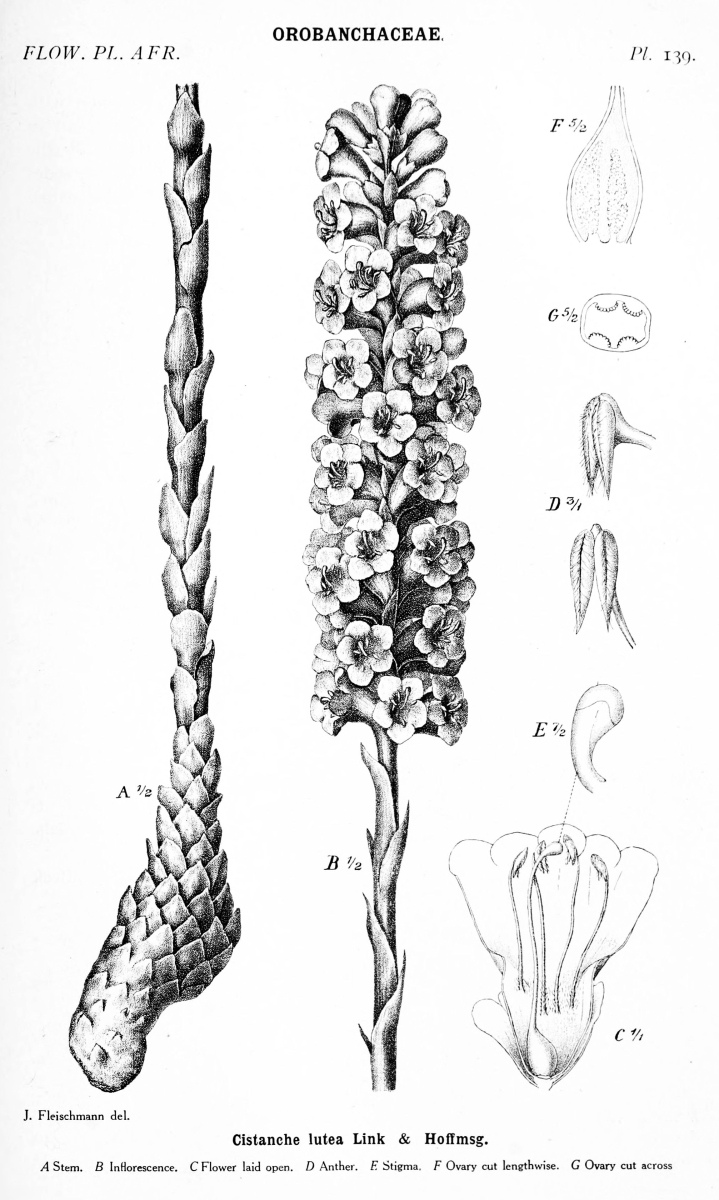
OROBANCHACEAE.
FLOW. PL. AFR.
Pl. 139.
J. Fleischmann del.
Cistanche lutea Link & Hoffmsg.
A Stem. B Inflorescence. C Flower laid open. D Anther. E Stigma. F Ovary cut lengthwise. G Ovary cut across.
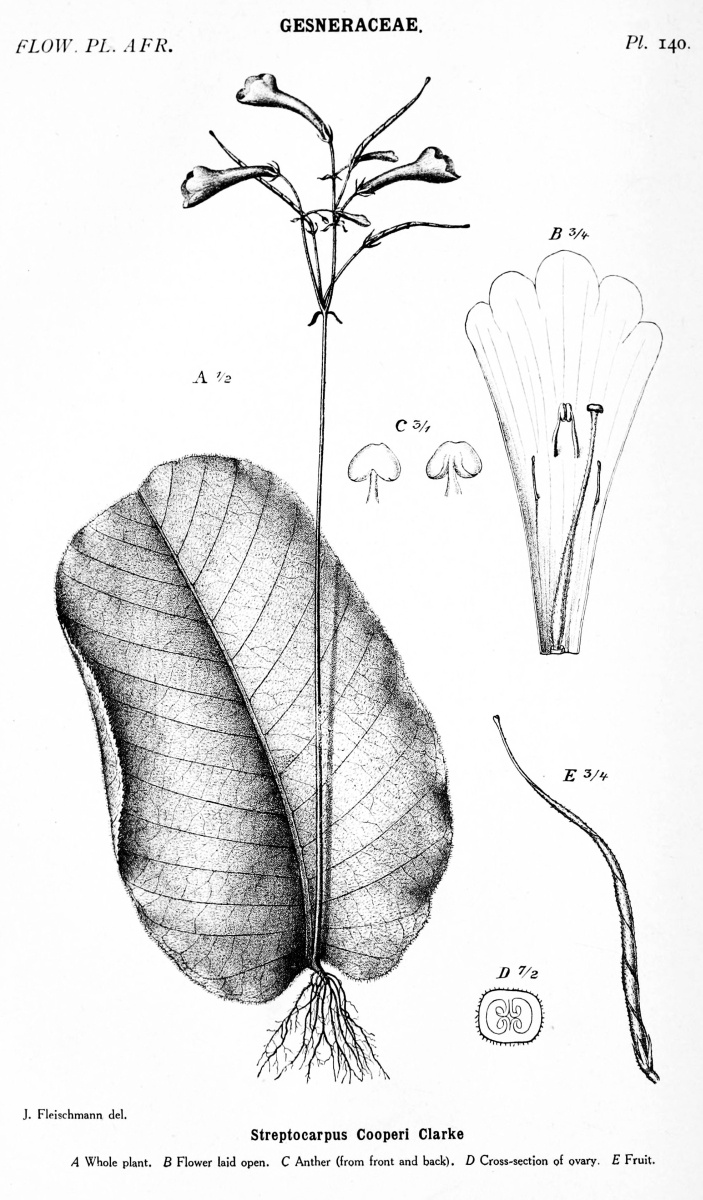
GESNERACEAE.
FLOW. PL. AFR.
Pl. 140.
J. Fleischmann del.
Streptocarpus Cooperi Clarke
A Whole plant. B Flower laid open. C Anther (from front and back). D Cross-section of ovary. E Fruit.
1. Fruit linear, loculicidal or follicular. Disc equal-sided, sometimes indistinct. 2 Fruit oblong, ovate, or globose. Disc one-sided, rarely (Saintpaulia) equal-sided. 3 2. Fruit twisted.—Species 50. Tropical and South Africa. Some are used as ornamental plants. (Plate 140.) (Tribe STREPTOCARPEAE.) Streptocarpus Lindl. Fruit not twisted.—Species 5. West Africa and Madagascar. (Roettlera Vahl, including Trachystigma C. B. Clarke). [Tribe DIDYMOCARPEAE.] Didymocarpus Wall. 3. Fruit globose, opening transversely. Calyx shortly toothed. Corolla blue or white. Posterior stamens fertile. Inflorescence capitate. Leaves few.—Species 2. West Africa. [Tribe BESLERIEAE.] Epithema Blume Fruit ovate or oblong, opening lengthwise. 4 4. Fruit loculicidal or follicular. Leaf single.—Species 2. West Africa. (Including Carolofritschia Engl.) [Tribe KLUGIEAE.] Acanthonema Hook. fil. Fruit septicidal. Leaves several. [Tribe RAMONDIEAE.] 5 5. Corolla white, lobed. Disc one-sided. Anthers oblong. Ovary completely 1-celled, glandular-hairy. Stigma entire. Stem creeping. Leaves alternate.—Species 1. East Africa. Linnaeopsis Engl. Corolla blue or violet, cleft. Disc equal-sided. Anthers ovoid or subglobose. Ovary incompletely 2-4-celled, hairy. Stigma 2-lobed. Stem erect or ascending. Leaves opposite or all radical.—Species 4. East Africa. Some are used as ornamental plants. Saintpaulia Wendl.
FAMILY 214. LENTIBULARIACEAE
Rootless herbs with pitcher-leaves. Flowers solitary or in spikes or racemes, irregular, hermaphrodite. Calyx 2-or 5-parted. Corolla of united petals, 2-lipped, spurred or saccate. Stamens 2, attached to the base of the corolla. Anthers 1-celled. Ovary superior, 1-celled, with a free central placenta. Ovules several or many, inverted. Stigma sessile, entire or unequally 2-lobed. Fruit a 3-many-seeded capsule. Seeds exalbuminous.—Genera 2, species 65. (Plate 141.)
Calyx subequally 5-partite. Land- or marsh-plants. Pitcher-leaves tubular with two spirally twisted arms. Flowers in few-flowered racemes, with 2 bracteoles each.—Species 3. South Africa and southern Central Africa. Genlisea St. Hil. Calyx 2-partite or of 2 free sepals. Pitcher-leaves bladder-like, ovoid or globose.—Species 60. Some of them are used as ornamental, medicinal, or dye-plants. “Bladderwort.” (Plate 141.) Utricularia L.
FAMILY 215. GLOBULARIACEAE
Shrubs. Leaves alternate, undivided, without stipules. Flowers in heads or spikes, irregular, hermaphrodite. Calyx 5-cleft. Corolla 2-lipped, 5-lobed, usually blue. Stamens 4, in two pairs of unequal length, attached to the corolla. Staminodes none. Anthers turned inwards, 2-celled, opening by a transverse slit. Disc present, usually gland-like. Ovary superior, 1-celled. Ovule 1, pendulous, inverted. Style simple; stigma entire or 2-lobed. Fruit dry, indehiscent. Seed albuminous; embryo straight, the radicle turned upwards.—Genera 3, species 6. North Africa, Cape Verde Islands, and Socotra. (Under SELAGINEAE.)
1. Flowers in spikes. Corolla scarcely exceeding the calyx; lobes of the upper lip similar to those of the lower.—Species 1. Island of Socotra. Cockburnia Balf. Flowers in heads. Corolla distinctly exceeding the calyx; lobes of the upper lip much shorter than those of the lower. 2 2. Heads axillary. Corolla-tube slit open between the lobes of the upper lip.—Species 2. Madeira, Canaries, and Cape Verde Islands. (Under Globularia L.) Lytanthus Wettst. Heads terminal. Corolla-tube not slit.—Species 3. North Africa. Used medicinally. Globularia L.
SUBORDER ACANTHINEAE
FAMILY 216. ACANTHACEAE
Leaves opposite or whorled, simple, without stipules, usually dotted with cystoliths. Flowers more or less irregular, 4-5-merous, hermaphrodite. Petals united below. Fertile stamens 2 or 4. Disc usually present. Style simple. Stigma entire or 2-lobed, rarely 4-lobed. Ovary superior, 2-celled, rarely (Afromendoncia) 1-celled. Fruit a loculicidal capsule, the valves bearing the split dissepiments, more rarely a drupe. Seeds 2 or more, mostly exalbuminous; funicle usually with a hook-like outgrowth.—Genera 106, species 1100. (Plate 142.)
1. Fruit a 1-2-celled, 1-2-seeded drupe. Funicles small, without an outgrowth. Ovary 1-2-celled, with 2 ovules in each cell. Stamens 4, with 2-celled anthers. Corolla with contorted aestivation. Calyx minute, enveloped by two large bracteoles. Flowers solitary or in clusters in the leaf-axils, rarely in terminal racemes. Leaves not dotted with cystoliths. Climbing shrubs. [Subfamily MENDONCIOIDEAE.] 2 Fruit a 2-celled, 2- or more-seeded capsule. Funicles with a tubercle- or hook-shaped outgrowth, or thickened throughout their length. Ovary 2-celled. 4 2. Ovary 1-celled. Fruit oblong or ovate. Flowers in axillary clusters.—Species 6. Tropics. (Including Liraya Pierre, under Mendoncia Vell.) Afromendoncia Gilg Ovary 2-celled, at least when young. 3
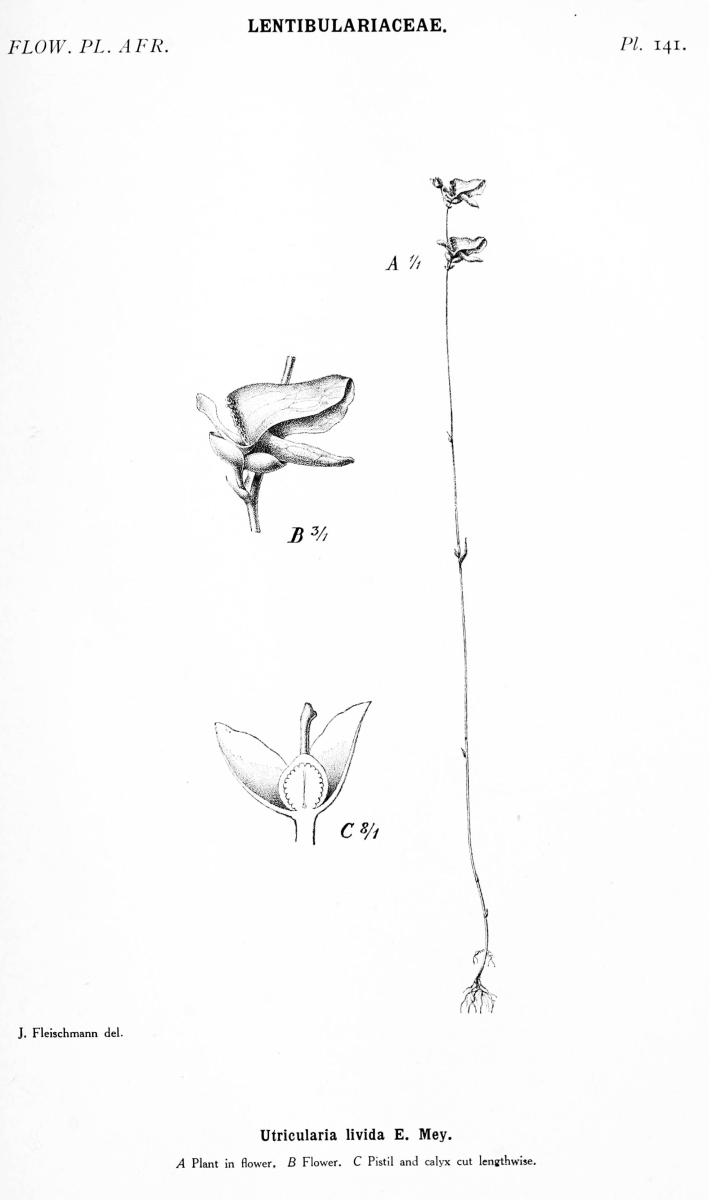
LENTIBULARIACEAE.
FLOW. PL. AFR.
Pl. 141.
J. Fleischmann del.
Utricularia livida E. Mey.
A Plant in flower. B Flower. C Pistil and calyx cut lengthwise.
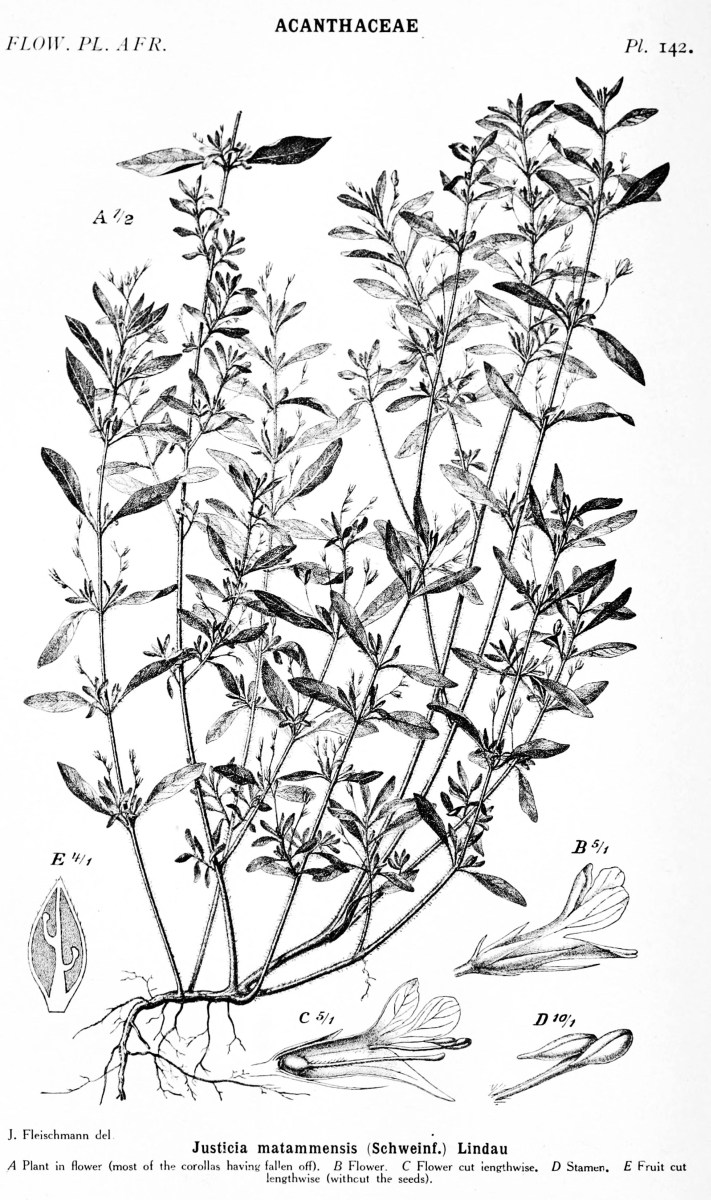
ACANTHACEAE.
FLOW. PL. AFR.
Pl. 142.
J. Fleischmann del.
Justicia matammensis (Schweinf.) Lindau
A Plant in flower (most of the corollas having fallen off). B Flower. C Flower cut lengthwise. D Stamen. E Fruit cut lengthwise (without the seeds).
3. Flowers solitary, axillary. Leaves ovate. Corolla-tube curved, gibbous below. Fruit globose.—Species 1. West Africa (Congo). Gilletiella De Wild. & Dur. Flowers in axillary clusters or in terminal racemes. Leaves oblong.—Species 2. Madagascar. Monachochlamys Bak. 4. Funicles short and thick, without a distinct outgrowth. Seeds and ovules 2 in each cell. Seeds globular, with a lateral hilum. Fruit beaked at the apex. Stamens 4; anthers 2-celled. Corolla nearly regular, with contorted aestivation. Calyx enclosed by two large bracteoles. Leaves not dotted with cystoliths. Shrubs or climbing herbs. [Subfamily THUNBERGIOIDEAE.] 5 Funicles with a large hook-shaped or a small tubercle-shaped outgrowth; in the latter case seeds and ovules 6 or more in each cell. 6 5. Anthers opening by pores. Stigma two-lobed. Calyx truncate. Corolla slightly two-lipped. Flowers in racemes. Climbing shrubs.—Species 2. Madagascar and southern East Africa. (Under Thunbergia L. f.) Pseudocalyx Radlk. Anthers opening by longitudinal slits.—Species 100. Tropical and South Africa. Some are used as ornamental plants. (Including Hexacentris Nees). Thunbergia L. f. 6. Funicles small, with a minute wart-like outgrowth. Seeds and ovules 6 or more in each cell. Seeds globose, with a lateral hilum, albuminous. Fruit beaked, rarely only pointed at the apex. Calyx unequally 4-5-parted. Corolla obscurely 2-lipped, with imbricate, not contorted aestivation. Anthers 2-celled. Disc indistinct. Herbs. Leaves not dotted with cystoliths. Flowers in spikes. [Subfamily NELSONIOIDEAE.] 7 Funicles with a distinct hook-shaped outgrowth, rarely (Synnema) thickened with an obscure outgrowth, but then corolla with contorted aestivation and leaves dotted with cystoliths. Seeds with a basal or subbasal hilum, exalbuminous, usually flat. Fruit usually prolonged into a stalk at the base, rarely beaked at the top. [Subfamily ACANTHOIDEAE.] 9 7. Sepals 5, unequal, almost free. Stamens 4. Ovules in each cell numerous, in 3-4 rows. Fruit not distinctly beaked.—Species 1. Central Africa. (Ebermaiera Nees, Zenkerina Engl.) Staurogyne Wall. Sepals 5, two of them united nearly to the top. Stamens 2. Ovules in each cell 6-10, in two rows. Fruit beaked. 8 8. Flowers with bracteoles. Stalk of the inflorescence covered with imbricate bracts. Leaves radical or alternate. Stem erect, usually very short.—Species 1. Central Africa. (Tubiflora Gmel.) Elytraria Vahl Flowers without bracteoles. Stalk of the inflorescence without bracts or wanting. Leaves opposite. Stem procumbent or ascending.—Species 1. Tropics. Nelsonia R. Br. 9. Corolla with contorted aestivation. Anthers 2-celled. Seeds usually hairy. 10 Corolla with imbricate, not contorted aestivation. Seeds usually glabrous. 40 10. Corolla distinctly 1-or 2-lipped. 11 Corolla nearly regular. 17 11. Fertile stamens 2. Corolla-tube long and thin. Fruit contracted into a stalk. Seeds 2 in each cell. Flowers in panicles.—Species 1. Equatorial East Africa (Uganda). Eranthemum L. Fertile stamens 4, rarely 2, but then, as usually, seeds more than 2 in each cell of the fruit. Ovules 4 or more in each ovary-cell. [Tribe HYGROPHILEAE.] 12 12. Corolla 1-lipped, 5-lobed; tube cylindrical. Calyx equally 5-toothed. Stamens 4. Anthers not spurred. Ovules 4-8 in each cell of the ovary. Shrubs. Flowers in panicles.—Species 5. Central Africa. Some of them yield fish-poison or serve as ornamental plants. (Including Eremomastax Lindau) Paulowilhelmia Hochst. Corolla 2-lipped. 13 13. Fertile stamens 2; the anterior stamens sterile. Calyx 5-partite. Corolla red or violet; tube short, with a transverse fold. Ovules numerous. Herbs or undershrubs. Flowers in panicles, racemes, or spikes.—Species 20. Tropics. Some are used as ornamental plants. Brillantaisia Beauv. Fertile stamens 4, rarely 2, but then the posterior stamens sterile or wanting. 14 14. Funicles of the seeds with an indistinct, cushion-shaped outgrowth. Ovules numerous. Stamens 2-4. Calyx 5-partite. Flowers solitary or in axillary cymes. Herbs.—Species 6. Central Africa. (Cardanthera Ham.) Synnema Benth. Funicles of the seeds with a distinct, hook-shaped outgrowth. Stamens 4, approximate in pairs, each decurrent upon a common fold. 15 15. Stem woody. Flowers in axillary cymes. Calyx equally 5-partite. Anthers spurred, rarely only pointed at the base. Ovules 4-6 in each cell of the ovary.—Species 4. East Africa. Mellera S. Moore Stem herbaceous. Anthers not spurred. 16 16. Flowers in axillary clusters, intermixed with spines. Calyx 4-partite. Ovules 4-6 in each ovary-cell.—Species 2. Central Africa. Used for making salt. (Under Hygrophila R. Br.) Asteracantha Nees Flowers solitary or in spineless clusters or panicles.—Species 20. Tropical and South Africa. Some are used medicinally. (Including Nomaphila Blume) Hygrophila R. Br. 17. (10) Fruit distinctly compressed from front to back, contracted into a short stalk, 2-4-seeded. Ovules 1-2 in each ovary-cell. Stamens 4, united in pairs and decurrent at the base. [Tribe PETALIDIEAE.] 18 Fruit more or less terete or 4-angled. [Tribes RUELLIEAE and STROBILANTHEAE.] 22 18. Ovary-cells 1-ovuled. Stigmas 2. Calyx 5-cleft or 4-parted. Flowers in axillary clusters. Bracts oblong, about as long as the calyx; bracteoles smaller.—Species 8. Central Africa. Disperma C. B. Clarke Ovary-cells 2-ovuled. Bracts or bracteoles large. 19 19. Calyx-segments 4 owing to the complete or nearly complete union of the two anticous segments. Flowers solitary or in short lateral inflorescences.—Species 18. Tropics. (Under Petalidium Nees). Pseudobarleria T. Anders. Calyx-segments 5, almost free. 20 20. Calyx-segments very unequal, the posticous much larger, bract-like. Inflorescences spike-like, composed of cymes.—Species 15. Tropical and South Africa. Some are used medicinally. (Aetheilema R. Br., Micranthus Wendl., Phaylopsis Willd.) Phaulopsis Willd. Calyx-segments nearly equal. 21 21. Stigma entire, capitate. Anther-halves blunt. Flowers in terminal false umbels.—Species 1. Madagascar. Zygoruellia Baill. Stigma unequally 2-lobed, filiform. Anther-halves pointed or tailed below. Flowers solitary or in cymes.—Species 5. West and South Africa. Petalidium Nees 22. (17.) Ovules 2 in each ovary-cell. Fruit contracted into a stalk, 2-4-seeded. 23 Ovules 3 or more in each ovary-cell. 30 23. Fertile stamens 2. Corolla-tube long and narrow throughout its length. 24 Fertile stamens 4. 25 24. Calyx divided nearly to the base. Corolla orange. Stigma capitate or oblong, more or less 2-lobed. Fruit ellipsoid, contracted into a short stalk, usually 2-seeded. Flowers in heads, spikes, or panicles. Bracteoles nearly as long as the calyx.—Species 5. Central Africa. Used as ornamental plants. Lankesteria Lindl. Calyx divided to the middle or somewhat beyond. Corolla white. Stigma entire, oblong-linear. Fruit linear, contracted into a long stalk, usually 4-seeded. Flowers solitary or few together in the leaf-axils. Bracteoles much shorter than the calyx.—Species 4. South and East Africa. (Under Calophanes Don). Chaetacanthus Nees 25. Filaments free from the base. 26 Filaments united in pairs at the base and decurrent in the form of two ridges. 27 26. Calyx shortly toothed. Corolla blue, with a long tube. Disc very small. Flowers solitary, axillary. Bracteoles very small and narrow.—Species 2. Northern East Africa. Satanocrater Schweinf. Calyx deeply divided. Flowers in racemes or panicles. Bracteoles large, membranous.—Species 15. Central Africa. (Including Stylarthropus Baill.) Whitfieldia Hook. 27. Staminal ridges confluent, hence all stamens inserted upon a common fold. Anther-halves blunt. Fruit oblong ovoid or globose, 3-4-seeded. Flowers solitary or in spikes.—Species 4. Madagascar. Strobilanthes Blume Staminal ridges separate. Flowers solitary or in cymes. 28 28. Calyx 5-cleft. Anther-halves usually tailed. Fruit linear, 4-seeded.—Species 30. Tropical and South Africa. (Calophanes Don, including Phillipsia Rolfe). Dyschoriste Nees Calyx 5-parted. Anthers blunt. Fruit oblong or elliptical. 29 29. Fruit 2-seeded. Pollen-grains ovoid, with longitudinal ribs. Undershrubs.—Species 1. Southern East Africa. Strobilanthopsis S. Moore Fruit 4-seeded. Pollen-grains globular, prickly.—Species 8. Tropics. (Under Dischistocalyx T. Anders.) Acanthopale C. B. Clarke 30. (22.) Fertile stamens 2. 31 Fertile stamens 4. 32 31. Ovules 3-6 in each ovary-cell. Staminodes present. Corolla nearly 2-lipped; tube short, wide, funnel-shaped. Flowers several together in the leaf-axils. Shrubs.—Species 2. Madagascar. (Under Ruttya Harv.) Forsythiopsis Bak. Ovules 10 in each ovary-cell. Flowers solitary. Herbs.—Species 1. Madagascar. Ruelliola Baill. 32. Filaments free from the base. Anthers with a fertile and a rudimentary half. Calyx 5-lobed. Corolla white. Ovules 3-4 in each ovary-cell. Flowers in spikes or heads.—Species 3. West Africa. (Physacanthus Benth.) Haselhoffia Lindau Filaments united in pairs at the base, decurrent in the form of two ridges. Anthers with both halves fertile. Calyx 5-cleft or 5-parted. 33 33. Staminal ridges confluent. Anthers not tailed. 34 Staminal ridges separate. 35 34. Corolla long funnel-shaped. Flowers in loose panicles.—Species 1. Island of St. Thomas. (Under Paulowilhelmia Hochst.) Heteradelphia Lindau Corolla tubular. Flowers in spike- or head-like inflorescences.—Species 5. Central Africa. Hemigraphis Nees 35. Anther-halves of the anterior stamens, at least one of them, tailed at the base. Calyx-segments subequal. Corolla funnel-shaped, with a short and wide tube. Flowers in panicles.—Species 15. Tropics. (Including Epiclastopelma Lindau) Mimulopsis Schweinf. Anther-halves without an appendage at the base, rarely (Ruelliopsis) all tailed, and then calyx-segments unequal and flowers solitary. 36 36. Stigma 2-lobed. Ovules 3-4 in each ovary-cell. Disc cup-shaped, toothed. Anthers exserted. Corolla red. Flowers solitary. Leaves crowded at the end of the branches. Glabrous shrubs.—Species 1. Madagascar. Camarotea Elliot Stigma entire or provided with a small tooth. 37 37. Flowers in spike- or head-like inflorescences. Calyx-segments usually very unequal. Bracteoles very small.—Species 9. Central Africa. (Dischistocalyx T. Anders.) Distichocalyx T. Anders. Flowers solitary or in neither spike- nor head-like cymes or panicles. 38 38. Leaves one-sided (with unequal halves) and usually very unequal in size, entire. Flowers solitary. Bracteoles very small. Calyx-segments subequal, very long. Corolla red or blue, with a long cylindrical tube. Anthers included.—Species 2. Equatorial West Africa. Endosiphon T. Anders. Leaves equal-sided or nearly so, about equal in size. 39 39. Pollen-grains with many longitudinal ribs. Anthers usually tailed. Calyx-segments unequal. Corolla funnel-shaped. Flowers solitary. Bracteoles small. Leaves linear, entire. Shrubs.—Species 3. East and South Africa. Ruelliopsis C. B. Clarke Pollen-grains netted or pitted. Anthers not tailed.—Species 30. Tropical and South Africa. Some are used as ornamental or medicinal plants. (Including Dipteracanthus Nees). Ruellia L. 40. (9.) Corolla with imbricate, not ascending aestivation, 2-lipped or nearly regular. Filaments free. Anthers, at least those of the anterior stamens, 2-celled. Ovules 1-2 in each cell, rarely (Crabbea) 3-4. Fruit not distinctly contracted into a stalk. [Tribe BARLERIEAE.] 41 Corolla with imbricate, ascending aestivation. 48 41. Calyx 4-parted, one of the segments sometimes shortly toothed. Stamens 2, more rarely 4, exserted. Disc cup-shaped. Stigma-lobes 2, subequal, sometimes nearly confluent. Flowers in cymes, spikes, racemes, or heads.—Species 120. Tropical and South Africa and Egypt. Some are used as ornamental or medicinal plants. (Including Somalia Oliv.) Barleria L. Calyx 2- or 5-parted. Stamens 4, included. Disc ring-shaped or indistinct. 42 42. Calyx 2-lipped or 2-parted. Corolla folded in the bud, nearly regular, with short triangular lobes. Anthers of the posterior stamens 1-celled. Disc indistinct. Stigma entire. Inflorescence spike- or head-like.—Species 12. Tropics. (Including Leucobarleria Lindau). Neuracanthus Nees Calyx 5-parted. Corolla not folded. Anthers 2-celled, rarely those of the posterior stamens 1-celled, but then corolla 2-lipped. Disc ring-shaped. 43 43. Flowers surrounded by 4 united bracts, solitary, with narrow bracteoles. Corolla-lobes spreading, pink. Anthers 2-celled.—Species 1. Madagascar. (Periblema DC.) Boutonia DC. Flowers not surrounded by united bracts, solitary but without bracteoles, or in spike- or head-like inflorescences. Corolla two-lipped. 44 44. Bracteoles surrounding the flowers 4, large, exceeding the calyx. Flowers in head-like cymes, very small, stalked, intermixed with bracts. Corolla white. Anthers with equal halves. Ovary hairy above. Ovules 2 in each cell. Stigma unequally 2-lobed.—Species 1. Madagascar. Warpuria Stapf Bracteoles minute or absent. 45 45. Flowers solitary, axillary. Stamens approximate in pairs. Anthers all 2-celled. Stigma with two almost equal lobes.—Species 2. South Africa. Glossochilus Nees Flowers in spike- or head-like inflorescences. Stigma entire or very unequally 2-lobed, rarely almost equally 2-lobed, but then anthers partly 1-celled. 46 46. Stamens approximate in pairs. Anther-halves unappendaged, inserted nearly at the same level. Calyx-teeth pointed. Ovary and style glabrous. Ovules 2-4 in each ovary-cell. Fruit narrow-oblong, 4-8-seeded. Inflorescence capitate.—Species 10. South and Central Africa. Crabbea Harv. Stamens not approximate in pairs. Anthers all with one half inserted lower than the other, or the posterior with one half only developed. Ovules 1-2 in each ovary-cell. Fruit 2-4-seeded. 47 47. Anterior calyx-segments united halfway up. Corolla violet. Anthers of the anterior stamens with unappendaged halves inserted at the same level; those of the posterior stamens with one half only developed. Stigma with 2 minute, subequal lobes. Flowers in few-flowered spikes.—Species 1. Northern East Africa (Somaliland). Lindauea Rendle Anterior calyx-segments nearly free. Anthers of all or only the anterior stamens with one half inserted lower than the other. Stigma entire.—Species 30. Central Africa. (Including Volkensiophyton Lindau). Lepidagathis Willd. 48. (40.) Corolla 1-lipped, 3-5-lobed; in place of the upper lip a slit. Stamens 4. Anthers 1-celled. Ovules 1-2 in each ovary-cell. Flowers in spikes. [Tribe ACANTHEAE.] 49 Corolla 2-lipped or nearly regular. 55 49. Calyx 4-parted. Corolla white or blue, rarely yellow; tube short. Leaves usually prickly. 50 Calyx 5-parted. Leaves undivided. 53 50. Corolla-tube of moderate length. Sepals free. Filaments very short. Bracts small; bracteoles much larger. Leaves undivided.—Species 1. Equatorial East Africa (Uganda). Crossandrella C. B. Clarke Corolla-tube very short. Bracts large, imbricate, usually prickly; bracteoles small and narrow or wanting. 51 51. Anterior filaments with a process near the top. Ovary with two glandular pits at the apex. Stigma-lobes 2, equal. Corolla-tube nearly globular. Fruit more or less contracted at the base. Seeds hairy.—Species 60. Tropical and South Africa and Egypt. Some are used as vegetables or in medicine; others are noxious weeds. Blepharis Juss. Anterior filaments without an apical process. Ovary without glandular pits at the top. Corolla-tube short-cylindrical. Fruit not or scarcely contracted at the base. 52 52. Stigma with 2 almost equal lobes. Disc oblique. Seeds 3-4, glabrous. Spikes stalked.—Species 15. Some of them are used as ornamental or medicinal plants. Acanthus L. Stigma with very unequal lobes or entire. Disc indistinct. Seeds bristly, usually 2. Spikes sessile. Bracts ending in 3-5 spines.—Species 7. South Africa. Acanthopsis Harv. 53. Calyx-segments unequal, the posterior much broader than the anterior, 2-nerved, often toothed. Corolla red or yellow; tube very long. Anthers included. Seeds hairy. Bracteoles usually as long as the calyx.—Species 17. Tropical and South Africa. Some are used as ornamental plants. Crossandra Salisb. Calyx-segments subequal, the posterior as broad as or a little broader than the anterior, one-nerved, rarely many-nerved and then sometimes toothed. Anthers more or less exserted. Seeds not hairy. Bracteoles shorter than the calyx. 54 54. Corolla-tube long. Anthers blunt. Disc thick. Fruit not contracted at the base.—Species 8. Tropics. (Including Butayea De Wild, and Pleuroblepharis Baill., under Sclerochiton Harv.) Pseudoblepharis Baill. Corolla-tube short. Anthers pointed. Disc small. Fruit slightly contracted at the base.—Species 4. Central and South Africa. Sclerochiton Harv. 55. (48.) Corolla nearly regular, often obscurely two-lipped. Ovules 2 in each ovary-cell. Flowers in spikes, racemes, or panicles. 56 Corolla distinctly 2-lipped. 64 56. Fertile stamens 2. Staminodes usually present. Calyx 5-parted. [Tribe PSEUDERANTHEMEAE.] 57 Fertile stamens 4. 59 57. Anthers 1-celled. Calyx-segments subulate. Corolla-tube cylindrical, not widened above. Seeds 1-2, nearly smooth. Shrubs. Flowers in panicles.—Species 1. Northern East Africa (Somaliland). Ruspolia Lindau Anthers 2-celled. Seeds 4, rarely fewer. 58 58. Corolla-tube funnel-shaped, much widened above. Seeds nearly smooth. Flowers in racemes, white. Shrubs.—Species 1. Natal. Used as an ornamental plant. (Under Asystasia Blume). Mackaya Harv. Corolla-tube cylindrical, scarcely widened above. Seeds wrinkled.—Species 12. Tropics. Some are used as ornamental plants. (Under Eranthemum L.) Pseuderanthemum Radlk. 59. Anthers 1-celled, cohering. Fruit not contracted into a stalk. Flowers in spikes.—Species 1. Madagascar. Stenandriopsis S. Moore Anthers 2-celled. Fruit contracted at the base into a long stalk. [Tribe ASYSTASIEAE.] 60 60. Calyx 5-lobed, with broad segments. Sterile stamen present. Stigma-lobes unequal. Shrubs. Flowers in racemes. Bracteoles none.—Species 4. West Africa. (Scytanthus T. Anders.) Thomandersia Baill. Calyx 5-parted, with narrow segments. Sterile stamen absent. Stigma-lobes subequal. Seeds 4. Bracteoles present. 61 61. Anther-halves of the longer stamens elliptical, one inserted much lower than the other; those of the shorter stamens suborbicular and divergent. Flowers in panicles.—Species 1. Equatorial West Africa. Filetia Miq. Anther-halves oblong, nearly parallel and inserted at about the same level. 62 62. Disc laterally 2-lobed. Bracts long. Flowers in spikes.—Species 2. East Africa. (Under Asystasia Blume) Parasystasia Baill. Disc not 2-lobed. Bracts short. 63 63. Pollen-grains prickly, not striped. Anther-halves shortly spurred at the base. Flowers in panicles.—Species 1. East Africa. Asystasiella Lindau Pollen-grain striped, not prickly.—Species 20. Tropical and South Africa. Some of them are used as vegetables or as ornamental or medicinal plants. Asystasia Blume 64. (55.) Ovules 3-6 in each ovary-cell. Fertile stamens 2, staminodes none. Anthers 2-celled. Herbs. Flowers in panicles.—Species 1. Naturalized in the Mascarene Islands. Used medicinally. [Tribe ANDROGRAPHIDEAE.] Andrographis Nees Ovules 1-2 in each ovary-cell. [Tribes GRAPTOPHYLLEAE, ODONTONEMEAE, ISOGLOSSEAE, and JUSTICIEAE.] 65 65. Fertile stamens 4. Anthers 2-celled. 66 Fertile stamens 2. 70 66. Corolla-tube long, cylindrical. Anther-halves pointed at the base. Leaves ovate or elliptical. Flowers in terminal cymes or panicles. 67 Corolla-tube rather short and wide. Leaves oblong or lanceolate. 68 67. Stigma entire. Stamens inserted a little below the throat of the corolla. Bracteoles small.—Species 1. Central Africa. (Styasasia S. Moore, under Asystasia Blume) Isochoriste Miq. Stigma 2-lobed. Stamens inserted in the middle of the corolla-tube. Bracteoles large.—Species 2. Madagascar. Forcipella Baill. 68. Anther-halves blunt at the base. Stamens inserted at the throat of the corolla. Posterior stigma-lobe tubercle-shaped. Calyx-segments unequal. Seeds oblong. Flowers crowded in the axils of the leaves. Bracts and bracteoles narrow, clothed with red hairs.—Species 1. Madagascar. Synchoriste Baill. Anther-halves pointed at the base. Bracts and bracteoles broad. 69 69. Inflorescences axillary, cymose, borne on a long stalk. Bracts incised.—Species 1. Madagascar. Podorungia Baill. Inflorescences terminal, racemose, the lower flowers solitary in the leaf-axils. Pedicels 4-winged. Seeds 2, roundish.—Species 1. Madagascar. Chlamydacanthus Lindau 70. (65.) Staminodes 2. Fruit contracted into a long stalk. Bracts and bracteoles small. 71 Staminodes none, rarely (Duvernoya) solitary. 73 71. Anthers projecting far beyond the corolla-tube; halves at equal heights, pointed at the base. Calyx short. Corolla red; tube long, funnel-shaped. Shrubs. Flowers panicled.—Species 1. Naturalized in West Africa. An ornamental and medicinal plant. Graptophyllum Nees Anthers slightly projecting, with one half only developed. 72 72. Anthers pointed. Corolla red; tube short and wide. Flowers in cymes or panicles.—Species 5. East and South Africa and Madagascar. Ruttya Harv. Anthers blunt. Corolla yellow; tube long, ventricose. Flowers solitary or in cymes. Shrubs.—Species 4. Island of Socotra. Ballochia Balf. fil. 73. Anthers 1-celled, blunt. 74 Anthers 2-celled. 80 74. Stigma entire. 75 Stigma 2-lobed. 76 75. Flowers in cymes surrounded by united bracts and collected in heads or fascicles. Bracteoles exceeding the calyx. Calyx scarious. Woolly shrubs.—Species 2. Madagascar. Lasiocladus Boj. Flowers in spikes or panicles, with free bracts. Corolla-tube very long and narrow.—Species 9. Tropics. Brachystephanus Nees 76. Corolla-tube very short, bell-shaped. Stamens inserted in the lower part of it. Fruit contracted into a long stalk. Flowers in panicles.—Species 1. Equatorial West Africa (Cameroons). Oreacanthus Benth. Corolla-tube not very short, cylindrical or funnel-shaped. Stamens inserted in its upper part or at the throat. 77 77. Flowers in spikes. Bracteoles equalling the calyx. Corolla funnel-shaped. Fruit contracted into a long stalk.—Species 2. Central Africa. Monothecium Hochst. Flowers in cymes, heads, or panicles. Bracts usually united. Bracteoles exceeding the calyx. Calyx scarious. Fruit contracted into a short stalk or not contracted. 78 78. Calyx deeply two-lipped, shortly 5-toothed. Corolla funnel-shaped. Fruit without a stalk. Flowers panicled.—Species 1. Madagascar. Amphiestes S. Moore Calyx regular or nearly so, 4-5-lobed or -parted. 79 79. Calyx 4-parted. Flowers in umbellately arranged cymes.—Species 2. Madagascar and Comoro Islands. Periestes Baill. Calyx 5-lobed to 5-parted.—Species 70. Tropical and South Africa. Some are used in medicine. Hypoëstes R. Br. 80. (73.) Anther-halves inserted at unequal heights. 81 Anther-halves inserted at the same level, unappendaged at the base. 101 81. Anther-halves, both or the lower one, prolonged at the base into a spur- or tail-like appendage. 82 Anther-halves blunt or pointed, sometimes bearing a short mucro, but neither spurred nor tailed. 92 82. Corolla-tube barrel-shaped, widened from the base; lips short. Calyx-segments very long and narrow. Stamens inserted in the middle of the corolla-tube. Upper anther-half without a spur. Disc cup-shaped. Fruit contracted into a long stalk. Shrubs. Flowers panicled, red. Bracts and bracteoles small.—Species 2. Island of Socotra. Trichocalyx Balf. fil. Corolla-tube cylindrical or narrowly funnel-shaped. 83 83. Corolla-tube very long, much longer than the limb. Herbs or undershrubs. Flowers solitary or 2-3 together in the axils of the leaves. Bracts narrow. 84 Corolla-tube short or rather short. 85 84. Corolla very large, red. Stamens inserted in the upper part of the corolla-tube. Leaves lanceolate.—Species 1. South-east Africa. (Under Siphonoglossa Oerst.) Aulojusticia Lindau Corolla medium-sized. Stamens inserted in the lower part of the corolla-tube. Leaves elliptical to orbicular.—Species 3. South and East Africa. (Under Justicia L.) Siphonoglossa Oerst. 85. Disc cup-shaped. Stamens inserted at the throat of the corolla. Pollen-grains with several longitudinal rows of tubercles sometimes replaced by patches. Partition of the fruit not separating from the valves at maturity.—Species 160. Tropical and South Africa and Canary Islands. Some of the species are used as ornamental, medicinal, or dye-plants. (Including Adhatoda Nees, Dianthera L., Gendarussa Nees, Monechma Hochst., and Rhytiglossa Nees). (Plate 142.) Justicia L. Disc ring-shaped. Pollen-grains usually without tubercles. 86 86. Calyx-segments 4. 87 Calyx-segments 5. 88 87. Flowers in spikes arranged in false umbels at the ends of the branches. Fruit contracted into a short stalk. Shrubs.—Species 1. Madagascar. Corymbostachys Lindau Flowers in axillary spikes. Fruit contracted into a rather long stalk. Herbs.—Species 5. Madagascar and West Africa. (Under Justicia L.) Anisostachya Nees 88. Flowers in panicles. 89 Flowers in spikes. 90 89. Stem woody, shrubby. Inflorescences scantily branched. Bracts very narrow. Corolla blue. Anther-halves both spurred. Fruit contracted into a short stalk.—Species 1. Equatorial West Africa (Cameroons). (Under Justicia L.) Salviacanthus Lindau Stem herbaceous. Inflorescences abundantly branched. Bracts broad. Lower anther-half spurred, the upper not. Fruit contracted into a long stalk.—Species 6. Tropical and South Africa. (Under Justicia L.) Rhaphidospora Nees 90. Stem woody, shrubby. Calyx 5-cleft, scarious. Corolla large, red.—Species 4. East Africa and Madagascar. (Under Macrorungia C. B. Clarke) Symplectochilus Lindau Stem herbaceous. 91 91. Stamens inserted at the throat of the corolla. Calyx membranous. Partition of the fruit separating from the valves at maturity. Flowers small. Bracts broad, in 4 ranks, whereof two enclose no flowers. Bracteoles large.—Species 9. Tropics. Rungia Nees Stamens inserted in the lower part of the corolla-tube. Partition of the fruit not separating from the valves.—Species 10. Central Africa. Some are used as ornamental plants. (Under Justicia L.) Nicoteba Lindau 92. (81.) Corolla-tube bell- or funnel-shaped, wide throughout or much widened above. 93 Corolla-tube cylindrical, narrow and not or slightly widened above. 95 93. Anther-halves inserted at slightly unequal heights. Corolla-tube somewhat shorter than the limb. Pollen-grains ovoid, with several rows of patches. Disc lobed. Fruit oblong or club-shaped. Flowers in spikes or panicles.—Species 18. Tropical and South Africa. (Under Adhatoda Nees or Justicia L.) Duvernoya E. Mey. Anther-halves inserted at very unequal heights, more rarely at slightly unequal ones, but then corolla-tube as long as or longer than the limb. Pollen-grains more or less globose, nearly smooth. Herbs or undershrubs. 94 94. Flowers in cymes. Corolla-tube long. Stamens inserted at its middle. Anther-halves inserted at slightly unequal heights. Stigma 2-lobed. Fruit oblong, without a distinct stalk. Seeds 2 fertile and 2 sterile. Leaves sessile, lanceolate.—Species 1. Madagascar. Melittacanthus S. Moore Flowers in racemes or panicles. Fruit contracted into a stalk.—Species 40. Tropical and South Africa. Isoglossa Oerst. 95. Corolla-tube short, much shorter than the lips. Anther-halves inserted at slightly unequal heights. Shrubs. 96 Corolla-tube long or rather long; upper lip entire or shortly toothed. Disc cup-shaped. 98 96. Upper lip of the corolla deeply cleft. Anther-halves pointed. Disc cup-shaped. Leaves broad, unequal-sided. Flowers in panicles.—Species 1. Madagascar. Populina Baill. Upper lip of the corolla entire or shortly toothed. Disc ring-shaped. Flowers in spikes or fascicles. 97 97. Bracts very small, shorter than the calyx. Calyx-segments nearly free, 3-nerved. Stamens inserted at the throat of the corolla. Partition of the fruit not separating from the valves. Species 5. Central Africa. Anisotes Nees Bracts large, as long as or longer than the calyx. Stamens inserted in the corolla-tube. Partition of the fruit separating from the valves at maturity.—Species 5. Tropical Africa to Transvaal. (Macrorungia C. B. Clarke). Himantochilus T. Anders. 98. Bracts small. Anther-halves inserted at slightly unequal heights. Fruit oblong, narrowed into a long stalk. Shrubs, usually climbing. Flowers in panicles.—Species 6. Tropical and South Africa. Some are used as ornamental or medicinal plants. Rhinacanthus Nees Bracts large. Fruit narrowed into a short stalk. Herbs. 99 99. Bracts not opposite in pairs. Corolla small. Anther-halves inserted at slightly unequal heights. Pollen-grains globose, with 6 pores and several longitudinal rows of raised dots. Species 3. Equatorial West Africa. Chlamydocardia Lindau Bracts opposite in pairs and usually united at the base, enclosing 1-2 flowers. Pollen-grains ovoid, smooth, with 3 pores and 3 bands. 100 100. Stamens inserted at the throat of the corolla. Fruit oblong; partition not separating from the valves.—Species 10. Tropical and South Africa. Some are used as ornamental or medicinal plants. Peristrophe Nees Stamens inserted in the corolla-tube. Fruit ovate; partition separating from the valves at maturity.—Species 30. Tropical and South Africa. (Diapedium Koenig). Dicliptera Juss. 101. (80.) Corolla-tube much widened above, long, curved; lower lip rolled in. Stamens inserted at the throat of the corolla. Shrubs. Flowers in long terminal spikes or racemes, reddish-yellow. Bracts and bracteoles very small.—Species 1. Island of Socotra. (Ancalanthus Balf. fil.) Angkalanthus Balf. fil. Corolla-tube not or slightly widened above. Stamens inserted in the corolla-tube. Bracts not very small. 102 102. Corolla-tube rather short, about equalling the limb. Seeds usually 2. Inflorescence spike-like. Bracts large. Bracteoles small or wanting. 103 Corolla-tube long. Fruit contracted into a long stalk. 104 103. Flowers solitary in the axil of each bract. Bracteoles linear. Fruit subglobose, contracted into a short stalk.—Species 5. Central Africa. (Under Ecbolium Kurz) Schwabea Endl. Flowers 2-3 in the axil of each bract. Bracteoles bristle-like or wanting. Shrubs.—Species 3. Central Africa. (Under Dicliptera Juss.) Megalochlamys Lindau 104. Bracts broad. Bracteoles long. Fruit flat. Seeds 2. Shrubs. Flowers in spikes.—Species 15. Tropical and South Africa. Some are used medicinally. Ecbolium Kurz Bracts narrow. Seeds 4. 105 105. Flowers in one-sided spikes. Bracts small. Shrubs.—Species 1. Naturalized in the Canary Islands. Anisacanthus Nees Flowers in panicles. Bracts long. Herbs.—Species 1. Equatorial West Africa. Schaueria Nees
SUBORDER MYOPORINEAE
FAMILY 217. MYOPORACEAE
Shrubs. Leaves alternate, at least the upper ones, undivided, without stipules. Flowers solitary or in pairs in the leaf-axils, without bracteoles, regular or nearly so, hermaphrodite. Sepals 5, united at the base, imbricate or open in the bud. Petals 5, united below, white, imbricate in the bud. Stamens 4, inserted on the corolla tube, in two pairs of slightly unequal length. Anthers 2-celled, the cells confluent at the top, opening inwards by longitudinal slits. Ovary superior, 2-4-celled. Ovules 1-6 in each cell, pendulous from the apex of the partition, inverted, with a thick funicle. Style simple; stigma entire or 2-4-lobed. Fruit a drupe. Seeds albuminous; radicle of the embryo superior.—Genera 3, species 4. Southern and tropical Africa.
1. Corolla salver-shaped. Ovary 2-celled. Ovules in each cell 4-6, in pairs placed one above the other. Stigma oblong, oblique. Fruit with a 1-2-celled stone.—Species 2. South Africa. Oftia Adans. Corolla bell-shaped. Ovules in each ovary-cell solitary or two side by side. 2 2. Calyx-segments linear. Corolla slightly irregular. Ovary 2-celled. Stigma capitate. Fruit with 4 stones.—Species 1. West Africa. Zombiana Baill. Calyx-segments lanceolate. Corolla regular. Fruit with a 2-4-celled stone.—Species 1. Mascarene Islands. Myoporum Banks & Sol.
ORDER PLANTAGINALES
FAMILY 218. PLANTAGINACEAE
Herbs, undershrubs, or shrubs; in the latter case leaves opposite. Leaves sessile, entire toothed lobed or pinnately cleft, without stipules. Flowers solitary or in spikes or heads, with broad bracts, without bracteoles, small, regular, 4-merous. Calyx of united sepals. Corolla scarious, of united petals, with imbricate aestivation, sometimes 2-toothed. Stamens 4, inserted on the tube of the corolla and alternating with its lobes. Filaments long, bent inwards in the bud. Anthers large, versatile, opening by two longitudinal slits. Ovary superior, 2-4-celled, sometimes one cell only fertile. Ovules axile, half-inverted. Style simple; stigma entire, filiform. Fruit dry, opening by a lid or remaining closed. Seeds with a fleshy albumen; embryo straight or nearly so.—Genera 2, species 40. (Plate 143.)
Flowers monoecious, the male solitary, the female at their base, solitary or several together; the latter with a bag-shaped, 2-4-toothed corolla. Ovule 1. Fruit indehiscent, 1-seeded.—Species 1. Azores. Litorella L. Flowers hermaphrodite or polygamous, in 2- or more-flowered spikes or heads, all with a 4-lobed corolla. Ovules 2 or more. Fruit dehiscent, 2- or more-seeded.—Species 40. Some of them yield food for cattle and birds, vegetables, medicaments, soda, and a mucilage. “Plantain.” (Plate 143.) Plantago L.
ORDER RUBIALES
FAMILY 219. RUBIACEAE
Leaves opposite or whorled, entire, provided with sometimes leaf-like stipules. Flowers regular or nearly so, but sometimes with a curved corolla-tube. Petals united below. Stamens as many as the corolla-lobes, inserted on the corolla, free. Anthers opening by two longitudinal slits, rarely (Argostema) by 1-2 apical pores. Ovary inferior, rarely (Gaertnera) superior, usually 2-or more-celled. Ovules inverted. Style 1, or several styles united at the base.—Genera 150, species 1900. (Plate 144.)
1. Ovules solitary in each ovary-cell. [Subfamily COFFEOIDEAE.] 2 Ovules two or more in each ovary-cell. [Subfamily CINCHONOIDEAE.] 81 2. Ovules pendulous or descending; micropyle superior. Radicle of the embryo superior. 3 Ovules ascending; micropyle inferior. Radicle of the embryo inferior. 30 3. Corolla with imbricate, sometimes contorted aestivation. Shrubs or trees. 4 Corolla with valvate aestivation. 18 4. Corolla with contorted aestivation. Ovary 2-celled. Seeds with copious albumen. Flowers in fascicles or panicles, rarely solitary. [Tribe ALBERTEAE.] 5 Corolla with imbricate, not contorted aestivation. 16 5. Corolla curved, tubular, hairy within. Calyx 5-partite; 1-4 of the segments much enlarged after flowering. Anthers hairy. Style much exserted. Flowers in terminal panicles. 6 Corolla straight. Calyx-segments not enlarged, rarely all enlarged after flowering. 7 6. Calyx with 1 enlarged segment. Corolla hairy at the base and at the throat. Stamens inserted at the throat of the corolla. Anthers bearded at the base. Style-apex 2-cleft.—Species 1. Madagascar. Nematostylis Hook. fil. Calyx with 2-4 enlarged segments. Stamens inserted in the corolla-tube. Style-apex entire.—Species 5. Madagascar and Natal. (Ernestimeyera O. Ktze.) Alberta E. Mey.
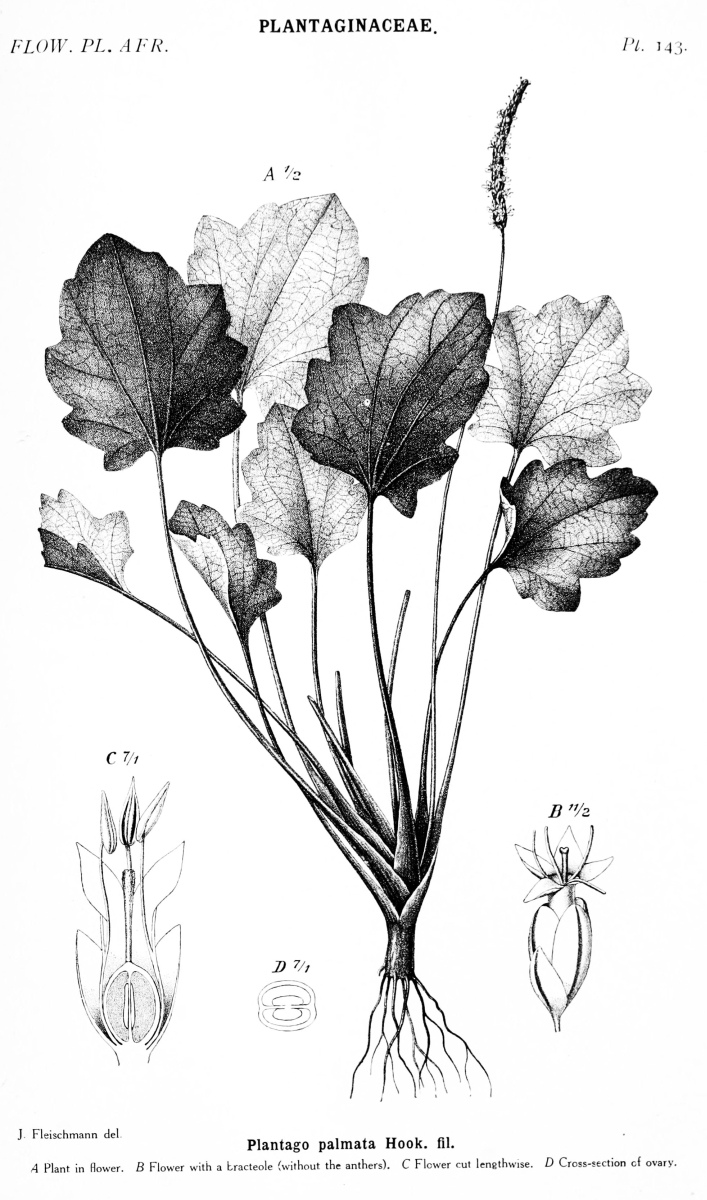
PLANTAGINACEAE.
FLOW. PL. AFR.
Pl. 143.
J. Fleischmann del.
Plantago palmata Hook. fil.
A Plant in flower. B Flower with a bracteole (without the anthers). C Flower cut lengthwise. D Cross-section of ovary.
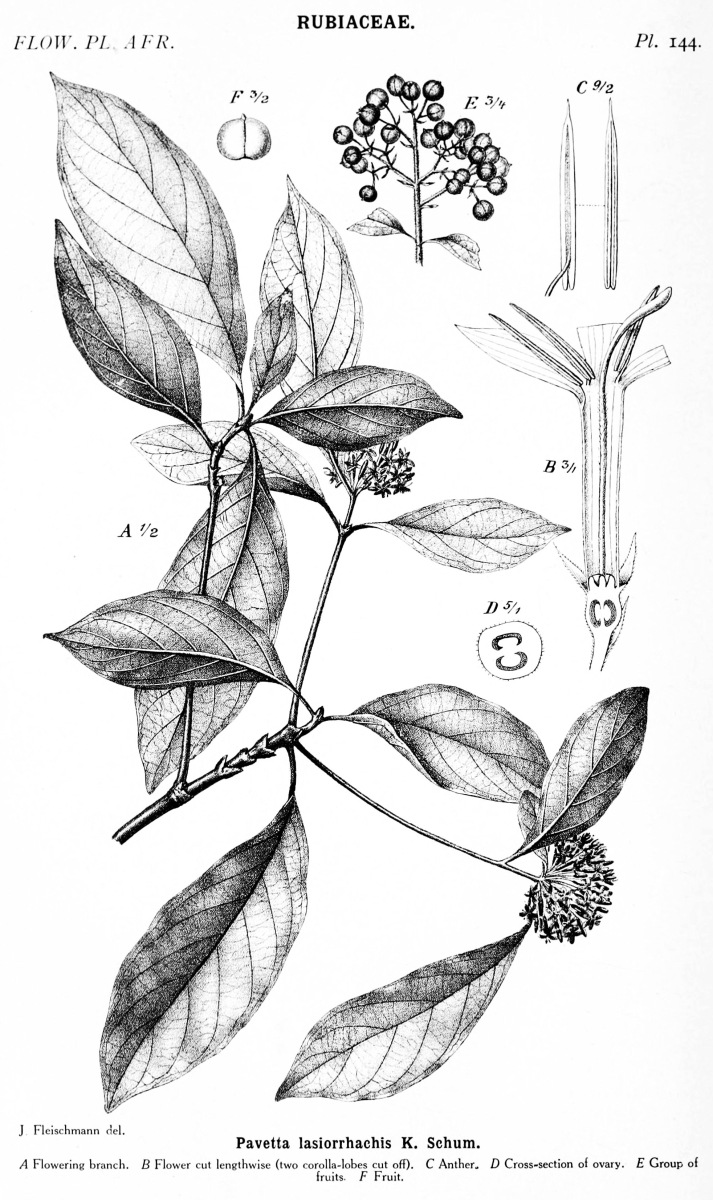
RUBIACEAE.
FLOW. PL. AFR.
Pl. 144.
J. Fleischmann del.
Pavetta lasiorrhachis K. Schum.
A Flowering branch. B Flower cut lengthwise (two corolla-lobes cut off). C Anther. D Cross-section of ovary. E Group of fruits. F Fruit.
7. Flowers solitary or in pairs. Calyx-segments enlarged in the fruit. Corolla glabrous at the throat. Anthers included. Style long, glabrous, two-cleft at the apex.—Species 6. Central Africa. Psilanthus Hook. fil. Flowers in fascicles or panicles. Calyx-segments not enlarged in the fruit. 8 8. Flowers in terminal panicles. Corolla hairy at the throat. Anthers exserted. Style downy above. Shrubs. 9 Flowers in axillary fascicles or panicles. 10 9. Calyx shortly lobed. Corolla white, funnel-shaped, 6-7-cleft. Style-apex 2-cleft.—Species 1. East Africa. Lamprothamnus Hiern Calyx deeply divided. Corolla yellow, salver-shaped, 4-cleft. Style-apex entire.—Species 1. Equatorial West Africa (Cameroons). Exechostylus K. Schum. 10. Style hairy. 11 Style glabrous. 12 11. Calyx 4-toothed or truncate. Style-apex 2-cleft. Albumen of the seeds ruminated. Bracteoles 4, one pair united into a cup.—Species 10. Tropics. Polysphaeria Hook. fil. Calyx 5-toothed or 5-cleft. Anthers exserted. Style-apex entire. Albumen of the seeds uniform. Bracteoles free.—Species 13. Tropics. Cremaspora Benth. 12. Style short, with 2 long stigmas. Sepals free above the ovary. Corolla salver-shaped, glabrous at the throat. Anthers included. Trees. Flowers subtended by 2-3 pairs of bracteoles.—Species 1. Island of St. Thomas. Belonophora Hook. fil. Style long, with 2 short stigmas or with a single stigma. 13 13. Style-apex 2-lobed. Corolla glabrous at the throat, but sometimes hairy below. 14 Style-apex entire, spindle-shaped, 10-ribbed. Flowers 5-merous. Anthers more or less exserted. 15 14. Flowers 4-merous. Sepals free above the ovary. Corolla salver-shaped. Anthers included. Flowers surrounded by 4 pairs of bracteoles.—Species 1. West Africa (Togoland). Kerstingia K. Schum. Flowers 5-merous. Sepals united above the ovary. Corolla funnel-shaped. Anthers exserted.—Species 4. West Africa. Aulacocalyx Hook. fil. 15. Corolla bell-funnel-shaped, glabrous at the throat. Stipules very narrow. Species 2. East Africa. Heinsenia K. Schum. Corolla bell-wheel-shaped, hairy at the throat. Stipules broad.—Species 3. East and South-east Africa. Rhabdostigma Hook. fil. 16. (4.) Flowers in heads. Calyx 4-toothed. Ovary 2-celled. Fruit separating into two leathery nutlets. Seeds with a thick aril and copious albumen.—Species 3. West Africa, Madagascar, Natal. Cephalanthus L. Flowers in forked cymes. Ovules with a thickened funicle. Fruit a drupe. Seeds with scanty albumen or without albumen. [Tribe GUETTARDEAE.] 17 17. Calyx deciduous. Corolla salver-shaped. Anthers included. Ovary 4-9-celled. Fruit globose; cells of the stone curved.—Species 1. East Africa, Madagascar and neighbouring islands. Used as an ornamental plant and in medicine. Guettarda Blume Calyx persistent. Corolla funnel-shaped. Anthers somewhat exserted. Ovary 2-8-celled. Fruit oblong.—Species 5. Madagascar and neighbouring islands. They yield timber and medicaments. (Under Guettarda Blume). Antirrhoea Comm. 18. (3.) Flowers in terminal or terminal and lateral heads. Ovary 1-2-celled. Fruit dry, of 1-2 nutlets. Herbs. Stipules united. [Tribe KNOXIEAE.] 19 Flowers in lateral cymes, fascicles, or panicles. Ovary 2-many-celled. Fruit fleshy, drupe-like. Shrubs or trees, rarely (Pachystigma) herbs, but then ovary 3-5-celled. 22 19. Ovary 1-celled. Sepals 1-2. Corolla bluish, funnel-shaped, 5-lobed. Anthers included. Leaves whorled. Flowers connate in pairs, without bracteoles. Stipules undivided.—Species 1. Southern West Africa (Angola). Calanda K. Schum. Ovary 2-celled. Leaves opposite. Stipules lacerated or bristle-like. 20 20. Calyx with awl-shaped, not enlarged segments. Corolla violet, salver-shaped, with 4 lobes bearded at the apex. Anthers exserted. Disc tubular. Stigma 2-lobed. Mericarps dehiscing lengthwise.—Species 1. Equatorial West Africa (Cameroons). Paragophyton K. Schum. Calyx with some of the segments enlarged and leaf-like. Corolla with long hairs at the throat. Mericarps dehiscing transversely or indehiscent. 21 21. Mericarps separating from a central column, dehiscing transversely. Calyx-segments 4, one of them enlarged. Corolla-lobes 4. Anthers included. Stigma 2-lobed. Heads in panicles.—Species 1. West Africa (Togo). Baumannia K. Schum. Mericarp without a central column, indehiscent.—Species 15. Tropical and South Africa. (Including Holocarpa Bak.) Pentanisia Harv. 22. Ovary-cells and fruit-stones 20-30. Flowers polygamous-dioecious, 4-merous. Corolla white or yellowish, glabrous within. Anthers included or nearly so. Seeds with scanty albumen. Shrubs.—Species 1. Madagascar and Seychelles. Timonius Rumph. Ovary-cells 2-10. Fruit-stones 1-10. Seeds with copious albumen. [Tribe VANGUERIEAE.] 23 23. Stem herbaceous. Leaves whorled. Ovary 3-5-celled. Stigma lobed.—Species 20. Central and South-east Africa. (Fadogia Schweinf.) Pachystigma Hochst. Stem woody. Leaves opposite. 24 24. Inflorescences fascicle-like or reduced to a single flower, surrounded by an involucre of two bracts united at the base. Calyx truncate or shortly toothed. Corolla hairy at the throat. 25 Inflorescences without an involucre. 26 25. Style deeply 4-5-cleft. Flowers in 6-12-flowered fascicles or heads. Trees.—Species 1. Island of Rodrigues. Scyphochlamys Balf. fil. Style simple, with a capitate stigma.—Species 10. Mascarene Islands and Madagascar. They yield timber. Pyrostria Comm. 26. Corolla curved, tubular. Calyx-segments 5, narrow. Anthers sessile. Ovary 5-celled. Stigma 5-lobed.—Species 6. Central Africa to Delagoa Bay. Ancylanthus Desf. Corolla straight. Stigma entire or 2-lobed. 27 27. Ovary 2-celled. Flowers small. Calyx truncate or shortly toothed. 28 Ovary 3-6-celled. 29 28. Stigma peltate, 2-toothed or 2-cleft. Corolla white, hairy at the throat. Shrubs. Leaves stiff-leathery. Stipules united at the base. Flowers in clusters.—Species 10. Central Africa and Seychelles. Some species yield dye-stuffs. Craterispermum Benth. Stigma capitate, entire.—Species 120. Tropical and South Africa. Some of them have edible fruits and are used in medicine. (Canthium Lam.) Plectronia L. 29. Flowers large, in many-flowered panicles, polygamous. Calyx deeply divided, exceeding the corolla. Anthers exserted. Ovules with a broadened funicle. Stigma hemispherical or mushroom-shaped.—Species 10. Central Africa to Delagoa Bay. Cuviera DC. Flowers small. Stigma capitate, cylindrical, or truncate.—Species 70. Tropical and South Africa. Some have edible fruits or are used in medicine. Vangueria Juss. 30. (2.) Ovules inserted on the partitions of the ovary, but sometimes near their base. 31 Ovules inserted at the base of the ovary-cells. Corolla with valvate aestivation. Stipules unlike the leaves. 54 31. Corolla with contorted aestivation. Fruit succulent. Shrubs or trees. Stipules small. Flowers solitary or in cymes. [Tribe IXOREAE.] 32 Corolla with valvate aestivation. 38 32. Ovules attached to placentas arising near the base of the partition of the ovary. Ovary 2-celled. Stigma spindle-shaped. Corolla glabrous at the throat. Flowers 5-merous, in head-like cymes. Seeds with ruminated albumen. Climbing shrubs.—Species 20. Tropics. Rutidea DC. Ovules attached to placentas arising near the middle of the partition. 33 33. Corolla with a curved tube, 5-7-lobed. Calyx-teeth indistinct. Anthers included. Ovary 2-celled. Style with two unequal stigmas. Flowers terminal, solitary or in groups of 3, surrounded by an involucre. Trees.—Species 1. Madagascar. Pleurocoffea Baill. Corolla with a straight tube. 34 34. Flowers with an epicalyx. Style 2-6-cleft. 35 Flowers without an epicalyx, hermaphrodite. Style 2-cleft or simple. Ovary 2-celled. 36 35. Flowers in terminal corymbs, 4-merous polygamous. Epicalyx 2-partite. Corolla glabrous at the throat. Fruit globose.—Species 5. Mascarene Islands. They yield timber, and are used in medicine. Myonima Comm. Flowers in axillary fascicles, 5-8-merous, hermaphrodite. Ovary 2-celled.—Species 50. Tropics; one species also cultivated in Madeira. Several species (especially C. arabica L. and C. liberica L.) yield coffee, oil, medicaments, a substitute for tea, and timber; some are used as ornamental plants. (Including Solenixora Baill.) Coffea L. 36. Calyx entire. Corolla-tube short, glabrous at the mouth. Stamens 5. Style-branches 2, linear, ending in a cone. Shrubs. Stipules united. Flowers in axillary, few-flowered cymes.—Species 1. Madagascar. (Buseria Dur.) Leiochilus Hook. fil. Calyx toothed. Corolla-tube long. Stamens 4, rarely 5. Flowers in usually terminal and many-flowered cymose corymbs. 37 37. Bracts at the base of the lowest branches of the inflorescence connate into a sheath. Style-apex entire or shortly 2-toothed.—Species 120. Tropical and South Africa. Some have edible fruits or serve as ornamental or medicinal plants. (Plate 144.) Pavetta L. Bracts at the base of the branches of the inflorescence not connate into a sheath. Style-apex 2-cleft. Leaves leathery. Stipules not united.—Species 60. Tropics. Some are used as ornamental plants or in medicine. Ixora L. 38. (31.) Stem woody. Stipules small, undivided, combined into a sheath. Flowers in heads, connate by their ovaries. Calyx truncate or with small teeth. Ovary 4-celled. Ovules inserted in the inner angle near the base. Style 2-cleft. Fruit formed of connate drupes.—Species 6. Tropics. They yield timber, dyes, mucilage, condiments, and medicaments. [Tribe MORINDEAE.] Morinda L. Stem herbaceous or woody at the base, rarely (Gaillonia) throughout, but then flowers solitary or in cymes or spikes. Stipules more or less lacerated or leaf-like. Ovary 2-3-celled. 39 39. Stipules similar to the leaves; hence leaves apparently whorled. Style 2-cleft or 2-parted, with head- or club-shaped stigmas. Fruit indehiscent; seed adnate to the pericarp. [Tribe GALIEAE.] 40 Stipules unlike the leaves, toothed, slashed or crowned by bristles, united at the base. Ovules inserted near the middle of the partitions of the ovary. [Tribe SPERMACOCEAE.] 46 40. Corolla funnel-shaped. 41 Corolla wheel- or bell-shaped. Calyx-limb indistinct or wanting. 43 41. Calyx-limb distinctly developed, 4-6-cleft. Corolla pink or lilac. Stamens 4. Flowers in heads. Stem prostrate.—Species 1. North Africa. Yields a dye-stuff. Sherardia Dill. Calyx-limb indistinct or wanting, rarely of 4 free minute teeth. 42 42. Flowers in spikes. Corolla-lobes with an inflexed appendage. Stamens 4-5. Ovules attached at the base of the partition of the ovary.—Species 7. North Africa. Used medicinally. Crucianella L. Flowers in sometimes head-like cymes. Stamens 4. Ovules attached near the middle of the partition.—Species 5. North-west Africa. They (especially A. odorata L., woodruff) yield dyes, vermin-poison, condiments, and medicaments, or serve as ornamental plants. Asperula L. 43. Flowers subtended by a large involucral bract, in few-flowered, axillary cymes. Stamens 3-4. Ovary with a fertile and a sterile cell.—Species 2. North Africa. Callipeltis Stev. Flowers without an involucral bract. 44 44. Pedicels connate in threes, thick, spinous, enclosing the fruit. Flowers axillary, polygamous-monoecious. Corolla 3-lobed in the male flowers, 4-lobed in the female and hermaphrodite. Fruit dry, one-seeded.—Species 2. North Africa and northern East Africa. Vaillantia L. Pedicels not connate and either not spinous or not enclosing the fruit. 45 45. Fruit fleshy. Stamens 5, rarely 4.—Species 10. Some of them yield dyes and medicaments. “Madder.” Rubia L. Fruit dry. Stamens 4, rarely 3.—Species 60. Some of them yield dyes, condiments, or medicaments. (Including Aspera Moench) Galium Tourn. 46. (39.) Ovary 3-celled. Style 3-cleft. Fruit separating into 3 nutlets. Calyx-limb 5-6-partite. Corolla-lobes 4-5. Flowers in terminal heads.—Species 1. Naturalized in East and South Africa. Used in medicine. (Richardia Bartl.) Richardsonia L. Ovary 2-celled. 47 47. Fruit indehiscent, not separating into mericarps. Flowers solitary or three together in the axils of the leaves. 48 Fruit dehiscent or separating into mericarps. 49 48. Pericarp corky. Flowers rather large. Calyx-lobes 4. Corolla broadly funnel-shaped, 4-lobed, hairy at the throat.—Species 2. South Africa and Madagascar. They yield dye-stuffs. Hydrophylax L. f. Pericarp bony. Flowers small. Calyx-lobes 7-8. Corolla salver-shaped, 5-lobed. Style 2-cleft.—Species 1. Madagascar. Gomphocalyx Bak. 49. Fruit separating into indehiscent mericarps. 50 Fruit dehiscent. Inflorescences head-like. 51 50. Pericarp very thin, adnate to the seed. Low shrubs. Leaves linear or subulate, stiff. Flowers solitary or in cymes or spikes.—Species 6. North Africa and northern Central Africa. Gaillonia A. Rich. Pericarp thick or rather thick, not adnate to the seed. Herbs or undershrubs.—Species 12. Tropical and South Africa. Diodia Gronov. 51. Fruit opening by a lid. Calyx-lobes 4.—Species 2. Central and South Africa. Used medicinally. Mitracarpus Zucc. Fruit opening lengthwise. 52 52. Fruit splitting upwards from the base, remaining entire at the apex. Calyx-lobes 4. Corolla long funnel-shaped. Stamens inserted on the limb of the corolla. Style-apex capitate, shortly 2-lobed.—Species 2. East Africa. (Under Spermacoce Dill.) Hypodematium A. Rich. Fruit splitting downwards from the apex, remaining entire at the base. 53 53. Fruit with only one valve opening, the other remaining attached to the partition. Calyx-lobes 4. Corolla shortly funnel-shaped. Stamens inserted at the base of the corolla-tube.—Species 1. Comoro Islands. (Spermacoceoides O. Ktze.) Spermacoce Dill. Fruit with both valves opening and splitting at the apex.—Species 45. Tropical and South-east Africa. Some are used medicinally. (Tardavel Adans., including Octodon Thonn., under Spermacoce Dill.) Borreria G. W. Mey. 54. (30.) Stamens inserted at the base or on the lower part of the corolla-tube; filaments long; anthers versatile. Flowers usually unisexual. Seeds with fleshy albumen. Leaves having a bad smell when rubbed. [Tribe ANTHOSPERMEAE.] 55 Stamens inserted at the mouth or on the upper part of the corolla-tube. Flowers usually hermaphrodite. 61 55. Style and stigma entire. Flowers solitary, axillary, 5-merous, polygamous. Fruit a nut or separating into two nutlets.—Species 3. South Africa. Carpacoce Sond. Style 2-cleft or 2-parted. 56 56. Style shortly 2-cleft. Flowers axillary, hermaphrodite. Corolla-lobes 3-lobed. Anthers included. Fruit a drupe. Shrubs.—Species 1. Naturalized in the Mascarene Islands. A medicinal and ornamental plant. Serissa Comm. Style deeply 2-parted. Anthers exserted. 57 57. Ovary and fruit with empty cavities between the two fertile cells; hence apparently 3-5-celled. Fruit separating into nutlets. Flowers axillary, dioecious.—Species 6. South Africa. (Ambraria Cruse). Nenax Gaertn. Ovary and fruit 2-celled without conspicuous empty cavities. 58 58. Stem herbaceous, prostrate. Flowers axillary. Corolla-lobes erect. Fruit a drupe.—Species 2. Island of Tristan da Cunha. Used as ornamental plants. Nertera Banks & Sol. Stem woody, at least at the base. Fruit capsular or separating into mericarps. 59 59. Flowers axillary, solitary or in clusters, rarely in terminal panicles; in this case undershrubs with entire stipules and dioecious, 4-merous flowers.—Species 35. Southern and tropical Africa. Anthospermum L. Flowers in terminal or terminal and lateral cymes or panicles. Undershrubs with 3-6-parted stipules, or shrubs with undivided stipules and monoecious flowers. 60 60. Calyx 4-toothed. Fruit warty. Stipules 3-6-parted. Undershrubs.—Species 2. South Africa. Galopina Thunb. Calyx 5-toothed in the male flowers, 2-toothed in the female. Flowers polygamous-monoecious. Fruit smooth. Stipules entire. Shrubs.—Species 1. Madeira and Canary Islands. Phyllis L. 61. (54.) Style deeply 2-parted. Fruit a capsule or a schizocarp. Leaves fetid when rubbed. 62 Style cleft, toothed, or entire. Fruit a drupe, rarely a berry or a schizocarp. 64 62. Stem climbing, woody. Stipules entire. Flowers in terminal and lateral cymes. Anthers included. Style-branches twisted. Fruit with a fragile rind.—Species 10. Tropics. Some are used medicinally. (Including Lecontea A. Rich. and Siphomeris Boj.) [Tribe PAEDERIEAE.] Paederia L. Stem erect or prostrate. Stipules toothed or slit, connate. Flowers in terminal fascicles or spikes, rarely axillary, 5-merous. Anthers exserted. Fruit separating into two nutlets. 63 63. Flowers polygamous. Calyx-lobes nearly equal. Corolla-lobes recurved. Ovary and style hairy. Shrubs. Stipules toothed. Flowers in terminal, head-like fascicles.—Species 1. South Africa. (Under Anthospermum L.) Crocyllis E. Mey. Flowers hermaphrodite. Calyx-teeth very unequal, some of them leaf-like. Corolla-lobes spreading. Ovary and style glabrous. Stipules slit. Flowers axillary or in terminal spikes or heads.—Species 9. Tropical and South Africa. Otiophora Zucc. 64. Fruit dry, separating into two mericarps. 65 Fruit succulent, berry- or drupe-like. 66 65. Filaments rather long. Mericarps without a carpophore. Flowers solitary.—Species 1. Seychelles. Neoschimpera Hemsl. Filaments none. Mericarps suspended from a cleft carpophore. Flowers in cymes.—Species 1. Comoro Islands. Cremocarpus Boiv. 66. Seeds with fleshy albumen. Flowers hermaphrodite. Corolla funnel-shaped. Ovary 2-3-celled. Style 2-3-toothed. Shrubs, having a bad smell when rubbed. Flowers in terminal or terminal and lateral cymes. 67 Seeds with horny albumen. Plants without a strong smell, rarely exhaling a bad smell when rubbed; in this case inflorescences axillary and style 4-12-cleft. [Tribe PSYCHOTRIEAE.] 68 67. Flowers in terminal fascicles, 4-merous. Corolla with a long tube and spreading lobes, glabrous at the throat. Anthers distinctly exserted. Style-apex thread-shaped, 2-cleft. Fruit a drupe.—Species 3. North-west Africa. Used medicinally. Putoria Pers. Flowers in terminal and lateral cymes, 5-7-merous. Corolla with a rather short tube and erect lobes, hairy at the throat. Anthers scarcely exserted. Style-apex thickened, 2-3-lobed. Fruit a berry. Leaves linear.—Species 1. Canary Islands. Plocama Ait. 68. Ovary superior. Style 2-cleft at the apex. Stamens 5, inserted on the corolla-tube. Anthers included. Shrubs or trees. Flowers in terminal panicles or heads.—Species 25. Tropics. Some yield timber or are used in medicine. Gaertnera Lam. Ovary inferior. 69 69. Flowers axillary, solitary or in usually few-flowered cymes or heads. Shrubs or small trees. 70 Flowers in terminal or terminal and lateral, many-flowered inflorescences, hermaphrodite. 74 70. Ovary-cells and style-branches or stigmas 2. 71 Ovary-cells and style-branches or stigmas 4-12. 73 71. Anthers exserted. Calyx 5-partite. Corolla hairy within above the base, glabrous at the throat. Seeds with ruminated albumen. Flowers in heads surrounded by an involucre.—Species 1. Equatorial West Africa (Gaboon) Peripeplus Pierre Anthers included. Calyx 4-partite or nearly entire. Flowers solitary or in glomerules. 72 72. Calyx with 4 segments alternating with small teeth. Corolla funnel-shaped. Anthers with a short appendage at the apex. Flowers solitary,—Species 2. Madagascar. Hymenocnemis Hook. fil. Calyx nearly entire. Corolla bell-shaped. Anthers unappendaged. Fruit with a single stone. Flowers in clusters.—Species 3. Madagascar. Saldinia A. Rich. 73. Leaves at first decussate, subsequently spreading in one plane, with many thin transverse veins. Stamens inserted at the throat or on the limb of the corolla.—Species 15. Tropics. Lasianthus Jack. Leaves always decussate, without conspicuous transverse veins. Stamens inserted in the tube of the corolla. Flowers hermaphrodite.—Species 7. Madagascar and neighbouring islands. Used medicinally. Psathura Comm. 74. Inflorescences capitate, surrounded by an involucre. Ovary-cells and style-branches 2-4. 75 Inflorescences without an involucre. 77 75. Corolla with a curved tube, 6-lobed, white. Calyx irregularly lobed. Ovary-cells and style-branches 3. Shrubs.—Species 1. East Africa. Megalopus K. Schum. Corolla with a straight tube. 76 76. Seeds grooved on the ventral face.—Species 18. Central Africa. (Under Uragoga L.) Cephaëlis Swartz Seeds flat on the ventral face. Creeping herbs. Leaves long-stalked, heart- or kidney-shaped.—Species 13. Tropics. Geophila Don. 77. Corolla-tube curved. Anthers included. Ovary-cells and style-branches 2. Seeds convex-concave. Shrubs or trees.—Species 20. Tropics. (Under Psychotria L.) Chasalia Blume Corolla-tube straight. 78 78. Fruit with a 5-7-celled stone. Ovary-cells and style-branches 5-7. Corolla salver-shaped, hairy at the throat. Anthers half-exserted. Shrubs or trees. Stipules 3-pointed. Flowers in corymbs.—Species 2. East Africa and Madagascar. Triainolepis Hook. fil. Fruit with 2-5 stones. Ovary-cells and style-branches or stigma-lobes 2, rarely 3-5. 79 79. Seeds flat on the ventral face. Calyx elongate. Corolla funnel-shaped, hairy at the throat. Anthers included. Herbs. Inflorescences capitate.—Species 12. Central Africa. Trichostachys Benth. & Hook. Seeds grooved on the ventral face. 80 80 Seeds with a ruminate albumen. Corolla salver-shaped, hairy at the throat. Anthers half-exserted. Shrubs.—Species 50. Tropical and South Africa. (Under Psychotria L.). Grumilea Gaertn. Seeds with a uniform albumen.—Species 200. Tropical and South Africa. (Myrstiphyllum P. Br., including Uragoga L. partly). Psychotria L. 81. (1.) Corolla with imbricate, sometimes contorted aestivation. Shrubs or trees. 82 Corolla with valvate aestivation. 124 82. Corolla with imbricate, not contorted aestivation. Ovary 2-celled. Style simple. Inflorescences head-like. [Tribe NAUCLEEAE.] 83 Corolla with contorted aestivation. 88 83. Ovaries of each head connate. Fruits fleshy, connate. 84 Ovaries separate. Fruits dry, separate, opening by two valves or breaking up into two mericarps. 85 84. Inflorescences surrounded by two at first united involucral bracts.—Species 10. Madagascar and Mascarene Islands. Breonia A. Rich. Inflorescences without involucral bracts.—Species 3. Tropics. They yield timber, edible fruits (negro-peaches), arrow-poison, and medicaments. Sarcocephalus Afzel. 85. Ovules 2-3 in each ovary-cell. Calyx 4-toothed. Fruit separating into two nutlets. (See 16.) Cephalanthus L. Ovules 6 or more in each ovary-cell. Calyx 5-lobed or 5-parted. 86 86. Ovules 6-8 in each ovary-cell. Flowers bracteolate, in glomerules collected in heads. Stem erect.—Species 1. Madagascar. Paracephaëlis Baill. Ovules numerous in each ovary-cell. Flowers ebracteolate, in heads. 87 87. Fruit separating into two 2-valved mericarps.—Species 2. Madagascar. They yield timber, dye-stuffs, edible fruits, and medicaments. Nauclea L. Fruit opening by two valves. Stem climbing by hooks.—Species 2. Tropics. (Ourouparia Aubl.) Uncaria Schreb. 88. (82.) Fruit opening by 4 valves, leathery. Corolla salver-shaped; tube glabrous within. Style much exserted, 2-lobed at the top. Flowers in panicles.—Species 2. Central Africa. They yield timber and are used in medicine. Crossopteryx Fenzl Fruit bursting irregularly or remaining closed, usually berry-like. [Tribe GARDENIEAE.] 89 89. Ovary 1-celled, sometimes incompletely 2- or more-celled. Anthers included or slightly exserted. 90 Ovary completely 2-5-celled. 93 90. Ovary 1-celled throughout its whole length, but the placentas sometimes much projecting and approximate in the centre. Style simple and entire or two-toothed at the apex. Flowers 5-11-merous. 91 Ovary 2-celled in its lower or upper half. Style 2-cleft. Flowers 4-5-merous, axillary. 92 91. Stipules glume-like, imbricate. Stem climbing. Flowers in terminal cymes. Calyx 5-parted, with awl-shaped segments. Corolla salver-shaped, glabrous within. Style very long. Stigma 2-lobed. Fruit globose.—Species 3. Central Africa. Used as ornamental plants. Macrosphyra Hook. fil. Stipules not glume-like.—Species 45. Tropical and South Africa. Some species yield timber, dyes, edible fruits, or medicaments, or serve as ornamental plants. (Including Genipa L. partly.) Gardenia Ellis 92. Calyx 4-parted, with an epicalyx. Corolla salver-shaped. Stamens inserted in the corolla-tube. Seed-coat leathery. Flowers solitary or in pairs.—Species 4. Mascarene Islands. Fernelia Comm. Calyx 5-toothed, without an epicalyx. Corolla funnel-shaped. Stamens inserted at the throat of the corolla. Seed-coat fibrous. Flowers in panicles.—Species 5. West Africa. Pouchetia A. Rich. 93. (89.) Ovary 2-3-celled. 94 Ovary 4-5-celled. 122 94. Ovules 2-3 in each ovary-cell. 95 Ovules 4 or more in each ovary-cell. 102 95. Ovules attached to thick, fleshy placentas, and more or less sunk in them. 96 Ovules attached to thin placentas, not sunk in them. 99 96. Style entire or shortly toothed at the apex, far exserted. Flowers in terminal corymbs.—Species 40. Tropical and South Africa. (Chomelia L., Webera Schreb., including Coptosperma Hook, fil.) Tarenna Gaertn. Style more or less deeply cleft. Anthers exserted. 97 97. Flowers in terminal and lateral panicles. Corolla salver-shaped. Placentas ascending from the base of the ovary-cells.—Species 1. Madagascar. Yields an essential oil used in perfumery and medicine. Santalina Baill. Flowers axillary, solitary or clustered. Corolla funnel-shaped. 98 98. Flowers solitary or 2-3 together, without an epicalyx. Calyx deeply lobed.—Species 3. East and South Africa. Empogona Hook. fil. Flowers fascicled, with an epicalyx of 2-6 bracteoles united at the base.—Species 60. Tropical and South Africa. (Including Bunburya Meissn., Diplocrater Benth. & Hook., Diplospora DC., and Kraussia Harv.) Tricalysia A. Rich. 99. Style entire or shortly toothed at the apex. Corolla funnel-shaped. 100 Style cleft at the apex or further. Anthers exserted. Inflorescences lateral. 101 100. Flowers in terminal corymbs. Anthers included. Seeds solitary.—Species 1. East Africa. Enterospermum Hiern Flowers in axillary fascicles. Anthers exserted.—Species 1. East Africa. Zygoon Hiern 101. Flowers solitary or fascicled on dwarf shoots, appearing before the leaves. Calyx-teeth awl-shaped. Corolla funnel-shaped. Seeds without an aril; albumen uniform.—Species 3. Central Africa. Feretia Del. Flowers in cymes, appearing with the leaves. Calyx-teeth minute. Corolla wheel-shaped. Seeds with an aril; albumen ruminate.—Species 1. East Africa. Galiniera Del. 102. (94.) Style entire or shortly lobed or toothed at the apex. 103 Style more or less deeply cleft. 113 103. Calyx-segments large and broad, with imbricate, sometimes contorted aestivation. Corolla hairy within. Anthers included. Flowers hermaphrodite. 104 Calyx-segments small or narrow, with open aestivation. 105 104. Flowers solitary or in pairs in the leaf-axils. Corolla bell-shaped, hairy within the base, glabrous at the throat.—Species 5. Central Africa. (Sherbournia Don) Amaralia Welw. Flowers in terminal cymes. Corolla salver-shaped.—Species 25. Central and South-east Africa. Leptactinia Hook. fil. 105. Flowers unisexual. 106 Flowers hermaphrodite. 108 106. Flowers in terminal cymes. Calyx entire or minutely toothed. Stamens inserted at the throat of the corolla. Trees.—Species 1. Madagascar. Byrsophyllum Hook. fil. Flowers solitary or paired in the leaf-axils, or in axillary panicles. Calyx lobed or divided. Shrubs. 107 107. Flowers in panicles. Calyx shortly lobed. Stamens inserted at the base of the corolla-tube; connective with a leaf-like appendage. Stem climbing.—Species 2. West Africa. Atractogyne Pierre Flowers solitary or in pairs. Calyx deeply divided. Stamens inserted at the throat of the corolla, without an appendage. Stem erect; branches thickened and hollow at the nodes.—Species 1. Equatorial West Africa (Cameroons). Epitaberna K. Schum. 108. Inflorescences terminal or terminal and lateral. 109 Inflorescences lateral. 111 109. Style much projecting beyond the corolla-tube. Flowers in cymose corymbs. (See 96.) Tarenna Gaertn. Style not or slightly projecting beyond the corolla-tube. 110 110. Corolla-tube as long as or slightly longer than the limb. Calyx-segments awl-shaped. Anthers included. Style hairy. Flowers in clusters, yellowish-red.—Species 1. South Africa. Yields timber. Burchellia R. Br. Corolla-tube considerably longer than the limb.—Species 85. Tropical and South Africa. Some species yield timber, poison, a substitute for soap, dyes, or medicaments, or serve as ornamental plants. (Including Genipa L. partly, Mitriostigma Hochst., and Stylocoryne Cav.) Randia Houst. 111. Seed-coat membranous or leathery. (See 110.) Randia Houst. Seed-coat fibrous. 112 112. Corolla-tube slightly longer than the limb. Stamens inserted in the tube, included. Fruit with a leathery rind. Flowers in fascicles.—Species 2. Madagascar. (Including Tamatavia Hook. fil.) Chapeliera A. Rich Corolla-tube considerably longer than the limb. Stamens inserted at the throat, exserted. Fruit a berry. Flowers in corymbs.—Species 35. Central and South Africa. Some have edible fruits or serve as ornamental plants. Oxyanthus DC. 113. (102.) Inflorescences lateral. Ovules 4-8 in each ovary-cell. 114 Inflorescences terminal or terminal and lateral. Ovules numerous in each ovary-cell. 119 114. Placentas thick. 115 Placentas thin. 117 115. Flowers without an epicalyx. Calyx with awl-shaped segments. Stamens inserted in the corolla-tube.—Species 1. Madagascar. Flagenium Baill. Flowers with an epicalyx. 116 116. Inflorescences borne upon a broadened, leaf-like stalk. Calyx 5-toothed. Corolla glabrous at the throat. Anthers included.—Species 3. Madagascar. Canephora Juss. Inflorescences sessile or borne upon a not broadened stalk. Anthers exserted. (See 98.) Tricalysia A. Rich. 117. Flowers large, with an epicalyx of partly leaf-like bracts. Corolla salver-shaped, hairy at the throat. Anthers far exserted.—Species 1. West Africa. Probletostemon K. Schum. Flowers small, without an epicalyx. 118 118. Style-branches hairy. Seeds 1-2. Shrubs. Stipules long.—Species 4. Madagascar. Hypobathrum Blume Style-branches glabrous. Seeds 3 or more. Trees. Stipules short.—Species 1. Madagascar. Paragenipa Baill. 119. (113.) Calyx shortly toothed. Anthers included or nearly so. Seed-coat pitted. Stipules united at the base.—Species 25. Tropics. Bertiera Aubl. Calyx deeply divided, with leaf-like segments. 120 120. Anthers projecting beyond the corolla-tube, with several-chambered halves. Corolla funnel-shaped. Fruit fleshy. Seed-coat smooth.—Species 2. West Africa. Dictyandra Welw. Anthers included within the corolla-tube or nearly so, with 2-chambered halves. Corolla salver-shaped. 121 121. Fruit fleshy. Seed-coat smooth. (See 104.) Leptactinia Hook. fil. Fruit dry or nearly so. Seed-coat pitted.—Species 7. Central Africa. Heinsia DC. 122. (93.) Ovules 2-4 in each ovary-cell. Calyx 5-toothed. Corolla funnel-shaped. Anthers exserted. Style simple. Flowers in axillary clusters.—Species 1. Central Africa. Yields fish-poison. (Under Randia Houst.) Morelia A. Rich. Ovules numerous in each ovary-cell. 123 123. Flowers in lateral inflorescences. Disc cushion-shaped. Fruit clothed with long hairs. Seeds with a fleshy aril.—Species 1. Southern West Africa (Angola). Chalazocarpus Hiern Flowers in terminal clusters. Disc rather flat. Calyx irregularly toothed. Corolla yellow, 8-lobed. Style 4-cleft at the top. Leaves very large.—Species 1. Equatorial West Africa (Cameroons). (Tetrastigma K. Schum.) Schumanniophyton Harms 124. (81.) Fruit a berry or a nut with a leathery skin. Seeds numerous, small; testa netted or dotted. [Tribe MUSSAENDEAE.] 125 Fruit a capsule or a schizocarp, rarely (Oldenlandia) an achene or nut with a membranous or crustaceous skin. Ovary 2-celled, rarely (Pentacarpaea) 5-celled. Flowers small. 133 125. Corolla-tube short. Style entire or toothed at the apex. Shrubs or trees. Inflorescences without an involucre. 126 Corolla-tube long. Style more or less deeply cleft. 128 126. Flowers in terminal clusters. Calyx 5-parted. Ovary 2-celled. Twining shrubs.—Species 1. Southern West Africa (Angola). Justenia Hiern Flowers in axillary inflorescences. Calyx 4-7-toothed. 127 127. Corolla urn-shaped. Anthers slightly exserted. Ovary 2-celled. Flowers solitary or in pairs.—Species 2. West Africa. Pauridiantha Hook. fil. Corolla wheel- or funnel-shaped. Anthers included. Ovary 4-7-celled. Flowers in panicles or heads.—Species 20. Tropics. Some species yield dyes. Urophyllum Wall. 128. Flowers in terminal panicles. Calyx 5-toothed or 5-lobed; one of the segments in several flowers of each inflorescence leaf-like, enlarged and brightly coloured. Stamens inserted at the throat of the corolla. Ovary 2-celled. Shrubs or undershrubs.—Species 30. Tropics. Some are used as ornamental, medicinal, or dye-plants. (Including Spallanzania DC.) Mussaenda L. Flowers in axillary inflorescences. 129 129. Inflorescences head-like and surrounded by a large, more or less bell-shaped involucre of united bracts. Stamens inserted in the corolla-tube. 130 Inflorescences with an involucre of free bracts or without an involucre. 131 130. Calyx deeply divided; segments at first awl-shaped, subsequently some or all broadened and leaf-like. Ovary-cells and style-branches 5. Fruit globose. Erect herbs.—Species 1. Equatorial West Africa. Temnopteryx Hook. fil. Calyx cleft about halfway down; segments ovate. Fruit ovate or oblong. Shrubs.—Species 4. Central Africa. Stipularia Beauv. 131. Stamens inserted in the middle of the corolla-tube. Calyx deeply divided; segments enlarged, leaf-like. Ovary 5-celled. Decumbent herbs.—Species 1. West Africa. Pentaloncha Hook. fil. Stamens inserted at the mouth of the corolla-tube or somewhat below it. Shrubs. 132 132. Corolla funnel-shaped. Calyx deeply divided. Disc cup-shaped. Ovary-cells and style-branches 2. Flowers in clusters springing from the base of the stem. Erect, glabrous plants.—Species 1. Equatorial West Africa (Cameroons). Ecpoma K. Schum. Corolla tube- or salver-shaped. Hairy, usually twining plants.—Species 35. Tropics. Sabicea Aubl. 133. (124.) Seeds winged, numerous. Fruit a capsule. Trees or shrubs. Stipules entire or toothed. 134 Seeds wingless. Herbs, undershrubs, or shrubs. [Tribe OLDENLANDIEAE.] 143 134. Flowers in heads, 5-merous. 135 Flowers in panicles. [Tribe CINCHONEAE.] 137 135. Calyx 5-cleft with leaf-like segments imbricate in the bud. Corolla tubular. Stamens concealed in the corolla-tube. Placentas ascending. Style 2-cleft.—Species 1. Madagascar. Payera Baill. Calyx with small and narrow segments, open in the bud, or entire. Corolla long funnel-shaped. Stamens inserted at the throat of the corolla. Placentas pendulous or adnate to the partition of the ovary. Style simple, far exserted. Fruit a septicidal capsule. 136 136. Calyx entire or shortly toothed. Stigma hood-shaped.—Species 4. Central Africa. They yield timber, dyes, and medicaments. (Mamboga Blanco, Stephegyne Korth., under Nauclea L.) Mitragyne Korth. Calyx cleft about to the middle. Stigma head- or club-shaped.—Species 4. Central and South Africa. Yielding timber. Adina Salisb. 137. Placentas shortly adnate to the partition of the ovary and more or less distinctly stalked. 138 Placentas adnate to the partition of the ovary throughout their whole length or almost so. 141 138. Flowers unisexual or polygamous, 5-merous. Corolla-lobes unappendaged. Fruit globose. Shrubs.—Species 20. Madagascar and neighbouring islands. Some species yield dyes or medicaments; several are poisonous. Danais Comm. Flowers hermaphrodite. Corolla-lobes usually with a thread- or club-shaped appendage on the back. Fruit oblong or linear. Trees. 139 139. Anthers concealed within the corolla-tube. Flowers 4-merous. Corolla urn-shaped. Fruit loculicidal. Leaves opposite.—Species 1. West Africa. Used medicinally. Pseudocinchona A. Chev. Anthers projecting at least partly beyond the corolla-tube. Corolla-lobes appendaged. Flowers usually 5-merous. 140 140. Fruit loculicidal. Corolla usually funnel-shaped.—Species 3. West Africa. Corynanthe Welw. Fruit septicidal. Corolla urn- or bell-shaped. Leaves whorled.—Species 3. West Africa. They yield timber and medicaments. (Under Corynanthe Welw.) Pausinystalia Pierre 141. Fruit loculicidal. Calyx-segments subulate, deciduous. Corolla-lobes erect. Style shortly lobed. Trees. Leaves herbaceous. Stipules glandular-toothed. Bracts partly petal-like.—Species 8. Tropics. Hymenodictyon Wall. Fruit septicidal. 142 142. Fruit splitting downwards from the apex. Calyx-segments lanceolate, leaf-like, deciduous. Corolla violet.—Species 4. Madagascar. Schismatoclada Bak. Fruit splitting upwards from the base. Calyx-segments persistent. Corolla pink or yellowish. Stamens of the long-styled flowers inserted in the middle of the corolla-tube, those of the short-styled at its mouth. Placentas thick.—Species 3. Cultivated in the tropics. They yield medicaments (especially quinine). Cinchona L. 143. (133.) Ovary 5-celled. Stigmas 5. Stamens 5, inserted a little above the base of the corolla-tube. Corolla salver-shaped, with a long tube. Calyx-segments unequal. Flowers in panicles. Herbs.—Species 1. Southern West Africa (Angola). Pentacarpaea Hiern Ovary 2-celled. Stigmas 1-2. 144 144. Placentas club-shaped, ascending from the base of the ovary-cells, few-ovuled. Shrubs or undershrubs. Flowers in terminal cymes, 4-merous. 145 Placentas attached to the partition of the ovary. 147 145. Calyx-segments distinctly unequal, one or several of them considerably enlarged. Corolla tubular or funnel-shaped. Stamens inserted in the corolla-tube. Fruit bursting irregularly. Stipules lacerated.—Species 15. Tropics. (Under Carphalea Juss.) Dirichletia Klotzsch Calyx-segments equal. 146 146. Calyx inversely umbrella-shaped, membranous at the base of the segments. Corolla salver-shaped. Stamens inserted at the throat of the corolla. Fruit opening loculicidally. Leaves linear.—Species 1. Madagascar. Carphalea Juss. Calyx not inversely umbrella-shaped, with 4 lobes alternating with small teeth. Corolla tubular. Stamens inserted in the corolla-tube. Leaves ovate.—Species 1. Island of Socotra. Placopoda Balf. 147. Calyx-segments distinctly unequal, usually one of them much enlarged. 148 Calyx-segments equal or nearly so. 151 148. Corolla glabrous at the throat. Style 2-lobed. Fruit loculicidal, with a persistent and a deciduous valve. Herbs. Flowers in cymes.—Species 10. Central Africa. Virecta Afzel. Corolla hairy at the throat. Style 2-cleft. 149 149. Flowers in spikes. Fruit with septicidal and loculicidal dehiscence. Undershrubs.—Species 12. Tropics. Otomeria Benth. Flowers in fascicles, cymes, or panicles. Fruit with loculicidal dehiscence. 150 150. Corolla red or violet. Stamens inserted in the upper part of the corolla-tube. Herbs or undershrubs. Stipules divided into awl-shaped or bristle-like segments.—Species 35. Tropical and South Africa. Some are used as ornamental plants. (Neurocarpaea R. Br.) Pentas Benth. Corolla yellow or white. Stamens inserted at the throat of the corolla. Shrubs or trees. (See 128.) Mussaenda L. 151. Stamens inserted in the lower part of the corolla-tube. Anthers converging above or cohering into a tube, opening at the top. Corolla rotate. Style simple, with a capitate stigma. Fruit opening with a lid or irregularly. Herbs. Stipules undivided. Flowers in spike- or umbel-like cymes.—Species 2. Central Africa. Argostema Wall. Stamens inserted in the upper part of the corolla-tube or at its mouth. Anthers neither converging nor cohering, opening lengthwise. 152 152. Flowers in racemes, 5-merous. Calyx-segments linear. Corolla white, funnel-shaped; tube rather short. Anthers included. Placentas spindle-shaped. Style 2-cleft. Creeping herbs.—Species 1. East Africa. Dolichometra K. Schum. Flowers solitary or in sometimes capitate or scorpioid cymes, often collected in false racemes or panicles. 153 153. Flowers in one-sided cymose inflorescences, 5-merous. Stamens inserted in the corolla-tube, included. Placentas filiform. Style-branches spatulate. Fruit narrow, compressed, few-seeded, with septicidal and loculicidal dehiscence. Climbing herbs. Stipules lanceolate.—Species 1. Central Africa. Hekistocarpa Hook. fil. Flowers in head-like or lax, not one-sided cymes, or solitary. 154
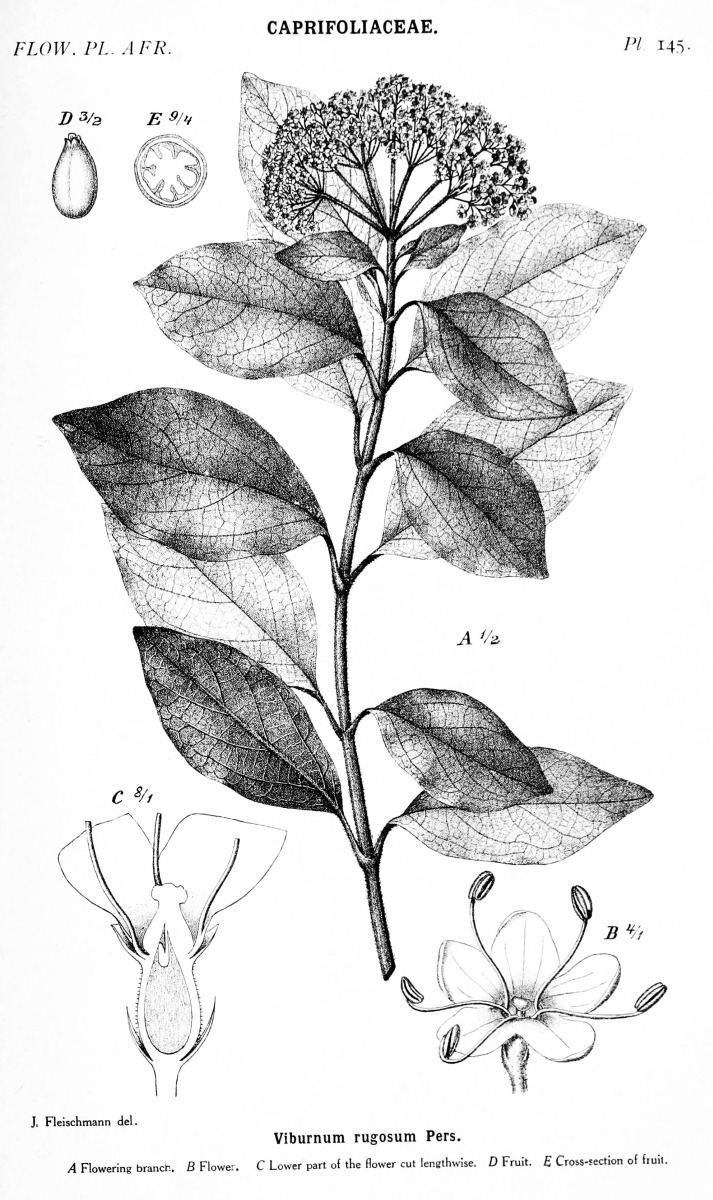
CAPRIFOLIACEAE.
FLOW. PL. AFR.
Pl. 145.
J. Fleischmann del.
Viburnum rugosum Pers.
A Flowering branch. B Flower. C Lower part of the flower cut lengthwise. D Fruit. E Cross-section of fruit.
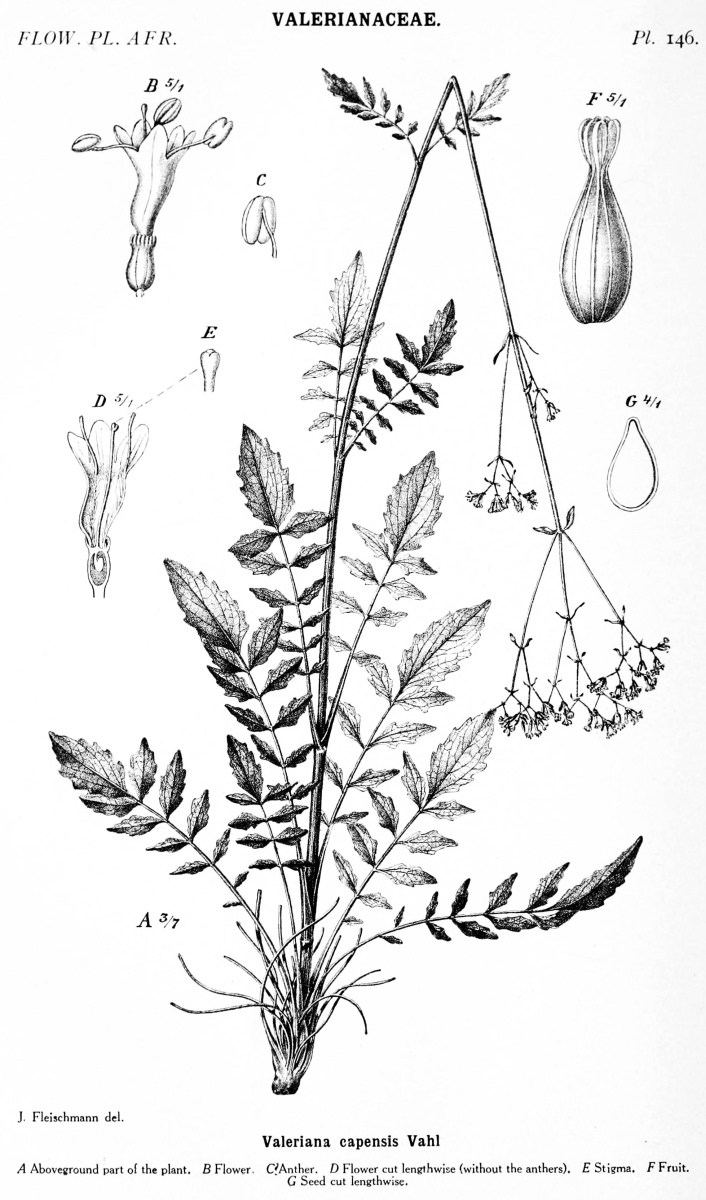
VALERIANACEAE.
FLOW. PL. AFR.
Pl. 146.
J. Fleischmann del.
Valeriana capensis Vahl
A Aboveground part of the plant. B Flower. C Anther. D Flower cut lengthwise (without the anthers). E Stigma. F Fruit. G Seed cut lengthwise.
154. Flowers 5-merous. Corolla shortly funnel-shaped. Anthers included. Style 2-cleft. Fruit opening loculicidally at the apex. Herbs. Stipules entire or toothed. Flowers in lax cymes.—Species 1. Tropical and South-east Africa. (Under Oldenlandia Plum.) Pentodon Hochst. Flowers 4-merous, very rarely 5-merous, but then solitary or in pairs or style simple. 155 155. Fruit opening by a lid, few-seeded. Flowers 4-merous. Corolla rotate. Placentas globose, with 3-4 ovules. Undershrubs. Flowers in terminal fascicles.—Species 1. Northern East Africa (Somaliland). Mitratheca K. Schum. Fruit opening lengthwise or remaining closed.—Species 120. Some of them yield vegetables, dyes, or medicaments. (Including Hedyotis L. and Pentanopsis Rendle). Oldenlandia Plum.
FAMILY 220. CAPRIFOLIACEAE
Leaves opposite. Flowers hermaphrodite. Sepals 5, united below. Petals 5, united below. Stamens 5, inserted on the corolla. Ovary inferior. Ovules axile, pendulous. Fruit a berry or a drupe. Seeds with a straight embryo and fleshy albumen.—Genera 4, species 15. North and East Africa. (Plate 145.)
1. Ovary 1-celled when fully developed. Ovule 1. Style very short, 3-parted. Anthers turned inwards. Flowers in corymbs, regular, at least the inner ones. Fruit a drupe with a 1-seeded stone. Shrubs or trees. Leaves entire, toothed, or lobed.—Species 4. North Africa. They yield timber and medicaments or serve as ornamental plants, so especially the guelder-rose (V. Opulus L.) and the laurustinus (V. tinus L.); the latter has poisonous fruits. (Plate 145.) [Tribe VIBURNEAE.] Viburnum L. Ovary 2-5-celled. Ovules 2 or more. Fruit a drupe with 3-5 stones or a several-seeded berry. 2 2. Ovary with 1 ovule in each cell. Style very short, 3-5-parted. Anthers turned outwards. Corolla rotate. Flowers regular, in panicles or corymbs. Fruit a drupe. Leaves pinnately dissected.—Species 4. North and East Africa; one species (S. nigra L.) only naturalized. The latter yields wood, pith, oil, edible fruits, and medicaments; another species is poisonous. “Elder.” [Tribe SAMBUCEAE.] Sambucus L. Ovary with 2 or more ovules in each cell. Style long. Anthers turned inwards. Flowers more or less irregular. Fruit a berry. Leaves entire, toothed, or lobed. Shrubs. [Tribe LONICEREAE.] 3 3. Ovary 2-3-celled.—Species 6. North-west Africa. Some are used as ornamental or medicinal plants. “Honeysuckle.” Lonicera L. Ovary 5-celled. Fruit many-seeded.—Species 1. Naturalized in the Azores. An ornamental plant. Leycesteria Wall.
FAMILY 221. VALERIANACEAE
Herbs or undershrubs. Leaves opposite or all radical, without stipules. Inflorescence cymose. Calyx not distinctly developed at the time of flowering. Petals 5, united below. Stamens 1-3, attached to the corolla-tube. Anthers turned inwards. Ovary inferior, with 3 cells, two of which are empty and sometimes rudimentary. Ovule 1, pendulous, inverted. Style simple; stigma entire or 3-parted. Seed exalbuminous; embryo straight.—Genera 4, species 35. (Plate 146.)
1. Stamen 1. Corolla spurred. Calyx-limb developing into a feathery pappus crowning the fruit. Fruit 1-celled.—Species 5. North Africa. Used as ornamental plants. Centranthus DC. Stamens 2-3. Corolla not spurred, but sometimes gibbous. 2 2. Stamens 2, more rarely 3, two of which are united. Corolla 2-lipped; tube long, with a minute gibbosity near the base. Calyx-limb toothed. Branches of the inflorescence thickened.—Species 4. North-west Africa. Fedia Moench Stamens 3, free. Corolla not 2-lipped. 3 3. Calyx-limb rolled inwards at the time of flowering, developing afterwards into a pappus of feathery bristles. Fruit 1-celled. Corolla-tube usually gibbous. Perennial herbs or undershrubs. Leaves divided.—Species 5. North-west, East, and South Africa. Used as medicinal or ornamental plants. (Plate 146.) Valeriana L. Calyx-limb entire or toothed. Corolla-tube without a distinct gibbosity. Annual herbs.—Species 20. North and South Africa and northern East Africa. Some species, especially V. olitoria Poll., are used as salad. “Cornsalad.” Valerianella Haller
FAMILY 222. DIPSACACEAE
Herbs or undershrubs. Leaves opposite, without stipules. Flowers in heads; each flower with an epicalyx embracing the ovary. Petals 4-5, united below. Stamens 2-4. Anthers turned inwards. Ovary inferior, 1-celled. Ovule 1, pendulous, inverted. Style simple; stigma entire or 2-parted. Fruit enclosed by the epicalyx, dry, indehiscent. Seed albuminous; embryo straight.—Genera 7, species 50. (Plate 147.)
1. Involucral bracts in many rows, imbricate, usually stiff and smaller than the scales of the receptacle. Calyx-teeth numerous. Corolla-lobes 4. Stigma entire.—Species 15. (Plate 147.) Cephalaria Schrad. Involucral bracts in 1-3 rows. 2 2. Involucral bracts united. Epicalyx with 8 pits near the apex. Calyx-teeth 5. Stigma entire.—Species 2. North-west Africa. (Under Scabiosa L.) Pycnocomon Hoffmsg. & Link Involucral bracts free. 3
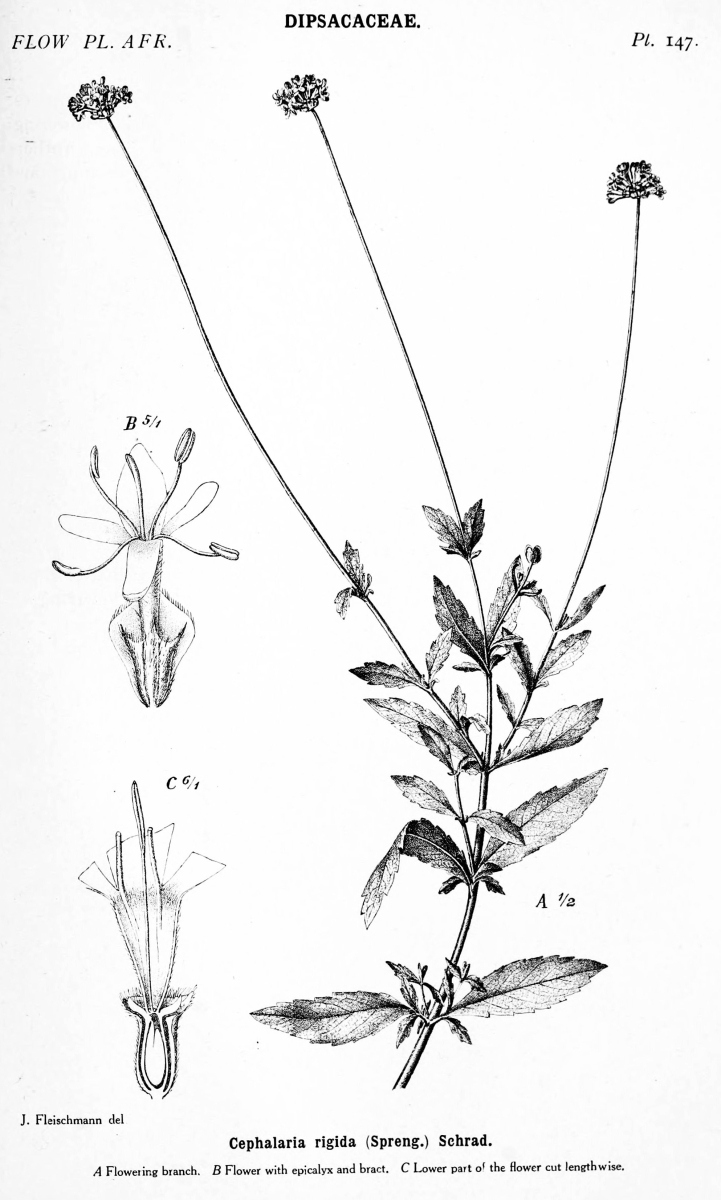
DIPSACACEAE.
FLOW. PL. AFR.
Pl. 147.
J. Fleischmann del.
Cephalaria rigida (Spreng.) Schrad.
A Flowering blanch. B Flower with epicalyx and bract. C Lower part of the flower cut lengthwise.
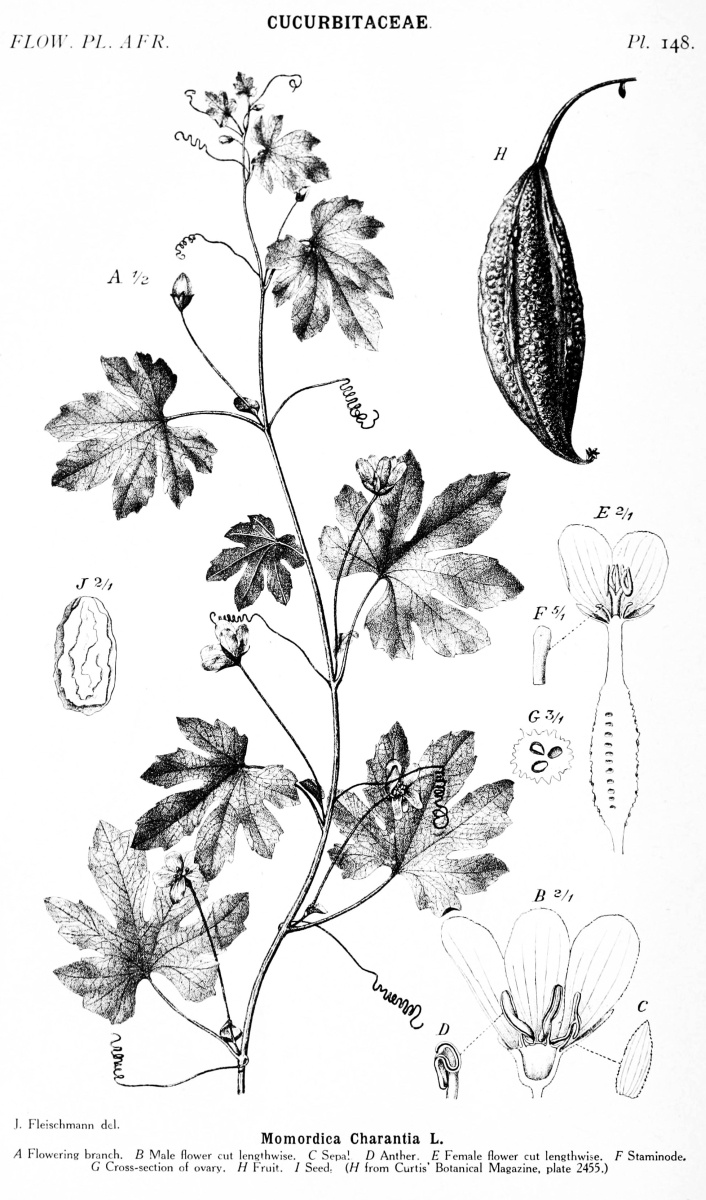
CUCURBITACEAE.
FLOW. PL. AFR.
Pl. 148.
J. Fleischmann del.
Momordica Charantia L.
A Flowering branch. B Male flower cut lengthwise. C Sepal. D Anther. E Female flower cut lengthwise. F Staminode. G Cross-section of ovary. H Fruit. I Seed. (H from Curtis’ Botanical Magazine, plate 2455.)
3. Scales of the receptacle stiff and pointed. Calyx-teeth usually 4. Stem prickly or bristly.—Species 5. North and East Africa. Several species are used in the manufacture of cloth and in medicine. “Teasel.” Dipsacus L. Scales of the receptacle herbaceous or replaced by hairs. Stem glabrous or hairy, rarely bristly. 4 4. Scales of the receptacle nearly as large as the flowers. Epicalyx with 8 longitudinal furrows. Calyx-teeth 5. Stigma entire.—Species 2. North-west Africa and Cameroons. They yield dyes and medicaments. (Under Scabiosa L.) Succisa Coult. Scales of the receptacle much smaller than the flowers or replaced by hairs. 5 5. Calyx-teeth 4-6. Stigma 2-parted. Epicalyx with 8 longitudinal furrows or ribs and a saucer-shaped limb. Receptacle scaly.—Species 18. Some of them are used as ornamental or medicinal plants. Scabiosa L. Calyx-teeth 8-24. 6 6. Calyx-teeth 8. Epicalyx without distinct furrows or ribs, and with a narrow, toothed limb. Receptacle hairy.—Species 2. North-west Africa. Used as ornamental or medicinal plants. (Under Scabiosa L.) Knautia Coult. Calyx-teeth 12-24. Epicalyx with 8 longitudinal furrows and a saucer-shaped limb.—Species 6. North Africa and Abyssinia. (Under Scabiosa L.) Pterocephalus Vaill.
ORDER CAMPANULATAE
SUBORDER CUCURBITINEAE
FAMILY 223. CUCURBITACEAE
Nearly always prostrate or climbing and tendril-bearing plants. Leaves broad, usually with pedate nervation. Flowers unisexual or polygamous, regular or nearly so, 5-merous. Calyx of united sepals. Stamens 4-5, four of them united in pairs, rarely all united or all free. Anthers usually opening outwards. Ovary inferior. Ovules inverted. Style undivided or cleft. Fruit berry-like, but sometimes dehiscent, more rarely dry and indehiscent. Seeds with a leathery or woody testa and a straight embryo, without albumen.—Genera 42, species 270. (Plate 148.)
1. Filaments all united into a column. [Tribe SICYOIDEAE.] 2 Filaments free or united at the base or in pairs. 5 2. Anthers 2-3, horizontal, straight or slightly curved. Staminal column very short. Male flowers in panicles, yellowish. Tendrils 2-cleft.—Species 1. East Africa. (Under Gerrardanthus Harv.) Cyclantheropsis Harms Anthers 3-5, erect and much curved or twisted. 3 3. Flowers usually dioecious, the female with staminodes. Ovules numerous, horizontal. Herbs. Tendrils simple or 2-cleft. Female flowers solitary.—Species 30. Central and South Africa. Some species have edible fruits or serve as ornamental or medicinal plants. (Cephalandra Schrad.) Coccinia Wight & Arn. Flowers monoecious, the female without staminodes. Ovule 1, pendulous. Tendrils 3-5-cleft. Male flowers in racemes or panicles. 4 4. Female flowers solitary or in pairs. Anthers free. Fruit large, fleshy. Shrubs. Flowers whitish.—Species 1 (S. edule Swartz). Cultivated and sometimes naturalized in North Africa, the island of St. Thomas, and the Mascarenes. The stem yields fibres, the roots and fruits are edible and contain starch. Sechium P. Browne Female flowers crowded in heads. Fruit small, with a leathery rind. Herbs. Flowers greenish.—Species 1. Central Africa; also cultivated in the Mascarene Islands. Yields starch and medicaments. Sicyos L. 5. Stamens 5, one of them sterile; filaments free; anthers more or less cohering, 2-celled. Petals unequal, undivided. Ovary incompletely 3-celled; ovules few in each cell, pendulous. Styles 3; stigmas 2-lobed. Fruit 3-valved at the apex. Seeds winged. Shrubs. Tendrils 2-cleft. Flowers dioecious, the male in racemes, the female solitary.—Species 4. Central and South Africa. Used medicinally. (Including Atheranthera Mast.) [Tribe FEVILLEAE.] Gerrardanthus Harv. Stamens 4-5, united in pairs, hence apparently only 2-3, rarely stamens 5, free and all fertile. 6 6. Anther-cells straight or slightly curved, rarely shortly inflexed at the base or apex. [Tribe MELOTHRIEAE.] 7 Anther-cells much curved or twisted, U- or S-shaped. [Tribe CUCURBITEAE.] 19 7. Anther-cells (pollen-sacs) 4. Flowers large, rose-coloured, the male without a rudimentary pistil. Calyx-segments toothed. Petals ciliate. Ovary oblong, 3-5-celled. Ovules numerous. Style 1. Fruit very large. Leaves compound. Tendrils 2-cleft.—Species 2. Tropics. They yield edible oily seeds and medicaments. (Including Ampelosicyos Thouars). [Subtribe TELFAIRIINAE.] Telfairia Hook. Anther-cells 2, rarely (Melothria) 4, but then flowers small, white or yellow, the male with a rudimentary pistil, fruit small, and leaves simple. 8 8. Disc at the base of the style distinctly developed. [Subtribe MELOTHRIINAE.] 9 Disc at the base of the style indistinct or wanting. [Subtribe ANGURIINAE.] 10 9. Calyx with a cylindrical tube and long, awl-shaped segments. Anthers sessile, attached by the back. Male flowers solitary or 2-3 together, female solitary.—Species 3. Central Africa. Oreosyce Hook. fil. Calyx with a campanulate tube and short segments. Anthers attached by the base.—Species 30. Tropical and South Africa. They yield vegetables and medicaments, or serve as ornamental plants. (Including Mukia Arn., Pilogyne Schrad., and Zehneria Endl.) Melothria L. 10. Stamens inserted at the throat of the calyx. 11 Stamens inserted in the calyx-tube. Climbing or prostrate herbs. 12 11. Stem erect, woody, tree-like. Leaves more or less deeply divided. Flowers monoecious, the male in panicles, without a pistil. Stigma 1, 3-lobed.—Species 1. Island of Socotra. Dendrosicyos Balf. fil. Stem prostrate or climbing, herbaceous. Stigmas 3.—Species 30. Central and South Africa, one species also cultivated in North Africa and the Mascarene Islands. Some species yield edible fruits and medicaments, or serve as ornamental plants. (Plate 148.) Momordica L. 12. Anther-cells inflexed at the apex. Connective broad. Flowers small, yellow, monoecious, the male with a rudimentary pistil. Stigmas 3.—Species 2. West Africa. They yield edible fruits, oily seeds, and medicaments. (Including Cladosicyos Hook., under Zehneria Endl.) Cucumeropsis Naud. Anther-cells straight, slightly curved, or inflexed at the base. 13 13. Calyx-tube long, cylindrical. Flowers dioecious, the male in panicles, the female in racemes. Ovules numerous. Stigmas 2, 2-cleft.—Species 1. Madagascar. Trochomeriopsis Cogn. Calyx-tube short, campanulate. Flowers nearly always monoecious. 14 14. Male flowers solitary or in fascicles or heads. Stamens with a lengthened or broadened connective. 15 Male flowers in racemes. 16 15. Stigma 1, lobed. Ovules few in each ovary-cell. Staminodes of the female flowers minute or wanting. Flowers small, yellowish-green. Fruit opening by a lid.—Species 20. Tropical and South Africa. Corallocarpus Welw. Stigmas 3-5. Ovules numerous. Staminodes hair-like or strap-shaped.—Species 30. Some of them (especially the cucumber, C. sativus L., and the melon, C. Melo L.) yield edible fruits, oily seeds, and medicaments, or serve as ornamental plants. Cucumis L. 16. Leaf-stalk with a small, fringed, stipule-like leaf at the base. Calyx-segments awl-shaped. Male flowers without a rudimentary pistil, female without staminodes. Connective not prolonged. Ovules 2-3 in each cell.—Species 2. Central and South-west Africa. (Ctenolepis Hook.) Blastania Kotschy & Peyr. Leaf-stalk without a stipule-like leaf at its base. 17 17. Stem short. Flowers appearing before the leaves, the male with a rudimentary pistil, the female with linear staminodes. Calyx-segments narrow. Connective narrow, not prolonged. Stigmas 3. Ovules numerous. Leaves lobed.—Species 1. South Africa. Pisosperma Sond. & Harv. Stem long. Flowers appearing with the leaves. 18 18. Staminodes in the female flowers thread-like, curved. Connective not prolonged at the apex. Male flowers without a rudimentary pistil. Stigmas 1-2. Ovules numerous. Calyx-segments broad. Fruit bottle-shaped. Seeds globose. Leaves toothed or lobed.—Species 3. South Africa to Ngamiland. Toxanthera Hook. Staminodes in the female flowers small or wanting. Connective prolonged at the apex, very rarely not prolonged, but then fruit oblong, without a beak, and leaves deeply divided. Ovules usually few.—Species 15. Central and South Africa. Some are used as ornamental or medicinal plants. (Including Coniandra Schrad. and Rhynchocarpa Schrad.) Kedrostis Medik. 19. (6.) Ovules solitary in each ovary-cell, erect. Style surrounded at the base by a disc. Staminodes present in the female flowers. Anthers cohering. Petals undivided.—Species 1. West Africa and Canary Islands. (Including Trianosperma Mart.) [Subtribe ABOBRINAE.] Cayaponia Manso. Ovules 2 or more in each ovary-cell or upon each placenta, horizontal, rarely ovary 1-celled with 2 ovules, one erect, the other pendulous. 20 20. Petals slit at the edge, free or nearly so. Calyx-tube long. Stem climbing. Leaves cleft or compound. Tendrils 2-3-cleft. Male flowers in racemes. [Subtribe TRICHOSANTHINAE.] 21 Petals not slit. 22 21. Stamens combined into 3, projecting beyond the calyx-tube. Male flowers with a rudimentary pistil. Fruit snake-shaped. Leaves 3-7-lobed. Tendrils 3-cleft. Flowers white.—Species 1. Cultivated and naturalized in Madagascar and the neighbouring islands. Used as a vegetable or as an ornamental or medicinal plant. “Snake-gourd.” Trichosanthes L. Stamens 5, free, seated in the calyx-tube. Male flowers without a rudimentary pistil. Fruit pear-shaped. Leaves ternately compound. Tendrils 2-cleft.—Species 1. Madagascar. Delognaea Cogn. 22. Corolla distinctly campanulate, lobed or cleft. Ovules numerous. Flowers large or medium-sized, the male without a rudimentary pistil. Leaves entire, toothed, or lobed. [Subtribe CUCURBITINAE.] 23 Corolla more or less rotate. [Subtribe CUCUMERINAE.] 26 23. Calyx-segments pinnately dissected. Female flowers without staminodes. Style long, inserted on the disc. Stigmas 3, 3-5-lobed. Fruit dry. Tendrils simple.—Species 4. Tropics. (Raphidiocystis Hook.) Rhaphidiocystis Hook. Calyx-segments undivided. Female flowers provided with staminodes. 24 24. Flowers monoecious. Style short and thick. Stigmas 3-5, 2-lobed. Tendrils 2- or more-cleft.—Species 4. Cultivated and sometimes naturalized. They yield edible fruits, oil, and medicaments, and serve as ornamental plants. “Pumpkin.” Cucurbita L. Flowers dioecious. Style long. Stigma 1, 3-lobed or 3-partite. Tendrils simple or 2-cleft. 25 25. Anthers cohering. Staminodes of the female flowers from subulate to oblong. Fruit small. (See 3.) Coccinia Wight & Arn. Anthers free. Staminodes of the female flowers conical or globose. Fruit rather large.—Species 6. Central Africa. (Including Staphylosyce Hook.) Physedra Hook. 26. (22.) Calyx-tube of the male flowers long, cylinder- or funnel-shaped. 27 Calyx-tube of the male flowers short, top- or bell-shaped. 32 27. Anthers connate. Female flowers without Staminodes. Flowers large, white or yellow. 28 Anthers free or loosely cohering. Female flowers provided with staminodes. 29 28. Flowers monoecious. Anthers folded lengthwise. Ovary oblong. Leaf-stalk without glands at the apex.—Species 20. Tropical and South Africa. (Peponia Naud.) Peponium Naud. Flowers dioecious. Anthers twisted transversely. Ovary globose.—Species 9. Tropics. Used medicinally. Adenopus Benth. 29. Flowers small or medium-sized, yellow or red. Anthers cohering. Rudimentary pistil of the male flowers conical. Stigma 1, 3-lobed. Seeds flattened. Root tuberous.—Species 15. Tropical and South Africa. Some species have edible roots also used in medicine. (Including Heterosicyos Welw.) Trochomeria Hook. Flowers large. Rudimentary pistil of the male flowers gland-like or wanting. Stigmas 3. Climbing herbs. 30 30. Flowers monoecious, white, solitary. Style very short. Stigmas 2-lobed. Fruit with a woody rind. Seeds flattened. Leaves undivided; stalk with 2 glands at the apex. Tendrils 2-cleft.—Species 1 (L. vulgaris Ser., bottle-gourd). Tropics; also cultivated and naturalized in extratropical countries. It yields edible fruits, also used for making bottles and other utensils, and serves as an ornamental and medicinal plant. Lagenaria Ser. Flowers dioecious. Tendrils simple. 31 31. Male flowers in racemes. Leaves undivided.—Species 5. West Africa. Cogniauxia Baill. Male flowers solitary or in clusters. Corolla yellow. Stamens with a broad connective. Staminodes bearded at the base. Stigmas heart-shaped. Fruit fleshy. Seeds nearly globose. Leaves lobed; stalk without glands.—Species 4. Central Africa. (Euryandra Hook.) Eureiandra Hook. 32. (26.) Anthers connate. Flowers dioecious, the male in clusters and without a rudimentary pistil, the female without staminodes. Leaves undivided. 33 Anthers free or loosely cohering; in the latter case flowers monoecious. 34 33. Stem herbaceous, without tendrils. Leaves linear. Anthers with a scale at the base.—Species 1. Abyssinia. Eulenburgia Pax Stem woody, climbing, bearing tendrils. Leaves broad.—Species 3. West Africa. They yield oily seeds. Dimorphochlamys Hook. 34. Anthers cohering; cells horse-shoe-shaped. Flowers monoecious, the male in umbels and with a rudimentary pistil, the female solitary and without staminodes. Stigma subcapitate. Herbs. Leaves lobed, with a stipule-like leaf at the base. Tendrils simple. Flowers white. Fruit small.—Species 1. West Africa. (Under Bryonia L.) Dactyliandra Hook. fil. Anthers free, at least when fully developed. 35 35. Stamens inserted at the throat of the calyx. 36 Stamens inserted in the tube of the calyx. 39 36. Calyx without scales at the base. Flowers dioecious, yellow or green, the male solitary or in clusters, the female solitary, with 5 staminodes. Ovary globose. Placentas and stigmas 5. Fruits large. Leafless, nearly erect, spiny shrubs.—Species 1. German South-west Africa and Angola. Yields edible fruits and seeds and medicaments. Acanthosicyos Welw. Calyx with 2-3 scales at the base. Ovary bottle-shaped. Placentas and stigmas 1-3. Climbing or prostrate herbs. 37 37. Ovules 2. Stigma 1, capitate. Flowers large, yellow, monoecious, the male 2-3 together at the base of the leaf-blade, without a rudimentary pistil, the female solitary or in pairs, without staminodes. Fruits small. Leaves slightly lobed. Tendrils simple.—Species 3. Central Africa. (Raphanocarpus Hook.) Rhaphanocarpus Hook. Ovules 3 or more. Stigmas 3. 38 38. Ovules few. Fruit constricted between the seeds.—Species 1. East Africa. (Raphanistrocarpus Baill.) Rhaphanistrocarpus Baill. Ovules numerous. (See 11.) Momordica L. 39. Male flowers in racemes. 40 Male flowers solitary or in clusters, yellow. 43 40. Female flowers in racemes or clusters, small. Ovules few. Male flowers without a rudimentary pistil. Fruit more or less globular. Tendrils simple.—Species 4. North Africa. Poisonous and used medicinally. Bryonia L. Female flowers solitary. Ovules numerous. 41 41. Flowers dioecious large, white, the male without a rudimentary pistil. Stigma 1, 3-lobed. Fruit large, globose. Leafstalk with two glands at the apex. Tendrils 2-cleft, rarely simple.—Species 1. Tropical and South Africa. Sphaerosicyos Hook. Flowers monoecious. Stigmas 3, 2-lobed. Leaf-stalk without glands. 42 42. Tendrils cleft. Leaves lobed. Fruit dry, opening by a lid.—Species 7. Tropical and South Africa; one species also cultivated in North Africa. They are used as vegetables and medicinal plants; some have edible, others poisonous fruits; the fibres of the fruit are employed for making sponges, hats, and various utensils; the seeds are oily. Luffa L. Tendrils absent. Leaves undivided. Flowers yellow, the male without a rudimentary pistil. Fruit fleshy, ejecting the seeds when ripe.—Species 1. North Africa. A poisonous and medicinal plant. “Squirting cucumber.” Ecballium A. Rich. 43. Male flowers without a rudimentary pistil. Ovules few. Stem climbing. Tendrils two-cleft. Flowers in clusters, small, yellowish-green, monoecious. Fruit small, globular.—Species 1. Tropics. Used as an ornamental and medicinal plant. Bryonopsis Arn. Male flowers with a rudimentary pistil. Ovules numerous. 44 44. Connective of the stamens with a 2-cleft appendage at the apex. Tendrils simple, rarely wanting. (See 15.) Cucumis L. Connective of the stamens not prolonged at the apex. Tendrils 2-3-cleft. Stem prostrate. Leaves lobed or divided. Flowers large, monoecious. 45 45. Calyx-segments leaf-like, serrate, recurved. Flowers solitary.—Species 1 (B. hispida Cogn.). Cultivated in various regions. The fruits are eaten and used in medicine. Benincasa Savi. Calyx-segments awl-shaped, entire.—Species 4. They yield edible fruits (chiefly from C. vulgaris Neck., water-melon), edible oily seeds, and medicaments; some are poisonous. (Colocynthis L.) Citrullus Neck.
SUBORDER CAMPANULINEAE
FAMILY 224. CAMPANULACEAE
Leaves entire toothed or lobed, without stipules. Petals usually united below. Stamens as many as the petals. Anthers turned inwards. Ovary inferior or half-inferior, rarely (Lightfootia) superior, 2-10-celled, rarely (Merciera) 1-celled. Ovules inverted, numerous and axile, rarely few and apical or basal. Style simple. Fruit a capsule, rarely a nut or (Canarina) a berry. Seeds with fleshy albumen; embryo straight.—Genera 26, species 400. (Including LOBELIACEAE and SPHENOCLEACEAE.) (Plate 149.)
1. Anthers connate. Flowers more or less irregular, solitary or in racemes or panicles. [Subfamily LOBELIOIDEAE.] 2 Anthers free, rarely (Jasione) cohering at the base, but then flowers regular and in heads. 7 2. Petals free. Flowers nearly regular, small, greenish-yellow, in many-flowered terminal and lateral racemes.—Species 2. Madagascar. Dialypetalum Benth. Petals united below. 3 3. Corolla-tube slit down to the base or nearly so, at least on one side. Stamens free from the corolla or nearly so. 4 Corolla-tube not or but shortly slit. 6 4. Fruit linear. All anthers hairy at the apex.—Species 1. South Africa. (Under Lobelia L.) Grammatotheca Presl Fruit roundish. 5 5. Anthers and stigmas ripe at the same time. All anthers hairy at the apex. Odd sepal in front.—Species 12. South and East Africa and Comoro Islands. Some are used as ornamental plants. (Including Dobrowskya Presl and Parastranthus Don, under Lobelia L.) Monopsis Salisb. Anthers ripe before the stigmas. Odd sepal usually behind.—Species 120. Southern and tropical Africa, Madeira, and Azores. Some are poisonous or are used as ornamental or medicinal plants. (Including Isolobus A. DC. and Metzleria Presl) Lobelia L. 6. Filaments adnate to the corolla on one side to beyond the middle. Corolla white.—Species 1. Naturalized in the Island of Réunion. A poisonous and medicinal plant. Isotoma Lindl. Filaments free from the corolla or shortly adnate to it. Corolla blue or white.—Species 10. South and North-west Africa. (Including Enchysia Presl) Laurentia Neck. 7. (1.) Flowers distinctly irregular. Ovary 2-celled. Fruit opening loculicidally and septicidally.—Species 30. South and Central Africa. Several species have edible tubers. [Subfamily CYPHIOIDEAE.] Cyphia Berg Flowers regular or nearly so. [Subfamily CAMPANULOIDEAE.] 8 8. Corolla imbricate in the bud. Style very short, without collecting hairs. Ovary 2-celled; placentas thick, suspended from the top of the partition. Fruit opening by a lid. Flowers in spikes, small, greenish or yellowish.—Species 1. Tropics and Egypt. [Tribe SPHENOCLEEAE.] Sphenoclea Gaertn. Corolla valvate in the bud. Style with hairs or viscid glands for collecting the pollen. [Tribe CAMPANULEAE.] 9 9. Carpels 5, as many as the sepals or stamens, and alternating with them. 10 Carpels as many as the sepals or stamens, but opposite to them, or fewer. 11 10. Corolla rotate or broadly campanulate, deeply cleft, yellow or red. Filaments broadened at the base. Fruit opening laterally by many transverse slits. Large herbs or undershrubs. Leaves elliptical. Flowers large, in panicles.—Species 2. Madeira. Used as ornamental plants. Musschia Dumort. Corolla tubular or narrowly campanulate. Filaments not broadened. Fruit opening loculicidally by 5 apical valves. Seeds few. Small herbs. Leaves linear. Flowers small, solitary or in clusters.—Species 4. South Africa. Microcodon A. DC. 11. Filaments adnate to the corolla halfway or higher up. Fruit opening by an apical lid. 12 Filaments free from the corolla or nearly so. 13 12. Ovules 2 in each ovary-cell, suspended from the top of the cell. Flowers blue, in raceme- or panicle-like cymose inflorescences. Leaves linear. Herbs or undershrubs. Siphocodon Turcz. Ovules many in each cell, attached to the inner angle. Flowers red, in heads. Leaves ovate. Shrubs.—Species 1. South Africa. Rhigiophyllum Hochst. 13. Anthers cohering at the base. Petals free or nearly so. Ovary 2-celled. Fruit opening loculicidally at the top. Flowers in heads surrounded by an involucre.—Species 4. North Africa. Jasione L. Anthers free. 14 14. Ovules 4, basal. Ovary 1-celled, sometimes incompletely 2-celled. Corolla tubular-funnel-shaped. Fruit dry, indehiscent, 1-, rarely 2-4-seeded. Undershrubs. Flowers solitary, axillary.—Species 4. South Africa. Merciera A. DC. Ovules axile, usually numerous. Ovary 2-10-celled. 15 15. Fruit a roundish berry. Flowers solitary, terminal, large, nearly always 6-merous. Corolla bell-shaped, yellow or red. Filaments broadened at the base. Leaves opposite, the lower whorled.—Species 3. East Africa and Canary Islands. They yield edible roots and fruits and serve as ornamental plants. Canarina L. Fruit a capsule, rarely a nut. Flowers usually 5-merous. 16 16. Fruit narrow, opening by an apical lid and sometimes also by lateral slits, more rarely remaining closed. Ovary 2-celled. 17 Fruit opening by apical valves or by lateral valves, slits, or pores. 18 17. Flowers in terminal heads. Corolla tubular. Ovary ovoid.—Species 1. South Africa. (Leptocodon Sond.) Treichelia Vatke Flowers terminal and solitary, or in lateral glomerules. Ovary oblong.—Species 15. South Africa. Some are used as ornamental plants. Roëlla L. 18. Fruit opening by lateral, but sometimes nearly apical valves, slits, or pores. 19 Fruit opening loculicidally at the apex, usually broad. 22 19. Fruit narrow, opening by pores or slits. 20 Fruit broad, opening by valves. 21 20. Fruit opening by long slits. Ovary 2-celled. Corolla funnel-shaped or narrowly bell-shaped.—Species 20. South Africa. Prismatocarpus L’Hér. Fruit opening by short slits or pores. Ovary 3-celled. Corolla wheel-shaped or broadly bell-shaped.—Species 4. North Africa. They serve as ornamental plants; the root is edible. “Venus’s looking-glass.” Specularia Heist. 21. Corolla tubular. Ovary 2-3-celled. Style projecting far beyond the corolla. Flowers in panicles.—Species 1. North-west Africa. Used as an ornamental plant; the root is edible. Trachelium L. Corolla bell- or funnel-shaped. Ovary 3-5-celled. Style not or slightly projecting beyond the corolla.—Species 25. North Africa and northern Central Africa. Several species are used as vegetables or as medicinal or ornamental plants. Campanula L. 22. Stigma-lobes 2-10, narrow. 23 Stigma-lobes 2-3, broad, sometimes very small. 24 23. Petals free or nearly so, narrow.—Species 50. Southern and tropical Africa. (Plate 149.) Lightfootia L’Hér. Petals obviously united below, or broad.—Species 80. Some of them serve as ornamental plants. (Including Cervicina Del.) Wahlenbergia Schrad. 24. Petals free or nearly so, narrow, blue. Herbs.—Species 6. Central and South-west Africa. Cephalostigma A. DC. Petals obviously united below. 25 25. Corolla bell-shaped, deeply cleft, yellow. Style equalling the corolla. Fruit opening at the top and laterally. Seeds numerous. Stem woody. Species 1. Mascarene Islands. (Under Wahlenbergia Schrad.) Heterochaenia A. DC. Corolla narrowly funnel-shaped, shortly lobed. Style much exceeding the corolla. Fruit opening at the top only. Seeds about ten. Stem herbaceous.—Species 1. Morocco. (Under Trachelium L.) Feeria Buser
FAMILY 225. GOODENIACEAE