KEY TO THE GENERA
Reading edition
EMBRYOPHYTA SIPHONOGAMA
(PHANEROGAMAE)
SUBDIVISION GYMNOSPERMAE
CLASS I. CYCADALES
FAMILY 1. CYCADACEAE
Stem simple, rarely branched at the top, woody, with mucilagineous juice. Leaves pinnate or pinnatisect, forming a tuft at the top of the stem and intermingled with scales. Flowers solitary, terminal, in the shape of a cone (but sometimes overtopped by the continued growth of the stem), dioecious, without a perianth. Stamens bearing many pollen-sacs on their lower side. Ovules 2-8 to each carpel, straight, with a single coat. Seeds drupe-like, albuminous. Embryo with two more or less united cotyledons.—Genera 3, species 25. Tropical and South Africa. (Plate 1.)
1. Stem growing through the female flower, covered with the remains of the old leaves. Leaf-segments one-nerved, coiled in bud. Carpels pinnately toothed or cleft, each with 4-8 ascending ovules.—Species 2, one growing wild in Madagascar and the neighbouring islands, the other cultivated and sometimes naturalized in various parts of Africa. Used as ornamental and medicinal plants; the fruits are edible and the pith contains starch (sago). [Tribe CYCADEAE.] Cycas L. Stem not growing through the female flower. Leaf-segments with several nerves, straight in bud. Carpels each with 2 descending ovules. [Tribe ZAMIEAE.] 2 2. Leaf-segments with pinnate nerves. Stem without remains of old leaves at the base. Cone-scales (stamens and carpels) imbricate.—Species 2. South-east Africa (Natal). Used as ornamental plants. Stangeria Th. Moore Leaf-segments with parallel nerves. Stem covered with the remains of old leaves. Cone-scales not imbricate.—Species 20. South and Central Africa. The pith (Kaffir-bread) and the seeds of some species are eaten and also used for making a sort of beer. Several species yield gum or serve as ornamental plants. (Plate 1.) Encephalartos Lehm.
CLASS II. CONIFERAE
FAMILY 2. TAXACEAE
Stem branched, woody, with resinous juice. Leaves alternate, linear or linear-lanceolate. Flowers solitary or the male umbellate, dioecious, without a perianth. Stamens with 2-9 pollen-sacs. Carpels free, one-ovuled, shorter than the seeds, sometimes rudimentary. Seeds 1-2, drupe-like, surrounded by a fleshy aril. Embryo with 2 or more free cotyledons.—Genera 2, species 9. (Under CONIFERAE.)
Stamens with 2 pollen-sacs and a triangular blade. Pollen-grains with air-bladders. Carpels distinctly developed. Ovule inverted, with two coats. Aril enveloping the seed. Leaves with resin-ducts.—Species 8. South and East Africa, Madagascar, Island of St. Thomas. They yield timber and bark for tanning. (Including Nageia Gaertn.) [Subfamily PODOCARPOIDEAE.] Podocarpus L’ Hér. Stamens with 5-9 pollen-sacs and a peltate blade. Pollen-grains without air-bladders. Carpels rudimentary. Ovule straight, with one coat. Aril cup-shaped. Leaves without resin-ducts.—Species 1. North-west Africa. A poisonous, medicinal and ornamental plant, with hard wood. “Yew.” [Subfamily TAXOIDEAE]. Taxus L.
FAMILY 3. PINACEAE
Stem branched, woody, with resinous juice. Leaves needle-or scale-like. Flowers unisexual, without a perianth. Stamens in catkins, with 2-5 pollen-sacs below the scale-like limb. Carpels arranged in the shape of a cone or bud, leathery woody or fleshy, when ripe. Ovules 2 or more to each carpel, rarely only 1. Seeds hidden by the carpels, without an aril. Embryo with 2 or more free cotyledons.—Genera 6, species 25. (Under CONIFERAE.) (Plate 2.)
1. Leaves alternate (as are also the floral leaves), but sometimes fascicled, needle-like. Stamens with 2 pollen-sacs. Pollen-grains with air-bladders. Carpels divided into an inner and an outer scale, leathery or woody when ripe. Ovules and seeds 2 to each carpel; ovules turned downwards. [Tribe ABIETINEAE.] 2 Leaves opposite or whorled. Stamens with 3-5, very rarely 2 pollen-sacs. Pollen-grains without air-bladders. Ovules turned upwards. [Tribe CUPRESSINEAE.] 4 2. Shoots all alike (all long). Leaves solitary, flat. Pollen-sacs opening obliquely or transversely; connective without an appendage. Cones ripening the first year; scales leathery.—Species 2. North-west Africa. The wood and the resin are used, the latter especially for the preparation of turpentine. “Silver fir.” Abies Juss. Shoots of two kinds, long and short. Leaves of the short shoots in clusters of two or more, surrounded by scales when young. Pollen-sacs opening longitudinally; connective with an appendage. Cones ripening the second or third year; scales woody. 3
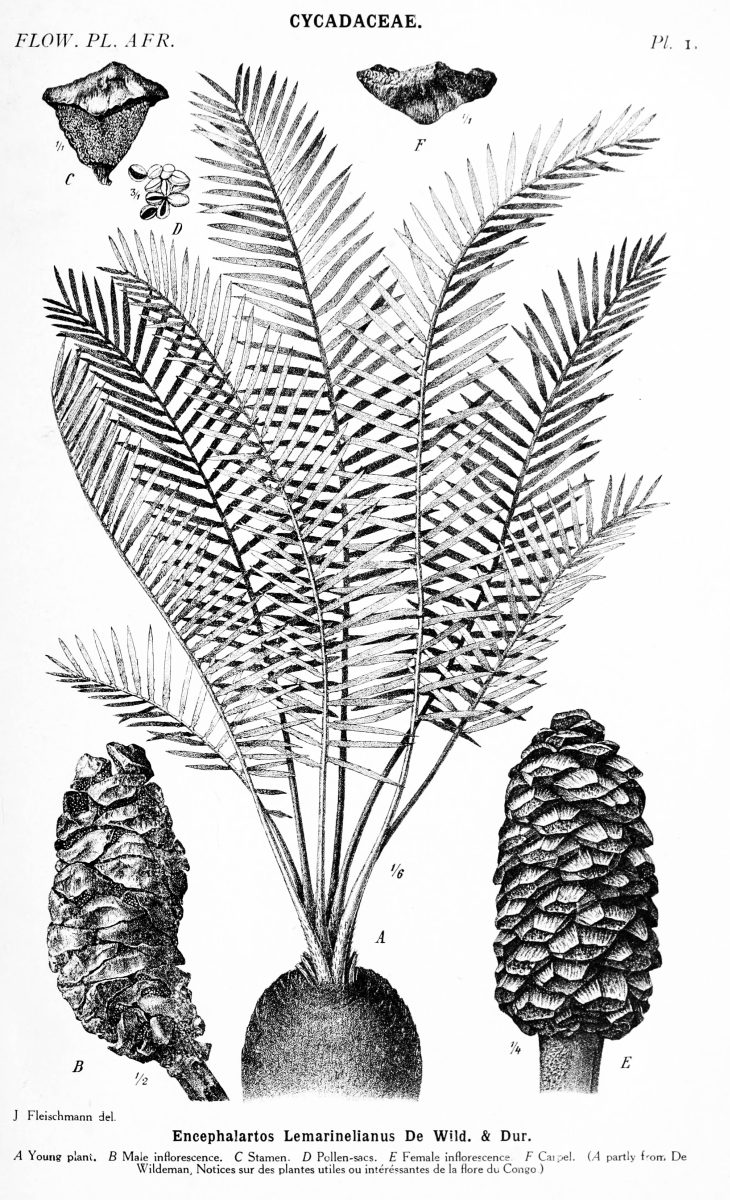
CYCADACEAE.
FLOW. PL. AFR. Pl. 1.
J. Fleischmann del.
Encephalartos Lemarinelianus De Wild. & Dur.
A Young plant. B Male inflorescence. C Stamen. D Pollen-sacs. E Female inflorescence. F Carpel. (A partly from De Wildeman, Notices sur des plantes utiles ou intéréssantes de la flore du Congo.)
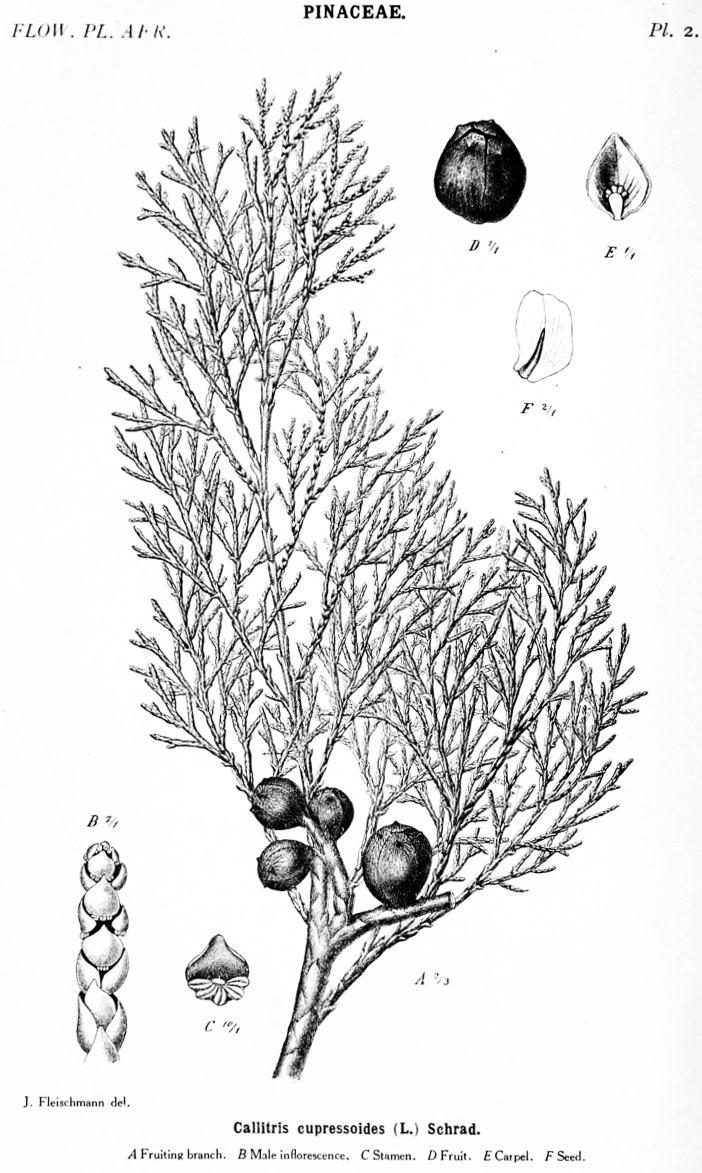
PINACEAE.
FLOW. PL. AFR. Pl. 2.
J. Fleischmann del.
Callitris cupressoides (L.) Schrad.
A Fruiting branch. B Male inflorescence. C Stamen. D Fruit. E Carpel. F Seed.
3. Leaves all needle-like; those of the short shoots in clusters of many; those of the long shoots scattered. Flowers inserted upon short shoots, the males solitary. Cone-scales flat, imbricate, without a terminal appendage, deciduous.—Species 2. North-west Africa. They yield timber and medicinal drugs. “Cedar.” Cedrus Loud. Leaves of the short shoots needle-like, in clusters of two or three, very rarely solitary; leaves of the long shoots scale-like. Male flowers in spikes replacing short shoots; female flowers towards the end of the branches, replacing long shoots. Cone-scales thick, with a terminal umbonate appendage, persistent.—Species 4. North Africa; also naturalized in South Africa and St. Helena. Wood, bark, and resin are used for carpenters’ and joiners’ work, for tanning and for the manufacture of paper, tar, pitch, colophony, turpentine, and other chemical products, as well as in medicine. The seeds of some species (especially those of the stone-pine, P. Pinea L.) are edible. “Pine.” Pinus L. 4. Fruit fleshy, berry- or drupe-like. Seeds not winged, as many as the carpels or fewer. Leaves usually needle-like.—Species 9. North and East Africa. They yield wood, bark for tanning, resin, an essential oil, brandy (gin), and medicines; some are used as ornamental plants. (Including Arceuthos Ant. & Kotschy and Sabina Spach). Juniperus L. Fruit woody, cone-like. Seeds winged, as many as the carpels or more. Leaves usually scale-like. 5 5. Carpels 4, valve-like, separating at the apex when ripe, 1-10-seeded.—Species 8, one of them only naturalized. North, South, and southern East Africa, Madagascar and Mauritius. Some of them (especially C. quadrivalvis Vent.) yield timber and resin (sandarac) which is used for the preparation of lacquer, varnish, cement, and in medicine. (Including Tetraclinis Mast. and Widdringtonia Endl.) (Plate 2.) Callitris Vent. Carpels 8-10, peltate, separating at the margins when ripe, many-seeded.—Species 1. Cultivated in North Africa as an ornamental plant and sometimes naturalized. It yields timber and is used in medicine. “Cypress.” Cupressus L.
CLASS III. GNETALES
FAMILY 4. GNETACEAE
Stem woody. Juice not resinous. Leaves opposite, undivided. Flowers in spikes or panicles or the female solitary, unisexual, but the male sometimes with rudimentary ovules. Perianth of the male flowers tubular or 2-4-parted, of the female bladder-like. Stamens 2-8. Ovule 1, erect, straight. Embryo with 2 cotyledons.—Genera 3 species 8. North and Central Africa.
1. Stem turnip-shaped, very short. Leaves 2, very large, sessile, linear, with parallel nerves. Flowers in panicled spikes; the male consisting of a 4-partite perianth, 6 stamens with 3-celled anthers, and a rudimentary ovule. Ovule with a single coat.—Species 1; German South-west Africa and Angola. (Tumboa Welw.) [Subfamily WELWITSCHIOIDEAE.] Welwitschia Hook. fil. Stem shrubby or twining. Leaves numerous, not very large. Male flowers consisting of a 2-partite or a tubular, undivided perianth and 2-8 stamens with 1-2-celled anthers, without rudimentary ovules, but sometimes accompanied by sterile female flowers. 2 2. Leaves large, with a short foot-stalk, lanceolate oblong elliptical or oval, penninerved. Stem climbing. Flowers in spikes or panicles, the male consisting of a tubular, undivided perianth and 2 stamens with 1-celled anthers. Ovule with two coats.—Species 2. West Africa. The young leaves are used as a vegetable. [Subfamily GNETOIDEAE.] Gnetum L. Leaves scale-like. Male flowers in spikes or panicles, female solitary or in pairs. Male flowers consisting of a 2-partite perianth and 2-8 stamens with 2-celled anthers. Ovule with a single coat exceeding the perianth.—Species 5. North Africa and northern Central Africa. The fruits of some species are eaten or used in medicine. [Subfamily EPHEDROIDEAE.] Ephedra L.