WHAT COLLEGE DID TO ME An Outline of Education
Reading edition
My college education was no haphazard affair. My courses were all selected with a very definite aim in view, with a serious purpose in mind—no classes before eleven in the morning or after two-thirty in the afternoon, and nothing on Saturday at all. That was my slogan. On that rock was my education built.
As what is known as the Classical Course involved practically no afternoon laboratory work, whereas in the Scientific Course a man’s time was never his own until four p. m. anyway, I went in for the classic. But only such classics as allowed for a good sleep in the morning. A man has his health to think of. There is such a thing as being a studying fool.
In my days (I was a classmate of the founder of the college) a student could elect to take any courses in the catalogue, provided no two of his choices came at the same hour. The only things he was not supposed to mix were Scotch and gin. This was known as the Elective System. Now I understand that the boys have to have, during the four years, at least three courses beginning with the same letter. This probably makes it very awkward for those who like to get away of a Friday afternoon for the week-end.
Under the Elective System my schedule was somewhat as follows:
Mondays, Wednesdays and Fridays at 11:00:
Botany 2a (The History of Flowers and Their Meaning)
Tuesdays and Thursdays at 11:00:
English 26 (The Social Life of the Minor Sixteenth Century Poets)
Mondays, Wednesdays and Fridays at 12:00:
Music 9 (History and Appreciation of the Clavichord)
Tuesdays and Thursdays at 12:00:
German 12b (Early Minnesingers—Walter von Vogelweider, Ulric Glannsdorf and Freimann von Stremhofen. Their Songs and Times)
Mondays, Wednesdays and Fridays at 1:30:
Fine Arts 6 (Doric Columns: Their Uses, History and Various Heights)
Tuesdays and Thursdays at 1:30:
French 1c (Exceptions to the verb être)
This was, of course, just one year’s work. The next year I followed these courses up with supplementary courses in the history of lace-making, Russian taxation systems before Catharine the Great, North American glacial deposits and Early Renaissance etchers.
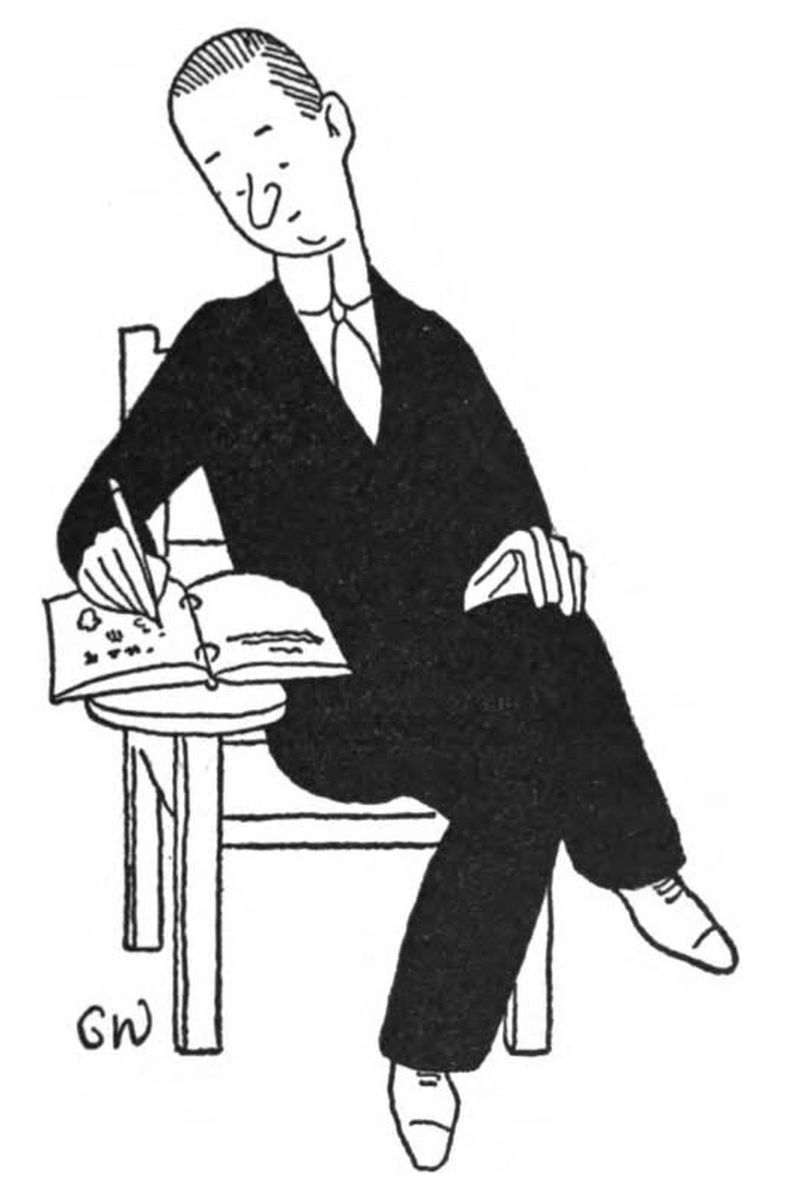
Some of the drawings in my economics notebook were the finest things I have ever done.
This gave me a general idea of the progress of civilization and a certain practical knowledge which has stood me in good stead in thousands of ways since my graduation.
My system of studying was no less strict. In lecture courses I had my notebooks so arranged that one-half of the page could be devoted to drawings of five-pointed stars (exquisitely shaded), girls’ heads, and tick-tack-toe. Some of the drawings in my economics notebook in the course on Early English Trade Winds were the finest things I have ever done. One of them was a whole tree (an oak) with every leaf in perfect detail. Several instructors commented on my work in this field.
These notes I would take home after the lecture, together with whatever supplementary reading the course called for. Notes and textbooks would then be placed on a table under a strong lamplight. Next came the sharpening of pencils, which would take perhaps fifteen minutes. I had some of the best sharpened pencils in college. These I placed on the table beside the notes and books.
At this point it was necessary to light a pipe, which involved going to the table where the tobacco was. As it so happened, on the same table was a poker hand, all dealt, lying in front of a vacant chair. Four other chairs were oddly enough occupied by students, also preparing to study. It therefore resolved itself into something of a seminar, or group conference, on the courses under discussion. For example, the first student would say:
“I can’t open.”
The second student would perhaps say the same thing.
The third student would say: “I’ll open for fifty cents.”
And the seminar would be on.
At the end of the seminar, I would go back to my desk, pile the notes and books on top of each other, put the light out, and go to bed, tired but happy in the realization that I had not only spent the evening busily but had helped put four of my friends through college.
An inventory of stock acquired at college discloses the following bits of culture and erudition which have nestled in my mind after all these years.
THINGS I LEARNED FRESHMAN YEAR
1. Charlemagne either died or was born or did something with the Holy Roman Empire in 800.
2. By placing one paper bag inside another paper bag you can carry home a milk shake in it.
3. There is a double l in the middle of “parallel.”
4. Powder rubbed on the chin will take the place of a shave if the room isn’t very light.
5. French nouns ending in “aison” are feminine.
6. Almost everything you need to know about a subject is in the encyclopedia.
7. A tasty sandwich can be made by spreading peanut butter on raisin bread.
8. A floating body displaces its own weight in the liquid in which it floats.
9. A sock with a hole in the toe can be worn inside out with comparative comfort.
10. The chances are against filling an inside straight.
11. There is a law in economics called The Law of Diminishing Returns, which means that after a certain margin is reached returns begin to diminish. This may not be correctly stated, but there is a law by that name.
12. You begin tuning a mandolin with A and tune the other strings from that.
SOPHOMORE YEAR
1. A good imitation of measles rash can be effected by stabbing the forearm with a stiff whiskbroom.
2. Queen Elizabeth was not above suspicion.
3. In Spanish you pronounce z like th.
4. Nine-tenths of the girls in a girls’ college are not pretty.
5. You can sleep undetected in a lecture course by resting the head on the hand as if shading the eyes.
6. Weakness in drawing technique can be hidden by using a wash instead of black and white line.
7. Quite a respectable bun can be acquired by smoking three or four pipefuls of strong tobacco when you have no food in your stomach.
8. The ancient Phœnicians were really Jews, and got as far north as England where they operated tin mines.
9. You can get dressed much quicker in the morning if the night before when you are going to bed you take off your trousers and underdrawers at once, leaving the latter inside the former.
JUNIOR YEAR
1. Emerson left his pastorate because he had some argument about communion.
2. All women are untrustworthy.
3. Pushing your arms back as far as they will go fifty times each day increases your chest measurement.
4. Marcus Aurelius had a son who turned out to be a bad boy.
5. Eight hours of sleep are not necessary.
6. Heraclitus believed that fire was the basis of all life.
7. A good way to keep your trousers pressed is to hang them from the bureau drawer.
8. The chances are that you will never fill an inside straight.
9. The Republicans believe in a centralized government, the Democrats in a de-centralized one.
10. It is not necessarily effeminate to drink tea.
SENIOR YEAR
1. A dinner coat looks better than full dress.
2. There is as yet no law determining what constitutes trespass in an airplane.
3. Six hours of sleep are not necessary.
4. Bicarbonate of soda taken before retiring makes you feel better the next day.
5. You needn’t be fully dressed if you wear a cap and gown to a nine-o’clock recitation.
6. Theater tickets may be charged.
7. Flowers may be charged.
8. May is the shortest month in the year.
The foregoing outline of my education is true enough in its way, and is what people like to think about a college course. It has become quite the cynical thing to admit laughingly that college did one no good. It is part of the American Credo that all that the college student learns is to catch punts and dance. I had to write something like that to satisfy the editors. As a matter of fact, I learned a great deal in college and have those four years to thank for whatever I know today.
(The above note was written to satisfy those of my instructors and financial backers who may read this. As a matter of fact, the original outline is true, and I had to look up the date about Charlemagne at that.)