THE RISE AND FALL OF THE CHRISTMAS CARD
Reading edition
Twenty-five years ago (December 21, 1685, to be exact) a man named Ferderber awoke after a week’s business trip and realized that he hadn’t bought any Christmas presents for his relatives and friends. Furthermore, all he had left from the business trip was eighty cents, two theater-ticket stubs, and a right shoe.
So he cut up some cardboard to fit envelopes and on each card wrote some little thought for the season. Being still a trifle groggy, he thought that it would be nice to make them rhyme although, as he expressed it, with a modest smile, “I am no poet.”
The one to his aunt read as follows:
“Just a little thought of cheer, A Merry Christmas and a Happy New Year.”
He liked this one so well that he just copied it on all the others. Then he got excited about the thing and drew a sprig of holly on each card. He mailed them on Christmas Eve and discovered that he still had twenty-eight cents left.
This man Ferderber is now wanted in thirty-two states on the same charge: Starting the Christmas Card Menace. His idea immediately took hold of the public imagination and the next Christmas all his friends and relatives sent cards to their friends and relatives, for, taking the old lie that “it isn’t so much the gift as the spirit i.w.i.i.g.” at its face value, they felt that people would be much better pleased with a friendly greeting than with a nasty old gift. And, for a while, the custom really was quite a relief.
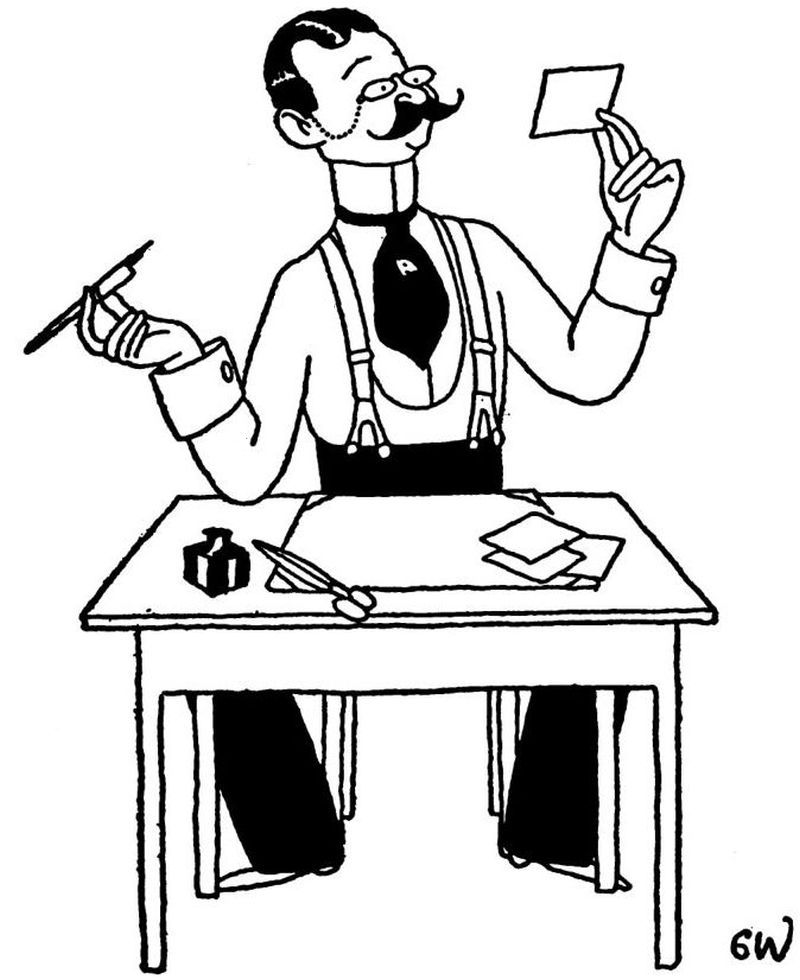
He liked this one so well he just copied it on all the others.
Then the thing began to get out of hand. Big Christmas card manufacturing concerns sprang up all over the country and factory sites adjacent to freight sidings were at a premium. Millions and millions of cards were printed and millions and millions of people began sending them to each other. Along about December 15, the blight began and, like locusts, the envelopes started drifting in from the mail. Seventy-five thousand extra mail carriers were drafted into service and finally the Government was forced to commandeer all males under 25 who did not have flat feet. Even at that, all the Christmas cards couldn’t be delivered until the first of the year, and by that time the flood of New Year’s cards had begun, for everyone who received Christmas cards from people to whom they had sent none rushed out and bought New Year’s cards to send them the next week just as if that was what they had intended to do all along.
It became impossible to read all these cards, and finally even to open them. Great stacks of unopened envelopes covered desks and hall tables throughout the country. Some of the wealthier citizens had chutes built on the outside of their houses into which the post men dumped the cards and by means of which they were conveyed direct to the furnace. The poorer people, unable to convert their mail matter into fuel in this manner, unable sometimes to clear away a path from their front door to the street, often starved to death before their provisions could be got to them. The winter of 1927 was known as the Winter of the Red Death, for all over the country families were snowed in with envelopes and perished before help could be brought to them. In some towns fires were accidentally started with results too horrible to relate.
UNEARTH VALUABLE SCIENTIFIC DATA
Excavators who have recently been at work in the Middle West digging through mounds of petrified envelopes have furnished valuable data on the nature of these objets d’art. The most popular design seems to have been that involving a fireplace with stockings hanging from it, with the slogan, evidently satirical, “A Merry Christmas and a Happy New Year.” Candles were also highly considered as decoration; candles and bells. When human figures were introduced, they were of the most unpleasant types: short, fat, bearded men dressed in red, offensively gay little children in pajamas carrying lighted candles, stagecoaches filled with steaming travelers, sleigh rides and coasting parties, and street musicians annoying householders with Christmas carols. The text was usually in Old English type, so that fortunately it was difficult, if not impossible, to read.
Evidently the tide began to turn when some one, perhaps a descendant of the very Ferderber who had brought all this distress on the land, thought of the idea of venting his personal spleen in his Christmas cards. He thought that, since no one read them anyway, he might as well say what he really felt, so long as he said it in Old English type. It would be a satisfaction to him, anyway. So near the top of these mounds of Early Twentieth Century cards we find some on this order:
A picture of a holly wreath with a large hammer stuck through it and the following legend:
“Just to Wish You the Measles. Christmas 1931.”
Another showed a little cottage on the brow of a snow-covered hill with the sun setting behind it. On the cottage was a sign: “For Sale.” The sentiment underneath was:
“Peace on Earth, Good Will Toward Men; Heh! Heh!”
A New Year’s card, with “Greetings” embossed at the top, read:
“If I don’t see you in 1933 1934 will be soon enough for me.”
As soon as this fad caught on, the pendulum swung the other way. The sentiments, beginning with the mildly abusive, gradually became actually vicious.
We find one, dated 1938, which says:
“This Christmas Eve I want you to know, That if you don’t leave $50,000 in Box 115 before New Year’s, I’ll sell your letters, you crook, you.”
Another, in a wreath of mistletoe, bore the following explicit legend:
“Watch Your Wife.”
It was naturally but a step from these to downright obscene vituperation, and at this point, the reform societies stepped in. A campaign was carried on throughout the country, which, unlike other reform campaigns, had the backing of a majority of the public. It was but the work of a year or so to induce the necessary two-thirds of the state legislatures to consent to an amendment to the constitution forbidding the manufacture and sale of Christmas cards. Naturally this was followed by a period of widespread bootlegging, but it was half-heartedly supported and soon collapsed.
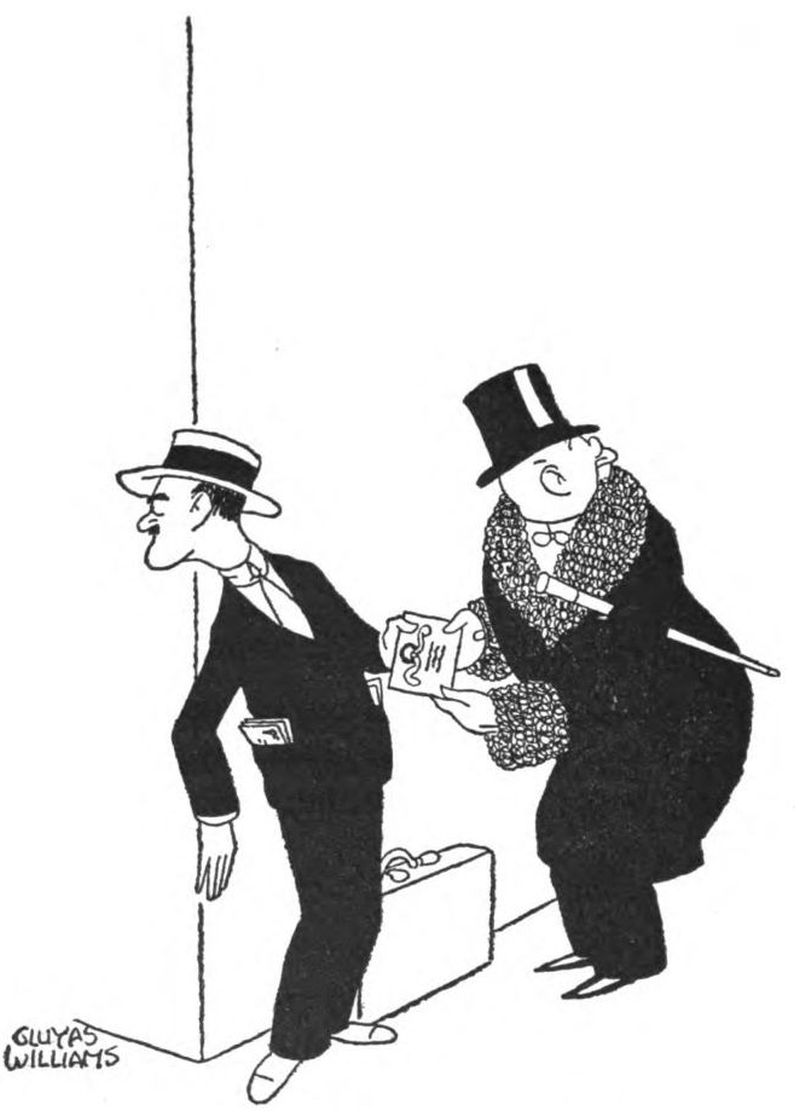
This was followed by a period of widespread bootlegging.
All of which is merely a historical summary of what has been done in the past, preliminary to launching a campaign against the sale and manufacture of all Christmas presents, with the exception of toys. What our fathers did, we can do.