WATER FOOTBALL Suggestions to the Rules Committee for Making Use of Rain
Reading edition
Whatever it is that the football rules committee does during that week in the spring that it spends in New York (and you can’t tell me that a group of healthy men can stay in a New York hotel room all the time and think of nothing but football, football, football) it certainly makes no provision for rain on the day of a big game. And anyone who has sat through four two-hour periods in a downpour will tell you that football, as it is played today, is essentially a fair-weather sport.
I had a cousin who went to the Harvard-Yale game last year and contracted gelatin-trouble, owing to the sizing in his fur coat having soaked through into his spine and gone the rounds of his entire system. He sat in a large puddle (one of the largest in the Yale Bowl, he tells me, and you know what a big place the Yale Bowl is) and along about six o’clock, on the way home in the machine, he felt a queer sort of spinal disintegration. “As if I were going to pieces,” is the way he expressed it. He thought nothing of it until his arms and legs began to come off and then he went somewhere and lay down. Whatever it was that finally became of him, the point is that watching football in the rain is no darned fun and the least that the rules committee can do is to make some regulations covering a situation that so frequently exists.
For instance, when it is found that the field is going to be knee-deep in mud and water, there ought to be some way of changing the nature of the game entirely, so that the very elements which would, under the old rules, work toward a spoiling of the game, might be turned into favorable factors for all concerned.
Thus we might have a play (to be called “left half around the sandbar”) in which, at the signal, the left halfback takes the ball from the quarter, tosses it into a dory, shoves off, and rows around right end. His interference, also in dories, could ward off tacklers by splashing water in their faces, use of the oars as clubs to be called illegal. To meet this play, it would be the function of the defensive backs to row through and, if possible, force the man with the ball in his boat to row onto a sandbar or else create such a wash that it upsets him.
Or, there might be an entirely different ball used during a rain storm—a large, red rubber ball such as some nuisance always has at the beach in the summer. This could be tossed back and forth, the players screaming with excitement the while, until one side or the other gets tired. With this type of ball, a very neat trick play could be utilized, the “U-56, or concealed ball play” in which the quarterback, immediately on receiving the pass, would shove the ball under the surface of the water, sit on it, and paddle himself around left end or through left tackle, if a hole could be opened up for him. The fun here would be for the defense to drown the runner.
Of course, the rain is not always sufficiently heavy to make the water deep enough for the two plays outlined above. Sometimes it merely drizzles and there is nothing but mud on the field. This would call for an entirely new list of plays. Under these conditions, the old Carlisle Indian trick could be revived, each of the backs scooping up an armful of mud and running with it, the defense being unable to tell in which armful the ball is hidden. Or, as an alternate play, the backfield could daub their faces with mud to look like a negro quartette and could start humming old plantation melodies. Then, while the defense stopped and listened, enchanted, the right end could pick up the leather and slide down the field with it.
The big spectacular play, however, for a muddy day is the “sappers’ wedge” or “East Side subway.” In this trick, the linemen throw up breastworks of mud in front of the line of scrimmage. When the ball is put into play, the backs burrow down into the soft ground and tunnel themselves under the line, digging out on the other side for a gain of perhaps five yards. This play can be used effectively when within five yards of the goal, as the back carrying the ball has made, ipso facto, a touchdown.
This outline of aquatic football has, however, not taken the spectators into account. Who ever does? But there they are, millions and millions of them, and something must be done for them on a rainy day.
Since there is always someone in front of you who has an umbrella up, you might as well give up any idea you may have had of watching the game. Don’t torture yourself by trying to peek around the umbrella, catching sight of the beginning of a play and never knowing until you hear the cheering whether or not it succeeded. In this way lies madness. Just give up trying to spy on the field maneuvers and get your neighbors to enter into a few little games with you to pass the time away.
There is, for example, the game of “Neck Cisterns.” In this game, all the people sitting in a row open out the collars of their coats in the back, sitting hunched forward so as to make the opening as big as possible. The idea is to see who can catch the most rain water down the back of the neck. Drippings from an umbrella are not allowed. The water must come directly down and into the collar. The winner is the one whose collar runs over first.
This may seem like a very simple game to play, and one dependent entirely on the capacity of the coat of the contestant. This is not so. A great deal of skill can be brought into playing it by adjusting the angle of the body to meet the angle of the rain at a point where the maximum amount of water will drive into the collar. An old hand at “Neck Cisterns” can fill his coat up to overflowing before a beginner has got even his shoulder blades wet.
Another similar game is that of “Brimming.” The players in this turn the brims of their hats up so as to catch the rain water. At a given signal, the brims are suddenly turned down and the heads thrust forward, the idea being to project the deluge of water as far out as possible. The one hitting the person farthest in front wins and is the champion “brimmer” of the section. During the final period of the football game, the champion “brimmers” from each section meet and play off the finals.
Of course, one of the chief features of watching a contest in the rain is the wet seat. You hop up in your excitement at seeing the boys pull off a forward pass (which is grounded) and, by the time you have got around to sitting down again, the place which you have been keeping dry up until the forward pass is now a tiny lily pond with swan boats in it. Into this you sink back exhausted from your cheering, and in it you sit for the rest of the game while, starting from the pond as a base, a series of chills race up your spine to a spot directly behind your ears, where they break ranks.
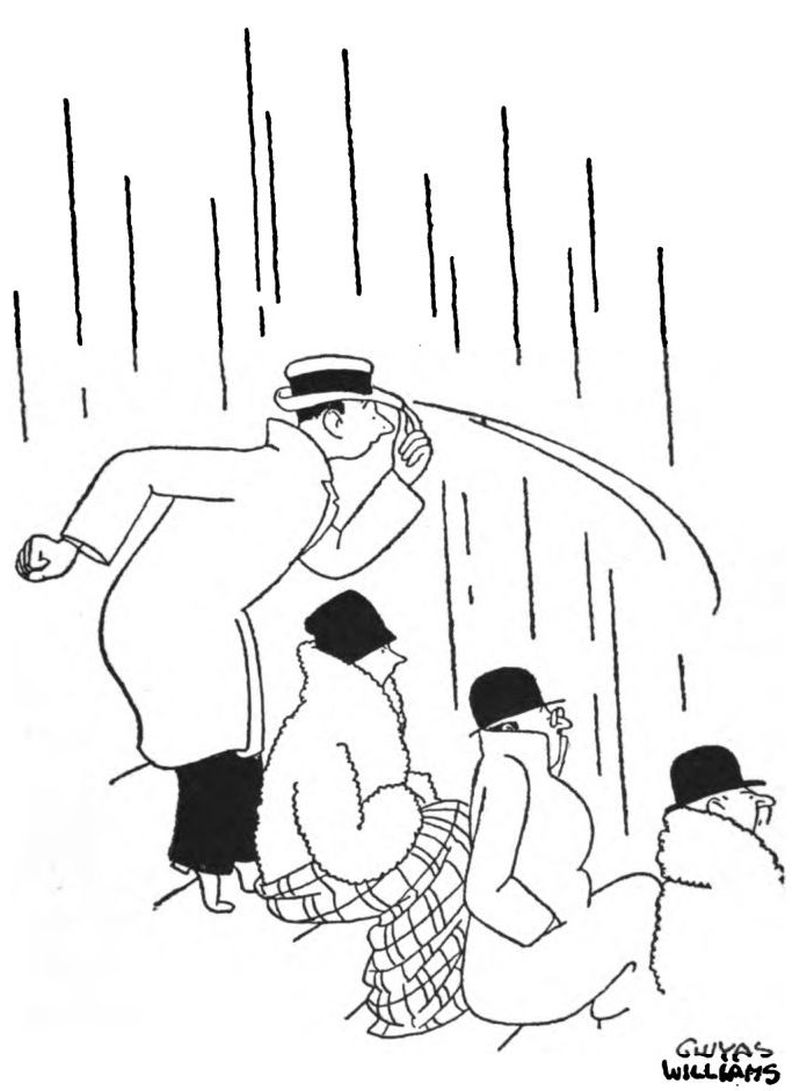
The one hitting the person farthest in front wins.
One of the most interesting by-products of watching a football game in the rain occurred in Lawrence, Massachusetts, in 1919. It had rained all during the first three periods of the game and everyone was sitting in individual pools, giving the matter no more thought. Several hundred of them had been fighting a brave fight against the cold and damp by means of that greatest little cold and damp fighter of them all, the pocket flask, and these brothers didn’t even know that they were sitting in water. They knew that they were sitting pretty and it didn’t make any difference to them where. Suddenly, at the beginning of the fourth period, the weather changed and grew much colder. There was a great deal of time out and dull playing, and no one felt called upon to hop up for quite some time. As a matter of fact, the game ended with the ball in mid-field and a lot of substitutes running in to get their letter. When the whistle blew, the fans started to get up to go home, but found that they were frozen to the stands. The entire Lawrence fire department came with axes and worked until eleven that night chopping the people out. A couple of old grads, who had very poor seats down in the corner behind the goal posts, were overlooked and had to stay there until spring.
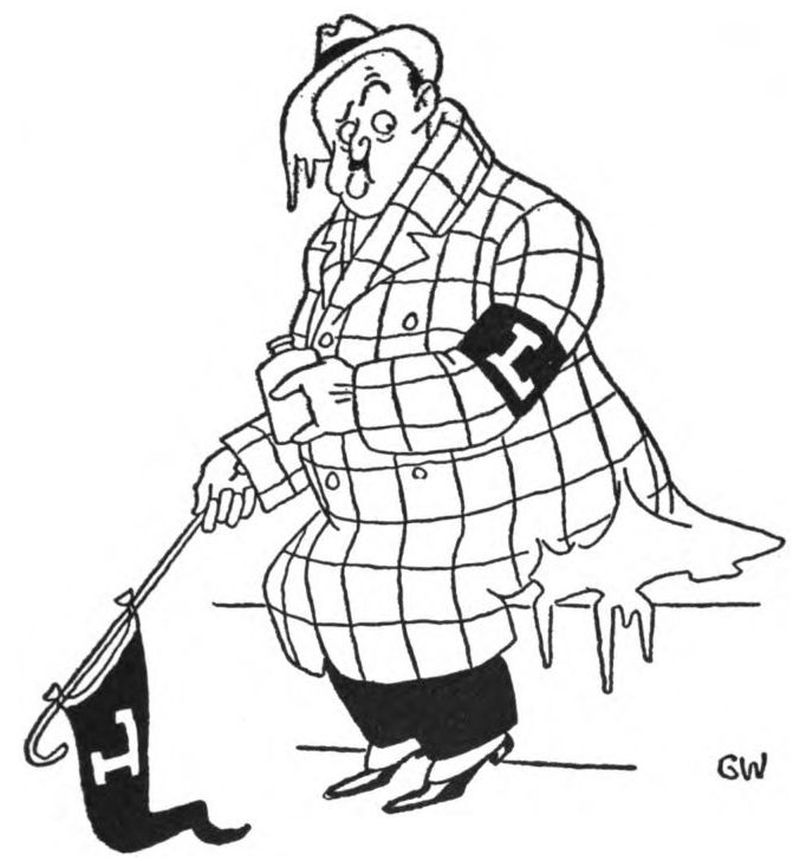
... found they were frozen to the stands.
In order to avoid a recurrence of this unfortunate accident, and in general to keep the seats dry, it has been suggested that the rules committee make it illegal for any spectator to jump to his feet during a game. This would apply even when two rival rooters started a fist fight in the stand. Coincident with the passage of this rule, similar prohibitions might be put on a man’s falling when dropped out of a window, and on the earth’s rotating on its axis.