A PLAN TO STABILIZE THE FRANC
Reading edition
To the Members of the Paris Bourse (of whom it has been said, “Bourse Will Be Bourse”), Monsieur Poincare, and Fellow Guests:
I have been asked by a deputation from your delightful country to present a plan for stabilizing the franc. I feel in this connection like the three men who found themselves in a row-boat in the middle of the ocean. One was a Frenchman, one an Irishman, and one a Scotchman.
But, seriously, the problem of the franc is a vital one. And I know of no better way to handle it than the way in which we, in my household, have handled the problem of the American dollar, an even more vital problem to us, as you may well imagine. There are, at this writing, approximately twenty-five francs to each American dollar. There are also, to each American dollar, thirty-one hungry mouths. Three times six is eighteen and one to carry, six times seven is forty-two and one is forty-three and four to carry, giving a result of four hundred and sixty-one.... No, that can’t be right.... Well, anyway, the life of one American dollar has been estimated at one-third that of a sugar lozenge under a faucet. This estimate gives the dollar the breaks.
Now, it was only through the most rigid household economy that we were able to stabilize the dollar in our family. Several of the older and more infirm members of the family died from under-nourishment and exposure, being unable to fight for the food or bed-clothing. But that is the Law of the Tribe, that the weaker shall give way to the stronger and those with protective coloring survive the assaults of the predatory land animals and the constant action of the tides. “Easy come, easy go,” is what the old folks must remember.
Our first move toward putting our household on a gold basis was to make out a budget, and that is what you dear people of France must do, too. It is much simpler for a nation to go on a budget than for a private family, because a nation never uses real money anyway. A nation says, “Here are twenty million francs,” or “Give me a hundred million dollars’ worth of chips,” and, if you push right up close to the counter and ask to see it, what do you find? A couple of theater-ticket stubs, a right-hand glove, and a piece of paper saying, “I.O.U. $100,000,000.... A. Mellon.” There probably isn’t $125 in actual cash in the whole United States Treasury at this very minute. And $45 of that belongs by rights to me, on account of the Government having disallowed my deduction for hotel expenses in my 1925 income tax. I’ll get that back yet, you wait and see. The big bullies!
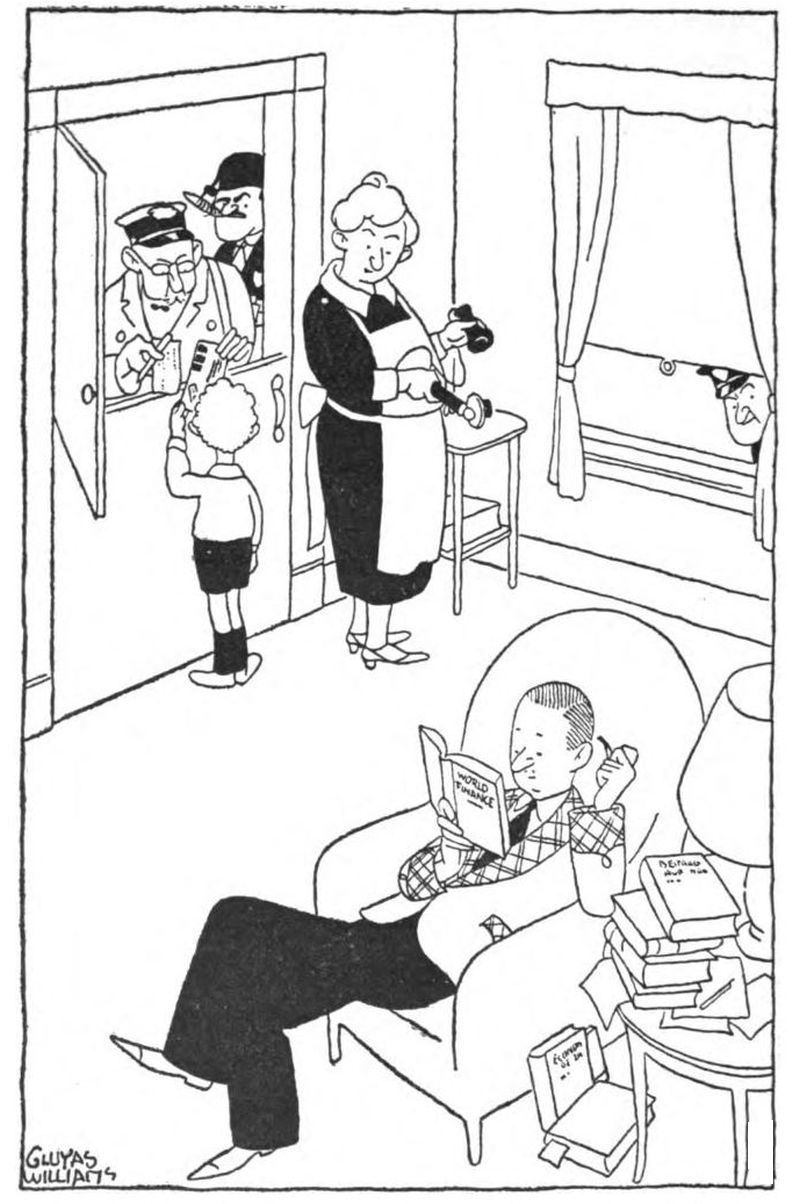
Then hell breaks loose—telephone calls, registered letters, night sweats.
This system of dealing in dream-dollars, which seems to be the special prerogative of governments and large corporations, is called “Credit,” and a pretty how-do-you-do it is, too. “Credit,” as applied to you and me, means that we have until the fifteenth of the month to dig up the actual gold ore with which to pay our bills. But for a large corporation or a nation it means that, so long as the Treasurer can sign his name, they are on Easy Street. I sign a check, in a kidding way, and give it to Altmeyer’s Meat Market. And what does Altmeyer do? Right away he presents it at my bank! And then hell breaks loose. Telephone-calls, registered letters, night-sweats—you’d think the whole world had gone money-mad. And I have to go and get a printing-press and print him his money in half a day.
But let Mr. Mellon sign a check for a billion dollars and no one even looks at the signature to see if it is genuine. It is folded up and put in the vest-pocket and never touched again for years. Is it ever presented for payment? Oh, no! Mr. Mellon signed it, never mind the money! You’d think Mr. Mellon was Richard Dix or Button Gwinnett. I could get pretty sore about the whole thing and so could you, if you had any spunk about you.
Now, in our family, there are four people, exclusive of the servant (who is lame). We have only three really to figure on, however, as the baby works.
In France, there are of course more people than that, but none nicer. It has been estimated that in each French sock there are fifteen thousand francs. In the southern provinces, where they don’t wear socks, the money is stored away in the peasants’ cheeks, or in hollow trees. This is going to make it hard to keep exact accounts because you can’t tell how much you have on hand. But nothing is worth while unless you have to work for it, which is one of the least true things that ever was said. So what I would advise would be for every French peasant to get a little pocket notebook (the J. C. Hall Co. of Providence, R. I., sell a neat little set for a dollar, a book for each month) and keep a strict personal account of everything spent—and, what is more important, everything received.
For instance, let us take a typical French shopkeeper (and wouldn’t I like to take one, and push him into the Somme!) named Jaques Duquesne. If we could get him to keep a personal account-book, marking down so much for tabac, so much for vin, so much for lavabo, and then, on the opposite page, received so much from sale to American tourist, so much from non-sale to American tourist, etc., etc., then the government officials would have a record of his financial status not one word of which could be deciphered.
But personal accounts are the only solution of the French situation, just as they were the only solution to our family crisis. My own personal account book is a joy to behold, especially if you are in the mood for a good laugh. Sometimes I get to laughing so that I can’t jot down the items. “Car-fare” I put down, and I haven’t ridden in a street-car since I used to go to dancing-school. Another good item is “Personal Improvement.” You’d be surprised at what you can crowd into Personal Improvement. If you are anything like me practically anything you do to yourself would be an improvement. My Personal Improvement account is going to run into thousands of dollars a year, and I don’t begrudge a cent of it.
To summarize then:
1. The franc is the monetary unit of France. 2. The franc is not so stable. 3. Verbs ending in aître retain the circumflex on the i whenever it is followed by t. 4. And how are you?