THE NEW VILLAINY
Reading edition
Although the new fall season in the drama is only just under way, it is not too early to view with alarm. Some Viewers-with-Alarm begin as early as September to view, but that doesn’t give you much time to collect data. Perhaps all that you can get is a datum, but a good, healthy datum is enough to base a sizable alarm-view on, and, as you go along, you can make up a datum or two, so that you can refer to the whole as data.
This month we are chiefly worried about the status (or stata) of what used to be known as “the old-time religion.” That is, its status in the world of drama. If the new season keeps on as the past two seasons have gone, being under suspicion of harboring religious thoughts will place one in the psychopathic class. For two years now, eight out of ten villains have been preachers and any layman with excessive religious tendencies has turned out to be just a repressed old sex-addict.
There was a time when the entrance of the preachers on the stage was the signal for a sigh of relief to go up, for you knew that so long as he stuck around, things were pretty sure to go as they should. The lowest he ever reached in the dramatic scale was when he was occasionally used for comedy purposes. Once in a while there was a comic bishop, but that was only natural. And any member of the cast who showed signs of quoting the Scriptures, or going to church, was pretty certain to be one of those whom you could trust to help foil the adventuress in the last act.
Then along about the time that “Rain” settled down for a run, we began to find preachers sneaking into plays whose minds were not on their work in the vineyard. Under the guise of evangelism they started in to cut up. At first we thought: “Oh, well, this is just an exception. Our Dr. Murnie at home wouldn’t do anything like this.” But gradually, after we had seen dozens and dozens of preachers come on in the first act, make a few sanctimonious remarks, and then sprout little horns and a goat’s tail, we began to look askance at even Dr. Murnie of the Second Congregational Church.
Then the lay members of the congregation came in for analysis. The hand of Freud reached out and touched the brethren and sistren and we learned that whenever anyone is excessively religious, it is a sign that they are suffering from an inhibition which is likely some day to break loose and leave Broadway strewn with bits of broken bottles and confetti. The more religious they are, the more they crave a good, rip-snorting week-end at Atlantic City, registering under the wrong name. It is all very confusing.
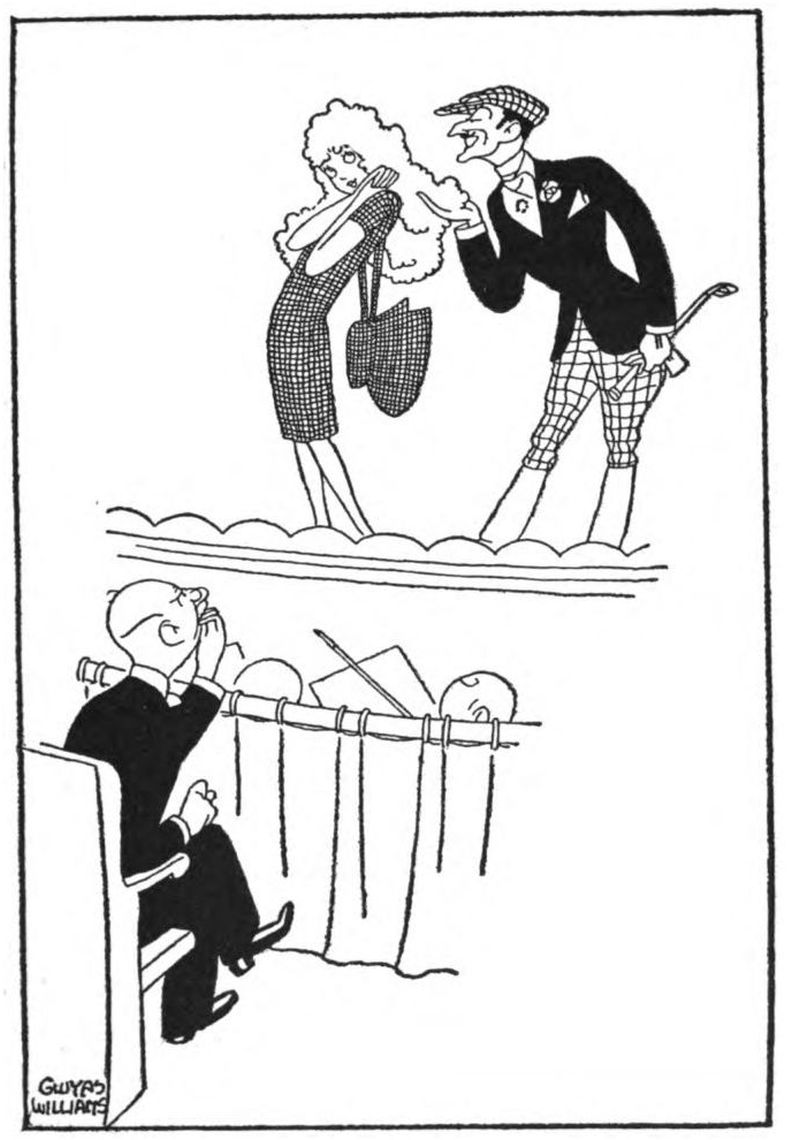
If you were highly strung you whispered out loud to the heroine.
In the old days, the minute a man came on with a mustache like Adolphe Menjou’s and wearing a pair of riding boots with a crop to slap them with, you could be pretty sure that he was up to no good. If you were highly strung you whispered out loud to the heroine not to go to the city with him as he had no more intention of marrying her than—well, than anything at all, and you know how little that is.
Today, whenever a character in clerical cloth makes his entrance, the orchestra starts picking at the violin strings in the old pizzicato villain-entrance music, the young-lady members of the cast pick their exits and the audience settles back in preparation for the dirty work.
Pretty soon we may have a scene like this:
Scene.—Living room of the DeViblis home. Father, mother, and daughter are seated around the table, splicing rope.
Daughter: Pa, there’s somethin’ I been a-wantin’ to ask you fer a long time.
Mother: For heaven’s sake, daughter, talk straight. This isn’t a New England farm play we’re in. You know how to talk better than that.
Daughter: Well, anyway, I want to marry Arthur Arthritis.
Father: What does he do for a living?
Daughter: Well, he’s changing his job in a few months.
Father: What does he do now?
Daughter: Why—er—well, I’ll tell you; just now he’s a preacher, but he’s going to change—
Mother: A preacher! Oh, my!
Father: A minister of the gospel? Where did you meet him? I thought I told you not to run around with them religious folks. They are every one of them inhibited.
Daughter: Oh, that’s just because you don’t know them, dad. They’re just as decent as you or I when you get to know them. And Arthur isn’t really a preacher. He’s just filling-in.
Father: Just filling-in, eh? I suppose you know what that leads to? Next he’ll be having a little parish of his own, then he’ll get a call to a big city, or perhaps he’ll even sink so low as to be a missionary. Them preachers are all missionaries at heart, and you know what missionaries are. No, sir, no daughter of mine gets mixed up in that crowd.
Daughter: Well, he’s coming here in a few minutes to hear your answer. There he is now!
(Enter the Rev. Heemerson.)
Father: Well, what do you want here?
The Rev. H.: Why, Brother—
Father: Don’t you “brother” me.
The Rev. H.: I love your daughter and I want to marry her.
Father: You want to marry her, eh? When you get to New York, I suppose?
The Rev. H.: Why, I thought—
Father (stepping to the telephone): Oh, you thought, did you? (To central): Give me police headquarters ... hello, police headquarters? Well, there’s a preacher in my house. Send an officer up right away!
The Rev. H. (leaving): I’m sorry, sir, that you feel this way, so I think I’ll be saying “good-by.”
Father: Good-by, and go back to your religious crowd and their loose ways and never darken my door again.
(Curtain with daughter crying, and father and mother getting down the family volume of Freud to read by the lamplight.)
All this is perhaps the result of years and years of bullyragging the stage and stage folk by preachers and religious zealots. The stage folk have found a comeback and are using it. It will be nip and tuck for a while, with the stage folk slightly in the lead until it is discovered that all stage folk are not really saints and all religious zealots not really satyrs and nymphs. Then things will settle down again. In the meantime, let’s have some more of that chicken potpie, please.