FASCINATING CRIMES II. The Wallack Disappearances
Reading edition
Shortly after the Civil War the residents of Wallack, Connecticut, were awakened by the barking of a dog belonging to James Lenn, a visiting farmer. The dog was an old one, so they thought nothing of it, and went back to sleep again.
Later it was discovered that James Lenn was missing, and that the dog also had disappeared, but in the opposite direction. A search of the countryside was instituted which resulted in the finding of twenty-five empty tins, several old brooms, enough newspapers to make a fair-sized bale, and one old buggy top. None of these seemed to have any value as clews in the mysterious disappearance of James Lenn. Some importance was attached to the discovery of the buggy-top until it was found that the missing farmer was not hiding under it.
The police, however, were not satisfied. There had been several violations of the State Fishing and Gaming ordinances in and around Wallack and public censure of the police was at its height. Chief of Police Walter M. Turbot determined to carry this case through to a finish. Thus it was that the search for Farmer James Lenn was begun afresh, a search which was destined to end in Innsbruck, Austria.
In the little town of Innsbruck there had been living an old garbler named Leon Nabgratz, a sort of town character, if such a thing were possible. Nabgratz had never been to America, but his young nephew, Gurling Nabgratz, son of Leon’s brother Meff, was born in that country and had lived there all his life. Late in December, 1867, he had moved to Wallack, Connecticut, where he was sold as a slave to one James Lenn.
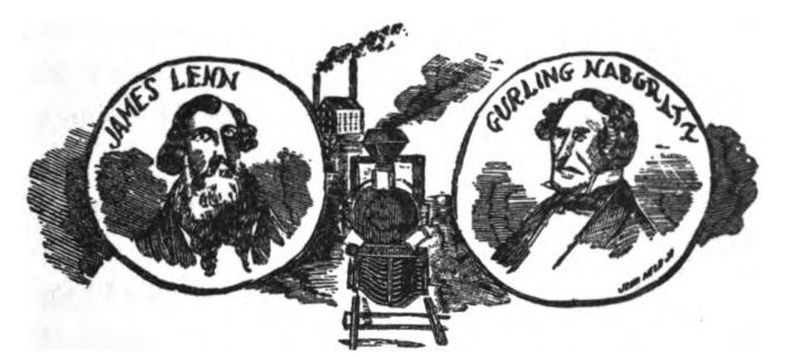
The principles in the famous Wallack disappearances.
—Courtesy of John Held, Jr., and Life.
One day, while reading the newspaper, Gurling Nabgratz came across an item indicating that slavery had been abolished four years previously and figured out that he was just a sap to be working for James Lenn for nothing. He mentioned the matter to his master, but Lenn maintained that it was only the Negro slaves who had been freed, and that Lincoln was no longer President anyway.
Nabgratz went away grumbling but did his chores that day as usual. He was seen late in the evening of April 17 in the poolroom of the village, where he is said to have made sotto-voce remarks and sung several slave songs of the ante-bellum South with such inflammatory refrains as “We’se all gwine ter be free!”
That night Gurling Nabgratz disappeared and was never seen again in Wallack.
This having preceded the disappearance of James Lenn by about two years, nothing was thought of it at the time. During the search for Lenn, however, the incident was recalled, and a search for Nabgratz was instituted. This made two searches going on at once in the little town of Wallack, and resulted in considerable hard feeling between the rival searching-parties. The town was divided into two camps, the “Find Lenn” faction and the “Find Nabgratz” faction, and on at least one occasion shots were exchanged.
In the meantime, in Innsbruck, Austria, Leon Nabgratz, the old garbler, was quietly pursuing his way, quite unconscious of the stir that he was causing four thousand miles away. His brother Meff had written him about Gurling’s disappearance, but, as the old man never bothered to read his brother’s letters, he was just as much in the dark as he had been before. More so, in fact, because he was older.
His surprise can well be imagined, therefore, when one day in the spring of 1869 the police entered his house in the Schmalzgasse and began a search for James Lenn of Wallack, Connecticut, U. S. A. In vain Nabgratz protested that he had never heard the name of Lenn and that, even if he had, it was not interesting to him. The arm of the law reaching across the Atlantic was inexorable. Leon Nabgratz’s house was searched and in it was found an old trunk of suspiciously large proportions. In spite of the fact that this trunk was labeled “Weihnachtsgeschenke” (“Christmas presents”) it was opened, and in it were found James Lenn and Gurling Nabgratz, together with a copy of the New York Times of October 12, 1868.
The mysterious Wallack disappearances were thus explained, and Leon Nabgratz was arrested for having in his possession a trunk with a misleading label on it.
Art is long and time is fleeting.