SPYING ON THE VEHICULAR TUNNEL
Reading edition
Before the formal opening of the Holland Vehicular Tunnel under the Hudson River, it behooves New Yorkers to study up a little on the subject and see why it is that 46,000 vehicles are going to want to go to Jersey City every day.
In order to present this problem fairly to the readers of this paper, the writer of this article (you must guess) took a tour of inspection of the tube, which is now completed with the exception of installing a ventilation system and hanging the curtains. Curtains make such a difference that it will probably be simply another tunnel when they are up.
Your investigator was not asked by the authorities to make this tour of inspection, but somebody from the New York Times went through the thing and wrote a story about it; so there didn’t seem to be any good reason why a reporter from The New Yorker shouldn’t. Not having the permission of the tunnel authorities, he went alone into this vast-two-mile submarine passageway, with the result that he got lost and is still in there. This story is being sent out to The New Yorker by a code of tappings executed on the roof of the giant shell by the lost investigator. As soon as he finishes sending in copy (which will be relayed to the publication offices by a special tugboat and automobile service) the reporter will turn his energies again to the problem of getting out of the tube. After all, there are only two ways possible in which to go; so it ought not to be very difficult. The big problem comes in trying to decide which way to take.
Now that we are well acquainted it might be less formal if I use the first person. You probably knew that it was I all along anyway. These little editorial subterfuges are rather futile.
But to get back to the tunnel—or rather to get out of the tunnel. Sneaking in by the entrance at Canal Street, Manhattan, I made my way through the tiled passageway for what must have been a mile before I realized that, really, when you have seen the first hundred feet of a vehicular tunnel you have seen all 9250. I had got the idea by then. The next problem was whether to go on ahead to the Jersey City exit or turn and go back to Canal Street. Not knowing how far I had come, I couldn’t figure out which way would be the shorter. Then, in turning around several times to see if I could make out any light at either end, I forgot which was the way to New York and which the way to Jersey City. This was quite terrifying and I began to cry softly. I made frantic little starts, first in one direction and then in the other, and finally sat down on the ground and sobbed myself to sleep.
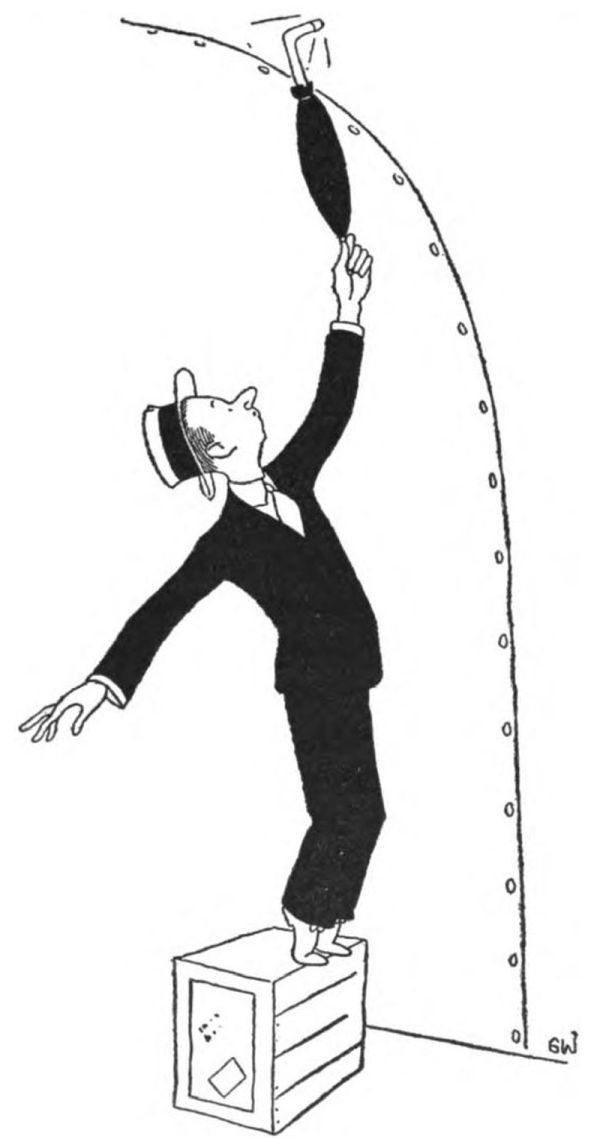
I attracted the attention of a passing tug.
When I awoke, it was high time that my story was in; so I attracted the attention of a passing tug by tapping on the roof of the tube and indicated that I had a story to file for The New Yorker. The rest is history.
Well, anyway.
The Holland Vehicular Tunnel is a dandy tunnel, all right, all right. The roadways are 20 feet wide and there is 13 feet, 6 inches of headroom. The extra six inches is for wedding parties in which there are men in silk hats. It is estimated that in one year 15,000,000 vehicles will pass through the tube. Wouldn’t you like to have a dollar for every vehicle! A dollar and a half would be even better. Boy! What I couldn’t do with $22,500,000!
I was pleased to note that there are to be telephone stations along the route. This will make it possible to call up and say:
“Look here! I’m held up in the vehicular tunnel and probably can’t get anything before the 8:15. Don’t wait dinner. I’ll eat in Jersey City.”
This question of being held up in the tunnel is one which must present itself to everyone who gives the matter any thought at all. There aren’t many things certain in this life, but there is one event I can predict without even adding “maybe.” On my first trip through the vehicular tunnel at the wheel of my high-powered car, just as I get halfway between New York and New Jersey, with a line of impatient Sunday automobilists behind me, I am going to run out of gas. I’ll bet that the engineers in charge have never once thought of this contingency, and when it arises, it is going to make their tunnel look pretty silly. It was a silly idea anyway, in the first place.