THROWING BACK THE EUROPEAN OFFENSIVE
Reading edition
This is probably the hardest time of year for for those of us who didn’t go to Europe last summer. It was bad enough when the others were packing and outlining their trips for you. It was pretty bad when the postcards from Lausanne and Venice began coming in. But now, in the fall, when the travelers are returning with their Marco Polo travelogs, now is when we must be brave and give a cheer for the early frost.
There are several ways to combat this menace of returning travelers. The one that I have found most effective is based on the old football theory that a strong offense is the best defense. I rush them right off their feet, before they can get started.
In carrying out this system, it is well to remember that very few travelers know anything more about the places they have visited than the names of one hotel, two points of interest, and perhaps one street. You can bluff them into insensibility by making up a name and asking them if they saw that when they were in Florence. My whole strategy is based on my ability to make up names. You can do it, too, with practice.
Thus, let us say that I am confronted by Mrs. Reetaly who has just returned from a frantic tour of Spain, southern France, and the Ritz Hotel, Paris. You are inextricably cornered with her at a tea, or beer night, or something. Following is a transcript of the conversation. (Note the gathering power of my offense.)
Mrs. R.: Well, we have just returned from Europe, and everything seems so strange here. I simply can’t get used to our money.
Mr. B.: I never see enough of it to get used to it myself. (Just a pleasantry.)
Mrs. R.: When we were in Madrid, I just gave up trying to figure out the Spanish money. You see, they have pesetas and—
Mr. B.: A very easy way to remember Spanish money is to count ten segradas to one mesa, ten mesas to one rintilla and twenty rintillas to one peseta.
Mrs. R.: Oh, you have been to Spain? Did you go to Toledo?
Mr. B.: Well, of course, Toledo is just the beginning. You pushed on to Mastilejo, of course?
Mrs. R.: Why—er—no. We were in quite a hurry to get to Granada and—
Mr. B.: You didn’t see Mastilejo? That’s too bad. Mastilejo is Toledo multiplied by a hundred. Such mountains! Such coloring! Leaving Mastilejo, one ascends by easy stages to the ridge behind the town from which is obtained an incomparable view of the entire Bobadilla Valley. It was here that, in 1476, the Moors—
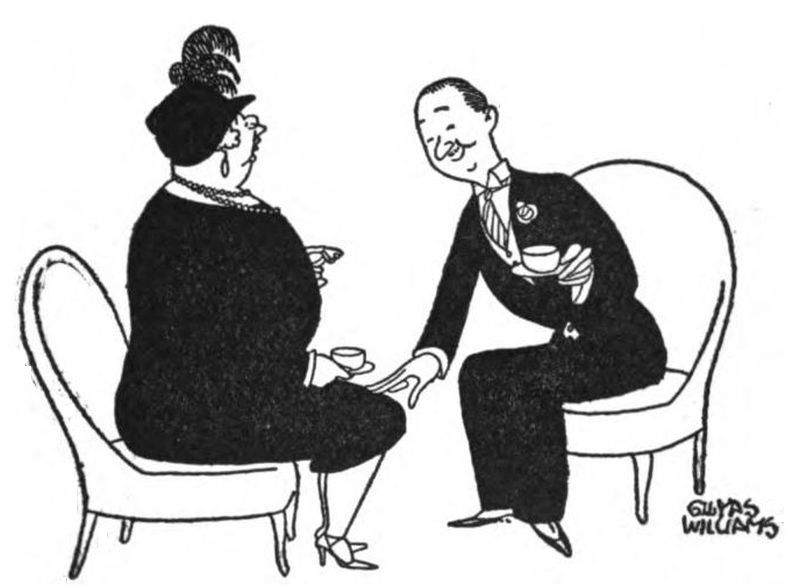
“Unless you have seen Tuna, you haven’t seen Spain.”
Mrs. R.: The Moorish relics in Granada—
Mr. B.: The Moorish relics in Granada are like something you buy from Sears-Roebuck compared to the remains in Tuna. You saw Tuna, of course?
Mrs. R.: Well, no (lying her head off), we were going there, but Harry thought that it would just be repeating what—
Mr. B.: The biggest mistake of your life, Mrs. Reetaly, the biggest mistake of your life! Unless you have seen Tuna, you haven’t seen Spain.
Mrs. R.: But Carcassonne—
Mr. B.: Ah, Carcassonne! Now you’re talking! Did you ever see anything to beat that old diamond mill in the Vielle Ville? Would they let you go through it when you were there?
Mrs. R.: Why, I don’t think that we saw any old diamond mill. We saw an old—
Mr. B.: I know what you’re going to say! You saw the old wheat sifter. Isn’t that fascinating? Did you talk with the old courier there?
Mrs. R.: Why, I don’t remember—
Mr. B.: And the hole in the wall where Louis the Neurotic escaped from the Saracens?
Mrs. R.: Yes, wasn’t that—? (Very weak.)
Mr. B.: And the stream where they found the sword and buckler of the Man with the Iron Abdomen?
Mrs. R. (edging away): Yes, indeed.
Mr. B.: And old Vastelles? You visited Vastelles, surely?... Mrs. Reetaly, come back here, please! I just love talking over these dear places with someone who has just been there.... May I call on you some day soon and we’ll just have a feast of reminiscence?... Thank you. How about tomorrow?
And from that day to this, I am never bothered by Mrs. Reetaly’s European trip, and you needn’t be, either, if you will only study the above plan carefully.
The other method is based on just the opposite theory—that of no offense, or defense, at all. It is known as “dumb submission,” and should be tried only by very phlegmatic people who can deaden their sensibilities so that they don’t even hear the first ten minutes of the traveler’s harangue. The idea is to let them proceed at will for a time and then give unmistakable evidence of not having heard a word they have said. Let us say that Mr. Thwomly has accosted me on the train.
Mr. T.: It certainly seems funny to be riding in trains like this again. We have been all summer in France, you know, and those French trains are all divided up into compartments. You get into a compartment—compartimon, they call them—and there you are with three or five other people, all cooped up together. On the way from Paris to Marseilles we had a funny experience. I was sitting next to a Frenchman who was getting off at Lyons—Lyons is about half way between Paris and Marseilles—and he was dozing when we got in. So I—
Mr. B.: Did you get to France at all when you were away?
Mr. T.: This was in France that I’m telling you about. On the way from Paris to Marseilles. We got into a railway carriage—
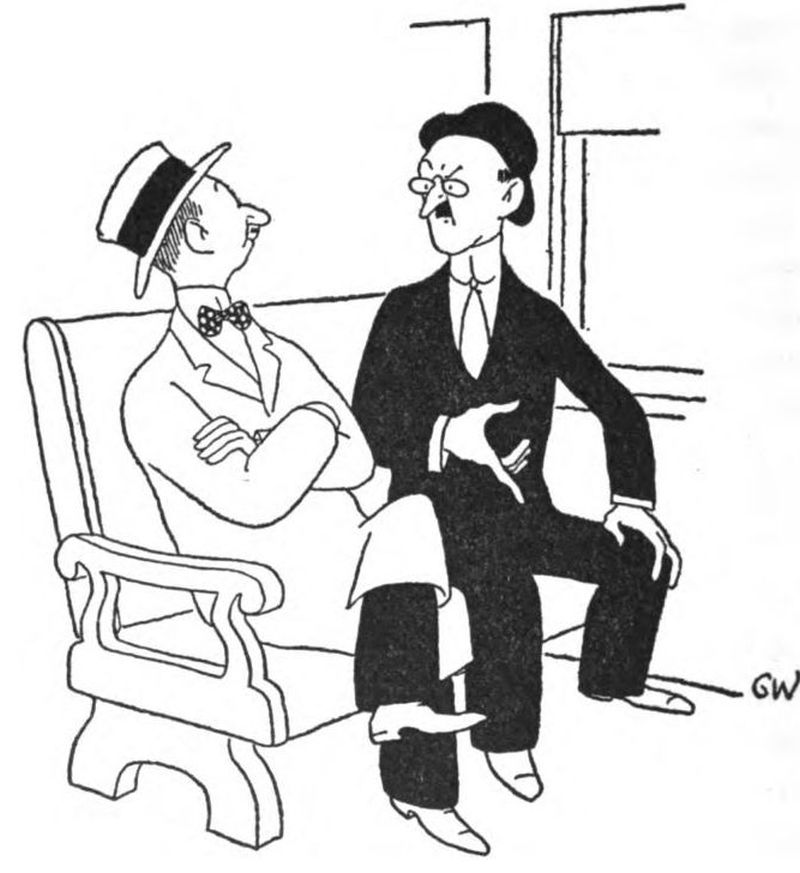
“Did you get to France at all when you were away?”
Mr. B.: The railway carriages there aren’t like ours here, are they? I’ve seen pictures of them, and they seem to be more like compartments of some sort.
Mr. T. (a little discouraged): That was a French railway carriage I was just describing to you. I sat next to a man—
Mr. B.: A Frenchman?
Mr. T.: Sure, a Frenchman. That’s the point.
Mr. B.: Oh, I see.
Mr. T.: Well, the Frenchman was asleep, and when we got in I stumbled over his feet. So he woke up and said something in French, which I couldn’t understand, and I excused myself in English, which he couldn’t understand, but I saw by his ticket that he was going only as far as Lyons—
Mr. B.: You were across the border into France, then?
Mr. T. (giving the whole thing up as a bad job): And what did you do this summer?
Whichever way you pick to defend yourself against the assaults of people who want to tell you about Europe, don’t forget that it was I who told you how. I’m going to Europe myself next year, and if you try to pull either of these systems on me when I get back, I will recognize them at once, and it will just go all the harder with you. But, of course, I will have something to tell that will be worth hearing.