FASCINATING CRIMES I. The Odd Occurrence in the Life of Dr. Meethas
Reading edition
Early in the evening of October 14, 1879, Dr. Attemas Meethas, a physician of good repute in Elkhart, Indiana, went into the pantry of his home at 11 Elm Street, ostensibly to see if there was any of that cold roast pork left. The good doctor was given to nibbling cold roast pork when occasion offered.
As he passed through the living-room on his way to the pantry, he spoke to his housekeeper, Mrs. Omphrey, and said that, if everything turned out all right, he would be at that cold roast pork in about half a minute (Elkhart time—an hour earlier than Eastern time). “Look out for the pits,” Mrs. Omphrey cautioned him, and went on with her stitching. Mrs. Omphrey, in her spare time, was a stitcher of uppers for the local shoe-factory.
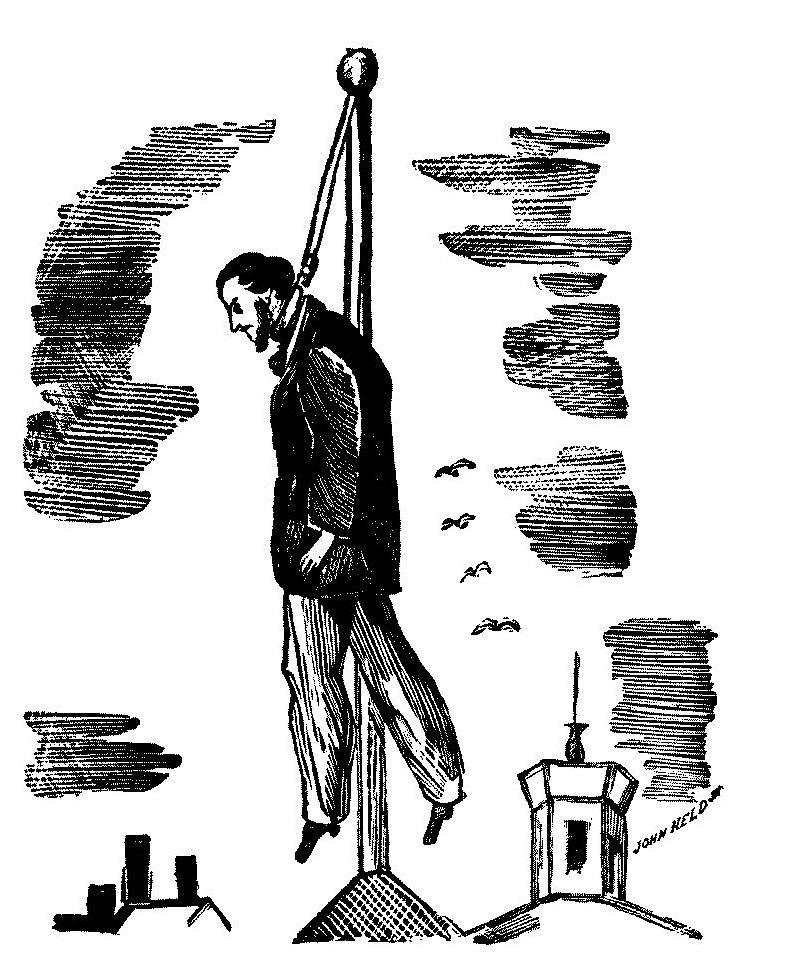
This is the last that was seen of Dr. Attemas Meethas alive. It is doubtful if he ever even reached the pantry, for the cold roast pork was found untouched on a plate, and Dr. Meethas was found, three days later, hanging from the top of the flag-pole on the roof of the Masonic Lodge. The mystery was even more puzzling in that Dr. Meethas was not a Mason.
The revolting death of Dr. Meethas.
—Courtesy of John Held, Jr., and Life.
Citizens of Elkhart, on being grilled, admitted having seen the doctor hanging from the flag-pole for two days, but thought that he was fooling and would come down soon enough when he got hungry. But when, after three days, he made no sign of descending, other than to drop off one shoe, a committee was formed to investigate. It was found that their fellow-citizen, far from playing a practical joke on them, had had one played on him, for he was quite dead, with manifold and singular abrasions. A particularly revolting feature of the case was that the little gold chain which the doctor wore over his right ear, to keep his pince-nez glasses in place, was still in position. This at once disposed of the possibility of suicide.
Mrs. Omphrey and her uppers were held for examination, as it was understood that she had at one time made an attempt on the doctor’s life, on the occasion of his pushing her down when they were skating together. But her story in the present affair was impregnable. After the doctor had gone through the living-room on his way to the pantry, she said that she continued stitching at her machine until nine o’clock in the evening. She thought it a little odd that Dr. Meethas did not return from the pantry, but figured it out that there was probably quite a lot of cold roast pork there and that he was still busy nibbling. At nine o’clock, however, she stopped work and started on her rounds of the house to lock up for the night. On reaching the pantry, she found that her employer was not there, and had not been there; at least that he had not touched the pork. She thought nothing of it, however, as it occurred to her that the doctor had probably remembered an engagement and had left suddenly by the pantry window in order not to worry her. So, after finishing the cold pork herself, she locked the bread-box and retired for the night. The police, on investigation, found the bread-box locked just as she had said, and so released Mrs. Omphrey.
When the news of Dr. Meethas’ accident reached La Porte, Amos W. Meethas, a brother of the victim and a respected citizen of the town, came directly to Elkhart and insisted on an investigation. He said that his brother had accumulated quite a fortune tinting postcards on the side, and was known to have this money hidden in a secret panel in the hammock which hung on the back porch. The police, guided by Mr. Amos Meethas, went to the hammock, slid the panel open and found nothing there but some old clippings telling of Dr. Meethas’ confirmation in 1848. (He was a confirmed old bachelor.) This definitely established robbery as the motive for the crime. The next thing to do was to discover someone who could climb flag-poles.
Neighbors of the doctor recalled that some weeks before a young man had gone from door to door asking if anybody wanted his flag-pole climbed. He said he was working his way through college climbing flag-poles and would be grateful for any work, however small. He was remembered to have been a short youth about six feet two or three, with hair blond on one side and dark on the other. This much the neighbors agreed upon.
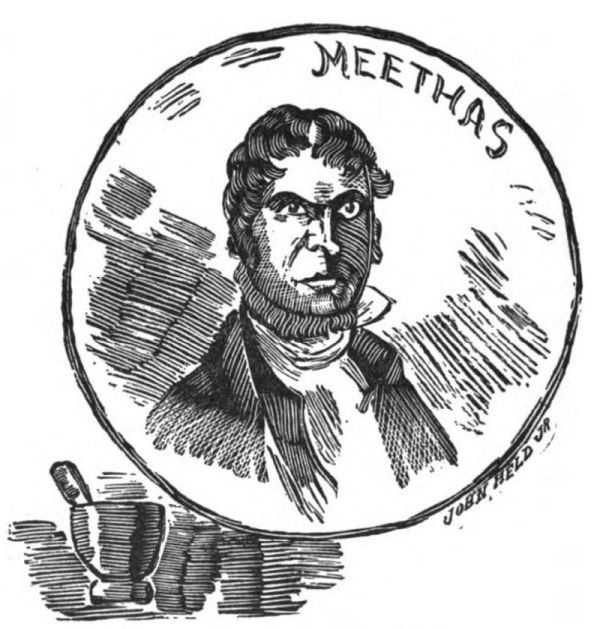
Dr. Meethas—The unfortunate victim.
—Courtesy of John Held, Jr., and Life.
Working in South Bend at the time was a young man named Herman Trapp. He was apprehended by the authorities, who subsequently decided that he had no connection whatever with the tragedy.
So the strange murder of Dr. Meethas (if indeed it was a murder) rests to this day unsolved and forgotten, which is just as well, as it was at best a pretty dull case.