THE BOYS’ CAMP BUSINESS
Reading edition
There seems to be an idea prevalent among parents that a good way to solve the summer problem for the boy is to send him to a boys’ camp. At any rate, the idea seems to be prevalent in the advertising pages of the magazines.
If all the summer camps for boys and girls turn out the sterling citizens-in-embryo that they claim to do, the future of this country is as safe as if it were in the hands of a governing board consisting of the Twelve Apostles. From the folders and advertisements, we learn that “Camp Womagansett—in the foothills of the White Mountains” sends yearly into the world a bevy of “strong, manly boys, ready for the duties of citizenship and equipped to face life with a clear eye and a keen mind.” It doesn’t say anything about their digestions, but I suppose they are in tiptop shape, too.
The outlook for the next generation of mothers is no less dazzling. “Camp Wawilla for Girls,” we learn, pays particular attention to the spiritual development of Tomorrow’s Women and compared to the civic activities of the majority of alumnæ of Wawilla, those of Florence Nightingale or Frances Willard would have to be listed under the head of “Junior Girls’ Work.”
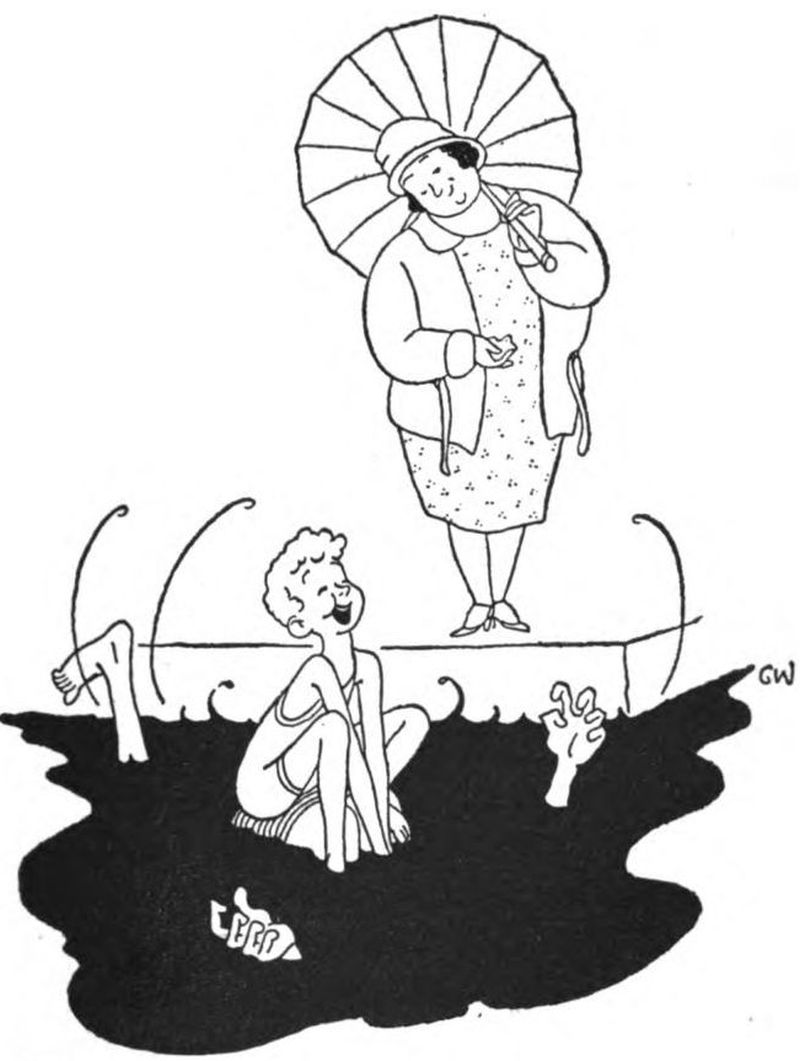
Holding you under water until you are as good as drowned.
Now this is all very splendid, and it is comforting to think that when every boy and girl goes to Womagansett or Wawilla there will be no more Younger Generation problem and probably no crime waves worth mentioning. But there are several other features that go hand in hand with sending the boy to camp which I would like to take up from the parents’ point of view, if I may. I will limit myself to twenty minutes.
In the first place, when your boy comes home from camp he is what is known in the circular as “manly and independent.” This means that when you go swimming with him he pushes you off the raft and jumps on your shoulders, holding you under water until you are as good as drowned—better, in fact. Before he went to camp, you used to take a kindly interest in his swimming and tell him to “take your time, take it easy,” with a feeling of superiority which, while it may have had no foundation in your own natatorial prowess, nevertheless was one of the few points of pride left to you in your obese middle-age. After watching one of those brown heroes in one-piece suits and rubber helmets dive off a tower and swim under water to the raft and back, there was a sort of balm in being able to turn to your son and show him how to do the crawl stroke, even though you yourself weren’t one of the seven foremost crawl experts in the country. You could do it better than your son could, and that was something.
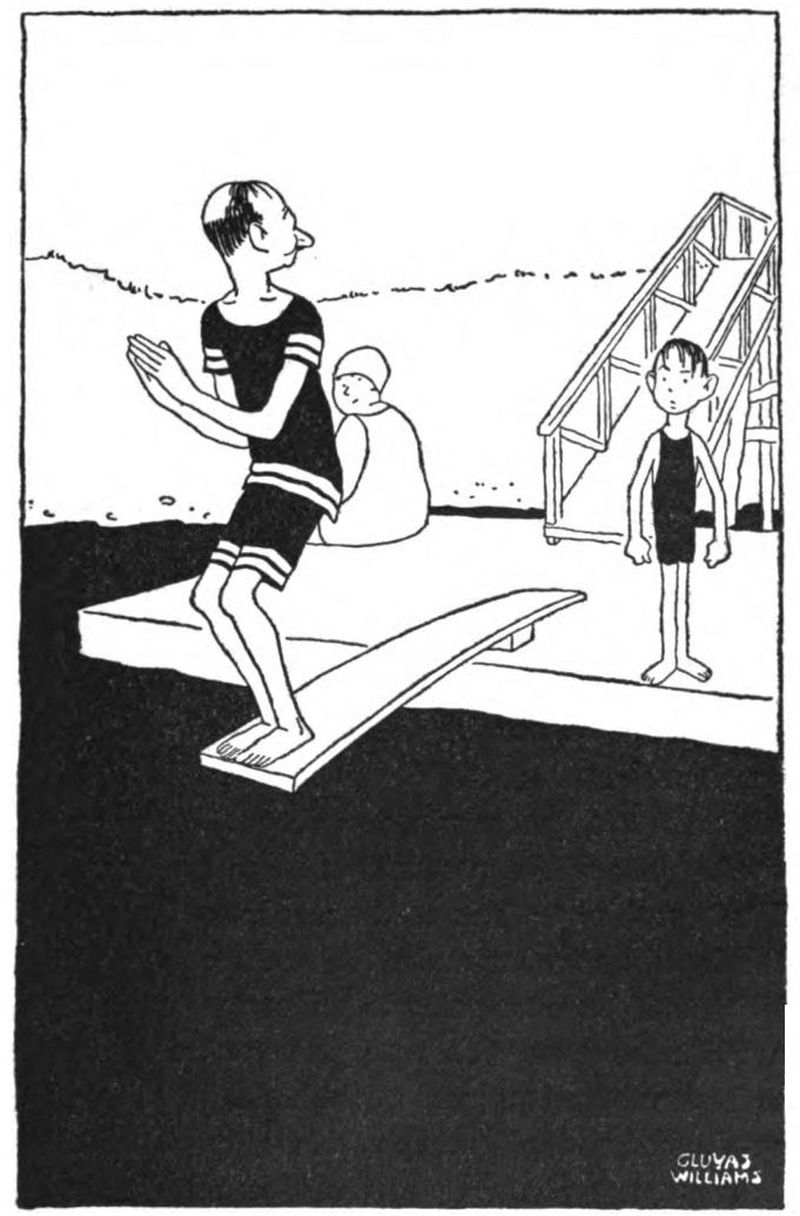
“Now watch Daddy. See? Hands like this, bend your knees. See?”
It was also very comforting to be able to stand on the springboard and say: “Now watch Daddy. See? Hands like this, bend your knees. See?” The fact that such exhibitions usually culminated in your landing heavily on the area bounded by the knees and the chest was embarrassing, perhaps, but at that you weren’t quite so bad as the boy when he tried the same thing.
But after a summer at camp, the “manly, independent” boy comes back and makes you look like Horace Greeley in his later years. “Do this one, Dad!” he says, turning a double flip off the springboard and cutting into the water like a knife blade. If you try it, you sprain your back. If you don’t try it, your self-respect and prestige are shattered. The best thing to do is not to hear him. You can do this by disappearing under the surface every time it looks as if he were going to pull a new one. After a while, however, this ruse gets you pretty soggy and waterlogged and you might better just go in and get dressed as rapidly as possible.
The worst phase of this new-found “independence” is the romping instinct that seems to be developed to a high state of obnoxiousness at all boys’ camps. I went to camp when I was a boy, but I don’t remember being as unpleasant about my fun as boys today seem to be. I have done many mean things in my time. I have tortured flies and kicked crutches out from under cripples’ arms. But I have never, so help me, Confucius, pushed anybody off a raft or come up behind anyone in the water and jumped up on his shoulders. And I don’t think that Lincoln ever did, either.
There is evidently a course in raft pushing and back jumping in boys’ camps today. Those photographs that you see in the camp advertisements, if you examine them closely, will disclose, in nine cases out of ten, a lot of boys pushing each other off rafts. You can’t see the ones who are jumping on others’ shoulders, as they are under water. But I want to serve notice right now that the next boy who pushes me off a raft when I am not looking, or tries to play leapfrog over me in ten feet of water, is going to be made practically useless as Tomorrow’s Citizen, and I am going to do it myself, too. If it happens to be my own son, it will just make the affair the sadder.
Another thing that these manly boys learn at camp is a savage habit of getting up at sunrise. The normal, healthy boy should be a very late sleeper. Who does not remember in his own normal, healthy boyhood having to be called three, four, or even five times in the morning before it seemed sensible to get up? One of the happiest memories of childhood is that of the maternal voice calling up from downstairs, fading away into silence, and the realization that it would be possibly fifteen minutes before it called again.
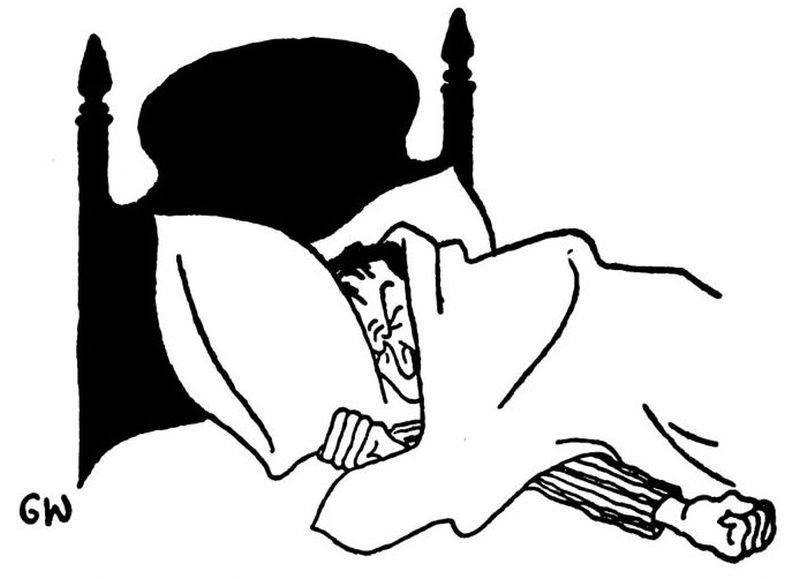
You’d be surprised at the sound two bicycle wheels can make on a gravel path.
All this is denied to the boy who goes to a summer camp. When he comes home, he is so steeped in the pernicious practice of early rising that he can’t shake it off. Along about six o’clock in the morning he begins dropping shoes and fixing up a new stand for the radio in his room. Then he goes out into the back yard and practices tennis shots up against the house. Then he runs over a few whistling arrangements of popular songs and rides his bicycle up and down the gravel path. You would be surprised at the sound two bicycle wheels can make on a gravel path at six-thirty in the morning. A forest fire might make the same crackling sound, but you probably wouldn’t be having a forest fire out in your yard at six-thirty in the morning. Not if you had any sense, you wouldn’t.
Just what the boys do at camp when they get up at six is a mystery. They seem to have some sort of setting-up exercises and a swim—more pushing each other off the raft—but they could do that by getting up at eight and still have a good long day ahead of them. I never knew anyone yet who got up at six who did anything more useful between that time and breakfast than banging a tennis ball up against the side of the house, waiting for the civilized members of the party to get up. We have to do enough waiting in this life without getting up early to wait for breakfast.
Next summer I have a good mind to run a boys’ camp of my own. It will be on Lake Chabonagogchabonagogchabonagungamog—yes, there is, too, in Webster, Massachusetts—and I will call it Camp Chabonagogchabonagogchabonagungamog for Manly Boys. And by the word “manly,” I will mean “like men.” In other words, everyone shall sleep just as long as he wants, and when he does get up there will be no depleting “setting-up” exercises. The day will be spent just as the individual camper gosh-darned pleases. No organized “hikes”—I’d like a word on the “hike” problem some day, too—no camp spirit, no talk about Tomorrow’s Manhood, and no pushing people off rafts.