AT LAST A SUBSTITUTE FOR SNOW
Reading edition
While rummaging through my desk-drawer the other night I came upon a lot of old snow. I do not know how long it had been there. Possibly it was a memento of some college prank long forgotten. But it suddenly struck me what a funny thing snow is, in a way, and how little need there really is for it in the world.
And then I said to myself, “I wonder if it would not be possible to work up some sort of mock snow, a substitute which would satisfy the snow people and yet cause just as much trouble as real snow.” And that, my dears, is how I came to invent “Sno.”
As you know, real snow is a compound of hydrogen, oxygen, soot, and some bleaching agent. (There is a good bleaching agent who has an office in Room 476, Mechanics’ Bank Building. He was formerly General Passenger Agent for the Boston and Maine, but decided that bleaching was more fun. As a matter of fact, his name is A. E. Roff, or some such thing.)
Again, as you know, real snow is formed by the passage of clouds through pockets of air which are lighter than the air itself, if such a phenomenon were possible. That is to say, these clouds (A) passing through these air-pockets (C) create a certain atmospheric condition known as a “French vacuum.” This, in turn, creates a certain amount of ill-feeling, and the result is what we call “snow,” or, more often, what we call “this lousy snow.”
Now in figuring out what I would have to do to concoct a mock snow, it was necessary to run over in my mind the qualities of snow as we know it. What are the characteristic functions of snow?
Well, first, to block traffic. Any adequate substitute for snow must be of such a nature that it can be applied to the streets of a city in such a way as to tie up all vehicular movement for at least two days. “This,” I thought, “requires distribution.” Our new snow must be easily and quickly distributed to all parts of town. This will necessitate trucks, and trucks will necessitate the employment of drivers. Now, if the weather is cold (and what good is snow unless the weather is cold enough to make it uncomfortable?) these drivers (B) will have to have mittens. So mittens are the first thing that we must get in the way of equipment.... And I took a piece of paper and wrote down “Mittens.” This I crossed out and in its place I wrote “Mittens” again. So far, so good.
Next, one of the chief functions of real snow is to get up in under the cuffs to your sleeves and down inside the collar to your overcoat. Here was a tough one! How to work up something which could be placed up the sleeves and inside the overcoat-collars of pedestrians without causing them the inconvenience of stopping and helping the process. For no substitute for snow could ever be popular which called for any effort on the part of the public. The public wants all the advantages of a thing. Oh, yes! But it doesn’t want to go to any trouble to get them. Oh, no! No trouble! If it is going to have snow up its sleeves and in its collars, it wants it put there while it is walking along the street, and no stopping to unbutton or roll back.
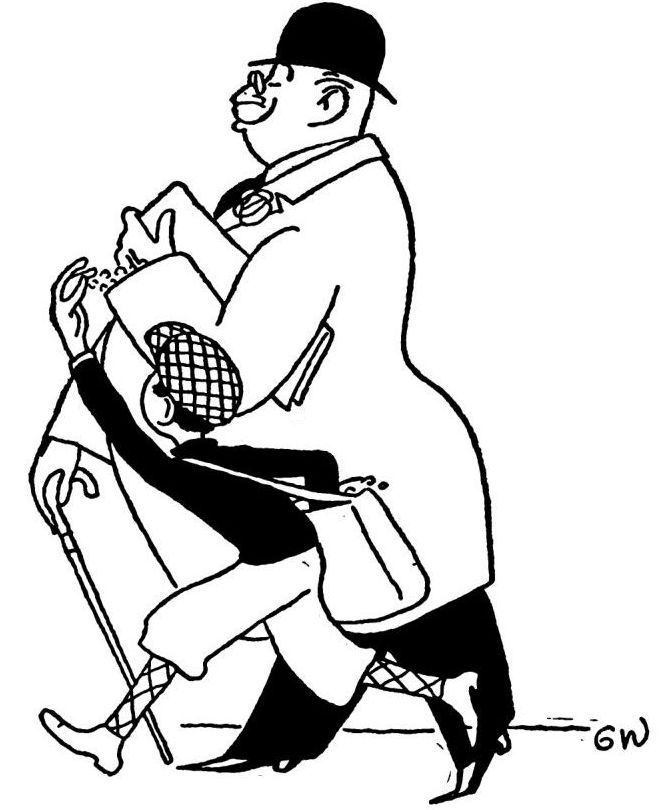
... hire boys to run along beside people to tuck the substitute in their sleeves.
So it was evident that, if this function of snow was to be imitated, it would be necessary to hire boys to run along beside people and tuck the substitute in their sleeves and collars as they walked. One boy could perhaps tuck two hundred handsful in an afternoon, and when you figure out the number of people abroad on a good snowy afternoon, you will realize the enormous number of boys it would take to do the job. Girls would be even worse, because they would stop to talk with people.
The problem of distribution thus unsuccessfully met with, the next thing was to decide what other attribute our “Sno” should have that would give it a place in the hearts of millions of snow-lovers throughout the country. Someone suggested “wetness” and in half a second the cry had been taken up in all corners of the conference-room (for we were in conference by now), “Wetness! Wetness! Our ‘Sno’ must be wet!”
It was decided that the place in which we should have to simulate wetness the most was under bedroom windows. Who does not remember getting up to shut the bedroom windows and stepping into a generous assortment of snow-flakes in their prettiest form of disintegration—water? Or even into a drift ’way, ’way out in the middle of the room right where Daddy could slip in it on his way to and from the office? This is perhaps the most difficult feature of snow to imitate—this bedroom drifting, and if, in addition to getting our composition snow into bedroom windows, we could manage some appliance whereby it could be shot into the folds of whatever underclothing might be lying on the chair nearest the window, then indeed might we cry “Eureka!”
The way in which we decided on the name “Sno” for our product would make a story all in itself. The copyright laws forbid one from naming anything “Snow” or “Gold” or “Rolls-Royce,” or any noun. This law was passed by some fanatics who took advantage of our boys being away at war to plunge the country into an orgy of blue laws. However, we have no other curse than to abide by the code as it stands.
We therefore decided that, by dropping the W, we could make a word which would sound almost like the real word and yet evade the technical provisions of the law. Some of the backers held out for a dressier-sounding name, like “Flakies” or “Lumpps,” but our advertising man, who specializes on Consumer Light Refractions, told us that the effect of a word like “Sno” on the eye of the reader would telegraph a more favorable message to his brain than that of a longer word ending in “ies” or “umpps.” Look at the word “Ford,” for instance. The success of the Ford product is almost entirely due to the favorable light refractions of the name on the consumer’s retina.
This decided us on the trade-name “Sno” and left nothing more for us to do but work out the actual physical make-up of the product and the sort of package to put it out in. The package is also an important feature of any merchandising scheme, and it was decided that a miniature snow-show would be appropriate and rather smart for our particular article. If we could work out some way in which “Sno” could be wrapped up in a six-inch snow-shoe it would not only give the dealer something snappy to display, but would make a nice-looking package for the consumer to take home—nicer-looking than a snootful of scotch, for example. You would be surprised, however, to find how difficult it is to wrap up a unit of imitation snow in a snow-shoe, unless you put them both in a box together.
And now all that remains to divulge is the physical make-up of “Sno.” That is what we are working on now.