TINTERNE ABBEY.
Reading edition
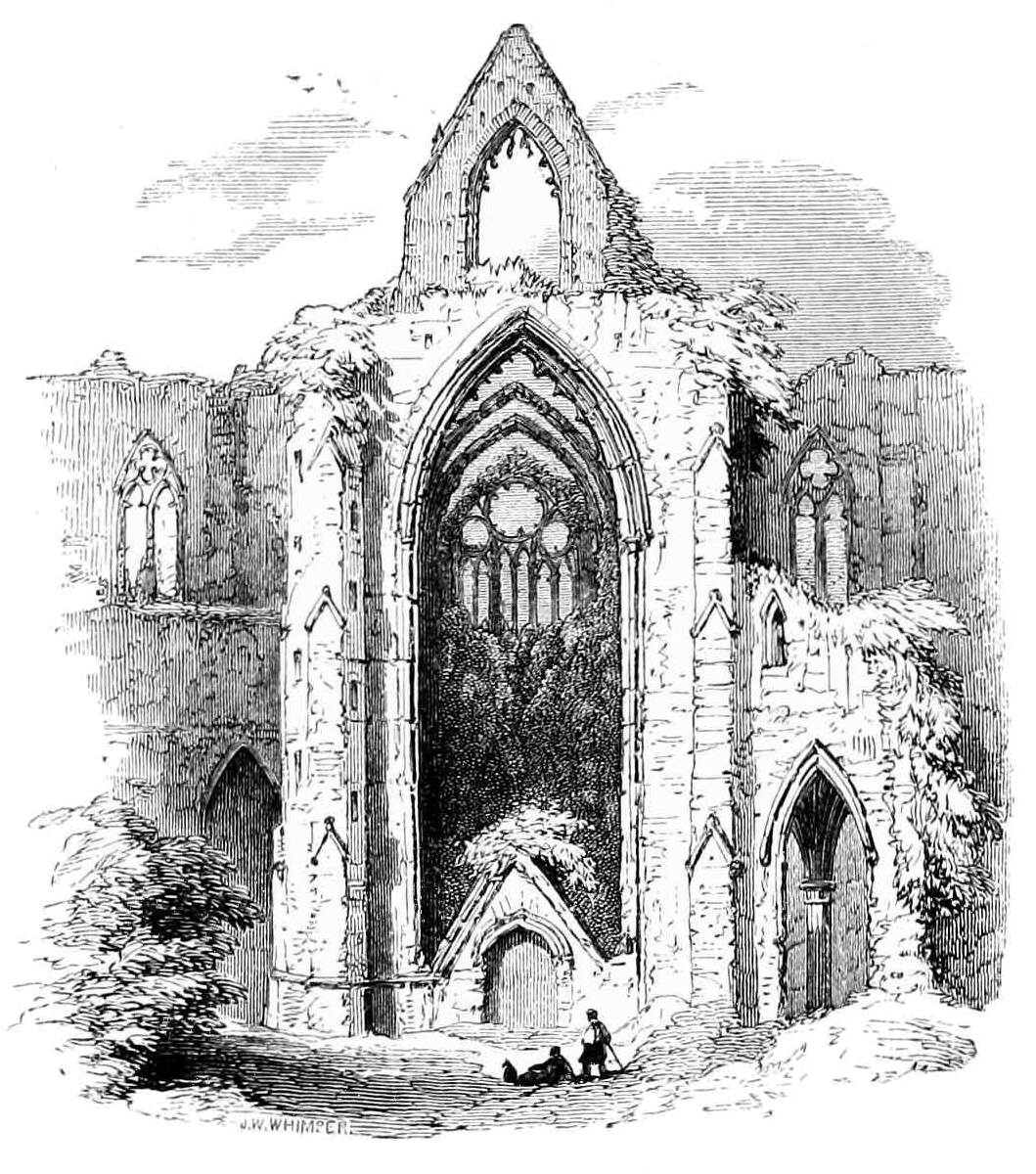
“There are some, I hear, who take it ill that I mention monasteries and their founders; I am sorry to hear it. But, not to give them any just offence, let them be angry if they will. Perhaps they would have it forgotten that our ancestors were, and we are, Christians; since there never were more certain indications and glorious monuments, of Christian piety than these.”—Camden’s Britannia, Pref. Ages of Faith, Book xi.
he Abbey of Tinterne, though one of the oldest in England, makes no conspicuous figure in its history, a proof that its abbots were neither bold nor ambitious of distinction, but devoted to the peaceful and retiring duties of their office. We do not find that the secluded Tinterne was ever the scene of any rebellious outbreak, or the refuge of any notorious criminal. From age to age, the bell that summoned to daily matins and vespers was cheerfully obeyed; and all they knew of the great world beyond the encircling hills, was learned, perhaps, from the daily strangers and pilgrims who took their meal and night’s lodging in the hospitium.

The name of Tinterne, as etymologists inform us, is derived from the Celtic words din, a fortress, and teyrn, a sovereign or chief; for it appears from history, as well as tradition, that a hermitage, belonging to Theodoric or Teudric, King of Glamorgan, originally occupied the site of the present abbey; and that the royal hermit, having resigned the throne to his son Maurice, “led an eremitical life among the rocks of Dindyrn or Tynterne.” It is also mentioned, as a remarkable coincidence in history, that two kings, who sought Tinterne as a temporary place of refuge, only left it to meet violent deaths. The first was Theodoric, who was slain in battle by the Saxons, under Ceolwilph, King of Wessex, in the year 600, having been dragged from his seclusion by his own subjects, in order that he might act once more as their leader. The next was “the unfortunate King Edward,[36] who fled from the pursuit of his queen,” Isabella. The Welsh monarch is said to have routed the Saxons at Mathern, near Chepstow, where his body was buried. Bishop Godwin says, that he there saw his remains in a stone coffin; and on the skull, after the lapse of nearly a thousand years, the wound of which he died was conspicuous—thus verifying the tradition as to the place and manner of his death.
Nothing could be more happily chosen for the seat of a religious community, than the beautiful valley of which these ruins are the unrivalled ornament. It would be difficult to picture, even with the aid of a fertile imagination, scenes more fitted to cherish devout feelings; to instruct us, from the tranquil bosom of Nature, to look up to Nature’s God; and in the exclusion of the busy world, to feel aspirations of gratitude continually ascending towards Him who enriched the valley with his bounty, and in homage to whom that temple and its altars were first erected. The latter, as the work of man, and a prey to neglect and violence, have disappeared or crumbled into ruins; but the former, as the work of God, has lost nothing of its original beauty. The woods that curtain the scene; the river that sweeps along under pendent cliffs of oak; the meadows and orchards that cover and adorn its banks,—all continue as luxuriant, as copious and abundant, as verdant and blooming, as on that day when the first pilgrim-father planted his cross in the soil, and consecrated the spot to the service of God.
It has been often observed—and the observation is confirmed by fact—that those venerable ascetics, who acted as pioneers in the army of Christian pilgrims, were no mean judges of soil and climate, and generally chose some fertile spot upon which nature had bestowed her special favour. But many instances may be pointed out where they chose even the inhospitable desert for their habitation; and, by unremitting labour, transformed that desert into a garden. To the personal example of those ancient Cistercians, the country is indebted for many improvements in all branches of cultivation and embellishment. From the model-garden and orchard of the monastery, hints were communicated and lessons taught, which found their way into every part of the country, and carried with them the principal arts of civilization and improvement. Thus, what first gave a prosperous agriculture to our own shores, is still in operation upon the barbarous islands of the Pacific, where Christian missions, religious fraternities, are busily propagating, by their own example, those domestic and mechanical arts which are the safest and best introduction to religious knowledge. Of this happy influence on the minds and habits of the peasantry, none of the monastic orders was more fully sensible than the Cistercians, whose laborious but abstemious lives, sumptuous temples, and gorgeous ritual, threw an air of luxury upon every spot where the Order had once set its name.[37]
From the shadowy woods which shelter and encompass it, Tinterne may be justly denominated the Vallis umbrosa of Monmouth; but the fertility of the soil, and solemn retirement of the scene, so desirable for a great sanctuary in the “Ages of Faith,” had an immense advantage in the noble and navigable river which formed the channel of communication between the interior and the sea; and, like an artery supplying nutriment to the system, brought its supplies of provision or treasure to the very gate of the abbey. And many a goodly cargo of corn from Hereford, and wine from Normandy, has been disembarked at that old pier, where the abbot’s galley has degenerated into a clumsy ferryboat, with old Richard Tamplin, the ferryman, for its commander.
From ancient historical sources, which treat of the origin, progress, and dissolution of this abbey, we select the following materials:—The founder was Walter de Clare, a name famous in the annals of chivalry and church-building. The first stone was laid in the thirty-first year of the twelfth century; but more than a century and a half elapsed before its completion. In those days churches were the work of generations; and it was rarely, indeed, that the founder lived to witness the fulfilment of his vow. “These all died in faith.” In 1287, we are told the White Friars took possession of the edifice consecrated to the Blessed Virgin,[38] and commenced those hallowed services which the Eighth Henry, by his sic volo, was destined to silence. These services, however, had lasted for centuries; and who shall say, during the lapse of barbarous times, how much crime was prevented, how much good effected, by those holy men. Shut out from the haunts and habits of secular life, they exercised their spiritual functions, we may charitably believe, in a manner that drew many penitents to their altar; and, in the midst of wars and tumults, displayed the sacred banner of peace, and published the doctrine of salvation. Their record is on high. And, in justice to the Cistercians, it must be confessed, that if less learned, they were more exemplary, and not more worldly, than some other fraternities of higher pretensions. They exercised and patronised agriculture; and planting themselves, as the rule directed, in the depths of forests, or on desert heaths, they drew from the earth such sustenance as it would yield to the hand of labour; and trusted to those who sought their spiritual aid and counsel, for the means of building and embellishing their altars.
The order of Cistercians, as the reader is aware, made its appearance in England about the year 1128. In imitation of Christ and his twelve Apostles, the brotherhood was limited to twelve, with an abbot at their head, according to the rule of the Founder:—“Et sicut ille monasteria constructa, per duodecim monachos adjuncto patre disponebat, sic se acturos confirmabant.”—Mon. Ang. iv. 699. Their first establishment in England was at Waverley, in Surrey; and in the course of time, their numbers had so multiplied, that, shortly before the dissolution of religious houses, they had seventy-five monasteries, and twenty-six nunneries in this country. Their patriarch was St. Robert, Abbot of Molesme, a Benedictine monastery in the bishopric of Langres. This holy man becoming alarmed at the gradual decay of vital religion among the brotherhood, and their wilful neglect of the rules instituted by their founder, adopted measures for the immediate reformation of the order. Having obtained the Pope’s sanction in support of his design, he chose twenty-one of the brethren, and retiring from Molesme to the neighbourhood of Chalons-sur-Saone, took up his abode in the wilderness[39] of Citeaux; where, under the protection of Otho, Duke of Burgundy, and the Bishop of Chalons, he laid the foundation of a religious house, in which the rules of St. Benedict were to be strictly enforced, and the character of his followers restored. But the wisdom and piety of Robert having introduced several improvements into the rules of St. Benedict, the brotherhood began to present features so distinct from the parent establishment, that, on the return of St. Robert to Molesme, his successor, Albericus, obtained a charter from the Pope, constituting the monks of Citeaux into an independent order—that of Cistercians, or Whitefriars. Their rules were positive and stringent; they involved the surrender of all secular affairs into the hands of lay brothers, so that their lives and labours might be exclusively devoted to the exercise of charity and the service of the altar. In their choice of localities for the establishment of new houses, they were enjoined, as already observed, to avoid cities, and go forth into the wilderness. This was favourable to pilgrimages; and with the fruits of these, and benefactions from all classes, what they had found a desert on their arrival, was speedily converted by labour and industry into a garden; and what was at first only a cell or chapel, was gradually extended into a church and abbey. The revenue of the order was divided into four parts—to the bishop, a fourth; to the priests, a fourth; to the exercise of hospitality, a fourth; and another fourth for the support of widows and orphans, the relief of the sick, and the repairs of churches and cloisters. And inasmuch as they could not find, either in the life or rule of St. Benedict,[40] that their founder had possessed any churches, or altars, or ovens, or mills, or towns, or serfs; or that any woman was ever permitted to enter his monastery, or any dead to be buried there, except his sister; they therefore renounced all these things: “Ecce hujus seculi divitiis spretis cœperunt novi milites Christi cum paupere Christo pauperes inter se tractare, quo ingenio, quo artificio, quo se exercitio in hac vita se hospitesque divites et pauperes supervenientes quos ut Christum suscipere præcipit regula sustentarent.” For a time the Cistercians continued in exemplary observance of their rules: poverty and humility walked hand in hand; but, in proportion as their revenues increased, their discipline began to relax; a taste for luxury[41] succeeded; and whoever has visited their splendid abbeys abroad, will readily confess that, while professing abstinence and self-denial, they were lodged like princes, and like princes shared in the vanities and pleasures of the world. Their ruling passion was said to be avarice; but if they amassed riches, they spent them with a princely liberality; and their buildings, in this and other countries, present some of the finest specimens of taste ever raised by the hand of man.[42]
Cistercians were Benedictines, according to the letter of the rule, without mitigation.[43] Their peculiarities are thus described in Dugdale’s Warwickshire:[44]—“First, for their habits, they wear no leather or linen, nor indeed any fine woollen cloth; neither, except it be on a journey, do they put on any breeches, and then, after their return, deliver them fair washed. Having two coats with cowls, in winter time they are not to augment, but in summer, if they choose, they may lessen them; in which habit they are to sleep, and after matins not to return to their beds. For prayers, the hour of Prime, they so conclude, that before the Lauda it may be daybreak, strictly observing their rule, that not one iota or tittle of their service is omitted. Immediately after Lauda, they sing the Prime; and after Prime, they go out performing their appointed hours in work. What is to be done in the day, they act by daylight; for none of them, except he be sick, is to be absent from his diurnal hours or Complinæ. When the Compline is finished, the steward of the house and he that hath charge of the guests go forth, but with great care of silence serve them.
For diet, “the Abbot assumes no more liberty to himself than any of his convent, everywhere being present with them, and taking care of his flock, except at meat, in regard his talk is always with the strangers and poor people. Nevertheless, when he eats, he is abstemious of talk or any dainty fare; nor hath he or any of them ever above two dishes of meat; neither do they eat of fat or flesh, except in case of sickness; and, from the ides of September till Easter, they eat no more than once a day, except on Sunday, and not even on festivals.
“Out of the precincts of their cloyster they go not but to work; neither there nor anywhere do they discourse with any but the abbot or prior. They unweariedly continue their canonical hours, not piecing any service to another, except the vigils for the deceased. Their manual labour was as follows: In summer, after Chapter, which followed Prime, they worked till Tierce; and, after Nones, till Vespers. In winter, from after Mass till Nones, and even to Vespers, during Lent. In harvest, when they went to work in the farms, they said Tierce and the conventual Mass immediately after Prime, that nothing might hinder their work for the rest of the morning; and often they said divine service in their places where they were at work, and at the same hours as those at home celebrated in the church.[45]
“They observe the office of St. Ambrose, so far as they can have perfect knowledge thereof from Millain; and, taking care of strangers and sick people, do devise extraordinary afflictions for their own bodies, to the intent their souls may be advantaged.” Of the same Order—
Hospinian says—“They allowed to candidates a year’s probation, but no reception to fugitives after the third time. All fasts were observed according to the rule: to visitors prostration was enjoined, with washing of feet. At the Abbot’s table sat the guests and pilgrims: they laboured more than the rule required: delicate habits were exploded: obsolete and primitive fervour was diligently revived and practised. But of this powerful order, avarice was the besetting vice: they were great dealers in wool, generally very ignorant, and, in fact, farmers rather than monks.”[46] The best account of this brotherhood, as Fosbroke has told us, is to be found in the Usus Cisterciensium; but of their habits and ceremonies further notice will be found when we come to treat of the more opulent houses. Guyot le Provins, first a minstrel, then a monk, has thus satirized them in a poem, which he called a bible, or, more properly, libel. The Cistercian “abbots and cellarers have ready money, eat large fish, drink good wine, and send to the refectory, for those who do the work, the very worst. I have seen these monks,” he affirms, “put pig-sties in churchyards, and stables for asses in chapels. They seize the cottages of the poor, and reduce them to beggary.”—With this brief account of the Order, we return to the subjects selected for illustration.
In a historical sketch, by the late Archdeacon Coxe, the ruins of Tinterne Abbey are thus described, and his description is at once accurate and graphic:—
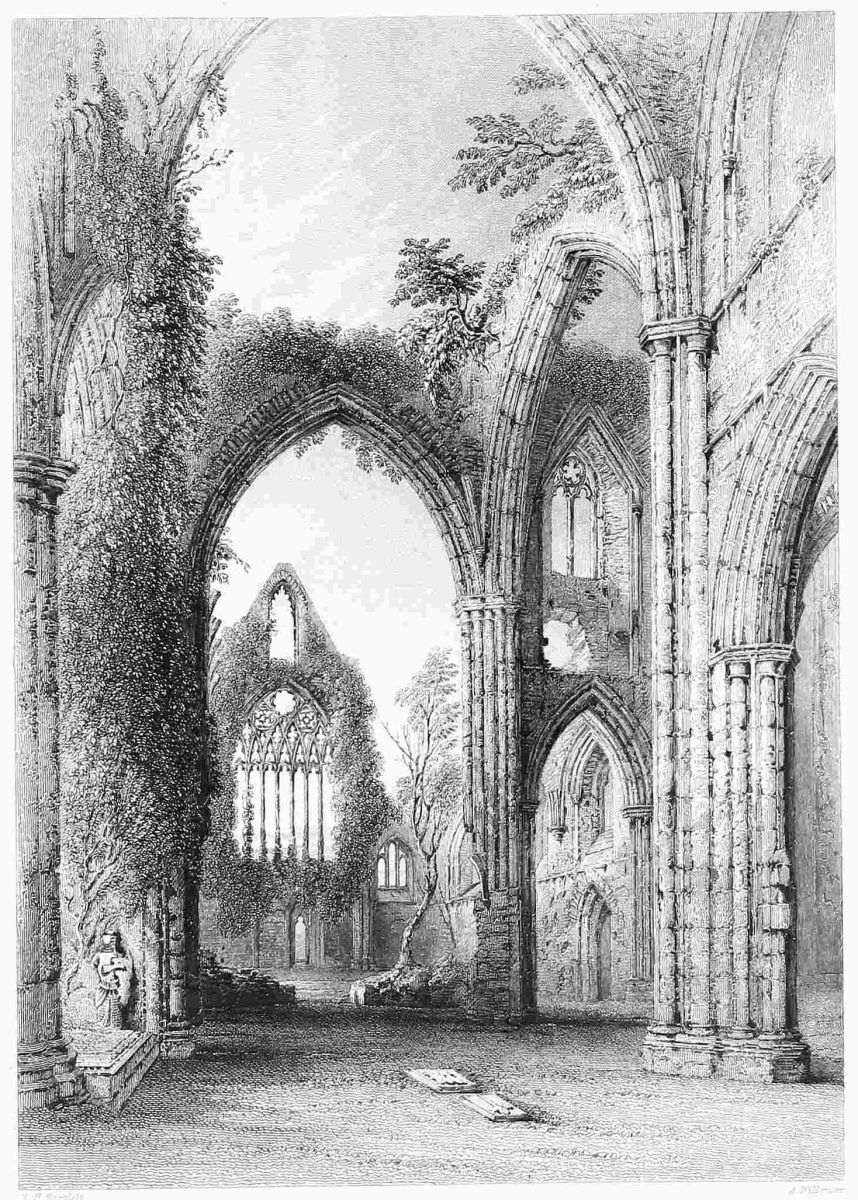
“We stopped to examine the rich architecture of the west front; but the door being suddenly opened, the inside perspective of the church called forth an instantaneous burst of admiration, and filled us with delight, such as I scarcely ever before experienced on a similar occasion. The eye passes rapidly along a range of elegant Gothic pillars, and, glancing under the sublime arches which once supported the tower, fixes itself on the splendid relics of the eastern window—the grand termination of the choir.
“From the length of the nave, the height of the walls, the aspiring form of the pointed arches, and the size of the east window, which closes the perspective, the first impressions are those of grandeur and sublimity. But as these emotions subside, and we descend from the contemplation of the whole to the examination of the parts, we are no less struck with the regularity of the plan, the lightness of the architecture, and the delicacy of the ornaments. We feel that elegance, no less than grandeur, is its characteristic, and that the whole is a combination of the beautiful and the sublime. The church, constructed in the shape of a cathedral, is an excellent specimen of Gothic architecture in its purity. The roof has long since fallen in, and the whole ruin is thus thrown open to the sky; but the shell is entire: all the pillars are standing, except those which divided the nave from the northern aisle, and their situation is marked by the remains of their bases. The four lofty arches which supported the tower, spring high in the air, reduced to narrow rims of stone, yet still preserving their original form. The arches and pillars of the transepts are complete: the shapes of all the windows may yet be discriminated; the frame of the west window is in perfect preservation, the design of the tracery is extremely elegant, and, when decorated with painted glass, must have produced a gorgeous effect. The general form of the east window is also entire, but its frame is much dilapidated. It occupies the whole breadth of the choir, and is divided into two large and equal compartments by a slender shaft, not less than fifty feet in height, with an appearance of singular lightness, which, in particular points of view, seems as if suspended in the air. To these decorations of art, nature has added her own ornaments. Some of the windows are wholly obscured, others partially shaded, with tufts of ivy, or edged with lighter foliage:
W.H. Bartlett A. Willmore
THE WESTERN WINDOW.
Tintern.
the tendrils creep along the walls, wind round the pillars, wreath the capitals, or, hanging down in clusters, obscure the space beneath. But instead of dilapidated fragments, overspread with weeds and choked with brambles, the floor is covered with a smooth verdant turf, which, by keeping the original level of the church, exhibits the beauty of its proportions, heightens the effect of the gray stone, gives relief to the clustered pillars, and affords an easy access to every part. Ornamented fragments of the roof, remains of cornices and columns, rich pieces of sculpture, carved stones and mutilated figures of monks and warriors, whose ashes repose within these walls, are scattered on the green sward, and contrast present desolation with former splendour.”
Although the exterior appearance of these ruins is not equal to the inside view, yet in some positions—particularly to the east—they present themselves with considerable effect. From a point on its left bank, and about half a mile down the river, the ruins assume a new character; and seeming to occupy a gentle eminence, impend over the river without the intervention of a single cottage to intercept the view. “The grand east window, wholly covered with shrubs, and half-mantled with ivy, rises like the portal of a majestic edifice embowered in wood. Through this opening, and along the vista of the church, the clusters of ivy, which twine round the pillars or hang suspended from the arches, resemble tufts of trees; while the thick mantle of foliage, seen through the tracery of the west window,[47] forms a continuation of the perspective, and appears like an interminable forest.”
The Abbey is a cruciform structure, built, it is said, after the model of Salisbury Cathedral,[48] consisting of a nave, north and south aisles, transepts, and choir. Its length from east to west is two hundred and twenty-eight feet, and from north to south, at the transepts, one hundred and fifty feet. The nave and choir are thirty-seven feet in breadth; the height of the central arch is seventy feet, of the smaller arches thirty feet; of the east window sixty-four feet, and of the west window forty-two feet. The total area originally enclosed by the walls of the abbey is said to have been thirty-four acres.
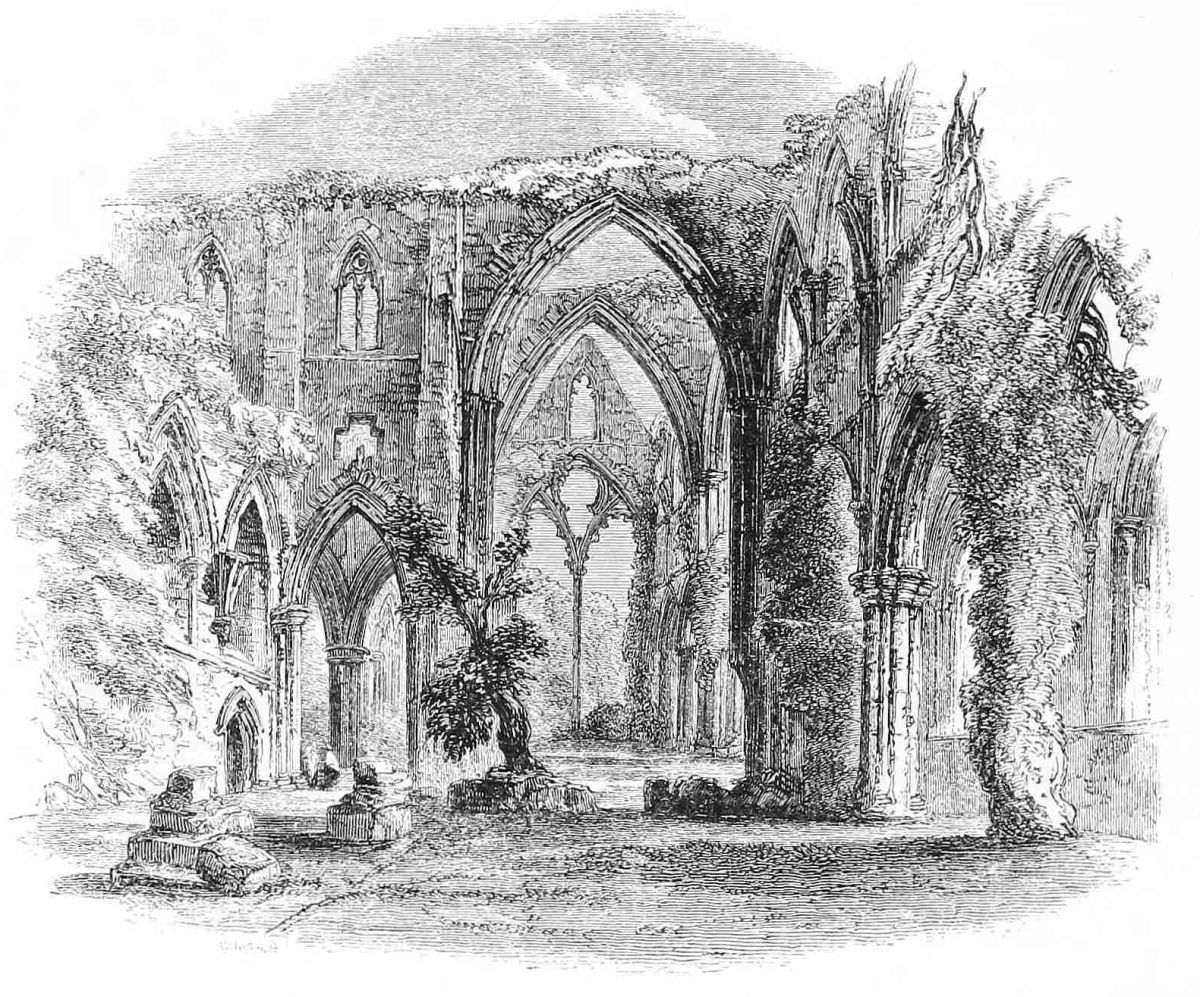
The exterior of the western front is singularly striking; but, on entering, as already observed, the scene that represents itself is indescribably grand and impressive. “When we stood at one end of this awful ruin,” says Gilpin, “the elements of earth and air its only covering and pavement, and the grand and
VIEW FROM ENTRANCE.
VIEW FROM ENTRANCE.
venerable remains which terminated both, perfect enough to form the perspective, yet broken enough to destroy the regularity, the eye was above measure delighted with the beauty, the grandeur, the novelty of the scene.”
The inner walls of the church are nearly entire; most of the elegant and massive columns, as already noticed, which separated the nave from the south aisle are yet standing; and the four lofty and magnificent arches which formerly supported the central tower are nearly perfect. The columns that divided the nave from the north aisle have fallen; but their bases still occupy the ground, showing their number, shape, and dimensions.
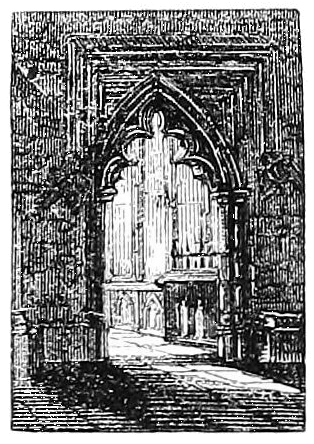
Windows.—The magnificent windows are little altered by time: and though somewhat obscured by a luxuriant and graceful drapery of ivy, the tendrils of which twine in their tracery, creep along the walls, encircle the columns, and form natural wreaths around the capitals, the forms of the principal objects are still so far preserved as to be easily discriminated. The tracery of the western window, as already observed, is exquisite; while the eastern window,[49] high and graceful, and occupying nearly the whole breadth of the choir, with its slender umbilical shaft rising to a height of fifty feet, and diverging at the top into rich flowery traces, has quite a magical effect. The other windows, though less ornamented, are all in character, and have the same elegant design and finish.[50]
The floor, originally covered with encaustic tiles, is now enveloped in a thick smooth matting of grass, trimmed like a bowling-green, and here and there spotted with little heaps of mutilated sculpture, and striped with flat tombstones—all thrown open to the winds of heaven.
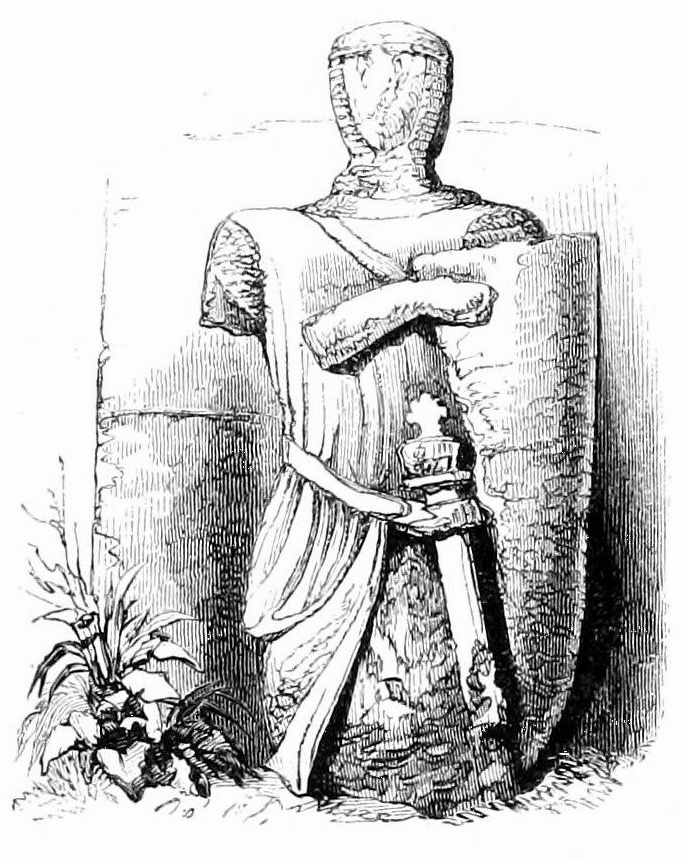
The effigy of a knight in chain armour, a pavache shield, and crossed legs, is supposed to be that of Strongbow, first Earl of Pembroke, already noticed, but more probably that of Roger Bigod, as Strongbow is historically known to have been buried in Dublin. This interesting relic, that had escaped the ravages of time and the hostile spirit of resolution, was at last, as Mr. Thomas informs us, wilfully mutilated by a native of the village.[51]
The next relic is a group of the Madonna and Child, much disfigured, but with sufficient evidence of its having been the work of a skilful artist. Mr. Bartlett considered it to be of very graceful design and execution.
Near the eastern window is the sculptured head of a friar, with the tonsure, but otherwise quite disfigured.
In the centre, between the transepts, is another broad stone slab, supposed to cover the ashes of the founder; but the fall of the tower, and the continual dropping of loosened fragments—until the ruin became an object of interest and consideration—have not left one of the sepulchral tablets or inscriptions entire. Many fragments may be discovered among the rubbish, but to reunite the scattered members were a very hopeless task. In the southern aisle is the only sepulchral antiquity that bears a legible inscription. It is elaborately carved in black or slate marble, with a cross finely sculptured on its surface longitudinally, and near its base three trouts,[52] so entertwined as to form the symbolic triangle, with the figure of a salmon on the right and left. The inscription, in black letter, along the top of the cross, is simple—
“Hic jacet humatus Johann: Willino.”
The sepulchral brasses have all disappeared. For a century and more after the Dissolution, the Abbey appears to have been abandoned to every species of wilful depredators, who defaced the altars, ransacked the graves, and carried off without molestation whatever was curious or portable.
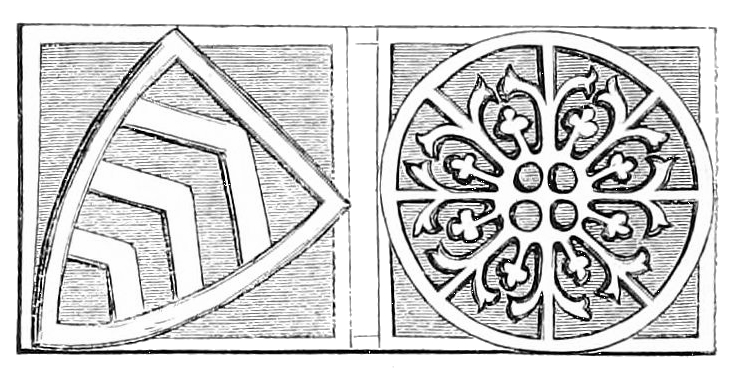
In the same aisle, close to the wall, and now preserved with great care, is the lately-discovered pavement of encaustic tiles, with escutcheons of the ancient Clare and Bigod families intertwined. The figures on these coloured tiles represent flowers, animals, and knights in full career at a tournament. This pavement was probably that of a private altar, belonging to the founder, or benefactor of the Abbey. In the process of clearing away the vast accumulation of rubbish, many of the ancient memorials were removed in fragments; and of the few that remain, not one, probably, now covers the dust over which it was originally placed.
Leaving the grassy lawn-like floor of the Abbey, the ascent to the top is still practicable by means of a spiral staircase in an angle of the northern transept. Those who conclude their survey of the ruins by this experiment, will be amply rewarded for any fatigue it may occasion. At the time of our visit, however, in the month of August last year, some unexpected obstacle prevented the custodier from gratifying our curiosity by a view from the summit: for the steps were either so unsafe or deficient, as to make the experiment rather hazardous.
Mr. Thomas, from whose notes we have already quoted, and whose late professional residence near the Abbey rendered him familiar with all its minutest features, tells us that the prospect it commands is highly picturesque; and in turning from the outward landscape, to look down into the cloistered depths below, the view of clustering pillars, lofty arches, mullioned windows, and flowing tracery, is indescribably grand and impressive.
The broken summit of the walls, throughout its whole outline, is adorned with a profusion of shrubs and flowers, that, with interlacing leaves and tendrils, cover the mouldering coping like a fragrant mantle. Where the labour of man appears to decay, nature has put forth her vigour and beauty, and transformed those roofless walls into a wild botanic garden. Here, and amidst the débris immediately adjoining, Mr. Thomas[53] found a luxuriant crop of shrubs and flowers, all of different families, some of them rare, and in number between forty and fifty.
Reed, in his ‘Remains,’ gives the following eloquent and highly poetical description of the Abbey by moonlight:—“The great tree or vegetable rock, or emperor of the oaks, if you please, before which I bowed with a sort of reverence in the fields of Tinterne, and which for so many ages has borne all the blasts and bolts of heaven, I should deem it a gratification of a superior kind to approach again with an ‘unsandalled foot,’ to pay the same homage, and to kindle with the same devotion. But I should find amidst the magnificent ruins of the adjoining Abbey, something of a sublime cast, to interest and give pregnancy to my feelings. I must be alone. My mind must be calm and pensive. It must be midnight. The moon, half-veiled in clouds, must be just emerging from behind the neighbouring hills. All must be silent, except the wind gently rustling among the ivy of the ruins; the river lulling, by its faint murmurings, its guardian genius to repose; and the owl, whose funereal shriek would some time die along the walls in mysterious echoes. I should then invoke the ghosts of the Abbey; and Fancy, with one stroke of her magic wand, would rouse them from their dusty beds, and lead them into the centre of the ruin. I should approach their shadowy existences with reverence; making inquiries respecting the customs, and manners, and genius, and fate of antiquity—desire to have a glimpse of the destiny of future ages, and enter upon conversations which would be too sacred and even dangerous to communicate.” The lines by Sir Walter Scott, on “Melrose Abbey by Moonlight,” are equally descriptive of Tinterne.[54]
It has been well observed, that, as the Abbey of Tinterne is the most beautiful and picturesque of all our Gothic monuments, so is the situation one of the most sequestered and delightful. One more abounding in that peculiar kind of scenery which excites the mingled sensations of content, religion, and enthusiasm, it is impossible to behold. There, every arch infuses, as it were, a solemn energy into inanimate nature; a sublime antiquity breathes mildly in the heart; and the soul, pure and passionless, appears susceptible of that state of tranquillity which is the perfection of every earthly wish.[55] By the late Sir C. Colt Hoare, a man of taste and many travelled acquirements, this “seat of devotion, solitude, and desolation,” is pronounced as surpassing every other ruin he had seen in England or in Wales. Captain Barber, whose “Tour” is now very scarce, was so charmed with the scene, that he locked himself up in the Abbey, and employed several hours in delineating its picturesque features.
From the general aspect of this venerable pile—a coup d’œil that never fails to captivate the stranger—we proceed to a few detached features of the picture, all more or less interesting as relics of men, and times, that have long passed away.

Walter de Clare, the founder, was grandson of Osbert, Lord of Tudenham and Wollaston, by gift of William the Conqueror.[56] He departed this life on the 10th of March, 1139, and dying without issue, was succeeded by his brother, Gilbert[57] de Clare, who survived him nine years, and dying on the 6th of January, 1148, was buried in the church of Tinterne. This Gilbert de Clare left two sons by his wife Elizabeth, daughter of Walleran, Earl of Melent—Richard, surnamed Strongbow, and Baldwin,[58] who, “fighting stoutly on the part of King Stephen, at the battle of Lincoln, was there taken prisoner.” Richard was one of the witnesses to that “solemn accorde,” made in 1153, between King Stephen, and Henry, Duke of Normandy, whereby the latter was to succeed to the crown of England after the king’s demise. In the year 1170 [16 Henry II.], the said Richard, Earl of Striguil or Pembroke, being stript of his paternal inheritance by King Henry II., invaded Ireland, and captured the cities of Dublin and Waterford. Soon after this event, when “the king, who was then at Argentine, was consulting with his nobles about an expedition into that realm; certain messengers from this earl being present, offered, on the part of Richard, the above-named cities, with all the castles which he had there captured, at the death of Dermot, king of Dublin, whose daughter and heiress he had married.” With this conciliatory offer, King Henry was so well pleased, that he restored to him all his lands, both in England and Normandy, and freely granted that he should enjoy all those in Ireland which he had received in dowery with his wife, constituting him at the same time constable or governor of that realm, and “thereupon passing thither, subdued it wholly without any considerable resistance.”
By the daughter of the said King of Dublin or Leinster, this last earl of his family, Richard Strongbow[59] left an only child, Isabel, who remained in ward fourteen years to the king, and was then given in marriage to William Marshall, who thereupon became Earl of Pembroke, Lord of Striguil, or Chepstow, and took possession of Leinster, with all the inheritance of the said Strongbow; and being thus advanced to that honour, he bore the royal sceptre of gold, with the cross on the head of it, at the solemn coronation of King Richard I.[60] The history of this family is given at full length in the Monasticon and Baronage of England, but it is much too diffuse for our purpose. William Marshall, who, by his marriage with Isabel, only child of Richard de Clare, came into possession of his estates and titles, was a great benefactor to the church; he built and endowed many religious houses both in England and Ireland; and having, by his last will and testament, constituted the abbot of St. Augustine’s at Bristol, and Henry Fitzgerald, his executors, he departed this life at Caversham, in the third of Henry II. Being thence carried to Reading, his body was received in solemn procession by the monks of the abbey, and placed in their choir, whilst mass was celebrated for him. It was then taken to Westminster, where the solemnity was again performed, and on Ascension-day it was consigned to the earth[61] with the following epitaph:—
Sum qui Saturnum sibi sensit Hibernia: Solem Anglia; Mercurium Normannia; Gallia Martem.
These complimentary lines, meant to record his virtues, are characteristic of the times when heathen mythology was so frequently called in to assist in the eulogy of some great champion or benefactor of the Christian church. He certainly appears to have merited all that could be said of him as a great mover and promoter of monastic fraternities—especially the Cistercians; and in the same strain, Matthew of Paris has recorded that this mighty earl was a severe tamer of the Irish, a great favourer of the English, achieved much in Normandy, and was an invincible soldier in France—“Miles strenuissimus, ac per orbem nominatissimus.”[62] But of the five sons whom he left behind, with the fair and flattering prospect that his name and titles would descend through many generations, all died prematurely and without issue. This deplorable fact was much commented upon at the time:—“Some did attribute it to God’s especial judgment, by reason that, when the said William, first earl, was a great commander in Ireland, and, according to the practice of soldiers, exercised such cruelties of fire and sword as usually accompany that sort of life, he took away by violence two fair manors from a reverend bishop there, and possessed himself of them as the acquisition of war; and that the bishop, after frequent and earnest entreaties for their restitution, without any effect, did thereupon pronounce the sentence of excommunication against him for the fact, which he the earl contemned.” The bishop,[63] having proceeded to London, made his grievous wrong known to the king, showing wherefore he had excommunicated the said earl. “Whereupon the king, then very pensive, desired the bishop that he should go to his grave and absolve him, and then he would satisfy his desire. Whereupon the bishop went, and the king with him, and spoke as followeth: ‘O William! who liest here buried, and shackled with the fetters of excommunication, if these lands which thou most injuriously didst take from my church, be restored with full satisfaction, either by the king or any of thy kindred or friends, I then absolve thee: otherwise, I ratify that sentence to this end, that, being wrapt up with thy sins, thou mayest remain condemned in hell.’”
The king, who was “much displeased at these his expressions, blamed him for his ghostly rigour;” but anxious to remove the curse from the illustrious defunct, he sent private messages to the heir and his brothers, advising them in a friendly manner to come to terms with the bishop, and thus “in mercy release their father’s soul.” But the brothers were obstinate; they would not restore even an acre of bog, nor a stock of timber; observing that, “as the old doting bishop hath pronounced the sentence unjustly, the curse will fall upon himself. For my part,” quoth the heir, “I will never lessen my patrimony descended to me by inheritance.” The king being still under tutelage, and fearing the resentment of so powerful a family, “forbore to displease them.” But the bishop, hearing thereof, was much grieved, taking more offence at their contumacy, than of the injury first done by their father; and going to the king, he said, “Sir, what I have spoken, I have spoken; and what I have written is not to be reversed: the sentence therefore must stand; the punishment of evil-doers is from God; and, therefore, the curse which the Psalmist hath written, shall come upon this earl, of whom I do thus complain. His name shall be rooted out in one generation, and his sons shall be deprived of the blessing—increase and multiply. Some of them shall die a miserable death, and their inheritance shall be scattered. And this, O king, thou shalt behold in thine own lifetime, yea, in thy flourishing youth.”
Having spoken “thus much in the bitterness of his spirit, the bishop departed thence, leaving the defunct earl enthralled with that curse. Whereupon it happened that, in a few years after, all his sons died without issue.”[64]
William, his successor, who, “in his father’s lifetime, had taken part with the barons, then in arms against the king, was one of those betwixt whom and the King those covenants were made, whereby the government of the realm was placed in xxv. of them, and the city of London thereupon put into their hands. Yea, so great a confidant was he of that rebellious pack, that they constituted him to be one of those xxv., for which respect amongst them he underwent the sentence of excommunication by the Pope. But upon the death of King John, which happened soon after, his noble father reduced him to obedience; so that he became loyal to King Henry the Third, and thereupon had a grant of the lands of Saier de Quinci, Earl of Winchester, and David, Earl of Huntingdon, two of those great rebels, for his support in the king’s service.”
A few years after this, “whilst he, the said William Marshall, was in Ireland, Leoline, Prince of Wales, took two of his castles; and having cut off the heads of those whom he found therein, manned them with his own soldiers. But when tidings thereof came to him, he soon returned into Wales; and having, with a great power, won them again, took the like revenge upon the Welsh: and thinking this not enough, he invaded the lands of Leoline, and wasted them with fire and sword. Whereupon Leoline advanced towards him with all his strength, but to little purpose; for, encountering him in battle, the Marshall totally routed his whole army, of which to the number of nine thousand were slain and taken.” This earl married Eleanor, daughter of King John; and dying at Kilkenny, in 1231, was there buried in the choir of the Mendicant Friars.[65]

Richard, his brother and successor, being irritated by the violent conduct of the king and his ministry, formed an alliance with Llewellyn ap Jowarth, Prince of Wales, and in 1233 defeated the king’s army at Grosmont; but with dutiful respect for his sovereign, he fell back with the Cambrian army before sunrise, to allow his Majesty’s retreat from the Castle of Gloucester. Henry, not appreciating the generous conduct of his reluctant foe, resisted this attack; and on the return of the Lord Marshall to his estates in Ireland, he was treacherously wounded to death at Kildare,[66] and there buried by the side of his brother William, whom he had survived only three years.
Gilbert, the third son, married a daughter of Alexander, King of Scotland, and died in 1242.
Walter Marshall, the fourth son, died at Goodrich Castle, in December, 1245. And—
Anselm, the fifth and last son of this doomed family, died like his brothers, childless, in the same month of the same year, in the Castle of Striguil or Chepstow, and was interred with his brother in Tinterne Abbey.
Of their five sisters, Eve, the youngest, married “William de Braliuse or Braose,[67] of whose family more hereafter.
The male line in him having thus failed, Maude, their surviving sister, and heiress to the family possessions, was espoused to Hugh Bigod, Earl of Norfolk. From this alliance sprang two sons, Hugh and Roger, or Rudulfus. The younger of whom, Roger, in right of his mother, was installed lord-marshal of the kingdom, and granted a charter[68] to Tinterne Abbey, confirming those granted by the Clares and Marshalls, and adding large possessions to the brotherhood. Maude, on the death of her husband, Hugh Bigod, married John de Warren, Earl of Surrey; and departing this life, anno 1248, was buried in the Abbey of Tinterne; when her four sons—two by each marriage—carried her body into the choir. To prosecute the descent farther, would far exceed our limits; but readers who may feel curious to trace the genealogy of the founders, will find ample details in the Baronage, the Monasticon, and old chronicles.
Of Earl Roger it is told, that, being “openly reproached by the king as a traitor, he replied with a stern countenance that he lied; and that he, Bigod, never was, nor would be a traitor;” adding, “if you do nothing but what the law warranteth, you can do me no harm.” “Yes,” quoth the king, “I can thrash your corn and sell it, and so humble you.” “If you do so,” replied Bigod, “I will send you back the heads of your thrashers.”
The Hospitium, or guest-chamber, was generally a large room with columns, like the body of a church, and called palatium—the original meaning of which was a place of short residence. If a visitor came before dinner to the refectory, notice was given to the refectioner; if he was too late to dine with the convent, he staid in the locutorium, or parlour, until the refectory was swept, and then was introduced. The hosteler provided all things fit for Mass for the visitors; and if he was prevented, any one asked by him sang the mass and hours to them, for they had divine service as well as the convent. The visitors had meat and drink at solicitation, and the hosteler was to fetch the viands according to the rank of the person; all which, however, was accompanied with the appendage of a “soiled table cloth, very indifferent wine, grease in the salt, and a clownish servant.” The hospitaler[69] could not introduce them to the collation before the end of the first verse. When this was over, he lighted his lantern with which the visitors waited before the Chapter door. He then introduced them into the parlour, after which they had refection, and Complin was sung to them. When the visitors wished to depart before daybreak, or at that time, the hosteler took the keys of the parlour from the Prior’s bed; but on Sundays, before procession, no one could receive the benediction, or ceremony of dismission.
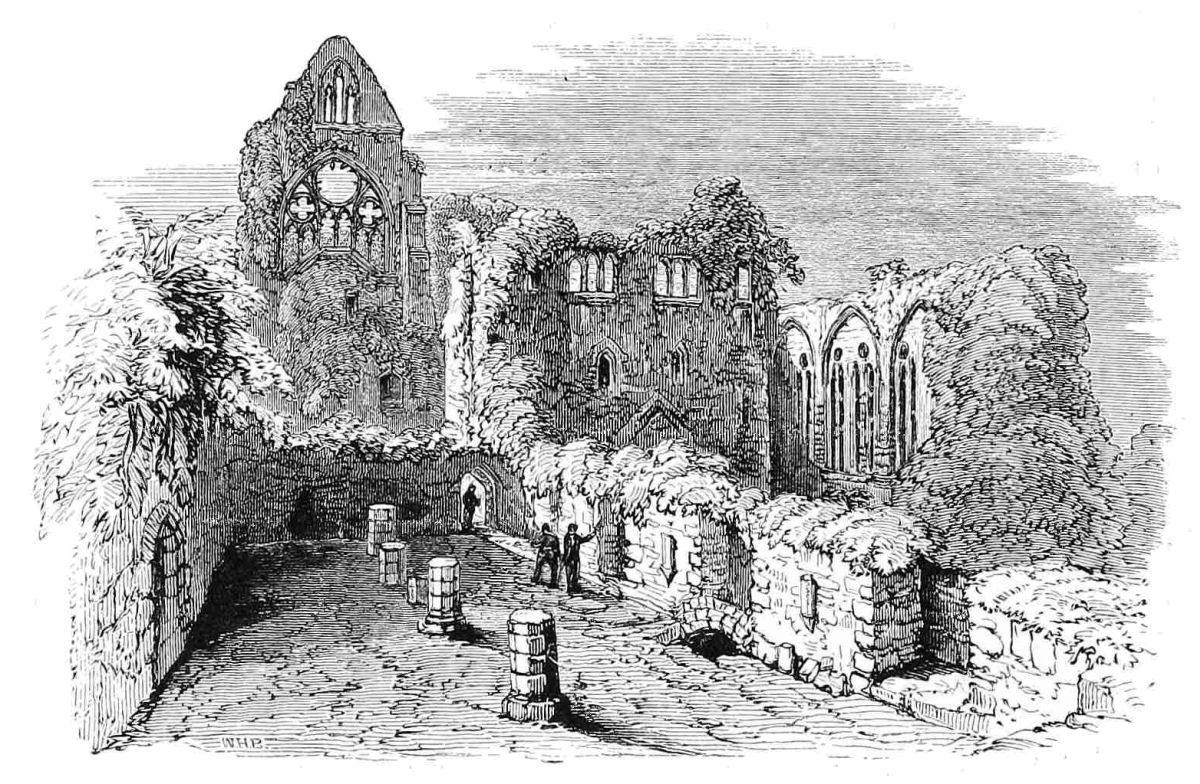
Persons of rank were received with processions and high honours. One of the great bells was struck three times, to give the monks notice of assembling in the church to robe themselves. Visitors were allowed to make a stay of two days and two nights, and on the third day, after dinner, they were to depart. If by accident a guest could not then go, the hosteler signified his request to the Abbot, or Prior, for a longer stay. If in health, he was to be present at Matins, and follow the convent in everything, unless he had leave to the contrary. Women were to be received who came with an honourable suite.[70] Particular attention was paid to the parents of monks, for whom necessaries and food were to be provided whenever they came to see their children—especially on the Nativity of the Virgin Mary, wheresoever they took refection, in the town or house; and they were to be honourably received on the Vigil.[71]
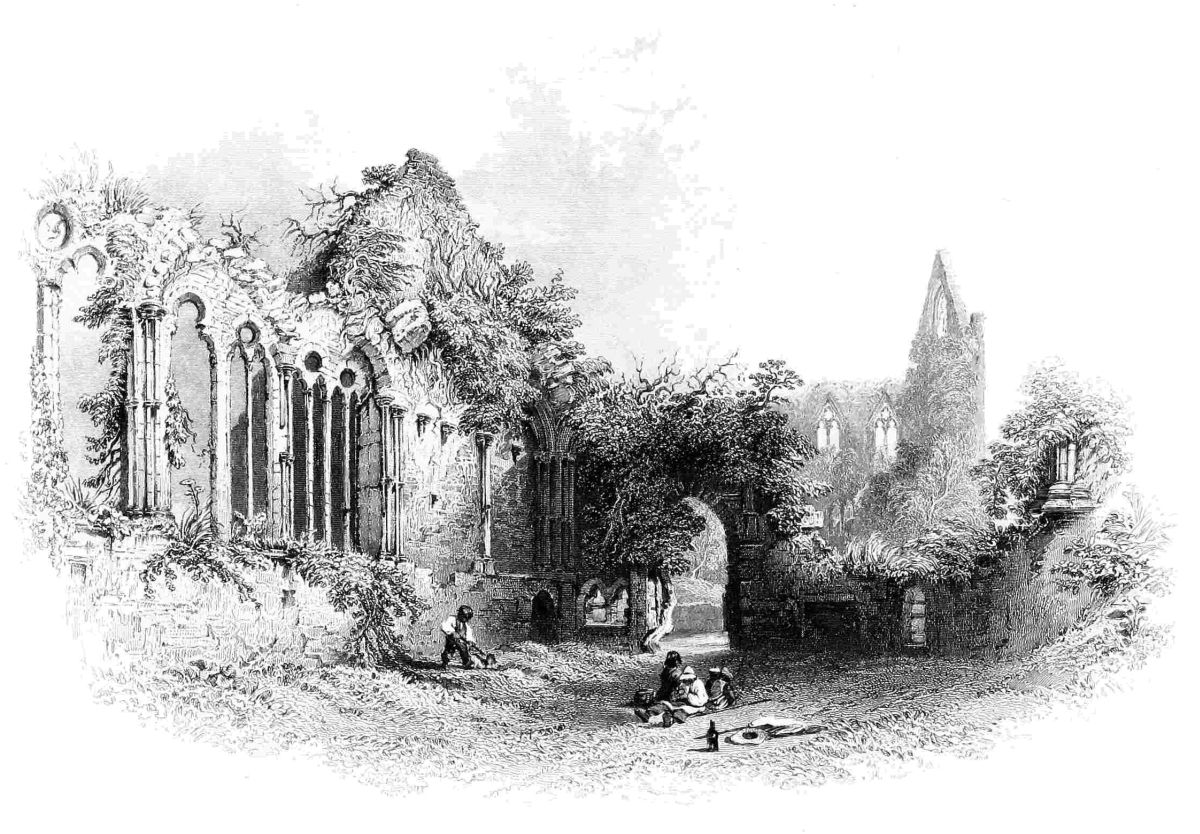
The Refectory, as described by monastic writers, was a large hall wainscoted on the north and south sides, and in the west and nether parts was a long bench of stone, in mason-work, from the cellar-door to the pantry, or cove-door. It had a dresser in it: above the wainscot was a large picture of Christ, the Virgin Mary, and St. John; but in most places—and here perhaps—was the Cross or Crucifixion, to which, on entering the Fratry with washed hands, the monks made obeisance with their faces to the east. Within the door on the left was an Almery—where stood the grace-cup (the classical αγαθου δαιμονος), out of which the monks, after grace every day, drank round the table—and another large one on the right, with smaller within, where stood the mazers, of which each monk had his peculiar one, with a ewer and basin, which served the Sub-prior to wash his hands in at the table, of which he sat as chief.[72] At the west end was a loft above the cellar, ascended by stairs with an iron railing, where the convent and monks dined together, the Sub-prior sitting at the upper end of the table. At the south end of the high table, within a glass window-frame, was an iron desk, ascended by stone steps, with an iron rail, where lay a Bible, out of which one of the novices read a part in Latin during dinner. The readers at the table were to give ear to the Prior in case of error; and if they did not understand his correction, they were to begin the verse again, even repeatedly, until they comprehended the Prior’s meaning. When the reader had finished, the master of the novices rang a silver bell hanging over his head, to call one of them to come to the high table to say grace; a single stroke of this bell (skilla), signified the conclusion of the lecture or the meal.[73]
ospitality, which the monastic rule enjoined upon all its professors, was faithfully practised by the Cistercians. The Refectory, as well as the Hospitium, or Guest Hall, of this Abbey, appears to have been an elegant and capacious chamber, with a vaulted stone roof supported on Gothic pillars, the massive bases of which still remain. But as the buildings were long thrown open as a stone quarry, for the use of the public, the squared and sculptured materials with which they were built and adorned, were employed for ages in constructing those shapeless hovels which now cluster, as if in mockery, around the sacred pile, and show to what base uses in this changing world, even the masterpieces of art may be applied.

The Dole.—An opening in the wall of the refectory westward, shows the place where the monk appointed to that duty, administered to the poor their daily portion of bread and beer. To that door the hungry and the weary never applied in vain—
Pilgrim, whosoe’er thou art, Worn with travel, faint with fear, Halt, or blind, or sick of heart, Bread and welcome wait thee here.
At the east end of the Refectory was “a neat table, with a screen of wainscot over it, for the master of the novices, the elects, and novices, to dine and sup at: two windows opened into the refectory from the great kitchen, one large for principal days, the other smaller for ordinary days; and through these the dishes were served. Over against the door in the cloister was a conduit or lavatory, for the monks to wash their hands and faces, of a round form, covered with lead, and all marble, excepting the outer wall, without which they might walk about the Tower. After the monks had waited a while on the Abbot, they sat down at two other tables, placed at the sides of the refectory, and had their service brought in by the novices, who, when the monks had dined, sat down to their own dinner. Fires in the refectory were ordered from All-hallows Day to Good-Friday, and the wood was found by the cellarer. Pinafores or super-tunics, to protect the clothes at dinner, are mentioned by Lynwood, and occur in foreign consuetudinals. Giraldus Cambrensis, on dining with the Prior of Canterbury, “noted sixteen dishes, besides intromels,” or entremets; “a superfluous use of signs, much sending of dishes from the Prior to the attending monks, and from them to the lower tables;” with “much ridiculous gesticulation in returning thanks, with much whispering, loose, idle, and licentious discourse;” herbs brought in but not tasted; numerous kinds of fish, roasted, boiled, stuffed, fried, eggs, dishes exquisitely cooked with spices; salted meats to provoke appetite; wines of various kinds; pimento made of wine, honey, and spices; with claret, mead, and other beverages. Respecting these, it was not unusual, says Barnard, to see brought a vessel half full to try the quality and flavour of the wine; and that, after proof thereof, the monks decided in favour of the strongest. Superior dinners were always given on the feasts of the Apostles; but it was not lawful, it seems, to eat the flesh of any animal nourished on the earth, because this had been cursed by God; but the curse not extending to air and water, birds were permitted, as created of the same element as fish. Hence the prohibition of quadrupeds; but as it was found
The Refectory.
Tintern Abbey.
impossible for inland monasteries to have fish enough, to eat flesh became unavoidable.[74] However, to the great rule all their articles of food bore relation; namely, bread, beer, soup, beans for soup, all Lent; oats for gruel, on Thursdays and Saturdays, in that season; flour for pottage, every day in the same season; fried dishes, wastels, or fine bread for dinner and supper, on certain feasts; formictæ, or fine flour cakes, in Advent, Christmas, against Lent, Easter, Pentecost, and certain feasts; ‘fat things,’ which appear to have been bacon,[75] were frequent with the Præmonstratenses; black beans and salt, with the Clugniacks; general bad fare with the Cistercians. In certain solemnities, we are told the convent was in the habit of retiring with the Abbot, leaving a few in the refectory, in order to eat meat elsewhere; and that they frequently dined in ‘extra-cloister’ apartments, where “they used to invite women (devout nuns, perhaps) to talk, eat, and drink with them.”[76]
Diet was strictly prescribed; variety of viands was forbidden; flesh was allowed only to the sick or invalids; fish, eggs, milk, butter, and cheese, were not to be used on common days, but only on special occasions, as dainties or “pittances.”[77] None but their guests and the sick were allowed any other than brown bread; they might use the common herbs of the country; but pepper and other spices were forbidden.
These observations, quoted from various authorities, apply to the monastic Orders generally, among whom the regulations of the refectory appear to have been nearly the same; but that order to which the Abbey of Tinterne belonged, professed the greatest abstinence, mortified diet, and abhorrence of all luxuries. To the devout taste of St. Bernard, the most rigid rules were the most agreeable; and hence he became a Cistercian, the strictest of the monastic orders in France. At that time they were but few in number, for, owing to their excessive austerities, men were discouraged from joining them. Bernard, however, by his superior genius, his eminent piety, and his ardent zeal, gave to this Order a permanent lustre and celebrity. At the age of twenty-three, with more than thirty companions, he entered into the monastery, and was afterwards appointed Abbot of Clairval. To those noviciates who desired admission, he used to say—“If ye hasten to those which are within, dismiss your bodies which ye brought from the world; let the spirit alone enter here; the flesh profiteth nothing.” “Yet, amidst all these disagreeable austerities,” says his biographer, “the soul of Bernard was inwardly taught of God; and as he grew in the divine life, he learned to correct the harshness and asperities of his sentiments.”
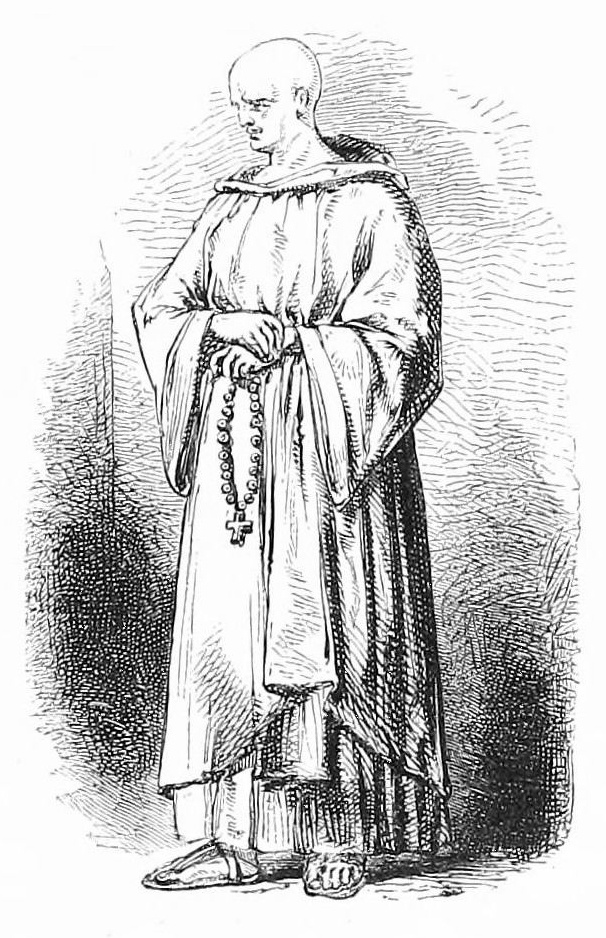
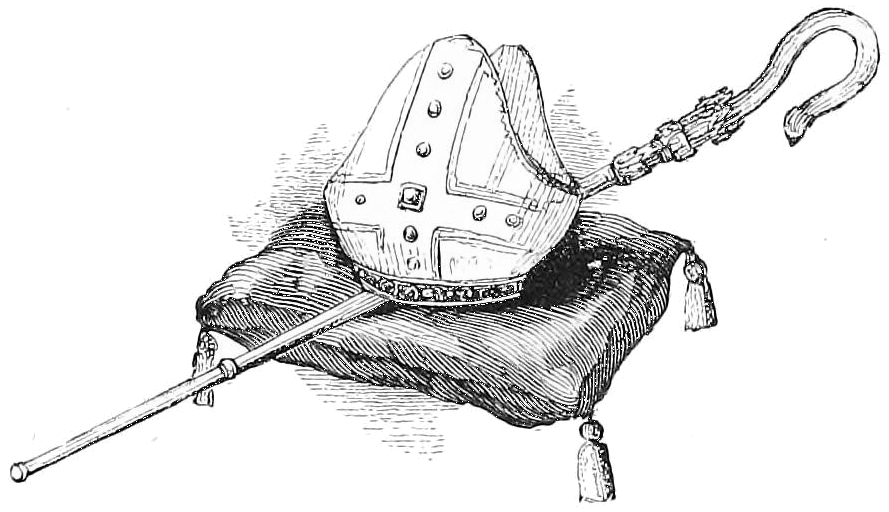
The Cistercian habit, as shown in the preceding woodcut, was a white robe in the nature of a cassock, with a black scapular and hood. Their garment was girt with a black girdle of wool; in the choir, they had over it a white cowl, and over that a hood, with a rochet hanging down, bound before to the waist, in a point behind to the calf of the leg. When they went abroad, they wore a cowl and a great hood, all black, which was also the choir habit.
The Lay Brothers of this Order were clad in a dark colour; their scapular hung down about a foot in length before, and was rounded at the bottom. Their hood was like that which the priests wore over their cowl, excepting the difference of the colour. In the choir they wore a cloak or mantle, reaching to the ground, and of the same colour as the habit.
The Novices, who were clerks, wore the same habit in the church, but it was all white; their scapular was not of the same length in all places, for sometimes it reached only half-way down the thigh, in others to the midleg, or even to the heels.[78]
The sumptuary regulations extended even to the ornaments of their churches, and the vestments of the ministers. The altar cloth, the alb, and the service, were to be of plain linen; the stole and maniple, which were at first of cloth, were allowed afterwards to be of silk. Palls, capes, dalmatics, and tunics, were forbidden. The crosses were to be of wood, painted; and it was forbidden to have them made of carved work, or of silver or gold. The cruets for the service of the altar, were not to be of gold or silver: the chalice and fistula might be of silver gilt; the candlesticks were to be iron, and the censers of iron or copper. Pictures or painted glass were not to be allowed in their churches; which in all monasteries of this order were dedicated to God, under the invocation of the Virgin Mary.
Cistercians, according to the reformed rule, were obliged to perform their devotions together seven times every twenty-four hours. The Nocturnal, the first of these services, was performed at two o’clock in the morning; two Matins, or Prime, commenced at six o’clock; Tierce, at nine o’clock; the Sexte, at twelve o’clock; the None, at three in the afternoon; Vespers, at six; and the Compline, at seven o’clock in the evening. As the monks retired to bed at eight, they had six hours to sleep before the Nocturnal began; and if they again betook themselves to rest, after that service, it was not considered any fault or infringement of the rule; but after matins, they were not permitted to have the same indulgence. At the first stroke of the convent-bell for prayers, they were to suspend all matters of business in which they might happen to be engaged at the moment; and those who copied books, or were employed in any kind of writing—even if they had begun a text letter—were not allowed to finish it. They were to fast every day in Lent, till six o’clock in the evening. During meals, as already mentioned in these pages, the Scriptures were read to them by one of the brethren, who performed this and other offices in weekly rotation. After the Compline, all conversation was prohibited, and they silently retired to rest. The dormitory was a long barrack-like room, not divided into separate cells, where each monk had his own bed furnished with a mat, blanket, coverlet, and a pillow which was not to exceed a foot and a half in length. When any of the fraternity went abroad, they always walked in couples, so that each might be a check upon the other, and incite him to edifying thoughts.[79]
At a General Chapter of the Cistercian Order, held in the year 1134, it was resolved that the rules of St. Benedict regarding diet, clothing, morals, and divine service, should continue to be strictly observed; and to these were added many new regulations for the suppression of luxury. It was directed that their monasteries, as already observed, should be founded in the most retired and solitary places; that the members of the Order should provide the necessaries of life by the labour of their hands. They were allowed, however, to possess lands, rivers, woods, vineyards, and meadows; with sheep, oxen, horses, and other domestic animals; but no deer nor bears, nor other animals kept merely[80] for pleasure. They were forbidden to possess tithes, the advowsons or revenues of churches, dues of ovens or mills, bond-servants, or even rents of lands.[81] The reason for these restrictions was, that they might not live by the labour of others; yet, upon the pretext of enabling the monks to live in greater retirement and abstraction from the world, they were allowed to admit into their community a certain number of lay brothers, called converts, whose office consisted in managing the secular business of the Convent, including the cultivation of their lands, in which they were permitted to employ hired servants. These lay brethren did not take the monastic vow; but in every other respect they were treated exactly like the professed monks.
With regard to the extension of their order, no convent was allowed to send forth a colony, unless the community consisted of at least sixty monks, and held a license, both from the general chapter, and from the archbishop, or bishop. Each monastery, as we have said, was to consist of at least twelve monks and their superiors;[82] and before they could be brought to their new residence, the buildings required for their immediate accommodation were to be provided; namely, an oratory, a dormitory, a stranger’s cell, and a porter’s lodge. The books required for divine service, were also to be got ready. The superior of the new establishment was bound to pay a visit to the parent monastery once a year; and the Abbots of all the monasteries of the Cistercian order, were obliged to attend the General Chapter held annually at Cisteaux,[83] those only excepted, who were excused by sickness or distance. Abbots in Scotland, Ireland, and Sicily, were obliged to be present only every fourth year. In some cases it was even allowed to send delegates.[84]
rofessions.—No person desirous of becoming a monk was suffered to enter upon his noviciate under fifteen years of age. The candidate having made his petition to be admitted, was, after four days, brought before the abbot, and a select number of the monks in the Chapter-house, where he threw himself down with his face to the ground. Being asked by the Abbot what he desired, he replied,—“The mercy of God and yours.” Upon this the Abbot made him stand up, and explained to him the strictness of the rules, and the self-denial required in keeping them; after which, he asked him if he was willing to submit to the restraint they imposed. Upon his replying in the affirmative, the Abbot admonished him, and when he concluded with these words,—“May God finish the good work which he hath begun in thee;” all who were present said, Amen! and then the candidate bowed, and retired to the guest-chamber.

A similar ceremony was observed when he was again introduced into the Chapter-house next day, after having read the rules of the Order. On the third day, he was admitted into the cell of the novices, and began the year of his probation; during which he was prepared and instructed for taking the vows, by a person called the Master of the Novices, who was usually one of the oldest and most learned of the monks. At the conclusion of the twelvemonth’s probation, when it was supposed he had had a sufficient trial of their discipline and manner of life, he was again formally interrogated; and if he persisted in his request, he was allowed to make his profession, and become a regular member of the Order.[85] The following is a copy of the formulary used in English monasteries on such occasions:—
“The first petycion in the Collogium: ‘Syr, I besyche yow and alle the Convent for the luffe of God, our Ladye Sanct Marye, Sanct John of Baptiste, and alle the hoyle cowrte of hevyne, that ye wolde resave me to lyve and dye here emongs yow, in the state of a monke, a prebendarye and servant unto alle, to the honour of God, solace to the companye, prouffet to the place, and helth unto my sawle.’
“The answer unto the examinacyon: ‘Syr, I tryste through the helpe of God, and your good prayers, to keep alle these thyngs ye have now heyr rehersede.’
“The first petycion before the profession: ‘Syr, I have beyn heyr now this twellmonth nere hand, and lovyde be God, me lykes ryght well both the ordour and the companye. Whereupon I besyche yow, and all the companye, for the luffe of God, our Ladye Sanct Marye, Sanct John of Baptiste, and alle the hoyle companye of hevyn, that ye will resave me unto my profession, at my twellmonth day, according to my petycion which I made when I was first resaved heyr emongs yow.’”[86]
The Cistercians, much to their honour, took considerable pains to cultivate and promote learning. The transcribing of books was one of the principal occupations in all their monasteries. A certain number of the brotherhood were constantly employed in the Scriptorium, in making copies of the most esteemed works, to furnish and augment the common library. None, however, were permitted to write new books, without first obtaining a license to that effect from the General Chapter. In the principal monasteries a chronicle was kept, in which the monks recorded, in Latin, the most remarkable events, both of general and local interest, that occurred within their knowledge.[87] The chronicle of Tinterne Abbey, as partly transcribed in the Monasticon, contains copies of those deeds and charters, by which former rights and privileges were confirmed, and new benefactions added; but it includes no chronicle of passing events, public or private.
Many and great were the privileges, franchises, and immunities granted to this Order in general, by sundry kings and pontiffs; and on some particular houses were conferred very special favours. The brothers of the order were exempted from appearing in any court, or at the trial of any cause whatever, if the distance from the monastery exceeded two days’ journey. They were exempted from tithes; the ordinary could not call upon, nor punish them for any crime; neither could their houses be visited by any one, except their own abbot. Their benefactors, those who frequented their mills [molendini], as well as their friends and servants, were all exempted from the ban of excommunication.[88] Boniface XI. made an effort to relieve them still farther, by exempting them from the payment of tithes for their lands, though let out to others; but this was rejected by King Henry IV., who would not permit the bull for that purpose to be executed. The monks of Tinterne, in common with their brethren of that order, enjoyed all the privileges and immunities here named. They were great proficients in the science of agriculture; and from the skill manifested in the cultivation of the abbey lands, and in those occupied by their tenants, produced the happiest effects on that important branch of rural economy.
The Cloister, which is so often described in poetry as the abode of religious harmony, was nevertheless subject, at times, to all those unruly passions which in the world engender strife amongst brethren, and destroy the quiet of secular life. Every monastery contained within its own walls, those elements of malice and dissension, which it required no common energy on the part of the abbot to regulate and subdue. Perverse men, clothed in the robe of meekness, were a constant source of trial to those patterns of monastic discipline, who laboured to correct and reform them.[89] Persecution within the cloister existed occasionally under two forms: men of eminent sanctity suffered it from degenerate brethren, sometimes, simply on account of their superior justice; and at others, in consequence of their endeavours to reform them. Sometimes when the monastery fell under the dominion of an evil superior, the monks who persevered in sanctity fled from his persecution.[90]
The character of a good Cistercian monk, contrasted with one of an opposite disposition, is thus drawn:—It happened that the pious Gobert, a monk of Villars, having to undertake a journey for the arrangement of certain affairs, set out accompanied by one of the brothers named Peter. Arriving late in the evening at a town where they were to pass the night, they were fatigued and exhausted with the labour and heat of the day; and Peter, causing a table to be spread, drew from the bag he carried, abundant provisions, and then ordered cups to be served, and many things made ready for their repast. To the pious Gobert, all this seemed to be more than necessary, more than was consistent with perfect moderation, and his conscience silently accused him of yielding too readily to the force of temptation. But after both had supped, he did not venture to give utterance to the compunctious feelings that were then passing in his mind. Next morning, however, as they were again prosecuting their journey through umbrageous lanes, he began meekly and humbly to disclose his thoughts; expressing his fears that the expense of the previous day had exceeded their wants; adding, that the patrimony of Christ ought not to be spent in superfluities, but given to the poor; that beneficed clerks are only dispensers of the Church, not lords of its substance; that when, in the words of St. Ambrose, we assist the poor, we give nothing of our own, but only that which the church appoints us to dispense; and, therefore, that ecclesiastical goods belong not to clerks, but to the poor.[91]
Saying these and other things that pressed heavily on his mind, Gobert lamented that he should have squandered the money which did not belong to him. But brother Peter did not receive this reproof with a humble mind; on the contrary, he became so angry that he did not answer him a word. Thus they rode on for nearly three hours, Peter all the while preserving a sullen and painful silence, which the holy Gobert observing, he tried to soothe and turn away his displeasure, by addressing him in terms of mild and brotherly affection. At last, seeing that he could make no impression upon him, he said, “My brother, it is time for us to discharge the service of hours to our Creator!” Whereupon, according to the custom of the Cistercians, they dismounted and knelt down to begin the office. In this posture of devotion, while brother Peter was prostrate on the earth, Gobert, with clasped hands turned towards him, and bursting into tears, humbly implored his forgiveness for having, by words of admonition and seeming reproof, moved his resentment. But as this did not appear to soften the monk’s obdurate heart, he continued his entreaties, and declared that he would not rise from his knees until he had forgiven him. At last, touched and overcome by so much Christian humility, brother Peter relented; and, taking Gobert by the hand, with feelings of mingled shame and contrition, raised him up; and having freely forgiven him,[92] and received his forgiveness, they went on their way rejoicing.
Thus far the chronicle, which the reader will find quoted in the Ages of Faith. “But,” says the learned author, “it was chiefly as reformers of their respective communities, that the holy men of monastic life suffered persecution.” In estimating the fortitude of those who laboured in this vineyard, it is to be observed, that specious arguments were never wanting to excuse the evil for which they sought a remedy. The monks of St. Benedict, according to Orderic Vitalis, who resisted the reform introduced by the Abbot Robert,[93] defended themselves on this ground, urging that the different circumstances of the times required a life different from that of the hermits of Egypt. “God forbid,” said they, “that valiant knights, that subtile philosophers, and eloquent doctors, merely because they have renounced the world, should be obliged as mean slaves to occupy themselves in ignoble works.[94] On these occasions, however, the real source of hostility was seldom avowed. Much was advanced in the time of St. Bernard, in respect to the colour of habits; but St. Peter the Venerable disengaged the question from its adventitious appendages: “Perhaps,” said he, writing to St. Bernard, “there is another and a deeper cause for this dissension between the Clugniacs and the Cistercians—between the ancient and the modern communities. We are restorers of piety that was grown cold; we are distinguished from others in manners, as well as in habits and customs. This is the secret and urgent cause of the breach of charity and of tongues, that are sharpened like swords against us. And oh, how much to be deplored, if the abstinence, the purity of a whole life; if invincible obedience, if unbroken fasts, if perpetual vigils, if such a yoke of discipline, if so many palms of patience, if so many labours—not so much of an earthly, as of a celestial life—should be dissipated by one hiss of the serpent: how much to be deplored, if the old dragon should thus, in an instant, with one breath, dissipate all your treasures collected by the grace of God, and leave you empty in the sight of the Supreme Judge!”[95]
f the miraculous legends connected with these institutions, the following, taken from the annals of a sister abbey,[96] may serve as a specimen:—One evening, three strangers knocked at the abbey gate, and being admitted to lodge there for the night, were immediately conducted into the church, as the rule of St. Benedict directs; and having there finished their devotions, they were led back to the Guest Chamber, and welcomed in by brother Walter. Thence, as soon as the ceremony of washing their feet was over, they were summoned to the Refectory; but scarcely had they taken their seats, when it was discovered that one of the strangers was missing, and his chair empty. “Where,” said the hospitaller, addressing the other two; “where is your companion?” “Companion!” said the strangers, greatly surprised at the question; “thy servants had no companion.” “Nay,” quoth the friar, “say not so, I pray you; for ’tis but this instant that I placed three at table, and he who sat betwixt you has left his chair empty.” “Nay, we assure thee,” rejoined the strangers, “that no third person entered with us, neither have we journeyed hither with any man; but, being overtaken by night, we came along to the abbey gate, nor have we spoken to any man, save only thyself.” Strong in his own conviction, friar Walter was immovable; and calling the porter and another monk to his assistance, the fact of a third person having entered was confirmed by their united testimony. Hereupon the strangers could only repeat what they had already asserted; but to give it more solemnity, they called St. Benedict himself to witness the truth of their words. All was amazement; diligent search was made, but no foot had repassed the gate, nor was any stranger to be found in church or cloisters; so the two visitors, being spared all further question, were hospitably entertained for the night, and dismissed with the usual benediction. The next night, however, the hospitaller had a vision in his sleep: a personage of angelic features appeared to him; and with a voice like that of celestial music, said, “Walter, dost thou know me? I am the stranger whose sudden disappearance last night so greatly moved the warder. Know then, that by the good pleasure of heaven I am appointed to watch over this Monastery; to attend the outgoing and the incoming of every holy brother; and that my present errand is to certify that the alms and oblations of this community, more especially of your Abbot, have ascended in sweet memorial to heaven, and are accepted.” Again—

Waltheof, an abbot of whom we read in the Cistercian Annals, had many severe trials to undergo, not only with refractory monks, but with the arch-fiend himself, who appeared to have delegated the management of his other affairs to inferior powers of darkness, in order that he himself might direct his whole force and strategy against the uncompromising Waltheof. But the abbot, aware of all these machinations, never lost an inch of ground; every fresh rencontre was to him a fresh triumph; for knowing the strength and skill of the enemy, he took up the shield of faith, and, cased in this armour of proof, met his spiritual foe with a look of contempt and defiance. To report their numerous conflicts, would be to recapitulate the days of the life of Waltheof—for it was literally a warfare. At length, one evening after Compline—when all the monks had retired to the dormitory—the abbot continued lingering in the church; for, feeling a weight at heart, he wished to unburden his grief in solitary prayer and meditation. At such moments, it is well known, the powers of darkness are always most active—most on the alert; and Waltheof no sooner looked down the left aisle, than he perceived the arch-fiend moving stealthily from behind a pillar. In this instance he had assumed the habit of a monk; but as he cast no shadow behind him, and caused no sound as he shuffled along the tesselated floor, the abbot soon recognised his old customer, and calmly waited for him at the foot of the altar. Seeing himself thus baffled, the fiend suddenly threw aside his cowl, and assumed the terrific form of a soldier, armed at all points, and of such gigantic proportions, that in a moment every pillar in the nave seemed to have dwindled into insignificance. His grand object, as the abbot foresaw, was to inspire him with sudden terror, and thus drive him from his sanctuary; but the attempt was vain. He then brandished a huge spear, and belching forth streams of blue fire as he approached, made a feint, as if he would have hurled the weapon at his head. But the abbot, continuing to make the sign of the cross, kept the great adversary of mankind at bay; yet still finding that he did not quit the sacred pile, he armed himself with the pix which contained the sacred wafer; and then advancing, exclaimed, “Behold, thou wicked soldier, thou base hireling! here is thy judge, who shall quickly send thee to the bottomless pit! Wait for him if thou darest!” What need of words; at this sight the foul fiend suddenly collapsed in all his terrific proportions, and vanished in a cloud of smoke.[97]
These two examples may suffice to give the reader some idea of the numerous legends with which the monastic annals abound: and, in addition to what has been already said of the internal administration of this order, we shall, from time to time, introduce other particulars, drawn from various sources, but chiefly from their own chronicles.
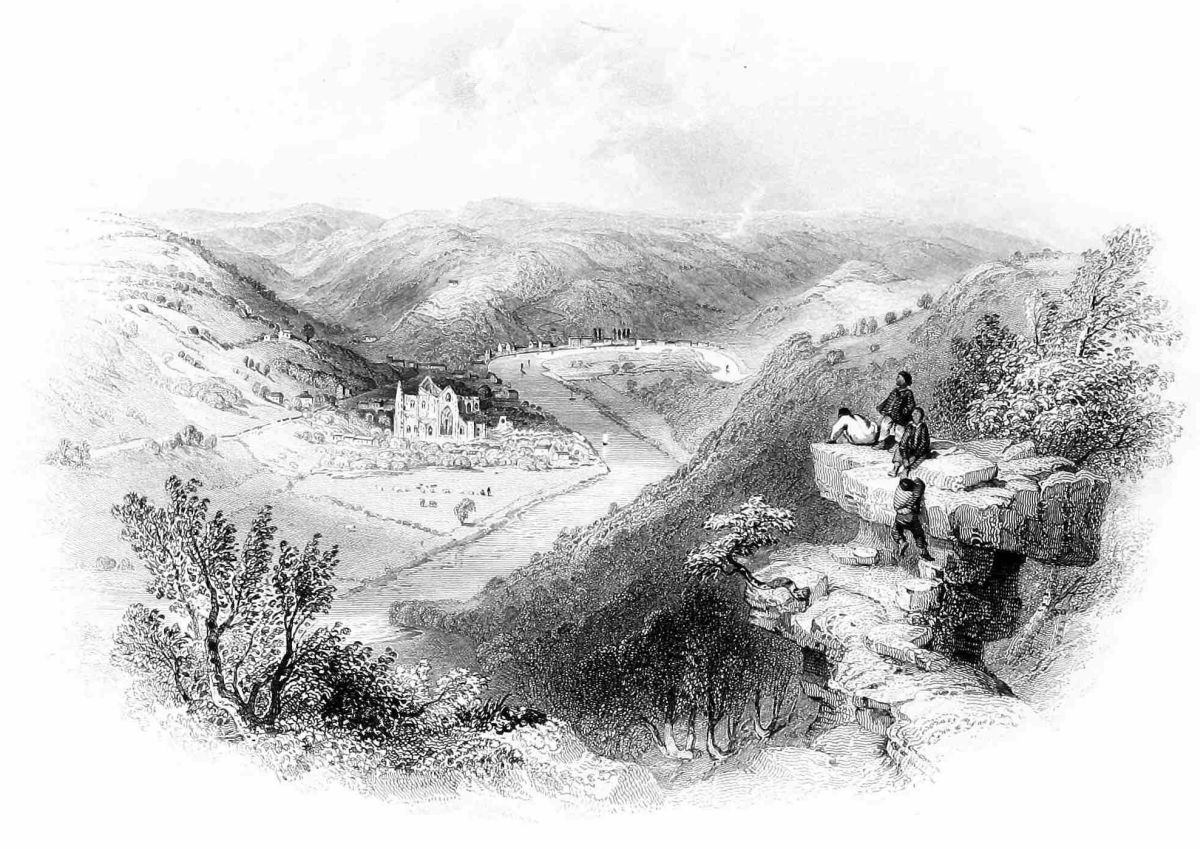
Environs.—It would be difficult to name a locality that, within so small a compass, contains so many richly-varied landscapes, as the Vale of Tinterne. In whatever direction we move, the eye is arrested by new features, new combinations of the graceful and picturesque. A saunter along the river, where it forms a crescent between the abbey and the village, will gratify every lover of the picturesque, and bring before him the beauty and freshness of nature, in striking contrast with the sublime but faded monuments of art. The best hour for enjoying this scene is about sunset; and, on returning, the tourist may ascend the Chapel Hill, and thence, in a more extended panorama, look down upon what would have furnished a rich subject for the pencil of Claude. The river, with its fantastic windings, here clamorous among shallows—there gliding away with the rapid but inaudible march of time—masses of brown rock overhanging the pass, gleaming in confused blocks through the trees that clamber up their
The Vale of Tintern.
From the Devil’s Pulpit.
steep sides, or crown their pinnacles with masses of verdure; while here and there a cottage, with its whitewashed walls, gives new life and interest to the scene.
How oft the pilgrim, lingering here, Beneath that yew’s sepulchral shade, Hath dropt the penitential tear, And, sighing to himself, hath said— There’s solace here for all my woe, St. Mary’s altar gleams below; And blessèd be the hand divine, That leads the pilgrim to her shrine.
But the point from which the Abbey of Tinterne is seen to most advantage, is that chosen by Mr. Bartlett in the illustration opposite. The way to the ‘Devil’s Pulpit,’ as it is called, runs along the left bank of the Wye, and, in its winding course, presents many little glimpses of the vale and river, that, like small cabinet-pictures, serve as a gradual introduction to the splendid panorama of nature—the features of which are here so faithfully illustrated by the pencil, as to render description superfluous.
The river, rolling far below— Here swift as time, there still and slow; O’ershadowed here with arching bowers, There sweetly fringed with summer flowers; The Vale—where, through its orchard trees, The curling vapour meets the breeze, And, vast and venerably grand, The Abbey’s mouldering arches stand,— All these a wondrous scene impart, To charm the eye and melt the heart; The scroll of ages to unfold, And paint the wondrous men of old.
Of this lofty and romantic scene Mr. Thomas writes:—“Who shall describe the glories of this splendid view? Who cannot but involuntarily think of the second scene in the Temptation, when the prince of the power of the air took the Prince of peace into an exceeding high mountain, and showed him all the kingdoms of the world and the glory of them, in a moment of time? But let no satanic thought break in upon the holy influence which the soul delights to cherish in this lovely spot! It seems as though imagination, that potent enchantress of the mind, had transmitted us to some pinnacled mountain to show us the peace, the beauty, and permanence of the works of God, in vivid contrast with the feeble, the transitory, the desolated works of man—the ruined abbey encircled by the everlasting hills. This comprehensive panorama contains the most pleasing combination of nature and art, mountain and meadow, water and wood. There flows the glassy Wye, coiled like a serpent, and either buried in woods, or gliding peacefully through meadows spangled with fleecy flocks. Its buoyant bosom bears a little bark freighted with the gay partizans of pleasure, whose scarlet banner is playing with the summer’s breeze. The distant sounds of a solitary flute harmonize with the busy hum of bees, and the song of some half-secluded bird. Again, we hear the hoarser cry of the mariner, and the metallic voice of an industrious anvil. The unpretending church of Tinterne, in its unspotted whiteness, contrasts with its aged companion—a sombre yew, which, like an ample pall, is overshadowing the clustered monuments of death.”
Lancaut cliffs, which contribute a striking feature to this part of the scenery, are rendered still more interesting by the following tradition:—During the calamitous war, so often referred to in these pages, Sir John Winter was eminently distinguished by his devotion to the royal cause. The personal risks and pecuniary sacrifices to which he was daily exposed, only served to give more warmth to his loyalty. When the Parliament sent their first troops to the banks of the Wye, Winter converted his house at Sidney into a fortress; and so promptly and skilfully was this accomplished, that it was rendered not merely inaccessible, but so well provisioned and fortified as to be able to stand a siege. In this, perhaps, there was some little exaggeration; for the garrison, then at Gloucester, and acting under the direction of skilful and determined leaders, were not likely to have been foiled, had they made any such attempt. Their grand object was Chepstow Castle; and if that fortress was ultimately found to be untenable, the defence of a private fortalice must have been a rash and hopeless attempt. It proves, nevertheless, that his loyalty admitted of no fear, and was prepared for every extremity. Acting under the command of Lord Herbert—whose operations will be detailed in our account of Raglan—Winter, by his rapid movements, frequently alarmed the troops under General Massey. But after the siege of Gloucester was raised by the Earl of Essex, the king’s interest in that part of the country was much impaired; and the Parliamentary forces continuing to advance, Sir John Winter was compelled by urgent duties to abandon his own residence, and retire across the frontier. In his retreat, however, through the forest of Tudenham, Cromwell’s dragoons were immediately on his traces; escape was seemingly impossible—he was completely hemmed in by the enemy on one hand, and the Wye on the other; and though well mounted, he soon perceived that his pursuers were sensibly gaining upon him. Determined that they should never boast of having taken him prisoner, he turned his horse’s head suddenly towards the rocks, which now bear his name, and by means, he knew not how, quickly disappeared and descended the cliffs in safety. At the base of these rolled the Wye, then in flood tide; but plunging into the river, his gallant steed carried him safely to the opposite bank, where he was soon joined by a party of royalists, and congratulated upon his miraculous escape. The point at which he descended the rocks is still called Winter’s leap. Of his escape, by scrambling down the cliff, there is no doubt; but to represent it as the result of a leap[98] on horseback, would be to assume the peculiar privilege of “Geoffrey of Monmouth.”
After this perilous feat, the hardy royalist returned to his house at Sidney; but finding it, on closer inspection, to be quite untenable, he had it demolished, and then, joining the king’s forces, took part in the battle of Naseby, which gave a finishing blow to the king’s affairs.
walk from the Abbey to the village of Tinterne Parva, will never fail to interest the stranger; in this short distance, many new features and new combinations of scenery crowd upon the view, and carry the mind back to remote times, when the cloister bell was the only sound that broke in upon the stillness of the scene. Sweeping round the outer ring of the crescent, within which the river flows in a deep smooth channel, the road is overhung by masses of rock, shaded by trees, and skirted by cottages, which, from the situations they occupy, rather than any taste or merit in their construction, present a picturesque appearance. As we advance, the scene is continually changing: the old abbey walls, beautiful from whatever point they are contemplated, assume a comparatively new aspect from the western approach, particularly about sunset, when the whole building appears as if bathed in a flood of yellow light. To enjoy the scenery of the place under such circumstances, is worth a long day’s pilgrimage. The river, which here doubles upon itself, so as to take the form of a horse shoe, is of a depth navigable for small craft; and though here and there fretted by rocks, the surface, as we passed, was smooth and limpid; through which, as in a mirror, the picturesque scenery on its banks appeared in distinct and beautiful reflexion.

Near to the Cross, the ancient market-place of the village, the stranger is shown a ruined edifice, partly covered with ivy, and bearing the evidence of having suffered less from time than violence. This is supposed to have been the villa, or extra-cloister residence of the abbots of Tinterne, to which at certain seasons they could retire from the exercise of their public functions, and enjoy the privileges of social life—the society and conversation of friends and strangers, without the forms and austerities of the cloister. Of this building, nothing but a few shapeless walls is left; but from the size and structure of the windows, square-headed and divided by transoms, it seems probable that the house is not earlier than the reign of Elizabeth. Mr. Thomas thinks, that from its Tudor-Gothic style, it was probably built by the abbot and some of the brotherhood, as a retreat about the period when the original foundation was dissolved. During the war which devastated the frontier in 1645-6, it was taken and ransacked by the soldiers of the Commonwealth. Since that period it has often changed its owners; and at one time, we are told, though on rather uncertain ground, it was the residence of the family of Fielding the novelist—
Whose name Still draws the pilgrim to its shattered frame, And bids him linger ’neath its shadow.
The parish church of Tinterne Parva is a small but very ancient building, irregularly divided into porch, nave, and chancel. Its erection, according to the historian of the abbey, was anterior to the foundation of the monastery itself; and by some writers it is even considered to have been the parent church. The evidences of its great antiquity may be found in the building itself; and a practised eye will detect indications of a British origin, in certain niches or circular arched windows in the massive walls of the western side. The porch, which is chaste and in good preservation, is a subsequent erection, and yet of a remote age. The chancel, which “most uncouthly joins the nave,” is the latest portion of the fabric. There are fragments of some antique monuments scattered about the floor—memorials of ecclesiastics—which, the writer sarcastically observes, “have been judiciously cut up, and squared, to mend the pavement!” By this sage arrangement, the parochial economy has been brought into the sharpest practice; and although it has evinced no special veneration for the sainted dead, or the hallowed relics of antiquity, yet “the ruinous expense of hauling fresh slabs from the quarry, on the opposite side of the way, has been most considerately spared.” Moreover, he adds, “the pipe of the stove within, is picturesquely thrust through the only Gothic window remaining in the nave!”[99]
As if its smoke, though dark and somewhat denser, Were meant to represent the ancient Censer, That once, with daily sacrifice, perfumed The ground where saints and heroes lay inhumed.
By the churchyard stile, as Mr. Thomas happily describes it, “and beneath the dark mantling boughs of the yew-tree, a scene of exquisite sweetness steals upon the eye. The beautiful meadows beyond are skirted by a ridge of lofty woods, with the gentle Wye flowing like a liquid mirror below. Beneath the
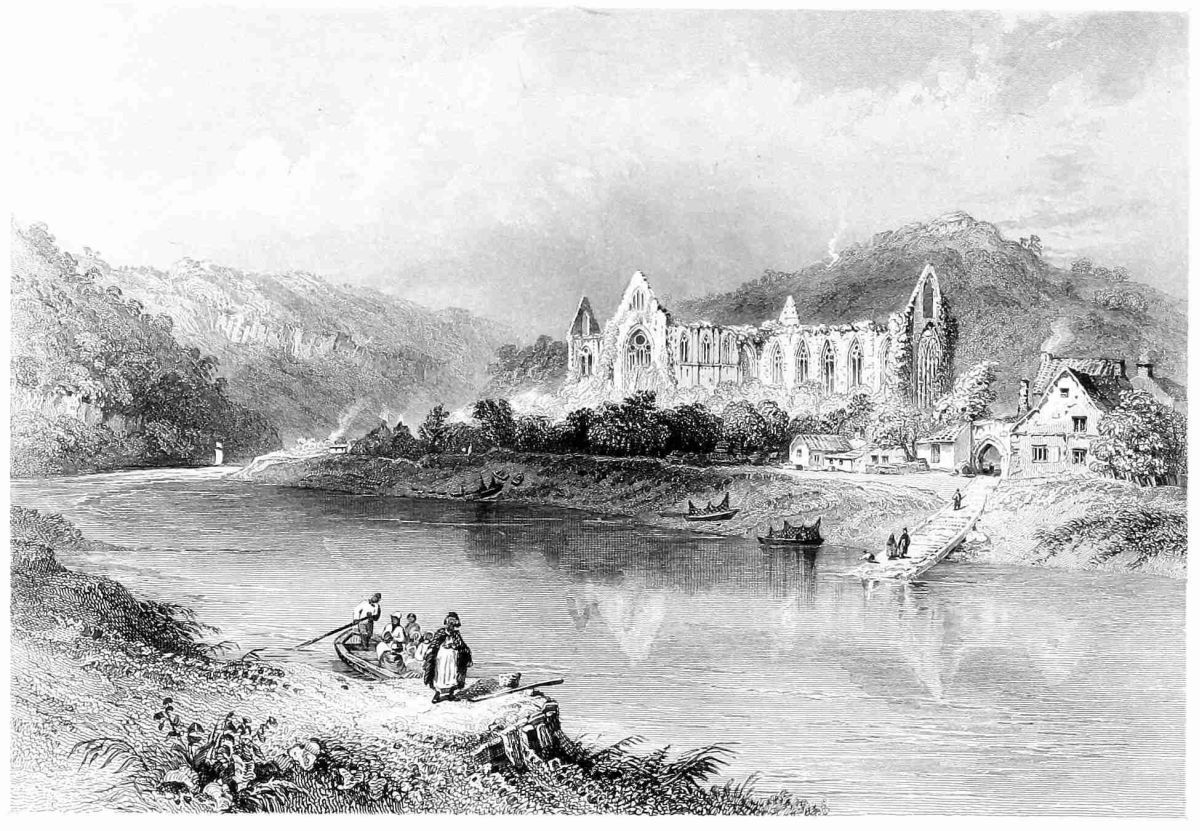
The Ferry at Tintern.
renewed limbs of an aged elm-tree, hollowed and blasted by the storms of many winters, a flock of unmolested sheep repose in grateful shade; these are, indeed, made “to lie down in green pastures,” and are “led beside the still waters.”
It would be difficult to picture to the mind’s eye a scene of more enchanting repose; in such a place as this, with such objects before him, the verdant pastures, the pendent groves, the winding river, the tranquil sky,—where the very clouds, with their fleecy wings stretched forth in vain to catch the subtile current, seem like a fleet becalmed on the wide ocean, waiting for the breeze;—with these before him, ambition forgets the world; sorrow looks up with more cheerful resignation; cares and disappointments lose both their weight and their sting: with so little of sordid earth, so much of the sublimity of nature to contemplate, his thoughts become chastened, soothed, and elevated; and the heart expands under a new sense of happiness, and a feeling of brotherly kindness and benevolence towards everything that breathes. He feels the poet’s exhortation in all its force—
When thoughts Of the last bitter hour come, like a blight, Over thy spirit, and sad images Of the stern agony, the shroud, and pall, And breathless darkness, and the narrow house, Make thee to shudder and grow sick at heart, Go forth into the open sky, and list To Nature’s teaching!
And then turning to Wordsworth:—
For I have learnt To look on Nature, not as in the hour Of thoughtless youth, but hearing oftentimes The still, sad music of humanity, Nor harsh, nor grating, though of ample power To chasten and subdue. And I have felt A presence that disturbs me with the joy Of elevated thoughts: a sense sublime Of something far more deeply interfused, Whose dwelling is the light of setting suns, And the roused ocean, and the living air, And the blue sky, and in the mind of man; A motion and a spirit that impels All thinking things, all objects of all thought, And rolls through all things. Therefore am I still A lover of the meadows, and the woods, And mountains, and of all that we behold From this green earth; of all the mighty world Of eye and ear, both what they half create, And what perceive.
Striguil.—The whole frontier of this interesting country—the land of Gwent—is sprinkled over with picturesque ruins,—the crumbling remains of those warlike strongholds raised by the Norman barons, as a defence to their newly-acquired possessions, which were brought into frequent jeopardy by the martial and reluctant subjects of the new dynasty. To these we can only advert in passing—for the plan on which this work is conducted, does not admit of their being noticed in detail. In the second century after the Conquest, six of these strongholds were erected near the British forest of Wentwood[100]—a still venerable chase of between two and three thousand acres in extent, and associated with many events in the history and traditions of the Welsh frontiers. The grand object of these castles was to form a chain of garrisoned forts for the protection of Norman interests against the incursions of a people who, although compelled to pass under a foreign yoke, still gloried in their independence, and embraced every occasion to prove that their martial spirit, though bowed, was not broken.
One of the strongest of these embattled fastnesses was Castell-glyn-y-Striguil,[101] erected, according to Doomsday-book, by the Norman warrior so often named in this work, William Fitzosborne. In Hammer’s Irish Chronicle,[102] however, its erection is ascribed to Gilbert Strongbow, whose life and family we have already noticed in the account of Tinterne Abbey. The remains of this castle, though inadequate to convey any just notion of its original strength, are still sufficiently marked with regard to its size and proportions. Its outworks have mouldered down into shapeless masses, over which nature has thrown so dense a matting of underwood, that the traces of art have been almost obliterated. The form “was that of an oblong square, the angles of which, as usual in such cases, were defended by octagonal towers;”[103] at one extremity was the donjon, or keep, the situation of which is indicated by the shapeless mound of vegetation, which draws nutriment from its débris. The walls were encircled by a deep moat, supplied by two mountain rivulets, which unite at this point to form the Troggy, one of the silver tributaries of the river Usk.
The other castles Avhich deserve a cursory notice, are, Llanvair, Llanvaches, Pencoed, Dinham, and Penhow.[104] The latter, an ancient seat of the Seymours, occupies a bold and romantic situation. The acclivity which forms the direct approach to it, is nearly perpendicular. The view which it commands consists of a valley, or rather wooded ravines, in the foreground; and in the distance, a range of barren hills that bound the horizon—
Hills that, giving birth To circling fountains, glad the parent earth; And from their bosom, framed for martial toil, Sent forth the guardian heroes of the soil.
By the marriage of the Lady Jane, daughter of Sir John Seymour, with Henry the Eighth, and the birth of their son, afterwards Edward the Sixth, the house of Penhow was placed in a situation to compete with that of Raglan; and by the fortuitous influence thus acquired, the Seymours took a leading authority in the management and direction of county affairs.
This castle, or rather fortalice, appears to have derived its strength, more from its isolated and once inaccessible position, than from the extent of its walls or outworks. A portion of the interior has been repaired and rendered habitable, or rather a house has been erected on the site of the old berçeau, and thus future patriots and statesmen may yet “come forth of Penhow.”
Llanvair, about six miles west from Chepstow, was the ancient residence of the Kemeys family, from whom sprang Sir Nicholas Kemeys, the last governor of Chepstow Castle, whose heroic but tragical fate has been already noticed in these pages. The ruins of this ancient homestead are too inconsiderable to challenge more than a passing glance from the tourist. The same may be said of Dinham, a hamlet in the parish of Llanvair-Discoed.
Goldcliffe, “so called,” says Camden, “because the stones there, of a golden colour, by reverberation of the sunne shining full upon them, glitter with a wonderful brightnesse. Neither can I be easilie perswaded that nature hath given this brightnesse in vaine unto the stones, and that there should be a flowre here without fruit; were there any man that would serch into the veines there, and using the direction of Art, enter into the inmost and secretest bowels of the earth.”[105] But what was a mystery in the days of Giraldus, and even of Camden, admits of a very simple solution. The Gold Cliff, so called, consists of a rock nearly perpendicular, which rises abruptly to the height of a hundred feet in an extensive moor.[106] It consists of limestone strata, nearly horizontal and parallel, supported by a base of brown sandstone, abounding with yellow mica. The brilliant effect of the sun upon this micaceous surface, was a reason for the old belief in the neighbourhood, that the rock contained gold, and was therefore considered as a situation of peculiar value and sanctity.[107] The church of Goldcliffe belonged to a priory founded and endowed in 1113, by Robert de Chandos, eighteen years earlier than that of Tinterne Abbey, who, by the persuasion of Henry the First, annexed it to the Abbey of Bec, in Normandy, whence a prior and twelve Black, or Benedictine, friars were conveyed to it. On the suppression of alien priories, Henry Beauchamp, Earl of Warwick, obtained of King Henry the Sixth the patronage of the priory, with permission to annex it to the Abbey of St. Mary, at Tewkesbury, to which it was made a cell in 1442. The Cambro-Britons, however, being offended at this measure, obliged the prior and monks of Tewkesbury to quit Goldcliffe in 1445; but in the following year they were permitted to return. In the twenty-ninth of the reign of Henry the Sixth, Goldcliffe Priory was granted to the college at Eton, and to Tewkesbury again. At the accession of Edward the Fourth, but seven years later, it was restored to Eton college, in whose possession it has since remained.[108]
Caldicot.—The castle of this name is said to have been erected by one of the ancient Bohuns, earls of Hereford, hereditary lords-high-constables of England,[109] for nearly two hundred years. From them the castle descended to Henry, Duke of Lancaster, and upon his accession to the throne as Henry the Fourth, it was invested in the crown. The ivy-mantled walls enclose a large court, with three entrances. The principal gateway is flanked by lofty square towers; and on the east side are the remains of the hall, comprising a range of windows, of large size and elegant workmanship. The style of masonry, as shown in the construction of the walls, is excellent; the courses of large and equal sized stones, are accurately squared and jointed; but the whole construction has more the appearance of an ancient domestic residence, than of a British stronghold—well suited for the accommodation of a feudal baron and his retinue in times of peace, but ill prepared to resist an enemy, or sustain a siege.