RAGLAN CASTLE, Monmouthshire. (continued 3)
Reading edition
“Such a house broke— So noble a master fallen! All gone— And not one friend to take his fortune by the arm!”
We now turn to the faithful friend who has recorded these anecdotes of his illustrious patron; who attended him during the whole progress of the siege, and, after the closing scene at Raglan, accompanied him to London, soothed him under the new series of afflictions to which he was there exposed, and never left him until he saw the Master whom he loved and honoured consigned to his final resting-place in the Beaufort Chapel at Windsor. This companion, friend, and counsellor, was Dr. Bayly; and, although our notice must be brief, it is a grateful task to commemorate the virtues of a man, whose name has almost passed into oblivion; but whose loyal devotion, genius, talent, and misfortune, justly entitle him to a place in the same page that records the merits and sufferings of Henry, first Marquess of Worcester.
Dr. Thomas Bayly was the fourth and youngest son of Dr. Lewis Bayly, Bishop of Bangor. After finishing his curriculum at the University of Cambridge, and receiving the degree of Bachelor of Arts in 1638, he was presented by King Charles to the subdeanery of Wells. In the troubles that continued to distract the nation, he took an active and unremitting interest; and having retired with other loyalists to Oxford in 1644, he was there created Doctor of Divinity. Previously to the battle of Naseby, he had accepted Lord Worcester’s appointment as chaplain to the household; and, as we have seen in the preceding account, acted in several instances as confidential adviser between the King and the Marquess. He was present during the whole course of the siege of Raglan, more as a soldier than a chaplain, and took his full share of the perils and responsibilities in which the officers of the garrison were then involved.
When terms of capitulation were finally tendered by General Fairfax, and accepted by the Marquess, Dr. Bayly was employed to draw up the articles upon which the garrison was to be disbanded: and when the castle was delivered up to the besiegers, he accompanied the Marquess to London, attended him during his imprisonment as a friend and servant, consoled him as a minister of religion, vindicated his character, advocated his rights, and, when the final hour arrived, he performed over his grave the last sad offices of religion and humanity.
After this event, Dr. Bayly repaired to the Continent, where he continued to reside, chiefly in France, until the “martyrdom of King Charles,” when he returned to England, and published the work already mentioned, entitled, “Certamen Religiosum; or, a Conference between King Charles I. and Henry, late Marquess of Worcester, concerning Religion, in Raglan Castle, anno 1646.” This conference, however, was believed by many to whom he stood opposed, to have no real foundation in truth; and to be merely sent forth as a prelude to his declaring himself a convert to the Roman Catholic faith; or, in the original words, to his “becoming a Papist.”
In the course of the same year he published another work, entitled, “The Royal Charter granted unto Kings by God himself,” &c.; to which is added, “A Treatise,” wherein is proved that Episcopacy is jure divino. By these writings he incurred the heavy displeasure of the Government—to which all such topics were obnoxious—and the author was committed to Newgate, where he languished for some time. But at length, a favourable opportunity having been presented, he made his escape into Holland, where he carried his religious views into immediate practice, and became a zealous Roman Catholic.
Previous to this date, and during his confinement in Newgate, he wrote a piece, entitled, “Herba Parietis; or, the Wallflower, as it grows out of the stone chamber belonging to the metropolitan prison; being an historie which is partly true, partly romantic, morally divine; whereby a marriage between Reality and Fancy is solemnized by Divinity.”[282]
Shortly after this publication, he quitted Holland, and took up his residence at Douay in France, where he sent forth another book, with the title of “The End to Controversy between the Roman Catholic and Protestant Religions, justified by all the several manner of ways whereby all kinds of controversies, of what nature soever, are usually or can possibly be determined.”[283] This was followed by “Dr. Bayly’s Challenge,” the last of his published works; after which he proceeded to Italy, where he spent the residue of his days, and died, as his biographers conclude, in poverty and distress. It is more likely, however, that, after having, by his controversial talents, rendered some service to the church of his adoption, he retired into a monastery, and there ended his chequered pilgrimage in exercises of devotion. This, however, is matter of conjecture, for he is said by Dodd to have died in the family of Cardinal Ottoboni; while Dr. Trevor, Fellow of Merton College, who travelled in Italy in 1659, reports that he died in a public hospital, and that he had seen his grave. His fate, however, like that of many others—driven into involuntary exile by similar causes—is involved in a mystery which no recent attempt has been made to elucidate. Requiescat in pace.
To the books or pamphlets above named, Dr. Bayly received various replies, which showed that, by their spirit and execution, they had excited no little attention among the able and fierce controversialists of that day. Among those who took the field against him were Christopher Cartwright, L’Estrange, Robert Sanderson, Peter Heylin, and others.
A “Life of Fisher, Bishop of Rochester,” is also ascribed to the pen of Dr. Bayly; but his title to that work is not fully substantiated. His Dedication of “Worcester’s Apophthegms,” to the second Marquess, author of “A Century of Inventions,” is manly and elegant. The conclusion is in these words:—“I layd your noble father in his grave with mine own hands; and I could not let a memorial of him lye buried under my own manuscript, but thought it a duty belonging to his fame, and your own merit, to dedicate this book unto your lordship, heir to all, but apparently to nothing but his virtues and this memorial of them.”
In his Epistle to the Reader, he enters upon a lively vindication of the genuineness of his “Certamen; or, Discourse Concerning Religion;” the veracity of which had been bitterly impugned by his enemies; and states that he published it in vindication of the King’s constant affection to the Protestant religion. There is considerable spirit in the preface:—“Some,” he says, “will not admit of that controversie otherwise than as a parable: First, because they were there—that is, at Raglan Castle—and heard no such thing; Secondly, because they believed not the Marquess of Worcester to be so able a man; as I hear it hath been said by some of his Majesty’s field chaplains, who envying that a loyal pen should wagge, where they can be contented to sew pillowes under the elbowes, to bead cushions over the heads of the people,[284] and preach such wholesome and sound doctrine of mortification, sanctification, justification, and good life, that they thought they might safely get up into any pulpit, not caring what bottom it had, nor what canopie was over head. Not much unlike the man who went to preach after [upon] the sureness of his foundation, when his house was all on fire. These men will tell you that this was no real thing; because they were there—at Raglan—all the while; whilst, in fact, they were not there at all except at meales; and when I tell you that they were the doctours, that were better at smelling a good dinner than a disputation, I have as good as told you their names. I expected truly better reason from those doctours, than from the knight that said, ‘He was sure there should be no such thing at Raglan, for his boy Tom was there all the time!’
“But you will say,” he continues, “you do not believe there was any such private discourse. Chuse then; who cares? Let him believe that will; it was writ for the satisfaction of Christians—not of Infidels. But it may be that ‘mendax Fama’ means to requite me for the wrong she did my father, who writ a good book;[285] and some would not believe it to be his; and now that I have set out a book none of mine own, she will have it to be mine. I thank her kindly; but I had rather be without her praises, than to be thought such an ingenious lyar.”
The suspicion that Bayly was the inventor, and not reporter, of the “Certamen Religiosum,” is not supported by any testimony to which we can attach implicit reliance; for those who charged him with the deception, were of the party to whom he was politically as well as religiously opposed. That conversations of the kind actually occurred between the King and the Marquess, can hardly be doubted; but as Bayly, in the midst of a garrison, could not be so cool and accurate as a modern reporter for the press, we may fancy that he clothed the arguments, sent forth in the “Certamen,” in his own language; and perhaps insensibly coloured them with his own sentiments.
It has been farther said of him, that, besides taking part in the defence of Raglan, he fought, on some occasion of his subsequent and chequered career, as a common soldier. This is by no means unlikely; for he was of an active and adventurous spirit; never reluctant to take up arms in a good cause; and like some other ecclesiastics of his day, as well known in the “tented field” as in the pulpit.
In his “Book of Apophthegms,”[286] he mentions the fact of his having saved Lord Worcester from the enemy, by giving him timely notice of their approach, when he found him wandering on the Welsh mountains; and, recording this incident as the occasion and origin of his acquaintance with the Marquess, he says: “From that time forward, until I laid him in his grave in Windsor Castle, I never parted from him.” Such enthusiastic attachment—disinterested as, under all the peculiar circumstances of the case, it must have been—does infinite credit to the memory of Bayly; for it generally happens that fallen greatness, like court favourites, has no real friends.—We now return to the closing scene of the master whom he had served with so much constancy, and whom it was literally his misfortune to survive; for after his obsequies at Windsor, Bayly was left a friendless wanderer, denounced at home, received with suspicion abroad, and indebted to charity for bread and—a grave.
Reduced, as we have seen, to the humiliating condition of a prisoner, the Marquess of Worcester did not long require the vigilance of the Black Rod. From the day that Raglan was delivered up to General Fairfax, his health, which during the siege had suffered from great mental anxiety, rapidly declined under the absence of all that reconciles worldly men to the evils of life. But, armed with that Christian philosophy which is the only panacea for the outrages of fortune, he preserved the inward calm of a resigned and tranquil spirit; and, looking forward to another and a happier existence, he regarded passing events, like his own bodily infirmities, as visitations from an unseen Power, who, through a rugged and stormy path, was conducting his servant into a new region of sunshine and peace. At his death, which took place in December, all that descended to his family, as unconvertible to Parliamentary uses, were the example he had set before them of unshaken loyalty, well-grounded faith, and a patient endurance of evils which the practice of such hereditary virtues might incur. By his wife, whom he long survived, he had issue nine sons and four daughters: namely, Lord Herbert, Earl of Glamorgan, who succeeded to the honours; Lord John, who married a daughter of Thomas, Lord Arundel of Wardour; and Lord Charles, who, during the siege of Raglan, acted as second in command under his father, and after signalizing himself in the royal service, devoted himself to the church, and died, as already observed, in exile at Cambray. These are the only members of the family that require to be noticed in this place.
Edward, the second Marquess, maintained the same spirit of loyalty which had actuated his father through life. The services which he had hitherto, as Lord Herbert, rendered to the royal cause, were followed by others which won for him the entire confidence of his Sovereign, by whom he was constituted Lord Lieutenant of North Wales, and invested with the highest authority ever delegated by a king to his subject. To this remarkable fact allusion has been already made;[287] but in this place, where it may be more properly introduced, we shall quote the original at full length. In the preceding history, as we have seen, the King addressed him in letters patent from Oxford, by the title of Earl of Glamorgan, Baron Beaufort of Caldecot; and to complete the honours showered upon him, his Majesty invested him, in 1644, with the following commission:—
“Charles, by the grace of God, King of England, Scotland, France, and Ireland, Defender of the Faith, &c., to our right trusty and right well-beloved cousin Edward Somerset alias Plantagenet, Lord Herbert, Baron Beaufort of Caldicote, Grosmond, Chepstow, Raglan, and Gower, Earl of Glamorgan, son and heir apparent of our entirely beloved cousin, Henry, Earl and Marquess of Worcester, greeting.
“Having had good and long experience of your prowess, prudence, and fidelity, do make choice, and by these nominate and appoint you our, &c., to be our generalissimo of three armies, English, Irish, and Foreign, and admiral of a fleet at sea, with power to recommend your Lieut.-General for our approbation; leaving all other officers to your own election and denomination, and accordingly to receive their commission from you, willing and commanding them, and every of them, you to obey as their general, and you to receive immediate orders from ourself only. And lest, through distance of place, we may be misinformed, we will and commend you to reply unto us, if any of our orders should thwart or hinder any of your designs for our service. And there being necessary great sums of money to the carrying on so chargeable an employment, which we have not to furnish you withal, we do by these empower you to contract with any of our loving subjects of England, Ireland, and dominion of Wales, for wardships, customs, woods, or any our rights and prerogatives; we by these obliging ourselves, our heirs, and successors, to confirm and make good the same accordingly. And for persons of generosity, for whom titles of honour are most desirable, we have entrusted you with several patents under our Great Seal of England, from a Marquis to a Baronet, which we give you full power and authority to date and dispose of, without knowing our further pleasure. So great is our trust and confidence in you, as that, whatsoever you do contract for or promise, We will make good the same accordingly, from the date of this our commission forwards; which, for the better satisfaction, We give you leave to give them, or any of them, copies thereof, attested under your hand and seal of arms. And for your own encouragement, and in token of our gratitude, we give and allow you henceforward such fees, titles, preheminences, and privileges, as do and may belong to your place and command above-mentioned; with promise of our dear daughter Elizabeth to your son Plantagenet in marriage, with three hundred thousand pounds in dower or portion; most part whereof we acknowledge spent or disburst by your Father[288] and you in our service; and the title of Duke of Somerset to you and your heirs male for ever; and from henceforward to give the Garter to your arms, and at your pleasure to put on the George and blue ribbon. And for your greater honour, and in testimony of our reality, we have with our own hand affixed our great seal of England unto these our commission and letters, making them patents.
“Witness ourself at Oxford, the first day of April, in the twentieth year of our reign, and the year of our Lord one thousand six hundred and forty-four.
“Charles.”
The result of this commission, full of promises, offers a striking instance of the uncertainty of “the best laid schemes” of men. Lord Glamorgan’s eldest son married; but no matrimonial alliance took place between the Royal family and his. Nor is it mentioned that any use was made of his unprecedented power to make peers; and what is singular enough, the title of Glamorgan, granted to Lord Herbert himself, was disputed, on account of some informality, at the Restoration of Charles II., and surrendered by him when Marquess of Worcester. He seems, indeed, to have regarded neither his private interest nor his public reputation in comparison with those of his Royal master. He was sent to Ireland, as already noticed, with a secret commission to negotiate with the Roman Catholics; and upon its discovery, and being disowned by Charles, he took all the fault on himself, to the imminent hazard of his own life. At the Restoration he met with no adequate reward for his devoted loyalty. Charles the Second, probably, had not all the power that was supposed, as he certainly had not all the inclination that was expected, to reward the adherents of his family.
Horace Walpole, in his “Catalogue of Royal and Noble Authors,” gives a lively, but a very careless and unfair, account of this Marquess of Worcester. He ridicules his “Century of Inventions;” but, in truth, Lord Orford’s opinion will not go far on scientific subjects. An opinion, very different from that of the critic-peer, will be formed on consulting the new edition of the “Century of Inventions,” with historical and explanatory notes, published in 1835, by Mr. Charles F. Partington.
The title the Marquess gives the original work is, “A Century of the Names and Scantlings of such Inventions, as at present I can call to mind to have tried and perfected, which (my former notes being lost) I have, at the instance of a powerful friend, endeavoured now, in the year 1655, to set these down in such a way, as may sufficiently instruct me to put any of them in practice.”
“Artis et naturæ proles.”
He dedicates it to the King in language of unabated loyalty; and in a second address impressively recommends his discoveries to the attention of both Houses of Parliament. In the sixth of these “Inventions,” Mr. Partington recognises an improved construction of the telegraph, as it was used before the electric telegraph came into use.
In VIII. IX. and X. various engines of war are hinted, which have since been perfected by Congreve and others. The reader who is curious in such subjects, will be well repaid by a perusal of Mr. Partington’s book. We can only find room for those inventions which foreshadow the steam-engine.
“XC. An engine so contrived that, working the primum mobile forward or backward, upward or downward, circularly or cornerwise, to and fro, straight, upright or downright, yet the pretended operation continueth and advanceth; none of the motions above-mentioned hindering, much less stopping the other; but unanimously and with harmony agreeing, they all augment and contribute strength unto the intended work and operation; and, therefore, I call this a semi-omnipotent engine, and do intend that a model thereof be buried with me.
“XCIX. How to make one pound weight raise an hundred as high as one pound falleth; and yet the hundred pounds weight descending doth what nothing less than one hundred pounds can effect.
“LXVIII. An admirable and most forcible way to drive up water by fire, not by drawing and sucking it upwards, for that must be, as the philosopher calleth it, infra spheram activitatis, which is had at such a distance; but this way hath no bounder, if the vessels be strong enough; for I have taken a piece of a whole cannon, whereof the end was burst, and filled it three quarters full, stopping and screwing up the broken end, as also the touchhole; and making a constant fire under it, within twenty-fours it burst, and made a great crack. So that having found a way to make my vessels, so that they are strengthened by the force within them, the one to fill after the other, have seen the water run like a constant fountain stream forty feet high; one vessel of water, rarefied by fire, driveth up forty of cold water; and a man that tends the work is but to turn two cocks, that one vessel of water being consumed, another begins to force and refill with cold water, and so successively, the fire being tended and kept constant, which the selfsame person may likewise abundantly perform in the interim between the necessity of turning the said cocks.
“C. Upon so potent a help as these two last-mentioned inventions, a waterwork is, by many years’ experience and labour, so advantageously by me contrived, that a child’s force bringeth up, an hundred feet high, an incredible quantity of water, even two feet diameter. And I may boldly call it the most stupendous work in the whole world! Not only, with little charge, to drain all sorts of mines, and furnish cities with water, though never so high seated, as well to keep them sweet, running through several streets, and so performing the work of scavengers, as well as furnishing the inhabitants with sufficient water for their private occasions; but likewise supplying the rivers with sufficient to maintain and make navigable from town to town, and for the bettering of lands all the way it runs; with many more advantageous and yet greater effects of profit, admiration, and consequence. So that, deservedly, I deem this invention to crown my labours, to reward my expenses, and make my thoughts acquiesce in the way of farther inventions. This making up the whole century, and preventing any farther trouble to the reader for the present, meaning to leave to posterity a book, wherein, under each of these heads, the means to put in execution and visible trial all and every of these inventions, with the shape and form of all things belonging to them, shall be printed by brass plates.” And he devoutly concludes:—“In bonum publicum, et ad majorem Dei gloriam.”
On these Mr. Partington has the following note:—“The three last inventions may justly be considered as the most important of the whole ‘Century;’ and when united with the 68th article, they appear to suggest nearly all the data essential for the construction of a modern steam-engine. The noble author has furnished us with what he calls a definition of this engine; and although it is written in the same vague and empirical style which characterises a large portion of his ‘Inventions,’ it may yet be considered as affording additional proofs of the above important fact.”
The Marquess’s “Definition” is exceedingly rare, as the only copy known to be extant is preserved in the British Museum. It is printed on a single sheet, without date, and appears to have been written for the purpose of procuring subscriptions in aid of a water company, then about to be established:—
“A stupendous, or a water-commanding engine, boundless for height or quantity, requiring no external nor even additional help or force, to be set or continued in motion, but what intrinsically is afforded from its own operation, nor yet the twentieth part thereof. And the engine consisteth of the following particulars:—
“A perfect counterpoise, for what quantity soever of water.
“A perfect countervail, for what height soever it is to be brought unto.
“A primum mobile, commanding both height and quantity, regulator-wise.
“A vicegerent, or countervail, supplying the place, and performing the full force of man, wind, beast, or mill.
“A helm, or stern, with bit and reins, wherewith any child may guide, order, and control the whole operation.
“A particular magazine for water, according to the intended quantity or height of water.
“An aqueduct, capable of any intended quantity or height of water.
“A place for the original fountain, or river, to run into, and naturally, of its own accord, incorporate itself with the rising water, and at the very bottom of the aqueduct, though never so big or high.
“By Divine Providence and heavenly inspiration, this is my stupendous water-commanding engine, boundless for height and quantity.
“Whosoever is master of weight, is master of force; whosoever is master of water, is master of both; and, consequently, to him all forcible actions and achievements are easy.”
“It is said,” continues our authority in another place, “that the Marquess, while confined in the Tower of London, was preparing some food in his apartment, (a singularly good result from a marquess having been obliged to be his own cook,) and the cover of the vessel having been closely fitted, was, by the expansion of the steam, suddenly forced off and driven up the chimney. This circumstance attracting his attention, led him to a train of thought, which terminated in the completion of his ‘water-commanding engine.’”
Thus, we think, posterity has something more to thank the noble owner of Raglan for, than deeds of arms, or the defence of castles. His great castle, however, was ere this time in ruins, and furnishing another instance of the folly with which the conquerors at that period destroyed the noble buildings which had belonged to their enemies the Royalists; as if it had not been enough, and more wise and provident, to have kept them in their own possession, and converted them to republican uses.
The Marquess survived the publication of his “Century” only about two years. He died in retirement, near London, on the 3d of April, 1667, and was buried in the vault of Raglan Church, on the 19th of the same month, near his grandfather, Edward, Earl of Worcester.[289]
After the Restoration, as already noticed, a committee was appointed by the House of Lords,[290] to take the patent above quoted into serious consideration. The consequence was, that in a very few days thereafter it reported that the Marquess was willing, without further question, to deliver it up to his Majesty; and accordingly, on the third of September following, the said patent, “granted,” as it was alleged, “in prejudice to the Peers,” was formally surrendered to the Sovereign, as the only fountain of national honours.
Henry, only son of the second Marquess, succeeded him in all those high titles and appointments, by which the King endeavoured to make him amends for the vast sacrifices which his family had incurred by a long course of unflinching and untarnished loyalty. And to crown the whole, he was installed K.G., and finally advanced to the highest rank of the peerage. Having been “eminently serviceable to the King”—as expressed in the patent—“since his most happy restoration to the throne of these realms; in consideration thereof, and of his most noble descent from King Edward the Third, by John de Beaufort, eldest son of John of Gaunt, Duke of Lancaster, by Catherine Swinford, his third wife,” the Marquess of Worcester was created, in December, 1682, Duke of Beaufort, with remainder to the heirs male of his body.
At the funeral of Charles the Second, his Grace was one of the supporters to George, Prince of Denmark, chief mourner. By James the Second he was made Lord President of Wales, and Lord Lieutenant of twelve different counties in the Principality; and at the Coronation, in April following, he had the distinguished honour of carrying the Queen’s crown. He was afterwards made Colonel of the 11th Regiment of foot, then first raised. He next exerted himself against the Duke of Monmouth; and endeavoured, though ineffectually, to secure Bristol against the adherents of the Prince of Orange. Upon that Prince’s elevation to the British throne, his Grace refused to take the oaths, and abjuring public life, lived in retirement until his death, which took place in 1699, in the seventieth year of his age.
Charles, the second but eldest surviving son of the first Duke, is mentioned in the family history as a nobleman of great parts and learning. He died in the lifetime of his father, in consequence of an accident, in the thirty-eighth year of his age. His horses, we are told, taking fright, and running down a steep hill, the danger became imminent; when, to avoid the casualty which threatened him, he unhappily leaped out, broke his thigh-bone, and only survived the accident three days.
Henry, his eldest son, succeeded his grandfather as second Duke of Beaufort. On Queen Anne’s visiting the University of Oxford in 1702, and going thence in her progress to Bath, the Duke met her Majesty near Cirencester, on the twenty-ninth of August; and, attended by great numbers of the gentlemen, clergy, and freeholders of the county, conducted her with great pomp to his seat at Badminton, where she was received with regal splendour. This act of loyal hospitality—so becoming in a descendant of Henry the first Marquess of Worcester—was most graciously acknowledged by the Queen and her royal consort Prince George of Denmark.
Three years after this event, the Duke took his seat in the House of Lords; but did not appear at court until after the change of ministers in 1710, when he frankly told her Majesty that he could “then, and only then, call her Queen of England.”
After being installed in various high offices, and while promising a long and distinguished career in the service of his country, he was prematurely cut off in the thirty-first year of his age, and buried at Badminton, where a monument records his titles, character, and public services.
Badminton, which we have just named, is the principal seat of the Beaufort family, and comprises one of the finest parks in England. Badminton Church, which contains the monuments above-named, was rebuilt at the expense of the late Duke of Beaufort in 1785, after a plan by Evans. It stands within the Ducal Park; and, besides various other specimens of art, represents the arms of Somerset—“foy pour devoir”—faith for duty—worked in mosaic in the pavement of the chancel. On the destruction of
Raglan Castle, as already described in these pages, was laid the foundation of Badminton Park, where the household gods of the family were formally enshrined, and insured the possession of a more peaceful and propitious home.
“Here, in forgetfulness of many woes, The loyal Founder sought and found repose; Here, in sweet landscapes to the Muse endeared, Soothed by Religion, and by Science cheered; Tasted the sweets that rarely can be known, Save when we make the public weal our own.”
This beautiful seat—long prior to the time in question—had been the hereditary demesne of the Botelers, whose names appear in the earliest period of British history. The house is built in the Palladian style of architecture—a style for which the first Duke of Beaufort had acquired a taste at Vicenza; and when the time had arrived that a house, worthy of his illustrious ancestors, should be erected in this county, a decided preference was given to the Italian model. The principal front is of great length, having in its centre division a composite colonnade, surmounted by an attic, on which is sculptured the family arms. The wings of the mansion, extending considerably on each side, are terminated by Tuscan arches, leading to the offices and stables. Over each extremity of the centre is a cupola. The interior decorations of this palace are splendid, but still in good keeping, and evincing due regard to the classical taste in which the building itself originated.
The great dining or banquet hall is tastefully ornamented by wood carvings, from the designs of the celebrated Gibbons—all of elaborate execution, and presenting some of the finest specimens ever produced by that artist. The picture gallery—which the stranger will admire for its fine proportions and classical simplicity—presents a series of family portraits, with which, individually, are associated many pleasing, and some painful events and circumstances of the national history—
“Of lofty stem! the beautiful, the bold— Names that still blazon the historic page! Faintly, yet brightly, hath the painter told Their worth and virtues to a latter age— ‘In faith inflexible;’ in beauty’s charms Triumphant; and invincible in arms.”
The park, by which the mansion is encircled, is of great extent—more than nine miles in circumference; and although the natural scenery is comparatively tame, the walks and drives are exceedingly picturesque; and, to the practised eye of strangers, present many points of view which will linger on the memory long after other and more romantic scenes are forgotten.
“Here waving woods—a mass of living green— With varied shade diversify the scene; Flowers of all hues perfume the haunted dell, Where streams descend, and bubbling fountains dwell; Where busts of heroes glimmer through the trees, And Nature’s music floats upon the breeze— Such, as in olden time, was heard to wake The slumbering echoes of the Larian lake; Or soothed, with dulcet tones, the opal sea, That clasps thy beauteous shore—Parthenopè! Yet brighter rises—fairer sets the sun Upon thy classic shades—fair Badminton.”
With these particulars, which bring down the family history to comparatively modern times, we close this portion of the subject, and return to the scene of our illustrations—
Raglan Castle.—By those unacquainted with the subject, it has been often regretted that, when prosperity had again visited the family of Worcester, no effort was ever made to restore this castle to something of its original splendour. But the obstacles that opposed such a patriotic design were innumerable; and although the apartments at vast expense might have been rendered habitable, yet the parks, and the timber—the growth of centuries—having all been cut down and swept away in the Revolution, and nothing left but a comparatively bleak and uncultivated waste, the grand ornament of the manor was not to be replaced by the hand of art. Turrets might again multiply along the battlements, and splendid courts be rescued from the cumbrous ruins that had long hid and disfigured them; but trees must be raised by a slower process, and he who should replant the wasted demesne must do so, not for himself, but for the benefit of future generations.
But, in addition to other obstacles that need not here be noticed, the habits and manner of society had become so thoroughly changed after the Restoration, that a feudal stronghold was no longer indispensable for the security and comfort of great families. The military chief had now thrown aside his cumbrous mail, and entered into the every-day duties of civil life; and by improved intercourse with his fellow-men—confidence in the stability of government—a taste for agriculture, and love of national sports and pastimes, he felt his own happiness advanced by the new facilities of promoting that of the people around him. He found that to sleep soundly, required the aid of neither drawbridge nor portcullis. Public order and confidence once restored, domestic feuds, which had so long kept men strangers to one another—except in some field of conflict—were succeeded by family alliances, which united them by new ties of friendship and affection; and instead of mutual distrust and mutual defiance, the nobles of the land were gradually weaned back from an immoderate love of war to the arts of peace, and the practical illustration of loyalty and patriotism. The feudal castle, built chiefly for defence, was now of course a structure of which every one could perceive the comfortless inconvenience. A host of retainers was no longer required either for the safety or the baronial state of the mansion; a new form of society required new and more simple forms of accommodation; and the rural mansion, with its waving woods, gardens, orchards, farm-like offices, well-stocked preserves, and richly variegated lawns, succeeded those stern fortifications within which former generations had maintained their haughty independence—but which, in reality, was little better than “the freedom of a state prisoner”—
“For still the ramparts, tall and grim, Were barriers ’twixt the world and him!”
Raglan Castle, however—even while occupied as a feudal residence—possessed many advantages over its contemporaries. Its spacious courts, lofty halls, numerous suites of chambers, extensive battlements, ancient gardens, shady walks, and variegated prospects, were luxuries to which few, if any, of our domestic fortalices could lay claim. Within the walls of the castle, the riches of art, pictorial and sculptured, were scattered with taste and liberality on every object that could please the eye or amuse the fancy; while the skill and science illustrated in their arrangement improved the mind, and imparted a classic grace and colouring to the whole structure. Of its luxuries in this respect—in its library, its Gallery of paintings and sculpture—the description of an old poet may be quoted as not inapplicable to the scene presented by Raglan, at the commencement of the seventeenth century:—
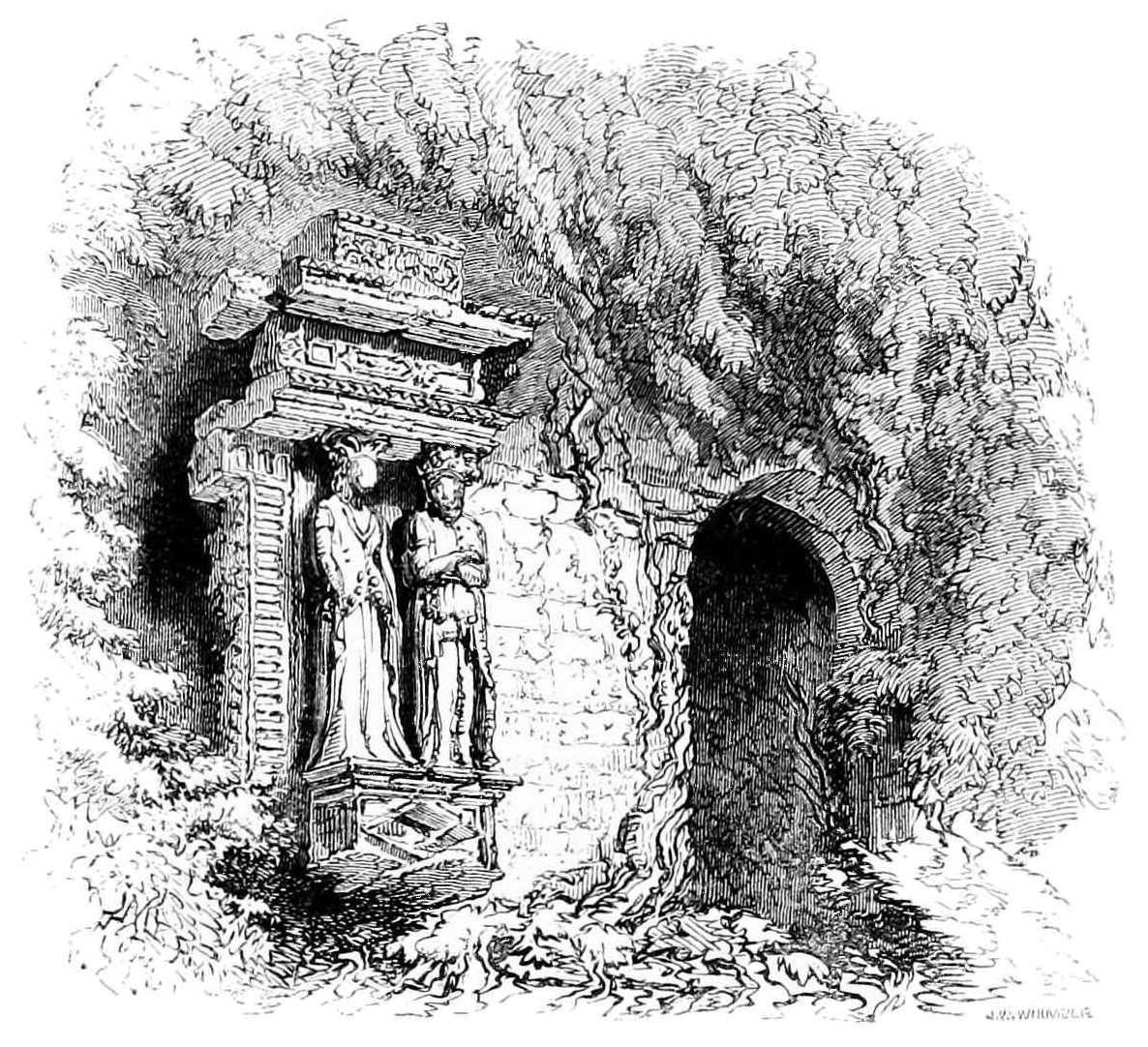
State Gallery—looking south.
“For the rich spoil of all the continents, The boast of art and nature, there was brought; Corinthian brass, Egyptian monuments, With hieroglyphic sculptures all inwrought; And Parian marbles, by Greek artists taught To counterfeit the forms of heroes old, And set before the eye of sober thought Lycurgus, Homer, and Alcides bold— All these and many more that may not here be told.”
But of all the artificial embellishments for which Raglan Castle was famed, its Water-works—on a most ingenious and expensive scale—are allowed to have formed a principal feature; and these Lord Herbert and the first Marquess appear to have brought to a degree of perfection previously unknown in this country. In their day—long before the name of Cromwell had inspired sentiments of either respect or alarm—Raglan Castle was probably as much distinguished in this respect amongst baronial mansions, as the “Palace of the Peak” among the aristocratic mansions of our own times. During the numerous fêtes celebrated within its gates in honour of the King’s visit, these water-works came in for a large share of royal admiration; and who can doubt that the rushing fountains of Raglan had, perhaps, as soothing an influence upon the distracted mind of the first Charles, as those of Tivoli are said to have had on that of Mecænas, whom the distracting cares of state, as tradition reports, had rendered sad and sleepless? Fresh from the field of Naseby, the sound of welcome that met King Charles at the gate of Raglan, must have been peculiarly grateful to his ear, on which the shouts of loyalty were destined never to fall again with so much truth and fervour. As the equestrian group in the Fountain Court threw up its snowy column during the night, the spray may have reached the very casement of the King’s chamber, and invited that repose which unparalleled reverses had scared from his pillow. If, under the ordinary circumstances of royalty, “uneasy lies the head that wears a crown,” his must indeed have been “unrest,” from whose head the crown was so surely but insensibly falling.—These, however, are sentimental conjectures, with which the topographer has little or nothing to do; we turn, therefore, to the subject in question, the water-works of Raglan, and the hero of the scene, the first Marquess, of whom local history reports the following
Anecdote.—At the beginning of the Long Parliament, we are told, certain rustics of the neighbourhood, availing themselves of the prejudices excited against Lord Worcester on account of his creed, presented themselves one morning at the gate of Raglan, and in the name of Parliament demanded possession of the household arms. Apprised of their design, the noble owner met them at the White Gate; and after hearing them repeat the demand for arms, put the question, “Whether, seeing that they had come to disarm him and his servants, they intended also to follow up that act of violence by robbing him of his money and goods?” “No,” said the intruders; “we want your arms, and that only because you are publicly denounced as a recusant!” “Nay,” said his lordship; “I am indeed a peer of the realm, but I am no convicted recusant; and therefore the law cannot in reason take notice of any such thing, much less sanction this violent proceeding.”
Thus checked in their first attempt, the Marquess proceeded to warn them of the danger they had incurred by pressing an unlawful demand; and threatening them with serious consequences, they were well pleased to forego the prime object of their visit, and turning round prepared to retire without further parley. The Marquess, however, seeing their contrition, invited them to enter the gate of the castle, and amuse themselves, in a peaceable way, with a sight of whatever it contained. His design, however, was to punish them, in a manner they little expected, for the unnecessary alarm they had occasioned to the household.
Condescending to be his own cicerone in the case, he conducted the rustic band from one place to another, until—greatly wondering at everything they saw—they had traversed nearly the whole premises. At last, just when they had come to that part of the Castle Moat, over which a lofty bridge communicated with the Keep,[291] he invited them to pause, and examine the scene at leisure.
“Now, at this point,” says Bayly, “Lord Herbert had lately contrived certain water-works, which, when the several engines and wheels were set agoing, vast quantities of water through the hollow conveyances were to be let down from the top of the high tower.” All being ready for action, a signal from the Marquess brought down through these a deluge of cataracts, which, by their roaring, hissing, and foaming through the hollow tubes, produced such a hideous and deafening noise, that every echo from the buildings around was roused into imitation; while the visitors themselves, suddenly enveloped in a magic circle of roaring cataracts, knew not what to think, nor which way to turn. Describing the effect in his own graphic style, the Chaplain writes:—
“Such was the roaring, as if the mouth of hell had been thrown wide open, and all the devils had been conjured up, that the poor silly men stood so amazed, as if they had been half dead; and yet they saw nothing!”
At last, as the plot was contrived, up comes a man in great haste and affected trepidation; and staring wildly at the half-petrified rustics, cried out as he passed them—“Look to yourselves, my masters; look to yourselves; for, by’r Lady, the lions are all broke loose!” Hereupon the rustic “arms-searchers” fell into such a dancing fit of ague, that, in their attempts to escape the lions’ jaws, they tumbled so over one another as they scampered down stairs, that it was feared one half of them had broken their necks. Nor did they once look behind them, until they found themselves a full mile beyond the gates of the castle.
By this ruse, the Marquess completely succeeded in warding off any second party disposed to make a similar experiment. The demand for arms was not repeated; the roar of Worcester’s “lions” kept all intruders at bay; and the recent adventure, which had lost nothing by telling, did more for a time to insure the tranquillity of Raglan Castle, than could have been accomplished by a regiment of cavalry.
View from the Keep.—The Donjon Tower, where the above adventure occurred—and which has been already described in these pages—commands a magnificent view over the surrounding country, particularly to the south-west, where the landscape—broken into verdant masses of vegetation—gradually swells into a mountain range, which limits the view, and depicts its own bold outline on the distant horizon. In describing this view, we shall be as particular as our limits will permit; for it is one of the finest in the county. The ascent, as usual in such buildings, is by a tourniquet staircase, which opens at each of the five different stories into the ancient, and, in the present case, lofty apartments; to which, in cases of imminent danger, the family could retreat as to an inviolable sanctuary. But this was an extremity to which—so far as we are informed—none of the Worcester family were ever compelled to resort. So that there are no dramatic incidents associated with the tower, upon which a romantic story of siege and storm might be founded.
Of this view, however, all visitors of taste in landscape-painting speak in terms of admiration; and, having made the experiment on a beautiful evening in September, we are bound, from the enjoyment it afforded us, to recommend to all visitors a tour of the battlements, closing with a view from the top of the Keep. In this view, as shown in the accompanying engraving, is comprehended a wide panorama, enriched and embellished with all the characteristic features of English landscape, from the green valley and fertile wheat-field to the bleak pastoral uplands that partly enclose the scene. All the foreground is occupied by smiling cottages and cultivated farms, half buried, as Mr. Thomas[292] has described them, in the umbrageous and many-coloured foliage that enriches the scene, and in which the melancholy yew-tree is conspicuous. The appearance of the ruins in this bird’s-eye view is particularly striking. Every tower, arch, and battlement—here diverging into distinct form and outline, and there grouped in picturesque confusion—strike the spectator with mixed feelings of surprise and amazement; for it is only from this elevation that he is enabled to form any correct estimate of the beauty, variety, and extent of a building, that seems every way fitted to have been the residence of a regal court.
The following table, as recommended by Mr. Thomas,[293] will assist the curious visitor in discovering the various hills and landmarks which are generally visible from the Tower of Gwent. Ranging from east to south, the prominent features of the landscape appear in the following order: namely—the Kymin, a conical hill overlooking the town of Monmouth, and crowned with its pavilion. The next is Troy Park, the favourite seat of the Ducal family; Craig-y-Dorth, the scene of a famous battle between Henry IV. and Owen Glendower; then the Trellig range of hills, particularly Beacon Hill—so called
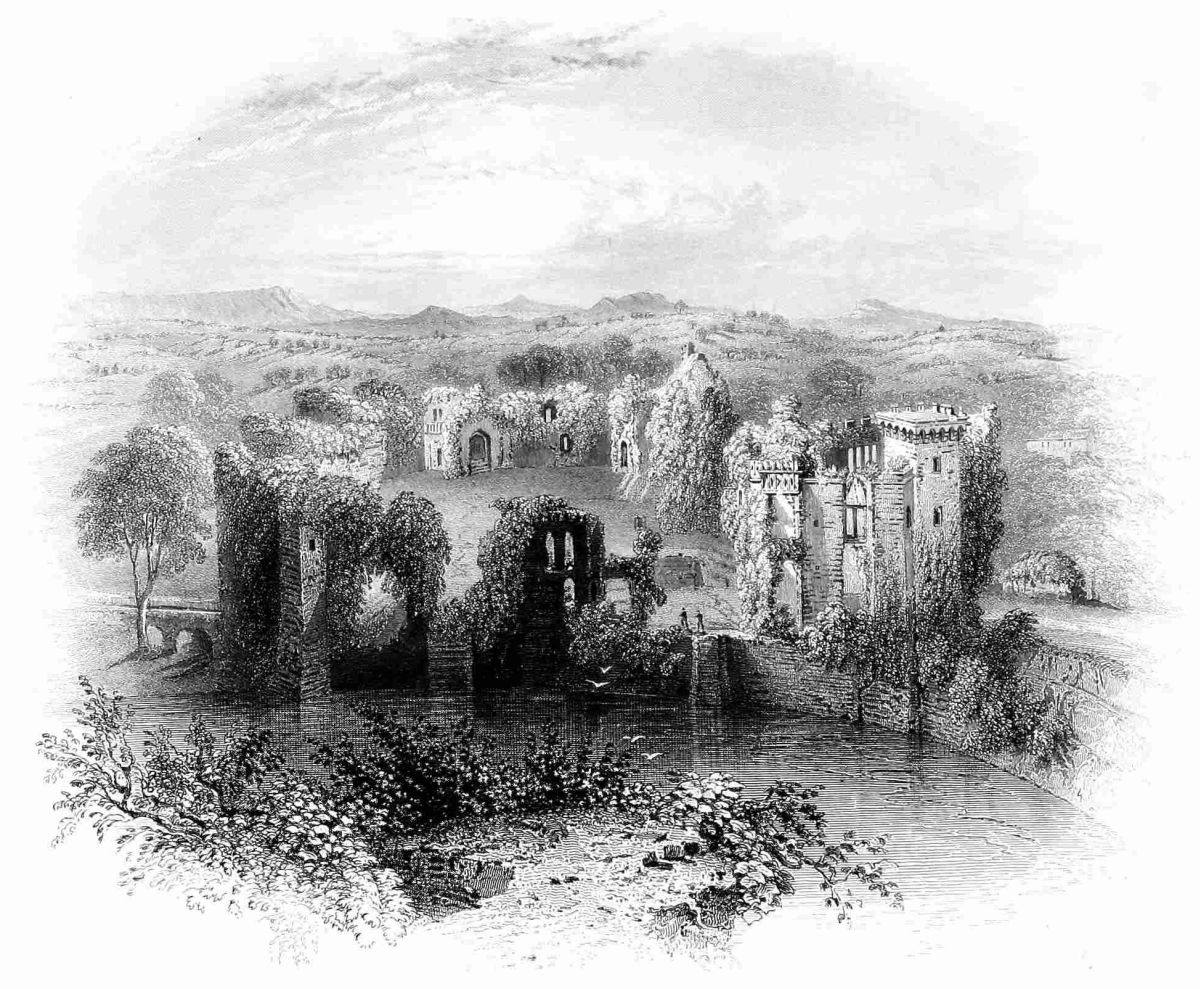
View from the Battlements.
Raglan Castle.
from being used as such in the late war during the threatened invasion. The next is
Llanishen Hill, with the church of St. Dionysius; and continuous with it rise the Devaudon and “New Church Hills,” opposite the Elms; the royal forest of Wentwood and Pen-y-Cae Mawr; Kemeys Firs, near to Caerleon, an elevation which commands a view of thirteen counties.[294]
In the south-west are seen the heights of Caerleon and Pen Twyn Barlwm; Gaer Vawr, on which is an ancient encampment—the largest in the county—with the site of a British town; Dial Carig; and Craig-y-Garcyd, two miles north-west of Usk, the site of a Roman camp. In the immediate foreground are the village and church of Raglan.
Westward appear Abersycan and the hills near Pontypool; the Blorenge hill, nearly two thousand feet high.[295] The opening which occurs in the range at this point, allows of a glimpse of the Breconshire hills at Crick Howell to Bwlch, within eight miles of the county town. The next in succession are—the Sugar Loaf, or Pen-y-Foel—so called from its conical shape—near Abergavenny, which crowns the summits of four converging hills, and rises eighteen hundred and fifty-two feet above the channel of the river Gavenny, which flows near its base.
The same view takes in the Hatteril Hills, or Black Mountains, crowned with Roman encampments; and near which is Oldcastle, once the residence of Lord Cobham, whose unhappy fate forms a painful page in the national history. From these hills the Monnow takes its source. Beneath lies the dark Vale of Ewias; and in its bosom are the ruins of Lanthony, a Cistercian Abbey of the twelfth century, which forms one of the illustrated subjects of this work. In the same direction is seen the Skyrrid Vawr, a lofty hill, seen in a volcanic fissure, which is supposed to have been thrown open during one of those remote convulsions of nature, of which in these districts the traces are so distinct and frequent.
Looking northward, the prominent objects are Campstone Hill, and the Craig, at the foot of which lie the picturesque remains of Grosmont Castle, which gives the title of Viscount to the Beaufort family. To these, but more northward, succeed Garway, Broad Oak, the Skinch-Cwm, and White Hills, which close the panorama from Raglan Keep.—We have been thus particular in designating the objects seen from the different points of view, in order that the tourists who annually visit this scene, may be in some degree prepared for the enjoyment which it is so well calculated to afford.
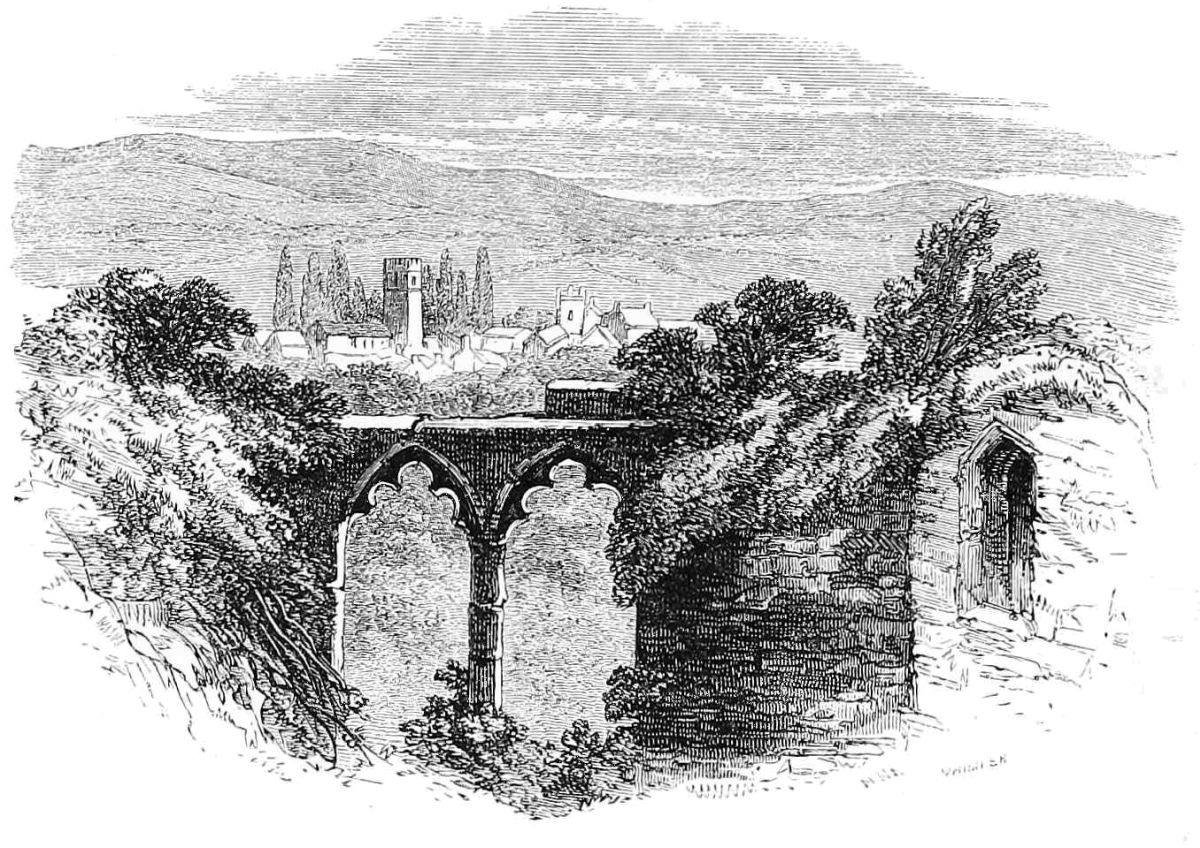
From the top of the Keep.
Descending from this lofty tower, where on festive occasions the family ensign still floats, the contrast between the Natural scenery, which has just faded from the spectator’s eye, and the iron-bound work of Art, forces itself upon the mind, and elicits a spontaneous burst of gratitude that, under the protecting banner of the English Constitution, the peasant is now as safe in his cottage as ever Baron of Raglan was in his Keep; that at last “right” is a match against “might,” and that the strong arm of Justice falls with impartial force on the culprit—whether he be robed in ermine, or clad in hodden grey.
“Yet Barons of the land! to you A grateful people still retains Proud memory of the swords ye drew— The swords that broke a tyrant’s chains, And planted Freedom on our plains! For Freedom’s cradle was the Keep, Her guardians were the Barons bold; Who placed her temple on the steep, And on her head a crown of gold; And cried—‘The deed is done! Behold, Henceforth our British land shall be The glorious land of Liberty!’”
The visitor, as he crosses the rustic bridge that now spans the moat, will recall the interesting fact, that this very spot, so to speak, was the “birthplace” of the Steam-engine; a circumstance which, had Raglan no other claim to their notice, must entitle it to a more than cursory observation from all who have an hour to spend within its walls. The spot where it is believed to have been first placed by the inventor—then Lord Herbert—was in a building erected close under the wall of the Keep, where the drawbridge rose; but which has left few or no traces, in shape or dimensions, that are now visible above the moat. It is satisfactory, however, to know that the ground is stamped by tradition as the spot where the noble inventor, during his father’s lifetime, made his first experiments on the uses and powers of steam; and where he probably constructed that “model of his invention,” which he desired might be placed with him in his coffin.
If ancient warriors considered it an honourable distinction to be consigned to the tomb in a full suit of armour, it was excusable in one who had carried with him through life the remembrance of many wrongs, many sacrifices, to desire that, at least, the evidence of one bloodless triumph, one proof of scientific discovery, might accompany him at his final departure from this scene. It was the favourite child of his matured judgment, the result of those scientific researches, after which he had been straining for many years—the mighty consequences of which were dimly foreshadowed in his imagination. It was the reward and consolation of a life of suffering, as well as of science; and there is something both natural and touching in the wish that this model—the only mechanical evidence that told him “he had not lived in vain”—should be deposited with him in the grave.
Some of his commentators have affected to smile at this wish, as evincing a feeling of weakness and vanity on the part of Lord Worcester, incompatible with a philosophic mind. But in this they only allege what cannot be proved; and the charge falls harmless when applied to a man who was—what can never be disputed—one of the most ingenious and scientific men of his day. When Columbus—a schoolboy at Genoa—first rigged his tiny skiff, and sent it dancing over the blue waters, on which it moved like the shadow of coming events; no one foresaw that this mere toy would one day be succeeded by vessels, directed by the same master-pilot, that should throw open another continent to the old world. Nor, while Lord Worcester was squandering much time and treasure, as it was thought, in useless experiments in the Keep at Raglan, did any one imagine that these very experiments were preparing the way for that stupendous power, that should one day give incredible impulse to the arts of civilized life, cross the Atlantic, and traverse the Pacific, with a celerity that promises to unite in one bond of fellowship all the nations of the earth.
It can hardly be doubted that results similar to these haunted the imagination of Worcester, and kept up within him that spirit of discovery which animated him in all his labours, soothed him with the hope of being numbered among the benefactors of his country, and a prospect of that immortality which attends the favoured votaries of science. He may often have indulged the thought, though never embodied in words—and it was a remarkable prediction on the part of him who uttered it long afterwards—
“Soon shall thine arm, triumphant Steam, afar, Drag the slow barge, and drive the flying car!”
It has been alleged by Desaguliers,[296] that Savary, the reputed inventor of the steam-engine, obtained his notions from the work already named, “The Century of Inventions;” and that, in order to conceal the original, he purchased all the Marquess’s books that could be had for money, and committed them to the flames. Of this, however, we have no direct proof, and Captain Savary must be acquitted; but it is quite certain that, as already mentioned, the original work is so rare, that not a copy is to be found except in the British Museum, and perhaps in the Beaufort Libraries at Troy House or Badminton Park. It is to be observed, however, that no contemporary record exists to illustrate or verify the Marquess’s description of the contrivance, which we presume to call a Steam-Engine; or to inform us where, and in what manner, it was carried into effect. Yet it is very evident from his account, that he had actually constructed and worked a machine that raised water by steam; an operation which was sufficient to produce on the minds of rustics, the effect ascribed to the “roaring of lions,” as mentioned in the preceding anecdote. The Marquess’s description, though short and obscure, would appear to favour the belief, that the force of his engine was derived solely from the elasticity of steam; and that the condensation of steam by cold was no part of his contrivance, but the invention of Captain Savary, who, in 1696—nearly thirty years after the Marquess’s death—published an account of his machine in a small tract, entitled, “The Miners’ Friend.” In these engines—several of which he had erected previously—the alternate condensation and pressure of the steam took place in the same vessel into which the water was first raised from a lower reservoir, by the pressure of the atmosphere, and then expelled into a higher one by the elastic force of strong steam. Steam was thus employed merely to produce a vacuum, and to supply the strength that was applied, for a like effect, to the sucker or piston of an ordinary pump; and it was a great and important step to have discovered a method of bringing the air to act in this manner, by the application of heat to water, without the assistance of mechanical force.
To the simple incident which, during his confinement in the Tower of London, first set the warm and fertile imagination of the Marquess to work on this subject, we have already adverted; and must now turn from the curiosities of science, to such portions or features of Raglan Castle as still remain to be noticed.
The Tilt-yard.—The exact situation of this important adjunct to the Castle is still a question among the learned. By some, what is now called the Bowling-green is described as the ancient Tilting-ground. This conjecture, however, being rendered improbable by a careful examination of the ground, another has been thrown out, namely—the Grand Terrace on the north-west side of the Castle. But this locale is also disputed, particularly by one who is resident near the spot, and fully conversant with whatever has descended to our own times respecting the original plan of the Castle. His opinion is, that the ancient Tourney-field must have been on the outside of the present walls. An experienced officer of the Royal Engineers, who lately inspected the grounds, with the view of ascertaining the exact spot, confirms this opinion; and observes that the Tilt-yard occupied the space immediately outside of the present gate, and enclosed between the two moats which surrounded the gateway. This opinion will probably set the question at rest—particularly as it comes from a quarter well qualified to decide in such doubtful cases—and allow the Bowling-green to retain its hereditary fame and honours.[297]
In this enclosure it was usual for the lords of Raglan to exhibit those chivalrous fêtes which gave a character to the age. They brought into martial competition those aspirants of knightly fame, whose dexterity in the use of the lance was perfected by daily practice in the tourney. In these gorgeous pastimes, all that could fascinate the eye, and kindle admiration in the spectators, was brought into brilliant operation. Beauty, presiding at the lists, bestowed the palm on him who had disarmed his rival in the charge, and thus established his claim to knightly honours. Here, no doubt, many a lance has been couched, many a spear broken in rival combat; for one of the old lords, as already mentioned, was renowned as the best horseman of his day; and to support this character, joust and tournament may have been no unfrequent spectacles under the walls of Raglan.
It cannot be doubted that these martial exercises—conducted with admirable tact and courtesy—contributed, in a very special degree, to foster a spirit for military enterprise; to inculcate a high and chivalrous sense of honour; to form the young soldier to habits of fortitude and endurance which procured him the respect of his comrades, and future distinction in the field. A knight, thoroughly trained according to the system of feudal times, was a being whom we are accustomed to regard as the beau-ideal of a soldier; whose high bearing, indomitable courage, inflexible faith, unsullied honour, and loyal devotion to his “ladye love,” are themes on which poets and historians of the middle ages have lavished many glowing panegyrics.
For the education and discipline of those military aspirants, the grand palæstra was the tilt-yard. For the feudal tournament—descriptions of which are handed down to us by contemporaneous authors—no substitute is left in these times. Nothing could have been more animated and dazzling, when celebrated with all those details of martial pomp and ceremony—indispensable to such exhibitions—than a pageant, in which all who aspired to distinction were required to evince, in action, the pure and elevating principles of love, loyalty, and religion. For these, and many other reasons, impartial taste, as Gibbon observes, must prefer a Gothic tournament to the Olympic games of classic antiquity. Instead of the naked spectacles which corrupted the manners of the Greeks, the pompous decoration of the lists was crowned with the presence of chaste and highborn beauty, from whose fair hands the conqueror received the prize of his dexterity and courage.[298]—And with this flattering
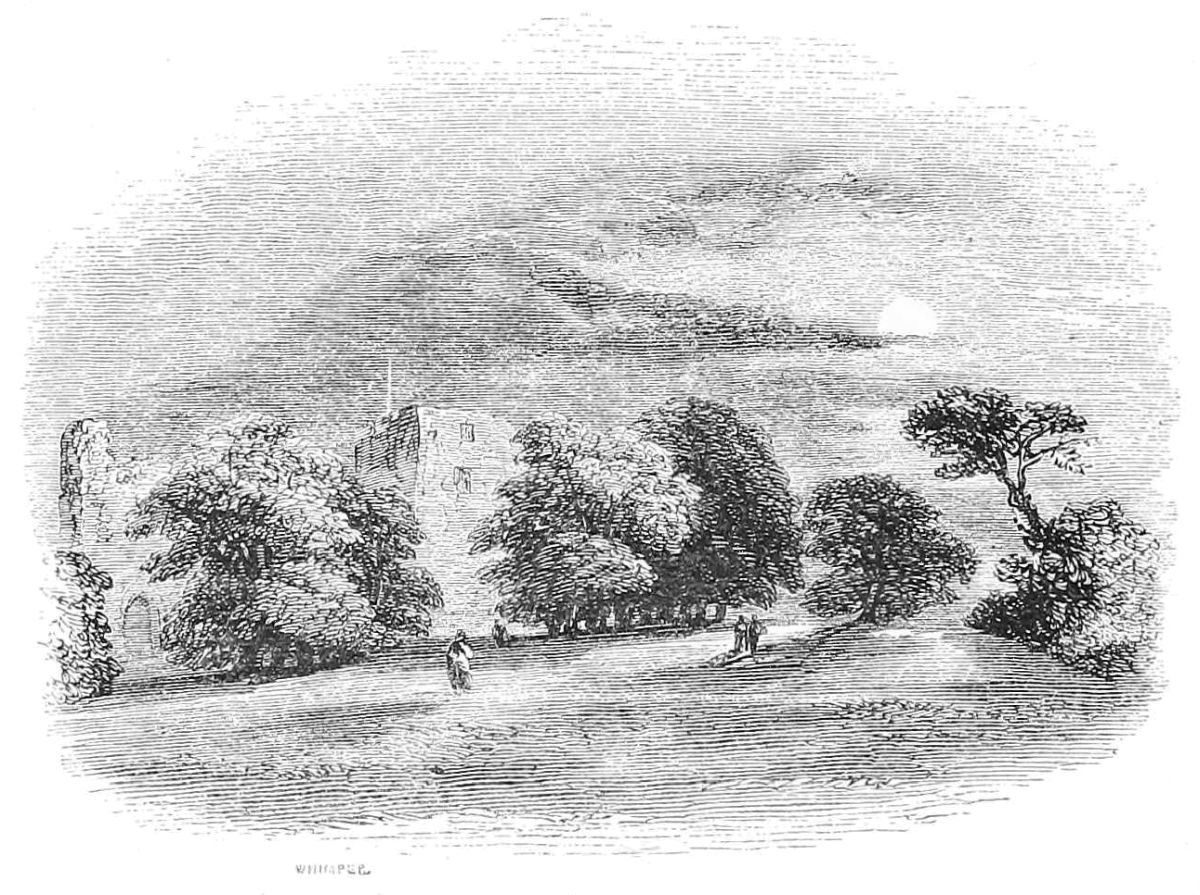
contrast between the demoralizing festivals of Greece, and the high tone of refinement which characterised those of our Gothic forefathers, we pass on to such other points in the history of Raglan Castle as have been selected for illustration. In the woodcut introduced in the preceding page, the view is taken from the old
Bowling-green—erroneously supposed to have been the Tilt-yard. Directly opposite, in the centre, is the Donjon, or Tower of Gwent, so often described or otherwise referred to in these pages. On the left, where a massive gateway is seen, is the entrance to the Fountain Court, from which, as formerly noticed, a noble staircase conducts to the State apartments occupying the south side of the Castle. These are now in a state of utter dilapidation; but the framework itself affords abundant evidence—so far as architectural design and elaborate ornament can assist us in such a conclusion—of their original splendour.
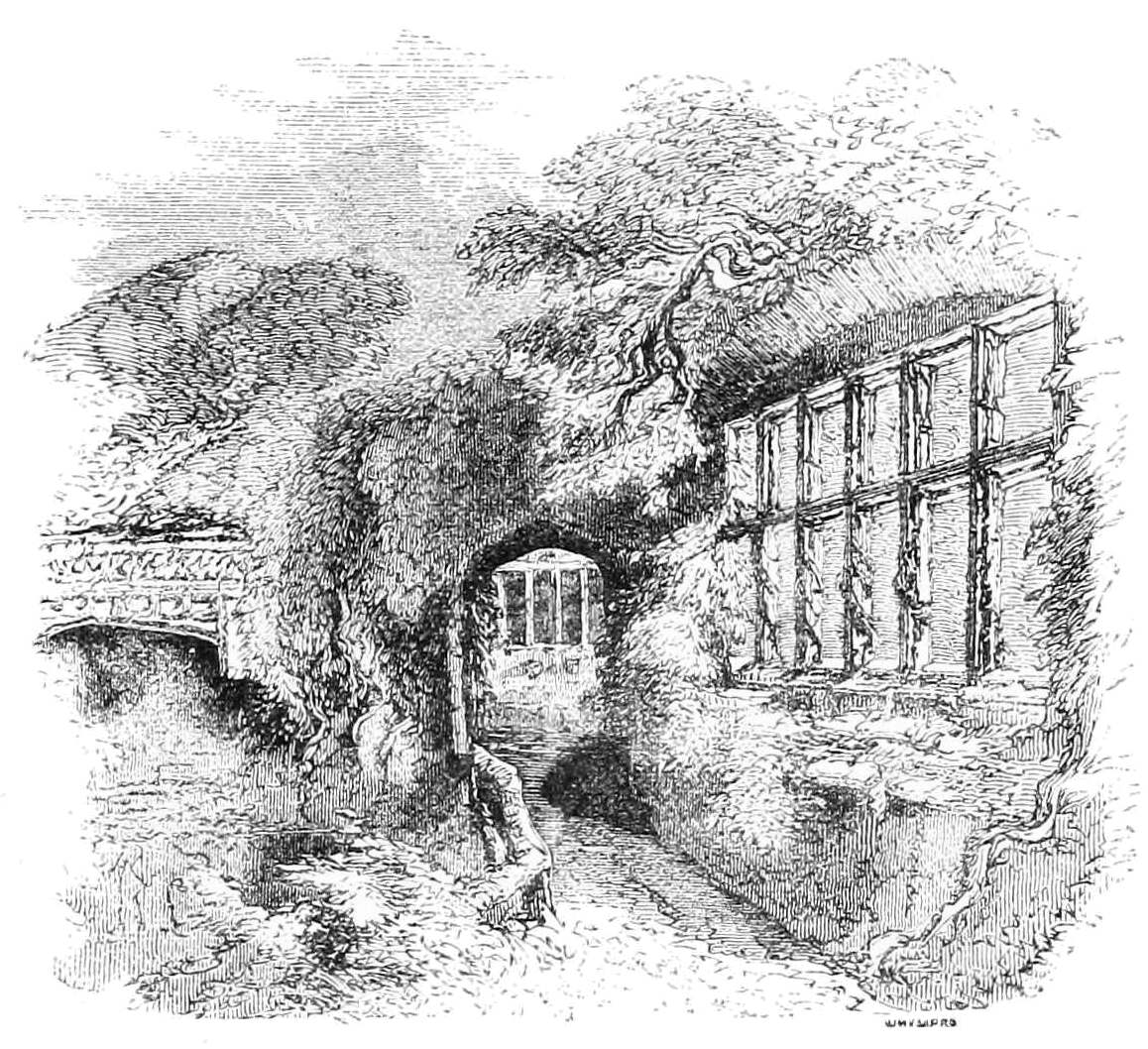
The royal apartments.
“But now th’ unsightly brier grows, Where once, in gilded bower, The Queen of Beauty trained the rose— Herself a fairer flower. And damp the hearth, and cold the bed, Where he who wore the crown, With anxious heart, and aching head, In slumber laid him down! But brief the slumber, long the night— For Naseby’s fatal day, And sorrow’s still increasing weight, Had scared his sleep away!”
There is a tradition, that the Bowling-green was King Charles’s favourite walk during his visit. It commands a varied and extensive prospect; the vegetation is vigorous; and the grassy carpet, though not in courtly trim, is still uninjured by plough or spade; and to sentimental tourists it seems the very spot—aided by the adjoining ruins—where, in the mirror of fancy, pictures of the olden day, the hues of domestic life as it passed in the fifteenth century, may be seen faithfully reflected.
“There is a spirit brooding o’er these walls, That tells the records of a bygone day; When, midst the splendour of thy courtly halls, A pageant shone, whose gorgeous array, Like Pleasure’s golden dream, has passed away; Where Beauty’s smiles, and winning graces, lent The witching radiance of their love-lit ray; And from the scene a mingled strain was sent Of music, laughter, festive song, and merriment.”—Raglan.
The game of bowls was unknown to the ancients, and bowling-greens are said to have originated in England; where, in the course of time, every castle, and most houses of the nobility, had each a bowling-green attached to them. The “greens” were in some places narrow strips turfed over; but if covered with gravel, they were called “Bares.” Bowling-alleys were so called from being roofed over for play when the weather was unfavourable; and these appear to have been the usual appendages to taverns, and other places of public resort, particularly in towns. In an old inventory we have—“To Sparke of Bury, Roper, for vi. li. etc., of herryng line for the Bowling-alley, iijs. ivd.” At the same place [Hengrave Hall] a bowling-alley occupied the space between the north side of the moat, having the convenience of an open corridor communicating with the Hall. Flat bowls were best for a close alley; “round biassed bowls” for open ground, of advantage; bowls, round as a ball, for green swarths which were plain and level; and of the latter description is the Bowling-green of Raglan, now under notice.
In a plate of “Strutt’s Sports,” two small cones are placed upright, at a distance from each other, and the players bowl at each alternately—the winner was he who could lay his bowl nearest to the mark. A small bowl or jack was also used as a mark; and only one bowl for each person—not two or three, as in the present day.[299] There were also ground-bowls, driven by a baton or mace through an arch. Half-bowl—so called because it was played with one half of a sphere—was prohibited by Edward the Fourth; and is the rolly-polly still practised in Herts.[300]
Tennis-Court.—The site of this is still a question in the topography of Raglan, although “the practice” cannot be doubted. Henry the Seventh—who was a prisoner in Raglan Castle—his son Henry, and Charles the Second, were all tennis players. In the sixteenth century, tennis-courts were quite common in England. They were divided by a line stretched in the middle; and the players, standing on either side with their rackets, had to receive and return the ball, which the rules of the game required to be struck over the line.[301]
Having already spoken of the Tilt-field, it is proper to remark that the jousts and tournaments, for which it was set apart, differed from one another in the following respects:—The latter consisted of parties of knights, engaged at the same time; the former of two persons only. The Joust was at first called the “Cane Game,” because hollow canes were used instead of lances. On some occasions the combatants with swords and lances were on foot, with a barrier of wood breast-high between them. Toys, made to imitate the joust, consisted of knights on horseback, who could be thrown off and unhorsed by the shock of their adversaries’ spears. Some had wheels, others not.
There were also boat-jousts, as represented in old paintings. The conqueror was he who could best turn aside the blow of his antagonist by one blow of his shield; and, at the same time, strike him with a lance in such a manner as to throw him over into the water, himself remaining unremoved from his station.[302]
Tradition.—On taking a final survey of these extensive ruins, and speculating on the style and date of several of their component parts, the difficulties that attend antiquarian decision—as great in the present day as in that of the first Marquess—remind us of the following anecdote:—
During an excursion in the vicinity, “We were told,” says his Chaplain, who relates the story, “that we should come to a place that was famous for a miracle, which, according to popular tradition, was wrought by the preaching of St. David to three thousand people.” To accommodate the saint, the ground on which he stood at the time, being too low to admit of his being advantageously seen and heard by the multitude, most obligingly rose up into a green knoll, carrying the saint with it, and there settled at a proper elevation. Whereupon St. David, pitching the cross on which he leant into the miraculous soil, and continuing his discourse, was distinctly heard and seen, much to their comfort and edification, by the whole assembly. This cross, at the time in question, “was yet standing, with some words, or letters, which time and Welsh weather had so defaced that they were no longer intelligible to vulgar eyes.” In memory, or rather in proof, of the miracle, the guardian saint had caused a church to be erected on the spot, and many were the pilgrims, during the long lapse of centuries, who had resorted to the Cross, and borne testimony to the celestial influence which still hovered round the spot; and in those who were already gifted with that “faith which can remove mountains,” produced the most wonderful changes.
This relation, working upon the Marquess’s mind, made him desirous to turn aside for a little, and inspect the hallowed ground in person. Having reached the churchyard, the cross was instantly visible; but in shape and ornament bearing all the marks of venerable antiquity. The inscription was almost obliterated; and among the gentlemen who attended the Marquess, it became an object of competition who should best decypher the original; though all that could be traced with any resemblance to an alphabet, were—Crx ... Xti ... Dd, and part of an s. The enigma that had puzzled so many others, however, appeared to his lordship of very easy solution. “Why,” said he to the gentlemen around him, “these letters are neither more nor less than fragments of three simple but sacred words; to wit—Crux Christi Davidis.” “Which we all wondered at,” says the Chaplain, “that no man could find out, though it afterwards appeared so plain. ‘Look ye now,’ said the Marquess; ‘I, without my spectacles, and ill eyes, could read it sooner than all you that needed none, and had good eyes. And mark me,’ he added, ‘it is not a good eye but a good faith that attains to a knowledge of such things; whilst you pore so much upon the letters you lose the meaning. Now, I will tell you how I came to find it out: I considered what had been told me, with the help whereof I came to understand what the words might signify; so that in this, I am sure, tradition was a means to help me to the understanding of the scripture.’”
The quaint simplicity of the last sentence—so full of meaning—and the lesson it inculcates regarding the authority of Traditions, illustrate in a quiet way the Marquess’s opinions as to those of the Church; and to antiquaries, the aid of tradition is thus very ingeniously recommended. Where authentic history falls short of the mark in researches, the traditions of a castle are entitled to consideration; and in the preceding account of Raglan, it has been our study to combine the two—though not in the sense recommended by the Marquess.
Of Lord Herbert, the following anecdote is recorded:—Some time after he was created Earl of Glamorgan, he received the King’s commission, as we have seen,[303] to proceed to Ireland, and there ascertain what could be done to strengthen the royal cause. Setting out on this expedition, and accompanied, as we are told, by a distinguished retinue of officers, knights, and gentlemen—“all of the red letter”—who had staked life and fortune on the enterprise, his lordship arrived at Caernarvon, where he was to embark for Ireland. Here they were detained a short time; and Glamorgan continuing to receive at his table the loyalist gentlemen of the place, the conversation turned upon some old prophecies, which it was thought were fast reaching their fulfilment. “And particularly one,” said a gentleman of the company. “It is an old Welsh prediction, and says—‘That in these latter times there should come to this very town a magpie, and build her nest in the royal crown; that next a jackdaw should arrive, and beat off the magpie; then a buzzard should appear on the same roost, and drive away the jackdaw; and then there should be seen no crown, but that of thorns, upon the King’s head! Farther, that there should come a band of men from a far country, and take away the thorns, and then the crown should appear again.’”
And thus far, as the townsmen averred, the prophecy had been accomplished; to wit—“Over the gate of Caernarvon Castle, there was a statue of King Edward the First, in full proportion, with a crown upon his head. Well, there did come a magpie, as every one could tell, which built, her nest in the said crown; then came a jackdaw that beat away the magpie, as foretold; and, in like manner, came at last a buzzard, and drove away the jackdaw.” “And all this,” said the worthy townsmen, “we assure your honour to be as true as Holy Writ.”
Hereupon the Earl of Glamorgan, having listened with deep interest to the recital, replied with much animation—“And why may not we, my gallant friends and comrades—why may not we be that band of men from a far country, that shall take away these thorns from the King’s head—first, in type, and then in substance?” And thereupon all concluded themselves to be the men destined for that glorious service. They resolved that, on rising from table, they would satisfy their eyes with the sight, as their ears had already been with the relation, and lend willing and helping hands to disencumber the figure. Nothing else could be thought of; and dinner being ended, the Earl and his company sallied forth to the castle gate, resolved to signalize the day by an act of loyalty that would endear their names to posterity. Looking up, accordingly, with great eagerness to the royal badge, that seemed to implore their assistance, its appearance, sure enough, was in literal accordance with the disordered condition in which crowns are generally left by rival combatants. It was, in fact, quite a heart-breaking sight to see the diadem of England so covered and entangled with thorns, as if artificially platted round the King’s temples.
“Verily,” said one of the nobles present, “never hath mine eye beheld a sadder spectacle!” “The Earl himself, almost frantic with grief and indignation, straightway commanded the nest to be torn down; which was done with every mark of ignominy; and then the company began to breathe again. The materials composing the nest being examined with severe scrutiny, were found to be of white-thorn—a substance whereof never was bird known before to build her nest!”
A thing so unprecedented, both as regards the nest and the material[304] thereof, caused in the beholders a degree of amazement not to be expressed: in memorial whereof, every one present thrust a sprig of thorn in his hatband, and so wore it as a talisman. So far, “in type,” the thorns were removed from the King’s crown—but not “in substance.”
This adventure in Caernarvon being duly narrated to the Marquess at Raglan, he paused for a minute, and then inquired of those about him, “What was the nickname which the Roundheads were wont to give the Bishops?” But there were none about him who could even guess at his meaning; which he perceiving, said, “As I take it, they used to call the Bishops Magpies, whom they reproach for building their nests in the crown; then came the Presbyterian Jackdaws, and beat them out; and the next thing that you shall see will be the Independent Buzzard, which shall drive them away. And who shall come next, God only knows!”
To this solution, one with a Roman nose made answer: “I hope, my lord, that after these men have played their pranks sufficiently, no man hereafter will presume to build his nest in the crown; but I hope there will be a knot of good fellows that may case the King’s head from the pricking of those thorns, and clear the crown from those incumbrances.” Whereupon the Marquess, replying, asked the party who related the story, “What manner of crown it was—of what form—that was upon the King’s head?” The gentleman replied, “A royal crown.” “Ay; but I mean,” rejoined my lord, “was it an open or an imperial crown?” “An open one.” “Oh, then, that was the reason; the King’s crown was too open: had it been close at top, with the Cross overhead [a sly word for the Roman Catholic faith], such unlucky birds could never have come there to have built their nests; but one thing there is,” said he, in conclusion, “that I mislike in the story, namely, that after they had taken the thorns from the King’s head, they should afterwards wear them in their own hatbands.”[305] This was what no one present could explain to the Marquess’s satisfaction. And Lord Glamorgan’s negotiations in Ireland proved a failure to remove any “thorns from the royal crown.”—So much for a prophecy which shows the superstition and credulity of the times—a credulity which tainted even those who were charged with the highest offices of the state. Yet such—
“The superstitious, idle-headed eld Received, and did deliver to our age.”
In those days, no fortress surrendered, no castle fell, no band of heroes was discomfited, but in fulfilment of some irresistible “prophecy.”—But here we must close the subject with a few words on the
Outworks of Raglan.—On this head little remains to be added. The details, given in the first volume of this work, respecting castles of the middle ages, preclude the necessity of our doing more than simply referring the reader to those passages in the description of Rochester and Arundel, which equally apply to Raglan. With respect to the outworks of the latter, a very brief notice may here suffice. By a practical eye the line of fortification may still be traced; and what remains of the original defences thrown up during the siege, shows very clearly that the military engineers employed were men whose skill and science did credit to the age. The vestiges of this lamentable war are mostly observable on the west side of the castle, where a strong bastion, projecting from the exterior wall of the fortification, forms a striking feature of the outworks, and a no less striking contrast with the luxuriant vegetation which now crowns, and almost conceals, these monuments of a barbarous and unnatural war. The point to which we allude, is that represented in the engraving, and entitled the “Avenue,” where the state apartments, unlatticed, roofless, and dilapidated, look down upon the green belt of trees and underwood that surround them with a melancholy aspect—but a melancholy that imparts feelings of thankfulness to the lovers of peace; for it tells very plainly that the devastating storm has long subsided, and that the sunshine of national prosperity and contentment has again visited the scene. The engines of war have disappeared; the ramparts, raised by men for the destruction of their fellow-men, are now razed to the ground. Nature—striving to throw her green mantle of oblivion over a scene from which she was so rudely banished by the violence of war—smiles at her own bloodless triumph, and peoples the over-arching groves with feathered tribes that sing no songs but those of peace and joy—
“Where once the steel-clad warrior trod, Spring renews her verdant wreath; And o’er the once ensanguined sod, Flowers their mingled incense breathe. Where the clang of clarion rose, All is silence and repose; Save where, in yonder halls of state, The blackbird serenades his mate.”
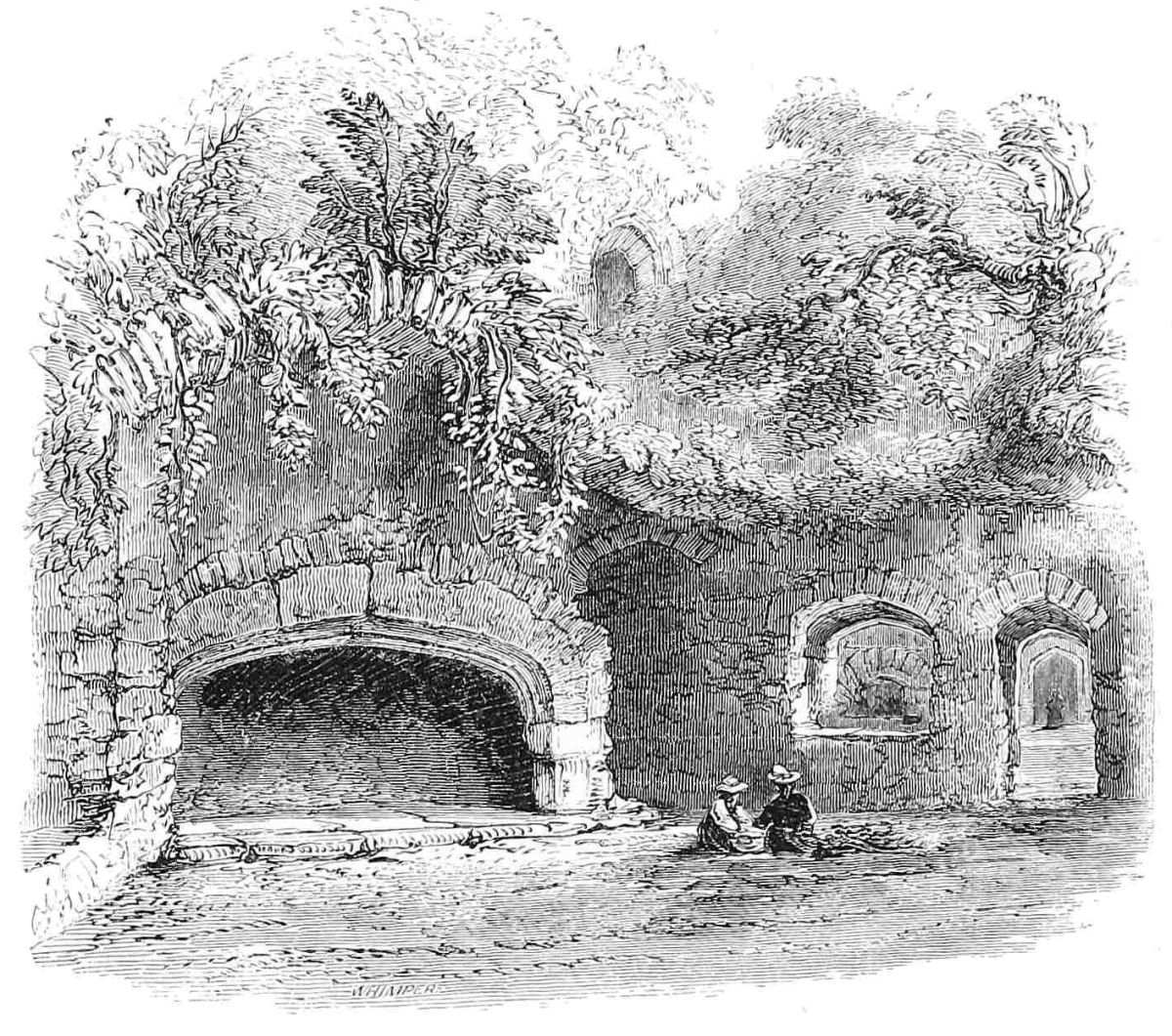
We now proceed to a brief notice of the environs:[306]—
Raglan Church has little to interest the archæological inquirer beyond its antiquity—and its claim to this distinction is fully vindicated by its appearance. It consists of a nave, side aisles, a chancel, and a square embattled tower, which, with a few trees throwing their shadows over the burial-ground, forms a pleasing landmark in the distance. We had the pleasure of uniting in the Morning Service before leaving the village, and were much gratified by the religious demeanour which pervaded the congregation, and edified by the simple but impressive discourse with which the service was terminated.
Every feature seems stamped with the seal of antiquity; at first sight nothing seems to have been renewed, or removed in the sacred edifice, for at least two centuries. The great-great-grandfathers of the present race may have occupied the same pews, knelt at the same altar, and been addressed from the same pulpit; for the materials of which these are composed seem as if framed to survive kingdoms and empires.
Over the Raglan Vault in the chancel, already noticed, some rusty trophies of chivalry are suspended; and beneath repose several of the ancient lords by whom they were worn, or wielded. To the state of the monument itself, we have already alluded;[307] and judging from that of its prostrate or dislocated compartments, the sculpture must have been among the best specimens of its day, and employed on materials worthy to transmit the family names to posterity; for it is of rare and variegated marble, and appears to have been, according to monkish—but in contempt of all classical—taste, elaborately gilded.
It has been regretted by visitors, that a tomb, in which are deposited the remains of a nobleman—to whom the credit of a renowned invention unquestionably belongs—should not be restored, or at least repaired. By others, who regard it merely as an example of the Arts at that early period, it is only a broken link in the chain of sepulchral associations, which the skill and pencil of the artist can readily supply. There might, indeed, be an appearance of inconsistency—a want of harmony—in restoring the old family sepulchre, while the Castle itself is left to destruction. In certain conditions and situations, a fragment is more interesting than the original monument; and such, perhaps, is the only interest which that in question ought to excite. But with regard to the noble dust, we need only say—
“Adieu, and take thy praise with thee to heaven; Thy ignominy sleep with thee in the grave, But not remembered in thy epitaph.”
The family residence, more immediately connected with that of Raglan, and to which, in the course of this article, special attention was directed in our notice of the royal visit to the Marquess of Worcester, is—
Troy House.—This name—which the King was so much pleased to use as a classical synonyme, in his acknowledgment of the fruits which it had furnished for the royal table while at Raglan—is so called from its situation on the river Trothy. The village of Mitchell Troy, about a mile and a half from Monmouth, contains a church dedicated to St. Michael; but the chief object to which the tourist’s eye is directed is the baronial mansion above-named. The house, which was already in high repute at the time of the King’s visit to Raglan, was built by Inigo Jones, who, in the suite of Christian IV. of Denmark, came back to England in 1606. In consequence of the patronage of James the First—and more particularly of his Queen—he was induced to settle in the metropolis; and hence originated the sacred, regal, and aristocratic edifices which bear his name. He was consequently appointed one of the commissioners for repairing St. Paul’s Cathedral; but this was not commenced until the spring of 1623. In the following reign he was much employed in preparing Masques for the entertainment of the court, and in building the Banqueting-house at Whitehall; but while thus engaged, he fell under the displeasure of Ben Jonson, who ridiculed him on the stage, and made him the subject of his epigrammatic muse. Jones realized a handsome fortune; but being a Roman Catholic, and a partisan of royalty, he suffered severely in the Civil War. At length, worn out with sorrow and physical sufferings, he died in July, 1652, leaving behind him many monuments of his genius, of which the subject under notice was not the least considerable.[308]
The fame of Troy House, however, depends less on the fact of its being the work of Inigo Jones, than upon the celebrity of its gardens—the fruits of which are still said to vie with those of tropical growth.[309] The excellence of these fruits, as already noticed, caused the King to remark, “That the Sovereign of the Planets had now changed the poles; and that Wales, the outcast of England’s fine gardens, had fairer and riper fruits than England’s valleys had in all her beds.” Sir Charles Somerset, sixth son of the fourth Earl of Worcester, married Elizabeth, daughter and heiress of Sir William Powel of Troy and Llanpylt, and added the influence of a considerable estate to that of the house of Worcester. It was from his gardens that the dessert for the royal table at Raglan was supplied.
In the picture gallery of Troy House is a large and beautiful portrait of the first Marquess of Worcester, by Sir Peter Lely. He is represented in an open field, seated before a tent, with the Marchioness and an infant daughter by her side, and wears a fancy dress, with a scarf over his right shoulder—the ribbon and badge of the Garter. The other portraits are those of the Ducal house of Beaufort, since its creation in 1682.
The situation of this hereditary mansion is too low to produce a striking feature in the landscape; but it commands very agreeable views of the town of Monmouth and its environs—with the rivers Monnow and Wye, whose waters unite and form one channel a short distance below Troy House.
Grosmont, from which the lords of Raglan take the rank of Viscount, is entitled to a brief notice in this place. In old writings it is spelt Grysmond, and contains a population of about eight hundred. The parish church, dedicated to St. Nicholas, is in the patronage of the Prince of Wales. In the churchyard, in the east wall of the chancel, is a monumental slab, said to cover the remains of Kent, or Gwent, a Franciscan monk, whose wonderful achievements in the early part of the fourteenth century[310] afford materials for many local traditions. According to one of these, the inhabitants are indebted to this good neighbourly monk for the bridge over the Monnow, on the road to Kentchurch in Herefordshire. It is called John of Kent’s Bridge, and is said to have been built in one night.
The Castle of Grosmont is a picturesque ruin.[311] It stands on a height commanding the view of a beautiful valley watered by the river Monnow, and bounded by Craig Savenny and the Garway Hill. The remains of this ancient castle occupy the summit of this hill, or rather eminence; its ivied walls, partly impending over the precipitous banks of the river, and towering at intervals through a grove of wide-spreading oaks, render the view extremely picturesque.
“By Grysmond’s ruins, scarred with years, On yonder roofless turret standing, How rich—how beautiful appears The scene beneath my eye expanding! The oak’s green banner clothes the steep, There—herds and harvests bless the Giver; And there, in many a crystal sweep, Descends the Monnow’s classic river! And here—if e’er romance be found To love the vale or haunt the mountain— Here is her home, with ivy bound, And here her grot, and crystal fountain. And here—to him who seeks repose, By sorrow worn, or passion driven— Here is a refuge from his woes, And here sweet intercourse with Heaven!” &c.
Monmouth.—Of this ancient town and its Castle, the limits prescribed to the present work will not permit us to indulge in any minute description. But before entering upon the Abbey of Llanthony—the next subject for illustration—the birthplace of Henry the Fifth is entitled to a general notice. The bridge over the Monnow, with its ancient gate-house at the west end, is, perhaps, the most striking feature of the place. Two other bridges, one over the Trothy, and a third over the Wye, contribute in no small degree to heighten the picturesque effect, as the stranger perambulates the scene and recalls the many interesting facts, connected with Monmouth and its vicinity, which to history and romance have given an early and permanent lustre.
The Castle—of which so little remains that its original appearance can only be described by reference to the historical fragments that still mark the spot—is of unquestionable antiquity. It is supposed to have been built—or rather perhaps rebuilt—by John of Monmouth, whose adherence to the Barons cost him his estate, but contributed to the success of the cause in which he had embarked. The King having created his son Earl of Lancaster, this estate was annexed to the earldom. The Castle became a favourite residence of John of Gaunt, to whom it descended by his marriage with Blanche, daughter of Henry of Monmouth, Duke of Lancaster. It was in this Castle that the unfortunate Edward the Second was confined when taken prisoner by his Queen Isabella.[312]
But the glory of the place is its association with Henry V., son of Henry of Bolingbroke, who was born here,[313] and whose name and renown are so familiar to every reader of our national history and the drama. His dissipated habits while Prince of Wales, and his glorious achievements in the conquest of France, have been so inimitably portrayed by Shakspeare, that he still seems to live in our own age—in the country which his worth and valour adorned—and to be as agreeably associated with our familiar recollections as the most illustrious characters of our own day. His good-humoured dissipation and pleasantry in youth, became the foil to his subsequent greatness; and was probably as much the origin of that strong admiration with which he is still regarded, as his general talents, or the splendour of those victories, to which his personal courage and address so mainly contributed. At the time, as the reader may recollect, when the French realm was torn asunder by the opposing factions of the Dukes of Orleans and Burgundy, Henry took the favourable moment for reviving the claims of his predecessors upon France. Placing himself at the head of his army, he landed at Harfleur, and with only fifteen thousand men, opposed to upwards of fifty thousand, won the battle of Agincourt, and returned to England covered with renown. Apart from the splendour, however, which attended the campaign, it has been justly remarked that his reign was more brilliant than beneficial; for whilst his triumph entailed great misery on France, it “did more harm than good” to the true interests of England.[314] But his life was short—too short for maturing the plans he had in view for consolidating the fruits of a brief but eventful career; and while his greatest projects seemed to be advancing to a successful issue, Henry of Monmouth was suddenly cut off at the age of thirty-four.
The connection of this gallant prince and sovereign with Monmouth, invests it with a lasting claim to veneration on the part of those tourists who judge of the soil by the character of its products. In the words of Fluellen, “All the water in Wye cannot wash your Majesty’s Welsh plood out of your pody;” nor, we may add, weaken a single link of that chain which connects the hero of Agincourt with the history of Monmouth.
The Bridge, of which a cut is here introduced, was erected by Edward the First in 1272. Surmounting the Saxon gateway is a room, used as a guard-room or a magazine; and immediately above the arch are three loopholes, made by the authorities of the place, when, at a very recent period, they apprehended a sudden irruption of Chartists from Newport.
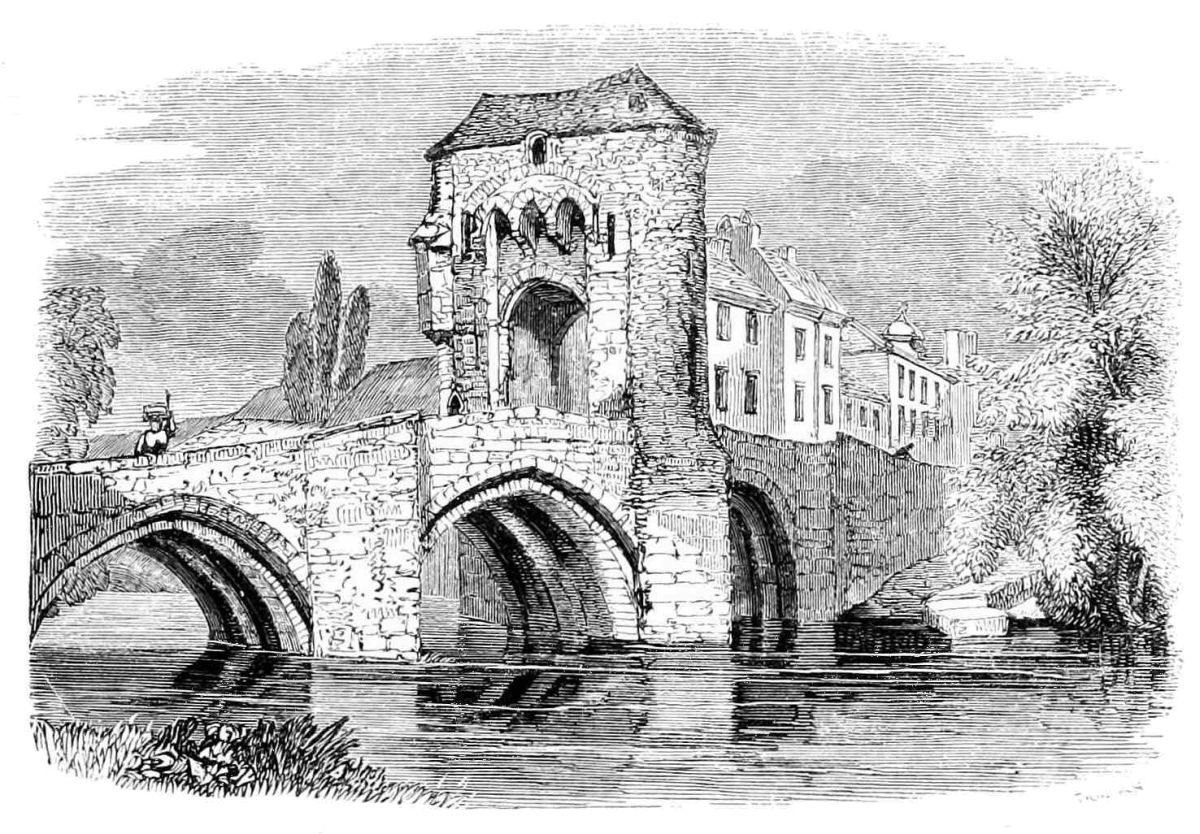
During the civil war, Monmouth was justly considered as a position of vast importance. After the defeat of the King’s army at Marston Moor, Prince Rupert directed his attention to the marches of Wales. He resolved to fortify Beachley, and with troops of horse to secure the isthmus between the rivers Severn and Wye; but in this attempt he was out-manœuvred by Colonel Massey. Lieut.-Colonel Kyrle afterwards negotiated with Massey to deliver up the town of Monmouth, then held for the King. Having revolted from the Parliamentary army on the loss of Bristol, he was willing to purchase reconciliation at the price of Monmouth. He proposed to Colonel Massey to feign a sudden return with his forces from Beachley to Gloucester, when he agreed to make a sortie from Monmouth, as if to fall on his rear, which might then drive him back, and in the pursuit enter the town with him. Massey, accordingly, gave out the necessity of a retreat; and having marched three miles, lodged his troops in the Forest of Dean. This was no sooner reported at Monmouth, than Kyrle drew out his men to follow in the rear of Massey. Accordingly, about a mile from Colford, he was surprised by Massey, and all his horsemen were led towards Monmouth. But the town having been alarmed by an officer who had escaped, the garrison were on the alert; yet, as Kyrle himself advanced to the drawbridge with a hundred horse, and pretended to be returning with many prisoners, the officers and soldiers were thrown off their guard; and with the consent of the governor, Colonel Holtby, the drawbridge was lowered, and the town was entered. “The governor and most of the garrison escaped, some prisoners were made, and the rest were put to the sword.”
The loss of Monmouth, so justly considered the key of South Wales, alarmed the garrison of Raglan Castle. The old Marquess called in the assistance of Prince Rupert’s cavalry, which obtained some advantages over the flying parties of Massey, but could not disturb his possession of Monmouth, in which he was strongly fortified.
Geoffrey of Monmouth, whose name gives additional lustre to the place, was also a native of this town. He is supposed to have been educated in the ancient Benedictine Priory, founded by Wihenoc de Monmouth, in the reign of Henry the First. A small chamber of the ancient monastery has long been shown to inquisitive tourists, as the library of Geoffrey. The apartment bears in the ceiling and windows certain traces of former magnificence; but the art is of a later period than the first Henry’s reign, and probably contemporary with that of Tinterne. Geoffrey, whose fame as the historian of Britain takes precedence of all his contemporaries, was archdeacon of his native town, and subsequently, through the patronage of Robert, Earl of Gloucester, and Alexander, Bishop of Lincoln—both renowned as the friends of learning—promoted to the bishopric of St. Asaph. His history is considered to be a vitiated translation of the “Annals of the British Kings,” written by St. Thalian, Bishop of St. Asaph, who flourished in the seventh century. It is very entertaining, and forms an epoch in the literature of this country, being almost the first production which introduced that species of composition called Romance. “Geoffrey of Monmouth’s History,” says Campbell in his elaborate Essay on English Poetry, “was not a forgery, but derived from an Armorican original, and with the pseudo-Turpin’s Life of Charlemagne, was the grand historical magazine of the romancers. Popular songs,” he adds, “about Arthur and Charlemagne—or, as some will have it, Charles Martel—were probably the main sources of Turpin’s forgeries, and of Geoffrey’s Armorican book.”
In Geoffrey will be found the affecting history of Lear,[315] King of Britain, who divided his kingdom between Gonerilla and Regan, his two elder daughters, and disinherited his youngest daughter Cordelia. Hence Shakspeare drew his incomparable tragedy of “King Lear,” but improved the pathos of the story by making the death of Cordelia precede that of Lear; while in the original, the aged father is restored to his kingdom, and Cordelia survives him. Milton also was indebted to Geoffrey of Monmouth for his beautiful fiction of Sabrina in the “Mask of Comus.” But to return to the scene under notice:—
The Priory, of which little remains, was a cell belonging to the Benedictine Monastery of Saumur in Anjou; and in this, as we have said, the renowned Geoffrey is believed to have prosecuted his studies. By some writers he is called a monk of the Dominican order; but, according to Leland, the fact has never been established; nor have we any sure grounds for believing that, as others report, he attained the dignity of Cardinal under the Holy See. He has higher claims to the reverential remembrance of posterity, than either a monk’s cowl or a cardinal’s hat. But notwithstanding his reputed Treatise on the Holy Sacrament, and poetical Commentaries on Merlin, his fame must ever rest on the original, or translated, History[316] of Britain, to which we have already alluded.
Queen Elizabeth, we are told, was fond of tracing her descent from the British line; and Spenser, in his “Faërie Queen,” introduces his Chronicle of Briton Kings, from Brut to Arthur, with the following address:—
“Thy name, oh Soveraine Queene, thy realme and race, From this renowned Prince derived arre, Who mightily upheld that royal mace, Which now thou bear’st, to thee descended farre, From mighty Kings and Conquerors in warre. Thy fathers and thy grandfathers of old, Whose noble deeds above the northern starre, Immortal Fame for ever hath enrolled, As in that Old Man’s book they were in order told.”
Near the bridge of the Monnow stands the ancient—