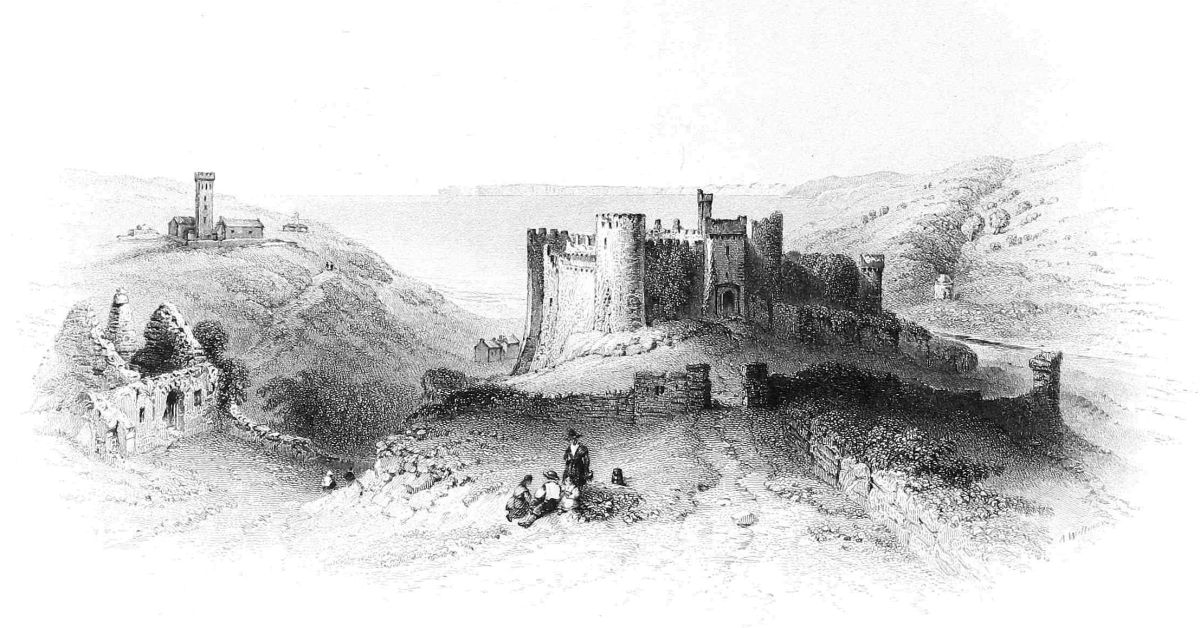
TENBY CASTLE, Pembrokeshire.
Reading edition
“Terra hæc triticea est marinis piscibus, vino que venali copiose referta; et quod omnibus præstat, ex Hiberniæ confinio aëris salubritate temperata.”—Gyraldus.
ENBY, so justly celebrated in the present day as a delightful watering-place, possesses in its traditions and antiquities many features of deep interest to the archæologist; and although not selected as a subject of special illustration in this work, it is fully entitled to the admiration of the tourist—whether in search of health, the gray landmarks of History, or studying the picturesque face of Nature in one of her most delightful aspects. Part of its buildings occupy the crest of an almost insulated tongue of land projecting into the sea; others slope down gradually to the harbour at its foot; while the extreme point of the promontory is crowned with the ruins of the Castle. “Nothing,” to quote the words of a late sketch,[389] “can be prettier than its little bay, encircled with rocks of romantic unusual form, and beautiful warm rich colouring, in some places overhung with wood, more crystalline than the emerald sea which washes their base, or more white and firm than the rim of sand which encircles it. In addition to these, the expanse of sea is everywhere magnificent. Nothing can surpass the view from the highest part of the town, where it overlooks the busy little Harbour—the Castle—the Bay, with Caldy Island; the black Rocks of Giltar Point—the distant Mountains of Carmarthenshire—and the Peninsula of Gower, with its conspicuous and fantastic termination—the Worm’s Head Promontory.

“To these natural beauties must be added the mingling of old-world relics with its modern buildings; traces of towers and fortifications, antiquated back streets, and crumbling fragments of the Castle, hanging over the verge of its sea-beaten rock. But a still greater recommendation to ordinary visitors is the extreme purity and softness of the air, the neatness and cleanliness of the streets, the quiet yet cheerful look of the place, and the romantic coast-scenery of the neighbourhood, with the ruins of castles and other buildings thickly studded within the circuit of a few miles.” With all these before us, it may well be questioned whether any other watering-place in the kingdom can offer a combination of attractions equal to those of Tenby.
The town appears to have derived its earliest importance from its fisheries;[390] and this, added to the many obvious advantages of its site, at a time when the Anglo-Norman lords made their first successful descent upon these shores, clearly pointed it out as a fit locality for the establishment of a new colony, and the erection of a strong castle for their protection. When the Flemish settlers—after being driven from their own home by successive inundations—had this coast assigned to them, the prosperity of Tenby became gradually accelerated and secured. Under the example of that industrious people, who had brought with them a more refined knowledge of commercial intercourse and its numerous advantages, the harbour was improved, the population of the town were soon engaged in an extensive woollen manufactory, which, with an increase of inland and foreign traffic, gradually enriched and enlarged the place. The commercial spirit of the inhabitants, by increasing the wealth of the native lords, procured for Tenby the numerous privileges and immunities which it received under successive governments; while the Earls of Pembroke, much to their honour, were liberal and munificent in the foundation and endowment of religious and charitable institutions.
History.—Among the historical facts in the records of Tenby, is the escape of Richmond, afterwards Henry the Seventh, from this harbour, by the connivance of Thomas White, the mayor. “Henry, who had been besieged in Pembroke Castle, succeeded at last in passing the guard, and making his way to the nearest harbour, where he meant to embark for the continent.” Here he was received by the mayor, a wealthy wine merchant, whose commercial intercourse with France gave him every facility for serving the Prince in this necessitous position of his fortunes. He was no sooner aware that young Richmond and his mother were in need of his advice and aid, than he provided them with a temporary shelter from all danger of their enemies; and as soon as a vessel could be got ready, conducted them on board, and placing the royal fugitives under the care of a skilful and trusty skipper, commended them to Heaven, and saw them safely entered on their prosperous voyage to Brittany.
It is pleasing to add that, when the fortunes of Richmond had placed him on the throne, the generous conduct of the worthy mayor of Tenby was not forgotten. The royal favour was expressed by giving him a life-grant of the King’s lands in and around Tenby, with all the privileges thereto belonging; and thus making him, in his own person and experience, a pleasing exception to the proverbial ingratitude of princes.
The town was formerly—and so long as fortifications were indispensable—a place of great strength. But of the massive walls and gates, by which it was attached to the Castle as a citadel, the remains present no features of paramount interest, except, perhaps, to the plodding antiquary, whose eyes penetrate far below the surface, and trace bastions and circumvallations where ordinary men see nothing but the weeds that cover them.
The Church is a capacious edifice—not remarkable for its architecture, but with a lofty spire which, like most others on the coast, serves as an imposing landmark. Churches, dedicated to St. Nicholas, were generally planted on some commanding eminence overlooking the sea; so that a glimpse of the sacred landmark might inspire the bewildered mariner with fresh courage to renew the struggle, or new light to direct his course, when overtaken by storms or darkness.
The interior of the Church is enriched with an elaborately-carved ceiling, and various sepulchral antiquities—some of which are curious and interesting. But that to which the stranger will probably turn with a partial eye, is the tomb of the worthy Mayor already named, containing the effigies of John and Thomas White in the quaint costume of their time, which it was the great merit of “old mortality” sculptors to imitate, in strict subserviency to the tailor and embroiderer. Here also—as in several other churches elsewhere—is the effigy of a human figure in the last stage of emaciation; supposed to be that of a Bishop of St. David’s, when bishops were known to fast as well as to pray. Perhaps of him who, in the great dearth—mentioned in a former page of this work—is said to have died of famine—a very improbable conjecture; for these exhibitions of frail mortality were only intended as monitors to the living, and to remind the thoughtless and idle spectators that to “this they must expect to come at last.” On a flat tombstone in the floor is an inscription which suggests revolting ideas of the barbarous practices that once disgraced the “inhospitable” shores of our own land. The words are, “Walter Vaughan, iv. Jan. 1637;” the name, as it is conjectured, of the once notorious “wrecker of Dunraven:” a miscreant who, by hanging out false lights in tempestuous weather, allured unhappy merchantmen, and other vessels, to the rocks; and when the sea had broken over them, and the crews were struggling in the arms of despair, descended with his fellow-ruffians to the double exercise of murder and plunder. Having amassed capital in this manner, he is supposed to have selected this coast as an “elegant retirement,” where he could enjoy the pleasures of society, without betraying the secret of his trade, and take his place at last among those worthies who have enriched the hallowed pile with their dust. We would gladly indulge the hope that this story, though repeated as a fact, is to be regarded only in the light of a fable; although every reader is aware that the wreckers of Cornwall were not imaginary beings.
The Carmelites, whose rule was founded upon that of St. Basil, had a house here, founded by John de Swynmore, of which the convent, or college, dedicated to St. Mary, stood near the parish church. But the ancient features of the town are fast passing away, and in a few years hence—if the march of improvement continue to advance at the same rate—many of the antiquities of Tenby will have become rather objects of faith than of sight.
Of the Castle, the only portions now standing that indicate its former strength are a bastion and a square tower. The rest of the structure exhibits rather the air of a splendid mansion than of a military fortress. On the north are the ruins of a large hall, about a hundred feet in length by twenty in breadth—not the usual proportions; and near the grand entrance gate is another apartment, eighty feet long by thirty feet wide. Attached to these two apartments are several others of smaller dimensions—used probably as offices, or barracks for the garrison. The situation of this fortress was admirably adapted for defence. It occupied the extreme point of the promontory; and on every side—except that facing the town, which was strengthened by art—it was secured by inaccessible rocks. The original founder of this stronghold is supposed to have been one or other of those Anglo-Norman lords who, in the manner already described, rendered themselves masters of the country. In their wars with the native princes, this Castle became a frequent object of attack; and in the year 1151, it was taken by Meredydd and Rhys, sons of Gruffyd-ap-Rhys, who put the garrison to the sword, in revenge for the shelter they had given to certain persons charged with having attacked and wounded their brother Cadell, while engaged in a hunting excursion in the neighbourhood. Again, in 1186, it was invested by Maelgwn, son of Rhys-ap-Gruffyd, who, by bringing an overwhelming force against it, took the fortress, and demolished the works. But the history of this stronghold, like that of most others built and garrisoned for the same purpose, is nothing more than a catalogue of disasters, of siege and storm, capture and surrender; where spectacles of blood were followed by scenes of barbaric splendour, and he who conquered to-day was often to-morrow’s captive.
Corporation.—Tenby was incorporated about the time of Edward the Third, by charters granted by the Earls of Pembroke, the provisions of which were afterwards confirmed and extended by Richard the Third and his successors. Previous to 1835, the government was vested in a mayor, common council, and an indefinite number of burgesses—the mayor and common council being the governing body; and the style of the Corporation—“The Mayor, Bailiffs, and Burgesses of the Borough of Tenby.”
Besides the ecclesiastical buildings already noticed, there are the Town Hall, the Assembly Rooms, a Theatre, spacious baths, and various minor edifices. All these combine to give an air of taste, comfort, and prosperity to the borough; and present to the mind’s eye a pleasing contrast to the crumbling monuments of feudal vassalage, that for centuries held this flourishing little town in its iron grasp. The harbour consists of two piers, which shoot into a corner of the bay, and nearly encircle a small but safe spot for the anchorage of vessels. The woollen trade, first introduced by the Flemish settlers, has been long superseded. The imports are chiefly articles of domestic consumption; and the exports consist of butter, corn, coal, and culm. During the fishing season, Tenby is a station for the vessels belonging to Plymouth and Broxham; and the oyster-beds constitute a source of considerable profit to the fishermen. The prosperity of the place, however, depends more upon its attractions as a watering-place, than upon any advantage it possesses as a seaport; and in this respect, as already observed, it takes unquestioned precedence over the majority of those fashionable resorts which have so long flourished under the smile of popular favour.
Flemings.—The cause which immediately led to the Flemish settlement on this coast is as follows:—An inundation[391] of great magnitude happening in the Low Countries soon after the Conquest, a vast number of Flemings, driven from their homes, betook themselves to their ships, and landing in England implored an asylum. An increase of industrious peaceable subjects was an object not to be overlooked by the Conqueror. They were accordingly received with alacrity, and treated with cordial hospitality. After a time these strangers were distributed over the country, and wherever they settled contributed to the prosperity of the district. “Many Flemings,” says Malmesbury, “came over to England on account of relationship to the mother of Henry the First, by her father’s side; insomuch that—like the Germans of the present day—they were burthensome to the kingdom.” “Farther,” says the old historian, “William Rufus had generally ill fortune against the Welsh, which one may well wonder at, seeing that all his attempts elsewhere were crowned with success. But I am of opinion that the unevenness of their country, and the severity of the weather, favoured their rebellion; so it hindered their progress. But King Henry found out an act to frustrate all their inventions, by planting Flemings in their country to curb and continually harass them. King Henry often endeavoured to reduce the Welsh, who were always prone to rebellion. At last, very advisedly, in order to abate their pride, he transplanted thither all the Flemings that lived in England. Wherefore, because their numbers created uneasiness, and were burthensome to the kingdom, he thrust them all into Ros, a province of Wales, as unto a common shore, as well to rid the kingdom of them, as to curb the obstinacy of his enemies.”
To the multitude of Flemings thus disposed of, Henry the Second added, by banishing out of England all the Flemish soldiers who had taken service under King Stephen, and granting them permission to join their compatriots in Pembrokeshire. But although historians in general confine the influx of Flemish settlers to the lower part of Pembrokeshire, it is certain that they extended over a much wider district, namely, the whole sea-coast bounding the counties of Pembroke, Carmarthen, Cardigan, and Glamorgan. Of the Flemish colony who settled in Cardiganshire, there are unequivocal proofs in our own times; for their posterity, who continue to inhabit the tract assigned to their ancestors, differ materially from the aboriginal Welsh, not only in the peculiarities of speech, but in those physical distinctions which mark the different races of mankind. “There is a farm called Nant-y-Flyman,” says Mr. Thomas,[392] “in the parish of Verwick, two miles north of Cardigan, which is said to derive its name from the landing of this colony at Traeth-y-Mwnt, a small creek hard by. The reception they met with on disembarking, was from the swords of armed natives; and in the carnage that ensued, fell many of the best and bravest on both sides. In commemoration of this disastrous rencounter, several heaps of sand adjoining Mount Church point out to this day the cromlechs of the slain, and are traditionally called “the graves of the Flemings—Beddau’r Fflemings—where bones of gigantic size often make their appearance.”
In the Welsh Chronicle, we read that the Normans and Flemings inhabited the county of Carmarthen, about Llanstephan—the castle of which we shall presently notice; and under the conduct of Girald and William de Hay invested the said castle. That they extended likewise coastwise to Glamorganshire, is evident from the Gower Whittle—a provincial article of dress peculiar to the Flemings, and from them adopted by the Welsh in general. The south-west portion of Gower, according to Mr. Collins, is inhabited by the descendants of a colony of Flemings, who do not talk the Welsh language, and are distinguished by their own peculiar dress. They seldom intermarry with their neighbours on the north-west side of the Gower. Mr. Pye supposes that the Flemings in Wales still speak the language of Flanders; and relates that a servant, inquiring the road, “could not understand the language of some cottagers, nor make them to understand him, though a Welshman; and he was certain they did not speak Welsh. After much altercation, and inquiry at an alehouse, all ineffectually, a clergyman solves their doubts by relating that some Flemish families had settled in that part of South Wales, and have retained their language to this day.” Here, however, Mr. Pye must have been misinformed; for they all speak—that is, the lower class—a horrid provincial dialect of the English language, though not much worse than certain counties of England, retaining many Saxon words now obsolete, and unintelligible to any but an antiquary. Camden says, “They speak a language so agreeable with the English (which indeed has much affinity with the Dutch), that this small country of theirs is called by the Britons—‘Little England below Wales.’” “But here Mr. Pye is to be regarded as a novelist,” says Thomas;[393] “for his account is not historically true.”
The policy of King Henry in settling these Flemings in Wales, for the purposes of conquest, security, and strength, was very judicious. Being a very warlike people—Belgæ—inevitably attached to their benefactors the English kings, they were always ready to join their standard, or to make a diversion in their favour against the Welsh. But such frontier military posts as surrounded the Welsh—such a cordon of warlike foreigners settled on their coasts—became a source of much evil to the natives; and altogether inadequate for the purpose which their introduction was intended to serve; namely, “to secure the fidelity of the Welsh nation”—whom, on the contrary, their harsh usage and oppression only contributed to alienate from the English crown, until their antipathy and resentment found vent in the open insurrection of Owen Glendower.
The colony is thus described by Giraldus:—“Gens hæc fortis et robusta; continuoque belli conflictu gens Cambrensibus inimicissima, gens lanificiis, gens mercimoniis usitatissima, quocumque labore sive periculo, terra marique lucrum quærere. Gens prævalida vicissim loco et tempore, nunc ad arma, nunc ad aratra gens promptissima.”
Manorbeer Castle.
Near the Church.