LLANSTEPHAN CASTLE, Carmarthenshire.
Reading edition
“Let them pass— I cried: the world and its mysterious doom Is not so much more glorious than it was, That I desire to worship those who drew New figures on its false and fragile glass, As the old faced—phantoms ever new Rise on the bubble, paint them as you may; We have but thrown—as some before us threw— Our shadows on it as it passed away. But mark how chained to the triumphal Cross Were the great figures of an elder day!”
This Castle—one of the oldest in Wales—crowns a bold eminence projecting into the bay of Carmarthen, and defends the entrance of the river Towy, which falls into the sea at this point. It is a military fortress of great strength and antiquity, but by whom founded—whether by Roman or Briton—or to what precise era it belongs, are questions which have never been satisfactorily answered. Yet the very obscurity which hangs upon it imparts to its dilapidated walls, mouldering turrets, and grass-covered courts, an interest which is seldom or never felt in the survey of those castellated ruins which make a prominent figure in the pages of history. All that has yet been advanced by archæologists regarding the founder of Llanstephan, is only based on plausible conjecture. It is not improbable, however, that the present castle occupies the position of a Roman fort; for it is not to be supposed that, during their occupation of the Silurian territory, a situation presenting so many natural advantages, and commanding the embouchure of the Towy, would be neglected by a people so prone to conquest, and so circumspect in all the means that could secure and fortify them in their new possessions. Nor were the Normans—who were equally observant and expert in the distribution of their military posts—likely to lose sight of the advantages which a castle on this promontory would afford in facilitating their operations, and widening their encroachments beyond the Welsh frontier; and in the citadel which now covers the steep, we have ample
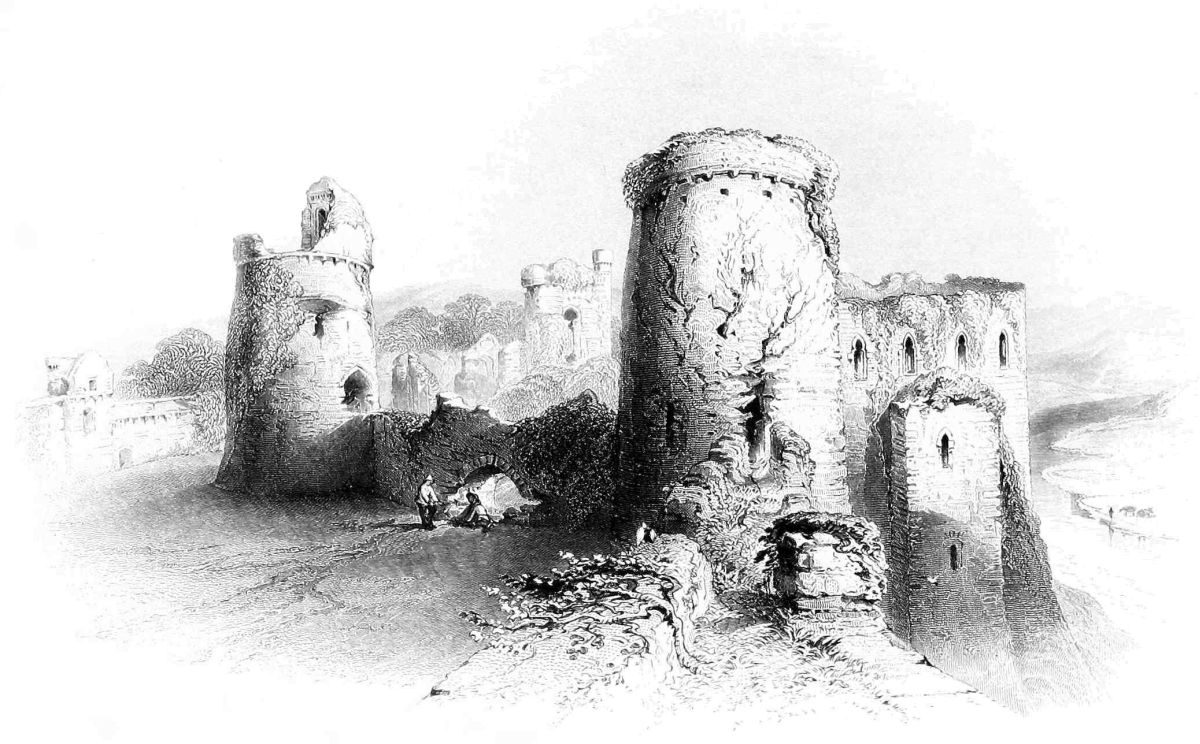
Kidwelly Castle.
Inner Courts and Chapel from the Battlements.
testimony, that whatever hands may have raised the first structure, that which now occupies our attention is of Norman architecture.
The historical details of Llanstephan are meagre and unsatisfactory; we would desire to learn the circumstances of siege and storm and surrender, the acts of fortitude and valour which mutually distinguished the besieged and their assailants, their patient endurance of privations, their resolute and determined resistance, the nightly assault, the treachery of professing allies, the regular investment by open enemies, the daily skirmishes, the nightly advance, the scaling of the walls, the final struggle, the throwing open of gates, the dismantling of towers, with mingled traits of personal prowess, magnanimity, and fortitude. But of these, history observes a mysterious silence. We learn, however, that
Caddell, Meredydd, and Rhys, sons of Gryffyd-ap-Rhys[405]—the prince so often named in these pages—having in 1143 succeeded in their enterprise against Carmarthen Castle, were induced to make a similar attempt upon Llanstephan, and, directing their march to that point, invested the walls, and summoning the Norman garrison to surrender, were answered by a message of contempt and defiance. This, however, served merely to stimulate the Cambrian leaders into immediate action; for, after a spirited resistance, they carried the fortress by storm or stratagem, and planted their own countrymen within its walls. This daring exploit was instantly reported to the Norman legions beyond the frontier, who made all possible haste to vindicate the tarnished honour of the garrison; and mustering all their available strength, soon made their appearance under the walls of Llanstephan.
The consequence of this movement was a protracted siege, in the progress of which everything promised a successful issue to the Normans. At last, while the Cambrian garrison within did little more than regard their operations with passive indifference, the signal was given to scale the ramparts, and at the word every Norman flew to the assault. Meredydd, however, was well prepared to give his unbidden guests a Welsh welcome; and while the Normans, like swarming bees, were covering fosse and rock with their numbers, he ordered a wedge to be struck home, and no sooner was the hammer at work than an avalanche of rocks, suddenly let loose from the highest point of the ramparts, overwhelmed the invaders, and hurled the scaling party and their ladders into the ravine below. A shout of derision followed them from the garrison above; operations on both sides were suspended; and with their ranks thus suddenly thinned by a catastrophe as unseen as it was disastrous, the Normans sullenly withdrew. But it was only to return with increased strength and whetted vengeance. They had sworn to extirpate the garrison at their next visit, and the Norman leader was not a man to break his word whenever stimulated by a thirst of revenge or plunder.
We need not dwell upon the skill and vigour of the besiegers, nor the spirited resistance of the garrison. But, in the present instance, the siege was conducted in a more regular and systematic method than heretofore; they had recourse to all the appliances of military art. The warlike engines employed against stubborn fortresses were now called into perpetual action, and night and day the butting of the battering-rams continued to shake the ramparts, until here and there a stone dropping from the mason-work, the whole ramparts began to shake under the feet of the besieged. At length, a breach being effected, the Normans poured in their best troops, and for a time the conflict was maintained with desperate fury. Foot to foot the assailants met, fought, and fell where they stood. Too proud to ask quarter, the fiery Cambrian rushed upon his adversary with a blind impetuosity that often placed him at his mercy; while the Norman, adroit in the management of his weapon, and bent on revenging his countrymen, was only stimulated to indiscriminate slaughter; and long before sunrise the Norman banner waved on the Castle of Llanstephan.
In M.CC.XVI the fortune of war was again invoked. The Norman sway, so intolerable to native independence, had extended its influence and territory; and with these had inspired into the heart of every reflecting Cambrian, a deep sense of the wrongs inflicted upon his country. With an irrepressible and Wallace-like determination to crush or expel the invader, he rushed to the conflict. This, so far as regards Llanstephan, was partly effected by Llewelyn-ap-Iorwerth, who, after a successful attack, entered the fortress, slew or captured the garrison, and then, to prevent its being again turned against the peace of the country, dismantled the walls, threw down the gates, filled up the ditches, and left its towers for a habitation to the owls.
The position of the Castle, however, was too advantageous to be neglected for more than a season: for, as war continued rampant along the marches, the demand for garrisons increased; and Llanstephan was again converted into a fortress, and crowded with troops. In this state it appears to have continued until the year 1254. But in those days of mutual hatred and jealousy—when neighbour plotted against neighbour, and friendships cemented at morning were often changed, by some sudden exasperation, into mortal enmities before night—the garrison of Llanstephan could never remain unconcerned spectators of passing events. Llewelyn-ap-Grufydd, whose name is so familiar in the Cambrian annals, finding himself in a position to resent, to the very death, some personal insult from the haughty castellan of Llanstephan, summoned his countrymen to arms. “This offensive castle,” said he, “must be demolished! Ye have true British hearts; and if your hands will only obey those hearts, my countrymen, before two days elapse ye shall drive your goats to pasture in the courtyard, of Llanstephan!”
This old Griffin kept his word—the raid was successful—his flag soon waved over the battlements of the castle; and there we leave him for the present to enjoy the fruits of his new seigneurie.
St. Anton’s Well, in the parish of Llanstephan, was long a place of popular resort for invalids. Impregnated by some mysterious qualities which escaped detection by the ancient process of analysis, the water was lauded as a never-failing resource under those forms of corporeal malady which had baffled the skill of physicians, and conducted the sufferer to the very brink of despair. It may, therefore, be imagined, that the concourse of pilgrims was a source of no little emolument to the place, more especially to the “hydropathic” friar of the olden day, who presided at the well, and propitiated, for a consideration, the kind offices of St. Anthony. But all the medicinal virtues of this holy well are now left to the gossip of old tradition; and although the fountain bubbles up as fresh, and clear, and salubrious as ever, public faith in its qualities has been shaken; and no pilgrim, in these days of scientific analysis, ever stoops down to taste the water, and, in testimony of its virtue, leaves his crutch behind him.[406]