TINTERNE ABBEY. (continued 2)
Reading edition
Yet there Tradition tells her tale Of warrior-knights in glittering mail— Of martial feat, and festive hall, And banners waving from the wall; When Cambria’s rival spears were bent For martial joust and tournament; While Beauty, from her lattice high, Surveyed the scene with radiant eye— And Cambria’s Chivalry in arms Did faithful homage to her charms. But Caldicot, how lonely now! The wreath has withered from thy brow; The scene of song and martial deeds Is now a wilderness of weeds! Ah, such at last the homes shall be Of England’s proudest Chivalry!
Mathern is remarkable as the burial-place of Theodoric or Teudrick, the hermit king of Glamorgan, already mentioned.[110] His hermitage “among the rocks of Tinterne,” to which he had retired for repose and meditation in the evening of life, is supposed to have stood on the site of the present abbey, which had thus, in the traditional records of the people, a spot already consecrated by royal example, as a foundation for those gorgeous altars by which it was subsequently distinguished.
When dragged from his retreat by the supplications of his family and subjects, and armed once more against the Saxons, he solemnly enjoined his son that, in the event of his falling in battle, they should erect a Christian church over his remains, as a monument of his faith and patriotism. The battle that speedily ensued, as tradition reports, was a great victory, but a victory purchased with the blood of Teudrick; for during the fierce conflict that had covered the Vale of Tinterne with the slain, he received a blow from a Saxon battle-axe which proved fatal. From the field he was conveyed homeward as far as Mathern, where he died; and there his son, who succeeded him in the chieftainship, erected a church to his memory, the name of which has perpetuated his martyrdom.[111]
The foundation of this church in its primitive state, consisted, like other British structures, of a nave only—a side aisle and chancel appear to have been added at a very early date; and, subsequently to these, a tower was erected which completed the sacred edifice, and rendered it more conspicuous as a historical landmark, and place of pilgrimage. It is distinguished by handsome Gothic windows, portions of which are adorned with stained glass; and the roof is supported by Saxon arches, resting on massive octagon piers.
On a plain mural tablet in the Chancel of this ancient church, is the following inscription, supposed to have been written by Bishop Godwin. The fact of its being the sepulchre of the British Prince Teudrick, was finally ascertained by the discovery of his stone coffin, in which the skeleton was found almost entire. On the skull, also, in accordance with local tradition, a fracture was observed, which clearly indicated the manner of his death, and confirmed the testimony of local history.
The following is the inscription:—“Here lyeth entombed the body of Theodoric, King of Morganuch, or Glamorgan, commonly called St. Theodoric, and accounted a martyr, because he was slain in battle against the Saxons, being then pagans, and in defence of the Christian Religion. The battle was fought at Tynterne, where he obtained a great victory. He died here, being on his way homeward, three days after the battle, having taken order with Maurice, his son, who succeeded him in the kingdom, that in the same place where he should happen to decease, a church should be built, and his body buried in the same, which was accordingly performed in the year 600.”
“On ascending the tower of this church,” says Mr. Thomas, “a scene of great extent and surpassing beauty is spread before the eye; on one side you have a long reach of water, strewn with vessels and rocks; on the other a wide undulating tract of land, overspread with villas and smiling meadows, crowded with many a gentle herd; while beneath, and not the least interesting objects of this scene, are those melancholy wrecks of bygone splendour—Mathern Palace and Moinscourt.” The first of these two objects, the old episcopal residence, is now “the ruinous retreat of some humble followers of the plough.” The north and north-east portions, comprising the porch and tower, were erected by Bishop De la Zouch, who was consecrated in the year 1408, and the chapel hall, and some other compartments, were added by Miles Sulley, who came to the see in 1504. Moinscourt, now reduced to the humble uses of a farmhouse, was another of the palaces, belonging to the see of Llandaff, and supposed to have been erected by Bishop Godwin, who made it his favourite residence. Passing beneath a Gothic porch, crowned with two lofty turrets, we enter a spacious quadrangular court, at the extremity of which stands the palace. Over the entrance is an escutcheon, on which are sculptured the arms of Godwin, impaled with those of the see, and bearing the date of 1603. The court was formerly adorned with two monuments of Roman antiquity found in the vicinity—one a votive altar, the other an inscription, recording the rebuilding of the Temple of Diana, by T. F. Posthumius Varus. It was from the ancient Roman slabs, built into the garden walls of this residence, that Bishop Godwin supplied the drawings and inscriptions for Camden’s Britannia.[112]
Before adverting to the final suppression of Tinterne Abbey, and the confiscation of its revenues to the king’s treasury, we shall now take a brief view of the circumstances which led to this grand revolution in our ecclesiastical government—quoting for our authority those writers of unquestionable veracity, who have treated of that momentous epoch. First, with regard to the
Dissolution.—“Never,” says an historian of this epoch,[113] “never was there any exploit, seemingly so full of hazard and danger, more easily achieved than the subversion of our English monasteries.” The church commissioners presented a startling report of the vices[114] and deceptions of the monks and nuns; and, what was of equal weight in the condemnation, they sent in the title-deeds of their estates, with the inventory of their plate, jewels, and ready money. Upon this a bill was introduced, giving unto the king and his heirs all monastic establishments, the revenues of which did not exceed two hundred pounds sterling a year, with every kind of property attached to them, whether real or personal. Three hundred and eighty of the lesser houses fell within this category, and were suppressed; whereby the king was enriched by thirty-two thousand pounds per annum—an enormous sum in that day—in addition to a hundred thousand pounds in ready money, plate, and jewels. The bill, according to one writer, was not passed through the House of Commons without some difficulty; but Henry, sending for the ministers, and telling them that he would have either the bill or their heads, they passed it immediately.
The parliament, which, by successive prorogations, had sat for the unprecedented term of six years, was now dissolved; and Henry, after all their passive obedience, appears to have been disgusted at this their last and feeble effort at opposition. He now named other commissioners to take possession of the suppressed monasteries, and to prepare measures for the seizure of others. If these men, mostly the friends of Cromwell or of Cranmer, had a better religion before their eyes, they certainly were not blind to the charms of lucre, and the temptations of fair houses and fat glebes; as many of them made a harvest for themselves, out of the spoils of the monks and nuns.[115]
The superiors of the suppressed houses were promised small pensions for life, which were very irregularly paid. All the monks not twenty-four years of age were absolved from their vows, and turned loose upon the world without any kind of provision; the rest, if they wished to continue in the profession, were divided among the greater houses that were still left standing. The poor nuns were turned adrift to beg or starve; having nothing given to them, save one common gown for each.[116] “These things,” says Godwin, “were of themselves distasteful to the vulgar sort, of whom each one did, as it were, claim a share in the goods of the church; for many being neither monks, nor allied to monks, did, notwithstanding, conceive that it might hereafter come to pass that either their children, friends, or kindred, might obtain their share; whereas, when all their property was once confiscated, they could never hope for any such advantages. But the popular commiseration for the thousands of monks and nuns who were, almost without warning given, thrust out of doors, and committed to the mercy of the world, became a more forcible cause of discontent. There were not wanting desperate men to take advantage of this state of public feeling; and it was diligently rumoured in all parts, that this was but the beginning of greater evils and more general spoliations—only a trial of their patience; that, as yet, the shrubs and underwood were but touched; but unless a speedy remedy were applied, the end would be with the fall of the lofty oaks.” At the same time, the crowds of poor, who, by an ancient but defective system, had derived their support from the monastic establishments, became furious at finding their resources cut off, and at seeing the monks who had fed them now begging like themselves by the roadsides.
In the midst of these general discontents, Cranmer and Cromwell issued certain doctrinal injunctions to the clergy, which were too novel to find immediate favour with the multitude; and certain Protestant reformers, who had more courage than they, ventured to print books about Iconolatria, image-worship, auricular confession, transubstantiation, and other fundamental tenets and practices of the Roman Catholic Church. The king, who assumed all the authority in matters of dogmas that had ever been claimed by the popes, and much more than they had ever put in practice in England, pronounced rewards and sentences which irritated both parties alike, and all these questions were referred to him—thus occupying a good deal of his time, and keeping in dangerous activity his old political bile.[117] We find the Lord Chancellor Audley writing in great perturbation to Cromwell, telling him that “there is a book come forth in print, touching the taking away of images, and begging to know whether he was privy to the publishing thereof,” which Cranmer probably was,[118] though, had such a fact been known to his master at that moment, his neck would have been in jeopardy. The chancellor says, “I assure you, in the parts where I have been, some discord there is, and diversity of opinion among the people, touching the worshipping of saints and images; and for creeping, kneeling at cross, and such like ceremonies heretofore used in the church, which discord it were good should be put to silence; and this book will make much business in the same, if it should go forth. Wherefore,” he continues, “I pray you, I may be advised whether you know it or no, for I intend to send for the printers and stop them; but there may be many abroad. It were good that the preachers and people abstained from opinions of such things, till such time as by the report of such as the king’s highness hath appointed for the searching and ordering of laws of the church, his grace may put a final order on such things, how his people and subjects shall use themselves without contention. And if the people were thus commanded by proclamation to abstain till that time, such proclamation, drawn in honest terms, would do much good to avoid contention.”[119]
The king was by no means backward in issuing his final orders and decrees spiritual; and the reformers herein concealing their ulterior views, he was led to reduce the number of sacraments from seven to three—Baptism, the Lord’s Supper, and Penance; to forbid the direct adoration of images; to abrogate a number of saints’ days or holidays, especially such as fell in harvest time; to declare the Scriptures, with the Apostolic, Nicene, and Athanasian creeds, the sole standards of faith; to order every parish priest to expound these to his parishioners in plain English; and to direct the printing and distribution of an English translation of the Bible, one copy of which was to be kept in every parish church. The king, in his wisdom, insisted on the necessity of auricular confession, and denounced any questioning of the ‘real presence’ in the eucharist as a damnable heresy, to be punished with fire and faggot. Purgatory, he confessed, puzzled him; steering a middle course, he declared himself to be uncertain on this head; and kindly permitted his subjects to pray for the souls of their departed friends, provided only that they fell into none of the old abuses of enriching religious houses and shrines for this object.[120]
“Meanwhile,” says the historian, “the king continued much prone to reformation, especially if anything might be gotten by it.” Nothing was more easy than to prove that all the monastic orders had been engaged in the late insurrection;[121] and as many of the richest abbeys and priories remained as yet untouched, there was no want of wise counsellors, all anxious to share in the spoil, who recommended their total suppression. In some cases, out of a dread of martial law, or, what was equally bad, a prosecution for high treason, the Abbots surrendered, gave, and granted their abbeys unto the king, his heirs and assigns for ever; but still many replied, like the prior of Henton, “that they would not be light and hasty in giving up those things which were not theirs to give, being dedicated to the Almighty for service to be done to his honour continually, with other many good deeds of charity which be daily done in their houses to their Christian neighbours.”[122] “These recusants were treated with great severity; the prisons were crowded with priors and monks, who died so rapidly in their places of confinement, as to excite a dreadful suspicion.”
Without waiting for a “needless act of parliament, the king suppressed many other houses; and soon after, with the full consent of Lords and Commons, finished the business, by seizing all the abbeys without exception, with all the other religious houses, except a very few, which, at the earnest petition of the people, were spared or given up to the representatives of their original founders.” Before proceeding to the “final suppression, under the pretence of checking the superstitious worshipping of images, he had laid bare their altars, and stripped their shrines of everything that was valuable; nor did he spare the rich coffins and the crumbling bones of the dead.” At the distance of four hundred years—exasperated at that extraordinary man’s opposition to the royal prerogative—he determined to execute vengeance on the bones and relics of
Thomas a Becket.—The Martyr’s tomb was broken open; and by an insane process, worthy of a Nero or a Caligula, a criminal information was filed against him as “Thomas Becket, some time Archbishop of Canterbury;” and he was formally cited to appear in court, and answer to the charges. Thirty days were allowed the saint; but we need hardly inform our readers that his dishonoured relics rested quietly at Canterbury, and did not appear to plead in Westminster Hall. With due solemnity the court opened its proceedings.[123] The attorney-general eloquently exposed the case for the prosecution, and the advocates of the saint—who no doubt spoke less boldly—were heard in defence; and that being over, sentence was pronounced, that “Becket” had been guilty of rebellion, treason, and contumacy; that his bones should be burnt as a lesson to the living not to oppose the royal will; and that the rich offerings with which many generations of men, native and foreign, had enriched his shrine, should be forfeited to the crown as the personal property of the traitor. “In the month of August,” continues the historian, “Cromwell, who must have smiled at the course pursued, sent down some of his commissioners to Canterbury, who executed their task so well, that they filled two immense coffers with gold and jewels, each of them so heavy that it required eight strong men to lift it.” “Among the rest,” says Godwin, “was a stone of especial lustre, called the Royal of France, offered by King Louis VII., in the year 1179; together with a great massive cup of gold, at what time he also bestowed an annuity on the monks of that church of an hundred tuns of wine. This stone was afterwards highly prized by the king, who did continually wear it on his thumb.” A few months after, the king, by proclamation, stated to his people, that forasmuch as it now clearly appears Thomas Becket had been killed in a riot provoked by his own obstinacy and insolence, and had been canonized by the Bishop of Rome merely because he was champion of that usurped authority, he now deemed it proper to declare that he was no saint whatever, but a rebel and traitor to his prince: and that, therefore, he, the king, strictly commanded that he should not be any longer esteemed or called a saint; that all images and pictures of him should be destroyed; and that his name and remembrance should be erased out of all books, under pain of his majesty’s indignation, and imprisonment at his grace’s pleasure.[124]
The revenues of Tinterne Abbey, though far inferior to others of the same order, particularly those in Yorkshire, were still sufficient for the maintenance of the brotherhood, the repairs and decoration of the buildings, and the exercise of hospitality, which formed so important a feature in the monastic code. The estimate recorded by Dugdale is probably under the mark; while that of Speed may possibly exceed, by a few pounds, the actual rental of the abbey lands. The former has computed it at £192. 1s. 3d., the latter at £252. 11s. 6d., sums which, taking into account the value of money in those times, give no mean idea of its annual resources. This sum, however, is exclusive of the daily tribute received from the pious hands of pilgrims, and the donations of many distinguished guests, who, from time to time, sat at the Abbot’s table, or found refuge in its sanctuary.
The details of the first endowments[125] of Tinterne Abbey, as well as various later benefactions, down to the seventh year of Henry the Third, are contained in a charter of confirmation from William Marshall, grandson of Walter de Clare, the founder.
“Herein,” says Tanner, “were thirteen religious about the time of the dissolution, when the estates belonging to this monastery were rated at £256. 11s. 6d. in the gross, and £192. 1s. 4-1/2d. per annum, clear income.”
The site of Tinterne Abbey, with all the monastic buildings, was granted 28th Henry VIII. to Henry, Earl of Worcester. It is still the property of his descendant, the Duke of Beaufort. Leland, mentioning Tinterne Abbey in his Collectanea, says, “There was a sanctuary granted to Tinterne, but it hath not been used many a day.”
The common seal of this monastery is appended to an instrument dated in the 6th of Henry VIII., whereby the abbot and convent appoint Charles, Earl of Worcester, and Henry Somerset, Lord Herbert, his son and heir apparent, chief stewards of their manor of Arle in Norfolk. The subject of this seal, of which only a mutilated impression in red wax remains, was the Virgin Mary and the infant Saviour, seated under an ornamented arch—in a niche underneath, was an abbot, with his crosier, on his knees praying. Nearly the whole of the legend is gone, the only part remaining being.... RII. BEATE.
William Marshall, the “vetus Marescallus,” as he is called in black-letter chronicles—who married the daughter and heiress of Richard Strongbow—became the founder of a new Cistercian Abbey, near Wexford, in Ireland. Finding himself, once upon a time, in great peril during a voyage thither, he made a vow to the Virgin Mary, that if by her help he escaped shipwreck, and once more set foot on dry land, he would testify his gratitude by founding an abbey to her honour. The ship having got safe into port, he lost no time in commencing the pious work, to which, in compliment to her elder sister on the Wye, he gave the name of Tynterna de Voto.
Daughters of Tinterne.—In addition to what has been already mentioned of the two daughters,[126] or offshoots, of Tinterne on the Wye, we collect the following particulars:—
Tinterne Abbey, in the County of Wexford.—“This abbey was situated on the shore of Bannow Bay, in the barony of Shelburne, three miles north-east of Duncannon Fort. William, Earl of Pembroke, as already mentioned, being in great danger and peril at sea, made a vow to found an abbey in that place where he should first arrive in safety; and the place was the bay in question. He accordingly performed his vow, dedicated his abbey to the Virgin Mary, endowed it, and settled a convent of Cistercian monks in it, whom he brought from Tinterne in Monmouthshire. Archdale gives the particulars of the Earl of Pembroke’s endowment of this house, from King. The whole, however, was not completed in the earl’s lifetime, for Dugdale has given King John’s charter confirming the bequest of thirty carucates of land to this abbey in the earl’s will.”[127]
Kingswood Abbey.—“Roger de Berkeley received by gift of William Rufus certain lands, upon condition that he should confer them upon some monks or canons; but being prevented by death, he bequeathed them to William de Berkeley[128] his nephew, upon the same terms. And of which William, I find that he bestowed upon the monks of Tynterne, in Wales, a certain Desart near Berkeley, called Kingswood, there to found an abbey of the Cistercian Order; and that Maud the Empress, daughter to King Henry the First, confirmed that grant. The convent was built, but during the troublous reign of Stephen they removed to Haselden; but thence, on the return of peace, they were expelled by the proprietor, and again took up their abode at Kingswood. Reginal D. S. Walerick repenting, invited them back to Haselden; but, after a time, the place being found very inconvenient for lack of water, they were removed by him to Tetbury, Kingswood all this time being left as a mere grange of the monastery. Of this the heir of the founder complained, and required that the convent should return thither, according to the conditions upon which it was given by his ancestor. A general chapter of the whole Order, however, decided against him, and determined that Kingswood should remain as a mere farm belonging to the convent of Tetbury; but that mass should always be sung at Kingswood, privately, by one monk, who was to have for his labour twenty-seven marks and a half. But after this, by another general chapter of that Order, it was agreed that the Abbot of Waverley, in Surrey, should rebuild Kingswood with the consent of the founder, and confirmation of the King; which being done without the privity of the convent at Tetbury, and Abbot of Tynterne, who opposed the same. Upon a meeting of divers other abbots at Kingswood, it was concluded, that the monks placed at Kingswood should be recalled, and that place reduced unto the state of a grange to Tettebiry, as it was before.” These transmutations, however, were not yet concluded: “for Tettebiry being found a narrow place, too little for an abbey, and having no fuel but what was brought from Kingswood, which was far distant, Bernard de S. Walerick came to accord with Roger de Berkley, the founder of Kingswood, and therefore, obtaining a grant from him of forty acres of land adjoining to Kingswood, translated those monks from Tettebiry thither, and called it Kingswood, as a name of most note.”[129] Such were the vicissitudes of this abbey.
According to Pope Nicholas’ taxation, the spiritualities of this monastery amounted in 1291 to the annual sum of £6. 4s. 4d.; the temporalities to £47. 17s. 2d.; making a total of £54. 1s. 6d. There is no valuation of Kingswood in the general ecclesiastical survey of the 26th Henry VIII., though Tanner says it was valued at that time, according to Dugdale, at £244. 11s. 2d. per annum; according to Speed, at £254. 11s. 2d.; clear, £239. 19s. 7-3/4d. In a MS. record in the whole at £254. 5s. 10d. A survey of this house, taken in the 29th Henry VIII., is preserved in the appendix to the Monasticon Anglicanum. There is also a minister’s ‘accompt’ of it in the Augmentation office, 32nd Henry VIII.; but its possessions are there answered for, in gross, at the sum of £245. 8s. 8d., the whole of its estates being then on lease to Sir Nicholas Peyntz, Knt., under the seal of the Court of Augmentations, dated 10th March, 29th Henry VIII., for a term of twenty-one years at the above rent. In the second year of Queen Elizabeth, the site of this house was granted to Sir John Thynne, Knt. The register of Kingswood Abbey was in the possession of John Smith, Esq. of Nibley, in the county of Gloucester. The common seal represented the Blessed Virgin crowned, holding in her arms the infant Jesus, and standing between two elegant pilasters, surmounted by a canopy; the field diapered; in base, under an arch, the half figure of a monk praying; the legend much flattened, so that no more of it can be read than S.COF ... CONVENTUS ... DE KINGEWOD. An impression of this seal on red wax is appendant to a conventual lease, temp. Henry VIII., in the Augmentation office.[130]
ROM the above cursory notice of the spiritual daughters of “Holy Tinterne,” we return to the Mother-Abbey.

In England, says an eminent Catholic writer, the scheme of plundering the ecclesiastical property by men of a certain class, had never been wholly abandoned. In Henry the Fourth’s time there was “the laymen’s parliament of those who countenanced Wickliffe, and loved the lands far better than they did the religion of the Church; but their designs at that time were defeated by the stout and religious opposition of Thomas Arundel, Archbishop of Canterbury, and other Prelates.”[131] Against these evils the ancient canons of the church in Germany provided, by prohibiting the faithful from holding any communication with men who disturb priests, and the state of the church.[132] “Now,” he continues, “if St. Thomas and the clergy of the middle ages are to be condemned for resisting such injustice by prayers, and law, and canonical censures, what will be thought of St. Ambrose, and other pastors of the early church, who, by still more uncompromising firmness, believed that they were imitating the apostles?” St. Ambrose declares that he will never relinquish the churches to the Arians, as the Emperor Valentinian commands, unless by force. “If any force remove me from the church, my flesh,” he says, “may be disturbed, but not my mind; for I am prepared to suffer whatever a priest may suffer, if the emperor should exert his regal power. I will never abandon the church voluntarily; but I cannot oppose force. I can grieve, I can weep, I can groan; against arms, soldiers, and Goths, tears are my arms; for these are the weapons of a priest. Otherwise I neither ought to resist, nor can I resist. When it was proposed to me to deliver up the vessels of the church, I sent word that I would willingly give up what was mine own, whether lands or houses, gold or silver; but that I could take nothing from the temple of God, nor lightly abandon what I had received to guard—not to deliver up. Fear not, therefore, for me, dearly beloved, since I know that whatever I am about to suffer, I shall suffer for Christ; and the will of Christ must be fulfilled, and that will be for the best. Let them decree the penalty of death, I fear it not; nor will I on that account desert the martyrs; for whither could I go where all things would not be full of groans and tears, when Catholic priests are ordered to be driven from the churches, or to be struck with the sword if they resisted; and this decree to be written by a bishop, who should quote ancient examples to prove himself most learned? Auxentius, thirsting for blood, demanded my church; but I say with the prophet—‘Absit ut ego patrum meorum tradam hæreditatem!’ Naboth was prepared to defend his vineyard at the expense of his blood. If he could not give up his vineyard, neither will we give up the church of Christ. Do I then return a contumacious answer? I have answered as a priest; let the emperor act as an emperor. Last year,” he adds, “when I was invited to the palace, and introduced before the council, when the emperor wished to take from us the church, I should have been subdued by the contemplation of the royal hall, and I should not have kept the constancy of a priest, or should have departed with loss of right. Do they not remember, then, how the people rushed to the palace, and overwhelmed every force, declaring that they would die for the faith of Christ? Then I was desired to appease the people, which I did by engaging that the church should not be given up; but now the Arians wish to give law to the church, and accuse us of sedition in resisting the emperor. Let him take our tribute or our lands, if they ask treasure: our treasure is the poor of Christ; our defence is in the prayers of the poor. These blind, and lame, and weak, and aged persons, are stronger than robust warriors. I am to give to Cæsar what belongs to Cæsar; to God what belongs to God: the tribute is Cæsar’s, but the church is God’s. As for the fire, or sword, or banishment, which are threatened, we fear them not.”[133]
Again, writing to his sister Marcella, he says: “Not only the basilica without the walls is now demanded, but also the new and greater one within the city. When the prince summoned me to resign them, I replied, what was of course, that ‘the temple of God could not be given up by a priest.’ The emperor cannot invade the house of a private man, and will he dare to take possession of the house of God! The palace belongs to the emperor, the church to the priest. If he be a tyrant, I desire to be aware of it, that I may know how to prepare against him, for I have the power to offer my body. If he thinks himself a tyrant, why does he delay to strike? By ancient laws empires were given by priests, not taken from them; and it is a common saying, that emperors have rather desired priesthood, than priests empire. The tyranny of a priest is his infirmity; for ‘when I am weak, then am I strong.’”
With examples like this before them—and numerous others might here be cited—it is not surprising that many of the monastic priesthood preferred to endure fines, imprisonment, and even death, to the enjoyment of that life and freedom which could only be purchased by acts of apostacy. And on this portion of our subject we avail ourselves of an eloquent passage from one of the most popular works of the day:—
The conversion of the Anglo-Saxons to Christianity was the first of a long series of salutary revolutions. It is true that the church had been deeply corrupted both by that superstition, and by that philosophy, against which she had long contended, and over which she had at last triumphed. She had given a too easy admission to doctrines borrowed from the ancient schools, and to rites borrowed from the ancient temples. Roman policy and Gothic ignorance, Grecian ingenuity and Syrian asceticism, had contributed to deprave her; yet she retained enough of the sublime theology, and benevolent morality of her earlier days, to elevate many intellects, and to purify many hearts. Some things also which, at a later period, were justly regarded as among her chief blemishes, were in the seventh century, and long afterwards, among her chief merits. That the sacerdotal order should encroach on the functions of the civil magistrate, would, in our time, be a great evil. But that which in an age of good government is an evil, may, in an age of grossly bad government, be a blessing. It is better that mankind should be governed by wise laws well administered, and by an enlightened public opinion, than by priestcraft; but it is better that men should be governed by priestcraft than by brute violence,—by such a prelate as Dunstan, than by such a warrior as Penda. A society sunk in ignorance, and ruled by mere physical force, has great reason to rejoice when a class, of which the influence is intellectual, rises to ascendancy. Such a class will doubtless abuse its power; but mental power, even when abused, is still a nobler and better power than that which consists merely in corporeal strength. We read in the Anglo-Saxon chronicles of tyrants who, when at the height of greatness, were smitten with remorse; who abhorred the pleasures and dignities which they had purchased by guilt; who abdicated their crowns, and who sought to atone for their offences by cruel penances and incessant prayers. These stories have drawn forth bitter expressions of contempt from some writers who, while they boasted of liberality, were in truth as narrow-minded as any monk of the dark ages, and whose habit was to apply to all events in the history of the world the standard received in the Parisian society of the eighteenth century. Yet surely a system which, however deformed by superstition, introduced strong moral restraints into communities previously governed only by vigour of muscle, and by audacity of spirit; a system which taught even the fiercest and mightiest ruler that he was, like his meanest bondsman, a responsible being, might have seemed to deserve a more respectful mention from philosophers and philanthropists.[134]
The same observations will apply to the contempt with which, in the last century, it was fashionable to speak of the pilgrimages, the sanctuaries, the crusades, and the monastic institutions of the middle ages. In times when men were scarcely ever induced to travel by liberal curiosity, or by the pursuit of gain, it was better that the rude inhabitant of the north should visit Italy and the East as a pilgrim, than that he should never see anything but the squalid cabins, and uncleared woods, amidst which he was born.[135]
In times when life and female honour were exposed to daily risk from tyrants and marauders, it was better that the precinct of a shrine should be regarded with an irrational awe, than that there should be no refuge inaccessible to cruelty and licentiousness. In times when statesmen were incapable of forming extensive political combinations, it was better that the Christian nations should be roused and united for the recovery of the Holy Sepulchre, than that they should, one by one, be overwhelmed by the Mahometan power. Whatever reproach may, at a later period, have been justly thrown on the indolence and luxury of religious orders, it was surely good that, in an age of ignorance and violence, there should be quiet cloisters and gardens, in which the arts of peace could be safely cultivated; in which gentle and contemplative natures could find an asylum; in which one brother could employ himself in transcribing the Æneid of Virgil, and another in meditating the Analytics of Aristotle; in which he who had a genius for art, might illuminate a martyrology, or carve a crucifix; and in which he who had a turn for natural philosophy, might make experiments on the properties of plants and minerals. Had not such retreats been scattered here and there, among the huts of a miserable peasantry, and the castles of a ferocious aristocracy, European society would have consisted merely of beasts of burden, and beasts of prey. The church has many times been compared to the ark of which we read in the Book of Genesis; but never was the resemblance more perfect than during the evil time, when she rode alone, amidst darkness and tempest, on the deluge beneath which all the great works of ancient power and wisdom lay entombed; bearing within her that feeble germ, from which a second and more glorious civilization was to spring.[136]
NDER the blasting influence of an arbitrary power, that found its zealous instruments in the Commissioners appointed for that service, the suppression and confiscation of the English monasteries were quickly followed by a long train of national misery and degradation, of which lamentable evidence is found in the chronicles of that period. From these popular and authentic sources we extract the following picture:—

In the final seizure of the abbeys and monasteries of England, the richest fell first. In the spring of 1540, all the monastic establishments of the kingdom were suppressed, and the mass of their landed property was divided among courtiers and parasites. The gold and silver, and costly jewels of shrines, had partly gone in that direction, and had partly been kept for the king’s use. The troubled fountain of the Reformation, it has been said, sent forth two streams—the one of sweet, the other of bitter waters.[137] “It is the duty of an impartial historian to dwell for a time by the bitter stream. Between the ignorant zealots of the new doctrines, and the rudeness of the men employed in the suppression, who were all most anxious for spoil, and who probably cared little for any form of religion, or any decency of worship, innumerable works of art were destroyed; magnificent specimens of architecture were defaced and left roofless. Statues and pictures, many of them the productions of Italian masters,—and which had, in the eye of taste, a sort of holiness independent of Saints and Madonnas,—were broken to pieces or burnt. The mosaic pavements of the chapels were torn up; and the same brutal hands smashed the painted windows, which, almost more than anything else, gave beauty and glory to our old abbeys and cathedrals. The church-bells were gambled for, and sold into Russia and other countries. Horses were tethered to the high altar; cattle were kept in stall in the very recesses of the shrines and the chapels; and these, according to good authority, were at times the least bestial of the occupants.” “The libraries, of which all the great houses contained one, numerously if not judiciously stocked,—but wherein existed, no doubt, many a book in manuscript, which we would now willingly possess,—were treated with the greatest contempt. And here we should wonder why the enlightened men who promoted the Reformation did not interfere, were we not convinced of the danger of opposing the king’s will, and the ruffianly character of the persons to whom the task of suppression and destruction was committed.” “Some books,” says Spelman, “were reserved to scour their candlesticks, some to rub their boots, some sold to the grocers and soapboilers, and some sent over the sea to bookbinders—not in small numbers, but at times whole shipfuls, to the wondering of foreign nations. A single merchant purchased, at forty shillings a-piece, two noble libraries, to be used as grey paper; and such as having already sufficed for ten years, were abundant enough for many years more.” Such is the testimony of an eye-witness.[138]
All the abbeys were totally dismantled, except in those cases where they happened to be the parish churches also, or where they were rescued in part by the petitions and pecuniary contributions of the pious inhabitants, who were averse to the worshipping of God in a stable. Cranmer and Latimer in some cases petitioned the king; but, as it is proved by their letters, they were too dependent on the court, and too fearful of its wrath to do very much. Latimer was the bolder of the two; and even before the final dissolution, he ventured to condemn in public the practice, which Henry had already adopted, of converting some of the monasteries into stables, conceiving it a monstrous thing that abbeys, which were ordained for the comfort of the poor, should be kept for the king’s horses! “What hast thou to do with the king’s horses?” retorted a noble courtier of the right stamp—“Horses be the maintenance and part of a king’s honour, and also of his realm; wherefore, in speaking against them, ye are speaking against the king’s honour!”[139] The following were the
Results.—The men who had recommended the wholesale spoliation of the church, had represented it as a never-failing fund, which would enable the king to carry on the government with none—or but the slightest taxes; and which would furnish him with the means of creating and supporting earls, barons, and knights, and of forming excellent institutions for the promotion of industry, education, and religion. But, in the event, the property was squandered in a manner which is scarcely accountable; for the king had the conscience to demand from parliament “a compensation for the expenses he had incurred in reforming the religion of the state:” and within a year after the completion of his measures, “the obsequious parliament voted him a subsidy of two-tenths and two-fifteenths for this express purpose. It is a striking fact, that none of the objects contemplated and spoken of were promoted by the money of the religious houses—always excepting the making and supporting of certain noblemen.”[140] Pauperism increased; as the whole body of the poor, which had been supported by the monks, who had funds for that purpose, were thrown, clamorous and desperate—unprepared for, and unprovided with, employment—upon the wondering nation, which had not before been aware of the extent of the evil. Education declined most rapidly; the schools kept in the monasteries were at an end; while other schools, and even the universities, were deserted. Religion was not promoted; for nothing but miserable stipends were given to the preachers, and none but poor and unlettered men would accept the office. To preach at St. Paul’s Cross had been a great object of clerical ambition; but now there was a difficulty of finding a sufficient number of preachers for that duty: and about four years after the final suppression, Bonner, Bishop of London, wrote to Parker, then Master of Corpus College, importuning him to send him some help from Cambridge; and not long after—during the short reign of Edward the Sixth—Latimer said, “I think there be at this day ten thousand students less than were within these twenty years.”
In the Country, “the rural parishes were served by priests who had scarcely the rudiments of education.” Following an example set them by the king—who required Cromwell to give a benefit to a priest who was kept in the royal service, because “he had trained two hawks for his majesty’s pastime, which flew and killed their game very well”[141]—the patrons of livings gave them to their menials as wages or rewards; to their gardeners, to the keepers of their hawks and hounds; or otherwise they let in fee both glebe and parsonage; so that whoever was presented to the benefice would have neither roof to dwell under, nor land to live upon, being but too happy if his tithes afforded him a chamber at an alehouse, with the worshipful society of the dicers and drinkers who frequented it. According to Latimer, the parish priest, under these circumstances, frequently kept an alehouse himself—thus uniting the more profitable calling of a tapster with that of a preacher of the gospel.[142]
So completely were the funds absorbed, and so greedy were the courtiers to keep fast hold of what they got, that no proper recompense was reserved for Miles Coverdale and his associates, who translated and published the first complete English Bible—the greatest achievement of the age, and the measure that most effectually promoted the Reformation. Coverdale himself was left in great poverty; and the printers, in order to cover their expenses, were obliged to put a high price upon their copies—thus impeding the circulation of the book, and thwarting the wishes expressed by the king himself.[143]
In addition to these lamentable facts, the destruction of the monasteries left important gaps in the physical accommodations of the people, which not a pound sterling of the spoil was devoted to fill up. The monasteries had been hospitals, infirmaries, and dispensaries for the poor; caravanseras to the wayfarer; and in the absence of inns, the badness of roads, and the thinness of the population, their value in this respect had been felt both by rich and poor. In many of the wilder districts, the monastery had served as a nucleus of civilization; and sociality, personal safety, and hospitality, were nowhere to be found but within these walls.
RANMER deplored “the woeful dissipation of church property, which he would have applied to the uses of religion, education, and charity; but he had not often the courage to press this subject with the king, whose displeasure, more easily excited than ever, was equivalent to a death-warrant. The archbishop, however, did what he could with safety to himself; and Henry, startled perhaps by a popular outcry, resolved to appropriate a part of the spoil to the advancement of religion. Parliament passed an act for the establishing of new bishoprics, deaneries, and colleges, which were to be endowed with revenues raised on the lands of the monasteries. But it was too late; the money and lands were gone, or the king and his ministers needed all that remained. The number of new bishoprics was reduced from eighteen to six—those of Westminster, Oxford, Peterborough, Chester, Bristol, and Gloucester; and these were so scantily endowed, that they hardly afforded the new bishops the means of living.” At the same time fourteen abbeys and priories were converted into cathedrals and collegiate churches, with deans and prebendaries; but the king kept to himself a part of the lands which had been attached to them, and charged the Chapters with the obligation of contributing annually to the support of the poor, and the repairing of the highways.[144]

The preamble of the act for the suppression of the lesser monasteries thus concludes: “Whereupon the said Lords and Commons, by a great deliberation, finally be resolved that it is, and shall be, much more to the pleasure of Almighty God, and for the honour of this his realm, that the possessions of such houses now being spent and wasted for the increase and maintenance of sin, should be used and committed to better uses, and the unthrifty religious persons so spending the same, to be compelled to reform their lives.”[145]
Besides that at Canterbury, already noticed,[146] “other shrines had been plundered, and certain miraculous images and relics of saints had been broken in pieces at St. Paul’s Cross, and the machinery exposed, by which some of the monks had deluded the superstitious people;” but now every shrine was laid bare; or, if any escaped, it was owing to the poverty of their decorations and offerings.
Among the rest of these condemned images, there was “a crucifix in South Wales, called by the common people David-Darvel-Gatheren, which, according to an old legend or prophecy, was one day to fire a whole forest. It happened at this time that there was one Forest, a friar, who, after taking the oath of supremacy, repented of the deed, and declared it unlawful; wherefore he was condemned as a relapsed traitor and heretic. Hitherto King Henry, ‘Defender of the Faith,’ had burned the Reformers, and hanged the Catholics; but on the present occasion, he could not resist the temptation to make a point, or to figure as a mighty engine of fate, and a fulfiller of prophecy.” “The miraculous image was accordingly conveyed from Wales to Smithfield, to serve as fuel with faggots and other materials; and there, on the twenty-second of May, 1539, the monk was suspended by the armpits; underneath him was made a fire of the image, wherewith he was slowly burned—and thus by his death making good the prophecy that the image should fire a whole forest. There was a pulpit erected near the stake, from which Hugh Latimer, Bishop of Worcester, preached a sermon; and there was also a scaffold in the centre for the accommodation of the Dukes of Norfolk and Suffolk, the Lord Admiral Howard, the Lord Privy Seal, Cromwell, and divers others of the council; together with Sir Richard Gresham, Lord Mayor, and many citizens of repute, who stayed to witness the frightful execution.”[147] By frequent spectacles like this, the minds of the people were brutalized to a degree previously unknown in England.[148]
From these revolting details of a fierce and persecuting spirit—a spirit opposed in every sense to that of Christianity—we turn with pleasure to the inspiring influence which monastic times and institutions have been supposed to exercise over the dominions of poetry and the fine arts; and of this Warton has transmitted us a glowing sketch:—The customs, institutions, traditions, and religion of the middle ages were favourable to poetry. Their pageants, processions, spectacles, and ceremonies, were friendly to imagery, to personification, and allegory. Ignorance and superstition, so opposite to the real interests of human society, are the parents of imagination. The very devotion of the Gothic times was romantic. The Catholic worship, besides that its numerous exterior appendages were of a picturesque, and even of a poetical nature, disposed the mind to a state of deception, and encouraged, or rather authorized, every species of credulity. Its visions, legends, and miracles, propagated a general propensity to the marvellous, and strengthened the belief of spectres, demons, witches, and incantations. These illusions were heightened by churches of a wonderful mechanism, and constructed on such principles of inexplicable architecture, as had a tendency to impress the soul with every false sensation of religious fear. The savage pomp, the capricious heroism, of the baronial manners, were replete with incident, adventure, and enterprise; and the untractable genius of the feudal policy held forth those irregularities of conduct, discordancies of interest, and dissimilarities of situation, that framed rich materials for the Minstrel-muse.
The tacit compact of fashion, which promotes civility by promoting habits of uniformity—and therefore destroys peculiarities of character and situation—had not yet operated upon life; nor had domestic convenience abolished unwieldy magnificence. Literature, and a better sense of things, not only banished these barbarities, but superseded the mode of composition which was formed upon them. Romantic poetry gave way to the force of reason and inquiry: as its own enchanted palaces and gardens instantaneously vanished, when the Christian champion displayed the shield of truth, and baffled the charms of the necromancer.
The study of the classics, together with a colder magic and a tamer mythology, introduced method into composition; and the universal ambition of rivalling those new patterns of excellence, the faultless models of Greece and Rome, produced that bane of invention—imitation. Erudition was made to act upon genius; fancy was weakened by reflection and philosophy. The fashion of treating everything scientifically, applied speculation and theory to the arts of writing. Judgment was advanced above imagination, and rules of criticism were established. The brave eccentricities of original genius, and the daring hardiness of native thought, were intimidated by metaphysical sentiments of perfection and refinement. Setting aside the consideration of the more solid advantages, which are obvious, and are not the distinct subject of our contemplation at present, the lovers of true poetry will ask, What have we gained by this revolution? It may be answered, Much good sense, good taste, and good criticism: but in the meantime we have lost a set of manners, and a system of machinery, more suitable to the purposes of poetry, than those which have been adopted in their place. We have parted with extravagances that are above propriety; with incredibilities that are more acceptable than truth; and with fictions that are more valuable than reality.[149]
N addition to what has been already noticed in these pages, respecting the employment of the monks within the walls of their monasteries, and by which they daily contributed to the public good, we present to the reader the following epitome of their industrial habits, as recorded by monastic writers. In every conventual establishment there was a chamber called the Scriptorium, or writing-room; but it was sometimes applied to a more remote place, where there was room for other employments. The only persons who had free access to this apartment were the abbot, prior, sub-prior, and precentor. There was an especial benediction of the Scriptorium. Writing of books, as a monastic employment, is to be found in the earliest eras. Among British monks, St. David, the tutelary saint of Wales, had a study, or writing-room, and began the Gospel of St. John in golden letters with his own hands.

The Antiquarii in monasteries, were industrious men continually employed in making copies of old books, either for the use of the monastery, or for their own emolument. Du Cange says, that Antiquarii were those scribes who repaired, composed, and re-wrote books, old and obsolete with age, in opposition to the Librarii, who wrote both new and old books. Those of the religious community, who were found dull at the study of letters, were employed in writing and making lines. The monastic scribes were certain persons selected by the Abbot. The senior monks were employed on the church books; the junior monks in letter-writing, and matters which required expedition. Du Cange mentions a singular kind of scribes, called Brodiatores, who wrote books and letters in the manner of embroiderers, so lightly representing the object that it almost escaped the sight. It is to such writers, perhaps, that Petrarch thus alludes: “His writing was not wandering, nor loaded like that of writers of our age, who flatter the eye from afar, and fatigue it when near.”[150]
To the credit of the monastic scribes, “very few instances of bad writing,” says the late Mr. Fosbroke, “have occurred during my researches.” In one manuscript, indeed, there was a shocking scrawl, which he took to be the writing of a nun, the lines being irregular, the letters of various size, and of rude make. Writing, after the Norman invasion, was neglected by the Anglo-Saxons. A neat running epistolary hand is quite modern, except among papers written by lawyers. Hamlet says—
“I once did hold it, as our statists do, A baseness to write fair.”
The Gilbertine rule prohibited the employment of hired writers—more probably, as Mr. Fosbroke thinks, limners. “At St. Alban’s, however, such limners, or writers, had commons from the alms of the monks and cellarer, that they might not be interrupted in their work by going out to buy food.” These had the too frequent drunken habits of artisans, who (‘because every man,’ says Johnson, ‘is discontented with his avocation, from the obligation to pursue it at all times, whatever be the state of his mind’) too often abuse relaxation. Barclay, without knowing that stimulants—however injurious, in a prudential and medical view, and never a good means—prevent, by the providential extraction of good from evil, much hypochondriacal influence and tedium, which might end in madness or suicide, says—
“But if thou begin for drinke to call and crave, Thou for thy calling such good rewarde shalt have, That men shall call thee malapert or dronke, Or an abbey loune, or limner of a monke.”—Eclogue 2.[151]
Printing.—This invention occasioned the following results: The scribes having less employment, there were few good artists of this kind, and writing lost much of its former beauty. About the year 1546, when all the religious houses had been dissolved, limners and scribes were reduced to great distress for want of employment; for, besides printing, engraving, “invented about 1460, superseded the illumination of initials and margins. The last specimen was the sectionary of Cardinal Wolsey at Oxford. Besides the rule, it was inquired whether the monks had made, taken, and received the king’s age and succession, according to act of parliament; for they were obliged to record these, and the births of the royal family, as well as other public events.”
Bookbinding was generally very gorgeous; gold, relics, silver plate, ivory, velvet, and other expensive adornments, were bestowed upon the books relating to the church service—hence the vast amount of plunder derived from this source alone at the Dissolution, when the Vandal emissaries, hired for the work of destruction, stripped the sacred books of their gold, silver, and jewels, and sold them to the highest bidder. These ornaments, however, were not confined to the books of the Altar; for we hear of a book of Poems, finely ornamented, bound in velvet, and decorated with silver-gilt clasps and studs, intended for a present to the king.
Books were written on purple vellum, in order to exhibit gold or silver letters, and adorned with ivory tablets. The most common binding was a rough white sheepskin, lapping over the leaves sometimes, with or without immense bosses of brass, pasted upon a wooden board; and sometimes the covers were of plain wood, carved in scroll and similar work. There were formerly leaden books with leaden covers, and books with wooden leaves.[152]
Music-schools, says Davies, were built within the church. Great pains were taken with the pupils, who were instructed in the musical service of the altar.[153] Music, says Giraldus, was so prevalent in the middle age, that even whistling became a fashion and amusement, from being asked for by an archbishop. In his own time, as Erasmus informs us, “they introduced into the church a certain elaborate theatrical species of music, accompanied with a tumultuous diversity of voices. All,” says he, “is full of trumpets, cornets, pipes, fiddles, and singing. We now come to church as to a playhouse; and for this purpose ample salaries are expended on organists, and societies of boys, whose whole time is wasted in learning to sing,—not to mention the great revenues which the church squanders away on the stipends of singing men, who are commonly great drunkards, buffoons, and chosen from the lowest of the people. These fooleries,” he adds, “are so agreeable to the monks, especially in England, that youths, boys, &c., every morning, sing to the organ, the Mass of the Virgin Mary, with the most harmonious modulations of voice; and the bishops are obliged to keep choirs of this sort in their families.”
Libraries.—Mr. Nichols has made the following excellent remarks upon the library of Leicester Abbey:—From the catalogue it seems rather doubtful whether, in the library of this religious house, there might be any one complete collection of all the Holy Scriptures. Supposing Biblie, in the first article, to have included both the Old and the New Testaments, it was a tome defective and worn. The second consisted of each book of the Old Testament only; and the third contained the Gospels, without any mention of the Acts of the Apostles, of the Epistles, or of the Apocalypse. There is, however, a second mention of “Actus Aplor’ gloss’, Apocalyps’ gloss’, Eple Pauli [but of no other apostle] gloss’, Eple Canonice;” and among the last occurs the “Canticus Canticorum.” Perhaps, he adds, there might be some of those Augustine monks, to whom the divine oracles in the learned languages would have been of little use; and yet to these was not indulged a translation in English, there being in the Consistorial Acts at Rochester, the minutes of a rigid process against the Precentor of the priory of that cathedral, for retaining an English Testament, [154]
in disobedience to the general injunction of Cardinal Wolsey, to deliver up these prohibited books to the bishops of the respective dioceses.[155]
It is worthy of remark, that Petrarch, as we learn from his “Memoires,” whenever he made a long journey, carried his books along with him upon extra horses, as carefully as others, passing through the Desert, carry their provisions of daily food.
Leland’s story of the library of the Franciscans at Oxford has been often told: it was only accessible to the warden and bachelors of divinity; was full of cobwebs, moths, and filth; and contained no books of value, the best having been surreptitiously carried away.[156] In the monastic libraries the books were contained in painted presses or almeries. In the Abbatial libraries, according to the catalogues given by Leland, there were only the following classics—Cicero and Aristotle, which were common; Terence, Euclid, Quintus Curtius, Sidonius Apollinaris, Julius Frontinus, Apuleius, and Seneca. From this disregard of the classics—not to the shameful destruction only of the monastic libraries at the Dissolution—probably ensued that loss of the Decades of Livy, &c., which has been so justly lamented.[157]
Museum.—Adjoining the abbey library, says Erasmus, “was a certain small but elegant museum, which, upon the removal of a board, exhibited a fire-place if the weather proved cold, otherwise it appeared a solid wall.[158] Coryatt saw a stuffed crocodile in an abbey”—the one solitary specimen, perhaps, of Natural History.[159]
Upon the utility of profane learning in ecclesiastical studies, Petrarch has thus emphatically expressed himself:—“I know by experience,” he says, “how much human learning may contribute to give just notions, to make a man eloquent, to perfect his morals, and, what is more, to defend his religion. If it be not permitted to read the poets and heathen authors, because they do not speak of Christ, whom they did not know, with how much more reason ought we to prohibit heretical works? Yet the defenders of the Faith studiously peruse them. Profane literature, like certain solid aliment, does not hurt a good stomach, only a weak one. Reading, though wholesome to a sound mind, is poison to a feeble intellect. I know that letters are no obstacles to holiness, as some pretend. There are many roads to heaven. Ignorance is that which the idle take. The sciences may produce as many saints as ignorance. And surely we ought not to compare an ignorant devotion to an enlightened piety.”[160]
Monastic Wit.—Speaking of the wit and humour that often enliven the otherwise dull uniformity of monastic writings—“I met with the following epigram,” says Mr. Fosbroke, “in a MS. of the Ashmole library, of which I have never seen a copy; but as it was in a collection of poems made in the sixteenth century, I cannot tell its age:”—
Marriage, saith one, hath oft compared bin Unto a fest, where meet a public rout; Where those that are without would fain get in, And those that are within would fain get out.
Acrostics were known to the Greeks; but the monks used those of a hieroglyphical kind, which could seldom be divined unless by aid of the inventor himself. In the hollow stonework over the kitchen chimney of Kingswood Abbey in Wilts—already noticed in this work—are a Tiger, hart, ostrich, mermaid, ass, and swan; the initial letters of which make the name of the founder, T h o m a s.[161]
Abbey Seals.—That of Tinterne Abbey, as already noticed in this volume, page 75, is imperfect.[162] Of ecclesiastical and monastic seals, those of a round form generally denoted, according to Lewis and Blomfield, something of royalty in the possessor, or a more than ordinary extent of jurisdiction. Monasteries of royal foundation had commonly round seals; bishops and superiors of houses had usually oval seals; the former held the pastoral staff in their left hands, abbots in their right. The earliest conventual seals commonly bore mere rude representations of their patron saints; the more recent were highly finished, the most common device being the superior of the house praying to the patron saint, who was represented as looking down upon him. Previously to the reign of Edward the Third, the conventual seals represented their patron saints and abbots seated upon thrones; but after this period, they as constantly exhibited these figures sitting or standing beneath canopies and arches. The Patron saint subduing and treading upon the dragon, was symbolical of his overcoming sin. A star, the symbol of the Epiphany, and a crescent of the increase of the Gospel, are frequently introduced into the seals.[163] In the Cistercian and Premonstratensian orders, the custody of the seal, though in general ill observed, was committed to the prior, and four others of the establishment elected for that trust.
Abbeys had not only different seals for different purposes, but these were often altered and changed; though, from the seal of Hyde Abbey being worth fifteen marks, the expense of having them engraved must have been extremely high. But so careless were the monks in the custody of it, that Matthew Paris mentions that it was thrown aside among a chest of papers. The abbot’s Bajulus, or domestic monk, was also the bearer of this seal. A silver seal and chain—‘sigillum argenti cum cathena’—is mentioned as that of a plain monk.[164]
Luxury.—With respect to luxuries—which in some monasteries, it was alleged, were earned to a degree quite inconsistent with their professed abstinence—Thomas Pennant, Abbot of Basingwerk, is said to have given twice the treasure of a king in wine, and was profuse of more humble liquors. The apartments for the reception of persons of quality, according to Davies, were furnished in a most expensive and gorgeous manner. But their profuse expenditure in wine, it must be remembered, was in consequence of a too liberal hospitality; for, while the monks themselves were restricted to a meagre diet, their guests, when men of rank and influence, were plentifully regaled with whatever was best in cellar and larder; and the whole country furnished no better cooks or butlers than were to be found in conventual houses.
ISTERCIAN abbeys, according to Giraldus Cambrensis, avoided all the bad consequences of cells, in the irregularities of their inhabitants, by having none; and by remedying all defects by visitors and chapters. Yet the Abbey of Kingswood, already noticed, was a cell of Tinterne, and the scene of as many irregularities and abuses, perhaps, as the cells of any other monastic order. The brethren who stayed at cells were to be three in every place, or two at least. “In food, in clothing, and the tonsure, they did not vary from the common institution. They kept silence at table, and did not speak in the church. They sung compline at an early seasonable hour, in summer and winter; and did not run about the village or elsewhere.” It was thought a great grievance to be sent to remote cells, or from cell to cell; and scandalous tales were occasionally told of the licentious lives of some of the monks, whom the abbots had sent thither for penance and reformation.[165]

In reference to the introduction of Cistercian monks into England, we annex the following from an old Chronicler:—“About this time,” says he, “by means of one Stephen Hardyng, a munke of Sherburne, an Englyshe man of the order of Sisteaux, or whyte munkes, had his beginning in the wildernesse of Cystery, within the Provynce of Burgoyne, as witnesseth Ranulph, munke of Chester: but other wryters, as Jacobus Philippus, and the auctor of Cronyca Cronycorū, Matheolus, with other sayen, yᵗ this Stephen was the second abbot of yᵗ place, and that it was founded by the means of one Robert, abbot of Molynēse, in the yere of Grace, M.lxxx.xviij, which, to follow their sayinge, shulde be in the ix yere of yᵉ reyne of this Kynge” [Rufus.] “This order was after brought into Englande by one called Walter Espeke, that founded the firste abbey of yᵗ religion at Ryuall [Rivaux], about the yere of Grace xi.c.xxxi., the which shulde be about the xxxi. yere of the firste Henry, than Kynge of Englande.” This last is the correct date of the introduction of white friars into this country, and he adds:—“Somewhat of their religion is towched in the x chapitre of the vii boke of Polychronicon.”[166]
Abbey Windows.—Warton says the stem of Jesse was a favourite subject, and Sugerius thus proves it: “I have caused to be painted a beautiful variety of new windows from the first, which begins with the stem of Jesse in the caput ecclesiæ, or part where the altar was erected. Any miraculous events happening to persons were represented in their chapels and churches in stained glass, or such as happened within the knowledge of the erector. Common subjects were a genealogical series of benefactors; arms and figures of donors of lights; the seven sacraments of the Romish Church; many crowned heads, with curled hair and forked beards, represent the Edwards, Richard the Second, and Henry the Fourth; whole length figures with crowns and sceptres, Jewish kings, connected with some Scriptural history, universally so when in profile.” The principal subjects in the great window of Tinterne Abbey appear to have been arms and figures of the founder, and of a series of benefactors. The last fragment, after many years of desolation, was a shield of the Bigod family.
Cowls.—With respect to the habit, it is recorded that many noblemen, and others of high rank, gave directions that, after their decease, they should be dressed in monk’s gear, and be thus consigned to the grave. This was a very common practice in Wales; for as it was written, that “all were monks who shall gain heaven, or rather that there were none there but monks,”[167] it became necessary to assume the garb at least, as a safe though surreptitious passport to those happy seats. It was usual in some cases to wear the garb during sickness only, and lay it aside on the return of health; in others, to keep it in reserve for their death. Lewis, Landgrave of Hesse, said to his attendants—“As soon as I am dead, put on me the hood of the Cistercian order; but take very diligent care not to do so while I am living.”[168]
MSS., Books.—In addition to what has been already quoted on this subject, it was long a proverbial saying, that a convent without a library, was like a castle without an armoury. When the monastery of Croydon was burnt in 1091, its library, according to Ingulphus, consisted of nine hundred volumes, of which three hundred were very large. “In every great abbey,” says Warton, “many writers were constantly busied in transcribing, not only the service-books for the choir, but books for the library.”[169] The Scriptorium of St. Alban’s Abbey was built by Abbot Paulin, a Norman, who ordered many volumes to be written there about the year 1080. Archbishop Lanfranc furnished the copies. Estates were often granted for the support of the Scriptorium. We find some of the classics written in the English monasteries very early. Henry, a Benedictine monk of Hyde Abbey, near Winchester, transcribed, in the year 1178, Terence, Boethius, Suetonius, and Claudian. Of these he formed one book, illuminating the initials, and forming the brazen bosses of the covers with his own hands. Other instances of the same kind are added. The monks were much accustomed both to illuminate and to bind books, as well as to transcribe them. “The scarcity of parchment,” it is afterwards observed, “undoubtedly prevented the transcription of many other books in these societies. About the year 1120, one Master Heugh, being appointed by the monastery of St. Edmondsbury, in Suffolk, to write and illuminate a grand copy of the Bible for their library, could procure no parchment for this purpose in England.” Paper made of cotton, however, was certainly in common use in the twelfth century; though no evidence exists that the improved kind, manufactured from linen rags, was known till about the middle of the thirteenth.[170]
The pavement lately discovered in the Abbey Church of Tinterne, and described at page 42 of this volume, forms an interesting relic of its internal decorations. There is abundant proof, in the Norman centuries, that mosaic work was adopted as an embellishment of the high altar, and, as in the present instance, in the front of shrines. At first, these pavements exhibited scripture stories, painted upon glazed bricks and tiles of an irregular shape, fitted together as the colour suited, and upon the same plan as the glass in windows. By an improvement in the succeeding ages, the bricks, as in the specimen before us, were made equilateral, and about four inches square; which, when arranged and connected, produced an effect closely resembling the Roman designs, yet wanting their simplicity and taste. The wreaths, circles, and single compartments, retain marks of Gothic incorrectness, and of as gross deviation from the original as the Saxon mouldings.
At what period heraldic devices were introduced cannot be ascertained with precision; but it is probable that, when they were first carved or painted upon escutcheons, or stained in glass, the floors received them likewise as a new ornament. The arms of founders and benefactors were usually inserted during the middle centuries after the Conquest, when many of the greater abbeys employed kilns for preparing them, from which the conventual, and their independent parish, churches were supplied. Some writers have conjectured that the painted tiles were made by Italian artists settled in this country; and it has been thought that monks, having acquired the art of painting and preparing them for the kiln in the manner of porcelain, amused their leisure hours by designing and finishing them.
The altar-pavement here under notice is of an early period; but in those of a later age, when the branch of encaustic painting had reached perfection, the exquisite delicacy and variety of the colours—though seldom of more than two—are particularly discernible. The use of these painted bricks, or tiles, was confined to consecrated places, almost without exception; and those discovered since the Reformation have been all found upon the sites of convents, preserved either in churches or in houses, to which tradition confirms their removal.[171]
Amongst the encaustic relics of a later date, family arms, impaled and quartered, as well as scrolls, rebuses, and ciphers, are very frequent. In the present instance, the tile exhibits a quartering of the Clare and Bigod shields. In others, the arms are interspersed with various devices, or single figures, such as griffons, spread eagles, roses, fleurs-de-lis, &c., of common heraldic usage, but not individually applied. It appears that in some instances they formed a kind of tesselated pavement, the middle representing a maze, or labyrinth, about two feet in diameter, so artfully contrived that a man, following all the intricate meanders of its volutes, could not travel less than a mile before he got from one end to the other. The tiles are baked almost to vitrifaction, and wonderfully resist damp and wear.[172] Actual tesselated pavements once existed. A manuscript Anglo-Saxon Glossary, cited by Junius, says—“Of this kind of work, mosaic in small dies, little is used in England. Howbeit, I have seen of it a specimen upon church floors, before altars—as before the high altar at Westminster—though it be but gross.”[173]
Abbey Wire-works.—Among the objects of local industry in Tinterne, to which the stranger’s attention is usually directed, the Abbey Wire-works are the most interesting. “These,” to quote the words of the late Mr. Thomas, “as well as the stately pile in their vicinity, amongst whose silent recesses the tourist has so often and fondly trodden, are also the dominions of Art. But how widely different is the scene! Here she is met with in her busy laboratory, controlling and directing the energies of mankind, and seizing upon the very subjects of nature—the gurgling water and the lambent flame—to make them tributaries to her ambitious designs; whilst there, in the precincts of that ruined fane, she is beheld indolently reclining in the flowery lap of her indulgent rival—just as we have seen the wasted form of a lovely maiden pillowed on the bosom of her elder sister, and gently languishing through the departing hours of her insidious disease.”
It was in the seventeenth century, during the times of the Stuart dynasty, that certain Swedish and German artisans, flying from continental tyranny, were induced to seek an asylum within the pale of the British constitution, and introduce into their adopted country the art of forging wire. They were received with open arms; locations were assigned them, denominated Seats; and a privilege of a vote in parliamentary elections, with an exemption from taxes, were constituted as part of the favours which our discerning government thought proper to confer. Of these seats Tinterne was one from the very first immigration; and here many of the descendants of the original settlers are still employed in the handicraft of their forefathers. Of the methods used in the manufacture of iron-wire before the introduction of improved machinery, tradition has preserved the following outline:—
“A large beam was erected across the factory, to which were affixed as many seats—in the form of large wooden scales—as there were men employed, who were fastened in them by means of a girdle round their bodies. The artificers were employed near each other, while between them stood a piece of iron pierced with holes of different dimensions, for reducing the wire to an appropriate size. The worked iron was heated; the beam was put in motion by a water-wheel; and as the workmen swung backwards and forwards, they passed and repassed the iron through the holes described with forceps, until it was reduced by force to the required diameter. The motion was regulated; and if any workman chanced to miss seizing the iron with his forceps, he suffered a considerable shock on the return of the beam.”
On the introduction of the improved system of wire factories, the nature of the contracts between the principals and their workmen underwent a necessary change. The struggle, however, was continued for some time, but ultimately subsided in the adoption of the present plan, and the alterations which it introduced. Under the management of the late Mr. Thompson—whose mausoleum forms a conspicuous object in the adjoining cemetery—the Tinterne Wire Works acquired a new impetus, which has been successfully kept up by his able and intelligent successor.
Natural History.—On this interesting subject, we take advantage of the following notes from the journal of the late Mr. Thomas of Tinterne:—April 2d, half-past seven A.M. Notwithstanding a cold north-easterly wind, with fugitive showers, I saw a nightingale, for the first time this year, on the road to Chapel Hill, perched upon the topmost branch of a budding thorn. He uttered one or two of those rich, cheerful, metallic notes, so characteristic of his song; and quickly returned to his busy search for food amongst the low bushes adjoining. One of my friends informed me that he had listened to its music the evening before; and another averred that he had heard the nightingale as early as the second week of March. If these accounts be true, which I have not the slightest reason to doubt, they seem to favour the idea that some of these lovely songsters hibernate amongst us. Naturalists, by common consent, name the last week of April as the period of their ordinary arrival in this island. It seems probable, however, that those which winter amongst us undergo some variation of plumage, which may lead a cursory observer—if he did not pass them by unnoticed—to confound them with the female redbreast, the hedge-sparrow, or some other unpretending bird.
In point of song from Nature’s choristers, says an enthusiastic admirer of the Wye, these woods might challenge all England. It is impossible to enjoy a higher treat of the kind than the harmony of these little warblers on a fine summer’s evening, when, on each side of the Wye, they seem to vie with each other in the richness and fullness of their notes. Mr. Heath had the following anecdote from Signor Rossignol, so celebrated for his imitations of the feathered tribes:—“While at Monmouth,” said he, “I often walked towards Hadnock at a late hour of the night, for the purpose of comparing my own notes with those which I attempted to imitate. First, I began with those of the blackbird, when every bird of that species within hearing would instantly awake as it were with the rapture of day. Then came the thrush, next the nightingale, and so on, until I had called forth the song of every bird in the woods; and thus I continued to amuse myself for an hour together. If, in the meantime, a traveller happened to be passing the road, he was immediately forced to conclude that he had quite mistaken the time of day!”[174]
Walnut-trees.—The Abbey appears to have been sheltered and enriched in its prosperous days by extensive orchards; but of the lofty walnut-trees, that formerly spread their luxuriant branches in its vicinity, one only remains. These trees were of great age: under their shadow many generations of monks and pilgrims had found shelter and repose; but having long survived their patrons, and attained that fatal majesty which insured their destruction, the axe was applied with ruthless force to their stems; they were hewn down, burnt, or sold; and the rich soil, from which they had derived their strength and fertility for centuries, was converted into patches of cabbage and potato ground, profusely bordered with weeds, and enlivened with pigsties that, to imaginative tourists, perhaps, may recall the memory of Friar Bacon.
The Abbot’s Meadow.—“I have often felt incommunicable delight,” writes Mr. Thomas, “in a walk southward along the meadows skirting the Wye. During the bright summer evenings, the glorious sun tinges the summits of the encircling hills with his oblique golden rays, while a gentle breeze makes the ripening grass wave in elegant undulations. How sweet at that pensive hour to sit upon the sedgy bank, and hear the artless music of the feathery tribes! The reedwren chants his vesper-song; full many a robin swells it by his perennial response; whilst the inimitable thrush and tender cushat revive the thrilling echo on the distant cliff.”
During this concert, “you turn round to behold the abbey embosomed amidst apple-trees, and so singularly foreshortened that the beautiful western window appears through the eastern. The entrance of the western valley is at the same time so happily disposed, that the effulgent light of the setting sun is seen through the roseate windows, gilding the interior of the abbey with an unearthly brightness; whilst, to complete the scene, multitudes of noisy daws are seen careering in fanciful circles, high in the balmy air, before they retire to roost within the mantling ivy of the ‘roofless house of God.’”
At such an hour how appropriate the lines:—
“When day, with farewell beam, delays Among the opening clouds of even, And we could almost think we gaze Through golden vistas into heaven; Those hues which mark the sun’s decline, So soft, so radiant, Lord, are thine!”—Moore.
At length a poetic sound breaks upon the ear—the whetting of a scythe; and how picturesque are the fields beyond! After passing through a succession of luxurious meadows, you arrive at the humble and ivied ruins of a Piscatory. This building is apparently of ancient date, and was intended to supply the monastery during those numerous fasts in which the good abbots were wont to exchange “the very best meat for the very best fish.”[175] Soon after passing this ruin, the hitherto placid Wye falls noisily over a broad and shallow weir, and the steep wood encroaches upon its rocky bank. Our footsteps, therefore, pursue a sinuous path through its deep and pensive shade, until we somewhat suddenly emerge upon a tabular meadow, encompassed by an amphitheatre of ivied rocks, a stupendous rampart, at whose base the Wye is winding, and, at the same time, reflecting in its peaceful bosom the majestic scene.[176]
Climate of Tinterne.—On this subject, a late intelligent medical practitioner at Tinterne says:—“I may here remark, that I am unacquainted with any warmer spot than this in England. Protected on the north and west by a steep hill, it is open alone to the east and south: it has therefore the sun upon it during the greater part of the day. On the third of February, 1839, at half-past 2 in the afternoon,” he adds, “while my thermometer on the mantel-shelf over the fire ranged at 60°, it rose to 99° outside the door. At nightfall, which ushered in a severe frost, the mercury fell to 44°. On the twenty-third of the same month, at 3 o’clock P.M., the thermometer ranged at 109° Fahrenheit, or nearly 34° Reaumur; at half-past 11 at night, the mercury fell to 45° Fahr. On the fifteenth of May, at 12.16 P.M., the thermometer on the mantel-shelf indicated 50° Fahr. At 3 P.M. a violent snow-storm came on, succeeded at nightfall by a nipping frost.” These facts sufficiently indicate
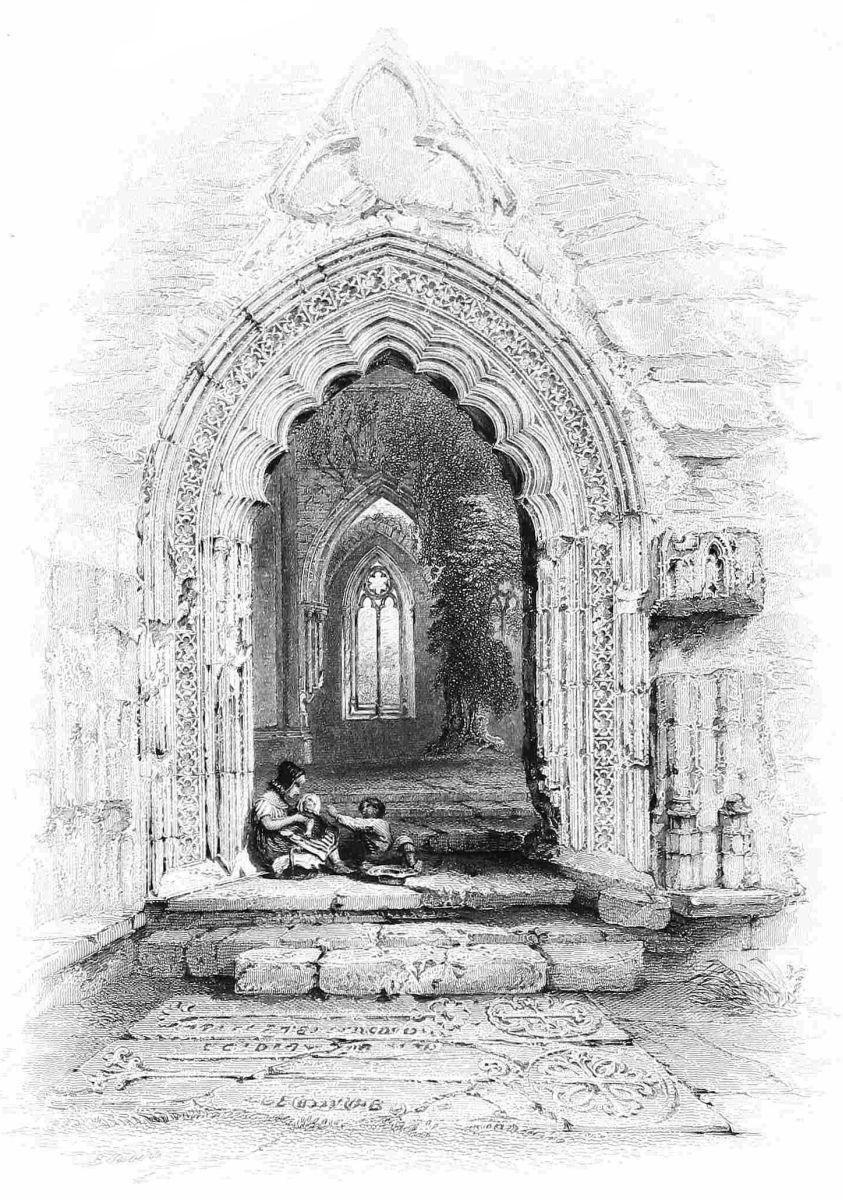
The Door into the Cloister.
Tinterne Abbey.
the capricious nature of the climate of Tinterne, where the transitions from a winter to a high summer temperature, and vice versa, are so frequent and remarkable.
Incidental Remarks.—During the plunder of this abbey church, which was long carried on with impunity, many interesting relics of antiquity appear to have been either mutilated, or carried off and sold. Among other fragments of ancient art, was a brass hand grasping a spear, taken from a tomb in the church in which was found a body entire, with leathern buskins, and buttons on the coat; but which, on exposure to the air, crumbled into dust. Human skeletons, we are told, were found in an orchard to the eastward, formerly the abbey cemetery. From the size of these—monks or soldiers—it was ascertained that their living owners must have been considerably beyond the common stature. On the legs of one of them were found cloth buskins in apparent preservation; while the metal studs, or buttons, it is added, were almost bright. No coffins were found; the bodies were simply deposited under large flat stones; and were probably of an order inferior to those interred within the church. Adjoining the north door, a portion of wall, long supposed to be the side of a cloister, was at last stripped of the ivy that covered it, and disclosed a range of fine Gothic windows.[177] And when the rubbish that encumbered the entrance leading into the cross aisle was removed, two stones were found inscribed with the following memorials:—
Hic jacet Johannes de Lynas. Hic jacet Henricus de Lancaut.[178]
At the entrance by the west doorway a flight of steps was also discovered, which at the time was supposed to communicate with a vault, or crypt, under the church. But the passage was not explored; and the stone with which the opening was originally covered, was restored to its place. It is the opinion of antiquaries, however, that there is no crypt, or vault, under the church. Of
Tinterne village, which still seems to derive its support from casual visitors to the abbey, much cannot be said in commendation. Little, if any improvement seems to have been made for many years, owing, we were told, to the restrictions laid upon building. With encouragement in this respect alone—or even with the ordinary accommodations of a spacious inn[179]—the place might speedily change its complexion, and become a cheerful and thriving hamlet. But, as in the days of Gilpin, it presents nothing inviting. The penury of the inhabitants may be less remarkable; “but they still occupy little huts raised among the ruins of the monastery, and seem as if a place, once devoted to indolence, could never again become the seat of industry.” “As we left the abbey,” says he, “we found the whole hamlet at the gate, either openly soliciting alms, or covertly, under pretence of carrying us to some part of the ruins which each could show, and which was far superior to anything which could be shown by any one else. The most lucrative occasion could hardly have excited more jealousy and contention.” In the present day, the duties of the abbey cicerone are performed by a sensible and well-informed guide, named Christian Payne.
Of the accommodations to be had at Tinterne Abbey in his day, Captain Barber has left the following reminiscence:—“Having despatched an attendant for a barber on my arrival at the inn, a blacksmith was forthwith introduced, who proved to be the only shaver in the place. The appearance of this man, exhibiting, with all the grim sootiness of his employment, his brawny arms bare to the shoulders, did not flatter me with hopes of a very mild operation; nor were they increased when he produced a razor that, for massiveness, might have served a Polyphemus. I sat down, however, and was plentifully besmeared with soap-suds. After this he attempted to supply the deficiency of an edge, by exerting his ponderous strength in three or four such vigorous scrapes as, without exciting my finer feelings, drew more tears into my eyes than might have sufficed for a modern tragedy. I waited no longer; but releasing myself from his iron gripe, determined to pass for a Jew Rabbi, rather than undergo the penance of another ‘shaving at Tinterne.’”
Plan of the Abbey.—The following simplified description may probably assist the reader to form a correct notion of the sacred and conventual buildings, of which the abbey was originally composed; and of the various compartments into which, in their former and perfect condition, these were so admirably arranged and subdivided:—
Entering the church by the west doorway, the visitor passes along the nave, with the “pillared aisles” on his right and left, and the newly-discovered pavement. In the distance, and directly opposite, under the great east window, is the high altar, as distinctly shown in the engraved illustration. Moving along the nave, he observes five distinct clustered pillars, surmounted by the magnificent arches, described in these pages. At the commencement of the north and south transepts, he will examine the bases of the four massive columns which formerly supported the great central tower; the doors and windows of the transepts; the sepulchral fragments scattered along the smooth grassy parterre of the choir; then, at the north-west corner of the north transept, he will ascend a few steps of a spiral staircase leading to the top of the church; and, from the gallery which runs round within the wall, look down on the scene before and beneath him. Descending to the transept floor, he will enter a door near the angle where the nave and north transept unite; and entering a passage northward, through a richly ornamented doorway, he will observe the following apartments, viz.:—
The Cloister on the left, forming a considerable quadrangle, the sides of which are of the same length as the nave of the church, on which it closely abuts, running parallel with it to the west doorway, and bordering the public road. Here, also, are some mutilated sepulchral effigies of ancient abbots, crosses, &c., from which the inlaid brasses have been sacrilegiously purloined. On the right hand of the visitor, as he enters, is the ancient
Vestry, or sacristy, an oblong chamber, divided into two compartments, the second of which opens by a doorway into the North Transept. Closely adjoining this on the north, is
The Chapter-house, of the same form and dimensions as the vestry, but not subdivided. Farther again on the right is a large hall, with the remains of five central pillars that supported the arched stone roof, supposed to be the ancient
Hospitium, or guest-chamber, already described in these pages. On the east of this, and running parallel with it, are the remains of offices or apartments—probably dormitories—the precise use of which has not been ascertained. Beyond, eastward, lay the Cemetery. Adjoining the Hospitium on the west, and connecting it with the Refectory, are several small buildings, with the remains of other dormitories on the upper floor. Immediately adjoining this, on the west, is the
Refectory, a spacious hall, in which the brethren, as already described, sat at table. The Lectern, or pulpit-desk, at which a reader presided during meals, is still visible about the middle of the west side. From the refectory, a tourniquet-door, for the passage of viands only, communicated with the kitchen; and close to this is the dole, where the indigent and wayfaring poor were daily supplied with victuals and refreshments. The kitchen runs parallel with the cloisters, and the west entrance of the church, along the public road leading to the ferry.
The Scale annexed to the Plan of the Abbey—as shown by the woodcut—will enable the reader to ascertain, with tolerable accuracy, the dimensions of all the compartments named.
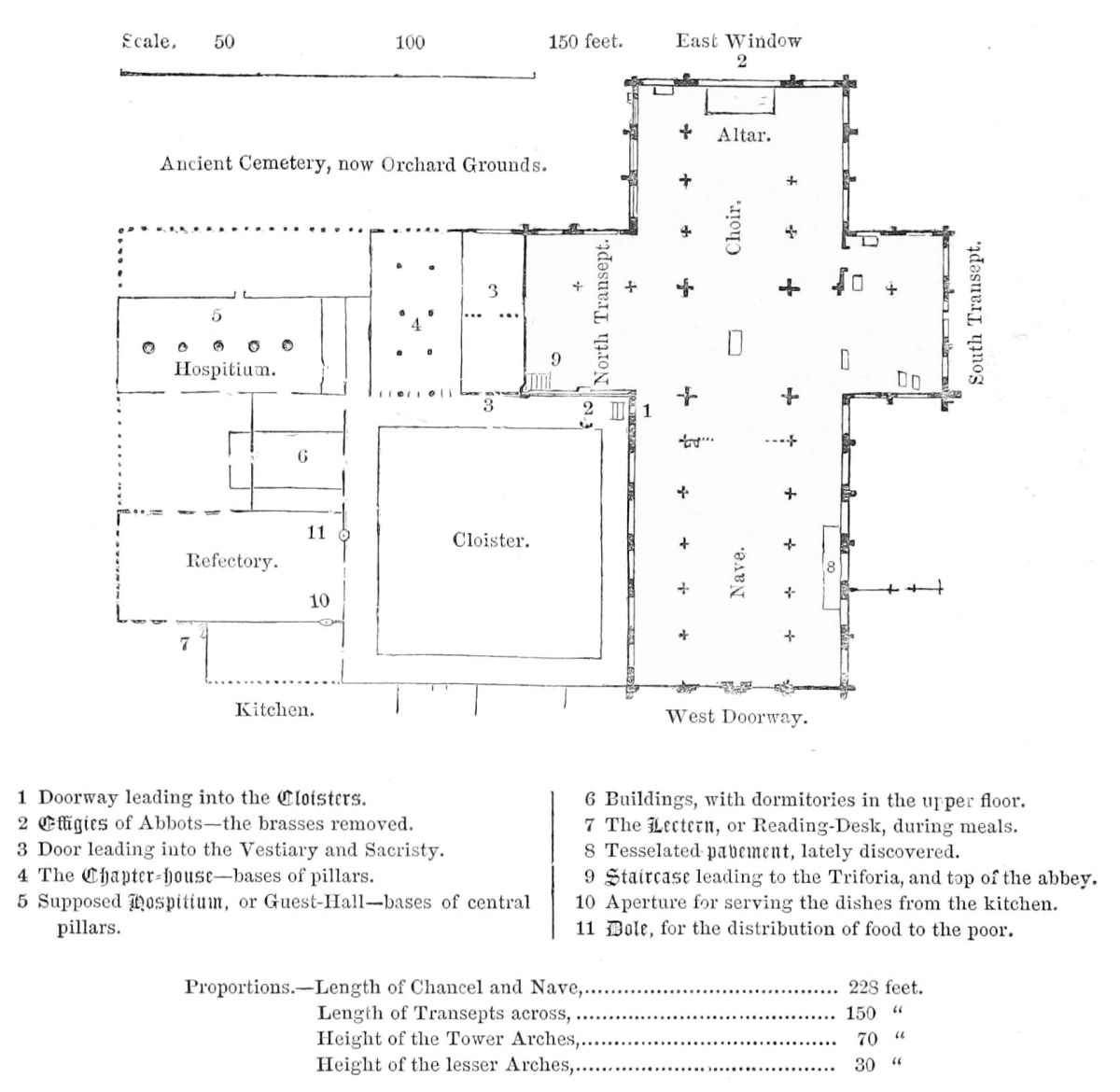
1 Doorway leading into the Cloisters.
2 Effigies of Abbots—the brasses removed.
3 Door leading into the Vestiary and Sacristy.
4 The Chapter-house—bases of pillars.
5 Supposed Hospitium, or Guest-Hall—bases of central pillars.
6 Buildings, with dormitories in the upper floor.
7 The Lectern, or Reading-Desk, during meals.
8 Tesselated pavement, lately discovered.
9 Staircase leading to the Triforia, and top of the abbey.
10 Aperture for serving the dishes from the kitchen.
11 Dole, for the distribution of food to the poor.
Proportions.—Length of Chancel and Nave, 228 feet.
Length of Transepts across, 150 “
Height of the Tower Arches, 70 “
Height of the lesser Arches, 30 “
As a specimen of the marvellous connected with these ruins, we cannot resist introducing another characteristic
Legend.—A party of gentlemen—horresco referens—who had inspected the abbey, employed several labourers to dig in the orchard adjoining, in hopes of discovering some antiquities. Part of one day and the following night were spent in this employment, when at last they were successful, and two human skeletons were discovered. Next day the same party resolved to celebrate their discovery by a dinner in the abbey. But scarcely had they commenced their sacrilegious repast, when a thick darkness overspread the horizon; deep thunder raised its tremendous voice, and shook the surrounding hills; lightnings flashed
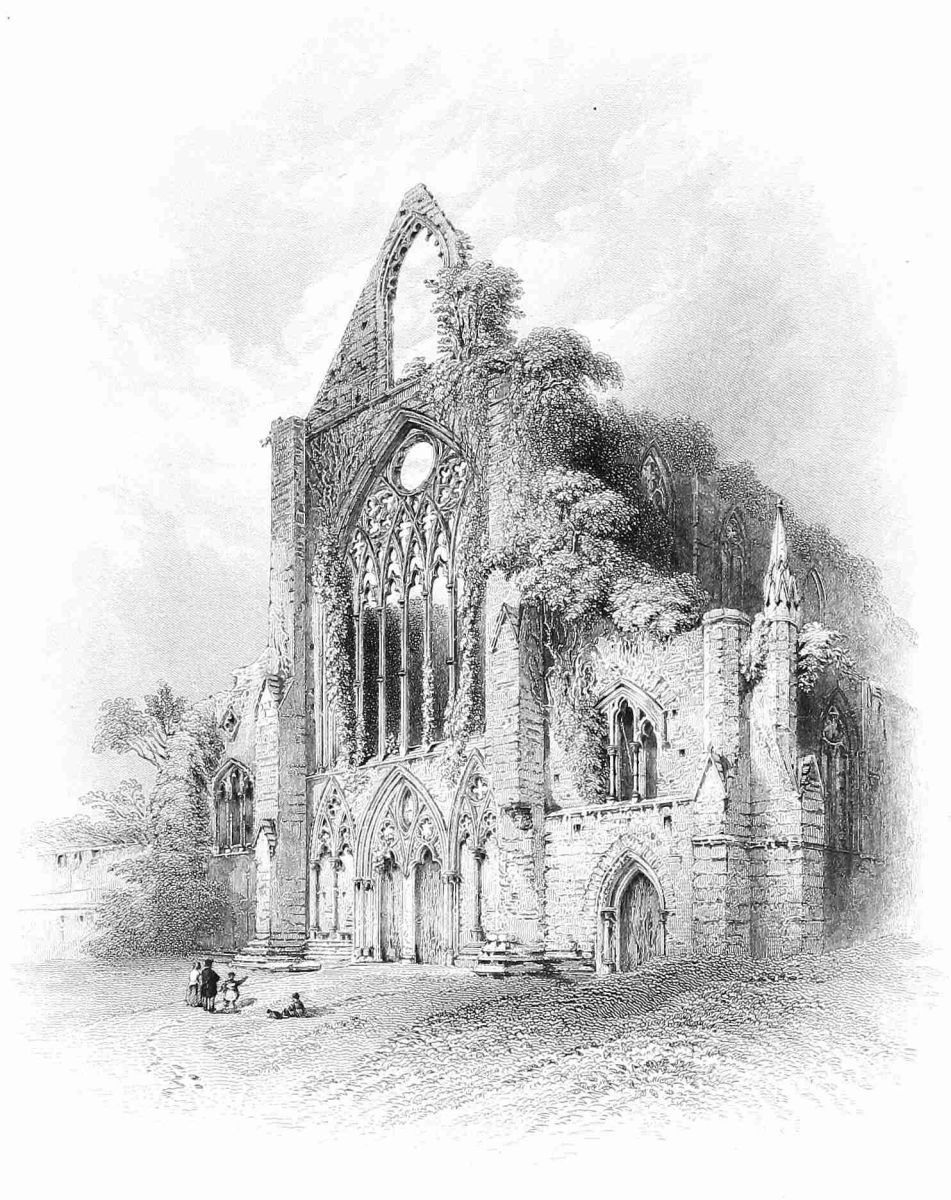
Tintern Abbey.
West Front.
throughout the ruin in sheets of livid flame; hail, succeeded by torrents of rain, deluged the plain, and
“Peal on peal Crashed horrible, convulsing earth and heaven!”
During this sudden and tremendous visitation, the indignant spirit of Strongbow—accompanied by the spectral forms of many whose death-sleep had been thus wantonly disturbed—arose from the grave, and fixed his eyes upon the petrified strangers. Then raising his gauntleted hand, he pointed to the abbey door—which at the sight had mysteriously opened—and sternly beckoned the impious visitors to depart! The awful signal was instantly obeyed; and some crawling, others trembling—all pale and speechless, the daring adventurers rushed from his presence, they knew not how, and fled they knew not whither; while the savoury viands left behind them were instantly swept over the abbey walls in a whirlwind.
The Engraved Views of Tinterne Abbey.
I.—The West Entrance,[180] a beautiful specimen of Decorated Gothic; the principal feature of which is the great west window, of which all visitors and writers on this subject have expressed their unqualified admiration. The stonework of this magnificent feature is nearly entire; the five mullions, tall, slender, and elaborately moulded, retain their original forms; and, terminating in the rich flowing tracery that fills and completes the arch, appear as if they wanted nothing but the ancient painted glass to restore the window to its primitive splendour. The ivy inserting itself into every joint, and hanging in graceful festoons, seems more like artificial garlands woven in honour of a fête day, than as the sure emblem and evidence of dilapidation and decay. Beneath this window is the richly-carved double doorway leading into the nave. On the right hand is another window communicating with the southern aisle, surmounted by a window of three compartments, and two buttresses terminating in pinnacles, of which only one remains. On the left hand is the north aisle, in form and dimensions exactly corresponding with the former, but much less perfect. Closely adjoining this were the abbey cloisters, the remains of which have been noticed in a former page.