LLANTHONY ABBEY, Monmouthshire. (continued 2)
Reading edition
Baldwin, the Bishop above named, was a native of Exeter, where he received, what was considered in those days, a liberal education; and in the early part of his life discharged the functions of a grammar-school in that city. After taking holy orders he was made Archdeacon of Exeter; but soon quitting the duties of that office, he took the habit of the Cistercian Order in the Monastery of Ford, in Devonshire, of which, in a few years afterwards, he was elected Abbot. He was next promoted to the episcopal dignity, and on the 10th of August, 1180, consecrated Bishop of Worcester. On the death of Richard, Archbishop of Canterbury, four years later, he was translated to that see—though not without difficulty, from his being the first of the Cistercian Order in England who had ever been promoted to the archiepiscopal dignity. He was enthroned at Canterbury, May the 19th, 1185, and the same day received the bull from Pope Lucius III., whose successor, Urban III., appointed him to the office of Legate for the diocese of Canterbury. Soon after his installation, he began to build a church and monastery at Hackington, near Canterbury, in honour of “St. Thomas à Becket,” for the reception of secular priests; but, being violently opposed by the monks of Canterbury supported by the Pope’s authority, he was compelled to abandon his undertaking.
On the third of September, 1190, he solemnly performed the ceremony of crowning King Richard the First—Cœur-de-Lion—in the palace of Westminster. The same year, the King having given the see of York to his natural brother, Geoffrey, Bishop of Lincoln, Baldwin took occasion to assert the pre-eminence of the see of Canterbury, forbidding the Bishops to receive consecration from any other than the Archbishop himself.
The next year, designing to follow King Richard into the Holy Land, he made the “Itinerarium” into Wales already alluded to; visited the Abbey of Llanthony, which he described in the words already quoted; said mass pontifically in all the cathedral churches, and persuaded many of the Welsh to quit their homes and take part in the crusade. After completing this progress, he returned to Canterbury; and then, embarking at Dover with the Bishop of Salisbury, sailed for the Holy Land, where he joined the King’s army in Syria. Shortly after his arrival, however, he was seized with a mortal distemper, and died at the siege of Acre, or Ptolemais, where he was buried with all the solemnity due to a great luminary of the church.[354]
Descent.—At the period of the dissolution of monasteries, Llanthony Abbey was given to Richard, or Nicholas Arnold; then sold to Auditor Harley, and remained in the Oxford family, until sold again to Colonel (afterwards Sir Mark) Wood, of Persefield, near Chepstow; from whom it passed to the present owner, Walter Savage Landor, Esq.
Arms of Llanthony Abbey: “Party per pale azure and purpure on chevron argent, between three oak-branches argent, three marigolds proper.”—Dugdale.
We now close the subject of Llanthony with the late Mr. Southey’s
INSCRIPTION FOR A MONUMENT IN THE VALE OF EWIAS.
Here was it, Stranger, that the Patron Saint Of Cambria passed his age of penitence, A solitary man; and here he made His Hermitage; the roots his food, his drink Of Honddy’s mountain stream. Perchance thy youth Has read with eager wonder, how the Knight Of Wales, in Ormandine’s enchanted bower, Slept the long sleep; and if that in thy veins Flows the pure blood of Britain, sure that blood Has flowed with quicker impulse at the tale Of Dafydd’s deeds, when through the press of war His gallant comrades followed his green crest To conquests! Stranger! Hatterill’s mountain heights, And this fair vale of Ewias, and the stream Of Honddy, to thine after-thoughts will rise More grateful—thus associate with the name Of Dafydd, and the deeds of other days.
Authorities quoted or referred to in the preceding article on Llanthony Abbey:—Dugdale’s Monasticon and Baronage, and their Commentaries—Tanner’s Notitia Monastica—Spelman’s Glossar. Archæologicum—Hist. of the Reformation—Histories of Monmouth, by Hoare, Coxe, and others—Giraldus Cambrensis—Howel’s Hystorie—Hallam’s Middle Ages—Camden’s Britannia—Speed—Hollinshed—Robert of Glo’ster—Roberts’ History of Llanthony Abbey—Thomas’ History of Owen Glendower—Collins—Notes by Correspondents, etc.
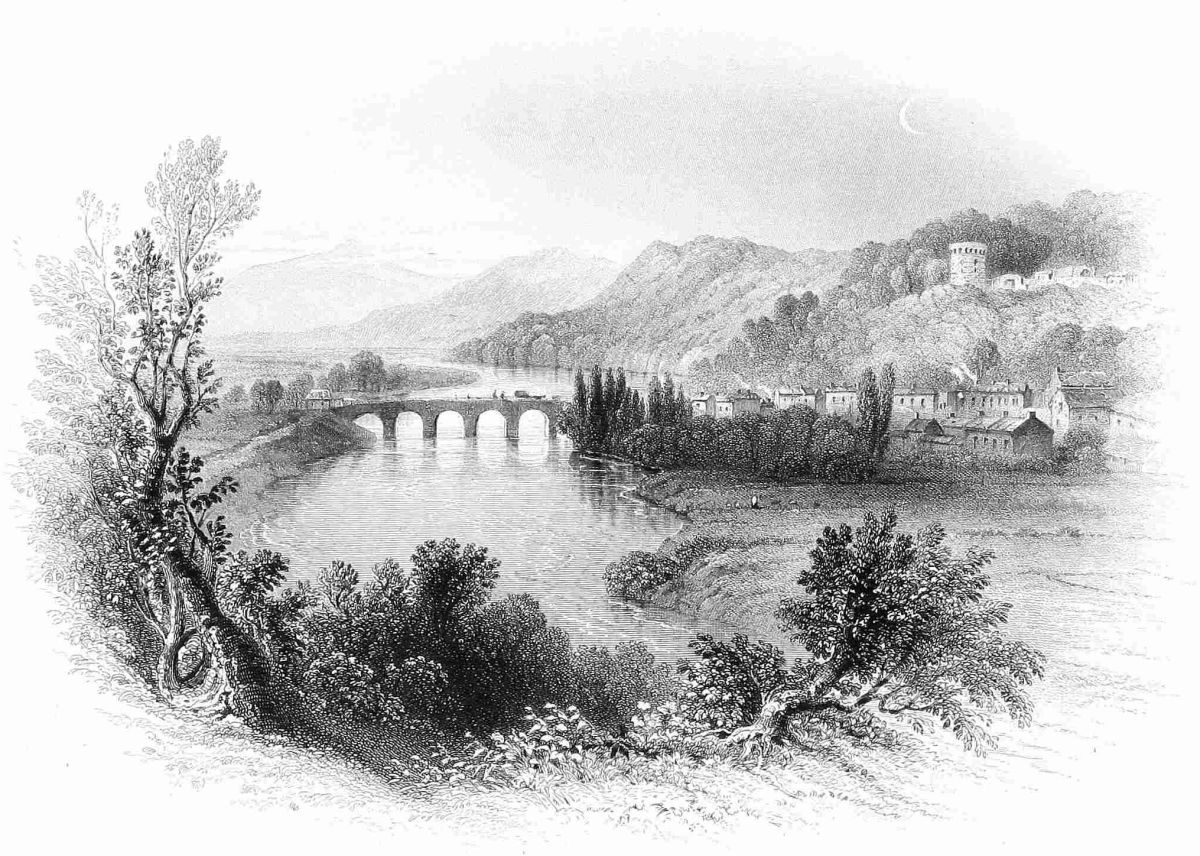
Usk Castle & Town.