KIDWELLY CASTLE, Carmarthenshire.
Reading edition
“For some brief passion Are centuries of high splendour laid in dust, And that eternal honour, which should live Sun-like above the rock of mortal fame, Changed to a mockery and a by-word.”
IDWELLY is supposed to have been erected by Rhys, Prince of South Wales, at the close of the twelfth century; and even now, after the lapse of five hundred years, it presents, in strength and appearance, one of the most striking examples of feudal architecture in Wales, where the science of castle-building attained the highest perfection. The old town of Kidwelly, over which the Castle once threw its protecting arms, is now ruinous; but a new Kidwelly, reared in happier times, and thriving under the arts of peace, seems to cast a glance of mingled pity and reproach upon the enormous fortress, whose very existence in such a situation is a melancholy proof of barbarism and bondage—

“When ‘might was right,’ and spear and brand Subdued and meted out the land— Demesnes, which he who built the strongest, And only he, retained the longest.”
History.—Describing the situation of Kidwelly, the Chronicle says, “So great is the bay or creek that here getteth within the land, that this country seemeth, as it were, for very fear to have shrunke back, and withdrawn itself more inwardly. The territory around this bay was held for a time by Keiani the Scot’s sonnes, until they were driven out by Cuneda, the Cambro-Briton, and is now counted part of the inheritance of the Dutchy of Lancaster, by the heires of Maurice of London, or De Londres, who, making an outroad hither out of Glamorganshire, after a dangerous war, made himself master hereof, and
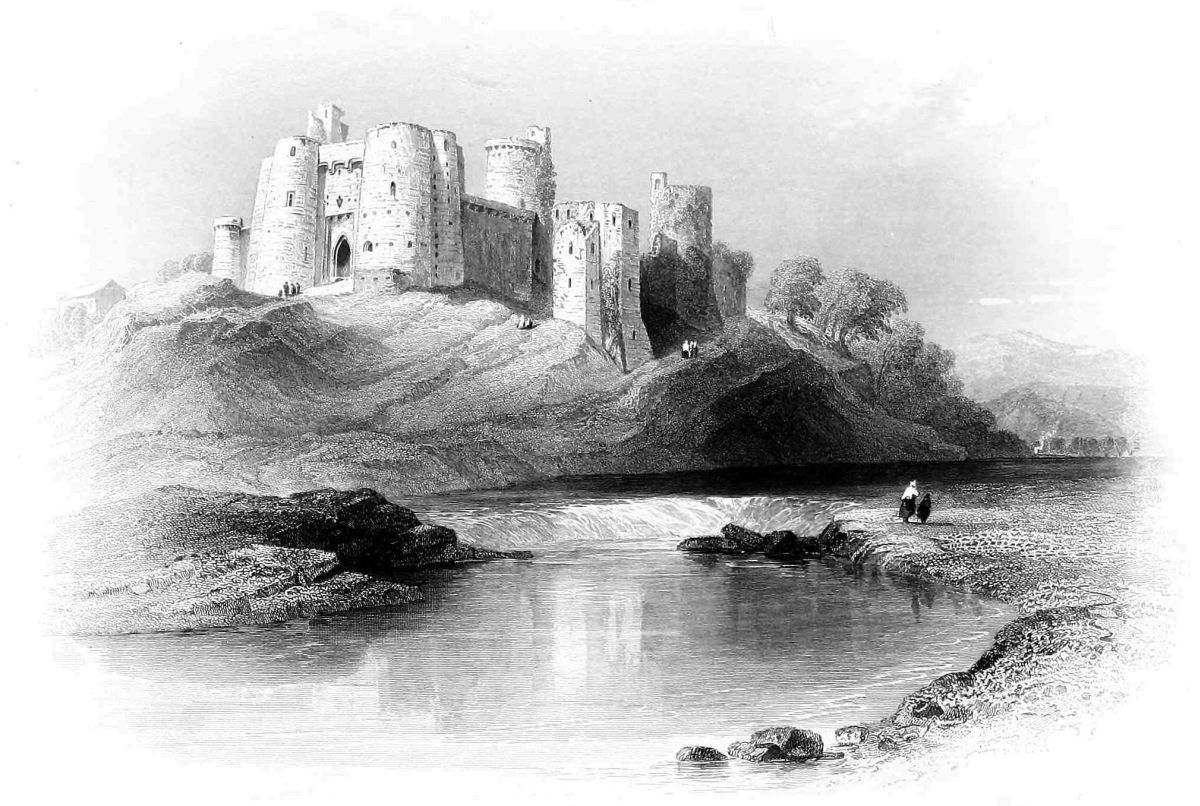
Kidwelly Castle.
fortified old Kidwelly with a wall and castle to it, which now for very age is growen to decay, and standeth, as it were, forlet and forlorne: for the inhabitants, having passed over the little river Vendraeth-Vehan, built a new Kidwelly, enticed thither by the commodity of the harbour, which, notwithstanding being at this day choked with shelves and barres, is at this present of no great use. While Maurice de Londres,” continues the Chronicle, “invaded these parts, [Gwenliana,[403]] the wife of Prince Gruffin—a stout and resolute woman in the highest degree—ultimæ audaciæ mulier—in order to recover the losses and declining fortunes of her husband, came, with displaied banner, into the field, and assailed him, but the successe of her enterprise not answering to her courage, she, with her sonne Morgan, and other men of especial note, was slaine in battle.
“By Hawes, or Avis, the daughter and heire of Sir Thomas de Londres, this passing faire and large patrimony, together with the title of Lord Ogmoor and Kidwelly, came unto Patrick Chaworth, and by his son Patrick’s daughter, unto Henrie, Earle of Lancaster. Now the heires of the said Maurice of London, as we learn from an old inquisition, for this inheritance were bound to this service—namely, that if their sovereign lord the King, or his Chiefe Justice, came into the parts about Kidwelly with an armie, they should conduct the foresaid army, with their banners and their people, through the mids of Nethland, as far as to Loghar.”
The Castle is in a more perfect state than any other ruin in the Principality: “meately well kept up,” says old Leland, “and veri faire and double waullid;” having been repaired by Alice de Londres, wife of one of the Dukes of Lancaster, and lastly in the reign of Henry the Seventh. Its appearance is literally grand and imposing. The ruins comprise a quadrangular area, enclosed by strong walls, defended by massive circular towers at the angles, and also by bastions in the intervals—as shown in the accompanying illustrations. The principal entrance, which is at the west side, is under a magnificent gateway, flanked by two round towers, and is still in good preservation. Many of the state apartments are almost entire. Of these the groined ceilings, in some instances, with other portions of the edifice, display many interesting features of the early style of English architecture. The chapel is sufficiently indicated in the engraving by its lancet-pointed windows, and forms a noble and characteristic feature of this truly majestic edifice.
Kidwelly is strongly situated, having on two sides a precipitous descent to the river Gwendraeth, and few things are finer than the first view of its massive and turreted bulwarks ranging along the summit of the cliff. The principal entrance was on the west, by means of a gateway, flanked by round towers, one of the most perfect and beautiful in the kingdom. This, however, is now closed, and the visitor, after clambering up the steep old street on the other side of the bridge, is conducted to an entrance in the rear of the building, communicating with a “pleasaunce,” or terrace promenade, now overgrown with noble trees. On entering the interior, the extent and massiveness of the remains create a feeling of astonishment. There were three courts divided by walls and towers; and in the centre is a building defended by four other towers, the grouping of which surpasses that of any other interior in Wales, unless, perhaps, that of Pembroke.
“We then clambered on the ramparts, entered the chapel, adorned with delicate lancet-pointed windows, and looked down from a dizzy height upon the river Gwendraeth, which rolls its melancholy stream through the marshy valley below. Altogether we were quite unprepared for the extent and preservation of this magnificent fortress, and regretted much that previous arrangements had left us so little time for its exploration.”[404]
The view from the ramparts is extensive: the valley of the Gwendraeth—the old town and its spire—the distant marshes and the sea—all blend together, and form a grand but melancholy picture, which harmonises with the feeling inspired by the aspect of the whole place and neighbourhood—
“How grand, and beautiful, and vast, Fortress and hall of ages past! With battlement and turret crown’d, And iron ramparts girdled round; Whose shadow, stretching o’er the land, Whose bulwarks, desolately grand, Whose chambers, voiceless and forsaken, A tide of mingled thoughts awaken, And dreams of fancy that restore The Barons and the Bards of yore, When trumpet-peal, from turret wall, Proclaimed the knightly festival.”—MS.
The air of the place is considered salubrious and the town healthy; but the importance which it formerly derived from its situation on the banks of a fine navigable river, within half a mile of its influx into the great bay of Carmarthen, has ceased—a reverse occasioned by an accumulation of sand, which has formed a dangerous bar across the mouth of the river. Its commerce, once flourishing, has consequently declined; while the opening of collieries, and the establishment of copper-works at Llanelly—to which port that of Kidwelly is a creek—have transferred the trade to that place.
“The scale has shifted—freighted barks no more Visit, with welcome sail, the lonely shore: Unprofitable weeds usurp the strand— The once wide port presents a mound of sand. But these stout towers, defying time and tide, Still o’er the scene in massive strength preside Kidwelly’s walls, firm as the native rock, Have braved, for centuries, the tempest-shock.”
Many fruitless attempts have been made to improve the navigation of the river, by removing the obstructions alluded to. In 1766, some docks and a short canal were constructed here. The navigation was afterwards transferred to the “Kidwelly Canal Company,” by whom it was extended about two miles up the valley of the Gwendraeth; and a branch, three miles and a half in length, was constructed to communicate with Pembrey harbour. Here were formerly both iron and tin works, the former of which have been entirely abandoned, and the latter are continued only in a diminished scale.
Kidwelly received its first charter of incorporation from King Henry VI. James II., in the sixteenth year of his reign, granted to its inhabitants their present charter, by which the government is vested in a mayor, a recorder, two bailiffs, and a common council of twelve aldermen, and twelve principal burgesses, assisted by a town-clerk, chamberlain, two sergeants-at-mace, and other officers.
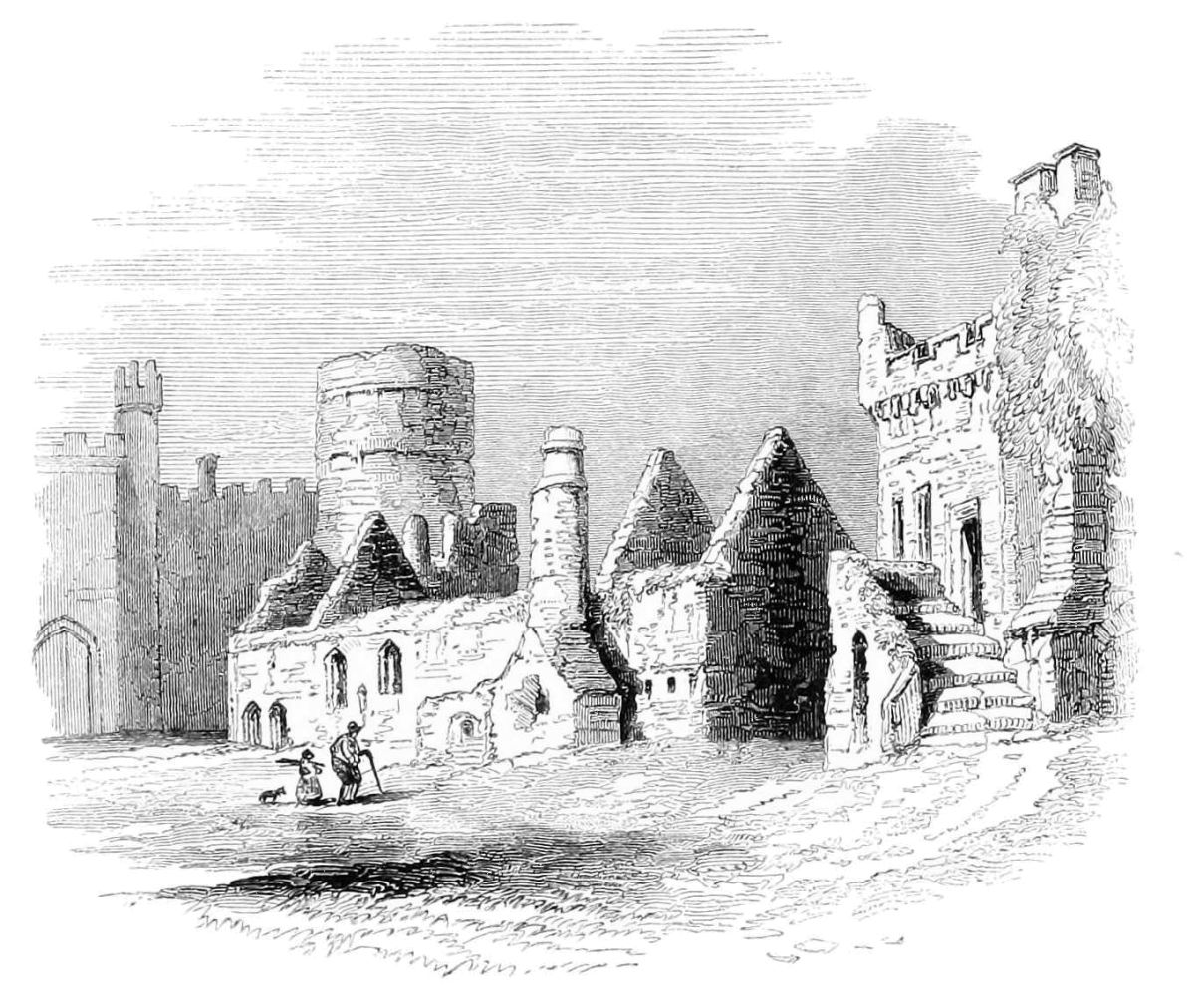
Ancient dwellings near Manorbeer Castle.—See Note, p. 327.