LLANTHONY ABBEY, Monmouthshire.
Reading edition
“’Mongst Hatteril’s lofty hills, that with the clouds are crowned, The valley Ewias lies immured so steep and round, As they believe that see the mountains rise so high, Might think the straggling herds were grazing in the sky; Which in it such a shape of solitude doth bear, As Nature at the first appointed it for prayer; Where in an aged cell, with moss and ivy grown, In which not to this day the sun hath ever shone; That reverend British Saint, in zealous ages past, In contemplation lived, and did so truly fast, As he did only drink what crystal Hodney yields, And fed upon the leeks he gathered in the fields. In memory of whom, in the revolving year, The Welshmen on his day that sacred herb do wear!”—Drayton.
AINT DAVID, uncle of the renowned King Arthur, and titular Saint of Wales, was the first who introduced the rites of Christian worship into these mountain solitudes. Selecting for his hermitage a spot which had all the characteristics of a rude and unfrequented wilderness, he built a chapel on the banks of the Honddy—the stream by which it was watered—and there spent many years of his life in the exercise of an austere devotion. The reputation of his sanctity having spread over the surrounding country brought many pilgrims to his cell; and when at length he was added to the list of canonized saints, it was still resorted to as a place long consecrated by the practice of a holy life.

In the reign of William Rufus—as attested by the Abbey records—the hallowed retreat was thus discovered. Hugh de Laci, a great Norman baron, having on a hunting excursion followed the deer into this secluded valley, sat down at the conclusion of the chase to refresh himself and his attendants. The wildness and beauty of the scenery around them appeared to have affected their minds with unwonted impressions; and the accidental visit was thus prolonged for the sake of the rude but romantic valley which the morning’s adventure had so unexpectedly thrown open.
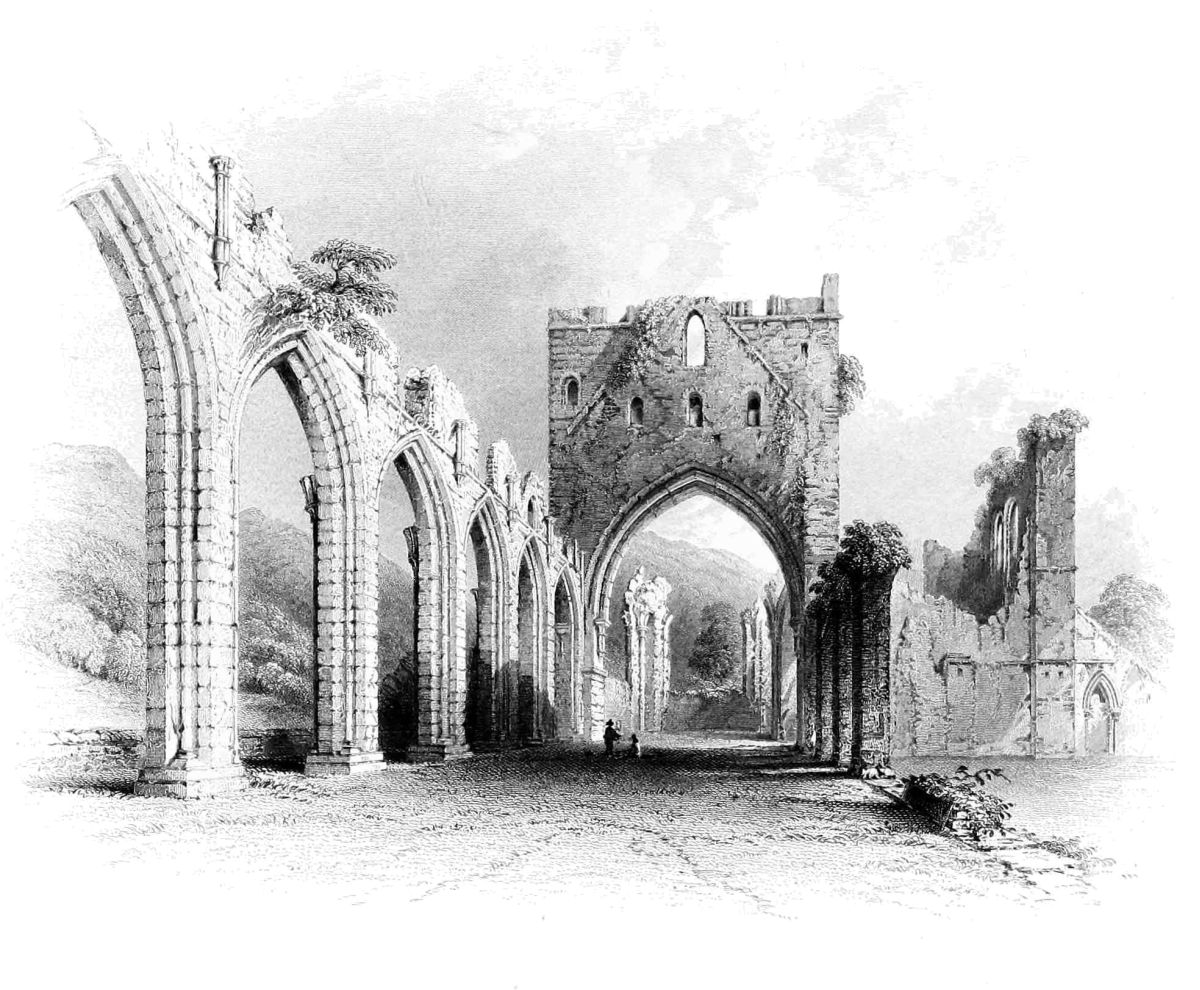
The Nave.
Llanthony Abbey.
William, one of the Baron’s retainers, feeling oppressed by the heat of the weather, and fatigued by the roughness of the mountain tract through which they had passed, gladly threw himself down on the soft grass to seek a few minutes’ repose. But the novelty and grandeur of the scene awakening his curiosity, he was tempted to make a hasty survey of the spot; and turning towards the river, that here and there filled the solitude with its murmurs, he caught a glimpse of the little chapel with which St. David had hallowed the scene. Suddenly inspired with religious enthusiasm, he felt an irresistible inclination to linger near the spot; and at last, dismissing his attendants, he took up his new abode in the desert; and, like his devout predecessor, consecrated his life to the service of God, or rather to the contemplation of divine things. He laid aside his belt—says the recording monk of Llanthony—and girded himself with a rope. Instead of fine linen, he made unto himself a vestment of haircloth; and instead of a soldier’s cloak, he loaded himself with heavy iron. The suit of armour which, in his warrior life, had defended him from the weapons of the enemy, he now wore as a garment highly suitable for hardening him against the temptations of his old enemy, Satan. So that the outer man being thus mortified by austerity, the inner man might become day by day better disposed and purified for the service of God. And in order that his zeal might not cool, adds the pious historian, he thus sacrificed himself, and continued to wear his hard armour, until the iron and steel were absolutely worn out with rust and age.
In this manner the devout ascetic spent his years, which otherwise might have been devoted, like those of his kinsmen, to acts of plunder and bloodshed; and it only leaves room for regret that his example was not more generally followed by his companions, whose armour, unfortunately for mankind, was never suffered to “rust;” and who often, at that period, transformed the beautiful Welsh frontier into a wide battle-field. The austerity of his life, witnessed by the rust on his armour, established his reputation for sanctity; and the cell that harboured a pious philosopher, was soon regarded as a shrine where he maintained constant intercourse with those angels and blessed spirits, whose office was to watch over the saints of that early day.
His fame becoming general among the religious fraternities, Father Ernesi, confessor to Queen Maude, was induced to make a pilgrimage to the Honddy; and there, entering into a holy alliance with the steel-clad hermit, he set immediately to work, and with most laudable industry erected a chapel on the spot, which was consecrated by Urban, Bishop of the Diocese, and Rammeline, Bishop of Hereford, and dedicated to the honour of St. John the Baptist, whose solitary life in the wilderness they affected to imitate.
Soon after this event, in the early history of Llanthony, Hugh de Laci, Earl of Hereford, listening to the ghostly exhortation of Ernesi, to evince his faith by good works, founded a Priory of Canons-Regular of the Order of St. Augustine, and placed it with all solemnity, as in the former instance, under the patronage of the blessed St. John. Of this new establishment, Father Ernesi, as he had a good right to expect, was elected Prior. This was the commencement of a new and important era for the fame of Llanthony, which, under the united management of the twain brothers—both in the odour of sanctity—acquired daily reputation, and drew to its sacred precincts some of the greatest men of the realm. The temporal affairs of the rising Abbey attained unwonted prosperity by the personal countenance and support of King Henry and his Queen, who were but too happy to exchange a portion of their superfluous wealth for an interest in the prayers of that holy brotherhood, who had elevated the banks of the Honddy to a near relationship with Heaven, and held in their hands—as it was currently believed—the “title-deeds of rich and extensive settlements in Paradise. And as the latter were assigned, without partiality, to the highest bidder,” the proceeds for masses alone—we speak not ironically but historically—increased the annual revenues to an amount that, in those times, was justly considered a fair proof of monastic prosperity. On the other hand, it is piously averred, that such was the disinterestedness and unworldly-mindedness of the brotherhood, that they despised everything that bore not the stamp of spiritual riches—that they declined all offers of lands, goods, and chattels, that were liberally tendered to their house.[317] In that case it seems probable that the Abbey of Llanthony was not erected in the ordinary way; that is, by dint of money, but by the force of miracles; and, like a certain city of old, was conjured into its fair and lofty proportions by the powers of Harmony. But after duly weighing the question, the evidence in favour of money seems conclusive; and indeed certain scripta are now extant to show that the brotherhood of Llanthony were not less sensible of the value of money—as a spiritual means—than any of their illustrious fraternity. But it may be said, with much truth, that the uses to which their money was applied, produced those “miracles” of Art, which it is the object of this work to illustrate.
[It is always to be kept in view, that these holy men, in professing poverty, were, literally, personally poor. The riches, of which they were merely the guardians—but which are so often charged against them as proofs of their avarice—were expended on the house of God; in other words, in fostering the arts, in relieving the poor, in practical hospitality, and in cultivating a niggardly soil. Personally, they were poor trustees upon a vast property, which they were bound to employ for the glory of God and the good of mankind; and if, in some cases that may be named, the funds thus contributed by the pious were perverted to less laudable purposes, the fact that, in general, they were applied to the excellent uses contemplated by the testators, is not to be controverted. The churches, hospitals, almshouses, cells, and priories, which were thus founded, built, and endowed from these sources, are proofs of the fidelity, good sense, and Christian philanthropy, with which the church property was then administered.]
Once upon a time, as the Monkish historian has told us, the Queen of King Henry, who desired to bestow a boon on William, of whose entire disinterestedness she was not apprised, desired permission to put her hand into his bosom;[318] and when, with great modesty, the holy man submitted to her importunity, she conveyed a large purse of gold between his coarse chemise and iron boddice; and thus, by a pleasant and innocent subtilty, administered, as she imagined, the means of comfort. But, oh, his wonderful contempt of the world! He displayed a rare example that the truest happiness is found to consist in possessing little or nothing of the good things of this life. He accepted, indeed, the Queen’s gift; but it was only that it might be expended, not in any worldly or selfish gratification, but in beautifying the house of God.
But having by this act overcome the scrupulous delicacy with which he had hitherto resisted the temptation of riches, they now flowed in from every quarter, until that noble edifice was completed, the mouldering Nave of which is represented in the engraving opposite.[319]
Of the situation of the Abbey, a very picturesque and glowing description, in good Latin, is given by the old historian, who paints the wild scenery, in which the first hermits took up their abode, with the pencil of a Salvator.[320] The following translation, though from a modern pen, is also a picturesque and not inaccurate sketch of the scene, which retains all the natural features ascribed to it by the first writer; but with one engrossing feature superadded—that of a stately abbey in the last stage of desolation—its towers and arches bearing witness to the arts employed in its construction, and the sacred objects of its foundation. In the following passage, Giraldus alludes to the Itinerary of Archbishop Baldwin[321] in 1188.
“In the deep Vale of Ewyas,” he writes, “which is about an arrow-shot in breadth, encircled on all sides by lofty mountains, stands the church of St. John the Baptist, covered with lead, and an arched roof of stone; and considering the nature of the place, not unhandsomely constructed on the very spot where the humble chapel of St. David had formerly stood, decorated only with moss and clay, a situation truly calculated for religious retirement, and better adapted for canonical discipline than all the monasteries of the British isle. It was founded, as already observed, by two hermits, in honour of religious seclusion, far removed from the bustle of life, and planted in a solitary vale watered by the river Hodeni—from which it was called Lanhodeni; for lan signifies an ecclesiastical place.[322]
“Owing to its mountainous situation, the rains are frequent, the winds boisterous, and the clouds in winter almost continual. The air of the place, though heavy, is found to be salubrious; and diseases are so rare, that the brotherhood, when worn out with long toil and affliction with the daughter—that is, New Llanthony on the Severn—no sooner return to this asylum, and their mother’s lap in the Vale of Ewyas, than they regain their wonted strength and vigour. For, as my topographical history of Ireland testifies, in proportion as we proceed to the eastward, the face of the sky is more pure and subtile, and the air more piercing and inclement; and as we draw nearer to the westward, the air becomes more cloudy, but, at the same time, is more temperate and healthy.
“Here, while sitting in their cloister, and enjoying the fresh air, the monks, when they happen to look up towards the horizon, behold the tops of the mountains, as it were, touching the heavens, and herds of wild deer feeding on their summits. The body of the sun does not become visible above the heights of the mountains, even in serene weather, until about the first hour, or a little more. Truly this is a spot well adapted for contemplation—a happy and delightful spot—fully competent, from its first establishment, to supply all its own wants, had not the extravagance of English luxury, the pride of a sumptuous table, the increasing growth of intemperance and ingratitude, added to the negligence of its patrons and prelates, reduced it from freedom to sterility; and if the step-daughter [Lanthonia Secunda], no less enviously than odiously, had not supplanted her mother.
It seems worthy of remark, that all the priors who were hostile to the old monastery died ‘by Divine visitation.’ William, who first despoiled the place of its herds and storehouses, being deposed by the fraternity, forfeited his right of sepulture among the priors. Clement seemed to like this place of study and prayer; yet, after the example of Heli [Eli], the priest, as he neither reproved nor restrained his brethren from plunder, and other offences, he died by a paralytic stroke. And Roger, who was more an enemy to this place than either of his predecessors, and openly carried away everything which they had left behind—robbing the church of its books, ornaments, and privileges—was also struck with a paralytic affection long before his death, resigned his honours, and lingered out the remainder of his days in sickness and solitude.
In the reign of King Henry the First, when the Mother-Church was as much celebrated for her affluence as for her sanctity[323]—two qualities which are seldom found thus united—the fame of so much religion attracted hither Roger, Bishop of Salisbury, who was at that time Prime Minister; for it is virtue to love virtue, even in another man; and a great proof of innate goodness it is to show a detestation of those vices which hitherto have not been avoided.
When he had reflected with admiration on the nature of the place, the solitary life[324] of the fraternity, living in canonical obedience, and serving God without a murmur or complaint, he returned to the King, and related to him what he thought most worthy of remark; and after spending the greater part of the day in the praises of this place, he finished his panegyric with these words—“Why should I say more? The whole treasure of the King and his kingdom would not be sufficient to build such a cloister.”
Having held the minds of the King and the Court for a long time in suspense by this assertion, he at length explained the enigma, by saying, that he alluded to the “cloister of mountains,” by which this church is on every side environed. But
William—the warrior who first discovered this place—and his companion Ernisius, a priest, having heard, perhaps—as it is written in the Fathers, according to the opinion of Jerome—“that the church of Christ decreased in virtues as it increased in riches”—were often used devoutly to solicit the Lord, that this place might never obtain great possessions. They were exceedingly concerned when this religious foundation began to be enriched by its first lord and patron, Hugh de Lacy, and by the lands and ecclesiastical benefices conferred upon it by the bounty of others of the faithful. From their predilection to poverty, they rejected a great many offers of manors and churches; and being situated in a wild spot, they would not suffer the thick and wooded parts of the valley to be cultivated and levelled, lest they should be tempted to recede from their eremitical mode of life.
But whilst the Mother-Church increased daily in riches and endowments, a rival Daughter—as we shall see—availing herself of the hostile state of the country, sprang up at Gloucester, under the protection of Milo, Earl of Hereford; as if, by Divine Providence, and through the merits of the saints, and prayers of those holy men (of whom two lie buried before the high altar), it were destined that the Daughter-Church should be founded in superfluities, whilst the Mother continued in that laudable state of mediocrity, which she had always affected and coveted.
“Wherefore let the active reside there, the contemplative here; there the pursuit of terrestrial wishes, and here the love of celestial delights; there let them enjoy the concourse of men, here the presence of angels; there let the powerful of this world be entertained, here let the poor of Christ be relieved; there, I say, let human actions and pompous declamations be heard, but here let reading and prayers be heard only in whispers; there let opulence, the parent and nurse of vice, increase with cares; here let the virtuous and golden mean be all-sufficient.
“In both places, the canonical discipline instituted by St. Augustine, which is now distinguished above all other orders, is observed; for the Benedictines, when their wealth was increased by the fervour of charity, and multiplied by the bounty of the faithful, under the pretext of a bad dispensation, corrupted, by gluttony and indulgence, our Order—that is, the Augustinian—which, in its original state of poverty, was held in high estimation. The Cistercian order, derived from the former, at first deserved praise and commendation, from its adhering voluntarily to the original vows of poverty and sanctity, until ambition, the blind mother of mischief, unable to fix bounds to prosperity, was introduced; for as Seneca[325] says, ‘Too great happiness makes men greedy, nor are their desires ever so temperate as to terminate in what is acquired.’”
Here the author, as if to contrast them with those of Llanthony Prima, indulges in a learned and eloquent apostrophe against the luxury and pride of several orders of monks. He concludes it with this anecdote: “I have judged it proper to insert in this place an instance of an answer which King Richard—Cœur de Lion—made to Fulke, a good and holy man, by whom God, in these our days, has wrought many signs in the kingdom of France. This man had, among other things, said to the king, “You have three daughters, namely, Pride, Luxury, and Avarice, and as long as they shall remain with you, you can never expect to be in favour with God.” To which the king, after a short pause, replied, “I have already given away those daughters in marriage—Pride to the Templars, Luxury to the Black Monks, and Avarice to the White.”[326]
“It is a remarkable circumstance,” he continues, “or rather a miracle, concerning Llanthony, that although it is on every side surrounded by lofty mountains, not stony or rocky, but of a soft nature, and covered with grass, yet Parian stones are frequently found there, and are called Freestones, from the facility with which they admit of being cut and polished; and with these the church is beautifully built. It is also wonderful, that when, after a diligent search, all the stones have been removed from the mountains, and no more can be found; yet, upon another search, a few days afterwards, they reappear in greater quantities to those who seek them.”
After some farther remarks on the manners of the monastic orders, the venerable author thus beautifully concludes:—“In these temperate regions I have obtained, according to the usual expression, a place of dignity, but no great omen of future pomp or riches; and possessing a small residence near the castle of Brecheinoc [Brecknock?], well adapted to literary pursuits, and to the contemplation of eternity,[327] I envy not the riches of Crœsus; happy and contented with that mediocrity, which I prize far beyond all the perishable and transitory things of this world.”
So far the monk of Llanthony—whose partiality is very excusable; but, unfortunately, the act or charter of Edward IV., uniting the two abbeys, gives a different colouring to the transactions between the two abbeys—mother and daughter. It recites that, owing to the depredations committed on the convent by the neighbouring inhabitants, and the frequent removal of the priors and other members of the convent, the religious functions were negligently performed, and acts of charity and hospitality to strangers no longer exercised: Also, that as John Adams, the prior, had profusely squandered away the revenues of the church, maintaining only four canons besides himself, who paid no attention to the holy duties of the establishment: And whereas all due regard and reverence were paid to the sacred offices of the church by the members of the monastery of new Llanthony near Gloucester, the king hereby grants all the lands—both in England, Wales, and Ireland—now appertaining to the convent of Llanthony in Wales, to the prior of the convent of Llanthony near Gloucester, to have and to hold for ever, on the payment of the fine of three hundred marks, and on condition that he maintains an establishment—dative and removable at will—of a prior and four canons, as the mother-church, for the purpose of performing religious service and mass for the souls of its founders. “Thus,” continues our author,[328] “in the short period of thirty years, we see the simple chapel of St. David transmuted into a spacious and elegant abbey; that same building nearly deserted, and another, still more magnificent, erected and translated from the solitary banks of the little river Hodni, to the rich and luxurious shores of the Severn.”
Milo, Founder of Llanthony Secunda.—Under this head, it is recorded in the Abbey Chronicle, that in the reign of King Henry, son of the Conqueror, there flourished a certain warrior of noble family named Gwalterus, or Walter, who was Constable, under the King, of the Castles of Gloucester and Hereford. The said Walter caused to be erected on his own demesne the Castle of Gloucester, and dying some time thereafter, his remains were conveyed to Llanthony Abbey, in Wales, and there buried. The aforesaid Walter left an only son, Milo by name, whom King Henry created Earl of Hereford; and moreover, by way of augmentation to the said earldom, made over to him and his heirs for ever a grant of the whole Forest of Dean.
This Milo, first earl of the name, took to wife Sibylla, heiress of Brecknock, and daughter of Bernard and Agnes of New March.[329]—The offspring of this marriage were five sons and three daughters, namely, Roger, Henry, Walter, Matthew, and William, Margery, Bertha, and Lucy. He founded the Abbey or Priory of New Llanthony, near Gloucester, on the 25th of May, 1136, being the first of King Stephen’s reign; and dying on Christmas-eve, 1143, was buried in the chancel of the Abbey which he had founded seven years before. After his demise, he was succeeded in his titles and estates by each of his five sons, one after the other; but all of whom died without legitimate issue. Hereupon his possessions were shared in equal proportions by his three surviving daughters.[330] Lucy, his third daughter, was married to Herbert Fitz-Herbert, and had for her share and dowry the Forest of Dean, and other estates in England.[331] The offspring of this marriage was a son named Peter, who became the father of a long line of descendants.
Bertha, second daughter of Count Milo, married William de Brewes, and took for dowry the lordship of Brecknock. The offspring from this marriage were three sons, William, Egidius, and Reginald. William, their eldest son and heir, in the time of King John, having made war upon his enemy Guenhunewyn, subdued him, and slew no less than three thousand Welsh in one day at Elvel. This battle took place on the morrow of St. Lawrence the Martyr, in the year of our Lord 1498. But for this rebellious act he was disinherited by King John; and, without trial, condemned to quit the realm of England. He died in exile; while his unhappy wife and their only son, being thrown into prison by the same heartless and arbitrary power, died shortly after in captivity.
Egidius, the second son, became Bishop of Hereford; and Reginald de Brewes, the third son, after the death of King John, and that of his two brothers the afore-named William and Egidius, was pronounced heir to all the possessions which had been forfeited by his brother William, and took possession of the same accordingly. He married a daughter of William de la Bruere, and had by his wife a son whom he named William de Brewes, quartus. The latter espoused the lady Eve, daughter of the renowned William, Earl Marshall, so frequently mentioned in these pages.[332] By this union he had issue four daughters—Isabella, Matilda, Eve, and Alionora. Of these, Isabella was married to David, son of Llewellyn, Prince of Wales.
But at a great festival where he presided, immediately after the Paschal Feast, in 1229, Llewellyn conceiving a bitter jealousy between his wife and the said William de Brewes, most treacherously caused the latter to be ignominiously hanged—an atrocity which threw the whole Welsh frontier into the greatest confusion and alarm; for at that time King Henry was still in France with a large army; and in his absence the country was but ill provided with the means of enforcing the law.
Matilda, the second daughter, married Roger Mortimer, Lord Wigmore, from whom sprang a numerous progeny. Eve, the third daughter, married William de Cartello. Alionora, the fourth and youngest, married Humphrey de Bohun, with the lordship of Brecknock, which for some time had belonged to the Counts or Earls of Hereford. Among the names here mentioned, those of Bertha and Lucy, daughters of Milo, are to be held in special reverence as eminent patrons and benefactors of New Llanthony.
And here, for the present, we take leave of the genealogical table, which exhibits in many striking examples the instability of fortune, the frailty of human nature, the vanity of riches, and the uncertain tenure of life.
HARTERS.—The following is an extract from the charter of King John, in the first year of his reign, wherein all grants previously made in favour of Llanthony are recited and confirmed:—

“Know all men by these presents, that I, John, King of England, have, out of love to God, confirmed in perpetual offering to God, to the Blessed Virgin, St. John the Baptist, and the Canons-Regular of Lantonay, the donations or grants hereunder described, which have been reasonably and lawfully conceded to them, viz.: By deed of gift from our father the late King Henry, the chapel near the Castle of Gloucester, the school in the same town, a moiety of the fishery of Horsepol, which is in our domain, with iiij lib. of land in the manor of Bernington, as alms in perpetuity.”—So much for the new Abbey near Gloucester.
He then recites and confirms the benefactions of Hugh and Walter de Laci, consisting of lands, woods, fisheries, villages, houses, and whatever property in those times was essential to the prosperity of a great religious establishment. It is a long deed; and, besides those already noticed, introduces a full list of benefactors, whose names and families—though of great note and influence at that day—have long vanished from the political horizon, and are seldom found but in ancient title-deeds, or charters like the present, in which their good works are faithfully and minutely registered.
It is to be observed, however, that after the establishment of New Llanthony on the Severn, the benefactions to the Mother-Abbey are few and insignificant. The former, under the patronage of the Milo family, became suddenly rich, and able to introduce those embellishments of art, and that luxurious mode of life, which opened a wide channel for the diffusion of its revenues; but while it increased its splendour, insured its ultimate poverty.
By a Deed given by Edward the Second, in the eighteenth year of his reign, the property conveyed to Llanthony by Walter de Laci and others, is again revised and confirmed. He grants also permission to elect from their own body, or from any other, as they may see meet, a fit person to preside over the Church and Priory of Llanthony, whenever a vacancy occurs, concluding—“Et ut hæc libertas eligendi eis in perpetuum perseveret illibata, huic scripto Sigillum meum est appositum.”
The Deed given by Walter and Hugh de Laci to the Canons of Llanthony is then recited; and by this document a vast amount of property, privileges, arable lands, pastures, fisheries, hunting-grounds, and various other benefactions, are described as finally made over to the Prior and Brotherhood, out of pure love for the glory of God, the welfare of their own souls, the souls of their predecessors, successors, and kinsfolk.
In this munificent grant is comprised the whole valley—‘totam vallem’—of the Ewyas, with all its appurtenances, in which the church is situated; describing, at the same time, its boundaries:—“Et concedo quod habeant omnimodam venationem et dominationem infra metus terræ suæ.” All this is followed by other unquestionable privileges, such as united with the spiritual an amount of despotic power, which invested the Prior and Canons of Llanthony with an authority in things temporal, no way inferior to that exercised by a feudal Baron in his own castle, and over his own vassals.[333]
But in spite of its revenues, and the ‘personal example and influence of a few—but only a few—distinguished members and benefactors of this monastery, it fell gradually into disrepute and decay.’ The principal cause has been generally ascribed to the rival Abbey at Gloucester, by which benefactors were alienated, and good works averted from that on the Honddy. But there were other causes at work—the evil lives of the Priors themselves; their indolence, luxury, and licentiousness; their dissipating the funds, and perverting their use to unsanctified purposes; which did more to degrade monastic habits, and pull down the sacred edifice, than could have been accomplished by their most inveterate enemies. And enemies they certainly had—both formidable and frequent; for they were exposed, by their insulated position and supposed wealth, to irruptions from those bands of marauders, to whom plunder and forced contribution from holy men were more like a pastime than military enterprise. But of this hereafter.
E are now to give some account of the decline and final dissolution of Llanthony, brought about by causes which are thus recorded by the Latin historian:—Whereas certain priories and religious houses, but more especially the aforesaid Priory of St. John the Baptist of Lanthony Prima in Wales, as well by frequent removals and expulsions of the Priors and occupiers of the places aforesaid, as by divers secular persons and others, tenants of these possessions, were so profligately squandered, dilapidated, and mismanaged, both in regard to their houses, substance, and affairs, that divine service and the regular observance of religious duties have become less frequent than ever; that the means of hospitality, almsgiving, and, above all, the works of piety and charity, which had been there established of old, and customarily done and observed in the place, are now withdrawn and perverted from the original design: And whereas John Adams, Prior of Lanthony, as we are plainly informed, hath wasted and destroyed, and continues to waste and destroy, the fruits, revenues, products, and emoluments of the said Priory; and hath found and supported no Canons, except himself and four others, little given to a religious life; that he hath withdrawn, and does withdraw, the forms of divine worship, works of hospitality, piety, and charity, which were there wont to be done and maintained, according to the original foundation of the same; whereby the vows and intentions of the Founders have been and are so fraudulently perverted, to the manifest offence and great displeasure of Almighty God, and contrary to the design of the Founder: And whereas our will is, that the pious vows of the Founders of the said Priory be not thus shamefully frustrated and forgotten; but in reverence of the salutary order observed by those godly men, the Prior and Canons-Regular of the Monastery of Lanthony, near Gloucester; and observing in what an exemplary manner divine service and punctual observances are every day celebrated therein, with honour and strict obedience, according to the full extent of its revenues: And whereas it is our earnest desire to make suitable provision for the honour of God and his Church, by a restoration of the forms of divine worship, and by application of the revenues left by the Founder to their original and legitimate object: We, therefore, have here, by an act of special grace, granted and conceded to our beloved in Christ, Henry Deen, Prior, etc., of Lanthony, near Gloucester, to that Convent and his successors for ever, the right of patronage, and the advocation of the Priory and Conventual Church of Lanthony, etc., in Wales. Also the Priory, etc., with all members, cells, churches, chapels, domains, lands, and tenements, whatsoever and wheresoever—in England, Wales, and Ireland—as parcels of the said Priory, or in whatever manner belonging thereto; With all rents, etc., to have and to hold by the said Prior and Convent of St. Mary of Lanthony, and their successors—for the sum of three hundred marks, paid to us beforehand—in pure and perpetual alms for ever. And

Moreover, we grant to the said Prior and Convent, the Conventual Church or Monastery of Lanthony in Wales; with the priorate, and all rights, privileges, and appurtenances, to the Prior and Convent of Lanthony, near Gloucester—their Conventual Church and successors—to be consolidated, united, appropriated—to transfer, or to be transferred to their management; and that they possess these in full and proper use for themselves and their successors for ever; together with, etc.
And these things, all and singular, as promised and permitted, consolidated, etc., and transferred to them and their successors aforesaid, to have and to hold for ever, for their proper use, and for masses and prayers to be performed for our prosperity, and that of Elizabeth, our well-beloved consort, so long as we remain in the body; and for the health of our souls when we shall depart this life. Also for the souls of our progenitors; and for the souls of all who have departed this life in the Faith.
And it is hereby ordered, that the Prior of New Lanthony and his Convent, they and their successors, shall exhibit and defray their own and all expenses incurred in the maintenance of Old Lanthony, and the Prior and Canons there resident. That the latter office shall be in the gift of the former, removable at the will and pleasure of the Prior and Convent for the time being. That four Canons[334] shall there reside, for the celebration of masses and other divine offices; and for the administration of the sacraments, and sacramental duties, to the parishioners and rural population, so long as they are not impeded or interrupted therein by the rebellious disturbers of our peace. And to pray for the souls of the Founders of Lanthony Prima, and for the souls above-named; and to be removable at the word or sign of the Prior, for the time being, of New Lanthony aforesaid, etc. etc.—By the King at Westminster, the x day of May.[335]
From this date the Abbey of Old Llanthony, which had been grievously interrupted in its religious duties, and damaged by its own internal misgovernment, the reckless lives of its inmates, and the frequent imposts and exactions to which it was subjected by the rebels and marauders above alluded to, was suffered to fall into decay and disrepute. Its resources, in obedience to the above decree, were drawn off from their legitimate channel, and employed to augment the revenues and foster the pride of its undutiful and “rival Daughter” on the banks of the Severn. Thus—as the old historian has pathetically observed—“Filii Matris meæ pugnaverunt contra me; nam leviùs communia tangunt, sed quodammodo specialiori et tanto atrociori flere, clamando, Filii uteri mei pugnaverunt contra me, quia—
Non sua sunt summa leviter perstricta sagitta Pectora, descendit vulnus ad ossa suum.”
Yet, after the lapse of centuries, the Abbey of Old Llanthony presents an imposing aspect. In that solitude, over which it was erected for the diffusion of spiritual life and light, it is still an object of venerable grandeur; while of the luxurious temple of “her Daughter,” built on one of the most fertile spots in the kingdom, elaborately ornamented and munificently endowed, the remains are few and insignificant. Thus, if the old monastic fathers could burst their cerements and look around them, they would perceive that Time, the avenger, has drawn a line of as marked distinction between the two monasteries, as between a greater and a lesser criminal; and, by a just and discriminating sentence, consigned one to the plough, and the other to pilgrims and archæologists.[336]
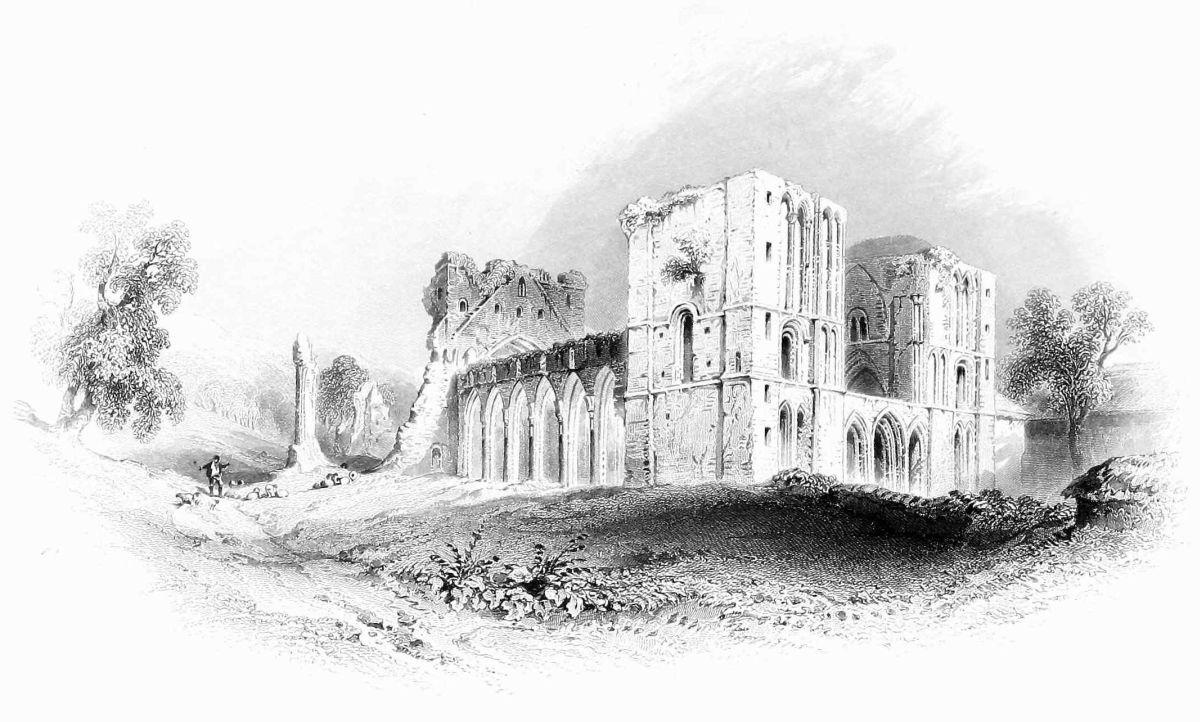
Llanthony Abbey.
N.W. View.
The wrongs, of which the older monks of Llanthony so justly complained, are thus told by their own pious chronicler:—When the storm subsided, and peace was restored, then did the sons of Llanthony tear up the bounds of their Mother-Church, and refuse to serve God, as their duty required, in the old Sanctuary. For great is the difference, said they, between the rich city of Gloucester, and the wild rocks of the Hatterill—between the fertile vale of Severn, and the craggy banks of the Honddy; between the wealth and civilization of England, and the barren hills and beggarly natives of Wales; between a land of smiling meadows and fertile orchards, and a region of trackless mountains and roaring cataracts; in fine—to justify their desertion—between a home amongst smiling gardens, and a grave in the howling wilderness!
Some of the renegade brethren declared that they wished every stone of the old foundation were a fleet hare and the hounds after it, that not a vestige might be left. Alas, says the ‘Jeremiad,’ they of Gloucester have usurped and lavished all the revenues of the Mother-Church: for their new abode, they have built stately offices; and the old they have left to moulder into ruins. But to avoid the open scandal of deserting their Mother, they send hither, as to a dependent cell, their old and decrepit members to be cherished in that very bosom—fostered in those very arms—which they have insulted by ingratitude, and weakened by wrong and robbery. So great was the poverty to which the few inmates were reduced, that they were actually without surplices, and at times so destitute of raiment that they could not with proper decency appear at divine service. Sometimes the allowance of bread for one day had to serve for two; whilst in the offshoot at Gloucester there was not only enough, but abundance and superfluity. When entreated to return to their Mother, these heartless brethren, who had tasted the sweets of a new residence, and been corrupted by unwonted luxury, only derided their appeal. “What!” they replied, “would you have us return to sing Miserere to the wolves? Do the whelps of wolves delight in choral harmony?” And when any one was sent to Old Llanthony, whether for health or discipline, they would exclaim—“Why, what has he done? what fault has he committed? what law has he broken, that he should be sent into banishment, shut up in such a prison?”—for it was thus that they spoke of the Mother-abbey—calling it a dungeon, a prison-house, fit only for the punishment of great criminals.
In like manner, says the monk, the library was despoiled of its books and MSS.; the record-room of its deeds and charters; the silk vestments and relics, embroidered with gold and silver, were carried away from the vestiary; the treasury was stripped of everything valuable. Whatever was precious or ornamental—even the bells, notwithstanding their great weight, were carried off to the rival abbey without the slightest resistance or redress. It was under these distressing circumstances that King Edward set about effecting the union to which we have adverted.
But there were other causes at work. It is very apparent that the religious peace and contemplation to which it was consecrated, were but rare guests in the old Abbey of Llanthony. Situated on the very border of countries that were mutually engaged in making or repelling aggressions, the sanctity of the place was often invaded by those who returned across the marches from some lawless foray, or by others who entered the Welsh frontiers to make reprisals. The calm serenity which, for a brief season, reigned within and around the sanctuary, was disturbed by continual apprehensions of violence or extortion. The ministering priest was often interrupted in his sacred office by the shouts of armed men. The stranger who had come in pilgrim weeds, confessed, and done penance, was too often found on departure to be a traitor, ready to conduct the next troop of marauders to the gate, and extort fresh contributions from the already impoverished brotherhood.
It is also alleged, with plausibility, that from the Cambrian people—who hated the place because its founders, benefactors, priors, and brotherhood, were aliens by birth, nation, and language—the abbey had no very cordial protection or support. During the long border struggles that preceded and followed its “foundation in the wilderness,” it was the mark of every invading or retreating foe. Instead of Matins and Vespers, and the meditations of holy men, the Vale of Ewias was often the retreat or the rallying point of adventurers, whose Parthian-like movements rendered them equally dangerous in the charge and the retreat. The sanctity and seclusion of the place once disturbed, the spell was broken; outrages were repeated and multiplied with impunity by those who, having no law, were a law unto themselves; and to such extremes were these carried, that the Prior and Canons—habituated as they were, by the rule of their Order, to fasting, and at best to a coarse and scanty fare—were often reduced to the verge of famine.
In one of the numerous expeditions by which the spirit of retaliation was kept up, and by which the religious houses were harassed and plundered, a soldier of the English army writes—“We lie here watching, praying, fasting, and freezing! We watch in dread of the Welsh, who beat up our quarters every night; we pray for a safe passage homeward; we fast, for hardly have we any food, the halfpenny loaf being raised to fivepence; and we freeze for want of clothing, having only a linen tent to keep out the cold!”
If such was the penance done by an officer of the “victorious army,” great must have been the sufferings endured by those who had to supply the “loaf,” as the monks of Llanthony had to do, either in substance or in coin.
While the Abbey was yet faintly struggling to recover a healthy activity in its affairs, its temporal revenues, and spiritual offices, so great a dearth occurred all over Wales, that the Bishop of St. David’s is said to have died of grief; the Bishop of Llandaff to have been stricken blind; while the Bishops of Bangor and St. Asaph, on their sees being rendered utterly destitute, were reduced to the necessity of supplicating alms. The bondage and destitution of the Welsh at this period—the evils of want and war—are thus expressed by an old writer:—“The harp of the churchman is changed into sorrow and lamentation; the glory of our proud and ancient nobility is faded away.”
It was about this time that the Bishop of Hereford, then Prior of Llanthony, the better to rescue them from a gross insult and trespass by a powerful neighbour, and accommodate their numbers to the scanty means of subsistence within the Welsh border, drew off the major part of the canons from Llanthony, and gave them an asylum in his own palace.
[After describing, in graphic language, the distractions of the country, the robbery, violence, murder, and rapine, that were daily perpetrated in their immediate vicinity, and which threatened the very existence of the brotherhood, the flagrant desecration that immediately led to their removal to Hereford is thus recorded:—Est præterea et aliud quod animos innocentium plus omnibus hiis in fixorio angustiarum acerbiùs terrebat. Unus namque ex vicinis Wallensibus inimicorum minis et jaculis undignè impeditus, cùm nullus ei tutus ad latendum vel evadendum locus superesset, c̄ omni domo sua, ad Lanthoniam convolavit; hanc sibi constituens domum Refugii ut salvus fieret, quem inimici odio inexorabili persequentes non longè ab atrio in insidiis sedentes vigilantiùs opportunitatem observabant, quando in eum casu aliquo tandem oblatum irarum virus evomere prævalerent. Ipse verò in interiores officinas, quò securior redderetur, cum suis et ancillis, se ingessit; ità ut ubi Fratres reficere consueverant, ibi mulieres choros ducere, et cætera muliebria, ignominiosè tractare non erubescerent!
Quid facient milites Christi tot hostium cuneis tarn atrociter vallati! Ecce foris pugnæ, et intus timores! Non enim possunt ab intus fratres divinis officiis, præ ingratorum hostium insolentia, consueta veneratione interesse: Luget Martha quia pascere non permittitur: dolet Maria quia sanctæ refectionis epulis privatur; et præterea nimis timet ne in infirmioribus membris suis alicujus culpæ dehonestetur.]
The result of this, after two years’ residence at Hereford, was the foundation of the new monastery at Gloucester; but which it was at first intended should be only a cell, dependent on the Mother-Church on the Honddy. But inured to this species of daily warfare—familiar with the dangers of their position, and strong in the belief that they were objects of regard in the eyes of Him who would assuredly carry them, as he did the faithful of old, through all their troubles—they are said to have left the scene of their trials and privations with reluctance; and to have declared that the gardens of Hereford, and the vineyards of Gloucester, had no attractions for them like the barren rocks of “Ewias and the Honddy:”—
And when at last these holy men, With lingering step and slow, Had wound their way along the glen Where Honddy’s[337] waters flow, They halted—gazed—and heaved a sigh, And dropt a parting tear— “Oh, never till this hour,” they cry, “Was Ewias’ vale so dear! Through richer lands our feet may roam— But long our hearts will pine, And feel they have no earthly home But Honddy’s hallowed shrine! Oh, Blessed Mary, shield us well! And, when the storm is past, Grant we beside that hallowed cell May lay our bones at last.” The prayer was heard—their labours o’er, Behold their nameless bier, Beneath the Chancel’s grassy floor, Where pilgrims drop the tear! The simple daisy loves the spot, And there, the leafy June Strews many a sweet Forget-me-not Beneath the dewy moon. And hallowed—hallowed be the ground Where sleep the good and brave, Decked by the firstlings of the Spring, And soothed by Honddy’s wave! &c.
It has been already observed, that monastic establishments were not generally popular among the Cambrians. They reminded them too sensibly of the haughty domination of those Norman lords, who had parcelled out the country amongst them, and hoped to extenuate their crimes by the building and endowment of religious houses. But the memory of what was gained by force or fraud, was not to be effaced by multiplying shrines and priories—great crimes were not to be buried under abbey walls. To every free-born Cambrian, the sight of an abbey appeared like a monument of his country’s degradation and bondage, for it was difficult to separate in his mind the blessings of religion from the galling yoke of oppression; he saw that what was at first gained by force of arms, was to be retained by the yet stronger hand of spiritual despotism. The ecclesiastical power was at times more efficient in subjugating a chief, than all that a feudal baron could carry with him into the field; and when both united for the purpose of conquest, their strength was irresistible, the result certain; and the hatred of the oppressed was naturally roused against the grinding sense of a twofold oppression.
Superstition was a mighty engine. An austere old writer gives us the following instance of its working in this golden age of the Church:—“The yeare after this, Gruffyth, son to Conan ap Owen Gwyneth, a nobleman, died, and was buried in a monke’s cowle at the Abbey of Conway; and so were all the nobles, for the most part, of that time buried. For they were made to believe by the old monkes and friers, that that strange weed was a sure defence betwixt their soulis and hell, howsoever they died. And all this baggage and superstition received they with monkes and friers, a few yeares before that, out of England. For the first abbey or frier-house that we read of in Wales, sith the destruction of the noble house of Bangor, which savered not of Romish dregges, was the Twy Gwyn, built the yeare 1146; and after that they swarmed like bees through all the countrie; for then the Cleargie had forgotten the lesson that they had receaved from the noble clerk, Ambrosius Telesinus, who, writing in the yeare 540, when the right Christian faith, which Joseph of Arimathea taught at the isle of Avalon, reigned in this land, before the proud and bloodthirsty monke Augustine infested it with the Romish doctrine, in a certaine ode hath these verses in Welsh, which may be thus Englished, almost word for word:—
“Wo be to that priest yborne, That will not cleanlie weed his corne, And preach his charge among! Wo be to that Sheepherd, I saie, That will not watch his flocke alwaie, As to his office doth belong! Wo be to him, that doth not keepe From Romish Wolves his simple sheepe, With Staffe and weapon stronge!
“And because that no man should doubt of them, I have set them down here as they were written by him that made them; whereby it may be produced that the Britaynes, the first inhabitants of this realme, did abhorre the Romish doctrine taught at that time.”[338]
Architecture.—The Abbey of Llanthony was built, like those already described, in the cathedral form—with a nave, lateral aisles, transepts, and chancel. It measures in length, from the western door to the great eastern window, two hundred and twelve feet; and the breadth of the nave, including the side aisles, is fifty feet. The style is a compound of Norman and Early English, or Gothic, of which the lancet-pointed windows in the nave are illustrations; while the Norman character is preserved in the arch between the choir and south transept, and again in the outer wall of the same transept by a double window. Of the roof, which was was of stone, nothing remains except a fragment in the north aisle; the transepts have also crumbled down; but the central tower, which connected the whole fabric, still presents a massive, though mutilated, feature of the ancient pile.
The Nave, with its six noble arches, which separates the body of the church from the north aisle, is the grand and imposing feature of the scene. To the spectator, who takes his stand at the west door, the objects present a picture of wild and melancholy grandeur. Before him rise the monuments of a religious Order, who exercised no small influence over the destinies of mankind; and, when their own were fulfilled, left behind them, in the ruins that still adorn the land, the strongest evidence—with the highest homage that art and science can offer to religion.
We do not pretend to say that the remains of Llanthony are equal in architectural beauty to those of many other religious houses in the kingdom; but as every object of this description depends—for the effect it may exert over the spectator’s mind—upon the character of the scenery, and the circumstances under which it is viewed, we may safely claim for these ruins an effect much beyond what others, though more lofty, elaborate, and extensive, could ever inspire. The monastic ruins that, in more favoured districts, attract and command attention, do not, and cannot, take such hold of the imagination as the contemplation of this temple of the Desert, where everything seems in harmony with the thoughts suggested; and where the combined features of Nature and Art invest the scene with peculiar solemnity.
The nave was separated from the two aisles, north and south, by eight noble arches, supported by massive pillars on each side. But of these several have disappeared on the south, and left only their grass-covered bases to indicate their size and position. Of the great tower, only two sides remain; and on that facing the nave, may be seen the angular lines where it was joined by the stone roof to the nave. On a line with the tower on the right are seen part of the south transept, with its double Norman window opening into the interior; and at the base, externally, a lancet-shaped doorway, opening into a side chapel. On the centre of each pillar, and on a line with the upper tier of windows, or clerestory, are seen the remains of the springing columns, which supported the groined roof—showing, by the triple-moulded shaft, the base or impost from which the ribbed arch threw its delicate ramifications along the stone vault, and connected the walls under a magnificent canopy, adorned at every intersection of the ribs with carved bosses and rosettes; but of which scarcely a fragment is left.
The ornamented arch in the eastern window, so long the admiration of travellers, has mouldered away. But the Norman arch, already noticed, between the choir and the south aisle, is a bold and characteristic feature that points very distinctly to the twelfth century. The walls of the north aisle are wholly dilapidated; but the outside wall of the south aisle, as observed, is the most entire. Of this the windows are Norman, lofty and finely proportioned. “The western side is considered by all connoisseurs to be the most elegant; the northern, the most entire; the southern, the most picturesque; and the eastern, the most magnificent.” Taken altogether, the remains of this Abbey present a coup d’œil that will bear comparison with many of far higher name. It unites the sublime and the picturesque in a more than ordinary measure, while the general effect is greatly enhanced by the natural solitude of the place.
On the south of the remaining transept is a neat Gothic chapel, with an engroined roof, in tolerable preservation. It measures twenty-two feet in length, by ten and a half in breadth; and on the south of this chapel are the remains of an oblong room, supposed to have been the Chapter-house, or more probably the Vestiary. The other offices—the Refectory, Hospitium, Dormitory, and Cloisters—may be easily traced by an experienced antiquary; but, to a common observer, their respective boundaries are indistinct. In a barn, westward of the ruins, is a fine arch, supposed to have formed the grand entrance to the Abbey. But now—
Stone after stone the hallowed temple falls, Fierce lightnings scathe, and torrents sap the walls; No mantling ivy round the ruin weaves Its verdant panoply of glittering leaves; No pious hand, with patriotic care, Props in its fall the ancient house of Prayer; But still yon Arch, that braves the winter blast, Stands the proud chronicler of ages past.
On the architecture of this period, we may here introduce a few desultory remarks, without entering into any disquisition on the subject.
The most remarkable works of architecture,[339] as opposed to that of the feudal strongholds, are the religious edifices erected about this period, and improved during the three following centuries. These structures uniting, as in the present instance, sublimity in general composition with the beauties of variety and form—intricacy of parts—skilful, or at least fortunate, effects of light and shade—and, in some instances, with extraordinary mechanical science, are naturally apt to lead those antiquaries, who are most conversant with them, into too partial estimates of the times wherein they were founded. They certainly are accustomed to behold the fairest side of the picture. It was the favourite and most honourable employment of ecclesiastical wealth, to erect, to enlarge, to repair cathedral and conventual churches; and upon these buildings in England, between the Norman Conquest and the Reformation, an immense capital must have been expended. And it is pleasing to observe how the seeds of genius, hidden, as it were, under the frost of that dreary winter, began to bud to the first sunshine of encouragement.
In the darkest period of the middle ages, especially after the Scandinavian incursions into France and England, ecclesiastical architecture, though always far more advanced than any other art, bespoke the rudeness and poverty of the times. It began towards the latter end of the eleventh century, when tranquillity, at least as to former enemies, was restored, and some degree of learning reappeared to assume a more noble appearance.
The Anglo-Norman cathedrals were, perhaps, as much distinguished above other works of man in their own age, as the more splendid edifices of a later period. The science manifested in them, according to the authority here quoted, is not very great; and their style, though by no means destitute of lesser beauties, is, upon the whole, an awkward imitation of Roman architecture, or, perhaps, more immediately of the Saracenic buildings of Spain, and those of the lower Greek Empire.[340] But about the middle of the twelfth century, when Llanthony, Tinterne, and so many remarkable edifices sprang up, this manner began to give place to what is improperly denominated the Gothic architecture. We are not concerned at present to inquire whether this style originated in France or Germany, Italy or England, since it was almost simultaneous in all these countries; nor from what source it was derived—a question of no small difficulty. I would only venture to remark, that whatever may be thought of the pointed arch, for which there is more than one mode of accounting, we must perceive a very oriental character in the vast profusion of ornament, especially on the exterior surface, which is as distinguishing a mark of Gothic buildings as their arches; and contributes, in an eminent degree, both to their beauties and their defects. This, indeed, is rather applicable to the later than the earlier stage of architecture; and rather to Continental than English churches. The Cathedral at Amiens is in a far more florid style than its contemporary at Salisbury. The Gothic species of architecture is thought by some to have reached its perfection—considered as an object of taste—by the middle of the fourteenth century; or at least to have lost something of its excellence by the corresponding part of the next age—an effect of its early and rapid cultivation; since arts appear to have, like individuals, their natural progress and decay. Yet this seems, if true at all, only applicable to England; since the Cathedrals of Cologne and Milan—perhaps the most distinguished monuments of this architecture—are both of the fifteenth century. The mechanical execution, at least, continued to improve; and is so far beyond the apparent intellectual powers of those times, that some have ascribed the principal ecclesiastical structures to the fraternity of Freemasons—depositaries of a concealed and traditionary science. There is probably some ground for this opinion; and the earlier archives of that mysterious association, if they existed, might illustrate the progress of Gothic architecture, and perhaps reveal its origin. The remarkable change in this new style, that was almost contemporaneous in every part of Europe, cannot be explained by any local circumstances, or the capricious taste of a single nation.[341]
“The Normans,” says “William of Malmesbury, “live in large edifices with economy. They revived by their arrival the observances of religion, which were everywhere grown lifeless in England. You might now see churches rise up in every village, and monasteries in the towns and cities—all built after a style previously unknown in this country.” It was soon after the renovation and introduction here mentioned, that the Abbey of Llanthony—though one of the smallest and least known of its class—sprang up in the desert, as a signal to many others, on a more extended and noble scale that quickly followed, and stamped their architectural character upon the age. It was most probably finished before the middle of the twelfth century—so prolific in ecclesiastical edifices. The style is of that period—designated as the transition from late Norman to early English, where the predominant features are Gothic—characterized by the pointed arch; by pillars which are so extended as to lose all trace of classical proportions; by shafts which are placed side by side, often with different thicknesses, and are variously clustered and combined.[342]
This style is divided into three distinct periods—besides that of transition between the circular and pointed styles—which lasted through the greater part of the twelfth century, when the circular and pointed arches are frequently—as in the nave and south transept before us—used indiscriminately in the same building. The ornaments, although generally partaking of the earlier style, begin to be better executed, and more elaborate; and the general appearance of the building assumes a lighter character. The first style of Gothic in this country, The Early English, prevailed through the greater part of the twelfth century; and of this style the subject in question is one of the numerous examples that followed its introduction in every part of the kingdom. Among these the variations, in all save dimensions, are so slight and unimportant, that the description of almost any one monastic structure of that century applies to every other of the same style and period. We possess in the ruins of Llanthony a pure example of this style, unchanged by any subsequent additions or alterations; for as the Abbey became reduced both in numbers and revenues, immediately after the establishment of the Abbey at Gloucester, it shared in none of the changes introduced by the decorated style; but has continued to the present day what it was in the middle of the twelfth century. To account for the splendour of conventual churches in general, we have only to remember that personal expense or secular indulgence were highly culpable in a monk; and that whatever was expended in ornamenting the Church was glorifying God.
William of Llanthony—the warrior monk already noticed—appears to have had followers in his penance; for Peter Damian mentions a man who wore an iron corslet next his skin, had iron rings around his limbs, so that he performed with pain and difficulty his Metaneas, or penitential inclinations, and very often dashed his hands upon the pavement. In “Strutt’s Dresses” is a female pilgrim lying on the ground, apparently to perform this penance of slapping the ground. The lady of Sir Thomas More, in reply to her husband, who counselled her to desist from scolding her servants during Lent, replied that she wore a “Monk’s girdle,” and therefore had nothing to fear.[343] The virtues of the monk’s girdle, it appears, were equivalent to those of the cowl, already alluded to in our notice of Tinterne.
The revenues possessed by Llanthony appear to have been very considerable at the outset; but through negligence or mismanagement—or rather by the prejudicial influence of a rival abbey—they fell off gradually, and at the dissolution were valued at a sum[344] considerably less than those of Tinterne Abbey.
When we read, in the Monastic Annals, of entire districts, towns, and villages being conveyed to monasteries, we are surprised at the boundless liberality of the founders. But when we reflect that, at the time of these princely endowments, the land, in many instances, was neither cultivated nor peopled, the question of prodigal generosity is materially altered. At the period of transition, as it may be termed, when it passed from the hands of the feudal Baron to the Abbot or Prior, the products of the consecrated territory were often nothing more than wood and pasture; nor, until it had been long subjected to the system of agriculture, so generally practised and taught by the monks, was it brought into a state fit for the sustenance of man. If we compare—so far as written documents enable us—the state of agriculture and its population, when these lands were transferred to the Abbot, with the condition they were in when taken from him, we shall see very clearly to what a vast amount they had improved under monastic management; and how much cause there was to applaud the stewardship of the venerable monks, in whose hands the physical aspect of the country underwent an entire change. Theirs were truly the arts of peace. Obliged, by the rule of their order, to plant their convents in sterile and uncultivated wilds, where intercourse with more favoured districts was neither easy nor expedient, circumstances required that they should, like the apostles and fathers of old, depend for daily bread on the labour of their hands. While some went to prayer, others went to work; and thus the blessing of heaven and the bounty of earth were believed to descend upon them, and abide with them, in those sacred habitations which had sprung up under their hands, and exercised on everything around them a mild and harmonizing influence.
This spirit of improvement, however, varied according to the different Orders of which the great monastic brotherhood was composed. To those who—in imitation of the Baptist—desired to limit their physical wants to a diet of “locusts and wild honey,” or to whatever the unaided hand of Nature might place within their reach, were content to consume their days in fasting and prayer. And observing—as he probably did—that whenever wealth and luxury had increased in religious houses, strict discipline had as certainly relaxed, the Monk of Llanthony appears to have preferred the desert to any of those “seductive landscapes” into which it might have been, in some degree, converted by means of industry and manual labour. He had also before his eyes the baneful effects produced by the luxurious indulgences of New Llanthony upon the minds of the absent brothers, whose piety, that had preserved its fervour amongst rocks and glens, became vapid and lukewarm when transplanted to the rich landscapes of the Severn. Where riches abounded, “pride and license did much more abound.” It was better to continue a poor but pious friar on the banks of the Honddy, than become a luxurious wine-bibbing canon in the Vale of Gloucester.
The space, therefore, in which the most distant resemblance to ancient cultivation can be traced is comparatively small. It was, perhaps, under a strong conviction of great piety and great property being in their very nature antagonistic, that the “Province of Berkeley,” which the King had offered to the Canons of Llanthony, was so firmly declined. The vineyards, which it is understood were then common on the banks of the Severn, were not likely to fortify the mind against temptation, or reconcile the brotherhood to the abstinence and austerities of conventual life. But when he speaks of the tract as a “province,” we can easily imagine that, fertile as the native soil undoubtedly was, only a small portion of it was under cultivation; so that the annual revenue bore an exceedingly small proportion to its extent in acres. And so it was with the almost innumerable tracts of Church lands in every part of the kingdom; for until they were brought into cultivation and crop, their value was merely nominal. And how much is due to the skill and perseverance of the monks in the encouragement of agriculture? There is scarcely a hill or valley in the kingdom, from which their judicious exercise of plough, and spade, and mattock, did not produce its annual return in the necessaries of life. And hence the revenues, that in the course of years and centuries flowed in upon them, were the legitimate result of a liberal and vigilant economy. We are too apt to forget, whilst reckoning up the vast territories bequeathed from age to age to the church by penitent benefactors, that these same tracts were, in many instances, of little or no current value to their original owners; and that it was only by passing them into more skilful and industrious hands, that they became actually appreciable, as corn lands, orchards, and vineyards.
The Canons of Llanthony, in their local position, had neither the advantages of a fertile soil, nor the acquired habits, nor obligations of Rule, which rendered its cultivation imperative. Their revenues were drawn from a distance—some from remote parts in Ireland. But in their immediate neighbourhood, the monks had a brook and enclosed ponds that produced fish; forests that bred herds of deer, hares, and wild fowl; while patches of garden, orchard, and rye-field, supplied their table with that allowance of fruits and vegetables, herbs and roots, and coarse bread, which formed the daily items of their scanty fare. But when a stranger of note or a noble pilgrim arrived at the gate, the Prior’s table assumed the appearance of more than frugal hospitality; and all that forest or river could furnish for the entertainment of the honoured guest was liberally supplied.[345] As an established
Sanctuary—from which even the greatest offenders were not excluded—we have already noticed the shame and desecration inflicted upon Llanthony by a powerful native, who in the hour of despair had fled to its gate for shelter. To this disastrous visit no opposition could be offered. The sanctuary of St. John was alike available to all—to the guilty as well as to the innocent. And if it was too frequently a refuge for those who had set all laws at defiance, it was happily still more so to the sick and the friendless; to the helpless victim of oppression, who from the horns of the altar appealed to heaven for redress; and to the penitent, who could find no escape from the snares of evil associates, but in the confessional and the cloister. It had been a difficult task, in such circumstances, to discriminate between the claims of those who, in their distress, flew to the sanctuary—between great criminals and true penitents; and therefore it was better the gate should be open alike to all, than that one sincere penitent should be driven back into a world which, in the bitter hours of remorse, he had resolved to abandon. In such institutions there was a gentle union of wisdom and mercy, which the refinement of later times has done much to loosen, and little to perpetuate.
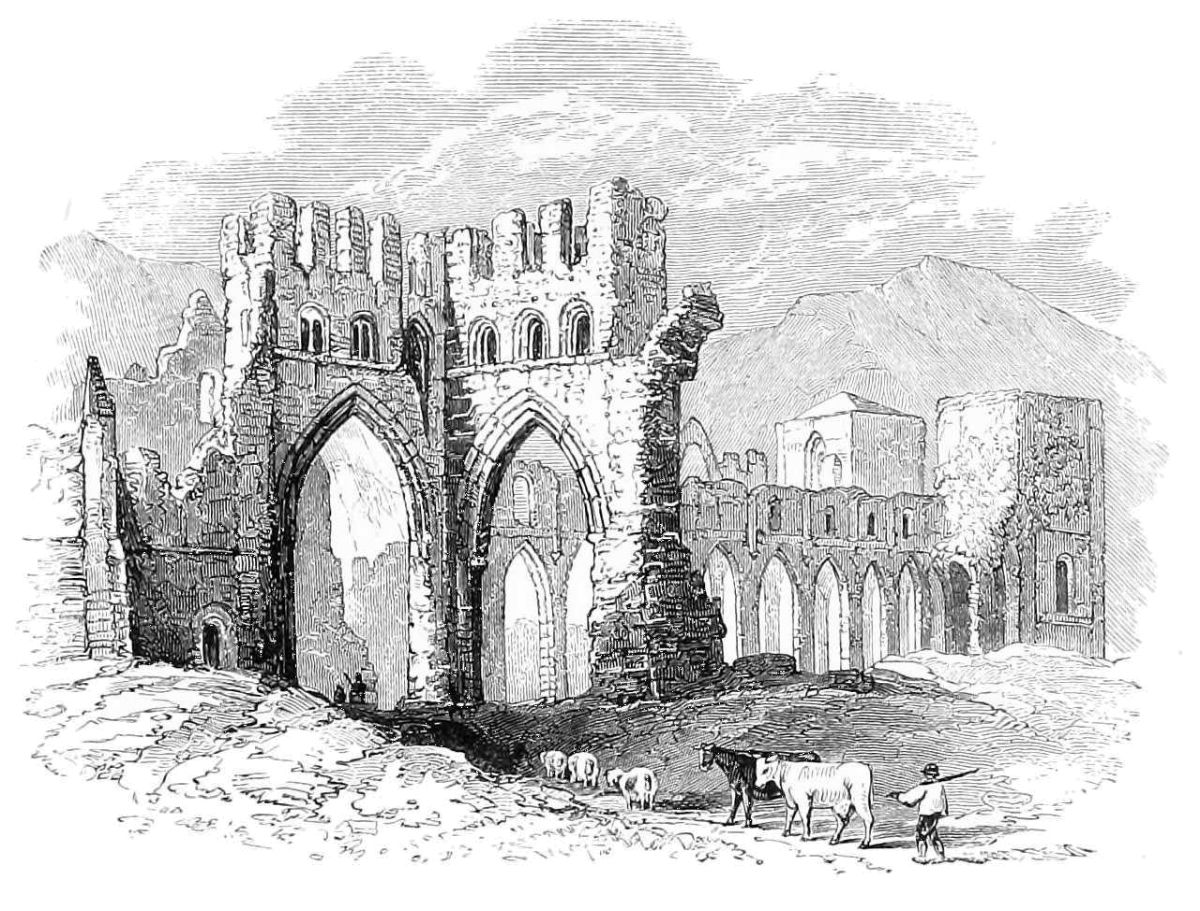
The Abbey Church from the East.
Of Llanthony, as it now appears, the following sketch is from the pen of a recent visitor; and the contrast is picturesque and striking:—
“At the western end of the Nave rise two towers—one of them, with modernized doors and windows, is inhabited. An open arcade extends in front of part of the adjoining cloister, and advancing through the open door it shaded, we found ourselves in a long vaulted half-parlour half-kitchen, with old arms suspended above the fire-place; sides of bacon nobly flanking the whitewashed walls; old chairs and cabinets, and various minor articles of furniture, all arranged with a neatness which betokened that the presiding genius of the place was feminine. Just as we had come to this conclusion, forth stepped from an inner recess the gentle tenant of the abode of the ancient monks, with a quiet simplicity of manner which went to the heart of a weary pilgrim, and made him feel instantly as if at home, and welcome. A little repose, and a cup of tea beside a blazing hearth—for even in summer the air is shrewd among these hills at evening—entirely refreshed us; and just as the sun was going down in the west, we sallied forth to see the ruins. Albeit the hospitality in early times was here dispensed by shaven monks, and now by maidens fair, there is a singular charm felt by all who visit Llanthony, in this quiet living within the precincts of the Abbey, which interests the imagination, and helps to blend agreeably the past and present.
“With this half-dreamy feeling I went forth, and ascended a slight eminence to the westward, whence the whole pile extended at length its ruined towers and arches, half-buried in trees, and overhung with the lofty hills which shut in the vale, and opened no view to the distant world beyond. These hills were cultivated half-way up their sides; a few farms, each sending up its column of smoke, appeared at intervals, with paths leading up into the wild heath that clothed the summits. The evening sun cast a broad red light upon the west front and towers of the pile, and half gilded the remaining portion. I thought I had never beheld, even among the secluded abbeys of the Yorkshire dales, anything more romantically serene. It was getting dusk ere I could tear myself from the spot. The moon was that evening at the full; and it gave me the opportunity of rambling among the ruins, before I repaired to my dormitory in the abbey tower, which I ascended by a narrow flight of stone steps. One might, in idea, have gone back to the olden time, and fancied oneself a pilgrim in very earnest, receiving hospitality from the ancient tenants of the place, had it not been for the dainty whiteness of the bed, which occupied a story of the old tower—far different, I trow, from the rude pallets of these romantic but uncomfortable ages.”[346]
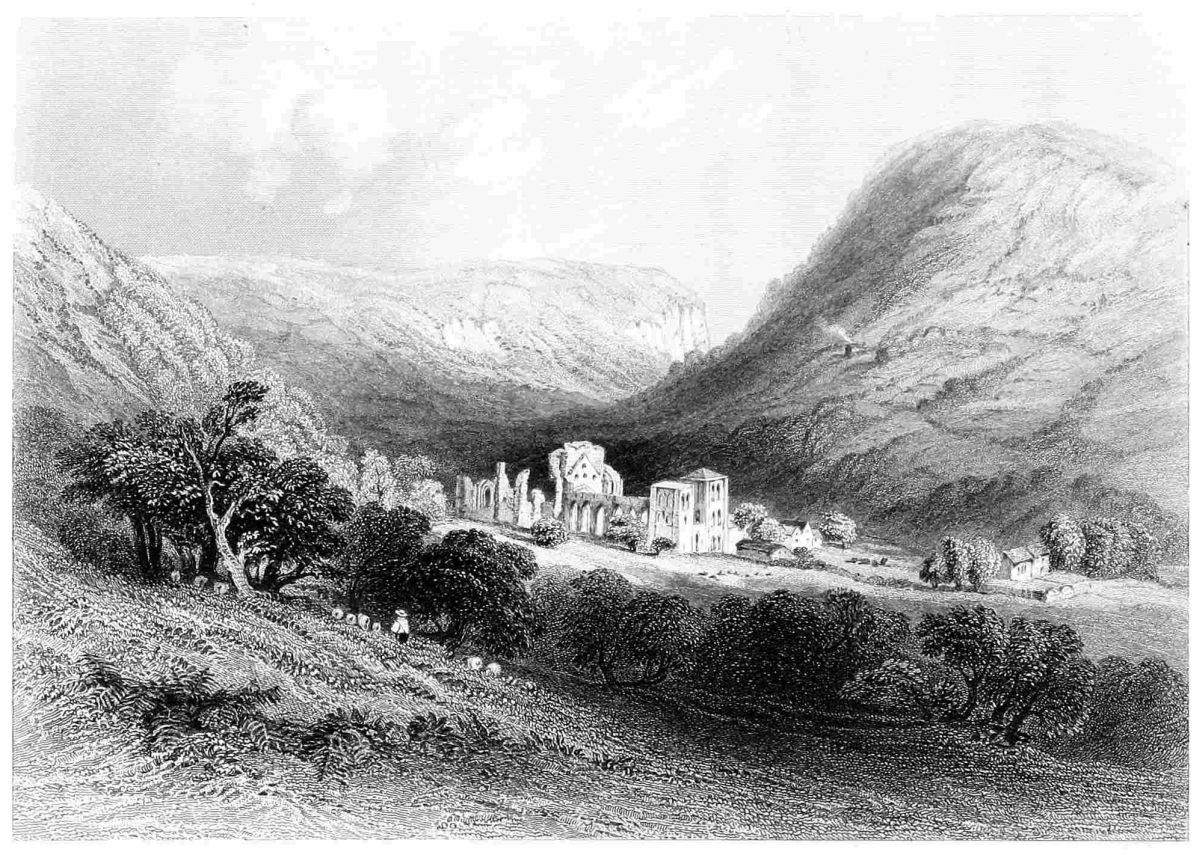
Llanthony Abbey.
Sir R. Colt Hoare says, that when his friend Mr. Wyndham made the tour of Wales, in the year 1777, the Eastern front of the abbey was standing, but has since fallen; and its design is now only preserved by the view engraven of it in his book. When he accompanied Mr. Coxe, in the year 1800, to make drawings for his historical tour through Monmouthshire, the western front still retained its superior elegance: in the year 1801, one of the fine windows gave way; and two years later he was a mournful eye-witness, not only to the total downfall of the three windows which composed the principal ornament of the front, but of some modern architectural innovations, highly injurious to the picturesque appearance of this venerable structure. It is a melancholy reflection to the traveller, who repeats, at certain intervals, his visits to the many interesting spots selected by our ancestors, either for military or religious establishments, that at each visit he will, most probably, find them progressively verging to decay. But Llanthony, even amidst its ruins, still supplies the artist with many fine subjects for his pencil, and furnishes ample matter of inquiry and investigation to the architect and antiquarian. From certain data we have of its first construction, about the year 1108, and subsequent desertion in 1136, we are enabled to ascertain the style of architecture then adopted in monastic buildings, as there can be little doubt but that the ruins we now see are those of the original abbey.[347]
Summary—[For the following details—slightly altered and abridged—we are indebted to a recent and popular Description of Llanthony Priory,[348] by the Rev. George Roberts, M.A., in which the ruins are traced with archæological taste and accuracy:]—
The west end is flanked by two low square massive Towers. The one on the south was fitted up by Colonel Wood, a former proprietor, with apartments for the grousing season, and is covered in with a sloping roof. The Abbot’s lodging, which joins on to the south side, is also turned into a dwelling-house for the steward of the estate, where visitors are obligingly accommodated. The stone staircase is perfect in the south tower, but broken in the north. The staircases were lighted by five chinks. Each tower on the outward face is divided into five stages by bold string-courses; the base is beveled off, and the ground story is broad and plain. The second and third stages are ornamented, arcade-fashion, on the side next to the west window, and the arches are pointed. The central compartment in each successive stage recedes. In the lowest story, two pointed windows have been disfigured by modern innovation. In the centre of the second story, a beautiful example of the round-headed Norman window remains perfect to the depth of the wall; the dripstone over it is plain in the north tower, but in the south is terminated by two corbel-heads. The third story is ornamented with a double long lancet-shaped blank window, of great elegance in design; the pointed heads spring from triple shafts with plain Norman capitals. Between these towers, thus ornamented so as to correspond, stood the great
West Window over the principal entrance, already noticed. Joining on to the south tower, there is a round-headed deep window, with a broad trefoiled head, belonging to a plain vaulted chamber called the Prior’s Lodging. This chamber abuts upon the church, and commences the conventual buildings. Entering by the west you see the interior of the whole church. The Nave was separated from the two Aisles on each side by eight obtusely-pointed arches, supported on massive pillars square without capitals; the bases ornamented with ogee mouldings. A round moulding, deeply let in, runs from the base entirely round the arch, to the base on the opposite side.
The Arches on the north side still stand perfect. On the south four only remain, and these imperfect—two at each end of the Nave. The central arches fell in thirteen years ago (1837), on Ash-Wednesday, without any external notice, and whilst the family were at dinner. Had they fallen a few minutes sooner, some person must have been killed. The pressure of the clerestory windows, which on this side were destroyed, as upon the other, overweighted the arches beneath, and forced them in. The four others remaining are in a very tottering condition—and would have fallen, if Mr. Webb, the steward, to whom the building is much indebted for its preservation, had not built up some rude but well-intentioned buttresses; which, however much they may disfigure, are essential to the strengthening of the remains. He also ingeniously hooped with iron two of the pillars, and by the application of the screw, has managed to bring them back into their former position.
The Side Aisles are completely down; but the termination of the North Aisle, with the only specimen of the roof remaining, is to be seen in the North Tower of the west front. Here there is also a long, deep, round-headed Norman window, looking to the north. The arch at the end of the Nave, next to the Tower, springs from a corbel, consisting of three truncated pillars with capitals. The bit of the roof of the Aisle which remains is heavily groined, and formed by the intersection of round arches. The flat wall buttress, on either side of the Tower, has at the top a square moulding, fluted, from which springs an arch spanning the Aisle—the only one of the series in existence. This is the most acutely pointed in the whole building, and gives an idea of the character of the rest belonging to the Aisles.
The Arches are divided from what seems to have been a triforium [Coxe, who saw it when perfect, calls it an upper tier of Norman arches], by a straight plain band. Between each arch is a corbel, formed of three clustered pillars, as before, with plain Norman capitals, and worked off to a point, where the base should have been, six in number, and from these, evidently, sprung the vaulted and groined roof.
In the interior, above, nothing remains but a double window, pointed and elegant, which seems to have formed the lower portion of the deep Norman recessed arch, through which the passage ran along to the Bell-tower. This may be clearly traced from the exterior of the building. A low round-headed plain door connected each aisle with its contiguous transept. The square
Bell-tower was supported upon four large and noble pointed arches, of which the west and the south, together with the sides above them, are standing; although there is reason to fear for the latter, from the pressure of the superincumbent building, which has shattered and bowed it out. Only sixty years ago the Bell-tower was thirty-seven feet higher than at present, viz., sixty-three feet, as taken by an instrument—whence the entire height was at first exactly a hundred feet. The ruin now reaches but a short way above the dripstone of the roof. The west arch springs from a corbel of three stunted pillars, clustered, and terminating in a flower—the corbel on the opposite terminating in a square moulding of the ogee description. The gable in the western arch is pierced by two small plain Norman windows, and has a third narrow-pointed window in the apex.
The Staircase communicating with the belfry is lighted by a round-headed window. We may conjecture there were several bells in the tower—carried off to Gloucester by Prior Roger.[349]
Transepts.—Nothing remains of the North Transept but one side of the window.—[See the woodcut.]—The South Transept is lighted upon the south by a double Norman window, the moulding and shaft plain, the window eighteen feet by three; and above them, in the gable, is a plain Rose window, of which nothing but the circular rim remains. The effect of this composition, from its simplicity, is exceedingly imposing. A bold Norman arch, supported by a plain Norman corbel pillar, with a cushion capital, communicates on the east, from the transept, with the Lady Chapel; and one step from the Tower leads into the Choir.
The Roof was supported upon pillars—lofty with Norman capitals. One on the south is perfect, and the base of the corresponding pillar is to be seen. The string-course runs over this pillar, and along the wall to the extremity of the Choir. At the distance of eighteen feet are traces of steps to the High Altar, flanked on either side by triple pillars, clustered; the distance from these steps to the east window is also eighteen feet. A long and exquisitely-proportioned round-headed window lighted the choir on the north side, and is quite perfect, except that the masonry above it is gone, leaving the naked rim of the head standing alone, with an effect at once graceful and melancholy. The space on the south side points out where the corresponding window stood. A gap shows the space occupied by the great east window, which was standing in Wyndham’s time. From his drawing, it appears to have been a fine pointed window, with tracery in the head, and having two small Norman lights in the gable above. A few mouldings are still extant, with slender shafts and Norman capitals in the wall where it was inserted.
As you return from the east, continues the historian of the Abbey, you are struck with two windows in the Bell-tower on the south side, in the second story. They consist of a round-headed arch, divided into two lights by a sturdy balustre, standing in the middle of the wall, and extending from its plinth to its capital, right through the centre to the top of the arch. Beyond this, in the thickness of the wall, vestiges of a passage are discovered, which seems to have formed a gallery round the tower. A round-headed plain Norman door, the jambs being low pillars with cushion capitals, at the west end of the choir, on the south side, leads into
The Lady Chapel. The slight remains of the corbels, from which the roof sprung, are here more elaborate in their work than in any other part of the building. We had some difficulty in tracing out the foundation.
The Chapter-house[350] was built in contiguity to the south side of the south transept. On the north side of it a stable is inserted, which prevents accurate observation. In a calf-pen or shed, however, we discovered the corresponding base of the columns to the other unencumbered side. It seems to have been a spacious and elegant room, of an oblong form, lighted at the east and at the south, where there is a deep recess, and traces sufficient to warrant the surmise that there were three Norman windows on that side. The south wall is ornamented and divided into four compartments by clusters of triple pillars, upon which the roof rested. The east end narrows in, and the entrance is from the west. On the south of the church, between the transept and the Chapter-house, is an
Oratory—the chapel already named—with an engroined roof in complete preservation. The central arch springs from a Norman corbel on each side, and two other arches form the angles of the building in the same manner. By their intersection the roof is formed. A deep Norman window is fixed in the east wall. The sides of the door consist of two pillars, capitals with flowers, and bases, ogee-shaped. South again of the chapter, a large space for a doorway—the side pillars of which are partly standing—opens into
The Refectory, of which the slight traces still in existence, defy anything like accuracy of detail. A rude window, chimney, and vaults, broken in and filled with rubbish, show where the offices and kitchen lay. Beyond these is a splendid Sewer, which has been mistaken by the common people to be the commencement of a subterraneous passage leading to “Oldham Castle,” under the mountains.
The Vivarium, or Fish-pond, is east of the church, and a mountain rill still runs through it. The whole of the conventual buildings, together with a close, amounting to seven acres, were surrounded by a wall. At some little distance south-west from the church, and divided from it by what is now a long meadow, stand
The Hospitium and Porter’s Lodge—the first of which is a barn, and has been enlarged for that purpose. A fine pointed arch, already alluded to, under which was the entrance gateway, still remains. The pillars upon which it rests are immensely strong—the capitals Norman and rudely carved. Above this were apartments lighted by two round-headed windows in the north gable; and in the south gable, by two windows with trefoil cusps, and one round-headed. An old fireplace above is also visible. The arches on the other side are blocked up with solid masonry. The Porter’s window is pointed, and looks to the west. In the “bay” of the barn, and on a level with the ground, on the west side, is a window deeply set in the wall, pointed; and in a line with it, a square open space, like the top of a buttery-hatch, with a large flat stone below, whence probably the dole[351] was distributed.
ULES of St. Augustin.—Of these, the rules of Llanthony—which the reader will find printed at full in the history of the Order[352]—a few extracts may here suffice.

A. By the first rule, or condition, every candidate for admission into the Order was called upon to relinquish all property. He was to enter on a term of probation by the Prior. No Canon, on taking leave of the Order from necessity, was permitted to take any property away with him. If anything were offered him as a present, he was not at liberty to accept it, until he had obtained leave from the Prior. This rule was to apply equally to all, from the Superior downwards. Punishment was to be denounced for contumacy, and offences to be declared to the Præpositus, before whom all disagreements were to be laid for consideration and adjustment. All property detained as above-mentioned, through necessity, was to be handed over to the Superior.
B. They were carefully to remember what psalms were appointed to be sung at the stated hours, and nightly readings after Vespers. Manual labour was to continue from morning until Sext; and from Sext till Nones was to be employed in reading. After refection, work was to be resumed till Vespers. In all matters of business connected with the convent, two monks were to act in concert; but none were permitted to eat or drink out of the house. Brothers sent to dispose of goods in public, for the benefit of the convent, were to be cautious of doing anything against the Rule. Idle talk, or gossiping, was strictly forbidden; and they were enjoined to proceed with their work in silence.
C. The union, or brotherhood, was to subsist in one house. Food and raiment were to be distributed by the Superior, and everything was to be held and enjoyed in common. Due consideration was to be observed towards infirmity; but no allowance to be made for pride on account of difference of birth. Concord was indispensable; and in attending divine service at the appointed hours, they were to observe the strictest punctuality. They were not to make use of the church for any other service than that to which it was consecrated, unless when, out of the proper hours, they found leisure and inclination for private prayer. While chanting the psalmody, they were to revolve and write the sentiment in their hearts. Nothing was to be sung but what was duly appointed. They were bound to mortify the flesh by frequent abstinence and fasting; and those who did not fast, were to take nothing after the usual time of dining, unless when sick. The scriptures were to be read during meals in the Refectory. To the sick a better kind of food was allowed; but not to make the others discontented. Brothers of delicate habit, or infirm health, were to have diet and clothes suitable to their condition; and such indulgence was not to excite envy or disgust in others. The sick were to be treated with all the care which their cases required; and as soon as they recovered their wonted health, they were to return to the fixed rule and habit of the house.
D. The Habit of the Order was to be sober, not conspicuous. When they went abroad, they were to walk two together, and so remain at the journey’s end. In gait, look, habit, or gesture, everything that could be termed indecent or offensive, was to be regarded as criminal. They were not to fix their eyes upon women; and when two were in church in the presence of women, they were mutually to support each other, in observing a serious and modest decorum—“invicem vestram pudicitiam custodite. Deus enim qui habitat in vobis, etiam isto modo custodiet vos a vobis....” All such offences or misdemeanours were to be punished by the Superior. The clandestine receipt of letters or presents was a punishable offence. Their clothes were to be taken from one common Vestiary, and their food from one Larder. All vestments presented by relatives were to be stored in the common Vestiary. All labour was to be considered as done for the common good. He who stole, and he who concealed his knowledge of a theft, were to be punished with equal severity.
E. Their clothes, and the linen of the house, according to the order of the Superior, were to be washed either by themselves or by fullers. In cases of illness, ablutions were to be used according to the physician’s advice; or, on refusal, by order of the Superior. They were to go to the baths only by two or three, and were then to be accompanied by a person duly appointed by the Superior. The sick were to have an Infirmarer; and cellarers, chamberlains, or librarians, were to serve the brethren with cheerfulness and good-will. Books could not be obtained for perusal but at the stated hours. Clothes and shoes were to be given out when needed. No litigations or quarrels were permitted. If a difference arose, it was to be instantly adjusted or put to silence by the authorities. For all offences, satisfaction—for all wrongs, retribution—was to be given; and the offended were commanded to practise, in all cases, the sacred duty of forgiveness towards the offender.
F. Harsh or uncharitable expressions were to be carefully avoided; and if hastily uttered, they were to be followed by an immediate apology. Obedience to the Superior was strictly enjoined; but if, in the exercise of his duty, he spoke harshly to any one, he was not to be called upon for any apology. They were to yield cheerful obedience to the head over them; but chiefly to the Priest, or Presbyter, on whom devolved the care of the whole house. If, in any emergency, the Superior found his authority unequal to the occasion, he was to have recourse to that of the Priest, or Elder. The Superior was bound to exercise his authority in the spirit of Christian charity and meekness, yet with firmness and impartiality. To be practically strict in discipline; but so to demean himself towards the brethren, as rather to win their love by kindness than excite their fear by severity; to set before their eyes an example of godly life; to excite imitation, and conciliate affection.[353]
The Rule of St. Augustin, it has been observed, is more courteous than that of St. Benedict; for among the Canons-Regular, every brother is well shod, well clothed, and well fed; they go out when they like, mix with the world, and converse at table. The Rule of St. Augustin was followed by the Dominicans; but with severe additions in food, fasts, bedding, garments, and utter dereliction of property.—See and compare the Cistercian Rule, as given in the foregoing article on Tinterne Abbey.
OUNDER.—Hugh de Laci was an adventurer in the suite of William the Conqueror; and, like most of his Norman followers and compatriots, received in compensation of services, or in testimony of the royal favour, certain grants of land from which the ancient Saxon nobility had been expelled. All that we learn of his subsequent career is, that he founded the Priory of Llanthony in the manner already described, spent his days in strict religious seclusion, and departed this life in the odour of sanctity—but without issue. His possessions, therefore, were divided between his two surviving sisters, Ermeline and Emma—the former of whom died without heirs; and the latter, married to a gentleman, whose name has not descended to posterity, had by her husband a son named Gilbert de Laci. The latter, by his marriage with a lady unknown to the chronicler, had two sons, Hugh and Walter de Laci. Hugh died without issue, and Walter espoused Margery, daughter of Matilda de S. Walerick, wife of William de Brewes. To this family were born several sons and daughters; all of whom died without heirs, except Gilbert de Laci, who took to wife the Lady Isabella, one of the five daughters of the great warrior William, Earl Marshall, of whose family history and exploits some account has been given in our notice of Tinterne Abbey.

Margery, daughter of the above-named Gilbert and Isabella de Laci, was married to John de Verdon; and at the death of her father, who left no male issue, she became joint heiress with her sister Matilda, the wife of Galfrid de Genevile.
From Walter de Laci, the right of all his inheritance descended to a certain Gilbert de Laci, as his son and heir; and from the said Gilbert, in default of male issue, it descended to his two sisters Margery and Matilda aforesaid, co-heiresses; between whom the family property left by their father was equally divided. The above-named Margery, as we have said, married John de Verdon; and to Nicholas, her son by this marriage, descended all the property she inherited from her father. From Nicholas, who died without legitimate issue, the family estates passed to his adopted brother Theobald, as his brother and heir. From Theobald, in like manner, they descended to John; from whom, having no heirs, they descended to William, who also dying childless, they descended to Johanna, Elizabeth, Margery, Isabella, and Catherine, daughters and coheiresses of the above-named Theobald de Verdon. Of these, Catherine dying unmarried, her share of the property fell in equal proportions to her sisters; the eldest of whom wedded Thomas de Furnivall: Elizabeth, the second daughter, married Bartholomew de Burghersh; Margery, the third daughter, William Blount; and Isabella took to husband Henry de Ferrers—names well known in history.