USKE CASTLE, Monmouthshire.
Reading edition
Here still the feudal bulwark frowns, With many a tale of siege and sally; And there the mouldering Abbey crowns The silent and secluded valley. And still, when Twilight spreads her wings, By Abbey wall or Castle hoary, The pilgrim hears harmonious strings Struck to the theme of Cambria’s glory. Again—from yonder halls of state, Where now the hermit-owl is dwelling— In song, assembled Bards relate The daring deeds of bold Llewellyn. Again from yonder Abbey choir— Its dim religious lights revealing— The lofty strains of David’s lyre From arch and pillared aisles are pealing. But no! the morning’s ruddy beam— The breath of day—is on the river; And all that peopled Fancy’s dream Is scattered in its light for ever.
HE CASTLE of Uske occupies a commanding position—an abrupt rocky eminence which overlooks the town, river, and valley, which were once the property of its feudal lords. It is a domestic fortress of great antiquity, and with the advantages of its natural site, strengthened and improved by all the appliances of military art—art as it was practised in the days of chivalry—these mouldering walls, though now stripped of all their massive proportions, must have presented a bold and almost impregnable aspect. The lapse of centuries, however, has materially changed its appearance; and the Castle that once entertained the redoubtable Strongbow and his companions, is now little more than a mass of ruins—the chief recommendation of which is its picturesque character as a prominent feature in the landscape.

The ruins consist merely of a shell, enclosing an area or court, and some outworks on the west, formed by two straight walls converging one to the other, and strengthened at their union by a round tower, as represented in the accompanying woodcut. At the extremity of the south wall is a grand pointed gateway, with grooves for a portcullis, which was the principal entrance. The upper part has been converted into a farm-house with considerable additions.
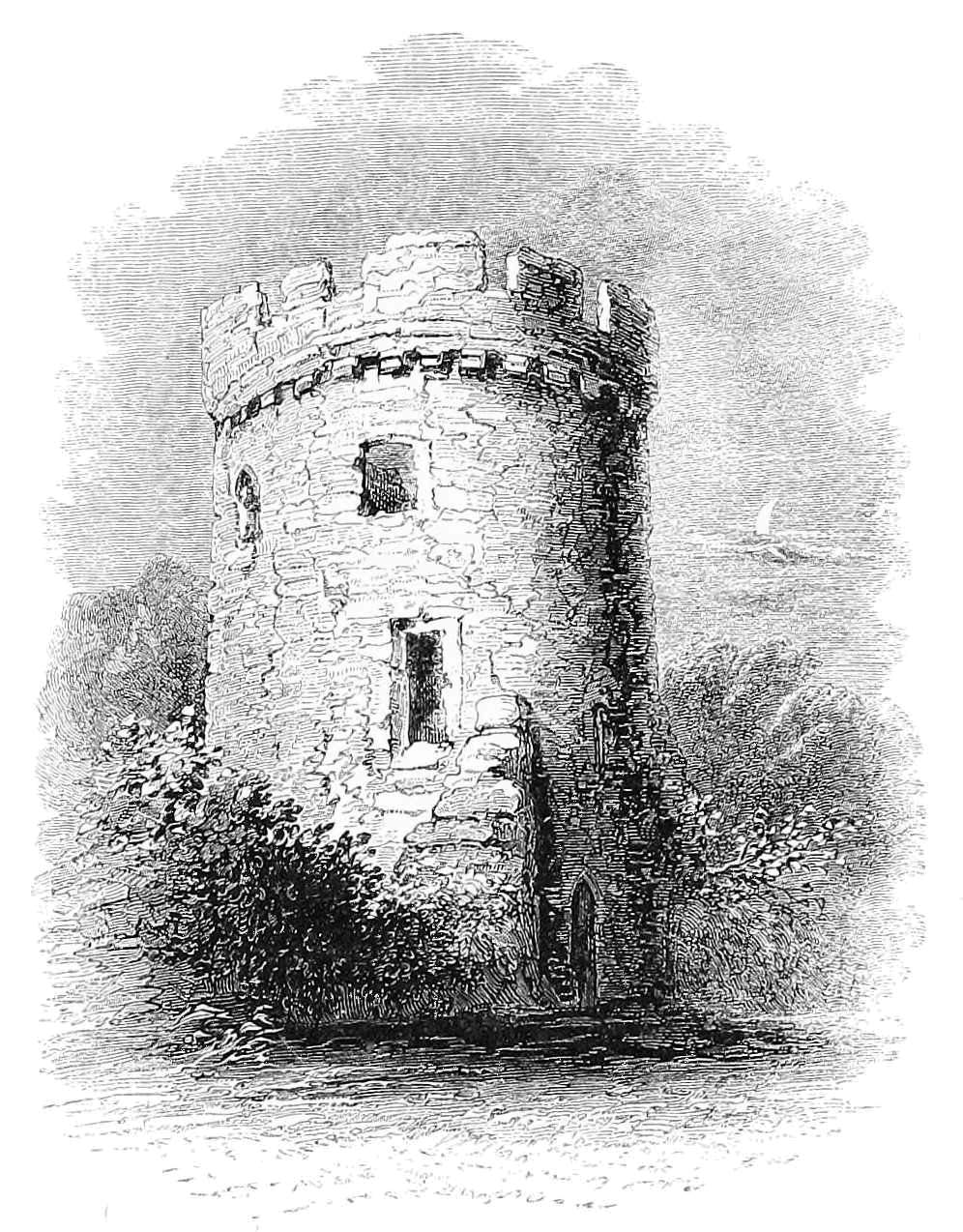
Tower in Uske Castle.
Like other castles of its style and period, it consists of straight walls, fortified with round and square towers, and no apertures externally but loopholes or œillets, except where these have been enlarged for modern use and convenience. Several of the apartments have chimneys—a comparatively modern refinement. The baronial hall measures forty-eight by twenty-four feet; far inferior in dimensions to some of the halls already described, but still a noble apartment, and dignified from its association with Strongbow and his knights, whose occasional rendezvous was within these walls.
At the time of the Roman occupation, this county formed part of the Silurian territory, which included also the counties of Glamorgan, Brecknock, Radnor, and Hereford; and in order to secure the conquest of this part of the country, the new masters were compelled to form a range of strongly fortified posts. No less than five stations were erected in that part of Siluria included in Gwentland, as at Caerwent, Caerleon, Abergavenny, Monmouth, and Uske. In the attempts of the Saxon monarchs to subjugate Wales, the Gwentians, or inhabitants of Monmouthshire, opposed the most formidable resistance; nor does it appear that they were ever vanquished during the Saxon period. The Conqueror, however, adopted a new and more effective mode of curbing their resistance. He directed his barons to make incursions at their own expense, and gave them leave to hold the lands they conquered in capite of the crown. These feudal tenures became petty royalties; the barons became despots, and, intrenched in their fortified castles, assumed independent sovereignty, until these baronial governments were abolished by Henry VIII., who divided Wales into counties.
The river Uske takes its rise from a lake on the northern side of the Bannau-Sir-Gaer, in Carmarthenshire, and after running first north and then east as far as Brecknock, is joined by the Honddi, which, as already described, waters the monastic vale of Ewias. It then flows south-east as far as Abergavenny, and in this part of its course is joined by the Grwyneu-fawr, and about three miles below this it enters Monmouth. The extent of its course is about sixty miles, every portion of which is distinguished more or less by scenes of pastoral and picturesque beauty—enhanced by vestiges of ancient encampments, religious edifices, and feudal strongholds. The river is spanned at Uske by a stately bridge of five arches.
The annexed woodcut, with which we close this brief notice, represents a chamber in the Castle, with an arched window and a fireplace, comparatively modern. Chimneys do not seem to have been introduced much before the time of Henry the Eighth, as appears from the following extract from Leland’s Itinerary:—“One thynge I much notyed in the haule of Bolton,” built temp. Rich. II., “how chimneys were conveyed by tunnels made in the syds of the wauls, betwyxt the lights in the haule; and by this means, and by no others, is the smoke of the harthe in the haule wonder strangely carrayed.”[355] Previously to this period, the smoke was suffered to escape from the louvre, or lantern-turret in the roof, in large halls and kitchens, the fire being made of logs of wood laid on iron or brass dogs, in the centre of the room. But in the smaller rooms, like that in the woodcut, fireplaces were built, the arches or chimney-pieces of which often remain; but the chimney itself was carried up only a few feet, where an aperture was left in the wall for the smoke to escape,[356] and there was frequently a window over the fireplace, as in the hall at Raglan.[357]
Uske is supposed to occupy the site of the Roman Burrium—the Bullæum of Ptolemy; it stands on a point of land formed by the confluence of the two rivers, Uske and Olway, and the situation is considered to be one of the most beautiful in South Wales. The successive ranges of woods and hills on each side of the river are richly varied and picturesque; while every year adds something to the natural embellishment of the scene, by the distribution of fruit and forest trees—for which the soil is naturally adapted—and that growing taste for agriculture and rural improvement which is everywhere conspicuous in the county of Monmouth. The boundaries and outlines of the valley—which is everywhere pleasing—perpetually vary as the points of view are changed; so that every change in his position opens to the spectator a new combination of features which pass before him like a moving panorama—
“Ever changing, ever new.”
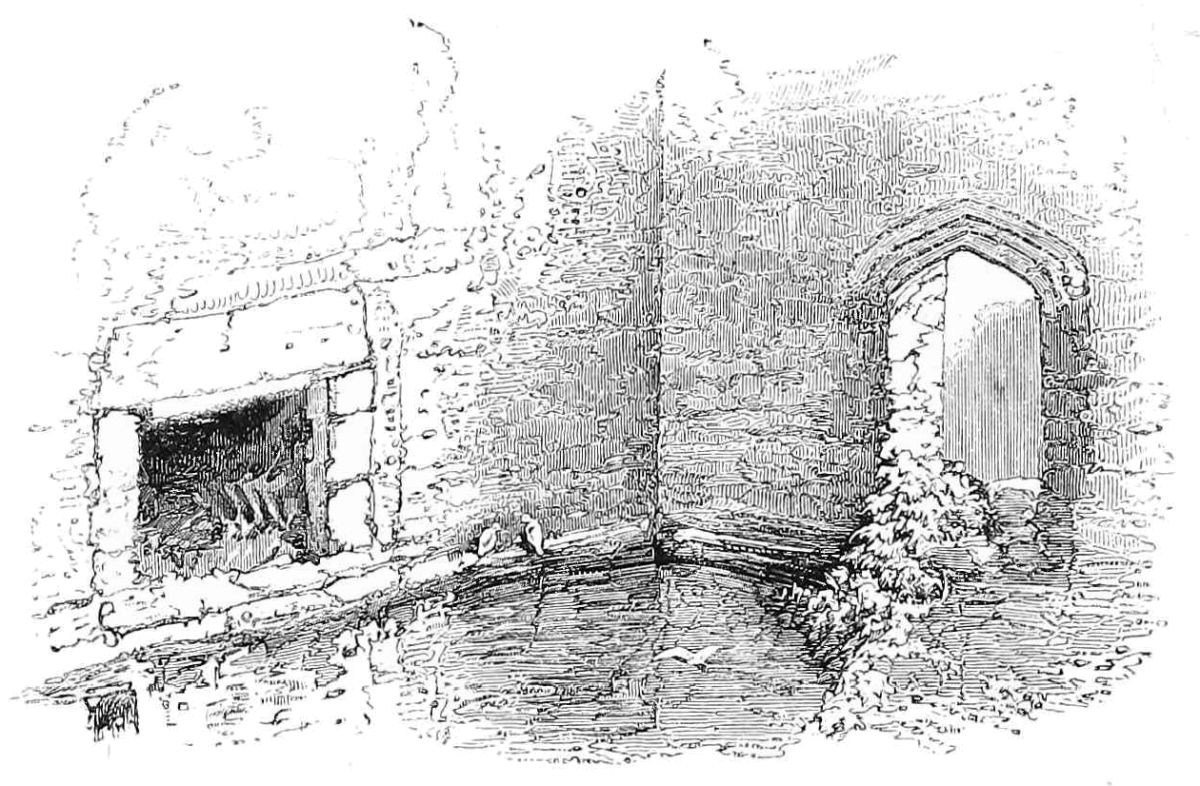
A Chamber in the Castle.
Uske has a melancholy pre-eminence among the strongholds of this county, as a point at which the fury of intestine war was often lighted into flames. During the long and disastrous warfare with Owen Glendower, it was subjected to every species of hardship and oppression. From the battle of Uske, when the Cambrian chief was defeated and driven into the mountains, it remained in possession of the royal troops; but while it suffered the fate of a vanquished post, it derived little support from the victors; for whatever standard floated from its walls, it was only the signal of systematic oppression. From the military chronicle of those unhappy times, we take the following particulars of the
Battle of Uske. This was the last effort on the part of Owen Glendower to drive the English from the frontier. Having assembled an army of eight thousand men enthusiastically attached to him, he prosecuted his march through scenes of fire and bloodshed—desolating the country, ravaging the Marches, and practising every cruelty which the spirit of revenge could suggest. Grosmont[358]—or more probably Uske—was given to the flames. This marauding division was opposed by a handful of men commanded by Sir Gilbert Talbot—joined by Sir William Newport and Sir John Geindre—on the 11th of March, and cut to pieces, no quarter being given except to one person, whom young Henry, in his despatch to his father, styles ‘un grand chieftyn entre eulx;’ and humanely adds, that “he would have sent him this prisoner, but that he could not ride with ease.” Prince Henry at the time of this action was at Hereford—at the head of the army, with which he was to open the campaign—when the news of the victory reached him. The ancient Britons, who lost a thousand men in this battle, appear to have fought with less than their accustomed valour. They were probably raw recruits, without good officers or strict discipline; and without Glendower’s presence to direct and animate them in the charge, they appear to have fallen an easy prey to the enemy. The interception of young March, and this defeat, hastened the fall of Glendower; but, resolved to make a strong effort to retrieve his lost credit in the field, he sent one of his sons with another army, which, on being joined by many fugitives from the late disaster, was found sufficiently strong to risk another engagement. This took place on the 15th of the same month; but the results were still more disastrous than on the previous battle; for of the Welsh army fifteen hundred were slain or taken prisoners. Tudor, the brother of Owen, was left dead on the field; while his son, who had the chief command, was made prisoner, and retained as a hostage in the English camp. The historian relates that so great was the personal resemblance between Owen and his brother Tudor, that when the dead body of the latter was discovered in the field, it was immediately reported that Glendower himself had fallen, and that, with the death of their leader, the Welsh must necessarily abandon the contest. On closer examination, however, it was found that the exultation thus spread through the English camp was premature; for although the resemblance was very striking, it was observed that a wart over the eye—a mark which distinguished the “great Owen”—was not to be traced in the present individual, and it was at once admitted that Tudor, and not Owen, had fallen in the conflict.
Prince Henry, according to Carte,[359] commanded at this battle, supposed to have taken place near Uske. Wynne also mentions an action fought on the same day on which the son of Owen was made prisoner; and the number of those slain and made prisoners, coincides with the above account of Mr. Pennant, but the scene of action is removed to Uske, where he says “the Welsh received a sad blow from the Prince of Wales’ men.” In the history of this period there is a confusion which Mr. Pennant thus clears up:—Hollinshed mentions another defeat sustained by the Welsh in the month of May, in which Griffith Yonge, Owen’s chancellor, was made prisoner. But in this, according to Pennant, the chronicler confounds this battle with the action near Grosmont. If Yonge was the “grand chieftyn” there made prisoner, which is questionable, he must have soon escaped from the power of the English, or have been released, as he is a witness the following year to a pardon granted by Owen to one Ieuan Goch. Here Mr. Thomas[360] suggests that the two accounts by Hollinshed and Wynne might be reconciled, by allowing that a battle was actually fought at Uske, subsequent to that on the 15th of March. Dates among earlier writers are often uncertain, always perplexing. But Uske in many parts bears evident marks of Owen’s desolating system of warfare; a ruinous aspect bespeaks its having been stormed by an enemy at no remote date; and all these circumstances deriving weight from local tradition—which corroborates the surmise, and attributes the havoc to Glendower—Uske may be fairly set down as the scene of devastation referred to in the text.[361]
Craig-y-Gaeryd, near Uske, is supposed to have been a Roman camp. It covers the brow of a precipice overhanging the eastern bank of the river, and is now overgrown with copsewood; but in many places the intrenchments are thirty feet deep. Within the area are several tumuli from fifteen to twenty feet high. From the small torrent of Berden, near this point, some authors have derived the name of Burrium, as being placed at its confluence with the river Uske.[362]
With regard to these camps and intrenchments, Mr. King, in his “Monumenta Antiqua,” supposes that most of the strong intrenchments on the summits of natural hills must be attributed to Britons, although subsequent conquerors might have occupied them. They are designated, indiscriminately, Roman camps, Danish forts, or Saxon intrenchments, but often erroneously. The Roman camps were quadrangular, divided into a pavilion for the general and chief officers, and another portion for the tents of the common soldiers. It was fortified with a ditch and parapet, termed fossa and vallum. The Danes did not undergo the labour of erecting them on the high hills where they are often found, nor run the risk of being cooped up and starved in them during their invasions; nor can we suppose them to be their work after they settled here as conquerors. The great castle of Norwich, built by Canute, and the great tower at Bury, prove their civilization and skill in architecture. Neither could these hill-camps be Saxon. During the Heptarchy, they erected fortresses of stones. Besides, their earth-works were encampments on plain ground with double ditches, and with either the whole or part of the area raised above the level of the adjacent country, and sometimes with a very small mount for a watchguard. The magnificence of the Norman castles, still splendid in their ruins, will not allow them to have had any share in throwing up these rude intrenchments. They must, therefore, have been the strongholds of the ancient Britons, where their families were lodged, and their cattle housed, on any emergency or invasion.[363]
The Church, dedicated to St. Mary, is an ancient structure of Anglo-Norman origin, but apparently curtailed in its dimensions to suit the diminished population of modern Uske. The square embattled tower which now stands at the east, formerly occupied the centre, and communicated with a transept and choir. Four pointed arches now separate the nave from the north aisle. The windows are ornamented Gothic, or rather Norman; and the porches, though not elegant, are in the same style. This was the Priory Church; and of the conventual building, the remains are seen on the south-east side of the tower. From the churchyard, a circular arched portal leads through the court to the ancient edifice now converted into a farm-house. It was founded by one of the Clare family as a priory for five Benedictine nuns, about the middle of the thirteenth century. In an apartment on the first floor, the frieze of the ceiling is ornamented with thirty devices, and emblazoned coats of arms. At the Dissolution, this priory was valued at £69. 9s. 8d. per annum; and the site granted to Roger Williams of Langibby. Rowland Williams of Langibby was distinguished by Queen Elizabeth and James the First, and received the honour of knighthood. His grandson, Sir Trevor Williams, was created a baronet in consideration of his services and loyal attachment to Charles the First.
Founder.—Tanner, quoting from a MS. in the office of First Fruits, says they accounted Sir Richard de Clare and Sir Gilbert his son, Earls of the Marches, for their Founders, and prayed for them as such; for which, at the time of the Dissolution, an allowance appears to have been made amongst the reprises.
The temporalities of this priory are thus valued in Pope Nicholas’s Taxation, A.D. 1291:—Priorissa de Uska habet viginti quatuor acras terræ quæ valent per annum viii.s.: De annuo redditu, vi.s. viii.d., de Molendino. ibidem x.s., de perquisitis cur. v.s. Item, habet apud Shirencnewt [Shire Newton?] de reddit, assis. iii.s. = Summa £1. 12s. 8d.
Among the spiritualities of the diocese of Llandaff, we find the following churches, of which the priory and convent of Uske appear to have been patrons, namely, Raglan, Mykenny, Uske, Langrerion, Lampadock, and Lamyhangel.
In another place, it is said:—Capitulam Landav. percipit de tenentibus de Landconyan unam marcam, et illam reddunt luminar. prioratus de Uske. In the diocese of Worcester, we find, “Porcio priorissæ in capell. de Hatherlo j.l. The gross value of this priory [26th Hen. VIII.] was rated at £69. 9s. 8d., the clear income at £55. 4s. 5d. The site and other lands were granted 28th Hen. VIII. to Roger Williams, grandfather of Sir Trevor Williams [of whom Cromwell speaks in his letter from Pembroke.] At the Dissolution, Elen Williams was the lady prioress. In the Lord Treasurer’s Remembrancer’s office is the following:—“Uske: De Elizea John ap Jevan vidua, occasionat. ad ostendendum quo titulo tenet domum et situm Prioratus de Uske, et alias terras in comitatu Monmouth. That the said widow be called upon to show by what title she holds the house and site of the Priory of Uske, and other lands in the county of Monmouth.” Leland describes it briefly as “a priory of Nunnes at Cair Uske, a flite shot from the castel.”
An impression from the conventual seal of this priory is extant in the Chapter-house at Westminster, attached to the acknowledgment of Supremacy. [25 Hen. VIII.] It represents the Virgin Mary seated on an ornamented chair between two pilasters, the infant Jesus in her lap. Above are a crescent and star, the legend—S. sĉe Marie et Conventus de Uske.
The emblematical devices and emblazoned arms already mentioned, as covering the frieze of the ceiling in the chief apartment, are supposed to represent the armorial bearings of the various benefactors of the priory.
Prioresses.—The last Prioress, or Superieure, was the above-named “Elen Williams.” Among the Gilbertine Nuns there were three prioresses, one of whom presided in turn, and had then the first stall—one of her coadjutors standing on the right hand, the other on the left. The presiding Prioress held the Chapter, enjoined the penances, granted all the licences or allowances, visited the sick, or caused them to be visited by one of her companions. She had obedience and respect paid to her by all. The food was delivered by the Cellaress, but the vestments of the Nuns were cut, sewed, and divided by the Prioress. She could not sit near any man in their house, unless some discreet sister sat between them. The Prioress was to endeavour to visit the Nuns, unless when she was in the kitchen, or confined to her dortoire by sickness. If any sister wished to confess, she signified her desire to the Prioress, if she was in the cloister or church; or she confessed to her, or to any person authorised to act for her. On holidays she sent some “learned nun” with a book to her sisters, to teach them somewhat that might operate to the profit of their souls, or confirm the rigour of the Order. She presided over the Chapter of the Sisters, and one of her coadjutors often took their veniæ in the evening Chapter. On festival days she visited them “if she had time,” and diligently inquired of their strict observance of the rules of the Order. If she left the dormitory after dinner, or after complin, she did not go out unless with attendant nuns. She was obliged to indicate the cause of her departure to the Prior of all. If she left the church through sickness, she confessed in the Chapter, and no one stood in her stall except at Mass, and when necessity required it.—[Brit. Monach.]
She was bound to shun conferring with the Scrutatrices, or sister-visitors, from other houses, that were deputed to her; or to make search for anything except in the common Chapter. If she was in the Infirmary, she was required to conduct herself more reservedly; and not to speak with more than two together, and that only in a “bounded place,” unless, perhaps, necessity compelled her to talk with more for the sake of consultation; or when she happened to hold the Chapter of the Sick. She had authority, upon emergencies, to hold the Chapter of the Convent, and receive confessions, and if she was confined by severe illness, she could, like the rest, talk and give her directions in bed.[364]
Uske enjoys the hereditary distinction of having been the “residence of Richard, Duke of York, and the birth-place of his two sons, Edward the Fourth, and Richard the Third;” names which have furnished many stirring incidents, many sparkling and many disastrous achievements to the British annals. The town of Uske is disposed in the form of an oblong square, the principal street forming the public road to Abergavenny. The corporation consists of a mayor or bailiff, a community, and burgesses;[365] and in the town-house are held the petty sessions for the upper division of the hundred of Uske. The only native manufacture is that of japan ware.
The river is famous for trout, particularly salmon trout—
“So fresh, so sweete, so red, so crimpe withal,”[366]
which, in conventual times, afforded an ample supply to the numerous religious communities on its banks, to whom a carneous diet was only permitted as an occasional indulgence. Epicures confirm the ancient reputation of the river in this respect; and during the season, the disciples of Isaak Walton, and the readers of Sir Humphrey Davy’s “Salmonia,” are constant visitors to the banks of the Uske, which, by way of climax, is said to produce better sport for the angler than any other river in Wales—or even the Severn—a quality which has become proverbial.
“Though bright the waters of the Towy, The Wye, the Severn, and the Tivy; Yet, well I wot, they cannot shew ye Such salmon as the Uske can give ye! It was—(we choose not to go farther)— The favoured dish of bold King Arthur; Who, when he chose like king to dine, Went down to Uske with rod and line, And there drew slily to the bank Such trout as best became his rank; Sometimes by twains, at others singly, But always with a twitch so kingly, The salmon seemed as much delighted, As if they really had been ‘knighted!’ No wonder, for they quickly found An entrée at the Table Round, Where, seated with his gallant knights, Those heroes of a hundred fights;— ‘Leave,’ quoth he, ‘acorns in the husk, Here’s glorious salmon from the Uske!’” &c.
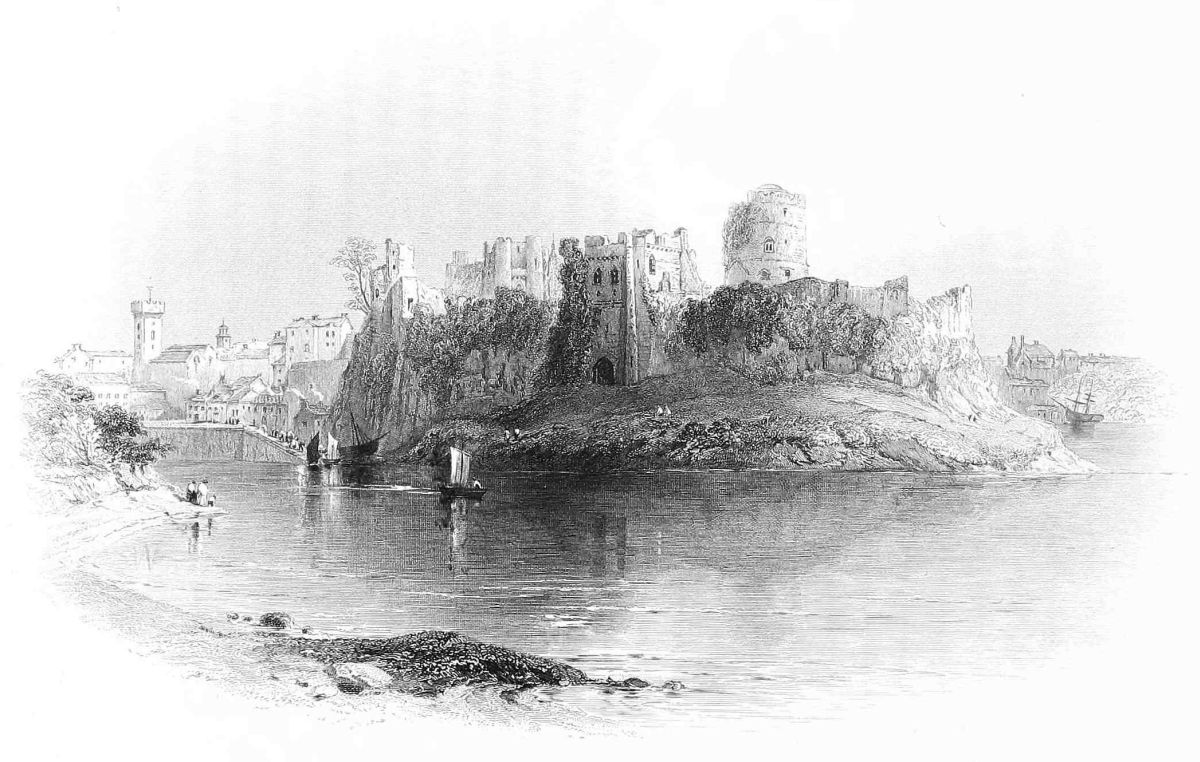
Pembroke Castle