RAGLAN CASTLE, Monmouthshire.
Reading edition
“Stranger! ponder here awhile; Pause in Raglan’s ruined pile; All that wealth and power, combined, With skill to plan, and taste refined, To rear a structure fit to be The home of England’s Chivalry, Was lavished here!—where, met in hall, Mailed Barons kept their festival; The night in lordly wassail spent— The day in tilt and tournament: Yet still, when England’s woes began, Were first to arm and lead the van; To shield the Monarch in his need, In Freedom’s glorious cause to bleed; To Loyalty surrendering all— Then, with their falling King to fall!”
The Castle of Raglan is one of the most picturesque ruins in the kingdom, and closely associated with a momentous period of our national annals. Though roofless, tenantless, and dismantled, it still presents a majestic and venerable aspect. No visitor of taste or sensibility will ever traverse its spacious but long-deserted halls, without feeling a deep interest in its eventful history.
It was on a bright autumnal evening that we quitted the comfortable little inn, the “Beaufort Arms,” at Raglan, to make our first survey of this baronial stronghold; and at that hour, and season of the year, it was seen through its embowering trees in all its glory. Ascending the gentle eminence on which it stands, we came to the outer gate, or barbican, portions of which still remain, and crossing the ballium, now covered with rich verdant pasture, we were received by the intelligent Warden, who conducted us to the majestic gateway, and pointed out to us, as we proceeded, the more imposing features of the Castle, as they alternately met and receded from the eye.
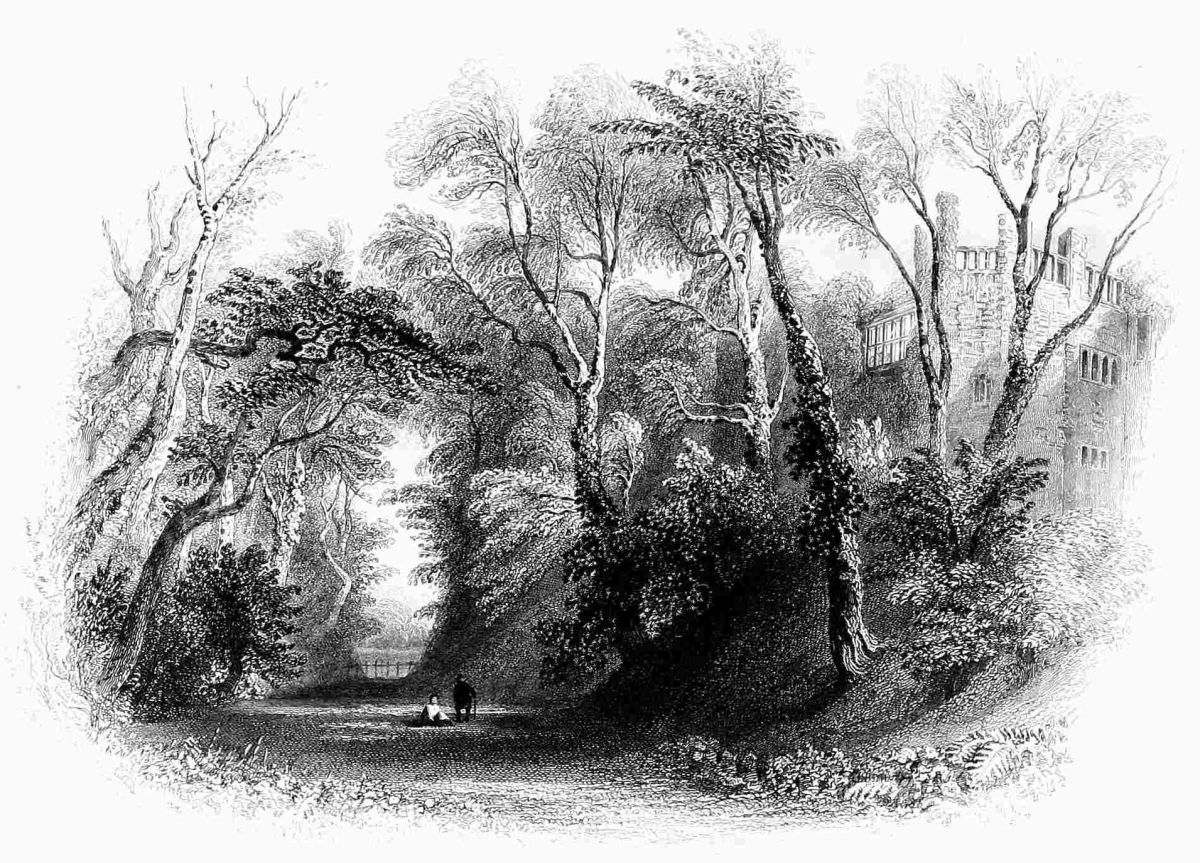
The Avenue.
Raglan Castle.
The vista through the Gateway, taking in the Great Court—once adorned with statues and fountains, but now, like everything around it, abandoned to the weather, is very striking; while the absolute silence which pervades the scene, contrasts forcibly with its ancient stir and splendour, and compels us, while fancy is peopling it with troops of chivalry and their retainers, to exclaim, “Where are they?” A long wooden table with benches, the last symbols of that hospitality for which its noble owners were once conspicuous, stood on the grassy floor. But these were no relics of the ancient banquet-hall, but of a modern festive meeting, when the tenants upon the estates had met to express their attachment to the noble Marquess and his family. The manner in which the kitchen had been refitted for their entertainment, showed that it must have been ‘got up’ in a style not unworthy of its feudal renown; and, “as for the venison,”—
“Finer or fatter Ne’er ranged in a forest, or smoked on a platter.”
We arrived, however, too late for the feast, though another, a much simpler, and palatable treat awaited us—that which Nature, luxuriating amidst the ruins of Art, had lavishly spread before us. Such piles of masonry, such masses of ivy, were never before brought together! Here and there, indeed, the sturdy ramparts looked through their leafy screen with a sort of ghastly whiteness, like Hobbes’ spectre from behind the yew-tree, or the bones of some enormous skeleton, upon which the kindly hand of Nature had suspended her own green mantle. Nothing could be more strikingly novel and picturesque. Along the vast framework of the castle, on which the wealth and taste of centuries had been employed, until its strength and beauty could receive no farther additions from the hand of man, a straggling forest of vegetation expanded its mingling branches. Under the same leafy covert, from the timid wren to the ill-omened raven, birds of every feather had found a congenial roost. From the sepulchral yew the moping owl looked out upon everything around her as her own domain and cherished inheritance. Over our heads bats performed their swift circles in the still twilight sky; while daws chattered from the ancient keep, as if they had never heard a musket-shot, nor felt the slightest apprehension of being disturbed in their possession. On a lofty spray that overtopped every other tree, a loving thrush serenaded his mate in the fragrant thicket below. Numerous smaller birds, that seemed puzzled from the very abundance of the accommodation where to fix their roost, kept up a constant fluttering amongst the branches; while here and there was heard a bickering of wings and twittering of bills, as if contending for possession of some favourite branch for the night. Surely, we thought, there is room enough here for all; and yet even there—among those spacious green arbours, place and position were as eagerly sought and coveted by the feathered tribes, as by the equally volatile and jealous retainers of a court.
At length all was seemingly adjusted; the stillness of night pervaded the scene; the last shadows of twilight had faded into one common pall; and night, attended by a host of sparkling satellites, took quiet possession of the long line of courts that once swarmed with life and enjoyment.
And now, between the western sky—that still retained some warm lingering traces of sunset—and the donjon tower, mousing owls were seen enjoying their solemn pastime, here swimming lazily through the arched court, then along the battlements, or the margin of the clear glassy moat; then soaring aloft, and settling for a minute or two among the dark ivy; but still returning to make another circle and finding no wings abroad but their own.
The contemplation of this Castle, at any period of the day, is calculated to make a lasting impression; but when the rising moon shot her mellow light through its old shattered casements, and the breeze seemed to waken at the same instant and set all the ivy in motion, the scene became still more impressive. Among the deep shadows that invested the spacious courts, every prominent object was now brought suddenly into view; and, with a little aid from fancy, the waving of plumes, and the flashing of steel armour, seemed distinctly visible on the battlements; while the fragments of crumbling masonry that lay scattered below, as if struck by an enchanter’s wand, presented the semblance of animated groups, that waited only the word of command to start into life and motion. The stillness, too, which but half an hour before had pervaded every court and tower, was succeeded by a soft rustling among the leaves, that now flickered like quicksilver as the moonlight fell upon them, and then lost itself in their massive branches; whilst the shrubs and flowers that grew wild and vigorous in every court, or clambered up the walls and archways, seemed to give forth their mingled odours to the night wind, as it passed wooingly through their leaves, and filled the air with incense.
“We seemed to tread on faëry land; For, in every thing around us, We felt the touch of a viewless hand, And we heard the notes of a seraph band, Whose magic spell had bound us; While bright yclad, as in days of yore, The Knight of Raglan strode before.”
The Pitched-court; the hall of state, with its magnificent bay-window; the chapel; the fountain-court, with the grand staircase on the south side opening upon it; then the elegant portal leading to the grand terrace that overlooks Raglan church, were all traversed in succession, with nothing to distract attention, or disturb the solitude, but the whistle of a night-hawk, or the sound of our own footsteps on the grassy carpet, that now forms the universal ‘pavement’ of these once sumptuous apartments. For over the once tesselated floor, and the tapestried walls, weeds have thrown an oblivious mantle, while—
“Ha, ha!” laughs the Ivy, “old Time to me Hath given the glory and mastery! So poets may sing, if it like them well, From early matins till vesper bell; And others may list to their minstrelsie— I’ve a song of my own—so what care I? Your castles, though stately, and strong, and tall, I conquer them all—I conquer them all!”
But as the faint outline here sketched will be filled up when we take the architectural features of the Castle in detail, we pass on to a few preliminary remarks.
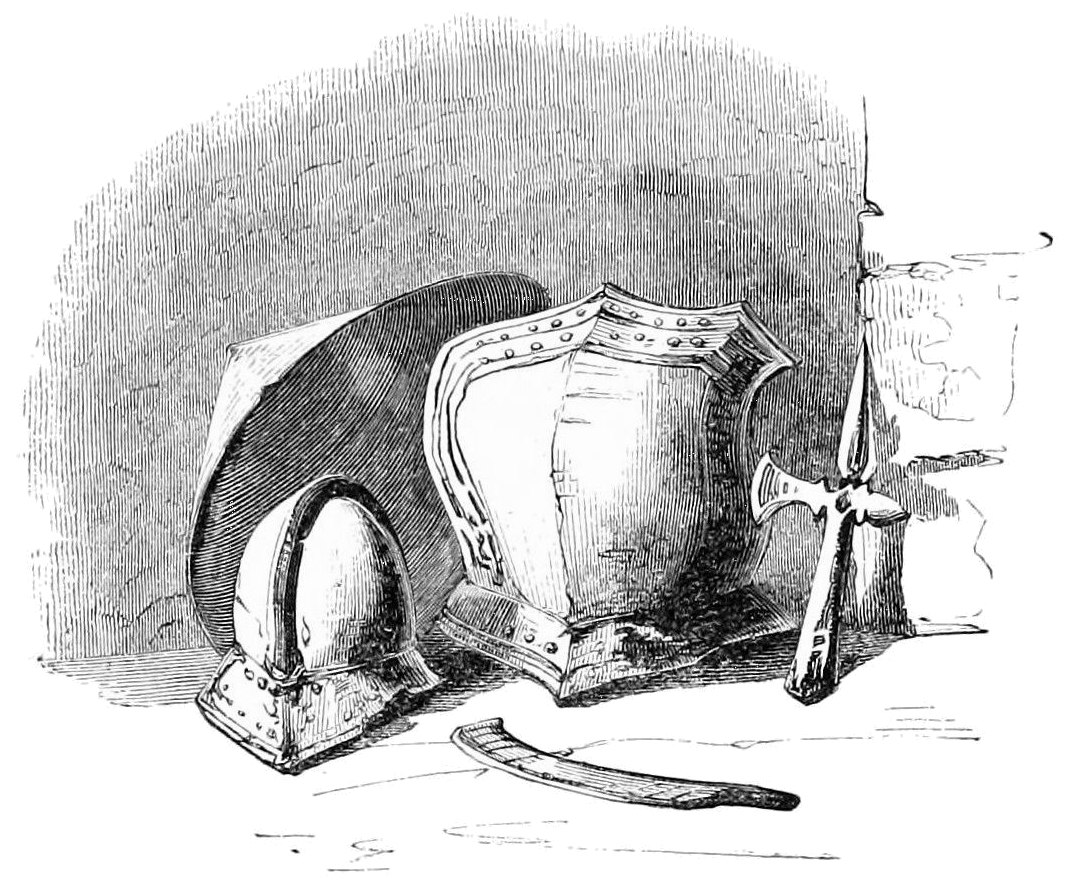
Ancient armour. [196]
Grose, in his ‘Antiquities,’ observes that this castle is of no great antiquity, having been founded, as he conjectures, about the close of the fifteenth century, although many important additions were subsequently added. In the time of Henry VIII., as Leland informs us, Raglan, “yn Middle Venceland [Wentland], was a fair and pleasant castel, with to goodlye parkes adjacent;” and “the laste Lord Herbertes,” as Morgan told him, “builded all the best coffes of the Castle of Raglan.” Camden, in his account of the Silures, or Monmouthshire, notices it very briefly, as “a fair house of the Earl of Worcester’s, built castel-like.”[197]
It is not stated by Grose on what authority he places Raglan Castle among the strongholds erected in the time of Henry VII. His observations can apply only to those portions of it which are comparatively modern. The Citadel, or Yellow Tower of Gwent, is of unquestionable antiquity. In the family history we are told that Sir John Morley, a military knight, who lived in the time of Richard II., resided here as ‘lord of Raglan Castle.’ But postponing this question at present, as one that will be considered more fully when we come to examine the Castle in detail, we shall merely observe that although, as it now appears, the Castle does not indicate any more distant origin than the reign of Henry V., yet traces may be discovered in various portions of towers built, or reconstructed, during every subsequent reign, down to that of Charles I.—with whose fate it is so painfully associated. Owing to the circumstance named, the learned antiquary may discover ‘a disunion of styles;’ but taken as a whole, the Castle of Raglan presents a remarkable harmony of proportions that hides every minute discrepancy, heightens the general effect, and leaves the spectator under a pleasing conviction that, in design and execution, it is the work, not of many, but of one master mind. But to this subject we shall return; and, in the meantime, we proceed to give a brief sketch of
The Founders of Raglan.—By Mr. Jones the name of the founder is traced to that of Sir William ap Thomas.[198] This date, however, is too modern, and only a repetition of the conjecture thrown out by Grose. There is every reason to believe that the Clares, as early as the thirteenth century, had a castle at Raglan, the site, of which is now occupied by the Citadel, or Tower of Gwent, erected probably in the reign of Henry V. The above-named Sir William ap Thomas resided at Raglan Castle during the reign of Henry V., who knighted him for his valour in the wars of France. He married Gladys, daughter of Sir Richard Gam, and widow of Sir Roger Vaughan,[199] by whom he had three sons and a daughter. Of his eldest son, William, first Earl of Pembroke, we shall speak hereafter. But of the old military Lords of Raglan, little of historical interest has descended to modern times. From Richard Strongbow, of whom a notice has been given in the preceding sketches of Chepstow and Tinterne, Raglan descended to Walter Bloet, “in consideration of soldiers, money, and arms,” furnished by him for the expedition to Ireland, of which Strongbow was the leader. By the marriage of the daughter and heiress of Bloet with Sir James Berkeley, it passed into and remained in that ancient family until the reign of Henry V., when it became vested in Sir William ap Thomas, already mentioned; whose eldest son was created by Edward IV. Lord of Raglan, Chepstow, and Gower, and commanded to assume the surname of Herbert, in honour of his ancestor Hubert Fitz-Henry, chamberlain to King Henry I. To this nobleman was entrusted the care of the Earl of Richmond, afterwards Henry VII., who was for some time a prisoner in Raglan Castle. Sir Hubert was created, in 1469, Earl of Pembroke, in acknowledgment of his zeal to the house of York; but his career was brief and disastrous, for having the same year raised a corps of Welshmen, he marched against the Lancastrians under the Earl of Warwick, and being taken prisoner at Dane’s Moor, was beheaded at Banbury on the 27th of July.[200] Of these calamitous events, the following account, abridged from the old Chronicle, may not be unacceptable to the reader:—
“King Edward hearing of these Northerne proceedings, and that his brother and Warwicke were preparing against him, sent for the Lord Herbert, whom he had created Earl of Pembroke, to be his general in the North; and therefore accompanied with Sir Richard Herbert his brother, and eighteen thousand well-furnished Welshmen, marched towards the enemy; and after him was sent Humfrey Lord Stafford, with sixe thousand archers, to second him in his warres. These lords meeting together had notice by espials that the Northerne made towards Northampton; to intercept whom, the Lord Stafford, lately made Earl of Devonshire, was employed; and Sir Richard Herbert, who with two thousand horse layd themselves covertly by the side of a wood, and suddenly set upon the rereward, the rest having passed; but the Northerne very nimbly turned about and bad the Welshmen such welcome, as few of them returned to tell of their entertainment. The king understanding of this hard beginning, mustered his subjects on every side, intending to cope with the Northerne himself. And Earle Warwicke, as forward to advance his fortunes, gathered his friends, with purpose to encounter with Pembroke and his Welsh. But before any supplies came to either of them, it chanced the armies to meete unawares upon a fair plaine called Dane’s Moor, neere to the towne of Hedgecot, three miles from Banbury, and presently fell to a bickering, wherein Sir Henry Nevill, knight, son of the Lord Latimer, upon a lusty courage venturing somewhat too farre, was taken prisoner; and notwithstanding he yielded himselfe to his takers, was cruelly slaine; which unmartiall act rested not long unrepaied, with the loss of most of the Welsh next day. For the field withdrawne, the Lord Stafford repaired to Banbury, and there took his lodging, where his affections were much enamoured vpon a faire damsell in the inne. But the Earl of Pembroke coming to the same towne, tooke into the same inne, and commanded the Lord Stafford to provide himself elsewhere, contrary to their agreements made before. Whereat Stafford was displeased, and departing thence with his whole band, left the Earl naked of men in the towne, and disabled the field of the archers, whereby the day was lost upon the king’s part, for which he shortly lost his owne head. The Northerne, inflamed for the death of young Nevill, the next morning most valiantly set upon the Welshmen, and by the force of archers drave them from their ground of advantage, which Pembroke wanting supplied with his own prowess; and Sir Richard, his brother, with his poll-axe twice made way through the battell of the Northerne without any mortal or deadly wound; so that by their valours it was verily supposed the field had been wonne, had not John Clapham, an esquire and servant to Warwicke, displayed his lorde’s colours with his white beare, and from an eminent place cried, ‘A Warwicke! A Warwicke!’ Whereat the Welsh were so terrified as they turned and fled, leaving their general and his brother alone in the field, who, valiantly fighting, were encompassed and taken, with the death of five thousand of their men. The Earl with his brother, Sir Richard Herbert, were brought to Banbury, where, with ten other gentlemen, they lost their heads, Conyers and Clapham being their judges.
“This second victory thus got, and the Northerne men now fleshed under the leadinge of Robbin of Riddesdale,[201] hasted to the king’s manor of Grafton, where the Earle Rivers, father to the queen, then lay, whom, with his sonne John, they suddenly surprised, and in Northampton strucke off their heads without any judgment. The death of these lords the king greatly lamented, and sought to revenge: first, therefore, writing his commissions for the apprehension of Humfrey, Lord Stafford of Southwicke, who, by diligent search, was found at Brentmarsh, and beheaded at Bridgewater, as he worthily deserved. Next hee prepared a mighty army, and with the same marched towards Warwicke, his company encreasing ever as he went.”[202] In another Chronicle the same disastrous events are thus related:—
“The Welshmen got first the West hill, hoping to have recovered the East hill; which if they had obteyned the victorye had been theirs, as their unwise prophesyers promised them before. The Northern men encamped themselves on the South hill. The Erle of Pembroke and the Lord Stafforde of Southwike were lodged at Banbery yᵉ day before yᵉ field, which was St. James’s Day; and there the Erie of Pembroke put the Lord Stafforde out of an inne wherein he delighted much to be, for the love of a damosel that dwelled in the house, contrarie to their mutuall agreement by them taken; which was, that whosoever obtained first a lodging, should not be deceyved nor removed. After many great wordes and crakes had betweyne these two captaynes, the Lord Stafforde in great despite departed with his whole companye and band of archers, leaving the Erle of Pembroke almost desolate in the towne, which with all diligence returned to his hoste lying in the field unpurvoyed of archers, abiding such fortune as God would sende and provyde.” In the mean time, “Sir Henry Nevil, son to the Lord Latimer, tooke with him certaine light horsemen, and skirmished with the Welshmen in the evening, even before their campe, where he did divers valyaunt feates of armes; but, a little too hardy, he went so farre forward that he was taken and yeelded, and cruell slaine; which unmerciful acte the Welshmen sore rued the next day or night. For the Northern men being inflamed, and not a little discontented with the death of thys nobleman, in the mornyng valyauntly set on the Welshmen, and by force of archers caused them quickly to descende the hill into the valey, where both the hostes fought.”
In this hot encounter, “the Erle of Pembroke behaved himselfe like a hardy knight, and an expert capitaine; but hys brother, Syr Richard Herbert, so valyauntly acquited himselfe, that with his poll-axe in his hand, as his enemies did afterwards report, he twice by fair force passed thorough the battaile of his adversaries, and without any mortal wound returned. If everye one of his felowes and companions in arms had done but halfe the actes which he that daye by his noble prowess achieved, the Northerne men had obteyned neither safetie nor victorie.”
The chronicler then relates the circumstance which threw the Welshmen into a panic, by which they lost five thousand men, and then records the result with touching simplicity:—
“The Erle of Pembroke, Sir Richard Herbert,[203] his brother, and divers were taken, and brought to Banbery to be behedded. Much lamentacion and no lesse entreatie was made to save the lyfe of Syr Richard, both for hys goodlye personage, which excelled all men there, and also for the noble chivalrie that he had shewed in the fielde the day of the battaile; insomuch that his brother, the Erle, when he should lay downe his head on the blocke to suffer, says to Sir John Conyers and Clapham—‘Maisters, let me die! for I am old; but save my brother, which is yung, lustie, and hardie, mete and fit to serve the greatest prince of Christendome.’
“But Coniers and Clapham remembering the death of the yung knight, Syr Henry Nevill, cosyn to the Erle of Warwicke, could not hear on that syde; but caused the Erle and his brother, with divers other gentlemen to the number often, to be there behedded.”[204]
William, eldest son of this unfortunate nobleman, succeeded to the earldom of Pembroke, and was retained by the king to serve him in his wars of France and Normandy for one whole year, with forty men-at-arms and two hundred archers. But the king, being desirous to dignify his son Prince Edward with the title of Earl of Pembroke, procured a resignation of the same from this William, and in lieu thereof created him Earl of Huntingdon, on the fourth of July, 1479. Four years later he was constituted, by Richard III., Justice of South Wales, and entered into covenants with the king to take Dame Catharine Plantagenet, his daughter, to wife, before the feast of St. Michael following; as also to make her a jointure in lands to the value of two hundred pounds per annum: the king undertaking to settle upon them and their heirs male, lands and lordships of a thousand marks per annum. But this lady dying in her tender years, it is likely that this marriage did not take effect. He afterwards wedded Mary, the fifth sister of Woodville, Earl Rivers, by whom he had an only daughter, at whose marriage with Sir Charles Somerset, the Castle of Raglan, and its dependencies, passed into the family of Worcester.
From the genealogical history of that house we collect the following particulars:—The Sir Charles here named was a natural son of Henry, third Duke of Beaumont, famous in his day for his desperate assault of the Castle of St. Anjou, in which he put three hundred Scots to the sword, and hanged all the Frenchmen therein. He was afterwards Governor of the Isle of Wight, and of Calais; was finally taken prisoner at the battle of Hexham, and there beheaded by Nevil for his adherence to the house of Lancaster. At his death his son Charles assumed the name of Somerset, and being a person of abilities attained to great wealth and honours under Henry VII.,[205] who entered him of his Privy Council, made him Constable of Helmsley Castle, Admiral of the Fleet, sent him as ambassador with the Order of the Garter to the Emperor Maximilian, made him a Banneret, Knight of the Garter, and Captain of the Royal Guard. On a second embassy to Maximilian, he concluded two treaties—gave a bond for the payment of £10,000 in aid of the Emperor against the Turks, and in support of the Christian religion. Living in high favour with his sovereign, his good fortune was established by his marriage with Elizabeth, heiress of William Herbert, Earl of Huntingdon, in whose right, in 1506, he bore the title of Lord Herbert of Raglan.
On the accession of Henry VIII. he continued in the same high offices; and having, with six thousand men, attended the king into France, in 1513, he was present at the taking of Therrouenne and Tournay. For his heroic conduct in this campaign, he received the office of Lord Chamberlain for life; and finally, on account of his descent from John of Gaunt, and alliance to the king by blood, he was advanced the following year[206] to the dignity of Earl of Worcester.
By his will, dated March 24, 1524, he ordered his body to be buried beside that of his first wife in the chapel of Our Lady, now called Beaufort Chapel, in the Castle of Windsor. He directed that, in case he departed this life at Raibo, in London, or near the river Thames, his body should be conveyed by water to the said church at Windsor, as privately as might be, without pomp or great charge of torches, or clothing, hearse, wax, or great dinner; but only that twenty men of his own servants should each have mourning and bear a torch; and that the bier, or herse, should be covered with black cloth, and have a white cross upon it.
Henry, the second Earl of Worcester, who, during his father’s lifetime, had distinguished himself in the king’s service, and been knighted by Charles Brandon, Duke of Suffolk, was appointed one of the commissioners for concluding a peace with the French. Departing this life in 1549, he was buried in the church of Chepstow, where a costly monument—already noticed—was erected to his memory.[207]
William, his eldest son, and third Earl of Worcester, accompanied the Marquis of Northampton into France, to present King Henry II. with the royal insignia of the Garter. And again, in 1573, he was sent by Queen Elizabeth as her representative at the christening of a daughter of Charles IX., on which occasion, in the name of his royal mistress, he presented a font in pure gold. He married Christian, daughter of Lord North of Earthlodge.
Edward, his only son and heir, was sent ambassador to the Court of Scotland, to offer the Queen’s congratulations to King James on his return from Denmark; and ten years later he was appointed Master of the Horse. At the accession of King James, he continued in the same office, and was also named one of the commissioners for executing the office of Earl-Marshall, the Duke of Norfolk being then under sentence in the Tower.[208] He was afterwards Lord Privy Seal; and dying on the third of March, 1628, ætatis 79, was buried in the family vault in Windsor Castle.[209]
In his youth, as recorded by his colleague Sir Robert Naunton, “this earl was a very fine gentleman, and the best horseman and tilter of his times, which were then the manlike and noble recreations of the Court, which took up the applause of men, as well as the praise and commendation of ladies. And when years had abated these exercises of honour, he grew then to be a faithful and profound counsellor. He was the last liver of all the servants of her favour, and had the honour to see his renowned Mistress, and all of them, laid in the places of their rest; and for himself, after a life of very noble and remarkable reputation, he died rich, and in a peaceful old age—a fate that befel not many of the rest; for they expired like lights blown out—not commendably extinguished—but with the snuff very offensive to the standers by.”[210] Sandford describes him as “a great favourer of learning and good literature.”
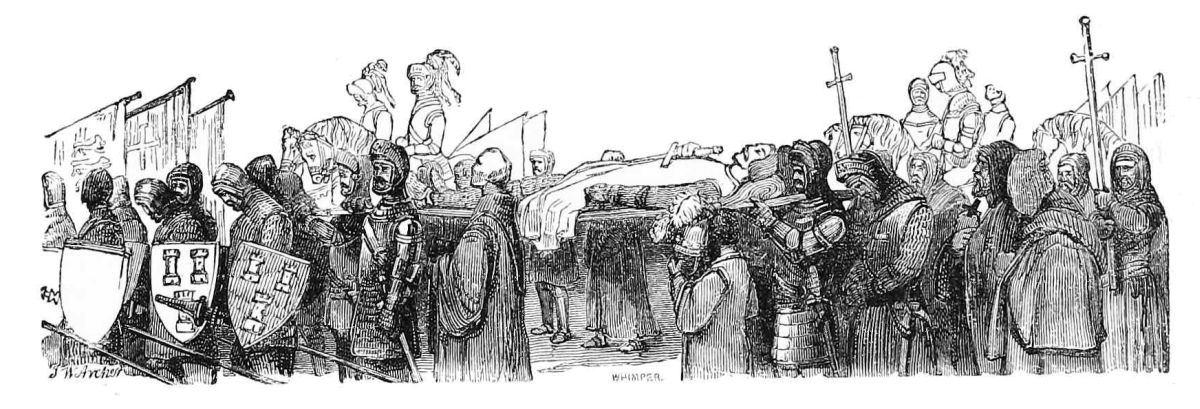
Procession.—Morning of the Tournament.
Henry, his son, the fourth earl, married Anne, daughter of John Lord Russell, heir apparent to the Earl of Bedford; and, in 1642, was created Marquess of Worcester. And this brings us down to the period, when the family fortunes—like the fortress they inhabited—were destined to undergo a lamentable change.
As the civil commotions increased, the Marquess fortified his castle of Raglan, and there entertained his Sovereign with unbounded magnificence. Such were his unlimited sacrifices to the royal cause, that the king, fearing lest the garrison stores should become exhausted by his numerous suite, offered to invest him with powers to exact supplies from the neighbouring country. But with great magnanimity Worcester replied—“I humbly thank your Majesty; but my castle would not long stand, if it leant upon the country. I had rather myself be brought to a morsel of bread, than see one morsel wrung from the poor to entertain your Majesty.” But of this more fully when we describe the royal visit and the Siege.
From these brief introductory notices of the lives and services of the primitive lords of Raglan, we proceed to give a few sketches of life, as it generally passed in the retirement of their own domains, in the midst of their friends and retainers at Raglan Castle.
Baronial Life.—Of the expenses of a nobleman’s family and household in the olden time, some idea may be formed by adverting to the facts adduced by writers of the day. In a letter from the Earl of Shrewsbury, who had the custody of Mary of Scotland, to the Marquis of Winchester, and Sir Walter Mildmay, it is said—“May it please you to understand, that whereas I have had a certain ordinary allowance of wine, amongst other noblemen, for expenses in my household, without impost: the charges daily that I do now sustain, and have done all this year past, well known by reason of the Queen of Scots, are so great therein, as I am compelled to be now a suitor unto you, that you will please to have a friendly consideration, unto the necessity of my large expenses. Truly two tuns in a month have not hitherto sufficed ordinarily; besides that which is sacrificed at times for her bathings, and such like use; which seeing I cannot by any means conveniently diminish, my earnest trust and desire is, that you will now consider me with such larger proportion in this case, as shall seem good unto your friendly wisdoms, even as I shall think myself much beholden for the same. And so I commit you unto God. From Tetbury Castle, this 15 of January, 1569. Your assured friend to my power.—G. Shrewsbury.”[211]
“This passage,” Mr. Lodge observes, “will serve to correct a vulgar error, relating to the consumption of wine in those days, which, instead of being less, appears to have been—at least in the houses of the great—even more considerable than that of the present time. The good people who tell us that Queen Elizabeth’s maids of honour breakfasted on roast beef, generally add, that wine was then used in England as a medicine, for it was sold only by apothecaries. The latter assertion, though founded on a fact, seems to have led to a mistake in the former; for the word apothecary [from the Greek αποθήχη, a repositorium] is applicable to any shopkeeper, or warehouseman, and was probably once used in that general sense.”[212] In the retinues and domestic attendance[213] of the nobles of this period, everything proclaimed that the era of feudal authority and magnificence had departed. Accordingly, when the civil wars had commenced, no peer, however wealthy or high in rank, could drag after him a regiment, or even a company, of unwilling vassals to the field. On the contrary, the meanest hind was free to choose between king and parliament. Something, however, of the mere pomp of feudalism was still maintained in the domestic establishments of the nobility and wealthier gentry. “The father of John Evelyn, when he was sheriff of the counties of Surrey and Sussex,[214] had a hundred and sixteen servants, in liveries of green satin doublets, besides several gentlemen and persons of quality, who waited upon him, dressed in the same garb.”
One of the largest, if not the very largest, of English establishments ever maintained by a subject, was that of the Lord Treasurer, the Earl of Dorset,[215] heir of the Lord Buckhurst, and well-known poet of the court. It consisted of two hundred and twenty servants, besides workmen attached to the house, and others that were hired occasionally.
The chief servants of the nobility—so they were called, but they were rather followers or clients—were still the younger sons of respectable, or even noble families, who attached themselves to the fortunes of a powerful patron, and served him either in court or military affairs, for which they were allowed separate retinues in men and horses, with gratuities in money, and promises of promotion.[216] The progress of improvement that had banished minstrels, jugglers, and tumblers, from princely establishments, had naturally introduced the drama in their room; and, accordingly, we sometimes find a company of actors classed among the servants of the chief noblemen, as well as a family physician, or even a whole band. A steward, distinguished by a velvet jacket, and a gold chain about his neck, presided as marshal of the household, and next to him was the clerk of the kitchen. But these cumbrous appendages were daily lessening, as domestic comfort came to be better understood. This improvement, however, had commenced still earlier among those of less rank and pretension. All who had their fortune still to seek in the court, or in the army, and all who repaired to the metropolis in quest of pleasure, found, so early as the time of Elizabeth, that the bustle and the scramble of new and stirring times, made a numerous train of attendants an uncomfortable appendage. The gallant, and the courtier, therefore, like Sir John Falstaff, studied “French thrift,” and contented himself with a single “skirted page,” who walked behind him carrying his cloak and rapier.[217]
In consequence of the extravagant living introduced during this period, the spendthrift gentleman often sank into the serving-man, as we may see from the frequent recurrence of such a transformation in the old plays. When servants were out of place—as we learn from the same authentic pictures of the real life of the times—they sometimes repaired to St. Paul’s Churchyard, the great place of public lounge, and there stood against the pillars, holding before them a written placard, stating their peculiar qualifications, and their desire of employment.[218]
“But whatever retrenchment,” observes the same author, “might be making in the household expenditure by a diminished attendance, it was more than counterbalanced by an extravagance in dress, and personal ornament, that had now become an absolute frenzy.” It is said that King James almost daily figured in a new suit, a humour that soon became prevalent among his courtiers. Still more generally influential than his own example was that of his several handsome favourites, all of whom having been indebted for the royal favour merely to their personal attractions, spared no pains nor cost to give those natural advantages their full effect.[219]
When Buckingham was sent ambassador to France, to bring the Princess Henrietta to England, he provided for this important mission a suit of white uncut velvet and a cloak, both set all over with diamonds, valued at eighty thousand pounds, besides a feather made of great diamonds. His sword, girdle, hatband, and spurs, were also set thick with diamonds. Another suit which he prepared for the same occasion, was of purple satin, embroidered all over with pearls,[220] and valued at twenty thousand pounds. In addition to these, he had twenty other dresses of great richness. As a throng of nobles and gentlemen attended him, we may conceive how their estates must have been impoverished by the purchase of chains of gold, ropes of pearl, and splendid dresses, befitting the retinue of such an ambassador. Even a court festival, of the time of James the First, must have made a perilous inroad upon a year’s amount of the largest income. Thus, at the marriage of the Princess Elizabeth to the Palatine, Lady Wotton wore a gown profusely ornamented with embroidery, that cost fifty pounds a yard; and Lord Montague spent fifteen hundred pounds on the dresses of his two daughters, that they might be fit to appear at court on the same occasion.[221]
The following letter—which we quote from a work of great merit and research—unfolds much of the domestic ‘economy’ and habits of a family of distinction during this reign. It is addressed to William, second Lord Compton, by his wife, soon after their marriage:—
“My Sweet Life—Now I have declared to you my mind for the settling of your state, I suppose that it were best for me to think and consider within myself what allowance were meetest for me. I pray and beseech you to grant to me, your most kind and loving wife, the sum of £2,600, quarterly to be paid. Also, I would, besides that allowance, have £600, quarterly to be paid, for the performance of charitable works; and these things I would not, neither will be, accountable for. Also, I will have three horses for my own saddle, that none shall dare to lend or borrow: none lend but I; none borrow but you. Also, I would have two gentlewomen, lest one should be sick, or have some other let. Also, believe it, it is an undecent thing for a gentlewoman to stand mumping alone, when God hath blessed their lord and lady with a large estate.
“Also, when I ride a hunting or a hawking, or travel from one house to another, I will have them attending; so for either of these said women, I must and will have for either of them a horse. Also, I will have six or eight gentlemen; and I will have my two coaches, one lined with velvet to myself, and four very fair horses; and a coach for my women, lined with cloth and laced with gold; otherwise with scarlet, and laced with silver; with four good horses. Also, I will have two coachmen, one for my own coach, the other for my women.
“Also, at any time when I travel, I will be allowed not only caroches and spare horses for me and my women; but I will have such carriages as shall be fitting for all; orderly, not pestering my things with my women’s; nor theirs with either chambermaids; nor theirs with washing maids.
“Also, for laundresses, when I travel, I will have them sent away before with the carriage, to see all safe. And the chambermaids I will have go before, that the chamber may be ready, sweet, and clean. Also, for that it is indecent to crowd up myself with my gentleman-usher in my coach, I will have him to have a convenient horse, to attend me either in city or country. And I must have two footmen. And my desire is that you defray all the charges for me.
“And for myself, besides my yearly allowance, 1 would have twenty gowns of apparel, six of them excellent good ones, eight of them for the country, and six other of them very excellent good ones. Also, I would have, to put in my purse, £2,000 and £200, and so you to pay my debts. Also, I would have £6,000 to buy me jewels, and £4,000 to buy me a pearl chain. Now, seeing I have been, and am, so reasonable unto you, I pray you do find my children apparel and their schooling; and all my servants, men and women, their wages.
“Also, I will have all my houses furnished, and my lodging-chambers to be suited with all such furniture as is fit; as beds, stools, chairs, suitable cushions, carpets, silver warming-pans, cupboards of plate, fair hangings, and such like. So, for my drawing-chambers, in all houses, I will have them delicately furnished, both with hangings, couch, canopy, glass, carpet, chairs, cushions, and all things thereto belonging.
“Also, my desire is that you would pay your debts, build up Ashley House, and purchase lands: and lend no money, as you love God, to my Lord Chamberlain, who would have all—perhaps your life—from you.... So now that I have declared unto you what I would have, and what it is that I would not have, I pray you, when you be an earl, to allow me £2,000 more than I now desire, and double attendance.”[222]
Prodigality in feasting and riotous living soon became as conspicuous as extravagance with regard to dress. In proof whereof, we may mention the ante-suppers of the epicurean Earl of Carlisle. Weldon informs us, that he gave a banquet to the French ambassador at Essex House, where fish of such huge size were served up, and which had been brought all the way from Russia, that no dishes in England could hold them, until several were made for the express purpose. The household expenditure of James the First was twice as much as that of his predecessor, amounting to a hundred thousand pounds annually.[223]
Country Life.—While such were the habits of the courtiers, the country aristocracy still followed that kind of life so much familiarized to our minds by the descriptions in the old songs and plays of “the golden days of good Queen Bess.” The rural knight, or squire, inhabited a huge building—half house, half castle—crowded with servants in homespun blue coats, many of whom were only serviceable in filling up the blank spaces of the mansion; but as these had been born in his Worship’s service, it was held as a matter of course that they should live and die in it.
“The family rose at daybreak, and first of all assembled at prayers, which were read by the family chaplain. Then came breakfast; after which the master of the household and his sons got into their saddles, and went off to hunt the deer, followed by some score of mounted attendants; while the lady and her daughters superintended the dairy, or the buttery, prescribed the day’s task for the spinning-wheels, dealt out bread and meat at the gate to the poor, and concocted all manner of simples for the sick and infirm of the village. If leisure still remained, the making of confections and preserves was a never-failing resource; independently of spinning and sewing, or perhaps embroidering some battle or hunting piece, which had been commenced by the housewives of a preceding generation.”
At noon dinner was served up in the Great Hall, the walls of which were plentifully adorned with stags’ horns, casques, antique brands, and calivers. The noisy dinner-bell, that sent the note of warning over the country, gave also a universal invitation and welcome to the hospitable board; and after dinner sack, or home-brewed ‘October,’ occupied the time until sunset, when the hour of retiring to rest was at hand.
Such was the ordinary history of a day in the country mansion. When the weather prevented out-door recreation or employment, the family library, containing some six or eight tomes, that had perhaps issued from the press of Caxton, or Wynkyn de Worde, was in requisition; and, if the members of the family could read, they might while away the hours in perusing these volumes for the twentieth time. In this fashion, they derived their knowledge of religion from the Bible, and the “Practice of Piety;” their Protestantism and horror of Popery from “Fox’s Acts and Monuments;” their chivalrous lore from “Froissart’s Chronicles,” or, perchance, the “Merry Gests of Robin Hood;” their historical erudition from “Hall” or “Hollingshed;” and their morality and sentiments from “the Seven Wise Masters,” or the “Seven Champions of Christendom.”[224]
Holidays.—In such a state of life the set holidays were glorious eras; the anticipation, the enjoyment, the remembrance of a single Christmas or birthday, furnished matter for a whole month of happiness. On such an occasion the lord of the manor was more than a king, as he proceeded with his family through the crowds of assembled peasants, to witness their games of merriment, and feats of agility or strength; for his smile inspired the competitors with double strength or swiftness; while the prize acquired a tenfold value because it was he who bestowed it. At evening, his bounty was expressed by oxen roasted whole, and puncheons of mighty ale, with which he feasted the crowd; while his house was thrown open to the throng of his more immediate acquaintances and dependents. After the feast, his hall was cleared for dancing; three fiddlers and a piper struck up; and as the “mirth and fun grew fast and furious,” the strong oaken floor was battered and ploughed in all directions by the hobnailed shoes of those who danced with all their might, and with all their hearts.[225]
Such was the life of an old country gentleman when James succeeded to the crown of England. But these habits, the last relics of the simplicity of the olden times, did not long survive that event. Tidings of the gay doings at court, and the wonderful good fortune of the royal favourites, reached the ears of the aristocratic rustics; and from that moment rural occupations and village maypoles lost their charm. The young were impatient to repair to the metropolis; and the old were obliged to yield to the prevailing fashion. With all the fierce impetuosity of novices, rural esquires, and well-dowried country widows, rushed into the pleasures and excesses of a town life; and thus, with a rapidity hitherto unknown in England, and at which moralists became giddy, ancient manners were soon abandoned; fortunes, that had accumulated for generations, vanished; the hereditary estates of centuries became the property of men of yesterday; and the time-honoured names of some of the most ancient families disappeared from the scroll of English heraldry, and soon ceased to be remembered.[226]
When Charles came to the throne, “the coldness of his character and his decorous habits discountenanced those coarse and profligate excesses; and the courtiers endeavoured to conform to something like the rules of external decency. A general sobriety of demeanour succeeded.” “But, as the stern ascetic Puritans grew into power, and advanced to the destruction of the monarchy with prayer and fasting, the court party soon became eager to distinguish themselves by an entirely opposite behaviour. All the excesses of the former reign were resumed; and Charles found himself unable to restrain, or even to rebuke, his adherents, who swore, drank, brawled, and intrigued, to show their hatred of the enemy, and their devotedness to the royal cause.”[227]
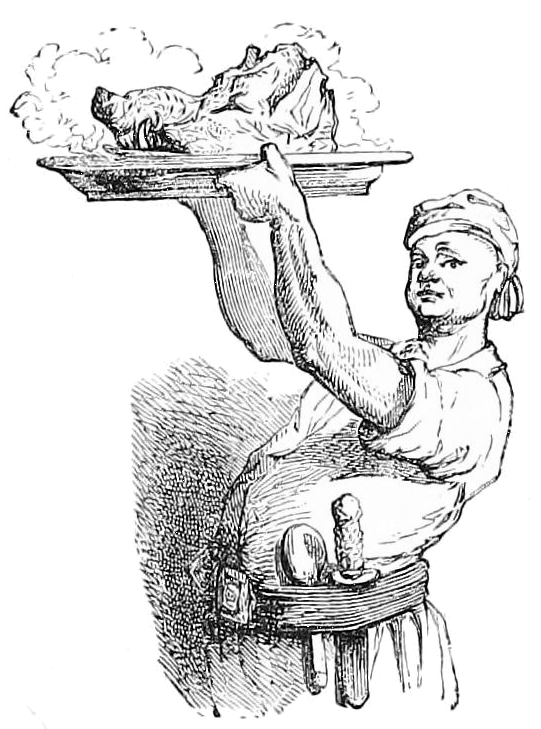
Life at Raglan.[228]—Down to this eventful period, the castellated mansion of Raglan had continued to bask in the sunshine of prosperity. Its halls were frequented by the elite of rank and station, and by many of that intellectual aristocracy whose genius threw so much lustre upon that and the preceding reign. The Earl, whose revenues were princely, lived in a style becoming the representative of an illustrious race; and while he observed great state, and gave sumptuous banquets to the magnates of the land, he did not neglect the humble votaries of the Muse.
Household.—The following record is taken from a “List of the Household and method of living at Raglan Castle,” previous to the visit of Charles the First:—
“At eleven o’clock in the forenoon the castle gates were shut, and the tables laid—two in the dining-room; three in the hall; one in Mrs. Watson’s apartment, where the chaplains eat (Sir Toby Matthews being the first); and two in the housekeeper’s room for the ladies’ women.
“First.—The Earl entered the dining-room, attended by his gentlemen. As soon as he was seated, Sir Ralph Blackstone, steward of the house, retired. The comptroller, Mr. Holland, attended with his staff, as did the sewer, Mr. Blackburne; the daily waiters, Mr. Clough, Mr. Selby, Mr. Scudamore; and many gentlemen’s sons, with estates from two hundred to seven hundred pounds a year, who were bred up in the castle; my lady’s gentlemen of the chamber, Mr. Morgan and Mr. Fox. At the first table sat the noble family, and such of the nobility as came there.
“Second.—At the second table in the dining-room sat knights and honourable gentlemen attended by footmen.
“Hall.—In the hall, at the first table, sat Sir Ralph Blackstone, steward; the comptroller, Mr. Holland; the secretary; the master of the horse, Mr. Dolowar; the master of the fish-ponds, Mr. Andrews; my Lord Herbert’s preceptor, Mr. Adams; with such gentlemen as came there under the degree of a knight, attended by footmen, and plentifully served with wine.
“Second Hall.—At the second table in the hall—served from my lord’s table, and with other hot meats—sat the sewer, with the gentlemen waiters and pages, to the number of twenty-four.
“Third.—At the third table, in the hall, sat the clerk of the kitchen, with the yeomen officers of the house, two grooms of the chamber and others.
“Other Officers of the household were—chief auditor, Mr. Smith; clerk of the accounts, George Whithorn; purveyor of the castle, Mr. Salisbury; ushers of the hall, Mr. Moyle and Mr. Cooke; the closet-keeper; gentleman of the chapel, Mr. Davies; keeper of the records; master of the wardrobe; master of the armoury; master-grooms of the stable for the war horses, twelve; master of the hounds; master falconer; porter, and his man; two butchers; two keepers of the home park; two keepers of the red deer park; footmen, grooms, and other menial servants to the number of one hundred and fifty. Some of the footmen were brewers and bakers.
“Out-officers were—the steward of Raglan, William Jones, Esq.; the governor of Chepstow Castle, Sir Nicholas Kemys, Bart.;[229] housekeeper of Worcester House, in London; James Redman, Esq.; thirteen bailiffs; two counsel for the bailiffs to have recourse to; solicitor, Mr. John Smith.”[230]
Among other distinguished individuals, who at this time filled offices in the household of Raglan, was the Earl’s—and soon afterwards the Marquess’s—chaplain, Dr. Thomas Bayly; to whom we owe those amusing “Apophthegms of the Marquess of Worcester,” published at the Restoration, and from which we take the following farce, in the chaplain’s own words, as presenting a characteristic picture of the times, when the Castle had become the scene of extraordinary festivity:—
“I cannot tell whether it was upon the marriage of my Lord Edward Herbert with the Earl Caernarvon’s sister, or the Lord Montague with the Marquis of Worcester’s daughter, that there happened this merrie passage, or mock wedding, as an echo to the voices that were heard in Hymeneus’ chappel, between those lovely couple—think which you please—who had newly left being wholly themselves, by being half of each other; viz., one of those two pair of lovers had no sooner united two hearts into one, and had seated themselves by one of the too many proprieties belonging unto the honourable state of matrimony, viz. the boord; but this Tom Deputy, an old bachelour, chanced to cast his eye upon a pretty piece of waiting-woman, one of the appurtenances to this honourable bride. Her, this jovial Tom, having whetted his wit by the side of the marriage-bowle, fixes upon, being enabled sufficiently thereby to follow any humour, as a fit subject to make their ladiships some sport; which happened to be so suitable to the occasion, and so well performed, that it soon captivated the cares also of all the masculine nobility.
“Thus encountering the faire bride—‘Madam, you have the prettiest piece of necessity yonder, at the side-table, that I know not how any man can be without a wife that may have her for asking. Madam, will you give her me? I protest I will marry her, and fancy myself to be a lord, and herself a lady. “My mind to me a kingdom is;” which shall make her a sufficient joynture.’
“‘Tom, Tom,’ said the Marquess, ‘such men as you and I, whose joynts are enfeebled with the strokes of many years, must not think to winne young maides, by promising to make them joyntures of the mind. But will you make her deputy of Deputy Hall? and landlady of all the land that is belonging to it? and Mrs. of all the stock that is upon the land, and goods that is within the house? Answer me this, and then you shall heare what my daughter and her woman will say unto you.’
“‘With all my heart,’ said Tom; ‘and all the hoggs and poultry that is about the house to boote; and she shall sleep upon six feather beds.’
“‘Why, then, it shall be a match,’ said the lady, ‘with all my heart.’
“‘Give me your hand, madam,’ sayes Deputy; ‘I will have her, if there be no more evills in the world.’ And presently he makes his addresses to the pritty little gentlewoman of the said table; who had heard all the discourse, and was persuaded, then, upon his approach, to answer his humour with a condescention at the first word, and informed that he was an old rich bachelor; he accosting her after this manner—‘This pritty moppit, now thy lady hath given her consent that I shall have thee, if thou saist so too, we’ll be married as soon as they.’
“‘With all my heart, and thank you too,’ said the young gentlewoman.
“‘By my troth, a match,’ said he; ‘give me thy hand—‘tis done. I’ll break such a jest this day as I never broke in my life.’
“‘Aye; but do not break your promise,’ said the gentlewoman.
“‘What! before all this company?’ said Deputy; ‘that were a shame.’
“Up he goes again to the lady, and tells her that they were agreed. My lady drank to him upon the same condition. He pledged her, and wished the wine might be his poison if he did not marry her after dinner. The lady, willing to prefer her woman to such a fortune, held him to his word, and required performance of his promise, giving her many and high commendations.
“Tom went not from any part of his promise, onely the time excepted; and that in regard he meant to buy himself some wedding clothes. The Marquess, willing to remove that obstacle, told him that he thought his clothes would fit him; and bid him goe unto his wardrope, and take what he had a mind to. ‘Give me your key,’ said Tom. It was delivered unto him. Up went he, and then came down with his bever hat, sattin cloke, laid with plush, dawb’d with a gold and silver lace, suite of the same, silk stockings, with roses and garters suitable, inside and outside, capope, all as brave as if he carried a lordship on his back.
“The lady-bride then takes her woman aside, and dresses her in one of her richest and newest gownes—that should have made every day of that week sensible of an exchange—with all things answerable thereunto; not without some store of slight jewels; and brings her down, as glorious as the morne, that breaks from the eastern hill, and chases night away.
“They look upon one another, and all upon them both. Tom cries out, ‘I had best be in good earnest, my lady.’ Said my lady, ‘I thought you had been in sober sadness.’ ‘Neither, madam,’ said the new bridegroome. ‘But, old Tom, I hope,’ said the lady, ‘you will not make me take all this paines for nothing?’ No, by no means,’ saith he; ‘if ever we repent, we will sell our fine cloathes and buy cattle! It is better being a lord for a week, than a slave for ever. Come thy wayes,’ quoth he—
‘How happy is the wooing That is not long a doing!’
“Well—married they were, in the greatest pomp and ceremony; and the Queen of Beauty took delight in leading the eyes of the vulgar, which by this time were altogether fixed on the ladye of the May. Tom acted his scene of mirth in the hall—which proved to be a thing of that convenience, as if it had been an act of some set policie, to keep the crowd out of the parlour that the masquers might have roome enough to dance in.
“At last, when the masque was ended, and time had brought in supper, the ‘Cushine’ led the dance, out of the parlour into the hall, and saluted the old-new-made bridegroome and his lady, leading them into the parlour, to a table which was furnished with the same allowance that was allotted for all the nobles, where they were soon forced to sit down first—Tom taking upon him as much good cheer as they could give him.
“In fine, supper being ended, the Marquess of Worcester asked the Lady-bride, ‘If she had a hundred pounds about her?’ She answered, ‘No, my lord, but I can send for as much.’ ‘I pray do,’ said the Marquess; ‘but it must be all in gold.’ She sent for it, and presented it to her father; who pulled out another purse of an hundred pieces, and put the two hundred pieces in the bason, saying, ‘Madam, if you do not give earnest, Deputy will tell you in the morning, that he married your woman but in jest.’ Whereupon some gave fifty, others forty; some gave twenty, others ten; the least gave five gold pieces, who sat at the table—in all, £700. The apparel and other gifts, amounting to no lesse a value than one thousand pounds; which so transported the old man, that he protested, ‘that now he was in the humour, he would marry all the waiting gentlewomen they had; one every day in the week, as long as the wedding lasted.’ My Lord Marquess replied, ‘Ay, but Tom, you should have added, “at this rate.”’...
“Not to be too tedious, the man—what with bounty, and what with that which was as free to every man, as was their purses unto him, which was good wine—the man was not himself when he should have gone to bed. Which being related to my lord, his lordship took occasion to tell the company the story of the beggar, who was made believe he did but dreame of the happiness which really happened; and, thereupon, the marquess was desirous to make experiment whether it could be related in the person of old Thomas. In order whereto, he gave command that my friend Thomas should be disrobed of his neat wedding garment, the rest of his fine clothes taken from him, and himself carried unto his old lodging in the porter’s lodge; and his wife to respite the solemnisation of the marriage, until his comportment should deserve so faire an admission—the which was done accordingly.
“The next morning made the experiment to answer the height of all their expectations; for news was brought unto the Marquess—all the rest of the lords and ladies standing by—that Tom took all yesterday’s work but for a dream; or, at least, seemed to do so to humour the fancy.... But I should be endlesse,” says Bayly, “if I should relate unto you the sport that this fellow made.
“To conclude: The Marquess called them both before him, and delivered unto them the money, with many good exhortations to them both, thus moralizing upon the premises”—in a strain very characteristic of that day:—
“‘That which was first in intention, is oftentimes, both with God and man, the last in execution. As, for example, God had, before all worlds, determined to show his love for mankind, by wedding his onely Sonne to his Church; so
The Paved Stone Court.
Raglan Castle.
that thus much we have gained already, viz., that the marriage that was made in paradise between Adam and Eve, though it was the first in time, yet it was but secondary to the first intention; and he that said, “Before Abraham was, I am,” was also before Adam was; and though the first marriage was but a type of the second, yet the second, according to the aforesaid intention, was an antecedent to the first. God, who having an intention to wed his Sonne to his beloved spouse, the Church, gave way to this type, or figure, or—to bring the similitude a little homer—mock-wedding, which was between Adam and Eve, whom to make appear more worthy and glorious in the eyes of his beloved, and all other creatures, he arrayed with full majesty, and the robe of righteousness. His mercy—the lady and empress of all the glorious attributes of God—arrais this type and figure of his Church with the robe of innocence, and gives them both a large proportion of his grace. These blessings, Adam, by tasting the forbidden fruit, lost with his paradise, and slept in death. Gentlemen,’ concluded the Marquess, ‘I will not make any application hereof, lest I may seeme to mistrust your wisdomes; but I have nothing to say to the woman.’”[231]
The preceding is certainly a very curious passage in the history of
A potent, grave, and reverend signior.
It reminds one of some parts of Don Quixote and of Rabelais—all but the sermon at the close—which may have been imitated from one of the old “Mysteries” then in vogue. But to these “Apophthegms” and Dr. Bayly, the “martial chaplain” of the household, we may return in a subsequent portion of the work. In the meantime, we shall take a survey of Raglan Castle, as it now appears, and then proceed to a narrative of the Royal Visits.
Architectural Details.—Of the strength, beauty, and attractions of this stronghold—which we are now to examine with some degree of minuteness—a quaint old poet[232] has thus recorded his admiration:—
A famous Castle fine That Raglan hight, stands moated almost round; Made of free-stone, upreight, as straight as line, Whose workmanship in beauty doth abound, With curious knots, wrought all with edged tool: The stately Tower that looks o’er pond and poole; The fountaine trim, that runs both day and night, Doth yeald in shew a rare and noble sight.
This description, of course, applies to times long before the guns of Fairfax had made a breach in the Yellow Tower; and while the Castle, with all its regal appendages, was the cherished abode of its illustrious owner—a repertorium of the fine arts, and the seat of unbounded hospitality. At no period of its history, however—not even while it was inhabited by worth and beauty, enriched with the precious works of art, and seemed to enclose within its walls an earthly paradise—at no period did it ever present so many features to fascinate the mind and eye of Taste as at this moment.
And “Why is it”—inquires one of the ablest writers of the day—“Why is it that we feel so poetical a sympathy with the great men of ages long past? Why do castles please most when they are dismantled, and palaces when they are in ruins? Why is an old battle-field rather improved than otherwise by a crop of standing corn? Because we can imagine nobler things than we can see. Because the heroic deed, not vile flesh and blood, is the impersonation of the hero. We should be rather displeased at meeting the Iron Duke walking to a pedometer on the field of Waterloo. We would doubt whether on the plain of Marathon we could be reconciled even to the ghost of Miltiades. Greatness shines more brightly when it is abstracted from the man.”
We will now, as proposed, take the building in detail, beginning with the grand entrance, and proceeding onward, until we have completed the circuit of the walls, the inner apartments, battlements, terraces, and outworks. On these prominent features we shall dilate with more or less minuteness according to the interest of the subject—but always directing the reader’s attention more especially to those portions which have been chosen as subjects of illustration.
Grand Entrance.—Here a magnificent and imposing spectacle bursts upon the eye—three pentagonal towers, crowned with battlements, and bearing on their mutilated outline marks of the cannon-shot directed against it by the besiegers. These, however, are less defaced than any other portions of the ruin, and are now invested with a luxuriant mantle of ivy, lichen, and parasitical plants, as if Nature interposed to protect the venerable edifice from further outrage and decay. In the gateway are grooves for two portcullises. The two pentagonal towers on the right and left were appropriated to the inferior offices of the castle. Immediately behind these were rooms occupied by the garrison, or household troops. Adjoining these on the right, was the third pentagonal tower, called the Closet Tower; and on the left again were the officers’ apartments, which were demolished during the operations of the siege.
Gateway.—Between the two foremost of the pentagonal towers, above-named, the great portal—a work of imposing strength and fine gothic proportions—opens into the second court. Halting under the archway, the curious visitor will examine, with mingled pleasure and surprise, the fine architectural details; the groined ceiling; its lofty span; its fine proportions, in which grace, strength, and beauty are eminently combined: while the deep grooves, worn smooth by the working of the double portcullis, show how readily this hospitable gateway could be transformed, when occasion required, into an impenetrable barrier, and employed as a destructive engine of war. The old apartments in the gateway tower are correctly represented in the following woodcut—
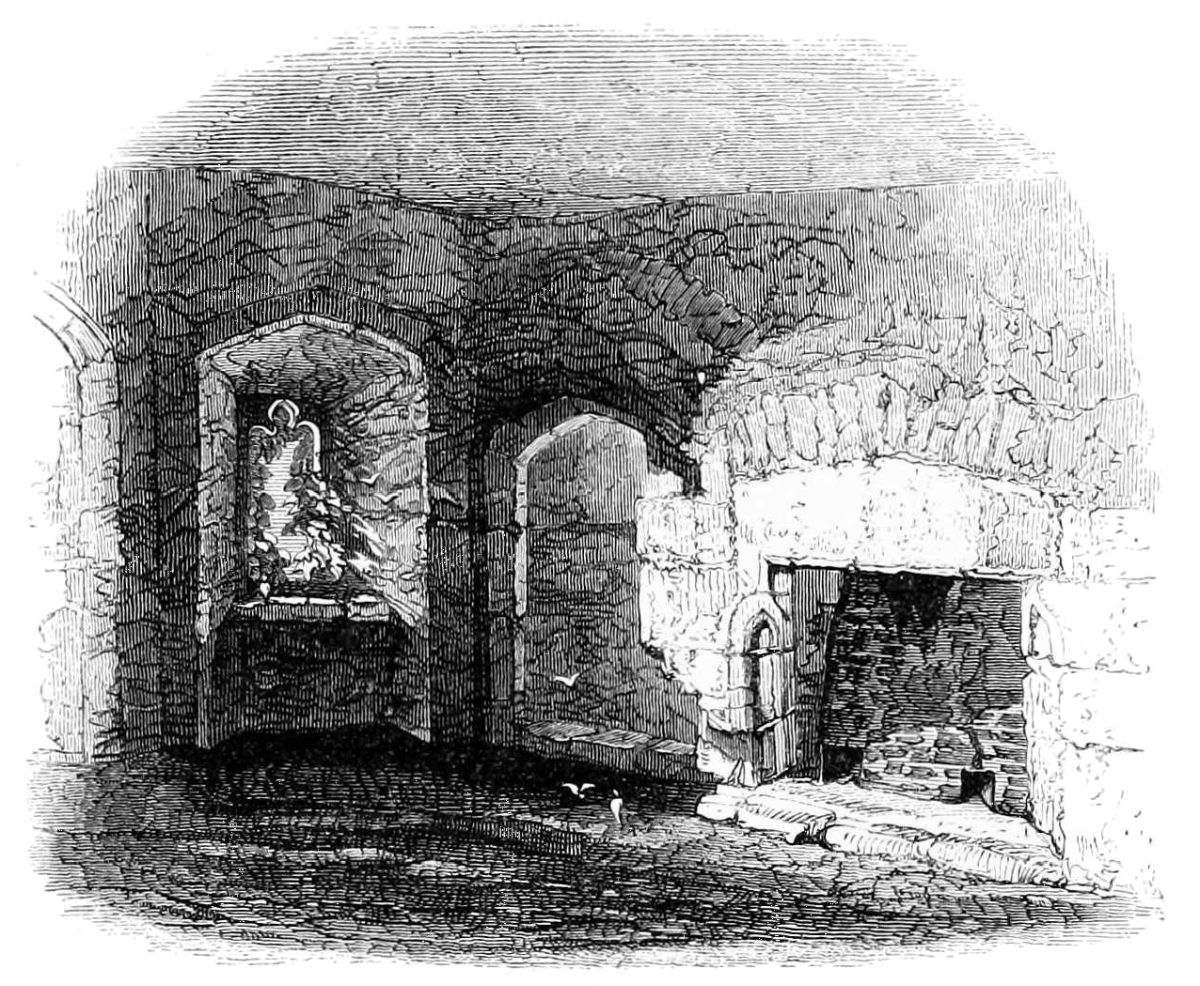
In a vaulted room in the east tower there is a remarkable echo; and thither musical parties frequently resort during the fine season to spread their pic-nic, and exercise their vocal powers. This apartment is considered to have been the prison to which captives, or hostages of distinction, were formerly consigned;[233] and certainly no place in the Castle presents an air of more “hopeless security.” In the court below—as represented in a former woodcut—several pieces of ancient armour, and some heavy cannon shot, are shown to the visitor, as illustrative of the times to which they belong. The next compartment is
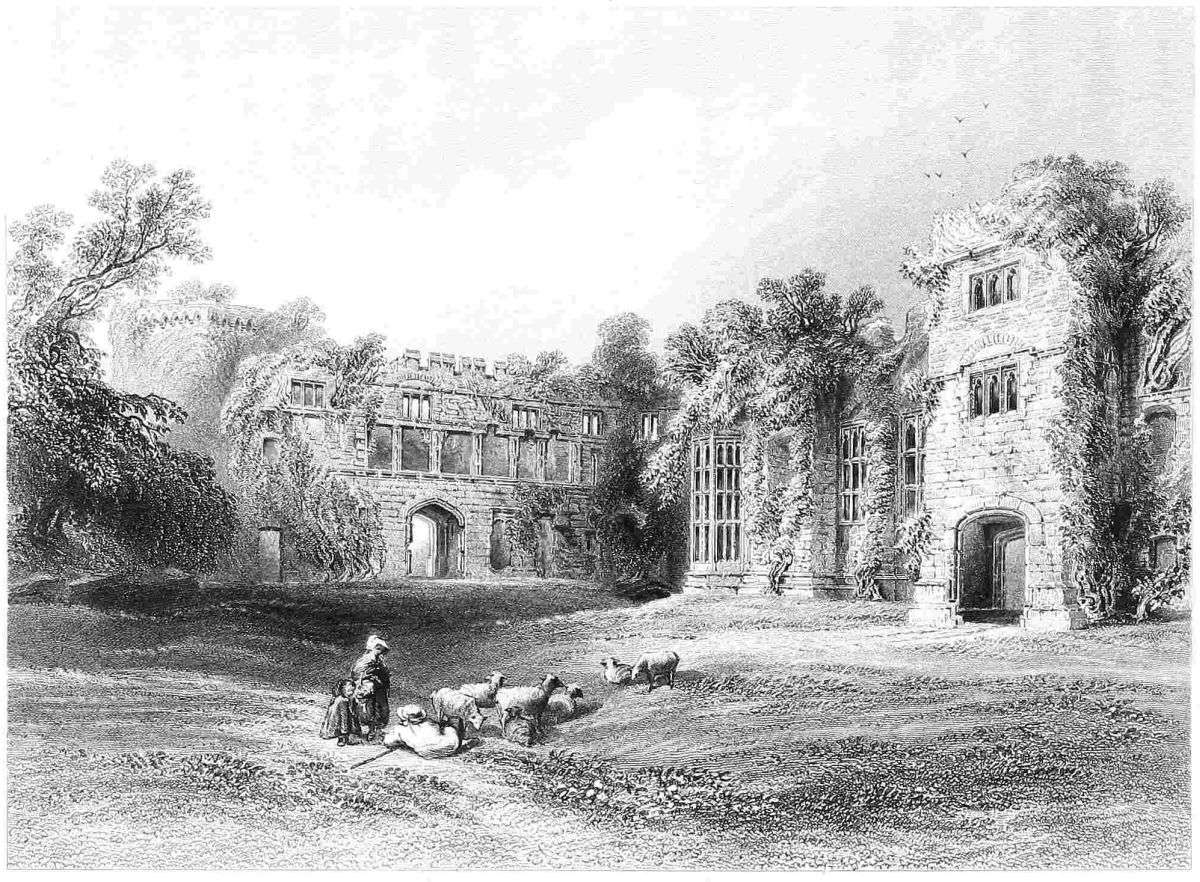
The Paved Court.—All the buildings on the right of this court, particularly the Closet Tower—the third pentagonal tower at the entrance—suffered greatly from the enemy’s cannon during the siege; and here, on the north-east side of the wall, the breach was effected that hastened the capitulation. The Pitched, or Paved Court, the area of which was once the parade ground, thronged with armed men, as they joined in some military fête, or entered on some warlike preparation for the siege, is now surrounded by only crumbling walls, and as verdant as a bowling-green. The towering battlements are all richly festooned with ivy. Every crevice sends forth its trees and shrubs, that seem to luxuriate in the old mortar; and under the same canopy of leaves, as already noticed, birds of song and birds of ill omen congregate together. At the extremity of the Paved Court, on the right, as we proceed westward, and from the point marked by a seat under a shady ash-tree, the visitor obtains an imposing view of the architecture on the south side, which, with all its dilapidations, is eminently picturesque. “Its boundary is there hung with the richest tapestry that Nature can weave—a mantling vestment of evergreen—through which appears, in grand proportions, the majestic window of the Hall of State.” This is a prominent feature in the steel engraving.
The Kitchen.—At the extremity of the court, and opposite to the portal, is an archway leading to the kitchen, which occupies the area of a pentagonal tower, projecting beyond the walls northward, and of narrow compass, but great solidity and strength. In an office adjoining is an extensive fireplace, the arch of which, thirteen feet in the span, is formed by two massive stones. The wide capacious chimney is worthy of notice. Beneath the kitchen is a room in perfect preservation, called the Wet Larder, which may be easily reached by a subterranean passage. From the kitchen a passage leads southward across the lower end of the Pitched Court to the Buttery, and this again to the common
Dining-Hall, or Parlour.—This apartment measures forty-nine feet in length by twenty-one in breadth, with an opening at the east end into a narrow cross passage, which also communicates, by three openings or doors, with the great Hall, which lies between the Pitched Court and the Chapel, and occupies nearly the whole space between this dining-hall and the Officers’ Tower, at the great entrance. Adjoining these is the
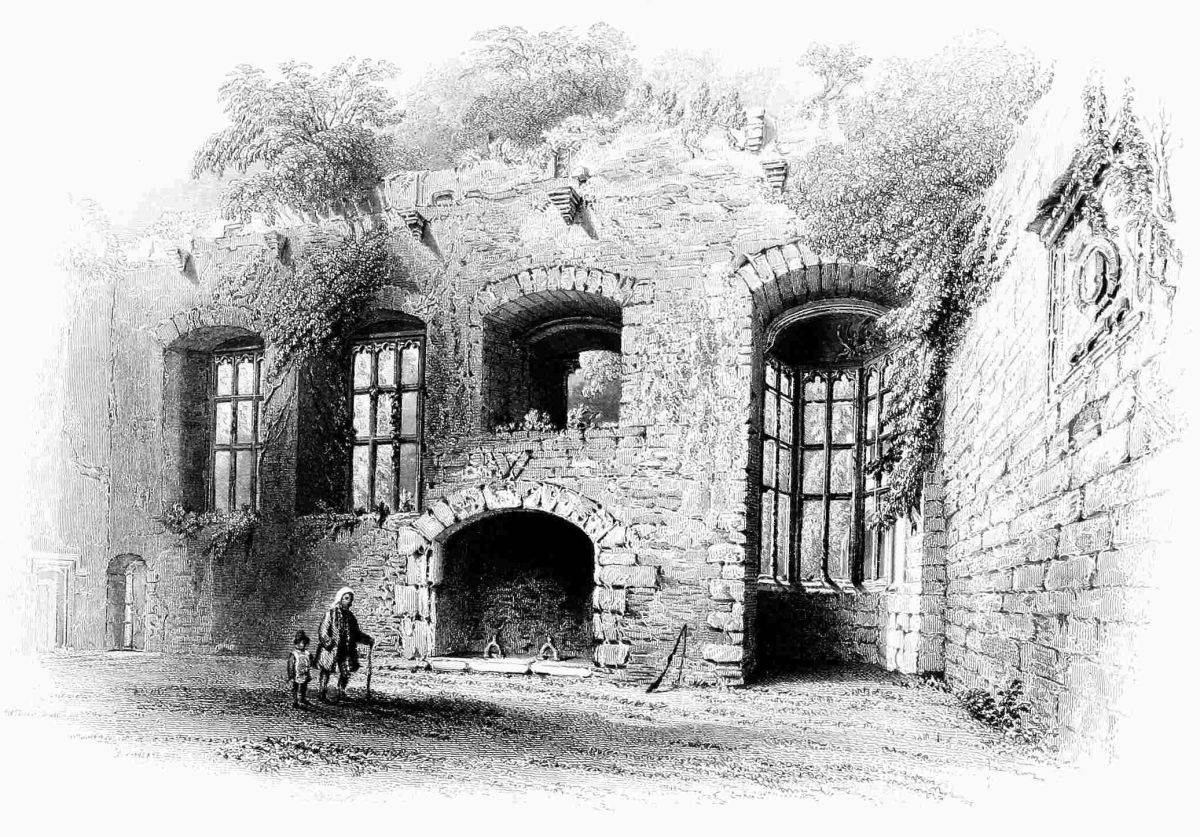
Baronial Hall.—This stately apartment, running parallel with the ancient chapel, occupies the interval between the two inner courts, and measures sixty-six feet in length by twenty-eight in breadth. The chief indications of its original grandeur consist in the majestic proportions—all of elegant design and masterly execution. The great bay-window is a feature that cannot fail to excite admiration; and were no other left entire, it would serve to convey a very distinct picture of that feudal magnificence which was in character with the splendour of its architecture. The fireplace, ten feet wide by eight feet high, is well adapted to the size of the apartment, and to those times when, instead of pit-coal, the branches or bole of a tree blazed on the winter hearth.
Arms.—The arms of the Marquisate of Worcester, cut in stone, but much obliterated, adorn the eastern wall; for the noble badge was an offensive object to the republicans; and, on their taking possession of the castle, it was probably
The Baronial Hall.
Raglan Castle.
used as a target,[234] and thus wantonly defaced. Over the fire-place, as shown in the engraving, is the letter W. worked in brick.
Roof.—The geometrical roof, which once covered this noble hall, is allowed by all writers on the subject to have been of admirable construction. It was of Irish oak of the best quality, nicely adjusted, elaborately carved, and so ingeniously framed and fastened together, that the whole appeared as firm as if it had been chiselled out of a solid block; yet withal so lofty, so light and airy in appearance, that it seemed rather to be suspended from the sky above, than to rest upon the corbel heads and walls which it covered and adorned. In the centre was a gothic louvre adorned with painted glass, through which the descending light streamed upon the assembled guests—their arms, dresses, and accoutrements, in all the colours of the rainbow.
At the lower end of the hall is the Buttery, an apartment, thirty-two feet long by eighteen broad; and attached to this is another of equal dimensions, called the Pantry.
Officers’ Barracks.—Opposite the door of the great Hall, on the south, was a range of apartments, used as lodgings for the superior officers of the garrison. During the siege these were razed to the ground by the enemy’s artillery; so that the area on which they stood is now confounded with that of the Fountain Court. The latter apartments are distinct from those already described.
The Chapel.—The Baronial Chapel stands in the rear of the apartments named. It is a long narrow structure, running parallel with the great Hall, and forming the north side of the Fountain Court; but the vestiges that remain convey no distinct notion of its architectural style and decorations; which were, no doubt, in harmony with other sacred buildings of that age and its character of a baronial chapel. If, however, we may form any opinion from two rudely carved stone effigies[235] projecting from the wall on the north side, and nearly covered with ivy, we should form but a very unfavourable estimate of its ornamental sculpture: unless, indeed, the deformity they exhibit be the result of wilful violence; and as they are at a good height, and not approachable in the ordinary way, we had no means of ascertaining the fact by close inspection. But the corbel heads, from which the arches sprung, do not appear to justify a more favourable opinion; for the workmanship exhibits neither skill in the design, nor spirit in the execution. The Chapel, therefore, was of a date perhaps much anterior to the surrounding buildings, and coeval with that of the Keep, or “Tower of Gwent,” a work of the eleventh century.
The Fountain Court.—This court was formerly adorned with an equestrian statue, mounted on a lofty pedestal, and embellished with a fountain—the water for which was brought at great expense from the neighbouring hills—and, after being thrown up in jets-d’eau, was conveyed into the fish-ponds adjoining, so as to combine in its progress the useful with the ornamental. But the pedestal, the marble basin, and the statue, with every other fragment of the structure, have disappeared. The pipes that conveyed the water have been ploughed up in the fields adjoining the castle; but the classic beauty of the fountain lives in the history and traditions of the place: and from a laughable incident related in the “Apophthegms,” and which will be found in another portion of this work, we may infer that the Marquess of Worcester took great pleasure in this kind of embellishments.[236]
South-west Tower.—Ascending the flight of steps commencing at the grand entrance, on the south side of the court, we were conducted through the desolate apartments, known traditionally as those occupied by Charles the First, after his flight from Naseby. This tower, and the whole range of apartments connected with it, are in a state of complete dilapidation; and were it not for the wooden scaffolding that secures and facilitates the visitor’s progress, a tour of the ramparts would be impracticable. A lady, we were told, who happened to be near this spot during a rather high wind, was blown over the wall; but an umbrella, which she had fortunately open in her hand, acted like a parachute, and broke her fall; and thus she alighted among the shrubs beneath without sustaining any material injury.
In these royal apartments, we were shown a tunnel, like a chimney, in the wall of the king’s chamber, communicating with the outer rampart, by means of which, in case of surprise or danger, the royal fugitive could have been lowered in a basket, and enabled to make his escape beyond the walls. Had a similar contrivance existed at Carisbrook, it would have served his purpose better. But there he was indeed a prisoner. Here he had the lives and services of a whole garrison at his command; with Worcester himself, the most devoted friend the king ever possessed, to provide against every danger, and supply every want.
A light and elegant stone window is here pointed out as that to which the king often resorted, on account of the richly variegated and extensive view which it commands of hill and dale, wood and water; trees, hamlets, and farmhouses, covering a rich and well-cultivated tract of land. These natural beauties are as fresh as ever; while the splendid building, from which he then
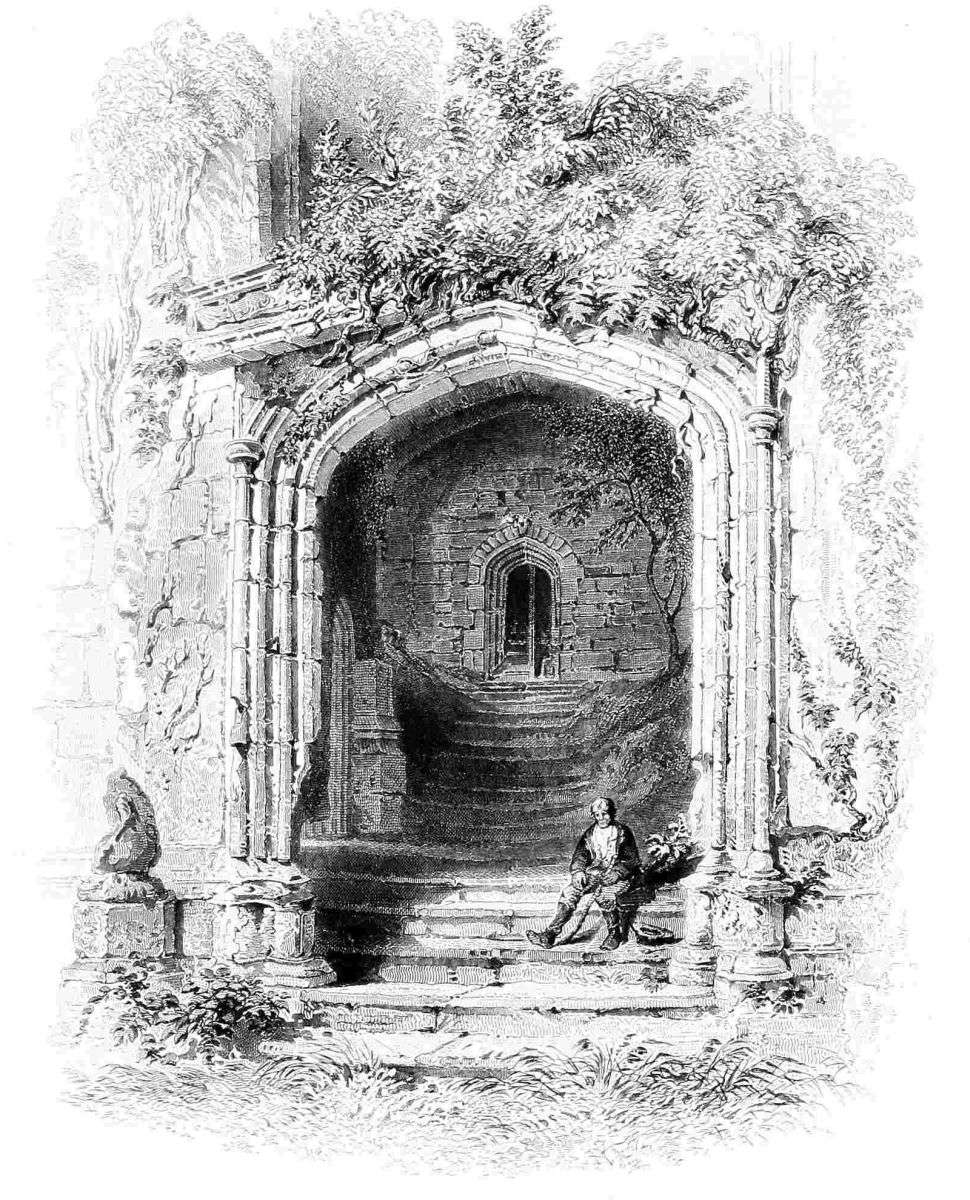
Gateway in the Fountain Court.
Raglan Castle.
contemplated the scene, is reduced to a lonely ruin—thus apostrophized by the muse of Bloomfield:—
“Majestic Raglan! harvests wave Where thundering hosts their watchword gave; When cavaliers, with downcast eye, Struck the last flag of loyalty!”
The Cellars.—These subterranean receptacles are of vast extent; and, in massive strength and proportions—like a crypt under a cathedral—are worthy of the noble edifice that covers them. In times of danger, and particularly during the siege, they appear to have served the manifold purposes of cellars, storehouses, larders, magazines, and muniments of war, with provisions for a numerous garrison and household.
At the north-eastern part of the court, the buildings were nearly all mutilated, or thrown down by the enemy’s batteries, which, from a rising ground in the line of his approach, played with destructive force upon this portion of the walls. Fragments, however, still remain to show the predominant features of the Castle—its strength and beauty. From this point, we are told, communication with the citadel was secured by means of a sumptuous arched bridge, with a gate to correspond. But of these no distinct vestiges are left. The “sumptuous bridge” is replaced by a rustic structure of wood; the moat it spans is half filled with decayed vegetables and debris; and the water, that formerly enclosed the Keep like a wall of crystal, is now covered with a sluggish green surface, that exhibits a very different kind of life.
In other parts of the moat, however, it is deep and transparent, mostly so at the south corner, where masses of verdure—with a particularly old and very picturesque tree, as shown in the illustration—are reflected as if in a mirror. This is probably the most interesting point of view in the whole Castle. Of a still summer evening, about sunset, the outline of the gray towers and battlements, with all their contrasted features of light and shade, beauty and decay—here fringed with wood, and there displaying honourable scars—sleeps on the face of the water like an inverted picture. The scene, with all its singular accompaniments, has then a dreaminess of romance about it, similar to that which the Fata Morgana conjures up on the Straits of Messina—but with this important difference, that the scenery here, however romantic, is real and substantial; that all we behold is the work of Art, over which Nature has only thrown her splendid illusion of cloud, sunshine, and exuberant vegetation.
Tower of Gwent.—This tall and massive structure, built as if to defy the united force of time and violence, forms the Citadel or Donjon-Tower of the fortress; and points very expressively to those remote times, when the peace of a great man’s household depended on the strength of his walls, and the number and courage of his retainers. In a direct line with this Castle were three gates; the first of brick, from which, at the distance of one hundred and eighty feet, and with an ascent of many steps, was the White Gate, built of square stone. At some distance on the left stands the Melin y Gwent, or Yellow Tower of Gwent, which for strength, height, and workmanship, surpassed most other towers, if not every other, in England or Wales. It had six sides, each thirty-two feet wide, and ten feet thick, built of square stone, and in height five stories. Its battlements, never meant to resist cannon shot, are only eight inches thick; but so symmetrical and compactly set, that they appear as if cut out of a solid block. During the siege—hereafter to be described—this portion was soon demolished by the batteries directed against it by Fairfax; but his heaviest guns, eighteen and twenty pounders, took no more effect on the body of the tower, than if they had opened upon a solid rock.[237] Our ancestors appear to have been particularly well skilled in the composition of their cement, which in Raglan is now nearly as hard as the stones it holds together. When the Goths and Vandals of the country—the blind instruments of Fairfax—were summoned to demolish with their pickaxes what the besiegers’ cannon had spared, their republican zeal was attended with little success; for “after battering of the top,” they were obliged, as we shall see, to desist from that method as fruitless, and adopt other means for its destruction.[238]
This Tower communicated with the Castle by means of an elegant arched bridge encircled by an outer wall, with six arched and embattled turrets, all of square stone. Adjoining this was a deep moat, thirty feet broad, and supplied by a clear running stream, from which the water-works, so much the fashion in those days, threw up columns of water as high as the Castle battlements. Along the edge of the moat, was a commodious sunken walk, embellished with grotto-work, statues of the Twelve Cæsars, and otherwise ornamented with the choicest productions of Nature and Art. This was the walk to which the family could resort at all seasons, whether for exercise or meditation. Within the walls and the green adjoining—then the bowling-green, and twelve feet higher than the walk—was a garden plat, the size of which was proportioned to the tower. Next to this plat—as shown in the accompanying ground-plan—stood the Barn.
In casting the eye over the whole circuit of these buildings, the mind is astonished at the immense labour which must have been exerted to collect together such a quantity of materials of various descriptions. And here it may
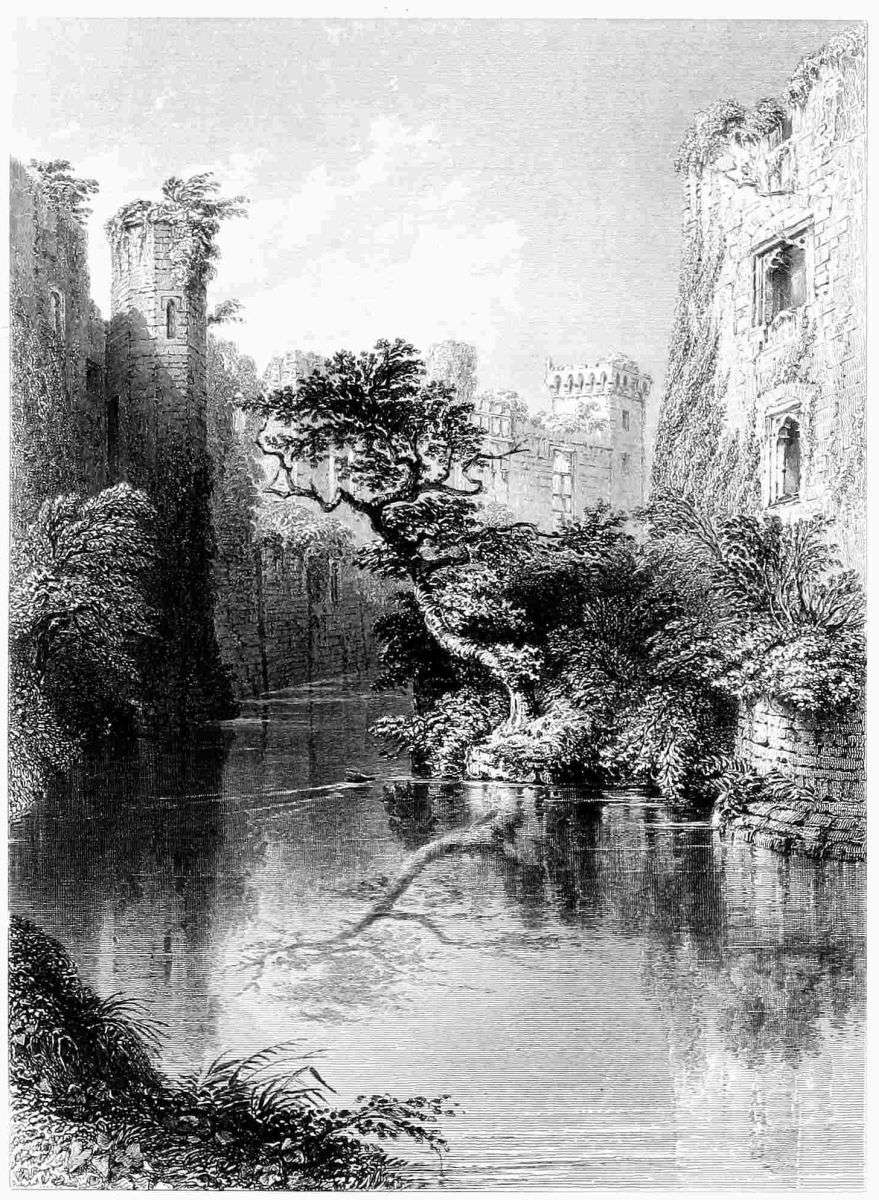
The Moat.
Raglan Castle.
be observed that the majority of these baronial mansions are situated on, or near, the bank of some navigable river, for the purpose of defending some important pass or fortress, by means of which the carriage of stone is attended with comparatively little expense or trouble; but in the present instance, there is no navigable river nearer than the Wye, from which the Castle is distant at Monmouth ten, and at Chepstow twelve miles.[239] And what is very remarkable, there is no quarry in the neighbourhood from which the stone employed in building the Castle could have been procured. It is of a light grey colour, and very hard; but the name of the quarter from which it was taken is still a matter of vague conjecture. No such stone as that used for the chimney-pieces of Raglan is now to be found in Monmouthshire. Such is the neatness and exactness with which the facing stones are laid, that they exhibit the same perfect appearance as if the artist had but just left the scaffold. “The bricks which compose the south wall are extremely well baked, and of a quality not less durable than that of the stone.”
In the present day, we can form but a very imperfect notion of the extent to which the original outworks were carried. When the demesnes of ancient families are let out as farms, the tenant soon brings about a revolution of ancient purposes. He adapts the whole to modern uses—to whatever will best enable him to pay his rent. He calculates how many bushels of potatoes will grow on the slope; how much the lawn will yield to the plough, how much to pasturage; and how much grass may be annually shorn from the old Bowling-green.
So has it fared with the renowned fortress of Raglan.[240] With little interest in its history, little reverence for its ancient lords, every successive tenant, during a long series of years, has only studied how to turn it to the best advantage. Its ancient gardens have been obliterated; its lawns converted into pasture; its fountains, streams, and fish-ponds have been dried up; its materials carted away to erect some farmer’s homestead; its walls, that so stoutly resisted the enemy’s shot, and returned it with interest, seem to feel their degradation, and strive to hide it under a mantle of ivy.[241] Now, however, the grounds are kept in good order; while every feature and fragment of the venerable ruin are preserved with exemplary care by the resident warden, who happily possesses a taste for archæology.
The accompanying ground-plan will enable the reader to trace the various apartments of the Castle in the same order in which they are described, and to follow with more interest the details of the Siege, upon which we are now to enter.
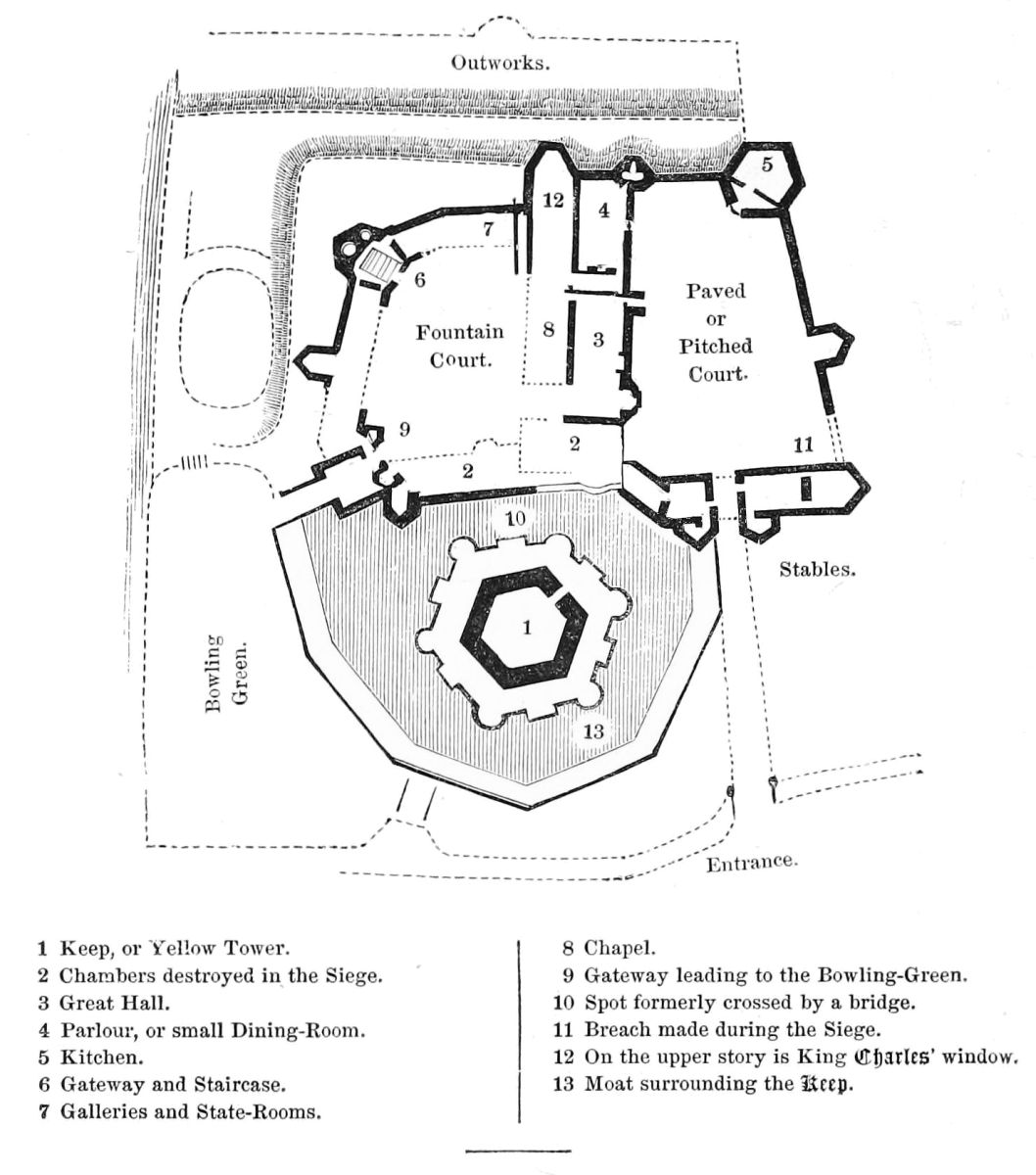
1Keep, or Yellow Tower.
2Chambers destroyed in the Siege.
3Great Hall.
4Parlour, or small Dining-Room.
5Kitchen.
6Gateway and Staircase.
7Galleries and State-Rooms.
8Chapel.
9Gateway leading to the Bowling-Green.
10Spot formerly crossed by a bridge.
11Breach made during the Siege.
12On the upper story is King Charles’ window.
13Moat surrounding the Keep.
“Our Donjon-tower is stout and tall, Each rampart mann’d and steady; And loyal hearts, from every wall, Shout—‘Roundheads! we are ready!’ Then here’s a health to Charles our King; And eke to noble Worcester! To each, to-morrow’s fight shall bring New loyalty and lustre! Then hoist the Royal Standard high! And crown our Chief with laurels! And where’s the man that would not die In combating for Charles?” &c. &c.
We have next to take a brief survey of that portion of the Revolutionary movements, with which the history of Raglan and its loyal garrison are so closely associated.
“The Parliament had now,” says Lord Clarendon, “such footing in Pembrokeshire, that many of the principal gentlemen had declared for them; and the harbour of Milford Haven gave their fleet opportunity to give them all supplies and relief.” This being the state of those parts,
The Lord Herbert, eldest son of the Marquess of Worcester, not only offered but desired to receive that command, and engaged himself “not only to secure it from the opposition and malignity of the other party; but before the spring to raise such a strength of horse and foot, and to provide such an equipage to march with, that might reduce Gloucester, and then be added to the King’s army when he should be ready to take the field. And all this so much at his own charge, for his father, the Marquess, who was well able, would furnish the money—as was pretended upon the King’s promise to repay him when he should be restored to his own—that he would receive no part of the King’s revenue, or of such money as his Majesty could be able to draw for the supply of his own more immediate occasions.”
This was a very great offer, and such as no man else could so reasonably make: for “the Marquess of Worcester was generally reputed the greatest mony’d man in the kingdom; and probably might not think it an unthrifty thing rather to disburse it for the King—who might be able to repay it—than to have it taken from him by the other party; which would be hardly questioned if they prevailed.”[242]
The Lord Herbert himself “was a man of more than ordinary affection for the King; and one who, he was sure, would not betray him. For his religion, it might work upon himself, but would not disquiet other men. For though he were a Papist, he was never like to make others so; and his reputation and interest were very great with many gentlemen of those counties, who were not at all friends to his religion. It was to be hoped that the old grudges and prejudices, which had been rather against the house of Worcester and the Popish religion professed there, than against the person of their lord, would have been composed, and declined by his fair and gentle carriage towards all men—as of truth he was of a civil and obliging nature—and by the public-heartedness of those who, for the Cause and conscience’ sake would, it was hoped, sacrifice all trivial and private contentions to a union that must vindicate the religion, honour, and justice of the kingdom. Upon these reasons and these presumptions, the King granted such a commission as is before-mentioned to the Lord Herbert; who, with more expedition than was expected by many, or by others believed possible, raised a body of above fifteen hundred foot, and near five hundred horse, very well and sufficiently armed, which increased the merit of the service.”[243]
Of the royalist army, raised and paid by the Marquess of Worcester, the command of the infantry was given to Major-General Lawley; that of the cavalry to Lord John Somerset, his second son; while Lord Herbert took the field as Commander-in-chief. Immediately on its being ascertained that Monmouth had declared for the Parliament, Lord Herbert placed himself at the head of a body of troops, and, joined by a party of volunteers from Goodrich, placed them behind a rising ground near the town. Here, with about forty intrepid followers, he proceeded to reconnoitre the enemy’s position, and surmounting an earthen mound which they had thrown up, he passed the ditch, and put the guard to the sword. They next succeeded in breaking the port chain and forced an entrance for the cavalry; then, joining their comrades, they entered the town at full gallop, and, surrounding the main guard, made them prisoners. “The result of this expedition was the capture of Col. Broughton, four captains, four lieutenants and ensigns, the republican committee, and all the private soldiers, with a considerable quantity of arms and ammunition.”
Raglan Castle by this time had been put into a state of thorough defence, with a garrison of eight hundred men, many distinguished officers, and all the necessaries for maintaining a long and vigorous resistance. The Marquess himself—then on the verge of fourscore—infused by his presence and conversation an invincible spirit of loyalty into the garrison; and provisioned as it was, the place might well be viewed as almost impregnable.
The clashing exploit of Lord Herbert, however, was speedily followed by a mortifying reverse; for as the King’s army was on its march to Gloucester, it was met near Coleford by a rabble force of disaffected peasantry, whose object was to obstruct the Royalists in their passage through the Forest of Dean; and a scuffle ensuing, Colonel Lawley, the captain-in-chief, was mortally wounded by a stone.[244] But order being restored, and Colonel Brett taking the command, the Royalists continued their march until arriving on the right bank of the Severn, they threw up defences at the “Vineyard”—the Bishop’s palace—and there fixed their quarters. But in the meantime, Sir William Waller, who was then with a regiment of horse on the borders of Worcestershire, put himself in motion, and by forced marches took up his position in front of the Royalists. This sudden apparition threw them into a panic; for, considering themselves in their newly-fortified position quite secure from all danger of surprise, Lord Herbert had gone to wait upon the King at Oxford; while his brother, Lord John, who commanded the horse, had set out with two or three troops on a reconnoitering party; so that no officer of skill or authority was left to direct or head the forces. All, therefore, was instant confusion in the camp; for, although their position was strong, well supplied with cannon, and certainly not to be stormed by any amount of cavalry that could be brought against them, yet they abandoned all thoughts of defence, and without striking a blow, surrendered to the first summons from Waller, on the simple grant of quarter.
This unexpected disaster was a death-blow to the army of Worcester; “the raising of which was considered such an effort on the part of the Marquess, that it could hardly have been accomplished by any other nobleman in the realm.” That “mushroom army grew up and perished so soon, that the loss of it was scarce apprehended at Oxford, because the strength, or rather the numerical force, was not understood. But had the money,” as Lord Clarendon observes, “that was laid out in raising and paying a body of men, who never in the least degree advanced the royal interest, been brought into the King’s receipt at Oxford, and employed to the most advantage, the war might have been ended the next summer; for I have heard the Lord Herbert say, that those preparations, and others which by that defeat were rendered useless, cost above three score thousand pounds; the greatest part of which”—an enormous sum in those times—“was advanced by his father, the Marquess of Worcester.”[245] We now proceed to notice the
Royal Visit to Raglan, which in its loyal devotion remained unshaken by these reverses; and the following anecdote gives us a favourable idea of the good humour, combined with courtly magnificence, with which Lord Worcester entertained the King on his first visit to the Castle. We relate the anecdote on the authority of the family Chaplain:—
“Sir Thomas Somerset, brother to the Marquess, had a house which they called Troy—the principal residence of the Duke of Beaufort—within five miles of Raglan Castle. Sir Thomas Somerset being a neate man, both within and without his house, as he was a complete gentleman of himself every way, delighted very much in fine gardens and orchards, and in replenishing and ordering them with all the varieties of choicest fruits that could be got, and in defending his new plantations from the coldness of the climate by the benefit of art. The earth, that was so much made of, proved so grateful to him, that, at the same time that the King happened to be at his brother’s house at Raglan, it yielded him wherewithal to send his brother Worcester such a present, as at that time of the year and place, was able to make the King and all his lords believe that the Sovereign of the Planets, with all his prime electors, had new changed the Poles; and that Wales, the refuse and outcast of the fair garden of England, had fairer and riper fruit growing upon her stone rubbish, than England’s levels had in all her beds. This, presented to the Marquess, he could not suffer to be presented to the King by any other hands except his own. In comes the Marquess, at the latter end of supper, led by the arm, having such a goodly presence with him, that his being led became him, rather like some ceremony of state, than shew of impotence; and his slow pace, occasioned by his infirmity, expressed a Spanish gravity, rather than feebleness. Thus, with a silver dish in each hand filled with rarities, and a little basket upon his arm, as a supply, in case his Majesty should be over bountiful of his favours to the ladies that were standers by, he makes his third obeysance and thus speaks:—
“‘May it please your Majesty, if the four elements could have been rob’d to have entertained your Majesty, I think I had done my duty; but I must do as I may. If I had sent to Bristol for some good things to entertain your Majesty, there had been no wonder at all. If I had procured from London some goodnesse that might have been acceptable to your Majesty, that had been no wonder indeed. But here I present your Majesty’—placing his dishes upon the table—‘with what neither came from Lincoln that was, nor London that is, nor York that is to be;[246] but I assure your Majesty that this present came from Troy.’ Whereupon the King smiled, and answered the Marquess—‘Truly, my lord, I have heard that corne[247] now growes where Troy town once stood; but I never thought there had grown any apricocks there before.’ Whereupon the Marquess replied—‘Anything to please your Majesty.’
“The fruit was very much admired by every one, and it was acknowledged by all that were in the presence at that time, that they never saw the King served in greater state in all their lives. There were some about the King who followed my Lord Marquess when he departed the presence, and told his lordship that he would make a very good courtier. ‘Aye,’ said the Marquess, ‘I remember I said one thing that may give you some hopes of me—Anything to please your Majesty.’”
Of the Marquess’s farther proficiency in the art and mystery of a courtier, during the royal visit, we find this specimen:—
“The Marquess had a mind to tell the King, as handsomely as he could, of some of his, as he thought, faults; and thus he continues his plot: Against the time that his Majesty was wont to give his lordship a visit, as commonly he used to do after dinner, his lordship had the book of John Gower lying before him on the table. The King casting his eye upon the book, told the Marquess he had never seen it before. ‘Oh!’ said the Marquis, ‘it is the book of books, which if your Majesty had been well versed in, it would have made you a king of kings.’ ‘Why so, my Lord?’ said the King. ‘Why,’ said the Marquess, ‘here is set down how Aristotle brought up and instructed Alexander the Great in all the rudiments and principles belonging to a prince.’ And under the persons of Alexander and Aristotle, he read the King such a lesson, that all the standers by were amazed at his boldness; and the King supposing that he had gone farther than his text would have given him leave, asked the Marquess, ‘If he said his lesson by heart, or whether he spoke out of the book?’ The Marquess replied, ‘Sir, if you could read my heart, it may be you might find it there; or, if your Majesty please to get it by heart, I will lend you my book.’ Which latter proffer the King accepted of, and did borrow it. ‘Nay,’ said the Marquess, ‘I will lend it you upon these conditions: First, That you read it; secondly, That you make use of it.’ But perceiving how that some of the new-made lords fretted, and bit their thumbs at certain passages in the Marquess’s discourse, he thought a little to please his Majesty, though he pleased not them, the men who were so much displeased already protesting unto his Majesty, that no man was so much for the absolute power of a king as Aristotle. Desiring the book out of the King’s hand, he told the King that he would show him one remarkable passage to that purpose, turning to that place that had this verse:—
“A king can kill, a king can save, A king can make a lord a knave, And of a knave a lord also,” &c.
“Whereupon there were divers new-made lords who slunk out of the roome, which the King observing, told the Marquess—‘My lord, at this rate, you will drive away all my Nobility!’