PEMBROKE CASTLE, Pembrokeshire.
Reading edition
“Hic exarmatum terris cingentibus æquor, Clauditur, et placidam descit servare quietem.”
“In agro totius Walliæ amœnissimo, principale provinciæ municipium Demetiæq. caput, in Saxosa quadam et oblonga rupis in capite bifurco complectitur. Unde Britannis Pembro dicitur, quod caput marinum sonat, et nobis Penbroke.”—Gyrald.
Earldom.—“There have been divers Earls of Pembroke,” says Camden, “out of sundry houses. As for Arnulph of Montgomery, who first wonne it, and was afterwards outlawed, and his castellan Girald, whom King Henry the First made afterwards president over the whole country, I dare scarcely affirm that they were Earles. The first that was styled Earle of Pembroke was Gilbert, surnamed ‘Strongbow,’[367] son of Gilbert de Clare, in the time of King Stephen. This Gilbert, or Gislebert, de Clare, let it unto his sonne, the said Richard Strongbow, the renowned conqueror of Ireland, and descended, as Gyraldus informs us, “ex clara Clarenium familia”—the noble family of Clare, or Clarence. His only daughter, Isabel,[368] brought the same honour to her husband, William, surnamed the Mareschal, for that his ancestours had beene by inheritance mareschals of the King’s palace, a man most glorious in war and peace,[369] and protector of the kingdome in the minority of K. Henry the Third,[370] concerning whom this pithie epitaph is extant in Rodburne’s Annales: ‘Sum quem Saturnus,’[371] &c., which is thus done into English—
‘Whom Ireland once a Saturn found, England a sunne to be; Whom Normandie, a Mercury, and France, Mars,—I am he.’”
“After him,” continues our authority, “his five sons were successively, one after another, Earles of Pembroke; namely, William, called the younger; Richard, who, after he had rebelled against King Henry the Third, went into Ireland, where he was slain in battle; Gilbert, who, in a tournament at Ware,[372] was unhorsed, and so killed; Walter and Anselm, who severally enjoyed the honor but a few daies; and all dying without issue, the King invested in the honor of this earldome William de Valentia, his brother by the mother’s side, who had to wife Joan, daughter of Gwarin de Montchensi, by the daughter of the foresaid William the Mareschal.”
Of this Earl Valence we read, shortly after this, that the King, solemnizing the festival of St. Edward’s translation, in the church at Westminster, with great state, sitting on his royal throne in “a rich robe of Baudekyn,” and the crown on his head, caused this William de Valence, with divers other young noblemen, to be brought before him, and so girt him with the sword of knighthood.
In a tournament held at Bruckley, it is said that he much abused Sir William Adingsells, a valiant knight, through the countenance of Richard, Earl of Gloucester. The following year he was signed with the cross, together with the King himself, and divers other noble persons, in order to an expedition to the Holy Land; and at the same time he obtained the King’s precept to Robert Walrane, to distrain all such persons as did possess any of the property belonging to Joan his wife, one of the cousins and heirs to Walter Mareschal, Earl of Pembroke, to perform their suit to the county of Pembroke, as they had wont to do in the time of that earl.[373]
This Earl Valence was present at the battle of Lewes, some particulars of which have been detailed in the first volume of this work. “When he had lost the day, and with the Prince was made prisoner, William de Valence, then called Earl of Pembroke, though not before, as it is thought, being a principal commander in the van of the King’s army, seeing the day lost, with the Earl of Warren and some others, escaped by flight, first to the castle of Pevensey, and thence to France. After which, all being in the power of the Barons, his lands were seized, and those in Surrey and Sussex committed to the custody of John de Aburnum and John de Wanton. And whereas Joan his lady was then great with child, and with her family and children in Windsor Castle, she was commanded to depart thence, and betake herself to some religious house or other place near at hand, until after her delivery. In which distress, the King, still their prisoner, being forced to comply with them in whatsoever they required, submitted to their ordinances of Oxford; the chief of his friends also giving oath for the due observance of them; amongst whom this William de Valence, then come back into England, was one.”
“But long it was not ere the two principal ringleaders in this tragic action, namely, Montfort, Earl of Leicester, and Clare, Earl of Gloucester, fell at odds—Clare stomaching Leicester for assuming to himself the whole sway in the government; betaking him, therefore, to those true-hearted Royalists who had stood firm to the King in his greatest miseries, a means was contrived for the Prince to escape from Hereford Castle, where, with the King his father, he was kept prisoner.” “Whereupon this
William, Earl of Pembroke, with John, Earl Warren, who had been banished the realm by a public edict of Montfort, landing at Pembroke, about the beginning of May, with about a hundred and twenty men, horse and foot, joined with them; and within a short time after, giving battle to Montfort and his party at Evesham, totally vanquished all their whole army; whereby the King, being set at liberty, was again restored to the exercise of his regal power.”[374]
This Earl William had issue three sons: to wit, John, who died young; William, and Aymer. “William was lord of Montygnac and Belluc; and in the 7th Edw. I. did oblige himself, on the behalf of John, Lord Visci, who had married Mary, the sister of Hugh de Lezinian (Lusignan), Earl of March, for the repayment of two thousand five hundred pounds Tournois, in case she should die without issue. After which, being with Gilbert, Earl of Gloucester, in a skirmish which he had with the Welsh, near Llantipowhir, was there slain in his father’s lifetime.” So that
Aymer de Valence, the third son—a name of great celebrity—succeeded to the earldom of Pembroke. He attended the King in the expedition made into Flanders; and the same year was assigned one of the commissioners to ratify the agreement betwixt the King and Florence, Earl of Holland, touching those auxiliaries which he was to have from that Earl in his present wars; as also one of the ambassadors sent to treat of truce betwixt King Edward and the King of France. He next attended the King two years in his wars in Scotland; and was then sent ambassador to treat with those from the King of France, touching a peace with the Scots. Two years after this he was again in Scotland; and the same year (33d Edw. I.) he had license to go beyond sea on his own occasions.
On his return he obtained a grant from the King, of the castles of Selkirk and Troquair in Scotland; also of the borough of Peebles, to hold by the service of one knight’s fees; likewise of the whole forest of Selkirk in fee-farm, paying a hundred and thirty pounds per annum; and to be sheriff there [as Sir Walter Scott was in our own times, though with very different powers]; with authority to build towns, churches, castles, and other fortifications; as also for free warren, and power to deafforest and make parks therein at his own pleasure. Shortly after which he made a “pile”[375] at Selkirk, and placed a garrison therein. Next year he was sent, as Warden of the Marches of Scotland, toward Berwick-upon-Tweed; and being thereupon made the King’s Lieutenant, and Captain-General of the soldiery—horse and foot—for the defence of those parts against Robert Bruce, Earl of Carrick, and his complices, he had an assignation of two hundred pounds in part of his wages, to be paid to him by John de Sandale, Chamberlain of Scotland.—[Chronicle.]
Shortly after this, Bruce, compassing that realm, and receiving the homage of many, came near to St. Johnstone [or Perth], to the defence whereof this Earl being arrived but a little before, Bruce sent to him, by way of challenge to battle, whereunto returning answer that he would meet him the next day, Bruce retired; which being discovered by this Earl, he sallied out and slew divers of the Scots, unarmed, as it is said. Bruce therefore being advertised hereof, fled to the Isle of Kintyre, whereupon he followed him, supposing to find him in the castle there. But upon his taking possession thereof, and discovering none but his wife, and Nigel de Bruce, his brother, he hanged up Nigel and all the rest who were with him, excepting only her. Bruce, therefore, growing exceedingly exasperated at this his great cruelty, raised all the power he could, and giving battle to him, forced him to flee to the castle of Ayr. Soon after this, being with King Edward, on his death-bed, at Burgh-upon-the-Sands, not far from Carlisle, he was one of those whom the King desired to be good to his son, and not to suffer Piers de Gaveston to come into England again, to set him in riot; for which he was much hated by Piers, as divers others of the nobility were, being called by him Joseph the Jew, in regard that he was tall, and pale of countenance.—[Chronicle.]
But as it would far exceed our present limits to notice all that the chronicles have recorded of him, we conclude with a few brief particulars:—In the second of Edward II. he was sent with Otto de Grandison and others to the Pope upon special business; he next joined the Earl of Lancaster and others in the design of putting down Gaveston—agreeably to the promise he had made to the dying King; so likewise with John de Warren, Earl of Surrey, in the siege of Scarborough Castle, in which Gaveston had taken refuge; and having there seized upon him, intended to have carried him to Wallingford, but lodging him at Deddington in Oxfordshire, he was taken thence in the night by the Earl of Warwick, and by him beheaded on Blacklow Hill, near Warwick, where a monument has been erected to perpetuate the deed.
Three years after this, the Earl was sent again to Rome, and obtained a grant in general tail from the King, of the house and place called the “New Temple” in London, as also of certain lands called Fleet-crofts, with all other the lands in the city and suburbs of London, which belonged to the Knights-Templars, with remainder to the King and his heirs.
In the tenth of Edward II. he was engaged in the Scottish wars; but before the end of that year, being taken prisoner by Sieur Moilly, a Burgundian, and being sent to the Emperor, he was constrained to give twenty thousand pounds of silver for his ransom, by reason, as Moilly alleged, that himself having served the King of England, had not been paid his wages. Upon this occasion King Edward wrote letters to divers foreign princes, soliciting his deliverance, which was effected; for we find him immediately thereafter appointed governor of Rockingham Castle, and heading the King’s army in Scotland. But at last, after many important and honourable services to the State, performed with great ability, he was constituted Warden of all the Forests south of Trent; and being still Warden of Scotland, had license to travel beyond sea.
Upon the taking of Thomas, Earl of Lancaster, at Boro’bridge, he was one of those who passed sentence of death upon him at Pontefract. “After which it was not long that he lived; for, attending Queen Isabella into France in 1323, he was there murdered in the month of June, by reason,” as the chronicle supposes, “of his having had a hand in the death of the Earl of Lancaster.” He left vast demesnes in England, in nine or ten counties, but no issue by any of his three wives.—[Chronicles.]
His eldest sister, Elizabeth, one of his heirs, “wedded unto John, Lord Hastings, brought this dignity into a new family; for Laurence Hastings, his grandson, Lord of Weishford and Abergavenny, was made Earle of ‘Penbrock,’[376] by virtue of King Edward the Third, his brieffe, the copy whereof I thinke good to set doune here, that we may see what was the right by heires generall in these honorary titles. It runs thus:—Rex omnibus ad quos ... Salutem, etc. The which being interpreted, is—
“Know ye that the good praesage of circumspection and vertue which we have conceived by the towardly youth and happy beginnings of our most welbeloved cousin Laurence Hastings, induce us worthily to countenance him with our especiall grace and favour, in those things which concerne the due preservation and maintenance of his honor: Whereas, therefore, the inheritance of Aimar de Valence, some time Earle of Penbrok (as he was stiled), deceased long since, without heire begotten of his body, hath beene devolved unto his sisters, proportionably to be divided among them and their heires: because we know for certain that the foresaid Laurence, who succeeded the said Aimar in part of the inheritance, is descended from the elder sister of Aimar aforesaid; and so, by the avouching of the learned with whom we consulted about this matter, the prerogative both of name and honor is due unto him: Wee deem it just and due that the same Laurence, claiming his title from the elder sister, assume and have the name of Earl of Penbroke, which the said Aimar had whiles he lived: which verily Wee, as much as lieth in Us, confirme, ratifie, and also approve unto him: willing and granting that the said Laurence have and hold the prerogative of Earle Palatine in those lands which he holdeth of the said Aimar’s inheritance, so fully and after the same manner as the said Aimar had and held them at the time of his death. In witnesse, the King at Mont-Martin, the thirteenth day of October, and in the thirteenth of oure reign.”
And now to continue:—
After Laurence, succeeded his sonne John, who, being taken prisoner by the Spaniards in a battle at sea, and in the end ransomed, died in France in the yeere 1375. The circumstances are these: “Having undergone four years’ imprisonment in Spaine, with most inhumane usage, he sent to Bertrand Clekyn, Constable of France, desiring that he would use some means for his enlargement; who thereupon interceding for him to the Bastard of Spaine, then calling himself King, obtained his liberty, in consideration of part of that money due to himself: which being agreed upon, he was brought to Paris. But after his coming thither, it was not long ere he fell mortally sick of poysin, as some thought, given him by the Spaniards, who were reputed to have such a special faculty in that art, as that the potion should kill at what distance of time they pleased. The French, therefore, seeing his death approaching, being eager to get his ransom before he died, made haste to remove him to Calais; but on his journey thitherward he departed this life, upon the xvi. day of April, leaving his sonne and heire only two and a half years old.”
Agreeably to the superstition of the time, all his misfortunes and death were looked upon as judgments, for various alleged offences committed against the Church revenues: recommending that the clergy should be taxed more than the laity—for living an ungodly life—for “everything that could render him hateful in the eyes of monks, whom he insulted and exposed.”
After him followed his sonne John, second Earle of his line, who, in running a tilt[377] at Woodstock, was slaine by Syr John Saint John, casually, in the yeare 1397. And hereupon, for default of his issue, there fell very many possessions and fair revenewes into the King’s hands, as our lawiers use to speake: and the Castle of Penbrock was granted unto Francis At-Court, a courtier in especiell great favour, who commonly thereupon was called Lord Penbrock. Not long after, Humfrey, sonne to King Henry the Fourth, before he was Duke of Gloucester, received this title of his brother, King Henry the Fifth: and before his death Henry the Sixth granted the same in reversion—a thing not before heard of—to William De la Pole, Earle of Suffolk, after whose downfall the said King, when he had enabled Edmund of Wadham, and Jasper of Hatfield, the sonnes of Queen Katherine, his mother, to be his lawfull half brethren, created Jasper Earle of Penbroke, and Edmund Earl of Richmond, with pre-eminence to take place above all Earles—for Kings have absolute authority in dispensing honours. But King Edward the Fourth, depriving Jasper of all his honours by attainder and forfeiture, gave the title of Penbrok to Syr William Herbert, for his good service against Jasper in Wales;[378] but he shortly afterwards lost his life at the battle of Banbury. Then succeeded his son, bearing the same name, whome King Edward the Fourth, when he had recovered the kingdom, invested in the Earldom of Huntingdon, and bestowed the title of Penbrok, being surrendered, upon his eldest sonne and heire, Edward Prince of Wales.—[Chronicle.]
Long after this period, “Henry the Eighth invested Anne Bollen, to whom he was affianced, Marchioness of Penbroke, with a mantle and coronet, in regard both of her nobility and also her virtues—for so runne the wordes of the patent. At length King Edward the Sixth adorned Sir William Herbert, lord of Caerdiff, with the title of Earl of Penbroke, after whom succeeded his sonne Henry, who was Lord President of Wales under Queen Elizabeth. And now”—says our old King-at-arms, speaking courteously of his contemporaries—“his sonne, richly accomplished with all laudable endowments of body and minde, enjoyeth the same title. And this family of Herberts, he concludes, is honourable, and of great antiquity in these parts of Wales, as lineally propagated from Henry Fitz-Herbert, Chamberlayne to King Henry the First, who married the said King’s Paramour, the mother of Reginald, Earle of Cornwall, as I was first informed by Robert Glover, a man passing skilfull in the study of genealogies, by whose untimely death that knowledge hath sustained a great losse.”
So much for the Genealogy of the old lords of Pembroke. In this department of history—the tracing of genealogies—in which the Cambrian families are proverbially expert, but which others affect to ridicule, we must not omit the defence of a learned Welshman: “That there have been,” says he, “parasites in the art, must be acknowledged; and family pride may sometimes have been flattered. However, upon the whole, much credit is due to our ancient genealogists, who were appointed and patronized by Royalty, and professed that art prior to their initiation into the higher mysteries of Bardism. Their records are still extant, and bear every mark of authenticity. A bard and a genealogist were synonymous; and though a bard can plead licentia poetica, yet fiction was not allowed in recording the actions of their heroes,[379] nor in registering the descent of families. The Welsh bards continued their genealogical pursuits down to the reign of Elizabeth; therefore, as Humphrey Lwyd, a learned antiquary and historian, observes: “Let such disdainful heads as cant know their own grandfathers, leave their scoffing and taunting of Welshmen for that thing that all other nations in the world do glory in.” Yet, in justice to the ancient Saxons on this point, it must be allowed that they themselves were not altogether indifferent to the study of genealogy, since their deducing of their King Ethelwulph from Adam is an instance of their accuracy in the art—
“Can Bourbon or Nassau go higher?”[380]
On the “Herbert genealogy,” Mr. Willatt relates the following characteristic Anecdote.—About two miles from Abergavenny, says he, is Handel—once a mansion of no less magnificence than antiquity; but in the present day it is only interesting from its having been the cradle of the ancient and numerous family of Herbert. Of the vast possessions of this family, the inheritance of the last lineal descendant, who died twenty years ago, had dwindled down to less than two hundred a year. But however reduced in fortune, his pride of ancestry had lost nothing of its strength or spirit by the change. Meeting a stranger one day near his mansion, who took an interest in the local history and natural beauties of the scenery, they entered into conversation.
“And pray, Sir,” inquired the stranger, “whose is that antique-looking mansion before us?”
“That, Sir,” replied the last of the Herberts, “is Handel—a very ancient house, for out of it came the Earls of Pembroke of the first line; and the Earls of Pembroke of the second line; the Lords Herbert of Cherburg; the Herberts of Coldbrook, Rumney, Cardiff, and York; the Morgans of Acton came out of it; so also did the Earl of Hunsdon; the Joneses of Treowen and Llanarth, and all the Powells. Out of this house also, by the female line, came the Dukes of Beaufort!”
“And pray, Sir,” inquired the stranger, “who lives in it now?”
“I, Sir—I live in it,” was the answer.
“Then pardon me, Sir, if I presume to give you a little advice. Do not lose sight of so many prudent examples, but come out of it yourself, or it will assuredly fall in upon you, and crush you in its ruins!”
With this digression, suggested by the subject, we return to Pembroke.
The Castle.—In the words of Giraldus, already quoted in our motto, the situation of the Castle of Pembroke is thus correctly described:—A tongue of the sea, shooting forth of Milford-Haven, encloseth in the forked end thereof the principal town of the whole country, and chief place of Dimetia, seated on the ridge of a certain craggy and long-shaped rock, from which circumstance the Britons gave it the name of Penbro, which signifies a head of the sea. Arnulph Montgomery, so often mentioned in the early portion of this work, was the first who built a temporary fortress on this promontory—a very weak and slender thing, God wot, says Giraldus—consisting of merely walls, held together by stake and turf; and which, after returning into England, he delivered unto Girald of Windesor, his constable and captain, to be kept with a garrison of a few soldiers. The absence of Arnulph, however, was the signal for immediate revolt; and the warlike inhabitants of South Wales hastening to the spot, laid siege to the brittle fortress. But here they met with such a hot reception and stubborn resistance from Girald and his small garrison, that they were speedily disheartened and raised the siege. This attack served as a warning for Girald to strengthen his position; and he lost no time in fortifying the town and castle with walls and towers, sufficient to maintain him in quiet possession of the new territory. When this was accomplished, he began to retaliate; and acting upon the aggressive, invaded the surrounding country far and near. At length, finding himself at the head of a powerful garrison, yet willing to conciliate the natives—and thereby preserve his own estates and those of his followers free from the vexation of hostile irruptions—he ingratiated himself with Gruffin, the prince of the country, who gave him his sister, the beautiful Nesta,[381] in marriage; and thus cemented a friendly alliance between the native Welsh and the Anglo-Normans. Great prosperity followed this event, and the Anglo-Normans—as Giraldus Cambrensis, who was a scion of the family, informs us—not only maintained peace along the sea-coasts of South Wales, but won also the “waulls of Ireland.”
The Giraldus de Windesor above mentioned was the first of that name; and is considered as the great progenitor of the Fitzgeralds of the present day—of whom the chief families are of Irish extraction, and familiar in the pages of modern history.
It is also written in the same documents, in regard to the tenure of this castle and town, likewise of the “castle and town of Tenbigh, of the Grange of Kingswood, of the Convent of Croytargath, and of the manors of Castle-Martin and Tregoire, that Reginald Grey, at the coronation of King Henry the Fourth, made suit to carry the second sword, but in vain; for answer was made him, that those castles and possessions were in the King’s hands, in the same manner as the town and castle of Pembroke now are”—[that is, at the date of the present extract.]
The Siege.—We now proceed to give a few details of Pembroke Castle, as it figures in the chronicles of Richard the Third and Charles the First.
The more rational and less bigoted part of the nation regarded Henry, Earl of Richmond, as the future deliverer of the kingdom, from the thraldom it endured from the tyranny of the sanguinary King Richard; for in Henry were to be united the pretensions of both the “Houses” of York and Lancaster. The Earl was, meanwhile, resident in Brittany, and living on good terms with the duke of that Province, who appeared to favour his claims, and treated him with marked respect and hospitality. But the circumstance that more immediately favoured his accession to the throne of England was the following:—Morton, Bishop of Ely, was confined in the Castle of Brecon, in custody of Henry, Duke of Buckingham, who had been a minion of Richard, and a powerful instrument of his advancement to the throne; but finding that his services in a bad cause were forgotten, and that Richard refused to ratify his claims to the Bohun estates and titles—to which he was heir—Buckingham entered warmly into the plans concerted by Morton and others for the recall of Richmond, and by his marriage with Elizabeth, daughter of Edward the Fourth, to establish a double right to the throne. Dugdale assigns another reason for Buckingham’s secession from the usurper: after asserting that he was reinstated in those possessions which he claimed as a descendant of Humphrey de Bohun, Earl of Hereford, and giving him an abstract of the instrument that put him in possession, he adds his opinion on the alteration which took place in his political sentiments, and ascribes it either to a remorse of conscience for raising Richard to the throne, after the murder of his nephews, or finding himself neglected by him: but with this question we have nothing to do.[382] Having concerted the plan of elevating Richmond to the throne, the secret was intrusted to Sir Rhys-ap-Thomas, and Richard Kyffin, Dean of Bangor—both strenuous friends of the House of Lancaster—who transmitted, by means of fishing-boats, the necessary intelligence to the Earl of Richmond, with assurance of all possible aid on his arrival in Wales. This was an occasion too alluring for the Welsh Bards to continue silent; one of whom, Dafydd ap Llwyd ap Llywelyn ap Dryffyd, lord of Mathafarn, an illustrious poet and herald, rendered himself very serviceable in the cause. His dark, mysterious, Pythonic prophecies, that a chieftain of Wales would liberate the nation from Saxon bondage, so wrought upon the valour of his countrymen, that many thousands enlisted under the banner of Sir Rhys-ap-Thomas, who afterwards joined Richmond on his arrival at Milford.
Apprized of the state and feeling of the country, and of the facilities which were now presented to him of recovering his position and station, Henry embraced the invitation as a message from Heaven; and, in the month of August, 1485, set sail for England. For this enterprise the Duke of Brétagne furnished him with a military force of two thousand men; and, with these distributed in a small fleet, he landed at Milford-Haven, where he was received with joy and acclamation by a vast concourse of friends, who now openly espoused his cause and predicted his triumph.
From Milford, Richmond proceeded to Dale and Haverfordwest, where he was joined by the above-named Sir Rhys-ap-Thomas, Arnold Butler, Richard Gryffydd, John Morgan, Sir George Talbot, with the young Earl of Shrewsbury, his ward, Sir William Stanley, lord of Bromfield Yale and Chirkland, Sir Thomas Burchier, and Sir Walter Hungerford.[383]
After a most hospitable reception at Carew Castle, it was agreed, in order to prevent disputes between the armies, that in the march to Shrewsbury, the Earl should shape his course to Cardigan, and Sir Rhys-ap-Thomas by Carmarthen. In this march, Dafydd-ap-Ievan had the honour of entertaining the illustrious Prince and his army at Llwyn-Dafydd, Cardiganshire, for one night; and the following night he was received with loyal enthusiasm at Wern-Newyd, by Einon-ap-Dafyd Llwyd. To Dafydd-ap-Ievan the Earl presented a superb hirlas, or drinking-horn, richly mounted on a silver stand, which was afterwards presented to Richard, Earl of Carbery, and may still be seen[384] at Golden Grove, the seat of Lord Cawdor, Carmarthen.
“Pride of feasts, profound and blue, Of the ninth wave’s azure hue; The drink of heroes formed to hold, With art enriched and lid of gold.”—Hoare’s Gir.
From his hospitable quarters in Cardiganshire, Richmond sallied forth to meet the usurper; and marching through Shrewsbury, Newport, Stafford, and Lichfield, encountered him at Bosworth—
“What, ho! young Richmond, ho! ’tis Richard calls thee! I hate thee, Harry, for thy blood of Lancaster! Now, if thou dost not hide thee from my sword, Now, while the angry trumpet sounds alarms And dying groans transpierce the wounded air; Richmond, I say, come forth and singly face me! Richard is hoarse with daring thee to arms!”
The fate of that day is so familiar in the page of Shakspeare, that we close this part of our subject, and proceed to other particulars:—
Anecdote.—Of one of Richmond’s adherents, the following is told by Turner in his “History of Remarkable Providences:”—Mr. Henry Wyatt, a gentleman of Kent, was a confederate in the plan, and intrusted with the correspondence between the friends of the Earl, which he conducted with great personal risk, but the greatest fidelity, being the bearer of several dispatches to and from the parties at home and abroad. But at last his conduct being suspected, he was arrested, examined, and discharged for want of conclusive evidence. But on a second charge being brought against him, he was committed to the Tower, and there put to the torture; but such were his fortitude and resolution, that nothing could be drawn from him either to prove his own participation in the designs laid to his charge, or to incriminate others. Finding threats, tortures, and fair promises alike unavailing, he was cast into a dungeon, fed upon bread and water, and thus continued until the question of supremacy was decided by the battle of Bosworth Field. The pittance, it is said, to which he was condemned, would have been quite inadequate to support nature, had not a cat brought him food daily. He lived to be made a baronet, in compliment to his unflinching loyalty, and served in the Privy Council of Henry VII.-VIII.
A picture is said to be still preserved in the family, in which a cat is represented creeping in at a grate—having a pigeon in its mouth—with these lines:—
Hunc. macrum. rigidum. mæstum. fame. frigore. cura Pavi. fovi. acui. carne. calore. joco.
Cromwell, before marching against the Scottish army, thought it advisable to suppress the returning loyalty of South Wales, which had recently defeated the Parliamentary forces. The town and castle of Pembroke had been consigned by Parliament to the government and defence of Colonel Poyer; but on his declaring for the King, the “gallant conduct of himself and the garrison afforded a brilliant example of devotion to the Royal cause.” The defence was continued with so much obstinacy and resolution, that the presence of Cromwell himself was necessary for the reduction of the castle: while the garrison, having suffered for some time from great deficiency of provisions, was at last—owing, as we shall see, to Lord Jermyn’s total neglect of his engagements—reduced to the verge of absolute famine.
Cromwell, in the meantime, was quite unaware of the real position of affairs within the walls; and thinking, from the resistance already offered, that the place might hold out much longer than would be consistent with his other plans, was on the point of raising the siege. But while this question was agitating his mind, a deserter from the Royalist camp brought him intelligence that, owing to the pressure of famine, it was impossible that Poyer and his companions could maintain their post beyond twenty-four hours. This unexpected news determined him to continue the siege; but however much he prized his timely information, he determined to express his abhorrence of the “informer;” and—as a salutary warning to all traitors—he ordered him to be hanged.
It has been doubted, however, whether, in his “military capacity,” Cromwell was ever in this part of Wales—though Mr. Yorke allows that he might have made a friendly visit there; for in an old house at Kinmael, that once belonged to the Llwyds, of the tribe of Maredudd—but at that period to Colonel Carter, an officer in his favour—there is a room called Cromwell’s parlour; and, with other circumstances taken into consideration, little doubt, he thinks, can be entertained of Cromwell’s having in person conducted the siege of Pembroke.[385]
But the following documents, written by Oliver Cromwell himself, are conclusive:—
“To Major Thomas Saunders, at Brecknock, these:
“Before Pembroke, 17th June, 1648.
“Sir,—I send you this enclosed by itself, because it’s of greater moment. The other you may communicate to Mr. Ramsey, as far as you think fit, and I have written. I would not have him and other honest men be discouraged that I think it not fit, at present, to enter into contests. It will be good to yield a little for public advantage; and truly that is my end: wherein I desire you to satisfy them. I have sent, as my letter mentions, to have you remove out of Brecknockshire; indeed, into that part of Glamorganshire which lieth next Monmouthshire. For this end: We have plain discoveries that Sir Trevor Williams of Llangibby,” &c., [is suspected, and must be secured. See “Raglan,” page 178.]
Again—
“Pembroke, June 28.—I have some few days since despatched horse and dragoons for the North. I sent them by the way of Winchester; thinking it fit to do so in regard of this enclosed letter, which I received from Colonel Dukenfield: requiring them to give him assistance on the way.”... “Here is, as I have formerly acquainted your Excellency, a very desperate enemy, who, being put out of all hope of mercy, are resolved to endure to the uttermost extremity, being very many of them gentlemen of quality, and men thoroughly resolved. They have made some notable sallies upon Lieutenant-Colonel Reade’s quarter, to his loss. [Reade had been intrusted with the siege of Tenby, ended June 2, and was now assisting at the reduction of Pembroke.] We are forced to keep divers posts, or else they would have relief, or their horse break away; our foot about them are four and twenty hundred; we always necessitated to have some in garrisons. The country, since we sat down before this place, have made two or three insurrections, and are ready to do it every day. So that—what with looking to them, and disposing our horse to that end, and to get us in provisions, without which we should starve—this country being so miserably exhausted and so poor, and we with no money to buy victuals. Indeed, whatever may be thought, it’s a mercy we have been able to keep our men together in the midst of such necessity, the sustenance of the foot, for most part, being but bread and water. Our guns, through the unhappy accident at Berkley, are not yet come to us; and, indeed, it was a very unhappy thing they were brought thither, the wind having been always so cross, that since they were recovered from sinking, they could not come to us: and this place not being to be had without fit instruments for battering—except by starving. And truly I believe the enemy’s straits do increase upon them; and that within a few days an end will be put to this business—which surely might have been before, if we had received things wherewith to have done it....”
“Pembroke, July 11, 1648.—To Hon. W. Lenthal, Esq., Speaker of the House of Commons.
“Sir,—The town and castle of Pembroke were surrendered to me this day, being the eleventh of July, upon the provisions which I send you here enclosed. [See Rushworth, vol. vii., 1190.] What arms, ammunition, victuals, ordnance, or other necessaries of war, are in the town, I have not to certify you—the commissioners I sent in to receive the same not being yet returned, nor like suddenly to be; and I was unwilling to defer giving you an account of this mercy for a day. The persons excepted are such as have formerly served you in a very good cause; but being now apostatized, I did rather make election of them than of those who had always been for the King, judging their iniquity double, because they have sinned against so much light, and against so many evidences of divine Providence going along with and prospering a just cause, in the management of which they themselves had a share.
“I rest your humble servant, Ol. C.”
[Colonel Poyer has had to surrender the castle; Maj.-Gen. Laugharne and certain other “persons excepted,” have had to surrender at mercy; a great many more on terms. “Pembroke happily is down, and the Welsh war is ended.”]
The “certain persons” here alluded to were Colonels Laugharne, Powel, and Poyer. They were tried by court-martial and found guilty; but Parliament having determined to punish only one, three papers were given to them, on two of which were written, “Life given by God;” the blank paper fell into the hands of the unfortunate Poyer, and served as his death-warrant.
Of these three officers—“heads of the insurrection in South Wales”—Clarendon gives the following account:—“Laugharne, Powel, and Poyer, commanded those parts under the Parliament, which they had served from the beginning. The first of them was a gentleman of good extraction, and a fair fortune in land in those counties, who had been bred a page under the Earl of Essex, when he had a command in the Low Countries, and continued his dependence upon him afterwards, and was much in his favour; and by that relation was first engaged in the rebellion, as many other gentlemen had been without wishing ill to the King. The second, Powel, was a gentleman too, but a soldier of fortune: the third, Poyer, had from a low trade raised himself in the war to the reputation of a very diligent and stout officer, and was at this time trusted by the Parliament with the government of the town and castle of Pembroke. These three communicated their discontents to each other, and all thought themselves ill-requited by the Parliament for the services they had done, and that other men, especially Colonel Mitten, were preferred before them; and resolved to take the opportunity of the Scots coming in, to declare for the King upon the Presbyterian account. But Laugharne, who was not infected with any of these freaks, and doubted not to reduce the other two when it should be time to sober resolution, would not engage till he first sent a confidant to Paris, to inform the Prince of what he had determined, and of what their wants consisted, which if not relieved, they should not be able to pursue their purpose, desiring to receive orders for the time of their declaring, and assurance that they should in time receive those supplies they stood in need of. And the Lord Jermyn sent him a promise under his hand, ‘that he should not fail of receiving all the things he had desired, before he could be pressed by the enemy,’ and therefore conjured him and his friends ‘forthwith to declare for the King, which, he assured them, would be of singular benefit and advantage to his Majesty’s service, since, upon the first notice of their having declared, the Scottish army would be ready to march into England.’ Hereupon they presently declared, before they were provided to keep the field for want of ammunition and money, and when Pembroke was not supplied with provisions for above two months, and were never thought of after.”
Pembroke Castle contained many elegant apartments, appropriated to the use of its lords, in one of which Henry VII. first saw the light of day. In the inner ward stands the Keep, a circular tower of vast strength and elegant proportions. The height is computed at seventy feet, the interior diameter at twenty-four, and the walls from fourteen to seventeen feet in thickness. The State Apartments appear to have been finished in a style of great elegance. On the north of the great tower is a long range of apartments, which seem to be of more recent construction, or to have been modernised in later times by one or other of its titled proprietors. From this part of the castle a staircase communicates with Leland’s “marvellus vault callid the Hogan”—a large cavern in the rock, opening upon the water, and extending a great way under the buildings. The entrance is now partially walled up, and formed into a spacious doorway. The name Hogan—which has occasioned some discussion among antiquaries and etymologists—is probably derived from ogof or ogov, the British name for a cavern. This castle is justly considered one of the most splendid remnants of military architecture in the United Kingdom; and, from the state of preservation in which it is maintained, the design and execution of every compartment may still be traced with accuracy and precision.
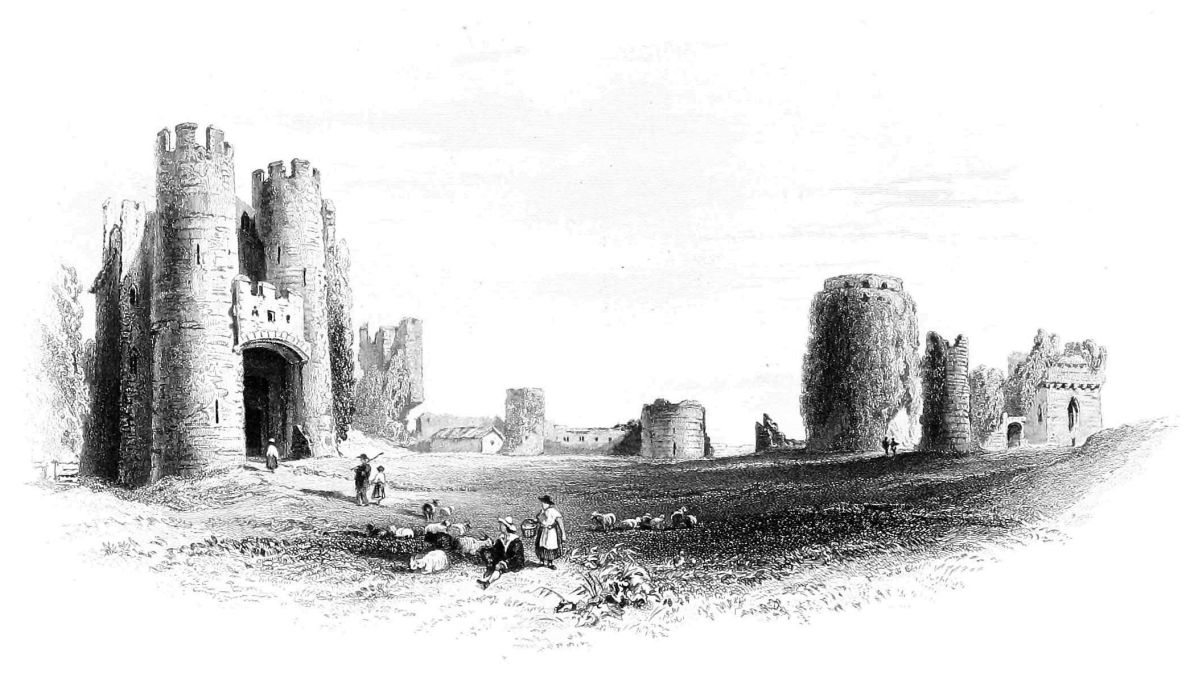
Pembroke Castle.
Interior of the Great Court.