RAGLAN CASTLE, Monmouthshire. (continued 2)
Reading edition
“The Marquess replied—‘I protest unto your Majesty, I am as new a made lord as any of them all;[248] but I was never called knave and rogue so much in all my life, as I have been since I received this last honour, and why should not they bear their shares?’”
But the Marquess, like many of the King’s party, seems to have wanted that undoubting confidence of success, which not unfrequently secures it. How different from the determined tone of a Cromwell is this:—“When the King first entered the gates of Raglan, the Marquess delivered his Majesty the keys, according to the ordinary custom; the King restoring of them to the Marquis, the Marquis said, ‘I beseech your Majesty to keep them, and you please, for they are in a good hand; but I am afraid that ere it be long, I shall be forced to deliver them into the hands of those who will spoil the compliment.’” And so it happened.
The plans taken by the King, while residing in Raglan Castle, to persuade the Marquess of Worcester to farther advances of money, afford a subject for a humiliating chapter in the royal history. The aged Marquess had three ruling principles—loyalty to the King, attachment to the Roman Catholic religion, and fondness for money. His loyalty had been already extensively drawn upon, and there remained now to be tried an attempt upon his proselytizing zeal. He had now to be flattered with the idea that he might possibly persuade the King to profess the tenets of his ancestors. Charles, indeed, had not made great progress in Protestant doctrines; and the Marquess, confident in his theological powers, imagined he would find an easy convert. Here is Dr. Bayly’s account of the matter:—
“Thus affected was that noble and, indeed, in his way, heavenly disposed, Henry, late Marquess of Worcester, to play the greatest prize that ever was played between any two that ever entered within those lists. Three diadems were to encounter with the tripple crowne, and the tripple crowne with three sceptres. Opportunity, that lucky gamester, that hardly loses a game in twenty, was on the Marquess’ side; time and place directed him how to take points in his own tables; the King at that time being in the Marquess’s own house at Raglan, and necessitated to borrow money to buy bread, after so great a loss in battle. The King being thus put to play the aftergame with the old Marquess, was a little mistrustful that he had not played the foregame with him so well, as that he had not thereby prejudiced the latter: for, though the Marquess and his son were the two ablest and most forward’st shoulderers up of the declining throne, especially the chip of the old block, whose disposition expressed itself most noble in not caring who had loved the King, so that he might be but permitted to love Alexander; whom he affected not only with the loyal respects of a subject towards his soveraigne, but also with such passionate ways of expressions and laboriousnesse in all good offices, as are wont to be predominant in those in whom simpathy is the only ground of their affections; yet there were not wanting some kind of men who made the averseness of this nobleman’s religion an occasion of improving their own envies. Which, though it could never lose him the least ground in his master’s good opinion of him—who never would judge no more a saint by his face than a devil by his feet, but both according to their several ingagements—yet there were some things which happened, as having relation to this family, which were not altogether pleasing. However, though his Majesty came thither ushered by necessity, yet he came neither unwelcomed nor uninvited; and entertained as if he had been more than a king, by reason of some late atchievements, rather than otherwise: and though money came from him like drops of blood, yet he was contented that every drop within his body should be let out at his command, so that he might performe so meritorious a piece of worke as, he thought, the being an instrument of bringing the father of his country to be the son of his church, would be unto his soul’s health. The Marquess having these resolutions within himselfe, thought to give them breath at the same time that his Majesty should make his motion for a further supply of money, which he daily and hourly expected; but was deceived in his expectations; for the relation having already reach’d the King’s ear, how an accident had made me no less fortunate to his lordship, than in being the means of preserving his lordship’s person, and no inconsiderable fortune then in the same venture with him; and how that I preserved both the one and the other, in concealing both, for the space that the moon useth to be twice in riding of her circuit,[249] (the particulars hereof, here to insert, would tend rather to much arrogance than any purpose, wherefore I further forbear,) until such time as the trust which Providence had reposed in me was crowned by the same hand with such successe as brought the Marquess safe to his own house in peace; which I had no sooner brought to passe, but the Marquess drew from me a solemn engagement never to leave him so long as we both should live; which I was so careful for to observe, that I neither left him in life nor death, faire weather nor foule, until such time as he left me, and I laid him under the ground in Windsor Castle, in the sepulchre of his fathers.”
The author of the notice of the Marquess of Worcester in “Lodge’s Portraits,” says, that “the adventure here alluded to by Dr. Bayly is and must remain unknown.” It is, however, made sufficiently clear in the “First Apophthegm,” where Bayly tells us that he met the Marquess in the Welsh mountains, “flying a danger with a softer pace than it made after him.” Bayly, whose knowledge of the country must necessarily have been great, had it in his power to conceal the Marquess. This was their first meeting, and they ever after were inseparable. In nearly the words already used, Bayly in this passage also says, “From which time forward, until the time that I laid him in his grave in Windsor Castle, I never parted from him.”
He continues—“And it was a strange thing, that during the time that I was thus a bond-servant to his lordship, which was for the space of twelve monethes thrice told, the difference in religion never wrought the least difference in his disposals of trusts of the highest nature upon me; but his speeches often shewed his heart, and his often lending me his ear, that they were both as much mine as any man’s. Of which, it seems, his Majesty being informed, I must be the beetle-head that must drive this wedge into the royall stock; and was also told, that no man could make a divorce between the Babilonish garment and the wedge of gold sooner than myself. To be brief—I was ingaged in the business; I could neither deny the employment, nor well tell how to go about it, I, not knowing the Marquess’ drift all this while, thought the Marquess had feared nothing more than what I myself was most afraid of, viz., that I should be made an instrument to let the same horse bleed, whom the King himself had found so free, that he was unwilling to give him the least touch with his spur. Howsoever, I went about it, and thus began to tell his lordship:—‘My Lord, the thing that I feared is now fallen upon me; I am made the unwelcome messenger of bad news—the King wants money!’ At which word the Marquess interrupted me, saying, ‘Hold, sir, that’s no news; go on with your business.’ ‘My Lord,’ said I, ‘there is one comfort yet, that as the King is brought low, so are his demands; and, like his army, are come down from thousands to hundreds: and from paying the souldiers of his army to buying bread for himself and his followers. My Lord, it is the King’s own expression, and his desire is but three hundred pound.’ Whereupon my Lord made a long pause before he gave me one word of answer. I knew by experience that in such cases it was best leaving him to himself, and to let that nature, which was so good, worke itselfe into an act of the highest charity—like the diamond, which is only pollished with its own dust. At last he called me nearer to him, and asked me, ‘If the King himself had spoken to me concerning any such business?’ To which I answered, ‘That the King himself had not; but others did in the King’s hearing.’ Whereupon he said, ‘Might I but speak unto him—but I was never thought worthy to be consulted with, though in matters meerly concerning the affaires of my own country—I would supply his wants, were they never so great, or whatsoever they were.’ Whereupon I told his lordship that, ‘If the King knew as much, he might quickly speak with him.’ Then said the Marquess, ‘The way to have him know so much is to have somebody to tell him of it.’ I asked his lordship, ‘If he would give me leave to be the informer.’ He told me, ‘He spake it to the same purpose.’ I hastened from him, with as much feare of being called back again, as I did towards the King, with a longing desire of giving his Majesty so good an account of my so much doubted embassie.
“Half going and half running through the gallerie, I was stopt in my way by one Lieutenant-Collonel Lyllard, who told me, that if ever I had a mind to do my Lord Marquess and the garrison any good, now was the time: for even now one of the King’s ships had run herself on ground under the town of Chepstow. Calling unto me the captain of her (one Captain Hill), who related unto me that upon the surrender of Bristol he was forced to fly into the sanctuary of the King’s quarters, having formerly revolted from the Parliament, or rather returned to her due obedience. Telling me, moreover, that she was fraught with store of goods and rich commodities, as sugar, tobacco, linnen of all sorts, &c., and that the law in such a case appropriated the King to such a part of her lading; which I better understood then than I can relate unto you now; and that she had many fair brass and iron guns in her, with proportionable ammunition, usefull for the garrison; and that, for a word of speaking, I might have all this of the King for the use of the garrison. I (considering that it would be nevertheless the King’s for being converted to such an use, as also the business I was about) made no doubt but that I could easily beg all this for the Marquess, in consideration of the great charges his lordship had been at in entertaining his Majesty so long. Neither was I deceived, for the King granted it willingly.
“But as to the matter in hand, I told his Majesty apart, that I had moved his lordship in matter of money; but found him a little discouraged, in regard that his Majestie having been twice at Raglan a moneth at a time, and that at neither of those times he ever vouchsafed his lordship so much honour as once to call him to councel, though it was in his own house, and must needs be acknowledged to be one who knew the countrey, and the constitution of the inhabitants, better than any other man that was about his Majestie had reason to understand. Wherefore I told the King, I thought his lordship leant my motion a deffer ear than he would have done, if his lordship had not been thought so uselesse a creature; and that I perceived his lordship had a desire to have some conference with his Majestie; which being obtained, I believed his Majestie’s request would be easilie granted, and his expectations answered in a higher measure than it may be his Majestie did believe. The King said, ‘With all my hart: and as to the other business which so much troubles my lord, in troth I have thought it a neglect in us heretofore; but the true reason why I did forbear to do so was, because I thought my Lord of Worcester did not desire it, by reason of his retiredness, unwieldiness of body, and unwillingness of mind to stir abroad; and therefore I thought it a contentment to him to be let alone.’ I told his Majestie, that I did verilie believe that his Majestie was in the rights in both respects, both of his Majestie’s and his lordship’s; and that if his Majestie had called him to councel, I do verilie believe his lordship would have been desired to be excused; but yet he did expect he should have been called. Whereupon the King said, ‘I pray tell my Lord of Worcester, that I did not forbear that respect unto him out of any disestimation I had either of his wisedome or loyaltie; but out of some reasons I had to myself, which indeed reflected as much upon my lord as they did on me. For had he used to have come to the councel board, it would have been said that I took no other councel but what was conveighed to me by Jesuites, by his lordship’s meanes: and I pray tell him that that was the true cause.’ I told his Majestie that I would, and that I thought it an easie matter to cause him to believe no less; but withal I intimated to his Majestie that I knew the Marquess had an earnest desire to have some private conference with his Majestie this night; which, if granted, it might conduce very much to his Majestie’s behoof. The King said, ‘How can that be?’ I told his Majestie that my lord had contrived it before his coming to the castle, and told his Majestie of the privacie of the conveighance. Thereat his Majestie smiled and said, ‘I know my lord’s drift well enough: either he means to chide me, or else to convert me to his religion.’ Whereupon I told his Majestie, I doubted not but that his Majestie was temptation-proof as well as he was correction-free; and that he might returne the same man he went, having made a profitable exchange of gold and silver for words and sleep.”[250]
It seems to have been thought necessary to make a great state secret of this conference; and, in order that the company might not observe any communication going on between the King and the Marquess, who, doubtless, knew his guests, he hastily made answer—“I will tell you what you shall do, so that you shall not need to fear any such thing. Go unto the yeoman of the wine cellar, and bid him leave the keys of the wine cellar with you, and all that you find in your way, invite them down unto the cellar, and shew them the keys, and I warrant you, you shall sweep the room of them if there were a hundred; and when you have done leave them there.”[251] This ruse appears to have been so successful, that after Bayly published his book, some of those who had been in Raglan denied that ever there had been private conversations between the King and the Marquess. But Bayly’s good faith seems to have been unjustly suspected; and he replies to the objectors with humour and severity in his Preface to the “Apophthegms.”
The Marquis having “lain down, the Chaplain found him asleep when he went to let him know the time to meet the King was come. He expressed much annoyance and fear on account of what had been arranged; but after taking a pipe of tobacco and a little glassful of aqua mirabilis, he recovered his spirits.”
Shortly after the King’s departure from Raglan, an adventure occurred which placed the venerable Marquess in a novel and rather ludicrous position. It was this:—
“There was a certain great man in the King’s army,[252] between whom and the house of Raglan,” says Bayly, “there was at that time animosity. The Marquess of Worcester had heard that this party should cast a dubious saying, as the case then stood, viz., ‘That he intended to take Raglan in his way;’ and was so far as good as his word, as that he marched into the parke, and there drew up his men, and fac’d the Castle. Whereupon the line was manned, and command was given that none should be suffered to come near the line, nor within such a distance; which command was so observed, that some of the officers of the army approaching within the place prohibited, the centry bid stand. They did not. The centry called upon them again to stand. They refused. The Lieutenant called upon the centry to give fire. The centry, preferring the knowledge of his friends to his duty to his officer, did not give fire; but swore he would give fire if they did not stand. Whereupon one of them told him that it was such a Generall, and wonder’d that the officer would bid the souldier give fire upon him. The Generall forthwith coming to the drawbridge, desired to speak with the Lord Charles; whom he no sooner saluted, but required satisfaction for the affront. He was desired to come into the Castle, and told that the matter should be examined before him, and if any affront were given, he should receive satisfaction. Whereupon, being come within the Castle, the Lieutenant was sent for; who told the Generall, that though he knew him to be the Generall, yet, as a souldier, he was not to take any notice of him, until such times as he had declared himself, which when he did, he respected him accordingly. Furthermore telling him, that he had been an old souldier, and that he had in other parts seen rewards given unto souldiers who stood centry, for firing upon their generall, having the like occasions; but never knew it a fault before. All this would not serve turn. The Generall said he was affronted, and must have satisfaction, requiring my lord to call a councell of warre, and to do him justice; and so took his leave and went his way. The Marquess of Worcester, sleeping upon his bed all this while, and not dreaming of any of all this that had happened in the interim, hearing the whole relation, he asked all his officers, ‘Whether or no the Lieutenant had offended?’ They all answered, ‘No;’ and commended him for what he had done. Then said the Marquess, ‘This is but a pretence—they have a mind to quarrel with us. If ye should call a councell of warre, and acquit him, that is what they desire, and thence they would ground their quarrel; and if ye should inflict any punishment upon him to give them satisfaction, that were basenesse and injustice; therefore I will have it thus: Send a guard with him to the Generall of such souldiers as are able to witness the truth; and let him try him at his councell of warre, and see what law he hath for it, and so we shall break the neck of the quarrell.’
“‘And so,’ said the Lieutenant, ‘I shall hang by the neck for my labour!’ Whereat the Marquis replyed, ‘What friends hast thou in the garrison?’ The Lieutenant made answer, ‘I have a wife and a daughter.’ Then said the Marquis with some vehemence, ‘I protest unto thee, if they hang thee, I’ll marry thy wife and provide for thy daughter.’ The Lieutenant replied, ‘I had rather you would marry my daughter, and provide for me.’ ‘I protest,’ said the Marquess, ‘so I will; I will marry thy daughter, and I will provide for thee an honourable grave; but thou shalt be hanged first.’ ‘My Lord,’ said the Lieutenant, ‘shall I bespeak my grave?’ ‘Thou shalt,’ said the Marquess. ‘Then,’ said the Lieutenant, ‘I will be laid in the vault in Raglan Church between your father and your grandfather; and I pray God I may be hanged before I see you again.’ And so saying he flung out of the roome, leaving my Lord in the merriest veine that ever I saw him in; who, remembering himself, sent him five pieces to beare his charges.
“The Lieutenant being brought to the Generall at Monmouth, the Generall dismissed him of his guard, and sent him to Hereford with an oath at his heeles, that he would hang him if there were no more men in England.
“Then the Lieutenant cried out, ‘This makes for us, sure enough. I do but think how finely I shall lie between the two old earles.’... The particulars hereof being brought to the Marquess, his lordship was not a little perplext between feare of having his new mistresse and loosing his old friend; which he had run himself into between jest and earnest. The time was come that the Marquess was not so much merrier than we heretofore; but we were as much merrie as he upon the return of this news. But the greatest sport of all was concerning the hopefull Lady Marchioness, who was ever and anon enquiring and asking many questions concerning the Marquess, whom she never saw. What manner of man he was? How old? Whether he went with a staff, or no? What was the reason he kept his chamber so much, and did not come abroad sometimes? What ailments he had? And how long it was since his lady died? With many other necessary questions to be asked by a young woman in her condition.
“Sport enough there was for both the garrisons of Raglan and Hereford. Nevertheless, it stood the Marquess upon to be sollicitous in the business, being sore prest between two strong passions, love and pitty. Me he sends to solicit the businesse, with instructions; whose telling me never so often, ‘that it was no laughing matter,’ could not make me forbear laughing.
“But having taken my leave, his Lordship called me back again, and with a loud and angry voice said to me, ‘Tell the Generall, that if he hang my Lieutenant, I’ll hang the centry for not giving fire upon him when he was bid.’ Whereupon I said unto his Lordship, ‘What doth he care how many you hang?’ ‘God bless us all,’ said the Marquess; ‘if he neither cares who he hangs of the King’s party, nor who other folkes hang; for aught I know he cares not an’ we were all hanged.’
“So taking my second leave of the Marquess, and then my humble leave of the Lady Elizabeth, who fearing nothing more but that I would prove too good a sollicitor for her good, I went to Hereford, and made some sport there; and so brought home the Lieutenant to his wife and daughter, who ever after was called ‘My Lady Marquess.’”
We now proceed to that part of our subject, in which the desperate fortunes of the Monarch are connected with his last visit to Raglan.
After the battle of Naseby, nothing prospered with the King. His army, it was suspected, had not displayed on that day their former valour. Though not disaffected, they were dispirited; the mass of the infantry threw down their arms and cried for quarter; and with Cromwell’s horse thundering in his rear, the King escaped to Leicester, and thence through Bewdley, in Worcestershire, to Hereford. Only five days before this ruinous defeat he had written in a letter to the Queen, that since the rebellion began, “his affairs were never in so fair and hopeful a way.” On the sixth he was a fugitive. But he had still hopes—strange as it must appear—of getting together an army in South Wales.[253] At Hereford, Prince Rupert took leave of the King, and hastened to Bristol, that he might put it into a condition to resist the victorious army that was speedily to make its appearance before it; and thence, says Lord Clarendon, “his Majesty went to Abergavenny to meet the Commissioners. As they were for the most part persons of the best quality and the largest fortunes of these counties, so they had manifested great loyalty and affection from the beginning of the war, by sending many good regiments to the army; and with their sons and brothers and nearest kindred—many of whom had lost their lives bravely in the field. They now made as large professions as ever, and seemed to believe that they should be able in a very short time to raise a good army of foot, with which the King might again look upon the enemy, and accordingly agreed what numbers should be levied upon each of the counties.” From hence, says the historian, “his Majesty went for the last time to Raglan Castle, the noble house of the Marquess of Worcester, which was well fortified and garrisoned by him who remained then in it.” There the King “resolved to stay till he saw the effect of the Commissioners’ mighty promises. But in a short time he found that, either by the continued successes of the Parliament armies, the particular information whereof was every day brought to them by intelligence from their friends, or the triumphs of their enemies in Monmouth or Gloucester, there was little probability of their raising an army in those parts, where all men grew less affected, or more frighted: which produced one and the same effect.”
In his progress—for it was more like a “progress” than a retreat—through Monmouthshire to Raglan, the King was greeted with every expression of loyal sympathy by his Welsh subjects. In the “Iter Carolinum,” printed amongst the “Somers’ Tracts,” it is recorded, “that King Charles slept at Tredegar, the seat of Sir William Morgan, in this county, on the seventeenth of July, 1645; and that he arrived at Sir Philip Morgan’s,[254] Ruperra, in Glamorganshire, on the twenty-fifth, and there remained till the twenty-ninth of the same month.” This must have been immediately before his return to Raglan Castle, in August. Entering upon a melancholy progress from house to house, among the staunch royalists of South Wales, he had thus sought relief from the gloomy reflections by which his mind was oppressed after the total defeat at Naseby.
At Raglan, however, says the historian, “the King, as on his former visit, passed days and weeks in sports and ceremonies, in hunting and audience-giving;” for every effort was employed by those around him to obliterate all recollections of the past by promises and predictions of a brilliant future. When his Majesty re-entered the gates of Raglan—which was indeed a harbour of refuge in his distress—the loyal Marquess, kneeling down, kissed his Liege’s hand; and then rising up saluted him with this compliment—“Domine! non sum dignus.” To which the King replied—“My Lord, I may very well answer you again: I have not found so great faith, no not in Israel. No man would trust me with so much money as you have done.” To which the Marquess replied—“I hope your Majesty will prove a defender of the Faith.”

By this time Lord Herbert (Earl of Glamorgan) had sailed for Ireland to raise, if possible, new forces for the King’s service, and the renewal of the war. Pleased with his zeal and loyalty, his Majesty had thus written to him from Hereford:—
“Glamorgan—I am glad to hear that you are gone to Irland, and asseure you that as myselfe is nowais disheartned by our late misfortune, so nether this country; for I could not have expected more from them then they have now freely undertaken, though I had come hither absolute victorious; which makes me hope well of the neighbouring sheers; so that, by the grace of God, I hope shortly to recover my late losse, with advantage, if such succours come to me from that Kingdome which I have reason to expect; but the circumstance of tyme is that of the greatest consequence, being that wᶜ now is cheefliest and earnestliest recomended to you by your most asseured, reall, constant frend,
“Charles R.”[255]
Among the numerous and more humble examples of loyal affection, by which the fallen Monarch was soothed during his retirement in Raglan Castle, the following is well deserving of notice:—The reverend individual, whom his own act has immortalized, was Thomas Swift,[256] incumbent of the neighbouring parish of Goodrich. Fully aware of the King’s pecuniary distress, he mortgaged his estate; and with the money thus raised he proceeded to Raglan Castle. The Governor, with whom he was personally acquainted, asked the object of his visit, and whether he could serve him; for he was equally esteemed as a zealous pastor, and a staunch royalist. “I am only come,” said he, “to give his Majesty my coat;” and, in taking it off, the Marquess pleasantly observed: “Thy coat, I fear me, is of little worth.” “Why then,” said Swift, “take my waistcoat also.” And here was the hidden treasure, for, on being ripped up, it was found to contain three hundred broad gold pieces. “And the King,” says Lord Clarendon, “received no relief that was more seasonable and acceptable than this during the war.” Mr. Swift’s zeal and activity in the royal cause exposed him to much danger and many sufferings. “He was plundered,” says Heath, “more than thirty times by the Parliament’s army, and ejected from his church living. His estate was sequestered, and he himself thrown into prison.”
At Raglan the King “stayed until news came that Fairfax, after taking Leicester, had marched into the west, and defeated Goring’s troops at Lamport; at the same time that the Scottish army, on its march, had taken a small garrison between Hereford and Worcester by storm, and put all within it to the sword;” while Prince Rupert sent for all those foot, which were levied towards a new army to supply the garrison. But the expectations, which had been industriously fostered in the King’s mind of a more propitious fortune, became every day more faint. Of all the schemes that had been set afoot for retrieving his past errors, and regaining the hearts of his alienated subjects, not one was permitted to prosper. And as a fatal climax to his unhappy fortunes, “it was at Raglan Castle,” says Lord Clarendon, “that the King received the terrible information of the surrender of Bristol (September 11, 1645), which he so little apprehended, that if the evidence thereof had not been unquestionable, it could not have been believed. With what indignation and dejection of mind the King received this advertisement, needs no other description and enlargement than the setting down in the very words of it the letter which the King writ thereupon to Prince Rupert; which, considering the unspeakable indulgence his Majesty had ever shewed towards that Prince, is sufficient evidence how highly he was incensed by that act, which yet he took some time sadly to think of and consider, before he would allow himself to abate so much of his natural candour towards him. As soon as he received that surprising intelligence, the King removed from Raglan Castle.”
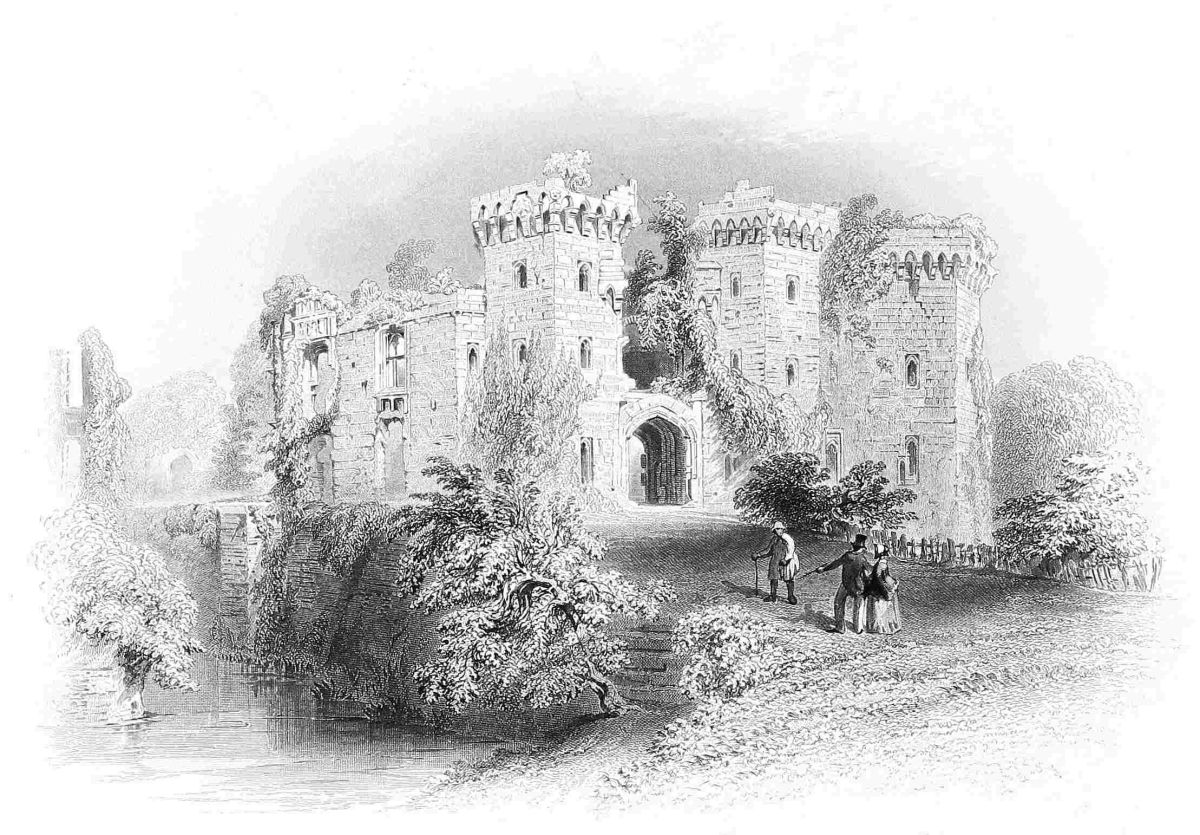
The Gateway Towers.
Raglan Castle.
The King took leave of Raglan Castle on the 15th of September, mournfully observing to the Marquess, that by so doing he hoped “to ease his lordship of a heavy burden.” His Majesty then thanked his noble and devoted host for the large sums of money which had been advanced to him in the course of his troubles. Whereupon the Marquess replied: “Sire, I had your word for the money; but I never thought to have been so soon repaid; for now that you have given me thanks, I have all I looked for.”[257] Well might the royal guest have expressed his feelings on quitting Raglan in the following lines, taken from his own ‘Collection:’—
I fall! I fall! Whom shall I call? Alas! can he be heard, Who now is neither loved nor feared? You, who were wont to kisse the ground, Where’er my honour’d steps were found, Come, catch me at my last rebound! How each admires Heaven’s twinkling fires, When from their glorious seat Their influence gives life and heat! But, oh! how few there are— Tho’ danger from that act be far— Will stoop and catch a falling star.[258]
“Distracted with a thousand griefs, and accompanied by a few trusty and disconsolate servants, the royal victim wandered about the country, thankful to accept protection from any one who had fortune or inclination to minister to his distress. And many ‘cruel days’ to use his own words, were spent in weary marchings without food, narrow escapes, and precipitate retreats, before he took his last farewell of the land of Gwent.”[259]
On one occasion he was hotly pursued in his retreat through Shire Newton, by a party of sixty Roundheads; but reaching a place called Charleston Rock, near the New Passage, a fishing-boat was found, in which he was safely ferried over the Severn into Gloucestershire. His pursuers coming up in the meanwhile, but only to find their object defeated, seized upon the remaining boats, and with drawn swords compelled the fishermen to ferry them across. They hurried into the boats, and, with the royal fugitive still in view, made all haste to be once more on his traces. The poor fishermen, however, being royalists at heart, had no sympathy with these king-hunters; but rowing lustily towards a reef of rocks called the “English Stones,” within a gunshot of the Gloucester shore, there hauled in their oars; and landing their freight on the rocks, told them the water was so shallow that the boats could go no further, and they might easily wade to the opposite bank. And such, in fact, was quite practicable at low water; but, in the present instance, the tide flowed so rapidly, that in making the attempt to reach the opposite bank the whole party were drowned.
Informed of the catastrophe, Cromwell abolished the ferry, which was not renewed until 1718, after a protracted lawsuit between the proprietor of St. Pierre and the Duke of Beaufort’s guardians,[260] when it was named the “New Passage.”

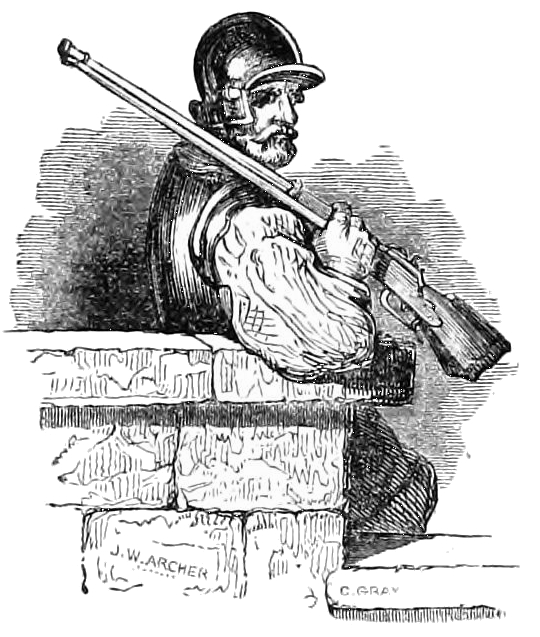
Armourer.
The Siege.—Early the following spring a resolution was passed that the Castle of Raglan, which had so often thrown open its gates to the King, and still supported a garrison in his service, should be reduced without loss of time. It was the last fortress that held out, and until its walls were dismantled, and the garrison made prisoners, the spirit of loyalty in Monmouth would never be thoroughly subdued. The Castle was accordingly invested by Major-General Glenham and Sir Trevor Williams;[261] but the latter, it has been asserted, was not very hearty in his opposition to the King; for he had many misgivings respecting the ultimate designs of Cromwell, who also, as it appears from existing documents,[262] was equally suspicious of Sir Trevor. The first summons to surrender the Castle to Parliament was received by the garrison with indignation and defiance.
Early in June they were joined by Colonel Morgan, who, with a strong body of men[263] from Worcester, took the command. The troops of the garrison made divers gallant sallies, and in one of these killed a cornet of Morgan’s, and carried off the colours. But after the surrender of Oxford to the Parliament, Colonel Morgan had a reinforcement of two hundred men, and being now in a position, both as regarded the works and the efficiency of the troops, to act with vigour, he sent the following summons:—
I.—Colonel Morgan to the Marquess of Worcester.
“My Lord,—By his Excellency’s command, this is my second summons, whereby you are required forthwith to deliver to me, for the uses of both Houses of Parliament, the Castle of Raglan, with all ordnance, arms, ammunition, and provisions, and all other necessaries that belong to war, that are now in it; which if you will be pleased to do, you may haply find mercy, as other garrisons have had; and if you do refuse, expect but the ruin of yourself, your family, and this poor distressed country. For I must acquaint your lordship that his Excellency Sir Tho. Fairfax, having now finished his work over the kingdom except this Castle, hath been pleased to spare his forces for this work, which are now upon their march this way with all materials fit for it; though I made no doubt but I had of mine own strength sufficient to effect it. If your lordship will deny to submit to this summons, and that more blood must be spilt, your lordship may be confident that you shall receive no favour from both Houses of Parliament. So, expecting your answer this night by nine of the clock, I rest your lordship’s servant,
“Tho. Morgan.
“From the Leaguer before Raglan, “June 28, 1646.
“Upon the faith and honour of a soldier, this is a true copy of his Majesty’s letter[264] to the Governors of Oxford, Lichfield, Wallingford, and Worcester, and all other garrisons in England and Wales; which I thought fit to present to your lordship, that you may clearly see what possibility of relief you are like to have.”
II.—The Marquess of Worcester to Colonel Morgan.
“Sir,—I have received this day two advertisements from you; the first I read, containing, as you would have me believe, a true copy of his Majesty’s warrant to several garrisons upon honourable terms to quit. But truly, Sir, it is not in the power of man to make me think so unworthily of his Majesty, that to one, in the opinion of the world, that hath given, himself and family, soe great a demonstrance and testimony of his and their faith and fidelitie towards him, that he would not please so much as name his name, or Raglan. I entreat you, give me leave to suspend my belief.[265]
“And for your second summons, it makes it too evident that it is desired that I would die under a hedge like a beggar, having no house left to put my head into, nor means left to find me bread. Wherefore to give you answer, I make choice (if it soe please God) rather to dye nobly, than to live with infamy. Which answer, if it be not pleasing to you, I shall not think you worthy to be styled by me your loving friend,
“H. Worcester.
“From my House of Raglan, “June 28, 1646.”
This was followed by a third letter from Colonel Morgan:—
“My Lord,—Since it is not in my power to make you nor your son believe anything concerning the surrender of those garrisons, by his Majesty’s order, that comes from me or any of our party: once more, and the last before I send your answer to his Excellency Sir Tho. Fairfax, I shall give your lordship way to send an officer, with another of mine, to those lords in Oxford to whom his Majesty’s letters were directed, for your better satisfaction. This I do, my Lord, to prevent your utter ruin, and that of this poor country, so much occasioned by your lordship’s obstinacy. I expect your present answer, and rest your servant,
“Tho. Morgan.
“June 28th.”
IV.—The Marquess of Worcester to Colonel Morgan.
“Sir,—In respect of your mentioning of any respect or kindness towards me, lest to be divulged to the world should do you any prejudice, I have thought fit in your own letter to return you thanks for the same. And for Sir Tho. Fairfax, if he were here with all his army, he should receive no other from me than what you have had. I hope I serve (though not so well as I should) a Master that is of more might than all the armies in the world; and to his holy will and pleasure I submit myself, and yourself to do what you think fitting.—Your friend and servant,
“H. Worcester.
“From my Dwelling at Raglan, “June 28.”
In the first week of August ensuing, General Fairfax arrived from Bath to hasten the siege—which was in great forwardness both for works and approaches—and then sent in another summons[266] to the Marquess:—
V.—Sir Thomas Fairfax to the Marquess of Worcester.
“My Lord,—Being come into these parts with such a strength as I may not doubt but, with the same good hand of Providence that hath hitherto blessed us, in short time to reduce the garrison of Raglan to the obedience of the Parliament, I have, in order thereto, thought good to send your lordship this summons, hereby requiring you to deliver up to me, for the Parliament’s use, the said garrison and Castle of Raglan; which, as it only obstructs the kingdom’s universal peace, the rendition may beget such terms, as by delay or vain hopes cannot hereafter be expected.—I remain, my Lord, your lordship’s most humble servant,
“Tho. Fairfax.
“Leaguer before Raglan, “August 7, 1646.
“Your lordship’s speedy answer to this summons is desired.”
VI.—The Marquess of Worcester to Sir Thomas Fairfax.
“Sir,—Although my infirmities might justly claim privilege in so sudden an answer; yet, because you desire it, and I am not willing to delay your time, to your letter of summons to deliver up my house, and the only house now in my possession to cover my head in, these are to let you know, that if you did understand the condition I am in, I daresay out of your judgment you will not think it a reasonable demand. I am loth to be the author of mine own ruin on both sides; and therefore desire leave to send to his Majesty to know his pleasure what he will have done with his garrison. As for my house, I presume he will command nothing; neither am I knowing how, either by law or conscience, I should be forced out of it. To these I desire your return, and rest your Excellency’s humble servant,
“H. Worcester.
“From my poor Cottage at Raglan, “Aug. 7, 1646.”
VII.—Sir Thomas Fairfax to the Marquess of Worcester.
“My Lord,—Touching your sending to his Majesty, it is that which hath been denied to the most considerable garrisons of England, further than an account to his Majesty of the thing done upon the surrender; which I do else freely grant to your lordship. And for that distinction which your lordship is pleased to make, that it is your house, if it had not been formed into a garrison, I should not have troubled your lordship with a summons; and were it disgarrisoned, neither you nor your house should receive any disquiet from me, or any that belong unto me.
“This I thought good to return to yours, and thereby to discharge myself, before God and the world, of all extremities and sad consequences that will ensue upon the refusal of the rendition of your garrison upon my summons.—I remain yours,
“Tho. Fairfax.
“August 8.”
VIII.—The Marquess of Worcester to Sir Thomas Fairfax.
“Sir,—I do much confide in your honour, as that being at stake, concerning leave to send to his Majesty, and will at this time forbear to make further motion in it; only one thing which is extraordinary, I offer to your consideration, for the just cause, besides my allegiance, of my reasonable request; which is, That upon his Majesty’s promise of satisfaction, I am above 20,000 pounds out of purse; and if I should do anything displeasing unto him, I am sure all that is lost, and no benefit to the Parliament. If you knew how well known I was, in Henry Earl of Huntington’s time, unto your noble grandfather at York, I am assured I should receive that favour at your hands that safely you might afford. God knows, if I might quietly receive my means of subsistence, and be in security, with the Parliament’s approbation, and freed from the malice of those gentlemen that are of the Committee within this county, I should quietly quit myself of the garrison; for I have no great cause to take delight in it. I have that high esteem of your worth, nobleness, and true judgement, that knowing you will offer nothing ignoble or unworthy for me to do, as the case stands with me, I desire to know what conditions I may have, and I will return you present answer. And, in the meantime, I rest your humble servant,
“H. Worcester.
“August 8, 1646.”
IX.—Sir Thomas Fairfax to the Marquess of Worcester.
“My Lord,—According to your lordship’s desire, I have returned you conditions, such as may be fit and satisfactory to the soldiery. To your lordship and family I have granted quiet and security from all violence of any that belongs to me. I would persuade your lordship not to fear any ill or disrespect from the Committee of this county; I shall easily reconcile that party; or that they will not do anything but as they shall receive order from the Parliament. By this means you are at liberty to send to the Parliament; and upon a present surrender and submission to their mercy and favour, your lordship cannot but think to receive better terms for yourself than if you stand it out to the last extremity; when, besides the hazard of your person, and of those in your family, (which I do presume are dear to you,) and the spoil of the Castle, which cannot be avoided in extreme undertakings against it; your lordship hath no reason to expect better than the Marquess of Winchester received, who, in making good Basing House to the last, narrowly escaped in his own person, lost his friends, subjected those that escaped to great frights and hazard, his house and estate to utter ruin, and himself to extremity of justice.
“Touching your lordship’s 20,000 pounds, your lordship hath liberty to solicit about that by the same hands your lordship shall give an account of the surrender to his Majesty. I desire your lordship upon receipt of these to dismiss my trumpeter, and to return an answer by one of your own.
“Tho. Fairfax.”
X.—The Marquess of Worcester to Sir Thomas Fairfax.
“Sir,—The difficulty of resolution by the soldiers and officers (other than I thought) causeth my request for your patience in not giving you full answer to the conditions you sent me yesterday; but as soon as I shall obtain it, you shall not be long without it. But one thing, and that of moment, I desire to be satisfied in, Whether, if any conclusion should be made, that afterwards I shall be left to the mercy of the Parliament, for alteration at their will and pleasures; and if it be so, I shall endeavour in vain to study more about it. For example, in my Lord of Shrewsbury’s case, and divers others, how conditions have been broken doth a little affright me. I know, by your will and consent, it should never be; but soldiers are unruly, and the Parliament unquestionable; and, therefore, I beseech you pardon my just cause of fear, and I will rest your humble servant,
“H. Worcester.
“August 11.”
XI.—Sir Thomas Fairfax to the Marquess of Worcester.
“My Lord,—I have perused your letter of this 11th of August. As to your scruple, wherein you desire to be satisfied, (so far as I understand it,) I can only give you this resolution, that what I grant I will undertake shall be made good. As to the instance you give in my Lord of Shrewsbury’s case, the actors in that breach (who were none of my army) have received their censure, and by this time I believe the execution. But here, if any conclusion be made while I stay, I dare undertake there shall be no such thing; or, if any, there shall be reparation.
“Tho. Fairfax.
“August 11, 1646.”
XII.—The Marquess of Worcester to Sir Thomas Fairfax.
“Sir,—For the better accommodation of these unhappy differences, if you please there may be a cessation of arms and working, and to engage your honour for the return of my commissioners to-morrow by ten of the clock, they shall wait upon you in your Leaguer; where they shall vindicate me from being the only obstruction of the general peace. So, in expectation of your sudden answer, I rest your humble servant,
“H. Worcester.
“August 13, 1646.”
XIII.—Sir Thomas Fairfax to the Marquess of Worcester.
“My Lord,—Having not yet received by any of your letters a direct answer to the conditions I sent you, I have no grounds or consideration for such a cessation of arms and working, as in your letter you desire; but if it be your purpose to return your answer by commissioners, I shall, by the hour you mention, appoint commissioners of mine own to receive the same in the Leaguer as you desire, and engage myself for the safe return of yours, not exceeding six commissioners and as many servants; and, in order to this, I shall be content there be a cessation of arms and working from nine of the clock to-morrow morning till two in the afternoon.—Yours,
“Tho. Fairfax.
“Uske, August 14.”
XIV.—The Marquess of Worcester to Sir Thomas Fairfax.
“Sir,—Had I not thought you had been in the Leaguer, to the end that the propositions from the place, in answer to yours, might have been first presented unto you; and to avoid delays, which I thought your side would best like of, it was resolved to send commissioners together with our propositions; but considering it was otherwise, I have sent you such as I am advised unto, to take into your consideration. And because there is some addition to yours, I would have been glad you had heard the just reasons thereof, to the end you might not have been persuaded to slight them without just cause. Your pleasure for the ordering of business, I, at your leisure, expect; and, if you please, the dismission of this messenger; and so rest your humble servant,
“H. Worcester.”
XV.—Sir Thomas Fairfax to the Marquess of Worcester.
“My Lord,—I have perused the propositions sent out by your commissioners, which I find such as deserve no answer. I have offered your lordship and the rest conditions which you may yet have, if you accept in time. If there be any thing in them obscure, needing explanation, or wanting circumstantials, for the better performing of the things intended therein I shall be willing to appoint commissioners on my part to treat with yours to that purpose upon these propositions of mine; provided you send commissioners instructed with power to treat and conclude, and return your resolution herein by six of the clock in the evening.—Yours, &c.,
“Tho. Fairfax.
“August 14, 1646.”
In the meantime the besiegers went on with their approaches toward the Castle—their main works being not above some sixty yards distant—and had planted four mortar pieces in one place, and two mortar pieces at another, each mortar piece carrying a grenade shell twelve inches diameter.
Towards the end of the siege, whilst the cannon of Fairfax was playing upon the Castle from the neighbouring height, and when casualties within the walls were of hourly occurrence, an incident occurred, which shows that in these perilous times even ladies deemed it necessary to apologise for being afraid of leaden bullets. “One evening, during the hottest period of the cannonade,” says Dr. Bayly, “there came a musket bullet in at the window of the withdrawing room, where my lord used to entertain his friends with his pleasant discourses after dinners and suppers, which, glancing upon a little marble pillar of the window, and from thence hit the Marquess upon the side of his head, and fell down flattened upon the table, which breaking the pillar in pieces, it made such a noise in the room, that his daughter-in-law, the Countess of Glamorgan, who stood in the same window, ran away as if the house had been falling down upon her head, crying out—‘O Lord! O Lord!’ But at length finding herself more afraid than hurt, she returned back again, no less excusing her—as she was pleased to call it—rudeness to her father, than acknowledging her fears to all the company. To whom the Marquess said: ‘Daughter, you had reason to run away when your father was knocked on the head.’ Then pausing some little while, and turning the flattened bullet round with his finger, he further said: ‘Gentlemen, those who had a mind to flatter me, were wont to tell me that I had a good head in my younger days; but if I don’t flatter myself, I think I have a good head-piece in my old age, or else it would not have been musket proof.’”
Of the exemplary good order observed by the household, before the establishment of a garrison within the Castle, an eye-witness has transmitted the following testimony:—
“I have lived in Raglan Castle,” said he, “three years, and in all that time I never saw man drunk, nor heard an oath, amongst any of all his (the Marquess’s) servants; neither did I ever see a better ordered family; and that which was most wonderful unto me was, that the servants of his house, being half Papists and half Protestants, were never at variance in point of religion—which was brought about by prohibiting disputations.[267] Neither was any man the less accepted for his religion, if his service were acceptable. But when the Castle was filled with officers and soldiers, he used to be more grieved to hear and witness the drunkenness that was then and there too much practised: insomuch, that when some of his chief officers had told him, how that they had fortified such and such a place so and so; and that the enemy could not come; and that there it was impossible. ‘Ay, ay,’ said my Lord; ‘but you have left the main place open and unprotected. You have no fortifications against Heaven. For there is so much swearing and drunkenness amongst you, that from thence I fear me will come our greatest enemy, and you have made no provision against him.’ And, indeed, he said justly; for, in truth, the royalists were grievously addicted to many vices, to which, on the contrary, the companions and followers of Cromwell were comparatively strangers.”
The importance attached by the Parliament to the reduction of Raglan Castle is shown by the following report from their commissioner:[268]—
“Your assured friend and servant, W. C.,” (as the letter is signed,) writes to the Parliament man from “Usk, August 15, 1646.—I shall now give you an account how near our approaches are made unto the Castle. That which is our maine work is about sixty yardes from theirs, and that’s the most. We have planted four mortar pieces, each of them carrying a grenado shel twelve inches diameter; and two mortar peeces planted at another place carrying shels about the like compas; soe that in case the treatye doe breake off, we are then ready to show by what extremitye they must expect to be reduced. This we are very confident, that the grenadoes will make them quit their workes and outhouses, and solely betake themselves into the Castle, which indeed will be a worke of time before we are able to undermine it, in regard we must mine down a hill[269] under a moate, and then the workes, before we can come to the Castle; yet we conceive it feasible to be done with some losse. Our engineer, Captain Hooper, a painful and honest man, proceeding, as he hath begun, with exact running trenches, which we made so secure as if they were workes against a storme, will, with God’s blessing, come within ten yards in a few dayes; and then, I believe, we shall make galleries, mines, and many batteries. The General is every day in the trenches, and yesterdaye appointed a new approache, which the engineer of this army, who is now returned from Worcester, is to carry on with all expedition. He has already broken the ground, throwne up approaches of about an hundred yardes in length and circuit, and is within sixty yards of the under part of their workes.”
The writer then proposes that the Parliament should agree to moderate terms, and accept of an honourable answer. That the plan might succeed he deems quite certain, though not without farther loss; and he adds, in terms less courteous than characteristic of the times, that “it would not be worth while to gaine this old man’s carkasse at so dear a rate.”[270]
Aug. 14.—Fairfax appointed a new approach, which the engineer, Captain Hooper, had so far proceeded in as to throw up approaches of an hundred yards in circuit, making exact running trenches (as secure as if they were works against a storm), coming within sixty yards of their works.
Aug. 15.—The Marquess sent forth his desire to treat upon the General’s propositions; whereupon the treaty was appointed at Mr. Oates’s house, (about a mile and a half from Raglan,) to begin at two of the clock that afternoon. Fairfax’s commissioners were Colonel Birch, Mr. Herbert, Quartermaster-General Grosvenor, Lieutenant-Colonel Ashfield, and Major Tulida.
By Monday the 17th of August, two days after the date of this report, the preliminaries for capitulation were finally arranged.[271]
Surrender.—During the blockade of Raglan, the Parliamentary General fixed his head-quarters at Kevantilla House,[272] the residence of Mr. Oates, about a mile and a half from Raglan; and there the treaty for the surrender of the Castle was finally adjusted and prepared for signature. The commission deputed for the occasion by Fairfax, were Colonel Birch, Quarter-Master Herbert, General Grosvenor, Lieutenant-Colonel Ashfield, and Major Tuliday. The meeting, as previously arranged, took place at two o’clock in the afternoon of Saturday, August the fifteenth; and, on the Monday following, the document was ratified, by appending to it the signatures of the authorized commissioners. The capitulation was agreed to on the following conditions:—
Article the First. The garrison, ammunition, and artillery of Raglan, to be surrendered to General Fairfax on the third day after the ratification of the said treaty; namely, at ten o’clock on the morning of the Wednesday following, being the nineteenth day of August.
Article the Second, stipulated that all the officers, soldiers, and gentlemen of the garrison, should march out with horses and arms; colours flying; drums beating; trumpets sounding; matches lighted at both ends; bullets in their mouths; and every soldier with twelve charges of powder and ball; with permission to select any place, within ten miles of the Castle, for the purpose of delivering up their arms to the general in command; after which the soldiers were to be disbanded and set at liberty.
Article the Third, engaged the General’s safe conduct and protection to all the gentlemen and others who had sought refuge within the walls of Raglan Castle to their respective homes.
Article the Fourth, was an enlargement of the preceding article, by which three months’ protection was guaranteed to certain other gentlemen, until they should either have made their peace with Parliament, or departed the realm.
Article the Fifth, guaranteed the protection and care of the sick and wounded left in the Castle.
Article the Sixth, was an indemnity for all words and acts of the garrison during the siege of the Castle.
On Wednesday the nineteenth of August, in pursuance of these arrangements, the Castle and Garrison of Raglan were duly surrendered to Sir Thomas Fairfax, for the use of both Houses of Parliament. The garrison, which at first had mustered eight hundred men, was now reduced to less than half that number; and as certain of the warlike muniments were becoming so diminished as to expose them at last to the chances of seeing the Castle entered by storm, a prolonged resistance must have been attended with disastrous consequences.
“The garrison had no sooner marched out,” says an eye-witness, “than Fairfax entered the Castle, took a view of it, had some conversation with the Marquess, and then, quitting the scene of his last operation in the way of siege, proceeded to Chepstow, where he was received in triumph by the committee; and, after a brief halt in the Castle, returned to his head-quarters at Bath,”
“A conqueror; and blushing on his sword The stains of blood, by loyal Raglan pour’d.”
Yet Fairfax, as far as lay in his power, was very exact in observing every condition to which he was a party. It is recorded to his honour, that, “far from allowing violence, he would not even permit insults, or expressions of triumph over the unfortunate Royalists.” Something of this generous bearing towards his opponents may be observed in his correspondence with the Marquess of Worcester. He is painted by historians as equally eminent for personal courage and for humanity; and though strongly infected with prejudices, or principles derived from religious and party zeal, he never seems, in the course of his public conduct, to have been diverted, by private interest or ambition, from adhering strictly to these principles. Sincere in his professions, disinterested in his views, open in his conduct, “he had formed,” says Hume,[273] “one of the most shining characters of his age, had not the extreme narrowness of his genius in everything but in war, and his embarrassed and confused elocution on every occasion but when he gave orders, diminished the lustre of his merit, and rendered the part which he acted, even when vested with the supreme command, but secondary and subordinate.”
With this just tribute to his merits as a man and a soldier, we take leave of the Conqueror of Raglan, annexing the following
Anecdotes.—When Fairfax, as we learn from the same authority, laid siege to Raglan Castle, and fair terms were offered to all the garrison, the Marquess only excepted, the generous old Nestor entreated his friends to accept the proposal, and allow him to be the ‘Jonas.’ But this proposition, it may be readily believed, had the opposite effect, of strengthening their determination to stand by him to the last man. In thanking his officers for their devotedness, he added, in his own peculiar way, “I do not much like that way of embalming neither—to be served up to my audit as a thing newly taken out of the cost of many friends’ blood.”
In the conversation above alluded to, when Fairfax took possession of the Castle, the Marquess is said to have made a jocular request, bespeaking the General’s indulgence in favour of some pigeons that still kept possession of their ancient haunt. To which he gravely replied, that he was glad to perceive his Lordship in so ‘merrie’ a frame of mind. Whereupon the Marquess told him the following story:—
“There were two rogues once going up Holborn in a cart to be hanged; but the one being very jocund on so serious an occasion, gave offence to his companion, who, being very downcast, reproved him. ‘Tush, man,’ said the other, ‘thou art a fool; thou wentest a thieving, and never once thoughtest of what would become of thee; wherefore, being on a sudden surprised and taken, thou fallest into such a shaking fit, that I am ashamed to see thee in such a pitiful condition. Whereas I was resolved to be hanged before I fell to stealing, which is the reason I go so composedly unto my death.’ So, in my own case,” continued the Marquess, “I resolved to undergo whatsoever—even the worst—evils that you were able to lay upon me, before I took up arms for my sovereign; and, therefore, wonder not that I am so merrie.”
The fall of Raglan Garrison was a source of much triumph and congratulation to the Parliamentary forces. “There were delivered up with it,” says Rushworth, “twenty pieces of ordnance, but only three barrels of gunpowder; for within the walls they had a mill with which they could make a barrel a day. There was found, however, ‘great store of corn and malt, wine of all sorts, and beer in abundance;’ but hay and forage for their horses had been so completely exhausted, that these noble animals were almost starved to death, and ‘had like to have eaten one another for want of meat, had they not been tied with chains.’”
The captors found also great store of goods and rich furniture in the Castle, which Fairfax committed to the care and custody of Mr. Herbert, commissioner of the army, Mr. Roger Williams, and Major Tuliday, or Tulida, to be inventoried. And in case any inhabitants of the country could make a just claim to them—as having been violently taken from them, or they compelled to bring them thither—that they should have them restored.
Agreeably to the terms of surrender, as recorded in the history of the siege, there marched out of the Castle—“The Marquess of Worcester, then in the eighty-fourth year of his age; the Lord Charles, the Marquess’s sixth son, Lieutenant-Governor of the Castle under his father: [he subsequently retired to Flanders, and died a canon of Cambray;] the Countess of Glamorgan; the Lady Jones; Sir Philip Jones; Dr. Bayly, so often quoted in the preceding narrative; Commissary Gwilliam; four Colonels; eighty-two Captains; sixteen Lieutenants; six Cornets; four Ensigns; four Quartermasters; fifty-two Esquires and Gentlemen.”
It is worthy of record in this place, that, of all the forts and garrisons in the King’s interest, those of Raglan and Pendennis endured the longest sieges, and held out the last of any forts or castles in England—being bravely defended by two persons of very great age—and were at length delivered up within a day or two of each other. “Raglan,” says Lord Clarendon, “was maintained with extraordinary resolution and courage by the old Marquess of Worcester (then 85) against Fairfax himself, until it was reduced to the greatest necessity. Pendennis refused all summons; admitting no treaty till all their provisions were so far consumed that they had not victuals left for four-and-twenty hours; and then they treated, and carried themselves in the treaty with such resolution and unconcernedness, that the enemy concluded they were in no straits, and so gave them the conditions they proposed, which were as good as any garrison in England had accepted. The governor of Pendennis was John Arundel of Trerice, in Cornwall, an old gentleman of near fourscore years of age, who, with the assistance of his son Richard, afterwards made a baron in memory of his father’s service, and his own eminent behaviour throughout the war, maintained and defended the same to the last extremity.”[274]
Returning to the subject of Raglan, we must not overlook the following predictions, as calculated to excite no little attention in times when witchcraft, sorcery, and apparitions, were admitted as articles of popular belief.
Prophecies.—Of the prophetic warnings which, from time to time, and particularly during the siege, had taken possession of the vulgar mind regarding the fall of Raglan and its hereditary lords, the following passage is sufficiently characteristic:—One evening, during the progress of the siege, one of his officers was relating to the Marquess how strangely the narrator, Dr. Bayly, had escaped a shot by means of the iron bar of a window that looked out upon the leaguer. Standing, for example, in a window of the castle, there came a musket bullet and hit full against the edge of an iron bar of a chamber window, so that it parted the bullet in halves, the bar expatiating itself by degrees towards the middle; “one half of the bullet,” said he, “flew by me on the one side, and the other half on the other side; so that, by God’s providence, I had no hurt.”
“The Marquess hearing this, asked me in what chamber it was. I told him. His Lordship then said, as I remember, ‘The window was cross-barred; and you will never believe me,’ said he emphatically, ‘how safe it is to stand before the Cross, when you face your enemy!’”
But returning to the subject of predictions:—“Never,” says the family historian, “never was there a noble house so pulled down by prophecies—ushered into its ruin by predictions, and so laid hold upon by signes and tokens! I shall tell you no more,” he continues, “but what I have both read and seen long before the fall of that proud fabric, which had the honour to fall the last of any that stood upon the tearmes of honour. Now there was one old book of prophecies that was presented to the Marquess, because it so much concerned Raglan Castle, wherein there were these predictions: namely, That there should come an Earl that should first build a white gate before the castle-house, and after that should begin to build a red one; and before that red one should be finished, there should be wars over all the land.”
Now all this was fulfilled in the Marquess’s own day, who, having built the one gate and begun the other, yet by reason of the distractions of the time, was forced to discontinue the latter, which at the time of the siege remained unfinished. Some one standing by while this prophecy was mentioned, exhorted the Marquess—half in jest, half in earnest—to make haste and finish his red-gate house, because we should have no quiet until that were up.
“Hark’ye,” said the Marquess, “nobody shall ever prophesy so much money out of my purse in such times as these! Besides, the prophet does not say until, but before—‘before the red gate is up;’ and, for aught I know, if I should make haste with that building, I should hasten the war to my own sorrow; for the prophet says, ‘before the red-gate house shall be finished, there shall be wars all over the land.’ But what if I had built neither the one nor the other, how could this prophecie have concerned me?”
“Oh, my Lord,” said one of the company, “it is done; and you could not otherwise choose but to do what you did.”
“Ay; but I can choose,” said the Marquess, “whether I will believe the prophet or not.”
“Another prophecie there was,” continues our authority, “that the king of the country should lose a great battle, [Naseby,] and afterwards fly to Raglan Castle for safety; that the enemy should pursue him; and that after a short time he should leave the Castle, and that the enemy should besiege and set fire to the Castle wall. All of which was literally fulfilled.”
Moreover it was said, that “an eagle should come into the park and be there slain, which should be a forerunner to the destruction of that house; which I saw literally performed; but yet executed by one that never heard of the prophecie. It was furthermore foretold, that a cloud of bats should hang over the Castle before its final demolishment; this, three days before, all the Castle beheld to their no small astonishment, and it continued a quarter of an hour, about twilight, so thick that you could not, towards the middle of them, see the sky, though clear. Being shot at with hail-shot, some of them fell down, and the rest flew away.
“The Marquess being told of this, asked what those kind of creatures might signify. Some about him answered, that they were scripture emblems of ruin and desolation.[275] He then asked if they were all gone. It was told him that they were. Whereupon the Marquess asked us whether or no the enemy had begirt us round. It was answered that they had. ‘Then,’ said his Lordship, ‘I am glad of it; for then those emblems of ruin cannot fly away from us, but they must also fly over the heads of the enemy.’”
The Chaplain then proceeds, according to the superstitious belief of the times, to relate the following prediction regarding the King himself:—“The strangest prophecie of all,” he affirms, “both for signification and accomplishment, is this, which I read before I saw it in this book, and fourteen years before the war.” He then gives it in the Welsh language, and explains that fab-anne, as it is one word, signifies a baby, and joined to another Welsh word, should imply a crowned infant, that, on growing up to man’s estate, and ruling these realms for a season, should at last “fall by the stroke of an axe,” or, “he shall be slain with an axe.” We shall not detain our readers by following the Chaplain through the various arguments by which he appears to establish the truth of this singular prediction; but, referring them to the “Apophthegms,” in which it is recorded, we proceed to another portion of our history.
As soon as the Castle was fairly occupied by the new garrison, the work of demolition began. The peasantry were summoned to their aid; but on the great tower their united labours made but slight impression. So, “after battering the top with pickaxes,” they resolved to effect their purpose more expeditiously, and, transferring their implements to the foundation, succeeded in undermining it. As they proceeded, the gaps were propped up with timber, and when the personal risk became too imminent to continue the work, they set fire to the timber, and the instant the charred props gave way, down came a solid mass of the
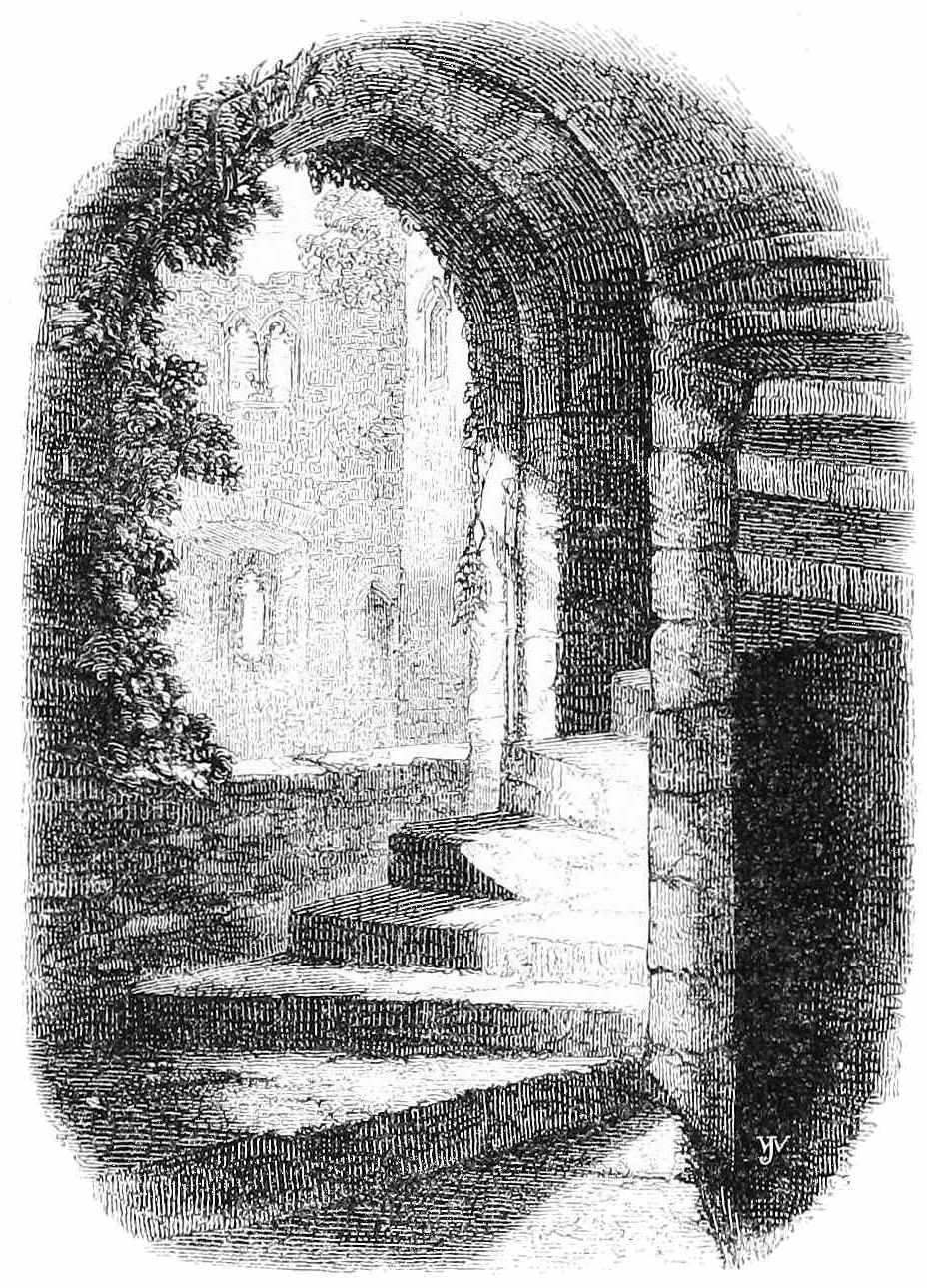
Tower of Gwent, half filling the moat, where it now lies; a specimen of as firmly compacted a structure as ever was framed by the hand of man. The mortar, indeed, seems harder and more durable than the materials which it cements together. Of its massive construction the annexed woodcut, showing the staircase in the centre of the wall, and the engravings opposite, give a very clear and distinct notion.
Much treasure, it was conjectured, had been thrown into the moat during the siege, while under the apprehension of being given up to plunder; so the people were set to work with axes, shovels, and pickaxes, to drain off the water, and collect the treasure. But nothing valuable being discovered in the moat, they were next set to cut the stanks of the fish-ponds, where they had store of very large carp and other fish. From these reservoirs, during many generations, the family had drawn an abundant supply for the table; and in times when the fasts of the Church were rigorously observed, fish-ponds were indispensable to every large establishment. The artificial oak roof of the great hall, already noticed in the introductory sketch, could not be removed with advantage; it was therefore allowed to remain full twenty years after the siege. But the sheet-lead with which it was covered was found to be a very “convertible material,” and was therefore rolled up, sent to market, and the product paid over to the Parliamentary Exchequer.
Above thirty vaults of all sorts of rooms and cellars, and three arched bridges, are yet standing; but the most curious arch of the chapel, and rooms above, with many others, are totally destroyed. Many coins of Queen Elizabeth have been found, but none deserving of preservation from the crucible of the silversmith, to whom they were speedily consigned by the finders.
These dreary “souterrains,” in the present day, are, of course, haunted by goblins, or other beings with lungs not likely to be affected by the damp and mephitic gases, which they are said to exhale. Never was place better adapted for unearthly visitants; and wherever blood has been spilt or treasure concealed, the spirits of vengeance or avarice seize upon the spot as their own exclusive territory. As it appeared to us, however, the genii loci were spirits of a very different stamp—beings with whom the painter, the philosopher, and the poet, would choose to make their abode. Not so the cicerone who showed these mysterious caverns to Bloomfield. “Look down there,” said she, pointing to the great cellar; “something very awful; candles wont burn there! Some people says it’s because the damp chokes ’em. For my part, I think it’s the devil himself; and not much fancying to be seen at his work, he blows ’em out. Well, sir, you may smile as you please; but one puff of brimstone’s enough for me. Let’s step into the Fountain Court. All the wine’s gone; so a cellar with only bad spirits in it, is hardly worth notice.”
Passing from the cellar to the dairy, we may observe that during the siege, and for many generations previously, the fine meadows on the banks of the Olwy, in the adjoining parish of Llandenny, were appropriated as the dairy-farm of the Castle.
The Marquess’s Library was considered one of the best selected, and most extensive in Europe; and we cannot doubt that the Gallery of Paintings bore equal and corresponding testimony to the liberality and taste of the noble owner.[276]
The loss sustained by the family in the immediate destruction of the castle and woods, according to the printed statement, was computed at one hundred thousand pounds; besides enormous sums furnished to his Majesty for the raising and equipment of two armies, and the maintenance of a numerous garrison, of which the daily expenses alone must have required a princely revenue. With this evidence of the Marquess’s resources, it is not surprising that he should be described by Clarendon as “the most moneyed man of the kingdom.” The siege was followed by the sequestration and sale of the whole estate, which, by the parliamentary audit of 1646, amounted to twenty thousand pounds per annum, and remained in the hands of Cromwell till the Restoration, a period of fourteen years. All the old timber in the parks adjacent was cut down and sold; the lead was stript from the roof of the great hall, and sold for six thousand pounds; and a quantity of the timber was carried to Bristol, and there used in rebuilding the wooden houses upon the old bridge, which had recently been destroyed by fire. But the loss of the library was in every sense a national loss, for in this, among many rare invaluable manuscripts, were the archives of Gwent, with the earliest records of Welsh literature. “One of these manuscripts,” says the late Mr. Thomas,[277] “was an interesting work by Geraint Bardd Glass y Cadair, an illustrious Welshman, who flourished about the ninth century. He was the first who composed a Welsh grammar, a work that was revised by Einion and Edeyrn, which form and arrangement are now extant; but the original MS. was in the Raglan library at its capitulation.”
In his palmy days, long before he was created Marquess, the good Earl lived in princely state in this Castle. Surrounded by faithful friends, numerous retainers, and a household that, by its daily expenditure, bespoke almost unlimited resources, he enjoyed in age all the happiness to which men look forward as the reward and solace of a virtuous youth; for, though long practised in the offices of Court, he could still relish the sweets of domestic retirement, the humanizing influence of science, and the conversation of pious and learned men. He was a friend of literature, a pattern of religious consistency, an example of loyalty which no reverses could shake; and when at last plunged into the deepest adversity, stript of his property, bent down with years, and suffering from bodily pain, he maintained a degree of mental serenity that softened the remembrance of his wrongs, showed the true foundation of his faith, and enabled him to view every dispensation of good or evil as coming from God, and intended, by weaning his thoughts from this world, to give him nearer and clearer views of heaven. Reduced in four short years from the height of prosperity into the very abyss of adversity—his home desolate, the prospects of his family blasted, his friends hopeless or in prison, himself an inmate of the Tower—it is impossible to withhold our sympathy from a man who, in no circumstances, forgot the true nobility of his nature, and the obligations of his creed; but in every trial could exclaim, in the words of his own motto—Mutare vel timere sperno.
“Go, empty joyes, With all your noyse, And leave me here alone, In sweet sad silence to bemoane Your vaine and fleet delight; Whose danger none can see aright, Whilst your false splendour dims his sight. Go, and insnare, With your false ware, Some other easie wight, And cheat him with your flattering light; Rain on his head a shower Of honours, favour, wealth, and power— Then snatch it from him in an hour.”[278]
On his melancholy departure from these ancestral halls, which he was never more to behold, the venerable Marquess—accompanied by certain members of his family and a few tried friends, among whom was the devoted Bayly—was conducted to London, and placed under the custody of the Black Rod. Expecting to be treated as a declared enemy of Parliament, notwithstanding the terms of capitulation, his lordship was agreeably surprised to find the severity, with which such cases were usually visited, was relaxed in his favour. “Lord bless us,” said he to Dr. Bayly, who never left him, “what a fearful thing was this Black Rod when I heard of it first! It did so run in my mind, that it made an infliction out of mine own imagination. But when I spoke with the man himself, I found him a very civil gentleman; and I saw no black rod! So, methinks, if we would not let these troubles and apprehensions of ours be made worse by our own fears, no rods would be black.” And although—
“The pride of life has vanished, And here I stand alone, Degraded, stript, and banished From all that was mine own; Yet in dreams, when friends surround me With the loyal and the true, The youthful links that bound me, Seem all riveted anew. When I hear their loyal voices, I half forget my wrongs, And again my heart rejoices In our good old loyal songs. Pent up in these dark regions, The only gems I boast, Are my honour and allegiance— All else of earth is lost.”[279]
But we shall leave the worthy Marquess for a time, to observe what is passing in that dearly beloved, but now desolate mansion, the gates of which were now closed upon him for ever.
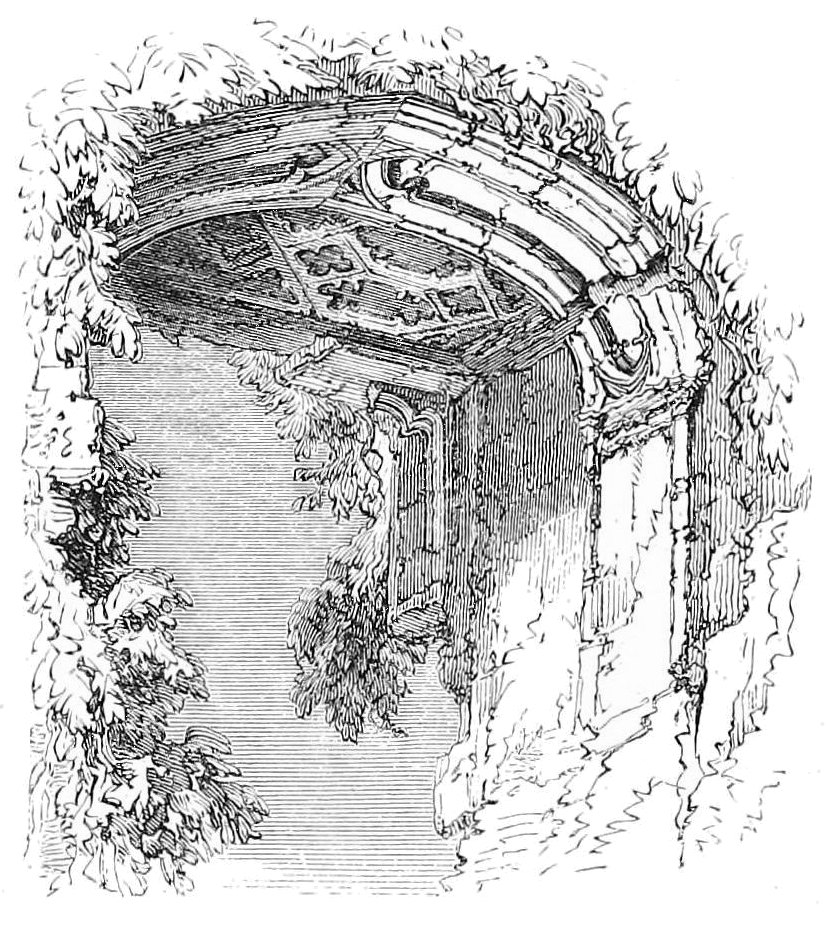
The woodcut here introduced represents one of the richly ornamented, but now dilapidated, windows of the front range of the Castle.
Of the settling of some portion of the Marquess of Worcester’s estates upon Cromwell, we take the following particulars from a popular writer of our own times:—“The Commons,” he observes, “now dealing with delinquents, do not forget to reward good servants—to ‘conciliate the grandees,’ as splenetic Walker calls it. For about two years (writing after the conclusion of the war) there has been talk and debate about settling £2,500 a year on Lieutenant-General Cromwell; but difficulties have arisen. First, they tried Basinghouse lands, the Marquis of Winchester’s, whom Cromwell had demolished; but the Marquis’s affairs were in disorder. It was generally found that the Marquis had only a life-rent there—only Abbotson and Itchin in that quarter could be realized. Order thereupon to settle lands of papists and delinquents to the requisite amount wheresoever convenient. To settle especially what lands the Marquis of Worcester had in that county of Southampton; which was done, though still with insufficient result. Then came the army quarrels, and an end of such business. But now, in the Commons’ Journals, March 7th, this is what we read:—‘An ordinance for passing unto Oliver Cromwell, Esquire, Lieutenant-General, certain lands and manors in the counties of Gloucester, Monmouth, and Glamorgan, late the Earl of Worcester’s, was this day read third time; and, upon the question, passed and ordered to be sent unto the Lords for their concurrence.’” Oliver himself, we shall find, has been dangerously sick; and the following is what Clement Walker reports upon the matter of the grant:—“The sixth of March brought an ordinance to settle two thousand five hundred pounds a year of land out of the Marquis of Worcester’s estate—the old Marquis of Worcester at Raglan—father of the Lord Glamorgan, who, in his turn, became Marquis of Worcester, and wrote the ‘Century of Inventions.’ But £2,500 a year out of the old Marquis’s estate upon Lieutenant-General Cromwell! I have heard some gentlemen, that knew the manor of Chepstow and the other lands, affirm that in reality they are worth £5,000, or even £6,000 a year. You see,” continues he, “though they have not made King Charles a ‘glorious king,’ they have settled a crown revenue upon Oliver, and have made him as glorious a king as ever John of Leyden was.”[280]
In addition to the personal anecdotes, or ‘pithy sayings,’ already introduced, the following are too original and piquant to be overlooked:—“We were talking one day,” says the family chronicler, “of an old drunken fellow, who having used his body to sad disorder in drinking all his lifetime, and at last giving it over, he presently died. The fact being thus brought before him, the Marquis observed, ‘there was nothing to be wondered at in such a termination of the man’s life; for if you take a brand,’ said he, ‘out of the fire that is thoroughly burnt, it will fall to pieces; but if you let it lie there still, it may remain a pretty while before it is turned to ashes.’”
This clearly shows that his Lordship was not a novice in the science of pathology; for, had he made the ‘anatomy of drunkenness’ his particular study, he could not have expressed himself by a figure that more completely illustrates the case. The burnt log may not only last longer, but also preserve its shape, and diffuse light and heat through the whole apartment, while it remains in the fire; but if suddenly removed, and the fire extinguished, it is soon transformed into a heap of black ashes. The comparison applies very forcibly to those in whom the pernicious habit of spirit-drinking has been long a rooted evil. If they suddenly reform, the constitution—to use the same figure—has been so thoroughly carbonized, that, on the artificial temperature being withdrawn, it breaks down like the charred firebrand and is extinguished; but if cautiously and gradually withdrawn, before the charring process has reached the core, it may live to furnish a better light than any that could be expected from it while in the furnace of dissipation. In the Marquess’s time, as already noticed, the habit of drinking was carried to a most fatal excess; and we may readily believe that the ‘apophthegm’ here recorded, was the result of personal observation among the troops of his own garrison, who—
“Red-hot with drinking; So full of valour that they smote the air For breathing in their faces.”
As the preceding anecdote shows the venerable Marquess as a pathologist, so the following exhibits him in the more congenial character of a quaint theologian:—“I was walking one day with his lordship,” says the narrator, “in the private walk about the Great Tower,[281] and there we spied where a bird had made her nest, whom we disturbed from hatching her young ones, and sitting upon her eggs; which act of nature my lord compared to the manner of the creation: ‘For,’ said he, ‘God having made his nest in the world, and brought forth his young at first imperfected, did by his Spirit incubate, and by his wings of prudence spread over them, he gave them life and power; and by his word he brake the shell—et sic pullulavit mundum.’” This method of giving a quaint and solemn turn to the most familiar incidents of life was characteristic of the times, and often introduced into their homilies by the clergy, who made use of the most homely figures to illustrate some of the highest questions in theology. But from the Marquess of Worcester, then at a very advanced age, the effort to extract a moral, or to expound a scriptural text, came very gracefully; and he omits no opportunity, as we perceive, of improving others, by directing their thoughts to those passages of scripture with which his own mind was familiar. It is almost impossible, however, to resist the ludicrous ideas which religious sentiment is made to conjure up when employed by the Parliamentary leaders, and those irreverent applications of scripture which are to be found, not only in their daily conversations, but in their speeches, and even dispatches. Cant was the fashion of the day; and where a letter was not profusely interlarded with the language and figures of Holy Writ, the author was liable to be suspected of indifference or disaffection to the cause.
“An evil soul, producing holy witness, Is like a villain with a smiling cheek——” “And thus he clothes his naked villany With old odd ends stol’n forth of Holy Writ.”
The Marquess’s contempt of hypocrisy and deception is exemplified in another apophthegm:—“A Roman Catholic being sorely pressed to take the oath of supremacy, and being acquainted with another gentleman, who was a Protestant, and so like unto him that you could hardly distinguish them whilst they were together, much less asunder,—this imago sui—this lifelike
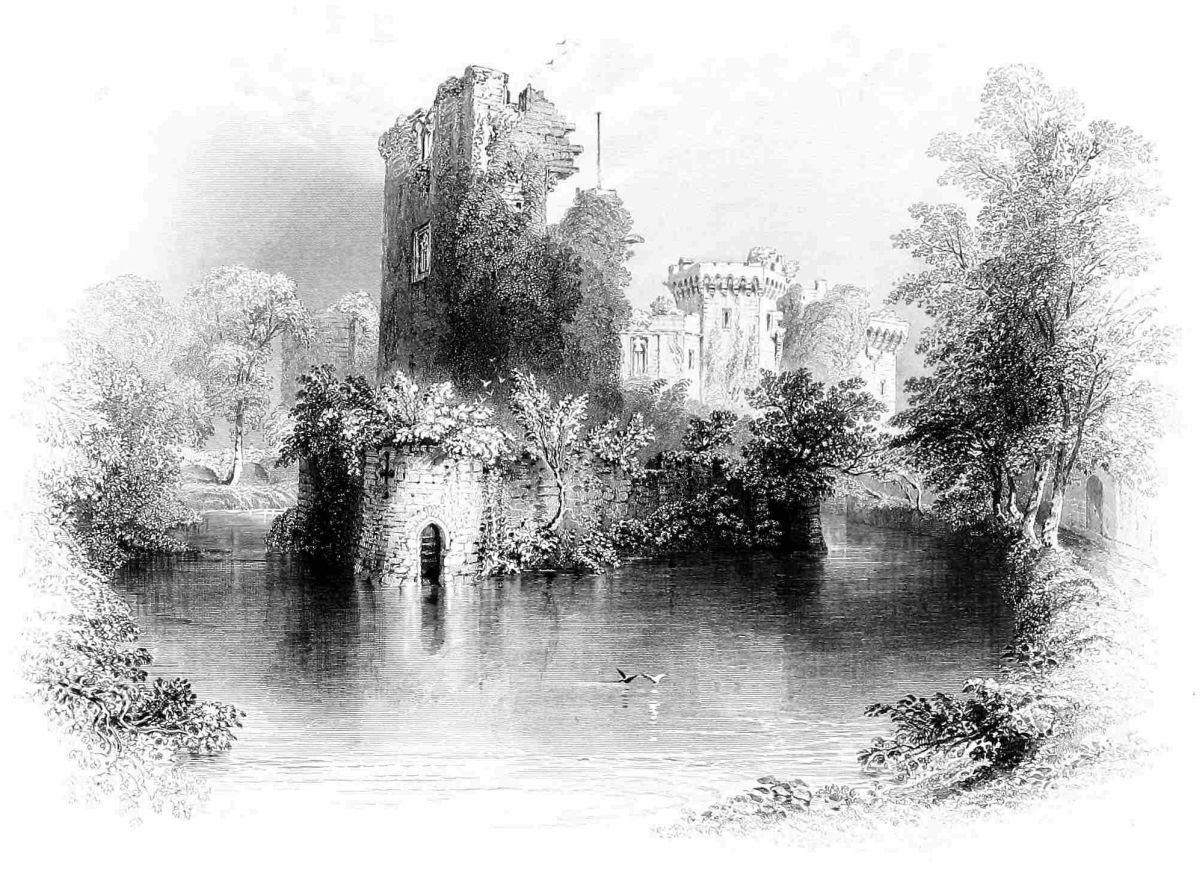
The Keep Tower, from the Moat.
Raglan Castle.
resemblance—as if Nature herself had chosen him to be his representative—the right stone being pulled out, and a counterfeit set in the right ring—and what with the likeness of his countenance, and the identity of apparel, he passed for current; which jest my Roman thought so good, that he must needs brag of it to the Marquess. But my lord no way liked it; asking him—‘Would you put another upon doing that which you would not do yourself? What if the devil—you two being so like one another—should mistake you for him? I assure you he would go neare to mar the conceit.’ For, he might have added, though honesty be no Puritan, yet it will do no hurt.”
“Mine honour is my life; both grow in one; Take honour from me, and my life’s undone.”
In the next passage, the Marquess undertakes the duty of admonishing a party who had come to visit him; and his method of doing so is somewhat amusing. We shall give the lecture, as nearly as we can, in his chaplain’s own words:—“There was a new-married couple,” says he, “presented before the Marquess. The bride was a goodly proper woman, her face well-featured, an excellent eye she had, but she was pitifully disfigured with the smallpox. The Marquess, looking much upon her, and saying nothing to her for a long while, we all knew that silence was in labour for some notable production. At last he advances toward the young bride, and asked her: ‘Gentlewoman, do you know why it is said that God Almighty created man and builded woman?’ The lady, somewhat out of countenance, answered, ‘No, indeed, my lord.’ The Marquess asked her again: ‘Do you know why you women are called housewives?’ ‘I think, my lord,’ said the bride, ‘because good wives should keep at home, and not gad abroad.’ ‘It is a good answer,’ said the Marquess, ‘but not the right one; for women may be bad wives at home, as well as abroad; otherwise they would never scold their husbands out of doors. The answer to my first question is: Woman is not said to be made as Adam was, which only signifies plain work; but to be built, which signifies curiosity and contrivance; and, therefore, as to my second question, a woman is called a housewife, because she is a house out of which all the royal families of kings and emperors derive their extract. Neither are you only compared to houses; but unto cities, kingdoms, churches, and commonwealths. But do you know what house you are like?’ ‘No, indeed, my lord,’ answered the bride. ‘Why, then, I’ll tell you,’ resumed the Marquess; ‘when God builded the first woman, he made her his storehouse, wherein he had laid up all the race of mankind, wherewith he replenished the whole earth. But I must tell you, my lady, God Almighty did not make you coaches nor waggons, that you should be always gadding about.’ Whereat the bridegroom made answer: ‘My lord, I thank you for this; I hope my wife will remember it.’ ‘My lord,’ said the young bride, ‘you will read such a lecture to my husband, that he will never let me go abroad.’ ‘Oh no, my lady,’ said the Marquess, ‘he must not debar you of that liberty, provided you never go abroad but when you go out like the snaile; who seldom stirs abroad but whilst that blessing, the dew of heaven, is upon the earth, that she may gather benefit; and by her greatest care, and equal management, still carries her house upon her back.’ ‘Oh, my lord,’ said she, ‘if I should goe abroad like the snaile, I should carry not only a house upon my back, but horns upon my forehead!’ ‘No, lady,’ said the Marquess; ‘though she pockes at you, yet they are not horns; the snaile can soon draw them in if you touch them, which no horned creature can perform; but she carries them in her head to teach you what you should provide, and bear in mind against you go to hay-making.’
“But the Marquess fearing he had a little displeased the young couple, he thought to make amends by the following, though somewhat equivocal, discourse:—‘Sir,’ said he to the bridegroom, ‘you know I have compared your wife unto a building, and I much commend your choice, for a goodly house should not be chosen for the smoothness or whiteness of the wall—for such a one may be but a dairy-house or a milk-house; nor according to the colours or paintings of the outside—for such a one may be but a tavern or an alehouse; but if I see a house that is lofty and stately built, and hath fair windows, though the outside be but rough-cast, yet I am sure there are goodly rooms therein.’
“And so,” adds Bayly, “both parties were well pleased.” For what the Marquess meant to express by this string of similes was, that although the lady was much disfigured by the smallpox, yet her fine expressive eyes, intellectual forehead, noble carriage, and cultivated mind, amply atoned for accidental disfigurement; and left a balance in her favour which no outward appearance could disparage or conceal.
These anecdotes of an octogenarian, however unsuited to modern ideas, and of rather doubtful merit on the score of compliment, are characteristic of times when the court-jester was still thought a necessary appendage to a great household; and when riddle and allegory were the daily vehicles of political wit and private satire, as well as the legitimate promoters of loyalty, mirth, and good-fellowship. That they were considered by Dr. Bayly himself—a grave and learned man—as reflecting honour upon the Marquess who uttered them, and creditable to his own taste and industry in transmitting them to posterity, is a proof that, agreeably to the taste of the age, they were fully entitled to the distinction of ‘apophthegms.’
Here follows another, in a more serious and figurative sense, to which Juxon himself would not have objected, even from the pulpit:—“We were talking upon one occasion of Christ’s miracles, more particularly of his turning water into wine, and of the five loaves and two fishes. ‘Truly,’ said the Marquess, ‘these miracles He works amongst us every day; but they are so ordinary, or familiar, that we take no notice of them. God sends rain upon the earth; this water gets up into the vine, and the sappe of the vine-tree God turneth into wine. And as few graines of corne as will make five loaves being covered in the earth, will multiply and encrease to such advantage as will feed five thousand with bread; and two fishes will bring forth so many fishes as will suffice so many mouths.’” It was by these serious and intelligible, as well as original, remarks upon subjects accidentally brought out in conversation, that the Marquess sought to impress upon all around him those religious sentiments and convictions which he had himself imbibed by diligent study of the Scriptures; the benefit of which he daily acknowledged, when overtaken by the accumulated evils of age and almost unparalleled adversity.