Chapter XXIII
Reading edition
TELEOSTEI (CONTINUED): ACANTHOPTERYGII—OPISTHOMI—PEDICULATI—PLECTOGNATHI
Sub-Order 10. Acanthopterygii.
Air-bladder usually without open duct. Opercle well developed; supraoccipital in contact with the frontals. Pectoral arch suspended from the skull; no mesocoracoid. Ventral fins thoracic or jugular, more or less firmly attached to the clavicular arch. Gill-opening usually large, in front of the base of the pectoral fin.
The character from which this sub-order, the most comprehensive of the whole class, derives its name, viz. the presence of non-articulated, more or less pungent, rays in the dorsal and anal fins, is by no means universal, exceptions to the rule being numerous. The mouth is usually bordered by the premaxillaries to the exclusion of the maxillaries, and if these should, by exception, enter the oral edge, they are always toothless. The ventral fins are sometimes inserted at some distance behind the base of the pectorals (Haplodactylidae, Platycephalidae), in which case, however, this is due to the elongation of the pelvic bones, which are solidly attached to the clavicular arch. The sub-order is broken up into divisions, which follow in somewhat arbitrary order, the natural affinities being opposed to a linear arrangement; the annexed diagram is intended to remedy this defect.
Synopsis of the Divisions.
I. No suborbital stay, or process extending from the suborbital bones towards the praeoperculum; basis cranii double in the symmetrical forms. Primary shoulder-girdle composed of a perforate scapula and a coracoid; of the four or five pterygials, or basal bones of the pectoral fins, only one or two are in contact with the coracoid; ventral fins thoracic.
Rays of the caudal fin not strongly forked at the base; hypural usually with a basal spine or knob-like process on each side; epipleural bones usually inserted on the parapophyses or on the ribs; dorsal fin usually with strong spines; caudal peduncle rarely much constricted .......... I. Perciformes.
Rays of the caudal fin strongly forked at the base, embracing a considerable portion of the hypural, which always bears a basal spine; epipleural bones usually inserted on the centra or on the parapophyses, rarely on the ribs; dorsal spines feeble or detached; caudal peduncle much constricted; scales usually very small or absent .......... II. Scombriformes.
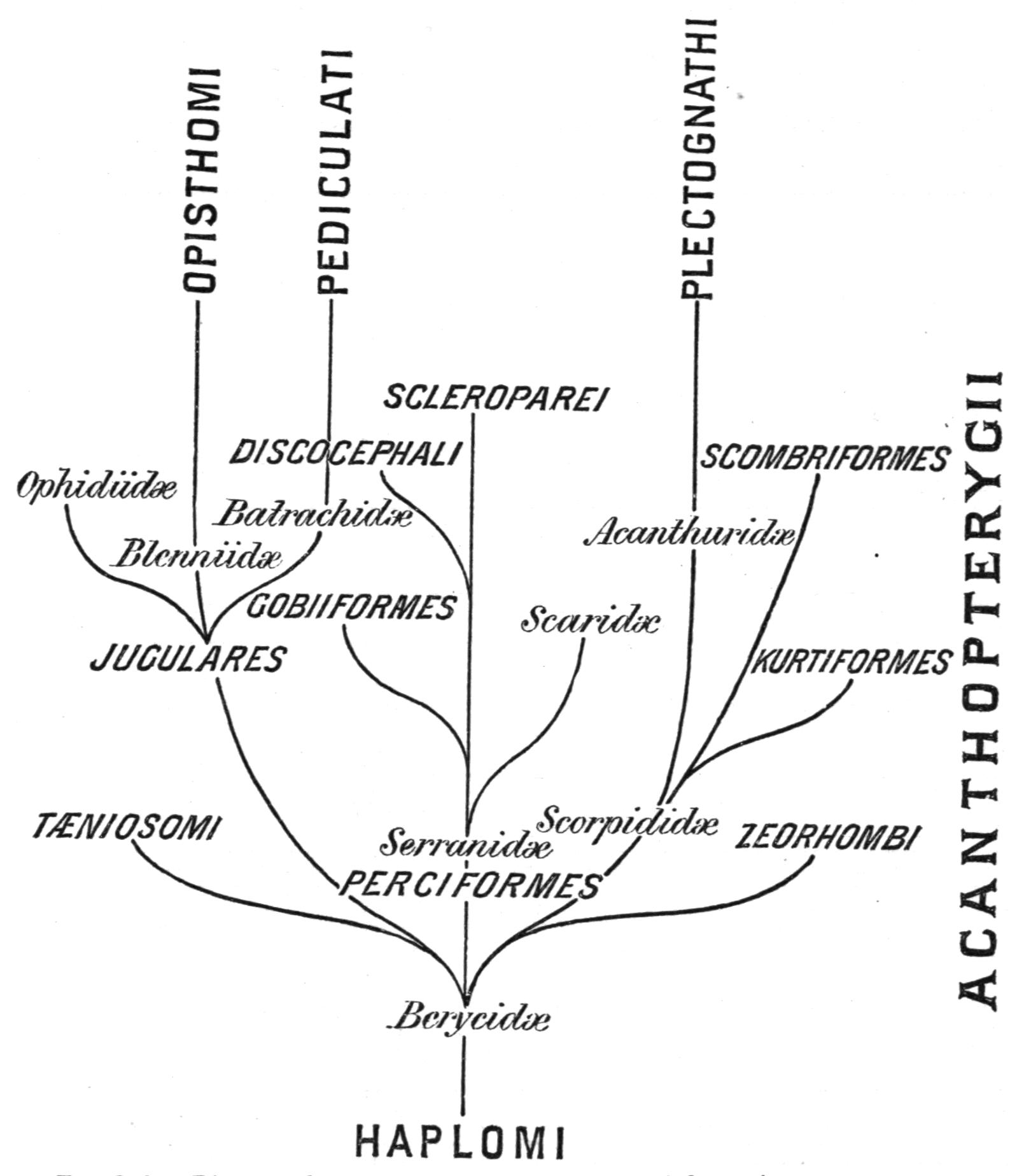
Fig. 399.—Diagram showing probable relationship of the various groups to one another.
Rays of the caudal fin not strongly forked at the base; ventral fins with one spine and six to eight soft rays, or cranium asymmetrical .......... III. Zeorhombi.
II. No suborbital stay; basis cranii double; scapula absent, the pterygials inserted on the coracoid; ventral fins thoracic .......... IV. Kurtiformes.
III. No suborbital stay; basis cranii simple; scapula and coracoid more or less reduced, sometimes vestigial; pterygials large, only one or two in contact with the coracoid; ventral fins thoracic .......... V. Gobiiformes.
IV. No suborbital stay; basis cranii simple; a perforate scapula; three pterygials in contact with the coracoid; ventral fins thoracic; a suctorial laminated disk on the upper surface of the head .......... VI. Discocephali.
V. A suborbital stay, the second suborbital bone more or less produced on the cheek or joining the praeoperculum; ventrals thoracic .......... VII. Scleroparei.
VI. No suborbital stay; ventrals usually jugular or mental; if thoracic, structure of the pectoral arch differing from that ascribed to the first five divisions of this Synopsis.
Pectoral fin with vertical or subvertical base; anal fin usually elongate, rarely small .......... VIII. Jugulares.
Pectoral fin with horizontal or sub-horizontal base; body exceedingly compressed; dorsal fin with all the rays simple; anal fin absent or very small .......... IX. Taeniosomi.
Division I.—PERCIFORMES.
No bony stay for the praeoperculum. Basis cranii double. Spinous dorsal usually well developed. None of the epipleural bones attached to the centra of the vertebrae in the praecaudal region. Pectoral arch with well-developed scapula and coracoid, the former pierced by a foramen or fenestra; pterygials longer than broad, more or less regularly hour-glass-shaped, four or five in number, one or two of which are in contact with the coracoid. Ventral fins thoracic.
This large group, consisting chiefly of marine forms, has members in all parts of the world, with the exception of the Arctic and Antarctic regions, and was already represented by numerous Berycidae and a few Serranidae and Scorpididae in the Upper Cretaceous. The division into families is a task of considerable difficulty, and the necessities of a linear arrangement result in the breaking up of some natural sequences. Thus it appears highly probable that the Scorpididae, themselves derived, together with the Serranidae, from the Berycidae, lead to the Carangidae in the division Scombriformes, whilst a nearly perfect passage can be traced between the Acanthuridae of this division and the Balistidae among the Plectognaths.
Synopsis of the Families.
I. Gills four, a slit behind the fourth.
A. Two nostrils on each side.
1. Ventrals with 1 spine and 6 to 13 soft rays. .......... 1. Berycidae.
2. Ventrals with not more than 5 soft rays.
a. Lower pharyngeal bones not completely united, showing at least a median suture.
α. Gill-membranes nearly always free from isthmus.
* Ventrals little if at all behind the pectorals.
† Third vertebra without transverse processes or with sessile ribs.
§ A more or less developed subocular shelf, or inner lamina of the suborbitals supporting the eye-ball, sometimes reduced to a mere process of the second suborbital.
‖ Ribs inserted on the transverse processes, when these are developed.
Body covered with very large bony scales; ventrals with a very strong spine and 2 or 3 very short soft rays .......... 2. Monocentridae.
Dorsal very short, with few graduated, adnate spines, anal very long .......... 3. Pempheridae.
Spinous dorsal usually well developed, soft dorsal usually not much more developed than the anal; palate usually toothed .......... 11. Serranidae.
Dorsal and anal fins elongate and formed mostly of articulated soft rays, the spines feeble and few .......... 12. Pseudochromididae.
Dorsal and anal fins much elongate, without distinct spines; body band-like .......... 13. Cepolidae.
Teeth in the jaws fused to form a beak .......... 14. Hoplognathidae.
Soft dorsal and anal much elongate; a separate spinous dorsal .......... 15. Sillaginidae.
Soft dorsal much longer than the anal; a separate spinous dorsal .......... 16. Sciaenidae.
‖‖ Ribs mostly sessile, behind the parapophyses; body deep; mouth moderately large and protractile.
Post-temporal forked, distinct from skull .......... 25. Scorpididae.
Post-temporal completely ankylosed to the skull; mouth very protractile .......... 26. Caproidae.
§§ No subocular shelf.
‖ Ribs mostly sessile, behind the parapophyses; anal spines 3 to 14.
Teeth conical; palate toothed; mouth feebly protractile .......... 4. Centrarchidae.
Teeth incisor-like; fins densely scaled .......... 5. Cyphosidae.
Teeth conical; palate toothless .......... 6. Lobotidae.
Maxillary very slender; mouth very protractile .......... 7. Toxotidae.
No entopterygoid; mouth very protractile .......... 8. Nandidae.
‖‖ Ribs inserted on the transverse processes when these are developed; not more than 3 anal spines.
Mouth not or but feebly protractile; spinous dorsal usually longer than the soft; anal with 1 or 2 spines .......... 9. Percidae.
Mouth moderately protractile; palate toothed; spinous dorsal not longer than the soft; anal with 2 or 3 spines .......... 10. Acropomatidae.
Mouth very protractile; palate toothless; praemaxillary with an upwardly directed lateral process .......... 17. Gerridae.
Mouth moderately protractile; palate toothed; anal longer than soft dorsal; body scaly .......... 18. Lactariidae.
Mouth moderately protractile; palate toothless; anal much longer than soft dorsal; body naked .......... 19. Trichodontidae.
†† Transverse processes developed on the third vertebra and bearing the ribs; palate usually toothless.
No subocular shelf; teeth small .......... 22. Pristipomatidae.
A subocular shelf; teeth often large, either cutting in front or molar-like on the sides .......... 23. Sparidae.
A subocular shelf; teeth very small or absent; a pair of barbels on the throat .......... 24. Mullidae.
** Ventrals rather far behind the base of the pectorals; lower pectoral rays unbranched, often thickened; no subocular shelf.
Anal fin nearly as long as the soft dorsal .......... 20. Latrididae.
Anal fin much shorter than the soft dorsal .......... 21. Haplodactylidae.
β. Gill-membranes attached to the isthmus.
* Scales well developed; vertebrae 24 or more.
A subocular shelf; mouth small; palate toothless .......... 27. Chaetodontidae.
No subocular shelf; mouth small; palate toothless .......... 28. Drepanidae.
Subocular shelf more or less developed; a superbranchial respiratory organ .......... 31. Osphromenidae.
** Scales minute; mouth small; vertebrae 22 or 23.
Post-temporal not distinctly forked; vertebrae with strong transverse processes; ventrals with 1 spine and 2 to 5 soft rays .......... 29. Acanthuridae.
Post-temporal forked; vertebrae without transverse processes; ventrals with 2 spines and 3 soft rays between them .......... 30. Teuthididae.
b. Lower pharyngeals completely united into one bone, without median suture .......... 32. Embiotocidae.
B. A single nostril on each side; lower pharyngeal bones more or less completely united, but with persistent suture; no subocular shelf; palate toothless .......... 33. Cichlidae.
II. Gills three and a half; lower pharyngeals completely united into one bone, without median suture; palate toothless.
A single nostril on each side; teeth conical or incisor-like; a subocular shelf .......... 34. Pomacentridae.
Two nostrils on each side; anterior teeth usually strong and canine-like; teeth on pharyngeal bones conical or tubercular; no subocular shelf .......... 35. Labridae.
Two nostrils on each side; anterior teeth more or less coalesced into a beak; teeth on pharyngeal bones flat, tessellated; no subocular shelf .......... 36. Scaridae.
Fam. 1. Berycidae.—One or several of the suborbitals emitting an internal lamina supporting the eye; entopterygoid present. Anterior vertebrae without transverse processes; all or most of the ribs inserted on the transverse processes where these are developed. Two nostrils on each side. Gill-membranes free from isthmus; 4 to 10 branchiostegal rays; gills 4, a slit behind the fourth; pseudobranchiae. Lower pharyngeal bones separate. Ventral fins with 1 spine and 6 to 13 soft rays.
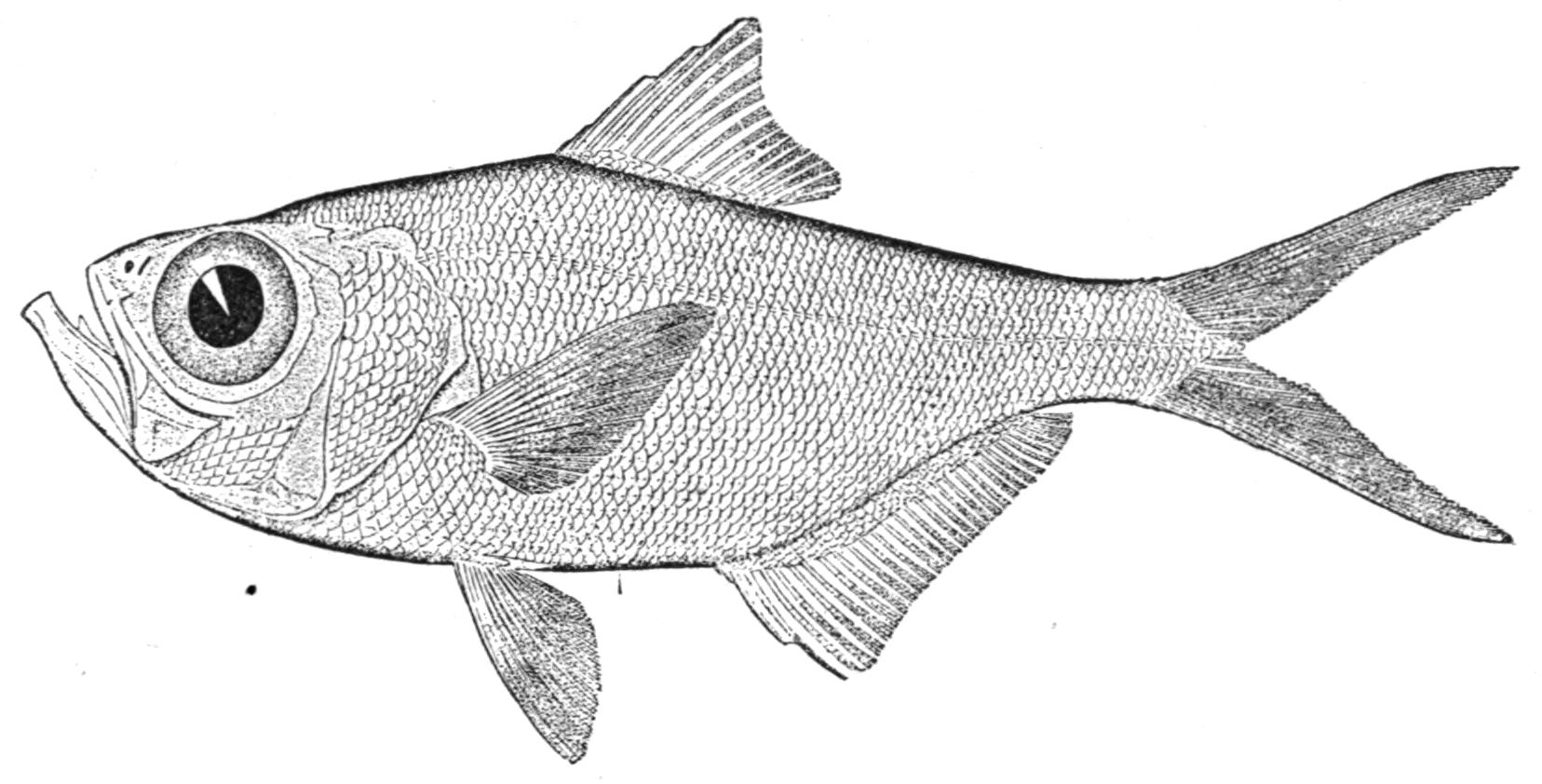
Fig. 400.—Beryx splendens, ⅓ nat. size. (After Goode and Bean.)
This family is remarkable for the retention of two archaic characters: the large number of rays to the ventral fins and the duct between the air-bladder and the digestive tract; the latter character is, however, not universal, and has only been found in two genera (Beryx and Holocentrum). The scaling of the body varies greatly, and so does the development of the spines in the vertical fins. Several genera (Melamphaes, Anoplogaster, Trachichthys, etc.) have the head studded with large muciferous cavities which are covered with a thin skin. The vent is usually situated far behind the ventral fin, but in Paratrachichthys, a genus closely allied to Trachichthys, it occupies a more anterior position, between the ventrals, whilst in Aphredoderus it shifts still further with age, opening on the throat in the adult.
The Berycidae were abundantly represented in Cretaceous deposits by Beryx and other genera more or less closely related to living forms, and they appear to have been the precursors of other Perciform Fishes. About 70 species, referred to 13 genera, are known to live at the present day, mostly at great depths, in the seas nearly all over the world. But one freshwater form is known, Aphredoderus sayanus, the little Pirate Perch of North America, growing to 5 inches in length. The largest marine forms (Beryx and Gephyroberyx) measure from 1 to 2 feet.
Recent genera: Beryx, Polymixia, Aphredoderus, Melamphaes, Plectromus, Scopelogadus, Anoplogaster, Caulolepis, Trachichthys, Paratrachichthys, Gephyroberyx, Myripristis, Holocentrum.
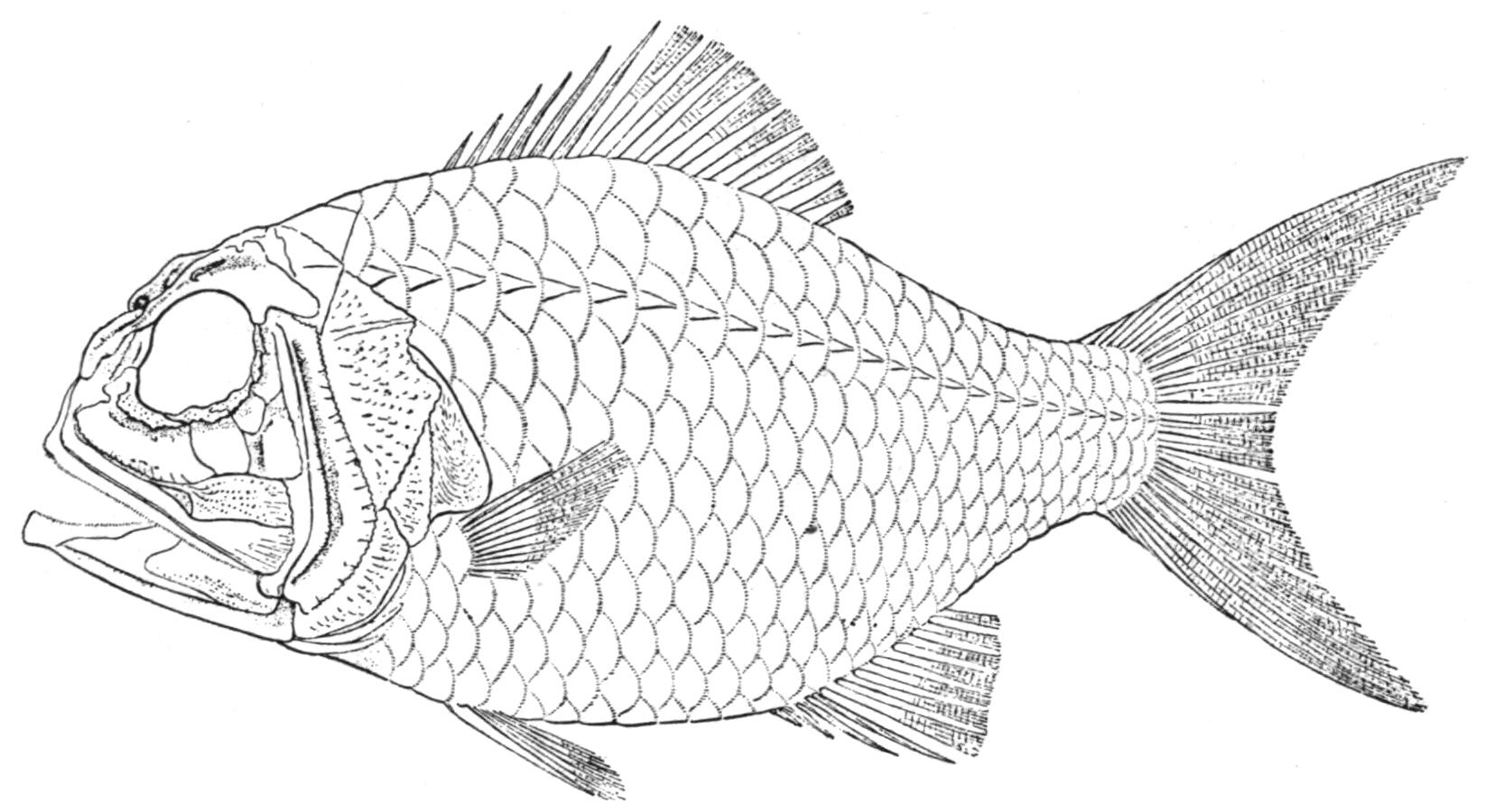
Fig. 401.—Hoplopteryx lewesiensis. (Restored by A. S. Woodward.)
Fossil genera: Sphenocephalus, Acrogaster, Pycnosterinx, Hoplopteryx, from the Upper Cretaceous. Asineops, from the Eocene of North America, is supposed to be allied to Aphredoderus. Beryx is represented by several species in the Upper Cretaceous, and Holocentrum occurs in the Eocene and Miocene.
Fam. 2. Monocentridae.—The single genus Monocentris, with two species, one from the seas of Japan, China, and India, and one from the South Pacific, is very nearly related to the Berycidae, but differs in the absence of ribs on the anterior six vertebrae, in the very large bony scales, forming together a coat of mail, and in the structure of the ventral fin, which is reduced to a strong spine and two or three very short soft rays. The spines of the dorsal fin are very strong and isolated.
Fam. 3. Pempheridae.—The resemblance which the fishes united under this family bear to Beryx is very striking, and applies to the skeleton as well as to the external characters. But the ventral fins are formed of one spine and five soft rays, as in most Acanthopterygians. Bathyclupea agrees with Beryx in being possessed of an open duct to the air-bladder. About twelve species are known, referable to four genera: Pempheris, Parapriacanthus, Neopempheris, from the Indian, Pacific, and tropical Atlantic Oceans, and the deep-sea Bathyclupea, from the Indian and Caribbean Seas, at depths of 145 to 419 fathoms.
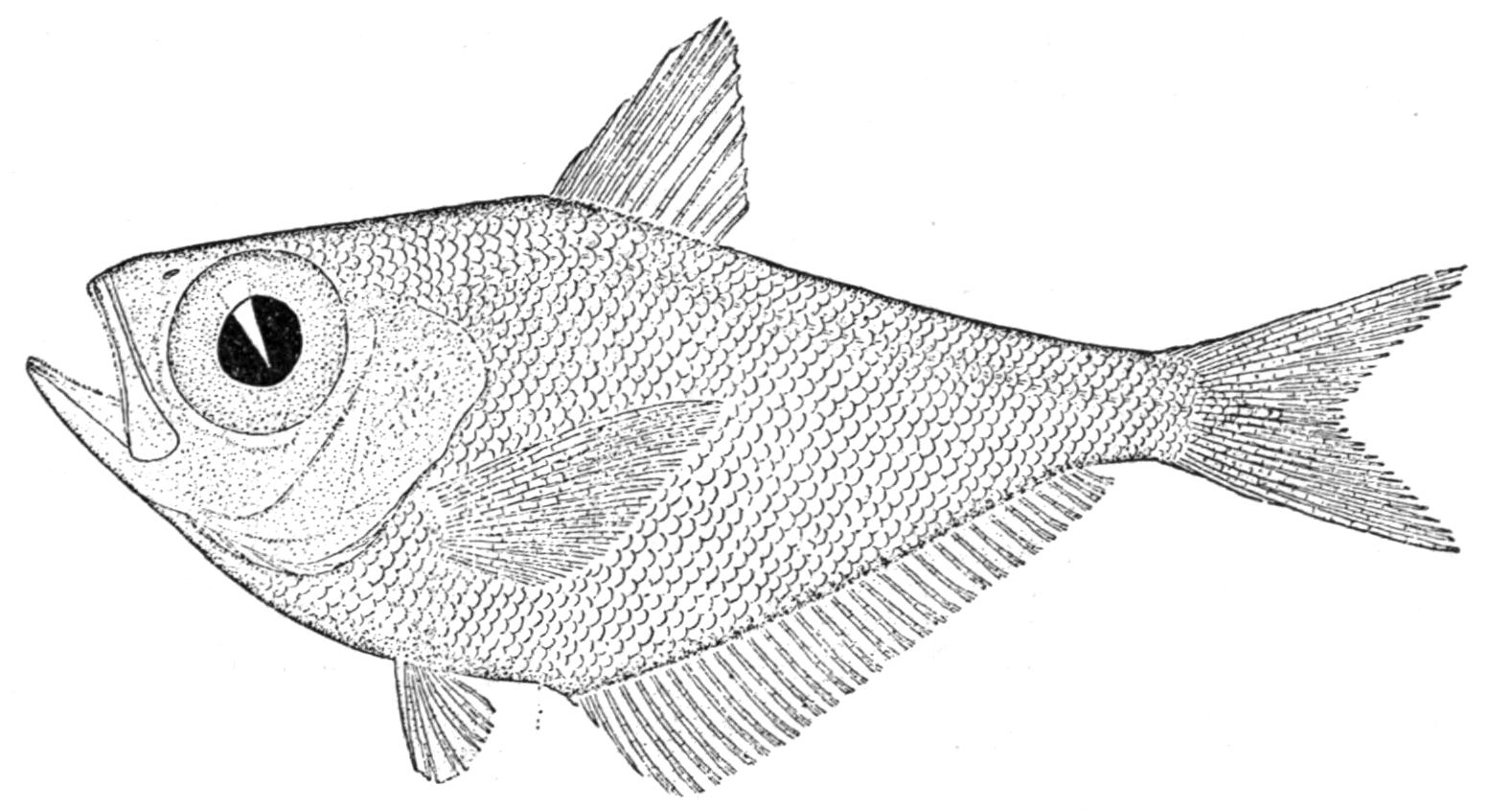
Fig. 402.—Pempheris muelleri. (After Jordan and Evermann.)
Fam. 4. Centrarchidae.—No subocular lamina of the suborbitals, or subocular shelf; entopterygoid present; palate toothed; teeth conical. Praecaudal vertebrae with transverse processes from the third or fourth to the last; ribs mostly sessile, behind the transverse processes. Two nostrils on each side. Gill-membranes free from isthmus; 5 to 7 branchiostegal rays; gills 4, a slit behind the fourth; pseudobranchiae more or less developed, often rudimentary or absent. Lower pharyngeal bones separate. Soft portion of dorsal fin not more developed than the anal. Carnivorous freshwater fishes, some entering brackish water. Many are known to build nests. Mostly inhabitants of North America, the best known being the Sun-Fishes (Lepomis), and Black Bass (Micropterus), several species of which have recently been introduced into continental Europe. Principal genera: Pomoxys, Centrarchus, Ambloplites, Chaenobryttus, Micropterus, Lepomis, Elassoma, Kuhlia. Thirty-two species are known.
Fam. 5. Cyphosidae.—Herbivorous fishes, agreeing in their essential osteological characters with the preceding, differing in the incisor-like outer teeth and densely-scaled fins. Some 14 species are known, from the Pacific and Indian Oceans, referable to 4 genera: Cyphosus (Pimelepterus), Hermosilla, Sectator, Medialuna.
Fam. 6. Lobotidae.—As in Centrarchidae, but transverse processes of vertebrae very short, and palate toothless. Two genera: Lobotes, with two species from the warm parts of the Indian and Pacific Oceans, the Mediterranean, and the Atlantic coast of America, and Datnioides, with two species from the estuaries of the Ganges and the rivers of Burma, Siam, and the Malay Peninsula and Archipelago.
Fam. 7. Toxotidae.—No subocular shelf; entopterygoid present; palate toothed; mouth very protractile; maxillary very slender. Ribs sessile, behind parapophyses which commence from the third vertebra. Two nostrils on each side. Gill-membranes free from isthmus; 7 branchiostegal rays; gills 4, a slit behind the fourth; pseudobranchiae present. Lower pharyngeal bones separate. Ventral fins with 1 spine and 5 soft rays.
A single genus, Toxotes, with 5 species from the fresh waters and coasts of the East Indies, N. Australia, Polynesia, and New Zealand. Toxotes jaculator derives its name from its habit of capturing insects flying near the surface of the water by shooting drops of water at them, a habit which it continues in captivity.
Fam. 8. Nandidae.—No subocular shelf; no entopterygoid; palate toothed; mouth very protractile. Praecaudal vertebrae with parapophyses from the 7th or 8th; ribs mostly sessile, behind the parapophyses. Two nostrils on each side. Gill-membranes free from isthmus; 6 branchiostegal rays; gills 4, a slit behind the fourth; pseudobranchiae absent. Lower pharyngeal bones separate. Soft portion of dorsal fin not more developed than the anal. Ventral fins with 1 spine and 5 soft rays.
Small carnivorous freshwater fishes, of which 14 species are known, referable to 6 genera: Nandus, Catopra, and Badis from South-Eastern Asia, Polycentropsis from West Africa, Polycentrus and Monocirrus from South America.
Fam. 9. Percidae.—No subocular lamina of the suborbitals; entopterygoid present. Anterior vertebrae without transverse processes; all or most of the ribs inserted on the transverse processes when these are developed. Two nostrils on each side. Mouth not or but feebly protractile. Gill-membranes free from the isthmus; 6 to 8 branchiostegal rays; gills 4, a slit behind the fourth; pseudobranchiae more or less developed, often rudimentary, rarely absent. Lower pharyngeal bones separate. Soft portion of dorsal fin not very much more developed than the anal; latter with 1 or 2 spines only. Ventrals with 1 spine and 5 soft rays.
Embrace about 90 species from the freshwaters of the Northern Hemisphere, referable to 12 genera: Perca, Lucioperca, Percina, Etheostoma, Boleosoma, Ulocentra, Diplesium, Ammocrypta, Crystallaria, Aspro, Percarina, Acerina. The British representatives of this family are the Perch (Perca fluviatilis) and the Pope (Acerina cernua). The largest forms are the Pike-Perches or Sander (Lucioperca) of Eastern Europe, Western Asia, and North America, which reach a length of 4 feet and are highly valued for the table. The American Darters (Etheostoma and allies), on the other hand, are among the smallest fishes, but many are remarkable for their brilliant coloration.
Fam. 10. Acropomatidae.—An ill-defined group of marine fishes, some deep-sea, placed here provisionally as annectant between the Percidae and the Serranidae (Pomatominae), differing from the latter in the absence of a subocular shelf. Spinous dorsal short.
About 28 species, mostly from the Pacific Ocean, distributed in 9 genera: Propoma, Xenichthys, Xenocys, Synagrops, Malacichthys, Acropoma, Melanostoma, Epigonus (Telescops), Dinolestes.
Fam. 11. Serranidae.—Second suborbital with an internal lamina supporting the globe of the eye; entopterygoid present; palate usually toothed. Anterior vertebrae without transverse processes; all or most of the ribs inserted on the transverse processes where these are developed. Two nostrils on each side. Gill-membranes free from isthmus; 6 or 7 branchiostegal rays; gills 4, a slit behind the fourth; pseudobranchiae usually present. Lower pharyngeal bones usually separate. Soft portion of dorsal usually not much more developed than the anal. Ventral fins with 1 spine and 5 (rarely 4) soft rays.
One of the largest families of fishes. The principal genera may be grouped as follows:—
Serraninae.—Percichthys, Percilia, Lateolabrax, Niphon, Morone, Percalates, Ctenolates, Macquaria, Siniperca, Coreoperca, Acanthistius, Trachypoma, Centrogenys, Polyprion, Oligorus, Stereolepis, Dinoperca, Liopropoma, Aulacocephalus, Plectropoma, Epinephelus, Cromileptes, Paranthias, Serranus, Centropristes, Chelidoperca, Gilbertia, Caesioperca, Caprodon, Anthias, Callanthias, Pseudoplesiops, Plesiops, Trachinops.
Grammistinae.—Grammistes, Rhypticus. Priacanthinae.—Priacanthus, Pseudopriacanthus. Centropominae.—Lates, Psammoperca, Centropomus. Pomatominae.—Pomatomus, Scombrops. Ambassinae.—Ambassis. Chilodipterinae.—Chilodipterus, Apogon. Lutjaninae.—Lutjanus, Glaucosoma, Therapon, Hoplopagrus, Etelis, Aprion, Aphareus, Odontonectes. Cirrhitinae.—Cirrhites, Cirrhitichthys. Pentacerotinae.—Pentaceros, Pentaceropsis, Histiopterus.
The number of recent species amounts to about 550, the great majority of which are marine.
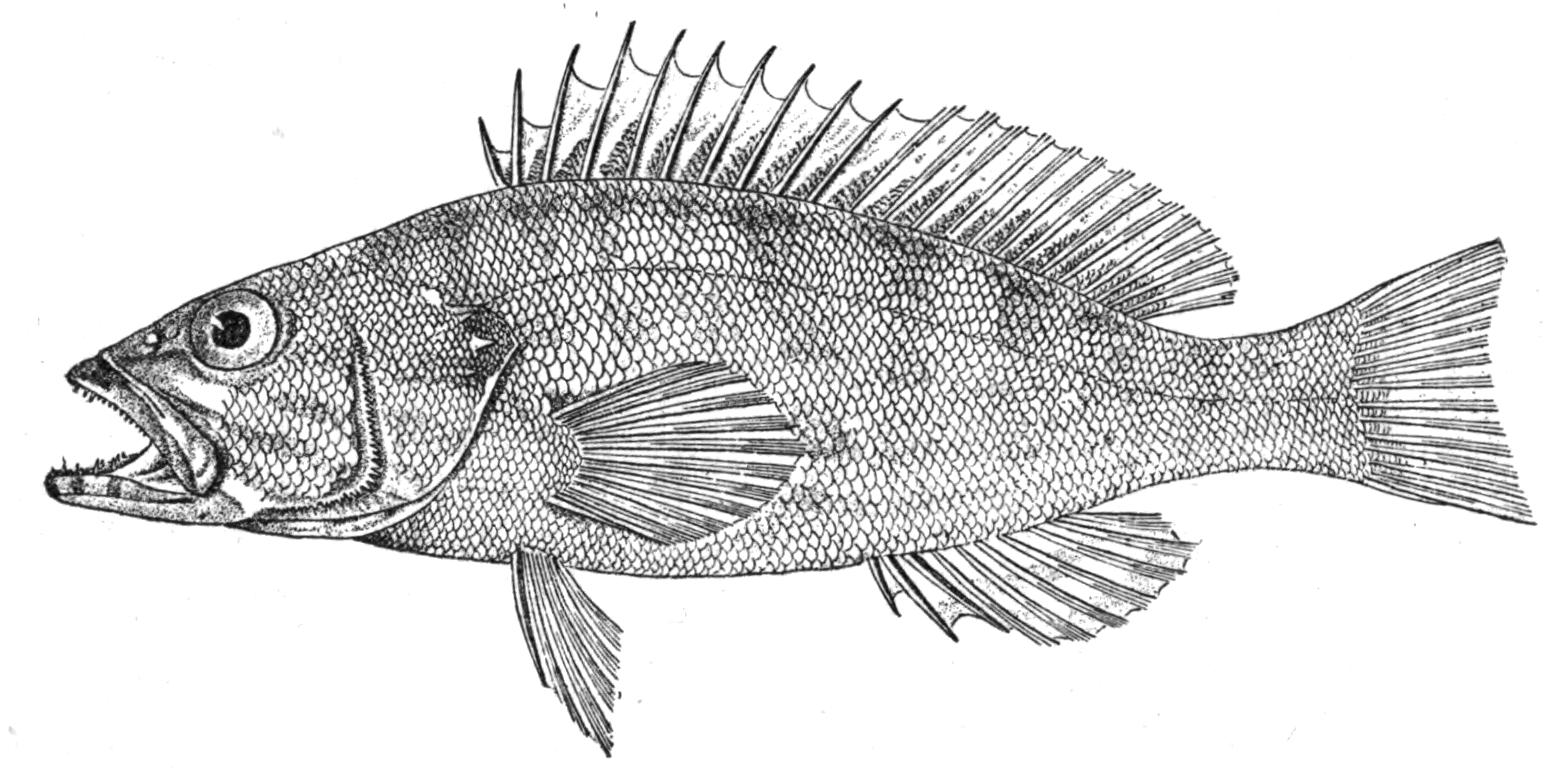
Fig. 403.—Sea Perch (Serranus cabrilla). × ⅓. (After Cuvier and Valenciennes.)
The earliest fossil form is Prolates, from the Upper Cretaceous of France. Morone, Serranus, Percichthys, Anthias, and Apogon are represented in Eocene and later strata.
The range of the family is almost cosmopolitan; few of the Marine Perches descend to any great depth. Some of the species of Stereolepis and Epinephelus grow to a length of 6 to 10 feet. Several species of Serranus (S. cabrilla, S. scriba, S. hepatus), inhabiting the Mediterranean and neighbouring parts of the Atlantic, and some Lutjanus are normally hermaphrodite. Some Chilodipterus and Apogon are remarkable for their nursing habits, the male sheltering the eggs in his mouth.
The curious genera Anomalops and Photoblepharon, of each of which a single species is known from the Malay Archipelago and the South Pacific, have been made the types of a family, Anomalopidae, the systematic position of which remains uncertain since the osteological characters have not been examined. They are remarkable for the movable flap below the eye, bearing a luminous organ, the nature of which has recently been investigated by Max Weber.[714]
Fam. 12. Pseudochromididae.—Closely allied to the Serranidae, and connected with them through Plesiops and its allies. Dorsal and anal fins elongate and formed mostly of articulated soft rays, the spines being feeble and few.
A. With two lateral lines: Pseudochromis, Cichlops.
B. With a single lateral line: Opisthognathus, Latilus, Caulolatilus, Lopholatilus, Malacanthus, Bathymaster, Rathbunella.
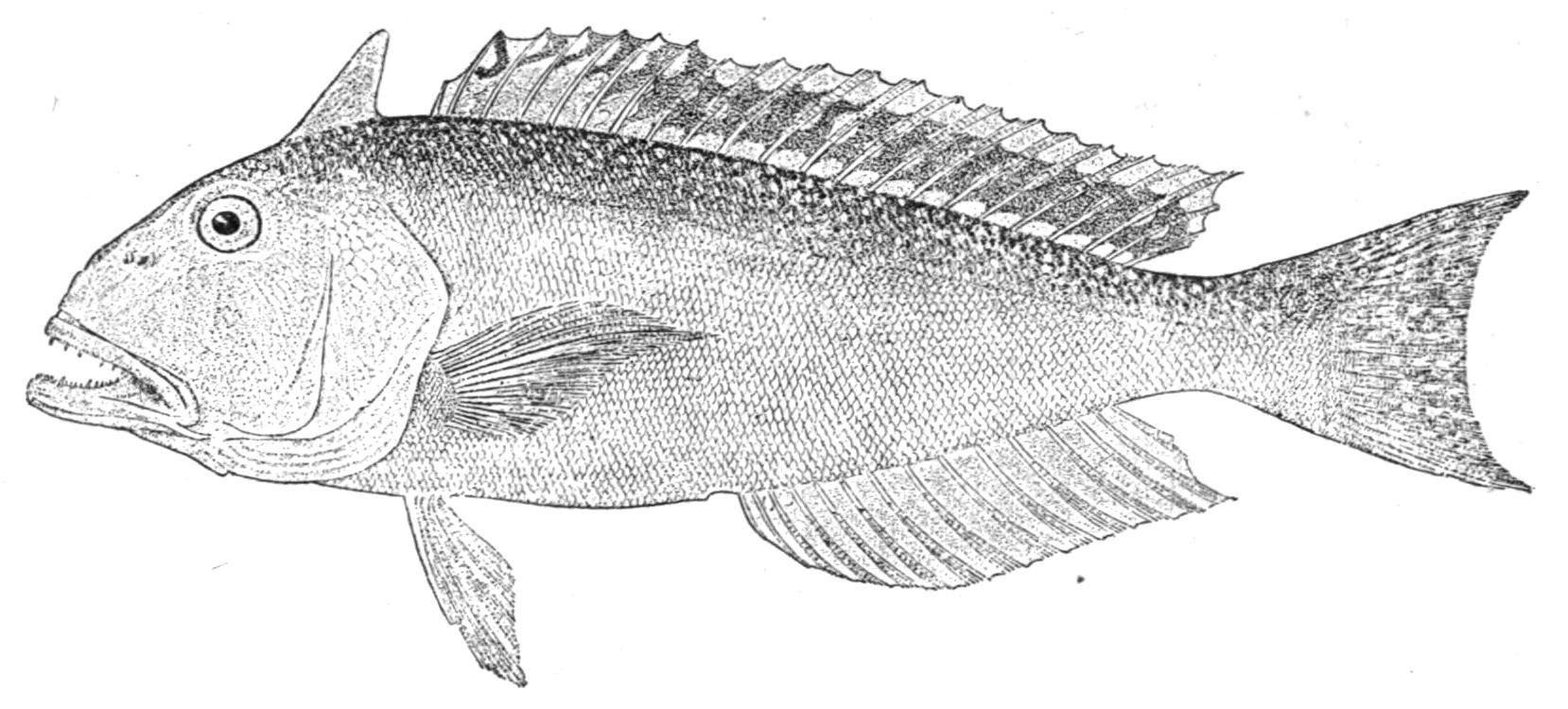
Fig. 404.—Tile-Fish (Lopholatilus chamaeleonticeps). × ¼. (After Goode and Bean.)
Marine, mostly of small size, inhabiting the Atlantic, Indian, and Pacific Oceans. About 30 species. One of the largest and best-known members of this family is the Tile-Fish (Lopholatilus chamaeleonticeps), living upon the bottom of what is known as the Gulf Stream slope, off the coast of New England, where it was first observed in 1879. Here the water is normally comparatively warm, coming as it does from the superheated region of the Gulf of Mexico. During a series of unusually severe gales in 1882, this mass of water was pushed aside, as it were, and replaced by colder water. As a result, millions and millions of these fishes were killed, and their dead bodies literally covered the surface of the sea for hundreds of square miles. It was feared that the Tile-Fish was exterminated; this was not so, however, and the fish has reappeared in tolerable abundance within the last few years.
Fam. 13. Cepolidae.—Agree in essential characters with the preceding, but body band-like with very numerous vertebrae (15 + 54), and very elongate dorsal and anal fins formed of soft rays, of which all except the first three dorsal and the first anal are articulated and branched.
Although these fishes have hitherto been placed near the Blenniidae, the Gobiidae, or the Trachypteridae, they are nothing but extremely elongate Perches, and they stand in the same relation to the Serranidae as the Trichiuridae to the Carangidae and Scombridae. They hardly deserve to rank as a family distinct from the Pseudochromididae.
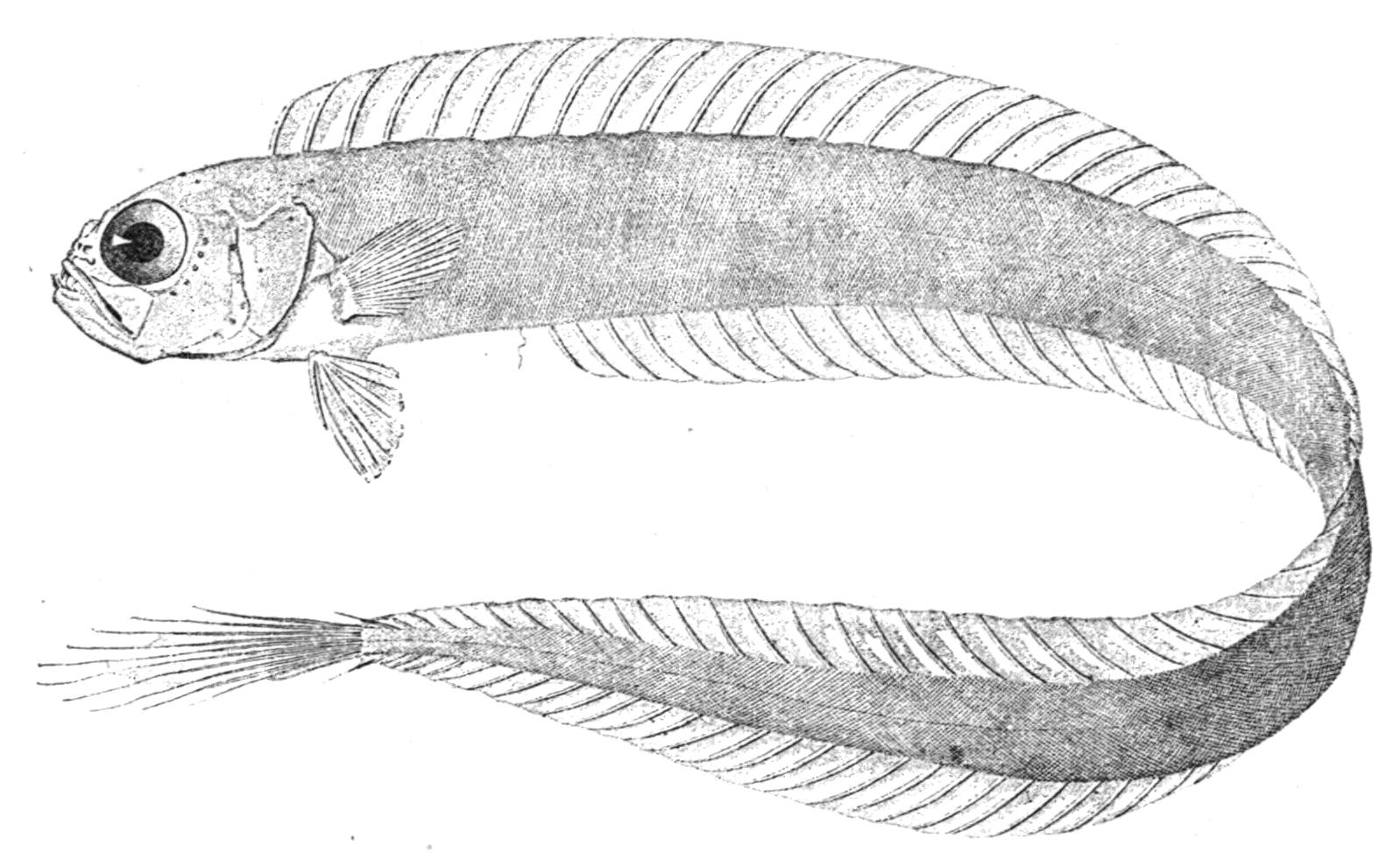
Fig. 405.—Cepola rubescens. × ½. (After Cuvier and Valenciennes.)
Two genera, Cepola and Acanthocepola, with 10 species, from the Mediterranean and North-Eastern Atlantic, the Indian Ocean, and the Western Pacific. The Band-Fish (Cepola rubescens), which is common in the Mediterranean, is sometimes found on the British coasts; it grows to a foot and a half in length, and is remarkable for its bright red colour.
Fam. 14. Hoplognathidae.—Characters of Serranidae, but teeth fused to form a beak as in Tetrodon; palate toothless.
Hoplognathus, with 4 species, from the Pacific Ocean.
Fam. 15. Sillaginidae.—As in Serranidae, but soft dorsal and anal much elongate, as in Pseudochromididae, from which the Sillaginidae differ in the separate spinous dorsal. Palate toothed. Connecting the Serranidae and the Sciaenidae.
Small Marine Fishes from the Indian and Pacific Oceans, ascending rivers. A single genus, Sillago, with about 10 species.
Fam. 16. Sciaenidae.—Also closely related to the Serranidae. Dorsal fin with a short spinous and a long soft portion; anal much shorter than the latter. Palate usually toothless.
A large family of about 150 species, mostly marine. Principal genera: Arripis, Sciaena, Corvina, Otolithus, Ancylodon, Nebris, Larimus, Pogonias, Haplonotus, Umbrina, Eques.
Many of these fishes reach a large size, and the flesh of nearly all is esteemed. The Meagre (Sciaena aquila) is sometimes taken on our coast. The Drum (Pogonias chromis) so called from the sounds which it produces, in common with many other Sciaenids, is remarkable for having the lower pharyngeal bones united, as is also the case in the North American freshwater genus Haplonotus. The air-bladder is usually large and complicated, provided with more or less numerous appendages.
Fam. 17. Gerridae.—Agree in the character of the vertebral column with the Serranidae, but differ in the absence of a subocular shelf; the very protractile mouth usually descends when protruded and the praemaxillary emits an upward lateral process; palate toothless; lower pharyngeal bones usually large and more or less completely coalesced.
About 60 species of carnivorous, mostly small, fishes, from the tropical seas, referable to 3 genera: Gerres, Equula, Gazza.
Fam. 18. Lactariidae.—Intermediate between Serranidae and Trichodontidae. No subocular shelf; palate toothed; branchiostegal rays 7; scales small, cycloid, deciduous; spinous dorsal short; anal longer than the soft dorsal; scapula with two foramina.
Lactarius delicatulus, from the coasts of Southern Asia.
Fam. 19. Trichodontidae.—Agree in the character of the vertebral column with the Serranidae, but have no subocular shelf; body naked, and anal much longer than the soft dorsal; palate toothless; only 5 branchiostegal rays.
Two genera, each with a single species, from the North Pacific, Trichodon and Arctoscopus, bearing some resemblance to the Trachinidae, with which they have usually been associated.
Fam. 20. Latrididae.—Marine Fishes intermediate between the Serranidae and the Haplodactylidae, agreeing with the former in the extent of the anal fin, which is nearly as long as the soft dorsal, and with the latter in the absence of a subocular shelf and the posterior position of the ventrals. A single genus, Latris, with 3 or 4 species, from the coasts of Australia and New Zealand.
Fam. 21. Haplodactylidae.—No subocular shelf; entopterygoid present; palate usually toothless. Vertebrae with transverse processes from the third or fourth; all the ribs attached to the transverse processes when these are present; anterior epipleurals strong. Two nostrils on each side. Gill-membranes free from the isthmus; 5 or 6 branchiostegal rays; gills 4, a slit behind the fourth; pseudobranchiae present. Lower pharyngeal bones separate. Soft portion of the dorsal fin much more developed than the anal. Ventral fins with 1 spine and 5 soft rays, inserted far back behind the pectorals, the lower rays of which are simple and more or less thickened.
This family embraces the genera Haplodactylus, Chilodactylus, Chironemus, and Threpterius, with some 30 species from the seas of the Southern Hemisphere and Japan. They feed chiefly on crustaceans, molluscs, and other invertebrates living among sea-weed.
Fam. 22. Pristipomatidae.—No subocular shelf; entopterygoid present; palate toothless. Vertebrae with transverse processes from the third; all the ribs attached to the transverse processes. Two nostrils on each side. Gill-membranes free from isthmus; 5 to 7 branchiostegal rays; gills 4, a slit behind the fourth; pseudobranchiae present. Lower pharyngeal bones separate. Ventral fins with 1 spine and 5 soft rays.
Pristipoma, Haemulon, Diagramma, and Pentapus, distributed over all the tropical and subtropical seas, a few entering fresh waters. About 130 species are known.
Fam. 23. Sparidae.—Second suborbital with an internal lamina supporting the globe of the eye; entopterygoid present; palate usually toothless; teeth often either cutting in front, or molar-like on the sides. Vertebrae with transverse processes from the second or third; all the ribs attached to the transverse processes. Two nostrils on each side. Gill-membranes free from isthmus; 5 to 7 branchiostegal rays; gills 4, a slit behind the fourth; pseudobranchiae present. Lower pharyngeal bones separate. Soft portion of dorsal fin not much more developed than the anal. Ventral fins with 1 spine and 5 soft rays.
The Sea-Breams embrace some 200 species, distributed over the coasts of nearly the whole world. Some are herbivorous, but the majority are carnivorous.
Principal genera: Scolopsis, Dentex, Synagris, Caesio, Maena, Oblata, Melambaphes, Girella, Doydixodon, Cantharus, Box, Crenidens, Pachymetopon, Dipterodon, Sargus, Charax, Lethrinus, Sphaerodon, Sparus, Pagrus, Pagellus.
Abundantly represented in Eocene and Miocene beds by remains of Sargus, Sparus, Pagrus, Pagellus, and by the extinct genera Ctenodentex, Sparnodus, and Trigonodon. Some species grow to a length of three feet, such as the "Sheep's-Head" of North America, one of the best salt-water fishes of the United States, and the "Schnapper" (Sparus unicolor), of Australia, also much esteemed. Some of the Atlantic and Mediterranean species of Box, Sargus, Charax, Sparus, and Pagellus are known to be normally, or at least very frequently, hermaphrodite.
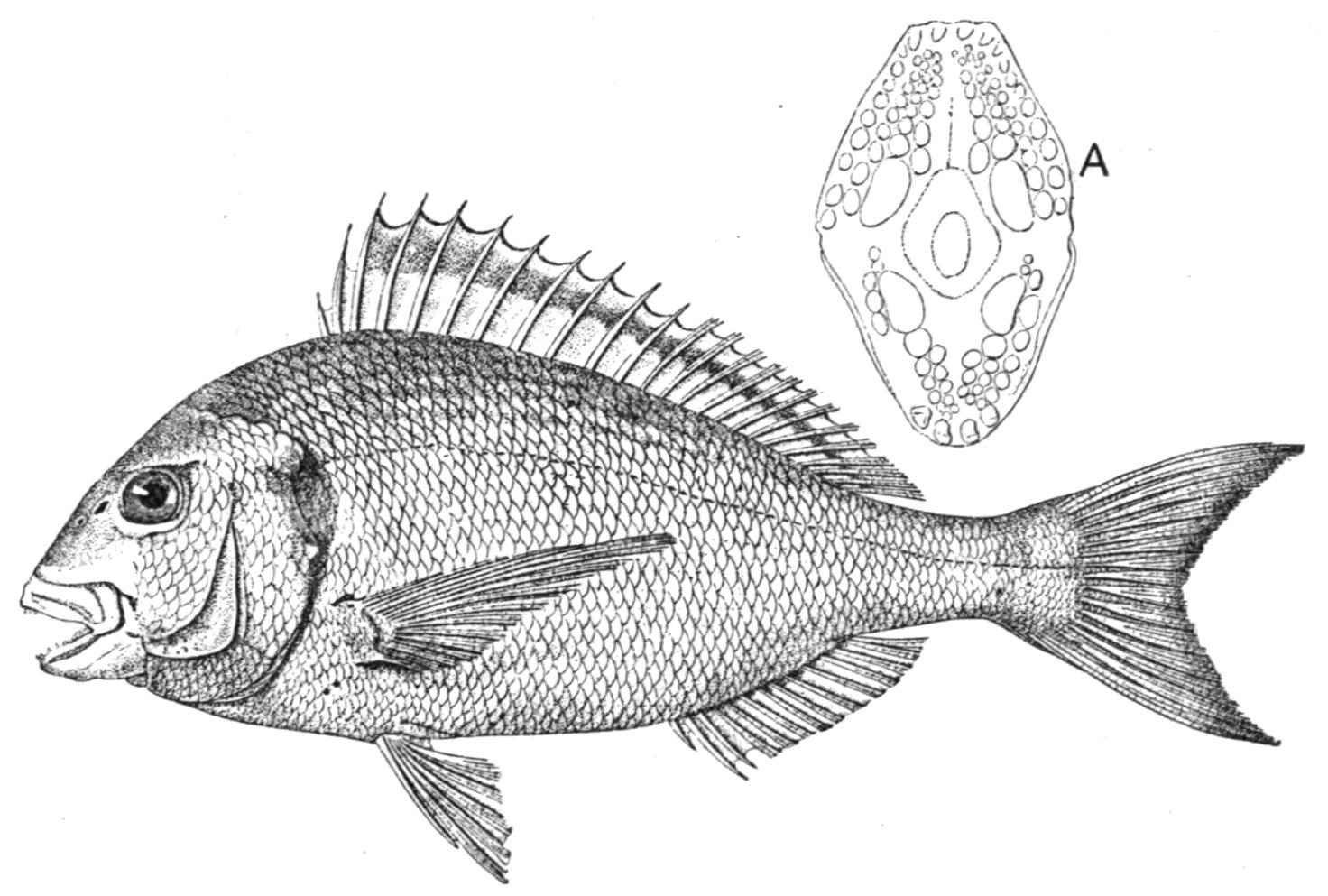
Fig. 406.—Gilt-head Sea-Bream (Pagrus auratus). A, its dentition. (After Cuvier and Valenciennes.)
Fam. 24. Mullidae.—The "Red Mullets" are very nearly related to the Sparidae, with which they agree in the structure of the vertebral column and the presence of a subocular shelf. They differ in the very weak dentition, the presence of a pair of hyoid barbels, the reduced number (4) of branchiostegal rays, and the double perforation of the scapula. Two short dorsal fins, remote from each other, the anterior with weak spines.
Small marine and brackish-water fishes, feeding on animalcules and decomposing matter; inhabitants of nearly all the tropical seas and extending to Northern Europe. About 50 species are known, referred to 5 genera: Upeneoides, Upeneichthys, Mullus, Mulloides, and Upeneus.
The British species are Mullus barbatus and M. surmuletus, remarkable for their beautiful pink or red colour, and much valued on the market, although no longer held in the high estimation for which they were noted by the Romans.
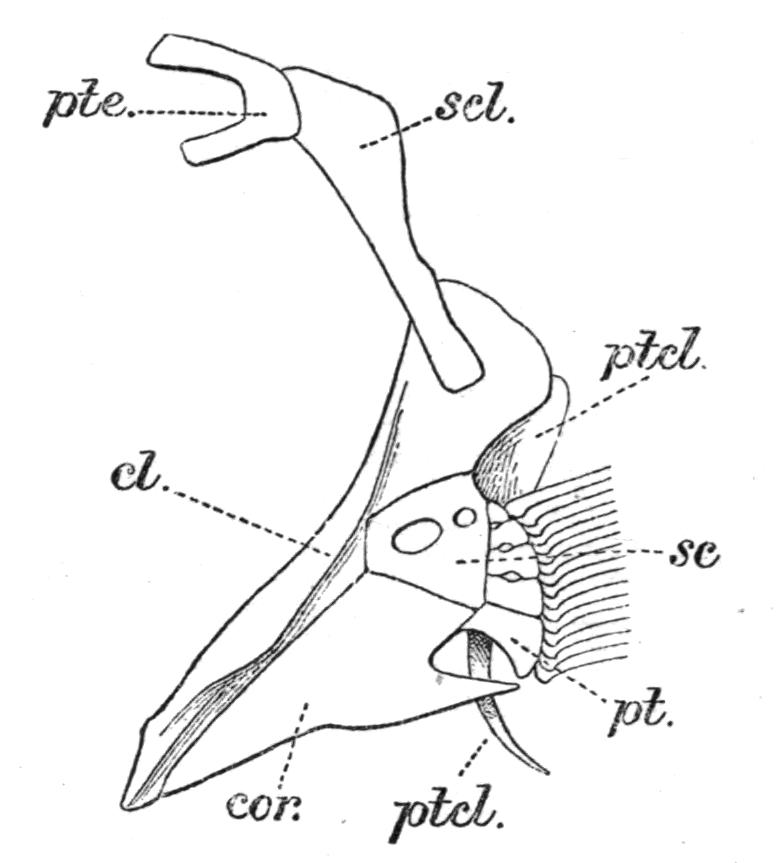
Fig. 407.—Scapular arch of Mullus surmuletus. cl, Clavicle; cor, coracoid; pt, pterygials; ptcl, post-clavicle; pte, post-temporal; sc, scapula; scl, supra-scapula.
Fam. 25. Scorpididae.—Second suborbital with an internal lamina supporting the globe of the eye; entopterygoid present; palate toothed. Ribs sessile, behind the parapophyses when these are present. Two nostrils on each side. Gill-membranes free from isthmus; 7 branchiostegal rays; gills 4, a slit behind the fourth; pseudobranchiae present. Lower pharyngeal bones separate. Ventral fins, if present, with 1 spine and 5 soft rays.
This family embraces 12 species from the coasts of Africa, Southern Asia, Australia, and New Zealand, referable to 5 genera: Scorpis, Atypichthys, Atyposoma, Henoplosus, Psettus. The fish here figured (Psettus sebae, Fig. 408) is remarkable for the excessive depth of the body, which is greater than in any other species.
Aipichthys, one of the few Acanthopterygian types known to have existed in the Cretaceous period, appears to belong to the family Scorpididae as here defined, and not to the Carangidae.
Fam. 26. Caproidae.—Characters of Scorpididae, but supratemporal completely ankylosed to the skull.
The Boar-Fish (Capros aper) of the Atlantic and Mediterranean is occasionally found on our southern coasts, and is highly remarkable for the hair-like bristles with which its scales are covered, an extreme exaggeration of the "Ctenoid" type. The mouth is very protractile, and the vertebrae are only 22 or 23 in number. Antigonia, with a single species found at remote points in the Atlantic, Pacific, and Indian Oceans, is probably allied to Capros, with which it is believed to be connected through the fossil genus Proantigonia, from the Upper Miocene of Croatia.
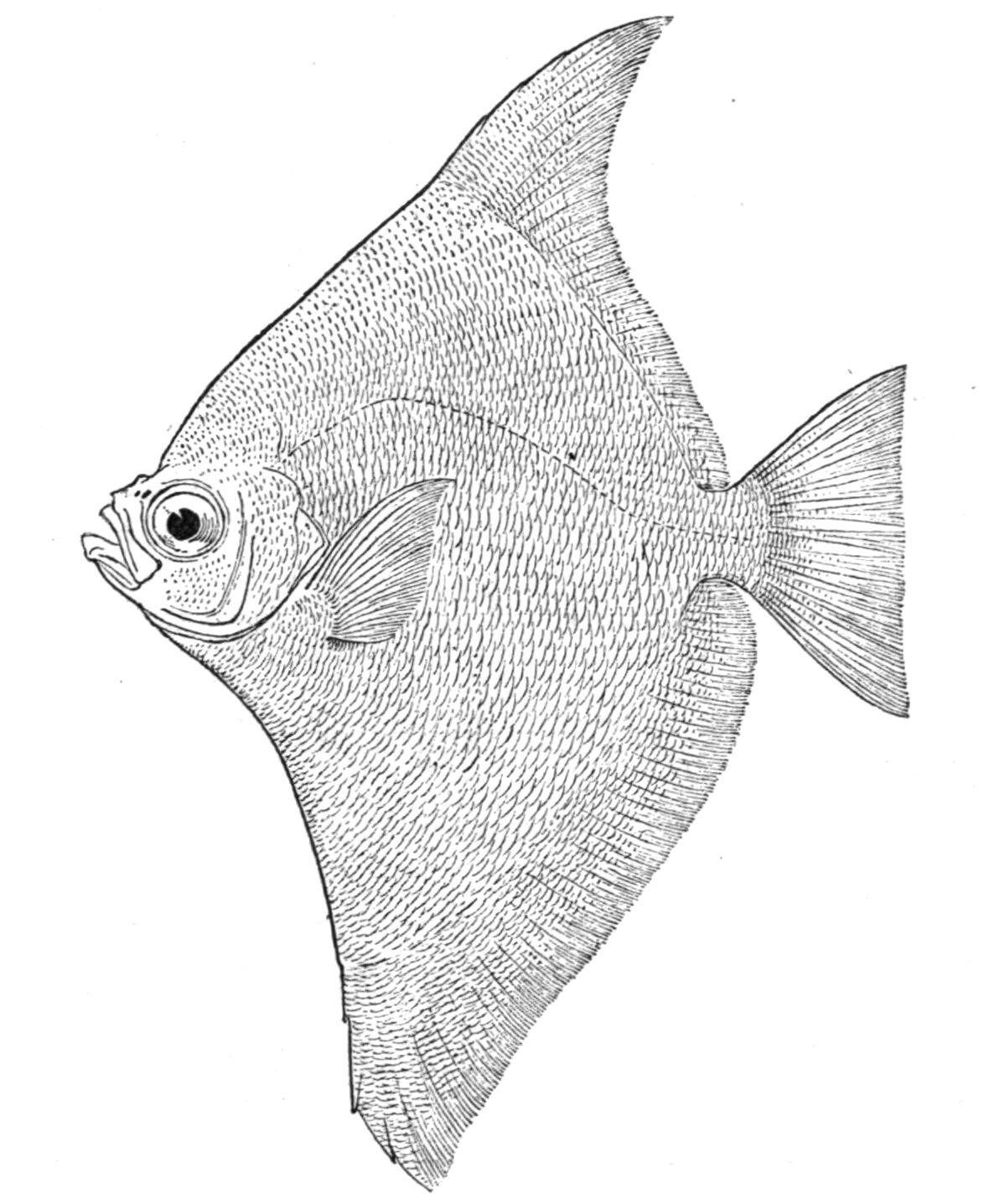
Fig. 408.—Psettus sebae, from the West Coast of Africa, × ½.
Fam. 27. Chaetodontidae.—Closely allied to and evidently derived from the more generalised types of the Scorpididae, differing in the attachment of the gill-membranes to the isthmus. Post-temporal more or less firmly united with the skull, sometimes indistinctly bifurcate. Mouth small; palate toothless; soft portions of vertical fins usually covered with scales; ribs usually strong and blade-like; body short and deep.
A large group of about 200 marine carnivorous fishes from the tropics, mostly of small size, remarkable for their singular forms and markings and brilliant coloration. They are particularly abundant about volcanic rocks and coral reefs.
An Atlantic species of Ephippus (E. faber) is extremely remarkable, when adult, for an enormously enlarged globular bony mass on the back of the head, formed by hypertrophy of the frontal and supraoccipital bones.
Principal genera: Ephippus, Parapsettus, Scatophagus, Chaetodon, Chelmo, Heniochus, Holacanthus, Pomacanthus, Platax.
Chaetodon, Holacanthus, Pomacanthus, Scatophagus, Ephippus, and Platax were represented in the Eocene of Europe.
Fam. 28. Drepanidae.—The genus Drepane, with a single species from the Indian Ocean, is very closely related to the Chaetodontidae, but it lacks the subocular shelf, and it is distinguished externally by the very elongate, falciform pectoral fin.
Fam. 29. Acanthuridae.—A more or less developed subocular shelf; entopterygoid present. Mouth very small, not or but slightly protractile, the maxillary more or less firmly attached or ankylosed to the praemaxillary; teeth conical, bristle-like, or incisor-like. Palate toothless. Vertebrae 22 or 23, the praecaudals with strong transverse processes commencing from the first; ribs and epipleurals inserted on the transverse processes. Post-temporal not distinctly forked, ankylosed to the skull. Two nostrils on each side. Gill-membranes broadly attached to the isthmus; 4 or 5 branchiostegal rays; gills 4, a slit behind the fourth; pseudobranchiae present. Lower pharyngeal bones separate. Body covered with minute, often rough scales. Dorsal and anal fins elongate, with more or less strong spines. Ventrals with 1 spine and 2 to 5 soft rays.
A family of about 80 species, mostly herbivorous, from the tropical seas, referred to 6 genera: Zanclus, Ctenochaetus, Acanthurus, Colocopus, Prionurus, Naseus. They form a connecting link between the Chaetodontidae and the Plectognathi.
Remains from the Eocene of Europe have been referred to Zanclus, Acanthurus, and Naseus, and to the extinct genera Aulorhamphus and Apostasis.
Fam. 30. Teuthididae.—No subocular shelf; entopterygoid present. Mouth very small, beak-like, not protractile, with incisor-like teeth; maxillary ankylosed to the praemaxillary. Palate toothless. Two nostrils on each side. Gill-membranes broadly attached to the isthmus; 5 branchiostegal rays; gills 4, a slit behind the fourth; pseudobranchiae present. Lower pharyngeal bones separate. Supratemporal forked. Vertebrae 23, with sessile ribs and no parapophyses, the epipleurals inserted on the ribs. Body covered with very small scales. Vertical fins elongate, with strong spines, 6 or 7 in the anal. Ventrals with 2 spines and 3 soft rays between them.
A single recent genus, Teuthis, with about 30 species, herbivorous fishes from the Indian and Western Pacific Oceans. According to Bottard[715] the sting from the spines of these fishes is much dreaded. Archaeoteuthis, from the Oligocene of Switzerland.
Fam. 31. Osphromenidae.—Second suborbital with a more or less developed internal lamina; entopterygoid present; palate toothed. Most of the praecaudal vertebrae with transverse processes, to which the ribs are attached. Two nostrils on each side. Gill-membranes attached to isthmus; 4 to 6 branchiostegal rays; gills 4, a slit behind the fourth; pseudobranchiae absent. Lower pharyngeal bones separate. Vertical fins very variable in extent, the spines sometimes very numerous, sometimes absent. Ventral fins with not more than 5 soft rays, sometimes reduced to a filamentous ray. A superbranchial respiratory organ, situated in a cavity above the gills.
Freshwater fishes having much in common with the Anabantidae, and likewise confined to South-Eastern Asia and Africa. Only 22 species are known, referable to 7 genera: Helostoma, Polyacanthus, Osphromenus, Trichogaster, Luciocephalus, Betta, and Micracanthus. The latter, the only African representative of the family (one species from the Ogowe), hardly differs from the Malay genus Betta. Most of the Osphromenidae are notable as aquarium fishes. The largest species, the Gourami (Osphromenus olfax), growing to a length of 2 feet, from the Malay Archipelago, is one of the best flavoured fishes of the Far East and has been acclimatised in India, the Guianas, and Mauritius. A domesticated variety of the Chinese Polyacanthus opercularis, known as Macropodus viridi-auratus, remarkable for the beauty of its form and colour, readily breeds in our aquariums. Like the Gourami, the male constructs a nest of air-bubbles, strengthened by a buccal secretion, and watches over the eggs and young. The little Betta pugnax, from South-Eastern Asia, derives its name from its excitable nature, which causes specimens to be kept by the Siamese in glass vessels where they engage in fights, special breeds being cultivated for the purpose. According to Cantor, the Siamese in 1840 were as infatuated with the combats of these fishes as the Malays are with their cock-fights, and the licence to exhibit them was farmed, bringing in a considerable annual revenue to the king.
Fam. 32. Embiotocidae.—Second suborbital with an internal lamina supporting the globe of the eye; entopterygoid present; palate toothless. Ribs sessile, above and behind the parapophyses, where these are present. Two nostrils on each side. Gill-membranes free from isthmus; 5 or 6 branchiostegal rays; gills 4, a slit behind the fourth; pseudobranchiae present. Lower pharyngeals united, with conical or pavement-like teeth. Anal fin, with three spines. Ventral fins with 1 spine and 5 soft rays.
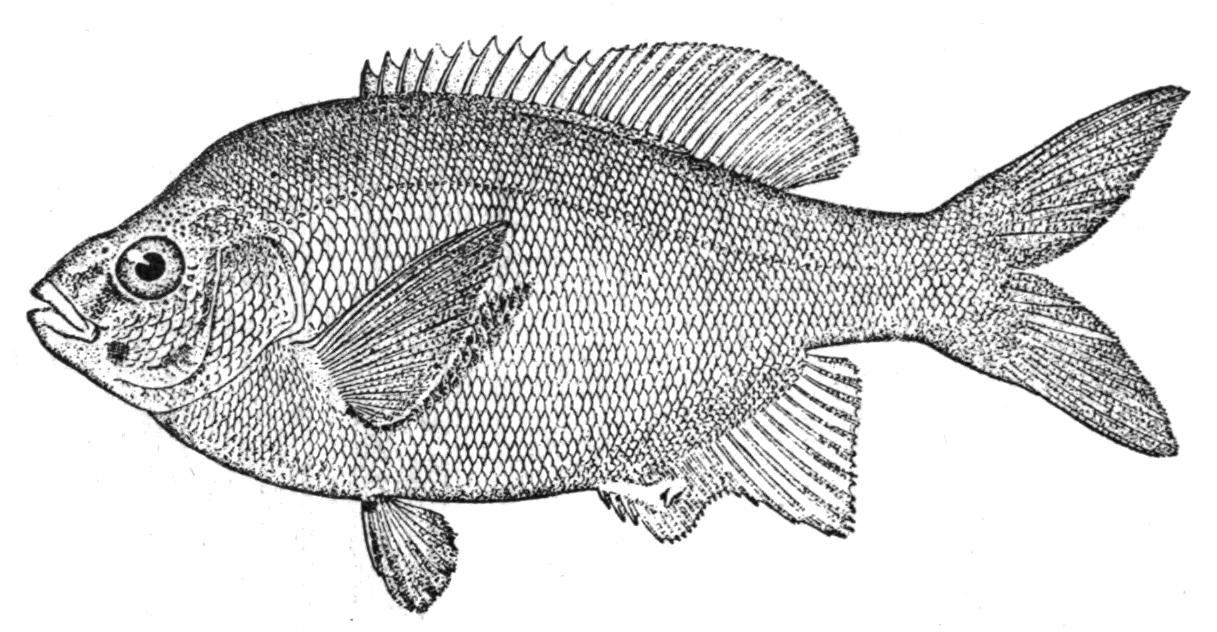
Fig. 409.—Ditrema temminckii, from Japan. × ⅓. (After Jordan.)
Small or moderate-sized fishes inhabiting California and Japan, mostly marine, one species, however, inhabiting fresh waters, whilst another descends to a great depth. They feed mostly on crustaceans, but one genus (Abcona) is herbivorous. The name "Surf-Fishes," by which they are generally known, refers to the fact that most species are found in the surf along sandy beaches. All are viviparous in the strictest sense of the term, the young remaining for a long time closely packed in a sac-like enlargement of the oviduct analogous to a uterus; they are of relatively large size at birth, and quite similar in form to the parent, whilst at an earlier period they differ in having the vertical fins much more elevated. Twenty-four species are known.[716] Principal genera: Hysterocarpus, Abcona, Cymatogaster, Embiotoca, Ditrema.
Fam. 33. Cichlidae.—No subocular shelf; entopterygoid present; palate toothless; lower pharyngeal bones more or less completely united, with median suture. Vertebrae with parapophyses from the third; ribs most frequently sessile or subsessile. A single nostril on each side. Gill-membranes free from isthmus; 5 or 6 branchiostegal rays; gills 4, a slit behind the fourth; pseudobranchiae absent. Dorsal fin, with numerous spines; anal with 3 spines or more. Ventral fins with 1 spine and 5 soft rays.
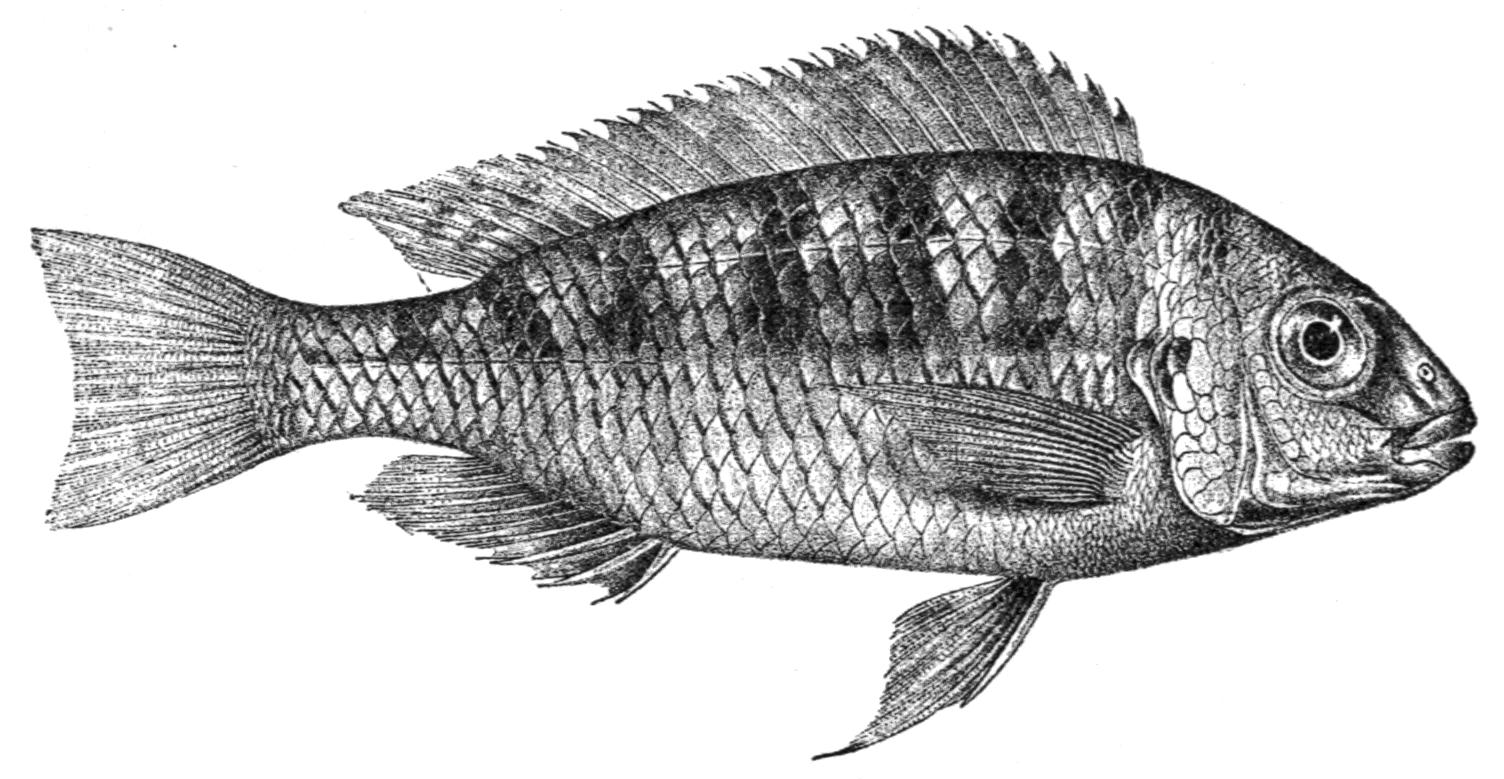
Fig. 410.—Tilapia dardennii, from Lake Tanganyika. ⅓ nat. size.
Fresh or brackish-water fishes, variable in form and dentition, some carnivorous, others chiefly herbivorous. In some American forms (Cichla) the males and females differ during the spawning season, the male developing a hump on the top of the head, which disappears afterwards. The eggs and young are cared for by the parents; either the male or the female, according to the species, sheltering them in the mouth or pharynx.[717] These fishes, often designated as "Chromides," a name which properly pertains to members of the following family, inhabit Africa, Madagascar, Syria, India and Ceylon, and Central and South America, from Texas to Uruguay. About 45 genera are distinguished, based mostly on the number of anal spines and the dentition, which for variety of types is comparable to that of the Characinidae. Of these 45 genera, 30 are African. 150 species are known from Africa (with Syria and Madagascar), 140 from America, and 3 from India and Ceylon.[718] Principal genera—African: Lamprologus, Hemichromis, Paratilapia, Xenotilapia, Tropheus, Tilapia, Asprotilapia, Eretmodus, Plecodus, Pseudetroplus. American: Acara, Heros, Hygrogonus, Cichla, Crenicichla, Chaetobranchus, Geophagus, Symphysodon, Pterophyllum. Indian: Etroplus.
No part of the world surpasses Lake Tanganyika in variety of generic and specific types of Cichlidae, the fish-fauna of this great lake being in great majority made up of members of this family.
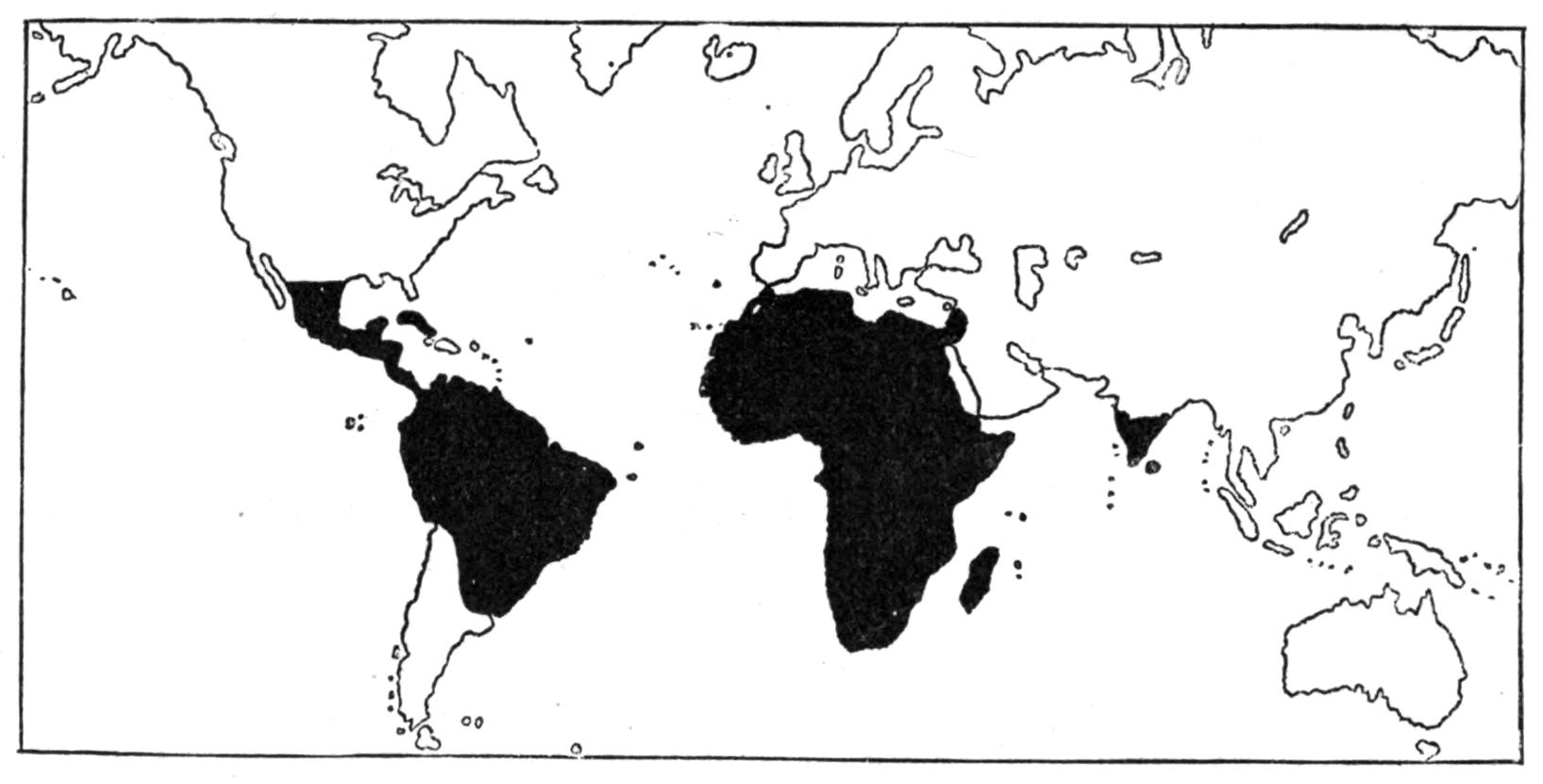
Fig. 411.—Distribution of the Cichlidae.
Priscacara, from the Eocene of North America, is the only extinct genus which can be referred to this family.
Fam. 34. Pomacentridae.—A subocular shelf; entopterygoid present; palate toothless; teeth conical or incisor-like; lower pharyngeals completely united into one bone. Vertebrae with transverse processes from the fourth or fifth; ribs inserted on the transverse processes, when these are present. A single nostril on each side. Gill-membranes free from the isthmus; 5 to 7 branchiostegal rays; gills 3½; pseudobranchiae present. Dorsal fin elongate, with numerous strong spines; anal with 2 spines only. Ventral fins with 1 spine and 5 soft rays.
Small fishes of the tropical and warm seas, resembling the Chaetodontidae in form and mode of life, likewise usually of brilliant coloration; in structural characters intermediate between the Cichlidae and the Labridae. They feed chiefly on small marine animals, but the species with incisor-like teeth are entirely or mainly herbivorous. Over 150 species are known.
Principal genera: Heliastes, Azurina, Amphiprion, Premnas, Dascyllus, Pomacentrus, Glyphidodon, Microspathodon.
The family is supposed to be represented in the Upper Eocene and Lower Miocene of Italy by the extinct genus Odonteus.
Fam. 35. Labridae.—No subocular shelf; entopterygoid present; palate toothless; anterior teeth of the jaws usually strong and canine-like, lateral teeth often soldered at the base; lower pharyngeals completely united into one bone, with conical or tubercular teeth. Vertebrae with transverse processes from the third; all the ribs attached to the transverse processes. Lips thick. Two nostrils on each side. Gill-membranes free or joined to the narrow isthmus; 5 or 6 branchiostegal rays; gills three and a half; pseudobranchiae present. Dorsal fin elongate, with numerous, usually slender, spines. Ventral fins with 1 spine and 5 soft rays.
The "Wrasses" form a large family of mostly brilliantly coloured marine fishes, inhabiting all the tropical and temperate coasts. Their regime is partially herbivorous, partially carnivorous. About 400 species are known. Principal genera: Labrus, Tautoga, Malacopterus, Ctenolabrus, Chaerops, Platychaerops, Heterochaerops, Labrichthys, Cossyphus, Cirrhilabrus, Chilinus, Epibulus, Anampses, Platyglossus, Novacula, Julis, Gomphosus, Chilio, Coris.
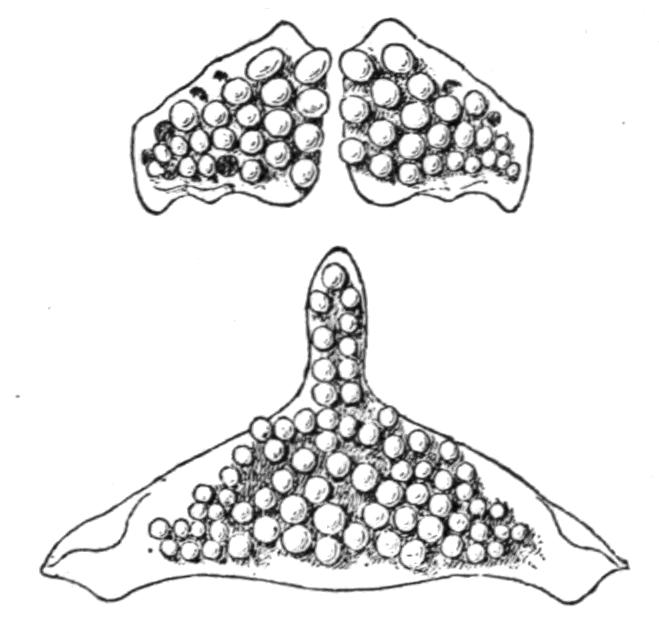
Fig. 412.—Upper and lower pharyngeal bones of Labrus maculatus.
Some of the members of this family have been observed to build nests for the protection of their eggs and young. These nests, in the European Labrus, are made of seaweeds, zoophytes, corals, broken shells, etc., and are the work of both the male and the female.[719] It is also in this family that sleep was first observed in fishes, and this has been fully verified by Möbius[720] on Labrus rupestris in an aquarium, the fish seeking a sleeping place at night and laying itself down to rest on one side.
As first pointed out by Günther, the Labridae found in temperate regions have a higher number (30 to 41) of vertebrae than those inhabiting the tropics (23 to 29), a rule which applies more or less to other families of Acanthopterygians. Remains of Labrus and Julis occur in the Eocene and Miocene of Europe. An allied fossil genus, Labrodon, is represented by numerous species in Tertiary beds of Europe and North America. Phyllodus, Egertonia, Platylaemus, and Pseudosphaerodon, from the Eocene and Miocene, are referred, with doubt, to this family.
Fam. 36. Scaridae.—Closely allied to the preceding, with which they have usually been united, but differing in the more or less coalescent teeth, forming often a parrot-like beak, the lower pharyngeals united into a concave or spoon-shaped bone with flat, tessellated teeth; and in the development of transverse processes from the first vertebra. Vertebrae 24 or 25.
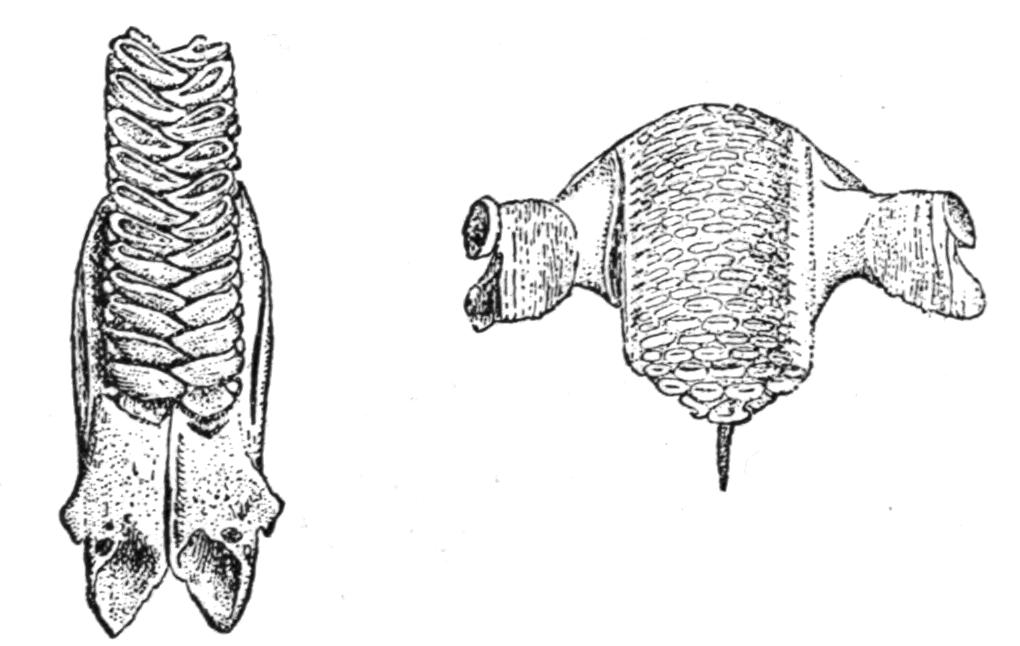
Fig. 413.—Upper and lower pharyngeal bones of Scarus strongylocephalus. (After Jordan and Evermann.)
Curious, mostly brilliantly-coloured fishes of the tropical seas and the Mediterranean, especially abundant about coral-reefs. "Parrot-Wrasses" feed mostly on vegetable matter, corals, and on hard-shelled Mollusca, for crushing which their dentition is well adapted. The largest reach a length of 4 feet. Some are much valued as food, whilst others are reputed poisonous. About 110 species are known, referable to 8 genera: Cryptotomus (Calliodon), Calotomus, Sparisoma, Scarus, Pseudoscarus, Odax, Coridodax, Siphonognathus. The latter is very aberrant in shape, the head and body resembling those of a Pipe-Fish.
Scarus is reported from the Eocene and Miocene of Europe.
Division II.—SCOMBRIFORMES.
No bony stay for the praeopercle. Spinous dorsal, if distinct, formed of short or feeble, slender spines. Epipleurals usually attached to the centra when ribs are sessile, or to the parapophyses of the vertebrae, rarely to the ribs. Pectoral arch similar to that of the Perciformes, but pterygials sometimes more abbreviated. Ventral fins thoracic. Caudal fin, if well developed, with very numerous rays deeply forked at the base.
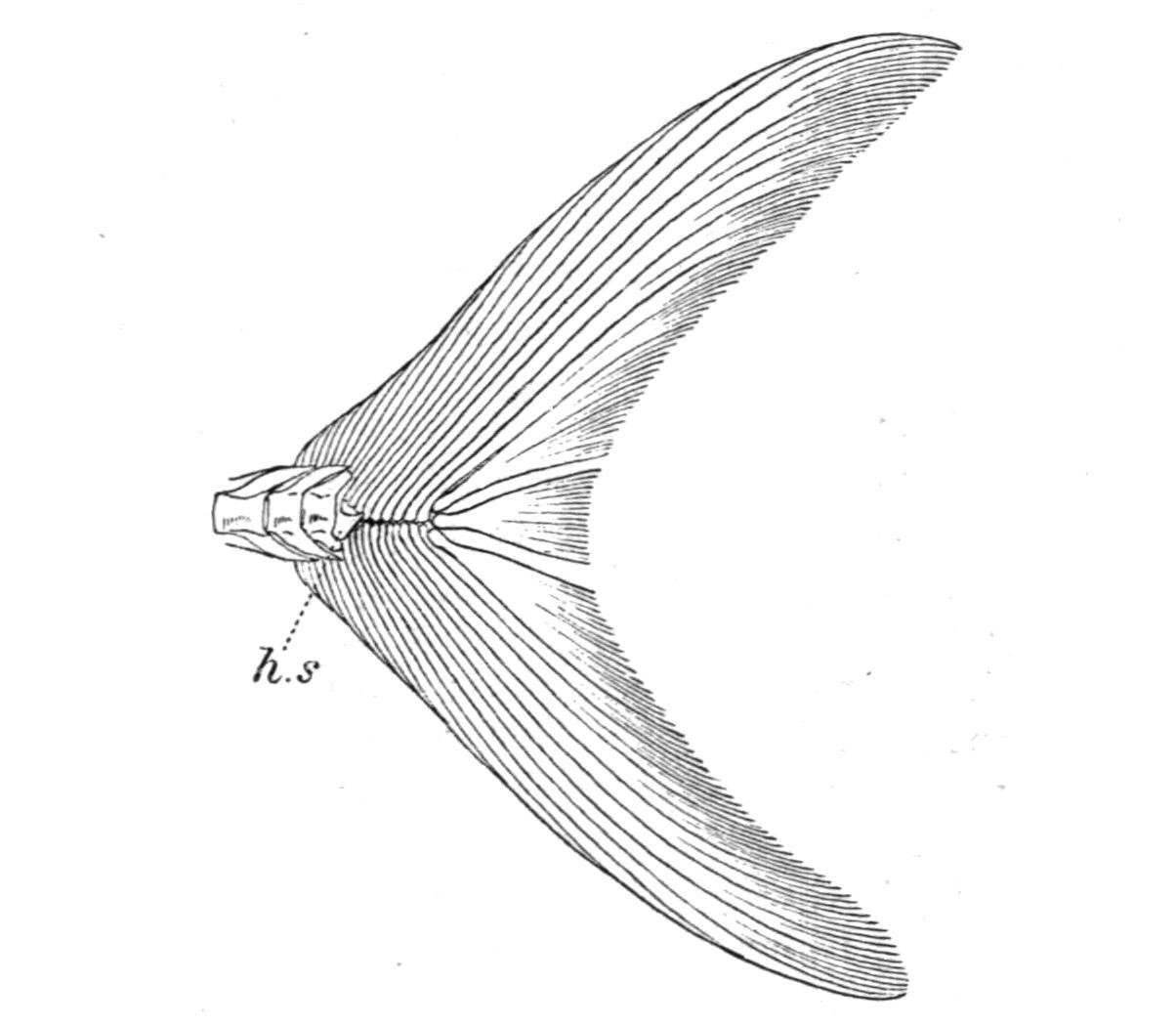
Fig. 414.—Caudal fin of Sarda orientalis. h.s, Hypural spine.
Although bound by natural ties, the series of families that cluster round the Mackerel offer so many modifications of structure that it is almost impossible to draw up a diagnosis differentiating every one of its members from the Perciformes, with which they are closely connected, and from which they hardly deserve to be separated. Even after removing many genera which have been united with them by my predecessors, and which will now be found scattered among various groups of the system, no good definition of the Scombriformes can be given. The Mackerel and Horse-Mackerel are taken as the pattern-forms around which more or less aberrant types are located, types yet not so aberrant as to be traced back to these familiar forms through a number of intermediate grades. As regards external features, it may be stated that the dorsal and anal spines, if present, are either weak and slender, or, if strong, short and detached; the caudal peduncle is constricted, and the caudal fin, if well developed, is usually deeply forked, and with the forked bases of the very numerous rays much longer than in most of the Perciformes, embracing at least a considerable portion of the expanded hypural bones, a character by which the Chaetodontidae, Acanthuridae, and several extinct types which have been placed with the Carangidae are at once excluded. All are carnivorous and marine, and many are pelagic and of very wide distribution. No praetertiary members of this division, as here defined, have yet been found.
Synopsis of the Families
I. Praemaxillaries more or less protractile, not beak-like; scales small or absent, sometimes with enlarged lateral scutes; spinous dorsal fin short or replaced by a series of isolated spines; anal usually with one or two spines detached from the rest of the fin.
Praecaudal vertebrae with transverse processes behind which the ribs are attached .......... 1. Carangidae.
Praecaudal vertebrae without well-developed parapophyses, ribs and epipleurals inserted close together on the centra .......... 2. Rhachicentridae.
II. Praemaxillaries not protractile; scales usually small or absent; body more or less elongate; dorsal fin elongate, single or divided, without free spines; no free anal spines.
A. Pseudobranchiae present.
Vertebrae without transverse processes; soft dorsal fin longer than the spinous; pectoral fins high up the sides .......... 3. Scombridae.
Vertebrae without transverse processes; soft dorsal fin shorter than the spinous, if the latter be distinct; pectoral fins low down the sides .......... 4. Trichiuridae.
Vertebrae without transverse processes; snout produced into a spear .......... 5. Histiophoridae.
Vertebrae with transverse processes bearing the ribs; snout produced into a sword; no ventrals .......... 6. Xiphiidae.
Vertebrae without transverse processes; gill-membranes attached to isthmus; dorsal and anal fins formed of unarticulated, widely set rays; dentition very feeble .......... 7. Luvaridae.
B. Pseudobranchiae absent; no well-developed transverse processes to the praecaudal vertebrae; the ribs and the epipleurals inserted close together on the centra; snout short and very deep .......... 8. Coryphaenidae.
III. Praemaxillaries not protractile, or if slightly protractile, scales large; dorsal and anal fins elongate, without distinct spinous division; most of the praecaudal vertebrae with strong haemapophyses, to which the ribs are attached .......... 9. Bramidae.
Fam. 1. Carangidae.—Praemaxillaries more or less protractile. Vertebrae 24 to 26; ribs behind the parapophyses; epipleurals on the parapophyses, rarely on the ribs.[721] Body covered with small scales, or naked, often with enlarged scutes on each side of the body or of the tail; dorsal spines few, or slender or rudimentary; a more or less developed spine adnate to the soft portion of the anal, often preceded by a pair of spines separated from the rest of the fin. Pseudobranchiae usually present. Inhabitants of the seas of the temperate and tropical regions, many of the species having a very wide range. About 150 species are known.
Principal recent genera: Caranx, Chloroscombrus, Selene, Mene, Apolectus, Nematistius, Seriola, Seriolichthys, Naucrates, Trachynotus, Zalocys, Lichia, Paropsis, Chorinemus. Species of Caranx, Mene, and Seriola have been described from the Eocene and Miocene of Europe, in which occur also the fossil genera named Vomeropsis, Archaeus, Carangopsis, Carangodes, Ductor, and Semiophorus.
The family is represented on our coasts by the common Horse-Mackerel, Caranx trachurus. The young of this species keep together in small bands in the neighbourhood of medusae, under which they seek shelter when disturbed. The Pilot-Fish, Naucrates ductor, is a truly pelagic fish of wide distribution, which occasionally appears on our coasts, accompanying large sharks and ships. Much has been written on the marvellous habits of this little fish, which is said to lead the shark like a pilot, directing it to its food, in exchange for which services the pilot enjoys protection from the fear which the proximity of its formidable companion inspires to its enemies among other carnivorous fishes, and an abundance of food from the shark's excrements.[722]
Fam. 2. Rhachicentridae.—Praemaxillaries slightly protractile. Vertebrae 25 (11 + 14), without well-developed parapophyses; ribs and epipleurals inserted close together on the centra. Body covered with very small scales; a series of short isolated dorsal spines; soft dorsal and anal long; pectorals inserted low down. A single genus, Rhachicentrum (Elacate), with a single species from the coasts of the tropical and warmer parts of the Atlantic and of the Indian Ocean.
Fam. 3. Scombridae.—Praemaxillaries large, not protractile, beak-like. Vertebrae 30 to 50, without transverse processes, but some of the hinder praecaudals with haemal arches; ribs inserted on the centra or on the haemal arches when these are present; epipleurals all on the centra. Scales cycloid and usually very small (except in Gastrochisma), sometimes absent. A spinous dorsal fin formed of slender spines, folding into a sheath; soft dorsal longer and broken up into finlets, similar to the anal; pectoral inserted high up the sides. Hypural bones completely embraced by the forked bases of the caudal rays. Pseudobranchiae present.
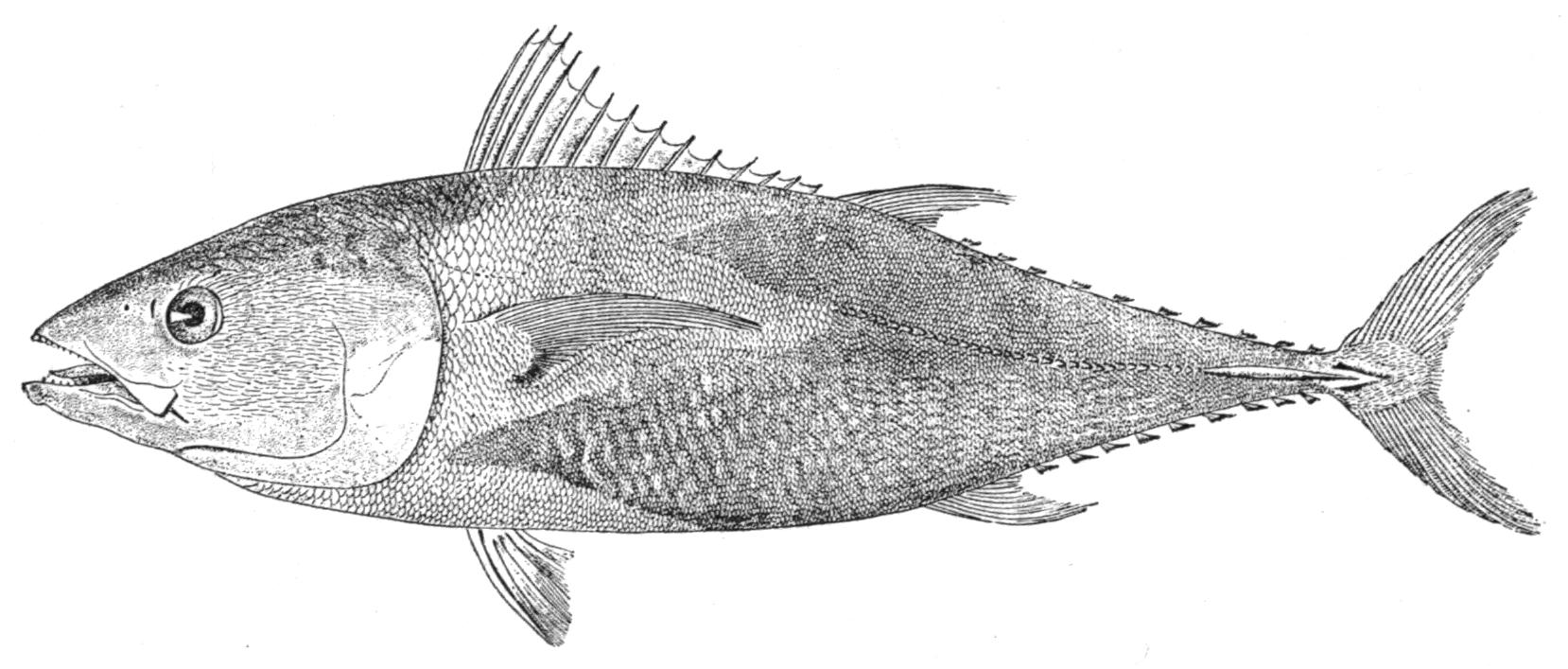
Fig. 415.—Tunny (Thunnus thynnus). (After Cuvier and Valenciennes.) × ⅛.
About 50 species, referred to the following genera:—Scomber, Auxis, Thunnus, Sarda, Cybium, Acanthocybium, Gastrochisma (Lepidothynnus). Numerous fossil representatives in Tertiary beds, belonging to Scomber, Auxis, Thunnus, Cybium, and to the extinct genera Eothynnus, Isurichthys, Palimphyes, Scombrinus, Sphyraenodus, Scombramphodon.
These fishes, elegant in form and often in colour, are among the swiftest of the inhabitants of the sea. Some are migratory, like the Mackerel (Scomber scombrus) of the North Atlantic, whilst others are remarkable for their wide distribution. The Tunny (Thunnus thynnus), for instance, the largest member of the family, reaching a length of 10 feet, inhabits the Atlantic, Pacific, and Indian Oceans, extending as far north as the British seas, Newfoundland, California, and Japan. It supplies important fisheries in France and Italy. The Tunnies are the only fish known to be warm-blooded.
Fam. 4. Trichiuridae.—Praemaxillaries not protractile. Vertebrae 32 to 160, without transverse processes; ribs sessile, on the centra or on the haemal arches when these are present; epipleurals, if well developed, on the centra. Scales very small or absent. Spinous portion of dorsal fin much longer than the soft, the spines more or less feeble. Pectoral fins inserted low down the sides. Pseudobranchiae present.
The members of this family show a great variation in the shape of the body, which, although always strongly compressed, is not unlike that of a Mackerel in the more normal types, such as Thyrsites and Ruvettus, whilst, through a chain of genera, it generally assumes an extremely elongate form; concurrently with this elongation of the body, the dorsal fin loses its differentiation into two portions, the ventrals become reduced and disappear, as in the Scabbard- or Frost-Fish (Lepidopus caudatus), while the caudal fin decreases in size, loses its fork-shape, and is finally lost in Trichiurus, in which the body is ribbon-shaped and tapers to a point.
About 25 species are known, pelagic and widely distributed, many descending to great depths.
Principal living genera: Ruvettus, Thyrsites, Epinnula, Nesiarchus, Nealotus, Promethichthys, Dicrotus, Gempylus, Aphanopus, Lepidopus, Euoxymetopon, Benthodesmus, Eupleurogrammus, Trichiurus.
Remains of several species referred to Thyrsites, Lepidopus, and to the extinct genera Thyrsitocephalus, Hemithyrsites, and Trichiurichthys, have been found in the Oligocene and Miocene of Europe.
Fam. 5. Histiophoridae.—Praemaxillaries not protractile; snout produced into a spear-shaped rostrum; a praedentary bone; teeth minute. Body elongate, covered with small or rudimentary scales. Vertebrae 24 or 25, without transverse processes; ribs sessile; no epipleurals. One or two dorsal fins, without a distinctly spinous portion. Pectoral fin low down the side. Pseudobranchiae present.
The Sail-Fishes are large oceanic fishes, endowed with great strength and swiftness, occurring in the tropical and sub-tropical seas. Four or five species are distinguishable, and are referable to two genera: Histiophorus, with a single dorsal fin and 2 or 3 ventral rays, and Tetrapturus, with the dorsal divided into two parts and a single ventral ray.[723]
Fossil Histiophoridae are known from the Eocene and later beds in Europe and America. Dr. A. S. Woodward observes that the known fossils are too imperfect to be referred with certainty to their respective genera. Most of them probably belong to Histiophorus, but at least one genus from the Eocene (Xiphiorhynchus) appears to be well distinguished.
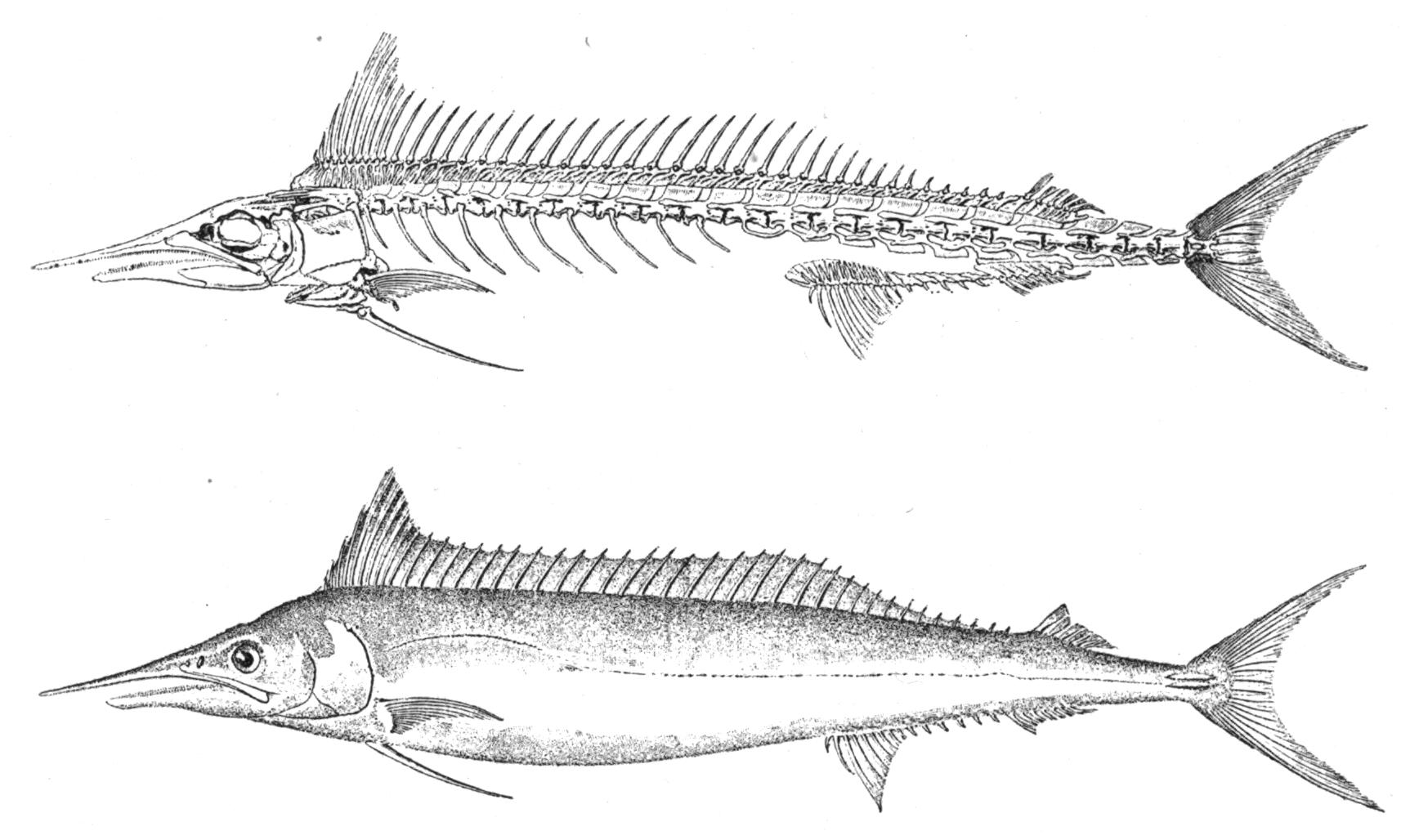
Fig. 416.—Tetrapturus belone, from the Mediterranean. (After Cuvier and Valenciennes.) × ⅒.
The imperfectly known extinct family Palaeorhynchidae, from the seas of the Eocene, Oligocene, and Miocene periods, with the genera Palaeorhynchus and Hemirhynchus, is probably closely related to the Histiophoridae. The vertebrae number 50 to 60, and the ribs completely encircle the body. In Palaeorhynchus both jaws are equally produced into an ensiform weapon. Blochius, from the Eocene, with diamond-shaped, slightly overlapping bony scutes on the body, is perhaps also to be placed near this family.
Fam. 6. Xiphiidae.—Differs from the preceding in the absence of praedentary bone, and in the vertebrae (26 in number), which in the praecaudal region are provided with short but well-developed transverse processes, to which the short ribs are attached. Ventral fins absent, the pectorals being inserted in the place usually occupied by them. Adult without teeth or scales.
A single species, the Sword-Fish (Xiphias gladius), of nearly world-wide distribution, occurring occasionally on the coasts of Great Britain and Ireland.
Fam. 7. Luvaridae.—Mouth small, praemaxillaries not protractile, with very feeble dentition. Gill-membranes attached to the isthmus. Vertebrae 23, without transverse processes; ribs blade-like, inserted on the centra; no epipleurals. Body rough, with minute scales. Dorsal and anal fins elongate, formed of unarticulated, widely set rays. Pectoral fins inserted rather low down; ventrals much reduced, the two halves of the pelvis fused into a single bone. Supraclavicle fused with the forked post-temporal. Hypural bones completely embraced by the forked bases of the caudal rays. Pseudobranchiae present.
Luvarus imperialis, a rare pelagic fish from the Atlantic, Mediterranean, and Pacific, growing to a length of 6 feet, and occasionally captured on our coasts, is the only representative of this family. Very little is known of the habits of this strange fish. The excessive length of the intestines and the feeble dentition point to its feeding partly on vegetable matter, partly on minute animals; the circumstances under which certain specimens were captured tend to indicate that they follow up streams of pelagic life such as engage the attention of the Basking Shark, of similar distribution.
Fam. 8. Coryphaenidae.—Praemaxillaries small, not protractile. Vertebrae 30 to 33, without transverse processes; ribs and epipleurals attached close together on the centra. Body elongate; scales small, cycloid or elongate lanceolate. Dorsal and anal fins much elongate, without distinct spines. Pectoral fins inserted rather low down the side. Pseudobranchiae absent.
The "Dolphins" (Coryphaena), of which only two species can be distinguished, are large pelagic fishes, of carnivorous habits, pursuing the Flying-Fish. They grow to a length of 6 feet, and their flesh is much valued. Their deep head, with short snout, and their long posteriorly attenuate body ending in a large forked caudal fin, give them a peculiar appearance.
Fam. 9. Bramidae.—Praemaxillaries small, not or but feebly protractile; maxillaries large, scaly. Vertebrae 42 to 47, the praecaudal without transverse processes, but mostly with hæmal arches to which the ribs are attached, the epipleurals being inserted on the centra. Body deep; scales moderate or large, strongly imbricate, with processes which, in certain parts at least, serve to connect the rows of scales. Dorsal and anal elongate, some or all of the rays simple, but not forming true spines. Pectoral inserted rather low down the side, freely movable upwards and downwards. Pseudobranchiae present.
Pelagic fishes, often descending to great depths. About 12 species are known,[724] referable to 6 genera: Brama, Taractes, Pterycombus, Pteraclis, Bentenia, and Steinegeria. Taractes, often confounded with Brama, differs from it not only in the larger, keeled scales, but also in the protractile mouth and in the much greater development of most of the ribs, which form curved lamellae of great width.[725] Pteraclis is very remarkable for the enormous, sail-like dorsal and anal fins.
Division III.—ZEORHOMBI.
Aberrant, strongly compressed Perciformes, with very short praecaudal region, modified much as in the Flat-Fishes, culminating in asymmetrical forms, and characterised by the combination of an increased number (7 to 9) of ventral rays, with absence of hypural spine (by which the Berycidae are excluded), or by asymmetry of the skull in the forms in which the spine of the ventral fin has been lost.
Among the symmetrical forms, the existing Zeidae agree with the Berycidae in having more than five soft rays to the ventral fins, and are probably derived, together with the Eocene Amphistiidae, from some common ancestral group still to be discovered in Cretaceous beds. These Zeidae have much in common with the Pleuronectidae,[726] and might be regarded as forming part of the family out of which the latter have sprung, were it not that they have lost the last half-gill. Amphistium is probably more nearly related to the Pleuronectidae, which may have been directly derived from the family of which it is as yet the only known representative.[727]
This division embraces three families only:—
A distinct spinous dorsal fin; anal spines detached from the soft portion; a ventral spine; gills three and a half, four slits between them .......... 1. Zeidae.
Dorsal and anal spines few, continuous with the soft rays; a ventral spine .......... 2. Amphistiidae.†
No spines; cranium twisted in front, with the two orbits on one side; gills 4, a slit behind the fourth .......... 3. Pleuronectidae.
† Extinct.
Fam. 1. Zeidae.—No subocular shelf; praemaxillaries strongly protractile. Gill-membranes free from isthmus; 7 or 8 branchiostegal rays; gills 3½; pseudobranchiae well developed. Lower pharyngeal bones separated. Vertebrae 30 to 46, the anterior with sessile ribs, the posterior praecaudals with long neural spines bent forwards and with transverse processes directed downwards, forming haemal arches and bearing the ribs at their extremity; epipleurals much reduced or absent; hypural large, without the basal spine or knob present in most Perciformes and all Scombriformes and Percesoces, bearing fewer than 20 rays. Dorsal and anal fins elongate, the former with a distinct spinous portion, the latter with 1 to 4 spines detached from the soft portion. Pectoral fin supported by 4 pterygials, of which 3 are in contact with the perforated scapular bone; post-temporal forked and solidly attached to the skull. Ventral fin with 1 spine and 6 to 8 soft rays.
Scales small or minute, sometimes hard and rough and firmly joined in vertical series; bony plates may be present along the base of the vertical fins. Air-bladder present.
Twelve species are known from the Atlantic and Pacific Oceans, referable to 5 genera: Grammicolepis, Cyttus, Cyttopsis, Zenion, and Zeus. Oreosoma was founded on a young form of a fish allied to Cyttus. Remains of Zeus occur in the Oligocene, and Cyttoides, from the same period, has been compared with Cyttus.
The well-known John Dory (Zeus faber) is much valued for the table.
Fam. 2. Amphistiidae.—The only known representative of this family, the Upper Eocene Amphistium paradoxum, originally described as a Pleuronectes, has much in common with the Zeidae, from which it differs in the smaller number of vertebrae (10 + 14), and in the dorsal and anal spines being more reduced, adnate and continuous with the series of soft rays; the scales are more normal and imbricate; ventral fins with 1 spine and 8 soft rays. This fish appears to realise in every respect the prototype of the Pleuronectidae before they had assumed the asymmetry which characterises them as a group.
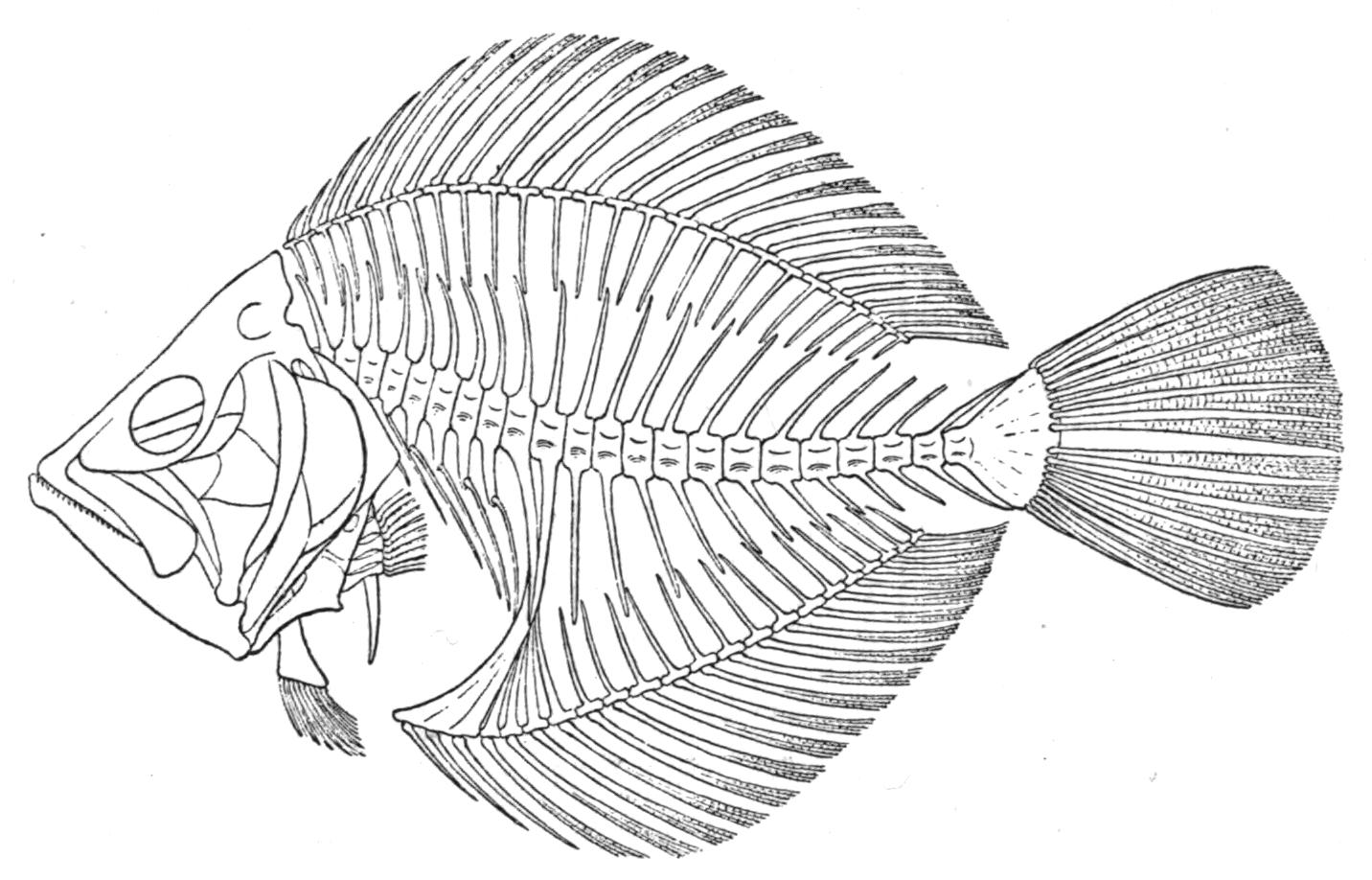
Fig. 417.—Restoration of Amphistium paradoxum. × ½.
Fam. 3. Pleuronectidae.—Head asymmetrical, the skull twisted in front, with the two orbits on one side in the adult; the side of the body bearing the eyes and turned upwards in life being coloured, the other side colourless and blind. Mouth more or less protractile. Gills 4, a slit behind the fourth; pseudobranchiae present. Lower pharyngeal bones usually separated, rarely imperfectly united. Vertebrae 24 in the most generalised form (Psettodes), varying from 28 to 65 in others, the praecaudals mostly with more or less developed transverse processes, which may be directed downwards and become converted into haemal arches; ribs and epipleurals present. Caudal fin, if well developed, supported by a large hypural usually without basal spine or knob. Dorsal and anal fins much elongate, without spines, the former often extending on the head. Paired fins often reduced, sometimes absent; if fully developed and normally formed, the bones of the pectoral and pelvic girdles as in the Zeidae. Ventral fins usually with 5 to 7 soft rays.
Scales usually imbricate, cycloid or ctenoid; rarely absent; bony tubercles sometimes present. Air-bladder absent.
Most species, and even genera, are either sinistral or dextral, but this is inconstant in some, including the most generalised genus, Psettodes. The very young are transparent and symmetrical, with an eye on each side, and swim in a vertical position like other Fishes. These larval forms have been described as distinct genera, under the names of Peloria, Bibronia, Charybdia, etc. As they grow, the eye of one side moves by degrees to the other side, where it becomes the upper eye. If at that age the dorsal fin does not extend to the frontal region, the migrating eye simply moves over the line of the profile, temporarily assuming the position which it preserves in Psettodes, Atheresthes, and Platysomatichthys; in other genera, the dorsal fin has already extended to the snout before the migration takes place, and the eye, passing between the frontal bone and the tissues supporting the fin, appears to pass from side to side through the head, as was believed by some of the earlier observers.[728]
Flat-fishes are a large group of some 500 species, mostly marine, a few species related to the Soles being confined to the fresh waters of South America and the Malay Archipelago. They range from the Arctic Circle to the southern coasts of the Southern Hemisphere; many occur at great depths (Citharichthys dinoceros down to 955 fathoms). Well-preserved remains referred to Psetta occur in the Upper Eocene, and a species of Solea is known from the Lower Miocene.
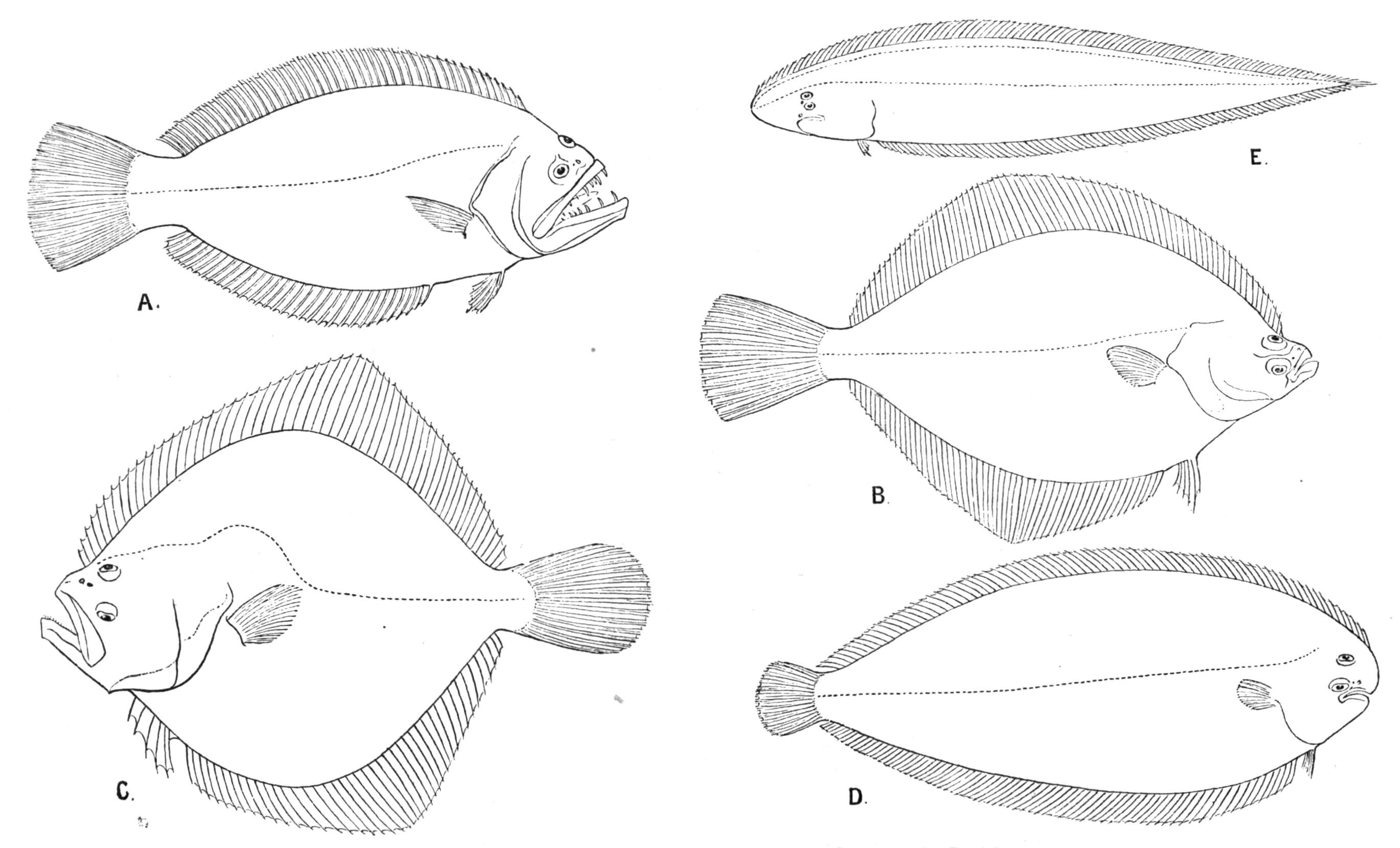
Fig. 418.—Outlines of various Pleuronectids, showing differences of form. A, Psettodes erumei; B, Pleuronectes platessa; C, Psetta maxima; D, Solea vulgaris; E, Cynoglossus lingua.
A satisfactory classification of the Pleuronectidae is still a desideratum, and cannot be attempted until the osteology of the very numerous forms has been thoroughly studied. Even the division into two principal groups, regarded by some recent authors as families, Pleuronectidae and Soleidae, is based on characters which the examination of a large number of generic types shows not to be constant. Thus the former have been defined as having the praeopercular margin distinct externally, the snout not projecting beyond the mouth, the nostrils of the two sides on the coloured side or those of the blind side high up near the dorsal line of the head; the latter as having the praeoperculum hidden under the skin, the snout projecting more or less beyond the mouth, and the nasal organ of the blind side similarly situated to that of the eyed side. However, the genera Aphoristia and Peltorhamphus, and others among the Soles, show exceptions to this definition.[729]
Principal genera: Psettodes, Atheresthes, Platysomatichthys, Hippoglossus, Hippoglossoides, Hippoglossina, Poecilopsetta, Chascanopsetta, Paralichthys, Pleuronectes, Glyptocephalus, Citharus, Rhomboidichthys, Psetta (Rhombus), Arnoglossus, Zeugopterus, Lepidorhombus, Ammotretis, Rhombosolea, Solea, Achirus, Achiropsis, Soleotalpa, Synaptura, Ammopleurops, Aphoristia, Cynoglossus, Symphurus (Plagusia).
The following are the principal British representatives which are valued as food:—The Halibut (Hippoglossus vulgaris), by far the largest of all Flat-Fishes, growing to a length of 10 feet or more; the Long Rough Dab (Hippoglossoides limandoides); the Plaice (Pleuronectes platessa); the Flounder (P. flesus), which ascends streams; the Dab (P. limanda); the Smear Dab, often called Lemon Sole (Glyptocephalus microcephalus); the Witch (G. cynoglossus); the Megrim or Whiff (Lepidorhombus megastoma); the Turbot (Psetta maxima); the Brill (P. laevis); and the Sole (Solea vulgaris).
Division IV.—KURTIFORMES.
No bony stay for the praeopercle. Dorsal spines feeble, few. Scapula absent, the coracoid supporting four small pterygials. Ventral fins thoracic.
Fam. 1. Kurtidae.—The genus Kurtus, with a single species, from the Indian and Pacific Oceans, forms an isolated, very aberrant group. The strongly compressed body is covered with minute, rudimentary scales; the dorsal is short, with few, graduated spines, and the anal much elongate, with 2 small spines; the ventrals are formed of 1 spine and 5 soft rays. The vertebral column consists of 24 vertebrae; the ribs of the third and fourth are free and slender, whilst the following are immovably fixed between rings formed by the ossification of the outer membrane of the elongate air-bladder in a manner unique among fishes. The skull is peculiar for its very strong, denticulate, occipital crest, which ends posteriorly in a curved spine bent forwards; the suborbitals are slender and do not emit a subocular lamina. Kurtus indicus does not exceed a length of 5 inches.
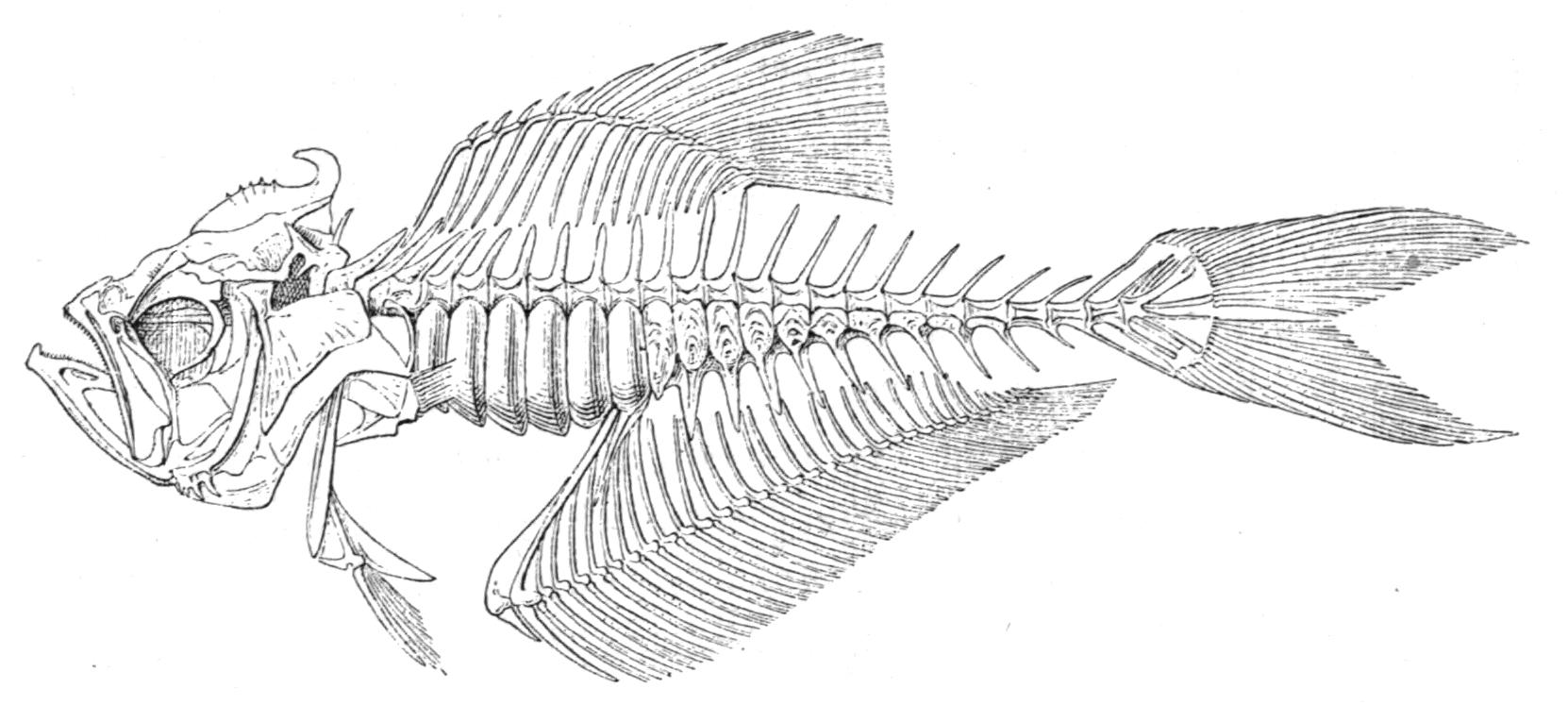
Fig. 419.—Skeleton of Kurtus indicus.
Division V.—Gobiiformes.
No bony stay for the praeoperculum. Basis cranii simple. Spinous dorsal, if present, formed of few, flexible rays. None of the epipleural bones attached to the centra of the vertebrae in the praecaudal region. Scapula and coracoid more or less reduced or even vestigial; pterygials large, 4 or 5 in number, forming together a thin plate which is in contact with or narrowly separated from the clavicle; one or two of the pterygials in contact with the coracoid. Ventral fins thoracic.
The Gobiidae, which alone constitute this division, are not very remote from the Perciformes, and may have evolved out of a type not very different from the Percidae.
Fam. 1. Gobiidae.—Suborbital arch ligamentous or absent. Gill-membranes more or less broadly attached to isthmus; 4 to 6 branchiostegal rays; gills 4, a slit behind the fourth; pseudobranchiae often present. All or most of the praecaudal vertebrae with transverse processes bearing the ribs, to which epipleurals are attached. Post-temporal forked, as in normal Perciformes. Ventral fins with 1 feeble spine and 4 or 5 branched rays, often united to form a sucking disk, a transverse fold of skin at their base completing the cup.
Head usually more or less depressed, body varying from short and stout to elongate and eel-shaped, but never with a very high number of vertebrae, these varying from 24 to 37 (10-14 + 13-24); scales cycloid or ctenoid, or absent; no lateral line; mouth moderate or large, dentition various; soft dorsal and anal fins nearly equally developed, varying from very short to very elongate; usually a large anal papilla.
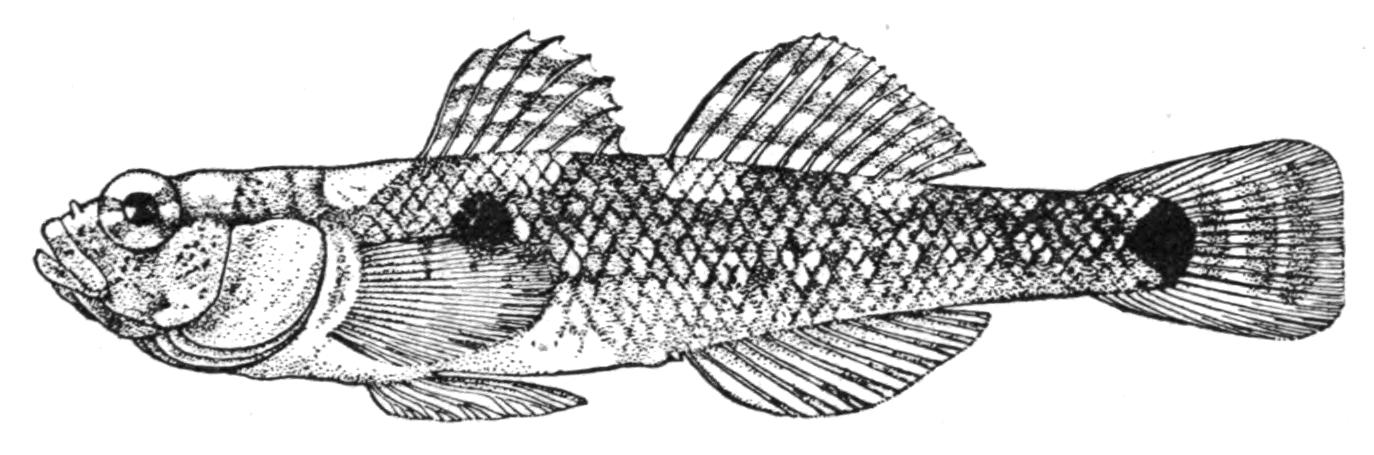
Fig. 420.—Gobius ruthensparri. Nat. size. (From Holt and Byrne, Report Fisheries Ireland for 1901.)
A large family of some 600 species, the great majority marine, mostly carnivorous and of small size. The largest form (Eleotris marmorata, from the rivers of Siam, Borneo, and Sumatra) grows to nearly 3 feet, whilst the smallest (Mistichthys luzonensis, from the Philippines) measures only 12 to 14 millimetres, and is believed to be the smallest known Vertebrate. Gobiids occur in all the seas outside the Arctic and Antarctic circles, and they have representatives in the fresh waters of all parts of the world.
The genera are numerous but difficult of definition. The following are the principal: Eleotris, Oxymetopon, Vireosa, Rhyacichthys, Gobius, Crystallogobius, Aphia, Gobiosoma, Gobiodon, Benthophilus, Typhlogobius, Luciogobius, Sicydium, Lentipes, Periophthalmus, Boleophthalmus, Amblyopus, Trypauchen, Trypauchenichthys. Oxuderces, which has been made the type of a distinct family, appears to differ from Trypauchen only in the absence of ventral fins. Fossils referred to Gobius have been described from the Upper Eocene and Miocene of Europe, but there is no satisfactory evidence that they really belong to this family.
Gobius, of which several species are of common occurrence on our shores, have attracted special interest from their habits during the much prolonged breeding season. The male, usually more brilliantly coloured than the female, mounts guard over the eggs, which are either simply fixed by the female to the under surface of stones or weeds, or in a sort of nest built and kept in constant repair by him. This nest is usually made of a shell of Cardium, Patella, Haliotis, etc., or of the carapace of a crab, with the convexity turned upwards and covered with sand; the sand underneath is hollowed out, and a round opening at the side, coated by a mucus secreted by the skin of the male fish, gives access to the interior; the eggs, which are elongate and pyriform, are stuck to the inner surface of the shell forming the roof.[730] A curious British form is Aphia pellucida, two inches long which, from its transparent and almost colourless body, has long been erroneously supposed to be the fry of some larger fish. Among exotic forms, mention should be made of the Blind Goby (Typhlogobius californiensis), two inches long, uniform light pink, scaleless, with the eyes very small, reduced to mere vestiges, covered by skin, and functional only in the young, living like a slug under rocks between tide marks on the coast of California;[731] and to the Walking-Fish or Jumping-Fish (Periophthalmus), of which various species are found in great abundance on the mud-flats at the mouths of rivers in tropical Africa, Asia, and North-West Australia, skipping about by means of the muscular, scaly base of their pectoral fins, with the head raised and bearing a pair of strongly projecting versatile eyes close together.[732]
Division VI.—DISCOCEPHALI.
Highly aberrant Acanthopterygians with the anterior dorsal fin modified into a suctorial, transversely laminated oval disk[733] on the head, the skull being very much flattened and with simple basis cranii. The pectoral rays are inserted on the small, perforate, scapula and on four hour-glass-shaped pterygials, three of which are in contact with the coracoid. Ventrals thoracic.
Fam. 1. Echeneididae.—Maxillary slender, adnate to the upper surface of the praemaxillary; suborbital arch slender. Pectoral fin inserted high up; supraclavicle much reduced; ventral fin with one spine and five soft rays. Body elongate and covered with small scales; soft dorsal and anal fins elongate and opposed to each other. All the praecaudal vertebrae with very strong parapophyses, the anterior with diapophyses as well; ribs and epipleurals nearly equally developed, both inserted at the extremity of the parapophyses.
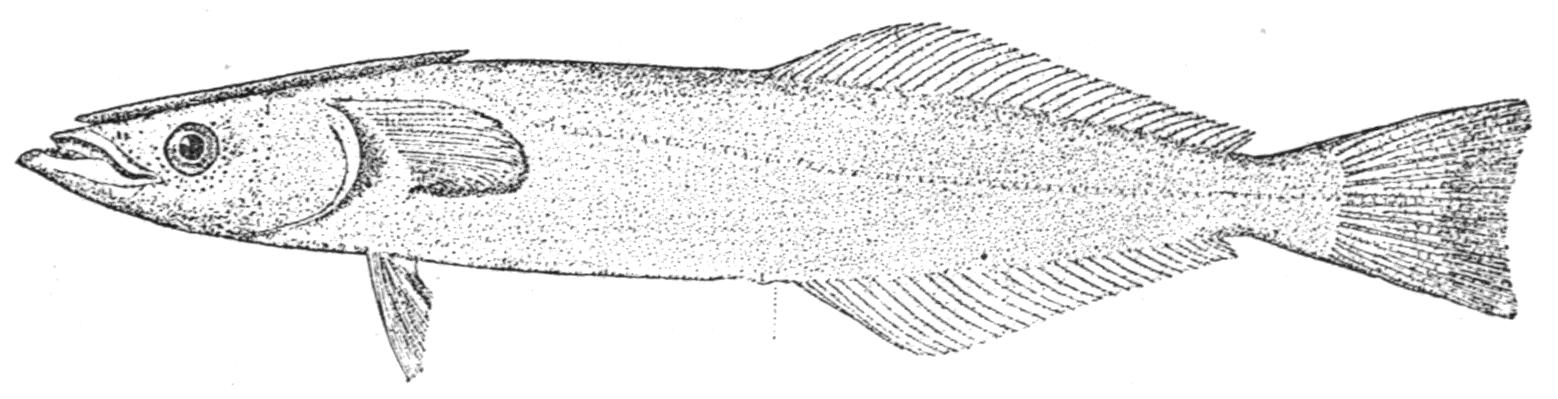
Fig. 421.—Remora brachyptera. (After Goode.) × ½.
In spite of a superficial external resemblance to the genus Elacate, the Sucking-Fish bear certainly no affinity to that genus nor to other Scombriformes, as first observed by Gill. They are probably derived from Perciformes, but from which family it is impossible to suggest. Three genera may be distinguished: Opisthomyzon, from the Upper Eocene of Switzerland, with a very small suctorial disk and 23 or 24 vertebrae; Echeneis, with large disk and 30 vertebrae; and Remora, distinguished from the second by a shorter body with only 27 vertebrae. These remarkable fishes, of which about 10 species are distinguished, are distributed all over the tropical and warm seas, and exceptionally carried as far north as the south coast of England. They feed on other fishes, and attach themselves by means of their cephalic sucker to boats or to sharks, turtles, cetaceans, and other large swift-swimming animals. On the East Coast of Africa they are employed by the natives for catching turtles, to the carapace of which they stick with extraordinary tenacity, being held by a line attached to a metal ring round the caudal peduncle.[734] The largest Sucking-fish grows to a length of three feet.
Division VII.—SCLEROPAREI.
Second suborbital bone more or less produced towards or ankylosed with the praeoperculum ("suborbital stay").[735] Ventral fins thoracic.
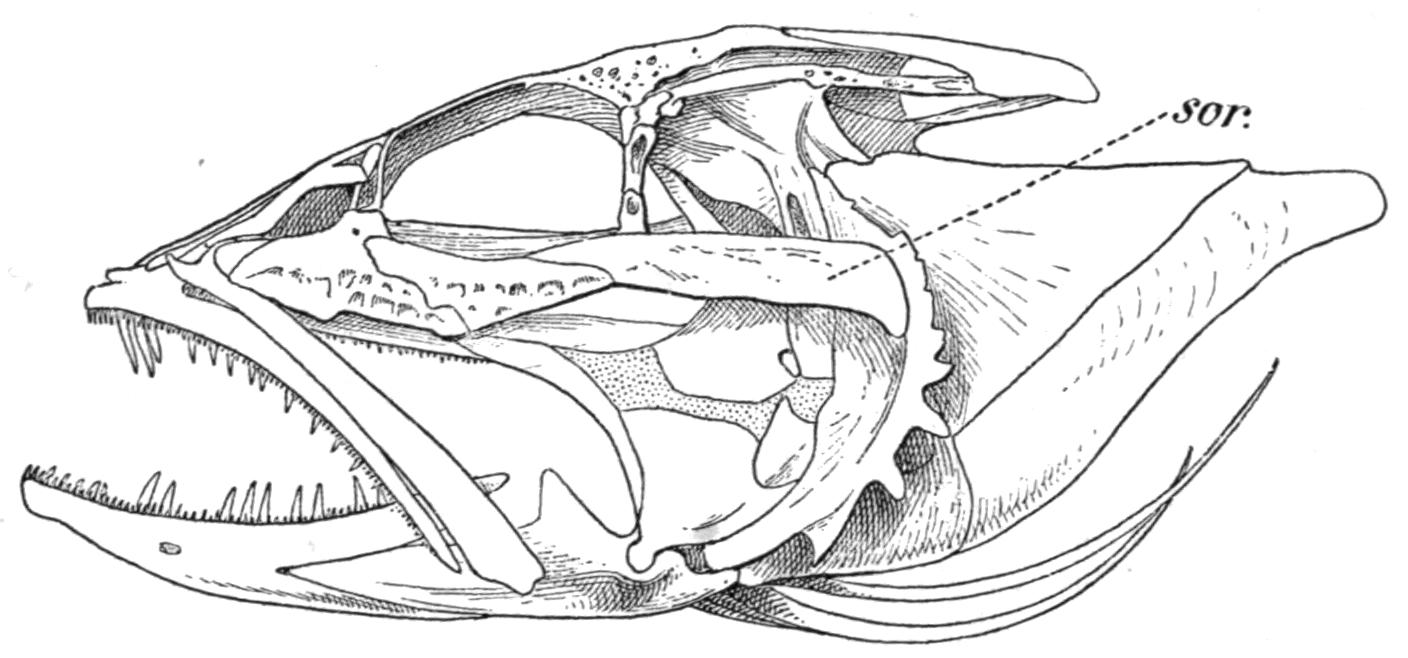
Fig. 422.—Skull of Ophiodon elongatus. sor, Suborbital stay.
The "Cheek-armoured Acanthopterygians," "Joues cuirassées" of Cuvier, after the exclusion of the Sticklebacks, form a perfectly natural association, evidently derived from the Serranidae, with which the more generalised forms have much in common. From the Perch-like genus, Sebastes, a continuous series can be traced towards the Triglidae, especially through such forms as Apistus, Minous, and Choridactylus, in which one or more of the lower pectoral rays are detached from the rest of the fin. Through the Comephoridae the Scorpaenidae are connected with the Cottidae, whilst the latter merge insensibly into the still more aberrant Cyclopteridae. These conclusions, which are apparent enough from a mere comparison of the external characters, become fortified by a study of the skeletons. The passage between the various groups here accepted as families is so complete that no serious objection could be raised to their union in one great family with a number of minor divisions.
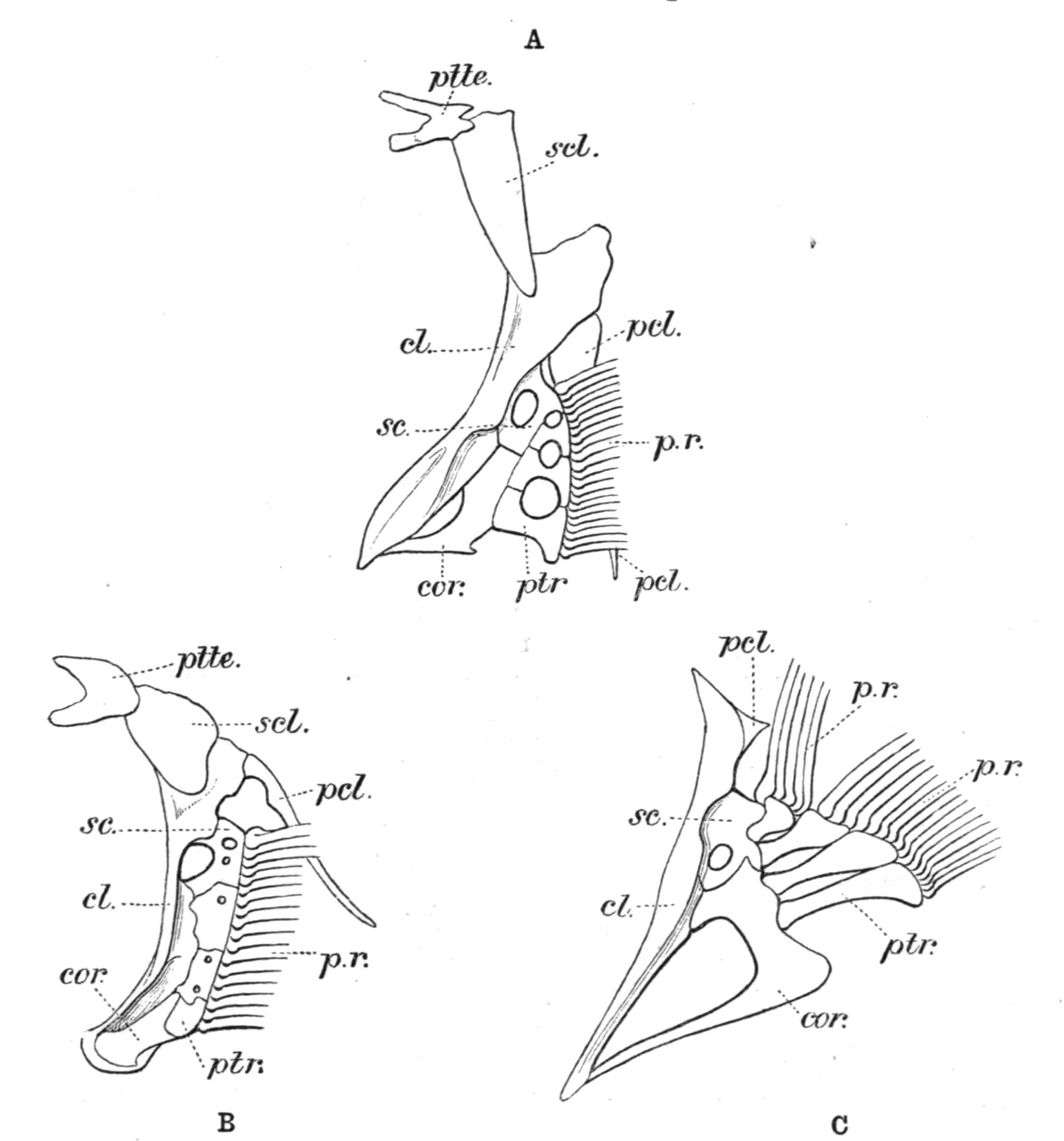
Fig. 423.—Left pectoral arch of A, Sebastes percoides; B, Scorpaenichthys marmoratus; C, Dactylopterus volitans. cl, Clavicle; cor, coracoid; pcl, post-clavicle; p.r, pectoral rays; ptr, pterygials; ptte, post-temporal; sc, scapula; scl, supraclavicle.
The character from which the Scleroparei derive their name is subject to many modifications. The second suborbital (the third if the praeorbital be regarded as the first) may be merely enlarged and prolonged over the cheek towards the praeoperculum (Sebastes, Anoplopoma), or firmly ankylosed to the latter (Scorpaena, Platycephalus), or form part of the external armature of the head (Trigla, Dactylopterus). The structure of the base of the pectoral fin appears to afford important characters for the definition of the families, as first pointed out by Gill; these characters have, however, not yet been tested on a sufficient number of the very numerous forms grouped under Cottidae, some of which I have already transferred to the Comephoridae.
Synopsis of the Families.
I. Head not completely cuirassed.
A. Ventral fins not widely separated; none of the pectoral pterygials in contact with the clavicle.
Two nostrils on each side; basis cranii double; gill-membranes free from isthmus .......... 1. Scorpaenidae.
A single nostril on each side; basis cranii double; gill-membranes free from isthmus .......... 2. Hexagrammidae.
Two nostrils on each side; basis cranii simple; gill-membranes free or narrowly attached to isthmus .......... 3. Comephoridae.
Two nostrils on each side; basis cranii simple; gill-opening narrow, above base of pectoral .......... 4. Rhamphocottidae.
B. Ventral fins, if present, not widely separated; one or several of the pterygials in contact with the clavicle.
Ventral fins distinct; gill-clefts wide .......... 5. Cottidae.
Ventral fins united into a sucking disk; gill-opening narrow, above base of pectoral .......... 6. Cyclopteridae.
C. Ventral fins widely separated; none of the pterygials in contact with the clavicle.
Ventral fins behind base of pectorals; praecaudal vertebrae without transverse processes .......... 7. Platycephalidae.
Ventral fins a little in front of base of pectorals; praecaudal vertebrae with transverse processes .......... 8. Hoplichthyidae.
II. Head completely cuirassed.
Ventral fins narrowly separated; no pectoral appendages; pterygials short and broad .......... 9. Agonidae.
Ventral fins widely separated; 2 or 3 lowermost rays of pectoral fin detached as feelers; pterygials short and broad .......... 10. Triglidae.
Ventral fins narrowly separated; pectoral fin divided into two portions; pterygials elongate .......... 11. Dactylopteridae.
Fam. 1. Scorpaenidae.—Head not or but incompletely cuirassed, usually with spines; basis cranii double; parietal bones often meeting on the median line, over the supraoccipital; two nostrils on each side. Gill-membranes free from isthmus; gills 3½ or 4; pseudobranchiae present. Vertebrae 24 to 37, the anterior praecaudals with sessile ribs bearing epipleurals, the posterior with transverse processes, often directed downwards, or forming haemal arches, bearing the rib and the epipleural. Post-temporal more or less distinctly forked, more or less firmly ankylosed to the skull; scapula and coracoid well developed, in contact with each other or separated by cartilage; pectoral rays inserted on the scapula and on 3 or 4 large, hour-glass or anvil-shaped pterygials, two of which are in contact with the coracoid. Ventral fins close together, with 1 spine and 3 to 5 soft rays. Spinous dorsal strong, usually longer than the soft, sometimes extending on the head; anal usually with 3 spines. Body covered with scales or naked.
A large family of carnivorous marine fishes, some descending to great depths, of nearly world-wide distribution, represented by three extinct genera (Ampheristus, Histiocephalus, Scorpaenoides) in the Eocene and by several species of Scorpaena in later formations. About 250 recent species are known. Principal genera: Sebastes, Setarches, Scorpaena, Pterois, Apistus, Minous, Pelor, Choridactylus, Centropogon, Gymnapistus, Amblyapistus, Pentaroge, Tetraroge, Gnathacanthus (Holoxenus), Agriopus, Synancia, Polycaulus.
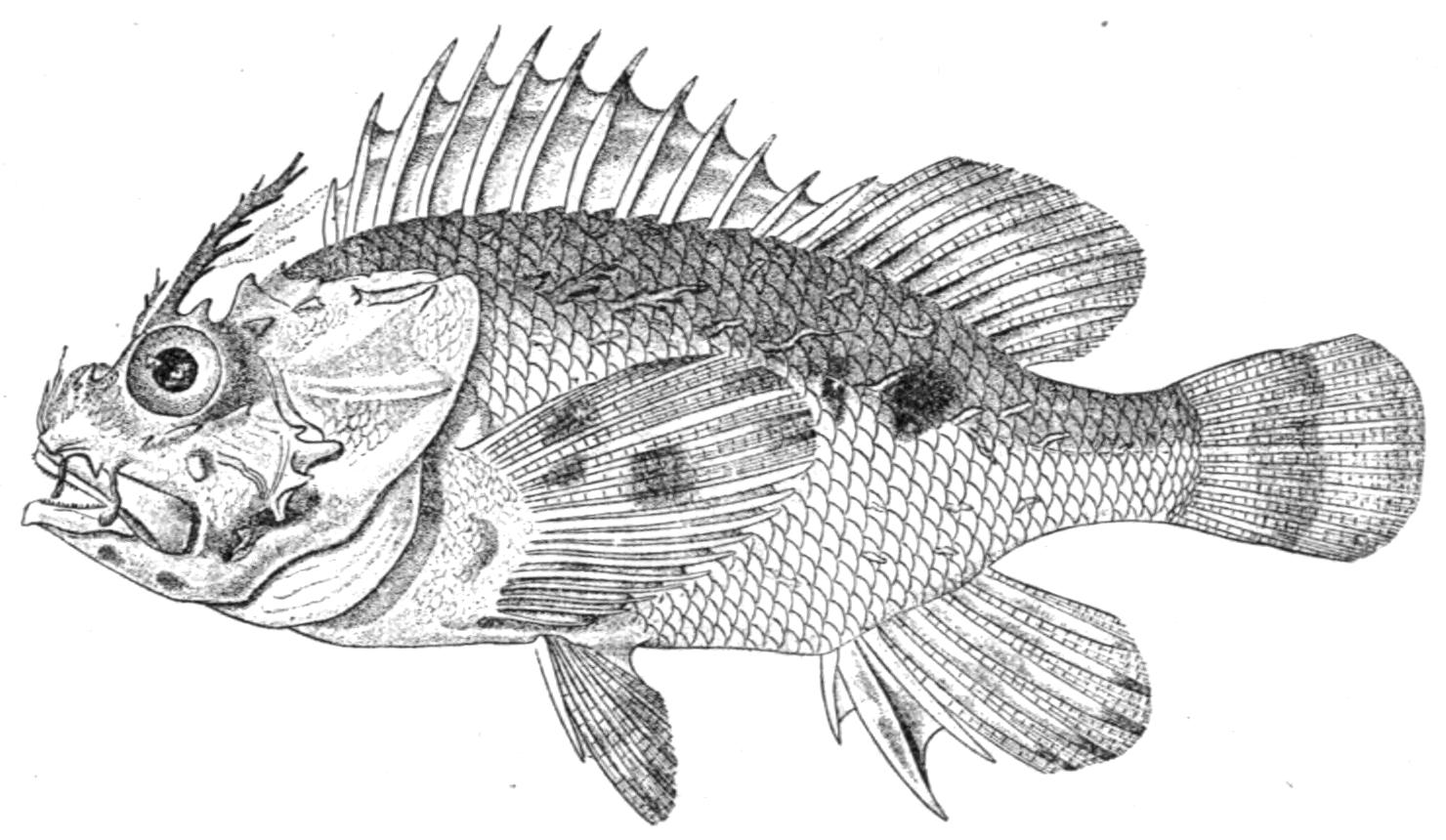
Fig. 424.—Scorpaena grandicornis. (After Valenciennes.) × ½.
Great variety of form obtains in this family, from the Perch-like Sebastes to the extraordinary-shaped Tetraroge, Pelor, and Synancia. Many of its members are excellent examples of mimetic adaptation to the surrounding, resembling the rocks among which they live and being covered with dermal appendages simulating weeds. An interesting example of commensalism has been discovered by A. Alcock[736] in Minous inermis, off the coasts of India, which, wherever found, is always more or less incrusted with the Gymnoblastic Hydroid Stylactis minoi. Many of the Sebastes and their allies are of large size and used as food; some are viviparous, the young being produced in great numbers and very small in size. Scorpaena, Pterois, Pelor, and Synancia are dangerous for the stings from their dorsal spines, which are provided with poison glands.[737]
Fam. 2. Hexagrammidae.—Head not cuirassed, without strong spines; basis cranii double; a single nostril on each side. Gill-membranes free from isthmus; gills 4; pseudobranchiae present. Vertebrae 42 to 57, most of the praecaudals with transverse processes bearing the ribs and the epipleurals. Post-temporal forked; scapula and coracoid well developed, in contact with each other; pectoral rays inserted on the scapula and 4 anvil-shaped pterygials, 2 of which are in contact with the coracoid. Ventral fins close together, more or less behind the pectorals, with 1 spine and 5 soft rays. Spinous dorsal of usually rather feeble rays, nearly as long as or longer than the soft; anal elongate, with or without spines. Body covered with small scales.
Carnivorous fishes, mostly of large size, from the rocky coasts of the North Pacific. Some are highly valued as food. Twelve species, referable to 6 genera: Hexagrammus, Pleurogrammus, Agrammus, Ophiodon, Zaniolepis, Oxylebius. Hexagrammus and Pleurogrammus are remarkable in having 4 or 5 lateral lines on each side.
Fam. 3. Comephoridae.—Head not cuirassed, without spines; basis cranii simple; two nostrils on each side. Gill-membranes free or narrowly attached to isthmus; gills 4; pseudobranchiae present or absent. Vertebrae 42 to 64, some or most of the praecaudals with transverse processes bearing the ribs and the epipleurals. Post-temporal forked; scapula and coracoid well developed, in contact with each other or separated by cartilage; pectoral rays inserted on the scapula and on 4 anvil-shaped or plate-like pterygials, 2 of which are in contact with the coracoid. Ventral fins, if present, close together, with 1 spine and 3 to 5 soft rays. Spinous dorsal of rather feeble rays, as long as or shorter than the soft; anal spines feeble or absent. Body covered with small scales or naked.
Four genera, each with a single species: Anoplopoma (Scombrocottus), from the North Pacific from Unalaska to California; Triglopsis, from deep water in Lakes Michigan and Ontario; Cottocomephorus, from Lake Baikal, and Comephorus from the greatest depths of that lake. As in many bathybial forms, Comephorus is colourless and provided with very large eyes; ventral fins are absent and the skeleton is very thin and papery. As a result of this condition, the second suborbital is not produced over the cheek, a unique exception to the main characteristic of this division; but no doubt can be entertained as to the propriety of referring it to the neighbourhood of Anoplopoma, since the recently discovered Cottocomephorus may be regarded as a connecting link between the two genera. Comephorus is viviparous, and dies after parturition.[738] Jordan regards Triglopsis as a relic of a former Arctic marine fauna.
Fam. 4. Rhamphocottidae.—Head incompletely cuirassed, with spines; basis cranii simple; two nostrils on each side. Gill-opening narrow, above the base of the pectoral; gills 3½. Vertebrae 24. Post-temporal short and flat, ankylosed to the skull; scapula and coracoid well developed, separated by cartilage; pectoral rays inserted on the scapula and on 4 plate-like pterygials, 2 of which are in contact with the coracoid. Ventral fins close together, behind the pectorals, with a rudimentary spine and 3 soft rays. Spinous dorsal shorter than the soft; no anal spines. Body densely covered with small prickly scales.
Rhamphocottus richardsonii, a small fish 3 inches in length, from the north-west coast of North America, is the only representative of this family.
Fam. 5. Cottidae.—Head not or but incompletely cuirassed, usually with spines; basis cranii simple; parietal bones often meeting on the median line; two nostrils on each side. Gill-membranes free or attached to isthmus; gills 3½ or 4; pseudobranchiae usually present. Vertebrae 24 to 50, the anterior praecaudals with sessile ribs, the posterior with transverse processes, often directed downwards, or forming haemal arches, bearing ribs and epipleurals. Post-temporal more or less distinctly forked; scapula and coracoid separated from each other by the intervention of the plate-like pterygials, of which one, two, or three are in contact with the clavicle; the coracoid more or less reduced. Ventral fins close together, with 1 spine and 2 to 5 soft rays (absent in Ereunias). Spinous dorsal usually shorter than the soft, sometimes quite indistinct; anal without spines. Body naked, partially scaly, or with prickles or bony plates.
Mostly small carnivorous fishes, the largest (Scorpaenichthys) growing to about 3 feet. Some species inhabit fresh waters, but the majority are marine, a few descending to great depths. Nearly all are from the northern regions, but a genus allied to Cottus (Sclerocottus) is from South Georgia, in the Antarctic region. Fossil Cottidae are known from the Upper Eocene and Miocene (Eocottus, Lepidocottus), and are distinguished from the modern forms in the smaller number of vertebrae (24 or 26 instead of 30 to 50). At least 220 species are known. Principal genera: Jordania, Scorpaenichthys, Icelus, Triglops, Cottus, Cottunculus, Blepsias, Pseudoblennius, Hemitripterus, Synchirus, Ascelichthys, Psychrolutes, Ereunias. The little freshwater "Miller's Thumb" (Cottus gobio) and the larger marine "Bull-heads" (C. bubalis and C. scorpius) are the most familiar British representatives of this family. The eggs are deposited on stones, weeds, or other submerged objects, or in a sort of nest, and are guarded by the male, which in most species is distinguished by a large genital papilla; this, in some forms, acts as an intromittent organ.
Fam. 6. Cyclopteridae.—Very closely related to the preceding, with which they are connected through Psychrolutes, and it is even doubtful whether they deserve to be separated from them. The only important distinctive characters reside in the structure of the ventrals, which, if present (absent in Paraliparis, a close ally of Liparis), are united to form a sucking disk, and the small size of the gill-cleft. The body is short, tumid, tadpole-like, naked or tubercular; the spinous dorsal, if present, is short. Vertebrae 28 to 60, the skeleton feebly ossified.[739]
Sluggish fishes, feeding on small animals and plants, from the North Atlantic and Pacific Oceans, and the Arctic and Antarctic seas, many descending to great depths (1800 fathoms). About fifty species are distinguished. Principal genera: Cyclopterus, Cyclopterichthys, Liparops, Liparis, Careproctus, Paraliparis.
The common Lump-Sucker of our coasts (Cyclopterus lumpus) is the largest member of the group, growing to a length of 2 feet or more. The male makes pits in the sand between stones, in which the female deposits the eggs; he watches over the eggs and also over the young, which cling to his body with their suckers. The "Sea-Snails" (Liparis), are represented by two species on the British coasts.
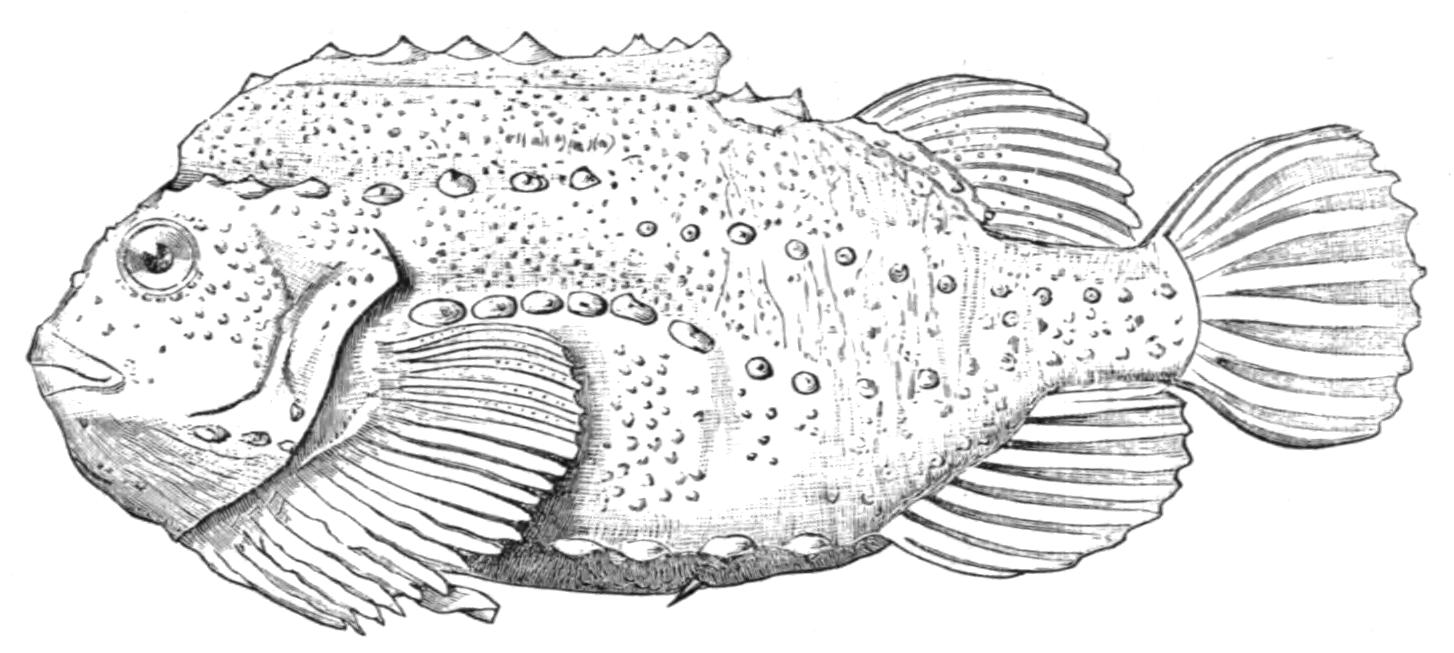
Fig. 425.—Cyclopterus lumpus. × ⅓.
Fam. 7. Platycephalidae.—Head not cuirassed, much depressed, with spines; basis cranii simple; two nostrils on each side. Gill-membranes free; gills 4; pseudobranchiae present. Vertebrae 27; ribs all sessile, bearing the epipleurals. Post-temporal forked; scapula and coracoid well developed, in contact with each other; pectoral rays inserted on the scapula and on 4 short and broad pterygials, 2 of which are in contact with the coracoid. Ventral fins widely separated, behind the pectorals, with 1 spine and 5 soft rays. Spinous dorsal shorter than the soft; anal without spines. Body covered with small scales.
The single genus Platycephalus, with some 40 species, inhabits the coasts of the Indian Ocean and the Western Pacific.
Fam. 8. Hoplichthyidae.—Head incompletely cuirassed, much depressed, with spines; basis cranii simple; two nostrils on each side. Gill-membranes attached to isthmus; gills 4; pseudobranchiae present. Vertebrae about 30, the praecaudals with transverse processes. Post-temporal fused with the skull; scapula and coracoid in contact with each other; pectoral rays inserted on the scapula and on 3 plate-like pterygials. Ventral fins widely separated, a little before the pectorals, with 1 spine and 5 soft rays. Spinous dorsal shorter than the soft; anal without spines. Back and sides with bony, prickly plates.
Hoplichthys, with a single species from the coasts of Japan and China. Bembras, with two species from the coasts of Japan, appears to be related to it, but the skeleton is still unknown; it differs in having the body covered with small scales and the gill-membranes free.
Fam. 9. Agonidae.—Head completely cuirassed, usually with spines; basis cranii simple; two nostrils on each side. Gill-membranes free or attached to isthmus; gills 3½; pseudobranchiae present. Vertebrae 35 to 50; ribs sessile. Post-temporal fused with the skull; scapula and coracoid in contact with each other, or separated by a cartilaginous space; pectoral rays inserted on the scapula and 3 or 4 plate-like pterygials. Ventral fins close together, with 1 spine and 2 soft rays. Spinous dorsal shorter than the soft, or absent; anal without spines. Body covered with bony plates.
Small fishes, mostly from the coasts of the Northern Atlantic and Pacific, extending into the Arctic Ocean; one species from the coast of Chili. Bathyagonus occurs in the North Atlantic between 350 and 477 fathoms.
About 40 species are known. Principal genera: Agonus, Agonopsis, Bathyagonus, Aspidophoroides. The "Pogge," or Armed Bullhead (Agonus cataphractus), is the only British species of this family.
Fam. 10. Triglidae.—Head completely cuirassed, with spines; basis cranii double; parietal bones meeting on the median line; two nostrils on each side. Gill-membranes free; gills 4; pseudobranchiae present. Vertebrae 25 to 40, the anterior praecaudals with sessile ribs, the posterior with transverse processes. Post-temporal fused with the skull; scapula and coracoid separated by a cartilaginous space; pectoral rays inserted on the scapula and on 4 large plate-like pterygials, of which two are in contact with the coracoid; 2 or 3 of the lower pectoral rays detached, forming feelers. Ventral fins widely separated, with 1 spine and 5 soft rays. Spinous dorsal shorter than the soft; anal without spines. Body covered with scales or bony plates.
Marine fishes from all warm and temperate regions, some occurring in deep water. They are remarkable for the finger-like appendages of the pectoral fins, which are employed to feel the ground in search of crustaceans and other small animals on which they feed; also for the grunting sounds which they utter by the contraction of the air-bladder. About 50 species are known, referable to 4 genera: Prionotus, Trigla, Lepidotrigla, Peristedion. Fossil remains referred to Trigla have been found in Miocene and later formations. British species are the Grey Gurnard (Trigla gurnardus), the Red Gurnard (T. cuculus), the Tub or Sapphirine Gurnard (T. hirundo), the Piper (T. lyra), the Long-finned Gurnard (T. obscura), and the Streaked Gurnard (T. lineata).
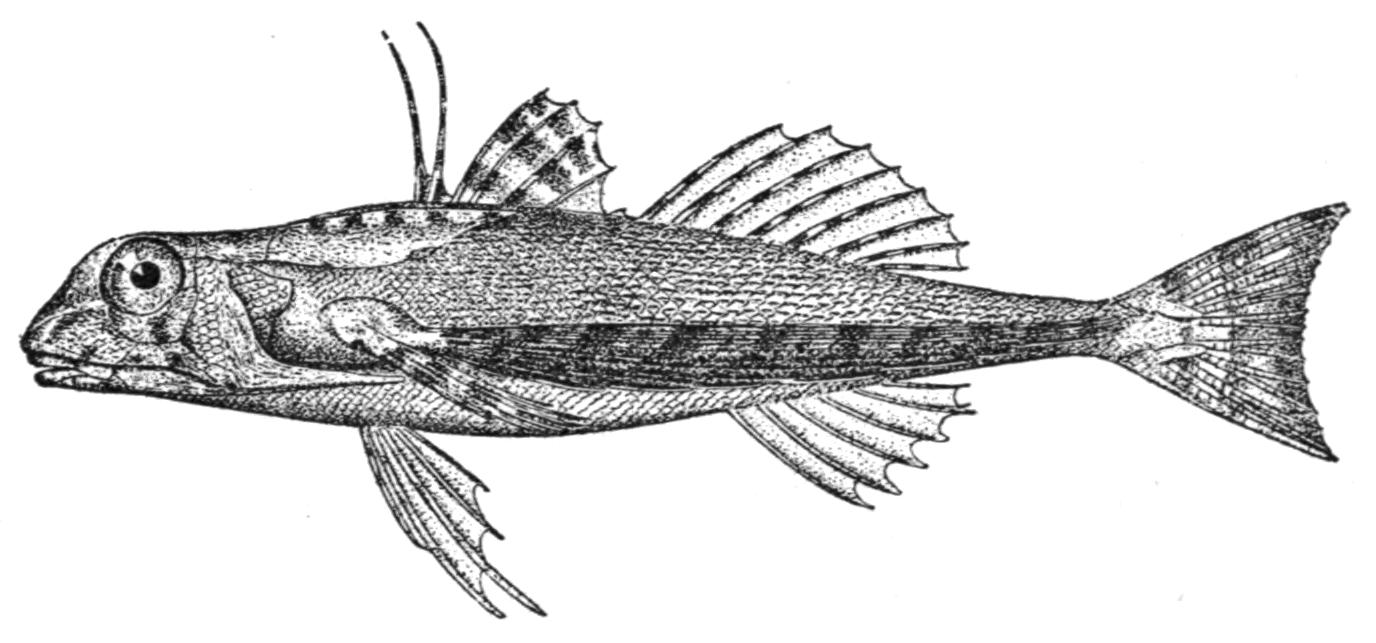
Fig. 426.—Dactylopterus volitans. (After Gill.) ⅓ nat. size.
Fam. 11. Dactylopteridae.—Head completely cuirassed; basis cranii simple; parietal bones meeting on the median line; two nostrils on each side. Gill-cleft broadly separated by scaly isthmus; gills 4; pseudobranchiae present. Vertebrae 20-22 (8-9 + 12-13), the first very elongate and formed by the fusion of three or four; ribs sessile, no transverse processes. Post-temporal fused with the skull; no supraclavicle; scapula and coracoid well developed, in contact with each other; pectoral rays divided into two parts, inserted on the scapula and on 4 elongate pterygials, of which 3 are in contact with the coracoid. Ventral fins close together, with 1 spine and 4 soft rays. Spinous dorsal shorter than the soft; anal without spines. Body covered with hard, rough scales.
The "Flying Gurnards," of which four species are known, belonging to a single genus (Dactylopterus), are inhabitants of the tropical and warm parts of the Atlantic and the Indian Ocean and Archipelago. They are remarkable, when adult, for the wing-like portion of the pectoral fins, by which they are able to move in the air like Exocoetus, but for shorter distances, and, unlike them, the wings are moved rapidly, the mode of flight resembling that of many forms of grasshoppers;[740] the young, however, have comparatively short pectorals, and were formerly regarded as belonging to a distinct genus (Cephalacanthus).
Division VIII.—JUGULARES.
No bony stay for the praeoperculum. Ventral fins jugular or mental. Gill-openings in front of the pectoral fin, the base of which is vertical or subvertical.
In a recently published note[741] I have alluded to the group of Physoclistous fishes for which I proposed to revive the old name Jugulares, pointing out that some of the forms previously grouped together as Trachinidae agree with the Gadidae, not only in the jugular position of the ventral fins, but also in the condition of the scapula and coracoid. Mr. Regan[742] has since been able to show that the Gadidae and Macruridae possess certain characters in common by which they may be separated not only from the other Jugulares, but even from the Acanthopterygians, and, as mentioned above (p. 646), the Müllerian Sub-order Anacanthini may be maintained, after excluding the Pleuronectidae. That the Blenniidae are akin to Lycodes and its allies has long been admitted, and authors who have placed them in different divisions of their systems have had to confess the difficulty of referring certain genera to the one family rather than to the other. The fact that Lycodes and many forms previously associated with the Ophidiidae agree with the Macruridae and Gadidae in the diphycercal vertebral column and in the absence of spines to the fins is merely, it seems to me, the result of degradation; they probably form the terminal group of a series in which the vertebral column was originally homocercal and fin-spines were present, as is the case in most of the Blenniidae and Trachinidae and their near allies. All these families may be assumed to have evolved in several series, often on parallel lines, from some group closely related to the Berycidae; and the resemblance which their terminal forms bear to the Anacanthini is, as pointed out by Regan, probably to be ascribed to convergence, not to any close genetic affinity, as hitherto believed by many authors.
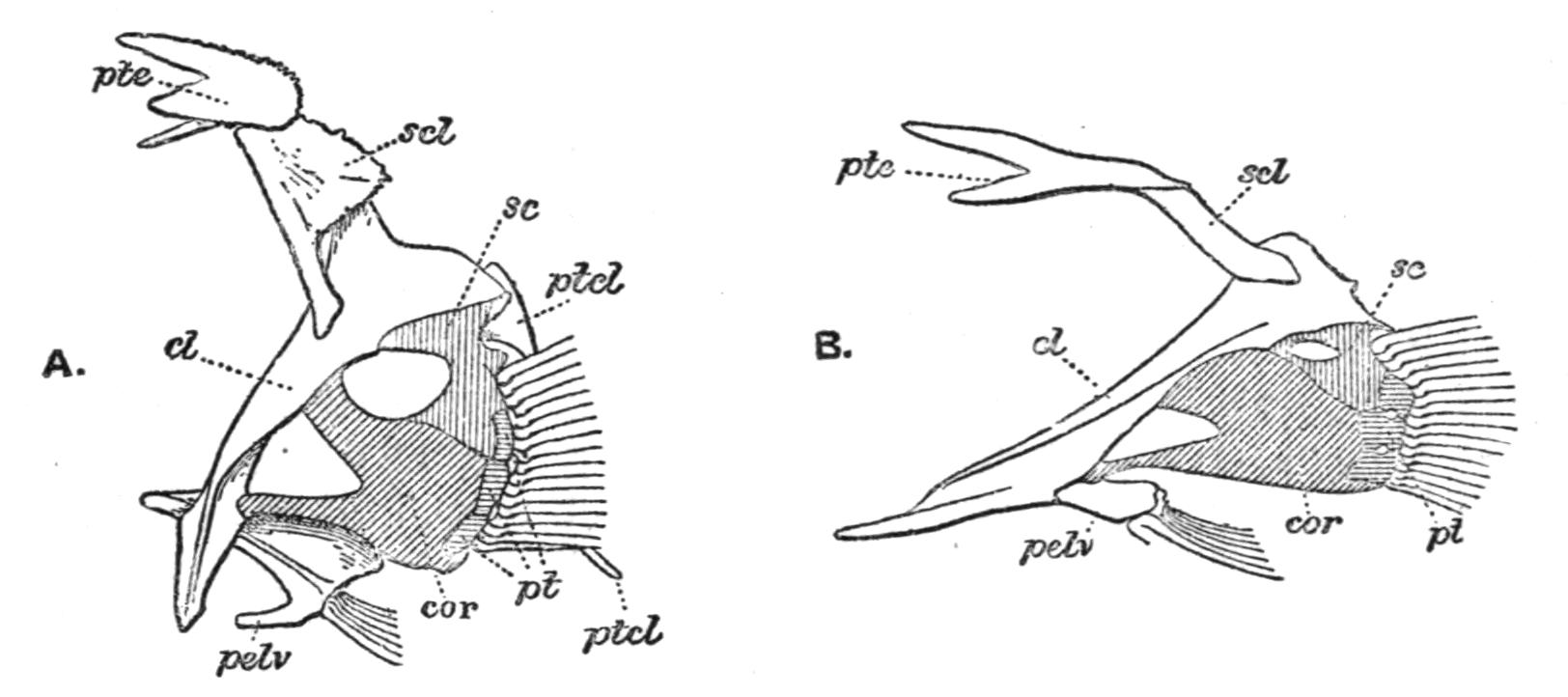
Fig. 427.—Pectoral arch and pelvis (left side) of A, Trachinus draco; B, Percophis brasilianus; cl, clavicle; cor, coracoid; pelv, pelvis; pt, pterygials; ptcl, post-clavicle; pte, post-temporal; sc, scapula; scl, supraclavicle.
The character of the position of the scapular foramen, either in the scapular bone or between it and the coracoid, which obtains in many genera of this division as well as in most of the Anacanthini, has proved to be unreliable even for the purpose of family definition; it is, however, of assistance in determining the relation of certain obscure, degraded forms placed by some authors with the Anacanthines, by others with the Blenniids.
Synopsis of the Families.
I. Pectoral rays attached to the scapula and to a series of pterygials of which only one or two are in contact with the scapula (see Fig. 427); ventral fins jugular, with 1 spine and 4 or 5 soft rays; anterior dorsal rays usually spinous or not articulated, often forming a detached fin.
A. Epipleurals present.
1. Second suborbital produced inwards to support the eye-ball.
Ventrals close together; scales very small, cycloid, forming oblique bands .......... 1. Trachinidae.
Ventrals widely separated .......... 2. Percophiidae.
2. No subocular shelf.
Ventrals widely separated; two nostrils on each side .......... 3. Leptoscopidae.
Ventrals widely separated; a single nostril on each side .......... 4. Nototheniidae.
Ventrals close together; scales very small, forming oblique bands; head partly covered with bony plates .......... 5. Uranoscopidae.
B. No epipleurals.
Post-temporal forked, articulated to the skull; soft dorsal and anal much elongate .......... 6. Trichodontidae.
Post-temporal closely adnate to the skull; soft dorsal and anal short (with only 7 to 10 rays) .......... 7. Callionymidae.
Post-temporal simple, articulated to the skull; soft dorsal and anal short; a ventral sucker .......... 8. Gobiesocidae.
II. Pectoral rays all attached to the pterygials, of which two or three are in contact with the scapula; ventral fins, if present, jugular or mental, composed of 1 to 4 rays.
A. Ventrals jugular or absent.
Post-temporal distinctly forked; praecaudal vertebrae with transverse processes; some or all of the dorsal rays spinous or not articulated; caudal fin usually distinct .......... 9. Blenniidae.
Post-temporal small and ankylosed to the skull; praecaudal vertebrae without well-developed transverse processes; a very short spinous dorsal; caudal fin distinct .......... 10. Batrachidae.
Post-temporal distinctly forked; praecaudal vertebrae with haemal arches; dorsal rays all spinous; caudal fin distinct .......... 11. Pholididae.
Post-temporal distinctly forked; praecaudal vertebrae with transverse processes; dorsal rays all articulated, or a few of the posterior spinous; no distinct caudal fin .......... 12. Zoarcidae.
Post-temporal forked, ankylosed to the skull; praecaudal vertebrae with transverse processes; no spines; no distinct caudal fin .......... 13. Congrogadidae
B. Ventrals mental (just behind the chin); no spines .......... 14. Ophidiidae.
III. Pectoral rays attached to an undivided cartilaginous plate representing the pterygials; ventral fins jugular, reduced to a filament formed of two adnate rays; fins without spines .......... 15. Podatelidae.
Fam. 1. Trachinidae.—Second suborbital with an internal lamina, supporting the globe of the eye; mouth large, protractile. Ribs and epipleurals nearly equally developed, sessile; posterior praecaudal vertebrae with short parapophyses. Gill-membranes free from isthmus; 6 branchiostegal rays; gills 4, a slit behind the fourth; pseudobranchiae well developed. Scapula and coracoid well developed, a foramen between them; pectoral rays attached to the scapula and to three short and broad pterygials, two of which are in contact with the coracoid. Ventral fins jugular, close together, with 1 spine and 5 soft rays. Body elongate, covered with small cycloid scales forming oblique bands. A short spinous dorsal and a long soft dorsal and anal. Vertebrae 35-43 (10-11 + 25-32). No air-bladder.
This family includes but one genus (Trachinus), the Weevers, with 4 species, occurring on the coasts of Europe, the Mediterranean, and West Africa north of the Equator. A fossil species has been described from the Upper Miocene of Croatia. The two British species, T. draco and T. vipera, are well known for the painful wounds which they are able to inflict through their sharp, grooved dorsal and opercular spines, which convey a very active poisonous fluid secreted by small glands at their base. As these fish like to bury themselves partially in the sands in shallow water, people bathing occasionally tread on them with, as a rule, at least violent pain as a result.[743] The flesh is not bad eating, and great numbers of the larger species (T. draco), are brought to the Paris market.
Fam. 2. Percophiidae.—Percophis, with a single species from the coast of Brazil, differs from the Trachinidae in the scapular fenestra being situated entirely in the scapula, in the ventral fins being rather widely separated at the base, and in the quincuncial disposition of the scales. Vertebrae, 57 (22 + 35). Bleekeria and Embolichthys, from the Indian and Japanese seas, with the ventral fins rudimentary or absent, which have been placed in the Ammodytidae, appear to be related to Percophis.
Fam. 3. Leptoscopidae.—Differ from the preceding in the absence of a subocular shelf. Scapular fenestra either in the scapula or between the scapula and the coracoid. Mostly Marine Fishes, various in form, from the tropics to the Antarctic circle, some occurring at great depths. About 25 species, referable to 7 genera: Leptoscopus, Parapercis, Neopercis, Pteropsaron, Bembrops, Pleuragramma, Chimarrhichthys. The latter, from New Zealand, is the only freshwater form of the family, and is remarkably adapted for living in alpine torrents. Pleuragramma antarcticum, brought home by the Southern Cross Expedition, comes from 78° 35´ S. lat., the farthest point at which fishes have yet been obtained in the Antarctic region. Macrius amissus, from the Pacific Ocean at a depth of 1000 fathoms, which, judging from a very imperfect description, probably belongs to this family, measures 5 feet, and is the largest known deep-sea Teleostean.
Fam. 4. Nototheniidae.—Also closely allied to the Trachinidae. No subocular shelf; a single nostril on each side; ventrals widely separated; pectoral arch usually as in the Trachinidae, but scapular fenestra sometimes in the scapula (Trematomus). Body varying much in shape according to the genera, the form sometimes suggestive of the Cottidae; scales usually ctenoid, sometimes absent; anterior (spinous) dorsal sometimes absent; lateral line often double, or even triple. Mostly from the Southern seas and the Antarctic circle. About 40 species, referable to 19 genera, of which the following are the principal:—Notothenia, Trematomus, Chaenichthys, Champsocephalus, Cryodraco, Acanthaphritis, Eleginops, Bovichthys, Gymnodraco, Gerlachia, Bathydraco, Racovitzaia, Harpagifer, Draconetta.
Fam. 5. Uranoscopidae.—Agree with the Trachinidae in general structure, and in the closely approximated ventrals. Scales very small, in oblique bands, or absent. Pterygials much reduced, fused with the scapula and the coracoid; scapular fenestra in the scapula. Parapophyses strongly developed on the praecaudal vertebrae, with the ribs attached to their upper surface. The head is very large, broad, partly covered with bony plates; cleft of the mouth vertical; eyes on the upper surface of the head. Vertebrae 25 to 30 (12-14 + 13-16). Four genera: Uranoscopus, Anema, Cathetostoma, Ariscopus, with 15 species, from the tropical seas, northwards to the Mediterranean and Japan, southwards to South Australia and New Zealand.