Chapter XVI
Reading edition
CYCLOSTOMATA (SYSTEMATIC)
CLASS I. CYCLOSTOMATA
The Cyclostomata, or, as they are sometimes called, the Marsipobranchii, from the pouch-like, or rather sac-like, shape of their branchial clefts, are divided into two orders, the first comprising the "Hag-Fishes" or "Borers," and the second the Lampreys.
Order I. Myxinoides.
The Hag-Fishes are probably the most primitive of all existing Craniates. The mouth is nearly terminal, and there is no buccal funnel. The naso-pituitary involution communicates behind with the oral cavity and functions as a channel for the in-streaming water-current to the gills. Four pairs of short tentacles, supported by a special tentacular skeleton, are present in relation with the mouth and the terminally-placed naso-pituitary orifice. The gill-sacs open directly into the pharynx. The branchial basket is but feebly developed, and at the most it is only represented by small isolated cartilages in relation with the external branchial apertures. The lingual apparatus is remarkably developed. Besides the lingual teeth there is only a single dorsal tooth in the roof of the mouth. The dorsal arcualia are restricted to the tail, or they extend for a short distance only into the trunk. A spiral valve is absent. There is a row of mucus-secreting sacs along each side of the body. The brain has no obvious cerebral hemispheres, nor a cerebellum. Only one semicircular canal is present in the auditory organ. The eyes are degenerate, and the usual eye-muscles with the cranial nerves supplying them have atrophied. The embryonic pronephros is retained in the adult. The eggs are large; segmentation is meroblastic; and development is direct, without a larval metamorphosis. Two families can be distinguished.
Fam. 1. Myxinidae.—Gill-sacs not exceeding six pairs, with a common external aperture on each side of the body.
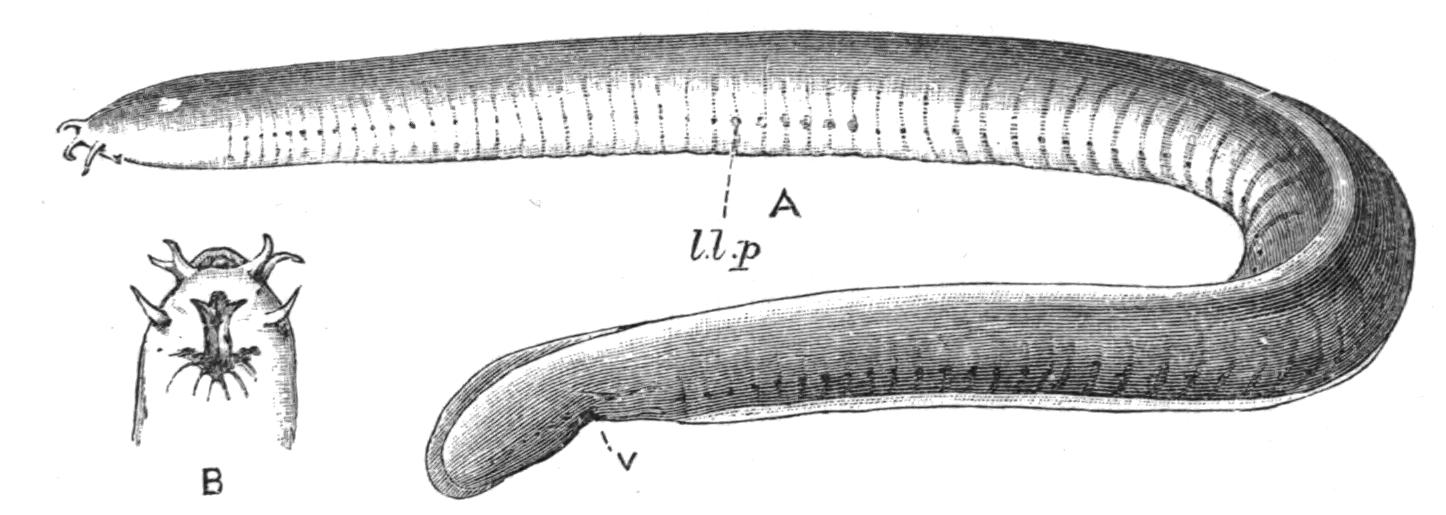
Fig. 240.—Myxine glutinosa. A, lateral view; B, view of the ventral surface of the head, showing the mouth and tentacles. l.l.p, Lateral pore-like apertures of the mucus-sacs; v, anus.
The family includes a single genus, Myxine, of which the common Hag (M. glutinosa) from the North Atlantic is the best known species (Figs. 92, A, and 240). This Hag-Fish occurs off the coasts of Northern Europe, including the British Isles, as well as on the Atlantic sea-board of North America,[504] southwards to Cape Cod. Other species are found off the coasts of Chili and Japan. Myxine is quasi-parasitic in its habits, boring its way into the bodies of large Fishes. By means of its rasping "tongue" it devours all the soft parts of its prey, leaving little more than a mere shell of skin and bones. The Fishes usually attacked are the Cod and other Gadoids, but the Sturgeon is not immune, and the presence of a Hag in the abdominal cavity of a Shark (Lamna cornubica) has been recorded. Myxine has the reputation of being very destructive to Fishes caught on lines, and it is said that whole "catches" have been destroyed by its depredations, so that North Sea fishermen have been forced to change their fishing-ground. To what extent the Hags attack Fishes which are living and free is somewhat uncertain, but the little evidence obtainable seems to point to the conclusion that, as a rule, they only prey on Fishes when the latter are hooked or netted, or injured or dead. When not seeking food the Hag lives in the mud of the sea-bottom at depths ranging to nearly 350 fathoms. They are able to swim very rapidly in an undulatory eel-like fashion. M. glutinosa may grow to a length of nearly two feet. The Hag has been described as a protandrous hermaphrodite, that is, it is first a male and then a female, the gonad of the young first producing spermatozoa, and at a later period becoming an ovary and giving rise to eggs. This view has hitherto met with general acceptance, but it has recently been urged with some force that the presence of the two kinds of sex-cells in a young animal is no proof of functional hermaphroditism, since it is not uncommon "to find immature eggs in the testis of many Vertebrates (Teleosts, Petromyzon, Amphibia), where the assumption of hermaphroditism, to say nothing of its protandric form, is entirely unwarranted."[505] Myxine produces eggs similar to those of Bdellostoma. Nothing is known of its breeding habits, or of its embryology.
Fam. 2. Bdellostomatidae.—Gill-sacs 6-14 pairs, all with separate external orifices. Bdellostoma (Fig. 92, B) is found on the Pacific sea-board of both North and South America, at the Cape of Good Hope, and on the coasts of New Zealand. The numerical variation of the gill-sacs in different species, and in different individuals of the same species, and even on opposite sides of the same individual, is very remarkable. Out of 354 examples of the Californian species (B. stouti) examined by Dr. Ayres,[506] 101 had 11 gill-sacs on each side; 26 had 11 on one side and 12 on the other; 208 had 12 on each side; 11 had 12 on one side and 13 on the other; and 8 had 13 on each side. Occasional specimens may have 14 gill-sacs on each side. The variations are apparently quite independent of size, age, or sex; and when the gill-sacs are asymmetrically developed, the additional sac may be either on the right side or on the left. In the Chilian species there are 10 gill-sacs on each side, but in the species from the Cape of Good Hope the number is reduced to 6 or 7. Bdellostoma closely resembles Myxine in its habits and mode of feeding. The Californian species attaches itself to the gills or to the isthmus of large Fishes, and then rapidly bores its way into the body, devouring the viscera and muscles but leaving the skin intact. It usually attacks large Flounders and species of Sebastodes, and it is especially destructive to Fishes taken in gill-nets. At Monterey every net in the summer contains the empty shells of eviscerated Fishes, and when these are taken out of the water the Hag scrambles out with great alacrity. Large fishes of even 30 pounds weight are often captured without either flesh or viscera, and it cannot be supposed that they entered the net in this condition.[507] The species lives on the sea-bottom most abundantly at a depth of 10-20 fathoms, but becomes rarer as the water deepens or becomes shallower.
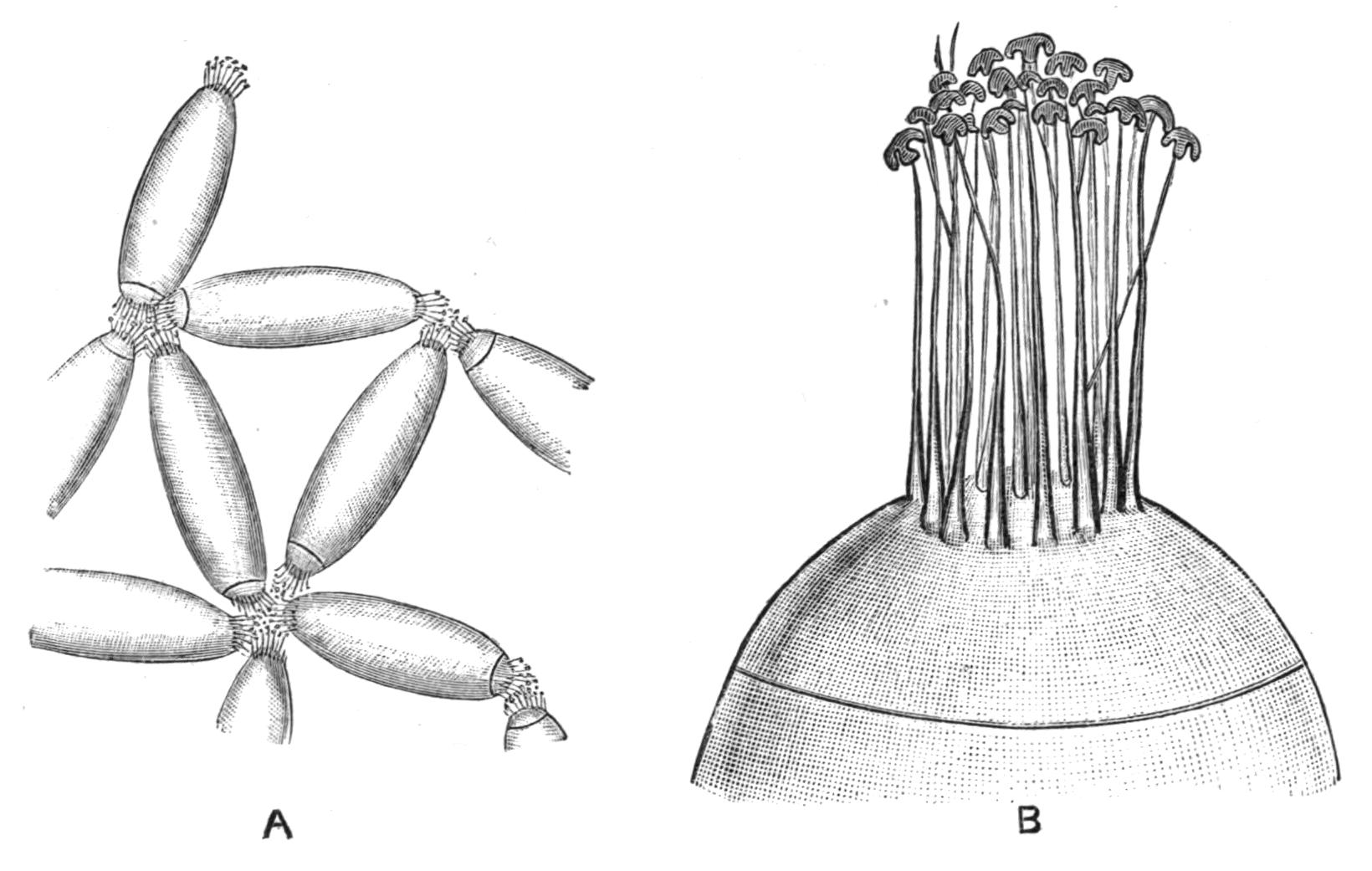
Fig. 241.—A, Cluster of the eggs of Bdellostoma stouti, connected by the interlocking of their anchor-shaped filaments; B, the animal pole of an egg, showing the polar "anchors" and the opercular ring. (From Bashford Dean.)
The eggs of the Californian Bdellostoma are large, varying in size from 14.3-29 mm. in length, and from 6.8-10.5 mm. in width, and each egg is enclosed in a horny egg-case secreted by the epithelium of its ovarian ovisac[508] (Fig. 241). At each pole of the egg-case there is a tuft of numerous horny filaments which end in 2- 3- or 4-hooked, anchor-like extremities. In the centre of the tuft of filaments at the animal pole of the egg the egg-case is perforated by a micropyle, and a little below this point the case is encircled by an opercular groove, which enables the polar portion to be thrown off like a cap at the time of hatching, so as to allow the young Bdellostoma to make its escape. The large size of the egg, which almost completely fills the cavity of the egg-case, is due to the fact that it consists mainly of food yolk, the germinal protoplasm containing the nucleus forming only a small hillock near the inner extremity of the micropyle. Bdellostoma spawns during the greater part of the year, but chiefly in the early summer, and probably about 20 eggs are deposited at one time, generally on a shelly or rocky bottom. After deposition the eggs become connected together in long chains or clusters by the interlocking of their polar hooks. Fertilisation takes place after extrusion, and the segmentation is meroblastic and discoidal, much as in Teleosts. The embryo completes its development within the egg, and when hatched it is a miniature of the adult.

Fig. 242.—Embryo of Bdellostoma stouti near the time of hatching. (From Bashford Dean.)
Order II. Petromyzontes.
In the Lampreys there is a large suctorial buccal funnel leading behind and above into the mouth, which is supported by special cartilages, and furnished with a marginal fringe of small cirri. Numerous horny teeth are present on the inner surface of the funnel as well as on the tongue. The naso-pituitary involution forms a caecum and does not communicate with the mouth. The gill-sacs, seven in number, open externally by separate orifices, but internally they open into a median branchial canal, situated below the oesophagus and opening into the mouth in front. There is a well-developed branchial basket. Dorsal arcualia are present throughout the precaudal as well as in the caudal region. A rudimentary spiral valve is present. The brain consists of parts usually present in other Craniates, including cerebral hemispheres and a cerebellum. The auditory organ has two semicircular canals, and the eyes are not degenerate. The pronephros is suppressed in the adult. The eggs are small; the segmentation is holoblastic; and there is a larval metamorphosis. There is but one family.
Fam. 1. Petromyzontidae.—The family has a nearly world-wide distribution. Most Lampreys are marine, although to a greater extent in some species than in others, but all of them seem to ascend rivers for spawning. The genus Petromyzon is characteristic of the northern hemisphere, where it is represented by various species on the coasts and in the rivers of Europe, West Africa, Japan, and North America. Three species, widely distributed in Europe, occur in the British Isles, viz.:—the Sea-Lamprey (Petromyzon marinus), which may reach or even exceed three feet in length, and is also found on the west coast of Africa and on the Atlantic coast of North America; the "Lampern" or fresh-water Lamprey (P. fluviatilis), about 18 inches long; and the Sand-Pride, Sand-Piper, or lesser freshwater Lamprey (P. planeri), usually less than a foot in length. Ichthyomyzon, Bathymyzon, Entersphenus, and Lampetra are also northern forms, collectively distributed along the Atlantic and Pacific coasts and in the rivers and great lakes of North America.[509] Other Lampreys occur only in the southern hemisphere. Geotria is common in the rivers of Chili, Australia, and New Zealand; and another genus, Mordacia, has a parallel distribution, being found on the coasts of Chili and Tasmania. A new genus and species from Chili has been recently described under the name of Macrophthalmia chilensis.[510] This Lamprey, which is only 107 mm. in length, has remarkably large eyes (2.5 mm. in diameter), vertically compressed gill-clefts, and a simple dentition resembling that of Myxine. All Lampreys are carnivorous. They feed by attaching themselves to the bodies of Fishes by their suctoral buccal funnels, and then rasping off the flesh with their lingual teeth. While thus engaged they are carried about by their victims. Salmon have been captured in the Rhone with the marine Lamprey attached to them. The Lamprey usually keeps near the bottom, either swimming with a graceful serpentine movement, or attached to stones by the buccal funnel.
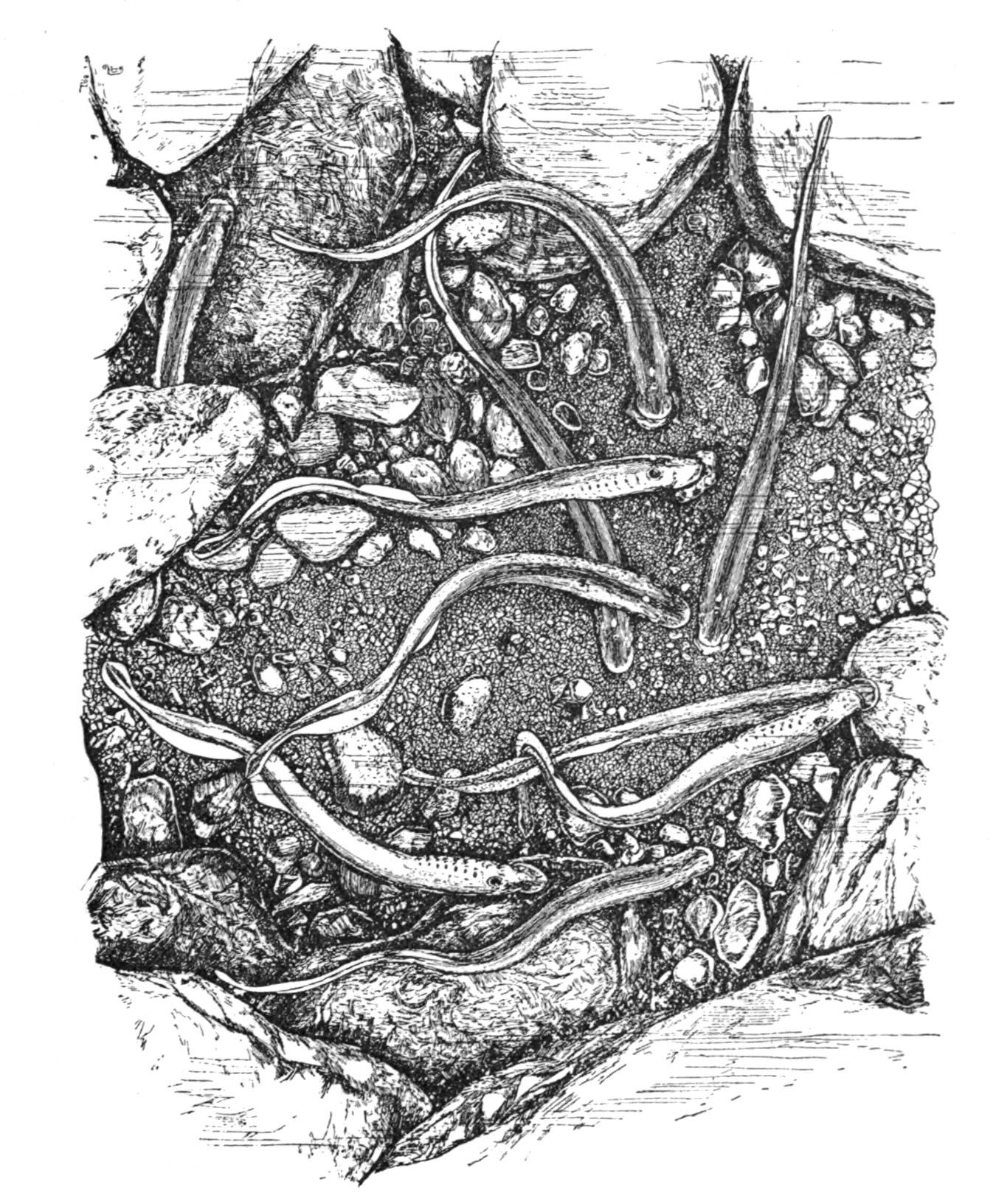
Fig. 243.—Spawning of the Brook-Lamprey (P. wilderi). On the right side of the figure a male is attached to the head of a female. (From Bashford Dean and F. B. Sumner.)
In the spring the Sea-Lamprey ascends the rivers to spawn, and, after depositing its eggs in furrows which it excavates in the river-bottom, it returns to the sea. The river-Lampreys spawn in the smaller streams and brooks. The North American Brook-Lamprey, Petromyzon (Lampetra) wilderi, which is found in the neighbourhood of New York, deposits its eggs on the gravelly bottom of a brook, in a small gravel-filled hole lying between a number of large rounded stones[511] (Fig. 243). In the vicinity of the "nest" some ten to twelve Lampreys congregate, the males, however, being much more numerous (five to one) than the females.
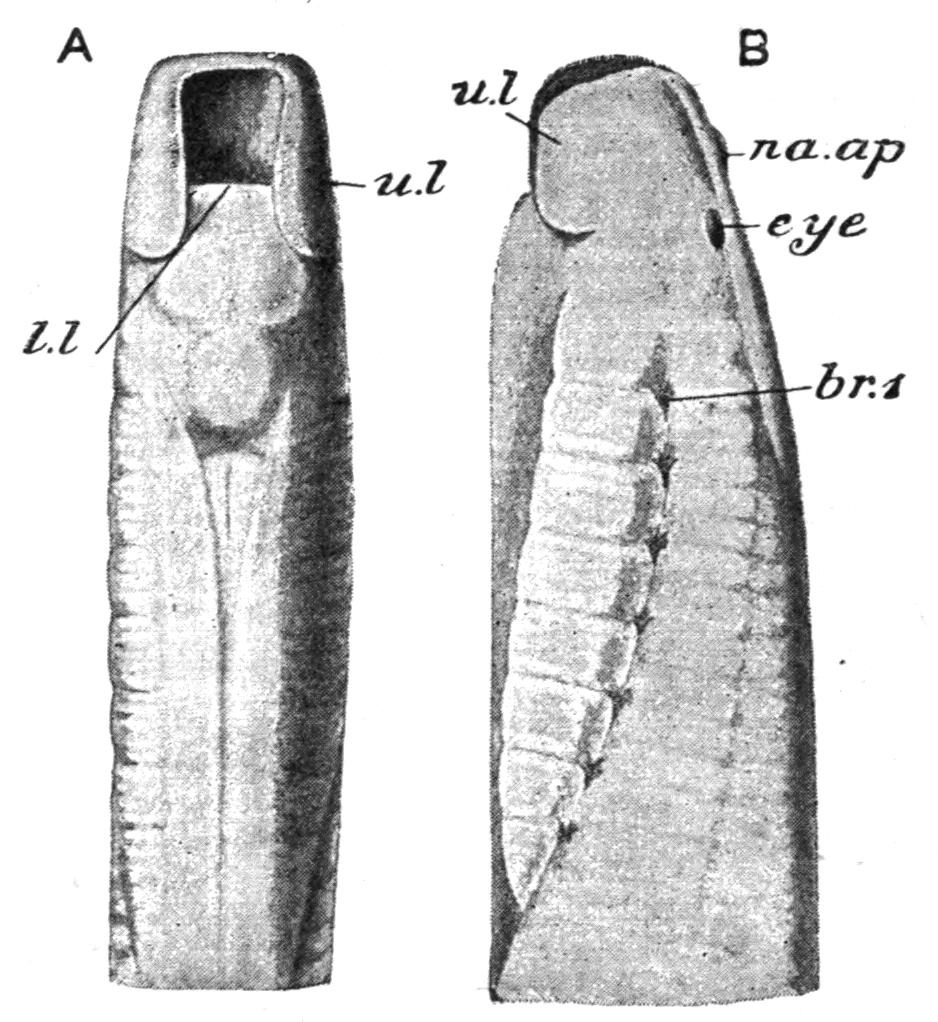
Fig. 244.—Head of the Ammocoetes of P. fluviatilis. A, ventral view; B, side view. br.1, First branchial aperture; eye, eye; l.l, lower lip; na.ap, naso-pituitary aperture; u.l, upper lip. (From Parker and Haswell, after W. K. Parker.)
Much energy is spent by both sexes in moving stones by lifting them with the buccal funnel, but it is not always clear that this is done to circumscribe the nest, or to remove impeding obstacles. Eventually, a male attaches himself to the back of the head of a female, who at the same time is holding fast to a stone. The male then rotates its body so that the urino-genital papilla is brought near the genital orifice of the female, and the simultaneous extrusion of eggs and spermatozoa at once follows. Owing to the small amount of food-yolk which they contain the eggs of the Lamprey (e.g. P. planeri) are small, measuring about 1.1-1.2 mm. in length, and from 0.9-1.0 mm. in width. There is a micropyle at the animal pole of the egg, but the characteristic horny egg-case and the polar hooks of the Myxinoids are both wanting. The embryo hatches out as a larva known as the "Ammocoetes." At this stage of its development the larva lacks several of the most striking features which characterise the adult, and it is highly probable that the Ammocoetes represents a stage in the evolution of Vertebrates in some respects intermediate between Amphioxus and a very primitive Craniate. The mouth of Ammocoetes is bounded laterally and in front by a curious hood-like upper lip, and behind by a short transverse lower lip (Fig. 244). The eyes are deeply seated and rudimentary, and as visual organs they are useless, but the parietal eye is well developed. As in the adult, there are seven pairs of gill-sacs, but they open internally into a pharynx, directly continuous behind with the rest of the alimentary canal, and there is no dorsal oesophagus. Like the skull, the branchial basket is still very rudimentary. The dorsal and caudal fins are continuous. A gall-bladder is present, and also a bile duct opening into the gut. In its mode of life, and especially in the manner in which it obtains its food, Ammocoetes presents a most remarkable resemblance to Amphioxus and the Ascidians. In the median line of the pharyngeal floor there is an open groove, the hypopharyngeal groove or endostyle, and a tract of ciliated cells along the dorsal wall represents a hyperpharyngeal groove: connecting the two in front there is a peripharyngeal ciliated groove.[512] The Ammocoetes feeds on small food particles carried through the mouth into the pharynx by currents of water produced by ciliary action. The food becomes entangled in strings of mucus probably secreted by the cells lining the endostylar groove. The mucus is then swept upwards in the pharyngeal groove, and finally wafted backwards to the stomach and intestine by the cilia of the hyperpharyngeal band. The skin exhibits the remarkable peculiarity of containing a peptic ferment capable of digesting proteids in a .2 per cent solution of hydrochloric acid. As the larva lives buried in the mud, the epidermic secretion probably helps to keep the skin free from bacteria, microscopic spores, and fungoid, or other parasitic growths.[513] The young Lamprey lives as an Ammocoetes from 3-4 years, and then in the course of a few weeks in the winter it undergoes a metamorphosis, losing its larval characters and acquiring the structure and habits of the adult. During this period the buccal funnel is completed and teeth are developed. The eyes approach the surface and become functional. The continuity of the median fins becomes interrupted. The endostylar groove becomes transformed into a thyroid gland, the gall-bladder disappears, and the bile duct becomes obliterated and changed into a mass of small follicles. The skull and branchial basket complete their development. At the same time the pharynx loses its connection with the rest of the alimentary canal and remains as the branchial canal. The so-called oesophagus of the adult is apparently a new formation which grows forwards and acquires a connection with the mouth. It is probable that it represents a hyperpharyngeal groove constricted off from the dorsal wall of the pharynx.
Both the marine Lamprey and the "Lampern" are captured for food, either by nets or wicker traps. Formerly the Lampern was taken in enormous numbers in several British and Irish rivers, especially in the Severn from February to May, and in the Thames during May and June, but for various reasons the supply has much diminished in recent years. The Lampern makes excellent bait for Cod and Turbot, and for this purpose large numbers used to be taken in the Trent and Thames for despatch to Grimsby and other fishing ports.[514]