Chapter XIII
Reading edition
MUSCULAR SYSTEM—LOCOMOTION—SOUND-PRODUCING ORGANS—ELECTRIC ORGANS
Muscular System.—The various muscles of the body may be arranged in two systems: (i.) the somatic or parietal, composed of striated or voluntary muscle-fibres; and (ii.) the splanchnic or visceral, consisting for the most part of unstriated or involuntary fibres. Somatic muscles form the great lateral longitudinal muscles of the trunk and tail, which retain the primitive embryonic metamerism to a greater extent in Fishes than in any other Vertebrates, and are the principal muscles associated with locomotion. The lateral muscles are composed of a series of transverse muscle-segments or myotomes, which are >-shaped, or S-shaped, or they even take a zigzag course from above downward. The myotomes are disposed in pairs, and they are separated from one another by fibrous septa or myocommata. Each myotome is divided into a dorsal or epiaxial portion, and a ventral or hypaxial portion, by a longitudinal, horizontal, fibrous septum extending outwards from the vertebral centra to the skin. The muscles of the pectoral and pelvic fins are derivatives from more or fewer of the adjacent myotomes. The splanchnic muscles include the musculature of the walls of the alimentary canal, as well as those specialised portions of the visceral system which are represented by the muscles of the branchial arches and the jaws, and are composed of striated fibres.
Locomotion.—A Fish and a Bird are equally remarkable for the many and various ways in which they are adapted for locomotion in the particular medium in which they live. In its shape the Fish is admirably adapted for cleaving the water. Spindle-like in shape, but thicker in front than behind, a Fish resembles a double wedge, the thick part of which is represented by the head and one of the thin edges by the free hinder margin of the caudal fin. The body is bounded by smooth flowing contour lines, unbroken by any sharp separation of the body regions from one another, and with no points of resistance to its forward motion through the water. The body being thicker in front than behind, and, as seen in transverse section, broader above than below, it follows that its centre of gravity will be nearer the head than the tail, and nearer the dorsal than the ventral surface. The dorsal position of the centre of gravity necessarily renders the equilibrium of the body unstable, and were it not for the balancing action of the paired fins the Fish would float belly upwards, as is always the case after death. Most Fishes are provided with a membranous gas-containing sac, the air-bladder, the principal function of which is to render the Fish, bulk for bulk, of the same weight as the water, so that in this position of equilibrium, or plane of least effort, the animal can execute its various locomotor movements with a minimum expenditure of muscular effort—an advantage which no other animal possesses.[414] To give stability to the body, and to steady its course when swimming, the Fish has a dorsal and a ventral keel, formed by the anal and dorsal fins, which, like the sliding keel of a yacht, can be raised or lowered as occasion requires. When these fins are removed the course of the Fish becomes zigzag, and the animal wobbles.
The organs more directly concerned with swimming are the tail and the caudal fin, and the pectoral and pelvic fins, but the relative share which these structures take in the actual propulsion of the Fish differs greatly. The principal organ of locomotion in the typical Fish is the powerful muscular tail, which, in swimming, is lashed from side to side by the alternating contraction of the great longitudinal muscles on opposite sides of the vertebral column.[415] In such movements the tail is first flexed or bent, say to the right side: this stroke has been termed the non-effective or back stroke. By a stroke in the reverse direction the tail is then extended and straightened, that is to say, the Fish makes the forward or effective stroke. By a rapid succession of such strokes to the right and left sides alternately the Fish is forced through the water. It is obvious, however, that the extension or effective stroke must have a considerable surplus of power over the flexion or non-effective stroke, and how this result is achieved will now be briefly considered. Experiment, and the observation of Fishes like the Sturgeon, which habitually move with sufficient slowness to allow the phases of their swimming movements to be followed without much difficulty, show that in swimming a Fish throws its body into two opposite and complementary curves, a cephalic curve formed by the anterior half of the body and a caudal curve by the tail. The double curve enables the Fish always to present a convex, less resisting or non-biting surface to the water during the flexion of the tail to the right or left as the case may be, and a concave or biting surface during extension, that is when the tail is straightening itself during the effective stroke.
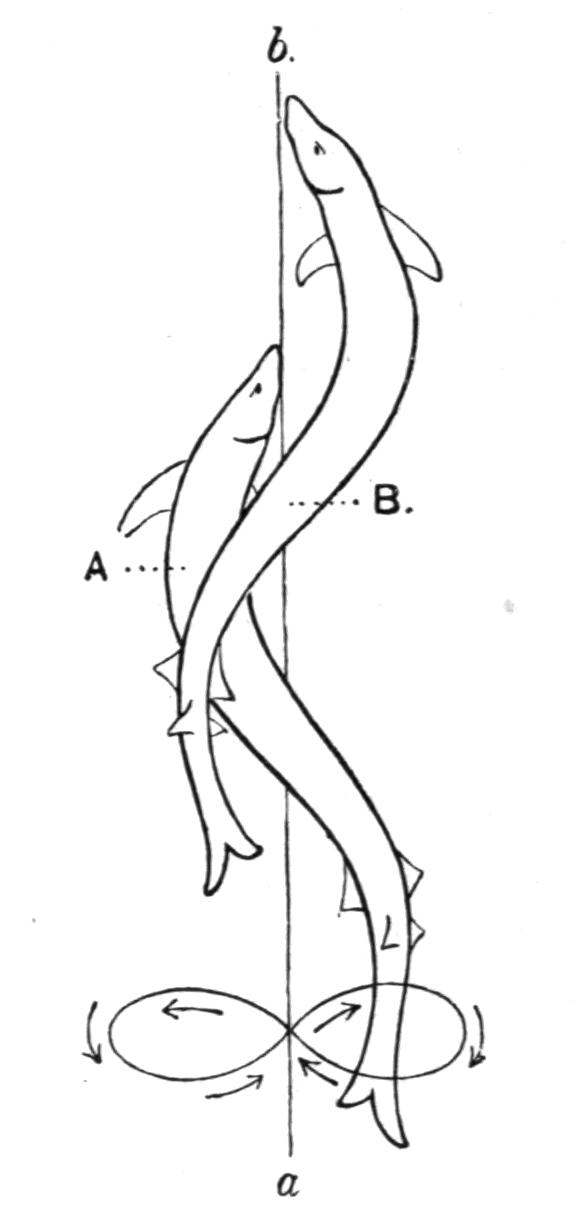
Fig. 204.—To illustrate the mode in which the tail of an ordinary Fish is used in swimming. See the text for the lettering. (Slightly altered from Pettigrew.)
Fig. 204, which represents a Fish in two successive positions while swimming, will serve to illustrate these conclusions. A Fish in the position A has its body thrown into a cephalic concavity directed to the right and a caudal concave surface facing the left. The tail is bent to the right of the line a b, which corresponds to the axis of the Fish when at rest and to the course pursued by the animal when swimming, and is in the position which it assumes during a flexion stroke, with its convex non-biting surface directed outwards and its concave biting surface inwards. The tail is now ready for an extension stroke, and while this is in progress it is clear that the concave biting surface of the tail will meet the water, while at the conclusion of the stroke the tail will be in a line with a b. At the same time the cephalic curve has so far diminished that the long axis of the body for a momentary period will also coincide with a b, and the Fish is free to advance without impediment. The tail, however, continues its movement to the left, but now as a flexion stroke, and assumes the curvature and position indicated in B, with a reversal in the direction of both the cephalic and caudal curves, but in the meantime the force of the preceding extension stroke has forced the Fish along the line a b to the new position indicated by B. By a rapid succession of alternating flexions and extensions, during which the tail describes figure-of-8 curves, the Fish travels in an undulating forward course with a maximum of propelling power and a minimum of "slip." In short, the action of the tail precisely resembles the action of the stern-oar in the operation of sculling a boat.
There are also other considerations which add to the surplus power of the extension stroke by lessening the resistance of the water to the flexion or non-effective stroke. During the flexion stroke the tail fin is less expanded and its area diminished, and by the rotation of the Fish on its long axis the surface of the tail strikes the water obliquely, and further, the tail moves with less rapidity. On the contrary, when the extension stroke is made these conditions are reversed. The caudal fin is expanded, the stroke is more rapid, and by the reverse rotation of the Fish the tail now strikes the water with its flat surface. In other words, the action of the tail during the two strokes may be compared to the "feathering" of an oar in rowing. Nor is this all. A Fish in motion through the water produces a suction current behind it. The current offers but little resistance to the flexion stroke, inasmuch as the direction of the two coincide, but during the extension stroke the tail meets the full force of the current, and consequently its grip and propelling power are greatly enhanced. There is a striking analogy between the movements of a Fish's tail in swimming and the action of the screw of a steamer, but as a propelling organ the former is far superior to the latter. As we have seen, the tail of a living Fish can so adjust its shape and surface that it alternately eludes and grips the water in accordance with the needs of particular strokes.
The curves into which the body of a Fish is thrown when swimming are never less than two, but in long-bodied Fishes, such as the Eels, the number may be increased, and in every case the curves occur in pairs and are complementary to one another.
Many Fishes can jump out of the water, either in pursuit of insect food, like the Trout, or to enable them to escape the pursuit of their foes, like the Flying-Fish (Exocoetus), by means of a single forcible stroke of the tail, when the Fish is in a nearly vertical position close to the surface of the water. It is thus that the Salmon executes its remarkable leaps over weirs or up salmon-ladders when ascending rivers for spawning.
The tail is also used for steering. If kept bent to one side when the Fish is moving the tail acts like a rudder, and the course of the Fish is deflected to that side; or the direction may be altered by single strokes of the tail to the right or left, according to the course which the Fish desires to pursue.
In the majority of Fishes the paired fins are probably of little use for propulsion, and their action in this as in other functions is not always clear. In the Sharks and Dog-Fishes as well as in some Teleosts their planes are nearly horizontal when the fins are extended from the body; in others they are more oblique, so that the surfaces of the fins look upwards and backwards, and downwards and forwards; and in others again their surfaces are so nearly vertical that their strokes will be backwards and forwards. The pectoral fins also vary in their position on the sides of the body, being much more dorsal in some Fishes than in others. The paired fins may act as lateral keels in steadying the course of the Fish especially when the fins are extended and their planes are horizontal. They certainly seem to act as balancers in keeping the Fish on an even keel, and in counteracting the tendency of the Fish to turn belly upwards—a result which is attained by a slight upward and downward movement of the fins, and particularly of the pectoral fins. A Fish deprived of its pectoral members sinks downwards at the head and assumes an oblique position in the water. Removal of both the pectoral and pelvic fins of one side causes the Fish to roll over to that side; and if the fins are removed from both sides the animal turns belly upwards like a dead Fish. The pectoral fins may also be used for steering: a backward stroke of one fin while the other is kept folded back against the body will wheel the Fish round to the opposite side. From the ventral position of its mouth a Shark is forced to turn over to one side in order to seize its prey, and this movement of rotation is probably produced by the down strokes of the pectoral fin of one side. In some Fishes it would seem that the pectoral fins may assist locomotion by acting as paddles. The 15-spined Stickleback (Gastrosteus spinosus) frequently progresses by their aid alone; and, as their action can be reversed at pleasure, it is not unusual to see this Fish move backwards. The fins appear to be rotated or twisted in spiral movements like the tail when used for swimming, or like the wings of Insects in flying.
It has been mentioned that the function of the median fins (dorsal and anal) is to give stability to the Fish by acting as dorsal and ventral keels. This is certainly the case in the generality of Fishes. Nevertheless, there are exceptional instances in which one, or even both, of these fins are important swimming organs, acting either as a substitute for a tail which has become adapted for other uses, or as supplementary to that organ. Thus, in some of the Syngnathidae (Pipe-Fishes and Sea-Horses) the small size or absence of the caudal fin, and its use as a prehensile organ, renders the tail of little or no value as a propelling organ: hence it is that these Fishes swim by a lateral undulating movement of the dorsal fin. To enable them to do this the supporting skeleton presents certain interesting modifications. In the majority of Teleosts the arrangement of the fin-muscles, and the nature of the articulation between the dermal fin-rays and their basal radial supports, which is generally some form of a hinge-joint, are such as to limit the motion of the rays to simple elevation or depression in the vertical plane, and no lateral motion of the fin is possible. But in the Syngnathidae, as in the Pipe-Fish (Siphonostoma typhle), there is an exceptionally mobile articulation between the dermal fin-rays and the distal radial nodules which their cleft bases embrace and the bony proximal or basal radials, so that the fin can be flexed or bent to the right or to the left. In addition to this, by a change in the insertion of their tendons, the muscles corresponding to the ordinary elevator and depressor muscles of the fin-rays in other Fishes are capable of producing extensive lateral movements of the fin, or, by contracting in orderly sequence, of bringing about the characteristic undulating motion of the fin. A similar mechanism exists in many Plectognathi (e.g. species of Balistes, Monacanthus, Diodon, Tetrodon and Orthagoriscus)[416] in connexion with both the dorsal and anal fins, but in these Fishes the action of the median fins in swimming must be regarded as supplementary to that of the tail.
Swimming is by no means the only form of locomotion in vogue amongst Fishes. A few, like the Angler-Fishes (Lophius), habitually use the pectoral fins for crawling about the sea-bottom. The East Indian Goby, Periophthalmus, uses its pectoral fins, which are bent at an angle like an elbow-joint, for hopping over sandy flats left bare by the retreating tide. The Flying-Fish (Exocoetus), when projected from the water by a stroke of its powerful tail, expands its large pectoral fins, and, using them after the fashion of a parachute, floats through the air for considerable distances before returning to its natural medium. The "Flying Gurnards" (Dactylopterus) are also capable of short aerial excursions in a similar fashion. Nor is tree-climbing beyond the province of a Fish, if credit be given to the assertion that the Indian "Climbing-Perch" (Anabas scandens) uses its opercular spines for ascending trees. Many freshwater Fishes are known to migrate across land from one pool or river to another, usually during the night. Eels do so by a serpentine or wriggling motion of their long bodies, but in others the pectoral fins seem to be the principal organs used for the purpose, aided, it may be, by a perverted use of the tail.
Sound-producing Organs.—Contrary to popular belief sound-producing or vocal organs are by no means uncommon in Fishes, especially in certain families of Teleosts. It is not always easy, however, to discriminate between involuntary, abnormal, or accidental sounds, and those due to the action of special vocal organs. There are, moreover, some Fishes which observations have shown to utter highly characteristic sounds, although the precise nature of the sound-producing mechanism is at present unknown; while other Fishes appear to possess organs which, on anatomical grounds, are perhaps vocal in function, although nothing is known of the nature of the sounds they emit. Here those organs only will be considered which, either with certainty or with some degree of probability, may be regarded as vocal structures. For most of our knowledge of these interesting structures we are indebted to the researches of Sörensen and Dufossé.[417]
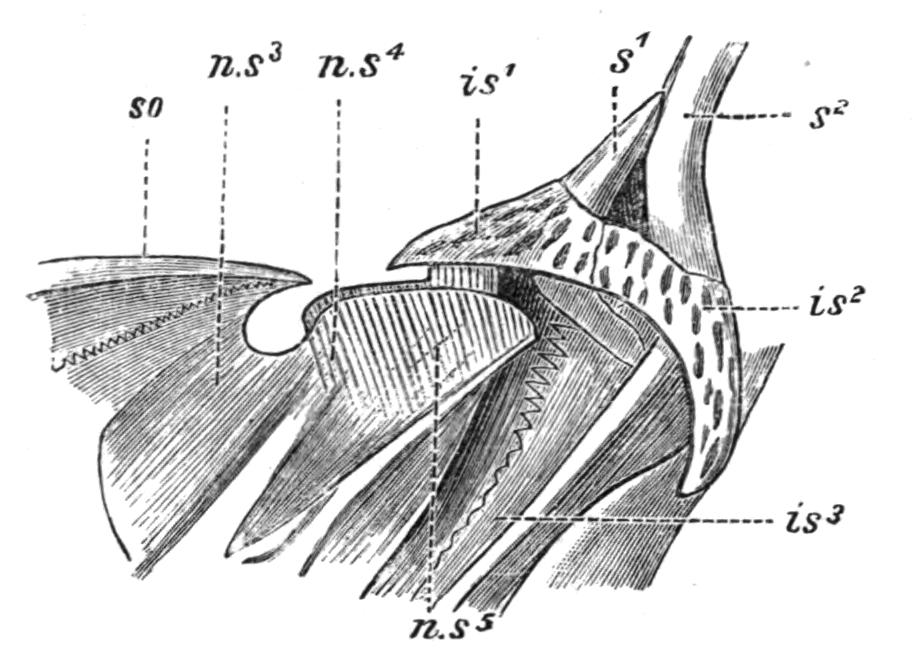
Fig. 205.—Stridulating apparatus of Callomystax gagata. is1, The first interspinous bone, the lower part of which forms the double file and fits into the interval between the cleft neural spines ns4 and ns5; is2, is3, second and third interspinous bones; ns3, ns4, ns5, neural spines of the third, fourth, and fifth vertebrae; s1, s2, spine-like rays of the dorsal fin; so, supra-occipital. (After Haddon.)
(a) Stridulation.—Stridulation as a method of sound-production has been recorded in many Teleosts, and one of the most interesting examples occurs in the singular Indian Siluroid, (Callomystax gagata).[418] In this Fish (Fig. 205) the first five vertebrae are rigidly connected with one another and with the skull, mainly through the union of the neural spines of the third, fourth, and fifth vertebrae, and their articulation with the supra-occipital bone. The united spines together form a high, laterally-compressed lamina of bone, the hinder portion of which is vertically cleft into two thin plates separated by an interval sufficiently wide to receive the first interspinous bone of the dorsal fin. The inner surface of each of the two plates is traversed by a series of about thirty parallel, close-set, vertical ridges, while the first interspinous bone is similarly ridged on both its faces like a double file. Lastly, it may be mentioned that owing to the width of the intervertebral ligament between them the fifth and sixth vertebral centra are articulated by a joint of unusual mobility. The action of the mechanism is simple. By the vertical movements of the sixth and succeeding trunk vertebrae, with the interspinous bones which they support, on the rigid structure formed by the head and first five vertebrae, the file-like first interspinous bone moves backwards and forwards, and, by scraping against the ridges on the inner surfaces of the cleft neural spines, gives rise to a harsh grating noise, which is particularly unpleasant when artificially produced. The lateral movements of the trunk in ordinary locomotion do not affect the mechanism: it is only when the trunk is alternately flexed and extended in the vertical plane that the mechanism comes into play and a noise is produced. In the Bull-head (Cottus scorpius) the preoperculum is modified for stridulation, and in Dactylopterus the hyomandibular bone; in other Fishes, as in some Siluroids (e.g. species of Doras), stridulation takes place between a basal process from the great spine of the pectoral fin and the wall of a socket in the cleithrum into which the process is received, or between the small first spine of the dorsal fin and a roof-like process at the upper extremity of the first interspinous bone; also, in a somewhat similar fashion in the anterior dorsal fin of such widely different Fishes as certain Trigger-Fishes (Sclerodermi) pertaining to the genera Balistes, Monacanthus, and Triacanthus, Acanthurus chirurgus (Acanthuridae), the Boar-Fish (Capros aper), Centriscus scolopax (Centriscidae), and the Three-spined Stickleback (Gastrosteus aculeatus); and even between the spinose ray of the pelvic fin and the basipterygium in Triacanthus, Capros, and Gastrosteus.
In the "Drumming" Trigger-Fish (Balistes aculeatus),[419] which frequents the coral-reefs off the Island of Mauritius, stridulation takes place between the postclavicles and a longitudinally grooved area on the inner surface of each cleithrum. Both the cleithra and postclavicles are in intimate relation with the air-bladder, and the sound produced by friction is apparently strengthened by the transference of the vibrations to the walls and gaseous contents of that organ. The passage of the sound-vibrations to the surrounding medium is facilitated by the fact that for a portion of their extent the lateral walls of the air-bladder are in contact with the superficial skin, which visibly shares in the vibratory movement of the bladder when the characteristic drumming sounds of Balistes are being emitted.
Stridulating sounds may also be produced by the friction of the upper and lower pharyngeal teeth, as in a species of Mackerel (Scomber brachyurus). By the grating of its teeth the Sun-Fish (Orthagoriscus mola) is said to emit sounds similar to those produced by the grinding of the teeth in Pigs and Ruminants; and Moseley[420] has remarked of a species of Balistes that the "living Fish when held in the hand makes a curious metallic clicking noise by grating its teeth."
(b) Breathing sounds.—Characteristic breathing or murmuring sounds, or "bruits de souffle" as Dufossé terms them, are produced by a few Teleosts, among which may be mentioned the Eels, certain Cyprinidae, as, for example, the Carp (Cyprinus carpio), several species of Loaches (e.g. Misgurnus fossilis and Cobitis taenia), and the European Siluroid, Silurus glanis. According to Dufossé these sounds originate in some cases from the expulsion of gas from the air-bladder through the ductus pneumaticus and mouth, and in others, as in Misgurnus fossilis, they are produced by the rapid ejection through the anus of bubbles of air previously taken in at the mouth.
(c) Sounds produced through the agency of muscles connected with the air-bladder.—In addition to its usual function as a hydrostatic organ or "float" the air-bladder is often modified in various ways in different Teleosts, and adapted for use as a sound-producing organ.
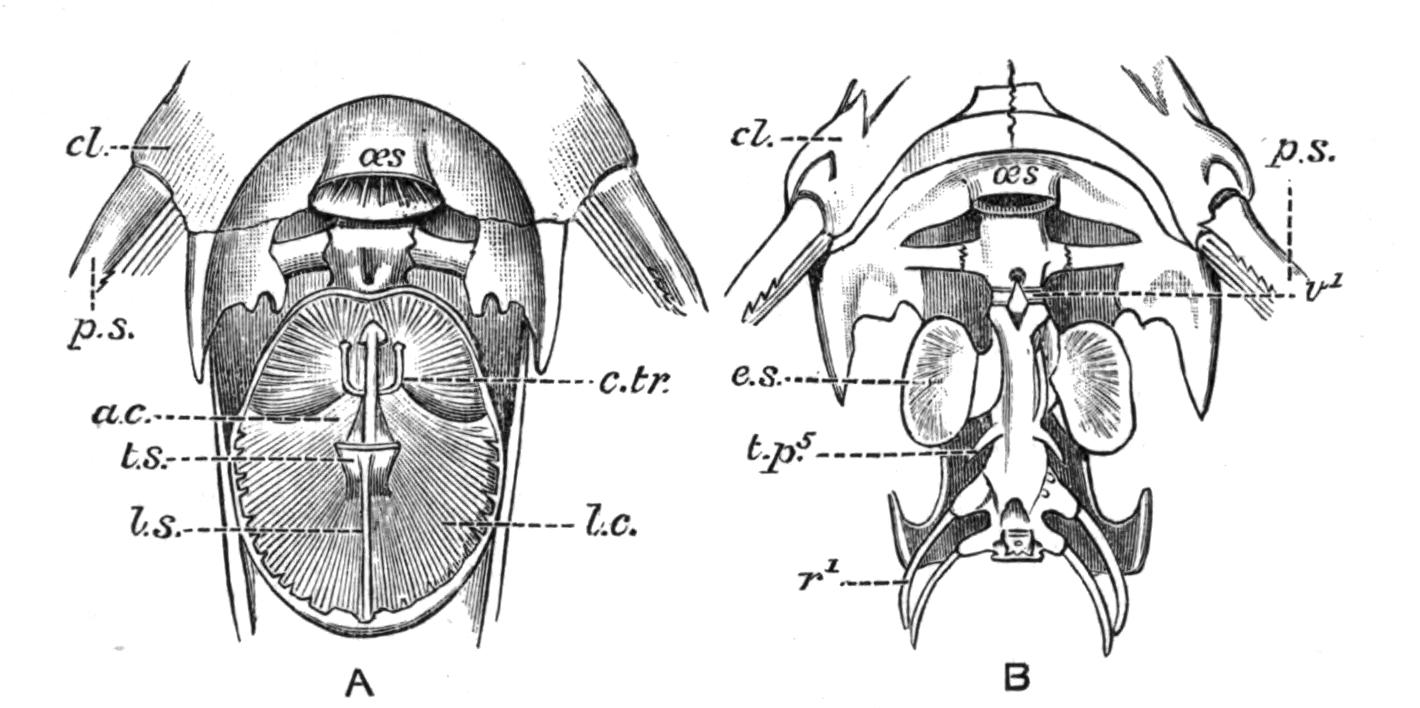
Fig. 206.—The air-bladder and elastic-spring-mechanism in Auchenipterus nodosus. A, Cavity of the bladder exposed by the removal of its ventral wall: a.c, anterior chamber; cl, clavicle; c.tr, crescentic process of the tripus; l.c, left lateral chamber; l.s, longitudinal septum separating the two lateral chambers; oes, oesophagus; p.s, pectoral spine; t.s, the narrow transverse septum which partially separates the anterior from the two lateral chambers. B, Ventral view of the anterior vertebrae, to show the elastic springs: es, the oval bony plates in which the elastic springs terminate; r1, first rib; t.p5, transverse process of the fifth vertebra; v1, first vertebral centrum; cl, oes, and ps, as in A. (From Bridge and Haddon.)
In the South American Siluroid, Auchenipterus nodosus, the transverse processes of the fourth vertebra are bent downwards and backwards, and at the same time become converted into flexible and highly elastic springs (Fig. 206, B). Their distal extremities expand into oval bony plates which are imbedded in the anterior wall of the air-bladder, and often cause the latter to bulge inwards (Fig. 206, A). From the occipital region of the skull arise two powerful muscles which pass backwards to their insertion into the anterior faces of the two springs. By the contraction of these muscles the springs, and consequently also the front wall of the bladder, are drawn forwards; but directly the muscles relax, the elasticity of the springs causes them to move backwards to their former position, carrying with them the wall of the air-bladder. Hence it follows that the rapid alternating contraction and relaxation of the muscles will impart a vibratory movement to the anterior wall of the bladder and to the gaseous contents of that organ, with the result that a sound is produced. As a rule, those Fishes in which an elastic-spring-mechanism is present have the air-bladder subdivided by internal septa into a series of chambers freely communicating with one another; and no doubt the intensity of the sound is greatly increased by the vibratory movements of the gases across the free edges of the septa, and from one chamber to another. The elastic-spring type of vocal organ is apparently restricted to the Siluridae,[421] and besides occurring in Auchenipterus is found also in the South American genera Doras, Oxydoras, Rhinodoras, and Euanemus; in the African genera Synodontis and Malopterurus; and in at least four species of the Indian genus Pangasius.[422] There are also a few Teleosts in which the air-bladder is provided with special muscles, but, instead of being connected with elastic springs, the muscles extend from the skull, and are inserted directly into the wall of the bladder (Fig. 207); or, without being in any way attached to the skeleton, the muscles simply invest some portion of the surface of the air-bladder. In other Fishes the air-bladder, without possessing special muscles of its own, may, nevertheless, be partially invested by tendinous, or partly muscular and partly tendinous, extensions from the muscles of the body-wall (Fig. 208), or may be intimately related to certain muscles connected with the pectoral girdle.
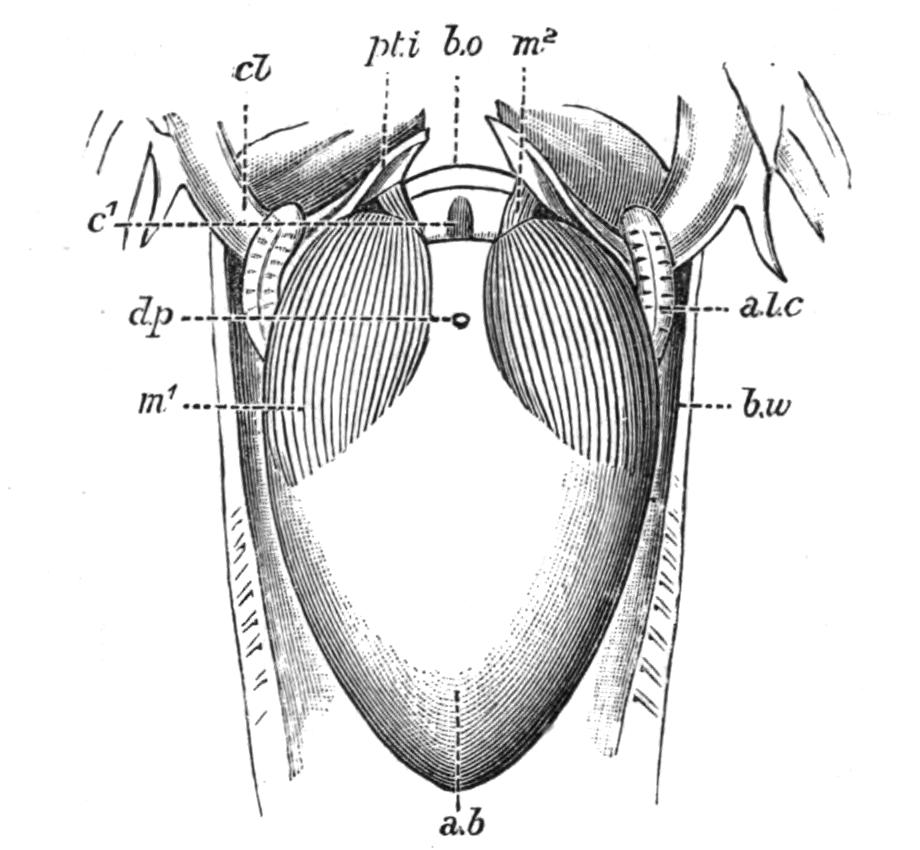
Fig. 207.—Ventral view of the air-bladder and its extrinsic muscle in Platystoma. a.b, Air-bladder; a.l.c, left antero-lateral caecum of the bladder; b.o, basioccipital; b.w, body-wall in contact with the lateral wall of the bladder; c1, centrum of the first vertebra; cl, clavicle; d.p, ductus pneumaticus; m1 and m2, extrinsic muscles of the bladder; pt.i, post-temporal. (From Bridge and Haddon.)
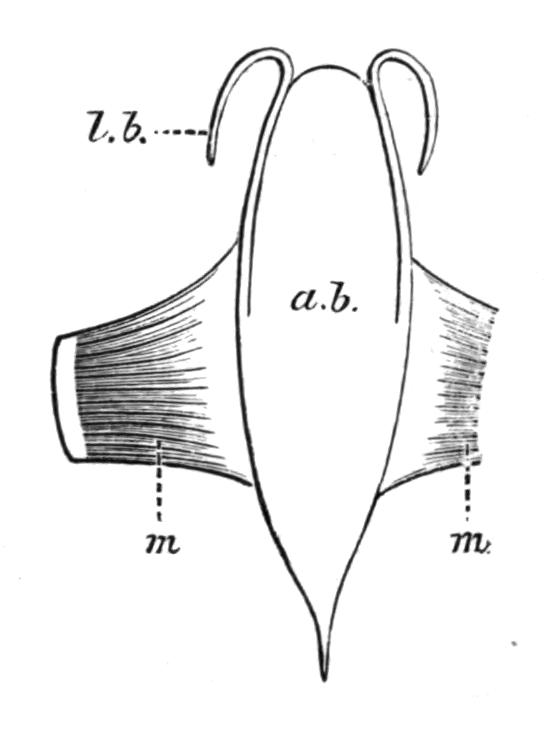
Fig. 208.—Air-bladder and its muscles in Micropogon undulatus. a.b, Air-bladder; l.b, right lateral caecum; m, m, musculo-tendinous extensions from the muscles of the body-wall, which partially invest the surface of the air-bladder. (From Sörensen.)
Whatever the precise relation of the air-bladder to its muscles it is probable that the physiological effect is in most cases the same. By the rapid alternating contraction and relaxation of the muscles, some part of the wall of the bladder becomes alternately compressed and relaxed in such a way as to initiate a series of vibratory movements in the gases of that organ, and so produce definite sounds. In not a few of the Fishes the cavity of the bladder is subdivided by external constrictions or by internal septa, or is complicated by the development of lateral, tubular, caecal branches; and hence the vibratory movements of the gases will be greatly strengthened by their passage across the edges of the septa, or the apertures of the caeca, and the intensity of the resultant sounds also increased. It will be readily understood that the nature and quality of the sounds emitted by different Fishes will necessarily vary with the shape of the air-bladder, the number and arrangement of the internal septa and the caeca, and the strength and disposition of the contracting muscles. In a few Teleosts (Triglidae and Zeidae) sounds are said to be produced by the rapid vibration of an annular, or centrally-perforated, muscular diaphragm, which stretches across the cavity of the air-bladder.[423] Nevertheless, it must be strongly emphasised that, while in some Fishes the air-bladder and its muscles undoubtedly constitute a vocal organ, there are many others in which the bladder can only be inferred to be sound-producing from its general agreement in anatomical structure with the same organ in Fishes where its vocal function has been clearly proved.
By one or other of these various methods the air-bladder is either known to be sound-producing, or is believed with good reason to be such, in the following Teleosts,[424] and many others:—Certain species of the South-American genera of Siluridae, Pimelodus, Sorubim, Platystoma, Piratinga, Centromochlus, and Trachelyopterus; species of the South-American family Characinidae; Amblyopsis spelaea, the blind Fish from the Mammoth Cave of Kentucky (Amblyopsidae); among the Syngnathidae, the short-snouted Sea-Horse (Hippocampus brevirostris) of the British Coasts; certain Sclerodermi, such as the Trigger-Fishes, Batistes vetula, Triacanthus brevirostris, T. biaculeatus, and Monacanthus pardalis, and also some "Coffer Fishes" (e.g. species of Ostracion); some Gymnodontes (species of Diodon and Tetrodon); a few Serranidae (e.g. species of Therapon and Pristipoma); species of Holacanthus (Chaetodontidae) and in Holocentrum sogho (Berycidae); such Sciaenidae as the "Drum" (Pogonias chromis), the "Maigre" (Sciaena aquila), which has sometimes been taken in British waters, Umbrina cirrhosa, Otolithus regalis, and Micropogon undulatus, and, with more or less probability, many other species of the same family; one species of Zeidae, the John Dory (Zeus faber); Batrachus tau among the Batrachidae; several species of Gurnards (Triglidae) belonging to the genera Prionotus and Trigla; the so-called Flying Gurnard, Dactylopterus volitans (Dactylopteridae); the Indian species Ophiocephalus marulius and O. gachua (Ophiocephalidae); amongst the Gadidae, the Cod (Gadus morrhua) and the Haddock (G. aeglefinus); in such Zoarcidae as the blind Fish (Lucifuga subterranea) from the subterranean waters of the caves of Cuba, and also in some Ophidiidae (e.g. species of Ophidium).
In Fishes other than Teleosts, instances of normal sound-production by special vocal structures are rare. No recorded instances are known in the Cyclostomes or the Elasmobranchs,[425] but there is evidence that sounds are emitted by Polypterus among the Crossopterygii, and by the Dipnoids Neoceratodus,[426] Protopterus, and Lepidosiren, although it is not certainly known how they are produced, or that they may not be the accidental concomitants of the inspiratory or expiratory action of the lungs in breathing.
As to the nature of the sounds produced by the air-bladder and its muscles in different Teleosts, a few examples may be given.
The sound produced by the elastic-spring-apparatus of a recently caught Doras maculatus, has been described as a "deep growling tone," which may be distinctly heard at a distance of 100 feet when the Fish is out of the water. Under like conditions the air-bladder and its muscles, in a species of Platystoma, emit a similar sound. On the other hand, the sound produced by the elastic springs of the Electric Siluroid (Malopterurus electricus) has been compared to the hissing of a cat. The Sea-Horse (Hippocampus brevirostris) utters a monotonous sound analogous to that of a tambour, which is characteristic of both sexes, but is more intense and frequent in the breeding season. The "Coffer Fish" (Ostracion trigonus) emits a growling sound, as also does the "Globe Fish" (Tetrodon honckenii) when taken out of the water.[427] The air-bladder and its muscles in the "Drum" (Pogonias chromis), constitute the most powerful sound-producing organ yet found in any Fish. The sounds emitted by the "Drum" are better expressed by the word drumming than by any other, and have frequently been heard by persons in vessels lying at anchor on the coasts of the United States, where these Fishes abound.[428] The "Drum" begins its drumming noise in the spawning season in April, but is rarely heard afterwards. The "Maigre" (Sciaena aquila), whose musical performances are perhaps responsible for the Homeric fable of the song of the Sirens, is remarkable among Fishes for the variety of its sounds, which have been compared to bellowing, purring, buzzing, and whistling.[429] The sound is often so intense that it may be heard when the Fish is at a depth of 18 metres, and the ear of the observer two metres above the water; and it has been recorded that by listening for these sounds, shoals of Maigres have been successfully netted. They rarely emit sounds when isolated; but in shoals, during the breeding season, they do not cease to make sounds with a vigour and a persistency which apparently must soon wear out their strength. One of the Indian Horse-Mackerels (Caranx hippos) grunts like a young Pig when captured, and the sound is repeated whenever it is moved, as long as vitality remains. A West Indian species of the same family (Argyriosus vomer) has been observed to produce a like sound, while an Egyptian Caranx (C. rhonchus) is known to the Arabs as the "Chakoura" or "Snorter."[430] The sounds produced by the different British Gurnards, such as the Grey Gurnard (Trigla gurnardus), the Piper (T. lyra), the Elleck or Cuckoo Gurnard (T. cuculus), and the Tub-Fish (T. hirundo), have been compared to snoring, a sonorous and prolonged grunting, crooning (whence, perhaps, the term "crooner," by which the Grey Gurnard is known in Ireland), and croaking. The John Dory (Zeus faber)[431] also utters sounds analogous to those of the Gurnards. Among the Dipnoi Lepidosiren is said to make a growling sound, and Neoceratodus a grunting noise which may be heard at night for some distance.
Whatever the nature of the vocal mechanism, it is highly probable that the sounds produced by Fishes travel to considerable distances in the water, inasmuch as the latter medium is a far better conductor of sound than air, and, moreover, the transmission of sound-vibrations from the air-bladder to the water is facilitated in many Fishes by the fact that, for a portion of its extent on each side the bladder is in direct contact with the superficial skin behind the pectoral girdle.
From the by no means exhaustive list of examples given above, it is obvious that in some form or other vocal organs are present in a considerable number of Fishes, both freshwater and marine, belonging to widely different groups; and further, that even in the same species (e.g. Doras maculatus and other Siluridae), both stridulation and the action of extrinsic muscles on the air-bladder may be utilised as a means of sound-production. Certain Teleostean families like the Siluridae, the Sciaenidae, and the Triglidae, seem to be distinguished above all others by the prevalence of some form of vocal organ. According to Sörensen, the first mentioned of the three families includes no less than 68 species, which utilise the air-bladder alone as a sound-producing organ. Nevertheless, there still remain many Teleostean families, rich in genera and species, and with an almost world-wide geographical distribution, in which such organs have not yet been found.
The advantages which Fishes derive from the possession of sound-producing organs are sufficiently obvious.
A characteristic feature in the reproduction of most Fishes is the general absence of any process of conjugation between the sexes, the eggs being fertilised in the water after their extrusion from the body of the female, and, consequently, any device which will facilitate the formation of shoals during the breeding season must be of great advantage to the species by largely increasing the chances that the ova will be fertilised, and thus secure the more successful propagation of the race. Hence it may be concluded that the vocal organs of Fishes are a means to this end, and that the sounds they produce are in fact recognition-sounds which enable Fishes of the same species to congregate together at periods when reproductive activity is greatest. This view is in harmony with much that is known of the habits of these Fishes, especially with the fact that particular sounds are often characteristic of particular species, and that the sounds are produced most frequently and with greater intensity during the breeding season than at any other time. While useful to all Fishes that possess them, vocal organs are, no doubt, specially serviceable to those Fishes which, from the nature of their habitat, can make but little use of their eyes; and this fact may perhaps explain the prevalence of such organs in the Siluridae, which are frequently bottom- or ground-feeding Fishes, and often live in muddy waters.
The sounds emitted by Fishes may also, in some instances at least, be warning sounds. Many of the sound-producing Fishes are provided with exceptionally strong spines either in connexion with the median and paired fins, as in many Siluridae, or on the general surface of the body, as in Diodon hystrix. Such spines are very effective weapons for offensive or defensive purposes, and are capable of inflicting very severe wounds. The natural enemies of these Fishes learn by experience or instinct to associate particular sounds with the possession of dangerous spines, and warned by the sounds, they refrain from attacking the owner of the spines, to the mutual advantage of both.
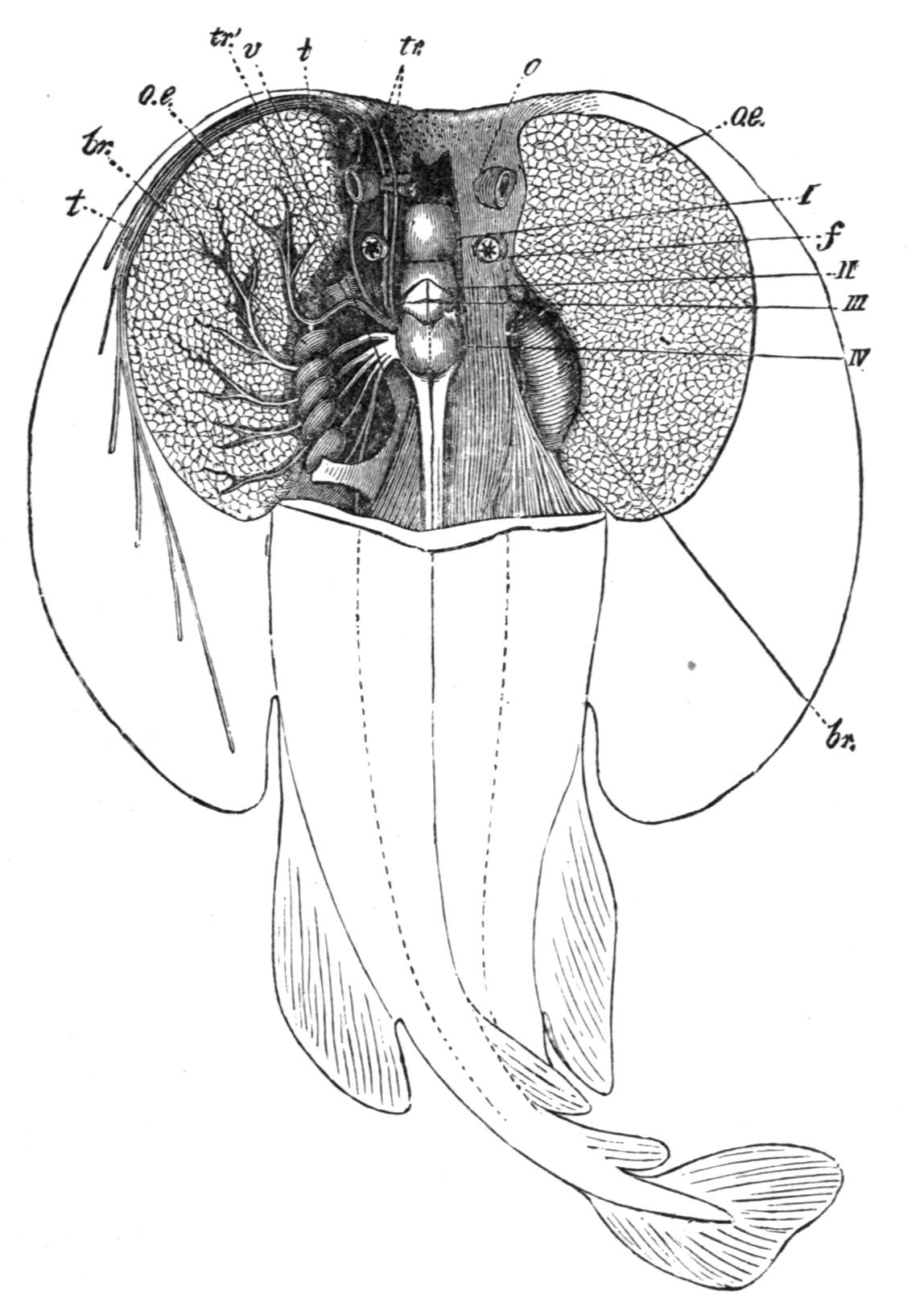
Fig. 209.—An Electric Ray (Torpedo) dissected to show its electric organs. On the left the nerves supplying the organ are dissected out. The prismatic areas on the surface of the organ indicate the vertical columns of electric plates, of which there may be 500,000 in each organ. The dorsal surface of the brain is exposed. br, Gills; f, spiracle; o, eye; o.e, electric organs; t, mucus canals; tr, tri-geminal nerve; tr′, its electric branch; v, vagus; I, fore-brain; II, mid-brain; III, cerebellum; IV, electric lobe of the medulla oblongata. (From Parker and Haswell, after Gegenbaur.)
Electric Organs.—Electric organs capable of generating more or less powerful electric discharges are present in certain Fishes, both marine and freshwater. They occur in a few Elasmobranchs (species of Raia, Torpedo, and Hypnos), in such Teleosts as the African Silurid Malopterurus the "Electric Eel" (Gymnotus), and in species of Mormyridae (e.g. Mormyrus). With one exception electric organs are composed of metamorphosed muscular fibres, and their nerve-endings or motor end-plates. The species of Raia have two small electric organs, one on each side of the terminal portion of the tail.[432] In Gymnotus[433] the organs are much larger, and extend the whole length of the tail, which is fully four-fifths of the total length of the Fish. The Mormyridae also have their feeble electric organs in the caudal region. In all these Fishes the electric organs are modified portions of the caudal muscles. In the Torpedo, however, these organs are two large oval masses, one on each side of the head, between the gills and the cephalic prolongation of the pectoral fin (Fig. 209). Malopterurus[434] is exceptional in possessing an electric organ derived from the epidermis and not from the muscular system. In this Fish the organ envelops nearly the whole body like a mantle, between the skin and the subjacent muscles of the trunk and tail. An electric organ is composed of an immense number of "electric plates" (modified motor end-plates), abundantly supplied with nerves on one of their surfaces, and disposed in a series of vertical (Torpedo) or longitudinal (Gymnotus) columns, separated by septa of connective tissue. In the active state of the organ in the Torpedo[435] the ventral surfaces of the plates, on which the nerves are distributed, become negative to the dorsal, and "the effect in all the plates of a column when summed up is, therefore, such that the dorsal end of a column becomes positive to the ventral end."[436] Hence the current in the form of a succession of shocks passes from the ventral to the dorsal surface of the head. In Gymnotus, where the columns are longitudinally arranged, it is the anterior and posterior surfaces which become oppositely electrified, and the current passes from the tail to the head. The shock imparted by an electric discharge is most powerful in Gymnotus,[437] Malopterurus, and Torpedo, in the order named, and relatively weak in the remaining genera. The strength of the shock increases with the number of electric plates included in the circuit. Thus in Gymnotus the maximum shock is given when the body of the Fish is so curved that the head and the tail are in contact with different points on the surface of some other Fish. The discharge may be reflex or voluntary. Repeated discharges induce fatigue and weaken the shocks. Electric organs are powerful offensive or defensive structures, enabling the Fish to repel the attacks of enemies, or to stun or kill their prey.