Chapter XVIII
Reading edition
TELEOSTOMI: GENERAL CHARACTERS—CROSSOPTERYGII—CHONDROSTEI—HOLOSTEI
Sub-Class II. Teleostomi.
In this group of Fishes the primary upper and lower jaws (palato-quadrate and Meckelian cartilages) are supplemented by the addition of certain tooth-bearing membrane bones which form secondary jaws corresponding to the functional jaws of the higher Craniates.[560] The chondrocranium and the primary jaws are usually more or less completely ossified by cartilage bones, and there is always a secondary cranium of dermal bones, of which paired parietals and frontals above, and a median vomer and a parasphenoid below, are amongst the most constant. The skull is hyostylic. An operculum covering the gill-clefts and supported by a special opercular skeleton is a constant feature. The vertebral column is often acentrous, and when centra are present they are invariably arch-centra. There is a well-developed secondary pectoral girdle, connected dorsally with the hinder part of the skull. As a rule the pelvic girdle is absent altogether, and when present it is rarely more than a rudiment or a vestige. The endoskeletal supports of the paired fins are uniserial. The dermal fin-rays of the paired and median fins are probably modified scales or lepidotrichia. In the median fins the fin-rays are at first more numerous than their supporting radials, but in the more specialised Teleostomes they ultimately equal them in number. The body is usually invested by an exoskeleton of articulated rhombic or imbricated cycloid scales. Claspers are unknown. In the surviving members of the group there is usually an air-bladder. The gill-filaments project freely beyond the outer edges of the greatly reduced interbranchial septa. The external opening of each nasal sac is usually divided into two distinct apertures, and there is no oro-nasal groove leading from the sac to the mouth. The brain has no proper cerebral hemispheres, but retains an undivided prosencephalon with a non-nervous roof. A cloaca is not developed, the rectum opening externally by an anus in front of, and distinct from, the separate or united urino-genital apertures. The ova are small and numerous, and the segmentation is either holoblastic and unequal, or meroblastic. Besides a large number of fossil forms the group includes the vast majority of living Fishes.
The Teleostomi include four "Orders," the Crossopterygii, the Chondrostei, the Holostei, and the Teleostei. Of these the Crossopterygii occupy a remarkably central position. Remotely connected with the Elasmobranchs on the one hand, and more intimately related to the Holostei and Teleostei on the other, they also probably represent the ancestral stock from which the Stegocephalan Amphibia and the Dipneusti have had their origin. Of the three remaining groups, often collectively spoken of as "Actinopterygii," the Chondrostei are the oldest and most primitive. Like the Crossopterygii, they are not without evidence of a remote kinship with the Elasmobranchs, but in a broad general sense they also represent the initial stages in a sequence of structural modifications, of which the Teleostei, the dominant Fishes of the present day, are the final outcome.
Order I. Crossopterygii.
Pectoral fins obtusely lobate and probably uniserial, or acutely lobate and probably biserial. Pelvic fins abdominal in position, uniserial, non-lobate, or obtusely lobate. Scales rhombic or cycloid, and, like the dermal cranial bones, they are generally invested by a layer of enamel-like ganoin. Tail heterocercal, or apparently diphycercal or gephyrocercal. Vertebral column acentrous, or with ring-like centra, or even with complete bony amphicoelous centra. Lower jaw with dentigerous splenials. As a rule, the opercular series includes an operculum and a suboperculum. Branchiostegal rays absent, their place being taken by a remarkable armature of jugular plates (Fig. 274). Secondary pectoral girdle complete, including a pair of infra-clavicles. With rare exceptions the fin-rays of the median fins retain their numerical preponderance over the supporting radials. The group is divisible into two "sub-orders," the Osteolepida and the Cladistia.[561]
Sub-Order 1. Osteolepida.
The obtusely or acutely lobate pectoral fins articulate with the pectoral girdle by a single basal endoskeletal element. Nostrils on the ventral surface of the snout. Two dorsal fins and an anal fin. Dermal bones of the ethmoid region often fused with one another and with the premaxillae in front and the frontals behind to form a continuous rostral shield. Infra-dentary bones may be present. A series of lateral jugular plates often present in addition to the pair of principal plates. The Osteolepida first make their appearance in the Old Red Sandstone and Devonian formations, where they become abundant. They are also well represented in the Carboniferous, but only one family survived to the Mesozoic period, finally becoming extinct in the Upper Cretaceous. The following are the more important families:—
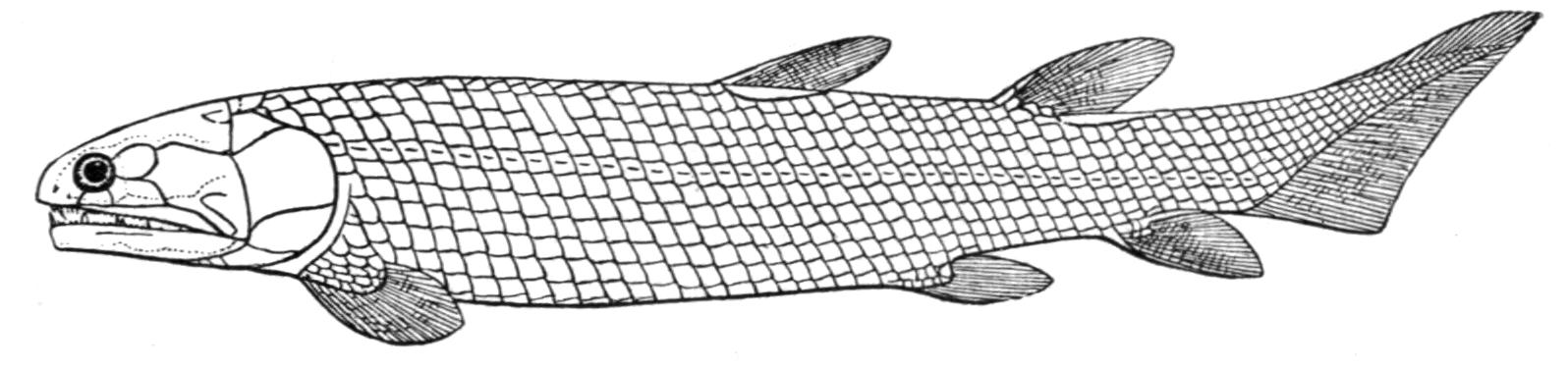
Fig. 273.—Restoration of Osteolepis macrolepidota. Old Red Sandstone. (From Traquair.)
Fam. 1. Osteolepidae.—Scales rhombic and thickly enamelled. Pectoral and pelvic fins obtusely lobate. Tail heterocercal. Teeth simple, not complicated by surface infoldings except quite at the base. Genera:—Osteolepis (Fig. 273), Thursius, Diplopterus (Middle Old Red Sandstone, Scotland), Glyptopomus (Upper Old Red Sandstone, Scotland), Megalichthys (Carboniferous and Lower Permian of Europe and North America).
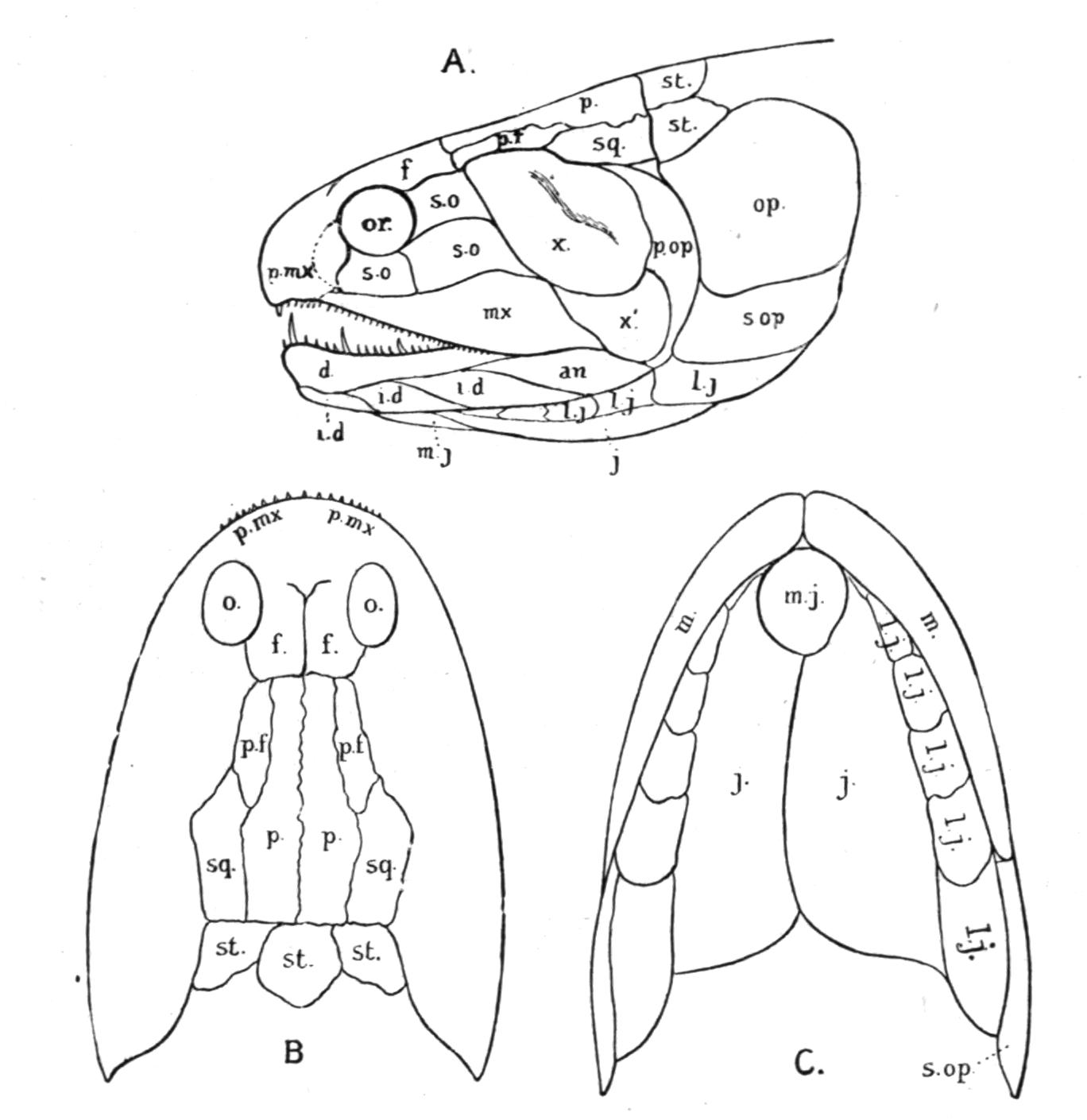
Fig. 274.—Skull of a Rhizodont (Rhizodopsis sauroides), Lower Carboniferous. A, lateral view; B, the dorsal surface; and C, ventral view. an, Angular; d, dentary; f, frontal; i.d, infra-dentary; j, principal jugular plates; l.j, lateral jugulars; m, mandible; m.j, median jugular; mx, maxilla; o, orbit; op, operculum; p, parietal; p.f, post-frontal; p.mx, premaxilla; p.op, preoperculum; so, suborbital; s.op, suboperculum; sq, squamosal; st, supra-temporal; x, x′, cheek plates. (After Traquair.)
Fam. 2. Rhizodontidae.—Scales cycloid and overlapping. Paired fins obtusely lobate. Tail heterocercal, sometimes apparently gephyrocercal. Teeth with the external enamelled layer of dentine infolded towards the axis in the form of radially arranged folds. In some genera ring-like vertebral centra have been recognised and also a preoperculum. Genera:—Rhizodus, Lower Carboniferous of Scotland and Northumberland; Tristichopterus[562] (Fig. 275), Old Red Sandstone of Scotland; Eusthenopteron[563] (Fig. 276), Upper Devonian of Scaumenac Bay, Canada; Gyroptychius, Old Red Sandstone, Scotland; Rhizodopsis[564] (Fig. 274), Carboniferous of England, Scotland, Silesia, and North America; Strepsodus, Carboniferous of Great Britain, Ireland, and North America.
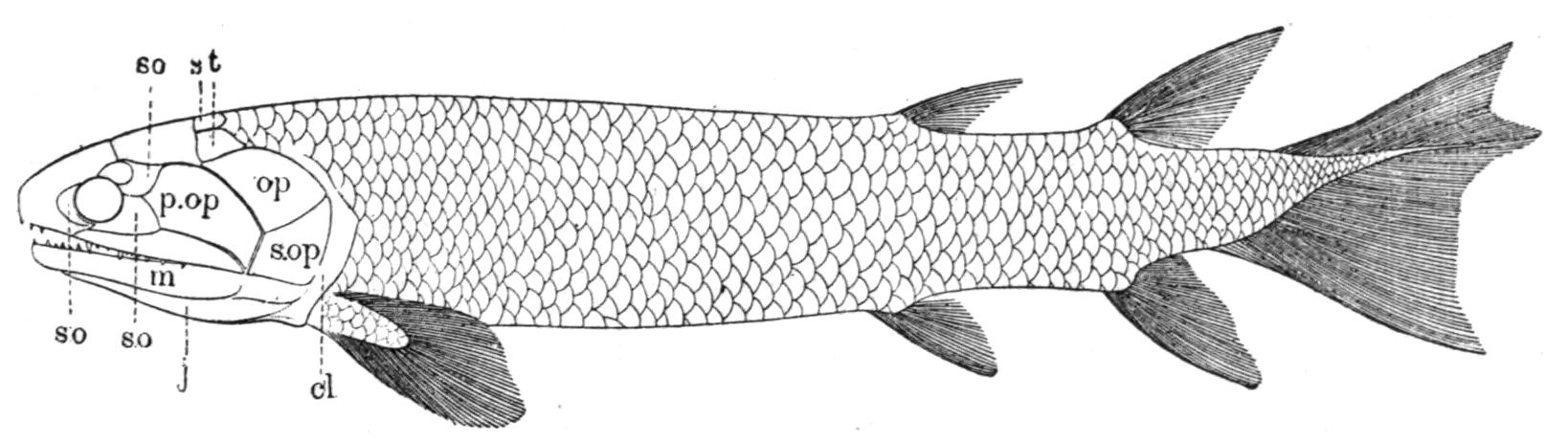
Fig. 275.—Restoration of Tristichopterus alatus. Old Red Sandstone. cl, Clavicle. Remaining reference letters as in Fig. 274. (After Traquair.)
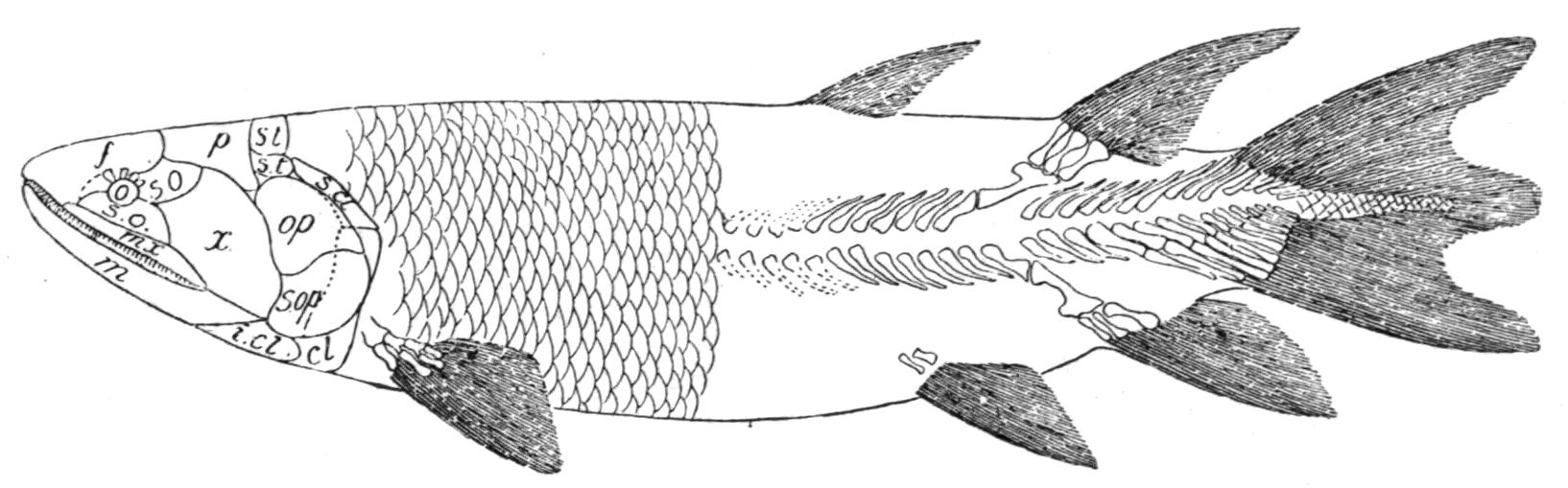
Fig. 276.—Restoration of Eusthenopteron foordi. Upper Devonian of Scaumenac Bay, Canada. The scales have been omitted in the hinder part of the body to show the vertebral column and the radials of the median fins. cl, Clavicle; i.cl, infra-clavicle; s.cl, supra-clavicle; for other reference letters see Fig. 274. × about ¼. (After Whiteaves.)
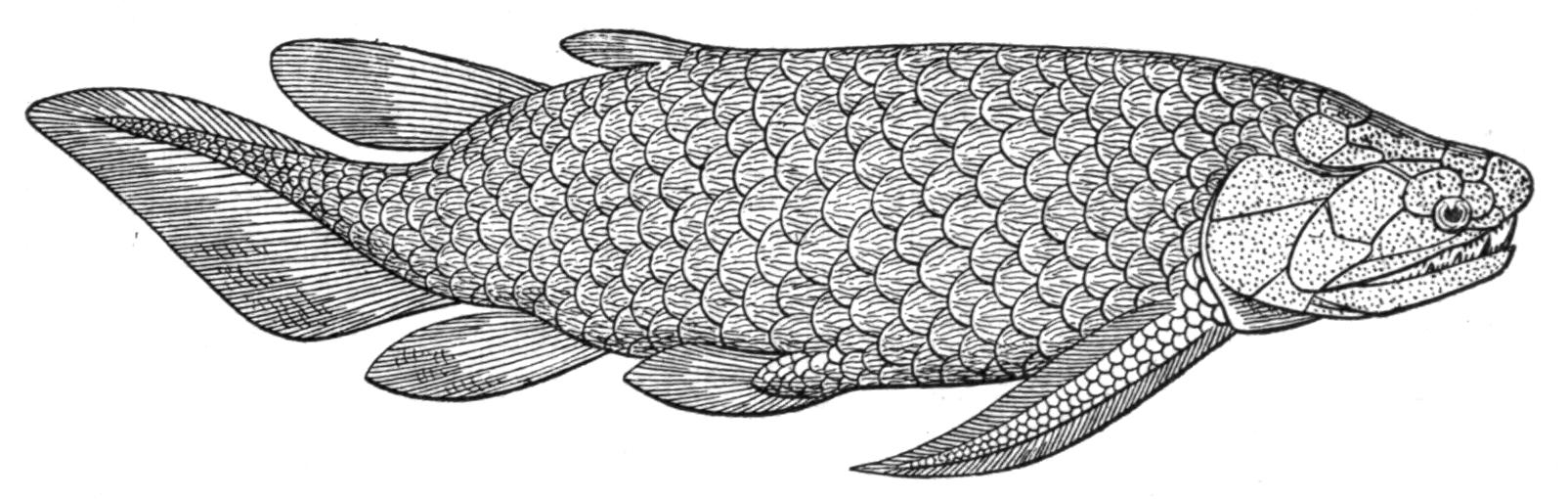
Fig. 277.—Restoration of Holoptychius flemingi. × ⅛. (From Traquair.)
Fam. 3. Holoptychidae (Dendrodontidae).—Scales cycloid. Pectoral fins acutely lobate; pelvic fins short and somewhat obtusely lobate. Tail heterocercal. Teeth similar to those of the Rhizodontidae but more specialised, the enamelled dentine infoldings being much more complicated, presenting a radiating arborescent appearance in transverse sections. Vertebral column acentrous. Genera:—Holoptychius[565] (Fig. 277), Old Red Sandstone of Scotland; Devonian of Belgium, Russia, North America, and East Greenland. Glyptolepis has a similar range.
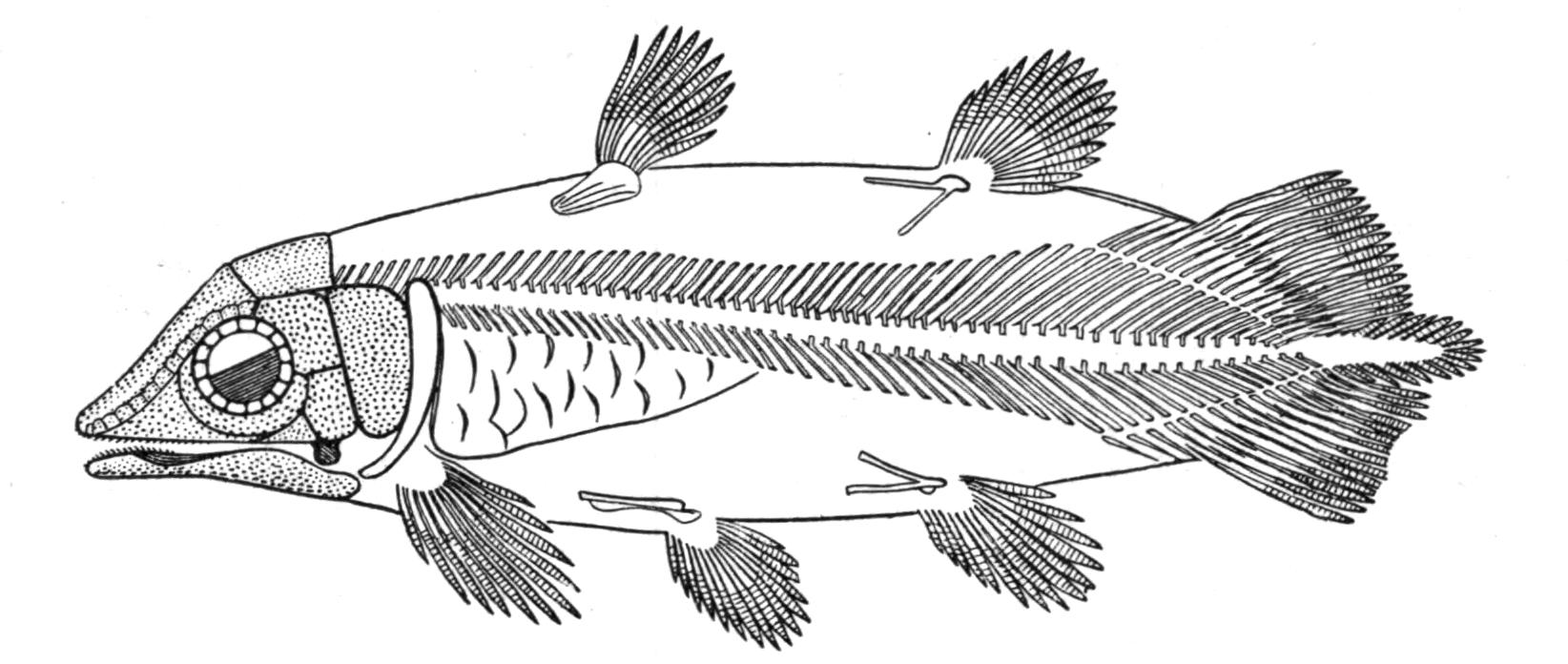
Fig. 278.—Restoration of Undina gulo. Lower Lias of Dorset. Scales and supra-clavicle omitted. The ossified air-bladder is shown beneath the anterior part of the vertebral column. The facial bones in front of the orbit are unknown, and the cheek-plates are supposed to be arranged as in other Coelacanths. × about ⅐. (From Smith Woodward.)
Fam. 4. Coelacanthidae.[566]—Scales cycloid. Paired fins obtusely lobate. Tail symmetrical but apparently gephyrocercal, usually with a protruding axial vestige of the disappearing terminal part of the tail and of the proper caudal fin. Radialia of the functional caudal lobes agree in number with the contiguous neural and haemal arches and dermal fin-rays, the diagnostic feature of Smith Woodward's Actinistia. Proximal radials of the dorsal and anal fins fused into a single, internally-forked basipterygium in each fin. Teeth simple. Vertebral column acentrous. The skull presents several interesting features. The hyomandibular and the palato-quadrate bar, for example, are fused on each side into a continuous triangular bone, articulating with the cranium above and with the lower jaw below. The opercular skeleton is reduced to an operculum and two jugular plates. A very singular feature in these Fishes is the ossification of the walls of the air-bladder (Fig. 278), a structural modification which has no parallel in Fishes, except in certain Teleosts (Siluridae and Cyprinidae)[567] in which the organ becomes encapsuled by bone owing to the partial ossification of its walls.
From their first appearance in the Lower Carboniferous the Coelacanthidae range, practically unchanged, through the intervening formations to the Upper Cretaceous. Coelacanthus itself occurs in the Carboniferous and Permian of England, Scotland, and Germany, and in the Carboniferous of North America. Undina[568] (Fig. 278) is a Jurassic genus. Diplurus is found in the Trias of North America, and Macropoma is a well-known form from the Middle and Upper Cretaceous beds of England, and other parts of Europe.
Sub-Order 2. Cladistia.
Pectoral fins uniserial and abbreviate, with three basal endoskeletal elements. Nostrils on the upper surface of the snout. Entire skeleton well ossified. Notochord replaced by bony, amphicoelous vertebral centra. Bones of the ethmoid region not fused to form a rostral shield. Infra-dentary bones absent. Jugular plates reduced to a single pair of large plates. As this group includes the only Crossopterygii which have survived to the present day, it is noteworthy that they retain certain primitive features indicative of their remote origin. The spiracles are persistent; the intestine has a spiral valve; and the conus arteriosus is furnished with several rows of valves. Amongst other characters of contrary significance, the air-bladder is double; its oesophageal aperture is ventral; and its afferent arteries are pulmonary arteries derived from a posterior aortic arch.
Fam. 5. Polypteridae.[569]—Pectoral fins obtusely lobate. Pelvic fins non-lobate. Scales rhombic and thickly enamelled. Dorsal fin in the form of a series of isolated finlets, each consisting of a stout spine-like[570] fulcral scale supporting a single soft ray, or a fringe of several rays, along its hinder margin. Tail symmetrical, apparently gephyrocercal. Teeth simple. Nostrils tubular.
The only representatives of the sub-order and the sole surviving family of Crossopterygii, the Polypteridae, are restricted to the Nile and to the river basins of tropical Africa which drain into the Atlantic (Fig. 280). Only two genera are known, Polypterus and Calamichthys, neither of which has yet been discovered in any geological deposits, ancient or recent.
In Polypterus each of the spines of the dorsal fin supports several soft rays. Pelvic fins and a suboperculum are present. Ten species are known, of which six pertain to the Congo and its tributaries.[571] P. bichir is said to attain a length of four feet.
Until recently little was known of the habits of Polypterus, but the observations of Budgett[572] on the widely distributed P. senegalus and those of Harrington[573] on P. bichir, have brought to light many interesting facts about these most interesting Fishes.

Fig. 279.—Polypterus senegalus. From a specimen in the Cambridge University Museum. The arrow points to the position of the left spiracle. × ⅓.
P. bichir haunts the deeper holes and depressions of the muddy bed of the Nile, although it is "not essentially a bottom-liver or a mud-fish." It is most active at night when in search of food, and then it may readily be taken by trawl lines. The lobate pectoral fins are used for progression, but their primary function is to act as balancers, and they exhibit the characteristic trembling movements so often seen in the balancing fins of Teleosts. Polypterus does not readily live out of water, rarely longer than three to four hours, and then only when covered with damp grass or weeds. P. bichir is said to feed on small Teleosts, which it swallows whole, and to these there may be added in other species, Batrachians and Crustaceans. The observations of Budgett show that in captivity Polypterus often remains motionless for a long time at the bottom of the water, the anterior part of the body resting upon the tips of the pectoral fins. According to the same observer, the air-bladder is an accessory respiratory organ, supplementary to the gills, rather than a hydrostatic organ.
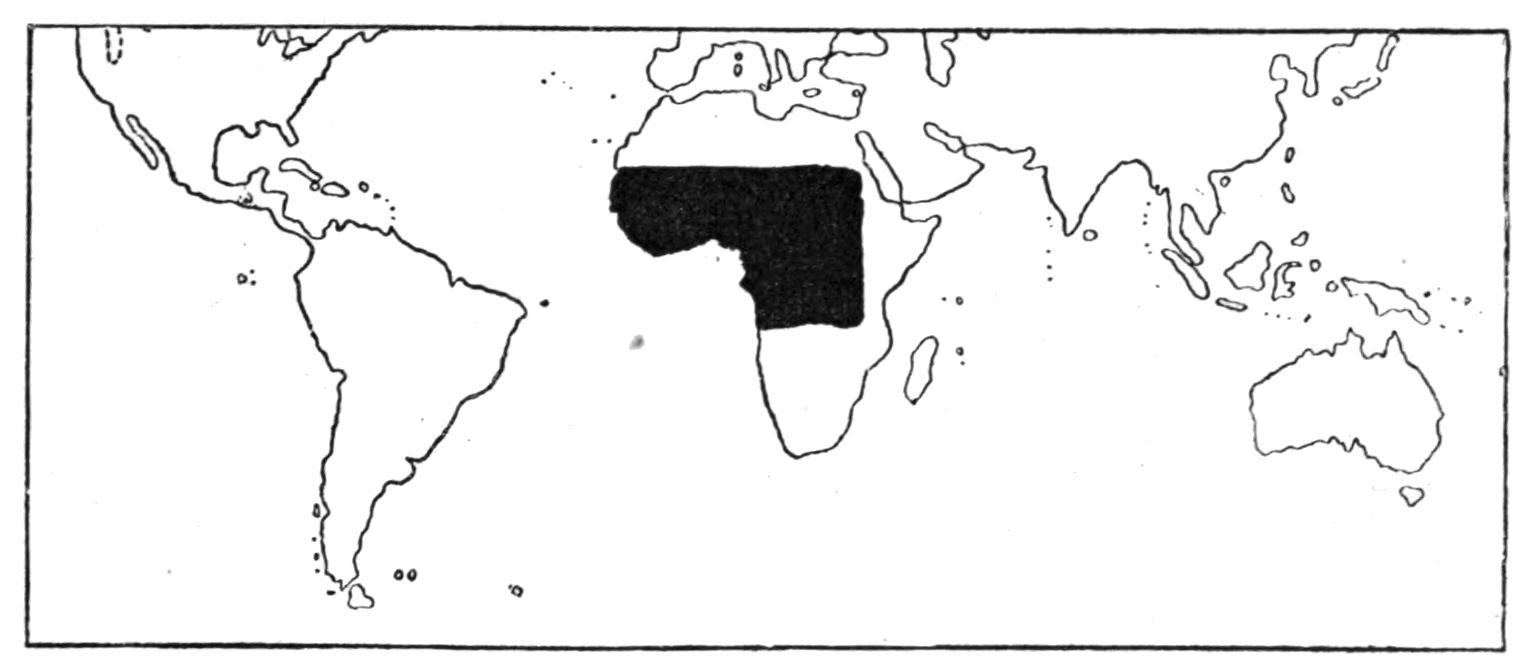
Fig. 280.—Map showing the distribution of the Polypteridae.
In P. bichir the eggs ripen from June to September, inclusive, and, as in most other Nile Fishes, the breeding season is during or just after the period of inundation. P. senegalus and P. lapradei spawn during the rainy season in the months of July, August, and September, but nothing is certainly known as to the place or mode of deposition of the eggs. During the breeding season Polypterus is unusually active and excitable, and at this period the anal fin of the male becomes greatly thickened and enlarged, and has its surface thrown into deep folds between the successive fin-rays.[574] The use of the modified fin is not known. During his stay at McCarthy Island, about 160 miles up the River Gambia, Budgett[575] was fortunate in securing a larva of P. senegalus, 1 to 1¼ inches in length, or only about one-third the length of any larval Polypterus previously known (Fig. 281). The larva is described as a most beautiful object, "marked with black stripes on a golden ground, with a conspicuous golden stripe on each side above the eye, across the spiracle, and along the dorsal surface of the external gill." The pinnate external or cutaneous gills were relatively of much greater size than in the considerably more advanced stage figured elsewhere,[576] and reached half-way to the tail. The dorsal fin is not divided into finlets, and behind it is continuous with the caudal, while the anal fin is scarcely distinct from the lower lobe of the caudal. The fin-rays which support the ventral portion of the caudal fin are more numerous and longer than those in relation with the dorsal lobe, and hence at this stage the tail is really heterocercal.
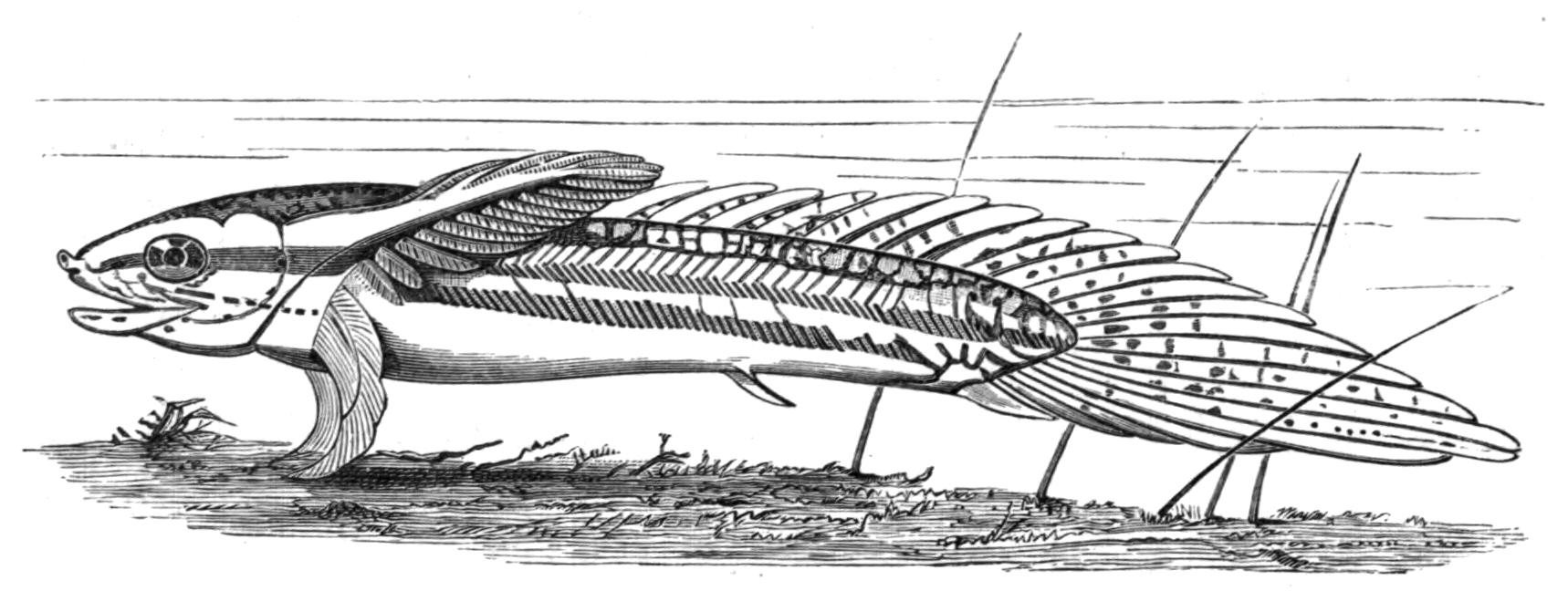
Fig. 281.—Larva of Polypterus senegalus. × 4. Showing its characteristic attitude when resting on the bottom of an aquarium, and the large size of the cutaneous gills. (From Budgett.)
In the genus Calamichthys the body is greatly elongate and Eel-like in shape. Pelvic fins are absent, and normally there is no suboperculum. The dorsal finlets are more isolated than in Polypterus, and each spine supports but a single soft ray. Only a single species is known, C. calabaricus[577] (Fig. 282).
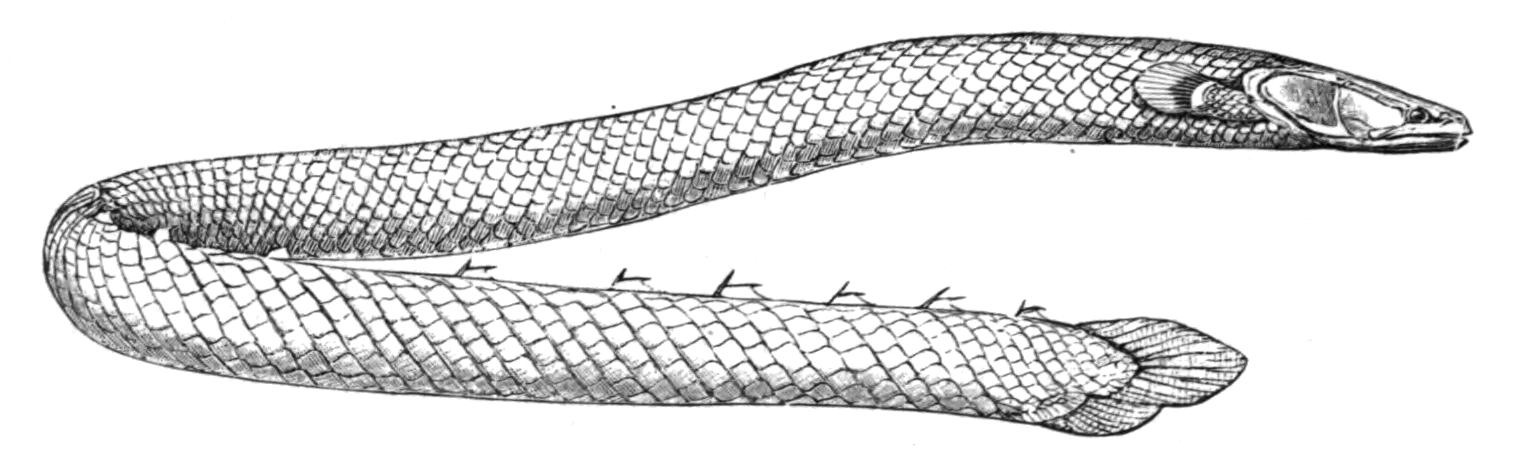
Fig. 282.—Calamichthys calabaricus. × ⅔. (From a specimen in the Cambridge University Museum.)
Calamichthys has a more restricted distribution than Polypterus, and is confined to certain rivers of West Africa. First obtained at Creek Town on the Old Calabar river, it is now known to occur in the delta of the Niger, on the coast of Cameroon, and as far south as the river Chiloango, frequenting the smaller muddy rivers opening into the estuaries.[578] It is a very agile Fish, swimming like a snake, and subsisting on insects and crustaceans. The anal fin is enlarged in the male, and the young are provided with cutaneous gills. Calamichthys may attain a length of nearly 40 cm.
* * * * *
In the remaining Teleostomi (Actinopterygii) the paired fins are invariably non-lobate, with abbreviate, multibasal endoskeletal supports. Fin-rays are the main support of both the median and paired fins. Jugular plates are usually replaced by branchiostegal rays, but both may co-exist. The Actinopterygii are the successors of the Crossopterygii in palaeontological sequence, and when the latter began to decline in Carboniferous and Permian times, the former, mainly represented by the earlier Chondrostei, had already become the dominant Fishes of the period.
Order II. Chondrostei (Acipenseroidei).
In these Fishes, the oldest and the most primitive of the Actinopterygii, the fin-rays of the median fins still continue to retain their primitive numerical superiority over the radials, and the tail is heterocercal. There is a single dorsal and an anal fin, which, like the upper lobe of the caudal fin, are generally provided with fulcra. Pelvic fins abdominal. Squamation typically rhombic and ganoid. Vertebral column acentrous. So far as is known the chondrocranium is but little ossified, and the cranial bones are mainly dermal. The secondary pectoral girdle still includes a pair of infra-clavicles.
The Chondrostei are first represented in the Lower Devonian by the solitary Palaeoniscid genus Cheirolepis, a contemporary of the earliest Crossopterygii. They occur throughout the Mesozoic period, except in the Cretaceous, and also in the Eocene, and while steadily diminishing in number and variety they gradually approximate to their degenerate and in some respects highly specialised descendants, the Sturgeons and Paddle-Fishes of the existing Fish fauna. Of the seven families included in the group the Palaeoniscidae are the oldest and the most generalised. The Platysomidae are a specialised offshoot from the Palaeoniscidae, and, if they are rightly to be considered as Chondrostei, perhaps the same may be said of the problematic Belonorhynchidae. On the other hand, there are certain features in the Catopteridae which indicate an approach to Fishes of an altogether more modern type. Finally, the Chondrosteidae represent a stage in a career of degeneration, the climax of which is reached by the modern Polyodontidae and Acipenseridae.
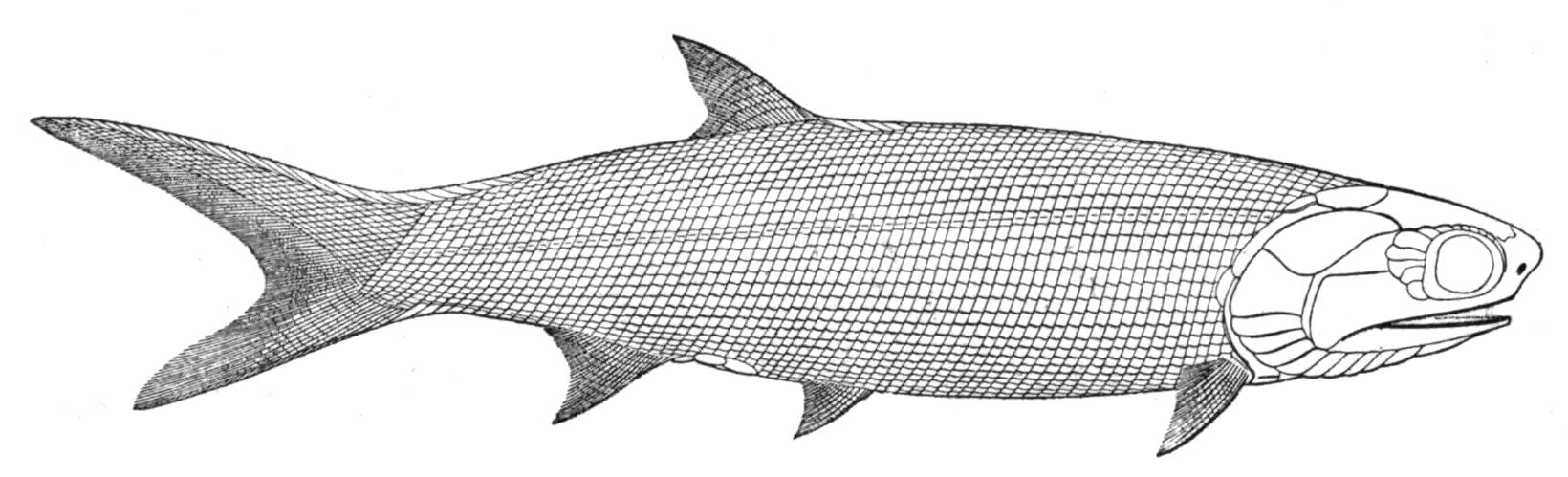
Fig. 283.—Palaeoniscus macropomus. Restoration, nearly one-half nat. size. (From Traquair.)
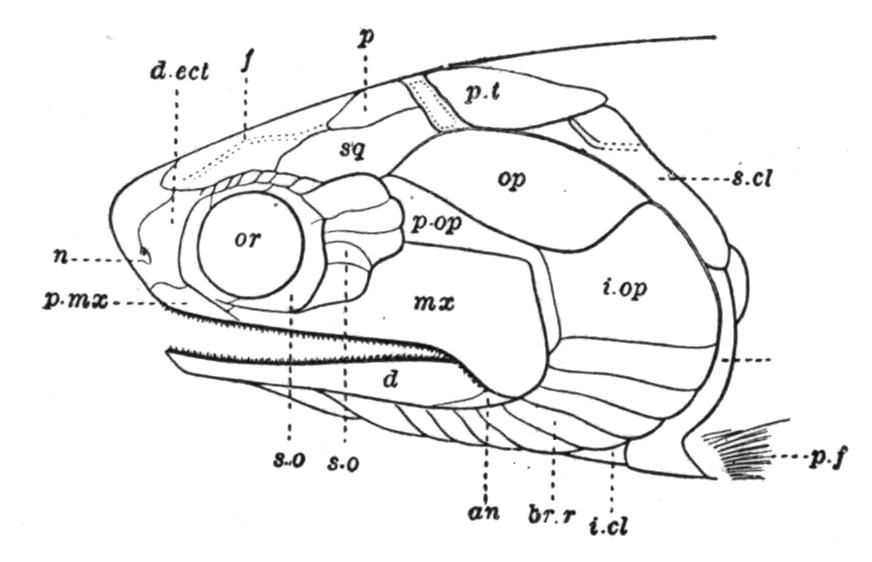
Fig. 284.—Outline restoration of the skull and secondary pectoral girdle of Palaeoniscus macropomus. an, Angular; br.r, branchio-stegal rays; cl, clavicle (cleithrum); d, dentary; d.ect, dermal lateral ethmoid; f, frontal; i.cl, infra-clavicle; i.op, suboperculum; mx, maxilla; n, nostril; op, operculum; or, orbit; p, parietal; p.f, pectoral fin; p.mx, premaxilla; p.op, preoperculum; p.t, post-temporal; s.cl, supra-clavicle; s.o, circumorbitals; sq, squamosal; the single median bone overlying the short rostrum is probably a dermal mesethmoid, and the one intercalated between the squamosal and post-temporal a supra-temporal. The dotted lines indicate sensory canals. (From Traquair.)
Fam. 1. Palaeoniscidae.[579]—Fishes with fusiform bodies, short dorsal and anal fins, and usually with a complete investment of articulating rhombic, rarely cycloid, ganoid scales (Fig. 283). Fulcra generally present at the bases of the median fins, and especially along the dorsal border of the upper caudal lobe. Ribs are not known to be present. Skull invested by a very complete series of paired dermal bones, which in number and disposition conform to the normal Teleostome type (Fig. 284). The secondary upper jaw includes both premaxillae and large maxillae; and, as a rule, both the dentary and splenial bones of the lower jaw are dentigerous. Except for the absence of an interoperculum, the opercular series of bones is complete, including numerous branchiostegal rays. There is a single small median jugular plate.
The Palaeoniscidae are remarkable both for their individual and specific abundance and for their extensive range in time. Represented only by Cheirolepis in the Middle Old Red Sandstone and Devonian, the family attained its maximum development in the later Palaeozoic rocks (Carboniferous and Lower Permian), became rare in the Mesozoic, finally dwindling away at the close of the Jurassic period. Their geographical distribution in the past is hardly less remarkable. In various geological formations they have been found in Great Britain and Ireland, in widely remote parts of continental Europe, and in North America, South Africa, and Australia. Cheirolepis, Amblypterus, Canobius, Phanerosteon, Elonichthys, Cryphiolepis, Palaeoniscus, and Trissolepis are Palaeozoic genera. Gyrolepis, Urolepis, Coccolepis, Oxygnathus, and Centrolepis are characteristic Mesozoic forms.
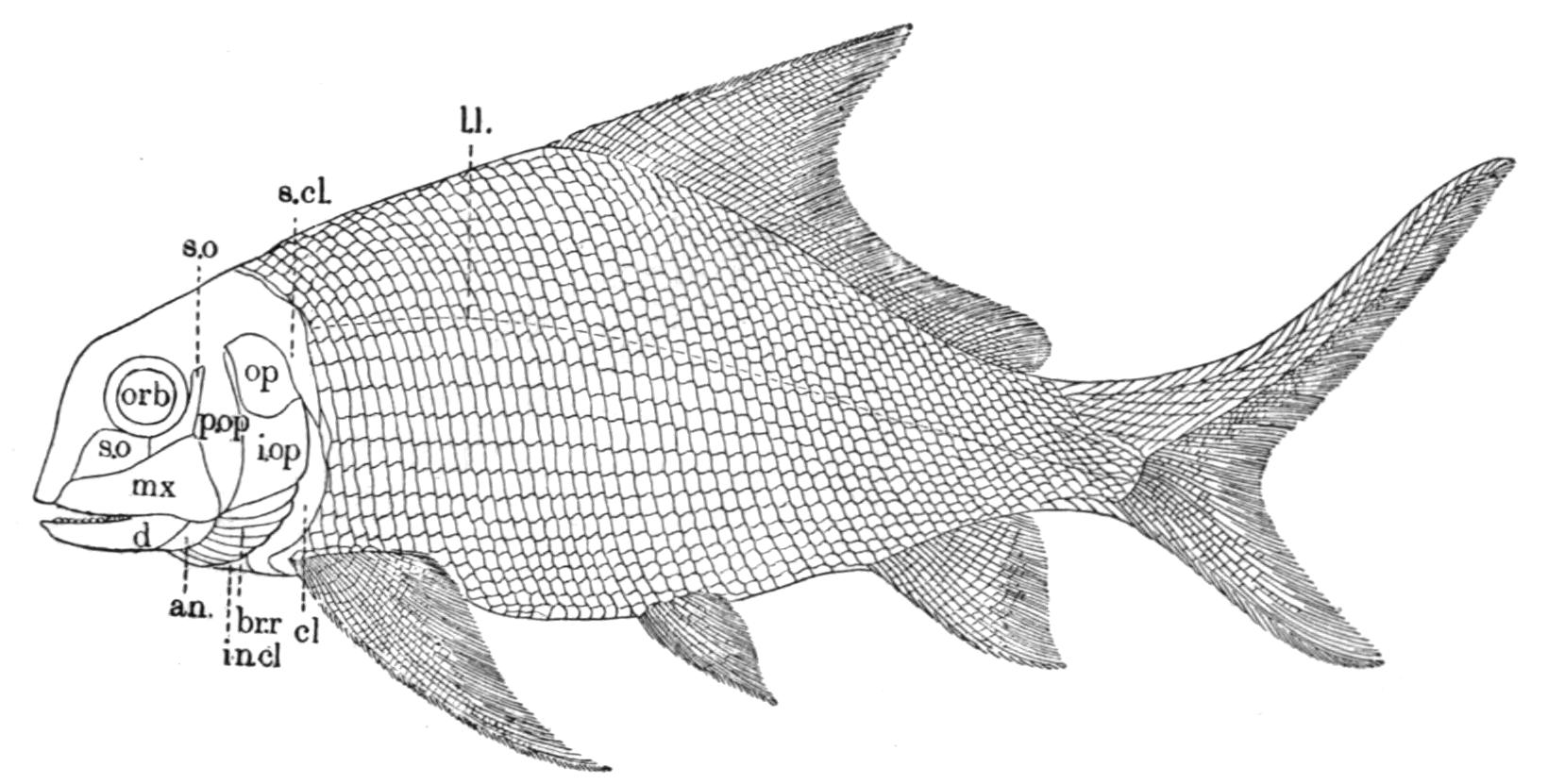
Fig. 285.—Restoration of Eurynotus crenatus. in.cl, Infra-clavicle; l.l, lateral line; orb, orbit; other reference letters as in Fig. 284. (From Traquair.)
Fam. 2. Platysomidae.[580]—More or less deep-bodied Fishes, with elongated dorsal and anal fins, a high head, short jaws, usually armed with bluntly conical tritoral teeth, and a complete investment of high, narrow, rhombic scales. They agree with the Palaeoniscidae in their osteology and in most other essential features, and they flourished in large numbers during the Carboniferous and Permian periods. Platysomus ranges from the Lower Carboniferous to the Upper Permian in Great Britain and continental Europe, and also occurs in the Carboniferous of North America. Eurynotus (Fig. 285), and the singularly deep-bodied Cheirodus (Fig. 286), in which pelvic fins are unknown, are British Carboniferous genera.
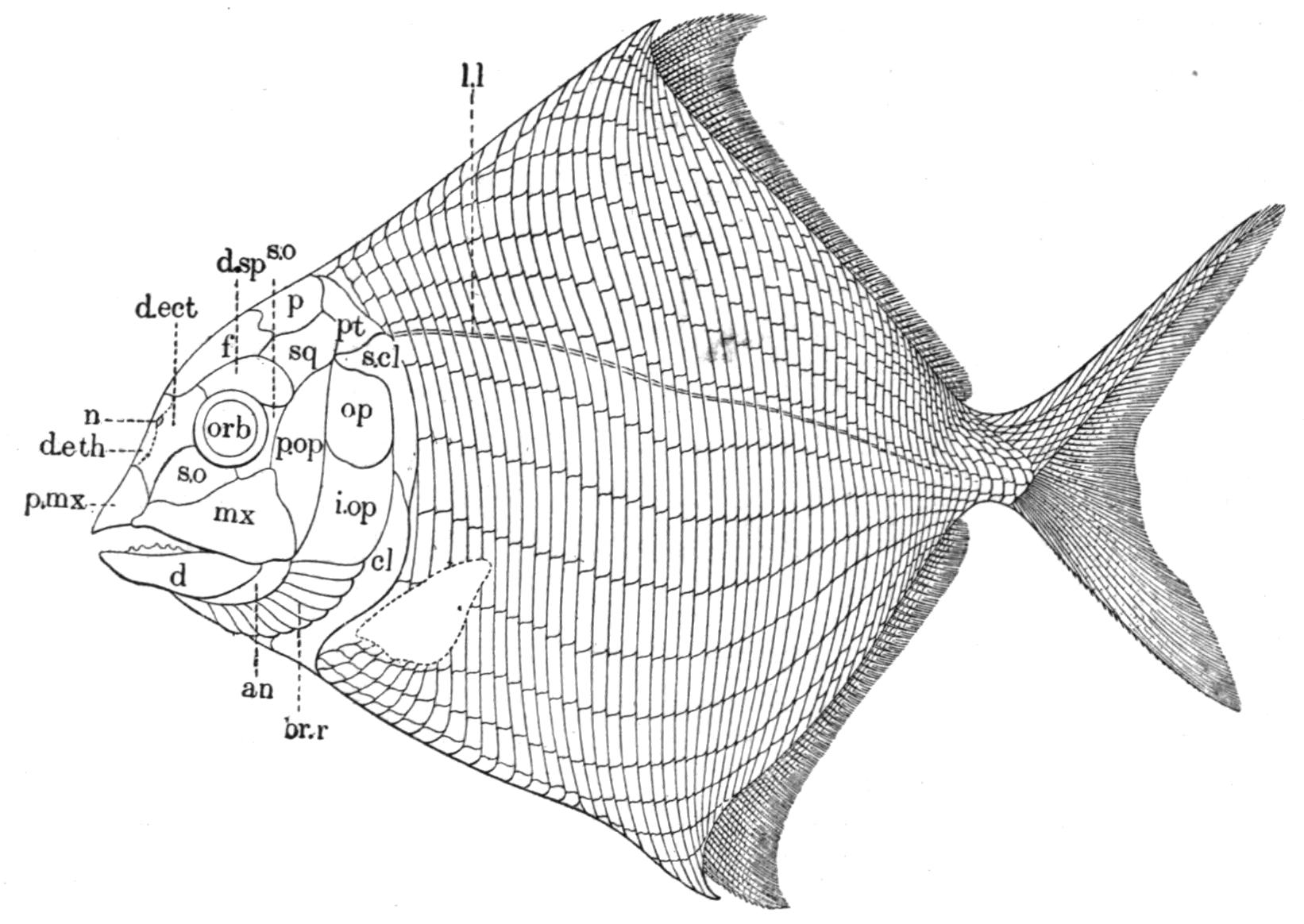
Fig. 286.—Restoration of Cheirodus granulosus. d.ect, Dermal lateral ethmoid; d.eth, dermal mesethmoid; d.sp, either a dermal sphenotic or a post-orbital bone; l.l, lateral line; orb, orbit. The pectoral fin is indicated in dotted outline. Other reference letters as in Fig. 284. (From Traquair.)
Fam. 3. Belonorhynchidae.—The systematic position of these Triassic forms is very doubtful, and it is by no means clear that they are Chondrostei at all.
Fam. 4. Catopteridae.—It is very probable that this widely-distributed Triassic family is an offshoot from the Palaeoniscidae. It agrees with the latter in the general character of the head and pectoral girdle and in the rhombic squamation, but differs from its progenitors and approaches the more modern Holostei in the semi-heterocercal condition of the tail, and in the approximate numerical agreement between the fin-rays and radialia of the dorsal and anal fins.[581]
Fam. 5. Chondrosteidae.—This family affords an interesting annectant link between the Palaeoniscidae and their degenerate living representatives the Polyodontidae and Acipenseridae. They agree with the latter in the general shape of the body, the growth of a preoral rostrum, and in the relatively small size of their ventrally-placed and probably protrusible mouth (Fig. 287). The skin is entirely scaleless, except on the upper lobe of the caudal fin, where, as in Polyodon and Acipenser, the primitive rhombic squamation and a series of fulcra are retained.
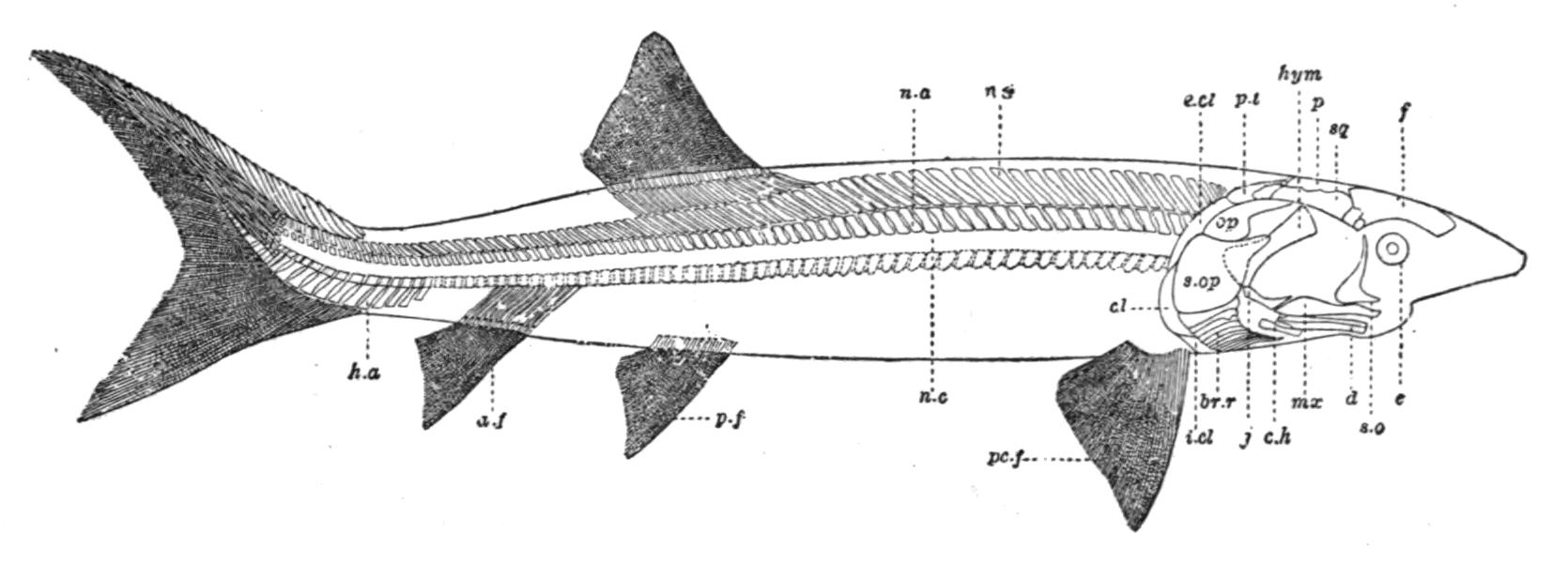
Fig. 287.—Restoration of the skeleton of Chondrosteus acipenseroides. a.f, Anal fin; c.h, cerato-hyal; e, eye; h.a, haemal arches; hym, hyomandibular; j, jugal; n.a, neural arches; n.c, notochord; n.s, neural spines; pc.f, pectoral fin; p.f, pelvic fin; s.o, suborbital; s.op, suboperculum; other reference letters as in Fig. 284. (After Smith Woodward.)
On the other hand, their relationship to the Palaeoniscidae is indicated by the general disposition of the dermal bones of the cranial roof, and the presence of a transverse row of supra-temporals and of an extensive series of branchiostegal rays (Fig. 288). The family is represented by Chondrosteus[582] from the Lower Lias of Dorset and Leicestershire, and Gyrosteus from the Upper Lias of Yorkshire. From an evolutionary point of view it is significant that the Chondrosteidae do not make their appearance until the Palaeoniscidae are approaching extinction.
The two remaining families, the Polyodontidae and the Acipenseridae, agree in presenting a remarkable leaven of characters otherwise distinctive of the typical Elasmobranch, associated with certain primitive features which they have doubtless inherited from some remote ancestral stock common both to existing Elasmobranchs and to the other primary groups of Fishes, and also with others obviously due to degeneration.
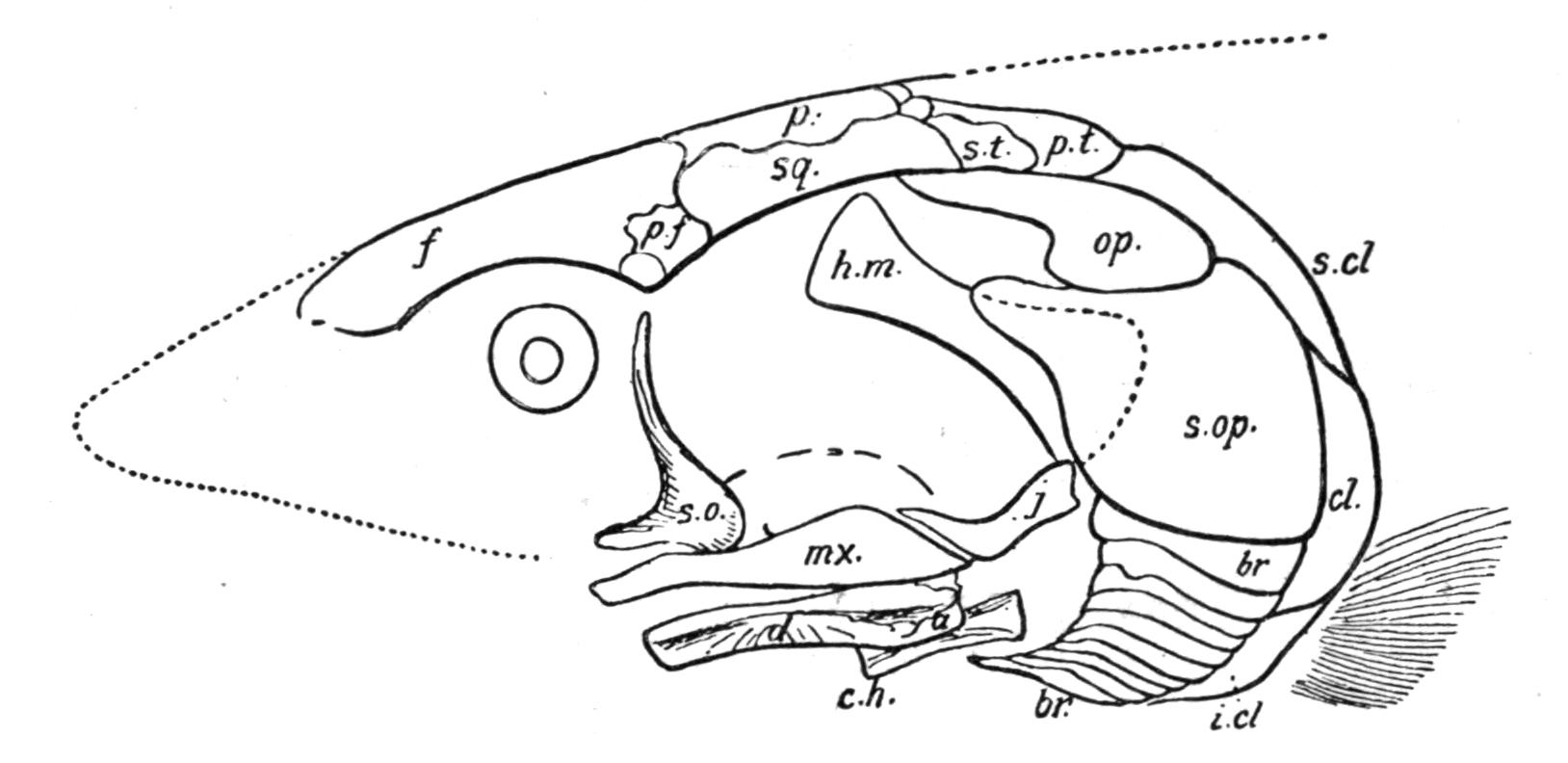
Fig. 288.—Lateral view of a restored skull and pectoral girdle of Chondrosteus acipenseroides. a, Angular; br, branchiostegal rays; c.h, cerato-hyal; h.m, hyomandibular; j, jugal; p.f, post-frontal; s.op, suboperculum; s.t, supra-temporal; other reference letters as in Fig. 284. (After Traquair.)
The most interesting illustration of the first point is to be found in the condition of the primitive upper jaw which, especially in the Polyodontidae, is typically Elasmobranch in the median union of the palato-quadrate bars beneath the basis cranii, but Teleostome in the presence of a secondary upper jaw formed by two maxillae. Both families also agree in possessing an acentrous vertebral column which, if it does so far resemble that of Teleostomes in being potentially arco-centrous, nevertheless has a better developed series of distinct inter-dorsal and inter-ventral cartilages, regularly alternating with only partially bony basi-dorsals and basi-ventrals, than is to be met with in any other adult Fishes except Elasmobranchs. Primitive features are apparent in the presence of spiracles, sometimes associated with pseudobranchs; the presence in one family (Acipenseridae) of a hyoidean hemibranch supplied with blood directly from the ventral aorta, and the existence of a multi-valvular conus arteriosus and an intestinal spiral valve. Finally, the massive growth of the chondrocranium wholly devoid of cartilage bones, except in so far as they may be represented by splint-like membrane bones, the fragmentation of the investing dermal bones, the degeneration of the opercular skeleton and the loss of branchiostegal rays, and the almost complete disappearance of the primitive rhombic squamation, are probably to be regarded as the outcome of a long-continued career of degeneration from some remote Palaeoniscid ancestor.
Fam. 6. Polyodontidae.—The Polyodontidae are more generalised, and in some features decidedly more Selachioid than the Acipenseridae. Body fusiform and apparently scaleless, but the primitive squamation is still represented by isolated vestigial scales imbedded in the otherwise soft skin, and by a continuous series of rhombic scales on the upper caudal lobe, which also has a dorsal fringe of large fulcra.[583] Rostrum exceptionally long, spatulate or somewhat conical, with a rigid axis and thinner and more flexible margins. Barbels absent. Mouth wide, not spout-like. Pectoral fins devoid of spines. Two pairs of membrane-closed vacuities separate the paired dermal bones of the cranial roof (possibly parietals and frontals) from the more laterally-placed post-temporals and squamosals, and there are no median plates posterior to the orbits, nor any representatives of supra-temporals. A feeble suboperculum is retained in addition to a small rayed operculum. Hyoidean hemibranch completely suppressed. Two genera only are known, each with a single species.
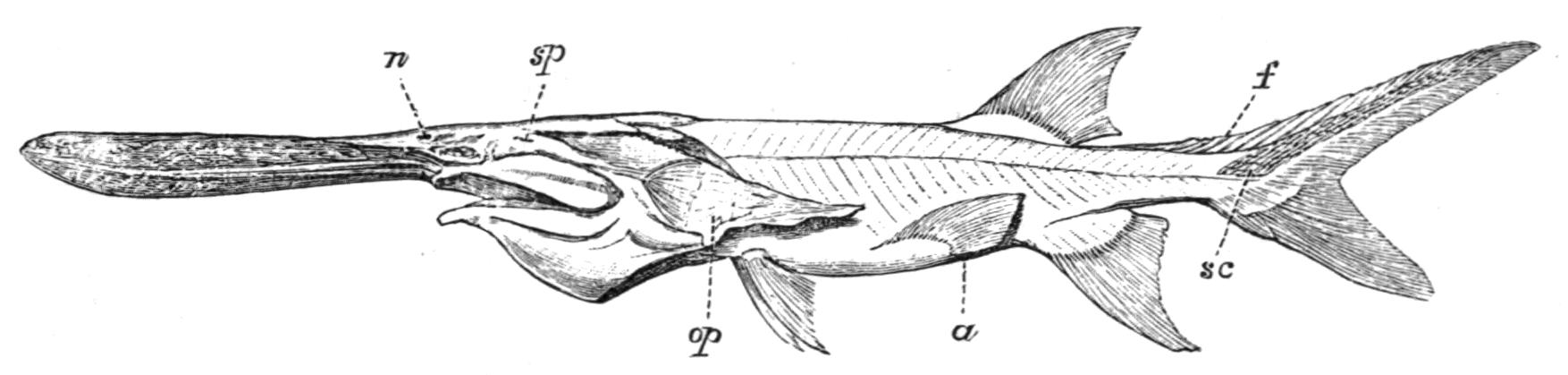
Fig. 289.—Polyodon folium. a, Anus; f, fulcra; n, nostrils; op, operculum; sc, rhombic scales on the upper caudal lobe; sp, left spiracle.
The Paddle-Fish or Spoon-Bill, Polyodon folium (Fig. 289) inhabits the rivers of the Southern States of North America, the Mississippi, Ohio, and Missouri, and their numerous tributary rivers and streams. A Fish of sluggish habits, Polyodon feeds chiefly on mud and the minute organisms it contains, the exceptionally long gill-rakers probably forming an efficient filter to prevent the food particles escaping through the gill-clefts with the expiratory water current. The singular rostrum is apparently used for stirring up the mud when feeding, but in view of the muddy waters the Fish frequents, and the very small size of the eyes, its value as a tactile organ must not be overlooked. Polyodon may attain a length of 5 to 6 feet. The time of spawning varies, according to locality, from March to June. Nothing is known of the development of Polyodon. Young less than 6 to 8 inches in length are unknown, and specimens of this size are very rarely seen. The jaws are furnished with minute teeth until the Fish is about half-grown, when they become edentalous. Caviare is made from the eggs, and the centres at which this industry is carried on are chiefly situated along the course of the Mississippi. The second species, Psephurus gladius, inhabits the Yang-tse-Kiang and Hoangho rivers of China, and differs from Polyodon in the conical shape of its rostrum and the smaller number and larger size of its fulcra. Psephurus is stated to reach a length of 20 feet. The family is represented in the Eocene of Wyoming by the genus Crossopholis, which is note-worthy for the retention of trunk scales in the form of small, somewhat quadrate denticulated discs, arranged in oblique rows.
Fam. 7. Acipenseridae.—In the Sturgeon family the body is elongate, cylindrical, and somewhat bulky. Rostrum well developed and often massive, with a transverse row of simple or branched preoral barbels on its ventral surface. Mouth small and remarkably protrusible. Jaws devoid of teeth except in the larvae. As in the preceding family, the primitive rhombic squamation is confined to the upper lobe of the tail, which, like the dorsal and anal fins, is furnished with fulcra. Elsewhere the scales are represented by five longitudinal rows of large bony scutes and by intervening small scattered ossifications. The anterior dermal ray of the pectoral fin is stout and spine-like. The dermal bones of the cranial roof suturally articulate with one another to form a continuous shield, uninterrupted by lateral vacuities. A median dermal bone in the occipital region transmits the occipital sensory canal. The opercular series is represented only by an opercular bone.
The family includes but two genera, Acipenser (Fig. 290) and Scaphirhynchus, and about twenty species, confined to the seas, estuaries, and rivers of the temperate and north temperate regions of the northern hemisphere. Acipenser includes the more typical Sturgeons, and is distinguished by the presence of spiracles, and by the fact that the longitudinal rows of scutes remain distinct to the base of the caudal fin.
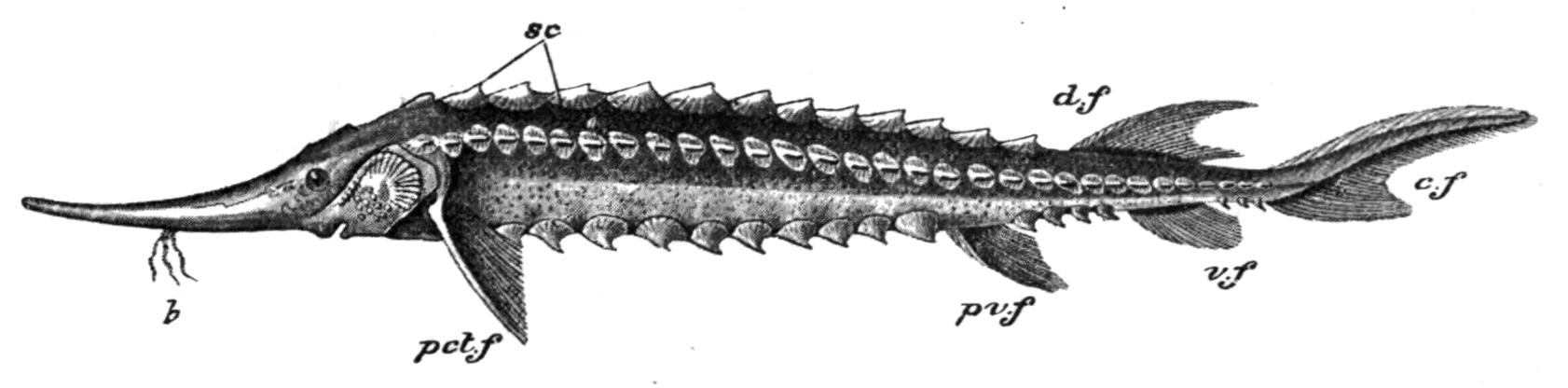
Fig. 290.—The Sterlet (Acipenser ruthenus). o, Barbels; c.f, caudal fin; d.f, dorsal fin; pct.f, pectoral fin; pv.f, pelvic fin; sc, scutes; v.f, ventral or anal fin. (From Parker and Haswell, after Cuvier.)
There are probably about fifteen species, but the exact number is uncertain. Sturgeons are abundant in the Black Sea, the Sea of Azov, the Caspian, and their tributary rivers, notably the Danube, Don, Dnieper, Ural, and Volga. They are also present in the rivers and on the coasts of Northern Europe and of China. Five species occur in North America, on the Atlantic and Pacific coasts, and in the rivers of these regions as well as in the Great Lakes.[584] One or two species are almost exclusively fresh-water, but most Sturgeons are migratory Fishes, living in the sea, but ascending rivers for spawning. Their food consists of worms, molluscs, the smaller Fishes and aquatic plants; and in feeding the mouth is protruded downwards in the form of a cylindrical, spout-like structure and thrust into the mud. The only species certainly known to frequent the British coasts is the common Sturgeon (A. sturio), which is also found in the Black Sea and the Mediterranean, and is abundant on the Atlantic coast of North America from Maine to South Carolina. The species occurs all round our coasts, more plentifully, perhaps, on the northern and eastern shores. In the spring and summer the Fish ascends the rivers, often to a considerable distance. Its presence has been recorded in the Severn, near Shrewsbury; in the Trent at Nottingham, and also, but not in recent years, in the Thames above London Bridge.[585] In this country the species is a "Royal Fish," and by an unrepealed Act of Edward II. it is enacted that "the King shall have the wreck of the sea throughout the realm, Whales and Great Sturgeons, except in certain places privileged by the King."[586] If not so large as some of its Russian relatives, A. sturio often attains a great size. Even on our own coasts the capture of individuals 8 to 10 feet in length has been recorded. The great Russian Sturgeon (A. huso), which is common in the Black Sea, the Sea of Azov and the Caspian, and in the rivers flowing into them, is the largest of all the Sturgeons, individuals weighing 2760 and 3200 pounds having been captured. The Sterlet (A. ruthenus), similarly distributed and often ascending the Danube to Vienna, is much smaller, rarely exceeding a length of three feet.
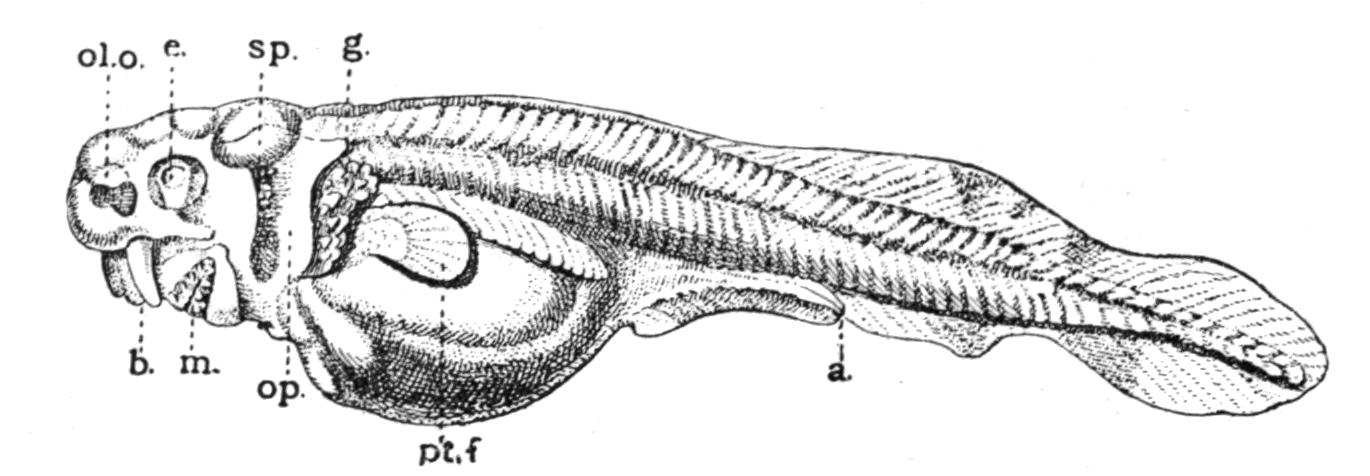
Fig. 291.—Larval Acipenser ruthenus. a, Anus; b, barbels; e, eye; g, gills; m, mouth, with teeth; ol.o, olfactory organ; op, operculum; pt.f, pectoral fin; sp, spiracle. × 10. (From Kitchen Parker.)
In Europe A. sturio spawns about July, but in North America (Delaware river) during May. Small in size, the eggs are produced in enormous numbers, a single female, it is said, producing about 3,000,000 in one season. They are invested by a gelatinous sheath, so that they readily stick to one another or to other objects, and, when deposited, they adhere in streaks or sheet-like masses to the bed of the river. The young are hatched very early, about the third or fourth day in A. sturio, and in the Sterlet between the ninth and twelfth, the length of the larva then varying from 7 to 10 mm. When they are a few days old the larvae closely resemble those of existing Holostei except that the small opercular folds leave the gills freely exposed (Fig. 291). A shallow pigmented groove in front of the mouth apparently represents the sucker of the young Amia and Lepidosteus. Although toothless in the adult, both the Sturgeon and Sterlet possess vestigial rudimentary, uncalcified, larval teeth, which in shape resemble the teeth of a Dog-Fish, consisting of a broad base and a sharp spine.
The Sturgeon is a Fish of considerable economic importance. The flesh is an article of food, and from the ovaries of certain Russian and American species thousands of hundredweights of caviare are prepared annually. Large quantities of isinglass are obtained from the air-bladders, in the United States and in Russia. The organ is split open and washed; the inner lining is then stripped off and the bladder dried as rough isinglass.
The second genus, Scaphirhynchus, which includes the Shovel-nosed Sturgeons, differs from Acipenser in the long, flattened, and almost spatulate shape of the rostrum, the suppression of the spiracles, and the union of the longitudinal rows of scutes beneath the dorsal fin to form a scaly armature completely investing the tail. The distribution of the genus affords an interesting parallel to that of the Polyodontidae. Of the four species, one (S. platyrhynchus) is common in the Mississippi valley and in the rivers of the Western and Southern States of North America, while the remaining species, also exclusively fresh-water, frequent the rivers of Tartary.
The Acipenseridæ are not known to occur earlier than the Tertiary. Scutes, pectoral spines and fragmentary bones, indistinguishable from the corresponding parts of existing species, have been recorded from the London Clay of the Isle of Sheppey (Lower Eocene), and from later Eocene deposits in the Isle of Wight and Hampshire; and also from the Pliocene of England (Red Crag of Suffolk) and Virginia.
Order III. Holostei (Lepidosteoidei).
The Holostei include a large and somewhat heterogeneous assemblage of Fishes, most of which are now extinct. As a group they are by no means easy to define or delimit. Widely separated from the Chondrostei, there is little evidence of the existence of connecting links between the two groups, although in some respects the Catopteridae may be regarded as transitional. On the other side, however, the Holostei shade off almost imperceptibly into the Malacopterygian Teleostei. In different fossil and recent Holostei there may be traced the gradual acquisition of the more special Teleostean characters and the elimination of the more archaic features of their remote Teleostome ancestors; and in a general sense this may be taken as the key to the more salient attributes of the group. It is not suggested that all the families of Holostei are on the direct lines of Teleostean descent. Some families, like the Eugnathidae and Amiidae, may possibly occupy this position, but others, such as the Pycnodonts, for example, seem to be highly specialised and terminal offshoots which have left no descendants. Of the more generalised features which different Holostei retain, mention may be made of the prevalence of rhombic scales which, like the dermal cranial bones, are generally invested by a variously ornamented coat of ganoin; the presence of fulcra, cheek-plates, post- or sub-orbital ossicles, and of a complex lower jaw, which includes dentigerous splenials; and the abdominal position of the pelvic fins. On the other hand, indication of advancing specialisation in the Teleostean direction are to be noted in the numerical agreement between the dermal fin-rays of the median fins and their supporting radialia, and in the character of the vertebral column. Some Holostei, especially the earlier forms, are acentrous, but between this primitive condition and the possession of well-ossified centra, associated with equally bony arcualia, almost every gradation is to be found. The chondrocranium is more or less completely replaced by cartilage bones corresponding to those generally present in Teleosts, while the palato-pterygoid cartilages, likewise modified by the growth of cartilage bones, separately articulate with the lateral ethmoid regions instead of meeting in a ventral symphysis beneath the basis cranii. With rare exceptions (e.g. certain Pycnodonts) the opercular skeleton is complete, and includes branchiostegal rays; and although a single gular plate is often present, it may be absent in entire families. Like so many other structures, the tail is in a transitional state: really heterocercal, but incipiently homocercal, it may be described as semi-heterocercal. Infra-clavicular plates no longer form part of the secondary pectoral girdle, their place being taken by cleithra which, as in most Teleosts, meet in a ventral symphysis.
Indications of transition are not wanting in the squamation in certain families, and may be seen in the partial or complete replacement of the rhombic type by thin, imbricated, cycloid scales. Lastly, the soft parts of the two surviving genera are not without features of similar significance. A multivalvular conus arteriosus, it is true, is still retained, but the spiral valve is vestigial, the spiracles are closed, and in the female of one genus (Lepidosteus) the gonoducts are peritoneal tubes, continuous, as in most Teleosts, with the investments of the ovaries.
The Fishes here included in the Holostei constitute the Protospondyli and Aetheospondyli of Smith Woodward.[587] In the former group vertebral centra are either entirely absent, or, if present, their components in the form of alternating hypo- and pleuro-centra invariably remain distinct in the tail. The latter group has been instituted for the provisional reception of two highly specialised families of uncertain relationships, which differ from the Protospondyli in their higher grade of vertebral structure, the centra always being complete without any indication of distinct hypo- and pleuro-centra.
The Holostei first appear in the Permian, where they are represented by a single genus (Acentrophorus). During the Mesozoic period they were abundant in the Trias, reaching their maximum development and becoming the dominant Fishes of the period in the Jurassic. In the Cretaceous they began to decline, and in the Tertiaries became reduced to the two families which at the present day are the sole survivors of the group.
Of the six families of Protospondyli the Semionotidae are the oldest and most generalised, and the Macrosemiidae a closely allied group. The Pycnodontidae are a highly specialised and terminal offshoot. The Eugnathidae obviously lead to the Amiidae, and from the same stock it is probable that the Pachycormidae have been derived. The relations of the Aspidorhynchidae and Lepidosteidae (Aetheospondyli) are extremely doubtful. That the two families are allied seems probable, but beyond the possibility of a remote connection with the Protospondyli there is no clue to their ancestry.
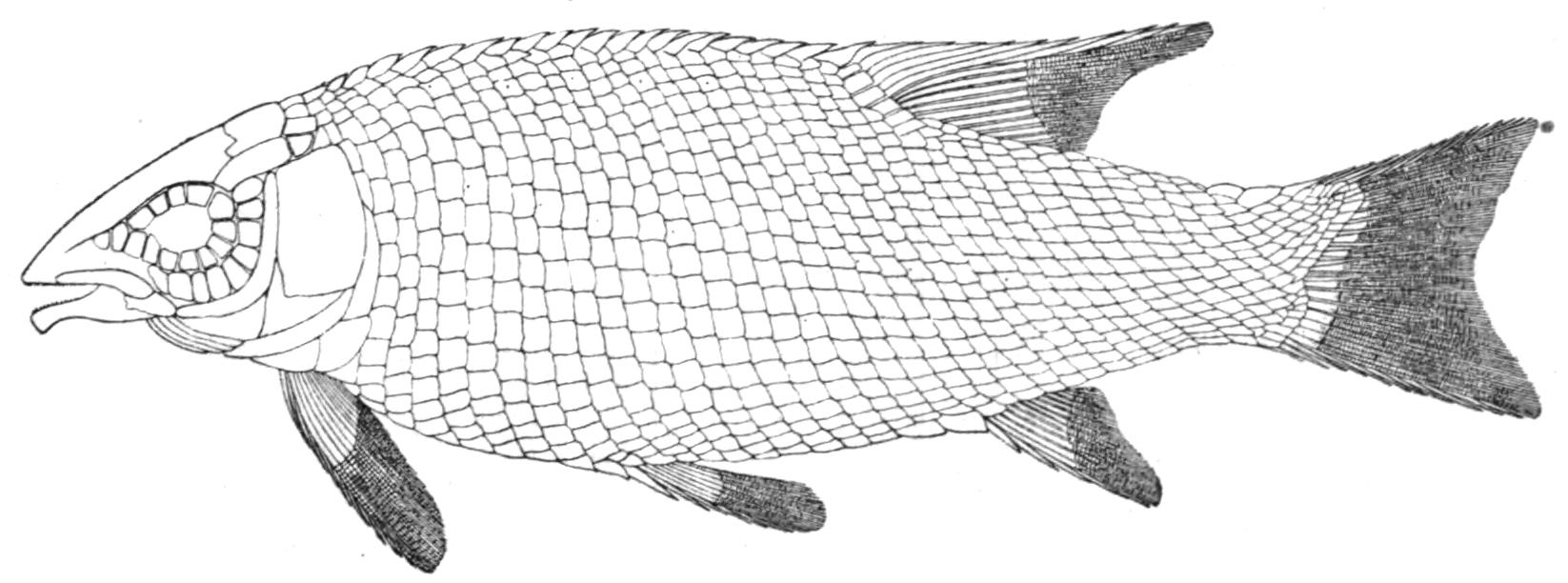
Fig. 292.—Restoration of Lepidotus minor. Upper Jurassic, Dorset. × ⅕. (After Smith Woodward.)
Fam. 1. Semionotidae.—Small-mouthed, fusiform or deep-bodied Holosteans with rhombic scales, rarely, as in Aetheolepis, cycloid in the caudal region. All the fins possess fulcra. Teeth more or less conical, with a tendency to become tritoral in certain genera. Jugular plate present or absent. Acentrophorus (Upper Permian); Semionotus (Trias of England, Germany, S. Africa, and N. America); Lepidotus (Fig. 292) (Trias of Germany, Jurassic of Europe and India, Cretaceous of Brazil); the deep-bodied Dapedius (Lias of Dorset, Fig. 293), and Aetheolepis (Jurassic of New South Wales) are characteristic genera.
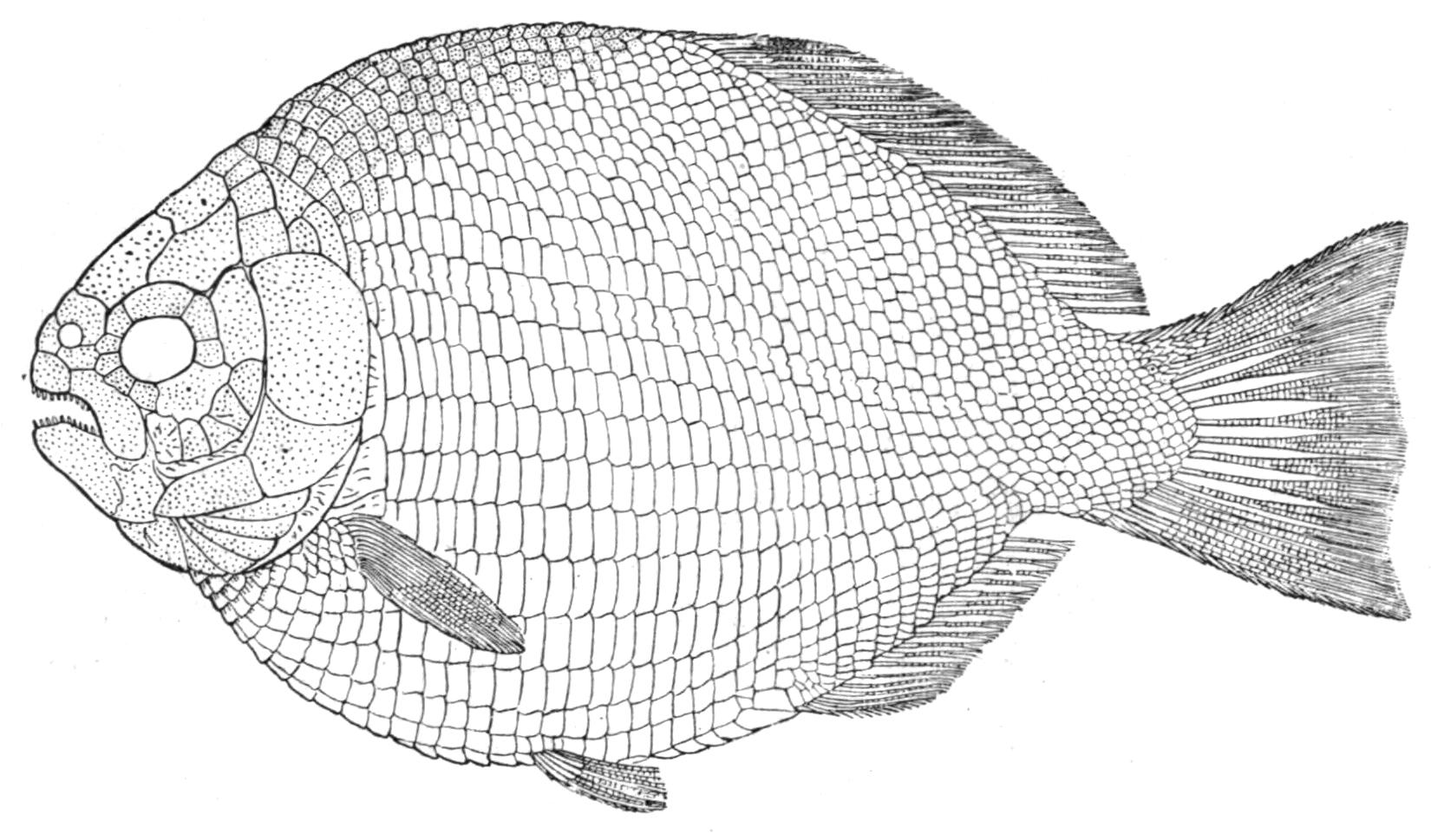
Fig. 293.—Restoration of Dapedius politus. Lower Jurassic, Dorset. × ¼. (After Smith Woodward.)
Fam. 2. Macrosemiidae.—Closely related to the Semionotidae, but with a more extended dorsal fin. Macrosemius (Upper Jurassic of England, Germany, France); Notagogus (Upper Jurassic of Naples, Bavaria, France); Petalopteryx (Upper Cretaceous of Syria).
Fam. 3. Pycnodontidae.—Highly specialised deep-bodied Fishes, with a small mouth and characteristic grinding or tritoral teeth. Scales rhombic. Fulcra absent. Dorsal and anal fins long. There is no jugular plate. The family ranges from the Lower Lias to the Lower Eocene, inclusive. Mesodon, Mesturus, Gyrodus, and Microdon are Jurassic genera. Coccodus and Xenopholis occur in the Upper Cretaceous of Syria (Mount Lebanon), and Pycnodus in various European Eocene formations.
Fam. 4. Eugnathidae.—Large-mouthed, elongate fusiform predaceous Fishes, with pointed teeth, rhombic scales, short dorsal and anal fins, a single jugular plate and prominent fulcra. The vertebral centra are represented by distinct hypo- and pleuro-centra, which may form complete alternating rings in the tail.
The family first appears in the Trias and ranges throughout the Jurassic period. Eugnathus (Jurassic) and Eurycormus (Upper Jurassic). Caturus (Fig. 294) has a more extensive range, occurring in the Upper Trias of the Tyrol and in the Upper Jurassic of England and Bavaria. Caturus and Eurycormus, with their relatively thin, imbricated, cycloid scales, which have lost the peg-and-socket articulation, form connecting links between the more typical Eugnathus and the Amiidae.
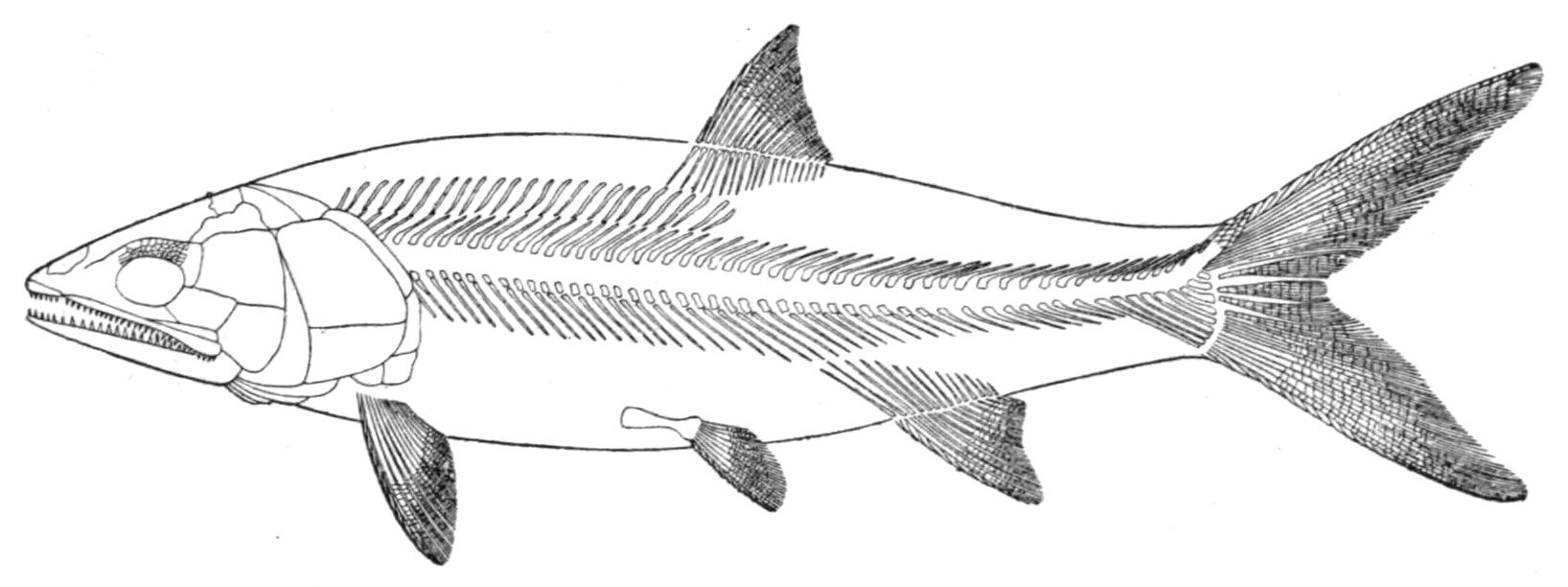
Fig. 294.—Restoration of Caturus furcatus, omitting the squamation. × 1⁄11. Upper Jurassic of Bavaria. (From Smith Woodward.)
Fam. 5. Amiidae.—Body fusiform and somewhat compressed. Scales uniformly thin, cycloid, and imbricated. Single dorsal fin long and low. Anal fin short. Tail nearly homocercal, with a rounded hinder margin. Fulcra absent from all the fins. Moderately large conical teeth are present on the premaxillae, maxillae, palatines and dentaries, and smaller teeth on the vomers, pterygoids, splenials and parasphenoid. Pre- and post-centra fused in the trunk, forming complete bony amphicoelous centra, but distinct in the tail. A single large jugular plate is present. In the solitary living species the air-bladder is cellular, and its afferent arteries are derived from a posterior aortic arch. Pyloric caeca absent. Two peculiar comb-like structures are present on the throat.
The Bow-Fin (Amia calva), the sole existing representative of the family, is abundant in the rivers and lakes of Central and Southern North America, including the great lakes Huron and Erie. It is a voracious, carnivorous Fish, preying upon other Fish as well as upon fresh-water Crustaceans and Insects, very tenacious of life, and of no economic value. The male is smaller than the female, about 18 inches in length, and is distinguished by the presence of a round black spot, encircled by a margin of orange, at the base of the caudal fin (Fig. 295). The female may exceed 24 inches.
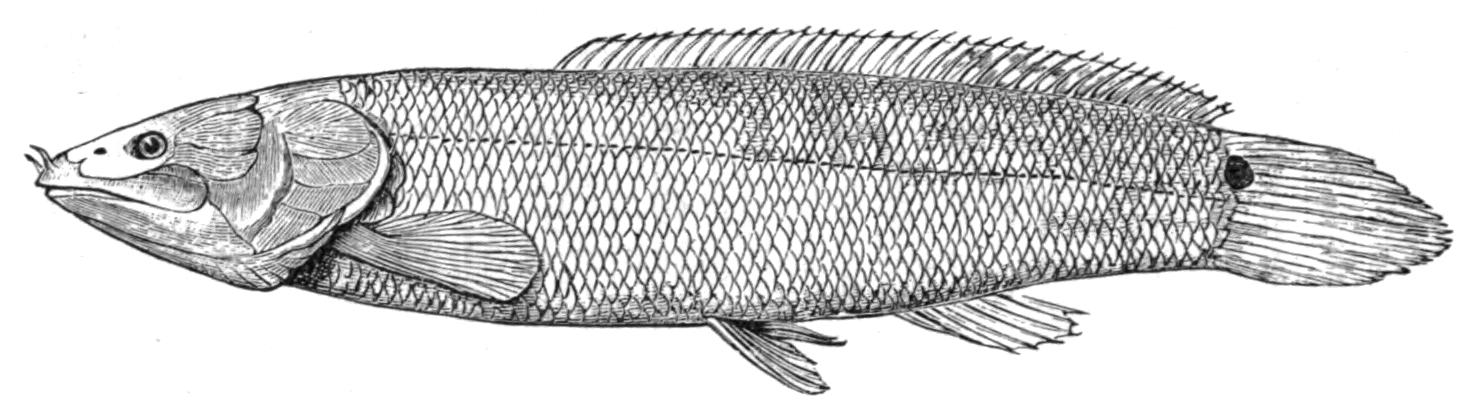
Fig. 295.—The Bow-Fin (Amia calva). (From a specimen in the Cambridge University Museum.) × ⅕.
Amia frequently rises to the surface, especially when the water is foul, and takes in large mouthfuls of air, and it is probable that the air is subsequently passed into the spacious cellular air-bladder which acts as a lung. The breeding season, during which the coloration of the Fish is more brilliant than at other times, lasts from the beginning of May to June, but it may begin and end somewhat earlier if the temperature be favourable. The Fish makes its way from the deeper water, where it has remained sluggish during the winter, to the spawning ground. This is usually at the swampy end of a lake where there is an abundance of aquatic herbage intersected by channels of clear water. There the Fish is said to circle round until the soft weeds and rootlets are bent and crushed aside, so as to leave an area having the appearance of a crude form of nest,[588] in which the eggs are deposited. They may be found in enormous numbers adhering to the leaves and rootlets of the weedy home. After oviposition the male remains on guard until the young are hatched out, when they appear to leave the nest in a body, still under the protection of their watchful parent. At all events a little later the male has been observed to be accompanied by a swarm of young fry, which he keeps together by circling round them. The development of the eggs is remarkably rapid. From the first cleavage of the egg to the hatching of the embryo the whole process may be completed within from 4 to 8 days. When hatched the larvae are about 5 to 6 mm. long. They possess a large yolk sac and a preoral sucker for attachment. The pectoral fins are conspicuous structures before there is any trace of the pelvic fins.
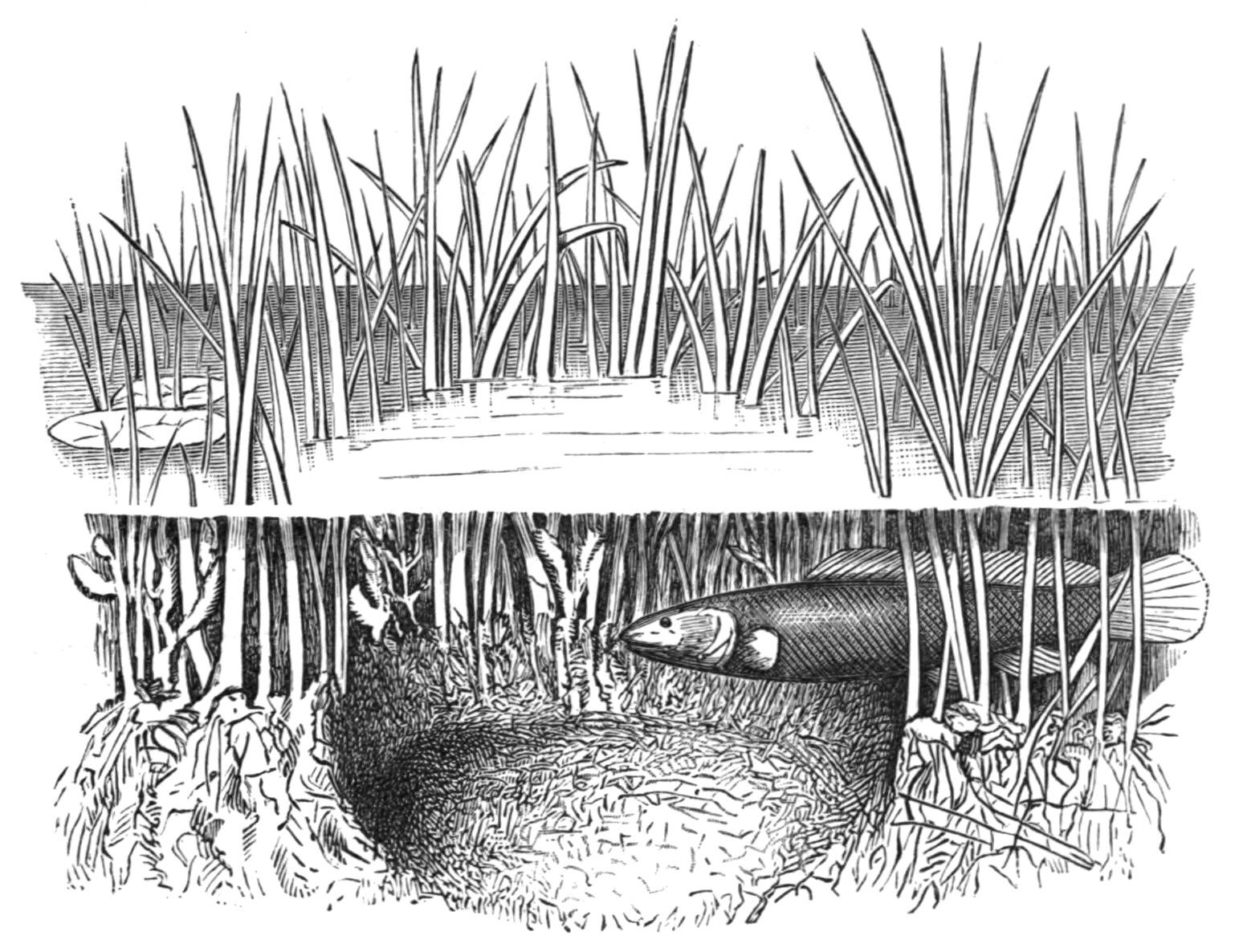
Fig. 296.—Amia and its nest. (From Bashford Dean.)
The Amiidae, represented by Megalurus,[589] first appear in the Upper Jurassic of Dorset, France, and Bavaria. In the Cretaceous period the family is represented by Amiopsis. Species of Amia occur in the Eocene of Europe and North America. In the former area the genus became extinct at the close of the Lower Miocene period, but in the latter Amia calva still survives.
Fam. 6. Pachycormidae.—Large-mouthed, predaceous Amioid Fishes with a more or less prominent snout and a short dorsal fin. Scales rhombic but thin, rounded behind, and overlapping, sometimes absent. A single large jugular plate.
In the earlier forms (e.g. Pachycormus, Lias) the snout is but slightly produced, but in Hypsocormus (Upper Jurassic), and especially in Protosphyraena (Cambridge Upper Greensand and the Cretaceous of Europe and North America), it becomes greatly elongated and associated with an exceptionally strong dentition.
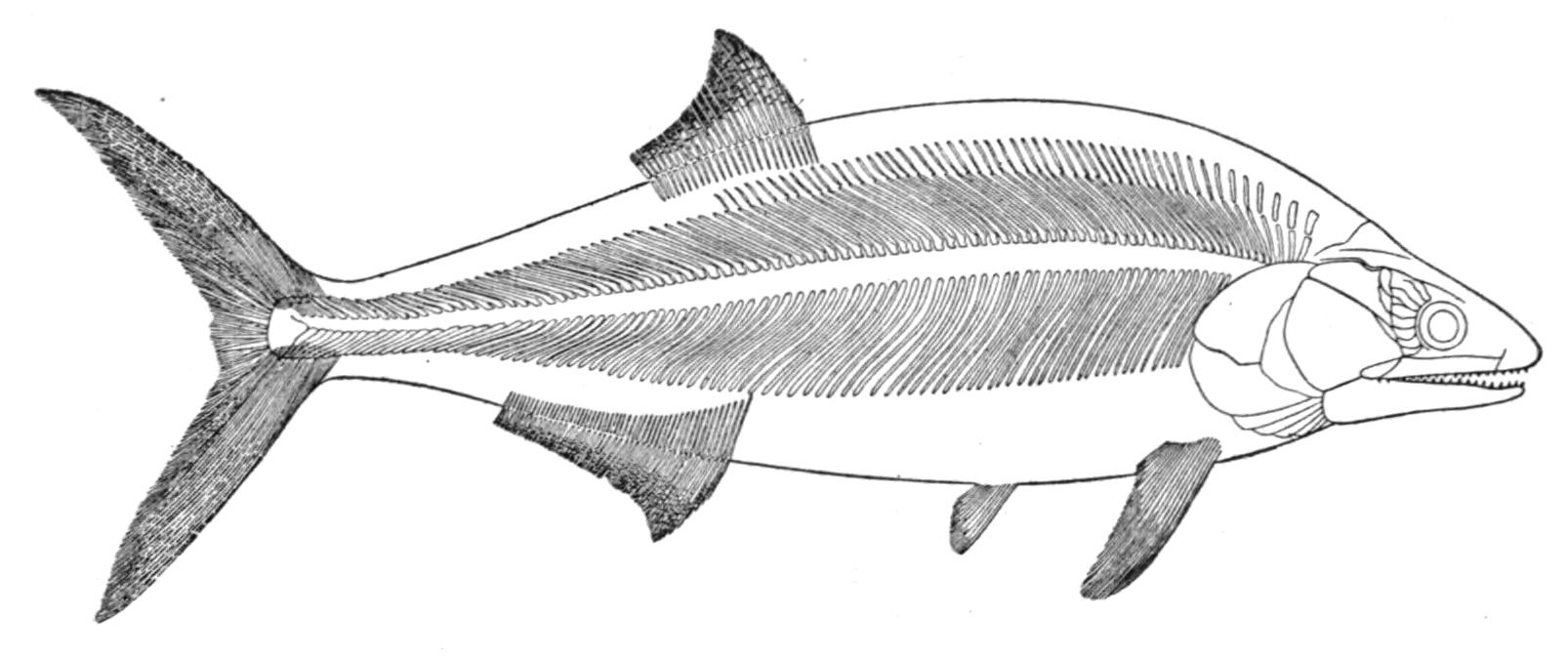
Fig. 297.—Restoration of Hypsocormus insignis, omitting the squamation. Upper Jurassic of Bavaria. × ⅛. (From Smith Woodward.)
Fam. 7. Aspidorhynchidae.—Long-bodied Fishes, with a pointed preoral rostrum, sharp teeth, and deep rhombic scales. Fins small, the dorsal and anal being remote from the pelvic fins. Fulcra vestigial or absent. Jugular plates not known.
Two genera only are known. Aspidorhynchus is a Jurassic form. Belonostomus is Upper Jurassic and Cretaceous. Species of the latter genus have a very wide distribution (Europe, North and South America, and Australia).
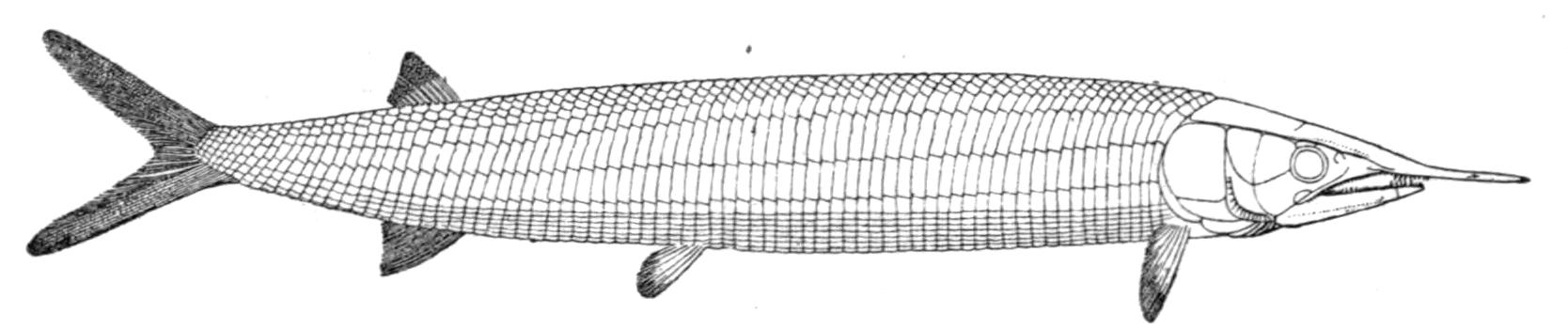
Fig. 298.—Restoration of Aspidorhynchus acutirostris. Upper Jurassic of Bavaria. × 1⁄11. (From Smith Woodward.)
Fam. 8. Lepidosteidae.—Body elongate, with a relatively short caudal region. Tail semi-heterocercal. Scales rhombic, thick, ganoin-coated and articulated, not vertically elongated on the sides of the body. Dorsal and anal fins short and remote from the pelvic fins. Median fins with fulcra. Both the upper and lower jaws more or less elongated, forming a broad and depressed or a long tapering beak, near the anterior end of which the nostrils are placed. Eyes small. Vertebral centra well ossified, opisthocoelous and fused with the neural arches. The metapterygoid bones have a secondary articulation with the skull.[590] Maxillae segmented into numerous pieces. Jugular plates absent. Branchiostegal rays reduced to three on each side. Teeth numerous, slender, and of unequal size. In the larger teeth the dentine is intricately folded. Pyloric caeca branched and compacted together into a gland-like mass. Air-bladder cellular, but its blood is not derived from a posterior aortic arch.
The only known genus is Lepidosteus, the existing species of which frequent the fresh waters of North America.[591] The common or Long-nosed Gar-Pike (L. osseus), remarkable for its long and slender beak, is generally abundant in the rivers and lakes of the United States from Vermont to the Rio Grande, and it may reach a length of five feet. The "Short-nosed Gar" (L. platystomus, Günther) has a much shorter and broader beak, and a similar distribution (Fig. 299). The "Great" or "Alligator Gar" (L. viridis, Günther) has a more southerly habitat, frequenting the rivers of the Southern States, Northern Mexico, and Cuba. It is by far the largest species, sometimes reaching a length of 8 to 10 feet.
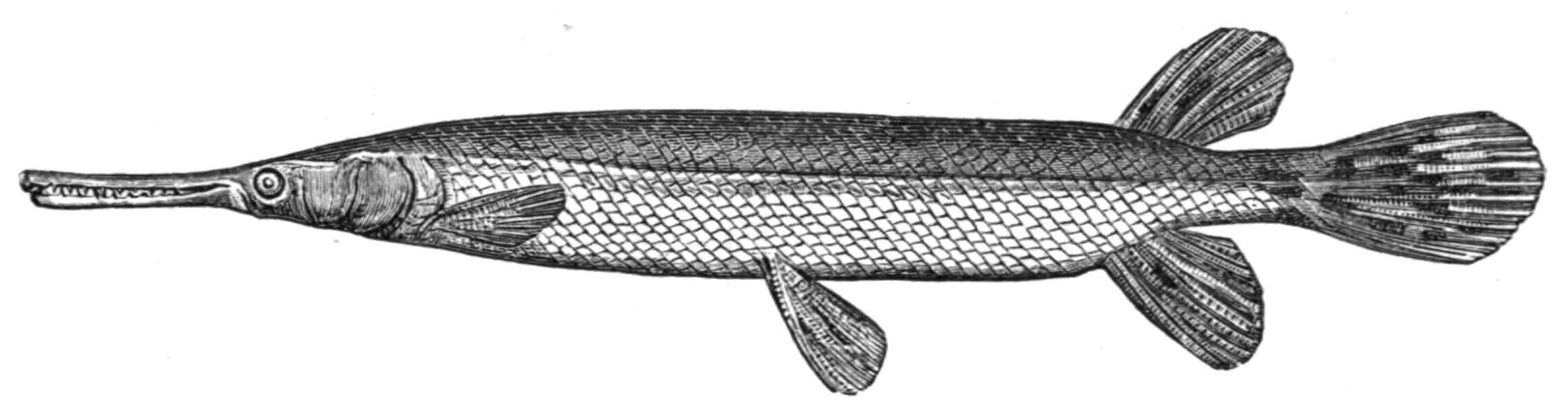
Fig. 299.—Short-nosed Gar Pike (Lepidosteus platystomus.) × ⅛. (From Bashford Dean, after Goode.)
Lepidosteus is a voracious Fish, preying upon smaller Fishes, and, except in the breeding season, it frequents the deeper parts of the rivers or lakes. The Fish is constantly in the habit of rising to the surface and emitting bubbles of gas, either through the mouth or by the branchial clefts, and it is probable that this gas is air which has been previously swallowed at the surface and passed into the air-bladder. About May Lepidosteus resorts in large numbers to shallower water, where the temperature is higher, for the purpose of spawning, each female being attended by from one to four males.[592] During brief recurring periods of excitement, accompanied by convulsive lashing movements, the eggs and sperm are emitted. The eggs are extremely sticky, and adhere tenaciously to the rocks and stones on which they are deposited. In a few days the embryos hatch out, and at this stage the larva has a huge mouth surmounted by a terminal preoral disc, fringed with a row of marginal wart-like suckers (Fig. 300). The yolk sac is so large as greatly to hamper the movements of the larva; hence, by means of its suckers, the young Lepidosteus attaches itself to surrounding objects, and remains almost entirely motionless for some little time after hatching. Later, about a fortnight after escaping from the egg, the yolk becomes completely absorbed, the suckers degenerate and eventually disappear, and the larva, freed from its load of nutritive reserve, assumes a more active life. After the absorption of the yolk the larvae of Mosquitos appears to form the exclusive diet of the young Lepidosteus for some time, but very soon young Fishes are readily devoured.[593]
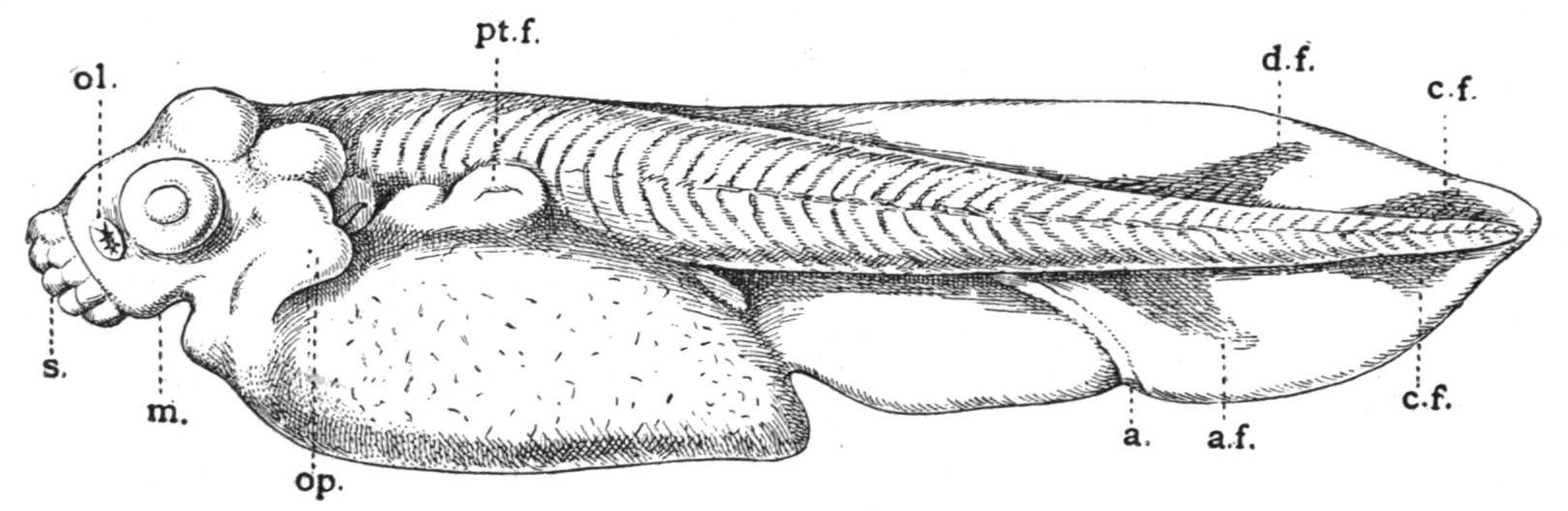
Fig. 300.—Larval Lepidosteus osseus, 11 mm. long. a, Anus; a.f, c.f, d.f, developing anal, caudal, and dorsal fins; m, mouth; ol, olfactory organ; op, operculum; pt.f, pectoral fin; s, sucker. (From Balfour and N. Parker.)
Lepidosteus seems to have been abundant in Europe during the Eocene and Miocene periods, but became extinct before the Pliocene. In North America, also, the genus dates from the Eocene, and still survives.
Order IV. Teleostei.
[For the account of this Order, see pp. 541 f.]