AMERICAN ENCYCLOPEDIA (continued 8)
Reading edition
THREATENED INVASION—SUBSEQUENT EVENTS.
For some time an invasion of Britain had been threatened by France; and, sacred as the land had been for centuries from the touch of a foreign enemy, the successes of the republicans had hitherto so greatly exceeded all previous calculation, that the execution of their design did not appear improbable. Just as the inteference of the neighboring powers had, in 1792, roused the energies of the French, so did this proposed invasion stimulate the spirit of the British people. The clamors of reformers, and of those who were friendly to France, were now lost in an almost universal zeal for the defense of the country; and not only were volunteer corps everywhere formed, but the desire of prosecuting the war became nearly the ruling sentiment of the nation. The ministers, perceiving the advantage which was to be derived from the tendency of the national spirit, appeared seriously to dread an invasion, and thus produced an unexpected and very distressing result. The credit of the Bank of England was shaken; a run was made upon it for gold in exchange for its notes, which it could not meet. On the 25th of February 1797, therefore, the Bank was obliged, with the sanction of the privy-council, to suspend cash payments—that is, to refuse giving coin on demand for the paper money which had been issued. This step led to a great depreciation in the value of Bank of England notes; and was followed by a very serious derangement of the currency for a number of years.
In April, a new alarm arose from the proceedings of the seamen on board the Channel fleet, who mutinied for an advance of pay, and the redress of some alleged grievances. A convention of delegates from the various ships met in Lord Howe’s cabin, and drew up petitions to the House of Commons and the Board of Admiralty. Upon these being yielded to, order was restored; but the seamen on board the fleet at the Nore soon after broke out in a much more alarming revolt; and on the refusal of their demands, moored their vessels across the Thames, threatening to cut off all communication between London and the open sea. The reduction of this mutiny appeared at one time as if it could only be effected by much bloodshed; but by the firmness of the government, and some skillful dealings with the seamen, a loyal party was formed, by whom the more turbulent men were secured, and the vessels restored to their respective officers. The ringleaders, the chief of whom was a young man named Richard Parker, were tried and executed.
The same year was remarkable for several victories gained by the British fleets. A Spanish fleet of twenty-seven ships was attacked by fifteen vessels under Admiral Jervis (February 14), off Cape St. Vincent, and completely beaten, with the loss of four large vessels. A fleet under Admiral Harvey, with a military force under Sir Ralph Abercromby, captured the island of Trinidad, a Spanish colony. In October, a Dutch fleet, under Admiral De Winter, was attacked off the village of Camperdown, upon their own coast, by Admiral Duncan, who after a desperate battle, captured nine of the enemy’s vessels. These naval successes compensated in some measure for the many land victories of the French, and served to sustain the spirit of the British nation under this unfortunate contest.
In 1798, the French overran and added to their dominions the ancient republic of Switzerland, which gave them a frontier contiguous to Austria, and enabled them eventually to act with increased readiness and force upon that country. In this year, the directors of the French Republic, beginning to be afraid of the ambition of their general, Bonaparte, sent him at the head of an expedition to reduce and colonize Egypt, intending from that country to act against the British empire in the East Indies. The expedition was successful in its first object; but the fleet which had conveyed it was attacked in Aboukir Bay, by Admiral Nelson (August 1), and almost totally destroyed or captured. While so much of the strength of the French army was thus secluded in a distant country, the eastern powers of Europe thought they might safely recommence war with the republic. Austria, Naples, and Russia, formed a confederacy for this purpose; and Britain, to supply the necessary funds, submitted to the grievance of an income tax, amounting in general to ten per cent., in addition to all her previous burdens.
The new confederacy was so successful in 1799, as to redeem the greater part of Italy. A Russian army, under the famous Suwaroff, acted a prominent part in the campaign; but, in the end, attempting to expel the French from Switzerland, this large force was nearly cut to pieces in one of the defiles of that mountainous country. In August of the same year, Great Britain made a corresponding attempt to expel the French from Holland. Thirty-five thousand men, under the Duke of York, formed the military part of the expedition. The fleet was successful at the first in taking the Dutch ships, but the army, having landed under stress of weather at an unfavorable place for their operations, was obliged, after an abortive series of skirmishes, to make an agreement with the French, purchasing permission to go back to their country by the surrender of 8000 prisoners from England.
The reverses which France experienced in 1799, were generally attributed to the weakness of the Directory—a council of five, to which the executive had been intrusted. Bonaparte suddenly returned from his army in Egypt, and, by a skillful management of his popularity, overturned the Directory, and caused himself to be appointed the sole depositary of the executive power of the state, under the denomination of First Consul. He immediately wrote a letter to King George, making overtures of peace, but was answered, by the British secretary, that no dependence could be placed by Great Britain on any treaty with France, unless her government were again consolidated under the Bourbons. Bonaparte, having much reason to wish for peace, made a reply to this note, vindicating France from the charge brought against her, of having commenced a system of aggression inconsistent with the interests of other states, and asserting her right to choose her own government—a point, he said, that could not decently be contested by the minister of a crown which was held by no other tenure. But the British government was at this time too much elated by the expulsion of the French army from Italy, and the late changes in the executive, which, in their estimation, betokened weakness, to be immdiately anxious for peace.
The events of 1800 were of a very different nature from what had been calculated upon in England. Sir Sidney Smith, who commanded the British forces in Syria, had made a treaty with the French army after it had been left by Bonaparte, whereby it was agreed that the French should abandon Egypt, and retire unmolested to their own country. The British government, in its present temper, refused to ratify this arrangement, and the consequence was a continuance of hostilities. The French overthrew a large Turkish army at Grand Cairo, and made themselves more effectually than ever the masters of the country, so that Britain was obliged to send an army next year, under Sir Ralph Abercromby, to accomplish, at an immense expense, and a great waste of human life, what the French had formerly agreed to do. In Europe, the presence of Bonaparte produced equally disastrous results. By one of his most dexterous movements, he eluded the Austrians, led an army over the Alps by the Great St. Bernard into the Milanese, and having gained a decisive victory at Marengo (June 14), at once restored the greater part of Italy to French domination. Cotemporaneously with Napoleon’s movements, Moreau led another army directly into Germany, overthrew the Austrians in several battles, and advanced to within seventeen leagues of their capital, Vienna. These reverses obliged Austria next year (1801) to sue for and conclude a peace, by which France became mistress of all continental Europe west of the Rhine and south of the Adige.
REBELLION IN IRELAND—UNION WITH GREAT BRITAIN.
Although the government had been able, in 1783, to procure a dissolution of the volunteer corps, the bulk of the Irish people continued to express the most anxious desire for such a reform in their Parliament as might render it a more just representation of the popular voice. Unable to yield to them on this point, Mr. Pitt endeavored to appease them by extending their commercial privileges; but his wishes were frustrated, chiefly by the jealousy of the British merchants. A strong feeling of discontent, not only with the government, but with the British connection, was thus engendered in Ireland.
The commencement of the revolutionary proceedings in France excited the wildest hopes of the Irish. Towards the close of the year 1791, they formed an association, under the title of the United Irishmen, comprehending persons of all religions, and designed to obtain ‘a complete reform of the legislature, founded on the principles of civil, political, and religious liberty.’ The government from the first suspected this association of meditating an overturn of the state, and took strong measures for keeping it in check. Acts were passed for putting down its meetings, and the secretary, Mr. Hamilton Rowan, was tried and sentenced to a fine and two years’ imprisonment for what was termed a seditious libel. At the same time, some concessions to the popular spirit were deemed indispensable, and the Irish Parliament accordingly passed acts enabling Catholics to intermarry with Protestants, to practice at the bar, and to educate their own children.
On discovering that a treasonable correspondence had been carried on with France by some leading persons in the society of United Irishmen, the government was so much alarmed as to send (1794) a Whig lord-lieutenant (Earl Fitzwilliam) to grant further concessions; but ere anything had been done, the ministers were persuaded by the Protestant party to return to their former policy. The patriotic party now despaired of effecting any improvement by peaceable means, and an extensive conspiracy was entered into for delivering up Ireland to the French republic. The scheme was managed by a directory of five persons, and though half a million of men were concerned in it, the most strict secrecy was preserved. In December 1796, a portion of the fleet which had been fitted out by the French to coöperate with the Irish patriots, landed at Bantry Bay; but measures for a rising of the people not being yet ripe, it was obliged to return. Next year, the losses at Camperdown crippled the naval resources of France, and prevented a renewal of the expedition. Losing all hope of French assistance, the conspirators resolved to act without it; but their designs were betrayed by one Reynolds; and three other members of the directory, Emmett, Macnevin, and Bond, were seized. Notwithstanding the precautionary measures which the government was thus enabled to take, the Union persisted in the design of rising on a fixed day. Lord Edward Fitzgerald, another of its leaders, was then arrested, and being wounded in a scuffle with his captors, soon after died in prison. On the 21st of May 1798, Lord Castlereagh, secretary to the lord-lieutenant, disclosed the whole plan of insurrection, which had been fixed to commence on the 23d.
Though thus thwarted in their designs, and deprived of their best leaders, the conspirators appeared in arms in various parts of the country. Parties attacked Naas and Carlow, but were repulsed with loss. A large party, under a priest named Murphy, appeared in the county of Wexford, and took the city of that name. Slight insurrections about the same time broke out in the northern counties of Antrim and Down, but were easily suppressed. In Wexford alone did the insurgents appear in formidable strength. Under a priest named Roche, a large party of them met and defeated a portion of the government troops; but on a second occasion, though they fought with resolution for four hours, they were compelled to retreat. Another defeat at New Ross exasperated them greatly, and some monstrous cruelties were consequently practised upon their prisoners. On the 20th of June, their whole force was collected upon Vinegar Hill, near Enniscorthy, where an army of 13,000 men, with a proportionate train of artillery, was brought against them by General Lake. They were completely overthrown and dispersed. From this time the rebellion languished, and in July it had so far ceased to be formidable, that an act of amnesty was passed in favor of all who had been engaged in it, except the leaders.
On the 22d of August, when the rebellion had been completely extinguished, 900 French, under General Humbert, were landed at Killala, in the opposite extremity of the country from that in which the insurgents had shown the greatest strength. Though too late to be of any decisive effect, they gave some trouble to the government. A much larger body of British troops, under General Lake, met them at Castlebar, but retreated in a panic. They then advanced to the centre of the country, while the lord-lieutenant confessed the formidable reputation which their countrymen had acquired, by concentrating an immensely disproportioned force against them. On the 8th of September, they were met at Carrick-on-Shannon by this large army, to which they yielded themselves prisoners of, war.
During the ensuing two years, the British ministers exerted themselves to bring about an incorporating union of Ireland with Great Britain; a measure to which the Irish were almost universally opposed, but which, by the use of bribes and government patronage liberally employed amongst the members of the Irish legislature, was at length effected. From the 1st of January 1801, the kingdom of Ireland formed an essential part of the empire, on which was now conferred the name of the United Kingdom of Great Britain and Ireland. The act of Union secured to the Irish most of the commercial privileges which they had so long sought. Upon a comparison of the aggregate exports and imports of the two countries, Ireland was to raise two parts of revenue for every fifteen raised by Great Britain, during the first twenty years of the Union, after which new regulations were to be made by Parliament. One hundred commoners were to be sent by Ireland to the British (now called the Imperial) Parliament; namely, two for each county, two for each of the cities of Dublin and Cork, one for the university, and one for each of the thirty-one most considerable towns. Four lord spiritual, by rotation of sessions, and twenty-eight lords temporal, elected for life by the Peers of Ireland, were to sit in the House of Lords.
The Union, though, upon the whole, effected in a spirit of fairness towards Ireland, increased the discontent of the people, which broke out in 1803 in a new insurrection. Under Robert Emmet and Thomas Russell, a conspiracy was formed for seizing the seat of the vice-government, and for this purpose a great multitude of peasantry from the county of Kildare assembled (July 23) in Dublin. Disappointed in their attempt upon the castle, they could only raise a tumult in the streets, in the course of which Lord Kilwarden, a judge, and his nephew, Mr. Wolfe, were dragged from a carriage and killed. The mob was dispersed by soldiery, and Emmett and Russell, being seized, were tried and executed.
CHANGE OF MINISTRY, AND PEACE OF AMIENS, 1801.
At the commencement of 1801, Britain had not only to lament this unexpected turn of fortune, but to reckon among her enemies the whole of the northern states of Europe, which had found it necessary to place themselves on a friendly footing with Bonaparte, and though they did not declare war against Britain, yet acted in such a manner as to render hostilities unavoidable. Nelson sailed in March with a large fleet for Copenhagen, and proved so successful against the Danish fleet, as to reduce that country to a state of neutrality. The death of the Russian Emperor Paul, which took place at the same time, and the accession of Alexander, who was friendly to Britain, completely broke up the northern confederacy. Yet the great achievements of France on the continent, joined to the distresses of a famine which at this time bore hard on the British people, produced a desire for that peace which, a year before, might have been gained upon better terms. With a view, apparently, to save the honor of Mr. Pitt and his friends, a new ministry was appointed under Mr. Addington, by whom a peace was at length, in the end of the year (1801), concluded with France, which was left in the state of aggrandizement which has just been described.
The war of the French Revolution placed Great Britain in possession of a considerable number of islands and colonies in the East and West Indies and elsewhere; and while only two war ships had been lost on her part, she had taken or destroyed 80 sail of the line, 181 frigates, and 224 smaller ships, belonging to the enemy, together with 743 privateers, 15 Dutch, and 76 Spanish ships. The triumphs of the British fleets were indeed numerous and splendid, and had the effect of keeping the national commerce almost inviolate during the whole of the war while that of France was nearly destroyed. There was, however, hardly the most trifling instance of success by land; and the expenses of the contest had been enormous. Previously to 1793, the supplies usually voted by the House of Commons were £14,000,000; but those for 1801 were £42,197,000—a sum about double the amount of the whole land-rent of the country.
WAR RENEWED WITH FRANCE, 1803—SUBSEQUENT EVENTS.
It was only one of the results of the war against French independence, that France was led by the course of events to place herself under the control of her chief military genius, Napoleon Bonaparte; a man singularly qualified for concentrating and directing the energies of a country in the existing condition of France, but animated more by personal ambition than by any extended views of the good of his species. It was soon manifested that Bonaparte did not relish peace. By taking undue advantage of several points left loose in the treaty, he provoked Great Britain to retaliate by retaining possession of Malta; and the war was accordingly recommenced in May 1803. Britain immediately employed her superior naval force to seize the French West India colonies; while France took possession of Hanover, and excluded British commerce from Hamburg. Bonaparte collected an immense flotilla at Boulogne, for the avowed purpose of invading England; but so vigorous were the preparations made by the whole British population, and so formidable the fleet under Lord Nelson, that he never found it possible to put his design in execution. In the year 1804, he was elevated to the dignity of Emperor of the French; and France once more exhibited the formalities of a court, though not of the kind which the European sovereigns were anxious to see established. In April of the same year, the Addington administration was exchanged for one constructed by Mr. Pitt, and of which he formed the leader.
In 1805, under the fostering influence of Great Britain, a new coalition of European powers, consisting of Russia, Sweden, Austria, and Naples, was formed against Napoleon. He, on the other hand, had drawn Spain upon his side, and was making great exertions for contesting with Britain the empire of the sea. A fleet of thirty-three sail, partly French and partly Spanish, met a British fleet of twenty-seven, under Nelson, off Cape Trafalgar, October 25, 1805, and was completely beaten, though at the expense of the life of the British commander. Britain thus fixed permanently her dominion over the seas and coasts of the civilized world. At this time, however, Napoleon was asserting with equal success his supremacy over continental Europe. By a sudden, rapid, and unexpected movement, he conducted an army into Germany, where the Austrians were already making aggressions upon neutral territory. On the 17th October, he took the fortress of Ulm, with its artillery, magazines, and garrison of 30,000 men; a month after, he entered Vienna without resistance. He then pursued the royal family, and the allied armies of Russia and Austria, into Moravia; and on the 2d of December 1805, he gained the decisive and celebrated victory of Austerlitz, which put an end to the coalition, and rendered him the dictator of the continent.
This series of events caused much gloom in the British councils, and with other painful circumstances, among which was the impeachment of his colleague Lord Melville, for malpractices in the Admirality, proved a death-blow to Mr. Pitt, who expired on the 23d of January 1806, completely worn out with state business, at the early age of forty-seven, half of which time he had spent in the public service. Mr. Pitt is universally allowed the praise of high talent and patriotism. But his policy has been a subject of dispute between the two great political parties into which British society is divided. By the Tories it is firmly believed that his entering into the war against the French Republic was the means of saving the country from anarchy and ruin; by the Whigs, that this step only ended to postpone the settlement of the affairs of France, and loaded Britain with an enormous debt. Of the absence of all selfish views in the political conduct of Mr. Pitt, there can be no doubt; for, so far from accumulating a fortune out of the public funds, he left some debts, which Parliament gratefully paid.
Mr. Pitt’s ministry was succeeded by one composed of Lord Grenville, Mr. Fox, and their friends; it was comprehensively called Whig, although Lord Grenville was a Tory, except in his advocacy of the claims of the Catholics for emancipation. In the course of 1806, the new cabinet made an attempt to obtain a peace from France, which now threatened to bring the whole world to its feet. But the Grenville administration encountered serious difficulties from the king, who never could be induced to look with the least favor on the Catholic claims, or those who advocated them. Exhausted by his useless labors, Mr. Fox died, September 13, 1806. Few names are more endeared to the British people than his, for, though the leader of the Whigs, he never excited any rancor in his opponents. He was remarkable for his frankness and simplicity. His abilities as a parliamentary orator and statesman were of the first order, and he was invariably the consistent and sincere friend of popular rights.
A new coalition, excluding Austria, but involving Prussia, had been subsidised by Britain, and was preparing to act. With his usual decision, Napoleon led what he called his ‘Grand Army’ by forced marches into Prussia; gained, on the 14th of October, the battles of Jena and Auerstadt, which at once deprived that country of her army, her capital, and her fortresses; and then proclaimed the famous ‘Berlin Decrees,’ by which he declared Great Britain in a state of blockade, and shut the ports of Europe against her merchandise. The King of Prussia, Frederick William III, took refuge with his court in Russia, which now was the only continental power of any importance that remained unsubdued by France.
Towards that country Napoleon soon bent his steps, taking, as he went, assistance from Poland, which he promised to restore to independence. After a series of skirmishes and battles of lesser importance, he met the Russian army in great strength (June 14, 1807), at Friedland, and gave it a total overthrow. He might now have easily reduced the whole country, as he had done Austria and Prussia; but he contented himself with forming a treaty (called the treaty of Tilsit, from the place where it was entered into), by which Russia agreed to become an ally of France, and entered into his views for the embarrassment of Britain by the exclusion of her commerce from the continental ports. France had thus, in the course of a few years, disarmed the whole of Europe, excepting Great Britain, an amount of military triumph for which there was no precedent in ancient or modern history.
The Grenville administration was displaced in the spring of 1807, in consequence of the difference between its members and the king on the subject of the Catholic claims, which had long been urged by the Whig party, with little support from the people. The next ministry was headed by the Duke of Portland, and included Lords Hawkesbury and Castlereagh (afterwards Earl of Liverpool and Marquis of Londonderry), and Mr. Canning, as secretaries; Mr. Spencer Perceval being chancellor of the exchequer. After being accustomed to the services of such men as Pitt and Fox, the people regarded this cabinet as one possessing comparatively little ability. One of its first acts was the despatch of a naval armament to Copenhagen to seize and bring away the Danish shipping, which was expected to be immediately employed in subserviency to the designs of France, and for the injury of Britain. The end of the expedition was very easily obtained; but it was the means of lowering the honor of Britain in the estimation of foreign powers.
FIRST PENINSULAR CAMPAIGN—SUBSEQUENT EVENTS.
The retaliation of France, for the interferences of other powers with its Revolution, even supposing such retaliation justifiable, was now more than completed. Further measures could only appear as dictated by a desire of aggrandizement. But France was now given up to the direction of a military genius, who had other ends to serve than the defense of the country against foreign aggression or interference. The amazing successes of Napoleon had inspired him with the idea of universal empire: and so great was the influence he had acquired over the French, and so high their military spirit, that the attainment of his object seemed by no means impossible. There was a difference, however, between the opposition which he met with before this period, and that which he subsequently encountered. In the earlier periods of the war, the military operations of the European powers were chiefly dictated by views concerning the interests of governments, and in which the people at large felt little sympathy. Henceforth a more patriotic spirit rose everywhere against Napoleon: he was looked upon in England and elsewhere as the common enemy of humanity and of freedom; and every exertion made for the humiliation of France was animated by a sentiment of desperation, in which the governors and governed alike participated.
The Spanish peninsula was the first part of the prostrated continent where the people could be said to have taken a decidedly hostile part against Napoleon. He had there gone so far as to dethrone the reigning family, and give the crown to his elder brother Joseph. A sense of wrong and insult, mingled with religious fanaticism, raised the Spanish people in revolt against the French troops; and though their conduct was barbarous, it was hailed in Britain as capable of being turned to account. In terms of a treaty entered into with a provisional government in Spain, a small army was landed, August 8, 1808, in Portugal, which had been taken possession of by the French. Sir Arthur Wellesley, who afterwards became so famous as Duke of Wellington, was the leader of this force. In an engagement at Vimeira, on the 21st, he repulsed the French, under Junot, who soon after agreed, by what was called the Convention of Cintra, to evacuate the country. Sir Arthur being recalled, the British army was led into Spain under the command of Sir John Moore; but this officer found the reinforcements poured in by Napoleon too great to be withstood, and accordingly, in the end of December, he commenced a disastrous, though well-conducted retreat towards the port of Corunna, whither he was closely pursued by Marshal Soult. The British army suffered on this occasion the severest hardships and losses, but did not experience a check in battle, or lose a single standard. In a battle which took place at Corunna, January 16, 1809, for the purpose of protecting the embarkation of the troops, Sir John Moore was killed.
Much of the public attention was about this time engrossed by circumstances in the private life of the eldest son of the king. The Prince of Wales had been tempted, in 1796, by the prospect of having his large debts paid by the nation, to marry the Princess Caroline of Brunswick, for whom he entertained no real affection. Almost ever since the marriage, he had shown the most marked disrespect for his consort, who consequently lived separate from him, and was herself considered by many as not altogether blameless in her conduct as a matron.
In 1809, Austria was induced once more to commence war with France. Upwards of half a million of men were brought into the field, under the command of the Archduke Charles. Bonaparte, leaving Spain comparatively open to attack, moved rapidly forward into Germany, and, by the victory of Eckmühl, opened up the way to Vienna, which surrendered to him. After gaining a slight advantage at Essling, the archduke came to a second decisive encounter at Wagram, where the strength of Austria was completely broken to pieces. The peace which succeeded was sealed by the marriage of Napoleon to Maria Louisa, daughter of the emperor of Austria, for which purpose he divorced his former wife Josephine.
In the autumn of 1809, the British government despatched an army of 100,000 men, for the purpose of securing a station which should command the navigation of the Sheldt. The expedition was placed under the command of the Earl of Chatham, elder brother of Mr. Pitt, a nobleman totally unacquainted with military affairs on such a scale. The army, having disembarked on the insalubrious island of Walcheren, was swept off in thousands by disease. The survivors returned in December without having done anything towards the object for which they set out. This tragical affair became the subject of inquiry in the House of Commons, which by a majority of 272 against 232, vindicated the manner in which the expedition had been managed.
SUCCESSES OF WELLINGTON IN SPAIN.
A new expedition in Spain was attended with better success. Taking advantage of the absence of Napoleon in Austria, a considerable army was landed, April 23, 1809, under the command of Sir Arthur Wellesley, who immediately drove Soult out of Portugal, and then made a rapid move upon Madrid. King Joseph advanced with a considerable force under the command of Marshal Victor; and on the 28th of July, attacked the British and Spanish troops in a strong position at Talavera. The contest was obstinate and sanguinary; and though the French did not retreat, the advantage lay with the British. As this was almost the first success which Britain experienced by land in the course of the war, Sir Arthur Wellesley became the theme of universal praise, and he was elevated to a peerage, under the title of Viscount Wellington of Talavera. He was obliged immediately to fall back upon Portugal, where he occupied a strong position near Santarem.
Early in 1810, Napoleon reinforced the army in Spain and gave orders to Massena to ‘drive the British out of the Peninsula.’ Wellington posted his troops on the heights of Busaco—eighty thousand in number, including Portuguese—and there, on the 27th of September, was attacked by an equal number of French. Both British and Portuguese behaved well: the French were repulsed with great loss, and for the first time in the war, conceived a respectful notion of the British troops. Wellington now retired to the lines of Torres Vedras, causing the whole country to be desolated as he went, for the purpose of embarrassing the French. When Massena observed the strength of the British position, he hesitated; and ultimately, in the spring of 1811, performed a disastrous and harassing retreat into the Spanish territory.
It now became an object of importance with Wellington to obtain possession of the Spanish fortresses which had been seized by the French. On the 22d of April, he reconnoitered Badajos, and soon after laid siege to Almeida. Massena, advancing to raise the siege, was met on fair terms at Fuentes d’Onoro, May 5, and repulsed. Almeida consequently fell into the hands of the British. General Beresford, at the head of another body of British forces, gained the bloody battle of Albuera over Soult, and thereby protected the siege of Badajos, which, however, was soon after abandoned. During the same season, General Graham, in command of a third body of troops, gained the battle of Barossa. At the end of a campaign, in which the French were upon the whole unsuccessful, Wellington retired once more into Portugal.
EVENTS OF 1811, 1812, AND 1813.
The year 1811 was regarded as the period of greatest depression and distress which the British empire had known for several ages. At this time, with the exception of an uncertain footing gained in Spain, the influence of England was unknown on the continent. Bonaparte seemed as firmly seated on the throne of France as any of her former monarchs, while every other civilized European kingdom either owned a monarch of his express appointment, or was in some other way subservient to him. By the Berlin and Milan decrees, he had shut the ports of the continent against British goods, so that they could only be smuggled into the usual markets. By British orders in council, which, though intended to be retaliatory, only increased the evil, no vessel belonging to a neutral power—such, for instance, as the United States—was permitted to carry goods to those ports, unless they should previously land and pay a duty in Britain. Thus the nation at once suffered from the shortsighted despotism of the French emperor, and from its own narrow and imperfect views of commerce; for, by embarrassing America, it only deprived itself of one of its best and almost sole remaining customers.
The power of Bonaparte, though sudden in its rise, might have been permanent if managed with discretion. It was used, however, in such a way as to produce a powerful reaction throughout Europe in favor of those ancient institutions, which, twenty years before, had been threatened with ruin. The exclusion of British goods—a measure which he had dictated in resentment against England—proved the source of great distress, oppression, and hardship throughout the continent, and was greatly instrumental in exciting a spirit of hostility against him. The very circumstance of a foreign power domineering over their native princes, raised a feeling in favor of those personages, which, being identified with the cause of national independence, acted as a very powerful stimulant. On the other hand, a sense of the grasping ambition of Napoleon—of his hostility to real freedom—of his unscrupulousness in throwing away the lives of his subjects for his own personal aggrandizement—had for some time been gaining ground in France itself.
In 1812, when the transactions in Spain had already somewhat impaired Napoleon’s reputation, Alexander, Emperor of Russia, ventured upon a defiance of his decrees against British merchandise, and provoked him to a renewal of the war. With upwards of half a million of troops, appointed in the best manner, he set out for that remote country, determined to reduce it into perfect subjection. An unexpected accident defeated all his plans. The city of Moscow, after being possessed by the French troops in September, was destroyed by incendiaries, so that no shelter remained for them during the ensuing winter. Napoleon was obliged to retreat; but, overtaken by the direst inclemency of the season, his men perished by thousands in the snow. Of his splendid army, a mere skeleton regained central Europe. Returning almost alone to Paris, he contrived with great exertions to reinforce his army, though there was no replacing the veterans lost in Russia.
Early in 1813, he opened a campaign in northern Germany, where the emperor of Russia, now joined by the king of Prussia and various minor powers, appeared in the open field against him. After various successes on both sides, an armistice was agreed to on the 1st of June, and Bonaparte was offered peace on condition of restoring only that part of his dominions which he had acquired since 1805. Inspired with an overweening confidence in his resources and military genius, he refused these terms, and lost all. In August, when the armistice was at an end, his father-in-law, the emperor of Austria, joined the allies, whose forces now numbered 500,000 men, while an army of 300,000 was the largest which Napoleon could at present bring into the field. Henceforth he might be considered as overpowered by numbers. By steady, though cautious movements, the allies advanced to France, driving him reluctantly before them, and increasing their own force as the various states became emancipated by their presence. At the close of 1813, they rested upon the frontiers of France, while Lord Wellington, after two successful campaigns in Spain, had advanced in like manner to the Pyrenees.
HOME AFFAIRS—WAR WITH AMERICA.
Some changes had in the meantime taken place in the British administration. On the 11th of May, 1812, the premier, Mr. Perceval, was shot in the lobby of the House of Commons, by a man named Bellingham, whom some private losses had rendered insane. Lords Liverpool and Castlereagh then became the ministerial leaders in the two Houses of Parliament, but were quickly voted down by a majority of four, upon a motion made by Mr. Stuart Wortley, afterwards Lord Wharncliffe. The ministry was finally rendered satisfactory to Parliament by the admission of Earl Harrowby as president of the council, Mr. Vansittart as chancellor of the exchequer, and Lord Sidmouth (formerly premier while Mr. Addington) as secretary for the home department; Lord Liverpool continuing as premier, and Lord Castlereagh as foreign and war secretary.
Notwithstanding the successes which were at this period brightening the prospects of Britain, the regent and his ministers did not enjoy much popularity. The regent himself did not possess those domestic virtues which are esteemed by the British people, and he had excited much disapprobation by the steps which he took for fixing a criminal charge upon his consort. The general discontents were increased by the effects of the orders in council, for prohibiting the commerce of neutral states. Vast multitudes of working people were thrown idle by the stagnation of manufactures, and manifested their feelings in commotion and riot. The middle classes expressed their dissatisfaction by clamors for parliamentary reform.
At this unhappy crisis, provoked by the orders in council, as well as by a right assumed by British war-vessels to search for and impress English sailors on board the commercial shipping of the United States, that country (June 1812) declared war against Britain. Before the news had reached London, the orders had been revoked by the influence of Lord Liverpool; but the Americans, nevertheless, were too much incensed to retrace their steps. During the summer and autumn, several encounters took place between single American and British ships, in which the former were successful. It was not till June 1, 1813, when the Shannon and Chesapeake met on equal terms, that the British experienced any naval triumph in this war with a kindred people. On land, the Americans endeavored to annoy the British by assaults upon Canada, but met with no decisive success. The British landed several expeditions on the coast of the States; and were successful at Washington, Alexandria, and at one or two other points, but experienced a bloody and disastrous repulse at New Orleans. The war ended, December 1814, without settling any of the principles for which the Americans had taken up arms. But while thus simply useless to America, it was seriously calamitous to Britain. The commerce with the States, which amounted in 1807, to twelve millions, was interrupted and nearly ruined by the orders in council, and the hostilities which they occasioned: henceforth America endeavored to render herself commercially independent of Britain, by the encouragement of native manufactures—a policy not immediately advantageous perhaps to herself, and decidedly injurious to Great Britain. The fatal effects of the Berlin and Milan decrees to Napoleon, and of the orders in council to the interests of Britain, show how extremely dangerous it is for any government to interfere violently with the large commercial systems upon which the immediate interests of their subjects depend.
PEACE OF 1814—SUBSEQUENT EVENTS.
At the close of 1813, it was evident that Bonaparte could hardly defend himself against the vast armaments collected on all hands against him. Early in 1814, having impressed almost every youth capable of bearing arms, he opposed the allies on the frontiers with a force much less numerous and worse disciplined. Even now he was offered peace, on condition that he should only retain France as it existed before the Revolution. But this proposition was too humiliating to his spirit to be accepted; and he entertained a hope that, at the worst, his father-in-law, the Emperor of Austria, would not permit him to be dethroned. Two months were spent in almost incessant conflict with the advancing allies, who, on the 30th of March, entered Paris in triumph; and in the course of a few days, ratified a treaty with Napoleon, by which he agreed to resign the government of France, and live for the future as only sovereign of Elba, a small island in the Mediterranean.
In the measures for settling France, Great Britain concurred by her representative Lord Castlereagh, who attended the allies during the campaign of 1814; and peace was proclaimed in London on the 20th of June. France was deprived of all the acquisitions gained both under the Republic and the Empire, and restored to the rule of the ancient royal family in the person of Louis XVIII. The emperor of Russia and the king of Prussia visited England in June, and were received with all the honors due to men who were considered as the liberators of Europe. Wellington, now created a duke, received a grant of £400,000 from the House of Commons, in addition to one of £100,000 previously voted; and had the honor to receive in person the thanks of the House for his services. Representatives from the European powers concerned in the war, met at Vienna, October 2, in order to settle the disturbed limits of the various countries, and provide against the renewal of a period of war so disastrous. Throughout the whole arrangements, Great Britain acted with a disinterested magnanimity, which, after her great sufferings and expenses, could hardly have been looked for, but was highly worthy of the eminent name which she bore amidst European nations.
In March 1815, the proceedings of the Congress were interrupted by the intelligence that Napoleon had landed in France and was advancing in triumph to the capital. He had been encouraged by various favorable circumstances to attempt the recovery of his throne; and so unpopular had the new government already become, that, though he landed with only a few men, he was everywhere received with affection, and on the 20th of March was reinstated in his capital, which had that morning been left by Louis XVIII. The latter sovereign had granted a charter to his people, by which he and his successors were bound to rule under certain restrictions, and with a legislature composed of two chambers, somewhat resembling the British Houses of Parliament. Bonaparte now came under similar engagements, and even submitted to take the votes of the nation for his restoration; on which occasion he had a million and a-half of affirmative, against less than half a million of negative voices, the voting being performed by ballot. His exertions to reorganize an army were successful to a degree which showed his extraordinary influence over the French nation. On the 1st of June he had 559,000 effective men under arms, of whom 217,000 were ready to take the field.
A Prussian army of more than 100,000 men, under Blucher, and one of about 80,000 British, Germans, and Belgians, under Wellington, were quickly rendezvoused in the Netherlands, while still larger armies of Austrians and Russians, making the whole force above 1,000,000, were rapidly approaching. These professed to make war, not on France, but against Bonaparte alone, whom they denounced as having, by his breach of the treaty, ‘placed himself out of the pale of civil and social relations, and incurred the penalty of summary execution.’ Napoleon, knowing that his enemies would accumulate faster in proportion than his own troops, crossed the frontier on the 14th of June, with 120,000 men, resolved to fight Blucher and Wellington separately, if possible. The rapidity of his movements prevented that concert between the Prussian and English generals which it was their interest to establish. On the 16th, he beat Blucher at Ligny, and compelled him to retire. He had at the same time intrusted to Marshal Ney the duty of cutting off all connection between the two hostile armies. His policy, though not fully acted up to by his marshals, was so far successful, that Blucher retired upon a point nearly a day’s march from the forces of Wellington.
After some further fighting next day, Napoleon brought his whole forces to bear, on the 18th, against Wellington alone, who had drawn up his troops across the road to Brussels, near a place called Waterloo. The battle consisted of a constant succession of attacks by the French upon the British lines. These assaults were attended with great bloodshed, but nevertheless resisted with the utmost fortitude, till the evening, when Blucher came up on the left flank of the British, and turned the scale against the French, who had now to operate laterally, as well as in front. The failure of a final charge by Napoleon’s reserve to produce any impression on the two armies, decided the day against him: his baffled and broken host retired before a furious charge of the Prussian cavalry, who cut them down unmercifully. On his return to Paris, Napoleon made an effort to restore the confidence of his chief counsellors, but in vain. After a fruitless abdication in favor of his son, he retired on board a small vessel at Rockfort, with the intention of proceeding to America; but being captured by a British ship of war, he was condemned by his triumphant enemies to perpetual confinement on the island of St. Helena, in the Atlantic, where he died in 1821.
Louis XVIII was now restored, and the arrangements of the Congress of Vienna were completed. The expenses of Great Britain during the last year of hostilities exceeded seventy millions; and the national debt, which in 1763 had been £230,000,000, now amounted to the vast sum of £860,000,000.
During the latter years of Napoleon, a reaction had taken place throughout Europe against the innovatory doctrines which, by producing the French Revolution, had been the cause, innocent or guilty, of so much ruinous warfare. Encouraged by this sentiment, the sovereigns of Austria, Prussia, and Russia, had no sooner settled the new government of France, than they entered, September 26, 1815, into a personal league or bond for assisting each other on all occasions when any commotion should take place among their respective subjects. This treaty was composed in somewhat obscure terms; and from its professing religion to be the sole proper guide ‘in the counsels of princes, in consolidating human institutions, and remedying their imperfections,’ it obtained the name of the Holy Alliance. It was published at the end of the year, and communicated to the Prince Regent of England, who approved of, but did not accede to it.
In May 1816, the Princess Charlotte, only child of the Prince Regent, was married to Prince Leopold of Saxe-Coburg, a young officer who had gained her affections when attending the allied sovereigns at the British court. In November 1817, to the inexpressible grief of the whole nation, the young Princess died, immediately after having given birth to a dead son.
In August 1816, a British armament under Lord Exmouth bombarded Algiers, and reduced that piratical state to certain desirable conditions respecting the treatment of Christian prisoners.
The year 1816, and the four following years, will always be memorable as an epoch of extraordinary distress, affecting almost every class of the community. The liberation of European commerce at the end of the war produced a proportionate diminution of that trade which England had previously enjoyed, through her exclusive possession of the seas. While all public burdens continued at their former nominal amount, the prices of every kind of produce, and of every kind of goods had fallen far below the unnatural level to which a state of war and of paper money had raised them; and hence the expenses of the late contest, which had never been felt in the fictitious prosperity then prevalent, came to press with great severity upon the national resources, at a time when there was much less ability to bear the burden. To complete the misery of the country, the crops of 1816 fell far short of the usual quantity, and the price of bread was increased to an amount more than double that which has since been the average rate.
On the 20th of January 1820, George III died at Windsor, in his eighty-second year, without having experienced any lucid interval since 1810. The Prince Regent was immediately proclaimed as George IV; but there was no other change to mark the commencement of a new reign. A few days after the decease of George III, the Duke of Kent, his fourth son, died suddenly, leaving an infant daughter, Victoria, with a very near prospect to the throne.
REIGN OF GEORGE IV.
At the time when George IV commenced his reign, the recent proceedings of the ministry, had inspired a small band of desperate men with the design of assassinating the ministers at a cabinet dinner, and thereafter attempting to set themselves up as a provisional government. On the 23d of February 1820, they were suprised by the police in their place of meeting, and, after a desperate resistance, five were seized, among whom one Thistlewood was the chief. These wretched men were tried for high treason, and executed. Nearly about the same time, an attempt was made by the workmen in the west of Scotland to bring about some alteration in the state; and two men were executed.
On the accession of the king, his consort’s name had been omitted from the liturgy. This and other indignities induced her to return from a voluntary exile in Italy, June 1820, to the great embarrassment of the king and his ministers. Her majesty, who had long been befriended by the Opposition, was received by the people with the warmest expressions of sympathy. Whatever had been blameable in her conduct was overlooked, on account of the greater licentiousness of life ascribed to her husband, and the persecution which she had suffered for twenty-four years. The king, who had established a system of observation round her majesty during her absence from the country, caused a bill of pains and penalties against her to be brought (July 6) into the House of Lords, which thus became a court for her trial. Messrs Brougham and Denman, who afterwards attained high judicial stations, acted as counsel for her majesty, and displayed great dexterity and eloquence in her defense. The examination of witnesses occupied several weeks; and nothing was left undone which might promise to confirm her majesty’s guilt. But no evidence of criminality could soften the indignation with which almost all classes of the community regarded this prosecution. Though the bill was read a second time by a majority of 28 in a house of 218, and a third time by 108 against 99, the government considered it expedient to abandon it, leaving the queen and her partisans triumphant.
In July 1821, the coronation of George IV took place under circumstances of great splendor. On this occasion, the queen made an attempt to enter Westminster Abby, for the purpose of witnessing the ceremony, but was repelled by the military officers who guarded the door; an insult which gave such a shock to her health as to cause her death in a few days.
From the year 1805, the Catholic claims had been a prominent subject of parliamentary discussion, and since 1821 they had been sanctioned by a majority in the House of Commons. Almost despairing of their cause, while left to the progress of mere opinion in the English aristocracy, the Irish Catholics had in 1824 united themselves in an Association, with the scarcely concealed purpose of forcing their emancipation by means of a terrifying exhibition of their physical strength. An act was quickly passed for the suppression of this powerful body; but it immediately reäppeared in a new shape. In fact, the impatience of the Catholic population of Ireland under the disabilities and degradation to which they were subjected on account of religion, was evidently becoming so very great, that there could be little hope of either peace or public order in that country till their demands were conceded. Though the English public lent little weight to the agitation, and the king was decidedly hostile to its object, Catholic emancipation rapidly acquired importance with all classes, and in all parts of the empire. In the spring of 1828, a kind of preparation was made for the concession, by the repeal of the test and corporation oaths, imposed in the reign of Charles II.
The ministry soon after received an alarming proof of the growing force of the question. Mr. Vesey Fitzgerald had vacated his seat for the county of Clare, on becoming president of the Board of Trade. He was a friend to emancipation, and possessed great influence in the county; but he was also a member of an anti-Catholic administration. As an expedient for annoying the ministry, the Catholic Association, and all the local influences on that side, were set in motion to procure the return of Mr. Daniel O’Connell, the most distinguished orator of the Catholic party. To the surprise of the nation, Mr. O’Connell was returned by a great majority. It was even surmised that the laws for the exclusion of Catholics from Parliament would be unable to prevent him from taking his seat. The Duke of Wellington now began to see the necessity of taking steps towards a settlement of this agitating question; and the first, and most difficult, was to overcome the scruples of the sovereign. At the opening of the session of 1829, in consequence of a recommendation from the throne, bills were introduced by ministers for removing the civil disabilities of Catholics, and putting down the Catholic Association in Ireland; and notwithstanding a great popular opposition, as well as the most powerful exertions of the older and more rigid class of Tories, this measure was carried by a majority of 353 against 180 in the House of Commons, and by 217 to 112 in the House of Lords.
REIGN OF WILLIAM IV.
The agitations respecting the Catholic Relief Bill had in some measure subsided, when, June 26, 1830, George IV died of ossification of the vital organs, and was succeeded by his next brother, the Duke of Clarence, under the title of William IV. About a month after, a great sensation was produced in Britain by a revolution which took place in France, the main line of the Bourbon family being expelled, and the crown conferred upon Louis-Philippe, Duke of Orleans. By this event, a great impulse was given to the reforming spirit in Britain, and the demands for an improvement in the parliamentary representation became very strong. The consequence was the retirement of the Wellington administration in November, and the formation of a Whig cabinet, headed by Earl Grey. The agitations of the time were much increased by a system of nocturnal fire-raising, which spread through the south of England, and caused the destruction of a vast quantity of agricultural produce and machinery.
The Whig ministry came into power upon an understanding that they were to introduce bills for parliamentary reform, with reference to the three divisions of the United Kingdom. These, when presented in March 1831, were found to propose very extensive changes, particularly the disfranchisement of boroughs of small population, for which the members were usually returned by private influence, and the extension of the right of voting in both boroughs and counties to the middle classes of society. The bills accordingly met with strong opposition from the Tory, now called the Conservative party. By a dissolution of Parliament, the ministry found such an accession of supporters as enabled them to carry the measure through the House of Commons with large majorities; but it encountered great difficulties in the House of Lords; and it was not till after a temporary resignation of the ministry, and some strong expressions of popular anxiety respecting reform, that the bills were allowed to become law.
During the few years which followed the passing of the Reform Bills, the attention of Parliament was chiefly occupied by a series of measures which a large portion of the public deemed necessary for improving the institutions of the country, and for other beneficial purposes. The most important of these, in a moral point of view, was the abolition of slavery in the colonies, the sum of twenty millions being paid to the owners of the negroes, as a compensation. By this act, eight hundred thousand slaves were (August 1, 1834) placed in the condition of freemen, but subject to an apprenticeship to their masters for a few years.
In the same year, an act was passed for amending the laws for the support of the poor in England, which had long been a subject of general complaint. One of the chief provisions of the new enactment established a government commission for the superintendence of the local boards of management, which had latterly been ill conducted, and were now proposed to be reformed. The able-bodied poor were also deprived of the right which had been conferred upon them at the end of the eighteenth century, to compel parishes to support them, either by employment at a certain rate, or pecuniary aid to the same amount: they were now left no resource, failing employment, but that of entering poor-houses, where they were separated from their families. The contemplated results of this measure were a reduction of the enormous burden of the poor-rates, which had latterly exceeded seven millions annually, and a check to the degradation which indiscriminate support was found to produce in the character of the laboring classes.
Early in 1837, the ministry again introduced into the House of Commons a bill for settling the Irish tithe question; but before this or any other measure of importance had been carried, the king died of ossification of the vital organs (June 20), in the seventy-third year of his age, and seventh of his reign, being succeeded by his niece, the Princess Victoria. The deceased monarch is allowed to have been a conscientious and amiable man, not remarkable for ability, but at the same time free from all gross faults.
COMMENCEMENT OF THE PRESENT REIGN.
Queen Victoria began to reign June 20, 1837, having just completed her eighteenth year; was crowned on the 28th of June in the following year; and was married to her cousin, Prince Albert of Coburg and Gotha, February 10, 1840. In the autumns of 1842, ‘44, ‘47, and ‘48, her majesty visited Scotland, but on each occasion more in a private than in a state capacity; residing at the mansions of the nobility that lay in her route to the Highlands, where the Prince Consort enjoyed the invigorating sports of grouse-shooting and deer-stalking. In 1843 she paid a visit, entirely divested of state formalities, to the late royal family of France; and shortly after made another to her uncle, the king of the Belgians. In 1845, besides making the tour of the English midland counties, the royal pair visited the family of Prince Albert at Coburg and Gotha; receiving the attentions of the various German powers that lay on their outward and homeward route. Her majesty has received in turn the friendly visits of several crowned heads, among whom have been the ex-king of the French, Leopold of Belgium, the king of Saxony, and the emperor of Russia. Such interchanges and attentions are not without their importance; at all events they are characteristic of a new era in the international history of Europe.
The Whig ministry and measures, which had for some time been on the decline, were set aside by a vote of ‘no confidence’ in the summer of 1841; a dissolution of Parliament was the consequence; and after the new elections, the Opposition was found to be so far in the ascendancy, that Viscount Melbourne tendered his resignation, and retired from public life, leaving Sir Robert Peel again to take the helm of affairs. The Parliament of 1841, under the direction of the Peel ministry, was in many respects one of the most important during the reigning dynasty. Besides passing several measures of benefit to the internal management of the country, it established, by the abolition of the corn-laws and other restrictive duties, the principles of free trade, and in that course Britain has since been followed by other nations; it gave, by the imposition of a property and income tax, a preference to the doctrine of direct taxation; it countenanced in all its diplomatic negotiations the duties and advantages of a peace policy; and engaged less with political theories than with practical and business-like arrangements for the commerce, health, and education of the country. In consequence of ministerial differences, Sir Robert Peel tendered his resignation as premier in June 1846, and was succeeded in office by Lord John Russell, to whom was assigned the further task of carrying out the principles of free trade, of legislating for Ireland in a time of dearth and famine (caused by successive failures of the potato crop), and of adopting some plan of national education—a subject which has been too long neglected in this otherwise great and prosperous empire.
Since the accession of her majesty, Britain has been on the most friendly terms with the other nations of Europe—coöperating with them in the extension and liberation of commerce, the continuance of peace, the suppression of slavery, and the advancement of other measures of importance to civilization. The disputed boundaries between British America and the United States have been determined by friendly negotiation; thus giving permanency in the new world as well as in the old to the spirit of peace and national brotherhood.
WAR WITH RUSSIA—ALLIANCE OF ENGLAND, FRANCE AND TURKEY.
On the 12th of March, 1854, a treaty of alliance between England, France, and the Porte, was signed by the representatives of those powers.
The treaty consists of five articles. By the first, France and England engage to support Turkey in her present struggle with Russia, by force of arms, until the conclusion of a peace which shall secure the independence of the Ottoman empire, and the integrity of the rights of the Sultan. The two protecting Powers undertake not to derive from the actual crisis, or from the negotiations which may terminate it, any exclusive advantage. By the second article the Porte, on its side, pledges itself not to make peace under any circumstances without having previously obtained the consent and solicited the participation of the two Powers, and also to employ all its resources to carry on the war with vigor. In the third article the two Powers promise to evacuate, immediately after the conclusion of the war, and on the demand of the Porte, all the points of the empire which their troops shall have occupied during the war. By the fourth article the treaty remains open for the signature of the other Powers of Europe who may wish to become parties to it; and the fifth article guarantees to all the subjects of the Porte, without distinction of religion, equality in the eye of the law, and admissibility into all employments. To this treaty are attached, as integral parts of it, several protocols. One relates to the institution of mixed tribunals throughout the whole empire; a second is relative to an advance of 20,000,000fr. jointly by France and England; and a third relates to the collection of the taxes and the suppression of the haratch or poll-tax, which, having been considered for a long time past by the Turkish Government as only the purchase of exemption from military service, leads, by its abolition, to the entrance of Christians into the army.
The Russians continued to prosecute the war eagerly on the banks of the Danube, but any temporary success was more than counterbalanced by subsequent and more brilliant Turkish victories.
In consequence of the atrocious conduct of the military authorities of Odessa, in firing upon an English flag of truce, a division of English and French steam frigates appeared before Odessa. On their arrival the greatest terror pervaded the city. The wealthy hired all the post-horses to remove to the interior, and the inhabitants sought refuge in the neighboring country; but the English and French steamers having withdrawn, after taking a survey of the roads, the alarm subsided, the population returned, and the shops were reöpened. On the 21st of April, however, the appearance of thirty-three sail on the horizon created still greater terror, for it was evident that they were coming to avenge the insult above alluded to, and which, even at Odessa, was the subject of universal reprobation. The next day nothing could exceed the consternation, everybody being in constant apprehension of a catastrophe. The fears redoubled when after a bombardment of eight hours, the gunpowder magazine blew up, and the military stores were seen on fire. The sight of wounded soldiers brought in from the batteries, and the brutality of the governor and his forces towards the inhabitants, were not calculated to allay their terror. This affair produced great discouragement among the troops, and an excellent effect on the population, who perceived that the Russian army was unable to protect them; and that, if the city were not reduced to ashes, it was solely owing to the generosity of the allied Powers.
On the 14th June, the Duke of Cambridge with his staff, the brigade of Guards, and the Highland brigade (42d, 79th, and 93d regiments), arrived at Varna, where a numerous Anglo-French army was already encamped. It is probable that the unexpected and retrograde movement of the Russians upon the Pruth—intelligence of which reached the allied generals about this time—occasioned a deviation from the plan of operations originally contemplated, as it obviated the necessity of any active coöperation with Omer Pacha’s army on the Danube. An expedition upon a gigantic scale was, however, planned, its destination being the Crimea and Sebastopol.
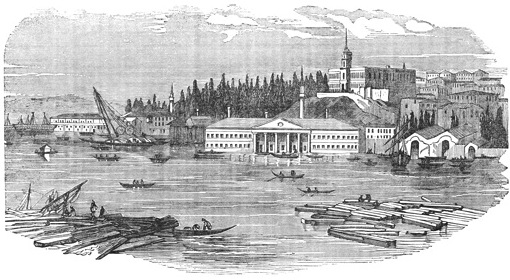
MARINE ARSENAL, CONSTANTINOPLE
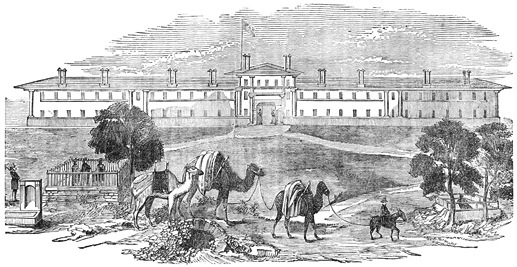
PLACE OF KOSSUTH’S IMPRISONMENT
The result of the Baltic operations may be given in few words. The fleet of the Czar, outnumbered by that of the allied powers, was detained in captivity at Helsingfors and Kronstadt, declining alike every offer of battle, and unable to stay the devastation that was effected along the Finnish shore of the Bothnian Gulf. Scarcely a Russian merchant vessel escaped the vigilance of the cruisers; and the whole line of her coasts, up to the shoals of Kettle Island, were shown to be at the mercy of the allies. In a national point of view, there was not much to boast of in the achievements of so stupendous a fleet. But there were individual acts of valor as bright as any that adorn the pages of naval history.
Until the last twelvemonth opened a new page in history, it could not have been anticipated that the battle-field of Europe would be a little arid peninsula in the remotest corner of the Black Sea, and that the armies of Britain, France, Turkey, and Russia would be concentrated in direct strife around a fortress, whose very name was hardly known in this country before the present war broke out.
Connected with the barren steppes of the mainland of Southern Russia only by the narrow strip of flat and sandy land, not five miles across, which constitutes the Isthmus of Perekop, the Crimea stretches out in a nearly northerly direction, in the form of a diamond-shaped peninsula, about one-third the size of Ireland. At its western point is Cape Tarkham; at its eastern, Kertch and Kaffa, and in the south, the bay, town, and fortress of Sebastopol.
At least one third of the Crimea consists of vast waterless plains of sandy soil, rising only a few feet above the level of the sea, and in many places impregnated with salt; but all along the south-eastern side of the peninsula, from Sebastopol to Kertch and Kaffa, there extends a chain of limestone mountains. Beginning at Balaklava, nine miles east of Sebastopol, precipices fringe all this north-eastern coast; but at the foot of these limestone precipices extends a narrow strip of ground, seldom half a league in width, intervening between the hills and the shore. It is in this picturesque and delightful region that the Allied army established its base of operations. A luxuriant vegetation descends to the water’s edge. Chesnut trees, mulberries, almonds, laurels, olives, and cypresses grow along its whole extent. Numbers of rivulets of the clearest water pour down from the cliffs, which effectually keep off cold and stormy winds. Thickly studded with villages, and adorned with the villas and palaces of the richest Russian nobles, this tract offers a most striking contrast to the remainder of the peninsula or indeed to any part of Russia.
The possession of the Crimea, and the construction of a maratime fortress of the first order in the magnificent harbor of Akhtiar (for such was the former name of Sebastopol) were prominent parts of that vast scheme of policy, by which the genius of the Czar Peter, and his successors, transformed Muscovy into the Russian Empire.
The ever-memorable expedition of the Allies, designed to wrench this fortress and fleet from the possession of the Czar, set sail from Varna in the first week of September, 1854. No naval expedition ever before equaled it.
In the bay of Baltjik, where the expedition first rendezvoused, the sea was literally covered for a space of eight miles long with splendid shipping. Thirty-seven sail of the line—ten English, sixteen French, and eleven Turkish, about a hundred frigates and lesser vessels of war, and nearly two hundred of the finest steam and sailing transports in the world, lay at anchor, in one immense semicircle, nine or ten deep. The great line of battle-ships, with lights gleaming from every port, looked like illuminated towns afloat; while the other vessels, with position-lights hoisted at the main and fore, shed a light upon the sea, twinkling away until lost in the distance. Each division of the army carried lights, corresponding to the number of their division, and at night, when every ship was lighted up the scene was of the most extraordinary and interesting description. Constantinople, during the feast of Bairam, or the feast of Lamps, described in Moore’s poems, would have been a worthy illustration.
On the 4th of September, 1854, six hundred vessels sailed from Varna, bearing the combined army of 60,000 in the direction of Sebastopol: at the same time intelligence was received by the commanders of a signal victory obtained by Schamyl at Tiflis, over the Russians under Prince Bebutoff. They lost on this occasion many men and horses, seven guns, 3000 tents, all their amunition, baggage, provisions, and retreated in some disorder from Kutais and Kars to Taflis.
On the 14th September, 58,000 men were landed at Eupatoria, about forty-five miles N. W. of Sebastopol. They subsequently advanced some distance inland without meeting with any opposition.
The place of debarkation had many advantages. It is a small town, containing only 4,000 inhabitants, weakly defended by a garrison of about 12,000 men, and in no condition to resist an invasion such as this. The commanders had intended, in the first place, to have thrown up entrenchments sufficiently strong to secure the place; but having experienced no resistance, the troops marched at once towards their destination. In this march they proceeded for about eleven miles, along a slip of land, having on the left the salt lake Sasik, and the sea on their right.
The country traversed is fertile, and well supplied with water by three rivers, the Alma, the Katcha, and the Balbek. On the left, or southern bank of the latter stream, the first obstacles encountered were the outworks recently thrown up by the Russians, and an old star fort. Having surmounted these, the Allies found themselves in possession of the high ground commanding the rear of the defenses on the northern shore of the inlet, and they were scarcely adapted to resist a strong attack.
As the Black Sea expedition was departing from Varna for the Crimea, the Baltic fleet, or the greater part of it, received orders to “bear up” for England.
On the night of the 18th September, 1854, orders were given by Lord Raglan that the troops should strike tents at daybreak. An advance had been determined upon, and it was understood that the Russian light cavalry had been sweeping the country of all supplies up to a short distance from the outlaying pickets.
At three o’clock next morning, the camp was roused by the reveille, and all the 30,000 sleepers woke into active life. Of Turkish infantry, 7,000 under Suleiman Pacha moved along by the sea side; next came the divisions of Generals Bosquet, Canrobert, Forey, and Prince Napoleon. The order of march of the English army was about four miles to the right of their left wing, and as many behind them. The right of the allied forces was covered by the fleet, which moved along with it in magnificent order, darkening the air with innumerable columns of smoke, ready to shell the enemy should they attack the right, and commanding the land for nearly two miles from the shore.
The troops presented a splendid appearance. The effect of these grand masses of soldiery descending the ridges of the hills, rank after rank, with the sun playing over forests of glittering steel, can never be forgotten by those who witnessed it. Onward the torrent of war swept, wave after wave, huge stately billows of armed men; while the rumbling of the artillery, and the tramp of cavalry, accompanied their progress. A halt took place about three o’clock, at a muddy stream, of which the men drank with avidity. At this stage they passed the Imperial post-house, twenty miles from Sebastopol.
Orders were given to halt and bivouac for the night, which was cold and damp, but the men were in excellent spirits, looking forward to the probability of an engagement with the enemy with perfect confidence as to the result.
On the morning of the 20th, ere daybreak, the whole force was under arms. They were marshaled silently; no bugles or drums broke the stillness; but the hum of thousands of voices rose loudly from the ranks, and the watchfires lighted up the lines of the camp as though it were a great town. When dawn broke it was discovered that the Russians had retired from the heights. It was known that the Russians had been busy fortifying the heights over the valley through which runs the little river Alma, and that they had resolved to try their strength with the allied army in a position giving them vast advantages of ground, which they had used every means in their power to improve to the utmost. The advance of the armies this great day was a sight which must ever stand out like a landmark of the spectator’s life. Early in the morning, the troops were ordered to get in readiness, and at half-past six o’clock they were in motion. It was a lovely day; the heat of the sun was tempered by a sea breeze. The fleet was visible at a distance of four miles, covering the ocean as it was seen between the hills, and steamers could be seen as close to the shore as possible. The Generals, St Arnaud, Bosquet, and Forey, attended by their staff, rode along the lines, with Lord Raglan and his Generals at second halt, and were received with tremendous cheering.
The order in which the army advanced was in columns of brigades in deploying distance; the left protected by a line of skirmishers of cavalry and of horse artillery. The advantage of the formation was, that the army, in case of a strong attack from cavalry and infantry on the left or rear, could assume the form of a hollow square, with the baggage in the centre. The great object was to gain the right of the position, so that the attacking parties could be sheltered by the vertical fire of the fleets. As soon as the position of the allies could be accurately ascertained, the whole line, extending itself across the champaign country for some five or six miles, advanced. At the distance of two miles the English army halted to obtain a little time to gather up the rear; and then the troops steadily advanced in grand lines, like the waves of the ocean.
The French occupied the high road, nearest the beach, with the Turks; and the English marched to the left. At about one o’clock in the afternoon, the Light Division of the French army came in sight of the village of Almatamak, and the British Light Division descried that of Burliuk, both situated on the right bank of the river Alma.
At the place where the bulk of the British army crossed, the banks of the Alma are generally at the right side, and vary from two and three to six and eight feet in depth to the water; where the French attacked, the banks are generally formed by the unvaried curve of the river on the left hand side. A village is approached from the north by a road winding through a plain nearly level till it comes near the village, where the ground dips, so that at the distance of three hundred yards a man on horseback can hardly see the tops of the nearer and more elevated houses, and can only ascertain the position of the stream by the willows and verdure along its banks. At the left or south side of the Alma the ground assumes a very different character—smooth where the bank is deep, and greatly elevated where the shelve of the bank occurs, it recedes for a few yards at a moderate height above the stream, pierced here and there by the course of the winter’s torrents, so as to form small ravines, commanded, however, by the heights above. It was on these upper heights, and to the sea, that the Russian army, forty-five thousand strong, besides six or eight thousand cavalry, and at least a hundred pieces of artillery, were posted. A remarkable ridge of mountains, varying in height from 500 to 700 feet, runs along the course of the Alma on the left or south side with the course of the stream, and assuming the form of cliffs when close to the sea. At the top of the ridges, between the gullies, the Russians had erected earthwork batteries, mounted with 32lb. and 24lb. brass guns, supported by numerous field pieces and howitzers. These guns enfiladed the tops of the ravines parallel to them, or swept them to the base, while the whole of the sides up which an enemy, unable to stand the direct fire of the batteries, would be forced to ascend, were filled with masses of skirmishers, armed with an excellent two-grooved rifle, throwing a large solid conical ball with force at 700 and 800 yards, as the French learned to their cost. The principal battery consisted of an earthwork of the form of the two sides of a triangle, with the apex pointed towards the bridge, and the sides covering both sides of the stream, corresponding with the bend of the river below it, at the distance of 1000 yards; while, with a fair elevation, the 32-pounders threw, very often, beyond the houses of the village to the distance of 1400 and 1500 yards. This was constructed on the brow of a hill about 600 feet above the river, but the hill rose behind it for another 50 feet before it dipped away towards the road. The ascent of this hill was enfiladed by the fire of three batteries of earthwork on the right, and by another on the left, and these batteries were equally capable of covering the village, the stream, and the slopes which led up the hill to their position. In the first battery were thirteen 32-pounder brass guns of exquisite workmanship, which only told too well. In the other batteries were some twenty-five guns in all.
The force of the British was about 26,000, that of the French about 23,000.
It had not escaped the observation of the allied Commanders that the Russian General had relied so confidently on the natural strength of his position towards the sea where the cliff rose steep and high above the gardens of an adjacent village, that he had neglected to defend this part of his works by masses of troops or by heavy guns. These military defenses were, on the contrary, accumulated on his right and centre. The plan of the battle was therefore formed so as to enable the French, and a Turkish division, in the first instance, to turn the Russian left, and gain the plateau; and, as soon as this operation was accomplished, so as to occupy a portion of the Russian army, the British troops and the French Third Division were to attack the key of the position on the right of the enemy, while the French completed his defeat on the upper ground.
General Bosquet’s division crossed the river Alma near the mouth about 11:30; the Turkish battalions crossing at the same time close to the bar, and within musket range of the beach. This movement was unopposed; and, although a crowd of French skirmishers and light-infantry crossed the gardens and brushwood below the hill, which might easily have been defended, not a shot was fired on them, and not a gun seemed to bear on the line of march they followed. It was afterwards ascertained from the Russian prisoners, that Prince Menschikoff had left this line unguarded, because he regarded it as absolutely impassable even for goats. He did not know the Zouaves. With inconceivable rapidity and agility they swarmed up the cliff, and it was not till they formed on the height, and deployed from behind a mound there, that the Russian batteries opened upon them. The fire was returned with great spirit, and a smart action ensued, during which General Bosquet’s division was engaged for some time almost alone, until General Canrobert came to his support. The Turkish division, which presented a very martial appearance, and was eager to fight, formed part of the army under the command of Marshal St. Arnaud; and some regret was felt by these brave troops that they had no active part assigned to them in the struggle.
While the French troops were scaling the heights, the French steamers ran in as close as they could to the bluff of the shore at the south side of the Alma, and commenced shelling the Russians in splendid style; the shells bursting over the enemy’s squares and batteries, and finally driving them from their position on the right, within 3000 yards of the sea. The Russians answered the ships from the heights, but without effect.
At 1:50 a line of skirmishers got within range of the battery on the hill, and immediately the Russians opened fire at 1200 yards, with effect, the shot ploughing through open lines of the riflemen, and falling into the advancing columns behind. Shortly ere this time, dense volumes of smoke rose from the river, and drifted along to the eastward, interfering with the view of the enemy on the left. The Russians had set the village on fire. It was a fair exercise of military skill—was well executed—took place at the right time, and succeeded in occasioning a good deal of annoyance. It is said the Russians had taken the range of all the principal points in their front, and placed twigs and sticks to mark them. In this they were assisted by the post sign-boards on the road. The Russians opened a furious fire on the whole English line. The round shot whizzed in every direction, dashing up the dirt and sand into the faces of the staff of Lord Raglan. Still he waited patiently for the development of the French attack. At length, an Aid-de-Camp came to him and reported the French had crossed the Alma, but they had not established themselves sufficiently to justify an attack. The infantry were, therefore, ordered to lie down, and the army for a short time was quite passive, only that the artillery poured forth an unceasing fire of shell, rockets, and round shot, which plowed through the Russians, and caused them great loss. They did not waver, however, and replied to the artillery manfully, their shot falling among the men as they lay, and carrying off legs and arms at every round.
Lord Raglan at last became weary of this inactivity, and gave orders for the whole line to advance. Up rose these serried masses, and—passing through a fearful shower of round, case-shot and shell—they dashed into the Alma and ‘floundered’ through its waters, which were literally torn into foam by the deadly hail. At the other side of the river were a number of vineyards, occupied by Russian riflemen. Three of the staff were here shot down; but, led by Lord Raglan in person, they advanced, cheering on the men. And now came the turning point of the battle, in which Lord Raglan, by his sagacity, probably secured the victory at a smaller sacrifice than would have been otherwise the case. He dashed over the bridge, followed by his staff. From the road over it, under the Russian guns, he saw the state of the action. The British line, which he had ordered to advance, was struggling through the river and up the heights in masses, firm indeed, but mowed down by the murderous fire of the batteries; and by grape, round shot, shell, canister, case-shot, and musketry, from some of the guns in the central battery, and from an immense and compact mass of Russian infantry.
Then commenced one of the most bloody and determined struggles in the annals of war. The 2d Division, led by Sir de Lacy Evans, crossed the stream on the right. Brigadier Pennefather (who was in the thickest of the fight, cheering on his men), again and again was checked, but never drew back in his onward progress, which was marked by a fierce roll of Minié musketry; and Brigadier Adams bravely charged up the hill, and aided him in the battle. Sir George Brown, conspicuous on a gray horse, rode in front of his Light Division, urging them with voice and gesture. Meantime the Guards on the right of the Light Division, and the brigade of Highlanders, were storming the heights on the left. Suddenly a tornado of round and grape rushed through from the terrible battery, and a roar of musketry from behind it thinned their front ranks by dozens. It was evident that the troops were just able to contend against the Russians, favored as they were by a great position. At this very time an immense mass of Russian infantry were seen moving down towards the battery. They halted. It was the crisis of the day. Sharp, angular, and solid, they looked as if they were cut out of the solid rock. Lord Raglan saw the difficulties of the situation. He asked if it would be possible to get a couple of guns to bear on these masses. The reply was ‘Yes;’ and an artillery officer brought up two guns to fire on the Russian squares. The first shot missed, but the next, and the next, and the next, cut through the ranks so cleanly, and so keenly, that a clear lane could be seen for a moment through the square. After a few rounds the columns of the square became broken, wavered to and fro, broke, and fled over the brow of the hill, leaving behind them six or seven distinct lines of dead, lying as close as possible to each other, marking the passage of the fatal messengers. This act relieved the infantry of a deadly incubus, and they continued their magnificent and fearless progress up the hill. ‘Highlanders,’ said Sir C. Campbell, ere they came to the charge, ‘don’t pull a trigger till you’re within a yard of the Russians!’ They charged, and well they obeyed their chieftain’s wish; Sir Colin had his horse shot under him; but he was up immediately, and at the head of his men. But the Guards pressed on abreast, and claimed, with the 33d, the honor of capturing a cannon. The Second and Light Division crowned the heights. The French turned the guns on the hill against the flying masses, which the cavalry in vain tried to cover. A few faint struggles from the scattered infantry, a few rounds of cannon and musketry, and the enemy fled to the south-east, leaving three Generals, three guns, 700 prisoners, and 4000 killed and wounded, behind them.
The loss on the part of the British was 2000 killed, wounded, and missing; that of the French, about 1400.
On the night after the battle the allied army bivouacked on the summit of the heights which they had so gloriously won; the French Marshal pitching his tent on the very spot occupied by that of Prince Menschikoff the morning before.
On the 23d the Allied armies left the Alma and proceeded to cross the Katscha; on the 24th they crossed the Belbec, where it had been intended to effect the landing of the siege materiel with a view to an attack on the north side of Sebastopol. It was found, however, that the enemy had placed a fortified work so as to prevent the vessels and transports from approaching this river; and it was determined to advance at once by a flank march round the east of Sebastopol, to cross the valley of the Tchernaya, and seize Balaklava as the future basis of operations against the south side of the harbor at Sebastopol.
The enemy did not hold Balaklava in any strength. After a few shots the little garrison surrendered, and as Sir E. Lyon’s ship, the Agamemnon, reached the mouth of the harbor at the very time that the troops appeared on the heights, the British army was once more in full communication with the fleet.
The march of the French army which followed in the track of the British, was more prolonged and fatiguing. They did not reach the Tchernaya river until the 26th, having passed the previous night at Mackenzie’s Farm. It was on this day that the French marshal, at length succumbing to his fatal malady, issued his last order of the day, in which he took leave formally of his troops, and resigned the command into the hands of General Canrobert.
Having swept the enemy from their path by the bloody triumphs of the Alma, the next step of the Allies was to lay siege to Sebastopol.
The bay of Balaklava, which now became the principal base of their operations, is a place admirably suited for the landing of stores and materiel. As a port it is the most perfect of its size in the world. The entrance is between perpendicular cliffs, rising eight hundred feet high on either hand, and is only wide enough to allow the passage of one ship at a time; but once in you find yourself in a land-locked tideless haven, still as a mountain lake, three quarters of a mile in length, by two hundred and fifty yards wide, and nowhere less than six fathoms deep, so that every square foot of its surface is available for ships of the greatest burden.
The bay of Balaklava was instantly adopted as the new base of operations of the British army, and never before did its waters mirror so many tall ships on their bosom.
From fifty to a hundred war-ships and transports were constantly at anchor, landing the siege-guns, stores, and provisions of all kinds. The only access to Balaklava from the land side is at the inner end of the bay, through a breach in the surrounding hills, which gradually opens out into an extensive valley, about three miles long by about two broad; it was in this valley that the serious part of the combat of the 25th October took place. Through this valley runs the road to the Tchernaya and Mackenzie’s Farm, by which the Allies advanced to Balaklava, and which on the other side of the Tchernaya enters deep gorges in the mountains. On the side next the sea this valley is bounded by a line of hills stretching from Balaklava to Inkerman, and along the summit of which runs the road to Sebastopol. Another road in the opposite direction conducts to the valley of Baider, the most fertile district of the Crimea.
The port of Balaklava having been found barely large enough for the landing of the British stores and guns, the French selected as their base of operations the three deep bays lying between Cape Chersonesus and Sebastopol bay. The country between Balaklava and Sebastopol, upon which the Allied army encamped, is a barren hilly steppe, destitute of water, and covered with no better herbage than thistles. The French took up their position next the sea; the British inland, next the Tchernaya. The front of the besieging force extended in a continuous line from the mouth of the Tchernaya to the sea at Strelitska bay, forming nearly a semicircle around Sebastopol, at a distance of about two miles from the enemy’s works. The position was found to be close enough, as the Russian guns were found to throw shells to the distance of four thousand yards. A most unfortunate delay took place in landing and bringing up the siege guns and stores of the Allies; a delay which was improved to the utmost by the Russians, who kept large bands of citizens, and even women, as well as the garrison, at work in relays both night and day, in throwing up a vast exterior line of earthen redoubts and entrenchments, and in covering the front of their stone-works with earth.
The force disposable for the defense of Sebastopol was nearly equal in number to the besieging army; and as, from the nature of its position, the place could only be invested upon one side, supplies of all kinds could be conveyed into the town, and the Russian generals could either man the works with their whole forces, or direct incessant attacks against the flank and rear of the allies.
Never did any army ever undertake so vast and perilous an enterprise as that in which the allied commanders found themselves engaged.