AMERICAN ENCYCLOPEDIA (continued 25)
Reading edition
JOHN PAUL JONES.
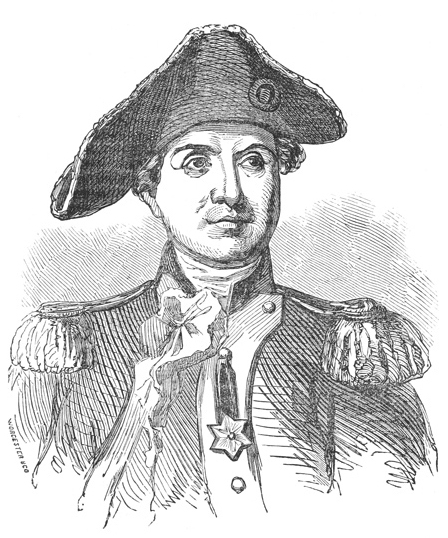
PAUL JONES.
John Paul Jones was born at Arbingland, in Scotland, July 6th 1747. His father was a gardener, whose name was Paul; but the son assumed that of Jones in subsequent life, for what reason is not known. Young Paul early evinced a decided predilection for the sea, and, at the age of 12, was bound apprentice to a respectable merchant of Whitehaven, in the American trade. His first voyage was to America, where his elder brother was established as a planter. He was then engaged for some time in the slave-trade, but quitted it in disgust, and returned to Scotland, in 1768, as passenger in a vessel, the captain and mate of which died on the passage. Jones assumed the command, at the request of those on board, and brought the vessel safe into port. For this service, he was appointed by the owners master and supercargo. While in command of this vessel, he punished a sailor who afterwards died of a fever at the island of Tobago—a circumstance which gave rise to an accusation against Jones, of having caused his death, by the severity of the punishment upon him; but this has been completely refuted. Jones was afterwards in command of the Betsy, of London, and remained some time in the West Indies, engaged in commercial pursuits and speculations, by which it is said he realized a handsome fortune. In 1773, he was residing in Virginia, arranging the affairs of his brother, who had died intestate and childless, and about this time took the name of Jones. In Virginia he continued to live until the commencement of the struggle between the colonies and mother country. He offered his services to the former, and was appointed first of the first lieutenants, and designated to the Alfred, on board of which ship, to use his own language in one of his letters, ‘he had the honor to hoist, with his own hands, the flag of freedom, the first time it was displayed on the Delaware.’ Soon after this, we find Jones in command of the Providence, mounting 12 four-pounders, with a complement of 70 men, cruising from the Bermudas to the Gut of Canso, and making 16 prizes in little more than six weeks. In May, 1777, he was ordered to proceed to France, where the American commissioners, Franklin, Deane and Lee, were directed to invest him with the command of a fine ship, as a reward of his signal services. On his arrival in France, he was immediately summoned to Paris by the commissioners. The object of this summons was to concert a plan of operations for the force preparing to act against the British in the West Indies, and on the coast of America. This plan, which certainly did great honor to the projector, though untoward delays and accidents prevented its immediate success, was afterwards openly claimed by Jones as his own, without acknowledging the assistance or participation of the American commissioners or the French ministry. The Ranger was then placed under his orders, with discretion to cruise where he pleased, with this restriction, however, that he was not to return to France immediately after making attempts upon the coasts of England, as the French government had not yet declared itself openly as the ally of the U. States. April 10th 1778 he sailed on a cruise, during which he laid open the weakness of the British coast. With a single ship, he kept the whole coast of Scotland, and part of that of England, for some time, in a state of alarm, and made a descent at Whitehaven, where he surprised and took two forts, with 30 pieces of cannon, and set fire to the shipping. In this attack upon Whitehaven, the house of the earl of Selkirk, in whose service the father of Jones had been gardener, was plundered, and the family plate carried off. But the act was committed without his knowledge, and he afterwards made the best atonement in his power. After his return to Brest with 200 prisoners of war, he became involved in a variety of troubles, for want of means to support them, pay his crew, and refit his ship. After many delays and vexations, Jones sailed from the road of St. Croix, August 14th, 1779, with a squadron of seven sail, designing to annoy the coasts of England and Scotland. The principal occurrence of this cruise was the capture of the British ship of war Serapis, after a bloody and desperate engagement, off Flamborough head, September 23d, 1779. The Serapis was a vessel much superior in force to Jones’ vessel, the Bon Homme Richard, which sunk not long after the termination of the engagement. The sensation produced by this battle was unexampled, and raised the fame of Jones to its acme. In a letter to him, Franklin says, ‘For some days after the arrival of your express, scarce any thing was talked of at Paris and Versailles, but your cool conduct and persevering bravery during that terrible conflict. You may believe that the impression on my mind was not less strong than on that of the others. But I do not choose to say, in a letter to yourself, all I think on such an occasion.’ His reception at Paris, whither he went on the invitation of Franklin, was of the most flattering kind. He was every where caressed; the king presented him with a gold sword, bearing the inscription, Vindicati maris Ludovicus XVI remuneratur strenuo vindici, and requested permission of congress to invest him with the military order of merit—an honor never conferred on any one before who had not borne arms under the commission of France. In 1781, Jones sailed for the U. States, and arrived in Philadelphia February 18 of that year, after a variety of escapes and rencounters, where he underwent a sort of examination before the board of admirality, which resulted greatly to his honor. The board gave it as their opinion, ‘that the conduct of Paul Jones merits particular attention, and some distinguished mark of approbation from congress.’ Congress passed a resolution, highly complimentary to his ‘zeal, prudence and intrepidity.’ General Washington wrote him a letter of congratulation, and he was afterwards voted a gold medal by congress. From Philadelphia he went to Portsmouth, New Hampshire, to superintend the building of a ship of war, and, while there, drew up some admirable observations on the subject of the American navy. By permission of congress, he subsequently went on board the French fleet, where he remained until the conclusion of peace, which put a period to his naval career in the service of the U. States. He then went to Paris, as agent for prize-money, and, while there, joined in a plan to establish a fur-trade between the north-west coast of America and China, in conjunction with a kindred spirit, the celebrated John Ledyard. In Paris, he continued to be treated with the greatest distinction. He afterwards was invited into the Russian service, with the rank of rear-admiral, where he was disappointed in not receiving the command of the fleet acting against the Turks in the Black sea. He found fault with the conduct of the prince of Nassau, the admiral; became restless and impatient; was intrigued against at court, and calumniated by his enemies; and had permission, from the empress Catharine, to retire from the service with a pension, which was never paid. He returned to Paris, where he gradually sunk into poverty, neglect, and ill health, until his death, which was occasioned by jaundice and dropsy, July 18th 1792. His last public act was heading a deputation of Americans, who appeared before the national assembly to offer their congratulations on the glorious and salutary reform of their government. This was before the flight of the king. Jones was a man of signal talent and courage; he conducted all his operations with the most daring boldness, combined with the keenest sagacity in calculating the chances of success and the consequences of defeat. He was, however, of an irritable, impetuous disposition, which rendered him impatient of the authority of his superiors, while he was, at the same time, harsh in the exercise of his own; and he was deficient in that modesty which adorns great qualities and distinguished actions, while it disarms envy and conciliates jealousy. His early education was of a very limited kind. It terminated when he went to sea, at the age of twelve, but he supplied its defects by subsequent study, so as to enable himself to write with fluency, strength and clearness, and to sustain his part respectably in the polished society into which he was thrown. In his letters, he inculcates the necessity of knowledge for naval officers, and intimates that he had devoted ‘midnight studies’ to the attainment of that information which he deemed requisite in his situation. His memorials, correspondence, etc., are quite voluminous. He also wrote poetry, and in Paris was a great pretender to ton, as a man of fashion, especially after his victory over the Serapis, which, of course, gave him great eclat amongst the ladies of the French capital. At this period, he is described by an English lady then resident of Paris, as ‘a smart little man of thirty-six; speaks but little French, and appears to be an extraordinary genius, a poet as well as a hero.’ An account of his life has been written by J. H. Sherburne (Washington, 1828).
GENERAL ANDREW JACKSON.
General Andrew Jackson was born on the 15th of March, 1767, at the Waxsaw settlement, in South Carolina. His parents emigrated to this country, two years previously, from the north of Ireland. He lost his father at a very early age; and the task of bringing him up devolved exclusively upon his mother. Intending him, it is said, to become a clergyman, she resolved, though restricted in her pecuniary circumstances, to give him a liberal education. For this purpose, she placed him at an academy, where he continued until his studies were interrupted by the advance of the British troops into the neighborhood, during the revolutionary war. Young as he was (scarcely 14 years of age), in company with an elder brother, he joined the American army. Before long, however, they had the misfortune of being made prisoners by the enemy, who maltreated them as rebels, and inflicted upon them injuries of which the brother died after having been exchanged. Andrew Jackson commenced the study of the law at Salisbury, in North Carolina, in the winter of 1784, and was admitted to the bar in 1786. In 1788, he removed to Nashville, then a new settlement in the western district of North Carolina. This district having been ceded to the United States, and organized into a territory in 1790, he was appointed to the office of United States’ attorney; and when the territory, in its turn, in 1796 became the state of Tennessee, he was a member of the convention to frame a constitution for it, and took a conspicuous part in the proceedings of this body. He was immediately afterwards chosen a representative, and in the next year a senator, in Congress. But his seat in the Senate he held only for a single session, alleging, as a reason for resigning it, his distaste for the intrigues of politics. On this, he was appointed by the Legislature of Tennessee to be a judge of the Supreme Court of that state; an office which he accepted with reluctance, and from which he soon retired to his farm on the Cumberland river, near Nashville. And there he continued to reside till the breaking out of the war with Great Britain, in 1812. During the earlier part of his residence in Tennessee, General Jackson had repeatedly distinguished himself by his prowess, in the warfare carried on by the settlers with their Indian neighbors, and had even earned from the latter, by his exploits, the appellations of ‘Sharp Knife’ and ‘Pointed Arrow.’ That after attaining to a prominent position in civil life, he should be selected by his fellow-citizens to occupy a corresponding military rank among them, was therefore almost a matter of course. The war of 1812, accordingly, found him a major-general of one of the divisions of the Tennessee militia. In the month of November of that year, he proceeded, by the direction of the government, at the head of a body of between two and three thousand volunteers, who had assembled on his invitation, down the Mississippi to Natchez, for the protection of the country against an apprehended hostile movement on the part of the Indians. The danger having passed away, he was ordered by the secretary of war to disband his troops on the spot. This order he did not hesitate to disobey, on account, as he stated, of many of his men being sick, and unprovided with the means of paying their expenses on their way home. They returned accordingly in a body with their General, whose apology for the course which he pursued was accepted by the government. In 1813 and 1814, General Jackson was employed against the Creek and Muscogee Indians, who had invaded the frontier settlements of Alabama and Georgia, and inflicted on the inhabitants the usual horrors of savage warfare. After a succession of bloody victories achieved by him over those tribes, they agreed, by a treaty concluded in August, 1814, to lay down their arms. In the month of May of this year, he was appointed a major-general in the service of the United States; and having first seized upon the town of Pensacola, in consequence of the admission into its harbor, by the Spanish governor, of a British squadron to refit, he proceeded to take the command of the forces intended for the defense of New Orleans against the approaching attack of the enemy. On arriving there on the 1st of December, he took his measures with the utmost decision and promptness. Becoming convinced of the expediency of taking precautions against the treachery of some disaffected individuals, he proposed to the Legislature of Louisiana, then in session, to suspend the privilege of the writ of Habeas Corpus. Impatient, however, of the time consumed in deliberating on his proposal, he proclaimed martial law, thus at once superseding the civil authority by the introduction of a rigid military police. Towards the enemy he acted with the same determined energy. Scarcely had the British troops effected a landing, when he marched against them, and by unexpectedly assailing them, in the night of the 22d of December, gained some advantages; the most important of which was that for which this movement of the General was chiefly made, namely, the impression produced upon his followers of their own ability to perform successfully the part assigned to them, at least while commanded by him, as well as that communicated to the invaders, of the formidable character of the opposition which they were destined to encounter. The contest for the possession of New Orleans was brought to a close by the memorable battle of the 8th of January, 1815, which raised the reputation of the American commander to the highest pitch among his countrymen, and served as a satisfactory apology with many for the strong measures adopted by him before the landing of the enemy, as well as for others which he adopted immediately after the retreat of the latter. General Jackson’s next public employment was the conduct of the war against the Seminole Indians, in 1818. With a force composed of Tennessee volunteers and Georgia militia, he penetrated into Florida to the retreats of the savages and fugitive slaves who had joined them, and set fire to their villages. He likewise took possession, without hesitation, of several of the Spanish posts in that region, whence the Indians had been supplied with arms and ammunition, and executed two Englishmen who had been actively engaged in this trade. The posts were restored by the orders of the government; but an attempt in the House of Representatives in Congress to inflict a censure upon General Jackson, for the irregularity of his proceedings, was defeated, after very protracted debates, by a considerable majority. When Florida was transferred by Spain to the United States, he was appointed the first governor of the new territory (in 1821). He resigned this office, and returned to his farm near Nashville, in the following year. In 1823, he was once more chosen to represent the State of Tennessee in the Senate of the United States, but resigned his seat in that body on becoming a prominent candidate for the presidency. Of the electoral votes which were given in the end of the year 1824, he received 99, Mr. Adams 84, Mr. Crawford 41, and Mr. Clay 37. The election devolved, by the provisions of the constitution, on the members of the House of Representatives in Congress, voting by states, and Mr. Adams was selected to be the president. In 1828, and again in 1832, General Jackson was chosen to fill that high office; in the former instance, by 178 of the electoral votes to 83 given in favor of Mr. Adams; and, in the latter, by a majority of 170 electoral votes above his opponent, Mr. Clay. He survived his presidency somewhat more than 8 years, dying at his residence, the ‘Hermitage,’ near Nashville, on the 8th of June, 1845. Though enfeebled in body, he retained his mental faculties, apparently undiminished, till the day of his death. ‘The violence of political strife,’ as is remarked by a writer in the American Almanac for 1846, ‘will long confuse men’s judgment of his character and abilities as a whole; but will accord to him the praise of great firmness, energy, decision, and disinterestedness,—of remarkable military skill, and ardent patriotism.’
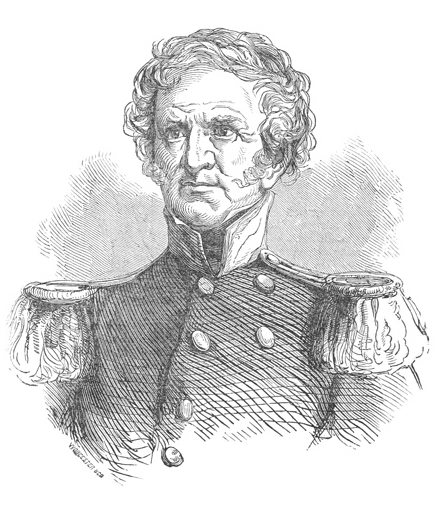
GEN. SCOTT.
WINFIELD SCOTT
Winfield Scott, commander-in-chief of the American army, was born June 13, 1786, near Petersburg, Virginia. He is descended from a Scotch family, who were obliged to take refuge in America after the rebellion of 1745. After completing his preparatory education, he spent a year or two at William and Mary college, and afterward studied the law, and was admitted to the bar in 1806. In the autumn of 1807, he emigrated to South Carolina, intending to practice his profession at Charleston, but meeting with difficulties in the attainment of his object, he returned to the north. The political events of the country were then rapidly approaching the crisis of 1812; a bill had passed through Congress to enlarge the army, and Scott having applied for a commission, was appointed, in 1808, captain in a regiment of light artillery, and was ordered the following year to join the army in Louisiana, under the command of General Wilkinson. For some act of insubordination toward his commander he was suspended for a year, but he again joined the army before the commencement of the war. Shortly after that event, he received a lieutenant-colonel’s commission, and was posted at Black Rock, on the Niagara frontier. His first active service was at the attack of Qeenstown heights, where he took command of the American force after all the superior officers were killed or wounded. This affair, as is well known, ended disastrously, and Scott, with the survivors of his men, became prisoners-of-war. From Queenstown he was sent to Quebec, and shortly after exchanged. In the following year he distinguished himself at the attack on Fort George, in the descent upon York, and the capture of Fort Matilda, on the St. Lawrence. In March, 1814, he was made brigadier-general; July 3, in the same year, he captured Fort Erie, and on the fifth he fought the bloody battle of Chippewa, in which both sides claimed the victory. On the 25th of the same month was fought the still more sanguinary battle of Niagara or Lundy’s Lane. In this well-fought contest, General Scott was badly wounded, and his life is said to have been despaired of for some weeks. Philadelphia and Baltimore having been threatened with an attack, Scott was requested to take command of the forces in that vicinity. On his way to the scene of his duties, he passed through Princeton, and the learned dignitaries of the college in that town conferred upon the general the honorary degree of master of arts, a curious compliment, probably having some reference to the art of war. About the same time he was promoted to the rank of major-general, the highest grade in the army, he being at that time but twenty-eight years of age. On the conclusion of the peace, in 1815, he was tendered the post of secretary of war, but declined to accept it; and the same year he paid a visit to Europe, principally for the purpose of improving himself in his profession. About 1833 he brought the Black-Hawk war, in the north-western frontier, to a successful termination, and he was shortly after in command at the commencement of the Seminole war in Florida; but this not being so successful as was anticipated, he was ordered home and deprived of his command. In 1837-’38 he was stationed on the Niagara frontier to enforce the neutrality of the United States during the ‘patriot war’ in Canada; and soon afterward he superintended the removal of the Cherokee Indians beyond the Mississippi. By the death of General Macomb, in 1841, General Scott became commander-in-chief of the army. The scene of his next exploits was Mexico. After some difficulty with the president and secretary of war, General Scott was permitted to lead a force to Vera Cruz. The events of that campaign are recent and well known. San Juan de Ulloa was captured March 27, 1847; the battle of Cerro Gordo was fought on the 18th of April; the battle of Contreras on the 19th of August; and the battle of Churubusco on the following day; and after the storming of Molino del Rey and Chapultepec, the city of Mexico was captured September 14, 1847.
ZACHARY TAYLOR.
Zachary Taylor was born in Orange County, Virginia, in November, 1784. He was the second son of Col. Richard Taylor, whose ancestors emigrated from England about two centuries ago, and settled in Eastern Virginia. The father, distinguished alike for patriotism and valor, served as colonel in the revolutionary war, and took part in many important engagements. About 1790 he left his Virginian farm, and emigrated with his family to Kentucky. He settled in the ‘dark and bloody ground,’ and for years encountered all the trials then incident to border life. The earliest impressions of young Zachary were the sudden foray of the savage foe, the piercing warwhoop, the answering cry of defiance, the gleam of the tomahawk, the crack of the rifle, the homestead saved by his father’s daring, the neighboring cottage wrapped in flames, or its hearth-stone red with blood. Such scenes bound his young nerves with iron, and fired his fresh soul with martial ardor; working upon his superior nature they made arms his delight, and heroism his destiny. Zachary was placed in school at an early age, and his teacher, who now resides in Preston, Connecticut, still loves to dwell on the studiousness of his habits, the quickness of his apprehension, the modesty of his demeanor, the firmness and decision of his character, and a general thoughtfulness, sagacity, and stability, that made him a leader to his mates and a pride to his master.
After leaving school, the military spirit of young Taylor was constantly fanned by the popular excitement against the continual encroachments of England; and soon after the murderous attack of the British ship Leopard upon the Chesapeake, in 1808, he entered the army as first lieutenant in the 7th regiment of infantry. He soon gained distinction in border skirmishes with the Indians, and the declaration of war with England found him promoted to the rank of captain. Within sixty days after the commencement of hostilities in 1812, the imbecility of Hull lost to the country its Michigan territory, and fearfully jeoparded the whole northwestern region. It was of the utmost importance to entrust the few and feeble forts of that great dominion to men of established valor and discretion. Captain Taylor was at once invested with the command of Fort Harrison, situated on the Wabash, in the very heart of the Indian country. The defenses of this post were in a miserable condition, and its garrison consisted of only fifty men, of whom thirty were disabled by sickness. With this little handful of soldiers, the young commander immediately set about repairing the fortifications. He had hardly completed his work, when, on the night of the 4th of September, an alarm shot from one of his sentinels aroused him from a bed of fever, to meet the attack of a large force of Miami Indians. Every man was at once ordered to his post. A contiguous block house was fired by the enemy, and a thick discharge of bullets and arrows was opened upon the fort. The darkness of the night, the howlings of the savages, the shrieks of the women and children, the fast approaching flames, and the panic of the debilitated soldiers, made up a scene of terror, but could not shake the determination nor the judgment of the young chieftain. He inspired his men with his own courage and energy. The flames were extinguished, the consumed breastworks were renewed, and volley answered volley for six long hours till day break enabled the Americans to aim with a deadly precision that soon dispersed their foes. This gallant repulse, at odds so unfavorable, prompted a report from Major General Hopkins to Governor Shelby that ‘the firm and almost unparalleled defense of Fort Harrison had raised for Captain Zachary Taylor a fabric of character not to be affected by eulogy;’ and forthwith procured from President Madison a preferment to the rank of brevet major, the first brevet, it is said, ever conferred in the American army.
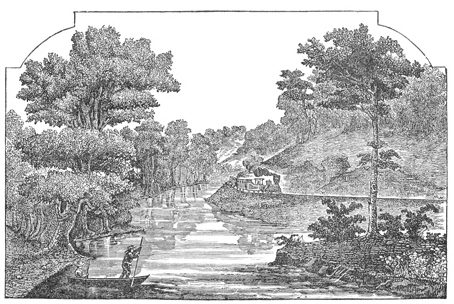
VIEW NEAR FORT ANCIENT, OHIO.
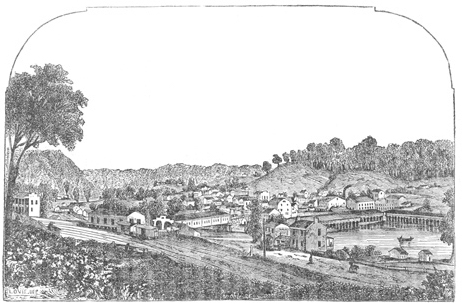
VIEW OF MILFORD.
Major Taylor continued actively engaged throughout the war; but being without a separate command, he had no opportunity to again signalize himself by any remarkable achievement. After the treaty of peace, he remained at the West, faithfully performing his duties at different military posts, and preparing himself for any future call to more active service. In 1832, he was promoted to the rank of colonel; and soon after the opening of the Florida war, he was ordered to that territory. Here he was in constant service, and distinguished himself for his discretion and gallantry in circumstances of the most trying difficulty and peril. His entire career won for him universal esteem and confidence.
The greatest achievement of Colonel Taylor in Florida was his victory of Okee-Chobee, which was gained on the 25th of December, 1837. The action was very severe, and continued nearly four hours. The Indians, under the command of Alligator and Sam Jones, numbered about 700 warriors, and were posted in a dense hammock, with their front covered by a small stream, almost impassable on account of quicksands, and with their flanks secured by swamps that prevented all access. Colonel Taylor’s force amounted to about 500 men, a portion of whom were inexperienced volunteers. By an extraordinary effort, the stream in front was crossed, under a most galling fire of the enemy, by our soldiers, who sunk to the middle in the mire. A close and desperate fight ensued, during which the five companies of the sixth infantry, who bore the brunt of the fray, lost every officer but one, and one of these companies saved only four privates unharmed. The enemy’s line was at last broken, and their right flank turned. They were soon scattered in all directions, and were pursued until near night. The American loss was 26 killed and 112 wounded; that of the Indians was very large, but never definitely ascertained. Throughout the whole engagement, Colonel Taylor was passing on his horse from point to point within the sweep of the Indian rifles, emboldening and directing his men, without the least apparent regard for his own personal safety. This victory had a decisive influence upon the turn of the war; and the government immediately testified their sense of its importance by conferring upon its gallant winner the rank of brigadier-general by brevet.
In the following May, General Taylor succeeded General Jesup in the command of the Florida army, and in this capacity, during two years, he rendered vast services to the country by quelling the atrocities of Indian warfare, and restoring peace and security to the southern frontier. In 1840, at his own request, he was relieved by Brigadier-general Armistead, and was ordered to the southwestern department. Here he remained at various head-quarters until government had occasion for his services in Texas.
The project for the annexation of Texas, which was first officially broached in the last year of President Tyler’s administration, acquired more and more weight and influence, until finally, in March, 1845, an act to that effect was passed by both Houses of Congress, and was soon after ratified by the Texian government. Mexico, although the independence of Texas had been long before de facto secured, stoutly protested against the annexation. The special American envoy sent to the Mexican capital to attempt an adjustment of this and other difficulties, was refused a hearing, and great preparations were carried on by the Mexican government for another invasion of Texas. In June, General Taylor received orders to advance with his troops over the Sabine, and protect all of the territory east of the Rio Grande, over which Texas exercised jurisdiction. He accordingly marched into Texas, and in August concentrated his forces, amounting to about 3000 men, at Corpus Christi. Receiving orders from Washington to proceed to the Rio Grande, the general, with his little army, moved westward in March, 1846; and after considerable suffering from the heat and the want of food and water, reached the banks of the river opposite Matamoras on the 28th of the month. Colonel Twiggs, with a detachment of dragoons, in the mean time took possession of Point Isabel, situated on an arm of the Gulf, about 25 miles east. General Taylor took every means to assure the Mexicans that his purpose was not war, nor violence in any shape, but solely the occupation of the Texian territory to the Rio Grande, until the boundary should be definitively settled by the two republics.
After encamping opposite Matamoras, the American general prepared with great activity for Mexican aggression, by erecting fortifications, and planting batteries. The Mexicans speedily evinced hostile intentions. General Ampudia arrived at Matamoras with 1000 cavalry and 1500 infantry, and made overtures to our foreign soldiers to ‘separate from the Yankee bandits, and array themselves under the tri-colored flag!’ Such solicitations were of course spurned with contempt. The American general was summoned to withdraw his forces at the penalty of being treated as an enemy; he replied that, while avoiding all occasion for hostilities, he should faithfully execute the will of his government. General Arista soon after arrived at Matamoras, and, superseding Ampudia, issued a proclamation to the American soldiers, begging them not to be the ‘blind instruments of unholy and mad ambition, and rush on to certain death.’ He immediately threw a large body of troops over the river, in order to cut off all communication between General Taylor and his dépôt at Point Isabel. A detachment of 61 soldiers, under Captain Thornton, was waylaid by a Mexican force of ten times their number, and after a bloody conflict and the loss of many lives, was obliged to surrender. With but eight days’ rations, and the country to the east fast filling up with the Mexican troops, the position of General Taylor became very critical. He at once resolved, at every hazard, to procure additional supplies; and, leaving the fort under the command of Major Brown, he set out with a large portion of his army, on the 1st of May, for Point Isabel. He reached that place the next day, without molestation. Soon after his departure, the Mexicans opened their batteries upon Fort Brown. The fire was steadily returned with two long eighteen and sixteen brass six pounders by the garrison, which numbered about 900 men. The bombardment of the fort was kept up at intervals from batteries in its rear, as well as from the town, for six days. The Americans, though possessed of little ammunition, and having to mourn the fall of their gallant commander, sustained the cannonade with unyielding firmness until the afternoon of the 8th, when their hearts were thrilled with exultation by the answering peal of General Taylor at Palo Alto.
On the evening of the 7th, the American general, with about 200 men and 250 wagons left Point Isabel for the relief of Fort Brown, and after advancing seven miles encamped. The next morning he resumed his march, and at noon met 6000 Mexican troops under Arista, with 800 cavalry, and seven field pieces, in line of battle, on a plain flanked at both sides by small pools, and partly covered in front by thickets of chaparral and Palo Alto. General Taylor at once halted, refreshed his men, advanced to within a quarter of a mile of the Mexican line, and gave battle. The conflict first commenced between the artillery, and for two hours, Ringgold’s, and Duncan’s, and Churchill’s batteries mowed down rank after rank of the enemy. The infantry remained idle spectators until General Torrejon, with a body of lancers, made a sally upon our train. The advancing columns were received with a tremendous fire, and faltered, broke, and fled. The battle now became general, and for a time raged with terrific grandeur, amid a lurid cloud of smoke from the artillery, and the burning grass of the prairie. It rested for an hour, and then again moved on. The American batteries opened with more tremendous effect than ever; yet the ranks of the enemy were broken only to be refilled by fresh men courting destruction. Captain May charged upon the left, but with too few men to be successful. The chivalrous Ringgold fell. The cavalry of the enemy advanced upon our artillery of the right to within close range, when a storm of cannister swept them back like a tornado. Their infantry made a desperate onset upon our infantry, but recoiled before their terrible reception. Again they rallied, and again were they repulsed. Panic seized the baffled foe, and soon squadron and column were in full retreat. The conflict had lasted five hours, with a loss to the Americans of 7 killed and 37 wounded, and to the Mexicans of at least 250 killed and wounded.
In the evening, a council of war was held upon the propriety of persisting to advance upon Fort Brown, in spite of the vastly superior force of the enemy. Of the thirteen officers present some were for retreating to Point Isabel, others for intrenching upon the spot, and only four for pushing ahead. The general, after hearing all opinions, settled the question by the laconic declaration, ‘I will be at Fort Brown before to-morrow night, if I live.’ In the morning the army again marched.
The enemy were again met most advantageously posted in the ravine of Resaca de la Palma within three miles of Fort Brown. About 4 P. M. the battle commenced with great fury. By order of General Taylor, May, with his dragoons, charged the enemy’s batteries. The Mexicans reserved their fire until the horses were near the cannons’ mouth, and then poured out a broadside which laid many a poor fellow low. Those of the dragoons not disabled rushed on, overleaped the batteries, and seized the guns. The enemy recoiled, again rallied, and with fixed bayonets returned to the onset. Again they were repulsed. The ‘Tampico veterans’ came to the rescue, were met by the dragoons now reinforced with infantry, and all but seventeen fell sword in hand after fighting with the most deperate bravery. This decided the battle. The flanks of the enemy were turned, and soon the rout became general. The Mexicans fled to the flat boats of the river, and the shouts of the pursuers and the shrieks of the drowning closed the scene. A great number of prisoners including fourteen officers, eight pieces of artillery, and a large quantity of camp equipage fell into the hands of the victors. The American loss was 39 killed and 71 wounded; that of the enemy in the two actions was at least 1000 killed and wounded. Fort Brown was relieved, and the next day Barita on the Mexican bank was taken by colonel Wilson without resistance.
The victories of the 8th and 9th filled our country with exultation. Government acknowledged the distinguished services of General Taylor by making him Major-general by brevet; congress passed resolutions of high approval; Louisiana presented him with a sword, and the press everywhere teemed with his praise.
As soon as means could be procured, General Taylor crossed the Rio Grande, took Matamoras without opposition, and made colonel Twiggs its governor. The army soon received large volunteer reinforcements, and on the 5th of August the American general left Matamoras for Camargo, and thence proceeded through Seralos to Monterey, where he arrived the 19th of September. The Mexicans, under General Ampudia, had placed this strongly fortified town in a complete state of defense. Not only were the walls and parapets lined with cannons, but the streets and houses were barricaded and planted with artillery. The bishop’s palace on a hill at a short distance west of the city was converted into a perfect fortress. The town was well supplied with ammunition, and manned with 7000 troops of the line, and from 2000 to 3000 irregulars. The attack commenced on the 21st, and two important redoubts without the city, and an important work within, were carried with a loss to the Americans in killed and wounded of not less than 394. At three the next morning, a considerable force under General Worth dragged their howitzers by main strength up the hill, and assaulted the palace. The enemy made a desperate sortie, but were driven back in confusion, and the fortification was soon taken by the Americans with a loss of only 7 killed and 12 wounded. The next night, the Mexicans evacuated nearly all their defenses in the lower part of the city. The Americans entered the succeeding day, and by the severest fighting slowly worked their way from street to street and square to square, until they reached the heart of the town. General Ampudia saw that further resistance was useless, and, on the morning of the 24th, proposed to evacuate the city on condition that he might take with him the personel and materiel of his army. This condition was refused be the American general. A personal interview between the two commanders ensued, which resulted in a capitulation of the city, allowing the Mexicans to retire with their forces and a certain portion of their materiel beyond the line formed by the pass of the Rinconada and San Fernando de Presas, and engaging the Americans not to pass beyond that line for eight weeks. Our entire loss during the operations was 12 officers and 108 men killed, 31 officers and 337 men wounded; that of the enemy is not known, but was much larger. The terms accorded by the conqueror were liberal, and dictated by a regard to the interests of peace; they crowned a gallant conquest of arms with a more sublime victory of magnanimity.
General Taylor could not long remain inactive, and with a bold design to seek out the enemy and fight him on his own ground, he marched as far as Victoria. But by the transfer of the seat of the war to Vera Cruz, he was deprived of the greater portion of his army, and was obliged to fall back on Monterey. Here he remained until February, when, having received large reinforcements of volunteers, he marched at the head of 4,500 men, to meet Santa Anna; and on the 20th, took up a position at Buena Vista, the great advantages of which had previously struck his notice. On the 22d, a Mexican army of 20,000 made its appearance, and Santa Anna summoned the American commander to surrender. General Taylor, with Spartan brevity, ‘declined acceding to the request.’ The next morning the ten-hours’ conflict began. We shall not attempt to rehearse the history of that fearful battle: it is written forever on the memory of the nation. The advance of the hostile host with muskets and swords and bayonets gleaming in the morning sun; the shouts of the marshaled foemen; the opening roar of the artillery; the sheeted fire of the musketry; the unchecked approach of the enemy; the outflanking by their cavalry and its concentration in our rear; the immovable fortitude of the Illinoians; the flight of the panic-stricken Indianians; the fall of Lincoln; the wild shouts of Mexican triumph; the deadly and successful charge upon the battery of O’Brien; the timely arrival of General Taylor from Saltillo, and his composed survey, amid the iron hail, of the scene of battle; the terrible onset of the Kentuckians and Illinoians; the simultaneous opening of the batteries upon the Mexican masses in the front and the rear; the impetuous but ill-fated charge of their cavalry upon the rifles of Mississippi; the hemming-in of that cavalry, and the errand of Lieutenant Crittenden to demand of Santa Anna its surrender; the response of the confident chieftain by a similar demand; the immortal rejoinder, ‘General Taylor never surrenders!’ the escape of the cavalry to a less exposed position; its baffled charge upon the Saltillo train; its attack upon the hacienda, and its repulse by the horse of Kentucky and Arkansas; the fall of Yell and Vaughn; the insolent mission, under a white flag, to inquire what General Taylor was waiting for; the curt reply ‘for General Santa Anna to surrender;’ the junction, by this ruse, of the Mexican cavalry in our rear with their main army; the concentrated charge upon the American line; the overpowering of the battery of O’Brien; the fearful crisis; the reinforcement of Captain Bragg ‘by Major Bliss and I;’ the ‘little more grape, Captain Bragg;’ the terrific carnage; the pause, the advance, the disorder, the retreat; the too eager pursuit of the Kentuckians and Illinoians down the ravines; the sudden wheeling around of the retiring mass; the desperate struggle, and the fall of Harden, McKee, and Clay; the imminent destruction, and the rescuing artillery; the last breaking and scattering of the Mexican squadrons and battalions; the joyous embrace of Taylor and Wool; and Old Rough and Ready’s ‘’Tis impossible to whip us when we all pull together;’ the arrival of cold nightfall; the fireless, anxious, weary bivouac; the general’s calm repose for another day’s work; the retreat of the enemy under the cover of darkness—are not all these things familiar to every American schoolboy? The American loss was 267 killed, 456 wounded, and 23 missing. The Mexicans left 500 dead on the field, and the whole number of their killed and wounded was probably near 2000. History tells not of a battle more bravely contested and more nobly won: and well did the greatest warrior of the age, in learning it, exclaim, ‘General Taylor’s a general indeed!’
The victory of Buena Vista was the last and crowning achievement of General Taylor’s military life. His department in Mexico was entirely reduced by it to subjection, and the subsequent operations of his army were few and unimportant. At the close of the war he retired from Mexico, carrying with him not only the adoration of his soldiers, but even the respect and attachment of the very people he had vanquished. Louisiana welcomed him with an ovation of the most fervent enthusiasm. Thrilling eloquence from her most gifted sons, blessings, and smiles, and wreaths from her fairest daughters, overwhelming huzzas from her warm-hearted multitudes, triumphal arches, splendid processions, costly banners, sumptuous festivals, and, in short, every mode of testifying love and homage was employed; but modesty kept her wonted place in his heart, and counsels of peace were, as ever, on his tongue. His prowess in conflict was no more admirable than his self forgetfulness in triumph.
His last great deed had hardly ceased to echo over the land, before the people began to mark him out for their highest gift. He coveted no such distinction, and constantly expressed a wish that Henry Clay might be the chosen one. But the popular purpose grew stronger and stronger, and General Taylor was named for the presidency by one of the great political parties of the country. During the political contest he remained steadfastly true to himself. He neither stooped nor swerved, neither sought nor shunned. He was borne by a triumphant majority to the presidential chair, and in a way that has impelled the most majestic intellect of the nation to declare, that ‘no case ever happened in the very best days of the Roman Republic, where any man found himself clothed with the highest authority of the state under circumstances more repelling all suspicion of personal application, all suspicion of pursuing any crooked path in politics, or all suspicion of having been actuated by sinister views and purposes.’
The inaugural address of President Taylor was redolent with old-fashioned patriotism, and breathed the very spirit of Washington. And his subsequent administration, though beset by sectional strifes of fearful violence, was conducted with wisdom, firmness, equanimity, and moderation, on great national principles, and for great national ends. Owing to his profound deference to the coördinate branches of government, and his inability to either dictate or assume, his policy in reference to some of the exciting questions of the day was not, during the short period of his administration, fully proclaimed to congress, and pressed upon its adoption; but, though a southern man and a slaveholder, he had deliberately and explicitly declared himself in favor of the prompt and untrammeled admission of California into the Union. He was taken away in the midst of the controversy, just as he was about to submit his views upon the subject to the representatives of the people. His last public appearance was in doing homage to Washington, on the birthday of our liberties, and his last official act was adding a new guaranty to the peace of the world, by signing the convention recently concluded between our country and Great Britain respecting Central America. Disease soon did its work. Confronting Death with the fearless declaration, ‘I am prepared—I have endeavored to do my duty,’ the old hero succumbed—his first and last surrender.
General Taylor married in early life a lady of Virginia, and was connected either by affinity or blood, with many of the most noted families of the Old Dominion. His excellent consort, a son, and a daughter, survive him. In person, General Taylor was about five feet eight inches in height, and like most of our revolutionary generals, was inclined to corpulency. His hair was gray, his brow ample, his eye vivid, and his features plain but full of firmness, intelligence and benevolence. His manners were easy and cordial, his dress, habits, and tastes simple, and his style of living temperate in the extreme. His speeches and his official papers, both military and civil, are alike famed for their propriety of feeling and their chastity of diction. His private life was unblemished, and the loveliness of his disposition made him the idol of his own household and the favorite of all who knew him. His martial courage was only equaled by his Spartan simplicity, his unaffected modesty, his ever wakeful humanity, his inflexible integrity, his uncompromising truthfulness, his lofty magnanimity, his unbounded patriotism, and his unfaltering loyalty to duty. His mind was of an original and solid cast, admirably balanced, and combining the comprehensiveness of reason with the penetration of instinct. Its controlling element was a strong, sterling sense, that of itself rendered him a wise counselor and a safe leader. All of his personal attributes and antecedents made him preëminently a man of the people, and remarkably qualified him to be the stay and surety of his country in its day of danger.
A braver soldier never wielded sword— A gentler heart did never sway in council. But he is dead—and millions weep his loss.
JOHN E. WOOL.
John E. Wool, a distinguished American general, was born in Newburgh, New York, in 1789. He received but a scanty education, and passed the greater part of his youth in the store of a merchant at Troy, in the situation of clerk. He afterwards commenced the study of law, but at the end of a year he gave up the idea of following this profession, and, war having been declared with Great Britain, he procured a captain’s commission in a regiment of infantry, and joined the forces under General Van Rensselaer, on the Niagara frontier. In the course of this war he distinguished himself greatly. For his services at Queenstown he was promoted to the rank of major; and for his gallant conduct at Plattsburgh he was made lieutenant-colonel, by brevet. During the interval of peace which followed the treaty of Ghent, Colonel Wool performed several important services. In 1832, he was despatched to Europe, for the purpose of procuring information on military matters; and in discharge of that duty he traveled through France and Belgium, and was present at Antwerp during the siege of that city by the French. In 1836, he superintended the removal of the Indians from the Cherokee country to the Arkansas; and, in 1838, he was placed in command of the Maine frontier during the troubles arising out of the boundary question. In 1841, he had risen by successive steps to the rank of brigadier-general. During the war with Mexico, General Wool was attached to the army under General Taylor; and it was to his skill and energy that the Americans were greatly indebted for the victory of Buena Vista. For his services on this occasion he was appointed major-general by brevet. Since the conclusion of the Mexican war, General Wool has been in command of the northeastern division of the American army, and now resides in the city of Troy.
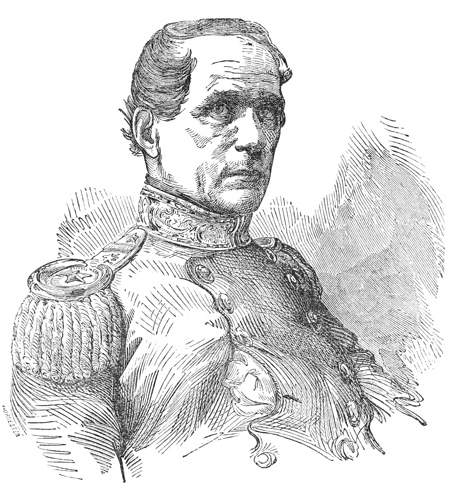
GEN. WOOL.
DANIEL WEBSTER.
Daniel Webster was born in the town of Salisbury, New Hampshire, January 18, 1782. His father, Major Ebenezer Webster, was one of the pioneers of the settlement in that quarter. He served with credit in the old French war, and also in the war of the revolution, especially under Stark, at Bennington. Major Webster established himself in a newly-granted township at the confluence of the Winnipisiogee and Pemigewasset, after the peace of 1763. In this region, then lying almost in a state of nature, the great orator and statesman was born, and passed the first years of his life. His opportunities of education were very deficient, and he was indebted for his earliest instruction to his mother, who was a woman of character and intelligence. For a few months only, in 1796, he enjoyed the advantages of Phillips’ Exeter academy. Here his education for college commenced; it was completed under the Rev. Dr. Wood, of Boscawen. He entered Dartmouth college in 1797, and during the four years of his study there, gave plain indications of future eminence. Soon after his graduation, he engaged in professional studies, first in his native village, and afterward at Fryeburg, in Maine, where at the same time he had the charge of an academy. He eked out his frugal salary by acting as a copyist in the office of register of deeds. He was moved to these strenuous exertions by the wish to aid his brother to obtain a college education. Having completed his law-studies in the office of governor Gore, of Boston, he was admitted to the bar of Suffolk, Massachusetts, in the year 1805. He immediately commenced the practice of law in his native state and county. His father, a man of sterling sense and character, who for the last twelve years of his life had been a judge of the court of common pleas, died in 1806, but not without the satisfaction of hearing his son’s first speeches at the bar. In 1807, Mr. Webster removed to Portsmouth in his native state, and soon became engaged in a most respectable and extensive, but not very lucrative practice. In 1812, he was chosen one of the members of congress from New Hampshire, and in due time was reëlected. Although among the youngest members of the house of representatives, and entirely without legislative experience, he rose at once to the front rank, both in the despatch of business and in debate. Among his associates in the house were Clay, Cheves, Lowndes, Calhoun, Forsyth, and other members of great ability. It was soon felt and admitted that he was worthy to be named with the ablest of them. It was the remark of Mr. Lowndes ‘that the south had not his superior, nor the north his equal.’ Finding the professional fields at Portsmouth inadequate to the support of a growing family, Mr. Webster removed to Boston in 1816. His professional reputation had grown as rapidly as his fame as a statesman. He placed himself at once by the side of the leaders of the Massachusetts bar. He had already appeared before the supreme court of the United States in Washington. By his brilliant argument in the Dartmouth college case, carried by appeal to Washington in 1817, he took rank among the most distinguished jurists in this country. In 1820, Mr. Webster was chosen a member of a convention called for the purpose of revising the constitution of Massachusetts. No one exercised a more powerful influence over its deliberations. He was offered, about this time, a nomination as a senator of the United States, but declined. In 1822, he yielded to the most pressing solicitations to become a candidate for the place of representative of the city of Boston in the eighteenth congress, and was chosen by a very large majority. This step involved a great sacrifice of professional interest. He took his seat in Congress in December, 1823, and early in the session made his celebrated speech on the Greek revolution, an effort which at once established his reputation as one of the first statesmen of the age. In the autumn of the same year he was reëlected by a vote of 4,990, out of 5,000 cast. In 1826 he was again a candidate, and not a hundred votes were thrown against him. Under the presidency of Mr. Adams (1825–29), he was the leader of the friends of the administration, first in the house of representatives, and afterward in the senate of the United States, to which he was elected in June, 1827. His great speech on the Panama mission was made in the first session of the nineteenth congress. When the tariff law of 1824 was brought forward, Mr. Webster spoke with great ability against it on the ground of expediency. He represented one of the greatest commercial constituencies in the Union; and his colleagues, with a single exception, voted with him against the bill. This law, however, forced a large amount of the capital of New England into manufactures; and in 1828 Mr. Webster sustained the law of that year for a more equal adjustment of the benefits of protection. The change which took place in his course in this respect was the result of the circumstances alluded to, and was approved by his constituents. Mr. Webster remained in the senate under the administration of Gen. Jackson, and Mr. Van Buren, a period of twelve years. During this time the most important questions were discussed, measures of the highest moment to the country were brought forward, and political events and combinations of the most novel and extraordinary character succeeded each other. Under all changes of men and measures, Mr. Webster maintained the position of a constitutional and patriot statesman, second to none who had ever devoted himself to the service of his country. In 1830, he made what is generally regarded the ablest of his parliamentary efforts, his second speech in reply to colonel Hayne of South Carolina. This gentleman in a speech on a resolution moved by Mr. Foote, of Connecticut, relative to the surveys of the public lands, had indulged in some personalities against Mr. Webster, had commented with severity on the political course of the New England states, and had laid down in rather an authoritative manner those views of the constitution usually known as the doctrines of ‘nullification.’ Mr. Webster was accordingly called upon to defend himself from the insinuations of the distinguished senator from South Carolina, to vindicate New England, and to point out the fallacies of nullification. To accomplish these objects, he employed all the resources of the most skillful rhetoric, polished sarcasm, and acute argument. The records of modern eloquence contain nothing of superior force and beauty. The second speech of Mr. Webster in this debate may be regarded as the greatest effort of this consummate orator. Shaping his public course by principle, and not by the blind impulse of party, Mr. Webster, though opposed to the administration of General Jackson, gave it a cordial support in its measures for the defense of the Union in 1832-’33. The doctrines of the president’s proclamation against the theories of South Carolina were mainly adopted from Mr. Webster’s speeches, and he was the chief dependence of the administration upon the floor of congress. When, however, the financial system of general Jackson was brought forward and fully developed, it was strenuously opposed by Mr. Webster. He foretold with accuracy the explosion which took place in the spring of 1837, and contributed materially to rally the public opinion of the country alike against the first phase of the new financial system, which was that of an almost boundless expansion of paper currency, issuing from the state banks, and against the opposite extreme, which was adopted as a substitute, that of an exclusive use of specie in all payments to or by the government. Mr. Webster maintained with great force of argument, and variety of illustration, the superior convenience of the financial system which had been adopted in the infancy of the government, with the approval of every administration, from that of Washington down, viz: that of a mixed currency of specie and convertible paper, kept within safe bounds by the law requiring all payments to be made in specie or its equivalent, and regulated by a national institution acting as a check upon the state banks. The clear and forcible manner in which these principles were inculcated by Mr. Webster contributed materially to the downfall of Mr. Van Buren’s administration. In 1839, Mr. Webster made a short visit to Europe. His time was principally passed in England, but he devoted a few weeks to the continent. His fame had preceded him to the old world, and he was received with the attention due to his character and talents at the French and English courts, and in the highest circles of both countries. On the accession of General Harrison to the presidency, Mr. Webster was placed at the head of his cabinet as secretary of state. His administration of the department during the two years he remained in it was signalized by the most distinguished success. The United States was at that time involved in a long standing controversy with Great Britain, on the subject of the northeastern boundary of Maine. To this had been added the difficult questions arising out of the detention of American vessels by British cruisers on the coast of Africa. Still more recently, the affair of M’Leod, in New York, had threatened an immediate rupture between the two governments. The correspondence between the United States’ minister, in London, in 1841, Mr. Stevenson and the British secretary of state for foreign affairs, Lord Palmerston, was of an uncompromising character. Other causes of mutual irritation existed, which the limits of this sketch do not permit us to enumerate.
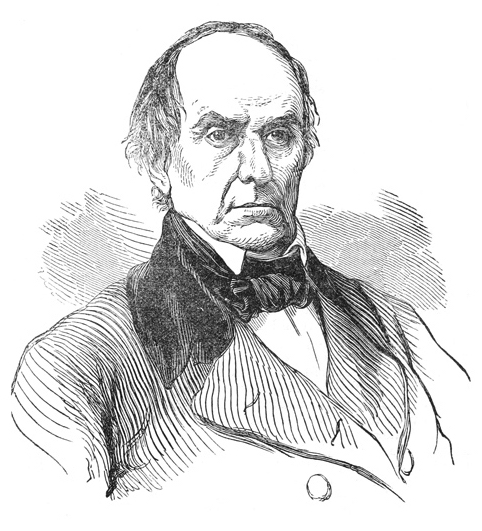
DANIEL WEBSTER.
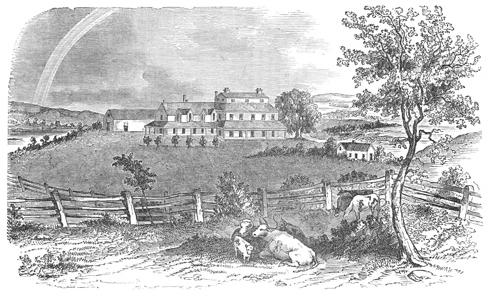
RESIDENCE OF DANIEL WEBSTER.
Shortly after the accession of General Harrison, the Melbourne administration was overturned in England, and Sir Robert Peel returned to power. This cotemporary change of government in the two countries was favorable to a settlement of the long-standing difficulties. Mr. Webster, after coming into the department of state, intimated to the British minister that the government of the United States was convinced of the impossibility of settling the boundary-line by adhering to the course hitherto pursued—that of topographical explorations, with a view to the literal execution of the treaty of 1783—but was prepared to adopt a conventional line, on the basis of mutual gain and concession, if such a line could be agreed upon. The new ministry, taking advantage of this overture, immediately determined to send Lord Ashburton as a special envoy to the United States, to negotiate upon this and the other subjects in controversy. Massachusetts and Maine were invited to take part by their commissioners in the negotiation; and on August 9, 1842, the treaty of Washington was ratified by the senate. By this treaty the boundary dispute, which had lasted fifty years, was happily adjusted. An amicable and efficient arrangement was made for joint action in the suppression of the slave-trade, and an agreement entered into for a mutual extradition of fugitives from justice. The other subjects of discussion at that period, between Great Britain and the United States, with the exception of the Oregon boundary, were happily disposed of in the correspondence accompanying the treaty. The terms of this important treaty were equally honorable and satisfactory to both parties. Mr. Tyler’s cabinet was broken up in 1842, but Mr. Webster remained in office till the spring of 1843, being desirous of putting some other matters connected with our foreign relations in a prosperous train. Steps were taken by him in the winter of 1842-’3, which led to the recognition of the independence of the Sandwich islands by the principal maritime powers. His last official act was the preparation of the instructions of General C. Cushing, as commissioner for negotiating a treaty with China. With the commencement of Mr. Polk’s administration, Mr. Webster returned to the senate of the United States. He remained a member of that body during the whole of the administration of Mr. Polk, and till the death of General Taylor. Though unconnected with the executive government, he rendered the most material service in the settlement of the Oregon dispute. It has been publicly stated by Mr. M’Gregor, the distinguished member of parliament for Glasgow, that a letter written to him by Mr. Webster, and shown to the British ministers, led them to agree to the adoption of the line of boundary which was established in 1846. Mr. Webster opposed the Mexican war on principle; and in the full persuasion, which events have confirmed, that acquisitions of territory would disturb the balance of the Union, and endanger its stability. He, however, concurred in granting the supplies which were required for the efficient conduct of the war. His second son, Major Edward Webster, with the entire approbation of his father, accepted a commission in the Massachusetts regiment of volunteers, and sunk under the exposures of the service in Mexico. He was a young man of great promise. In conformity with Mr. Webster’s anticipations, the acquisition of Mexican territory led to agitations on the subject of slavery, which, during the years 1849-’50, seriously threatened the Union. The question whether slavery should exist in California seemed likely to lead to the renewal of the Missouri controversy, aggravated by all the bitterness which has grown out of the struggles of the last fifteen years. Mr. Webster entertained the most serious apprehensions of an inauspicious result. The convention of the people of California having unanimously adopted a constitution by which that question was disposed of, without the interference of congress, Mr. Webster conceived the hope that, by mutual concession on other and less important points, the harmony of the South and North could be restored, and a severance of the Union averted. With a view to this consummation, he made his great speech of March 7, 1850. A very powerful influence was exerted by this speech on the public mind. While the debates on what have been called the ‘compromise measures’ were in progress in the senate, General Taylor died. The chair of state was assumed by President Fillmore, who immediately called Mr. Webster to the department of state. His administration of the office was marked with characteristic ability and success. In a series of public addresses of unsurpassed ability, made in different parts of the Union, he enforced the great duty of mutual concession, in reference to the sectional controversy which so seriously alarmed the country. In December, 1850, the famous Hülsemann letter was written, to which Kossuth has applied the epithet of ‘immortal.’ Mr. Webster, by his firm and judicious manner of treating the Cuba question, obtained of the Spanish government the pardon of the followers of Lopez, who had been deported to Spain. About the same time, he received from the English government an apology for the interference of a British cruiser with an American steamer in the waters of Nicaragua. This is the second time that the British government has made a similar concession at the instance of Mr. Webster. The first was in reference to the destruction of the ‘Caroline,’ at Schlosser. It has been affirmed that these are the only occasions on which the British government has ever apologized for the conduct of its affairs. Mr. Webster’s intellectual efforts were not confined to politics. He filled a place second to none of his cotemporaries at the American bar, and his discourses upon various historical and patriotic anniversaries are among the brightest gems of modern eloquence. The works of Mr. Webster have been lately published in six volumes, 8vo, with a biographical memoir by Mr. Edward Everett, from which the preceding sketch has been for the most part extracted. He died at his residence in Marshfield, Massachusetts, on the 24th day of October, 1852.
HENRY CLAY.
Henry Clay was born April 12, 1777, in Hanover county, Virginia. His father was a Baptist clergyman, of small means, who died when his son was only five years of age. He was one of a large family of children, who were left under the care of their mother—a firm-minded and truly excellent woman. Henry’s early advantages consisted in the privilege of attending a common country Virginia school; and such were the circumstances of the widow, that thus early, he was obliged to contribute to the support of the family. His work was generally on the farm. At fourteen years of age he was placed in a small retail shop in Richmond, Va. The next year he entered the office of Mr. Tinsley, clerk of the high court of chancery, where among other valuable acquaintances, he attracted the notice and acquired the friendship of the distinguished and beloved Chancellor Wythe—one of the venerated signers of the declaration of independence. With him the poor orphan found a patron and a home. Under the direction of his great benefactor, and for the purpose of studying his profession, he entered the law office of Robert Brooke, attorney general of the State. In 1797 he moved to Lexington, Ky., where before he commenced the practice of the law, he devoted some months to severe study. Such were the youthful trials of this great man. The foundation of his long, eminent, patriotic and glorious career was thus, not family, nor wealth, nor titles, but talents, industry, integrity, and worth. Our space will not permit a full detail of a progress alike honorable to a people who saw and appreciated his value as a man, and to the patriot who devoted himself zealously to the public service. This commenced in 1797, when he took part in the debates relating to the call of a convention to form a constitution for Kentucky, and in 1798, when he zealously entered the field against the celebrated alien and sedition laws. As soon as he was eligible, he was elected to the legislature of Kentucky. He was a leading member until 1806, when he was sent to the senate of the United States, to fill the place occasioned by the resignation of General Adir. This, however, was only a fraction of a term; and at the close of the session, Mr. Clay was again chosen to a seat in the legislature. He was speaker several years. In 1809, he was a second time elected to the United States senate and to fill a fractional part of a term. This expired in 1811, when he was elected a member of the house of representatives. On the first ballot he was elected speaker, which office he filled with distinguished ability. It is no more than justice to remark, that thus far Mr. Clay had proved himself equal, and more than equal, to every place which he had been called upon to fill. Indeed, he was a member of the republican party, and so signal had been his eloquence, his patriotism, his influence and his efficiency, as to have attracted the eyes of the nation. He nobly sustained the administration of Mr. Madison and the war of 1812. After the conclusion of the treaty of Ghent, Mr. Clay, with Mr. Adams and Mr. Gallatin, went to London, where a commercial convention between this country and Great Britain was concluded. Mr. Clay was again elected to the house of representatives in 1815, and again made speaker. Subsequently, after two years absence from congress, he was reëlected in 1823, and again made the speaker, which place he filled until 1825, when he was appointed secretary of state by John Quincy Adams. Mr. Clay was speaker of the house from 1811 to 1825, with the exception of two years, during which time he voluntarily retired from congress.
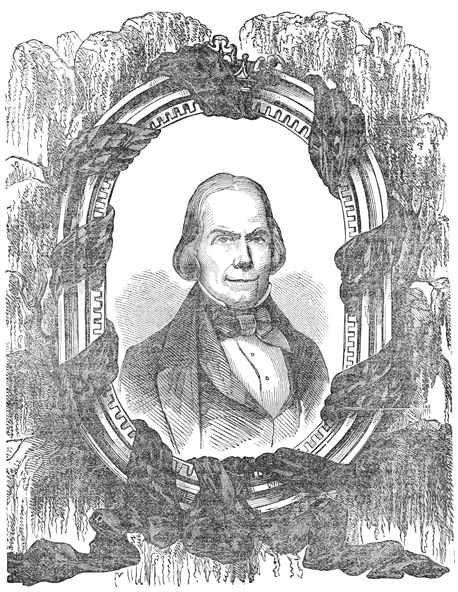
HENRY CLAY.
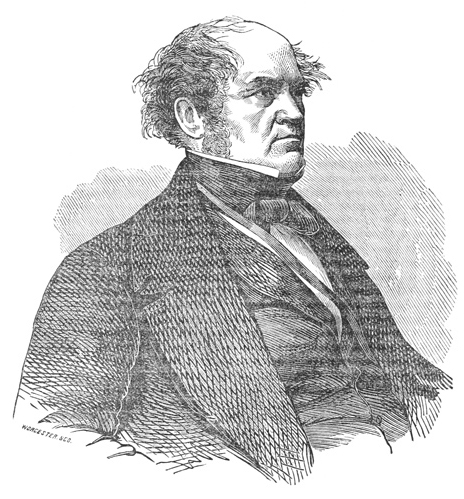
HON. LEVI WOODBURY.
Mr. Clay continued in the office of secretary of state until 1829. Two years later, in December, 1831, he was again elected to the senate of the United States, and continued a member of that body until March 31, 1842, when he resigned. Mr. Clay lived in elegant retirement at Ashland, until he was again (1849) elected to the senate. And here, after a brilliant parliamentary career, he closed his life, as his friend John Quincy Adams did, with his harness on—still serving the country for whose welfare his heart so fervently beat. He died on the 29th of June, 1852.
HON. JUDGE WOODBURY.
The subject of the accompanying likeness is one, perhaps, as well known to the people of this country as any name engraven upon its political scroll. His long public service has been such as to keep him prominently before the public eye for forty years, during which period he has sustained an unsullied reputation, and has commanded the respect and a large share of the confidence of all parties. Mr. Woodbury graduated at Dartmouth College in 1809, and immediately applied himself to the study of the law, which he subsequently practiced with credit and success until 1816, when he was appointed secretary of the senate of the United States, and during the following year judge of the superior court. Shortly after this we find him a member of General Jackson’s cabinet, and in 1823, governor of New Hampshire. In the year 1825, Mr. Woodbury was chosen to the United States senate. In 1831, we find him secretary of the navy. In 1834, we find him secretary of the treasury, and find him again in the senate of the United States from New Hampshire, in 1841. In the autumn of 1845, a vacancy occurred on the bench of the supreme court of the United States, by the demise of Judge Story; this appointment was offered to Mr. Woodbury and accepted. Such are a few of the important datas in the career of Mr. Woodbury’s life, and would space permit us, we should be pleased, in this connection, to go into an elaborate description of his personal characteristics and patriotism. His character has ever been remarkable for firmness and consistency, and whether as a citizen, a politician, or a jurist, he has been found a steady supporter of the constitution of the United States.
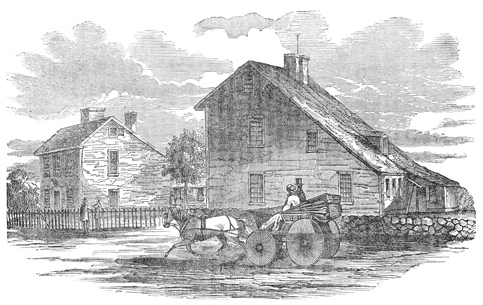
BIRTH PLACE OF JOHN QUINCY ADAMS.
HON. ROBERT RANTOUL, JR.
We can give no better sketch of Mr. Rantoul’s life than to quote from Hon. Charles Sumner’s eulogy pronounced in congress. He was born August 13th, 1805, at Beverly, in the county of Essex, the home of Nathan Dane. Here under happy auspices of family and neighborhood, he commenced life. His excellent father, honored for his public services, venerable also in years and flowing silver locks, yet lives to mourn his last surviving son. The sad fortune of Burke is renewed. He who should have been as posterity, is now to this father in the place of ancestry. Mr. Rantoul was early a member of the legislature of Massachusetts, and there won his first fame. For many years he occupied a place in the board of education in that state. He was also, for a time, collector of the port of Boston, and afterwards attorney of the United States for Massachusetts. During a brief period he held a seat in the senate, and finally, in 1851, by the choice of his native district, remarkable for its intelligence and public spirit, he became a representative in the other branch of our national legislature. In all these spheres he performed most acceptable service, and the future promised opportunities of a higher character, to which his abilities, industry and fidelity would have amply responded. By fitness, by study, knowledge and experience, he was formed for public service, but he was no stranger to other pursuits. Early devoted to the profession of the law, he followed it with assiduity and success. In the antiquities of our jurisprudence, few were more learned, and his arguments at the bar, were thorough. Nor were his intelligence and promptness in all emergencies of a trial easily surpassed. Literature, neglected by many under the pressure of professional duties, was always cultivated by him. His taste for books was enduring. He was a constant student, amidst his manifold labors, professional and public. He was a reformer in the warfare with evil. He was enlisted earnestly and openly as a soldier for life. As such, he did not hesitate to encounter opposition, to meet obloquy, and to brave his enemies. His conscience, pure as goodness, sustained him in every trial, even that sharpest of all, the desertion of friends; and yet while earnest in his cause, his zeal was tempered beyond that of the common reformer. He knew well the difference between the ideal and the actual, and sought by practical means, in harmony with public sentiment, to promote the public interest. Recognizing in the social and political system the essential elements of stability and progress, he discerned the office of the conservative and the reformer; but he saw, also, that a blind conservatism was not less destructive than a blind reform. He was the faithful supporter of common schools, the glory of New England. By word and example he sustained the cause of temperance. Some of his most devoted labors, commencing in the legislature of Massachusetts, were for the abolition of capital punishment. With its final triumph, in the progress of civilization, his name will be indissolubly connected. In harmony with these noble reforms was the purity of his private life; there he was blameless. In manners, he was modest, simple and retiring. In conversation, he was disposed to listen rather than to speak, though all were well pleased when he broke silence, and in apt language declared his glowing thoughts. But in the public assembly, before the people, he was bold and triumphant. As a debater, he rarely met his equal. Fluent, earnest, rapid, incisive, his words at times came forth like a flashing scimitar. Few could stand against him; he always understood his subjects, and then clear, logical, and determined, seeing his point before him, pressed forward with unrelenting power. His speeches were enriched by study, and contained passages of beauty—but he was most truly at home in dealing with practical questions arising from exigencies of life. Few had studied public affairs more intelligibly. As a constant and effective member of the democratic party, he had become conspicuous by the championship of its doctrines. There was no topic of national moment that did not interest him. Northwestern and Western interests were near his heart.
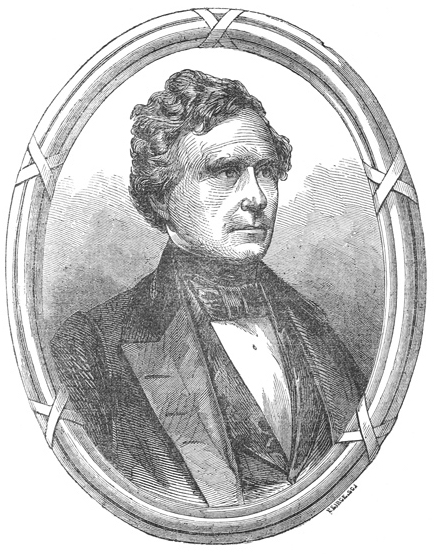
FRANKLIN PIERCE.
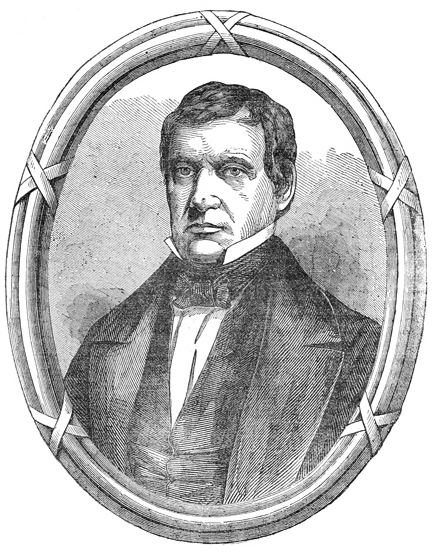
WILLIAM R. KING.
In person, Mr. Rantoul was of medium height, of spare figure, and restless activity both of mind and body. His manner of speaking was peculiar to himself; with great rapidity of utterance, his sentences were simple in their construction, and his language selected less with reference to ornament than to strength. Devoted to his profesion and studies, of abstemious habits, great purity of character, the friend of all moral movements of society, he was snatched away in the prime of life, when his talents, matured by earnest study, were unfolding themselves to the world with much power.
FRANKLIN PIERCE.
Franklin Pierce, president of the United States, is the son of Benjamin Pierce, who rose to the rank of brigade-major in the American army during the revolutionary war, and held several political offices in the state of New Hampshire. Franklin Pierce was born in the western part of that state, in the town of Hillsborough in 1804, and after completing his academical studies, entered Bowdoin college, Maine. Immediately on leaving college he commenced his legal studies with Judge Howe, of Northampton, Mass., but subsequently returned to his native state and, finally finished his studies at Amherst Mass. He was admitted to the bar and commenced the practice of his profession in his native town; but before the end of two years he was elected a representative in the state legislature, and during his second year’s service was chosen speaker of the house. In 1833 he was elected to congress, and remained a member of the house of representatives for four years. During this period, General Pierce, although a firm supporter of democratic measures, seldom distinguished himself as a debater, being modest and unassuming in his character, and rather quick to hear and slow to speak. In 1837 he was elected a member of the United States senate, but, after five years’ service in that body, resigned his seat, intending to devote himself wholly to his profession. He had been more than ten years in public life and he felt the necessity of giving his attention to his private affairs, which had suffered in his absence. He accordingly settled in Concord, the capital of his native state, and resumed his practice at the bar, with a firm resolution to be withdrawn for the future from public life. He rose to high distinction as an advocate, being considered one of the ablest lawyers in New Hampshire. He firmly adhered to his resolution of accepting no political office; he declined to be a candidate for governor of the state, or United States senator, and he also refused the offices of attorney-general and secretary of war, which were tendered him by President Polk. On the breaking out of the Mexican war, however, General Pierce, deeming that his services were required in the cause of his country, enrolled himself as a private soldier in the New England regiment, but President Polk sent him a colonel’s commission, and subequently raised him to the rank of brigadier-general in March, 1847. His command consisted of 2,500 men, with whom he landed at Vera Cruz, June 28, 1847. He distinguished himself in most of the battles which were fought between Vera Cruz and the city of Mexico, and made himself highly popular with the men under his command. On the restoration of peace between the two countries, he resigned his commission, and returned home, where he met with a brilliant reception from his fellow-citizens. He was elected president of the United States in 1852.
SAMUEL FINLEY BREESE MORSE.
Samuel Finley Breese Morse, an American artist, better known, perhaps, as the inventor of the electric telegraph, is the eldest son of the Rev. Jedediah Morse, the first American geographer, and was born in Charlestown, Massachusetts, April 27, 1791. He was educated at Yale College, where he graduated in 1810. He had from a very early age determined to be a painter; and his father finding his passion for art incorrigible, consented to indulge him in his wishes; and he accordingly sailed for England, under the charge of Mr. Allston, and arrived in London, in August, 1811. Here he formed an intimacy with C. R. Leslie, and the first portraits of either of these artists painted in London were likenesses of each other. Mr. Morse made rapid progress in his profession. In 1813, he exhibited at the Royal Academy his picture of “The Dying Hercules,” of colossal size, which received high praise from the connoisseurs, and the plaster model which he made of the same subject, to assist him in his picture, received the prize in sculpture, the same year. Encouraged by this success, the artist determined to contend for the premium in historical composition offered by the academy the following year. The picture, the subject of which was, “The Judgment of Jupiter, in the case of Apollo, Marpessa, and Idas,” was completed in time, but Mr. Morse was obliged to leave England before the premiums were to be adjudged, and was consequently excluded from the privilege of competing for the prize. Mr. West afterward assured him that he would undoubtedly have won it. On his return to America, he settled in Boston, but he met with so little encouragement, that he removed to New Hampshire, where he found employment in painting portraits at $15 per head. He was induced by his friends to remove to Charleston, South Carolina, and there his art proved more profitable. About 1822, he took up his residence in New York, where he found his works and talents more justly appreciated, and his skill as an artist put into requisition. Under a commission from the corporation, he painted a full length portrait of Lafayette, then on a visit to the United States. It was shortly after this, that Mr. Morse formed that association of artists which resulted in the establishment of the National Academy of Design, of which he was elected president; and it is worthy of note, that the first course of lectures on the subject of art read in America, was delivered by him before the New York Athenæum, and afterward repeated to the students of the academy. In 1829, he paid a second visit to Europe, and remained abroad three years. On his return from Europe, in the packet-ship Sully, in 1832, a gentleman, in describing the experiments that had just been made in Paris with the electro-magnet, the question arose as to the time occupied by the electric fluid in passing through the wire, stated to be about one hundred feet in length. On the reply that it was instantaneous (recollecting the experiments of Franklin,) he suggested that it might be carried to any distance, and that the electric spark could be a means of conveying and recording intelligence. This suggestion, which drew some casual observation of assent from the party, took deep hold of Professor Morse, who undertook to develop the idea which he had originated; and, before the end of the voyage, he had drawn out and written the general plan of the invention with which his name will be inseparably connected. His main object was to effect a communication by means of the electro magnet that would leave a permanent record by signs answering for the alphabet, and which, though carried to any distance, would communicate with any place that might be on the line. His first idea was to pass a strip of paper, saturated with some chemical preparation that would be decomposed when brought in connection with the wire, along which the electric current was passing, and thus form an alphabet by marks, varying in width and number, that could be made upon the paper at the will of the operator, and by this means avoid separating the wire at the different points of communication. On his return to New York, he resumed his profession, still devoting all his spare time, under great disadvantages, to the perfection of his invention. Finding his original plan impracticable, he availed himself of the action of the electro-magnet upon the lever as a mode of using pens and ink, as in the ruling machine. Of these he had five, with the idea of securing the required characters from one of the pens. These he abandoned for pencils, and after a trial of various means for obtaining the end desired, and finding by experiment he could obtain any requisite force from the lever, he adopted the stylus or steel point for indenting the paper, and it is this he has since used. After great difficulty and much discouragement, Professor Morse in 1835 demonstrated the practicability of his invention by completing and putting in operation in the New York university, a model of his ‘Recording Electric Telegraph’—the whole apparatus, with the exception of a wooden clock which formed part of it, having been made by himself. In 1837, he abandoned his profession, with great regret, hoping to make his invention a means of resuming it, under easier and more agreeable circumstances. In the same year, he filed his caveat at the patent-office in Washington; and it is somewhat singular that, during this year (1837), Wheatstone, in England, and Steinheil, in Bavaria, both invented a magnetic telegraph, differing from the American and from each other. Wheatstone’s is very inferior, not being a recording telegraph, but requiring to be watched by one of the attendants—the alphabet being made by the deflection of the needle. Steinheil’s, on the contrary, is a recording telegraph, but from its complicated and delicate machinery, has been found impracticable for extended lines. At a convention held in 1851 by Austria, Prussia, Saxony, Wurtemberg, and Bavaria, for the purpose of adopting a uniform system of telegraphing for all Germany, by the advice of Steinheil, Professor Morse’s was the one selected. From the sultan of Turkey he received the first foreign acknowledgment of his invention in the bestowal of a nishan, or order—the ‘order of glory:’ a diploma to that effect was transmitted to him with the magnificent decoration of that order in diamonds. The second acknowledgment was from the king of Prussia, being a splendid gold snuffbox, containing in its lid the Prussian gold medal of scientific merit. The latest acknowledgment is from the king of Wurtemberg, who transmitted to him (after the adoption of the Telegraph treaty by the convention above mentioned) the ‘Wurtemberg Gold Medal of Arts and Sciences.’ In 1838, he went to England, for the purpose of securing a patent there, but was refused through the influence of Wheatstone and his friends, under the pretense that his invention had already been published there. All that could be adduced in proof of this was the publication in an English scientific periodical of an extract copied from the New York ‘Journal of Commerce,’ stating the results of his invention, without giving the means by which they were produced. In the following spring, he returned to this country, and in 1840 perfected his patent at Washington, and set about getting his telegraph into practical operation. In 1844, the first electric telegraph was completed in the United States, between Baltimore and Washington; and the first intelligence of a public character which passed over the wires was the announcement of the nomination of James K. Polk, as the democratic candidate for the presidency, by the Baltimore convention. Since then, he has seen its wires extend all over the country, to the length of more than fifteen thousand miles—an extent unknown elsewhere in the civilized world. His success has led to the invasion of his patent rights by others, whom he has finally succeeded in defeating, after an expensive and protracted litigation. Professor Morse still clings to the idea of resuming his early profession of painting, to which he is strongly attached, and in the progress of which he has always taken a deep interest. As an artist, he has always enjoyed a very high reputation. His tastes inclined to historical painting, but circumstances did not often permit him to indulge in it; he was mainly engaged in the painting of portraits. In 1820, he painted a large picture of the interior of the house of representatives, with portraits of the members, which passed into the possession of an English gentleman; and in 1832, while in Paris, he made a beautiful picture of the Louvre gallery, copying in miniature the most valuable paintings. He resides at Locust Grove, two miles south of Poughkeepsie, on the banks of the Hudson river.
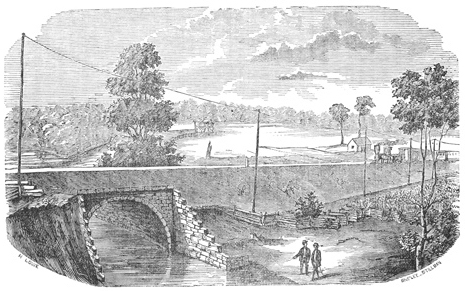
EUCLID CREEK.
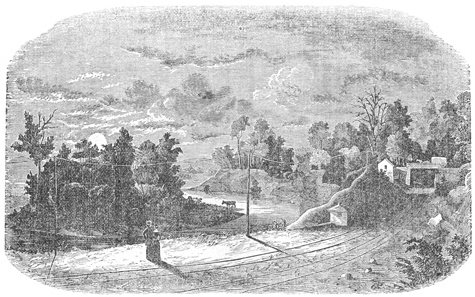
SCENE BY MOONLIGHT AT RED BANK, OHIO.
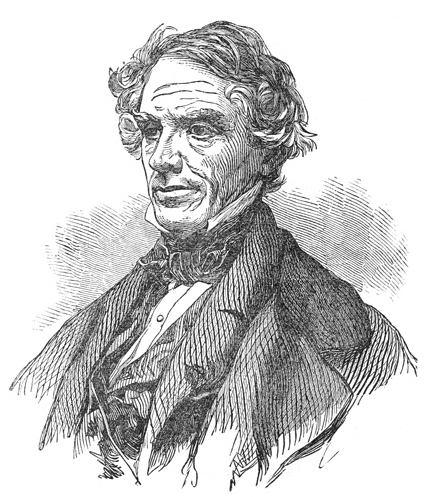
PROF. MORSE.
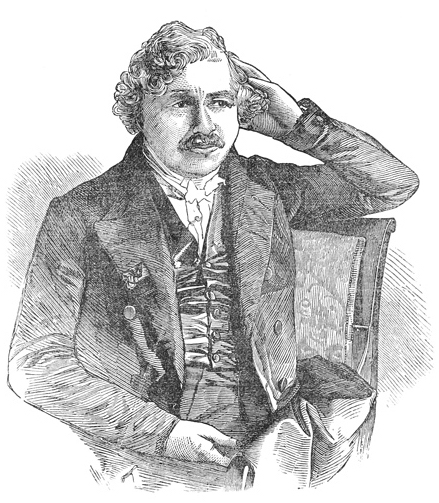
DAGUERRE.
M. DAGUERRE.
This far-famed Frenchman, who has given his name to the art which he first discovered, the Daguerreotype, died not long since, at his residence, near Paris. The likeness which we present herewith, is from an original, taken after his own style and invention, and is necessarily correct. It would be superfluous for us to enlarge upon the merits of an art so familiar to all. Daguerre was an artist, a painter, and also possessed considerable chemical talent and taste; and it was while experimenting for other purposes, that he discovered the art which now bears his name. It was destined, however, to be wonderfully improved by other hands, and it is said that the Americans have produced by far the most perfect and beautiful specimens of the art that have ever yet been exhibited. Daguerre was favorably known to the world before the announcement of his discovery of the Daguerreotype. His attempts to improve panoramic paintings, and the production of dioramic effects, were crowned with the most eminent success. His pictures attracted much attention at the time of their exhibition. In them the alternate effects of night and day—of storm and sunshine—were beautifully produced. To these effects of light were added others, arising from the decomposition of form, by means of which, for example, in the ‘Midnight Mass,’ figures appeared where the spectators had just beheld seats, altars, etc.; or, again, as in ‘The Valley of Goldau,’ in which rocks tumbling from the mountains replaced the prospect of a smiling valley. He was in the 62d year of his age at the time of his death, and is represented to have been an extremely modest and worthy man, and one devoted to his profession of the fine arts.
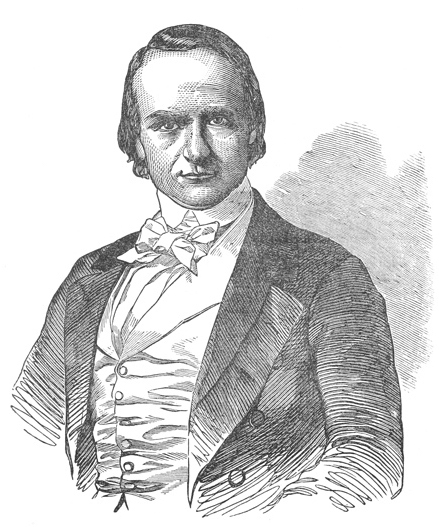
VICTOR HUGO.
VICTOR HUGO.
Victor Hugo, a politician, one of the most prominent living French writers, was born February 26, 1802. The political contrariety which has marked his career may be said to have been inherited by Hugo, his father having been one of the first volunteers of the republic, and his mother, a Vendéan by birth and sentiment, a proscribed royalist, wandering while yet a girl in the Bocage of La Vendée. At the date of his birth, his father was a colonel in the army of Napoleon; and the child, born almost amid the roar of cannon, followed with its mother the steps of Bonaparte. From Besancon he was carried to Elba, from Elba to Paris, from Paris to Rome, from Rome to Naples, before he was five years of age, so that he exclaims, ‘I made the tour of Europe before I began to live.’ In Naples he resided about ten years, his father having been appointed governor of Avellino. In 1809 he returned to France with his two brothers and his mother, by whom he was educated within the walls of the convent of the Feuillantes, where the family had taken up its residence. He here received the benefit of classical instruction from an old general, whom his mother was then concealing from the imperial police. At the close of 1811, his father, then a general and majordomo of Joseph Bonaparte’s palace at Madrid, sent for his family to join him in that capital, and Victor accompanied his mother to Spain. He remained at Madrid about a year, and returned to the old convent until the restoration of 1814. This event, by exciting in his mother and father the opposite feelings of joy and indignant grief, led to their separation. Victor was placed by his father in a private academy, where he studied mathematics, it is said with great success, previous to his intended removal to the polytechnic school. In 1816 he published his parable of ‘The Rich and Poor,’ and an elegy called the ‘Canadian.’ In 1817 he was a competitor for a prize on the ‘Advantages of Study,’ offered by the academy. In 1819, having committed himself to a literary career with his father’s consent, he wrote two odes, entitled ‘The Virgins of Verdun,’ and ‘The Restoration of the Statue of Henri IV,’ and sent them to the Academy of Floral Fêtes, at Toulouse, by which they were both crowned. In 1820 he published his ‘Infant Moses in the Nile.’ In 1822 appeared the first volume of his ‘Odes and Ballads,’ a collection of occasional pieces, all breathing a royalist spirit. His ‘Hans of Iceland,’ and ‘Bug-Jargal,’ though not published until some years later, were written about this time. Before the close of the same year the young poet married Mdlle. Foucher, and rising into distinction as a royalist writer, he received a pension from Louis XVIII. In 1826 he published a second volume of ‘Odes and Ballads,’ which betrayed an inward revolution in his political and literary opinions. In the succeeding year he composed a drama, called ‘Cromwell,’ intended to assert the freedom of the Christian and romantic drama, against the theory of Aristotle’s unity, as understood and practiced by Racine. He prefaced it with a dramatic theory of his own, to which, however, he hardly gave a fair chance of success, since its accompanying illustration contained scarcely a feature of merit. In 1828 he published his ‘Orientals,’ a poem of finished versification, but destitute of force or spirit. In 1829, Victor Hugo published his ‘Last Days of a Condemned Prisoner,’ and so vividly depicted the anticipated tortures of a man left for execution, that the terrific interest of the work gave it an immense success. Hugo now prepared to make a second attack on the stiff and unnatural dramatic system prevalent in his country. On the 26th February, 1830, his ‘Ernani’ was played at the Théâtre Français. The indignation of the old and the enthusiasm of the new party knew no bounds. The academy went so far as to lay a complaint against the innovation at the foot of the throne, but Charles X, with a good sense which would have been very serviceable to him four months later, replied, that ‘in matters of art he was no more than a private person.’ Meanwhile the drama, which was far superior in construction to ‘Cromwell,’ succeeded. Shortly after the revolution of July, his ‘Marion de Lorme,’ embodying his new political tastes, and which had been suppressed by the censorship under the restoration, was brought out, and was considered theatrically successful. In January, 1832, his play, ‘Le Roi S’amuse,’ was performed at the Théâtre Français, and the next day interdicted by the government. This was scarcely necessary, the piece had not been warmly received; in fact, people, however willing to be amused, especially at the expense of monarchs, did not like to see the quondam royalist employed in burlesquing the historical heroes of their country. M. Hugo afterward published a number of dramatic pieces of various merit; among them are ‘Lucrèce Borgia,’ ‘Marie Tudor,’ ‘Angelo,’ and ‘Ruy Blas.’ His greatest novel is ‘Nôtre Dame de Paris.’ He has since produced ‘Chants du Creépuscle,’ and ‘Voix Intérieures.’ In the works of this poet may be found some of the sublimest creations of French poetry. It is to be regretted that, side by side with these, the author’s preverted taste led him to place images the most monstrous and disgusting. He was created a peer of France by Louis Philippe, and, on the downfall of that monarch, avowing the principles of the revolution, was returned to the constituent, and afterward to the national assembly, of which he was one of the few eloquent speakers. He is also a leading member of the Peace Congress, and was its president in 1849—a position remarkable enough for the author of the bellicose ‘Lettres du Rhin.’ He was an energetic opponent of Louis Napoleon in December, and on that account was compelled to fly to Brussels in an assumed name.