AMERICAN ENCYCLOPEDIA (continued 34)
Reading edition
Before requesting the reader to accompany me on the route eastward to Suez, I shall pause to describe some things which I visited and felt interested in on the occasion of my previous visit to Cairo.
The Nile—Pyramids. Egypt, as is well known, consists of the fertile valley of the Nile, and a strip of desert on each side. The Nile, formed by streams coming out of Abyssinia on the south, is about 1500 miles in length; at certain places it forms rapids, or sloping cataracts, and at other points encloses islands, interesting for their beauty or the ruins which remain upon them. The remarkable phenomenon connected with the Nile, is its annual overflow of the banks which border it—an event looked for with as much certainty as the daily rising of the sun. These inundations of the Nile are owing to the periodical rains which fall between the tropics. They begin in March, but have no effect upon the river until three months later. Towards the end of June it begins to rise, and continues rising at the rate of about four inches a-day, until the end of September, when it falls for about the same period of time. The towns are generally built in such a situation and manner as not to be overflowed by the inundation, and in some parts of the country there are long raised causeways, upon which the people may travel during the floods. It is only in cases of an extraordinary rise that any villages are destroyed. The inundations, instead of being viewed as a calamity, are considered a blessing, for they are the cause of inexhaustible fertility. After the waters have subsided, the earth is found covered with mud, which has been left there by the river. This mud, which is principally composed of argillaceous earth and carbonate of lime, serves to fertilize the overflowed land, and is used for manure for such places as are not sufficiently saturated by the river; it is also formed into bricks, and various vessels for domestic use. The whole valley of the Nile may be considered as an alluvial plain, formed of the washed-down mud and sand of Central Africa, and it is therefore to these inundations that Egypt owes its existence.
Notwithstanding the overflow of the Nile, the atmosphere of Egypt is extremely dry and healthful. During our winter, the climate of Egypt is delightful. The inhabitants speak with intense affection of the Nile, for to it they owe the verdure of their fields, their food, their drink, and the cotton for their clothing. In its taste the water is delicious and salubrious.
The Pyramids are situated about ten miles from Cairo, in a western direction, and consequently on the farther side of the Nile. The traveler may now have the benefit of a carriage for the journey: formely, the only conveyance was by donkeys. The road leads by Old Cairo, a decayed suburb of Cairo, at two miles’ distance, on the banks of the river. The Nile is forded or crossed in boats at the upper end of the island of Rhoda. When within a couple of miles of the end of the journey, a number of frightful-looking Bedouins commonly make a rush from a large village a little way off, as if intent on mischief. They are men anxious to be employed as guides; and they had better be employed at once, to save further annoyance.
The Pyramids scarcely appear to increase in size until you are close up to their base; then their bulk seems enormous, and the distance betwixt one and the other looks like a forenoon’s journey. They are four in number in one view—three large, and one small—and are usually known as the Pyramids of Gizeh. They stand on a plateau some forty feet above the plain, and are fairly within the Desert. I do not believe any one who has not visited them has a correct idea of their vast dimensions. The present base of the Great Pyramid of Cheops, as it is called, is 746 feet each way; the mass is estimated at eighty-five millions of cubic feet, and covers an area of eleven acres. Measured by the slope, its height is 611 feet, and its perpendicular height is 461 feet, being 117 feet higher than St. Paul’s, London. The age of the Pyramids is unknown, but it cannot be less than three thousand years. And what a waste of human labor in their construction! A hundred thousand men, changed every three months, for twenty years, are said by the Greek writers to have been occupied in their erection!
At a distance, the Pyramids appear to be tolerably smooth and pyramidal; but on coming close to them, they are found to have a ragged and half-ruined aspect, in consequence of the outer coating of stones and plaster having been removed. Their sides in this rough state present the appearance of a series of steps, composed of huge blocks of yellowish-white limestone. The ascent is toilsome, but I made a point of reaching the top of the Great Pyramid. The ledges of stone are uncomfortably high for a stair; and ladies meaning to ascend, should provide themselves with a footstool, which the guides could lift and hand up to them at each step. There are altogether 206 tiers of stone, from one to four feet high. At length we reached the top, which is an irregular platform, thirty-two feet square; the stones constituting the apex having been thrown down. On gaining this lofty eminence, on which there was room to move about, I felt an extraordinary exhilaration of spirits, not only from the effect of historical associations, but from the remarkable fineness of the atmosphere. The view on all sides was magnificent. One of its most striking features is the distinctness of the line which divides the fertile region from the Desert. There is no middle ground—no debateable land, over which fertility and desolation, the sand of Sahara and the silt of the Nile, alternately hold sway. So far as the influence of the Nile extends, all is verdure; the moment the sand begins, utter waste ensues.
Having satisfied our curiosity, the party descended; but all found that coming down was a vast deal more fatiguing and dangerous than going up. However, we got to the bottom in safety; and being pretty well appetized, we adjourned to luncheon in a sort of cave close by, where victuals we had brought with us were enjoyed. It is necessary to make this provision for refreshment, because there is no house, tent, or village in the neighborhood. The Great Pyramid is not entirely solid. An entrance has been made, by which a series of labyrinthian passages and chambers have been discovered. The entrance is on the north side; but we did not feel inclined to enter; for the journey in some places requires to be performed on hands and knees. At the centre are two chambers of red granite, in one of which is a sarcophagus; and here is supposed to have slept one of the great rulers of the earth, the king of what was the greatest kingdom of the earth, the proud mortal for whom this mighty structure was raised.
The ascent of the second Pyramid is seldom attempted by visitors: it is much more difficult than that of the first, especially over that portion of the smooth granite crust which still remains about thirty feet down. It is of somewhat less magnitude than the other, but looks as large, from standing on higher ground. The third of the group is considerably smaller. The fourth I did not visit. In the neighborhood of these grand objects of antiquity lie scattered about many interesting remains. The most attractive of these is the Sphinx—a gigantic figure, half-woman, half-lion, nearly all hewn from the solid rock, the fore-legs and part of the back only being built. There is an altar between the two paws, on which sacrifices appear to have been offered. From the lower part of the body to the top of the head, the Sphinx measures 66 feet, the recumbent portion 102, the paws 50, and the circumference of the head 100 feet. Such has been the drifting of the sands, that the whole figure is now covered except the head and a portion of the dilapidated neck.
A few miles above the Pyramids of Gizeh once stood Memphis, a city as large and flourishing as Alexandria, but now utterly destroyed, and the very ruins hardly distinguishable. Continuing the journey up the valley of the Nile, and within the distance of two hundred miles, the traveler passes the ruins of many decayed cities, now reduced to miserable villages of half-starving Arabs, but once the glory of Egypt. Among these are Arsinöe, Dendera, Thebes, Karnac, Edfou, Elephantina, and Philöe. Edfou is thus described by Mr. Stephens:—‘At one corner of this miserable place stands one of the magnificent temples of the Nile. The propylon (or gateway), its lofty proportions enlarged by the light of the moon, was the most grand and imposing portal I saw in Egypt. From a base of nearly 100 feet in length, and 30 in breadth, it rises on each side of the gate in the form of a truncated pyramid, to the height of 100 feet, gradually narrowing, till at the top it measures 75 feet in length and 18 in breadth. Judge, then, what was the temple to which this formed merely the entrance; and this was far from being one of the large temples of Egypt. It measured, however, 440 feet in length and 220 in breadth, about equal to the whole space occupied by St. Paul’s Churchyard. Its dromos, pronaos, columns, and capitals, all correspond; and enclosing it is a high wall, still in a state of perfect preservation. I walked round it twice, and, by means of the wall erected to exclude the unhallowed gaze of the stranger, I looked down upon the interior of the temple. Built by the Egyptians for the highest uses to which a building could be dedicated—for the worship of their gods—it is now used by the pasha as a granary and storehouse.’
Few travelers proceed farther up the Nile than Philöe, as the journey through Nubia is less safe or agreeable than that within the Egyptian territory. Yet without a visit to the Nubian valley of the Nile, which extends to near the head branches of the river in Abyssinia, much of the ancient grandeur of this part of the world will remain unexplored. Nubia, which is at present a Turkish province, subject to the pasha of Egypt, is frequently called by the name Ethiopia—from the black complexion of whose inhabitants the term Ethiopian came in early times to signify one who is black, or a negro. This country of Nubia, or Ethiopia, is understood by some historians to have enjoyed a degree of civilization and refinement in art at a date even earlier than Egypt; and till the present day, it possesses pyramids and other monuments of architectural skill as wonderful, in the eyes of the traveler, as those in the lower divisions of the Nile.
So much for a glance at the archaeological treasures of Egypt; let us now return to Cairo, in order to undertake an excursion which has been seldom performed.
The Petrified Forest. This extraordinary curiosity is situated eight or ten miles south from Cairo, and is reached by a journey on the back of a donkey through a rugged piece of country. The ground over which you travel is a dry gravely soil, without a particle of vegetation. Having proceeded for some miles through a rocky valley, a sudden turn to the right takes you through a low range of sand-hills, and in less than a quarter of an hour you arrive at the forest. And such a forest! Trees lying prone on the ground, and transferred into stone. The world contains nothing so wonderful as a work of nature. On every side the prostrate forest extends as far as the eye can reach. Plains and rolling hillocks of sand sweep on and on to the horizon, all strewed thickly over with fragments of fallen trees. They lie at some places so close to each other, that a sure-footed Cairo donkey can scarcely thread his way through them: at other places they are few and far between, scarcely within stone-throw of each other, as if those had been the thickets, these the openings, in the forest. The trees are nowhere round in the surface, but sharp and angular, as if split by heat into many fragments. Few pieces are more than from four to six feet in length; but a series of these may often be seen lying end to end for a space of from fifty to sixty feet, as if the tree they constituted had been sawn or broken across, the pieces remaining in their places. The aspect of the fallen trunks is like that of the half rotten bog-wood found in an Irish or a Scottish morass. In hue, they are for the most part of a lightish chesnut-brown; some of them of a dusky-white, precisely of the color of common ash or pine long exposed to the weather. Of this tint are nearly all the smaller fragments, which often lie about as if chipped off from the larger ones. There are no fangs of roots or branches connected with the stems, but there are the rudiments of both in abundance. The knots indicating where branches once had been, are often of singular beauty and distinctness; sometimes so much so, as to seem fresh torn off the stem. The whole scene is the very picture of solitude and desolation, enhanced beyond that of the ordinary Desert—which leaves no token of ever having been more productive than it is—inasmuch as the remains around remind you that what is now salt and barrenness must once have been fertility and verdure. The trees, as already said, are mostly on the surface; many of them, however, are half-buried, others barely show themselves above the sand. The sand itself is light colored; the nodules of stone intermixed with it are rounded; sea-shells everywhere abounding. Near the edge of the forest there are what resemble the dry beds of small-sized streams and torrents: here the little cliffs displayed are of very soft limestone, full of oyster-shells, so fresh and bright, that they seem scarcely at all affected by the weather. They are of the transparent kind, nearly flat, and scarcely thicker than common paper. Selenite here abounds, as generally over the Desert, where sea-salt prevails. It is here for the most part fibrous, the fibers being horizontal, and at right angles to the axes of the vein. I took nearly half a ton of specimens home with me; and these, like the whole of the rest of my collection, were carried free of charge both by the Egyptian Transit and Steam Navigation Company. They were afterwards distributed amongst various of our public museums.
As for the nature of the trees, they are not palms, as their branches show; nor am I aware that there is any living race nearly kindred to them. They are completely silicified, ring like cast-iron, strike fire with flint, and scratch glass. How has this transformation been effected? By no chemical process now known to man. We have nothing at all analogous to it either in the laboratory of the chemist or that of nature. There is no substance more indestructible than charcoal. Cut off from air, it resists the most intense heats known to us, and remains in the bowels of the earth unscathed for millions of years! Here the whole woody and carbonaceous matter has vanished, and its place we find silica—the earth of flints, a substance nearly insoluble, and by itself infusible by any heat we are acquainted with. Yet so quietly and perfectly has the exchange been effected, that for every atom of charcoal that has been displaced, an atom of flint has been left behind. Textures and tissues so minute, that the help of microscopes is required for their detection—that their delineation can only be attempted after they have been much magnified—are changed in substance, but in substance only: the most minute and fragile of their forms remain as when the green leaves and bright blossoms drew their sustenance, and the vital fluids circulated through them. Egypt is the land of hoar antiquity; but what are the wonders of the mummy-case to this? The trees look as if they had fallen down, and been turned to stone on the ground where they grew; they look ‘like to a forest felled by mighty winds;’ they bear no marks of rolling or abrasion, such as that by which flints themselves are rounded. Yet all is sea-sand and shells everywhere; there is nothing to sustain vegetation; and whether the theory that they belong to an age previous to that of the rock in which they are occasionally imbedded, be adopted or not, it is clear that, subsequent to their assumption of their present form and condition, the ground on which they now repose sunk beneath, and rose again far above, the surface of the sea.
It is singular, considering the extent of area, and the diversity of positions in the world over which silicified trees are found exposed above ground, that so little has been written on the subject. In Trinidad, in the West Indies, they are abundant; and they prevail over a vast expanse of surface on the seaboard of New Holland. They abound on the Coromandel coast near Madras; and in Scinde are found from Sukkur to Kurrachee, on salt desert sand, resting on nummulite limestone, exactly as in Egypt.
Cairo to Suez. It has been already stated that our party arrived at Cairo on the morning of the 23d of December. Only a few hours is allowed, and every one should make his arrangements without unnecessary delay. Having arranged at the Transit Office to get all luggage, a small bag excepted, sent forward, and secured his place, the traveler may be considered ready to start. The conveyance to Suez is by vans, which start in detachments at specified hours. In hot weather, it is preferable to start from Cairo in the afternoon, so as to travel all night. By this plan he arrives at the centre sleeping-station in the morning, and after a few hours’ repose, he can again proceed, so as to reach Suez early in the following morning. Some go on direct; others stop.
The distance from Cairo to Suez is eighty-five or eighty-six miles; and as the line of route is without any towns or villages, station-houses have been erected for the accommodation of travelers, and for changing of horses. There are altogether seven station-houses, of which No. 4 from Cairo is the most commodious. Refreshments are furnished at three of the stations, and they are usually of the most sumptuous kind. The vans are of different sizes. For the greater part they are strong clumsy machines, open all around, tolerably stuffed, but without springs—merely suspended on leathern straps. They have two wheels about five feet in diameter; that is, one-third larger than those of a common carriage. They are drawn by four horses, two being in shafts, and two before them in traces. They are, in general, not over-well trained, tempered, or conditioned; but really, on the whole, get on wonderfully well. The plan of the drivers generally is to urge them a good gallop for a mile or so, and then allow them a few minutes to rest. Including twelve hours’ repose by the way, the journey from Cairo to Suez is performed in thirty-two to thirty-six hours.
There is but little of the Suez desert covered with drift sand; it consists mainly of hard gravel, with a vast abundance of loose stones in all directions. The vans seldom adhere very regularly to any particular track, and the jolting is occasionally dreadful. In the direction of Suez, as indeed in most other directions, unless when approaching the Nile, you enter on the Desert at once. The burying-ground around the city is all in sand; and the first step beyond this, the ground is as completely barren and desolate as it can be in the heart of the Great Sahara itself. The route through might be almost traced by the skeletons and bones of camels to be seen all a long; thousands and thousands lie bleaching by the wayside. The surface of the ground is salt, and covered with rounded pebbles, chiefly the Egyptian agate, and sea-shells. Pieces of petrified wood, often of considerable magnitude, lie strewed around: and when the limestone rock shows itself above the sand and gravel, it is generally perforated by the pholas, or some other variety of marine borer. The rocks, like those near Cairo, abound in petrifactions—beautiful specimens of crabs and stars-fishes being amongst the most abundant. Little nimble fairy-looking lizards, in color very like the surface of the ground around them, are occasionally to be seen in the Desert; also a curious variety of serpent, with two horn-like processes protruding from the forehead. There are numberless vultures and carrion crows, which feed on the dead carcases of the animals who so frequently perish on the way across. Besides these, scarcely a living thing is to be seen. Here and there are considerable quantities of the poisonous henbane, and half-way betwixt Suez and Cairo numerous bushes of the prickly acacia or camelthorn. Just beyond the centre station is what is called ‘the tree of the Desert;’ solitary acacia, about one and a half feet in diameter, and ten feet length of stem, with a large thick bushy round top. This is seen at a vast distance from each side: to the weary wayworn traveler it seems almost impossible to approach it, he riding for hours after first catching sight of it without apparently coming nearer it.
The beautiful phenomenon known to sailors as ‘looming,’ to naturalists as mirage, equally visible in extremely cold as in warm countries, is often seen in great perfection betwixt Cairo and Suez. It is occasioned by the unequal temperature and refractive powers of different strata of the atmosphere—objects being invariably elongated or depressed, or a succession of images of them exhibited one over another. Scoresby gives drawings of images of ships and icebergs being seen by him in the arctic regions—direct or reversed, or the one and the other alternately—high up in the air. Pools, and lakes of water, are occasionally seen to fill up the hollows or valleys; and this is the shape the illusion most frequently assumes. Three of us together once saw so perfect a picture of a pool surrounded by lofty rocks and hills, by which there were two tall men in black fishing, that, but for the fact that we had traversed the ground before, and knew that there was no such thing in existence, no reasoning short of that which induced us to refuse the testimony of ourselves could have persuaded us that it was all deception. The fishers turned out to be a couple of crows, the rocks and trees a few stones and shrubs—not half so many inches in reality as they seemed feet in altitude. On another occasion, the low hillocks to the south of the centre station rose into stupendous cliffs—a noble river cleft its way through a chasm by which they were disrupted, and was received in a finely-wooded lake at their base. It seemed some three or four miles off—the whole was occasioned by the distortion of objects not two hundred yards away. So constantly had we witnessed these exhibitions in April 1840, that the Red Sea was visible for nearly an hour before we believed it to be other than an illusion: the sight of ships and steamers was the first thing that convinced us of the reality.
The portion of the road nearest to Suez is extremely rough, and the path is covered on every side with large rounded stones; the whole forming one of the most unsightly portions of the Desert. Barren and arid as it is, it is curious to find fresh plants of the water-melon species growing here and there on the most unfruitful-looking spots. The leaves are about the tint, form, and size of those of the sweet-scented geranium. The stems trail along the ground, attaining a length of two or three feet. The fruit is about the size of a smallish apple, bright-green, and very pretty. In many places here, the sand of the Desert is in process of solidification into rock. The muriates and sulphates of the sea-salt, with which the soil is charged, seem to act on the calcareous material abounding everywhere; and the result is a carbonate of soda and sulphate of lime. The last constitutes the cementing material: it is bright and shining, in small plates or crystals, and yields readily to the finger-nail. A specimen of the rock which is the result of this, would most grievously perplex a geologist not familiar with the process by which it is formed. It consists of the sand and the sea-shells of the Desert—the last of these, when near Suez, being all apparently perfectly recent and identical with those now in the Red Sea; of the Egyptian jaspers, which here mainly constitute the gravel of the Desert, and are themselves the remnants of an abraded conglomerate of one of the rock formations at hand, and of the oyster, nummulite, and other shells of the different varieties of tertiary limestone, everywhere presenting itself above the surrounding drift and alluvium. With these heterogeneous materials, the bones of birds and animals now existing in the country, or portions of the works of man, may occasionally mingle, and present a conglomerate made up of as many different kinds of material as can be collected together. This, it must be recollected, is a process not confined to a few limited spots: it is apparently in progress over vast expanses of surface in all parts of the Desert towards the shore of the Red Sea. Though there is no continuous rain, heavy showers occasionally fall near Suez; and in the pools formed by them, fishes, some inches long, have been found four or five miles from the sea.
When within four miles of Suez, you reach the edge of a perfectly level plain, diversified here and there by slight ridges and hillocks of sand and gravel, but the whole wearing the appearance of one of the most recent upheavals—the Red Sea, at a geological period comparatively recent, having obviously covered a large surface now dry land. It was noon before we reached Suez, and we were to leave at three; but as I had been before disappointed in my attempts to examine the country around, I was resolved to make the most of the two hours at my disposal. I accordingly, hammer in hand, and knapsack on back, proceeded to make a geological ramble; and I need only say, was amply repaid for my trouble, as well as for the annoyance from a scorching sun. Close to Suez is the track where the Israelites crossed the Red Sea in flying into the wilderness from Egyptian bondage. Wilkinson assumes the place to have been a little above the harbor, at the camel ford, where the water then must have been much deeper than now, and where the effects of ‘a strong east wind,’ as described in Exodus, are now similar to what they seem to have been from the account given of them in Holy Writ. The extremity of the Red Sea is a few miles above the town, and thither travelers sometimes proceed to have the pleasure of placing one foot on African, the other on Arabian ground.
The entire journey through Egypt from Alexandria to Suez is usually performed in seventy-two hours; and to afford time for travelers getting forward, the steamers for India do not start for several hours later.
Suez to India. Suez is a poor, walled town, situated at the head of the Red Sea, and sustains its existence principally by the trade of the great caravans of pilgrims from Egypt in their journey to Mecca. Latterly, it has come a little into note by being made the point of embarkation for India. The pasha built a very large and handsome hotel at Suez, the only decent-looking building in the place. The water here is all highly saline: it contains a considerable quantity of pure alkali, and is well adapted for washing—that used by Europeans for drinking is brought from the Nile. Coal is also transported across the Desert from Cairo on camels, and here costs £6 a ton.
Quitting Suez, a long pull of nearly two miles through shallows and intricate channels brings you to the roadstead, where the steamer waits your reception—the smoking funnel and roaring steam giving note of a preparation for a start. The Gulf of Suez, which comes to a point a little way above the town, is about three miles across at the place from which the steamer starts. The distance from Suez to Aden is sixteen hundred miles due south-east; that from Aden to Bombay is nineteen hundred and sixty miles east and by north. Passengers to Calcutta are accommodated in the magnificent steamers of the Oriental Steam Navigation Company, each from twelve hundred to fifteen hundred tons burden, and four hundred to five hundred horse-power. These vessels proceed straight to Aden, this part of the route being common to both; then stretch away south-east for Ceylon, nearly at right angles to the path pursued by the Bombay vessels. The Bombay passengers are conveyed by the packets or war-steamers of the Indian navy: a portion of these are from seven hundred to seven hundred and fifty tons burden, and from two hundred and twenty to two hundred and fifty horse-power. Two very superior vessels, each of twelve hundred tons and four hundred horse-power, have lately been put on the line, and two others of still larger dimensions are now in process of construction. It was on board the Acbar, a first-rate ship, commanded by one of the most popular officers of the Indian navy, that we found ourselves on Christmas eve 1845. The traveler towards the East, who has been dragging by each remove a lengthening chain—who has found semi-tropical Europe at Gibraltar and Malta, and fairly tasted of the Orient in Egypt—at length finds a floating fragment of India before him at Suez. The talk becomes exclusively of Bombay: inquiries are made after old places and friends, and England is spoken of as now a distant country, not soon to be seen again. The regulations as to dress, discipline, etc., are the same in the Indian as in the royal navy; and the packets are in all respects regarded as ships of war. To the old Indian, everything looks familiar; to the visitor for the first time to the East, all seems a fragment and foretaste of what is to come. Seldom, indeed, do you find so large a variety of races assembled in so narrow a compass. The officers, engineers, and regular seamen of the ship are Englishmen, all rigged out man-of-war fashion. The pilots are Arabs, from Aden or Mocha. Their costumes are beautifully picturesque and they are for the most part highly intelligent-looking men. Then you have the sepoys of the Bombay Marine Battalion, smart, dark-olive complexioned men, in the common uniform of the English soldier. The servants of the ship are mostly Portuguese, natives of the East, dressed in jackets and trousers of white cotton, such as Europeans not in uniform usually wear in India. The butler and head-servants are generally Parsees or Mussulmen: the Hindoo is forbidden by his creed from serving where his hands might be defiled by the flesh of the sacred cow. The firemen are mostly Mohammedans, or low-caste Hindoos—strong active fellows, who perform all the drudgery about the engine-room.
Fairly afloat on the Red Sea, there is little to attract the eye, the shores being rocky, sandy, and lifeless. If the weather be clear, we see in the distance north from Suez the towering summit of Sinai. As the traveler proceeds southwards, he begins to be interested in the changes presented by the firmament. At night the Southern Cross becomes prominent amongst the constellations, and the beautiful clouds of Magellan give nubulæ of an aspect altogether different from any he has seen before. The Great Bear is no longer seen to sweep around the Pole; the tail becomes at times altogether invisible, the four stars which constitute the quadrangle only keeping in view, and the great land-mark, so to speak, by which the tyro astronomer guides his way amongst the constellations, is for a period lost sight of. The moon and planets again shine out with unusual splendor; and the phenomena, new to the European, are presented by a night sky intensely bright without the sensation of cold being occasioned by it.
The middle channel alone is navigable for vessels of any considerable burden. Vast margins on either shore are filled up with coral to near the surface of the water. The scenes these present are often beyond description beautiful. When we went up in June 1845, the wind blew a strong breeze against us. Captain Barker, who was engaged in the survey, knew every channel and island so well, that he often took the most narrow and intricate, to enable him to keep the lee of some rocky island, and so shelter his ship from the adverse wind. From the mast-head, the track through which we navigated was of so deep and intense a blue, it was hard to believe that the waters were not colored by some dyeing substance. They looked like the liquid seen streaming from the dyer’s pot. A few ships’ length on either side, they suddenly became slightly tinted with green; a little beyond, the greenish blue became turned into a bluish green; a band of the most intense emerald green succeeded, and then swept towards the shore; the last hue the sea assumed, before breakers appeared, was a whitish green, when the coral was but a few feet beneath the surface. These colors appeared in well-defined bands—they were not shaded, nor run into each other, as if produced by the gradual shoaling of the reef, but seemed the effect of a set of shelves, with precipices of no great elevation between. The effect of the whole was heightened by the brown and burnt hue of the rocks and islands which were constantly appearing, rising suddenly from the surface to an altitude of some scores or hundreds of feet.
Keeping straight on our course down the middle of the Red Sea, we do not approach the land till the Straits of Babel-Mandeb make their appearance. Here the sea is greatly narrowed, not only by the projections of land, but by the island of Perim. The Straits are closed in on both sides by rugged, barren, burnt-looking rocks—the distance across being about three miles. Pushing her way through one of the channels, the steamer turned towards the left in a south-easterly direction, being now in what is called the Sea of Babel-Mandeb, which is a portion of the Indian Ocean. A series of picturesque and precipitous capes and headlands, along the coast of Arabia-Felix, on our left, came in view, and stretched away to the most prominent of them, for which we were steering—Cape Aden.
It was near midnight when we reached Aden, and a portion only of the passengers landed. The only object of the stoppage is to take in coal. Aden is situated in latitude 12 degrees 47 minutes north: longitude 45 degrees 9 minutes east. It is a wild, barren peninsula, composed of volcanic rocks, and of no use except as a half-way house to India via the Red Sea. Within two hundred yards of the landing-place there is a hotel, kept by a Parsee. It contains a large roomy hall, in which smoking is specially forbidden, but always indulged in, with a very good verandah all round, and good bedrooms, and baths. There is a store for general merchandise behind, and a billiard-room, likely to become a common nuisance, close by. I was one of the party who went ashore to the hotel; but all attempts to sleep were vain, in consequence of the noise made by members of the party, who chose to sit up drinking and smoking! As early as three o’clock I arose, and made a most interesting little excursion to the extinct volcanoes in the neighborhood, where the garrison is situated. This leads me to speak of the manner in which the place has become a British settlement.
Aden fell into our possession in 1839. It previously belonged to the sultan of Lahege, who was little better than a common marauder, and in 1837 plundered a Madras vessel sailing under British colors, which had the misfortune to go ashore. A collision with Britain followed; and finally, after some fighting, and a stipulation by treaty to pay the sultan a few thousand dollars annually, the place was taken possession of. The population has since risen from six hundred to above ten thousand, besides the troops and their followers from India: of these there are generally three thousand in garrison. A traffic is kept up with the interior of Arabia by means of camels and asses. There is good fresh water in wells in the cantonments, but nowhere besides, which is a sore drawback in the place.
We quitted Aden about three in the afternoon, and after losing sight of land, saw nothing but the broad ocean, till the high lands on the south of Bombay made their appearance. In a few hours the vessel arrived at its destination, and I stood once more on Indian ground, with well-known faces around me. The journey altogether from Southampton had occupied from thirty-nine to forty days, which is about the average allowance of time. My expenses may be set down at £120. Fortunately, no accident had occurred on the journey; neither, as is usually the case, was there any interruption in the arrangements established for the benefit of travelers. All went on smoothly and agreeably; and every year promises to add new accommodations and new pleasures to the excursion. Such is the story of what is now a very unromantic affair—an overland journey to India.
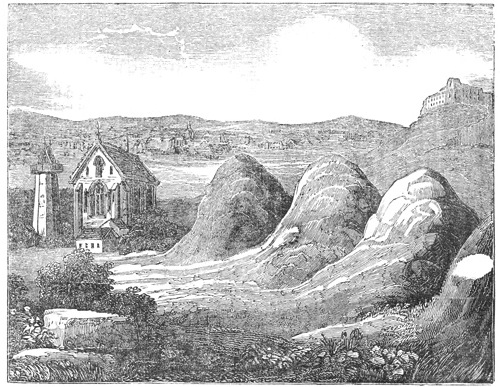
UPSALA—SWEDEN.
Transcriber’s Note:
This book was written in a period when many words had not become standardized in their spelling. Titles of individuals were not always spelled with a capital letter. Proper nouns may have multiple spelling variations; inconsistent use of hyphens, diacriticals, and small capitals were not changed. Dialect, obsolete words, spelling errors and incorrect dates were not changed. Words missing from the text were not added.
Footnotes were renumbered sequentially and were moved to the end of the book. Obvious printing errors, such as backwards, upside down, and partially printed letters, were corrected. Letters in reverse order were corrected. Capital letters were added where missing at the beginning of sentences. Final stops missing at the end of abbreviations and sentences were added. Duplicate letters and words at line endings or page breaks were removed.
Unprinted dashes were added between entries within the Table of Contents. For consistency, space was added between letters B. C. Unprinted quotation marks were added and mis-matched quotation marks were adjusted to standard usage.
The List of Illustrations omits the Frontispiece, the image preceding the text and final image of the book. Contained in the List, but omitted in the book, were two illustrations: ‘Disappointed Gold Seekers’ and ‘Gold Seeker’s Grave.’ An Illustration entitled ‘City of Barcelona—Spain’ was inserted at that point instead.