AMERICAN ENCYCLOPEDIA (continued 26)
Reading edition
OMAR PASHA.
Omar Pasha who commands the Turkish army, is an Austrian subject, and a native of Coroalia. He was born in 1801, at Vaski, a village situated in the circle of Ogulina, thirteen leagues from Fiume. His family name is Lattas. His father was lieutenant-administrator of the circle; his uncle was a priest of the United Greek Church. Admitted, when very young, into the School of Mathematics of Thurm, near Carlstadt, in Transylvania, after having completed his studies with distinction, the young Lattas entered the corps of the Ponts et Chaussees, which, in Austria, is organized on a military footing. In 1830, in consequence of a misunderstanding with his superiors, he left for Turkey, and embraced Islamism. Khosrew Pasha, who was then Seraskier, took him under his protection, procured him admission into the regular army, and attached him to his personal staff. He then gave him his ward in marriage, who was one of the richest heiresses in Constantinople, and a daughter of one of the Janizaries, whose head he had caused to be cut off in 1827, when that corps revolted against Sultan Mahmoud. In 1833, Lattas, who had taken the name of Omar, was chief of battalion, and was appointed aid-de-camp, and interpreter to General Chrzanowski, who had charge of the instruction of the Ottoman troops encamped near Constantinople. Omar was thenceforward actively employed in the reörganization of the Turkish army, and, still protected by Khosrew Pasha, obtained successively important missions and command in the army. The troubles of Syria, and the Albanian insurrection of 1846, gave him occasion to distinguish himself, and attracted to him the attention of the Sultan. He was sent to the Kurdistan, and succeeded in obtaining the submission of that province, which was nearly independent of the Porte. Named in 1848 to the command of the army, sent to the Danubian provinces, he made the authority of the Sultan respected, while at the same time he respected the susceptibilities and the privileges of those provinces, placed, as they were, under the double protection of Russia and Turkey. The year 1851 was the most brilliant period of the military career of Omar Pasha. Named commander-in-chief of Bosnia, the principal chiefs of which had refused to recognize Tanzimat—that is, the new organization of his empire—he combatted successfully, though with an inferior force, the Beys of that country. At last he was sent to Montenegro, where he found himself for the first time commanding an army of 30,000 men. The intervention of Austria, as is known, put a term to that expedition before decisive operations could be commenced. At the present date, Omar Pasha is at the head of nearly 100,000 men in the Crimea.
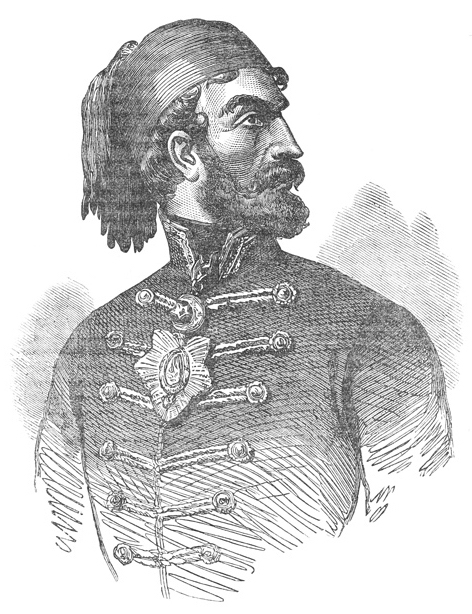
OMAR PASHA.
EDWARD EVERETT.
Edward Everett, an American orator, scholar, and diplomatist, was born in Dorchester, Massachusetts, in April 1794. His father was a respectable clergyman in Boston; and his elder brother was minister at the court of Spain. He received his early education at Boston, and entered Harvard college when little more than thirteen years old, leaving it with first honors four years later, undecided as to a pursuit for life. He turned his attention for two years to the profession of divinity; but, in 1814, he was invited to accept the new professorship of Greek literature at Cambridge, Massachusetts, with permission to visit Europe. He accepted the office; and, before entering on its duties, embarked at Boston for Liverpool. He passed more than two years at the famous university of Göttingen, engaged in the study of the German language and the branches of learning connected with his department. He passed the winter of 1817–18 at Paris. The next spring he again visited London, and passed a few weeks at Cambridge and Oxford. While in England, he acquired the friendship of some of the most eminent men of the day; among others, of Scott, Byron, Jeffrey, Campbell, Mackintosh, Romilly, and Davy. In the autumn of 1818, he returned to the continent, and divided the winter between Florence, Rome, and Naples. In the spring of 1819, he made a short tour in Greece. Mr. Everett came home in 1819, and entered at once upon the duties of his professorship. Soon after his return, he became the editor of the ‘North American Review,’ a journal, which, though supported by writers of great ability, had acquired only a limited circulation. Under its new editor, the demand increased so rapidly that a second and sometimes a third edition of its numbers was required. One of his first cares as editor was, to vindicate American principles and institutions against a crowd of British travelers and critics, who were endeavoring to bring them into contempt. The spirit with which he performed his task checked this system of assault; and Campbell, who had inadvertently admitted into ‘The New Monthly Magazine’ a paper of the same description, made a handsome amende. In 1824, Mr. Everett delivered the annual oration before the Phi-Beta-Kappa Society, at Cambridge, Massachusetts. The entire discourse was favorably received; but the peroration, being an apostrophe to Lafayette, who was present, touched a chord of sympathy in an immense audience, already excited by the unusual circumstances of the occasion. This was the first of a series of orations and addresses delivered by Everett on public occasions of almost every kind during a quarter of a century, and lately collected in two volumes. Up to 1824, he had taken no active interest in politics; but his articles in the review had evinced his acquaintance with the wants and spirit of the nation, and his recent oration had brought him prominently before the public. The constituency of Middlesex, Massachusetts, without any solicitation on his part, returned him to congress by a great majority over the regular candidate. For ten years he sat in congress, and proved himself a working member, never taking advantage of his superior powers to detain the house with oratorical display, but taking part in every debate of importance. In 1835, he retired from congress, and was for four successive years chosen governor of Massachusetts. In 1839, he was again a candidate for the same honor, but was defeated on local questions by a majority of one out of more than 100,000 votes. In 1841, he was appointed to represent the United States at the court of St. James, a position for which he was peculiarly qualified by his knowledge of the European tongues, and his acquaintance with the then mooted boundary question. Although the secretaryship of state at Washington was held by four different statesmen, of various politics, during Everett’s mission, he enjoyed the confidence and approbation of all. His firmness, high intelligence, and assiduous habits, won him great respect in England; and his scholarship was recognized in the bestowal of the degree of D. C. L. by the universities of Oxford and Cambridge. He returned to America in 1845, and was chosen president of Harvard college, which office he resigned in 1849. He now lives at Boston, employed on his promised ‘Treatise on the Law of Nations.’
WASHINGTON IRVING.
Washington Irving was born in the city of New York, April 3, 1783, in which place his father, William Irving, had been settled as a merchant some twenty years. After receiving an ordinary school education, at the age of sixteen, he commenced the study of the law. Three years later he contributed, under the signature of Jonathan Oldstyle, a series of letters to the ‘Morning Chronicle,’ a newspaper of which his brother, Peter Irving, was editor. These juvenile essays attracted much notice at the time, were extensively copied by other journals, and in 1823 or 1824 were collected and published without the sanction of the author. In 1804, in consequence of ill health, he sailed for Bordeaux on a visit to Europe, and traveled through the south of France to Nice, where he took a felucca to Genoa, in which city he remained some two months. He then went by sea to Sicily, made the tour of the island, crossed from Palermo to Naples, passed through Italy, meeting Allston at Rome, who strongly recommended his devoting himself to art, thence over the St. Gothard, through Switzerland to Paris, where he remained several months. He then went to Holland, whence he embarked for England, where he spent part of the autumn, and returned to New York in March, 1806, completely restored to health. He again resumed the study of the law, and was admitted to the bar in November of that year, but never practiced. Shortly after he took the chief part in ‘Salmagundi,’ the first number of which appeared in January, 1807, and the last in January, 1808. In December the following year, he published his ‘Knickerbocker’s History of New York.’ In 1810, two of his brothers, who were engaged in commercial business, one being at the head of the establishment in New York, and the other in Liverpool, gave him an interest in the concern, with the understanding that he was not to enter into the duties and details of the business, but pursue his literary avocations. During the war with Great Britain, in 1813–14, he edited the ‘Analectic Magazine,’ and in the fall of the latter year, joined the military staff of the governor of the state of New York, as aid-de-camp, and military secretary, with the title of colonel. On the close of the war, May, 1815, he embarked for Liverpool, with the intention of making a second tour of Europe, but was prevented by the sudden and great reverses which followed the return of peace, overwhelming, after a struggle of two or three years, in which Mr. Irving took an active part to avert the catastrophe, the house in which his brothers had given him an interest, and involving him in its ruin. In 1818, he determined to try his pen as a means of support, and commenced the papers of the ‘Sketch-Book,’ which were transmitted piecemeal from London, where he resided, to New York for publication. Three or four numbers were thus published, when, finding that they attracted notice in England, he had them published in a volume, February, 1820, by Mr. John Miller; but he failing shortly after, the work was transferred to Mr. Murray, with a second volume, published in July of that year. Mr. Murray had bought the copyright for £200, but its success far surpassing his expectations, he sent Mr. Irving, of his own accord, first £100, and the sale still increasing, an additional £100. After a residence of five years in England, Mr. Irving removed to Paris in August, 1820, and remained there till July of the following year, when he returned to England and published his ‘Bracebridge Hall’ in London and New York in May, 1822. The following winter he passed in Dresden, returned to Paris in 1823, and crossed to London in May, 1824, to publish his ‘Tales of a Traveler,’ which appeared in August of that year in two volumes, and in four parts in New York. In August, he returned to Paris, and in the autumn of 1825, visited the south of France, spending part of the winter in Bordeaux. In February, 1826, he left that city for Madrid, where he remained two years. Here he wrote the life of ‘Columbus,’ which appeared in 1828. In the spring of 1828, he left Madrid on a tour to the south of Spain, visiting Granada and the main points mentioned in the ‘Chronicles of the Conquest of Granada, by Fray Agapida,’ of which he had made a rough sketch. This he prepared for the press at Seville, and transmitted to London and New York for publication; it appeared in 1829. In the spring of this year he again visited Granada, and resided some three months in the Alhambra, where he collected materials for the work published under that name in 1832. In July he went to England, being appointed secretary of legation to the American embassy in London, which office he held until the return of Mr. M’Lane in 1831, when, after remaining a few months as chargé, he resigned, on the arrival of Mr. Van Buren. While in England, in 1830, Mr. Irving received one of the fifty-guinea gold-medals, provided by George IV, for eminence in historical composition; the other was awarded to Mr. Hallam, the historian. In 1831, the university of Oxford conferred on Mr. Irving the degree of LL.D. In the spring of 1832, he returned to New York, after an absence of seventeen years. His return was greeted on all hands with the warmest enthusiasm; a public dinner was given to him, at which Chancellor Kent presided; and similar testimonials were offered in other cities, but which he declined. In the summer of this year he accompanied Mr. Ellsworth, one of the commissioners for removing the Indian tribes west of the Mississippi, and whom he had met on a tour to the west, on his expedition. The most interesting portion of this journey has appeared in the ‘Tour on the Prairies,’ published in 1835. This was followed in the same year by ‘Abbotsford and Newstead Abbey,’ and ‘Legends of the Conquest of Spain.’ In 1836 he published ‘Astoria,’ and in the following year he published ‘The Adventures of Captain Bonneville.’ In 1839 he entered into an engagement which lasted two years, with the proprietors of the ‘Knickerbocker Magazine,’ to furnish monthly articles for that periodical. In February, 1842, he received, unsolicited, the appointment of minister to Spain. He left for Madrid on the 10th of April of that year. His official duties terminating in the summer of 1846, he returned to this country, and, in 1848, commenced the publication of a revised edition of his works which had long been out of print. In 1849 he published ‘Oliver Goldsmith, a Biography,’ and ‘Mahomet and his Successors,’ 1849–50. He has recently published a life of Washington. Mr. Irving is essentially the man of his works, genial, warm-hearted, and benevolent; so much so, that all who see him would be apt to forget the author in the man. He has a countryseat, ‘Sunnyside,’ on the banks of the Hudson, twenty-five miles from the city of New York, which is now his home.
WILLIAM CULLEN BRYANT.
William Cullen Bryant, an American journalist and poet, was born at Cummington, Hampshire county, Massachusetts, November 3d, 1794. His forefathers, for three generations, were medical men; but this family penchant for physic did not exist, apparently, in the case of our poet, who changed the professional current by becoming a lawyer. For ten years he followed the tortuous course of legal practice, but at last gave it up for the more genial profession of literature. In 1808, Mr. Bryant published a little collection of poems, written before he had completed his fourteenth year, entitled, ‘The Embargo, and other Poems.’ In 1821, he published at Cambridge, Massachusetts, the volume entitled, ‘The Ages, and other Poems.’ In 1825, he came to New York, when he became one of the editors of the ‘New York Review’ (which, however, had but a short existence), and published several poems and tales, which quickly became popular. From this point he went on successfully, writing in the chief periodical publications, in conjunction with some of the leading American authors of his day, and becoming, moreover, the editor of a New York paper, the ‘Evening Post.’ In 1834–35, and also in 1845, he traveled in Europe, writing descriptions of what he saw for his journal in America. Mr. Bryant again visited Europe in 1849, and on his return published his ‘Letters of a Traveler,’ being a resume of his tours in Europe and this country. He has gained a high reputation by his poems; and his political writings in favor of free trade and free discussion, against monopolies of all kinds, are marked with clearness and vigor. He has labored earnestly to diffuse a taste for the fine arts in this country, and was president of the Apollo Association, prior to its incorporation as the American Art Union.
GEORGE BANCROFT.
George Bancroft, the distinguished American author and historian, was born at Worcester, Massachusetts, in the year of 1800. His father, who was himself an author and a doctor of divinity, gave to his son’s mind the bent and disposition which in after-years conducted him to celebrity, position, and power. Not yet seventeen, Mr. Bancroft graduated at Harvard college, with honors, and soon entered upon a course of literary pursuits, having as their ultimate end the profession of a historian. In 1818, he went to Europe, and there studied at Göttingen and Berlin, enjoying the high advantages of the most thorough system of instruction and the society of distinguished and cultivated men. After an absence of four years, during which he traveled in England, Switzerland, Germany, and Italy, he returned to the United States. His first sphere of labor was naturally in accordance with his previous life, and he was appointed tutor of Greek in Harvard college. A love of intellectual independence and the desire to engraft upon the academic system in New England the German method of instruction, led him in company with a literary friend, to separate labors in the field of instruction, which were pursued for some time in the interior of New England, but afterward abandoned for duties of a more public and permanent character. During the interval of severer labors, Mr. Bancroft made many contributions to American literature, especially from the stores of German thought and intellect, then comparatively sealed, even to educated men in the United States. He early adopted decided political opinions, attaching himself to the democratic party, in whose behalf his first vote was cast. In 1826, in a public oration, afterward published, he announced as his creed ‘universal suffrage and uncompromising democracy;’ and in the ranks of the liberal party he rose to political preferment and distinction rarely attained by one whose career at the outset was so purely that of a scholar. In 1834, Mr. Bancroft published the first volume of his ‘History of the United States,’ a work to which he had long devoted his thoughts and researches and in which he laid the foundation of a reputation at once permanent and universal. The first and two succeeding volumes of the work, comprising the colonial history of the country, were hailed with the highest satisfaction, as exhibiting for the first time, in a profound and philosophical manner, not only the facts but the ideas and principles of American history. In January, 1838, Mr. Bancroft received from President Van Buren the appointment of collecter of the port of Boston, a post of more responsibility than profit, which he occupied until the year 1841, discharging its duties with a fidelity which proved that a man of letters may also be a man of business, in the strictest sense of the term. In 1844, he was the candidate of the democracy of Massachusetts for the office of governor of the state; and though the party was in the minority, his unusually large vote, greater than that which any other democratic candidate has since received, attested his popularity. In the spring of 1845, Mr. Bancroft was called by President Polk to a seat in the cabinet, and the administration of the navy department, over which he presided with an energy and efficiency which, notwithstanding the short period of his connection with it, perpetuated themselves in numerous reforms and improvements, of lasting utility to the naval service. In 1846, he was appointed minister-plenipotentiary to Great Britain, and there represented the United States, until succeeded by Mr. Abbott Lawrence, in 1849. In England, the prestige of Mr. Bancroft’s literary reputation and his high social qualities contributed to enhance the popularity and respect which attached to him during his entire diplomatic career, which was one of complete satisfaction to the government which he represented and to that to which he was accredited. On his return, he fixed his residence in the city of New York, and resumed more actively the prosecution of his historical labors. The fourth volume of his history appeared early in 1852. It includes the opening scenes of the great drama of American independence, and amply sustains the interest and dignity of the work by which Mr. Bancroft has inseparably linked his name with the annals of his country.
WILLIAM HICKLING PRESCOTT.
William Hickling Prescott, an eminent American historian, was born in Salem, Massachusetts, in 1796, the son of an able lawyer, and grandson of that Prescott who commanded our troops at Bunker’s Hill. When he was twelve years of age his family removed to Boston, where Prescott has since resided, and where his classical training, begun in the place of his birth, was continued with success by Dr. Gardiner, a pupil of Dr. Parr. In 1811 he entered Harvard college, and was graduated there in 1814, with honors appropriate to his favorite studies, and with an intention to devote himself to the legal profession. But the great misfortune of his life had already befallen him. Before he had been graduated, an accidental blow had deprived him of the sight of one eye, and the natural consequences soon followed. The other became weakened by the increased labor thrown upon it; and, after a severe illness, during which he was entirely blind, he found the sight of his remaining eye so much impaired, that he was compelled to give up his professional studies and his hopes of success at the bar. The next two years he spent in Europe, traveling for his health in England, France, and Italy, and seeking the aid of the great oculists of London and Paris. He returned to America with renovated health, but for his misfortune found no relief. Still he was not disheartened, but turned with alacrity to those studies which remained yet within his reach. He resolved to become, in the best sense of the word, a historian, and freely gave himself ten years to prepare for the task, by a course of the classical reading he had always loved. He then selected his subject, and, having done this, gave ten years more to his ‘History of Ferdinand and Isabella,’ one of the few important periods in the affairs of modern Europe that seemed to invite the hand of a master. With this great work, in 1838, at the age of forty-two, he appeared before the world as an author, publishing simultaneously in London and Boston. It was received on both sides of the Atlantic, with unhesitating applause. It has since run through many editions, and been translated into German, Italian, French, and Spanish. During his labor on this work, Mr. Prescott’s vision had been somewhat improved by a diminution of the sensibility which had led to earlier inflammations, and which had compelled him to live in a darkened apartment, relying entirely on a reader when collecting his materials. His ‘Conquest of Mexico,’ therefore, first printed in 1843, though prepared largely from manuscript documents, was perhaps a work of less troublesome toil than his first had been. The prompt honors that it received were even more brilliant than those paid to the ‘Ferdinand and Isabella,’ and having before been admitted to several of the distinguished academies of Europe, he was now elected a member of the French institute. His ‘Conquest of Peru’ appeared in 1847. It is marked by the same striking events which distinguished its predecessors, and is, with the exception of a volume of collated miscellanies, his last work. It is understood that he is now engaged in writing a ‘History of Philip II.’ In 1850 he made a short visit to England, where he was received with marked kindness and respect by whatever is most distinguished in society and letters, and where the ancient university of Oxford conferred on him the honorary degree of doctor in the civil law.
HIRAM POWERS.
Hiram Powers, sculptor, was born in Woodstock, Vermont, July 29, 1805. He was the eighth child of a family of nine, and his parents were plain country people, who cultivated a little farm. He acquired such education as the district school afforded, and he also found leisure to get some knowledge of divers kinds of handicraft, among which was the art of drawing. His father finding it difficult to maintain his family upon his farm removed to Ohio, where he shortly after died, and the future artist was thrown upon his own resources. He set out for Cincinnati to seek his fortune, and found employment in a reading-room connected with one of the principal hotels of the city, and afterwards became clerk in a produce store, where he remained until his principal failed. He then found a situation with a clockmaker, by whom he was employed in collecting debts, and afterwards in the mechanical part of the business; but, although this employment was not disagreeable to him, he aspired to some higher branch of the arts. In Cincinnati, he made the acquaintance of a Prussian, who was engaged upon a bust of general Jackson, and with some little instruction in the art of modeling obtained from him, Mr. Powers was soon able to produce busts in plaster of considerable merit, in fact one of his earliest he has declared, himself, to have been unsurpassed in likeness and finish by any of his later works. He then felt that his vocation was the arts, and he formed a connection with the Western Museum at Cincinnati, where, for about seven years, he superintended the artistic department, such as wax-work shows etc. After leaving this place he visited Washington in 1835, hoping to gain some reputation as an artist, which would enable him to increase his business, and furnish him the means of visiting Italy. In this he was not disappointed. After spending some time in the capital engaged in taking the busts of the most eminent men of the day, he was enabled, by the liberality of Mr. N. Longworth, to accomplish his long-cherished scheme; and in 1837 he landed in Florence. For some time after his arrival he continued to devote himself principally to busts, but he soon determined to employ his spare time on the production of an ideal work; the subject determined upon was ‘Eve.’ Just before the model of this statue was completed, Mr. Powers received a visit from the celebrated Thorwalsden, who was then passing through Florence. He expressed himself in terms of high admiration of the artist’s busts; and, in reference to these, declared Powers to be the greatest sculptor since Michael Angelo. The statue of ‘Eve’ also excited his admiration: and to the artist’s apology that it was his first statue, he replied that any man might well be proud of it, as his last. When the model of ‘Eve’ was completed, he began the ‘Greek Slave,’ which was finished in eight months. This, the best known and most admired of all Mr. Powers’ works, has been exhibited throughout the United States, and at the Great Exhibition at London. There are two copies in existence besides the original, one of which recently formed one of the prizes distributed by the Western Art-Union. Among some of his finest works are portraits of Jackson, Webster, Adams, Calhoun, Chief-Justice Marshall and many persons of less eminence. He has also produced some ideal busts; the ‘Proserpine’ is one of the finest.
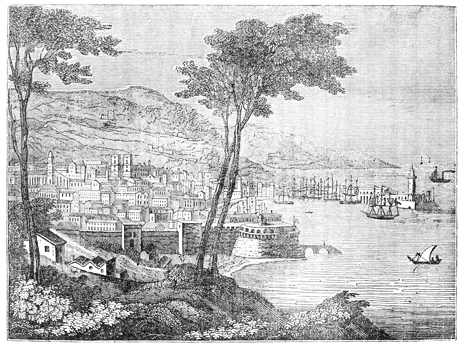
CITY OF BARCELONA—SPAIN.
DEPARTMENT OF TRAVEL.
HISTORICAL SKETCH OF NAVAL ARCHITECTURE.
From the semi-barbarous epoch of the middle ages to the present century, which has seen the birth of steam navigation, the form and rig of vessels have undergone many modifications. We are about to give a rapid historical sketch of these, quoting, as far as possible, those types of naval architecture celebrated in preceding centuries. Still, we are hardly permitted to go back farther than the ninth century, where we find some certain ideas respecting the Scandinavian vessels. Before this period all is confusion, and leaves us full of uncertainty. We know well that the ancient Trireme gave birth to a sort of row-galleys known in the fifth century by the name of Dromons; but we have no positive details respecting the precise form of these vessels. In the sixth century, the Emperor Maurice, in a treatise on the military art, spoke of them as vessels particularly contrived for battle. Three hundred years later, the Emperor Leo, who wrote on the same subject, said that the dromon was long, and broad in proportion to its length, and that it carried on each side two banks of oars, one above the other, of twenty-five each; but nothing further to enlighten us. As for the Norman vessels from the ninth to the twelfth century, we know the drakar (dragon), which was as much of a dragon as the ancient Pristis was a whale—that is to say, that at the summit of her prow rose a figure carved into a dragon, and that her form had something that resembled a serpent. All of the dragons were not of the same size. The dragon of Alaf Tryggrasson is spoken of in cotemporary histories as the giant of Scandinavian vessels.
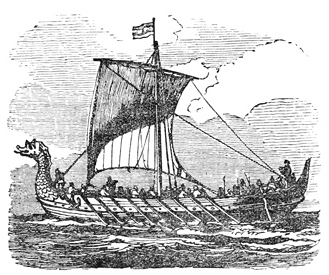
1. Tenth Century.—A Norman Vessel.
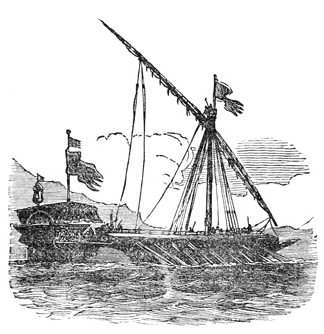
2. Twelfth Century.—Galley, three rowers to Bench.
Never was one seen larger, finer, or more imposing in bulk and decoration. She had thirty-four oars on each side. If the tradition is accurate, she must have been as long as the galleys of the sixteenth century. It was, it will be seen, a vessel of considerable importance; for galleys with twenty-six oars only were about one hundred and thirty feet long. The dragons were built to resist a sea more stormy than the Mediterranean. Consequently they had broad sides and a vast stern, so as to have a firm seat on the water. They were flatbottomed, and drew very little water. Besides the draker, the Scandinavians had the sekkar, or serpent vessel, which had twenty benches of rowers. Its form differed little from that of the dragon. It was only shorter, shallower and narrower. All Norman vessels were alike in bow and stern. But some war vessels had a little building on the poop called the castle. This castle was a little embattled platform, where the archers and slingers were placed. It would be difficult to tell precisely what the internal arrangements of the Scandinavian vessels were. The smallest were not probably decked. As for the larger ones, they doubtless had a deck like the galleys; and beneath this deck a hold, apportioned according to their wants, to rooms, magazines and stables for their horses. The Scandinavian vessels had only one mast, with a vane and four or five shrouds. The sail was square, attached to a yard, furnished with sheets at its lower angles, and managed by two braces that belayed aft. The yard had a halyard passing through a block at the mast head. As for the rudder, it consisted of two blades, large, crutchhandled oars, near the stern, on the right, and also left of the vessel. The anchors of the Normans were like oars, but they did not have that cross-bar of wood we call the stock. In the twelfth century we see the galleys, according to Wenesalf, which were only little light dromons, built particularly for speed, and having only one tier of oars. The following is a textual passage from this writer relating to them:—‘What the ancients called liburnus, the moderns have named galley. It is a ship of no great depth, armed at the prow with a motionless piece of wood, vulgarly called calcar (spur), an instrument with which the galley pierces the enemy’s ships that she strikes.’ A diminutive of the galley was the galleon, which, being shorter and swifter, was better suited for discharging the Greek fire. For the rest, starting from this invention, the action of the shock of the calcar was by degrees replaced by the hand to hand struggle.
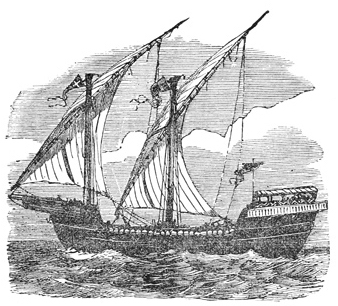
3. Thirteenth Century.—Ship of St. Louis.
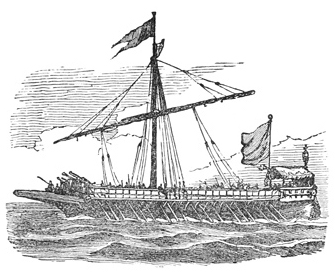
4. Thirteenth Century.—A Galley.
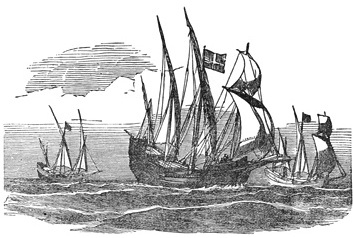
5. Fifteenth Century.—Ships of Christopher Columbus.
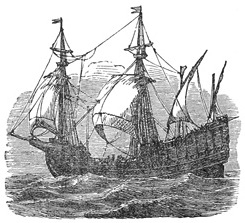
6. Fifteenth Century.—A Carrack.
Among the galleys, which afterwards gave birth to the galea grossa, in assuming more capacity and more amplitude, some were manœuvred by two oars to the bench, others three. It is even certain that, at a later period, in the sixteenth century, the strongest ones had as many as five oars, which appears incredible. The galleys possessed only one mast, which was stepped rather forward—that is, in the first third of the vessel. In the thirteenth century, the fleet which St. Louis took with him towards the Holy Land, gives proof of the thorough modifications which naval structures have undergone. St. Louis could only collect the eighteen hundred vessels which composed his fleet, without recourse to the marine of neighboring states—Genoa and Venice among others. Now, the contracts for hire he exchanged with Venice for many vessels, give us information with respect to one called the St. Mary, represented in the engraving. This vessel had two decks and two masts. It possessed two poops, placed above each other, two platforms, an upper deck, and a fighting gallery of four or five feet overhanging the poop. This ship, manned by one hundred and ten sailors, was one hundred feet long. The same contracts give us also information concerning another vessel, called the Rochefort. Although not so long as the St. Mary, she was stronger and broader. She had two rudders; one to starboard, and the other to larboard. Her sparring consisted, also, of two masts; one at the prow, and the other amidships. The mainmast was smaller and lower than the foremast. It had only twenty-six braces, while the other had twenty-eight. The sails of almost all the fleet were of cotton. All the sails were rectangular triangles with the hypothenuse attached to the yard, and were called antennal. Still, it is proper to mention the assertion of some authors, that the sails of St. Louis’ vessels were square. Their assertions were only founded on the form and dimensions of the yards, which all the documents of the time represent as very long and slung by the middle. We ought to observe that, in speaking of the St. Mary and the Rochefort, Venetian ships, we have indirectly spoken of naval constructions coming from the ports of France and those of other European countries. At this period, all vessels, Genoese, Castilian, French, etc., resembled each other; and to be acquainted with one was to know all. The galleys of the thirteenth century were thus somewhat changed. Lighter, sharper than those of the preceding century, in the fourteenth, the kind called ‘subtle galleys,’ were observed to preponderate. These galleys, extremely light and swift, were furnished on each side with from twenty-four to twenty-six oars, and might have been from one hundred and ten to one hundred and twenty feet in length. Still, in the fourteenth century, and even in the fifteenth and sixteenth, the most celebrated ships were the carracks. Their tonnage may be estimated by their cargoes, which sometimes amounted to fourteen hundred casks.
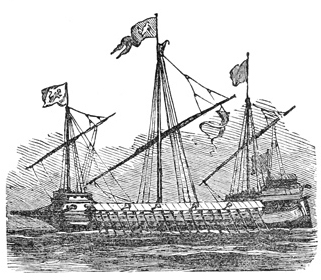
7. Sixteenth Century.—Venetian Galeass.
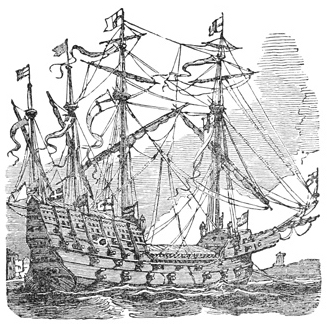
8. Seventeenth Century.—The Great Harry.
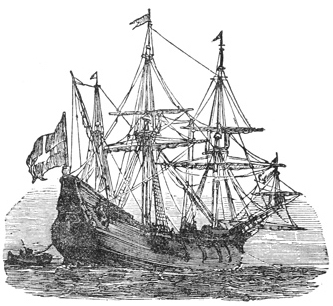
9. Seventeenth Century.—Store Ship.
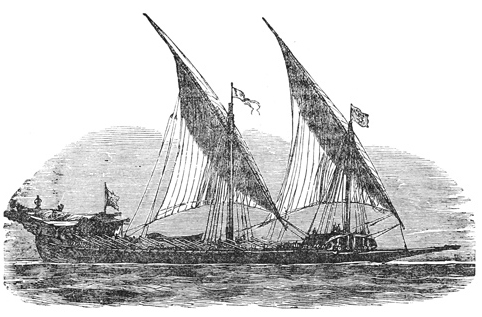
10. Seventeenth Century.—A Galley.
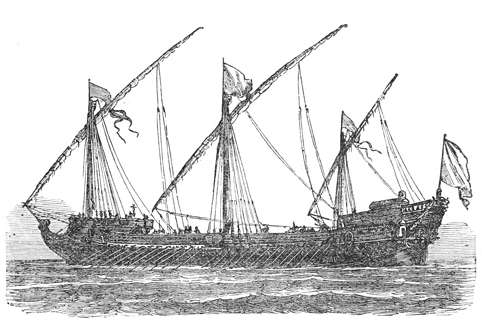
11. Seventeenth Century.—The Galeass.
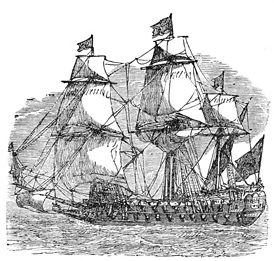
12. Seventeenth Century.—The Sovereign of the Seas.
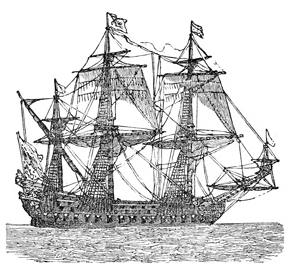
13. Seventeenth Century.—The Royal Sun.
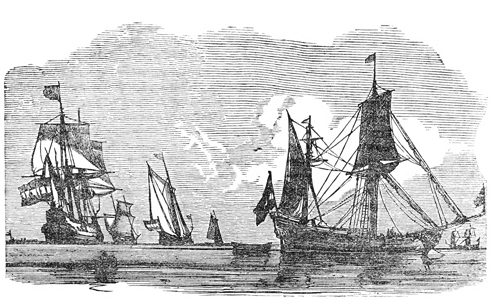
14. Seventeenth Century.—Sea-Going Craft.
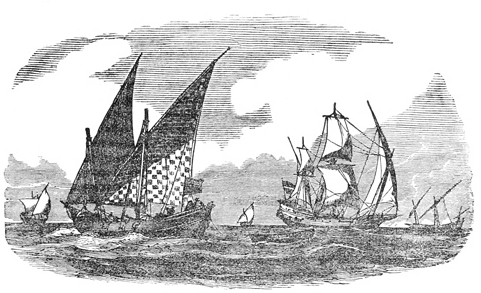
15. Seventeenth Century.—Mediterranean Craft.
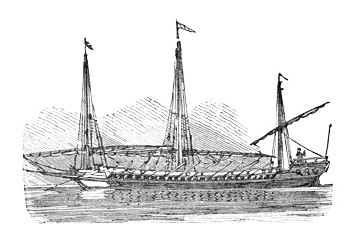
16. Seventeenth Century.—Long Barque.
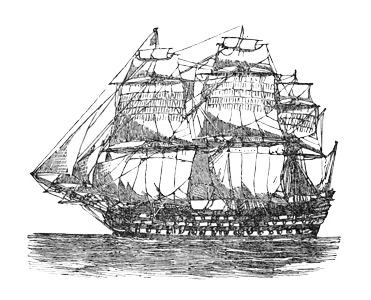
17. Seventeenth Century.—Ocean, Line of Battle Ship.
In 1359, the Castilians took a Venetian carrack, which had three ‘covers’ (decks), and must consequently have been as high as the great storeships of the seventeenth century. In 1545, a French carrack, the Carraquon, which passed for the finest ship and fastest sailer of the western ocean, was of eight hundred tons burthen, and had one hundred pieces of artillery of all calibers for armament. The carracks of the fourteenth century had only two masts; in the fifteenth, they took three, and afterwards four. At first three-decked, they finally reached as high as seven decks. The poop and prow were the height of three or four men above the deck, and looked like castles raised at each of the extremities. The castles mounted each from thirty-five to forty guns. In the galleys, the employment of fire-arms did not effect material changes; the prow alone, somewhat shortened, was armed with a gun mounted on a mass of wood destined for its recoil, and extending amidships through the whole length of the vessel. This piece of wood was called the coursie, and the gun placed upon it the courser. At the sides, upright carriages supported a few falconets and other pieces of small ordnance. The galeass, originating in the galea grossa, as the latter did in the galley, carried, as well as the carrack and other ships, a castle at the bow and a castle at the stern. In the former, there were twelve guns in three tiers; in the latter, ten only in two tiers. She had thirty-two benches of rowers, and between each of her benches rose a swivel on a point. This, it will be perceived, was a formidable armament. The galeass had three masts and lateen sails. The Venetians made great use of this vessel. Their famous Bucentaur belonged to this class. At the end of the fifteenth century, when Christopher Columbus armed his vessels at Palos, he formed his little flotilla exclusively of caravels. Now, this name of caravel, which in the outset belonged only to a common barque, was at this time borne by a vessel of considerable, but not extraordinary size. The caravel had four masts; the forward one with a square sail surmounted by a topsail, the three others each carrying a lateen sail. These sails enabled the caravel to manœuvre well, and she was as prompt to handle as the French tartane, much renowned at that epoch. She came about as quickly as if she had been a row-boat. She had but one deck, and very little carrying capacity. Still, if the caravels of Christopher Columbus were smaller than those of a later period, at the close of the sixteenth century, they were large enough to contain ninety seamen and the provision necessary for a long voyage. The flag ship of Columbus was called the Santa Maria; the two other, La Pinta and La Nina. A passage in the journal of Columbus himself, gives a detail of the canvass of the Santa Maria. ‘The wind,’ says he, ‘became mild and manageable, and I set all the sails of the vessel—the mainsail with the two studding sails, the foresail, the spritsail, the mizzen and the topsail.’ The caravels then had, like all the great vessels of the period, a castle at the bow and a castle at the stern. They made, on an average, six knots an hour. Columbus was only thirty-five days in going from Palos to San Salvador—an ordinary passage even in these days of quick sailing. The sixteenth century was an epoch of progress for the marine; England particularly gave it the onward impulse. Meanwhile, an important invention, that of gun-ports, was due to a Frenchman, of Brest, named Descharges. The system then adopted for the arrangement of batteries has never since been changed, and exists to the present time. Historians and antiquaries have taken great pains to arrive at a knowledge of the forms of ships of war at this period. The documents written and drawn are, some so confused, others so deficient in proportion and perspective, that it is difficult to understand them.
Still, as some authentic details respecting the Great Harry are known, this ship may serve to give an idea of the navy of the sixteenth century; and we have accordingly presented our readers with an engraving of this formidable vessel. Up to the seventeenth century, one model seems to have prevailed in all naval constructions. The Spaniards and the Portuguese followed the example of the Venetians; the Dutch and the northern nations derived their nautical knowledge from the same sources; the English themselves, so jealous of their naval supremacy, received their lessons in improving and strengthening their embarkations from Italian masters. They were accustomed to place at the extremity of the prow a sculptured figure, which served to distinguish the vessels of one nation from another. The Venetians adopted a bust from preference; the Spaniards, a lion; the English, especially after the accession of the Stuarts, the figures of the reigning monarch, either on horseback, or riding on a lion. The stern, above the cabin windows, presented a plane surface or tablet, with apertures for light and air, starboard and larboard. On Venetian, Spanish and Portuguese stern some saint or hero was placed. Other nations had only the arms of their respective states. Before the end of the sixteenth century, some Portuguese and Spanish vessels carried as many as eighty guns mounted on carriages. At this period, the strongest vessel of the English navy carried but fifty guns or pieces deserving that name. The ‘Sovereign of the Seas,’ built in 1637, at Woolwich, Kent, ‘to the great glory of His Britannic Majesty,’ as a cotemporary description we have before us declares, was decorated in a style of regal magnificence. On her bow was king Edgar, on horseback, trampling on seven kings; on the stern, a cupid on a lion; and grouped together, at the bow, six statues, representing Counsel, Prudence, Perseverance, Strength, Courage and Victory. On the quarter-deck, four figures, with their attributes, Jupiter, with his eagle, Mars, with sword and shield, Neptune, with his sea-horse, and Eolus on a cameleon. On the stern, a Victory displayed her wings, and bore a scroll with this device: Validis incumbite remis. This vessel had two galleries on each side. These galleries, as well as the whole vessel, were covered with trophies, emblems and scutcheons, of all kinds. Her length from stem to stern was 232 feet. She carried five lanterns, one of which, the largest, could contain ten persons, standing, with ease. She had three decks running from stem to stern, a forecastle-deck, a half-deck, a quarter-deck, and a poop-deck. Her armament was as follows: thirty ports, with large and small guns, in the lower battery; thirty ports, with culverins, in the second battery; twelve ports in the forecastle, and fourteen on the half-deck; finally, thirteen or fourteen swivels, a multitude of port-holes for musketry, ten bow-chasers, and as many stern-chasers. There were twelve anchors. ‘The Sovereign of the Seas,’ says Charnock, ‘was the first large vessel constructed in England. Splendor and magnificence were particularly kept in view in building her. She was in some sort the occasion of the serious complaints made of the expenses of the navy in the reign of Charles I. Cut down one deck, she became one of the best ships of war in the whole world.’ It is certain that the suppression of this deck, and the lowering of her deck-cabin, gave her more stability than she had at first. Now, for speed, what she gained in strength by these changes was compensated by the length added to her masts. Topsails at this period were an important addition to ships. Old engravings show us the vessels of the sixteenth century sailing generally under their courses. After the building of the Sovereign of the Seas, this only occurred in particular cases and certain conditions of the elements. Captain Phineas Pett directed the work of building and afterwards improving the Sovereign of the Seas. A learned engineer, he deserves the credit of having done more than any one else to give an impulse to the English navy. The artillery was strengthened, and the crews larger, and better lodged. The entire navy felt this progress. The Sovereign of the Seas gauged 1637 tons, a thing which, according to a historian of the time, deserved the attention of the whole world, since it represented exactly the date of her launch. Notwithstanding the thrice-fortunate augury which the historian saw in this coïncidence, the Sovereign of the Seas met with the fate of the Great Harry. She was destroyed, like the latter, by fire, in a ship-yard, where she was being repaired, in 1696, after sixty years’ service. Observe here that Fuller, in his history of the ‘Wonders of England,’ acknowledges that at the commencement of the seventeenth century, the Dunkirkers furnished the models of the best vessels built at this period in the British ports.
When Louis XIV became king of France, there was no French navy, properly speaking. Voltaire asserts that in 1664 a few frigates and a line-of-battle ship, in poor condition, constituted the entire force. After the siege of La Rochelle, Richelieu, jealous of the growth of the English navy, had given a sort of impulse to naval ideas by arming immediately fifty ships and twenty galleys; but the effect of this impulse was merely momentary. Colbert was the true creator of the French navy. Under him, in less than five years, France possessed a triumphant maritime force. The most renowned of the French ships at this period was the Royal Sun. This vessel was constructed partly on French, and partly on Dutch principles. She was 1600 tons, 150 feet long, 48 broad, and 16 deep. She carried three lanterns on the poop. As the flag-ship, she carried at the main the white standard, embroidered with the fleurs-de-lys, and the French coat of arms surrounded the orders of St. Michael and the Holy Ghost. The decorations of the Royal Sun surpassed everything before or since. A model of this ship is contained in the naval museum of the Louvre, at Paris. The Royal Sun mounted 120 guns in three batteries complete, with stern and bow guns.
The seventeenth century was perhaps the most brilliant period in the history of galleys. Those of France were commanded by a general. There were two kinds of them, the ordinary and the extraordinary. The ordinary had only twenty-six oars, and twenty-six benches on each side; the extraordinary had often thirty-two. There was no difference of model between them, their dissimilarity only resulting from their relative sizes. All were extremely long, low and narrow. They carried only two masts and lateen sails. The armament consisted of five guns forward and two swivels. These swivels were attached to the sides of the galley to prevent the recoil. There were generally at least five rowers to each oar, the oars being very long and very heavy. Between the rowers’ benches and the sides of the ship there was a space where the soldiers were stationed. Soldiers to fight, sailors to manœuvre, and a gang composed of galley-slaves, or Turkish prisoners, made up the crews of the galleys.
Naval architecture, in the course of the eighteenth century, advanced in model, sparring and rigging of vessels. Two deckers with fifty guns were superseded by frigates carrying the same number of pieces in one battery. The following were the dimensions generally adopted for the different classes of vessels: For first class vessels, one hundred and sixty four to one hundred and eighty-six feet in length, forty-seven to fifty feet in breadth, twenty-three to twenty-five feet in depth; for second class vessels, one hundred and fifty-six to one hundred and seventy in length, forty-three to forty-seven in breadth, twenty and a half to twenty-three in depth; for third class vessels one hundred and fifty to one hundred and sixty in length, forty-two to forty-three in breadth, twenty to twenty and a-half in depth; for fourth class vessels, one hundred and thirty-five to one hundred and fifty in length, thirty-five to forty in breadth, seventeen to twenty in depth; for fifth class vessels, one hundred and two to one hundred and thirty in length, thirty-three to thirty-four in breadth, thirteen to seventeen in depth; for sixth class vessels, sixty to seventy in length, eighteen to twenty in breadth, nine to ten in depth. Among the considerable changes in construction, the first that strikes the eye is the enormous augmentation of canvas. Never did ships carry so much sail.
At the same time that ships of fifty guns became frigates, in their turn the light frigates—those, for instance, which carried from ten to twenty pieces of artillery—formed a new class of vessels, under the name of corvettes. The corvettes, at the beginning, had three masts, and their guns under cover. Afterwards, to increase their speed, they carried all their artillery on the upper deck. Later year, the mizzen-mast was abandoned in the smallest. This kind of corvette gave place to the brig-of-war. The bomb-galliot became a bomb-ketch, a sort of three-masted corvette, with platforms between the main and mizzen, and the main and fore masts. Yachts, galliots, gun-boats, armed some with a few light pieces, others with one heavy gun, complete the series of naval forces in use at the eighteenth century, except a few varieties peculiar to different seas and coasts. As for the fire-ship of the first part of the century, no mention is made of it at the close; and if, since that time, certain infernal machines, more or less closely fashioned after the fire-ships, have made their appearance, they have only proved unfortunate attempts, and not answered the expectations of their contrivers. The Turks alone preserved these old warlike contrivances up to the present time; and Navarino offered us, for the last time, the spectacle of a ship—the Scipio—engaged with a fire-ship. Like the fire-ship, the ancient galley disappeared with the eighteenth century. In the Mediterranean, the three-masted barque has become the xebeck; and we find, under the same appearance, all the embarkations spoken of in the preceding ages. The lateen vessels are those the least changed in appearance, because, from the simplicity of their rig, they sooner reached a stage bordering on perfection.
The ship Ocean, represented in engraving (17), is an excellent specimen of the science of the eighteenth century. Presented to Louis XIV, by the estates of Burgundy, nothing was spared to make the frigate worthy of its destiny. Built in 1760, it was modernized, and is still in existence.
EARLY MARITIME DISCOVERIES.
The Portuguese were among the first to signalize themselves in the career of geographical discovery. At the beginning of the fifteenth century, Prince Henry, son of John I, was at the head of the marine of Portugal. Under his immediate direction, several voyages were undertaken to the coast of Africa; in one of which the voyagers were driven by a storm out of their usual course along shore, and for the first time the terrified mariners found themselves in the boundless ocean. When the storm abated, they were in sight of an island, to which, in their thankfulness to Heaven for the succor it afforded, they gave the name of Puerto Sancto, or the Holy Haven—the least of the Madeiras. The voyages of the Portuguese now succeeded each other rapidly; and other navigators of this nation, either grown bolder, or again driven off the coast, discovered the Azores. In 1433, the Portuguese passed Cape Nun, hitherto the limit of their courses, and arrived at a cape, which presenting a frightful barrier to the still timid seamen, in the terrible surf that broke on the shoals near it, they named Bojador, signifying its projection into the sea and the consequent circuit it required to double it.
In succeeding expeditions, Cape Verd was reached, and the Senegal arrived at, and Lisbon saw with astonishment a different race from the Moors. Cape Mesurado was the limit of the Portuguese discoveries at the death of Prince Henry in 1463, which damping the ardor of discovery, it was not until 1471 that the Equator was crossed, and the islands in the gulf of Guinea were discovered.
The terrors of the burning zone, and the belief of the union of Africa and Asia being dissipated by these successive voyages, the passage to India round Africa was no longer deemed impossible, and a fleet was fitted out under Bartholomew Diaz for the express purpose of attempting it. The captain coasted Africa to within sight of its southern point, to which he gave the name of Cape of all Torments, from the violent storms he experienced off it, and which, as well as the want of provisions, obliged him to return to Lisbon, after an absence of sixteen months. The name of the Cape of all Torments was changed by the king to that of Good Hope, from the prospect it afforded of accomplishing the passage to India.
Ten years however elapsed after the discovery of the Cape before this passage was attempted; and Vasco de Gama had the honor of doubling the promontory the 20th of November, 1497. Sailing along the coast of Africa, he passed through the Mozambique Channel to Mombaz and thence to Melinda, where he procured pilots, and crossing the Arabian sea, arrived at Callicut the 22d of May, 1498. It is thought that the ridiculous ceremony of ducking, etc., on crossing the line, was first practiced in this voyage.
CHRISTOPHER COLUMBUS.
Christopher Columbo or Colon, better known by his Latinized name of Columbus, was born at Genoa about the year 1436. His father was a woolcomber, in not very affluent circumstances; although connected, according to some accounts, with persons of superior rank. Columbus was the eldest of a family of four. His two brothers, Bartholomew and Diego, will afterwards be mentioned in connection with his discoveries; his sister married an obscure person of the name of Bavarello.
Of the early life of Columbus very little is known. Considering the habits of the age, and the condition of his parents, he appears to have received a good education. While yet a mere child, he learned reading, writing, and arithmetic; he was also such a proficient in drawing and painting, that according to one of his biographers, he could have earned a livelihood by them. At an early age he went to the university of Padua, in Lombardy, then a celebrated school of learning. Here he acquired the Latin language, and devoted himself with zeal to the study of mathematics in all its branches, especially those connected with geography and navigation, towards which he seems to have been drawn from the first by an irresistible propensity. His stay at Padua connot have been long; for in his fourteenth year he returned to his father’s house in Genoa, where he is said to have pursued for some time the occupation of woolcombing. This, however, was far from his taste; and he made choice of the seafaring profession. Genoa being at that time one of the greatest commercial cities in the world, the enthusiasm for maritime enterprise was universal amongst its inhabitants. A historian of the period speaks of the proneness of the Genoese youth to wander through the world in quest of riches, which they intended to return and spend in their native city: few, however, he says, were able to carry their intention into effect—not one in ten of those who left Genoa ever revisiting it. Of these adventurous youths, whose ambition to be sailors was nursed by the sight of the merchant-vessels landing their rich freights on the quays of Genoa, Columbus was one; and, as we have already seen, his education was suitable for the mode of life he had chosen.
At fourteen years of age Columbus left Genoa in the humble capacity of a sailor boy on board a Mediterranean trader; and for many years, at first as a common sailor, and latterly as master of a vessel, he appears to have sailed along the Mediterranean from the Levant to Gibraltar, possibly also undertaking an occasional voyage to some of the northern countries of Europe, with which the Genoese merchants may have had dealings. In this undistinguished course of life he passed his youth; and he does not come prominently into notice till he settled in Lisbon in 1470, when he was thirty-four years of age. At this period he is described as being above the middle size, and of strong muscular frame. His visage was long; his nose aquiline; his eyes of a bluish gray; his complexion fair, but somewhat inflamed. His hair in youth was reddish, but before he was thirty years of age it had turned quite white. His habits were simple; his manners grave and affable; his temper, which was naturally irritable, he had subdued by the force of his will; and in his attention to the observances of religion, he was devout and enthusiastic. His acquirements were far beyond what might have been expected in one whose life had been spent at sea. Besides being a skillful navigator, he was well-informed in astronomy, geography, and all the general science of the age; and while on shore, his leisure appears to have been spent in studying such scientific works as were within his reach. A marriage which he contracted about this period seems to have had some effect in determining his subsequent career. The lady to whom he became attached was Felipa de Palestrello, the daughter of Bartolemeo de Palestrello, an Italian who had distinguished himself as a navigator in the Portuguese service. Marrying this young lady, Columbus obtained from her mother all the charts, journals, and memorandums of her late husband, the possession of which was a treasure to him. After his marriage he lived for many years as a humble citizen of Lisbon, earning a livelihood for himself and family by constructing maps and charts, or by making an occasional voyage in a Portuguese vessel to the Guinea coast, then the ultimate limit of African navigation.
Columbus seems to have acted from deliberate choice in making Lisbon his place of residence. In no city in the world would the demand be so great at that time for maps and charts, or for persons skilled in any of the arts connected with navigation. Portugal had taken the lead of all the nations of Europe in maritime enterprise; and for upwards of twenty years all the great discoveries which had been made by navigators of new coasts or islands had been effected under the auspices of the Portuguese government.
The best result of Columbus’ labors in drawing maps was, that he thereby became acquainted with the small extent of that part of the earth’s surface known to geographers and navigators, as compared with the conjectural extent of the whole. This fact appears to have made a deep impression on his mind, and to have been the germ of his future speculations. It was not long, however, before the idea began to assume a more definite shape. Like all the navigators of the time, he was full of the notion of discovering a new route to India, Cathay, or Cipango—the land of gold, and diamonds, and spices—which was supposed to lie in the east of Asia, and respecting which the most gorgeous fancies were entertained. There was this difference, however, between the speculations of Columbus and other navigators as to this imaginary route to India, that while they universally followed Prince Henry in supposing that it was to be sought by sailing round Africa, he was employed in considering the possibility of effecting the same object by sailing due west across the Atlantic. This most original idea was fully formed in Columbus’ mind before the year 1474.
The globular form of the earth had been for a considerable time known to all scientific men, and various calculations had been made as to its probable size. On this latter point all were at fault, the general supposition being, that the globe was much smaller than it is. Columbus, in pondering on its imaginary magnitude, arrived at the conviction that the Atlantic was a comparatively narrow sea, and that if any one were to push boldly across it, he would inevitably reach the shores of India. These ideas were confirmed by the various rumors which prevailed of lands existing in the Atlantic to the west of Africa. Plato’s fabled island of Atalantis was supposed to be a real country lying in that quarter. There were many traditionary recollections of mariners having been cast upon unknown shores when driven far out to sea by the violence of a storm. There were legends also of adventurers who had embarked in ships in the northern countries of Europe, and gone to seek homes across the Atlantic; and of fugitive bishops and priests, who, to escape persecution in their own country, had committed themselves to the waves, and been conducted by the hand of Providence to fertile and happy islands to the west of the Azores. Moreover, certain circumstances had come within Columbus’ own knowledge, which seemed to argue the existence of land in that direction. Martin Vicenti, a pilot in the Portuguese service, had picked up a piece of carved wood floating in the ocean four hundred and fifty leagues west of St. Vincent, which, as the wind was westerly, he concluded must have come from some land opposite to Africa. Columbus’ brother-in-law, Pedro Correa, had seen a similar piece of wood, which had drifted across the ocean from the same quarter; and had also heard of large canes seen floating on the waves west of Madeira, apparently resembling the reeds known to be produced in the East Indies. It was likewise reported that, when the wind had blown long from the west, trunks of huge pine-trees were often cast ashore upon the Azores; and that once two dead bodies, evidently the corpses neither of Europeans nor Africans, were driven upon the beach of the island of Flores.
All these and many other arguments convinced Columbus that the East Indies could be reached by sailing westward from Gibraltar, or the western coast of Africa. Every circumstance corroborative of this view which came to his knowledge he diligently noted down; and at last the conviction became so strong, that he conceived himself to be expressly destined by God for the great work of discovering a new world. No doubt or hesitation remained in his mind; and his only wish was to find the means of making the contemplated voyage. Once launched upon the Atlantic, he was absolutely certain that, after having sailed seven or eight hundred leagues to the west of the Canaries, he would come upon Marco Polo’s island of Cipango, or the dominions of the great khan of Tartary.
Impressed with these delusive convictions, Columbus was eager to make application to some of the governments of Europe for means to make a voyage of discovery on the Atlantic. He first applied to John II, king of Portugal, who inherited the enterprising spirit of his grand-uncle, prince Henry, and in whose reign the means of finding the latitude at sea had been discovered. Columbus, without much difficulty, obtained an interview with the Portuguese monarch, to whom he explained his scheme of reaching the East Indies, not by the route round Africa, which all other navigators were pursuing, but by a shorter one across the Atlantic. Various accounts are given of the manner in which the proposal was received. John himself was a wise and magnanimous prince, and he appears to have been much impressed by the earnestness of the noble-looking foreigner who addressed him. Naturally cautious, however, of patronising an enterprise which might turn out to be a mere chimera, he referred the matter to some of his counselors, who dissuaded him from engaging in it. Still, such was the effect of Columbus’ representations, that John did not at once dismiss the project. On the contrary, by a piece of meanness not agreeing with his general character, he followed the advice of some of his counselors, and having, on false pretenses, procured from Columbus a detailed plan of his contemplated voyage, with maps and charts to correspond, he secretly despatched a vessel to ascertain the practicability of the intended route. The vessel actually sailed a considerable way beyond the Cape Verd islands; but a storm arising, the crew became afraid to venture farther, and put back, reporting that Columbus’ notion was mad and irrational.
Indignant at this unjust treatment, Columbus, whose wife had for some time been dead, secretly left Lisbon, taking with him his young son Diego. The reason for his leaving the city secretly is said by some to have been the fear of being prevented by the government; by others, the fear of being apprehended for debts which he was unable to pay. Proceeding to his native city of Genoa, he renewed an offer which he had previously made by letter, of conducting the enterprise under the patronage of the Genoese government—an offer which was contemptuously refused, Genoa being already in the decline of her fortunes, and too broken-spirited to engage in any more bold enterprises. It is said that Columbus’ next offer was made to the Venetian government; which, however, is improbable. The usual account, also, of his sending his brother Bartholomew at this time to England to propose the scheme to Henry VII, is incorrect: it was not till the year 1488, when the negotiations with Spain had begun, that Bartholomew proceeded to England on this errand.
Columbus’ Negotiations in Spain. Spain was the country to which Columbus looked with the greatest hope after the rejection of his scheme by Portugal. No country at that time occupied the attention of Europe so much as Spain. By the marriage of Ferdinand II of Arragon, with Isabella of Castile, the whole of the peninsula, except Portugal, had been consolidated into one powerful kingdom. Ruling separately over their distinct territories—the wise, cold, and wary Ferdinand over his subjects of Arragon, and the generous and high-souled Isabella over hers of Castile—the two made it their common endeavor to promote the glory of Spain, and raise its reputation as one of the first powers of Christendom. They were at this time engaged in a war with Granada, the last of the Moorish kingdoms in Spain; and all their energies were occupied in the accomplishment of what was then regarded a noble and chivalrous enterprise—the entire expulsion of the Moors from the peninsula. Spain, accordingly, was then the land of daring deeds, and hither our poor Italian resolved to bend his steps, with the scheme of a new world.
In Andalusia, one of the most southern of the Spanish provinces, and next to Granada, is an insignificant little seaport, of the name of Palos de Moguer. At a little distance from this village stood, and we believe still stands, a Franciscan convent, dedicated to Santa Marie de Rabido. One day, late in the year of 1485, a stranger on foot, accompanied by a little boy, stopped at the convent gate, and begged a little bread and water for his child. The stranger was of a noble aspect, venerable from his white hairs, and interesting from his foreign accent. While the porter of the convent was supplying him with what he had asked, the prior, Juan Perez de Marchena, chanced to pass, and, struck with the stranger’s appearance, he entered into conversation with him. The stranger informed him that his name was Columbus, and that, with his son, he was on his way to the neighboring town of Huelua, where his brother-in-law resided. Inviting him into the convent, the prior soon learned the rest of his story; and instantly conceiving a wonderful affection for the extraordinary man whom Providence had thus cast in his way, he insisted on his taking up his residence with him until a fit time should arrive for proceeding to the court of the Spanish sovereigns. Himself a man of information and ability, Juan Perez entered heartily into Columbus’ views, and sent for such scientific persons in the neighborhood as he thought would be able to form a judgment on the matter. Here, in the midst of a little club of listeners, gathered in the evenings in the comfortable apartment of the prior, did Columbus produce his charts and expound his project in the winter of 1485–6; and long afterwards, in the height of his fame, did the great navigator remember Juan Perez, his first kind friend in Spain.
Early in the year 1486 Columbus set out for Cordova, where the Spanish court then resided, making preparations for a spring campaign against the Moors of Granada. He left his son Diego under the charge of the worthy prior, who, to add to his other kindnesses, furnished him with a letter of introduction to Fernando de Talavera, prior of Prado, and confessor of Queen Isabella—a man, therefore, of some importance, and likely to be of use to him. The letter proved of small avail; either Juan Perez had overrated his influence with so great a personage as Talavera, or Talavera was too busy to pay any attention to the poor Italian enthusiast who was introduced to him. Neither Columbus nor his project appears to have been mentioned to the Spanish sovereigns; and the campaign against the Moors having commenced, there was no hope of his obtaining an interview with them for some time. While the court was thus shifting about, Columbus remained in Cordova, supporting himself, as before, by his skill in designing maps. Here also his worth, his noble appearance, and the modest enthusiasm of his manners, gained him many kind friends, through whom he made the acquaintance of Mendoza, archbishop of Toledo, and grand cardinal of Spain. Mendoza, after being satisfied that there was something more in Columbus’ project than a mere vague fancy, procured him an audience with Ferdinand and Isabella. The able Ferdinand instantly perceived the propriety of at least inquiring into the scheme which was proposed to him; he therefore referred the matter to Fernando de Talavera, the above-mentioned prior, to whom Columbus had already been introduced: instructing him to hold a council of the most learned geographers and scientific men to examine and report on the plan submitted by Columbus.
Few meetings ever held are more interesting to us now than the great meeting of scientific men held in the convent of St. Stephen, at Salamanca, to investigate into the feasibility of Columbus’ project of reaching the East Indias by sailing due west. There were assembled all the sages of Spain, professors of astronomy, geography, and mathematics, most of them churchmen, together with a number of learned friars and ecclesiastical dignitaries in their robes; and in the midst of them all stood a simple mariner of Genoa, ready to explain his scheme and answer questions. A great majority seem to have been prepossessed against Columbus from the beginning, arguing that of necessity he must be wrong, seeing that it was not in the nature of things that one man could know better about such matters than all the rest of the world. Others, however, favored him so far as to be ready at least to enter into argument with him. The arguments produced against him were of the strangest kind—a mixture of crude science with religious dogmas—quotations from Scripture interpreted in the oddest manner; together with extracts from the Greek and Latin fathers. To all the objections urged Columbus answered with firmness and modesty, failing, however, as may be supposed, to convince men against long-cherished prejudice, backed by an erroneous interpretation of Scripture.
The deliberations of the assembly were interrupted by the departure of the court from Cordova in the spring of 1487. No answer had as yet been given to Columbus with respect to his project; on the whole, however, there seemed little hope of a favorable one. The next five years were occupied by the Spanish sovereigns in the war against Granada, so that they had no leisure to enter personally into a consideration of the merits of the proposal made to them by the Genoese navigator. During all that time Columbus waited patiently, generally residing at Cordova, where, it is said, the children in the streets used to point to their foreheads as he passed, bidding each other look at the mad Italian; sometimes, however, following the court in its journeys from place to place, and even taking part in the sieges and battles in which the Spanish troops were engaged. His hopes seem to have alternately risen and sunk during these five years. In the year 1488 he appears to have despaired of a favorable issue to his application; for in that year he despatched his brother Bartholomew Columbus to England to make an offer of his project to Henry VII. Unfortunately, Bartholomew was captured by pirates on the voyage, and was not able to reach England for some years, otherwise Spain might have been for ever deprived of the advantages offered her; for when the scheme was ultimately proposed to Henry VII, he embraced it more warmly than any monarch to whom it had been broached before. In the same year, 1488, Columbus received a letter from the king of Portugal, inviting him to return to that country, but he refused the invitation.
In the winter of 1491, when the Spanish monarchs were about to commence their last Moorish campaign, Columbus received an answer to his frequent applications. He was informed that the expenses of the war prevented the sovereigns from engaging at present in any new enterprise, but that, when the war was over, his scheme would be again considered. This was most disheartening to one who had waited so long. Already advanced in years, he began to fear that death would overtake him before he had obtained the means of accomplishing his design. He resolved to quit Spain. Before doing so, however, he offered his scheme to two of the Spanish nobles, whose wealth and importance made them almost independent princes—the Duke of Medina Sidonia and the Duke of Medina Celi. Both, after some delay, refused to engage in the project, as too ambitious for any but a great sovereign. Columbus, therefore, hesitated no longer, but prepared to go to France, where he anticipated a more favorable reception. Before setting out, he proceeded to the convent at Palos, to visit his friend Juan Perez, and to bring away his son Diego, whom with his other son, Fernando, he intended to leave at Cordova. When his old friend the prior saw Columbus once more at the gate of his monastery, after several years of vain solicitation at court, he was deeply affected. He entreated him by all means to remain in the country. He had been father confessor to the queen, and thought he might still exercise an influence over her mind. He accordingly proceeded to Santa Fé, where the sovereigns were in person superintending the siege of the capital of Grenada. Perez obtained a ready access to the queen. He laid before her the propositions of Columbus with freedom and eloquence. Isabella was moved with the grandeur of the project. The principles on which it was founded, the advantages that would result from its success, and the glory it would shed on Spain, were for the first time represented to her in their true colors. She promised her patronage to the undertaking. Columbus was summoned to court, and 20,000 maravedies, equivalent to upwards of $200 of our money, were sent to him to pay his traveling expenses; and he arrived in time to witness the memorable surrender of Granada to the Spanish arms. It was now only necessary to agree upon the terms of the proposed enterprise. A meaner spirit, after years of unsuccessful toil, poverty, and disappointment, would have been glad to secure the assistance of the sovereigns on such arrangements as their own liberality might dictate. But Columbus stipulated his own rewards and honors, and would consent to no other. He demanded them as if he were already successful, and aware of the extent and importance of his discoveries. In consequence of his resoluteness in adhering to these demands, the negotiation was once more broken off; and Columbus, mounting his mule, left Santa Fé; resolved never to return. He was within two leagues of Grenada, when a courier overtook him and brought him back. The court now agreed that he should be admiral on the ocean, and enjoy all the privileges and honors allowed to the high admiral of Castile; that he should be governor over all the countries he might discover; and that he should reserve to himself one-tenth of all pearls, precious stones, gold, silver, and articles of merchandise, in whatever manner obtained, within his admirality. They also allowed that he should appoint judges in all parts of Spain trading to those countries; and that on this voyage, and at all other times, he should contribute an eighth part of the expense, and receive an eighth part of the profits. These articles of agreement were signed by Ferdinand and Isabella at the city of Santa Fé on the 17th of April 1492.
Preparations for the voyage were now commenced in good earnest. The port of Palos de Moguer, already mentioned, was fixed as the place where the armament should be fitted out. Royal orders were issued to the magistrates of Palos to have three caravels in readiness, and somewhat arbitrary measures were had recourse to for the purpose of obtaining crews. As soon as the nature of the enterprise became known, the little town of Palos was in an uproar; the owners of vessels refused to lend them; and the boldest seamen absconded, lest they should be pressed into such service. Columbus had repaired to the spot; but all his exertions were unavailing; neither vessels nor crew could be got. At length a rich and adventurous navigator, named Alonzo Pinzon, came forward, and interested himself strenuously in the expedition. His assistance was effectual. He owned vessels, and had many seamen in his employ, and consequently possessed great influence. He and his brother Vicente Pinzon determined to take commands, and sail with Columbus. Their example had a great effect; they persuaded their relations and friends to embark with them; and the vessels were ready for sea within a month after they had thus engaged in their equipment.
After all, the armament was miserably ill-proportioned to the grandeur of the enterprise. Only one of the three small vessels was full-decked. The other two, says Washington Irving, ‘were light barques, called caravels, not superior to river and coasting craft of more modern days. They are delineated as open, and without deck in the center; but built up high at the prow and stern, with forecastles and cabins for the accommodation of the crew. The largest vessel was called the Santa Maria: on board of this Columbus hoisted his flag. The second, called the Pinta, was commanded by Martin Alonzo Pinzon, accompanied by his brother Francisco Martin, as pilot. The third, called the Nina, had latine sails, and was commanded by the third of the brothers, Vicenta Yanez Pinzon.’ The crews, including Columbus, the three Pinzons, three other pilots, several royal officials, a physician and a surgeon, some private adventurers with their servants, and ninety sailors, amounted in all to one hundred and twenty persons.
Thus, in the fifty-sixth year of his age, after innumerable efforts and disappointments, and at least eighteen years after he had matured his project in his own mind, did Columbus find his wishes gratified, by being placed at the head of an armament bound on a voyage through the hitherto unexplored Atlantic. He still labored under the delusion that the lands he would reach by sailing in that direction would be the East Indies—the golden regions lying in the eastern extremity of Asia, and described in such glowing colors by Marco Polo. So firm was he in this belief, that he was furnished by Ferdinand and Isabella with letters to be delivered to the great khan of Tartary. It ought to be mentioned also, as characteristic of the times, and of the almost wildly-enthusiastic genius of Columbus, that he had all along cherished the design of devoting the wealth which should be acquired from his discoveries to the object of rescuing the holy sepulchre of Jerusalem from the hands of the infidels.
The Voyage.—On the 2d of August, 1492, Columbus and all his companions marched in solemn procession to the monastery of Rabida to confess their sins, obtain absolution, and implore the blessing of God on their expedition. The account of this deeply-interesting voyage may be best given in the elegant language of Robertson:
‘On Friday, the third day of August, in the year one thousand four hundred and ninety-two, Columbus set sail, a little before sunrise, in presence of a vast crowd of spectators, who sent up their supplications to Heaven for the prosperous issue of the voyage, which they wished rather than expected. Columbus steered directly for the Canary Islands, and arrived there (August 13) without any occurrence that would have deserved notice on any other occasion. But in a voyage of such expectation and importance, every circumstance was the object of attention. The rudder of the Pinta broke loose the day after she left the harbor; and that accident alarmed the crew, no less superstitious than unskillful, as a certain omen of the unfortunate destiny of the expedition. Even in the short run to the Canaries, the ships were found to be so crazy and ill-appointed, as to be very improper for a navigation which was expected to be both long and dangerous. Columbus refitted them, however, to the best of his power; and having supplied himself with fresh provisions, he took his departure from Gomera, one of the most westerly of the Canary Islands, on the sixth day of September.
‘Here the voyage of discovery may properly be said to begin; for Columbus, holding his course due west, left immediately the usual track of navigation, and stretched into unfrequented and unknown seas. The first day, as it was very calm, he made but little way; but on the second, he lost sight of the Canaries; and many of the sailors, dejected already and dismayed, when they contemplated the boldness of the undertaking, began to beat their breasts and to shed tears, as if they were never more to behold land. Columbus comforted them with assurances of success, and the prospect of vast wealth in those opulent regions whither he was conducting them. This early discovery of the spirit of his followers taught Columbus that he must prepare to struggle not only with the unavoidable difficulties which might be expected from the nature of his undertaking, but with such as were likely to arise from the ignorance and timidity of the people under his command; and he perceived that the art of governing the minds of men would be no less requisite for accomplishing the discoveries which he had in view, than naval skill and undaunted courage. Happily for himself, and for the country by which he was employed, he joined to the ardent temper and inventive genius of a projector, virtues of another species, which are rarely united with them. He possessed a thorough knowledge of mankind, an insinuating address, a patient perseverance in executing any plan, the perfect government of his own passions, and the talent of acquiring an ascendency over those of other men. All these qualities, which formed him for command, were accompanied with that superior knowledge of his profession which begets confidence in times of difficulty and danger. To unskillful Spanish sailors, accustomed only to coasting voyages in the Mediterranean, the maritime science of Columbus—the fruit of thirty years’ experience, improved by an acquaintance with all the inventions of the Portuguese—appeared immense. As soon as they put to sea, he regulated everything by his sole authority; he superintended the execution of every order; and allowing himself only a few hours for sleep, he was at all other times upon deck. As his course lay through seas which had not formerly been visited, the sounding line, or instruments for observation, were continually in his hands. After the example of the Portuguese discoverers, he attended to the motion of tides and currents, watched the flight of birds, the appearance of fishes, or seaweeds, and of everything that floated on the waves; and entered every occurrence with a minute exactness in the journal which he kept. As the length of the voyage could not fail of alarming sailors habituated only to short excursions, Columbus endeavored to conceal from them the real progress which they made. With this view, though they ran eighteen leagues on the second day after they left Gomera, he gave out that they had advanced only fifteen; and he uniformly employed the same artifice of reckoning short during the whole voyage. By the fourteenth of September, the fleet was above two hundred leagues to the west of the Canary Islands, at a greater distance from land than any Spaniard had been before that time. There they were struck with an appearance no less astonishing than new. They observed that the magnetic needle in their compasses did not point exactly to the polar star, but varied towards the west; and as they proceeded, this variation increased. This appearance, which is now familiar—though it still remains one of the mysteries of nature, into the cause of which the sagacity of man hath not been able to penetrate—filled the companions of Columbus with terror. They were now in a boundless and unknown ocean, far from the usual course of navigation; nature itself seemed to be altered, and the only guide which they had left was about to fail them. Columbus, with no less quickness than ingenuity, invented a reason for this appearance, which, though it did not satisfy himself, seemed so plausible to them, that it dispelled their fears or silenced their murmurs.
‘He still continued to steer due west, nearly in the same latitude with the Canary Islands. In this course he came within the sphere of the trade wind, which blows invariably from east to west between the tropics and a few degrees beyond them. He advanced before this steady gale with such uniform rapidity, that it was seldom necessary to shift a sail. When about four hundred leagues west of the Canaries, he found the sea so covered with weeds that it resembled a meadow of vast extent, and in some places they were so thick as to retard the motion of the vessels. This strange appearance occasioned new alarm and disquiet. The sailors imagined that they were now arrived at the utmost boundary of the navigable ocean; that these floating weeds would obstruct their farther progress, and concealed dangerous rocks, or some other large tract of land, which had sunk, they knew not how, in that place. Columbus endeavored to persuade them that what had alarmed ought rather to have encouraged them, and was to be considered as a sign of approaching land. At the same time a brisk gale arose and carried them forward. Several birds were seen hovering about the ship, and directing their flight towards the west. The desponding crew resumed some degree of spirit, and began to entertain fresh hopes.
‘Upon the first of October they were, according to the admiral’s reckoning, seven hundred and seventy leagues to the west of the Canaries; but, lest his men should be intimidated by the prodigious length of the navigation, he gave out that they had proceeded only five hundred and eighty-four leagues; and, fortunately for Columbus, neither his own pilot, nor those of the other ships, had skill sufficient to corect this error, and discover the deceit. They had now been above three weeks at sea; they had proceeded far beyond what former navigators had attempted or deemed possible; all their prognostics of discovery, drawn from the flight of birds and other circumstances, had proved fallacious; the appearances of land, with which their own credulity or the artifice of their commander had from time to time flattered and amused them, had been altogether illusive; and their prospect of success seemed now to be as distant as ever. These reflections occurred often to men who had no other object or occupation than to reason and discourse concerning the intention and circumstances of their expedition. They made impression at first upon the ignorant and timid; and, extending by degrees to such as were better informed or more resolute, the contagion spread at length from ship to ship. From secret whispers or murmurings, they proceeded to open cabals and public complaints. They taxed their sovereign with inconsiderate credulity in paying such regard to the vain promises and rash conjectures of an indigent foreigner, as to hazard the lives of so many of her own subjects in prosecuting a chimerical scheme. They affirmed that they had fully performed their duty by venturing so far in an unknown and hopeless course, and could incur no blame by refusing to follow any longer a desperate adventurer to certain destruction. They contended that it was necessary to think of returning to Spain while their crazy vessels were still in a condition to keep the sea; but expressed their fears that the attempt would prove vain, as the wind, which had hitherto been so favorable to their course, must render it impossible to sail in the opposite direction. All agreed that Columbus should be compelled by force to adopt a measure on which their common safety depended. Some of the more audacious proposed, as the most expeditious and certain method of getting rid at once of his remonstrances, to throw him into the sea, being persuaded that, upon their return to Spain, the death of an unsuccessful projector would excite little concern, and be inquired into with no curiosity.
‘Columbus was fully sensible of his perilous situation. He had observed with great uneasiness the fatal operation of ignorance and of fear in producing disaffection among his crew, and saw that it was now ready to burst out into open mutiny. He retained, however, perfect presence of mind. He affected to seem ignorant of their machinations. Notwithstanding the agitation and solicitude of his own mind, he appeared with a cheerful countenance, like a man satisfied with the progress he had made, and confident of success. Sometimes he employed all the arts of insinuation to soothe his men. Sometimes he endeavored to work upon their ambition or avarice, by magnificent descriptions of the fame and wealth which they were about to acquire. On other occasions he assumed a tone of authority, and threatened them with vengeance from their sovereign if, by their dastardly behavior, they should defeat this noble effort to promote the glory of God and to exalt the Spanish name above that of every other nation. Even with seditious sailors the words of a man whom they had been accustomed to reverence were weighty and persuasive, and not only restrained them from those violent excesses which they meditated, but prevailed with them to accompany their admiral for some time longer.
‘As they proceeded, the indications of approaching land seemed to be more certain, and excited hope in proportion. The birds began to appear in flocks, making towards the south-west. Columbus, in imitation of the Portuguese navigators, who had been guided in several of their discoveries by the motion of birds, altered his course from due west towards that quarter whither they pointed their flight. But, after holding on for several days in this new direction, without any better success than formerly, having seen no object during thirty days but the sea and the sky, the hopes of his companions subsided faster than they had risen; their fears revived with additional force; impatience, rage, and despair appeared in every countenance. All sense of subordination was lost. The officers, who had hitherto concurred with Columbus in opinion, and supported his authority, now took part with the private men; they assembled tumultuously on the deck, expostulated with their commander, mingled threats with their expostulations, and required him instantly to tack about and to return to Europe. Columbus perceived that it would be of no avail to have recourse to any of his former arts, which, having been tried so often, had lost their effect; and that it was impossible to rekindle any zeal for the success of the expedition among men in whose breasts fear had extinguished every generous sentiment. He saw that it was no less vain to think of employing either gentle of severe measures to quell a mutiny so general and so violent. It was necessary, on all these accounts, to soothe passions which he could no longer command, and to give way to a torrent too impetuous to be checked. He promised solemnly to his men that he would comply with their request, provided they would accompany him, and obey his command for three days longer; and if, during that time, land were not discovered, he would then abandon the enterprise, and direct his course towards Spain.
‘Enraged as the sailors were, and impatient to turn their faces again towards their native country, this proposition did not appear to them unreasonable. Nor did Columbus hazard much in confining himself to a term so short. The presages of discovering land were now so numerous and promising, that he deemed them infallible. For some days the sounding-line reached the bottom, and the soil which it brought up indicated land to be at no great distance. The flocks of birds increased, and were composed not only of sea-fowl, but of such land birds as could not be supposed to fly far from the shore. The crew of the Pinta observed a cane floating, which seemed to have been newly cut, and likewise a piece of timber artificially carved. The sailors aboard the Nina took up the branch of a tree covered with red berries, perfectly fresh. The clouds around the setting sun assumed a new appearance; the air was milder and warmer; and during night the wind became unequal and variable. From all these symptoms, Columbus was so confident of being near land, that on the evening of the eleventh of October, after public prayers for success, he ordered the sails to be furled, and the ships to lie to, keeping strict watch lest they should be driven ashore in the night. During this interval of suspense and expectation no man shut his eyes; all kept upon deck, gazing intently towards that quarter where they expected to discover the land, which had been so long the object of their wishes.
‘About two hours before midnight, Columbus, standing on the forecastle, observed a light at a distance, and privately pointed it out to Pedro Guttierez, a page of the queen’s wardrobe. Guttierez perceived it, and calling to Salcedo, comptroller of the fleet, all three saw it in motion, as if it were carried from place to place. A little after midnight the joyful sound of ‘Land! land!’ was heard from the Pinta, which kept always ahead of the other ships. But having been so often deceived by fallacious appearances, every man had now become slow of belief, and waited in all the anguish of uncertainty and impatience for the return of day. As soon as morning dawned [October 12th], all doubts and fears were dispelled. From every ship an island was seen about two leagues to the north, whose flat and verdant fields, well stored with wood, and watered with many rivulets, presented the aspect of a delightful country. The crew of the Pinta instantly began the Te Deum, as a hymn of thanksgiving to God, and were joined by those of the other ships with tears of joy and transports of congratulation. This office of gratitude to Heaven was followed by an act of justice to their commander. They threw themselves at the feet of Columbus, with feelings of self-condemnation mingled with reverence. They implored him to pardon their ignorance, incredulity, and insolence, which had created him so much unnecessary disquiet, and had so often obstructed the prosecution of his well-concerted plan; and passing, in the warmth of their admiration, from one extreme to another, they now pronounced the man whom they had so lately reviled and threatened, to be a person inspired by Heaven with sagacity and fortitude more than human, in order to accomplish a design so far beyond the ideas and conceptions of all former ages.