AMERICAN ENCYCLOPEDIA (continued 33)
Reading edition
Having concluded an agreement to make a machine which should enable one ox to raise as much water as was drawn previously by four, he, after much difficulty and obstruction on the part of those whose cattle were employed in the gardens, completed his work, and demonstrated with great success, a practical experiment of its power. The opposition, however, of the Arabs to the use of his machine, which they had materially damaged, induced Belzoni to relinquish his projects concerning it, and to undertake, at the suggestion of Mr. Salt and Mr. Burckhardt, an expedition to Thebes, for the purpose of removing an enormous bust, to which they had given the name of ‘the younger Memnon.’
‘It has been erroneously stated,’ says Belzoni, ‘that I was regularly employed by Mr. Salt for the purpose of bringing the colossal bust from Thebes to Alexandria. I positively deny that I was ever engaged by him in any shape whatever, either by words or writing, as I have proofs of the case being on the contrary. When I ascended the Nile, the first and second time, I had no other idea in my mind, but that I was making researches for antiquities which were to be placed in the British Museum; and it is naturally to be supposed, that I would not have made these excursions, had I been aware that all I found was for the benefit of a gentleman whom I never had the pleasure to see before in my life.’
Our traveler, accompanied by his wife, left Boolak on the 30th of June, 1815, examined the ruins of ancient Antinoe, and arrived at Ashoumain, where he met with the first remains of Egyptian architecture, which he supposes to have been of a date anterior to those of Thebes. Having arrived at Siout, he requested of the bashaw’s physician, permission to employ the workmen necessary to remove the head of Memnon; but not receiving a favorable reply, he, by means of his interpreter, procured the requisite assistance, and after viewing the tombs of Issus, proceeded to Thebes. On his way thither, he visited, near Dendera, the Temple of Tentyra, before which he remained seated some time, lost in admiration, at ‘the singularity of its preservation, and the extent and magnificence of its structure.’ On his return to Dendera, the inhabitants insisted on detaining his interpreter, imagining him to be the same who had joined the French army, some years ago, and declaring ‘that he had been long enough among Christian dogs.’ With much difficulty he procured the man’s release, and in a few days, came in sight of the ruins of Thebes, of which he thus writes:—‘The most sublime ideas that can be formed from the most magnificenct specimens of our present architecture, would give a very incorrect picture of these ruins: for such is the difference, not only in magnitude, but in form, proportion, and construction, that even the pencil can convey but a faint idea of the whole. It appeared to me like entering a city of giants, who, after a long conflict, were all destroyed, leaving the ruins of their various temples as the only proofs of their former existence.’ After pausing with wonder before the two colossal figures in the plain, he proceeded to examine the bust, which it was the object of his expedition to remove. ‘I found it,’ he observes, ‘near the remains of its body and chair, with its face upwards, and apparently smiling on me, at the thought of being taken to England.’ Finding the distance to his boat on the Nile too far to go every night, he built a small hut with the stones of the Memnonium, in which, with Mrs. Belzoni, he determined to remain till he had accomplished the removal of the bust. This, after much difficulty and persuasion, he procured sufficient men to raise from the ground; ‘which,’ says Belzoni, ‘so astonished the Arabs, that, though it was the effect of their own efforts, they said it was the devil that did it.’ On the 5th of August, he reached, with the head, that part of the land which he was afraid of being prevented from crossing by the rising of the water; and on the 12th, he observes, ‘Thank God, the young Memnon arrived on the bank of the Nile.’ Next day he entered a cave in the mountains of Gornou, for the purpose of taking out a sarcophagus which had been mentioned to him by Mr. Drouetti; and which, after having more than once lost his way in the different avenues that led to it, he was preparing to remove, when the Arabs, who were working for him, were put into prison by the cacheff of Erments, who replied, on his complaining of such conduct, ‘that the sarcophagus had been sold to the French consul, and that no one else should have it.’
Whilst waiting the arrival of a boat from Cairo, be made an excursion to the Temple of Ybsambul, the entrance of which, though choked up by an accumulation of sand to the height of thirty-six feet, he determined on using his utmost endeavors to open. Previously, however, to commencing his operations, he made a voyage to the second cataract of the Nile; in reference to which he says, ‘though some authors assert that the Nile has no waves, but runs quite smooth, I can assure the reader that we were this day tossed about as if by a gale at sea.’ On his return to Ybsambul, he immediately began to clear the entrance to the temple, and after five days’ labor, had succeeded in uncovering twenty feet of sand, when, finding that he had neither sufficient time nor money for the completion of his undertaking, he obtained a promise from the cacheff to keep the place untouched till his return, and descended the Nile to Deboade, where he took possession of an obelisk, twenty-two feet long, ‘in the name of his Britannic majesty’s consul in Cairo.’ On arriving at Thebes, he met two Frenchmen, who made some remarks on the head of Memnon to deter him from taking it away, and was told by their dragoman, that if he persevered in his researches, ‘he should have his throat cut, by order of two personages.’ After hiring a boat to convey the bust to Cairo, he proceeded to Carnak, where he employed twenty men to dig away the sand from a large temple, from the ruins of which he transported to Luxor six sphinxes and a white statue of Jupiter Ammon, which he subsequently conveyed to England, and are now in the British Museum. The merit of the discoveries he made here, was attempted to be taken from him by Count de Forbin, who published an account, extracted from Belzoni’s letters.
After examining the extensive ruins of Medinet Aboo, which he describes as ‘best worthy the attention of the traveler of any on the west of Thebes,’ and penetrating into several tombs which he discovered in the valley of Beban el Malook, Belzoni returned to Luxor with the intention of putting on board the colossal head, which, after many impediments, he effected on the 17th of November. On the 15th of December he arrived at Cairo, with the bust and other antiquities; the latter of which he left, according to the instructions of Mr. Salt, at the consulate, and with the former, departed for Alexandria, where he saw it safely deposited in a British transport. Having accomplished this important object, he proceeded to resume his operations at the Temple of Ybsambul, stopping on his way thither at Thebes, where he found the agents of Mr. Drouetti in the act of completing many of the excavations he had begun, and removing several statues and sphinxes from the ruins. With some difficulty our traveler procured sufficient workmen to pursue his excavations at Carnak, where he discovered a magnificent temple, dedicated to the great God of the creation; on entering which, he says, ‘my mind was impressed with ideas of such solemnity, that for some time I was unconscious whether I were on terrestial ground, or in some other planet.’
From Carnak he again proceeded to Gornou, a tract of rocks two miles in length, and formerly the burial place of the city of Thebes; of which subterranean abodes, the most wonderful in the world, he thus speaks:—‘In some places there is not more than a vacancy of a foot left, which you must contrive to pass through in a creeping posture, like a snail, on pointed and keen stones, that cut like glass. Once I was conducted from such a place to another resembling it, through a passage of about two feet in length, and no wider than a body could be forced through. It was choked with mummies, and I could not pass without putting my face in contact with that of some decayed Egyptian; but as the passage inclined downwards, my own weight helped me on, however, I could not avoid being covered with bones, legs, arms, and heads rolling from above; at the same time my throat and nose were choked with dust; but, though fortunately I am destitute of the sense of smelling, I could taste that the mummies were rather unpleasant to swallow.’ After collecting several papyri from the shrouds of the mummies, and purchasing a pair of beautiful brazen vessels, which he describes as ‘two of the finest articles of metallic composition, that ever were to be found in Egypt,’ he returned to Carnak, where, among other discoveries, he dug up, and sent to England, a colossal head of red granite, still larger than that of the younger Memnon. About this time he was joined by Captains Mangles and Irby, with whose assistance he succeeded in entering the temple at Ybsambul, which he found to be one hundred and seventeen feet wide, and eighty-six feet high, and ‘enriched with beautiful intaglios, paintings, colossal figures, etc.’ His next and most important discovery was in the valley of Beban el Malook, of a vast and magnificent tomb, described by him as ‘a new and perfect monument of Egyptian antiquity, which can be recorded as superior to any other in point of grandeur, style, and preservation.’ Speaking of the day on which he discovered this tomb, he says, ‘I may call it one of the best, perhaps, of my life; it led me to the fortunate spot which has paid me for all the trouble I took in my researches.’
On his return to Cairo, he was much annoyed to hear that the credit of the discoveries he had made had been usurped by others, who had been announced, by name, in the English journals, as the means of bringing to light the principal temples which he had so long been employed in excavating. Accordingly he resolved, in future, to keep his operations as secret as possible; and with this view, went alone, to inspect the second great pyramid of Ghizeh, ‘that enormous mass which, for so many ages, has baffled the conjectures of ancient and modern writers;’ and which, whether one solid mass, or possessing any cavity in the interior, no one had yet been able to ascertain. Notwithstanding, however, the difficulty of the attempt, and the uncertainty of success, he resolved on making an effort to discover an entrance to the tomb; a project for the undertaking of which, £20,000 had been considered by Mr. Drouetti necessary, while Belzoni determined to begin it with the small sum of £200, all he, at that moment, possessed. Having procured the requisite number of workmen, he commenced his operations, and after a month’s labor, to his inexpressible delight, found a passage, and penetrated into the centre of the pyramid. So unsuccessful, however, were his attempts at first, that those who came to see him at work, ridiculed the idea of his proceeding further, and the Count de Forbin, says Belzoni, ‘requested, in a kind of sarcastic manner, when I had succeeded in opening the pyramid, (which, no doubt, he supposed I never would,) that I would send him a plan of it.’ Accordingly Belzoni sent it to the count, who taking advantage of the opportunity, on his arrival in Paris, caused it to be published in the newspapers, that he himself had penetrated into the pyramid, and produced the plan as an evidence.
Having sent some account of his proceedings to England, Belzoni made a third journey to Thebes, whence, after taking models in wax of the principal tombs, he set out on a voyage to the Red Sea, principally with the intention of visiting Sarkiet Minor, said to be the site of ancient Berenice. Accordingly, on the 16th of September, 1818, accompanied by Mr. Beechey, he embarked at Gornou, and sailing down the Nile, was witness to one of the most calamitous inundations ever known; the river having risen three feet and a half higher than usual, and swept away several villages and some hundred of their inhabitants. On leaving the Nile, he proceeded across the desert to the Red Sea, the coast of which he found to have been accurately described by Bruce; and, at Cape el Golahen, he discovered the ruins of a town, which, from his own observations, and those of the geographer, D’Anville, he concluded to be the site of ancient Berenice, of which city he had found no traces at Sarkiet Minor. Returning to Gornou, he was met by Mr. Salt and Mr. Banks, the latter of whom, having been authorized to take possession of the obelisk found by Belzoni in the island of Philoe, engaged him to remove it down the Nile to Alexandria, preparatory to its embarkation for England. On reaching the spot where it lay, he, after some opposition on the part of Mr. Drouetti, who claimed the obelisk as his own, commenced his operations for putting it on board, which he effected after a delay of three days, caused by its slipping from the machine into the water. Having arrived at Luxor, he landed for a few days to visit the excavations he had commenced at Carnak, when, on his returning to the boat, he was suddenly attacked by a large party of Arabs, headed by two Europeans and Mr Drouetti, who endeavored to force Belzoni to deliver up the obelisk. He was, however, firm in his refusal; but, on reaching the Nile, hastened on to Alexandria, determined to quit Egypt for ever, as he observes, ‘I could not live any longer in a country where I had become the object of revenge, to a set of people who could take the basest means to accomplish their purpose.’
Previously, however, to sailing for Europe, he made an excursion to Faiume, the ruins of ancient Arsinoe, Lake Mœris, and the Oasis of Ammon, near Zaboo, where he received a severe injury on his side, in consequence of his camel falling with him down a hard rock of twenty feet in depth. In this journey he tried to discover some remains of the famous Temple of the Labyrinth; visited the fountain at Ell Cassar, mentioned by Herodotus; and, after passing some time at various places, in search of antiquities, returned to Alexandria, whence, in the middle of September, 1819, he says, ‘Thank God, we embarked for Europe; not that I disliked the country I was in, for, on the contrary, I have reason to be grateful; nor do I complain of the Turks or Arabs in general, but of some Europeans who are in that country, whose conduct and mode of thinking are a disgrace to human nature.’ On his arrival in Italy, he visited his friends and family at Padua; to which city he presented two lion-headed statues of granite, which were placed, by his townsmen, in the Palazza della Justitia, who also struck a medal in honor of him. In 1820, he reached England; and, in the same year, published an Account of his Travels and Discoveries, a work which excited the interest and attention of the whole literary and scientific world. In 1821, he exhibited, at the Egyptian Hall, in Piccadilly, a representation of two of the principal chambers of a tomb he had discovered in Beban el Malook, besides a model of the entire excavation; with several specimens of Egyptian sculpture, cases containing idols, mummies, etc., and a superb manuscript of papyrus.
In the latter end of 1822, Belzoni left England for Gibraltar, with the intention of traveling through Africa to Senaar, by way of Timbuctoo, a city which, up to that time, had never been visited by an European. On reaching Fez, he was introduced to the emperor of Morocco, who, at first, gave him permission to join a caravan about to set out for Timbuctoo; but, subsequently, remanded him back to Tangiers, whence our traveler proceeded to Gibraltar, determined not to relinquish his project, although he had already fruitlessly expended £1,000 in his attempt to accomplish it. Having arrived at Madeira, he continued his course to Teneriffe and Cape Coast Castle, where he resolved to take a northerly direction, from the kingdom of Benim direct to Houssa, towards the east of which country he had some hope of falling in with the Niger. On the 30th of October, he reached the Bar of Benim river; and, after making an excursion to the capital of Warra, about one hundred and twenty miles distant from Bobee, returned to the latter place, and set out, in company with Mr. Houtson, an English merchant, on his expedition to Timbuctoo. Whilst stepping into the canoe in which he departed, he evinced much agitation; and when the crew of the vessel he had just left, gave him three cheers, it was with trepidation, though with earnestness, that he exclaimed—‘God bless you, my fine fellows! and send you a happy sight of your country and friends!’ He reached Gato on the 20th of November, 1823; and, on the 26th, departed for Benim, where he arrived in the evening of the same day, suffering slightly from an attack of diarrhœa, of which he had complained in the course of his journey. After some negotiation with the king of Benim, to whom Mr. Belzoni was represented as an Indian, or Malay, on his return home, it was arranged that he should be escorted as far as Houssa, whither, however, his diarrhœa, now changed to a dysentery, prevented him from preparing to proceed.
On the 2d of December, his illness increased to such an alarming degree, that he expressed a conviction of his approaching death, and begged Mr. Houtson to send him back to Gato, in the faint hope that the sea breeze might revive him. On his arrival there, though much fatigued, he appeared better for the voyage; resumed his usual cheerfulness, ate and drank, slightly, of bread and tea, and fell into a sound sleep, from which, however, he awoke with a dizziness in the head, and coldness in the extremities; shortly after he lost the power of speech, and, in the afternoon of the 3d of December, tranquilly expired.
Previously to his death, he had given directions respecting his papers, and had attempted to write to his wife; but, his strength failing him, he requested Mr. Houtson ‘to bear witness that he died in the fullest and most affectionate remembrance of her; and begged that gentleman would write to her, and send her the amethyst ring which he then wore.’ He was buried on the day following his death, the funeral service being delivered by Mr. Houtson, who placed over his grave the following inscription:—‘Here lie the remains of G. Belzoni, Esq., who was attacked with a dysentery at Benim, on the 26th of November, on his way to Houssa and Timbuctoo, and died at Gato, on the 3d of December, 1823. The gentleman who placed this inscription over the grave of this intrepid and enterprising traveler, hopes that every European, visiting this spot, will cause the ground to be cleared, and the fence around it put in repair, if necessary.’
The character of Belzoni was of an intrepid and enterprising nature; and he possessed a spirit of perseverance, in the midst of the many difficulties and dangers which surrounded him, that would have turned most men from their object. His person was as well-favored as it was tall and powerful; and his countenance was handsome and intelligent. He was accompanied by his wife in all his expeditions, except the last: she was, for a woman, as prodigious in size and strength as Belzoni was for a man; and proved of much assistance to him in the course of his researches in Egypt. The travels of Belzoni are the most interesting ever recorded; the account of them is written by himself, choosing, as he says in his preface, to tell in his own way his events and discoveries; being more solicitour about the accuracy of the facts than the manner of relating them. His narrative, however, although occasionally confused, from an over-earnestness to convey to the reader’s mind an adequate idea of the difficulties encountered by the author, is written in a pure and unostentatious style, and in a tone which occasionally approaches to the poetic and sublime. Nor is his diction inelegant; and, notwithstanding his want of a classical education, he displays, in his work, a very extensive knowledge of ancient history, and particularly of the classical traditions respecting Thebes and other celebrated places of Egypt.
GEORGE FORSTER.
George Forster, born some time about the year 1750, went out as a writer in the service of the East India Company to Madras, whence, in 1782, he set out on his return to England, by way of Persia and Russia. Embarking on the Ganges, towards the latter end of June, he proceeded through Rajmahal, Monghee, and Patna, to Benares, where he spent three months in familiarity with the Hindoos, and in endeavoring to discover the origin of the Brahmin theology. After making an excursion to the fort of Biggighur, and assuming, for safety, a Georgian name, he proceeded through the Delhi country to Najebabad, where he represented himself as a Turkish merchant, and joined a kafila going to Cashmere. On the 6th of March, he crossed the river Jumma; and, on the 20th, arrived at a frontier town of the Punjaub, or Five Rivers, whence, after a rest of three days, he left the caravan; and in company with his servants, and an other Cashmerian, passed through the respective armies of two rajahs at war with each other; and, about the middle of April, reached Jummoo. Leaving this wealthy and commercial city, he set out, on foot, towards Cashmere, which, after a fatiguing journey of ten days, he approached, on the 26th, at a time, he observes, ‘when the trees, the apple, the pear, the peach, the apricot, the cherry, and mulberry, bore a variegated load of blossoms. The clusters also of red and white roses,’ he continues, ‘with an infinite class of flowering shrubs, presented a view so gaily decked, that no extraordinary warmth of imagination was required to fancy that I stood, at least, on a province of fairy land.’
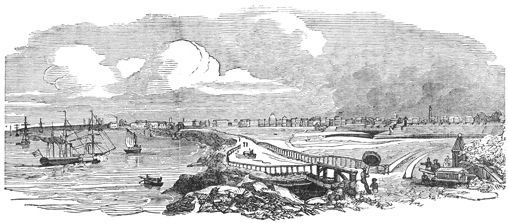
CALCUTTA.
Whilst residing at Cashmere, he was declared, by a Georgian who noticed the flatness of his head, to be a Christian, but threatening his detector with the confiscation of an estate he found him to possess at Benares, in the event of his discovering him, he escaped exposure, and, immediately afterwards, solicited his passport, and left the city. On the 10th of July, he crossed the Indus, about twenty miles above the town of Altack, and, on the following day, passed the Kabul river to Akorah; whence, after a journey, in which he was nearly discovering his true religion, and a few transient dangers, he proceeded to Kabul, which he reached on the 2d of August. A few days after his arrival, he was attacked by a malignant fever, which appeared on his body in bright blue spots, and left him scarcely strength to move for some time after his recovery. Having hired one side of a camel, where he was placed in a pannier, he set out for Kandahar; in the course of his journey whither he was much annoyed by the insults and reviling of the whole kafila, in consequence of his no longer wearing the Mohammedan disguise, which, consequently, on his arrival at Herat, he thought it prudent again to assume. Here he joined another kafila, about to proceed to Tursheez, and obtained great respect the whole way, by representing himself as a pilgrim going to visit the shrine of Meshed. On the 28th of December, he left Tursheez, with a body of pilgrims proceeding to Mesanderan, whence he journeyed to Mushedsir on the Caspian sea; embarked at that city for Baku, shaved off his beard, which had grown to an enormous thickness, and sailed to Astrachan, where he arrived in the beginning of 1784, and, in the following July, landed in England.
Immediately on his arrival he began to put his manuscripts in form for the press, and in 1786, published, in London, his Sketches of the Mythology and Manners of the Hindoos. Returning some time after this to India, he published, at Calcutta, in 1790, the first volume of his travels, under the title of A Journey from Bengal to England, and was just about to print a second, when he died at Nagpoor, whither he had been sent on an embassy, some time in the year 1792. In 1798, a complete edition of his travels was published in two quarto volumes, but so negligently edited, that it has been doubted whether the second volume was compiled from the manuscripts of Forster, of whom no account was given, nor of the manner in which his papers were obtained. The work, though not gaining the reputation it deserved, received great commendation from the literary world, and was translated into German by Meineis, and into French, with the addition of notes and two maps, by Langlès, who has written a short memoir of Forster, in the Biographie Universelle.
Few travels have been more adventurous and hazardous than those of Forster; yet the gay and spirited manner in which the account of them is written, gives no indication of any apprehension on the part of the author, who seems to have been as much at home in the deserts of Khorasan, as on the banks of the Thames. Indeed, had he not preserved, during his travels, the unreserved, unsuspicious, and familiar manner which his disguise as a Mohammedan rendered necessary, he would neither have had so good an opportunity of seeing the manners and dispositions of his infidel associates, nor have lived, perhaps, to relate them.
EDWARD DANIEL CLARKE.
This distinguished traveler and antiquarian, son of the Rev. Edward Clarke, was born at Willingdon, in the county of Sussex, on the 5th of June 1769. Whilst very young, he gave proofs of a roving disposition, and of a fondness for natural history and chemistry, and many amusing anecdotes are related of his conduct under the influence of these predilections. He received the rudiments of education at an academy in the village of Uckfield; and, in 1779, was sent to the grammar school at Tunbridge, then under the superintendence of the celebrated Vicessimus Knox. Here he made but little classical progress, but his fondness for books was evinced by his habit of reading late at night, when all his schoolfellows were asleep, for which purpose he spent great part of his pocket-money in purchasing candles. In 1786, shortly after which his father died, he entered Jesus College, Cambridge, where he obtained the situation of chapel clerk, to the duties of which office he was scrupulously attentive, but distinguished himself in no branch of university learning, excepting that of English declamation. He devoted himself, however, with great assiduity to his self-selected studies, which consisted of history, antiquity, and every variety of learning comprehended under the term of belles lettres. Natural history, and particularly mineralogy, also occupied great part of his time; and he evinced a capacity for scientific pursuits, by the construction of a large balloon at Oxford, and of an orrery at home, for the purpose of delivering lectures to his sister, his only auditor. His sole means of support at this time were derived from an income of about £96 per annum, the source of which was a Rustat scholarship, and his exhibition from Tunbridge. Thus situated, and having made a vow to accept no pecuniary assistance from his mother, whose income was extremely small, he determined to exert himself, and accordingly, as the time approached for his examination, he, for the first time, entered upon a regular course of study, and on proceeding to his degree, in January 1790, he obtained the mathematical honor of a junior optime, which, though it did not confer a high distinction, enabled the college, with some show of justice, to elect him afterwards to a fellowship. In the following April, on the recommendation of the Bishop of Gloucester, he became tutor to the Honorable Henry Tufton, nephew of the Duke of Dorset, with whom he made the tour of Great Britain; and, on his return, published an account of it, but the work is by no means on a level with his subsequent performances.
In 1791, he went with his pupil to Calais; and, in the following year, he obtained an engagement to accompany Lord Berwick on a tour to Germany, Switzerland, and Italy. ‘He was now,’ says Mr. St. John, one of his biographers, ‘in the position for which nature had originally designed him.’ ‘An unbounded love of travel,’ are the words of Clarke himself, ‘influenced me at a very early period of my life. It was conceived in infancy, and I shall carry it with me to the grave. When I reflect upon the speculations of my youth, I am at a loss to account for a passion, which, predominating over every motive of interest, and every tie of affection, urges me to press forward, and to pursue inquiry, even in the bosom of the ocean and the desert. Sometimes, in the dreams of fancy, I am weak enough to imagine that the map of the world was painted in the awning of my cradle, and that my nurse chaunted the wanderings of pilgrims in her legendary lullabies.’ He remained abroad about two years, and on his return, became tutor, successively, to Sir Thomas Mostyn, and to two sons of the present Marquis of Anglesey. In 1798, having previously taken his degree of M. A., he resumed his residence at Cambridge; and, in the following year, set out with his pupil and friend, Mr. Cripps, on a tour through Denmark, Sweden, Lapland, Finland, Russia, Tartary, Circassia, Asia Minor, Syria, Palestine, Greece, and Turkey. Having arrived at the gulf of Bothnia, Clarke declared he would not return until he should have ‘snuffed the polar air,’ and he accordingly proceeded as far as Enontakis, in latitude 68 deg. 30 min. 30 sec. north: beyond which, illness prevented him from venturing.
On the 26th of January 1800, he arrived at Petersburg, whence he continued his course to Moscow, and Taganrog on the sea of Azoff; and, on his reaching Achmedshid, in the Crimea, he passed some time with his pupil in the house of Professor Pallas. He next visited Constantinople, where he was employed in searching for, and examining, Greek medals; and, among other curiosities of the Turkish capital, he contrived to enter the seraglio, ‘where,’ he says, ‘no Frank had before set his foot.’ Hence he made an excursion to the Troad, at the prospect of beholding which, he had previously said in a letter to a friend, ‘Tears of joy stream from my eyes while I write.’ Egypt and Syria next claimed his attention; and whilst near the lake of Genesareth, he took particular observation of the Druzes, whom he describes as ‘the most extraordinary people on earth,’ and whose custom of prostrating themselves weekly before the molten calf, he observes, ‘is exactly that worship at which Moses was so incensed in descending from Mount Sinai.’
In 1801, he returned to Egypt, and whilst in that country, a dispute arising between the French and English generals respecting the literary treasures collected by the former, he was deputed by General Hutchinson to point out those most worthy of being conveyed to England, which country is indebted to him, amongst other things, for the acquisition of the famous sarcophagus of Alexander the Great. From Europe he proceeded to Greece, where his enthusiasm seems to have reached its highest stretch. ‘It is necessary,’ he exclaims, ‘to forget all that has preceded—all the travels of my life—all I ever imagined—all I ever saw! Asia, Egypt, the Isles, Italy, the Alps—Whatever you will! Greece surpasses all! Stupendous in its ruins!—awful in its mountains,—captivating in its vales,—bewitching in its climate. Nothing ever equaled it—no pen can describe it—no pencil can portray it!’
Our traveler returned to Cambridge in 1802, when, in consequence of his presents to the university, of which the principal was a Grecian statue of Ceres, he was presented with the degree of LL. D. It does not appear at what time he took orders, but in 1806, in which year he married Angelica, daughter of Sir William Beaumaris Rush, he succeeded to the college living of Harlton, in Cambridgeshire; and shortly afterwards to the vicarage of All Saints, Cambridge, where he officiated with great popularity, and upon which he bestowed an altar-piece, after the Grecian model. In the year last-mentioned, he commenced a course of lectures on mineralogy, the excellence of which induced the university, in 1808, to found a professorship for the encouragement of that branch of learning, when he was unanimously elected to the chair. About the same time he received £1,000 from the curators of the Bodleian Library, Oxford, for the manuscripts he had collected during his travels, including the famous one known as the Patmos Plato, to which Professor Porson assigned a very high antiquity. In 1810, the first volume of his travels appeared; and was succeeded, at subsequent periods, by five others. The publication of them produced him a sum of £6595; and by no means a more than adequate one, when it is considered that the work occupied five thousand pages of quarto letter-press; a task, under which, he says, ‘I should have sunk, had I not been blessed with double the share of spirits which commonly belong to sedentary men.’ Yet amidst all this toil and multifarious employment, he pursued the study of chemistry both with zeal and success, as appears in one of his letters to a friend, in September, 1816, in which he says, ‘I sacrificed the whole month of August to chemistry. Oh, how I did work! It was delightful play to me; and I stuck to it, day and night. At last, having blown off both my eye-brows and eye-lashes, and nearly blown out both my eyes, I ended with a bang that shook all the houses round my lecture-room. The Cambridge paper has told you the result of all this alchemy, for I have actually decomposed the earths, and attained them in a metallic form.’ The death of this accomplished traveler took place at the residence of his father-in-law, on the 9th of March, 1822, and he was buried on the 18th, in the chapel of Jesus College, Cambridge, with academic solemnities.
For ardent enterprise, energy of purpose, industry of research, and extent and variety of observation, few travelers are to be compared with Dr. Clarke. His works have, on this account, become more popular than any other of a similar nature, though containing an account of countries both before and since visited and described. They would certainly bear abridgement; but it would require a most skillful hand to select from pages where few paragraphs appear worthy of rejection, if of curtailment. Although he expresses himself with enthusiasm, and many of his reflections are hastily and inconsiderately formed, his style is chaste and clear, and he details the most curious facts with a simplicity incompatible with exaggeration. In speaking of the second volume, Lord Byron says, in a letter to the author, ‘in tracing some of my old paths, adorned by you so beautifully, I receive double delight. How much you have traversed! I must resume my seven-leagued boots, and journey to Palestine, which your description mortifies me not to have seen, more than ever.’
A peculiar feature in the character of Dr. Clarke, is the rapidity with which he passed from one pursuit to another. ‘I have lived to know,’ he says in a letter to Dr. D’Oyley, ‘that the great secret of human happiness is this:—never suffer your energies to stagnate. The old adage,’ he adds, ‘of “too many irons in the fire,” conveys an abominable lie. You cannot have too many; poker, tongs, and all—keep them all going.’ ‘His ardor for knowledge,’ says his biographer, the Rev. Mr. Otter, ‘not unaptly called by his old tutor, literary heroism, was one of the most zealous, most sustained, and most enduring principles of action that ever animated a human breast.’ As a preacher, his biographer speaks of ‘the sublimity and excellence of his discourses,’ and says that his ardor in the pursuit of science was ‘softened by moral and social views.’ In private life he was amiable and benevolent; and, to conversation equally interesting and intelligent, joined the most kind and captivating manners. He was survived by five sons and two daughters.
In addition to his Travels, Dr. Clarke was the author of Testimony of different Authors respecting the Colossal Statue of Ceres; The Tomb of Alexander; Description of the Greek Marbles brought from the Shores of the Euxine, Archipelago, and Mediterranean; besides some letters and pamphlets, on subjects relating to science and antiquity.
RICHARD POCOCKE.
Richard Pocoke was born at Southampton, some time in the year 1704. After having received a classical education, and acquired a knowledge of several oriental languages, he, in August, 1733–4, about which time he took the degree of LL. D., visited France and Italy; and in 1736, he set out on an expedition to the east. He reached Alexandria in September, 1737, and proceeded thence to Rosetta, where he visited Cosmas, the Greek patriarch, and observed the veneration of the people for ‘two of those naked saints, who are commonly natural fools, and are held in great esteem in Egypt.’ On the 11th of November, he reached Cairo, when he took great pains in ascertaining the modern condition of the country, and the customs of the people, with every description of whom he associated and conversed. After descending the well of Joseph, visiting and examining the pyramids near Cairo and Saccara, and endeavoring to discover the site of ancient Memphis, which in accordance with Bruce and others, he places at Metrahenny, he made an excursion to Faiume, the Fake Mœris, and ancient Arsinoe; in which province he discovered, at Baiamont, the ruins of two pyramids; where, he observes, ‘I saw the people sifting the sand in order to find seals and medals, there being no part in all the east where the former are found in such great abundance.’ About two miles distant from Lake Mœris, he explored the remains of the Temple of the Labyrinth, a building which once contained three thousand rooms, ‘contrived in such a manner that no stranger could find his way out;’ and he relates a tradition, prevalent among the inhabitants near the lake, of King Caroon, ‘who had keys to his treasures that loaded two hundred camels.’ ‘One would imagine from this,’ he observes, ‘that the fable of Charon might have its rise here, and that this name might be the title of the chief person who had the care of the labyrinth and of the sepulchres in and about it.’
Mr. Pococke embarked in the beginning of December, for Upper Egypt; and, on the 9th of January, 1738, reached Dendera, where he discovered the remains of all the ancient buildings choked with ashes, and the inhabitants of the Arabs fixed on the Temple of Athor-Aphrodite, or the Egyptian Venus. He then visited the ruins of Thebes, Elephantina, Philoe, and the cataracts; and returning to Cairo, the latter end of February, prepared for an excursion to Mount Sinai; but a war just breaking out between the monks and Arabs in that part, he changed his course, and, sailing down the Nile to Damietta, arrived at Jaffa on the 14th of March. Proceeding immediately to Jerusalem, he explored every spot worthy of notice in that city; and his topographical observations have removed much obscurity respecting several parts of it. After making an excursion to Jericho and Jordan, he proceeded along the brook of Kedron to the Dead Sea, where he bathed, in order to ascertain the truth of Pliny’s assertion that no living bodies would sink in it. ‘I stayed in it,’ says Mr. Pococke, ‘near a quarter of an hour, and found I could lay on it in any posture without motion and without sinking; it bore me up in such a manner, that when I struck in swimming, my legs were above the water, and I found it difficult to recover my feet.’ His face was covered with a crust of salt on coming out of the lake, and he describes the water as having the effect of constringing his mouth, in the same manner as strong alumn juice. In May, he returned to Jaffa, whence he sailed to Acra, and visited the northern parts of Palestine and Galilee, particularly Mounts Carmel and Tabor, Cana, Nazareth, the lake of Tiberias, and Mount Hermon; whence he proceeded towards the sea, and sailed to Tyre, Sidon, and Mount Lebanon. He next explored Balbec and its magnificent temple; proceeded to Damascus, Horus, and Aleppo; and after crossing the Euphrates to Orfah, continued his route through Antioch and Scanderoon to Tripoli, where on the 25th of October, he embarked for Cyprus. After passing some time in this island, he returned to Egypt; visited Mount Sinai; followed the track of the Israelites through the wilderness; embarked at Alexandria for Crete; ascended Mount Ida, and continued his course to Smyrna and Constantinople. He then visited the principal cities of Greece, and returned to England in 1741; two years after which, he published, in one folio volume, an account of his travels, with maps and plates, under the title of A Description of the East, and some other Countries, which was succeeded by two other volumes of the same size.
Mr. Pococke, on his return to England, was spoken of with great reputation through Europe; and having taken orders, was made, in 1756, Archdeacon of Ossory; in 1765, Bishop of Elphin; in the July of the same year, Bishop of Meath; and died of apoplexy in the following month of September.
OVERLAND JOURNEY TO INDIA.
The following description of the route from England to India was drawn up by Dr. Buist, of the Bombay Times:
The only way, not many years ago, of reaching India from England, was by sailing vessels, which, touching at St. Helena or the Cape of Good Hope, made the voyage in about four months. Now, the journey is usually performed partly by sea, and partly by land, in from thirty-five to forty days. This overland journey, as it is called, admits of variation. Some travel across France to Marseilles, and then proceed by a steamer to Alexandria; and this is undoubtedly the quickest way of reaching Egypt, through which it is necessary to pass. The greater number of travelers, however, prefer proceeding by steamer from Southampton direct to Alexandria, because this saves much fatigue, shifting of luggage, and also some expenses.
Having spent a few months in England in the latter part of 1845, it became necessary for me to decide on returning to my official duties in Bombay. Of the different modes of making the journey, I preferred that by steam vessel from Southampton. Occupied till the last moment with business in London, I did not find it possible to leave town till the morning of the 3d of December. Packing having been got through rapidly enough, I found myself on my way to the South-Western Railway station, at half-past six—an unpleasant time to start on a long journey, but travelers learn to accommodate themselves to all sorts of inconveniences. The distance from London to Southampton was traversed in little more than three hours. I found various friends and acquaintances about to be my companions on the journey to India, and a more pleasant and agreeable party than that turned out to be which left Southampton in the Tagus, on the 3d of December, no one need desire to travel with.
It is sad to witness the parting of relatives with those about to leave for India; doubly sad to those who know the sickness, the suffering, the sorrow, and the disappointment too often awaiting the young who quit home with visions of the East flitting before them in their brightest hues. The looked-for return—the bright future—the hopes of happy meetings—all how rarely realised!
We quitted our moorings at three o’clock P. M., and lost sight of England in the darkness while yet very close to it. We steered down the Channel during night. Next day the weather was thick, and the land invisible. The Bay of Biscay, which opens after passing Ushant, has, by means of steam, been divested of half its terrors.
We sighted Cape Finisterre on the morning of the 7th—the first land we had seen since leaving Southampton. We continued to make good progress, though latterly we had had a rough wind and heavy sea to contend with.
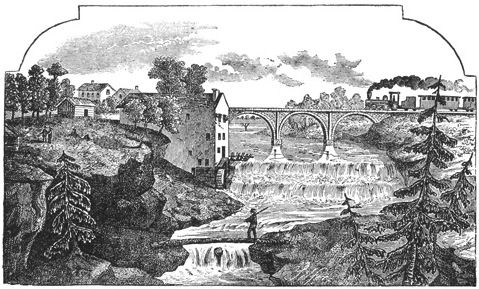
EAST BRANCH ROCKY RIVER.
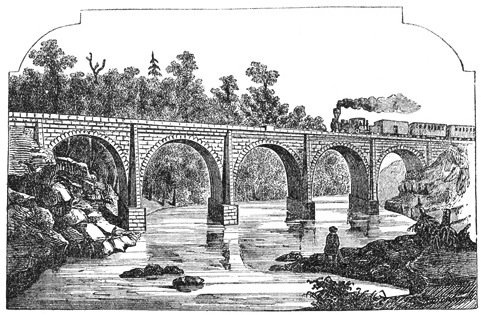
WEST BRANCH ROCKY RIVER.
The vessel, in general, approaches tolerably near to the Cape. The outlines of the landscape are bold, varied, and beautiful; but a heavy swell, which commonly rolls in, is apt to interfere with the voyager’s contemplations.
From this on running down the coast of Portugal, the steamer on most occasions keeps pretty close in-shore, so that the land is for the most part visible. The first places of note that present themselves are Oporto and Vigo Bay. The appearance presented here by the mainland is exceedingly picturesque. The coast seems rocky and precipitous, jagged and irregular. There are lighthouses on certain small islands, and on more than one of the headlands; and white-walled dwellings and villages everywhere present themselves.
The heights of Torres Vedras, close on shore, present nothing to the eye that is marvellous or attractive, though rich in the most striking historical associations. The magnificent pile at Mafra is generally distinctly visible without the aid of a telescope. It is of enormous extent, containing a palace, convent, and superb church. The lines of Byron here recur to remembrance:—
‘The horrid crags, by toppling convent crowned, The cork-trees hoar that clothe the shaggy steep, The mountain-moss by scorching skies embrowned, The sunken glen, whose sunless shrubs must weep, The tender azure of the unruffled deep, The orange tints that gild the greenest bough, The torrents that from cliff to valley leap, The vine on high, the willow branch below, Mixed in one mighty scene, with varied beauty glow.’
The ridge, on the highest pinnacle of which the convent of our Lady of the Rock is situated, is wild, rugged, and precipitous, ascending to an elevation of about two thousand five hundred feet. A low cliff skirts the sea-shore, and singular masses, apparently of drift sand, make their appearance, stretching for some miles along and inland.
A very picturesque appearance is often presented by the fishing-boats when the breeze is fresh. They have a drag-net attached to the extreme end of a long outrigger, stretching some thirty or forty feet beyond the vessel, and hundreds of sea-birds follow the net, with the view, apparently, of picking up any stray fish they can extract from it.
The Rock of Lisbon, a huge, unshapely, but striking mass, indicates the approach to the Tagus. The river opens up magnificently from the sea. The spires and lofty buildings of Lisbon are distinctly visible, with the vessels at anchor off the quay. Cape Espartelle, a remarkable headland, with a lighthouse upon its extremity, becomes visible a little to the south of the debouchure of the Tagus. The cliff is obliquely stratified, and marked like those of Alum bay, Isle of Wight. The land now recedes, and is in a considerable measure lost sight of, till, rounding close in upon cape St. Vincent, the scene of the celebrated engagement in 1797, the bay of Cadiz is entered. In crossing this bay, land is for some time lost sight of. It becomes visible again off cape Trafalgar; but this celebrated headland it was our misfortune to pass in the dark.
The next place of importance reached by the steamer is Gibraltar, where we quit the Atlantic ocean, and enter the Mediteranean. The rock of Gibraltar first comes into view about ten miles off. As the bay is approached, the suddenness of the change in the color of the water, from bright deep blue to green, as the soundings decrease at once from twenty-four to sixteen fathoms, strikes the voyager. The transition is instantaneous, without any intermediate hue or shading. Rounding the point Carnero, and breasting Europa point, you find yourself at once within a beautiful sheltered and spacious recess, some six miles across and ten in depth, with British men-of-war, steamers, and merchant-ships of every nation at anchor. The appearance of the rock of Gibraltar, with respect to its known military strength, generally disappoints the stranger. The most formidable of the batteries are either concealed in mysterious galleries in the bosom of the rock itself, half-way up, or lie so close on the line of the sea, as to be lost sight of amongst the hulls of the vessels around. The promontory consists of a vast rock, rising from twelve hundred to fourteen hundred feet above the sea; it is about three miles in length, and from one-half to three-quarters of a mile in width, and is joined to the mainland by a low sandy isthmus, about a mile and a half in length. On the north side, fronting the isthmus, the rock is almost perpendicular, the east and south sides are also steep and rugged; but on the west side it slopes downward to a fine bay, nine miles long by four and a half miles broad. On this slope lies the town, containing a mixed population of sixteen thousand, and above rise the principal ramparts of the rocky fortress, which is generally garrisoned by from three to four thousand troops. The ordnance consists of more than seven hundred cannons fit for service.
Gibraltar derives its name from Tarif, a Moorish general, by whom it was taken from the Spaniards in 711—Gibel Tarif, the Mountain of Tarif. It remained in the hands of the Moors till the beginning of the fourteenth century, when it was recovered by the Spaniards. It was retaken by the Moors in 1333. In 1462 it finally fell into the hands of the Christians, after having been possessed by their adversaries for seven hundred and forty-eight years. On the 24th of July, 1704, it was captured by the English, who fell on it suddenly, and stormed it—the garrison amounting to no more than one hundred and fifty men, the batteries mounting one hundred guns. From this time till nearly the end of the century, numberless attempts to wrest it from them have been made by the French and Spaniards, but in vain. During the late war, it seemed to be considered idle to attempt to disturb them.
The town of Algesiras, a place of considerable importance, and remarkable as that at which the Moors first landed in Spain, lies across the bay about five and a half miles off, while the village of St. Roque, at the upper end of the bay, is conspicuous on the slope. The high blue mountains of Granada fill up the background.
The winter climate of Gibraltar is extremely delightful. In December, the temperature varies from 60 to 75 degrees, clouds shading the piercing rays of the sun. In summer, it is occasionally extremely hot, especially when the wind blows from the African shore. The appearance presented by Gibraltar, viewed from the harbor, is peculiarly striking after nightfall. The numberless lights, seen in all their brightness through the open windows, look as if issuing from apertures admitting to some bright cave or furnace in the centre of the rock, whose huge black mass towers on high, the houses in the town being indistinguishable in the darkness. In summer, the surface of the sea is occasionally so closely covered with luminous particles, as to seem sheeted in phosphorus. The slightest ripple increases the intensity of the light, and the dolphins flash through the water, literally ‘moving in light of their own making.’ In winter, this in a great measure disappears, the luminosity being confined to a few bright masses which sweep by the ship. I have often taken up bucketsful of water brilliant with luminous particles when stirred, but though I have tried the experiment in a hundred different ways, I have never been so fortunate as to get a sight of the zoophyte or animalculæ by which this is given forth, either with the naked eye or glass.
We landed at Gibraltar at noon, and embarked about five o’clock on the evening of the 10th. Of this time—of which a good deal was made by the more active of our passengers—I was unable to avail myself, being occupied in duties which I could not properly desert. Some of the party provided themselves with mules, and made an interesting excursion over the rock. The view of the African shore from Gibraltar Bay is, towards sunset, peculiarly beautiful—the fortress of Ceuta, standing out purple and red in the setting sun, in mimic rivalry of that on the European shore. One huge mass of mountains, of the Atlas group on the African side, with the Sierras of Andalusia on the Spanish shore, ‘fill the mind with beauty’ for a long while on leaving or on approaching Gibraltar.
After staying but a few hours, our gallant vessel was again on her course. The weather, unfortunately, was not propitious. On leaving Gibraltar we encountered a heavy gale of wind, which lasted four days. The wind was westerly, and, as is usual in such circumstances, the mercury in the barometer kept rising as the gale increased. When at its height, the column stood at 30.114, and began steadily to descend as the storm abated. How useful is this instrument to the mariner—how faithful its prognostications of storm and calm!
Pursuing our way up the Mediterranean, the vessel steers direct for Malta, by which we approach the African shore. On the 14th we were off Algiers. The bay and town, with the villas around, were plainly visible by the naked eye: we were little more than six miles off. The country adjoining appeared fertile and well-cultivated, and we could see roads, gardens, and enclosures, with fields and vineyards, all looking in good condition. Cape Faroe, and the promontory of the Seven Capes, are jagged, irregular headlands, very distinctly visible. Cape Bon was another headland which came into sight. We likewise passed within view of the dreary island of Pantellaria, which is evidently the huge tumulus of an extinct volcano. It is about thirty-six miles in circumference, and seems about three thousand feet in height. The raptured craters and streams of lava are easily traceable, with beds of loose stones hurled down the mountain’s side during some of its fiercer explosions. A large mass of cloud, which might readily be mistaken for the smoke of smouldering fires, almost constantly rests on the summit of the mountain. There is a considerable town, of the same name with the island, near the sea-shore on the western slope, and vineyards and gardens appear scattered about in surprising abundance. It belongs to the king of Sicily, and is used as a penal settlement, whither the Sicilian convicts are sent.
Our coal had been so heavily taxed by the storm, which had only now abated, that we were at one time on the point of making for Tunis. The wind got round upon us, and it is astonishing how rapidly in these seas the swell goes down after a gale. Six hours after it had ceased to blow the waves were nearly smooth, and the speed of the vessel almost doubled.
We reached Malta at daybreak on the 17th of December, and proceeded to land with as little delay as possible. Had we come in an opposite direction, we should have had to perform a troublesome quarantine. The island of Malta, which now belongs to England, is sixty miles from the nearest point in Sicily, and two hundred from the African shore. It attains at one place an elevation of six hundred feet. The climate is fine and healthy, though hot in summer, and suffers occasionally from the sirocco, which blows from the south-east, and occurs chiefly in September. The mean annual temperature is 67 degrees; the variation of the yearly means from 1820 to 1840 was no more than 3 degrees; the extreme range during the year is about 24 degrees.
Malta consists entirely of calcareous rocks, with scarcely any soil, diluvium, or abraded matter. The country has rather an arid appearance, but it produces grapes in abundance, and other fruits. At a distance, the view is rendered lively by the great number of windmills perched on the heights, and employed for grinding corn. The inhabitants speak a language partly Arabic and partly Italian, the former predominating.
The port of Malta consists of two splendid harbors, separated from each other by the narrow promontory called Mount Xiberras. On this stands the capital, Valetta. Marsamuscetta is the name given to the western or quarantine harbor; the other is called Valetta, or the great Harbor. The entrance to this last is guarded on the one side by the fortress of St. Elmo, on the other by that of Ricasoli, both of remarkable strength. On Fort St. Elmo is one of the most brilliant lighthouses in the Mediterranean. The great Harbor runs away into numerous creeks and inlets. In one of these is the dockyard, victualling-yard, and arsenal, with a wet-dock just finished, which is said to have cost the government not much under a million sterling. In another is the merchant shipping wet-dock and store-yards. A number of British, American, and French ships of war are commonly at anchor in the port: one British line-of-battle ship, of the largest size, with the admiral’s flag on board, being of the number. The vast variety of forms, and diversity of appointments, of the mercantile vessels, especially of those from the Levant, present a most picturesque appearance.
It is seldom the traveler to or from the East can find leisure to examine the whole of the noble sights in or around Malta. There are abundance of excellent ‘guide-books,’ of which a supply can at all times be procured from the admirable library of Mr. Muir, for those who have leisure and inclination for such things. I shall confine myself to a short notice of those which, during my brief visit now and on a former occasion, I was able to examine.
One of the principal objects of attraction is the cathedral of St. John, the patron of the order of the famed Knights of Malta. It was built in 1580. Externally, it is a heavy-looking pile. It has a fine chime of bells, supposed to have been brought from Rhodes, and its internal decorations are rich and beautiful. The floor is mosaic marble pavement, chiefly composed of sepulchral monuments of the knights, whose figures are represented in white marble. The governor now resides in the palace of the Grand Master; it is a fine spacious building, well worthy of attention. The most striking object connected with it is the armory. It contains ten thousand stand of modern infantry arms, fit for immediate use. The most attractive portions of its contents are the arms and suits of armor of the middle ages: some of these are beautifully chased, and inlaid with gold. There is a singular piece of ordnance, an eight or ten pounder, made of a moderately strong tube of sheet-copper, covered over with coils of tarred rope. The gun was really neatly formed, and at first the singular nature of the material of which it was made was not apparent. It seems to have been burst in firing. No great wonder that it should. The library is said, at the time of the expulsion of the knights, to have contained seventy thousand volumes. There are in the palace tables, slabs, vases, and ornaments of various kinds, cut from the marble of Valetta.
The fortifications of Malta are most extensive and intricate; they are connected with the harbors; and on looking at their powers of defense, the mind sinks under the conviction that they are impregnable. Fort St. Elmo, the most massive of these works, contains accommodation for two thousand men. Few things are more dazzling or trying for the eyes than the rocks and buildings around Malta harbor; they are of an intense yellowish-white, without one particle of vegetation to relieve them. The waters of the harbor are singularly pure, so that the bottom is distinctly visible to the depth of thirty or forty feet. The Parlettario is the favorite resort for quarantine-bound passengers. It is a long narrow room, near the anchorage, divided by a barrier, where the gold and silver filagree-work, for which Malta is famous, is sold. Here also are shell cameos, bracelets, and brooches in mosaic, and a vast variety of bijouterie. The Maltese females are celebrated for the skill and delicacy with which they embroider in gold and colored silks, as well as for the beauty of the knit silk gloves, etc., which they manufacture; and on these a good deal of money is usually expended in the Parlettario for the benefit of friends at home.
There is a tradition that, from the time of the visit of St. Paul, Malta has been devoid of serpents or other poisonous reptiles. During our stay, we had evidence of the baselessness of the tradition—having seen a snake killed by a soldier on duty close by his sentry-box. It was about three feet long, of a dingy brown, and had very much the hue and aspect of the common cobra. We had no means of determining whether it was poisonous or not. Close by the anchorage were several sentry stations, and the neat economical penthouse with which the soldier was protected from the sun, struck me as particularly suitable for India. It is a light wooden stand, not unlike a music stand in shape, with a movable board, which can be fixed at any degree of angle, to shelter the sentinel from the sun. Without such a protection in summer, the poor soldier would soon be broiled to death.
So many days had been lost in the storm after leaving Gibraltar, that the time allowed us at Malta was limited to eight hours. We quitted the shore at four o’clock, and were on board as speedily as possible. The Oriental Steam Navigation Company had at this time but one vessel for the Bombay mail, as it is called, which plies constantly betwixt Malta and Alexandria—the Iberia. She is of five hundred tons burden, with engines of two hundred horse-power; a clever-going, clean, tidy little ship, with one of the most kind-hearted, attentive, and obliging captains that can be. And here I may be permitted a few passing remarks on the Tagus and Iberia, in which both my voyages were performed, belonging to the lighter class of the Oriental Steam Navigation Company’s ships. The Tagus is a fine powerful vessel, of nine hundred tons and three hundred horse-power, well kept, and a stout sea-boat. Nothing can surpass the politeness and attention of her officers; and the whole attendance has that air of thorough respectability which imparts so much confidence, and assures so much comfort, to the passengers—contrasting strikingly in the latter with the ragamuffianly crew which, on the Suez side, constitutes the servants in the government steamers. The Oriental Company give high pay to their servants, so as to make their service eminently desirable. They keep the establishment always fully employed; the heaviest punishment that can be inflicted on either seaman or servant is dismissal, with the assurance that he will never be employed by them again. The provisioning of the vessel is let out to a provider, who receives five shillings a-day for each passenger: the officers have nothing to do with it, but to see that everything is abundant and of the best.
We had a beautiful run of six days from Malta to Alexandria; our voyage bringing us within the farther limits of the Mediterranean, known as the Levant. The time occupied from Southampton to Alexandria was about twenty days, including stoppages.
Egypt. The land around Alexandria is so low, that it does not come into sight till we are quite close to the harbor of Alexandria; but some time previously, we observe rising, as it were, out of the sea, the windmills, Pompey’s Pillar, the Lighthouse, and Cleopatra’s Needle, with several towers and minarets. From the town westward to the Lake Mareotis, for the space of nearly a mile, the sand hillocks by the shore are literally covered with windmills. I counted about two hundred. The turrets are about thirty feet high in all, the length of the arms about twenty feet, breadth of sail three to three and a half feet. They have eight vanes each; and as they are set different ways, and so move in opposite directions in different mills, when tossing their arms in the wind, they look like a set of sea-monsters sprawling about on the shore, and striving to regain their native element. They are all employed in grinding wheat; and though rugged and rude enough in appearance, are in reality simple and efficient implements. They employ a single pair of stones, made either of French bhurr or vesicular lava from Sicily. They have no sifting or bolting apparatus: the ground wheat is received from the stones in a sack, and the flower afterwards dressed through a fine gauze sieve by the hand. I visited several of them, with a view to the introduction of a similar species of machine into India.
On landing at Alexandria, the traveler now feels that he is fairly out of Europe. He may have seen a stray and stunted palm-tree or two at Gibraltar or Malta, with here and there a Turk or Arab in his native dress: these last, indeed, may be met with in the streets of London. At Alexandria all the costumes are Oriental, European residents mostly dressing like Turks. Vast groves of magnificent date-trees, far surpassing in beauty those to be met with in Western India, stretch away in all directions. Long strings of camels are employed in carrying merchandise. The women are all veiled—covered over with that unsightly blue vestment which conceals the person and the face, leaving a pair of little holes for the eyes to peep through. Formerly it was the custom for passengers from the steam-packets to place themselves on the backs of donkeys, in order to get through the streets. This is all changed now, and the traveler finds a large and roomy van ready for his convenience.
The great square of Alexandria, where most of the European inhabitants reside, has a singularly fine and pleasing appearance, though without anything of which the architect can boast. The houses are built of whitish limestone, like Bathstone, only here the walls remain pure as when erected—taking no tarnish from the weather. In the centre is an obelisk of the yellowish-white Cairo marble, which surmounts a fountain. The residences of the consuls around the square are each surmounted by a flag-staff, on which on gala-days the ensigns of their respective nations are displayed. The French consul has a strange-looking corkscrew staircase surrounding his, and leading to a watch-tower which overlooks the town. Many of the sign boards of the shopkeepers, especially of the apothecaries, are painted with Greek characters. Here are situated the principal hotels, and hence diverge streets to all parts of the town.
Alexandria was originally built in the form of a Madonian mantle, with its longer side to the sea. At one time it contained a population of above half a million, of which half were slaves. It boasted of four thousand palaces, four thousand baths, four hundred theatres or places of amusement, twelve thousand shops for the sale of vegetables, and forty thousand tributary Jews. Its public libraries are said to have contained seven hundred thousand volumes of books. It was accidentally destroyed by fire during the war with the Romans in Cæsar’s time. Ages of misrule under Saracens, and latterly under Turks, fell like a blight on everything in Alexandria, as on everything else in Egypt: and not until the era of Mehemet Ali, the present vigorous ruler, did the country show any symptom of revival. Since the beginning of the present century, the population of Alexandria has increased from seven thousand to seventy thousand. With its harbor and docks, it now possesses the appearance of a thriving port.
Vestiges of the ancient splendor of Alexandria are everywhere to be found. Fragments of richly-sculptured columns, of architraves, cornices, and other portions of architectural ornament, are to be seen strewed about in every quarter of the city—broken up for lime or for paving-stones, and built into the meanest houses. Huge shafts of granite are continually disclosed, half buried amongst the rubbish or the sand; and the mounds of ruins are in many cases one mass of porphyries, granites, verde-anticoes, and marbles, brought from Upper Egypt or the south of Europe. In the course of a few hours I picked up some hundred specimens of thirty different varieties of the stones I have named, which required only a little polishing to restore to them their lustre. Mosaics, and pieces of ancient glass, are also abundant; the latter marked by that iridescent semi-metallic hue which indicates decay through extreme lapse of time. The sights of Alexandria are Pompey’s Pillar, Cleopatra’s Needle, the Catacombs, the pasha’s palace, and the battle-field where Abercromby fell; the Lake Mareotis, of which a distant view usually satisfies the traveler; and the canal. Pompey’s Pillar stands on an eminence about six hundred yards from the present walls of the town, close beside the road which leads from the Rosetta Gate to the Mahmoudyè Canal. The total height of the column is ninety-eight feet. The shaft, which is a single block of red granite or syenite, is nine feet eight inches in diameter, and seventy-three in length. It is now shown to have been erected by Publius, the prefect of Egypt, in honor of the Emperor Dioclesian. It probably was only put in its place when it is said to have been erected, forming most likely a portion of some of the more ancient and noble relics of Egypt. Cleopatra’s Needles are at the opposite extremity of the town: they consist of two obelisks, one prostrate and one erect, of the same material as the column. One is seventy, the other sixty-five feet high, and about seven feet in diameter at the base. They stood originally at Heliopolis, and were brought to Alexandria by one of the Cæsars. Both are covered with hieroglyphics.
The Lake of Mareotis is one of the curiosities of the neighborhood of Alexandria, and is situated a short way beyond the Rosetta Gate. This lake, which is about a hundred and fifty miles in circumference, was originally fresh-water; and being about five or six feet deep, it answered the purpose of navigation. In consequence of its connexion with the Nile being cut off, its waters were wholly dried up, or nearly so; and in this condition it was eighty or ninety years since. An entire change followed. It is divided from the sea by mounds of sand, blown up from the shore, and its bottom is several feet lower than the level of the Mediterranean. Thus exposed to the danger of submersion, it was resolved, during the siege of Alexandria in 1788, to let in upon it the waters of the ocean. It was certain to produce a wide-spread calamity; but when did the demon War stop to consider results? Four cuts were made, each of six yards in width, and ten distant from each other. The water rushed in with a fall of six feet. Two more cuts were finished next day, and the sea finally broke down the divisions. What a scene of devastation! The sea flowed in for a week. The calamity was fearful. The sites of three hundred villages were flooded, and rendered barren for ever. The bank was afterwards closed up again, and the communication with the sea cut off; but the basin of the lake being lower than the surface of the sea, and the Mediterranean here being without tide, there was no means of drawing off the salt water. It was by degrees in a great measure evaporated by the sun, leaving a vast expanse of once fertile surface covered with a dazzling snow-white sheet of salt. In this condition I examined it in June 1845. The Nile is admitted annually to it at flood, and the lake then reappears; but the returning dry season only restores the condition previously existing. Nor does there appear to be any remedy for this, until the successive depositions of silt from the river accumulate sufficiently to raise the bottom of the lake to a level with the sea—an operation only to be effected through some vast and very indefinite lapse of time. Till then, the salt must always mingle with the fresh-water silt deposited every year. Could rice or any grain be grown on it, as in India, which flourishes even on saline grounds, the process of recovery would of course be greatly accelerated. The lake formerly communicated by a canal with a port of Old Alexandria.
In various masses of rock, composed of oölitic limestone, adjacent to the lake and near the town, are a number of curious catacombs, and other ancient works of art, including a variety of mosaics. South of the city are several high mounds, likewise interesting from the relics of ancient art found imbedded in them. The bricks used for building in Alexandria are those excavated from the ruins of the ancient city: they are quarried in abundance in all directions. They are well-formed, and excellently burnt; and so perfectly cemented together, that it is often more difficult to break the hardened mortar than the material it unites. The potter’s wheel of Alexandria is a singular one: it consists of a spindle about two feet long, turning in a socket some one and a half feet under the level of the floor, and a collar about three inches from the upper extremity. The circular disk on which the ware is thrown is of course above this last. The wheel is turned at the rate of about two revolutions a second, by a circular flange some one and a half feet in diameter just above its lower insertion. The potter sits on the floor, his legs in a small pit below the wheel, shuffling with his feet on the flange just mentioned, and so making the wheel revolve. It is certainly the most awkward-looking implement by much that I have seen for the purpose. Yet the ware turned out is good, strong, well-shaped, and is afterwards thoroughly burned in kilns.
Admission to the pasha’s palace may be procured by an order from the vakeel, or steward. It is a neat, but plain and unpretending building. The view from it is beautiful. The rooms are handsome, and well-proportioned and arranged; and the floors, of inlaid brightly-polished wood, have a very pleasing effect.
Travelers for India usually hurry through Egypt, with the view of not losing the steamboat, which is ready for them at Suez. But as there are two steamers a-month, those who have time and money to spare, may occupy themselves very delightfully in spending a fortnight on the journey. The conveyance of travelers from Alexandria to Suez is effected by the pasha, at an expense of £12. This charge includes everything save liquors and hotel bills of all kinds at Cairo, which fall on the passenger, and frequently amount to 15s., or £1. All charges of this class seem in Egypt extortionately high, and are indeed out of all proportion to tavern bills in Europe. But then it must be remembered that the whole establishments are permanently maintained, for the sake of employment, one day in fourteen; that unless when the passengers are on the way, the innkeepers are wholly idle. And now the arrangements hurry every one so fast, that they can only get some half-dozen hours of even the passengers, desiring to saddle them with the expenses incurred on their account during the interval when the house is open for the reception of guests, but when there are no guests to be received. Having arranged matters at the Transit Office, the traveler is duly informed of the hour when the vans quit the hotel, and should make the best of his time in the interval. The vans proceed to the place of embarkation, about two miles distant, on the Mahmoudyè Canal. The luggage is forwarded beforehand on camels, a carpet-bag being all that is allowed—it is all, indeed, that is requisite—for each individual to carry along with him.
The road to the canal leads through the great square already described, and on to the Rosetta Gate—an old ragged fragment of the fortifications of the town. And here, to his astonishment, the traveler finds that Alexandria is being fortified, after the manner of Paris, with walls, and bastions, and ditches, and all the other contrivances of military engineership. The works are being constructed on the recommendation of the French, and under the superintendence of French engineers. A quarter of a century in time, and some millions of money, may be allowed for their completion, the miserable starving population being taxed for this useless and wanton waste. Passing onward, the road leads close to the elevation on which stands Pompey’s Pillar. Not far to the left is the battle-field where Sir Ralph Abercromby fell.
The Mahmoudyé Canal connects Alexandria with Atfèh, a navigable point on the Nile. This important public work was begun in 1819, and completed in little more than six months, having been opened on the 24th of January 1820. It is forty-eight miles in length, ninety feet across, and about eighteen feet in depth. For a long distance, the banks of the canal are ornamented on one side by neat villas, with most beautiful shrubberies and flower-gardens in front of them. The little kiosks, or summer-seats, consisting in a circle of benches, shadowed by lofty trees, almost hang over the banks. The canal is nowhere strait, and passes along a country so perfectly level, that locks are not required. One only exists at Atfèh. As many as a hundred and fifty thousand people are said to have been employed in the excavation of the canal: the inhabitants of all the villages in Lower Egypt were marched down to the stations respectively assigned to them, one month’s pay having been advanced to enable them to supply themselves with provisions. The assemblage of so enormous a multitude, which would have formed a double line from end to end of the canal, had they stood as close as possible to each other, was sure to be productive of fatal results; and accordingly twenty thousand are understood to have perished on the occasion. Provisions ran scanty, many fell victims to starvation, and pestilence swept many more away. Two-thirds of them were without tools or clothing of any kind whatever, groping up the mud, and lifting it out with their hands. The last portion of this statement appeared to myself incredible, until I had seen people engaged in cleaning out a portion of an old canal near the Lake Mareotis. They dug with their hands into the soft mud, until a portion about a cubic foot in size was detached; this was passed on to the nearest workman, and so conveyed by others to the bank. Not one vestige of implement or attire was possessed, or apparently desired by them.
The banks of the canal are sufficiently high to intercept the view of the adjoining country, so that, after passing the villas already alluded to, there is really nothing to be seen. A good sailing-boat traversed the distance in eight hours; one, tugged by horses, in ten. A small high-pressure steamer is presently employed, which goes snort, snorting along at the rate of about five miles an hour. The boats containing the passengers and luggage are towed behind. We started at half-past six, and were no less than eleven hours on the canal, reaching Atfèh on the Nile at half-past five. It has always been my fortune to pass this filthy little village late at night, or early in the morning, so as scarcely to be able to see it, and the matter did not seem entitled to excite much regret. On reaching the Nile, the traveler finds a neatly-kept and commodious steamer awaiting him—not very roomy, but such as passengers, if not numbering more than fifty, may put up with without much discomfort. In going up the Nile, several large works for assisting the irrigation of the country are passed.
One who has examined the magnificent specimens of grain now grown in England, is exceedingly disappointed on examining that for which Egypt, for thirty centuries, has been famous. I collected many specimens in 1840: it is exceedingly prolific on the root, but not more so than grain at home thinly sown on rich soil. The stalks of the barley are seldom above eighteen or twenty inches long; each root produces from six to twenty-five stems, fifteen being about the average. There are six rows of grains or pickles on each stalk, each row containing at an average about ten grains, so that the return from the seed in from six to nine hundred. The roots are from six to fourteen inches from each other, and I do not believe that an acre of land in Egypt will yield nearly so much grain, by measure or weight, as a similar surface in England—both under present cultivation. The barley itself, when rubbed out, would have been little short of unsaleable in average season at home, so thin, husky, and poor it was. It is trampled out of the straw by oxen, and cleared of chaff by the wind. The straw is chopped or cut up into what we in India call boosa, by an implement closely resembling a turnip-sowing harrow, drawn over it by oxen, each roller being armed with three or four circular cutters. The crop which most surprises by its abundance is tobacco, vast fields of which extend in all directions. Nor is it to be wondered at that the cultivation of this narcotic should rival in extent that of grain, or roots, or fruits for human food. In Egypt, every man who can afford it smokes at every hour of the day. The dull and watery eye, the want of energy and enterprise apparent in all, tell too plainly how the drug is doing its work. It is sad to see Englishmen reducing themselves to the level of Turks, as is too often the case, by the filthy and degrading practice of everlasting smoking. A singular variety of raft, consisting of a framework of slight sticks, buoyed up by a vast number of earthen pots, is frequently to be seen on the Nile. They appear to be chiefly employed in carrying coarse earthenware down the river.
From the moment of arrival in Egypt, we feel that we are in a country possessing many relics of the past; but this feeling cannot be said to exist in perfect force till we approach Cairo, which is the threshold of all the great marvels of ancient art. Those who have not before sailed up the Nile, watch for the first appearance of the pyramids. These become suddenly visible about forty miles below Cairo; and the cry that they are in sight, renders the spectator almost breathless with anxiety to discover them. They are seen far across the desert breaking the western horizon, and seem at this enormous distance almost as large as when looked at from Cairo. Here the desert sand has fairly drifted over the fertile soil, and is blown in masses into the river. The banks of the Nile, indeed, show that this has been an event of frequent occurrence since silt began to accumulate, alternate beds of sand and mud being visible all down a section of ten to fifteen feet of bank. The sand examined through a magnifier, is of a yellowish smoke color, sharp and angular, often of a pretty regular cubical form. It looks like the quartz portions of disintegrated granite, which it probably is.
The banks of the Nile, which have been hitherto dull and uninteresting, become exceedingly striking as we approach Boulac, which is in the vicinity of Cairo. Long lines and groups of trees skirt the left bank of the river. Amongst some half-dozen of beautiful acacias, the magnificent golden flowers of the acacia fistula stand conspicuous. The tree receives its name from the seed-pod being of the form and size of an ordinary fife: the flower is something like that of the laburnum, with each branch five or six times the size of those of the latter tree. Then come the gardens and pleasure-grounds around the palace of Shoubra. The island of Rhoda, a garden nearly altogether, divides and half fills up the river in front. The beautiful weeping-willow of Egypt—most graceful and lovely of its loveliest of races—is conspicuous everywhere. The long sweeping yards of the lateen-sailed boats of the Nile, sometimes not less than sixty feet in length, shoot up by the shore. Just beyond are the large cotton-mills and other works of the pasha, intruding English steam-engines, and huge chimney stalks, which, though striking enough as contrasts, seem here eminently out of place. Sweeping along the eastern horizon, at a distance of two miles, is the Citadel, with the vast city and countless minarets of Grand Cairo. On the other or right side but two objects present themselves to the eye—the desert and the pyramids: and they are enough.
The voyage up the Nile, extending to 120 miles from Atfèh, occupied from eighteen to nineteen hours, and was brought to a close at Boulac. Here travelers disembark, and go to Cairo by vans provided on purpose. The drive to the city is by no means over a good road; but being through fields and gardens, the scene is everywhere most rich and beautiful. ‘All, save the spirit of man is divine;’ saving, it may be added, his habitations and his fleshly tenements. More wretched hovels than are the houses, more squalid wretches than are the people, cannot be conceived. Crossing various canals and gardens, and threading some beautiful avenues of trees, the traveler at length reaches the great square of Grand Cairo, and the picture presented is sufficiently striking. There is nothing in the way of building which deserves the name of fine architecture; but the houses are lofty and picturesque, and of every conceivable shape and size—tall graceful minarets shooting up in all directions. The Hotel d’Orient the principal one in Cairo, is in the great square, and is a large and very showy building, though the establishment and style of living is somewhat too French for an Englishman’s taste. There is an excellent, though less conspicuous, English tavern close by. The area enclosed by the great square is surrounded by a very wide and deep ditch, which is filled with water during the inundation: fine rows of acacia-trees skirt it on both sides, and form a double avenue along the road which intersects it. Vast crowds of people are at all times in the neighborhood, and here almost alone in Cairo there is abundant room for observing the passers-by. It is indeed almost the only open space in this vast city, the thoroughfares of which consist of narrow lanes, hardly anywhere deserving the name of streets. The houses are so high, and the balconies above project so far, that it is often difficult to obtain a glimpse of the sky above. They are almost everywhere crowded most densely with people. Nimble donkeys, with jingling bells, trot rapidly along, threading their way with extraordinary dexterity through the multitude. Lines of huge camels, with vast burdens on their sides, bear down upon you, threatening to close up the pathway, and arrest the progress of the living current. Contrasted with all this activity and bustle, is the profound composure of the shopkeepers, who, in the richest dresses, and with long flowing beards, recline beside their wares, smoking their hookas, or long cherry-stalked, amber-mouthed pipes, as in a state of the most apathetic unconcern. I have rarely seen so large a proportion of fine-looking men as are to be found thus occupied in many of the bazaars.
We reached Cairo at eight o’clock in the morning, and were told that the first set of vans would set off for Suez at eleven, and the last at four o’clock in the afternoon. To those who propose going forward, there is little time to spare. Some of our party, however, who were active, were able to traverse the city, to inspect the palace of the pasha, and to enjoy the magnificent view from the battlements of the Citadel. They also had a little time to spend on shopping at the silk embroidery and perfumery bazaars, and to purchase some memorials of their stay; to visit the reading-rooms and museum of the Egyptian Society—the valuable collection of Dr. Abbot being one of the richest and most interesting in Egypt.
Cairo is said to contain a population of two hundred thousand inhabitants: it stands on a plateau about forty feet above the level of the Nile, and on the edge of the Desert. The Citadel is one of the most prominent objects of attraction, and can be examined however short almost may be the traveler’s stay. It was built about the year 1171, by the Caliph Yoosef Saláh-è-deen, well known in the history of the Crusaders as ‘the Magnificent Saladin.’ A long ride through narrow, crowded, and irregular lanes, past numerous mosque of great magnitude and beauty, leads to the bottom of the steep winding ascent, at the extremity of which is the gate of the fortress. The first object of attraction which it contains is a magnificent mosque, which has now been ten years in process of construction. It is still incomplete. It consist of an open square, surrounded by a single row of thirty-five columns. In the centre of this is a superb fountain, and on the east a lofty gate leads to the inner part of the house of prayer. I do not know to what variety of architecture the building can be referred. I cannot concur with Sir Gardiner Wilkinson, that its attractions are due more to the beauty of the material of which it is constructed than to the skill displayed in the structure itself. To me it seemed in this latter respect supremely beautiful; not the less so because of the extent to which it departed from anything known to us of Greek, Roman, Gothic, or even of Indian art. The extreme richness of its decorations partake nothing of tediousness—they are all symmetrical, tasteful, and beautiful. I do not even know that the effect is heightened by the burnished brass mouldings which surrounded the base of the capital and top of the basement of the column, though this sort of combination of metal and stone is one of the most unusual in masonry. The walls, which consist of the common building-stone of Cairo, are everywhere crusted over with a yellowish-white variegated horny-colored marble. It is brought from a considerable way across the country, having been discovered some fourteen years since at a place called Wadee Moähut, about seventy miles from the Nile, and is a travertine, or fresh-water limestone, deposited from springs. The undulations and coatings of the deposit form beautiful markings in the marble; it is unfortunately not susceptible of a very high polish, and is often defaced by small angular crevices, which, however, cease to be observable a few yards off. It is brought in large blocks from the quarry, and sawn into slices beside the building. The magnificent granite columns which formerly surrounded Joseph’s Hall are lying prostrate around. They were pulled down in 1827, to make room for the mosque, and were in all likelihood originally the fragments of some of the noble works of Egypt’s splendor in its earlier days. They are of the same material as that of which Pompey’s Pillar and Cleopatra’s Needle are composed. Just beyond the mosque is the palace and harem of the pasha—a neat, plain building, more richly than tastefully fitted up and furnished within, but quite worthy of examination. The Mint is beyond this; and near by is Joseph’s Well, an excavation two hundred and sixty feet in depth, a winding staircase leading to the bottom. The reader must be reminded that the Joseph here referred to is not the Hebrew patriarch, though commonly imagined to be such, but the famous Sultan Saladin, by whom the works were constructed.
From the palace garden may be seen the spot where Emir Bey leaped his horse over the wall, to escape the massacre which awaited his brother Mamelukes on the 1st of March 1811. Mohammed Ali had prepared an expedition into Arabia, to chastise the Wahabees, who had robbed and murdered the pilgrims on their way to Mecca. The Mamelukes, impatient of his curtailment of their power, resolved to avenge and liberate themselves by the overthrow of his government. Their secret was badly kept, and the pasha was informed of the plot hatching against him. He pretended to disbelieve it altogether, and treated it as a slander against the Mamelukes. His preparations being completed, he invited all his courtiers and chiefs to the Citadel, to be present at the investiture of his son with authority to be exercised during his absence. The beys of the Mamelukes were received with the usual courtesy; but on their retirement, found the gates shut against them, while volleys of musketry were poured in on them from every side. Horses and riders fell in heaps. It is said that four hundred and forty were slaughtered in the court, Emir Bey alone escaping. He remembered that a heap of rubbish thrown over the wall, had accumulated to a considerable height near its base. He leaped his horse over: the animal was dashed to pieces, but the rider escaped. He found shelter in the tents of some soldiers near, and succeeded in making his way to Constantinople. He survived till within these few years. The beautiful aqueduct seen from the Citadel was originally built by Saladin the Magnificent in 1171, for the purpose of bringing water from the Nile to supply the garrison: it was renewed and enlarged in 1518.