AMERICAN ENCYCLOPEDIA (continued 28)
Reading edition
They came to anchor in the Cape harbor, on the 28th of December. The English saluted the Dutch fort with nine guns: which compliment was was returned with seven. At this place they waited for the convoy of the Dutch fleet till April, on the 5th of which month the Dutch admiral hoisted a blue flag, and loosed his fore-top-sail, as a signal to unmoor; and the next day the whole fleet sailed with a fresh breze at S. S. E. On the 23d of July they arrived in the Texel, and sailing hence with seven prizes came to the moorings in the Downs on the 2d of October, 1711.
CAPTAIN JOHN CLIPPERTON.
About the beginning of the year 1718, some English merchants, foreseeing war between England and Spain, resolved to fit out two ships for the South Seas. Two ships were accordingly provided, one called the Success, the other the Speedwell. The command of the former was given to captain Clipperton, and captain Shelvock was appointed to command the latter. They sailed from Plymouth on the 13th of February 1719, with a fair wind; but the whole stock of wine, brandy and other liquors, for the use of both ships, was still on board the Speedwell. On the 15th, had squally weather with rain; in the evening, unbent the best and small bowers in the Success, stowed their anchors, and found themselves often obliged to shorten sail for the Speedwell. Captain Shelvock came this day under the lee of the Success, and complained to Clipperton of the crankness of his ship, which proceeded from having too much weight aloft; and, therefore, desired him to send for his wine and brandy, which would give him an opportunity of striking down some of his guns into the hold. This was never done.
About ten o’clock at night, on the 19th, there arose a fresh breeze, so as to oblige both ships to take in their topsails. The gale increasing, the Success made a signal for the Speedwell to bring to, and by seven o’clock both ships were under bare poles, nor able to bear a rag of canvass during the night. On the 20th, the storm abated, when Clipperton made sail, steering S. by E., whereas Shelvock stood away to the N. W., so that from this day they never saw each other till they met by accident in the South Seas.
The Canaries being the first place appointed for a rendezvous, Clipperton sailed thither with such expedition as to arrive on the 5th of March. After waiting ten days he determined to continue his voyage, lest he should miss his consort at the next place of rendezvous, which was the Cape de Verd Islands. On the 21st, they saw St. Vincent, and next morning anchored in the bay. They remained here ten days, but not meeting with their consort, proceeded on their voyage.
On the 29th of May, found themselves off the north point of the entrance of the straits of Magellan, and the next day entered the straits. They arrived in the South Seas on the 18th of August, and on the 7th of September cast anchor off the island of Juan Fernandez. They left this island on the 8th of October, leaving behind two deserters whom they had not been able to find. After taking a number of valuable prizes; the Success bore away for the Gallapagos, in order to refresh; and anchored in York Road on the 9th of January 1720. On the 11th of August anchored with a prize they had taken, at the island of Lobos de la Mar. While here a conspiracy among the crew was discovered and punished.
On the 1st of November, sailed for the Bay of Conception; and in the passage took a ship, laden with tobacco, sugar and cloth. They made the Bay on the 6th in the afternoon, where they saw three men-of-war lying, with their topsails loose, who no sooner discovered them than they cut their cables, and stood in chase. At this time Captain Clipperton had one prize with him, which, as well as the Success, hauled close upon a wind; on which the best sailor among the Spanish men-of-war, gave chase to the prize, which she soon came up with and took. The other ships crowded all the sail they could for some time, till the largest, having her mizen-top-mast carried away, fired a gun, tacked, and stood in for the shore, which gave the Success an opportunity of making her escape. In the Spanish prize Clipperton lost his third lieutenant, and twelve of his men.
They continued cruising to the northward, and on the 4th of December found themselves very near the Gallapagos. On the 17th saw the island of Cocos, and most of the crew went on shore. On the 19th of January, 1721, sailed from this place, and on the 25th arrived on the coast of Mexico, where, discovering a sail, they sent their pinnace to give chase, to whom he struck. On the return of the pinnace they had the surprising account that this was a Spanish ship called the Jesu Maria, now commanded by Captain Shelvock, who had lost his ship and most of his men, and taken this prize. These ships again parted, and on the 31st of May, Clipperton anchored in the road of Guam. On the 5th of July entered the port of Amoy, where the crew demanded that the prize money should be shared. Clipperton not complying, they applied to the chief mandarin of the place, requesting that he would do them justice against the captain. Clipperton was therefore summoned before him; and on the mandarin’s demanding a reason why he refused to comply with the desires of the crew, he produced the articles, by which it appeared that the prize-money was not to be shared till their return to London. The mandarin decided that the shares should be settled, and this distribution was accordingly made on the 16th of September; £7,000 being set aside as belonging to the owners. This sum was immediately put on board a Portuguese East Indiaman, which ship was afterwards burnt, and the greater part of the money lost.
Clipperton afterwards took passage for England in a Dutch ship, and arrived there bankrupt in health and fortune, after a long and disastrous voyage.
COMMODORE ANSON.
The expedition under Commodore Anson was fitted out by the English government in the year 1740, to attack the Spanish settlements in America. The squadron consisted of six vessels of war, and two victuallers. These were the
Ships. Commanders. Guns. Men.
Centurion George Anson 60 400
Gloucester Richard Norris 50 300
Severn Edward Legge 50 300
Pearl Matt. Mitchell 40 250
Wager Dandy Kidd 28 160
Trial Sloop John Murray 8 100
On the 18th of September, 1740, the squadron weighed from St. Helens, and reached Madeira the 25th of October. Having sailed hence, they discovered the land of Brazil, on the 16th of December, and on the evening of the 19th cast anchor at the island of St. Catherines. Having repaired their vessels, they quitted this place on the 18th of January, and on the same day of the following month came to anchor in the Bay of St. Julian. The squadron again stood to sea on the 28th of February, when the Gloucester not being able to purchase her anchor, was obliged to cut her cable, and leave her best bower behind. Having reached the southern extremity of the straits of Le Maire, the wind shifted and blew in violent squalls, and the tide turned furiously against them, driving to the eastward with such rapidity, that the two sternmost vessels, the Wager and the Anna Pink, with the utmost difficulty escaped being dashed in pieces on the shore of Staten Island.
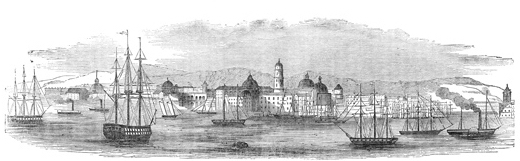
CITY OF HAVANA.
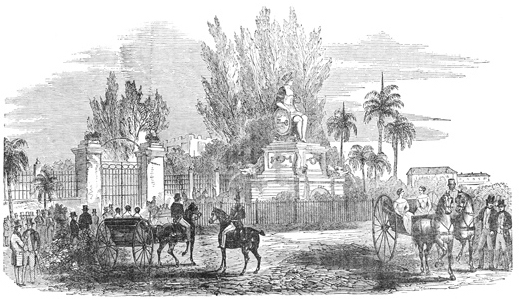
SCENE AT HAVANA.
For above three months they struggled with severe gales and terrific waves, and on the 1st of April, the weather, after having been a little more moderate, returned to its former violence; the sky looked dark and gloomy, and the wind began to freshen and blow in squalls; and there were all the appearances of an approaching tempest. Accordingly, on the 3d, there came on a storm, which exceeded in violence and duration all they had hitherto encountered. On the 14th in the morning the weather clearing up a little and the moon shining out on a sudden, the Anna Pink made a signal for seeing land right a-head; and it being then only two miles distant, they were under great apprehensions of running on shore; and had not the wind suddenly shifted, or the moon shone out, every ship must have perished. They found this land, to their disappointment, to be Cape Noir, though they imagined they were ten degrees more to the west. On the evening of the 24th of April, the wind increased to a prodigious storm, and, about midnight, the weather became so thick that the whole squadron separated, nor met again till they reached the island of Juan Fernandez. To add to their misfortunes, the scurvy began to make such havoc, that on board the Centurion only, it carried off forty-three men in the month of April, and twice that number in May.
On the 22d of May the Centurion encountered the severest storm it had yet experienced. Almost all the sails were split; the rigging was destroyed, and a mountainous wave breaking over them on the starboard quarter, gave the vessel such a shock, that several of the shrouds were broke, and the ballast and stores so strangely shifted, that she lay on her larboard side. The wind at length abating a little, they began to exert themselves to stirrup the shrouds, reeve new lanyards, and mend the sails; during which they ran great risk of being driven on the island of Chiloe. After many difficulties they at length reached the island of Juan Fernandez, in a most desponding condition. Here many of the crew died of weariness and disease.
A few days after the Centurion had arrived, the Trial Sloop appeared in sight, and on the 21st of June the Gloucester was discovered to leeward. The Anna Pink arrived about the middle of August, which, with the Trial and Gloucester, mentioned above, were the only vessels that ever joined the squadron; for the Severn and Pearl, having parted from the commodore off Cape Horn, with difficulty reached Brazil, whence they made the best of their way back to Europe, while the Wager was wrecked on the coast. The Anna Pink being judged unlit for service, was taken for the use of the squadron, and her men were sent on board the Gloucester.
About eleven in the morning of the 8th of September, they discovered a sail; when the Centurion, being in the greatest forwardness, made after her as fast as possible. Night coming on they lost sight of the chase. About three in the morning of the 12th, a brisk gale springing up at W. S. W. obliged them to lie upon a N. W. tack, which at break of day, brought them within sight of a sail, at about five leagues distant. She appeared to be a large vessel, and upon hoisting Spanish colors, and bearing towards the Centurion, the commodore ordered everything ready for an engagement; but upon coming nearer, she appeared to be a merchantman, without a single tier of guns, and had mistaken the Centurion for her consort. She soon surrendered, and was found to be a valuable prize.
It appearing from letters on board the prize, that several other merchantmen were at sea, between Callao and Valparaiso, the commodore sent the Trial sloop, to cruise off the latter port; and ordered the Gloucester to cruise off the island of Paita, till she should be joined by the Centurion. The Centurion and her prize weighing from the bay of Juan Fernandez, on the 19th of September, took her course to the eastward, proposing to join the Trial off Valparaiso.
On the 24th, in the evening, they came up with the latter, having taken a prize of six hundred tons burden, laden with a rich cargo. On the 27th, the captain of the Trial came on board the Centurion, bringing with him an instrument, subscribed by himself and all his officers, setting forth that the vessel was so leaky and defective, that it was at the hazard of their lives they staid on board; upon which, the commodore having ordered the crew and every thing of value to be put on board the prize, the Trial was scuttled and sunk. It was now resolved to join the Gloucester off Paita. With this view they stood to the northward, and, on the 10th of November discovered a sail, which Lieutenant Brett was ordered to chase, with the Trial’s pinnace and barge. They found her to be a Spanish vessel of two hundred and seventy tons burden. From the prisoners they learned that, a few days before, a vessel had entered Paita, the master of which told the governor he had been chased by a very large ship, which he imagined to be one of the English squadron, and that the governor had immediately sent an express to Lima, to carry the news to the viceroy, while the royal officer residing at Paita had been busily employed in removing both the king’s treasure and his own to Piuza, a town fourteen leagues within land. It was at once conjectured that the ship which had chased the vessel into Paita was the Gloucester; and, as they were now discovered, and the coast would soon be alarmed, so as to prevent cruising to any advantage, the commodore resolved to endeavor to surprise the place that very night.
When the ships were within five leagues of Paita, about ten o’clock at night, Lieutenant Brett, with the boats under his command, put off, and arrived without being discovered, at the mouth of the bay; though he had no sooner entered it, than some of the people on board a vessel riding at anchor there, perceived him, and immediately getting into their boat, rowed towards the shore, crying out ‘the English, the English dogs,’ etc., by which the town was alarmed and the attack discovered. The town was, however, taken in less than a quarter of an hour from the first landing of the boats; with the loss of one man killed and two wounded.
They weighed anchor from the coast of Paita on the 16th of November, the squadron being increased to six sail by the prizes. On the morning of the 18th, they discovered the Gloucester with a small vessel in tow, which joined them about three in the afternoon, when they learned that captain Mitchell had taken two prizes, one of which had a cargo consisting of wine, brandy and olives, and about seven thousand pounds in specie; and the other was a launch, the people on board which, when taken, were eating their dinner from silver dishes. Notwithstanding this circumstance, the prisoners alleged that they were very poor: having nothing on board, but cotton made up in jars, which, being removed on board the Gloucester, were examined, when the whole appeared to be an extraordinary piece of false package; there being concealed among the cotton, doubloons and dollars, to the amount of twelve thousand pounds.
The cargo and crews of the several vessels were afterwards divided between the Centurion and Gloucester. Quitting the coast of America, they stood for China, the 6th of May, 1742. The Gloucester, which had become decayed, was cleared of every thing by the 15th of August, and then set on fire. On the 27th they arrived at the island of Tinian, where they remained some time. On the night of the 22d of September, when it was excessively dark, the wind blew from the eastward with such fury, that those on board despaired of riding out the storm. At this time Mr. Anson was ill of the scurvy, and most of the hands were on shore, and all the hopes of safety of those on board seemed to depend on immediately putting to sea; all communication between the ship and the island being destroyed.
About one o’clock a strong gust, attended with rain and lightning, drove them to sea, where, being unprepared to struggle with the fury of winds and waves, they expected each moment to be their last. When at daybreak, it was perceived by those on shore that the ship was missing, they concluded her lost, and many of them begged the commodore to send the boat round the island to look for the wreck. In the midst of their gloomy reflections, the commodore formed a plan for extricating them from their present situation; which was by hauling the Spanish barque on shore, sawing her asunder, and lengthening her twelve feet; which would enlarge her to near forty tons burden, and enable her to carry them all to China.
But a discouraging circumstance now occurred, which was, that they had neither compass nor quadrant on the island. At length, on rummaging a chest belonging to the Spanish bark, they found a small compass, which though not much superior to those made for the amusement of school-boys, was to them of the utmost importance.
When this obstacle was removed, and all things ready for sailing, it happened on the afternoon of the 11th of October, that one of the Gloucester’s men being upon a hill, saw the Centurion at a distance. She was soon visible to all, and the next day cast anchor in the road. On the 14th, a sudden gust of wind drove her to sea a second time, but in about five days, they returned again to anchor. On the 20th of October, they set fire to the bark and proa, hoisted in their boats, and got under sail, steering away towards the south end of the island of Macao.
About midnight, on the 5th of November, they made the mainland of China, and on the morning of the 9th, a Chinese pilot came on board, and told them that he would carry the ship into Macao for thirty dollars, which being paid him they proceeded, and on the 12th entered the harbor of Macao.
On the 6th of April the Centurion again stood out to sea. On the last day of May they came in sight of Cape Espiritu Santo, where they continued to cruize till the 20th of June, when about sunrise the great Manilla ship came in sight, having the standard of Spain flying at the top-gallant-mast head, and to the commodore’s surprise, bore down upon him. The engagement soon began, and lasted an hour and a half, when the galleon struck to the Centurion, after having sixty-seven men killed and eighty-four wounded. The Centurion had only two men killed and seventeen wounded. The prize carried five hundred men and thirty-six guns, and her cargo was worth £400,000 sterling. It is impossible to describe the transports on board, when, after all their reiterated disappointments, they at length saw their wishes accomplished. But their joy was very near being suddenly damped by a very alarming accident; for no sooner had the galleon struck, than one of the lieutenants coming to Mr. Anson, whispered him, that the Centurion was dangerously on fire near the powder-room. The commodore received this shocking intelligence without any apparent emotion, and taking care not to alarm his people, gave the necessary orders for extinguishing the fire, which was done, though its first appearance threatened the ship with destruction.
On the 14th, the Centurion cast anchor off Bocca Tigris, forming the mouth of that river: and having got under sail on the 16th of October, 1743, came to anchor in the straits of Sunda on the 3d of January, and continued there till the 8th, taking in wood and water, when she weighed and stood for the Cape of Good Hope, where, on the 11th of March, she came to anchor in Table Bay. Mr. Anson continued here till the 3d of April, 1744, when he put to sea, and on the 19th of the month, was in sight of St. Helena, but did not touch at it.
On the 12th of June they got in sight of the Lizard, and on the evening of the 15th, to their great joy, came safe to anchor at Spithead. On his arrival Mr. Anson learned, that under cover of a thick fog, he had run through a French fleet, which was at that time cruizing in the chops of the channel.
BYRON.
In the year 1764, the Dolphin and Tamar, English ships-of-war, were fitted out for the purpose of prosecuting discoveries in the South Seas. Byron was commander-in-chief, and Captain Mouat commander under him.
On the 3d of July, the commodore hoisted his broad-pendant, and they sailed in prosecution of the voyage. On the 13th of September they came to an anchor in the road of Rio de Janeiro, on the coast of Brazil, when the commodore paid a visit to the governor, who received him in state. They weighed anchor on the 16th of October, steering for Cape Blanco, and on the 21st of November, entered the harbor of Port Desire, and the commodore in his boat, attended by two other boats, went to sound it. He landed, and they had a sight of four beasts, near thirteen hands high, and in shape like a deer, which they took to be granicoes.
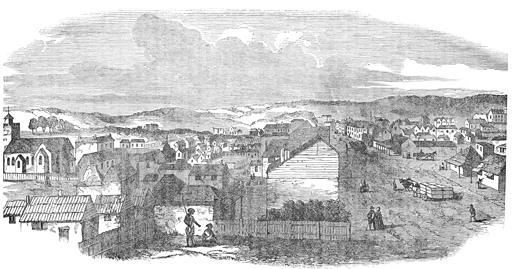
CITY OF ADELAIDE.
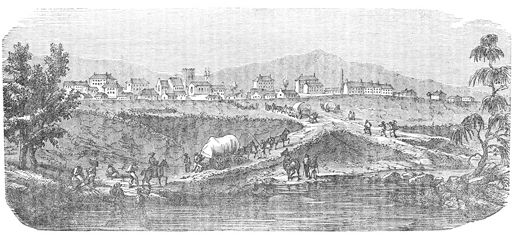
BALTHURST, N. S. W.
On the 5th of December the ships got under sail, and on the 20th, ran close in-shore to Cape Virgin Mary, and came to an anchor. The commodore observed a number of men on horseback, riding to and fro, opposite the ship, and waving something white, which he took to be an ivitation to land; and as he was anxious to know what people these were, he went in one boat with a party of men well armed; the first lieutenant, with a separate party, following in another. When they came near the shore, the whole appeared to amount to five hundred persons, drawn up on a stony point of land that ran far into the sea. Byron now advanced alone, but as he approached, the Indians retreated: he therefore made signs that one of them should come forward, which was complied with. The one who advanced appeared to be chief, and was over six feet in height; round one of his eyes was a circle of black paint, and a white circle round the other; the rest of his face was painted in streaks of various colors. He had the skin of a beast, with the hair inwards, thrown over his shoulders. The commodore and the Indian having complimented each other, in language equally unintelligible to either, they walked together towards the main body of the Indians, few of whom were shorter than the height abovementioned, and the women were large in proportion.
On the 21st of December they began sailing up the Strait of Magellan, with a view to take in a stock of wood and water. On the 26th, came to anchor at Port Famine. In this place, they found drift-wood enough to have supplied a thousand vessels. The quantity of fish that was daily taken was equal to the supply of both the crews: and the commodore shot as many geese and ducks as furnished several tables besides his own. On the 4th of January 1765, they sailed in search of Falkland’s Islands.
On the 12th they saw land, and on the 14th a flat island, covered with tufts of grass as large as bushes. Soon after this they entered another harbor, to which Byron gave the name of Port Egmont. This harbor is represented to be the finest in the world, and capacious enough to contain the whole navy of England, in full security; there is plenty of fresh water in every part of it, and geese, ducks, snipes, and other edible birds, abound in such numbers, that the sailors were tired with eating them. The commodore was once unexpectedly attacked by a sea-lion, and extricated himself from the impending danger with great difficulty; they had many battles with this animal, the killing of one of which was frequently an hour’s work for six men; one of them almost tore to pieces the commodore’s mastiff-dog, by a single bite. The commodore took possession of the harbor, and the adjacent islands, by the name of Falkland’s Islands.
On Sunday, January the 27th, they left Port Egmont. Next day the commodore gave the name of Berkley’s Sound to a deep inlet between the islands. On the 6th of February stood in for Port Desire at the mouth of which they came to anchor, and had the pleasure of seeing the Florida, a store-ship, which they had expected from England. On the 20th, at Port Famine, received orders to sail for England.
Having narrowly escaped the dreadful effects of a storm on the 3d of March, at length the Dolphin was moored in a little bay opposite Cape Quod; and the Tamar about six miles to the eastward of it. On the 28th the Tamar narrowly escaped being dashed to pieces against the rocks, by the parting of the cables to her best bower-anchor. The Dolphin, therefore, stood out again into the bay, and sent her proper assistance, after which they both anchored for the night; a night the most dreadful they had known. The winds were so violent as perfectly to tear up the sea, and carry it higher than the heads of the masts: a dreadful sea rolled over them, and broke against the rocks, with a noise as loud as thunder. Happily they did not part their cables, or they must have been dashed in pieces against these rocks.
The ships came to anchor on the 4th of April, in a bay which had been discovered, proposing to take in wood and water. While they were here, several of the natives made a fire opposite the ship, on which signals were made for them to come on board; but as they would not, the commodore went on shore, and distributed some trifles which gave great pleasure. Four were at length prevailed on to go on board; and the commodore, with a view to their diversion, directed one of the midshipmen to play on the violin, while some of the seamen danced. The poor Indians were extravagantly delighted; and one of them to testify his gratitude, took his canoe, and fetching some red paint, rubbed it over the face of the musician; nor could the commodore, but with the utmost difficulty, escape the like compliment.
They sailed from this bay on the 7th, and next day the wind blew a hurricane. On the 9th, passed some dangerous rocks, which in Narborough’s Voyage are called the Judges. This day a steady gale at the southwest carried them at the rate of nine miles an hour, so that by eight in the evening they were twenty leagues from the coast. On the 26th, they sailed westward, and bore away for the island of Massafuero and anchored at seven o’clock on Sunday morning.
On the 30th of April they sailed, and on the 7th of June discovered land, being then in 14 deg. 5 min. south latitude, and 144 deg. 58 min. west longitude. The commodore steered for a small island, the appearance of which was pleasing beyond expression. Several natives ran along the beach, with long spears in their hands. The sailors made every possible sign of friendship—but they retired to the woods, dragging their canoes after them. The commodore proceeded to the other island, and brought to, at three-quarters of a mile from the shore. The natives again ran to the beach, armed with clubs and spears, using threatening gestures. The commodore fired a cannon-shot over their heads, on which they retreated to the woods. This paradise in appearance, was named the Island of Disappointment.
Quitting these on the 8th of June, they discovered an island on the day following, low, and covered with various kinds of trees, among which was the cocoa-nut, and surrounded with a rock of red coral. They now sailed to the westward, and soon discovered another island, distant four leagues. The natives pursued them in two large double canoes, in each of which were about thirty armed men. At this time the boats were at a considerable way to leeward of the ships, and were chased by the canoes; on which the commodore making a signal, the boats turned towards the Indians, who instantly pulled down their sails, and rowed away with great rapidity. On the 12th of June, sailed to another island, and as they coasted along it, the natives, armed as those of the other islands, kept even with the ship for some leagues. This island is situated in 14 deg. 41 min. S. latitude, and 149 deg. 15 min. W. longitude; and both the islands the commodore called King George’s Islands. The boats having returned on board, they sailed westward the same day; and the next afternoon descried another island, towards which they immediately sailed, and found that it was well inhabited, and had a fine appearance of verdure; but that a violent surf broke all along the coast. It lies in 15 deg. south latitude, and 161 deg. 53 min. west longitude, and received the name of the Prince of Wales’ Island.
On the 24th they discovered another island, which was named the Duke of York’s Island. A terrible sea breaks round the coast, but the place itself had a pleasing appearance. On the 29th sailed northward, with a view to cross the equinoctial line, and then sail for the Ladrone Islands. On the 2d of July they discovered a low flat island, abounding with the cocoa-nut and other trees, and affording a most agreeable prospect. A great number of natives were seen on the beach, many of whom, in about sixty canoes or proas, sailed, and formed a circle round the ships; which having surveyed for a considerable time, one of the Indians jumped out of his boat, swam to the ship, ran up its side in a moment, sat down on the deck, and began laughing most violently: he then ran about the ship, pilfering whatever he could lay hands on, which was taken from him as fast as stolen. This man having as many antic tricks as a monkey, was dressed in a jacket and trousers, and afforded exquisite diversion. He devoured some biscuit with great eagerness, and having played the buffoon for some time, made prize of his new dress, by jumping over the side of the ship, and swimming to his companions. These Indians are of a bright copper, with regular and cheerful features, and are tall and well made. One of them, who seemed to be one of some rank, wore a string of human teeth round his waist. Some carried a long spear, the sides of which, for the length of three feet, were stuck with the teeth of the shark, which are as keen as a razor. The officers named this place Byron’s island, in honor of the commodore. It lies in 1 deg. 18 min. S. latitude, and 173 deg. 46 min. E. longitude. They sailed hence on the 3d of July, and on the 28th had sight of the islands Saypan, Tinian, and Aiguigan, which lie between two and three leagues from each other. At noon, on the 31st, anchored at the south-west end of Tinian. The water is so wonderfully clear at this place, that, though one hundred and forty-four feet deep, they could see the bottom. The commodore went on shore, where he saw many huts, which had been left the preceding year by the Spaniards. The commodore remained at Tinian till the 30th of September, by which time the sick being tolerably well recovered, he weighed anchor and stood to the northward.
On the 5th of November they came to an anchor off the island of Timoan, on which Byron landed the day following. The inhabitants, who are Malays, no sooner saw the boat approaching the shore, than many of them came to the beach, each having a dagger by his side, a spear in one hand, and a long knife in the other. The boat’s crew, however, made no hesitation to land, and bartered a few handkerchiefs for a goat, a kid, and a dozen of fowls.
Nothing worth notice happened till the 14th, when a sloop being seen at anchor in the harbor of an island, named Pulo Toupoa, Byron having anchored in the same harbor, and observed that the vessel hoisted Dutch colors, sent an officer on board, who was received with great politeness. The commodore sailed the following day, and held his course till the 19th, when he spoke with an English snow, bound from Bencoolen to Malacca and Bengal, in the East India Company’s service. At this time their biscuit was filled with worms, and rotten, and their beef and pork were unfit to eat. The master of the snow being apprized of the circumstance, sent Byron two gallons of arrack, a turtle, twelve fowls and a sheep. During their run hence to Prince’s Island, in the strait of Sunda, they were so abundantly supplied with turtle, by boats from the Java shore, that the common sailors subsisted wholly on that fish. They staid at Prince’s Island till the 19th, when they sailed for the Cape of Good Hope. On the 13th of February they came to anchor, and were treated with great politeness by the governor.
They sailed on the 7th of March, and, on the 25th, crossed the equinoctial line. About this time an accident happening to the rudder of the Tamar, and it being impossible to make a perfect repair of it at sea, the captain was ordered to bear away for Antigua; in consequence of which they parted company on the 1st of April; and the Dolphin, without meeting with any other material occurrence, came to an anchor in the Downs, on the 9th of May, 1766, after having been little more than twenty-two months in the circumnavigation of the globe.
CAPT. WALLIS.
In 1766, Capt. Wallis, of London, having been appointed to command the ship Dolphin, destined for a voyage round the world, received orders to take under his command the Swallow sloop, and Prince Frederick store-ship. They sailed on the 22d of August, and, on the 7th of September, came to anchor in the road of Maderia.
On the 12th, they sailed thence, and by the 12th of November, were in 30 degrees of south latitude, when they found the weather so cold as to have recourse to their thick jackets. On the 16th of December, being very near Cape Virgin Mary, they saw several men riding on the shore. The captain went ashore, and gave them combs, buttons, knives, scissors, beads, etc., and pleased the women greatly by the distribution of some ribbons. The tallest among these people was six feet seven inches; but the general height was from five feet ten to six feet. They were muscular and well made, but their hands and feet very small, in proportion to the rest of their bodies. The captain took eight of them into the boats: when they came into the ship, they expressed no surprise at the novelties which they beheld, till a looking-glass being observed, they acted many antic gestures before it. The marines being exercised before them, they were terrified at the firing of the muskets, and one of them falling down, shut his eyes, and lay without motion, as if to intimate that he knew the destructive nature of these weapons.
On the 21st, they turned into the Strait of Magellan, and on the 26th, anchored in Port Famine Bay; and the sick were sent on shore. On the 28th, the empty water-casks were landed. When they arrived here, many of the people were very sick with the scurvy; but, by the plentiful use of vegetables, and bathing in the sea, they all recovered in a short time.
They sailed on the 18th, and on the 3d of February came to anchor in York Road. The next day, Captain Wallis, with a party, went on shore near Bachelor’s River. There is a cataract near this river, the noise of which is tremendous, as it falls more than four hundred yards, partly over a very steep descent, and partly in a perpendicular line. On the 1st of March sailed again, and anchored in a place called Swallow harbor, whence they sailed the next morning; and, on the following day, the Swallow, being driven among breakers, made signals of distress; but was happily relieved by a breeze from the shore. On the 10th of April the two ships sailed in company; and, on the 11th, lost sight of each other, and did not meet again during the whole voyage.
This day the Dolphin cleared the Strait of Magellan, in which she had labored with innumerable difficulties, and escaped most imminent dangers, in a passage of almost four months, viz: from December the 17th, 1776, to the 11th of April following. The Spaniards, it seems, built a town here in 1581, which they named Phillipville, and left in it a colony of four hundred persons. They were all starved to death except twenty-four; and the place was called Port Famine, from the melancholy fate of these unfortunate men.
The long wished for relief was now fast approaching, for on Saturday, the 6th, the man at the mast-head cried, ‘Land in the west-north-west.’ As no anchorage was to be found, the captain steered for the other island, giving the name of Whitsun Island to this, because it was discovered on the eve of Whitsunday. Having approached the second, the lieutenant was sent on shore, with two boats, to take possession of the island and to call it Queen Charlotte’s Island. The boats returned loaded with cocoa-nuts and scurvy-grass, after having found two wells of excellent water. Provisions for a week were now allotted for an officer and twenty men, who were left on shore to take in water; the sick were landed for the benefit of the air; and a number of hands were appointed to climb the cocoa-trees, and gather the nuts.
An adjoining island, lying in nineteen degrees twenty minutes south latitude, and one hundred thirty-eight degrees thirty minutes west longitude, received the name of Egmont Island. On the 11th, they observed about sixteen persons on an island, which was called Gloucester Island. This day they likewise discovered another, which was called Cumberland Island; and on the day following, a third, which received the name of Prince William Henry’s Island. On the 17th, again discovered land, but could find no place in which the ship might anchor. This was named Osnaburgh Island, and having soon discovered high land, they came to anchor because the weather was foggy; but it no sooner cleared away, than they found the ship encompassed by hundreds of people. They sailed along the shore, while the canoes made towards the land. On the 21st, the ship came to anchor.
The boats having been sent to sound along the coast, were followed by large double canoes, three of which ran at the cutter, staved in her quarter, and otherwise damaged her; the Indians, at the same time, armed with clubs, endeavoring to board her. The crew now fired; and wounding one man dangerously, and killing another, they both fell into the sea. The ship made sail the following day, and was piloted round a reef, into a harbor, where she was moored. On the 24th, she sailed further up the harbor, followed by many canoes. In the evening, a number of very large canoes advanced, laden with stones; on which the captain ordered the strictest watch to be kept. Soon after a large canoe advanced, in which was an awning, on the top of which sat one of the natives, holding some yellow and red feathers in his hand. He delivered the feathers; and, while a present was preparing, he put back from the ship, and threw the branch of a cocoa-nut tree in the air. This appeared the signal for an onset, for the canoes, approaching the ship, threw volleys of stones into every part of her. On this two guns, loaded with small shot, were fired, and the people on guard discharged their muskets. The number of Indians now round the ships was full two thousand; and though they were at first disconcerted, they soon recovered their spirits, and renewed the attack. Thousands were observed on shore, embarking as fast as the canoes could bring them off; orders were therefore given for firing the cannon, some of which were brought to bear upon the shore. The scattered canoes soon got together again, and threw stones of two pounds weight from slings by which a number of seamen were wounded. At this time several canoes approached the bow of the ship, in one of which was an Indian, who appeared to have an authority over the rest; a gun was therefore leveled at his canoe, the shot of which split it in two pieces, which put an end to the contest; the canoes rowed off with the utmost speed, and the people on shore ran and concealed themselves behind the hills. Next day a lieutenant was despatched, with all the boats manned and armed, and having hoisted a pennant on a staff, he took possession of the place by the name of King George the Third’s Island.
Three days after this, the gunner conducted to the ship a lady of a portly figure and agreeable face, whose age seemed to be upwards of forty. Her whole behavior indicated the woman of superior rank. The captain presented her with a looking-glass and some toys, and gave her a handsome blue mantle, which he tied round her with ribbands. Having intimated that she would be glad to see the Captain on shore, on Sunday, the 12th, he landed, and was met by his fair friend, who was attended by a numerous retinue. As they advanced, great numbers of Indians crowded to meet them. Many advanced to meet her, whom she caused to kiss the captain’s hand, while she signified that they were related to her. Her house was above three hundred and twenty feet in length, and about forty in breadth. The captain, lieutenant, and purser, who had been ill, being seated, the lady helped four of her female attendants to pull of their coats, shoes and stockings; which being performed, the girls smoothed down the skin, and rubbed it lightly with their hands for more than half an hour; and the gentleman received great benefit from the operation. Orders had been given that the captain should be carried; but as he chose to walk, she took hold of his arm, and when they came near any wet or dirty place, she lifted him over, with as much ease as a man would a child. On the 15th, a large party in all the boats rowed round the island. The island was found to be every where very pleasant, and to abound with various necessaries of life. On the 17th, Captain Wallis received another visit from the lady whom he called his queen. On the 21st, she repeated the visit, and presented him with some hogs. The captain having sent a party on shore on the 25th, to examine the country minutely, caused a tent to be erected to observe an eclipse of the sun, and when it was ended, took his telescope to the queen’s house to show her the use of it; and her surprise is not to be expressed, on beholding several objects which she was very familiar with, but which were too distant to be seen by the naked eye. She made signs to be informed if he held his resolution as to the time of his departure, and being answered in the affirmative, her tears witnessed the agitation of her mind. The captain presented her with several articles of use and ornament, which she received in silent sorrow. After some time a breeze springing up, the queen and her attendants took their final leave, with many tears.
The place where the ship had lain was called Port Royal Harbor, and is situated in 17 degrees 30 minutes south latitude, and 150 degrees west longitude. The Dolphin sailed from Otaheite on the 27th of July, 1767, and passed the Duke of York’s Island. On the 28th, they discovered land, which was called Sir Charles Saunder’s Island. On the 30th again made land, which received the name of Lord How’s Island, on which smoke was seen, but no inhabitants. Their next discovery was some dangerous shoals, to which Captain Wallis gave the name of the Scilla Islands. They now steered westward till the 13th of August, when they saw two small islands, one of which was named Keppel’s Isle, and the other Boscawen’s Island. On the 16th they again discovered land, to which the officers gave the name of Wallis’ Island.
On the 18th of September they discovered the island of Saypan, and soon afterwards that of Tinian, off which they anchored on the day following. Tents were erected for the sick, who were sent on shore with all expedition. By the 15th of October the fruit and water were carried on board, and all the sick being recovered, on the next day they left the bay, and sailed to the west.
On the 3d of November they discovered three islands, which were named Sandy Isle, Small Key, and Long Island; which islands are in 19 degrees 20 minutes north latitude, and 247 degrees 20 minutes west longitude. They now altered their course, and, on the 13th, saw the island of Timoun, Aros, and Pesang. On the 16th they crossed the equinoctial line, and came again into south latitude. The next day they saw the islands of Pulo Totè, and Pulo Weste, and the Seven Islands. On the 22d saw the coast of Sumatra; and came to an anchor in the road of Batavia, on the 30th of November, 1767. From this place they sailed on the 8th of December, without losing a single man, and having only two on the sick list.
On the 24th of January they encountered a dreadful storm, which tore the sails to pieces, broke a rudder-chain, and carried several of the booms overboard; yet during this storm they observed a number of birds and butterflies. On the 30th they saw land; and came to anchor in Table Bay, at the Cape of Good Hope, on the 4th of February. Sailed on the 17th of March, anchored in the bay of St. Helena. On the 28th crossed the equinoctial line, and on the 24th of next month saw the Cape of Pico.
No material incident happened from this time to the end of the voyage; and on the 20th of May, 1768, the Dolphin came to anchor in the Downs.
DE BOUGAINVILLE.
A settlement having been commenced by the French on Falkland’s Islands, in the month of February, 1764, the Spaniards demanded them as an appendage to the continent of South America; and France having allowed the propriety of the demand, Mons. de Bougainville was ordered to yield possession of the islands to the Spaniards.
On the 5th of December he sailed from the harbor of Brest, in the frigate La Boudeuse, having on board the Prince of Nassau Seighen, three gentlemen who went as volunteers, eleven officers in commission, and warrant-officers, seamen, soldiers, servants and boys to the number of two hundred. On the evening of the 29th of January, they had sight of Rio-de-la-Plata, and on the morning of the 31st came to anchor in the Bay of Montevideo, where the two Spanish ships, which were to take possession of Falkland Islands, had been at anchor for some weeks. They sailed with these ships on the 28th of February, 1767; and on the 1st of April Bougainville, in the name of the French king, surrendered the islands to Don Puente, the Spanish governor, who received them for his most Catholic majesty, with the ceremony of hoisting the Spanish colors, and the firing of guns from the ships and on shore.
Falkland Islands lie in about 52 degrees south latitude, and 60 degrees west longitude. From the entrance of the Straits of Magellan, and from the coast of Patagonia, their distance is about 250 miles. The harbors are large, and well defended by small islands most happily disposed; and even the smallest vessels may ride in safety in the creeks, while fresh water is easily to be obtained. After waiting at these islands till the 2d of June, 1767, in expectation of the Etoile store-ship from Europe, Bougainville steered for Rio Janeiro, at which place he had appointed the Etoile to join him. They had fine weather from the 2d to the 20th of June, on which day they had sight of the mountains on the main land of Brazil, and entered Rio Janeiro the day following. At the same time a canoe was despatched from the captain of the Etoile, with information of the safe arrival of that vessel, which now lay in the port; and on the 14th of July, both vessels sailed, and on the 31st came to anchor in the Bay of Montevideo. As it was necessary that Bougainville should remain in his present station till the equinox was passed, his first care was to build a hospital for the sick, and to take lodgings at Montevideo.
On the 14th of November, 1767, they sailed from Montevideo, with a fine gale of wind at north. On the 16th, and the five following days, the sea ran high, and the wind was contrary. The 2d of December they had sight of Cape Virgins, with a fair wind. They now saw a number of albatrosses and petrels, the last of which are said to be a sign of bad weather whenever they are seen. They made their best efforts to reach the entrance of the Straits of Magellan; and Bougainville was seven weeks and three days in passing through it, the whole length of which, from Cape Virgin Mary to Cape Pillar, he computes at about 340 miles.
On the 22d of March, land was discovered, and when they had coasted one of the islands for about two miles, they had sight of three men, who advanced hastily towards the shore. They at first imagined that these were part of the crew of some European ship which had been wrecked on the coast, but discovered their conjecture ill-founded, for the people retired to the woods, from which, in a short time, issued a number of them, supposed to be near twenty, with long staves in their hands, which they held up with an air of defiance. This done, they retreated to the woods. These islanders were of a copper complexion and very tall.
During the night between the 22d and 23d they had much rain, accompanied with violent thunder, while the wind blew almost a tempest. At day-break land was discovered, which was called Harp Island, and in the evening a cluster of islands, eleven of which were seen, received the name of the Dangerous Archipelago. A steep mountain, which appeared to be encompassed by the sea, was discovered on the 2d of April, and received the name of Boudoir, or Boudeuse Peak, from Bougainville’s ship. Bearing to the northward of this peak they had sight of land, which extended farther than the eye could reach.
As Bougainville coasted the island, he was charmed with the appearance of a noble cascade, which, falling immediately from the summit of a mountain into the sea, produced a most elegant effect. On the shores very near to the fall of this cascade, was a little town, and the coast appeared to be free from breakers. It was the wish of our adventurers to have cast their anchor within view of such an enchanting prospect; but, after repeated soundings, they found that the bottom consisted only of rocks, and they were, therefore, under a necessity of seeking another anchoring place, where the ships were safely moored.
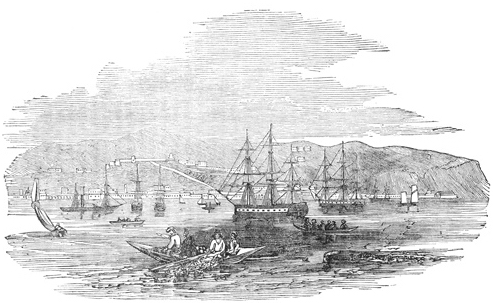
VALPARAISO.
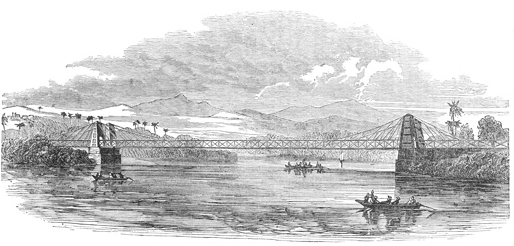
IRON BRIDGE AT JAMAICA.
They remained at Otaheite until the 16th of April, when they departed, and in the beginning of May three islands were discovered. On the following day another island was seen to the westward of the ship’s course. To the islands the commodore gave the general name of the Archipelago of the Navigators. On the morning of the 11th, another island was discovered, which received the name of the Forlorn Hope.
The ships now steered a westerly course, and early on the morning of the 22d two islands were discovered, one of which received the name Aurora, from the early hour on which it was first seen, and the other that of Whitsuntide Isle, from the day which gave birth to it being so named. In the afternoon, mountainous lands, at thirty miles distance, were seen, appearing, as it were, over and beyond the Island of Aurora. On the 23d it was discovered that this was a separate island, the appearance being lofty, its descent steep, and the whole clothed with trees. From this time to the 27th, they passed many islands, on one of which they observed a fine plantation of trees, between which there were regular walks, resembling those of an European garden. They now quitted this great cluster of islands, which received the general name of Archipelago of the great Cyclades, which, it is conjectured, occupies no less than three degrees of latitude, and five of longitude.
From the 14th to the 18th of June they discovered a number of islands. On July the 2d a cape was discovered, which was called Cape l’Averdi, on which were mountains of an astonishing height. Two more islands were seen on the 6th, and, as the wood and water were expended, and disease reigning aboard, the commodore resolved to land here, and on the following afternoon the ships came to anchor.
In the afternoon of the 24th a favorable breeze enabled the ships to get out to sea. On the 31st a number of Indian boats attacked the Etoile with a volley of stones and arrows; but a single discharge of the musketry got rid of these troublesome companions. On the 4th of August two islands were seen. On the 5th a third island was seen, and then the northern point of New Britain which lies only forty-one minutes south of the land. On the 7th a flat island was seen, covered with trees, abounding with cocoa-nuts. Fishing-boats in multitudes surrounding the island; but the fisherman took no notice of the ships. This received the name of the Island of Anchorets. From this time till the end of the month innumerable small islands were observed every day.
Early in the morning of the 31st our voyagers had sight of the island of Ceram, which runs in a parallel east and west, abounds in lofty mountains, and is partly cleared, and partly in its original state. At midnight a number of fires attracted their attention to the island of Boero, where there is a Dutch factory, at the entrance of the Gulf of Cagei, which the French had sight of at day-break. Their joy on this occasion is not to be expressed, for at this time not half of the seamen were able to perform any duty, and the scurvy had raged so violently, that no man on board was perfectly clear of it.
They sailed on the 7th September and on the 13th the ships were surrounded with Indian boats, bringing parroquets, cockatoos, fowls, eggs, and bananas, which the natives sold for Dutch money, or exchanged for knives. By day-light on the 19th they were within about a league of the Coast of Celibes, which in this part is described as one of the finest countries in the world. On the morning of the 26th the coast of Java appeared with the rising sun. Having come to an anchor for the night, the ships sailed early in the morning of the 27th and on the next day came to anchor in the port of Batavia.
The ships sailed thence on the 16th of October, 1768, and cleared the straits of Sunda on the 19th in the afternoon. By this time the crew were all perfectly recovered of the scurvy, but a few remained ill of the bloody flux. On the 20th the ships were in sight of the Isle of France, and, on the 8th of November, the Boudeuse anchored in the port of that island; the Etoile, which had been unavoidably left behind, anchoring in the same port on the following day.
They sailed from this the 12th of December, 1768, leaving the Etoile behind them to undergo some necessary repairs. Without encountering any singular accident they had sight of the Cape of Good Hope on the 18th of January, and came to anchor in Table Bay on the following morning. Bougainville quitted this on the 17th, anchored off St. Helena on the 4th of February, and on the 25th, joined the Swallow, commanded by Captain Cartert. Nothing material happened from this time till they had sight of the Isle of Ushant, where a violent squall of wind had nearly blasted the hopes of the voyage. On the 15th the commander bore away for St. Maloes, which he entered on the following day, after an absence of two years and four months from his native country; during all which time he had buried only seven of his crew, a circumstance that will be deemed truly astonishing, when we reflect on the variety of dangers they had encountered and the amazing changes of climate they had experienced.
CAPTAIN JAMES COOK.
James Cook was born in a mud hut at Marton, in the north riding of Yorkshire, 27th October 1728. His father was an agricultural servant, who, with his wife, bore a most unexceptionable character for honesty and industry. The village school-mistress taught the boy to read; but at eight years of age his father, through his good conduct, was appointed to be bailiff of a farm near Great Ayton, belonging to Thomas Skottowe, Esq., who at his own expense put James to a day-school in that town, where he was taught writing and the first rules in arithmetic. The predilection of the lad inclined him for the sea; but as this stood contrary to the wishes of his parents, he was soon after his twelfth year apprenticed to William Sanderson, a general dealer in haberdashery, grocery, hardware, etc., at Staith, upon the coast, about ten miles north of Whitby. The youth’s mind, however, continued more occupied upon maritime affairs than anything else, and though he faithfully discharged his duty to his master, he longed to be at sea. An opportunity occurred to favor his desires. Mr. Sanderson canceled his indentures, and left him to pursue his inclinations. Thus freed, he bound himself to Messrs. John and Henry Walker, who owned the Freelove, in which Cook embarked. She was principally engaged in the coal trade, but made a voyage or two to the north; and when his time was out, the youngster still continued to serve as a foremast-man till he was made mate of one of Mr. John Walker’s ships. During this period he evinced no particular marks of genius. His associates, however, were not exactly the class of persons to observe the real bent of his mind; they thought him taciturn, and sometimes sullen; but this doubtless arose from his studious habits, and endeavors to acquire knowledge. As for practical seamanship, there could be no better school than a collier.
When in his twenty-seventh year, war broke out between England and France, and Cook, who was then in the Thames, tried to escape the press-gang, which was sweeping the river of every seaman that could be picked up. This restraint, however, did not meet his views; he looked upon the service of his country as honorable, and at once entered for the Eagle, of 60 guns, commanded by Captain Hamer, who, a few months afterwards, was superseded by Captain (subsequently Sir Hugh) Palliser. The young man’s steady conduct and seaman-like qualities soon attracted this officer’s attention. His knowledge of the coasts was excellent; and Mr. Skottowe having applied to Mr. Osbaldeston, M. P. for Scarborough, to exert his influence to raise Cook to the quarter-deck, by the joint interest of this gentleman, with Captain Palliser, a warrant as master was obtained on 10th May 1759, James being then in his thirty-first year. He joined the Grampus, but she had a master already; he was then appointed to the Garland, but she was abroad; and eventually he sailed in the Mercury, to join the fleet under Sir Charles Saunders, then engaged in conjunction with General Wolfe in the reduction of Quebec. Here the peculiar talents of Mr. Cook were called into active operation. The buoys in the navigation of the St. Lawrence had all been removed by the French at the first appearance of the English fleet, and it was essentially necessary that a survey should be made of the channels, and correct soundings obtained, to enable the ships to keep clear of the numerous shoals. By the recommendation of his old commander, Captain Palliser, this onerous duty was confided to Mr. Cook, who readily undertook it in a barge belonging to a 74. This could only be executed in many parts during the darkness of the night, on account of the enemy; and he experienced a narrow escape one night when detected, his boat having been boarded by Indians in the pay of the French, and carried off in triumph, he and his companions getting away just in time to save their lives and scalps. Through Mr. Cook’s judicious arrangements, the fleet reached the island of Orleans in safety; and he afterwards surveyed and made a chart of the St. Lawrence, which, together with sailing directions for that river, were published in London.
On his return from Quebec, Mr. Cook was appointed master of the Northumberland, under Lord Colville, who was stationed as commodore at Halifax. Here he enjoyed much leisure during the winter, but instead of frittering it away in the frivolous or worse amusements of a seaport, he diligently employed it in studies suitable to his profession. No sailor can possibly advance beyond the rank of an ordinary seaman unless he be acquainted with the theory as well as the practice of navigation; and to gain this knowledge, he must attain a proficiency in mathematics. Aware of this, Cook began by gaining a knowledge of Euclid’s Elements of Plane Geometry; and then of the higher branches of mathematical study, including nautical astronomy. By these means he soon learned to take observations, to calculate a ship’s progress, and to ascertain the degree of latitude and longitude at any given spot on the trackless ocean. In short, he became an accomplished mariner, ready for any office of trust. Besides improving himself in these useful branches of education, he possessed sufficient tact to cultivate urbanity of manner, and to gain the confidence and esteem of his acquaintance. This was a point of some consequence; for intellectual acquirements, without a polite and high moral bearing, are of small avail in the general intercourse of the world, and, personally, may do more harm than good. It is gratifying to know that Cook aimed at gentlemanly behavior not less than skill in his profession; and to this commendable effort—which the most humble may practice—is perhaps owing not a little of his future success in life.
In 1762 the Northumberland was ordered to Newfoundland, to assist in the recapture of that island; and here the talents and assiduity of our hero were again conspicuous. Greatly improved by his winter’s studies, he was now still more able to make nautical surveys, and these he carried on to a considerable extent on the coast of Newfoundland; laying down bearings, marking headlands and soundings, and otherwise placing on record many facts which proved highly advantageous to future voyagers, especially those engaged in fishing speculations.
Towards the close of this year (1762) Mr. Cook returned to England, and was married at Barking, in Essex, to Miss Elizabeth Batts, who has been spoken of as a truly amiable and excellent woman. In the following year, through the intervention of Captain (afterwards Admiral) Graves, the governor of Newfoundland, who was well acquainted with Cook’s worth, he was appointed to survey the whole coast of that island, which he accomplished with great ability, as well as Miquelon and St. Pierre, which had been ceded to the French. Cook then returned to England, but did not remain long. His constant friend, Sir Hugh Palliser, assumed the command at Newfoundland, and took Mr. Cook with him, bearing the appointment of marine surveyor, and a schooner was directed to attend upon him in his aquatic excursions. His charts and observations, particularly on astronomy, brought him into correspondence with the members of the Royal Society; and some scientific observations on the eclipse of the sun were inserted in the 57th volume of the Philosophical Transactions.
Here may be said to close the first chapter in Cook’s life. We have traced him from the humble home of his father, an obscure peasant, through the early part of his career, till his thirty-fourth year, at which time he had gained a footing among the most learned men in England. The youthful aspirant will observe that this enviable point had not been reached without patient study. Cook could have gained no acquaintanceship with members of the Royal Society, nor could he have placed himself in the way of promotion, had he been contented to remain an illiterate seaman.
First Voyage Round the World. Prepared by diligent self-culture, Cook was ready for any enterprise which circumstances might produce. The project of a voyage of discovery, involving certain important astronomical observations, fortunately came under discussion while he was in a state of hesitation as to his future movements. The principal object of the expedition was to observe a transit of the planet Venus over the face of the sun, which could only be done somewhere in the Pacific or Southern ocean. The transit was to happen in June 1769. The Royal Society, interested as in the phenomenon for the sake of science, applied to George III to fit out an expedition suitable to take the observations. The request was complied with; and no other man being so well calculated to take the command it was given to Cook. The appointment was quite to the mind of our hero, and he was soon ready for sea. He received the commission of a lieutenant from his majesty, and the Endeavour, of 370 tons, was placed at his disposal. About this time Captain Wallis returned from his voyage of discovery, and reported Otaheite (now called Tahiti) to be the most eligible spot for the undertaking. That island was therefore fixed upon for the observation. Mr. Charles Green undertook the astronomical department, and Mr. Banks (afterwards Sir Joseph) and Dr. Solander, purely through love of science, and at great expense to themselves, obtained permission to accompany the expedition.
The Endeavour was victualed for eighteen months, armed with 12 carriage guns and 12 swivels, and manned with a complement of 84 seamen. Every requisite preparation was made for such a voyage that human foresight could suggest; trinkets and other things were put on board to trade with the natives; and on the 26th of August 1768, they sailed from Plymouth Sound for the hitherto but little explored South Seas. On the 13th September they anchored in Funchal roads, Madeira, and here commenced the researches and inquiries of the men of science. From hence they departed on the night of the 18th; and falling short of water and provisions on the Brazil coast, they put into the beautiful harbor of Rio Janeiro on the 13th November. The viceroy of this fine city could make nothing of the scientific intentions of the English, and was exceedingly troublesome and annoying. When told that they were bound to the South Seas to observe the transit of Venus, he could form no other conception of the matter than that it was the passing of the north star through the south pole. Numerous difficulties were thrown in the way of the departure of the voyagers after they had victualed and watered; and when they sailed, shots were fired at them from the fort of Santa Cruz, a heavy battery at the entrance of the harbor; and on inquiry, Mr. Cook ascertained that the pass for the Endeavour had not been sent from the city. A spirited remonstrance was made, and the viceroy apologised.
On the 7th December the voyagers finally quitted this place, and on the 14th January 1769, entered the Straits of Le Maire, where the sea was running tremendously high, and on the following day anchored in the Bay of Good Success. Although the season was extremely inclement, yet the love of botany induced Mr. Banks, Dr. Solander, Mr. Monkhouse the surgeon, and Mr. Green the astronomer, to ascend the mountains in search of plants. They took with them their attendants and servants, with two seamen; and after suffering severe hardships from the cold and the torpor it produced, they got back to the ship on the second day, leaving two black men, who had accompanied them, dead from the extreme severity of the weather. They could not be got on, but lay down to rest, and slept the sleep of death. Dr. Solander with great difficulty was saved; for although the first to warn others against the danger of reposing, yet he was eventually himself so overcome, that great exertion was required to force him along. They found the inhabitants on the coasts of these straits a wretched set of beings, with scarcely any covering; dwelling in hovels made of sticks and grass, that offered no obstruction to the entrance of the wind, the snow, and the rain. They wandered about, picking up a scanty subsistence wherever they could, though they had not a single implement to dress their fish when caught, or any other food: still they appeared contented; and the only things they coveted from the English were beads and useless trinkets.
On the 26th January the Endeavour took her departure from Cape Horn, and before March 1st had run 660 leagues. Several islands were discovered in their progress, most of which were supposed to be inhabited; and their beautiful verdure and delightful appearance were highly gratifying to the sea-worn mariners. On the 11th of April they came in sight of Otaheite, and two days after anchored in Port Royal (Matavai), where the scientific gentlemen landed, and fixed upon a spot to serve them for an observatory. The natives displayed much friendship; but, to prevent collision, Mr. Cook drew up a code of regulations by which communication and traffic were to be carried on. A tent was erected on the site proposed—the natives keeping outside a marked boundary—and a midshipman with thirteen marines were placed over it as guards. As soon as this was accomplished, the party proceeded to examine the interior of the island; but soon after their departure, one of the natives snatched away the musket of the sentry. The marines were ordered to fire, and the thief was shot dead. This greatly alarmed the natives; but in a day or two they again became familiarized and friendly. Mr. Cook proceeded to erect a fort round the observatory, and mounted six swivel guns, which caused apprehensions among the chiefs; but the natives assisted in the works; and the commander displayed his sense of justice by publicly flogging the butcher for having attempted or threatened the life of a wife of one of the chiefs, who was particularly favorable to the English. On the first stroke of the lash, the natives earnestly solicited that the man should be forgiven; but Mr. Cook deemed the example essential, and inflicted the whole punishment, greatly to the pain and regret of the compassionate Indians, many of whom shed tears.
As soon as the fort was completed, and the astronomical instruments were landed, they sought for the quadrant by which the transit was to be observed, but it was nowhere to be found. Diligent search was made, and a reward offered, but without success; and it was feared that the object of their long and arduous voyage would remain unaccomplished. At length, through the judicious intervention of Mr. Banks, the quadrant was recovered from the natives who had stolen it, and with great joy set up in its place. The approach of the time of observation produced anxiety and excitement; and hoping that the atmosphere would be clear and favorable, as well as to make assurance sure, Mr. Cook established two other observatories—one on the island of Eimeo, under Mr. Banks, and the other to the eastward of the main observatory, under Mr. Hicks (the master).
The morning of the 3d June was ushered in with a cloudless sky, and at the fort the transit was observed in the most satisfactory manner. The success of their enterprise was highly gratifying to the voyagers; but their pleasure was somewhat damped by the violence which at times was engendered between the natives and the seamen, the former of whom proved to be dexterous thieves. But Mr. Cook would not allow the plunderers to be fired upon, as he considered the issue of life and death to be of too important a nature to be intrusted to a sentinel, without any form of trial or show of equity; nor did he deem a petty theft as meriting so severe a punishment. On one occasion, however, he seized upon all their fishing canoes, fully laden; and though from motives of humanity he gave up the fish, yet he detained the vessels, under a hope that several articles which had been pilfered would be restored. But in this he was mistaken; for nothing of value was given up, and ultimately he released the canoes. Mr. Cook and Mr. Banks circumnavigated the island, and visited many villages, where they renewed acquaintance with the several chiefs. Exploring parties were also sent into the interior; and Mr. Banks planted the seeds of water-melons, oranges, lemons, limes, and other plants and trees which he had collected for the purpose (some of which are now in rich perfection); and it was ascertained that parts of the island manifested appearances of subterranean fire.
On the 7th July the carpenters began to dismantle the fort preparatory to departure, and on the 13th the ship weighed anchor. Tupia, one of the principal natives, and chief priest of the country, with a boy of thirteen, having obtained permission from Mr. Cook to embark for England, they took an affecting and affectionate leave of their friends. Few places possess more seductive influences than Otaheite. The climate is delightful, the productions of the earth bountiful and almost spontaneous, and the people, though addicted to pilfering, simple, kind-hearted, and hospitable.
After quitting Otaheite, the Endeavour visited the islands Huaheine, Ulietea, Otaha, and Bolabola, where Mr. Cook purchased various articles of food. They also anchored at Owharre, and exchanged friendly gifts with the natives; and presents of English medals, etc., with inscriptions, were made to the king Oree. Ulietea had been conquered by the king of Bolabola, but he received the English with considerable courtesy. These visits occupied rather more than three weeks; and Ulietea, Otaha, Bolabola, Huaheine, Tabai, and Mawrua, as they lay contiguous to each other, were named by Mr. Cook the Society Islands.
In their intercourse with the natives of these places (all of which more or less resembled the manners and habits of the Otaheitans), they were greatly assisted by Tupia, who was very proud of the power possessed by his new friends. On the 9th August, the Endeavour quitted Ulietea, and on the 13th made the island Oheteoa, where they attempted to land; but the natives displayed so much hostility, that Mr. Cook deemed it best to desist, and proceed on his way to the southward in search of a supposed continent. On the 25th they celebrated the anniversary of their departure from England, and on the 30th they observed a comet; it was just above the horizon, to the eastward, at one A. M.; and about half-past four, when it passed the meridian, its tail subtended an angle of forty-five degrees. Tupia declared that its appearance would be the signal for the warriors of Bolabola to attack the Ulieteans and drive them to the mountains. The vessel was now proceeding in a south-westerly direction from the Pacific towards New Zealand, Cook designing to return by way of the Cape of Good Hope, and thus circumnavigate the globe. On the 6th October land was discovered, which proved to be a part of New Zealand; where, having anchored, an attempt was made to open a communication with the natives, but without effect. Their hostile menaces and actions were all of a decidedly warlike nature, and it was only when they felt the superiority of firearms, of which they seemed to have been in ignorance, that they desisted from attacks. Tupia addressed them to be peaceable, and they understood his language; but he could not prevail upon them to put confidence in the English. A conflict took place, in which some of the New Zealanders were rather unnecessarily killed, and three boys were taken prisoners, who were treated with much kindness. As the place afforded nothing that the voyagers wanted, Mr. Cook named it Poverty Bay. The Boys were dismissed, and the treatment they had experienced induced some of the Indians to come off to the ship; but it appeared almost impossible to conciliate any one of them for long. Armed parties in large canoes assembled, and paddled off to the Endeavour, under pretext of trading, but in reality to plunder; and in various instances it was deemed essentially necessary to fire upon them. They also seized Tayeto, Tupia’s boy, but were compelled to relinquish their prey through the effects of a musket ball; and the lad, taking advantage, leaped from the canoe, in which he had been held down, and swam back to the ship. Whilst standing along the coast, they fell in with the largest canoe they had yet seen: her length was 68½ feet, her breadth 5 feet, and her depth 3 feet 6 inches. About this time the Endeavour narrowly escaped being wrecked on the rocks that lay some distance from the land; but by the skill and judgment of Mr. Cook, the danger was avoided. On the 9th November, Lieutenant Cook, accompanied by Mr. Green, landed with the necessary instruments to observe the transit of Mercury over the sun’s disc, and this they performed to their entire satisfaction.
On the 5th December, whilst turning out of the Bay of Islands, it fell calm; and the Endeavour drifted so close to the shore, that notwithstanding the incessant roar of the breakers, they could converse with the natives on the beach. The pinnace was got out to tow the vessel’s head round; but none expected to escape destruction, when a light land-breeze sprang up, and gradually they got clear from their perilous situation—the ground was too foul to anchor. About an hour afterwards, just as the man heaving the lead sang out ‘seventeen fathoms,’ she struck on a sunken rock with force; but the swell washed her over, and she was again in deep water. On the 30th December they made the land, which they judged to be Cape Maria, Van Diemens; and on the 14th January, 1770, anchored in a snug cove in Queen Charlotte’s Sound, to refit the ship and clean her bottom. Here they caught a great quantity of fish by means of the seine—at one time not less than three hundred weight at two hauls. They also found an excellent stream of fresh-water. In one of their researches they discovered an Indian family; and it is related that they had indisputable proofs of the custom of eating human flesh. The place they were in is described as very delightful; and Mr. Cook took several opportunities of obtaining views from the high hills, and examining the nearest coast. The inhabitants were friendly disposed, and everywhere received the English with hospitality. Mr. Cook selected a favorable spot, on which he erected a pole, and having hoisted the union jack, named the place Queen Charlotte’s Sound, in honor of her majesty. Coins and spike-nails were given to the Indian spectators; and after drinking the queen’s health in wine, the empty bottle was bestowed upon the man who had carried it when full, with which he was much delighted.
On the 5th February he quitted this part of New Zealand, and proceeded to explore three or four islands in that locality, giving names to capes, headlands, rocks, etc. But this was not accomplished without considerable peril, on account of the strength of the currents. To one place he gave the name of Admiralty Bay, where he took in wood and filled his water-casks, and sailed again on the 31st March, intending to return home by way of the East Indies. On the 19th April they came in sight of New Holland (or New South Wales, as it is now called), and anchored in Botany Bay on the 28th, where they landed; but contrary to the will of two or three Indians, who attacked the English with their lances, but on the firing of muskets, fled. The voyagers left beads and trinkets in the huts of the natives, and during the time they remained at that place they were untouched. The inhabitants seemed utterly regardless of the ship, though they could never have seen such a spectacle before. Here they caught a fish called a string-ray, which, after the entrails were taken out, weighed 336 pounds.
Mr. Cook prosecuted his discoveries in New South Wales with zeal and energy over a tract of 1300 miles; but on the 10th June, near Trinity Bay, the Endeavour struck on a reef of coral rocks, and was compelled to start her water, throw her guns overboard, and use every mode to lighten the vessel; but with four pumps at work, they could not keep her free; and every soul, though struggling hard for life, yet prepared for that death which now appeared to be inevitable. Upon these rocks the ship remained for nearly forty-eight hours, her sheathing ripped off, and the very timbers nearly rubbed through: by great exertion, however, she was got afloat at high tide, and it was found that she made no more water than when aground; and the men, by working incessantly at the pumps, kept her afloat. At the suggestion of Mr. Monkhouse, a sail was fothered (that is, pieces of oakum and other light materials were slightly stitched to it), and being hauled under the ship’s bottom, the loose pieces were sucked into the leaks, and in a great measure stopped the holes, so that they were enabled to keep the water in the hold under with only one pump. On the morning of the 17th, after running aground twice, they got into a convenient harbor for repairing their damages; and here, when the vessel was hove down, they found a large piece of rock in the ship’s bottom, firmly jammed in the hole it had made, so as to exclude the sea, and which, if it had fallen out, must have proved fatal to all.
About this time the scurvy broke out amongst them, and attacked indiscriminately both officers and men; but the quantity of fish that was caught, allowing each man two pounds and a-half per day, together with turtle and herbs, somewhat checked its progress. Three of the turtle caught weighed together 791 pounds. The natives took but little notice of the voyagers at first, but afterwards became familiar; and on one occasion, when refused something which they wanted, one of them seized a firebrand, and going to windward of the place where the armorer was at work, set fire to the high grass, so that every part of the smith’s forge that would burn was destroyed. A musket ball was fired at them, and they ran away. The fire was repeated in the woods shortly afterwards, but without injury, as the stores and powder that had been landed were already on board. The hills all round burned fiercely for several nights.
It must here be mentioned, that the injuries sustained by the vessel proved destructive to many valuable specimens that had been collected by Mr. Banks, which had been put for security in the bread-room, but the salt-water saturating a great portion, they were utterly spoiled. The place where they refitted was named by Mr. Cook Endeavour River. Its entrance for many miles was surrounded with shoals, and the channels between them were very intricate. On the 4th August they quitted their anchorage, and it was not till the 24th that they got clear of the reefs and sandbanks. After another narrow escape from being wrecked, they made New Guinea on the 3d September, where they anchored, and went on shore; but the hostility of the natives, who resembled those of New South Wales, prevented intercourse. The latter used a sort of combustible material that ignited, without any report. The land looked rich and luxurious in vegetation, and the cocoa-nut, the bread-fruit, and the plantain trees, flourished in the highest perfection. Mr. Cook made sail to the westward, contrary to the wish of his people, who wanted to cut down the trees to get their fruit, but which, through humanity to the natives, he would not permit. In pursuing their voyage, they fell in with islands which were not upon the charts, and passed Timor and others, intending to run for Java: on the 17th they saw a beautiful island, and found Dutch residents, with cattle and sheep. The crew of the Endeavour had suffered many privations and hardships, and the scurvy was making havoc among them, so that they complained of their commander not having put in at Timor; but now they obtained nine buffaloes, six sheep, three hogs, thirty dozen of fowls, etc., with several hundred gallons of palm syrup. This was the island Savu, and the natives are spoken of as highly pure in their morals and integrity, and their land a perfect paradise.
On the 21st Mr. Cook again sailed, and on the 1st of October came within sight of Java, and on the 9th brought up in Batavia Roads, where they found the Harcourt East Indiaman, and once more enjoyed the pleasure of communicating with their countrymen, and obtaining news from home. As it was deemed necessary to reëxamine the Endeavour’s bottom, preparations were made for the purpose. Tupia and his boy Tayoeta were almost mad with delight on viewing the display of European manners on shore; but sickness assailed all who resided in the city, and the two Indians became its victims. In about six weeks there were buried Mr. Spearing, assistant to Mr. Banks, Mr. Parkinson, artist, Mr. Green, astronomer, the boatswain, the carpenter and his mate, Mr. Monkhouse and another midshipman, the sailmaker and his assistant, the ship’s cook, the corporal of marines, and eleven seamen.
On the 27th of December the Endeavour, being completed, stood out to sea, and on the 5th of January 1771, anchored at Prince’s Island, but sailed again on the 15th for the Cape of Good Hope, where they arrived on the 15th of March. On the 14th April Mr. Cook resumed his voyage home, touched at St Helena (1st May to 4th), made the Lizard on the 10th of June, and anchored the next day in the Downs, where Mr. Cook left her.
The arrival of Mr. Cook, and the publication of sketches of his voyage, produced earnest desires to ascertain the full extent of his discoveries. Unknown parts had been explored; vast additions were made to geographical and scientific knowledge; the productions of various countries, together with the manners, habits, and customs of the natives, excited universal curiosity and deep interest; so that, when Dr. Hawkesworth’s account of the voyage, from the papers of Mr. Cook and Mr. Banks, was published, it was eagerly bought up at a large price. The astronomical observations threw much information on the theory of the heavenly bodies; navigation had eminently proved its vast capabilities: it had been in a great measure determined that no southern continent existed, or at least that neither New Zealand nor New South Wales were parts of such a continent; and most interesting accounts were given of the places visited and the perils encountered.
Mr. Cook was promoted to the rank of commander; the Royal Society honored him with especial favor and notice; and his society was courted by men of talent and research, eager for information. His worthy patrons, Sir Charles Saunders and Sir Hugh Palliser, were gratified to find their recommendations had been so well supported; the Earl of Sandwich, then at the head of the Admiralty Board, paid him considerable attention; and his majesty George III, treated him with more than ordinary consideration. Captain Cook enjoyed sufficient to make him proud; but he was too humble in mind, too modest in disposition, and too diffident in manners, to cherish one atom of unbecoming self-estimation.
Second Voyage Round the World. The idea of the existence of a southern continent, or as the learned called it, Terra Australis Incognita, had existed for more than two centuries; and though Cook had sailed over many parts where it was said to be situated, without seeing land, yet his first voyage did not altogether destroy the expectation that it might yet be found. Besides, his discoveries in the South Seas had whetted the public appetite for still further knowledge on the subject. The king, well pleased with what had been done, wished more to be accomplished; and accordingly, two stout ships built at Hull were purchased—the Resolution, of 462 tons, commanded by Captain Cook, with a complement of 112 persons; and the Adventure, of 336 tons, commanded by Tobias Furneaux, with a crew including officers, of 81 souls. These appointments took place on the 28th of November 1771, and the most active exertions were immediately called into operation to fit them for the undertaking. Experience had taught Captain Cook what was the most essential and requisite for such a voyage; not only for the comforts and preservation of his people from scurvy, not only for commerce with the natives, but cattle and seeds of various kinds, and numerous things which philanthropy suggested, were shipped for the purpose of spreading the advantages of propagation and fertility amongst the South Sea islands; the benefits of which have since been experienced by other voyagers in an eminent degree. The Admiralty engaged Mr. W. Hodges as landscape painter; Mr. J. R. Forster and son were appointed to collect specimens of natural history; and Mr. Wales in the Resolution, and Mr. Bayley in the Adventure, were sent by the Board of Longitude to superintend astronomical observations, for which they were furnished with admirable instruments and four excellent time-pieces.
The instructions given to Captain Cook were—‘To circumnavigate the whole globe in high southern latitudes, making traverses from time to time into every part of the Pacific Ocean that had not undergone previous investigation, and to use his best endeavors to resolve the much agitated question of the existence of a southern continent.’
On the 13th July 1772, the two vessels quitted Plymouth, and after touching at Madeira for wine, and at the Cape de Verde for water, crossed the line with a brisk south-west wind, and anchored in Table Bay, Cape of Good Hope, on the 30th October. Here Captain Cook ascertained that the French were prosecuting discoveries in the South Seas, and that, eight months before, two French ships had sailed about forty miles along land in the latitude of 48 degrees, but had been driven off by a gale of wind. He also learned that two others had recently left the Mauritius for a similar purpose. On the 22d November Captain Cook took leave of Table Bay, and pursued his voyage for Cape Circumcision, but encountered very severe gales, which destroyed much of the live stock, and the people experienced great inconvenience from the intensity of the cold. The judicious management of the commander, however, prevented any fatal result. Warm clothing was given to the men; the decks below were kept well dried and ventilated, as well as warmed; and an addition was made to the issue of grog. On the 10th December they fell in with immense icebergs, some two miles in circuit at the edge of the water, and about sixty feet in height, over which the sea was breaking with tremendous violence. On the 14th the ships were stopped by a field of low ice, to which no end could be seen, either, east, west, or south. On the 18th they got clear of this obstruction, but continued amongst the fields and bergs, with heavy gales of wind, till the 1st January 1773, when it was clear enough to see the moon, which they had only done once before since quitting the Cape. The fogs had been so impenetrable as to obscure the heavens. Various indications had induced a belief that land was not far distant, and Captain Cook had as near as possible pursued a course for the supposed Cape Circumcision. By the 7th January they had reached the latitude of 67 degrees 15 minutes south, where they found the ice closely packed from east to west-south-west, and further progress debarred, unless by running the hazard of getting blocked up as the summer in this part of the world was rapidly passing away. The captain therefore desisted from penetrating further to the south, and returned northerly, to look for the asserted recently-discovered land of the French. On the 1st February they were in latitude 48 degrees 30 minutes south, and longitude 58 degrees 7 minutes east, where it was stated to have been seen; but nothing of the kind presented itself to view. He traversed this part of the ocean with similar results; and during a dense fog, parted company with the Adventure. On the 23d they were in latitude 61 degrees 52 minutes south, and longitude 95 degrees 2 minutes east; the weather thick and stormy, and the ship surrounded by drifting ice. Captain Cook therefore stood to the north in a hard gale with a heavy sea, which broke up the mountains of ice, and rendered them, by their numbers, still more dangerous, especially in the long dark nights. On the 13th and 14th March the astronomers got observations which showed the latitude to be 58 degrees 22 minutes south, and the longitude 136 degrees 22 minutes east, whilst the watches showed the latter to be 134 degrees 42 minutes east. Captain Cook had become convinced he had left no continent south of him, and consequently shaped a course for New Zealand, to refresh his men, refit his ship, and look for the Adventurer. He made the land, and anchored in Dusky Bay on the 26th March, after having been 117 days at sea, and traversed 3660 leagues without seeing any land; whilst during the whole time, through the arrangements and supplies of Captain Cook, scarcely a single case of scurvy occurred. From Dusky Bay they removed to another anchorage, where fish were plentifully caught, and the woods abounded with wild fowl; timber and fire-wood were close at hand, and a fine stream of fresh water within a hundred yards of the ship’s stern. This place was named Pickersgill harbor, in honor of the lieutenant who discovered it. The workmen erected tents for the forge, the carpenters, the sail-makers, coopers, and others, and a spot was selected for an observatory. Some tolerably good beer was manufactured from the branches and leaves of a tree resembling the American black spruce, mixed with the inspissated juice of wort and molasses.