AMERICAN ENCYCLOPEDIA (continued 11)
Reading edition
The Silesian and northern armies having crossed the Elbe where Bertrand was defeated by York, near Wartemberg, in order to effect, if possible, a junction with the army of Bohemia in Napoleon’s rear, the French Emperor quitted Dresden, and drew together all his forces at Leipzic, where the great ‘battle of the nations’ was fought on the 16th, 17th, and 18th October. Towards the end of this battle, the Saxons and Würtembergers went over to the allies. On the first day Napoleon engaged the main body of the allies, under Schwarzenberg, on the plain southwards of Leipzic, near Wachau, but without any decisive result; whilst at the same time Blücher defeated Marmont, on the northern part of the city, near Möckern. On the 17th there was no general engagement, Napoleon having communicated to the Emperor of Austria his willingness to purchase peace, by the relinquishment of his sovereignty over Warsaw, Illyria, and the Rhineland, and to withdraw his troops to the other side of the Rhine, as soon as an armistice was concluded. Meanwhile, however, a reinforcement of more than 100,000 men had joined the allied army, which now numbered 300,000, whilst the French had scarcely 130,000. Under these circumstances the battle was renewed on the 18th of October. After losing more than 30,000 men (including Prince Poniatowsky, a nephew of the last King of Poland, who was drowned in the Elster), the defeated army, which still numbered 100,000 men, commenced its retreat, and fought its way to the Rhine, where 70,000 men crossed the river at Mainz. During this retreat, the French were attacked on the Unstrut by York, and at Hanau by the Bavarians, under Wrede, and were incessantly harassed by bands of Cossacks. The immediate consequences of this victory were—1. The breaking up of the Rhenish confederacy. 2. The dissolution of the kingdom of Westphalia and the grand duchies of Frankfort and Berg. 3. The surrender of all the French garrisons as prisoners of war, with the exception of the garrison of Hamburg, which held out, under Davoust, until the 26th of May, 1814. 4. The re-conquest, by Bülow, of Holland, where the people, who had been more forward than any other nation in their resistance to the continental system, proclaimed the Prince of Orange sovereign of the Netherlands. 5. Denmark, on account of its alliance with Napoleon, was invaded by the crown prince of Sweden, and compelled, after a short winter campaign, to cede Norway to Sweden in exchange for Swedish Pomerania and Rügen. 6. Illyria and the Tyrol were restored to Austria after a long and bloody struggle. In the south, Murat, King of Naples, the Emperor’s brother-in-law, formed an alliance with the Austrians for the expulsion of the French from Italy, the Emperor of Austria undertaking to guarantee to him the undisturbed possession of his dominions. On the other hand, Switzerland, too feeble as yet to throw off the French yoke, concluded a treaty of neutrality with Napoleon, who deemed this the best mode of protecting his weakest frontier.
Wellington, being now prepared to enter France from Spain, and the allied army from the Rhine, Napoleon, who had rejected the offers of peace made to him by the allies, demanded a fresh conscription of 300,000 men, and prorogued the legislative assembly, which had ventured to present him an address describing, in strong language, the misery and exhaustion of France. At the commencement of the year 1814 the allies entered France, the grand army of Schwarzenberg traversing a portion of neutral Switzerland, and crossing the frontier at Basle, whilst the force under the command of Blücher crossed the Rhine, on new year’s eve, at Mannheim, Caub, and Coblenz. In the hope of preventing a junction, Napoleon attacked Blücher near Brienne, and forced him to retreat; but, in spite of this check, the united armies attacked the French at la Rothière, and drove them across the Aube. The two corps then separated, the grand army under Schwarzenberg proceeding along the banks of the Seine, and the army of Silisia along the Main, in the direction of Paris. No sooner was Napoleon aware of this separation, than he several times attacked the army of Silesia, and compelled it to retire northwards, and then defeated the grand army at Montereau. A congress was now held at Chatillon, but without any result except the temporary suspension of hostilities. In order to prevent Napoleon from following the grand army, Blücher continued his march on Paris, and defeated the French near Laon. Then Napoleon attacked the grand army at Arcis-sur-Aube, and being compelled to retire before a superior force, conceived the desperate design of leaving the road to Paris open, attacking the enemy in the rear from Lorraine, and drawing together all the garrisons of the eastern fortresses for a final struggle. With equal courage the allies continued their march towards the capital, and after defeating Marshals Marmont and Mortier, at la Fère Champenoise, and storming the heights of Montmartre, entered Paris, in consequence of a capitulation, on the 31st of March, with the Emperor Alexander, King Frederick William, and Prince Schwarzenberg, at their head. No sooner had the capital fallen, than the senate was persuaded by Talleyrand to declare the throne forfeited by Napoleon and his family, and the nation absolved from its oath of allegiance.
Napoleon, who had reached Paris a few hours too late, signed his abdication on the 11th of April, at Fontainebleau, renouncing for himself and heirs all claims to the throne of France, Italy, or any other country; the allies, on their side, engaging to confer on him the sovereignty of the island of Elba, with a pension of two millions of francs, to grant to his wife the duchies of Parma, Piacenza, and Guastalla, with succession to her son and his desendants, and to provide for his relations.
On the very day of Napoleon’s landing at Elba (14th of May), Louis XVIII entered Paris, replaced the constitution hastily drawn up by the provisional government by another formed on the English model, with two chambers, one of peers and one of deputies, and concluded with the allies the peace of Paris, by which it was settled that the boundaries of France should be the same as they were before the Revolution, with the exception of some unimportant extensions towards the east and north-east.
For the definitive settlement of European affairs, especially as regarded Germany, a Congress was held at Vienna (1st of November, 1814–9th of June, 1815), which was attended by the Emperors of Russia and Austria, the Kings of Prussia, Denmark, and Würtemberg, and several other princes, statesmen, and generals.
A spirit of disaffection had already begun to manifest itself in France, in consequence of the mal-administration of the government, and the insolence of those classes which had enjoyed peculiar privileges before the Revolution. Encouraged by the reports which he received of the prevalence of discontent, especially among the soldiers, and the difficulties in which the Congress of Vienna was involved by the Polish and Saxon questions, Napoleon escaped from Elba, landed with 2000 men at Cannes on the 1st of March 1815, and being joined by all the troops sent to oppose his progress, and by Marshal Ney, entered Paris on the 20th, amidst the acclamations of the people, and immediately established his head quarters at the Tuileries. Meanwhile Louis XVIII had fled to Ghent.
Napoleon, by a proclamation dated from Lyons, had already summoned the electoral colleges of the empire to hold an extraordinary meeting (Champ de Mai) in Paris, for the improvement of the constitution; but the popularity obtained by this apparent concession to the wishes of the people, was in a great measure lost in consequence of these ameliorations being eventually decreed by the emperor himself, without the intervention of a representative body. Notwithstanding repeated attempts on the part of Napoleon to reöpen negotiations with the emperors of Austria and Russia, the Congress of Vienna proclaimed him an outlawed traitor on the 13th of March, renewed their alliance for the restoration of Louis XVIII, and engaged to raise a force, which eventually amounted to 900,000 men. On the other hand, Napoleon was unable to complete the number which he had intended to bring into the field (560,000 men).
Napoleon now determined to commence hostilities by attacking simultaneously the allied troops (English, Dutch, Belgians, Hanoverians, Brunswickers, Nassauers, etc.), which were dispersed through Belgium under the command of Wellington, and the Prussians under Blücher; and thus preventing a junction of the two armies. The Prussian army, which had not yet had time to concentrate itself, was defeated at Ligny; whilst Ney meanwhile marched northwards as far as Quatrebras, for the purpose of preventing the advance of Wellington to relieve the Prussians. Here an indecisive battle was fought, in which Duke William of Brunswick lost his life. Instead of falling back on Namur, as Napoleon had expected, the Prussians now endeavored to effect a junction with Wellington by Wavre. Having dispatched Marshal Grouchy to intercept Blücher, Napoleon attacked Wellington on the 18th of June, at Waterloo, where the English, after bravely fighting throughout the day, were beginning to waver towards evening, when Blücher who had left Thielemann to oppose Grouchy at Wavre, appeared on the field, and, in conjunction with Wellington, completely routed the French army, which fled in disorder, pursued by the Prussians. After a succession of victorious skirmishes, Blücher arrived, on the 22d of June, at Paris, where Napoleon had a second time abdicated, in favor of his son. Napoleon then fled to Rochefort, with the intention of embarking for America; but finding the harbor beset by English cruisers, he surrendered himself to Capt. Maitland, of the Bellerophon, and was conveyed a prisoner to St. Helena, where he died, after nearly six years’ suffering, on the 5th of May, 1821.
Before his return to Paris, Louis XVIII had issued a proclamation from Cambray, granting a free pardon to all who had taken part in the Revolution, with the exception of its chief authors, and constituted a liberal administration under Talleyrand; which, however, was speedily overthrown by the court party, headed by the king’s brother, the Compte d’ Artois. An act was then passed by the ultra-royalist majority in the chambers, excluding from the amnesty, and condemning to perpetual banishment, all who had taken part in the murder of Louis XVI.
Ney was arraigned before the chamber of peers, found guilty of high treason and shot. Louis XVIII having been persuaded to dissolve the chambers, some projects of law, of a more liberal character, respecting elections, liberty of the press and person, etc., were carried through the new chambers by the Duc de Richelieu, who also obtained at the congress of Aix la Chapelle, 1818, the withdrawal of the army of occupation, and a remission of some portion of the debt still due from France to the allies. In return for these concessions Louis XVIII joined the holy alliance.
The ultra-royalists now exerted themselves to obliterate every trace of the Revolution, and reëstablish the privileged classes in all their former splendor; a plan which they pursued with great zeal and success under Charles X. But the indignation of the people was at length excited by the pertinacity with which they endeavored to increase the influence of the priesthood, and by their granting an indemnification to the extent of 1,000,000,000 of francs to the emigrants, whose estates had been confiscated by the revolutionary government.
The ministry persuaded the king to sign the fatal Ordonnances of 25th of July, by which the liberty of the press was suspended, the recently elected chamber dissolved, the number of deputies diminished, and the mode of election altered. This open violation of the constitution produced the Revolution of July, 1830.
Some of the royal troops having joined the revolutionists, and the remainder been driven out of the city after three days’ hard fighting (27th—29th of July), Charles X abdicated at Rambouillet on the 2d of August, in favor of his grandson, the Duc de Bordeaux. Several unsuccessful attempts had already been made to proclaim a republic: and on the 30th of July the peers and deputies who happened to be resident at Paris, had met and nominated as regent the Duke of Orleans (descendant of a brother of Louis XIV), by whose representations Charles was induced to quit the kingdom, and seek an asylum in Scotland. On the 7th of August, the Duke of Orleans was proclaimed hereditary “King of the French,” by the chambers, and on the 9th swore fidelity to the charter of 1830, in which the sovereignty of the people was fully recognized. The national guard was reëstablished and placed under the command of Lafayette.
The first care of Louis Philippe was to obtain the recognition of his title by foreign powers; an object which was effected without much difficulty, as he founded his claim on his legitimate right to the throne (the elder branch of the Bourbons having abdicated) rather than the choice of the people. But this disavowal of the principle on which he had been chosen king of the French, however satisfactory to foreign cabinets, was exceedingly distasteful to the people, and the cause of serious disturbances. His ministers, who were repeatedly changed, were engaged in a perpetual contest with the Republicans on the one side, and the adherents of the ancient dynasty (Legitimists or Carlists) on the other.
The Carlists or Legitimists, who considered Henry V the Duke of Bordeaux the rightful sovereign of France, had many adherents, especially in la Vendée, where the Duchesse de Berri, who personally exerted herself on behalf of her son, was arrested and banished the country. On the other hand, the Republicans, endeavored to effect the overthrow of the ministry, if not of the throne itself, by means of societies, trades-unions, conspiracies, and émeutes in Paris, Lyons, and other cities. Several attempts were also made to assassinate the king (Fieschi’s infernal machine, Alibaud, Meunier, Hubert, Darmès, Henry). The appearance of Louis Napoleon, a son of the ex-king of Holland, at Strasburg, in 1837, and at Boulogne in 1840, produced no important results. In order to preserve peace with foreign powers, Louis Philippe adopted a system of non-intervention, which he was compelled to violate on several occasions by the clamors of the opposition party.
The manner in which the mediation of France was employed in a dispute between the Pacha of Egypt and the Porte afforded Thiers an opportunity of attacking the foreign policy of the government so fiercely, that the king was obliged to dismiss his advisers, and form a liberal administration (1840), which well nigh involved France in a war with the four great powers, on account of the Eastern question. Louis Philippe then formed a new administration (Soult-Guizot), which directed all its efforts towards the maintenance of peace, and persuaded the chambers to sanction the fortification of Paris.
The attempts of Louis Philippe to render himself independent of the nation, his selfishness with regard to the Spanish marriage, and the closeness of his political connection with the absolute European powers, had rendered it impossible for him to obtain a majority in the chambers, except by bribery; and as this could only be effected as long as the number of electors was limited, he resisted with his usual obstinacy every proposal for the extension of the franchise. This policy disgusted all who looked to a reformed system of election as the only means of improving the administration, and greatly increased the number of the moderate Republican party.
Even the eyes of those who had been slow to credit the corruption of the government, were at last opened by the trial of two ex-ministers, Cubières and Teste, for bribery, and the desire for reform became universal. An order of the government for the suppression of reform dinners, founded, as they pretended, on a law passed at the beginning of the first revolution (1790), and especially an attempt on the part of the police to prevent by force the holding of a reform banquet at Paris, provoked the opposition party, headed by Odillon Barrot, to propose the impeachment of ministers, a motion which was carried in the chamber of deputies after a stormy debate. The national guard and some of the troops of the line having refused to act against the people who had taken up arms on the 22d of February, Louis Philippe dismissed the Guizot ministry on the 23d, and tranquillity seemed to be completely restored; but on the evening of the same day fresh disturbances broke out, in consequence of some troops stationed in front of the foreign office having fired on the unarmed populace. Throughout the whole of that night the inhabitants of Paris were occupied in constructing barricades, and making preparations for active resistance on the morrow. Meanwhile, however, the king, alarmed at the increasing disaffection of his troops, and fearing an attack on the Tuileries, had abdicated in favor of the Comte de Paris, and quitted his palace, which was immediately plundered by the populace.
The Duchess of Orleans, accompanied by her two sons, having proceeded to the chamber of deputies for the purpose of obtaining their recognition of the Comte de Paris as king, and herself as regent, an armed multitude burst into the hall, and compelled the deputies to sanction the establishment of a provisional government, which proclaimed a republic at the Hôtel de Ville, and again on the Place de la Bastille, subject to the approbation of the great body of the people.
The provisional government commenced its proceedings by calling together the electoral colleges and constituent assembly. The elective franchise was extended to all Frenchmen who had attained their twenty-first year, and all above twenty-five years of age were declared eligible as deputies, of whom about 900 were returned to the chamber. The constituent assembly having met on the 4th of May, and the republic having been again proclaimed, the provisional government dissolved itself, and was succeeded by an executive commission composed of five of its members, Arago, Garnier, Pagès, Marie, Lamartine, and Ledru Rollin. The most formidable opponents of these commissioners were the workmen and the leaders of the communists Barbes, Blanqui, Louis Blanc. The revolutionists of February had pronounced it to be the duty of the state to provide employment for the citizens, and had followed up this declaration by the establishment of national workshops, with a view to the ‘organization of labor.’ The failure of this impracticable scheme produced great discontent among the workmen; and after a fruitless attempt on their part to overthrow the government and extort contributions from the wealthier classes, the workshops were closed, and the men sent into the provinces. A sanguinary struggle ensued, in the course of which the Archbishop of Paris was shot, whilst addressing words of peace to the insurgents from one of the barricades. After four days’ hard fighting the malcontents were utterly defeated by General Cavaignac, formerly governor of Algiers. The city of Paris was then declared in a state of siege, and the powers of the executive commission transferred to Cavaignac, who immediately formed an administration, of which he declared himself president. More than 4000 of the insurgents were banished to the French settlements beyond seas, the national workshops suppressed, and the public clubs placed under the surveillance of the police.
By the new Constitution, France was declared to be a democratic republic, one and indivisible. The legislative authority was committed to a single assembly of 750 members, elected by all Frenchmen who had attained their twenty-first year. All citizens above twenty-five years of age were eligible as representatives, with the exception of paid government functionaries. The executive authority was vested in a ‘President of the Republic,’ who was required by the constitution to be thirty years old, and a native of France. Louis Napoleon was chosen for four years, by the direct suffrages of all the electors, on the 10th of December 1848.
Arrived at this hazardous position, he sought to strengthen his hold on the French by reviving, whenever opportunity offered, the most agreeable souvenirs of his uncle’s rule; while, at the same time he incessantly disavowed all ambitious sentiments, and complained of the suspicion of them as an injury. He made a pilgrimage to Ham, and in the neighborhood of his former prison expressed his repentance of the attempts of Strasbourg and Boulogne. Having thus combatted the preparations which a few constitutionalists were inclined to make against a possible coup d’etat, he played with the parliament until December 2d, 1851, in the morning of which day, before sunrise, he swept into prison every statesman of Paris known for public spirit and ability, dissolved the assembly, seized the most distinguished generals, and proclaimed himself dictator. A number of officers who had served in Africa, were sent into the streets with picked regiments, to shoot down remorselessly all who should raise an arm for the constitution; and so, having by the aid of 100,000 soldiers completely subdued the capital, and possessed himself of all power, he offered himself to France for ten years’ election to the office of president. As no other candidate was allowed to come forward he of course was returned, and subsequently proclaimed a constitution, which gave him more power than any European monarch, except the Czar of Russia, pretends to exercise.
A decree was issued October 19th, summoning the Senate to meet on the 4th of November 1852, to consider the question of changing the form of government and reëstablishing the empire.
Prince Jerome Bonaparte presided and opened the session by briefly stating its object. A committee of ten was appointed which subsequently made a report, closing with the draft of a senatus consultum, declaring; ‘The Empire is reëstablished, and Louis Napoleon Bonaparte is Emperor, under the title of Napoleon III.’ Two decrees were immediately issued; the one convoking the French people, in its primary assemblies, to accept or reject the empire; and the second convoking the legislature for the purpose of verifying the regularity of the votes, and of counting them out and declaring the result. On the 1st of December, the vote was reported to be 7,864,189 for the empire, and 253,145 against it; 63,000 votes were canceled as illegal. There was no hesitation on the part of foreign powers to acknowledge the empire.
In March 1854, England and France announced to the world their intention of aiding Turkey in her struggle with Russia. The Queen’s declaration of war appeared in the Gazette on the 28th, and on the preceding day, at Paris, the Minister of State read to the legislative corps a Message from the Emperor, announcing ‘that the last resolution of the cabinet of St Petersburg had placed Russia in a state of war with respect to France—a war, the responsibility of which belonged entirely to the Russian government.’ The military operations of the commencement of this war have been described in the preceding pages. [See History of England—Reign of Victoria.]
HISTORY OF SPAIN.
About the opening of the fifth century, when Alaric, the terrible king of the Visigoths, had sacked and burned the City of the Seven Hills, his brother, Adolph, crossing the Pyrenees, penetrated into Spain, and founded, in that secluded province of the Roman Empire, a kingdom, of which the capital was Toledo—situated on a steep rock, which was washed on three sides by the waters of the Tagus.
The Gothic monarchy, thus established, lasted for three centuries, when Roderick, who wore the crown of Spain, ravished the daughter of a Count named Julian, and thus created an implacable foe. Boiling with resentment, and panting for vengeance, Count Julian crossed to Barbary, and invoked the aid of the adventurous Moors; and forthwith the sound of Moorish horns, and the neighing of war-steeds, and the waving of the Crescent, announced that a Saracenic host had invaded the sunny fields of Spain.
King Roderick encountered the Moors in several battles; and at length, in the summer of 711, a decisive conflict took place at Xeres. There the king and the flower of his chivalry perished; and the cities quietly yielding to the turbaned victors, a splendid Moorish monarchy was instituted under princes of the line of Omeyades. They exercised a temporal as well as spiritual authority, selected Cordova as their seat of empire, and adorned that city with magnificent palaces, colleges, libraries, hospitals, mosques, bridges, and fountains.
The vanquished Spaniards, so far from being harshly treated, enjoyed so much civil and religious liberty, that many remained in their native regions; and the Spanish women freely availed themselves of the invitation to intermarry with the conquerors. Such of the proud barons, indeed, as disdained to submit, escaped to neighboring countries; while others, departing from Andalusia, with its sunny skies and fair landscapes, moved northward, and formed themselves into petty states, at such mortal enmity with each other, and so exposed to the predatory incursions of the Arab cavalry, that the chieftains were under the necessity of keeping their followers in harness night and day.
Notwithstanding their internal feuds, the eyes of the Spaniards were perpetually turned, with the longing of exiles, toward the land of corn and wine of which they had been dispossessed; and they contemplated, with fierce indignation, the Crescent glittering on mosques under which their sires had worshiped the Christian’s God. Invoking as their patron St. James, on his white steed, bearing the banner of the Cross, they deemed themselves the champions at once of their country and Christendom; and the Spanish nobles, thus trained from infancy to serve against the Moors, were continually advancing southward, and in the stern school of adversity regained among the mountains of Gallicia so much of their ancestral valor as to render them formidable foes.
In the thirteenth century the Cordovan empire had been reduced to the little province of Granada, in the midst of which stood the beautiful city of that name, on one of whose hills rose the far-famed Alhambra; while the kingdom of Castile was not only receiving the homage of other states, but even the homage of the Moorish king, who pledged himself to pay an annual rent, to serve in war with a certain number of knights, and to attend the Cortes, or legislative assembly, when summoned.
A hundred years later, Castile was the scene of fierce civil war. Pedro, surnamed the Cruel, had rendered himself unpopular by the severity with which he treated his enemies; and his illegitimate brother, Henry of Trastamare, conceived the idea of seizing the throne. With this view, he applied to Charles V of France, who sent to his aid several companies of Free Lances, commanded by Bertrand Du Guesclin, one of the most valiant warriors of the age. These terrible adventurers, after passing Avignon, and compelling the Pope to bestow upon them gold and his blessing, entered Spain. Pedro disbanded his troops and sought shelter in Gascony, at the court of Edward the Black Prince, by whom he was honorably received; while his rival was proclaimed king in his stead.
Henry of Trastamare transmitted the crown of Castile to his descendants, whose disputed title was decidedly favorable to public liberty, and rendered them deferential to public opinion, till the reign of Henry IV, who ascended the Castilian throne with the promise of a crusade against the Moors of Granada. The preparations made by him for that purpose were attended by results so inadequate, that he fell into contempt with friends and foes.
In the year 1465, on a plain outside the walls of Avila, a platform was erected; and thereon was placed, in royal robes, an effigy of Henry, with the crown on his head, the sceptre in his hand, and the sword of justice by his side. A sentence of deposition was pronounced: the archbishop of Toledo tore off the crown; one Count snatched away the sword; another removed the sceptre; a third tumbled the figure headlong to the ground; and proclamation was made that Don Alphonso was king of Castile and Leon. But Alphonso died in 1468; and Henry, though reduced to the depths of despair, continued to reign till his decease in 1474.
His daughter Joanna not being considered worthy of occupying the throne, his sister Isabella was recognized as heir to the deceased sovereign. The young queen, one of the most interesting characters in history, was highly endowed both in mind and person. Intelligence beamed in her mild blue eye, and was displayed in a manner which, though modest, was particularly gracious and dignified. In her nineteenth year she had been united to Ferdinand, the hereditary sovereign of Arragon, in conjunction with whom she now began to reign over the united kingdoms. They were not, however, undisturbed; for Alphonso, king of Portugal, whose victories over the Barbary Moors had gained for him the cognomen of ‘the African,’ having been affianced to the princess Joanna, invaded Castile to vindicate her claim to the crown. Ferdinand, by a herald, challenged the invader to fight with his whole army or by single combat, and the hostile ranks encountered. Castilian valor prevailed; the standard of Portugal was torn to shreds; the king escaped to a fortified castle, and soon after he withdrew with his youthful bride into Portugal; but the Pope having forbidden their marriage, the hapless princess sought consolation in a convent.
Ferdinand and Isabella, being now secure, introduced several important reforms for the observance of law, the administration of justice, and the regulation of trade. The Moorish kingdom of Granada was so tempting a prize, that they determined on annexing it to their dominions. Hitherto the two nations, in spite of their natural enmity, had enjoyed much, and not unimportant, friendly intercourse. The Spaniards had acquired something of Arabian gravity of demeanor, magnificence of air, and reserve in conversation, from communicating with their Saracenic neighbors. As late as 1463, Henry had held a personal interview with the king of Granada, under a splendid pavilion erected in the vega, at the foot of the Alhambra, and after an exchange of presents, the Spanish sovereign had been escorted to the frontiers by Moorish cavaliers; but in 1476, when the annual tribute was demanded, the Moorish king proudly replied, that the mints of Granada coined gold no longer, but steel; and he soon after attacked and carried off the population of the town of Zahara. At this crisis the high-spirited Moor died, and was succeeded by his nephew, the weak and unfortunate Boabdil. Thereupon Ferdinand, entering Granada with the whole force of Arragon and Castile, besieged the city for eight months. The Moorish king then came to the gates, and presenting the keys on a cushion to Ferdinand and Isabella, implored their protection. The valley of Piorchena was assigned him as a residence; but being discontented with his lot, he after a little delay went over to Barbary. On Friday, the 6th of January, 1492, Ferdinand and his queen made their entrance into Granada; the Moslem crescents were plucked from the minarets of the Alhambra, and the arms of Castile and Arragon were displayed in their stead.
The conquest of Granada made Ferdinand master of the fairest province in the Peninsula; and, assuming the title of King of Spain, he recovered from France the districts of which Louis the Crafty had taken possession. He then established the Court of Inquisition, which consigned thousands of his subjects to the flames for heresy, and was put in force against the Jews, who fled by thousands, with their industry and intelligence, to the other states of Europe. For these services, Ferdinand and Isabella were rewarded by the Pope with the title of Catholic Majesties.
About this time Christopher Columbus received from the court of Spain the encouragement which led to discoveries so important. A native of Genoa, he had unsuccessfully applied to the Government of that state for aid in his daring project of sailing to the East Indies by the west, and then made proposals to the Kings of England and Portugal, which were rejected. In 1486 he came to urge his schemes upon the sovereigns of Spain; but after six years of fruitless entreaty, was on the point of leaving the country, when Isabella, at the instance of her confessor, summoned the suitor to her presence. At this interview, the solemn aspect, grave air, and dignified appearance of Columbus, made so favorable an impression on the Queen that she ordered a fleet of three vessels to be fitted out at Palos. At that port, with a hundred and twenty companions, Columbus embarked on the 3d of August, 1492; and on the 12th of October, after thirty days’ sail from Canary, came in sight of land, which proved to be one of the Bahama Islands. When the sun rose, the adventurers, manning their boats, rowed ashore, playing martial music, and displaying the royal standard. Columbus, in a scarlet dress, and bearing a naked sword, set his foot on the soil of the new world, and after taking possession of the island on behalf of the Castilian sovereigns, gave it the name of San Salvador. The natives gazed on in silent surprise, and in the simplicity of their hearts believed the Spaniards to be preternatural beings.
Pursuing his career of discovery, Columbus took possession of Cuba and St. Domingo, and then returned in triumph to Spain. At Barcelona he was received by Ferdinand and Isabella with the utmost favor, and desired to sit covered, like a grandee of the realm. A fleet of seventeen ships was fitted out, and he undertook a second voyage, which ended in disappointment; but during a third, on the 1st of August, 1498, he discovered the continent of America, and carried six of the natives to St. Domingo, as evidence of his success. But the great navigator was doomed to humiliating reverses: his enemies prevailed at Madrid; he was displaced from his offices, and sent home in chains. Being set at liberty on arrival, he undertook a fourth expedition, from which, after being shipwrecked on the island of Jamaica, he arrived in Spain in 1505; but Isabella having meantime died, he was allowed by Ferdinand to drag out his career in obscurity at Valladolid.
Ferdinand, after taking an important part in the Italian wars, where his general, Gonsalvo de Cordova, the Great Captain, signalized his military skill against the French, died in 1516, and an Austrian prince ascended the Spanish throne.
Mary of Burgundy, daughter and heiress of that fiery Duke who fell fighting against the Swiss, became wife of Maximilian, afterward Emperor of Germany. In the month of February, 1482, that noble lady was holding her court in the city of Bruges, in Flanders, then a great commercial emporium of Europe; and, mounting her palfrey one day, she rode forth, with a small retinue, to fly her hawks at the herons, which abounded in the vicinity. While pursuing the sport and leaping a fence, the girths of her saddle burst, and she was thrown violently against a tree. Dying from the effects of the accident, Mary left a son, named Philip, who espoused Ferdinand’s daughter, Jane the Foolish, and had a son Charles, born at Ghent in 1500. On the demise of Isabella, Jane, as her daughter, became Queen of Castile; but immediately after, the sudden death of Philip bereft his young widow of her reason. Her case was hopeless; and on Ferdinand’s death, young Charles of Austria was associated with his insane mother on the Spanish throne, while the aged Cardinal Ximenes, a consummate statesman, grasped the reins of government with vigor and dexterity. Three years later, on the death of his grandfather Maximilian, the ambitious King of Spain was elected Emperor of Germany; and thus becoming the most powerful monarch in Europe, he commenced that long and arduous struggle with Francis I of France, which has been previously sketched.
At the time when Charles received the imperial crown there was residing on the island of Cuba a Spaniard, named Hernando Cortez, the scion of an ancient and honorable family. He had left the mother country at nineteen, became proprietor of a flourishing plantation, married a young woman of beauty and excellence, and acquired high favor with Velasquez, governor of the colony. Yet, though apparently destined to a prosperous and peaceful career, so adventurous was the spirit of Cortez, that he sought and obtained the command of a squadron which the governor was fitting out for a voyage of discovery to the American continent. Dreading the bold and ambitious nature of Cortez, the governor recalled this promise, and appointed another as captain; but Cortez got under way in the night, with the ships half-stored and equipped, and sailed from Cuba, never more to return. Arriving in the river Tabasco, he landed in spite of a desperate resistance, made the natives swear allegiance to the King of Spain, caused mass to be celebrated in the principal temples, formed an alliance with the Tlascalans, a warlike Indian tribe, and rolled the tide of conquest toward the capital of Mexico.
Montezuma, the Mexican Emperor, received the strangers with veneration, swore fealty to Spain, placed himself in the custody of Cortez, and assigned a temple as a Christian place of worship. This last concession was too much for his heathen subjects, who, instigated by their priests, declared that the Spaniards must perish on the altars they had violated. Cortez was preparing for a fierce struggle, when informed that a fleet had anchored off the coast, commanded by Narvaez, commissioned by the Governor of Cuba to supersede him. Aware that his only chance lay in a sudden stroke, Cortez, with seventy picked men, set out for the camp of Narvaez, and after arresting his rival in a dark night, allured the soldiers to his standard, and returned to the capital. There the fury of the Mexicans had become so great, that Montezuma in vain attempted to allay the storm; and mortified at his loss of authority, the Emperor expired, while the streets were thronged with countless multitudes, who for successive days besieged the palace where the Spaniards were lodged.
In this terrible situation, Cortez resolved to cut his way to the territory of his Tlascalan allies; and on a July night, after hearing mass, he led his followers from their quarters in the centre of the city. After a bloody fight on the causeway he effected an escape, and reached the open country; but there his little army was suddenly attacked by an overwhelming force. The position of the Spaniards seemed desperate, when Cortez, ever cool and courageous, suddenly penetrated to where the enemy’s banner was displayed, killed with his own hand the Mexican general, and instantly changed the fortune of the day. Resting from his fatigues till the autumn, he returned to the capital, where Gautemozin now reigned as Emperor, and commenced warlike operations. But in May, 1521, Cortez, hopeless of otherwise accomplishing his object, took the terrible resolution of destroying every house as he advanced. Burning palaces and temples, he gradually made his way into the market-place, and then reluctantly gave orders for a general assault. The battle, which lasted for two days, was decisive: the youthful Emperor, being taken in a canoe, was executed: and the independence of Mexico was extinguished.
Soon after the conquest of Mexico, Francis Pizarro, landing in Peru with a formidable force, subdued that large, powerful, and flourishing empire, compelled the Peruvians to work the mines for their advantage, and added the conquered territory to the possessions of the Spanish crown.
While his gallant subjects, stimulated by the desire of wealth, were winning for Charles an empire on which the sun never set, war was carried on in Europe; and his great rival, Francis, taken at Pavia, was lying at his mercy in Madrid. But though the might of the Emperor overshadowed the princes of Europe, the Spaniards, regarding him as a stranger and foreigner, revolted in defense of their political rights; the civil wars of the Communeros were the consequence; and Charles, having excluded the grandees from the representation, succeeded in withering by his despotism the free spirit that had long animated the ancient institutions of Castile and Arragon.
While the religious reformation was agitating the other states of Europe, the Spanish nation remained unmoved by the shock, and out of it came Ignatius Loyola, destined not only to rescue the imperiled Papacy, but to breathe new life into the expiring system by which Rome had for centuries held the human intellect in sacerdotal bondage.
Eight years after his rival Francis had gone to the grave, Charles, in 1556, abdicated the Spanish throne in favor of his son Philip, and a few months later, weary of war and disgusted with grandeur, he resigned the imperial crown to his brother Ferdinand, and retired to indulge his melancholy mood in the monastery of St. Just, on the frontiers of Castile. While there he is reported to have enacted no less extraordinary a scene than the celebration of his own funeral obsequies. After causing a tomb to be erected in the chapel, and making his attendants walk thither in procession, the ex-Emperor followed in his shroud, and was laid in his coffin. The monks then chanted the service for the dead, prayed for the repose of his soul, and shed tears for his departure. This singular ceremony is said to have thrown Charles into a fever, of which he expired in his fifty-ninth year.
Philip II, inherited one of the wealthiest and most magnificent empires on which the sun ever shone, and he sought to increase his hereditary influence by espousing Mary, queen of England, who loved him with the utmost tenderness. But, notwithstanding her displays of affection, Philip, tiring of the society of a spouse so destitute of attractions, and indignant that her subjects would not allow England to be made a fief of Spain, escaped to his Continental dominions. However, when the Pope, jealous of the King’s enormous power, formed an alliance with Henry II of France, to detach Milan and the Sicilies from the crown of Spain, Philip considered it expedient to feign some esteem for his Queen, and paying her a visit at Greenwich, obtained the aid of England in his struggle. His army was victorious over the French, led by the Constable Montmorency, at St Quentin; and at Gravelines the Count Egmont vanquished the old Marshal Thermes; after which the King of France, by the Treaty of Cambresis, surrendered to Spain eighty-nine fortified towns in Italy and the Low Countries.
Philip was destined to deal with a sovereign infinitely less accommodating: for, ere the treaty of peace was signed, Queen Mary had breathed her last, and been succeeded on the English throne by a princess whose policy baffled his schemes, and whose courage defied his vengeance. After in vain soliciting the coveted hand of Elizabeth, Philip wedded a daughter of Catherine de Medici; and becoming disquieted on the score of religion, he resolved to gratify his natural bigotry by extirpating from his dominions every species of heresy. He began with the Netherlands, where the Reformed doctrines had made considerable progress, and established the Inquisition with plenary power; but this alienated the hearts of the inhabitants, who, choosing as their leader William of Orange, a Count of the Empire, bravely resisted the power of Spain. Philip proscribed, and set a price on the head of, the Prince of Orange, who was soon assassinated; but his son, Maurice, appeared as his successor, and, with the aid of Queen Elizabeth, ere long secured the independence of the United Provinces.
Philip, exasperated by the assistance which the English Queen had afforded to the revolted Netherlands, having meantime seized on Portugal, commenced fitting out the Invincible Armada for the invasion of England; and preparations were in full progress when suddenly Sir Francis Drake made a dash at Cadiz, and after destroying thirty vessels, scoured the Spanish coast, burning and shattering many castles and ships. The King’s naval operations were thus delayed till May, 1588, when the Armada, consisting of a hundred and thirty sail, left the Tagus under the command of the Duke of Medina, who hoped to steer through the Channel to Flanders, and form a junction with the Duke of Parma. But being attacked by the English Admiral, and after several engagements driven toward Orkney, the fleet was so effectually scattered by a tempest, that the Duke returned to Spain with not more than sixty shattered vessels.
In 1596, war being formally declared, the Spaniards seized Calais, with other walled towns; and in alarm Queen Elizabeth dispatched a fleet to Cadiz, under the young and accomplished Earl of Essex. Landing in spite of the fire from the forts and battlements, the English forced the town to capitulate, made the inhabitants pay for their lives, razed the fortifications, and burned the houses. In revenge, Philip sent ships to threaten the English coast, though without any success; and at length, satiated with the blood which had been shed in promotion of his various ambitious designs, he signed the Peace of Vervins. On the eve of the battle of St. Quentin, Philip vowed, in the event of victory, to build, in honor of St. Lawrence, a church, a monastery and a palace, and in fulfillment of this vow, he erected near Madrid the magnificent palace of the Escurial, which contained the residence and mausoleum of the sovereigns of Spain. Expiring in 1598, he was laid in the cemetry which he had formed beneath the pavement of the church; and his son, Philip III, ascended the throne.
From that period Spain declined in power and importance, though her empire was long, to outward appearance, great and magnificent. The new king, who was not less bigoted than his gloomy sire, prosecuted the war against the United Provinces, but, in 1609, was forced to conclude a treaty at the Hague, which secured civil and religious freedom to the new republic, and restored the confiscated estates of the house of Orange. Yet, untaught by experience, and under the inspiration of his minister, the Duke of Lerma, he issued an edict, ordering the Morescoes, or descendants of the Moors, to leave the kingdom within thirty days, and thus farther enfeebled a state which war and emigration had previously deprived of so many energetic and industrious inhabitants. The Morescoes had been conspicuous for their skill and ingenuity in arts and manufactures, and this depopulation produced a most baneful effect.
Philip IV succeeded, on his father’s decease, to an empire more extensive indeed than the realms of the Grand Monarch, but corrupt in all its parts, and in a state of hopeless prostration. The result soon appeared. Brazil was taken by the Dutch; Catalonia revolted to France; and to suppress the rebellion, the Portuguese were intrusted with arms. The latter turning against their oppressive governors, placed the Duke of Braganza on the throne; and Philip was one of the last personages in Europe who heard of the important event. Shut up in the recesses of the Escurial, he was indulging in licentious dissipation, when one day his able and artful minister, Olivarez, craved an audience. ‘I bring,’ said he, ‘good news to your majesty. The Duke of Braganza’s whole fortune is yours. He has presumptuously got himself declared King of Portugal, and, consequently, you are entitled to the forfeiture of all his estates.’ Philip, lost in luxurious enjoyment, only replied, ‘Let the sequestration be ordered.’ And Portugal was lost to him beyond the hope of recovery.
A war which broke out with France was terminated, in 1659, by the Peace of the Pyrenees, which was negotiated by the crafty Mazarin; and by this treaty it was stipulated that Louis XIV should espouse the King’s eldest daughter, she renouncing all claim to the succession.
In 1665, Philip expired, and his son Charles succeeded. The kingdom was in a deplorable state, and its ruler a prey to listless melancholy and extravagant superstitions; so the Kings of France and England, seeing that Charles had no heirs, and that his days were numbered, agreed to a treaty of partition. This roused the languishing monarch into temporary indignation, which Louis, though the chief offender, succeeded in turning entirely against the other powers. Thus it happened, that while the Spanish ambassador was so insolent in his remonstrances at the court of St. James, that William commanded him to leave England, Charles, in making a destination of his territories by will, after numerous consultations with the Pope, the Spanish Universities, and his own Council, nominated as his heir Philip, duke of Anjou, second son of the Dauphin of France, and grandson of Louis. Having thus laid the foundation of a memorable war, Charles died on the 3d of November, 1700.
When it was publicly announced that the kingdom of Spain had been bequeathed to the Duke of Anjou, Louis, with an unscrupulous disregard of the obligations he had incurred by treaties, acknowledged his grandson as Philip V, and rejoiced in the thought of all the rich possessions of the crown of Spain being transferred to the house of Bourbon. Philip hastened to take possession of the magnificent legacy; his brothers accompanied him to the frontier; and Louis made use of the vain, but significant words—‘The Pyrenees exist no longer.’
Ferdinand V, a prince of a mild and pacific disposition, succeeded his father in 1746, and gave much encouragement to arts, commerce and manufactures; but the death of his Queen overwhelmed him in such grief that he died in 1759. His brother Don Carlos, ascending the throne with the title of Charles III, was induced to sign, with France, that family compact which stipulated for reciprocal aid between the different branches of the Bourbons, and denounced as the enemy of all, any power that might hereafter be at war with one.
Ferdinand and his subjects had soon cause to repent of this temerity; for the Seven Years’ War began, and the arms of England were signally triumphant. Havana was taken by the English in 1762, and Spain suffered enormous losses, till the Treaty of Fontainebleau put an end to the war, and restored her possessions.
Charles was once more drawn into war with England; and in 1779 commenced that siege of Gibraltar, which for two years was persisted in without effect. At length, in 1782, when the defense had been intrusted to General Elliot, a grand attack was resolved upon, and King Charles inquired every morning on waking, ‘Is it taken?’ On the 13th of September a mighty effort was made; a French engineer had constructed floating batteries which he said could neither be sunk nor set on fire; and four hundred pieces of the heaviest artillery were brought to bear on the fortress. But the red-hot balls fired by the garrison were irresistible in their effect; the hostile batteries were destroyed, the ships sunk, and most of the besiegers with them. Elliot, for his gallant and memorable defense, was ennobled, with the title of Lord Heathfield, and peace was concluded next year.
Soon after this failure, King Charles made an attempt to reform the dress and manners of his subjects, and carried his measures to so imprudent a length, that an insurrection occurred at Madrid, and he was under the necessity of dismissing his favorite minister, Squillace. The earthly career of Charles closed in 1788, and he was succeeded by his son, Charles IV.
When, in 1793, a confederacy was formed against the French Republic, Charles joined in the league; but a French army being sent into Spain, he changed sides, and was soon inspired with a high admiration of the Emperor Napoleon. His subjects being still animated by their ancient hatred toward England, Charles was not averse to minister to Napoleon’s ambition, and in 1805 they declared war in concert; but their united fleets were destroyed in the great battle of Trafalgar.
Still it was in Bonaparte’s power to exercise a sovereign influence over Spain, without infringing on that national spirit which, a century earlier, had resisted the allies of the House of Austria; till the dissensions in the royal family stimulated his ambition. Charles, a feeble prince, entirely under the influence of Godoy, the Queen’s favorite, had fallen into contempt. His son, Ferdinand, was the idol of the nation; and Napoleon was entreated to arbitrate in regard to their differences. He seized the occasion to send an army across the Pyrenees under Murat, who suddenly took possession of Barcelona and several strongholds. Soon after, Napoleon demanded a surrender of the provinces on the left bank of the Ebro. Charles and his spouse were dumb with surprise; Godoy advised the King and Queen to embark for their American dominions; and preparations were made with that view. But their son, Ferdinand, opposing the step, summoned the populace, raised an insurrection, in which the royal troops took part, caused Godoy to be arrested, kept the King prisoner, and after procuring an abdication in his own favor, entered Madrid in haughty triumph as Sovereign of Spain.
Brief was his ovation; for on the following day Murat marched his army into the capital, and Charles protested against his compulsory abdication; but though Murat refused to acknowledge the royalty of Ferdinand, he administered no comfort to Charles—‘Napoleon alone,’ he said ‘can decide between the father and the son.’
What that meant was ere long beyond all doubt; for the Emperor going to Bayonne, summoned thither the King as well as his undutiful heir. He then decided the matter by making Charles abdicate in his own favor, by imprisoning Ferdinand in the Château of Valencay, and by assigning that of Compiègne as a residence for the deposed monarch.
Murat, meanwhile, retained possession of Madrid; and, under French influence, the Council of Castile demanded as King the Emperor’s eldest brother, Joseph. The latter, resigning the crown of Naples to Murat, hastened to Bayonne, where he was acknowledged as sovereign of Spain by various deputations. But, ere his entry into Madrid, the Spanish peasantry had indignantly taken up arms; the clergy had inflamed their enthusiasm by representing Napoleon as Antichrist; the royal troops joined the insurgents; a cry of vengeance arose throughout the land; and at Cadiz the French fleet was seized and the crew slaughtered. The victory of Bessières opened the gates of Madrid to King Joseph; who, however, was fain, when Dupont capitulated at Bayleu, to leave the city within a week of his triumphant entry; and he soon possessed in all Spain no more than Navarre, Biscay, and Barcelona.
Ambitious of subjugating Spain, the Emperor summoned thither his still unconquered legions, and placing himself at their head, was victorious in three engagements. Entering Madrid, he tempted the inhabitants with promises of franchises and the abolition of feudalism; but their ears were closed against all offers.
The Spaniards were resolutely rising in organized bands, and the English army was approaching, when the news arrived that Austria had formed a new coalition with England. Bonaparte withdrew to the Rhine, while the Spaniards hailed their ancient enemies as deliverers, and the English defeated King Joseph in the battle of Talavera. The victory of Wellington over Marmont at Salamanca, in 1812, and that over King Joseph at Vittoria, in 1813, brought the English to the Pyrenees; and Spain was irreclaimably lost to the Empire of the French.
Emerging from his prison at Valencay, Ferdinand VII returned to take possession of his ancestral throne; but the princes of restored dynasties are the most infatuated of beings, and the new King of Spain did not escape the general doom. Instead of granting liberal institutions, he, at the instigation of the priests, reëstablished the hateful Inquisition, and practiced his tyrannies so ruthlessly, that, in 1820, the endurance of his subjects was at an end. Riego, rising in arms, proclaimed the Constitution which the Cortes had adopted in 1812; and, though he was unsuccessful, the greater part of the nation rose. The army joined the insurgents, and, though Ferdinand announced his intention of convening the Cortes and granting reforms, his offers were despised. The populace thronged and clamored around his palace; and the wretched King was fain to proclaim the Constitution.
At that time, the Congress of Verona convoked to consider the affairs of Greece, found the Spanish revolution a much more exciting topic; a French army on the frontier was ready to aid Ferdinand, but the Duke of Wellington, as representative of England, objected to intervention. Nevertheless, in 1823, the troops, under the Duke of Angoulême, crossed the Pyrenees, and entered Madrid. Ferdinand, who had previously been deposed by the Cortes, on being restored by French arms annulled every act of the Constitutional Government, and Riego was hanged on a very high gibbet, without being permitted to address the people.
In 1833, Ferdinand, from indulging to excess in eating, died of apoplexy, having previously nominated his Queen as Regent during the minority of her daughter, Isabella II, then three years of age. The new reign began with civil strife, for Don Carlos, uncle of the youthful sovereign, aspired to the crown, and on his return from exile the Carlist war for years desolated the unfortunate country.
HISTORY OF GERMANY AND AUSTRIA.
The Empire of the West, which Charlemagne had constructed at so much cost of blood and treasure, fell to pieces after he had gone to the grave; and the crown of Germany, being separated from that of the Frankish monarchy, was worn by one branch of the Carlovingian race, while the members of another were enacting the part, without exercising the authority, of kings on the banks of the Seine. But in 911, the various princes of Germany, assuming an attitude of independence, elected Conrad of Franconia to the Imperial throne; and he, after a reign rendered troublous by the inroads of the Hungarians, was succeeded by Henry of Saxony, surnamed the Fowler.
Previous to the time of Charlemagne, the Germans considered it indicative of servitude to live in cities, and argued that even the fiercest animals lost their courage when confined. The prejudice had gradually worn away; and Henry, in order to resist the Hungarian horsemen, induced his subjects to build towns, surrounded them with ramparts, fortified them with towers, and enjoined a certain number of his nobles, albeit their favorite occupation was hunting, to reside within the walls.
Otho the Great, son of Henry, becoming emperor in 938, checked the indefatigable Hungarians, rendered Bohemia tributary to the Imperial crown, forced the Danes to receive baptism, and, on the invitation of the pope, marched to settle the affairs of Italy. At Rome he was crowned emperor, dignified with the title of Cæsar Augustus, and invested with the right of nominating the pope.
The son and grandson of Otho having successively enjoyed the Imperial dignity, it was, on the decease of the latter, conferred on his nephew, Henry of Bavaria, who asserted by arms his claim to the sovereignty of Italy.
Conrad II, duke of Bavaria, or the Salic, next enjoyed the crown, and rendered fiefs hereditary. By his wife, Gisella of Swabia, he had a son, who succeeded him, in the person of Henry III, surnamed the Black; and he, being a prince of spirit and ability, vindicated his right to create popes, nominated three in succession, and departing this life in 1056, left an infant son of his own name, under the care of his widow, Agnes of Guienne.
Henry IV succeeded to the Imperial throne on the eve of a great and momentous struggle, to which he was sacrificed from his youth upward. Being carried off from his widowed mother and intrusted to intriguing prelates, his young mind was deliberately corrupted; and he was encouraged to indulge in vicious courses. He was then commanded by pope Alexander to appear before the tribunal of the Holy See, and answer for his debaucheries. Henry treated this mandate with contempt; but soon after, Alexander died, and the papal throne was ascended by Hildebrand, one of the most remarkable men Europe ever saw.
Hildebrand, the son of a carpenter in a little town of Tuscany, had risen to be prior of Clugny, and in that capacity had become conspicuous for austerity and self-denial. On the nomination of Leo IX to the papal chair, he had pursuaded that pious prelate that an emperor had no right to create a pope, and even prevailed on Leo’s successor to confer on the College of cardinals the exclusive right of voting at papal elections. For his services to the church, Hildebrand had successively been appointed cardinal and chancellor of the Holy See; and in 1073, he was elected as pope by the Sacred College. But before assuming the tiara, he obtained the youthful emperor’s assent, and then assuming the title of Gregory VII, he prepared to throw off his mask, and execute his mission of ‘pulling down the pride of kings.’
Meantime the Saxon subjects of the emperor, on the verge of revolt, sent deputies to demand an audience of him, and explain their grievances. The deputies found Henry engaged with a game of hazard, and he contemptuously bade them to wait till it was finished. The Saxons indignantly rose in arms under Otho of Nordhim, and in a few hours the emperor was a fugitive. A Diet, or Assembly of the States, was held to depose him, and bestow the crown on Rodolph of Swabia; but a display of excessive loyalty on the part of the citizens of Worms caused the dissolution of the Diet, and Henry, panting for vengeance, led, in the depth of a severe winter, his gallant army to the Saxon frontier. There, however, he found the insurgent forces of Otho so much superior to his own, that he was under the necessity of capitulating; but at this point, the great feudatories of the empire taking up his quarrel, Henry, with the whole strength of Germany, encountered the rebellious Saxons on the banks of the Unstrut, and, at a fearful cost of life, gained a bloody victory.
Meanwhile, Gregory, having enacted a law forbidding priests to marry, and another precluding kings from the right of investing spiritual dignitaries, sent two legates to cite Henry to appear before him for his delinquencies, in continuing to bestow and sell investitures. This brought the dispute between the pope and the emperor to a crisis, for the legates being unceremoniously dismissed, and a Diet held at Worms having deposed Hildebrand, he, in retaliation, excommunicated the emperor, and released all that prince’s subjects from their oath of allegiance.
It was about the opening of the year 1076, that Henry, returning to Utrecht from a campaign against the revolted Saxons, became aware that he was under the papal ban; and in autumn a Diet held at Tribur decided that, in the event of the emperor not being received into the bosom of the Church by the following February, a Diet should be held at Augsburg, and his crown given to another. Henry, thereupon, took up his residence at Spire, where, deserted by his courtiers, he was consoled by his injured but forgiving wife—the pure and faithful Bertha. When months had worn away, and the pope still refused to receive him in Italy as a penitent, the proud emperor, assuming the garb of a pilgrim, and accompanied by Bertha, with their infant child in her arms, undertook, in the midst of a singularly severe winter, to cross the Alps, which, after the utmost danger and fatigue, they almost miraculously accomplished.
About the end of January the emperor appeared as a humble suppliant at the gate of the castle of Canossa, in whose feudal halls the pope was enjoying the hospitality of his faithful adherent, Matilda, countess of Tuscany. In the trenches of that Italian fortress, while the Aphenines were covered with snow, and the mountain streams with ice, Henry, cold, fasting, barefoot, and unclad, save with a scanty woolen garment, stood for three whole days, imploring, with tears of agony and cries for mercy, the pity of Hildebrand. As the third day was drawing to a close, the pope relaxed, admitted the humiliated emperor to his presence, and after subjecting the royal victim to the depth of debasement, revoked the papal anathema.
The degradation to which the emperor had been exposed so galled his subjects, that they meditated a removal of the imperial crown to the head of his infant son, Conrad; the Saxons having elected Rodolph as their sovereign, defeated Henry in two battles; and Hildebrand once more pronounced against him the sentence of excommunication. But the emperor had his revenge; for his rival, Rodolph, having fallen in battle by the hand of Godfrey of Bouillon, and the pope’s Norman allies being absent in the East, the banners of Germany were suddenly displayed before the walls of Rome. In the spring of 1084 the besiegers entered the Eternal City. Gregory took refuge in the castle of St. Angelo, and Clement III, a rival pontiff, placed the Imperial crown on Henry’s brow. But the return of the warlike Normans caused the Imperial troops to retreat with precipitation; while the Roman citizens rising against his allies compelled Hildebrand to fly for shelter to Salerno. There, broken with time and trouble he expired; and his last words were, ‘I have loved righteousness and hated iniquity; therefore I die in exile.’
Henry returned to Germany, where he reigned for a while undisturbed by civil war; but Pope Pascal, aspiring to follow in the footsteps of Hildebrand, incited Henry, the Emperor’s eldest son, to rebellion; and the youth declaring that he could not acknowledge as king or father a man who was excommunicated, treacherously imprisoned his sire, and assembling a Diet was proclaimed in his stead. Two prelates were sent to demand the regalia from the deposed Emperor; he, receiving them in his symbols of sovereignty, refused; but, laying violent hands on him, they dragged him from his chair, and forcibly divested him of the regal robes. Poor and distressed, Henry escaped from prison, and raised a considerable force to assert his rights; but he died at Liége in 1106, before active operations commenced. His body, denied a resting-place in consecrated ground, was interred in a cave near Spire.
Henry V, though indebted to the Pope for support in his parricidal rebellion, was no sooner established on the Imperial throne, than, reviving the claim of investiture for which his father had contended, he invited the Pope to Germany, that they might settle the dispute. But Pascal having appealed to the King of France, and a fruitless conference having been held at Chalons, Henry entered Italy with eighty thousand men, and after a tedious interview in the church of St. Peter, ordered his guards to take Pascal into custody. The populace of Rome rushed to the Pope’s rescue; a battle was fought under the walls; and the carnage was so terrible that the waters of the Tiber were stained with blood. Pascal, taken prisoner, crowned the Emperor, and confirmed the right of investiture; but hardly had Henry departed when the Pope changed his tune, and pronounced a sentence of excommunication. The Emperor once more entered Rome, chased the Pope to the territories of the Norman princes, and marched to take possession of Tuscany, which Matilda, during Hildebrand’s visit to Canossa, had bequeathed to the Church. Meanwhile Pascal died, and the States of the Empire having implored Henry to make peace with the new Pope, a Diet was held at Worms, and the matter accommodated. In 1125 a pestilential disease carried Henry to the grave; and the Imperial dignity, after being enjoyed till 1138 by Lothario II, was bestowed upon Henry’s nephew, Conrad, duke of Franconia. A rival appeared in the person of the haughty Duke of Bavaria, whose followers called themselves Guelphs, from his family name; while the adherents of the Emperor adopted the appellation of Ghibelines, from Hihghibelin, the village of which Frederick, the brother of Conrad, was a native. Both parties took up arms, and during the contest a romantic incident occurred at the siege of Weinsberg. The Guelphs in the castle, after being long besieged, yielded on condition that the Duke of Bavaria and his officers should be allowed to retire unmolested: but the noble Duchess, apprehending a breach of faith, stipulated that she and the other women in the castle should be allowed to come forth and be conducted to a place of safety, with as much as each of them could carry. Conrad, who expected to see the ladies loaded with jewels, gold, and silver, was in no small degree surprised when the Duchess and her fair comrades appeared carrying their gallant husbands; and he was so touched at this display of conjugal affection, that he granted most favorable terms to the Guelphs.
The preaching of St. Bernard, though in French, and therefore unintelligible to the Germans, had nevertheless a powerful effect on the latter; and Conrad, resolving to take part in the second Crusade, embarked with a mighty army: but being betrayed by Greek guides in Asia Minor, his forces were surprised and defeated amidst the defiles of Laodicea. The defeated Emperor, returning to Europe, died in 1151, and was succeeded by his nephew, Frederick Barbarossa, who was soon involved in a struggle with Henry the Lion duke of Saxony, with the Italian cities, and with another enemy infinitely more formidable than either.
Early in the twelfth century, Nicolas Breakspear, an English mendicant, was strolling about from place to place, when chance directed his vagrant steps to the convent of St. Rufus, in Provence, where the canons received him as a servant. Being afterward admitted as a monk, Nicolas rose to the rank of Abbot. In 1154, by personal merit and good fortune, the Anglo-Saxon beggar was placed in the papal chair as Adrian IV, and before crowning Frederick he insisted that the Emperor should on bended knee kiss his foot, hold his stirrup, and lead his white mule by the bridle for nine paces. Frederick reluctantly consented to perform the ceremony at Venice; but purposely mistaking the stirrup, he remarked with a sneer, ‘I have yet to learn the business of a groom.’
The Emperor proved himself an able politician and a stout soldier. To abridge the power of the martial nobles, he followed the example of Louis VI, of France, and conferred charters of community, which enfranchised the people and formed them into corporations.
Going to the third Crusade, this great ruler was drowned in crossing the river Seneff, and was succeeded on the Imperial throne by his son, Henry VI, who was speedily involved in Italian wars.
A few years earlier the throne of Sicily had been filled by William, a king of the Guiscard line, who had espoused Joan, a sister of Richard of England, without being blessed with heirs. William, however, had an aunt, named Constance, whose chance of being queen appeared so certain, that Henry, who was at once poor and avaricious, wedded, with great pomp, the princess, though she was thirty-two—an advanced age for a royal Italian bride. But when William died, so strong was the prejudice against a female sovereign, that his illegitimate son Tancred was proclaimed King. Henry prepared to assert his claim, but the lion-hearted King of England, on his way to Palestine, arrived at Sicily, and indignant to find his sister deprived at once of her dower and her freedom, commenced aggressions. Subsequently, however, Richard concluded with Tancred a league, offensive and defensive, and the Emperor, however he might have dealt with the Sicilian King, had no fancy for playing at the game of carnage with Richard Cœur de Lion. He therefore waited till the English King’s departure, and entering Italy, laid siege to Naples in the summer of 1091; but when a fever, which carried off a large portion of his army, prostrated himself, the Emperor, in alarm, raised the siege, and executed an inglorious retreat. But he treasured up his malice, and his day of triumph came.
When Richard had been seized, imprisoned, and forced to pay an enormous ransom, Tancred died, and his son was placed on the throne. Availing himself of the money extorted from Richard, Henry—who had meanwhile incorporated into a regular order the Teutonic knights, originally destined for the service of the sick in Palestine, and built for them a house at Coblenz—announced his resolution of undertaking a Crusade. But instead of going to the Holy Land, he marched into Sicily, the throne of which he seized, after perpetrating revolting cruelties. At length, one of the Norman princes having been tied naked to a chair of red-hot iron, and crowned with a circle of the same burning metal, the Empress in disgust turned against her husband, incited the inhabitants to rebel, and imposed upon him the most humiliating conditions. Henry died at Messina, poisoned, as was said, by his Italian spouse, and his son, Frederick II, was placed on the Imperial throne; but the German princes, indignant at seeing the crown become hereditary, held a Diet at Cologne, and elected Otho, duke of Brunswick, son of Henry the Lion. Civil war arose between the princes, and Otho IV was crowned at Rome by the Pope; but Frederick allied himself with Philip Augustus, king of France, who at the village of Bovines, in 1214, totally defeated and ruined the rival. Upon this disaster Otho retired to Brunswick, where he became a devotee; while Frederick, having been crowned with unwonted magnificence, afterward undertook a Crusade without the papal sanction, and on his return was excommunicated by Gregory IX. From that period his life was one long and vexatious struggle with the Popes; the Dominican friars preached a holy war against him; a defeat before Parma made him retire to recruit his army in Sicily; and there he died in the year 1251.
His son Conrad, last Emperor of the house of Swabia, assumed the Imperial title; but after his death, in 1254, there was an interregnum of several years, during which Richard, earl of Cornwall, brother of Henry III of England, spent large sums to secure his election as King of the Romans, which he deemed a certain step to the Imperial dignity; but several of the Electors being favorable to Alphonso, king of Castile, Richard’s aspiration was not fulfilled.
At length, in 1274, the German princes, though impatient of subordination, willing that the throne should be occupied by an emperor whose influence was not such as to excite their jealousy, elected Rodolph of Hapsburg, a Swiss baron; but the king of Bohemia, of whose household Rodolph had been steward, unable to brook the sovereignty of his former inferior, not only refused homage for his fiefs, but seized on the Duchy of Austria. He was soon compelled to give up Austria and do homage for Bohemia and Moravia, but bargained for the latter ceremony being performed in private. To gratify him in this particular, a close pavilion was erected on the small island of Cumberg, and thither came the Bohemian, decked with gold and jewels, while the Emperor appeared in plain and simple habiliments. The Bohemian was nervously anxious to avoid a public scene; but at a critical moment the curtains of the pavilion, falling aside, revealed to thousands of soldiers the proud King on bended knee before his former steward. Incited by a haughty spouse, he renounced his allegiance; but the Emperor taking the field, slew the hapless King in battle, and, to aggrandize the house of Hapsburg, bestowed Austria on his second son, Count Albert.
Adolph of Nassau being next elected Emperor, Count Albert of Austria, incited by Philip IV of France and supported by a minority of the Electors, rose in arms, slew Adolph in a battle at Spire, and was soon after crowned as Emperor. Thereupon Pope Boniface summoned him to answer for Adolph’s murder; but a bitter feud arising between the French King and the Pope, the latter found it convenient to court Albert’s alliance, and transferred to him the sovereignty of France. However, Albert soon had his hands full at home; for having, as hereditary sovereign of several Swiss cantons, made an attempt to seize the whole of the provinces, the natives combined, and with a small army won successive victories.
The end of Albert was particularly tragical. In 1309 he was walking one day on the banks of the Russ, when his companion, a nephew, whose patrimony he had unjustly retained, drawing his sword, inflicted a mortal wound; and the Electors raised to the throne Henry of Luxembourg, the most renowned knight of an age which boasted of Robert Bruce and Giles de Argentine. The martial Emperor having avenged his predecessor’s assassination, fought his way to Rome, imposed a tribute on the Italian States, and died in 1314; poisoned, as was supposed, by emissaries of the Pope. Louis of Bavaria was then elected; and, after a long dispute, defeated and captured Frederick the Handsome, of Austria. But successive Popes proved his mortal foes; and though the death of his Austrian competitor left Louis without a rival, Benedict XII, who resided at Avignon, vindictively pursued him to the grave. His subjects were made to choose between their sovereign and the pontiff: discord and disorder loosened the frame-work of society; and the fraternity known as the Friends of God, by the spread of their doctrines, prepared the way for that religious reformation which was accomplished in the following century.
On the death of Louis, in 1348, the king of Bohemia, favored by the Pope, obtained the vacant throne, with the title of Charles IV. This Emperor issued the celebrated Golden Bull, which limited the number of Electors to seven, because of the seven mortal sins and the candlestick with seven branches. The publication was signalized by an ostentatious ceremony, in which the Electors took their appropriate parts as hereditary officers. The Archbishops of Mentz, Cologne, and Triers, carried the Imperial seals of Germany, Italy, and Gaul; the Duke of Luxembourg, as proxy of the Bohemian King, officiated as cupbearer, and poured wine from a golden flagon into the Emperor’s golden cup; the Duke of Saxony, as grand-marshal, appeared with a silver measure of oats; the Elector of Brandenburg presented the Emperor and Empress with water in basins of gold; and the Count Palatine, in presence of the great officers of state, served up the viands in dishes of the most precious metal.
The Emperor Maximilian, known as the Moneyless, described Charles as ‘the pest of the empire,’ and not without cause; for he first dissipated the Imperial territories in Italy, and in 1376, to secure the election of his son, Wenceslaus, as King of the Romans, he promised each of the Electors a hundred thousand crowns. Unable to pay so large a sum, he alienated the ample Imperial domain which stretched along the banks of the Rhine from Basil to Cologne, and dying in 1378, was succeeded by the son for whom he had made so great a sacrifice.
Wenceslaus proved himself the most cruel and vicious of mankind. He is said to have walked the streets with an executioner, to put to death such persons as incurred his dislike, to have drowned in the Moldau a monk who refused to reveal the confessions of his wife, the Queen of Bohemia, and even to have, in an hour of intoxication, ordered his cook to be roasted alive. The tyrant was, in consequence of his gross incapacity, deprived of the Imperial crown, which was given to Robert, the Count Palatine; and he, in his turn, was succeeded by Sigismund, brother of Wenceslaus, and King of Hungary.
Christendom was at that period scandalized by the great schism of the West, produced by the cardinals having elected three rival popes—each considering himself endowed with all the attributes which Hildebrand had claimed for the Vicar of Christ; and Sigismund, eager to settle the controversy, visited England to consult Henry V. But finding that hero wholly occupied with French wars, the Emperor returned, and in 1418 summoned the Council of Constance, which settled the dispute by degrading the three rivals and electing Martin V.
The new pontiff was installed by an imposing ceremony. Arrayed in pontifical vestments, he mounted a richly-caparisoned mule, which was led by the reins, with due solemnity, by the Emperor and the Elector of Brandenburg. A magnificent canopy was held over the Pope’s head by four Counts; several princes walked around; and forty thousand equestrians took part in the procession. The Council then went to more serious work, and summoned John Huss, a disciple of Wicliffe. Huss, after defending the articles of his faith, was declared a heretic, stripped of his sacerdotal habit, crowned with a mitre of paper, on which were painted three devils, and condemned to be burned with his writings. The victim died praising God, and was followed to the stake by Jerome of Prague.
When Sigismund went down to his tomb in 1436, his son-in-law, Albert of Austria, who inherited the crowns of Hungary and Bohemia, was raised to the Imperial throne; and after dividing Germany into six circles, each regulated by a Diet, he was succeeded by his cousin, Frederick III. At the beginning of this long and languid reign, while war was raging between the Turks and Hungarians, John Guttenberg invented at Strasburg the art of printing, which brought into operation the power of the pen; and that potent weapon being, on the revival of learning, directed first against spiritual, and then against temporal despotism, materially influenced those revolutions which have gradually removed ancient landmarks, and changed the face of Continental Europe.
Maximilian I succeeded his brother Frederick in 1493, and, to terminate the calamities created by private feuds, instituted, at the stately city of Frankfort, the Imperial Chamber, consisting of a president appointed by the Emperor, and sixteen judges, chosen by him and the States; and he prevailed on the Diet to consent to the Aulic Council as the Emperor’s Court, and without appeal. After wearing the crown with honor, and exhibiting much enthusiasm for science and literature, Maximilian, in 1519, disappeared from the stage of affairs on the eve of great events; and his grandson Charles, the juvenile King of Spain, who inherited Austria, became a candidate for the Imperial dignity. In this he was opposed by Francis I, whose ambassadors impressed upon the Electors the necessity of showing that the empire was not an heir-loom in the house of Austria; and the Electors, with whom it was a rule not to select any prince already occupying an important position, caring little for either candidate, laid the diadem at the feet of Frederick of Saxony, a man of great prudence and popularity. Frederick, however, declined the distinction, and recommended them to choose the King of Spain, who was accordingly elected on 28th June, 1520, and crowned at Aix-la-Chapelle in the following October.
Thirty-seven years before that important event, the wife of a miner, named Luther, (a worthy, studious, and stubborn man), had, in the little town of Eisleben, become the mother of a boy, who was named Martin, from having been born on St. Martin’s Eve. Removed in infancy to Mansfeld, on the banks of the Vipper, young Luther, while standing by his father’s forge, or accompanying his mother to gather fagots in the forest, indulged in the anticipation of becoming a scholar, and being sent, after some preparatory training, to Erfurt, he excited by his intellectual powers the admiration of the whole university. One day, while reading keenly in the library, he came upon a Latin copy of the Bible, the pages of which he perused with breathless interest; and resolving upon a monastic life, he entered the Convent of St. Augustine at the age of twenty-one. After spending three years in the cloister, Luther accepted a professorship in the University of Wittemberg, which Frederick, the Elector of Saxony, had founded. And in 1512 being sent as envoy to Rome, where Pope Julius then reigned, and his monastic illusions vanishing into air, he commenced his career as a Reformer, and was excommunicated by Leo X, who did not like his hunting, shooting, and fishing to be disturbed by heretics. Luther retaliated by publishing the ‘Babylonish Captivity;’ and the book being burned, he, in 1520, publicly committed to the flames the Pope’s bull and decretals.
The popular spirit in Germany was in Luther’s favor; for though, from the days of Louis of Bavaria, the Emperors had acknowledged the ascendancy of the Popes, the people had exhibited an increasing dislike to the yoke of Rome, and in 1512 the populace of the Rhenish provinces had displayed their discontent by forming the League of Shoes. Maximilian, it appears, had not manifested any dislike to the new faith; but Charles V had inherited enough of Spanish bigotry to decide his opinions, and in 1521 he summoned Luther to appear before the Diet of Worms, and answer for his doctrines. The bold Reformer soon arrived from Wittemberg in a wagon, defended himself with great spirit, and afterward escaped into Saxony, where, secured by his friend the Elector in the fortress of Wartberg, while branded by the Pope as ‘a viper of hell,’ he commenced his translation of the Bible. And matters did not rest here, for the mind of Europe was in agitation.
While, in England, Henry was attacking alike the Catholics and Protestants; while, in Scotland, Cardinal Beaton was feasting his eyes with the burning of heretics; while, in France, the brave and glory-loving Francis was sullying his fame by consenting to the villages of the Vaudois being converted into a desert waste; the Emperor Charles was by no means indifferent to the interest of the Romish Church within the Imperial dominions. And when freed by the death of his impetuous rival from apprehensions of war, he gained, at Muhlberg, a victory over the Confederates at Smalcalde, which placed the venerable Frederick of Saxony in his power. Strangely, at that crisis, the Lutherans turned for aid to Henry II of France, who, though bent on persecution at home, on certain conditions proclaimed himself their champion. But ere his services could be rendered, Maurice of Saxony, to whom Charles had given the Electorate, preferring to be a chief of the Protestants to figuring as the Emperor’s creature, after much dissimulation marched on Inspruck, and almost succeeded in capturing Charles, who, after escaping over the Alps in a litter, sick and solitary, signed the Convention of Passau, which was converted into a definitive peace in 1552—the era of religious liberty in Germany.
At the close of this war, weary of the world, the great Emperor, having previously abdicated the Spanish throne in favor of his son Philip, resigned the Imperial crown to his brother Ferdinand, king of the Romans. After a reign of eight years, that prince was succeeded by his son, Maximilian II, who died in 1596, while preparing to support his election as King of Poland.
Rodolph II, son of Maximilian, was so entirely devoted to the study of astronomy and astrology that he saw with indifference his dominions usurped by his brother Matthias, who, succeeding to the Empire in 1612, procured the election of his cousin Ferdinand to the thrones of Hungary and Bohemia. Both nations revolted, and the Hungarians were appeased; but Ferdinand was a pupil of the Jesuits, and the Bohemian Protestants, to whom he was obnoxious, advanced in arms to the gates of Vienna; and, while Matthias was on his dying bed, commenced that terrible conflict known in history as the Thirty Years’ War.
Ferdinand, though elevated to the Imperial throne, was sternly rejected by the Bohemians, who offered their crown to Frederick, the Elector Palatine, and son-in-law of the first James of England. Frederick, proceeding to Prague, accepted the gift, but rashly, as it soon appeared; for in November, 1620, the Imperialists coming thither, under Tilly, inflicted a defeat, which made the Elector and his fair spouse, whom men called the Queen of Hearts, fly to the Hague, while their friends surrendered town after town in the Palatinate to the Italian general Spinola. The Duke of Batavia, ere long, took possession of the Electorate; and its hereditary sovereign, homeless and houseless, in spite of the alliance of the King of Denmark, remained a pensioner on Dutch bounty at the Hague.
The tyranny of Ferdinand speedily led to the confederacy of Leipsic, of which Gustavus Adolphus, the heroic King of Sweden, was chief. After bearing the banner of Protestantism in triumph through Germany, that Lion of the North fell in the battle of Lutzen, and the fortunes of the Elector seemed desperate. But when the Emperor had closed his checkered career, and been succeeded by his son Ferdinand III, and when Germany was suffering from famine and poverty, the consequence of the long war, the Protestants, with the aid of France, found matters assuming a more favorable aspect. Turenne won the battle of Sommerhausen; Wrangel captured Prague; and the great Condé’s victory at Lens, where the Archduke Leopold, brother of the Emperor, had his army routed, compelled Ferdinand to consent to the Peace of Westphalia, by which the Palatine family were restored and religious equality decreed.
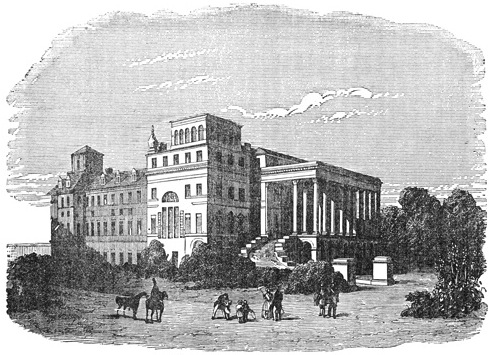
THE CASTLE OF EISENSTADT, HUNGARY.
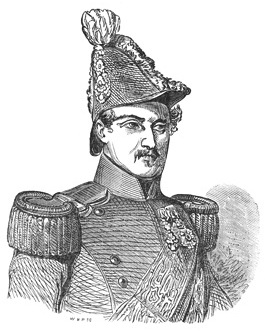
KING OF DENMARK.
The peace was grateful to the inhabitants after their long struggle. Their losses were gradually repaired, their lands cultivated, and their towns rebuilt; but on the death of Ferdinand, and the accession of his unamiable son, Leopold, in 1658, the Hungarians rose in insurrection, made Tekeli their prince, and called in the Turks to their aid. The reigning Sultan, in 1683, raised the most formidable force ever sent against Christendom; and Lorrain, the Imperial general, retired before the Turkish crescent. Leopold and his household fled from Vienna; two-thirds of the inhabitants followed; the city was besieged, and it would have fallen but for the timely arrival of John Sobieski, king of Poland, who defeated the invaders, and took the famous standard of Mohammed, which was sent as a present to the Pope. Fearful was the vengeance which Leopold now took on the Hungarians. A scaffold, erected in the market-place of Eperies, stood there so many months, that the executioners were weary of victims. At length, the Hungarian nobles having been summoned to Vienna, declared the crown hereditary: the States at Presburg confirmed the decree; and the Emperor’s son, Joseph, at the age of nine, was acknowledged as King of Hungary.
When Charles, king of Spain, breathed his last, without heirs, and Louis XIV sent his grandson Philip V to Madrid, Leopold, whose mother was daughter of Philip III, claimed the Spanish throne for his second son, the Archduke Charles. England supported the Austrian claim, and the war was still raging when, in 1705, Leopold dying, was succeeded on the Imperial throne by his son Joseph, who seized Mantua and Milan, assailed the temporal power of the Pope, and made everything bend to his power. In the midst of his successes he expired, in 1711, and Charles VI, whom the allies were attempting to place on the Spanish throne, having obtained the Imperial crown, the treaty of Utrecht terminated the War of Succession. To that treaty Charles at first refused his assent; but when a French army under Marshal Villars had passed the Rhine, he acceeded to the views of the allies, and obtained Milan, Naples, and the Netherlands.
One of the greatest and most successful captains of that age was Prince Eugène. His father being a member of the house of Savoy, and his mother a niece of Cardinal Mazarin, he applied to Louis XIV first for an abbey, and then for a regiment. The Grand Monarch, little understanding the applicant’s character, refused in both cases. Prince Eugène, taking service with the Emperor, was associated with the illustrious Marlborough in those brilliant victories that have made the name of the ‘handsome Englishman’ immortal, had the distinction of expelling the French from Italy, and in 1717, undertook the memorable siege of Belgrade, the strongest castle in Europe. Surrounded in his camp by a hundred and fifty thousand Turks, he routed them with immense slaughter, and captured the place, which remained in possession of Austria for twenty-two years.
Charles, anxious that the hereditary dominions of the house of Austria should be settled on his daughter, the celebrated Maria Theresa, obtained the assent of the European powers to a pragmatic sanction. But hardly had his eyes closed in 1740, when events verified the observation of Prince Eugène: ‘The best guarantee in this case would be an army of a hundred thousand men.’ Frederick the Great, king of Prussia, claimed Selesia, captured Breslau, after winning the battle of Molwitz; while Charles of Bavaria, whom Louis XV had caused to be crowned as King of Bohemia, was chosen Emperor, with the title of Charles VII. But Maria Theresa, though deserted by her allies, was a woman of too high spirit to be daunted by adverse circumstances. She convoked the States of Hungary, and taking her infant son in her arms, addressed the assembly in Latin, the idiom of the States—‘I place in your hands,’ she said, ‘the daughter and son of your kings. They look to you for succor, and depend on you for safety.’
The Hungarian nobles, too chivalrous to resist such an appeal from such lips, drew their glittering swords, and exclaimed with one accord, ‘we will die for our Queen,’ and levied an army which brought her enemies to reason. At length, after an English army had won the battle of Dettingen, and Charles VII had been removed by death, peace was restored, and the husband of the popular Queen was raised, in 1745, to the Imperial throne, with the title of Francis I. But, in 1756, the Seven Years’ War breaking out between France and England, Maria Theresa, regretting the cession of Selesia to the Prussian King, flattered the vanity of Madame Pompadour, and secured the aid of France. The skill and intrepid courage of Frederick prevailed, and after seven bloody campaigns, he signed a peace with the Empress-Queen.
On the death of his father, Joseph, the son of Maria Theresa, ascended the Imperial throne, and issued some oppressive edicts against the Netherlands, which his grandfather had acquired at the close of the Spanish war. The inhabitants had been contented under the rule of Maria Theresa, but revolted at Joseph’s tyranny; and terrible was the punishment. Their houses were ruthlessly entered at midnight; women and their infants were slain with one bayonet, and their husbands were, without trial, carried off prisoners to Vienna on the banks of the Danube. These cruelties prompted the Netherlands to declare themselves forever released from Austrian sway, and to treat every offer of indemnity with contempt.
This Emperor’s conduct was otherwise praiseworthy; he abolished the system of torture, with servitude and villeinage, granted a liberal toleration in religion, and was easy and affable in communicating with his subjects. He was succeeded in 1790 by his brother Leopold, who, during his brief reign, restored tranquillity in the Netherlands, and was hesitating about the course he should pursue toward revolutionary France, when he died in 1792.
Francis II then succeeded his father, and took a conspicuous part in the struggle, as has already been related. But in 1806, when fourteen princes of Germany formed the Confederation of the Rhine, and acknowledged the victorious Napoleon as their protector, Francis, finding himself deprived of all his honors as head of the Germanic body, abandoned the ancient title, and styled himself Emperor of Austria.
When Napoleon, after making the kings of the earth bow down before his mighty energies, fell in 1814, Vienna, the capital of the new empire, was the scene of one of the most important assemblies of modern days. There the Emperors of Austria and Russia, the King of Prussia, and many of the Germanic princes, met the representatives of England and France, to establish the territorial limits of the Continental States upon recognized principles of international policy. That was the celebrated Congress of Vienna; and while withholding the Netherlands from Austria, it restored Lombardy, and added thereto all the ancient possessions of the far-famed Venetian republic. The Germanic Confederation was likewise dealt with, and something done toward harmonizing the interests of the independent states into a nationality.