AMERICAN ENCYCLOPEDIA (continued 14)
Reading edition
Immediately on receiving intelligence of the declaration of war, Washington convened a cabinet council, and by their unanimous advice, issued a proclamation, enjoining strict neutrality to be observed on the part of the United States toward the belligerent powers, April 22, 1793. The opposition (anti-federalist) party, through the press, bitterly inveighed against this proclamation, denouncing it as a high-handed assumption of power on the part of the president, ‘a royal edict,’ evincing his monarchical disposition, and also as dishonorable and ungrateful towards France.
In this state of things, Mr. Genet, the new minister appointed by the French republic, arrived in the country, with the object of engaging the coöperation of the United States against England. Misled by the flattering reception he met with at Charleston, where he landed, he immediately began, even before he had been recognized as minister, to excite the people against the government, and carried his audacity so far as to set at defiance the proclamation of neutrality, fitting out expeditions, and giving commissions to American vessels to cruise against the enemies of France, and assuming the power to hold admiralty courts, for the trial and sale of prizes thus made. In these measures he was supported by the opposition, or as it began to be called, the DEMOCRATIC party, which now began, under the influence of the French minister, and in imitation of the affiliated clubs in France, to form democratic societies throughout the country.
Washington demanded the recall of Mr. Genet. The French government complied, and instructed his successor to express its entire disapproval of Genet’s conduct. When Congress assembled in December following, the proclamation of neutrality, and the conduct of Washington towards Genet, were approved by that body, as they were finally by the great body of the nation.
In 1794 Congress passed a bill providing for a naval force to protect American commerce against the Algerines. The slave-trade was likewise prohibited.
There seemed now reason to apprehend the necessity of another war with England. In addition to severe and unjust commercial restrictions imposed by that government, she had proceeded to capture and condemn neutral vessels having on board French goods, or carrying corn and other supplies to France. In anticipation of a war, Congress passed several bills—for imposing an embargo; for organizing the militia; and for increasing the standing army. Meanwhile information was received that the British government was disposed to redress the grievances complained of, and amicably adjust all differences. John Jay was accordingly nominated and approved as envoy to Great Britain.
All attempts to make peace with the Indians having failed, the war was renewed. Gen. Wayne was appointed to succeed Gen. St. Clair. On the 20th of August, he gained a decisive victory over a large body of the Miamies, and then proceeded to lay waste their country. This victory prevented a general war with the Six Nations and with the tribes northwest of the Ohio. The ‘Whisky Insurrection’ in Pennsylvania is one of the events of this year. It grew out of the duty on domestic spirits; this tax pressed heavily on the inhabitants of the west, and was besides considered unjust in principle. The proclamation of the president being disregarded, a considerable force of militia (fifteen thousand men), under Governor Lee of Maryland, was ordered out. On their approach, the insurgents laid down their arms, and promised submission to the laws.
In 1795 Mr. Jay having concluded a treaty of amity, commerce, and navigation, with Great Britain, the senate was convoked to consider it. Meanwhile, its contents having been disclosed, the most violent opposition was made to it; public meetings were held, and petitions against it were sent from all quarters of the country. The partisans of France and the enemies of England denounced it in the most unmeasured terms. The objections to it were, generally, that it wanted reciprocity; that it gave up all compensation for negroes carried away contrary to the treaty of peace, and for the detention of the western posts; that it contravened the French treaty, and sacrificed the interest of our ally to that of Great Britain; that it gave up in several important instances the law of nations, particularly in relation to free ships makings free goods, cases of blockade, and contraband of war; that it improperly interfered with the legislative powers of Congress, and that the commercial part gave few advantages to the United States. The treaty was, however, ratified by the senate, and signed by the president, August 14, 1795.
In October, after a long negotiation, a treaty was made with Spain, settling some questions of boundary, and acquiring for the United States the right of navigating the Mississippi. Treaties were also concluded with Algiers, and with the Indians in the West.
On the assembling of congress in 1796, it became necessary to make appropriations and pass resolutions for carrying these treaties into effect. This gave occasion for a new display of hostility to the British treaty: and it was only after a debate of seven weeks, that the necessary resolutions passed the house of representatives, and then only by a majority of three. Public opinion at length gradually settled in favor of this treaty, as the only means of saving the country from becoming involved in the wars of the French revolution; and in the sequel it proved of great advantage to the United States. The close of the second term of Washington’s administration was now approaching. Signifying his intention to retire from public life, the Father of his country took occasion to issue a farewell address to his countrymen, replete with maxims of political wisdom, and sentiments of patriotism and virtue.
The personal influence of Washington, due alike to his wisdom, his virtues, and his eminent services, was of the utmost importance in the first working of the new government. During the eight years of his administration, all differences with foreign nations had been peaceably settled, except those with France; and at home the Indian tribes had been pacified. Public and private credit were restored; ample provision made for the security and ultimate payment of the public debt; American tonnage had nearly doubled; the exports had increased from nineteen to more than fifty-six millions of dollars; the imports in about the same proportion; and the amount of revenue from imposts had exceeded the most sanguine calculations. The population had increased from three and a half to five millions; and agriculture and all the industrial interests of the country were in a flourishing state.
The only drawback to this picture of prosperity were the difficulties with France. Discontented at the neutral policy of America, the French republic continued to make demands upon the gratitude of the United States, which could be yielded to only by surrendering the right of self-government. Finding all attempts to involve America in its wars with Europe ineffectual, and feeling aggrieved at the treaty with its enemy, the French government proceeded to retaliate, by adopting certain resolutions injurious to American commerce, under the operation of which, moreover, several hundred American vessels were seized and confiscated. Just before his retirement from office, Washington had recalled Mr. Monroe, and despatched Mr. Charles Cotesworth Pinckney to France, as minister plenipotentiary, to settle the difficulties between the two nations. Such was the state of the country at the close of Washington’s administration.
On the 4th of March, 1797, John Adams became president. The French republic refusing to receive Mr. Pinckney, a subsequent mission extraordinary to that government having also totally failed, and spoliation upon American commerce continually increasing, congress began to adopt vigorous measures for defense and retaliation. The treaties with France were declared no longer obligatory on the United States; an army was raised; and Washington was appointed commander-in-chief. Several engagements at sea took place between French and American vessels. The French government now signified indirectly a willingness to treat, and envoys were again sent from the United States. Before their arrival, the revolution of the 18th Brumaire (November 10, 1799) had taken place; the directorial government was overthrown, and Bonaparte was at the head of affairs as first consul. This event changed the policy of the French government; negotiations were commenced, and a treaty was concluded September 30, 1800.
On the 14th of December, 1799, died George Washington, mourned by the nation as no other man was ever mourned by any people. There have been great men superior perhaps to him in particular qualities and endowments: but in the perfect proportion and harmony of all the qualities of his nature, intellectual and moral, in the entireness and unity of his character, he is distinguished above all the great men whom history presents to our contemplation. In this consisted the secret of the repose, dignity, and grandeur, that through his whole life made so strong an impression upon all who approached him, and gave him such power over them.
Party spirit ran high during Mr. Adams’s administration. Its measures were violently assailed by the opposition, particularly the ‘alien’ and ‘sedition’ laws: by the former of which, any alien considered dangerous might be ordered to depart from the country; and by the latter, combinations to oppose the government, libelous publications etc. were made penal. The unpopularity of these and some other measures gave great strength to the democratic party, and defeated the reëlection of Mr. Adams.
On the 4th of March, 1801, Thomas Jefferson succeeded Mr. Adams as president of the United States. At the next session of congress, several of the most important acts of the preceding period were repealed, particularly those imposing internal taxes, and reorganizing the United States courts. Among the most important events of this period was the purchase of Louisiana from the French for fifteen millions of dollars. Mr. Jefferson’s term of office expiring, he was reëlected, and commenced a second term, March 4, 1805. The same year a war which had been carried on for several years with Tripoli, was brought to a close by a treaty of peace.
The interests of the United States were now becoming complicated with the policy of the belligerent powers of Europe. The peace of Amiens in 1802 gave but a short repose from war; hostilities were soon renewed between France and England, and all the powers of Europe became involved in them. The United States maintained a strict neutrality and engaged in an extensive and profitable carryingtrade. But in 1806, the English government, by an order of council, declared the blockade of all the ports and rivers from the Elbe to Brest. Napoleon retaliated by the famous ‘Berlin decree,’ declaring all the British islands in a state of blockade. This was met by another British order of council, prohibiting all coasting-trade with France.
While these measures, which were partly in contravention of the law of nations, operated very injuriously upon the commerce of America, and tended to embroil her with both the belligerent powers, an old difficulty with England was aggravated by a special outrage. Great Britain had always claimed the right of searching American vessels, and of impressing from them native-born British subjects. They had also impressed some thousands of American seamen, under the pretext that they were British born. In this course the English government persisted in spite of the remonstrances of the United States. In June, 1807, Commodore Barron, commanding the American frigate Chesapeake, refusing to deliver three men claimed by the British, the Chesapeake was attacked by the British frigate Leopard off the capes of Virginia, very much injured and crippled, and the men in question forcibly taken away.
The public mind was greatly exasperated by this outrage. The president, by proclamation, ordered all British armed vessels off the waters of the United States, until satisfaction should be made, which the American minister, Mr. Monroe, was instructed to demand forthwith, as well as security against future impressments from American vessels. The British government declined to treat concerning the general question of search and impressment, but sent a special envoy to the United States, to settle the particular injury in the case of the Chesapeake. Mr. Rose was instructed, however, not to treat until the president’s proclamation was revoked. This being refused, the matter rested; and was not finally adjusted until four years later, when satisfactory reparation was made by the British government.
Meantime, on the 17th of December, 1807, Bonaparte, in retaliation for the British order in council, issued the Milan decree declaring every vessel denationalized that should submit to search by the British, and every vessel a good prize taken sailing to or from Great Britain or its colonies, or any place occupied by British troops.
The embargo failing to compel the belligerent powers to revoke measures so injurious to American commerce, and so subversive of the rights of neutrals, it was repealed on the 1st of March, 1809, and a law passed prohibiting all trade and intercourse with France and England.
Mr. Jefferson declining a reëlection, was succeeded, March 4th, 1809, by James Madison. The state of the country was gloomy. Her commerce was suffering both from foreign and domestic restrictions; and it seemed that she must indefinitely submit to this condition of things, or make war with the belligerents. In passing the non-intercourse act of March 1st, congress had empowered the president to repeal it by proclamation in the event of either of the hostile parties revoking their edicts. The British minister at Washington engaged for his government the repeal of the orders of council, so far as the United States were concerned. The president accordingly notified the renewal of commercial intercourse with Great Britain. But the English government disavowed the engagement of its minister, and non-intercourse was again proclaimed.
On the 23d of March 1810, Napoleon retaliated the non-intercourse act of congress by issuing the Rambouillet decree—ordering all vessels arriving in French ports, or the ports of countries occupied by French troops, to be seized and condemned. On the 1st of May, congress passed an act excluding British and French armed vessels from the waters of the United States—with a provision for renewing intercourse with whichever nation should within a given time cease to violate the commercial rights of neutral nations. In consequence of this act, the French decrees were revoked, and intercourse with France was renewed. It had been made a condition on the part of the French government, in revoking its decrees, that the English orders of council should be also revoked. But England affecting to question the fact of the actual revocation of the French decrees, continued to enforce its orders, stationing vessels-of-war just out the harbors of the United States, searching, and in many instances capturing and condemning American merchant vessels. In the period between 1803 and the close of 1811, nine hundred American vessels had been thus captured.
On the 3d of April, 1812, an act was passed by congress laying an embargo for ninety days on all vessels within the jurisdiction of the United States. And on the 4th of June following war was declared against Great Britain. The grounds of war alleged were the impressment of American seamen, and the violation of neutral rights. The feeling of the nation was by no means unanimous in favor of the war. It was protested against by a strong minority in congress, as unnecessary, impolitic, and immoral; and was generally condemned by the federal party throughout the country.
Thus the United States were again at war with England. The contest lasted for nearly three years. The limits of this history forbid any thing but a slight sketch of its events.
In the campaign of 1812, nothing of any importance was achieved by land. The invasion of Canada was planned: forces were drawn to the northern frontier of the Union, and naval preparations made upon the lakes. No footing was, however, gained in the British territory; on the contrary, Detroit and all the forts and garrisons in Michigan fell into the hands of the British, together with a considerable force under the command of General Hull, who surrendered without a battle, August 19; and the Americans were repulsed in an attack on Queenstown, and obliged to surrender, October 13. But on the ocean the American arms were more successful. The series of brilliant naval victories which distinguished the war was commenced by the capture of the British frigate Guerriere by the Constitution, Captain Isaac Hull, August 10. This was followed (August 13) by the capture of the Alert by the Essex, Captain Porter; of the Frolic by the Wasp (October 17); of the Macedonian by the United States, Commodore Decatur (October 25); and of the Java by the Constitution, then commanded by Commodore Bainbridge.
On the 4th of March, 1813, Mr. Madison was reëlected president. The military operations of this year extended along the whole line of the northern frontier. The Americans were signally defeated at Frenchtown by a body of British and Indians, and five hundred men made prisoners, who were nearly all massacred by the Indians after their surrender. York (now Toronto), the capital of Upper Canada, was taken by the Americans, with a large quantity of military stores. On the 1st of June, this year, the American navy suffered a severe loss in the capture of the frigate Chesapeake, Captain Lawrence, by the British frigate Shannon. In the engagement, Captain Lawrence and several brave officers were killed. This was followed by the loss of the Argus. These losses were counterbalanced by the capture of the British brig Boxer by the Enterprise, on the 5th of September, and by a brilliant victory gained (September 10) by the fleet on Lake Erie, under the command of Commodore Perry. This made the Americans masters of the lake, and opened the way to Detroit, which was soon after taken; its fall being preceded by the battle of the Thames, in which the British and Indian forces, under the command of General Proctor, were totally defeated by General Harrison. This victory had the effect of putting an end to the Indian war in the northwest, and of giving security to that frontier. The invasion of Canada was again attemted; but unexpected circumstances concurred to disarrange the plan of operations, and at length the northern army went into winter-quarters, without having effected anything toward the accomplishment of the object. High expectations had been formed of the success of this campaign, and the public disappointment was proportionally great.
At the south, the Creek Indians, instigated by the British, had taken up arms against the United States, and a sanguinary war was carried on in that quarter during the year 1813, and until in the summer of 1814, when General Jackson, having reduced the enemy in several engagements, at length inflicted upon them an almost exterminating defeat at Horseshoe Bend. The remnant of the tribe submitted, and the war was at an end. General Jackson was soon after appointed to the command of the forces at New Orleans.
In the spring of 1814, the American frigate Essex was captured by a superior British force in the bay of Valparaiso. But about the same time, the British brigs Epervier and Reindeer were captured, the former by the United States sloop-of-war Peacock, the latter by the sloop Wasp.
After some ineffectual movements at the north by General Wilkinson, little was attempted by either nation until midsummer, when the British government, free from the burden of the European war by the abdication of Napoleon, augmented their armies in America by the addition of fourteen thousand of the veteran troops of Wellington, and at the same time sent a strong naval force to blockade the harbors, and ravage the towns upon the coast.
On the 3d of July, General Brown crossed the Niagara river from Buffalo, and took the British fort Erie; and on the 4th, after an obstinate and bloody engagement, gained a victory over the British at Chippewa. On the 25th, was fought the battle of Bridgewater, near the falls of Niagara, one of the most bloody battles of modern times. The British force amounted to nearly five thousand men; the American was one third less. The loss of the English was eight hundred and seventy-eight; of the Americans, eight hundred and sixty. The Americans were left in possession of the field.
About the middle of August, a large British fleet arrived in the Chesapeake bay. Six thousand men, under the command of General Ross, landed and proceeded to Washington, burnt the capitol, the president’s house, and the buildings of the executive departments; and then by rapid marches retired to the ships, having lost about one thousand men in the expedition. On the 12th of September, an attack was made on Baltimore; but the place was so gallantly defended by militia and the inhabitants, that the enemy abandoned the attempt. General Ross, the commander-in-chief of the British forces, was among the killed. While the English were thus repulsed from Baltimore, signal success attended the American arms at the north. The naval force of the enemy on Lake Champlain was annihilated by Commodore M’Donough. The engagement took place off Plattsburgh; and while it was raging, Sir George Provost, with a force of fourteen thousand men, commenced an assault on the American works at Plattsburgh; but he met with such a destructive fire from the Americans under General Macomb, that he was compelled to retire, with the loss of twenty-five hundred men, abandoning his military stores, his sick and wounded.
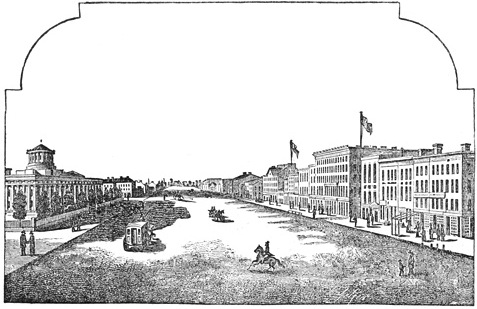
VIEW OF THE STATE HOUSE AND HIGH ST., COLUMBUS, OHIO.
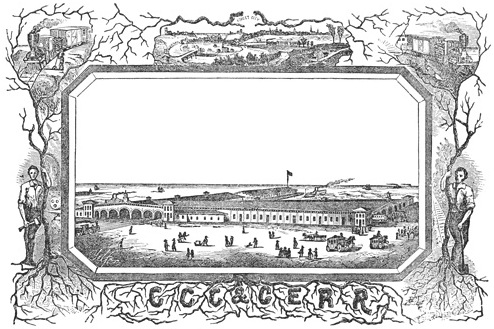
VIEW OF LAKE ERIE AND GREAT CENTRAL DEPOT, CLEVELAND.
On the 24th of December, a treaty of peace was signed at Ghent. But before its arrival, the last and most memorable battle of the war was fought at New Orleans. On the 8th of January, 1815, the American forces, amounting to about six thousand, chiefly militia, under the command of General Jackson, intrenched before the city, were attacked by fifteen thousand British troops, commanded by Sir Edward Packenham. After three charges, in which they were swept down with incredible slaughter, the British fled in confusion, leaving their dead and wounded on the field of battle. General Packenham was killed while rallying his troops to the second charge; General Gibbs, who succeeded in command, fell mortally wounded in the third charge. The loss of the British in killed was seven hundred; in wounded, fourteen hundred; in prisoners, five hundred: in all, twenty-six hundred. The Americans lost seven killed and six wounded. The joy excited by this victory was merged in the still livelier joy with which the news of the treaty of peace was soon after received. On the 17th of February, the treaty was ratified by the president and senate. This treaty made no allusion to the causes of the war, and settled none of the matters in dispute, and for which it was professedly declared. All parties, however, welcomed the return of peace. At a subsequent convention, signed by plenipotentiaries of the two countries appointed for the purpose, various articles for the regulation of commerce between England and the United States were adopted. Before the expiration of the time within which, by the treaty, all vessels taken by either party were to be held good prizes, several engagements at sea were fought, and several captures made. Among them the American frigate President was captured by a British squadron; and the British ships Cyane, Levant, and Penguin, were taken by the Americans.
At the next session of congress, a bill was passed incorporating the Bank of the United States, with a capital of thirty-five millions of dollars. The charter was to continue in force until the third of March, 1836. This measure was the subject of a very earnest and protracted debate both as to its constitutionality, and as to the principles on which the bank should be established.
Mr. Madison was succeeded in the office of president by James Monroe, March 4, 1817. The country was now at peace, but its condition was by no means prosperous. Commerce had not yet revived, and the manufactures which had been carried on during the war were entirely broken down by the influx of foreign merchandise. In 1818, a war broke out between the Seminoles and the United States, occasioned by the removal of some Indians from lands ceded to the United States by the Creeks in 1814. The Indians were entirely subdued by General Jackson. In 1819, another convention was made between Great Britain and the United States, granting to American citizens the right to fish on the banks of Newfoundland; establishing a portion of the northern boundary; and extending for ten years longer the commercial convention concluded four years before.
A treaty was also this year concluded with Spain, by which East and West Florida, with the islands adjacent, were ceded to the United States.
On the 4th of March, 1821, Mr. Monroe was unanimously elected to a second term of office. Much less unanimity, however, was displayed in the deliberations of the next congress. Some important commercial acts were passed; revolutionary soldiers were provided for by pensions; and the ratio of population and representation fixed at one representative to forty thousand inhabitants.
The year 1824 is signalized in the annals of the country by a visit from La Fayette, the friend and companion-in-arms of Washington, to whose services in the dark day of the revolutionary war the nation owed so much. He passed about a year in the country, visiting every part of it, and receiving everywhere the most enthusiastic tokens of homage and gratitude. He returned to his own country in a national frigate prepared for the purpose, and named, in honor of him, the Brandywine—the name of the battle in which he was wounded nearly fifty years before. During his visit, congress appropriated two hundred thousand dollars, and a township of land in Florida, as an acknowledgment of his eminent services.
Mr. Monroe retired from office with the respect and good will of all parties. His administration of affairs, both foreign and domestic, had been uninfluenced by party spirit, and characterised by uprightness, prudence, and good sense. The country was everywhere peaceful and prosperous. No choice of a successor to Mr. Monroe having been made by the electors, the choice devolved upon the house of representatives.
On the 4th of March, 1825, John Quincy Adams was inaugurated president of the United States.
Among the noticeable events during this administration, the first to be mentioned is a controversy between the general government and the executive of Georgia, in relation to certain lands held by the Cherokees and Creeks of that state. The general government had agreed to extinguish, for the benefit of Georgia, the Indian title to those lands—‘whenever it could be peaceably done, upon reasonable terms.’ But the Creeks, at a national council, refused to alienate their territory. After the council had broken up, and a majority of the chiefs had departed, a few who remained were induced to make a treaty, ceding the lands in question to the United States. This treaty was repudiated by the Creek nation. But the governor of Georgia determined to act upon it as valid. To prevent a war, the president ordered General Gaines to repair to the Creek country, for the protection of the Indians; and directed Governor Troup of Georgia to suspend his intended measures. Congress approved the course of the president; and at length a treaty was formed with the Creeks, which gave satisfaction to all parties except the state of Georgia.
The most important among the measures which occupied the first session of the twentieth congress, was the revision of the tariff, with a view to afford protection to American manufactures. The principle of a protective tariff was warmly opposed by the south, and by a large portion of the commercial body at the north; while the details of the bill which was passed were far from satisfactory to the friends of protection.
During Mr. Adams’ administration the prosperity of the United States had increased to an unexampled height. Agriculture, commerce, and manufactures, were every where flourishing. The public debt which at the close of the war, amounted to nearly one hundred and fifty millions of dollars, was almost extinguished. The annual revenue largely exceeded the demands of the government; and at the close of Mr. Adams’ term, there was a surplus of more than five millions in the treasury.
On the 4th of March, 1829, Andrew Jackson was inaugurated president of the United States.
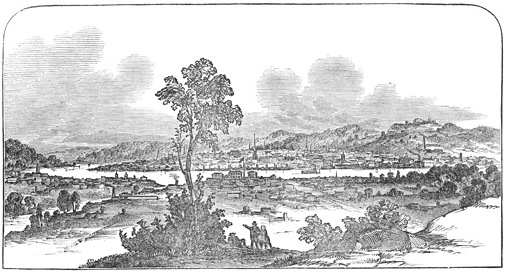
CINCINNATI OHIO.
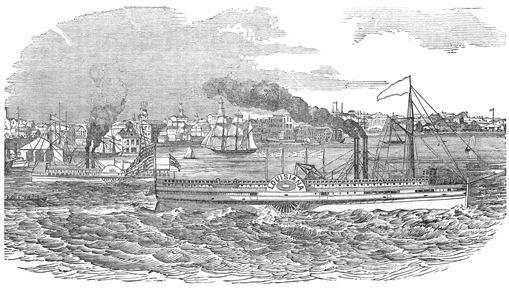
SANDUSKY CITY, O.
Among the most important measures which engaged the attention of the twenty-first congress, were, the modification of the tariff; Indian affairs; internal improvements; and the renewal of the charter of the United States bank. It was not until 1832 that a memorial came before congress for the renewal of the charter of the United States bank. A bill to that effect passed both houses of congress; but on the 10th of July it was returned by the president with objections. The policy of making appropriations for internal improvements was adopted during Mr. Jefferson’s term of office, and had continued through all succeeding administrations. To this policy General Jackson was opposed, and accordingly returned, with his veto, several bills making such appropriations. In 1832, the hostility of the south to the protective tariff assumed in South Carolina an attitude dangerous to the peace of the country. A convention of delegates assembled at Columbia, November 24; pronounced the acts of congress imposing duties for protection unconstitutional, and of no binding force in that state; and that it was the duty of the state legislature to pass laws to prevent the payment or enforcement of such duties. The remedy thus proposed received the name of nullification. President Jackson immediately issued a proclamation, containing an admirable exposition of the principles and powers of the general government, and expressing a firm determination to maintain the laws. This only increased the exasperation in South Carolina: the governor of the state, by the authority of the legislature, issued a counter-proclamation, urging the people to be faithful to their primary allegiance to the state, and to resist the general government in any attempt to enforce the tariff laws. General orders were also issued to raise volunteers for repelling invasion, and supporting the rights of the state. General Jackson hereupon addressed a message to congress recommending such measures as would enable the executive to suppress the spirit of insubordination, and sustain the laws of the United States.
Everything thus betokened a civil war. But an appeal to South Carolina by the general assembly of Virginia, and the passage of a bill modifying the tariff (introduced by Henry Clay, and commonly known as the ‘compromise act’), joined with a manifestation of firmness and energy on the part of the executive, served to allay the ferment in South Carolina, and led to a repeal of the nullifying ordinances.
On the 4th of March, 1833, Andrew Jackson entered on a second term of office. The charter of the United States bank being about to expire, the president who had before expressed to Congress his doubts of the expediency of continuing that institution the depositary of the funds of the United States, directed the secretary of the treasury, Mr. Duane, to remove the government deposits from the bank. This Mr. Duane declined to do. He was immediately removed from office by the president; and Mr. Taney was appointed in his place, by whom the deposits were removed, and placed in the custody of several State banks. This measure was strongly censured by a resolution which passed the senate, June 9, 1834.
The country was now disturbed with serious apprehensions of a collision with France. By a treaty, negotiated in 1831, by Mr. Rives, the French government had agreed to make indemnity for spoliations committed on American commerce during the reign of Napoleon; but it had failed to fulfill its stipulations. In December, 1834, the president recommended reprisals upon French commerce. This was deemed by Congress not expedient at present. Happily, however, the danger of hostile collision was removed in the course of the next year by the action of the French government in making provision to fulfill its stipulations.
The most important act of the first session of the twenty-fourth Congress, which began December 7th, 1835, was a law directing the deposit, under certain regulations, of the moneys of the United States in several of the State banks, and distributing the surplus revenue among the several States.
In December, 1835, one of the most destructive fires on record occurred in the city of New York. The amount of property destroyed is computed not to have fallen much short of twenty millions of dollars, without estimating the injury and loss from suspension and derangement of business.
Near the close of this year, the Seminole Indians, refusing to remove from Florida to the lands appropriated for them west of the Mississippi, the country became involved in a war with them; and it was not until 1842 that they were finally subdued and sent west.
On the 11th of July, 1836, the receivers of public money were instructed, by a circular from the treasury department, to receive nothing but gold and silver in payment for public lands.
On the 16th of January, 1837, the ‘expunging resolution’ (so called) introduced by Mr. Benton, passed the senate by a small majority. By this act the resolution of the senate passed June 9, 1834—censuring the president for removing Mr. Duane, and ordering the withdrawal of the United States deposits from the bank of the United States—was expunged from the journal of the senate. Against this proceeding, Mr. Webster, of Massachusetts, in behalf of himself and his colleagues, read a solemn protest.
On the 4th of March, 1837, Martin Van Buren became president of the United States. Mr. Van Buren’s administration was, in its general policy, a continuation of that of his predecessor. Scarcely, however, had he entered upon office, when the country was overwhelmed by one of the most severe commercial revulsions ever known. For several years previous, the wildest spirit of speculation had prevailed throughout the country. Vast public works were undertaken by States and chartered companies; immense importations of foreign goods were made; and real estate, especially lots in cities and towns, went up a hundred fold beyond its intrinsic value. The multitude of State banks that had been chartered, after the expiration of the charter of the United States bank, and the consequent excessive expansion of the paper currency, had contributed to increase the spirit of speculation. At length a crisis came; and the revulsion was proportionately severe. Some idea of it may be formed from the fact that a list of failures in the city of New York (including only the more considerable, and omitting hundreds of less importance), shows a total amount of more than sixty millions of dollars. All credit, all confidence was at an end. On the 10th of May, all the banks of the city of New York suspended specie payments, and the suspension became general throughout the country. The general government became involved in the universal embarrassment—the banks in which its deposits were placed having stopped in the general suspension. The government still insisted, however, upon all postages and duties being paid in specie or its equivalent, and even refused its own checks and drafts when offered in payment of custom-house bonds. In this state of things, the president convoked an extra session of Congress, which began on the 4th of September. Agreeably to the recommendation of the executive, as measures for the immediate relief of the general government, Congress passed a law postponing to the 1st of January, 1839, the payment to the States of the fourth installment of the surplus revenue; and authorizing the issue of ten millions of treasury notes, to be receivable in payment of public dues. The president also recommended the ‘separation of the fiscal operations of the government from those of corporations or individuals.’ A bill in accordance with this recommendation—commonly called the sub-treasury bill, placing the public money in the hands of certain receivers-general, subject to the order and control of the treasurer of the United States—passed the senate, but was lost in the house.
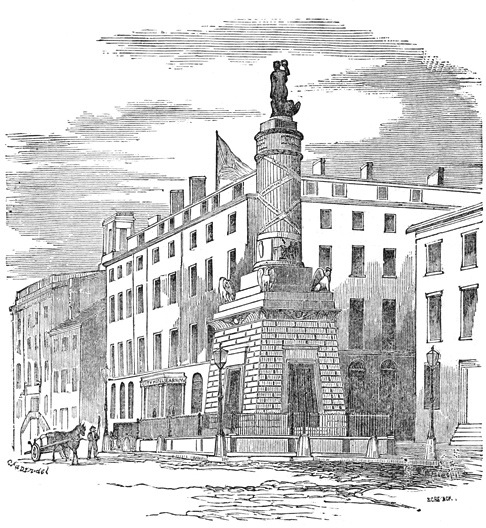
BATTLE MONUMENT, BALTIMORE.
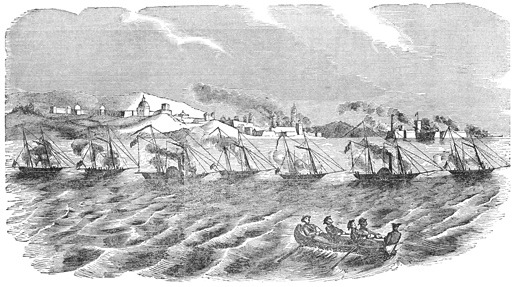
BOMBARDMENT OF VERA CRUZ.
At the next regular session of congress (December, 1837—July, 1838), a reissue of treasury notes was authorized. The sub-treasury system was again urged upon the attention of congress, but was not adopted. On the 13th of August, 1838, the banks throughout the country generally resumed specie payments: but in October following, the banks of Philadelphia again suspended, and their example was followed by the banks in Pennsylvania, and in all the states south and west. The banks of New York and New England continued to pay specie. The twenty-sixth congress commenced its first session December 2d, 1839. Among its acts, two only need be mentioned: one for taking the sixth census of the United States; the other, ‘for the collection, safe keeping, transfer, and disbursement, of the public revenue’—being the sub-treasury system so earnestly recommended by the president. At the second session of this congress, nothing was done of sufficient importance to find a place in this sketch.
The administration of Mr Van Buren was drawing to a close. He was a candidate for reëlection; William Henry Harrison, of Ohio, was the candidate of the opposition. After a contest unprecedented for intensity of political excitement, Mr. Van Buren was defeated.
On the 4th of March, 1841, William Henry Harrison was inaugurated president of the United States. Scarcely had the new president entered upon his office, and organized his administration by the appointment of his cabinet, when he was stricken with sickness; and on the 4th April, one month from the day of his inauguration, he expired. ‘In death, as in life, the happiness of his country was uppermost in his thoughts.’
By the death of General Harrison, John Tyler, of Virginia, the vice president, became, according to the constitution, president of the United States. The passage of a general bankrupt law was one of the earliest measures passed by congress. This law was, however, subsequently repealed. The tariff was modified with a view to further protection of American industry.
Among the most memorable events of this administration is the treaty of Washington, concluded in September, 1842, between Great Britain and the United States, by Lord Ashburton and Daniel Webster, by which the differences about the boundary line between Maine and Lower Canada, long a matter of dispute and ill-blood, were amicably and satisfactorily adjusted.
The disturbances in Rhode Island are a less agreeable subject of record; though happily the apprehensions they excited have been dispelled. In 1841, a convention of inhabitants of Rhode Island framed a new constitution, giving the right of suffrage (which under the existing government was extremely limited) to all free white inhabitants; and proceeded to organize a new government under this constitution. They elected a legislative body, and chose Thomas W. Dorr governor of the state. All these proceedings were considered as unlawful and revolutionary by those opposed to them, inasmuch as they had taken place without any legal warrant, and without being in any way initiated by the lawful and actual government. A civil war seemed inevitable. The legal government applied to the president of the United States, who detached several companies of troops to Newport to await events. Dorr mustered a considerable force of armed men, with two pieces of artillery, and made an ineffectual attempt to gain possession of the arsenal at Providence. Shortly after, he took a position at Chepachet, where his force was increased by volunteers from New York and other states. Upon the approach of a body of the state militia, under General M’Neil, Dorr and his party broke ground and fled, June 25th, 1842. His government fell to pieces.
On the 4th of March, 1845, James K. Polk was inaugurated president. The most important event of this year was the voluntary annexation of Texas to the American Union. In 1846, a war broke out between Mexico and the United States. A rapid succession of brilliant victories by the troops under Generals Taylor and Scott, soon placed the capital and all the strongholds of Mexico in the hands of the victors; but the power to dictate the terms of a peace were used with moderation. The government of the United States assumed the payment of all the claims of its own citizens against Mexico, and agreed to pay $15,000,000 for a boundary line beginning at the mouth of the Rio Grande, then up that stream to the southern boundary of New Mexico, then across to the river Gila, and down to its mouth; with free navigation to the Gulf of California, and thence across to the Pacific. The treaty was concluded May 30th, 1848. In the same year gold was first discovered in the newly-acquired territory of California.
On the 4th of March, 1849, Gen. Zachary Taylor was inaugurated president of the United States. He died in July, 1850, and was succeeded by the vice-president, Millard Fillmore. In September, 1850, California was admitted into the Union. On the 4th of March, 1853, Franklin Pierce was inaugurated president. The ‘Gadsden Treaty,’ by which the Mesilla Valley was acquired from Mexico, was made Dec. 30, in the same year. By act of June 29, 1854, $10,000,000 were appropriated to carry out the treaty; $7,000,000 to be paid upon exchange of ratifications, and $3,000,000 as soon as the boundary line should be surveyed and established.
Thus have been briefly sketched the leading events, political and civil, of the history of the United States, from the first feeble and scattered colonial establishments to the formation of a great and prosperous nation. The great problem of the possibility of a permanent and well-ordered republic, on so extensive a scale, doubtless yet remains to be solved. It depends on the INTELLIGENCE and VIRTUE of the people, whether it shall be solved as the friends of free institutions desire. Theoretically the most perfect of all forms of human government, it requires, beyond any other, the presence of these conditions to preserve it from becoming practically the worst.
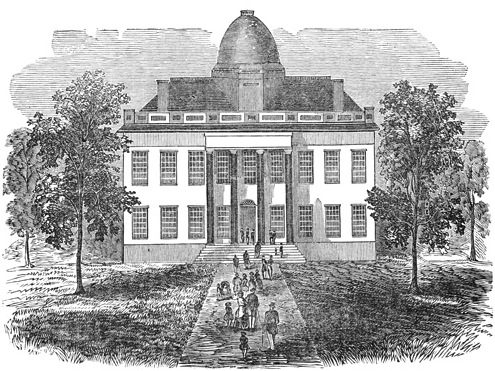
STATE HOUSE, WISCONSIN.
DEPARTMENT OF BIOGRAPHY.
HERNANDO CORTEZ.
The portion of the new world earliest colonized by the Spaniards was the Island of St. Domingo, Hayti, or Hispaniola, discovered by Columbus in his first voyage in the year 1492. For nearly twenty years this island was the only colony of importance held by the Spaniards in the new world; here alone did they occupy lands, build towns, and found a regular commonwealth. Cuba, although the second of the islands discovered by Columbus, remained long uncolonized; indeed it was not till the year 1509 that it was circumnavigated, and ascertained to be an island. At length, in 1511, Don Diego Columbus, the great admiral’s son, governor of Hispaniola, despatched a force of three hundred men, under Don Diego Velasquez, to take possession of the island. Velasquez soon subdued the island, the natives of which offered but little resistance, and he was shortly afterwards appointed governor, subordinate to the governor of Hispaniola. Ambitious of sharing in the glory to be derived from the discovery of new countries, Velasquez fitted out one or two expeditions, which he despatched westward, to explore the seas in that direction. In one of these expeditions, which set out in 1517, commanded by a rich colonist called Cordova, the peninsula of Yucatan was discovered, and the existence of a large and rich country called Culua or Mexico ascertained. Elated with this discovery, Velasquez fitted out another expedition under his nephew, Juan de Grijalva, who leaving Cuba in April 1518, spent five months in cruising along the newly-discovered coast, and trafficking with the natives for gold trinkets and cotton cloths, very skillfully manufactured. The result of this expedition was the importation to Cuba of gold and jewels to the amount of twenty thousand pesos, or upwards of fifty thousand pounds.
Delighted with this success, Velasquez wrote home to Spain announcing his discovery, and petitioning for authority from the king to conquer and colonize the country which his subordinates, Cordova and Grijalva, had discovered. Without waiting, however, for a reply to his petition, he commenced fitting out a much larger squadron than either of the two former; and this he placed under the command of Hernando Cortez, a respectable Spanish hidalgo, or gentleman, residing in the island, and who was at this time thirty-three years of age.
Cortez proceeded with the greatest activity in making his preparations. ‘Borrowing money for the pupose,’ says Bernal Diaz, the gossiping chronicler of the Conquest, ‘he caused to be made a standard of gold and velvet, with the royal arms and a cross embroidered thereon, and a Latin motto, the meaning of which was, ‘Brothers, follow this holy cross with true faith, for under it we shall conquer.’ It was proclaimed by beat of drum and sound of trumpet, that all such as entered the service in the present expedition should have their shares of what gold was obtained, and grants of land, as soon as the conquest was effected. The proclamation was no sooner made than, by general inclination as well as the private influence of Cortez, volunteers offered themselves everywhere. Nothing was to be seen or spoken of but selling lands to purchase arms and horses, quilting coats of mail, making bread, and salting pork for sea-store. Above three hundred of us assembled in the town of St. Jago.’ These preparations were likely to be interrupted. Velasquez, ruminating the probable consequences of the expedition, had begun to repent of having appointed Cortez to the command, and was secretly plotting his removal. Cortez, perceiving these symptoms, determined to outwit his patron. Accordingly, on the night of the 18th of November 1518—having warned all the captains, masters, pilots, and soldiers to be on board, and having shipped all the stores that had been collected—Cortez set sail from the port of St. Jago without announcing his intention to Velasquez, resolving to stop at some of the more westerly ports of the island for the purpose of completing his preparations, where he would be beyond the reach of the governor. Nothing could exceed the rage of Velasquez at the sudden departure of Cortez. He wrote to the commandants of two towns at which he learned that the fleet had put in for recruits and provisions, to seize Cortez, and send him back; but such was the popularity of Cortez, that both were afraid to make the attempt.
At last all was ready, and Cortez finally set sail from Cuba on the 18th of February 1519. The expedition, which consisted of eleven vessels, most of them small, and without decks, met with no disaster at sea, but arrived safely at the island of Cozumel, off the coast of Yucatan, after a few days’ sail. Here Cortez landed, to review his troops. They consisted of five hundred and fifty-three soldiers, not including the mariners, who amounted to one hundred and ten. They possessed sixteen horses, some of them not very serviceable, ten brass field-pieces, four smaller pieces called falconets, and thirty-two cross-bows; the majority of the soldiers being armed with ordinary steel weapons. Attending on the army were about two hundred Cuba Indians, and some Indian women. And as religion in those days sanctioned military conquest, there were in addition two clergymen—Juan Diaz, and Bartholomew de Olmedo.
For nine or ten days the Spaniards remained at Cozumel, making acquaintance with the natives, who were very friendly. Here Cortez, whose zeal for the Catholic religion was one of the strongest of his feelings, made it one of his first concerns to argue with the natives, through an interpreter, on the point of their religion. He even went so far as to demolish their idols before their eyes, and erect an altar to the Virgin on the spot where they had stood. The natives were horror-struck, and seemed at first ready to fall upon the Spaniards, but at length they acquiesced.
While at Cozumel, Cortez had the good fortune to pick up a Spaniard, who, having been wrecked in his passage from Darien to Hispaniola in the year 1511, had for seven years been detained as a slave among the Indians of Yucatan. The name of this poor man was Jeronimo de Aguilar; he had been educated for the church; and as he could speak the language of Yucatan, his services as an interpreter were likely to be very valuable. On the 4th of March 1519, the fleet, consisting of eleven vessels, commanded respectively by Cortez, Pedro de Alvarado, Alonzo Puerto Carrero, Francisco de Montejo, Christoval de Olid, Diego de Ordaz, Velasquez de Leon, Juan de Escalante, Francisco de Morla, Escobar, and Gines Nortes, set sail from Cozumel, and on the 13th it anchored at the mouth of the river Tabasco or Grijalva, flowing into the south of the Bay of Campeachy.
The expedition had now reached the scene of active operations; it had arrived on the coast of the American continent. Cortez does not appear to have been naturally a bloodily-disposed man. He was only what a perverted education and the vices of his times had made him—a man full of mighty notions of the Spanish authority; of its right to take, by foul or fair means, any country it liked; and not without an excuse from religion to rob and kill the unfortunate natives who dared to defend their territories.
We have now therefore, to record the beginning of a most unjust and merciless war of aggression. As Cortez, with his followers, sailed up the river as far as Tabasco, he everywhere observed the natives preparing to repel his attack, and at length he was brought into collision with them—of course overpowering them by the force of arms, with immense slaughter. On reaching Tabasco, his soldiers fought their way through dense masses of Indians, who discharged among them perfect clouds of arrows and stones. Pushing through the streets, which were lined with houses, some of mud, and some of stone, the victors reached a large open square in the centre, where temples of large size were erected. Here the troops were drawn up; and Cortez, advancing to a large ceiba-tree which grew in the middle, gave it three slashes with his sword, and took possession of the city and country in the name of his royal master Don Carlos, king of Castile.
Next day another battle was fought between the Spaniards and the Tabascans on the plain of Ceutla, a few miles distant from the city. For an hour the Spanish infantry fought in the midst of an ocean of enemies, battling on all sides, beating one wave back, only that another might advance—a little islet encircled by the savage breakers. At length, with the assistance of their horse—a terrible sight to the Indians—the Spaniards were victorious. The spirit of the Tabascans was now completely subdued. Their chiefs came to the camp of Cortez with faces and gestures expressive of contrition, and brought him presents of fowls, fish, maize, and numerous gold toys representing many kinds of animals in miniature. For the horses, they brought a feast of turkeys and roses! They also gave Cortez twenty Indian girls to attend the army. To his inquiries respecting the country whence they obtained the gold, they replied by repetitions of the words ‘Culua’ and ‘Mexico,’ and pointing to the west. Having obtained all the information the Tabascans could give him, Cortez resolved to proceed on his voyage. Accordingly, after a solemn mass, which the Indians attended, the armament left Tabasco, and after a short sail, arrived off the coast of St. Juan de Ulua, the site of the modern Vera Cruz. It was on Holy Thursday (April 20th), in the year 1519, that they arrived at the port of St. Juan de Ulua, the extreme eastern province of the Mexican dominions properly so called. The royal flag was floating from the mast of Cortez’s ship. The Spaniards could see the beach crowded with natives, who had come down to gaze at the strange ‘water-houses,’ of which they had formerly seen specimens. At length a light pirogue, filled with natives, some of them evidently men of rank, pushed off from the shore, and steered for the ship of Cortez. The Indians went on board without any symptoms of fear, and, what was more striking, with an air of ease and perfect good-breeding. They spoke a different language from that of the inhabitants of Cozumel or the Tabascans—a language, too, which Aguilar did not understand. Fortunately, one of the twenty Indian girls presented by the Tabascans to the Spaniards was a Mexican by birth. This girl, whose Spanish name of Donna Marina is imperishably associated with the history of the conquest of Mexico, was the daughter of a chief, but, by a singular course of events, had become a slave in Tabasco. She had already attracted attention by her beauty, sweetness, and gentleness, and she had been mentioned to Cortez. Her services now became valuable. The Mexican was her native language; but by her residence in Tabasco, she had acquired the Tabascan, which language was also familiar to Aguilar. Interpreting, therefore, what the Mexicans said into Tabascan to Aguilar, Aguilar in turn interpreted the Tabascan into Spanish; and thus, though somewhat circuitously, Cortez could hold communication with his visitors.
The Aztec visitors who came on board the ship of Cortez, informed him that they were instructed by the governor of the province to ask what he wanted on their coast, and to promise that whatever he required should be supplied. Cortez replied that his object was to make the acquaintance of the people of those countries, and that he would do them no injury. He then presented them with some beads of cut glass, and after an entertainment of wine, they took their departure, promising that Teuthlille, the governor of the province under their great emperor, should visit him the next day.
Next day, Friday the 21st of April 1519, Cortez landed with his troops, and had an interview with Teuthlille, who received the visitors with suspicion; and this feeling was not lessened by the parade of mounted dragoons and firing of guns with which the Spanish commander thought fit to astonish him and the other natives. Sketches were taken of the appearance of the strangers, in order to be sent to Montezuma, the king of the country, who was likewise to be informed that the white men who had arrived on his coast desired to be allowed to come and see him in his capital.
Here we pause to present a short account of the Mexican empire, in which Cortez had landed; also of the character and government of this monarch, Montezuma, whom the Spaniards expected soon to be permitted to visit.
If a traveler, landing on that part of the coast of the Mexican gulf where Cortez and his Spaniards landed three hundred and thirty years ago, were to proceed westward across the continent, he would pass successively through three regions or climates. First he would pass through the tierra caliente, or hot region, distinguished by all the features of the tropics—their luxuriant vegetation, their occasional sandy deserts, and their unhealthinesss at particular seasons. After sixty miles of travel through this tierra caliente, he would enter the tierra templada, or temperate region, where the products of the soil are such as belong to the most genial European countries. Ascending through it, the traveler at last leaves wheat-fields beneath him, and plunges into forests of pine, indicating his entrance into the tierra fria, or cold region, where the sleety blasts from the mountains penetrate the very bones. This tierra fria constitutes the summits of part of the great mountain range of the Andes, which traverses the whole American continent. Fortunately, however, at this point the Andes do not attain their greatest elevation. Instead of rising, as in some other parts of their range, in a huge perpendicular wall or ridge, they here flatten and widen out, so as to constitute a vast plateau, or table-land, six or seven thousand feet above the level of the sea. On this immense sheet of table-land, stretching for hundreds of miles, the inhabitants, though living within the tropics, enjoy a climate equal to that of the south of Italy; while their proximity to the extremes both of heat and cold enables them to procure, without much labor, the luxuries of many lands. Across the table-land there stretches from east to west a chain of volcanic peaks, some of which are of immense height, and covered perpetually with snow.
This table-land was known in the Mexican language by the name of the plain of Anahuac. Near its centre is a valley of an oval form, about two hundred miles in circumference, surrounded by a rampart of porphyritic rock, and overspread for about a tenth part of its surface by five distinct lakes or sheets of water. This is the celebrated valley of Mexico—called a valley only by comparison with the mountains which surround it, for it is seven thousand feet above the level of the sea. Round the margins of the five lakes once stood numerous cities the relics of which are yet visible; and on an islet in the middle of the largest lake stood the great city of Mexico, or Tenochtitlan, the capital of the empire which the Spaniards were now invading, and the residence of the Mexican emperor, Montezuma.
The origin of the Mexicans is a question of great obscurity—a part of the more extensive question of the manner in which America was peopled. According to Mr. Prescott, the latest and one of the best authorities on the subject, the plains of Aanahuac were overrun, previous to the discovery of America, by several successive races from the north-west of the continent where it approaches Asia. Thus, in the thirteenth century, the great table-land of central America was inhabited by a number of races and sub-races, all originally of the same stock, but differing from each other greatly in character and degree of civilization, and engaged in mutual hostilities. The cities of these different races were scattered over the plateau, principally in the neighborhood of the five lakes. Tezcuco, on the eastern bank of the greatest of the lakes, was the capital of the Acolhuans; and Tenochtitlan, or Mexico, founded in 1325, on an island in the same lake, was the capital of the Aztecs.
In the thirteenth and fourteenth centuries the dominant race in the plains of Anahuac was the Acolhuans, or Tezcucans, represented as a people of mild and polished manners, skilled in the elegant arts and possessing literary habits and tastes—the Athenians, if we may so call them, of the new world. The most celebrated of the Tezcucan sovereigns was Nezahualcoyotl, who reigned early in the fifteenth century. By this prince a revolution was effected in the political state of the valley of Anahuac. He procured the formation of a confederacy between Tezcuco and the two neighboring friendly cities of Mexico and Tlacopan, by which they bound themselves severally to assist each other when attacked, and to carry on wars conjointly. In this strange alliance Tezcuco was the principal member, as being confessedly the most powerful state; Mexico stood next; and lastly Tlacopan, as being inferior to the other two.
Nezahualcoyotl died in 1470, and was succeeded on the Tezcucan throne by his son Nezahualpilli. During his reign the Tezcucans fell from their position as the first member of the triple confederacy which his father had formed, and gave place to the Aztecs or Mexicans. These Aztecs had been gradually growing in consequence since their first arrival in the valley. Decidedly inferior to the Tezcucans in culture, and professing a much more bloody and impure worship, they excelled them in certain qualities, and possessed, on the whole, a firmer and more compact character. If the Tezcucans were the Greeks, the Aztecs were the Romans of the new world. Under a series of able princes they had increased in importance, till now, in the reign of Nezahualpilli, they were the rivals of their allies, the Tezcucans, for the sovereignty of Anahuac.
In the year 1502, a vacancy occurred in the throne of Tenochtitlan, or Mexico. The election fell on Montezuma II, the nephew of the deceased monarch, a young man who had already distinguished himself as a soldier and a priest or sage, and who was noted, as his name—Montezuma (sorrowful man)—implied, for a certain gravity and sad severity of manner. The first years of Montezuma’s reign were spent in war. Carrying his victorious arms as far as Nicaragua and Honduras in the south, and to the shores of the Mexican gulf in the east, he extended the sovereignty of the triple confederacy, of which he was a member, over an immense extent of territory. Distant provinces he compelled to pay him tribute; and the wealth of Anahuac flowed from all directions towards the valley of Mexico. Haughty and severe in his disposition, and magnificent in his tastes, he ruled like an Oriental despot over the provinces which he had conquered; and the least attempt at rebellion was fearfully punished, captives being dragged in hundreds to the capital to be slaughtered on the stone of human sacrifice in the great war temple. Nor did Montezuma’s own natural-born subjects stand less in dread of him. Wise, liberal, and even generous in his government, his inflexible justice, and his lordly notions of his own dignity, made him an object less of affection than of awe and reverence. In his presence his nobles spoke in whispers; in his palace he was served with a slavish homage; and when he appeared in public, his subjects vailed their faces, as unworthy to gaze upon his person. The death of Nezahualpilli, in 1516, made him absolute sovereign in Anahuac. On the death of that king, two of his sons, Cacama and Ixtlilxochitl, contended for the throne of Tezcuco. Montezuma sided with Cacama; and the dispute was at length ended by a compromise between the two brothers, by which the kingdom was divided into two parts—Cacama obtaining the southern half with the city of Tezcuco, and Ixtlilxochitl the northern half.
Thus, at the period of the arrival of the Spaniards, Montezuma was absolute sovereign of nearly the whole of that portion of central America which lies between the Gulf of Mexico and the Pacific Ocean—the kings of Tezcuco and Tlacopan being nominally his confederates and counselors, according to the ancient treaty of alliance between the three states, but in reality his dependents. The spot where Cortez had landed was in one of the maritime provinces of Montezuma’s dominions.
It is a singular but well-authenticated fact, that at the time the Spaniards landed in America a general expectation prevailed among the natives of the arrival of a mysterious race of white men from the East, who were to conquer the country. This was especially the case in Mexico. There was a tradition among the Mexicans that, some ages before the arrival of the Spaniards, and while yet the Aztec empire was in its infancy, there appeared in Anahuac a divine personage called Quetzalcoatl. He was a man of benevolent aspect, tall in stature, with a white complexion, long dark hair, and a flowing beard; and he came from the East. He resided in Anahuac for many years, teaching the Mexicans numerous arts and sciences, and reforming their manners; and under his care the country flourished and became happy. At length some difference arose between him and the Mexicans, and they no longer paid respect to the words of the good Quetzalcoatl. He then announced to them that he was going to depart from their country. Proceeding eastward, delaying a little while at Cholula, a city which ever afterwards was regarded as sacred, he arrived at the sea-shore. Embarking on board a little skiff made of serpents’ skins, he pushed out to sea, and as the Mexicans strained their eyes after him, he disappeared in the distance, going, as it seemed, to the East. Before he departed, however, he delivered a prophecy, that at some future time people of his race, with white complexions like his, would come from the East to conquer and possess the country.
The tradition of Quetzalcoatl’s prophecy was rife among the natives of Anahuac when Cortez arrived, and it was with a kind of religious awe that Montezuma and his people heard of the arrival of the white men in their ‘water-houses.’ Cortez and his men constituted, as we have seen, this body. Teuthlille’s messengers, announcing their arrival, had already reached Montezuma; and he was deliberating in what manner he should receive the strangers. In order to learn his decision, let us return to the Spaniards on the sea-coast.
The Spaniards, supplied by the natives with plenty of everything which they required, were waiting the return of the messengers to Montezuma. After six days they returned, accompanied by Teuthlille. They bore with them a splendid present from Montezuma to the Spanish emperor. It consisted of loads of finely-wrought cotton, ornamented with featherwork; and a miscellaneous collection of jewels and articles of gold and silver, richly carved, of which the most attractive were two circular plates as large as carriage-wheels, one of gold, valued at more than fifty thousand pounds, and intended to represent the sun; the other of silver, and representing the moon. As they gazed on the kingly present, the Spaniards could scarcely contain their raptures. The message which accompanied it, however, was less satisfactory. Montezuma was happy to hear of the existence of his brother, the king of Spain, and wished him to consider him as his friend; he could not, however, come to see the Spaniards, and it was too far for them to come and visit him. He therefore hoped they would depart, and carry his respects to his brother, their monarch.
To this Cortez, thanking Montezuma for his present, replied that he could not leave the country without being able to say to his king that he had seen Montezuma with his own eyes; and the ambassadors again departed, carrying a sorry present from Cortez to Montezuma. After another interval of six days they returned, with another gift little inferior in value of the former, and informed Cortez that the great Montezuma had received his present with satisfaction, but that, as to the interview, he could not permit any more to be said on the subject. Cortez, though greatly mortified, thanked them politely, and returned to Montezuma a second message to the same effect as the former, but couched in more decided language. The Mexicans withdrew in distrust, and ceased to barter with the Spaniards, or to bring them supplies.
Meanwhile differences had been springing up among the Spaniards themselves, the partisans of Velasquez insisting that they ought now to return to Cuba, and that it was folly to think of founding a settlement. Pretending to yield to the clamors of these persons, Cortez issued orders for embarkation on the following day. Immediately the other party, consisting of the friends of Cortez, flocked to his tent, and implored him not to give up the enterprise which had been so successfully begun. This was precisely what Cortez wished. Accordingly, after some delay he seemed to yield; and revoked the order for embarkation, he announced his willingness to found a settlement in the name of the Spanish sovereign. Forthwith the new city, although not a stone of it had yet been raised, and the site had alone been determined on, was named Villa Rica de la Vera Cruz—‘The Rich Town of the True Cross.’ Magistrates were immediately appointed in the king’s name; the two captains Puerto Carrero and Montejo, the latter a friend of Velasquez, being nominated alcaldes, and others to different offices. ‘Thus,’ says Mr. Prescott, ‘by a single stroke of the pen the camp was transformed into a civil community.’
At the first sitting of the new magistracy, Cortez appeard before it, with his cap doffed, and formally resigned his commission from Velasquez into its hands. He then withdrew; but after a short time was recalled, and informed that he had been unanimously appointed by them, in the king’s name, ‘Captain-General and Chief-Justice of the colony.’ Thus, by a clever stroke of policy, had Cortez shaken off all connection with Velasquez. He held his command now directly from the king, and could be superseded only by royal authority. The friends of Velasquez were at first furious with rage; but Cortez at length soothed them into acquiescence.
A little before the conclusion of these proceedings, an event of some consequence happened. This was the arrival in the Spanish camp of five Indians, differing in dress and language from the Mexicans. They informed Cortez that they were a deputation sent by the caçique of Cempoalla, a city at a little distance on the sea-coast, the capital of the Totonacs, a nation which had been recently conquered by Montezuma, and was now groaning under his yoke. They were sent by their caçique to beg a visit of the Spaniards to Campoalla. A light instantly flashed upon the mind of Cortez. He saw that Montezuma’s empire was not so firmly compacted as he had supposed, and that it might be possible to divide it against itself, and so overthrow it. He therefore dismissed the ambassadors kindly, and promised a speedy visit to Campoalla.
Accordingly, as soon as the disturbance which had arisen among his men was quashed, Cortez marched to Campoalla, a city not rich, but prettily built, and containing a population, as it appeared, of about thirty thousand inhabitants. He was cordially received by the caçique, a large and very corpulent man. Remaining some time in Campoalla and its neighborhood, while the city of Villa Rica was being built, the Spaniards soon gained the reverence and good-will of the inhabitants, the Totonacs, who willingly submitted themselves to the dominion of the distant monarch Don Carlos, of whom the Spaniards told them. Here the Spaniards were horrified by the symptoms of human sacrifice, which were perpetually visible in the temples—the blood-stained walls, and the fragments of human flesh which lay about; and, fired with religious enthusiasm, they resolved to put a stop to such practices by tearing down the idols. Cortez informed the caçique of his intention; but although the announcement filled him with speechless dismay, no opposition was offered, and the idols were broken in pieces, and burnt before the eyes of the Totonacs, while the priests went about shrieking like demons. ‘These priests,’ we are told, ‘were dressed in long black mantles, like sheets with hoods: their robes reached to their feet. Their long hair was matted together with clotted blood; with some it reached to the waist, and with others to the feet: their ears were torn and cut, and they smelt horribly, as it were of sulphur and putrid flesh.’
The destruction of their idols did not alienate the Totonacs from the Spaniards; on the contrary, it raised their opinion of them, inasmuch as they saw the gods patient under the indignity. The intercourse of the two parties, therefore, continued; and, by his frequent conversations with the caçique, Cortez gained greater insight every day into the condition of Montezuma’s empire.
By this time the town of Villa Rica had been nearly finished, and nothing remained to prevent the Spaniards from commencing their march into the interior. Before beginning it, however, Cortez deemed it advisable to send a report of his proceedings to Spain, to be laid before the king, knowing that Velasquez must have represented his conduct in very disadvantageous terms to the home government. Accordingly, Cortez drew up one letter, and the magistrates of the new colony another, detailing the whole of the incidents of the expedition down to the foundation of Villa Rica, and announcing that they were on the point of commencing their march into the heart of the country. To increase the effect of the letters, they were accompanied by nearly all the gold that had been collected, together with the splendid gifts of Montezuma, and such curiosities as might interest the learned of Spain. The business of carrying these letters to the king was intrusted to Montejo and Puerto Carrero, and they were instructed, above all, to endeavor to secure the appointment of Cortez as captain-general of the colony. On the 26th of July 1519, the little ship set sail, freighted with a more precious cargo than had ever yet been packed within the timbers of a vessel from the new world. The pilot was instructed to make direct for Spain, landing at no intermediate station, and especially avoiding Cuba.
The departure of this vessel seems to have raised thoughts of home in the minds of some of those who were left behind. A conspiracy was formed by some of the soldiers and sailors, along with the clergyman Diaz, to sieze a vessel and return to Cuba. The conspiracy was discovered; two of the ringleaders were hanged, and the rest whipped or confined. Foreseeing, however, that such conspiracies would be constantly occurring, unless effectual means were taken to prevent them, Cortez came to the resolution, almost unparalleled in the annals of heroism, of destroying the ships which had brought him to Mexico. Accordingly, taking counsel with a few of his most attached followers, he procured a report from the pilots that the vessels were not seaworthy, and caused them to be broken in pieces and sunk, before the majority were aware of his design. When the Spaniards thus saw themselves shut up in a strange and populous country, with no means of retreat, their first impulse was one of rage and despair, and Cortez had nearly fallen a sacrifice. As he foresaw, however, the daring act had the effect of bracing his men to a pitch of resolution all but supernatural. Besides, by the destruction of the fleet, he obtained a reinforcement of a hundred and ten men—the mariners formerly employed in the ships being now converted into soldiers, and very good ones, as it afterwards proved.
All being now ready, Cortez, leaving a considerable force as a garrison to the new settlement of Villa Rica, under the command of Juan de Escalante, set out from the territory of the Totonacs, on his march inland, on the 16th of August 1519. His army consisted of four hundred Spaniards on foot, and fifteen horse, accompanied by thirteen hundred Cempoallan warriors, and a thousand tamanes, or Indian body slaves, furnished by the caçique of Cempoalla, who were to carry the heavy burdens, and perform other laborious offices. Advancing through the tierra caliente, they began to ascend the mountains which separate it from the vast table-land of Anahuac. A few days’ march across the tierra templada and the tierra fria, brought the Spaniards to a small mountain province of Tlascala, situated about half-way between the sea-coast and the Mexican valley. The Tlascalans were a brave and high-spirited people, of the same race as the Aztecs. They had refused, however, to submit to the empire of Montezuma, and were the only people in Anahuac who bade defiance to his power, preferring poverty and hardship in their mountain home to the loss of independence. The government of Tlascala was a kind of feudalism. Four lords or caçiques held their courts in different quarters of the same city, independently of each other, and yet mutually allied; and under these four chieftans the Tlascalan population, nobles and commons, was ranged as subjects. On the approach of the Spaniards, a consultation was held among the Tlascalan lords and their counselors as to how the strangers should be received; some being inclined to welcome them, in hopes of being able, by their assistance, to cope with Montezuma; others maintaining that the Spaniards were enemies, who ought to be repulsed by all means. The latter opinion prevailed, and three desperate battles were fought between the Tlascalans under the command of Xicotencatl, a brave and able young chief, the son of one of the four caçiques, and the Spanish invaders. These engagements were far more serious than the battles which the Spaniards had fought with the Tabascans; and it required the utmost exertion of Castilian valor, directed by all the ability of Cortez, to gain the victory. But Indian courage against the flower of European chivalry—the maquahuitl, or war-club, dreadful instrument as it was, with its sharp flinty blades, against muskets and artillery—coatings of war-paint, or doublets of featherwork, against Spanish mail—were a very unequal contest; and, as usual, the losses of the Spaniards were as nothing compared with the apparent fierceness of the struggle. But how could the little army hope to advance through a country where such battles had to be fought at every step? If such were their reception by the Tlascalans, what might they not expect from the richer and more powerful Mexicans? Such were the reflections of the Spanish soldiery. The idea of their ever reaching Mexico, says Bernal Diaz, was treated as a jest by the whole army. Fortunately, when these murmurs were reaching their height, the Tlascalans submitted, and sent ambassadors to beg the friendship of the Spaniards; and on the 23d of September 1519 the Spaniards entered the city of Tlascala, a large and populous town, which Cortez compared to Grenada in Spain. Here they were cordially received by the four caçiques, and especially by the elder Xicotencatl; and in a short time an intimacy sprung up between the Tlascalans and the invaders, and a treaty was concluded, by which the Tlascalans bound themselves to assist the Spaniards throughout the rest of their expedition. Here, as elsewhere, Cortez showed his zeal for the Catholic faith by endeavoring to convert the natives; and it is probable that the same scenes of violence would have taken place at Tlascala as at Cempoalla, had not the judicious father Olmedo interfered to temper the more headlong fanaticism of the general.
While in Tlascala, Cortez received various embassies from provinces in the neighborhood anxious to secure his good-will. About the same time an embassy was received from Montezuma himself, entreating Cortez not to place any reliance upon the Tlascalans, whom he represented as treacherous barbarians; and now inviting him, in cordial terms, to visit his capital, pointing out the route through the city of Cholula as the most convenient. This route was accordingly adopted, and the Spaniards, accompanied by an army of six thousand Tlascalan warriors, advanced by it towards Mexico. Their approach gave great alarm, and Montezuma set on foot a scheme for their massacre at Cholula, which, however, was discovered by Cortez, who took a terrible vengeance on the sacred city. Montezuma, overawed, again made overtures of reconciliation, and promised the Spaniards an immense quantity of gold if they would advance no farther. This Cortez refused, and the Spanish army, with the Tlascalan warriors, left Cholula, and proceeded on their march, met everywhere by deputations from neighboring towns, many of which were disaffected to the government of Montezuma. The route of the army lay between two gigantic volcanic mountains, and the march, for a day or two, was toilsome, and bitterly cold. At last, ‘turning an angle of the sierra, they suddenly came on a view which more than compensated their toils. It was that of the valley of Mexico; which, with its picturesque assemblage of water, woodland, and cultivated plains, its shining cities and shadowy hills, were spread out like some gay and gorgeous panorama before them. Stretching far away at their feet were seen noble forests of oak, sycamore, and cedar; and beyond, yellow fields of maize, and the towering maguey, intermingled with orchards and blooming gardens. In the centre of the great basin were beheld the lakes, their borders thickly studded with towns and hamlets; and in the midst, like some Indian empress with her coronal of pearls, the fair city of Mexico, with her white towers and pyramidal temples, reposing, as it were, on the bosom of the waters—the far-famed “Venice of the Aztecs.”’
Descending into the valley, the Spaniards halted at Ajotzinco, a town on the banks of the southernmost of the five lakes. Meanwhile Montezuma was in an agony of indecision. When intelligence reached him that the Spaniards had actually descended into the valley, he saw that he must either face the strangers on the field of battle, or admit them into his capital. His brother, Cuitlahua, advised the former; but his nephew, Cacama, the young lord of Tezcuco, was of the contrary opinion, and Montezuma at length sent him to meet the Spaniards, and welcome them to his dominions. Cacama accordingly set out in state, and arrived at Ajotzinco just as the Spaniards were about to leave it. When he came into the presence of Cortez, he said to him, ‘Malintzin, here am I and these lords come to attend you to your residence in our city, by order of the great Montezuma.’ Cortez embraced the prince, and presented him with some jewels. After a while Cacama took his leave, and the Spaniards resumed their march. Traveling along the southern and western banks of Lake Chalco, they crossed the causeway which divides it from Lake Zochichalco, and advanced along the margin of the latter to the royal city of Iztapalapan, situated on the banks of the great Tezcucan lake over against Mexico. To the eyes of the Spaniards, all they saw in their journey seemed fairy land.
ENTRY INTO MEXICO—RESIDENCE THERE—DESCRIPTION OF THE CITY.
It was on the 7th of November, 1519, that the Spaniards arrived at Iztapalapan; and here they spent the night, lodged in magnificent palaces built of stone, the timber of which was cedar. From this position the eye could sweep over the whole expanse of the Tezcucan lake. Canoes of all sizes might be seen skimming along its surface, either near the middle, or close to the banks, where the thick woods came down to the water’s edge. Here also, moving slowly along the margin of the lake, might be seen a still stranger sight—the chinampas, or floating-gardens—little islands consisting of earth laid on rafts, planted with flowers, shrubs, and fruit-trees, and containing a small hut or cottage in the centre, occupied by the proprietor, who, by the means of a long pole, which he pushed against the bottom, could shift his little domain from place to place. But what fixed the eyes of the Spaniards above all else was the glittering spectacle which rose from the centre of the lake—the queenly city of Mexico, the goal of their hopes and wishes for many months past. In a few hours they would be within its precincts—a few hundred men shut up in the very heart of the great Mexican empire! What might be their fate there!
The islet on which Mexico was built was connected with the mainland by three distinct causeways of stone, constructed with incredible labor and skill across the lake, and intersected at intervals by drawbridges, through which canoes might pass and repass with ease. The causeway by which the Spaniards must pass connected the island with the southern bank of the lake, about half way across to which it branched off into two lines, one leading to the city of Cojohuacan, the other meeting the mainland at a point not far from Iztapalapan, where the Spaniards were quartered. This causeway was about eight yards wide, and capable of accommodating ten or twelve horsemen riding abreast. It was divided, as before-mentioned, by several drawbridges; a circumstance which the Spaniards observed with no small alarm, for they saw that, by means of these drawbridges, their communication with the mainland could be completely cut off by the Mexicans.
On the morning of the 8th of November, 1519, the army left Iztapalapan, and advanced along the causeway towards the capital. First went Cortez, with his small body of horse; next came the Spanish foot, amounting to not more than four hundred men; after them came the Indian tamanes, carrying the baggage; and last of all came the Tlascalan warriors, to the number of about five thousand. As they moved along the causeway, the inhabitants of the city crowded in myriads to gaze at them, some finding standing-room on the causeway itself, others skimming along the lakes in canoes, and clambering up the sides of the causeway. A little more than half way across, and at a distance of a mile and a half from the city, the branch of the causeway on which the Spaniards were marching was joined by the other branch; and here the causeway widened for a small space, and a fort or gateway was erected, called the Fort of Xoloc. On arriving at the gateway, the army was met by a long procession of Aztec nobles, richly clad, who came to announce the approach of the emperor himself to welcome the Spaniards to his capital. Accordingly, when the remainder of the causeway had been almost traversed, and the van of the army was near the threshold of the city, a train was seen advancing along the great avenue. ‘Amidst a crowd of Indian nobles, preceded by three officers of state bearing golden wands, the Spaniards saw the royal palanquin of Montezuma, blazing with burnished gold. It was borne on the shoulders of nobles, and over it a canopy of gaudy featherwork, powdered with jewels, and fringed with silver, and was supported by four attendants of the same rank. They were barefooted, and walked with a slow measured pace, and with eyes bent on the ground. When the train had come within a convenient distance, it halted; and Montezuma, descending from his litter, came forward, leaning on the arms of the lords of Tezcuco and Iztapalapan—the one his nephew, the other his brother. As the monarch advanced under the canopy, the obsequious attendants strewed the ground with cotton tapestry, that his imperial feet might not be contaminated by the rude soil. His subjects, of high and low degree, who lined the sides of the causeway, bent forward with their eyes fastened on the ground as he passed, and some of the humbler class prostrated themselves before him.’
Cortez and the Mexican emperor now stood before each other. When Cortez was told that the great Montezuma approached, he dismounted from his horse, and advanced towards him with much respect. Montezuma bade him welcome, and Cortez replied with a suitable compliment. After some ceremonies, and the exchange of presents, Montezuma and his courtiers withdrew, the Spaniards following. Advancing into the city, wondering at all they saw—the long streets, the houses which, in the line along which they passed, belonged mostly to the noble and wealthy Mexicans, built of red stone, and surmounted with parapets or battlements; the canals which here and there intersected the streets, crossed by bridges; and the large open squares which occurred at intervals—the Spaniards were conducted to their quarters, situated in an immense square in the centre of the city, adjoining the temple of the great Mexican war-god. Montezuma was waiting to receive them; and the Spaniards were surprised and delighted with the princely generosity with which he supplied their wants.
Next day Cortez paid a visit to Montezuma in his palace, attended by some of his principal officers. In the conversation which ensued, Cortez broached the topic of religion, and informed Montezuma ‘that we were all brothers, the children of Adam and Eve, and that as such, our emperor, lamenting the loss of souls in such numbers as those which were brought by the Mexican idols into everlasting flames, had sent us to apply a remedy thereto by putting an end to the worship of these false gods.’ These remarks seemed to displease Montezuma, who, however, made a polite reply. Day after day the intercourse between Cortez and Montezuma was renewed; the Spanish soldiers also became gradually familiar with the Mexicans. Bernal Diaz, the old soldier of Cortez, to whom we are indebted for the most minute and interesting account of the Conquest, thus describes Montezuma and his household: ‘The great Montezuma was at this time aged about forty years, of good stature, well-proportioned, and thin; his complexion was much fairer than that of the Indians; he wore his hair short, just covering his ears, with very little beard, well arranged, thin, and black. His face was rather long, with a pleasant countenance, and good eyes; gravity and good-humor were blended together when he spoke. He was very delicate and clean in his person, bathing himself every evening. He had a number of mistresses of the first families, and two princesses, his lawful wives. He had two hundred of his nobility as a guard, in apartments adjoining his own. They entered his apartment barefooted, their eyes fixed on the ground, and making three inclinations of the body as they approached him. In addressing him, they said, ‘Lord; my lord; great lord.’ His cooks had upward of thirty different ways of dressing meat, and they had earthen vessels so contrived as to keep it always hot. For the table of Montezuma himself above three hundred dishes were dressed, and for his guards above a thousand. It is said that at times the flesh of young children was dressed for him; but the ordinary meats were domestic fowls, pheasants, geese, partridges, quails, venison, Indian hogs, pigeons, hares, and rabbits, with many other animals and birds peculiar to the country. At his meals, in the cold weather, a number of torches of the bark of a wood which makes no smoke, and has an aromatic smell, were lighted; and, that they might not throw too much heat, screens ornamented with gold, and painted with figures of idols, were placed before them. Montezuma was seated on a low throne or chair, at a table proportioned to the height of his seat. The table was covered with white cloths and napkins, and four beautiful women presented him with water for his hands. Then two other women brought small cakes of bread; and when the king began to eat, a large screen of wood gilt was placed before him, so that people should not, during that time, see him. He was served on earthenware of Cholula, red and black. While the king was at table, no one of his guards, or in the vicinity of his apartment, dared for their lives make any noise. Fruit of all the kinds that the country produced was laid before him; he ate very little; but from time to time a liquor, prepared from cocoa, and of a stimulative quality, as we were told, was presented to him in golden cups. At different intervals during the time of dinner there entered certain Indians, hump-backed, very deformed and ugly, who played tricks of buffoonery; and others who, they said, were jesters. There was also a company of singers and dancers, who afforded Montezuma much entertainment. During the time Montezuma was at dinner, two very beautiful women were busily employed making small cakes with eggs, and other things mixed therein. These were delicately white; and when made, they presented them to him on plates covered with napkins. After he had dined, they presented to him three little canes, highly ornamented, containing liquid amber, mixed with an herb they call tobacco; and when he had sufficiently viewed and heard the singers, dancers, and buffoons, he took a little of the smoke of one of these canes, and then laid himself down to sleep; and thus his principal meal concluded.’
After describing other parts of Montezuma’s household, including a great aviary or collection of birds, and a menagerie, the chronicler gives us an account of Cortez’s first tour through the city, accompanied by Montezuma. They first visited the great bazaar or market, held in the western part of the city. ‘When we arrived there, we were astonished at the crowds of people, and the regularity which prevailed, as well as at the vast quantities of merchandise which those who attended us were assiduous in pointing out. Each kind had its particular place of sale, which was distinguished by a sign. The articles consisted of gold, silver, jewels, feathers, mantles, chocolate, skins, dressed and undressed, sandals, and other manufactures of the roots and fibres of nequen, and great numbers of male and female slaves, some of whom were fastened by the neck in collars to long poles. The meat market was stocked with fowls, game, and dogs. Vegetables, fruits, articles of food ready dressed, salt, bread, honey, and sweet pastry made in various ways, were also sold here. Other places in the square were appropriated to the sale of earthenware, wooden household furniture, such as tables and benches, firewood, paper, sweet canes filled with tobacco, mixed with liquid amber, copper axes and working-tools, and wooden vessels highly painted. Numbers of women sold fish, and little loaves made of a certain mud which they find in the lake, and which resembles cheese. The makers of stone-blades were busily employed shaping them out of the rough material; and the merchants who dealt in gold had the metal in grains, as it came from the mines, in transparent tubes, so that they could be reckoned; and the gold was valued at so many mantles, or so many xiquipils of cocoa, according to the size of the quills. The entire square was enclosed in piazzas, under which great quantities of grain were stored, and where were also shops for various kinds of goods. Courts of justice, where three judges sat to settle disputes which might arise in the market, occupied a part of the square, their under-officers, or policemen, being in the market inspecting the merchandise.’
Proceeding from the market-place through various parts of the city, the Spaniards came to the great teocalli, or temple, in the neighborhood of their own quarters. It was a huge pyramidal structure, consisting of five stories, narrowing above each other like the tubes of an extended spy-glass (only square in shape), so as to leave a clear pathway round the margin of each story. The ascent was by means of a stone stair, of a hundred and fourteen steps. Arrived at the summit, Cortez and his companions found it to be a large flat area, laid with stone; at one end of which they shuddered as they saw a block of jasper, which they were told was the stone on which the human victims were laid when the priests tore out their hearts to offer to their idols: at the other end was a tower of three stories, in which were the images of the two great Mexican deities Huitzilopochtli and Tezcatlipoca, and a variety of articles pertaining to their worship. ‘From the top of the temple,’ says Bernal Diaz, ‘we had a clear prospect of the three causeways by which Mexico communicated with the land, and we could now perceive that in this great city, and all the others of the neighborhood which were built in the water, the houses stood separate from each other, communicating only by small drawbridges and by boats, and that they were built with terraced tops. The noise and bustle of the market-place below us could be heard almost a league off; and those who had been at Rome and Constantinople said that, for convenience, regularity, and population, they had never seen the like.’ At the request of Cortez, Montezuma, though with apparent reluctance, led the Spaniards into the sanctuary or tower where the gods were. ‘Here,’ says Diaz, ‘were two altars, highly adorned with richly-wrought timbers on the roof, and over the altars gigantic figures resembling very fat men. The one on the right was their war-god, with a great face and terrible eyes. This figure was entirely covered with gold and jewels, and his body bound with golden serpents; in his right hand he held a bow, and in his left a bundle of arrows. Before the idol was a pan of incense, with three hearts of human victims, which were burning, mixed with copal. The whole of that apartment, both walls and floor, was stained with human blood in such quantity as to cause a very offensive smell. On the left was the other great figure, with a countenance like a bear, and great shining eyes of the polished substance whereof their mirrors are made. The body of this idol was also covered with jewels. An offering lay before him of five human hearts. In this place was a drum of most enormous size, the head of which was made of the skins of large serpents: this instrument, when struck, resounded with a noise that could be heard to the distance of two leagues, and so doleful, that it deserved to be named the music of the infernal regions.’