AMERICAN ENCYCLOPEDIA (continued 20)
Reading edition
Having soon after this embroiled himself in some serious disputes which took place in his native town between the operative weavers and their employers, by writing some severe personal satires on certain individuals of the latter class, he found his residence in Paisley no longer compatible with his comfort or happiness, and therefore determined on proceeding to America. But before taking his departure, he called on those persons whom he had satirised, expressed his sorrow for what he had done, and solicited their forgiveness. This circumstance is a pleasing proof of the generosity of his nature—that which follows a very striking one of the determination of his character. Although he had resolved on going to America, he did not possess a single shilling wherewith to pay his passage. To supply this desideratum, he instantly abandoned every other pursuit, and for four months labored with incessant industry at his loom, confining the expense of his living during this time to one shilling in the week. The result of this perseverance and rigid economy was, that at the end of the period named, he found himself in possession of the requisite sum, but nothing more. With this he set out for Portpatrick on foot, crossed to Belfast, and there engaged a passage to America; and he arrived at New York on the 14th of July 1794, with only a few shillings in his pocket, and even these were borrowed from a fellow-passenger.
Up till this period, and indeed for several years after, Wilson exhibited no indications of a genius or even predilection for that particular department of natural history in which he afterwards acquired so brilliant a name; but it is said that, immediately after landing in America, and while proceeding from the place of his disembarkation to Newcastle, his attention was strongly excited by the specimens of the feathered inhabitants of the New World which he met with, and that he was particularly delighted with the splendor of the plumage of a red-headed woodpecker, which he shot by the way. Whether or not his genius received on this occasion that bent which afterwards led to such splendid results, it is certain that he always retained a lively recollection of the feelings of surprise and delight with which he for the first time contemplated the beauties of the American woodpecker.
For many years after his arrival in America, Wilson’s condition underwent but little improvement. He found there nearly the same difficulties to contend with, and prospects nearly equally cheerless, with those he had left behind him in his native land. The first employment he obtained was with a copperplate printer in Philadelphia; but this he soon relinquished, and betook him to his original trade, weaving. This he again resigned for the pack; but his success as a pedler was not sufficient to induce him to continue by it, and he abandoned it also, and commenced teacher; making his first experiment in this laborious and somewhat precarious profession near the town of Frankford in Pennsylvania. While in this situation, he in a great measure repaired the defects of his early education, by close and unremitting study in various departments of science and knowledge; and, as has often been the case, by instructing others, he taught himself. He afterwards removed to Milestown, where he remained for several years, adding a little to the limited income arising from his school, by surveying land for farmers.
At the end of this period he applied for and obtained the appointment of schoolmaster of the Union School in the township of Kingsessing, within a few miles of Philadelphia; and it is from this period that his history in the pursuit of the bird creation commences, although he yet entertained that branch of natural history only in common with others, and by no means confined his studies to the feathered tribes. His attention was equally engrossed by a host of other animals; and his apartment, as described by himself, had the appearance of Noah’s ark, being crowded with opossums, squirrels, snakes, lizards, and other animals. Finding his ignorance of drawing a serious drawback in his new pursuit, he applied to the acquisition of this art with such diligence and determination of purpose, that he in a very short time succeeded in obtaining a command of the pencil, that enabled him to sketch from nature with great fidelity and spirit. It was not, however, till the year 1803 that Wilson conceived the magnificent design of his American Ornithology, and even then his ideas on the subject fell very far short of the great work he afterwards achieved. At this period he contemplated little more than ‘making a collection of the finest American birds,’ as he himself writes to a friend in Paisley. Having mentioned his intention to some of his American friends, they endeavored to dissuade him from prosecuting it, and, with a sincere regard for his interest, pointed out to him the formidable difficulties which he would have to encounter, and which appeared to them insurmountable. But they spoke in vain. Wilson’s ardor and enthusiasm was more than a match for their prudence; and trusting to his own resources, he quietly but resolutely proceeded with his design; although—and it is a curious fact—when he began his stupendous work on American Ornithology, he did not know even the names of more than three or four of the American birds. But from this moment he devoted himself with a zeal and energy to the accomplishment of his enterprise, which removed all obstacles as fast as they presented themselves, and swept away all difficulties, as straws are swept away by the stream.
In October 1804, with his gun on his shoulder he made the first of that series of perilous journeys through the wilds of America, which he found it necessary to perform to obtain an accurate and intimate knowledge of the birds of the forest; and amidst privations and hardships which few men but himself would have voluntarily encountered, he completed a journey of twelve hundred miles on foot, through deep snows, boundless forests, deep and dangerous rivers, and over wild and desolate mountains. But the experience of this perilous and painful excursion, instead of damping his ardor, had the effect only of increasing it. In the spring of the following year, he had completed drawings of twenty-eight rare birds, and about this time also made an attempt to acquire the art of engraving on copper, thinking, in the devotedness of his enthusiasm, that he might, by diligence and perseverance, soon attain such a proficiency in this art as would enable him to execute the plates for his contemplated work; and he actually completed two: but when he had got this length, he became dissatisfied with the result of his labors, and abandoned the pursuit. At this period the general aspect of his affairs, and those, in particular, which related to his undertaking, were exceedingly gloomy. He was without means and without money, and was persevering in a course which his friends thought an imprudent one, and was therefore without even words of encouragement to cheer him on his way. But neither these disheartening considerations, nor any other, could deter him from prosecuting his great design. So far from being discouraged by the difficulties which surrounded him, he declared that he would proceed with his plan even if it should cost him his life; and, in that noble spirit which belongs to true genius alone, exclaimed, ‘I shall at least leave a small beacon to point out where I perished.’
At the close of the year 1805, he made an unsuccessful attempt to be appointed to take part in an exploratory expedition which the American government was then about to send to the valley of the Mississippi. He addressed his application on this occasion to President Jefferson, stating to that functionary what he had done in the prosecution of his intended work on American ornithology, and representing the advantages which the being permitted to accompany the party would afford him in furthering his views. To this communication—from what cause is now unknown—he obtained no reply, and of course did not join the expedition. Soon after this, more cheering prospects presented themselves to the enterprising ornithologist. A Mr. Samuel F. Bradford, a publisher in Philadelphia, who was about to print an edition of Rees’s Cyclopedia, engaged Wilson, on what the latter himself called liberal terms, to superintend the publication of that work. But this connection presented another inducement to Wilson, and one which had infinitely greater attraction for him than any which related to his own personal advantage. This was the prospect it afforded him of procuring a publisher for his work; and so far he was not disappointed. On his explaining the nature and object of his undertaking, Mr. Bradford readily consented to become his publisher; and in September 1808, the first volume of ‘American Ornithology’ appeared, one of the most splendid books by far which had then emanated from the American press; but unfortunately the price was, though necessarily, much too high for a country comparatively in its infancy, and which had not then had time to turn its attention to the arts or sciences, or to acquire a sufficient taste for them to encourage such an expensive appeal on their behalf. The price of the work, when completed, was to be one hundred and twenty dollars. It is not therefore at all surprising to find that, even a considerable time after its publication, its ingenious, but in this respect certainly injudicious author, could only boast of forty-one names on his list of subscribers. This number, however, he afterwards increased to two hundred and fifty, by traveling through the country, and visiting the different towns in quest of patrons; but these, he himself says, were obtained ‘at a price worth more than five times the amount;’ and they no doubt were so, if wounded feelings, fatigue of body and mind, and all the humiliations to which such a mission must of necessity have frequently subjected him, be taken into the account. From this tour he returned to New York in March 1809.
Two hundred copies only of the first volume of the Ornithology had been printed, but it was now thought advisable to throw off three hundred more; which was accordingly done: and in the meantime Wilson assiduously employed himself in preparing the second volume for the press, although he neither had yet benefited to the extent of a single dollar by the publication of his work, nor was likely to do so. The second volume appeared in January 1810; and immediately after its appearance, the author set out on another tour in quest of support and patronage. This time he penetrated into the western part of the States, or valley of the Ohio and Mississippi. At Pittsburg, he succeeded beyond his expectations in getting subscribers; and after ascertaining that the roads were such as to render a land journey impossible, he bought a small boat, which he named the Ornithologist, intending to proceed in it down the Ohio to Cincinnati, a distance of more than five hundred miles. Some advised him not to undertake the journey alone; but he had made up his mind, and only waited, exploring the woods in the interval, till the ice had left the the stream. At length the time arrived for his departure on this inland voyage. His provision consisted of some biscuit and cheese, and a bottle of cordial, given him by a gentleman in Pittsburg: one end of the boat was occupied by his trunk, greatcoat, and gun; and he had a small tin vessel, with which to bale his boat, and to drink the water of the Ohio. Thus equipped, he launched into the stream. The weather was calm, and the river like a mirror, except where fragments of ice were floating down. His heart expanded with delight at the novelty and wildness of the scene, The song of the red-bird in the deep forests on the shore, the smoke of the various sugar-camps rising gently along the mountains, and the little log-huts which here and there opened from the woods, gave an appearance of life to a landscape which would otherwise have been lonely and still. He could not consent to the slow motion of the river, which flowed two miles and a half an hour; he therefore stripped himself for the oar, and added three miles and a half to his speed. Our traveler’s lodgings by night were less tolerable than his voyage, as he went down the desolate stream. The first night was passed in a log-cabin, fifty-two miles below Pittsburg, where he slept on a heap of straw.
Having reached Cincinnati, he there got a few subscribers for his work, and then proceeded to Louisville, where he sold his boat. He next walked a distance of seventy-two miles to Lexington, whence he traveled to Nashville, exploring on his journey some of the remarkable caverns of Kentucky. He had thoughts of extending his tour to St. Louis; but after considering that it would detain him a month, and add four hundred miles to his journey, without perhaps adding a single subscriber to his list, he gave up the plan, and prepared for a passage through the wilderness towards New Orleans. He was strongly urged not to undertake it, and a thousand alarming representations of hardship and danger were set before him; but, as usual, he gave fears to the winds, and quietly made preparations for the way. He set out on the 4th of May, on horseback, with a pistol in each pocket, and a fowling-piece belted across his shoulder. During this adventurous journey he suffered severely from the heat of the sun, and all the changes of the weather. His exposure by night and day brought on an illness, which he with difficulty surmounted. He had occasion to travel among the Indians, who, it seems, treated him with great kindness; and though dreadfully worn out with fatigue, he enjoyed the journey very much. He reached New Orleans on the 6th of June, and shortly after embarked in a vessel for New York, and from thence he proceeded to Philadelphia, where he arrived on the 2d of August 1810.
Wilson now applied himself with unwearied industry to the preparation of the third volume of his Ornithology. At this time, he says that the number of birds which he had found, and which had not been noticed by any other naturalist, amounted to forty. Between this period and 1812 he made several other journeys throughout the country, partly with the view of promoting the sale of his publication, and partly to procure materials for his study, an object which he never lost sight of—seldom traveling, whatever might be the immediate or ostensible cause of his changing place, without his fowling-piece.
In the year above named, he received a gratifying proof of the estimation in which his merits were beginning to be held. This was his being chosen a member of the Society of Artists of the United States: and in the spring of the following year, he was admitted to the American Philosophical Society in Philadelphia. But this extraordinary man was not destined to see either the completion of his meritorious labors, or to enjoy the triumph of achieving all that he designed. The excessive labor and fatigue of both body and mind to which he had for many years subjected himself, gradually undermined his constitution, and prepared it to yield to the first act of indiscretion to which it should be exposed; and this, unfortunately, now very soon occurred.
While sitting one day with a friend, he caught a glimpse from the window of a rare bird, for which he had long been vainly looking out. The instant he saw it he seized his gun, rushed out of the house in pursuit of it, and after an arduous chase, during which he swam across a river, succeeded in killing it; but he succeeded at the expense of his life. He caught a violent cold; this was followed by dysentery, which carried him off after an illness of ten days. He died on the morning of the 23d August 1813, in the forty-seventh year of his age, and was buried in the cemetery of the Swedish church in Southwark, Philadelphia. A plain marble monument, with an inscription intimating his age, the place and date of his birth, and of his death, marks the place of his sepulture.
Wilson had completed the seventh volume of his Ornithology before he died, and was engaged, when seized with his last illness, in collecting materials for the eighth. At this he labored with an assiduity and unintermitting industry which called forth the remonstrances of his friends. His reply, while it seems to indicate a presentiment of his premature fate, is at the same time characteristic of his extraordinary enthusiasm and diligence. ‘Life is short,’ he would say on these occasions, ‘and nothing can be done without exertion.’ Nor is a wish which he repeatedly expressed to a friend some time before his death, less characteristic of his amiable nature and deep admiration of the works of his Creator. This wish was that he might be buried where the birds might sing over his grave.
His person is described as having been tall and handsome, rather slender than robust; his countenance expressive and thoughtful, and his eye intelligent. Unfortunately for himself, the speculation in which he engaged with so much ardor yielded him no remuneration; for he had committed the serious error of issuing his work on too expensive a scale. From the publication he derived no profits whatever; and the heavy expenses he had to incur in his journeys, as well as his ordinary outlays, were only paid by the wages he received in the capacity of colorer of his own plates. Of the many active men whose biographies are before the public, there is not, perhaps, one whose life presents such a heroic resolution in the pursuit of science as Wilson. Although this most indefatigable genius did not live to enjoy the reward of his diligence, he certainly anticipated what has come to pass—that this work would always be regarded as a subject of pride by his adopted country, as it certainly is by the country which gave him birth, and would secure a high degree of honor for him whose name it bears.
JAMES WATT.
James Watt, the son of a merchant, was born at Greenock, in Scotland, on the 19th of January, 1736. He received the first part of his education at a school in his native place, and completed it at home, by his own diligence. The science of mechanics, for which he afterwards became so famous, formed, at an early age, his favorite study; and, in conformity with his desire, he was, at the age of eighteen, apprenticed to a mathematical instrument-maker, in London. The bad state of his health, however, which had before retarded his progress at school, compelled him to return, after a year’s stay in the metropolis, to Scotland. This was all the instruction he ever received in the business for which he was intended, yet he must have attained considerable skill, as, in 1757, he, at the recommendation of some relations, commenced the practice of it, at Glasgow, and was immediately appointed mathematical instrument-maker to the college. He continued to hold this situation till 1763, when he married, left his apartments in the university, for a house in the town of Glasgow, and commenced the profession of a general engineer. He soon acquired a high reputation; and in making surveys and estimates for canals, harbors, bridges, and other public works, was as extensively employed in his own country, as Brindley had been in England.
His attention to the employment of steam, as a mechanical agent, had been, in the first instance, excited by witnessing some experiments of his friend Mr. John (afterwards Dr.) Robison, and he had also made some experiments himself, with a view of ascertaining its expansive force. It was not, however, till 1763–4 that he began to devote himself seriously to the investigation of the properties of steam, and to ascertain those results upon which his fame was to be founded. An examination of Newcomen’s engine, a model of which had been sent him to repair, revived all his former impressions respecting the radical imperfections of the atmospheric machine, to the improvements of which he now ardently devoted himself. One of his first discoveries was, that the rapidity with which water evaporates, depends simply upon the quantity of heat which is imbibed, and this again on the extent of the surface of the vessel containing the water, exposed to the fire. He ascertained also the quantity of coals necessary for the evaporation of any given quantity of water, the heat at which it boils under various pressures, and many other particulars never before accurately determined.
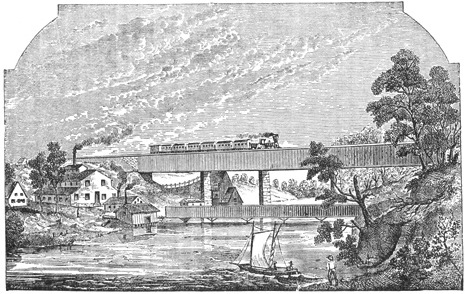
VIEW ON GRAND RIVER, OHIO.
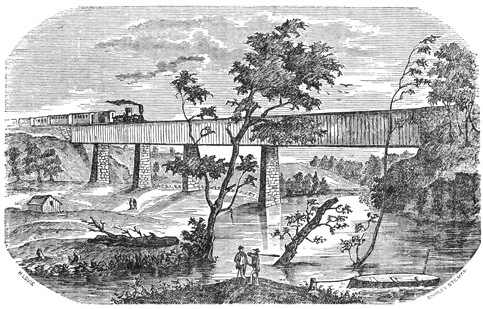
BRIDGE, CONEAUT RIVER.
He now proceeded to attempt a remedy of the two grand defects of Newcomen’s engine—the necessity of cooling the cylinder before every stroke of the piston, by the water injected into it; and the non-employment of the machine, for a moving power, of the expansive force of the steam. On account of the first defect, a much more powerful application of heat than would otherwise have been requisite was demanded for the purpose of again heating the cylinder, when it was to be refilled with steam. To keep this vessel, therefore, permanently hot, was the grand desideratum; and Watt at length hit upon an expedient equally simple and successful. His plan was to establish a communication, by an open pipe, between the cylinder and another vessel, the consequence of which would be, that when the steam was admitted into the former, it would flow into the latter, so as to fill that also. Supposing, then, that the steam should here only be condensed, by being brought into contact with cold water, or any other convenient means, a vacuum would be produced, into which, as a vent, more steam would immediately rush from the cylinder; this steam would also be condensed; and so the process would go on, till all the steam had left the cylinder, and a perfect vacuum had been effected in that vessel, without so much as a drop of cold water having touched or entered it. The separate vessel alone, or the condenser, would be cooled by the water used to condense the steam; which, instead of being an evil, would tend to quicken and promote the condensation. Experiments fully confirmed Watt in these views; and the consequence was, not only a saving of three-fourths of the fuel formerly required to feed the engine, but a considerable increase of its power.
In overcoming this difficulty, Watt was conducted to another improvement, which effected the complete removal of what we have described as the second radical imperfection of Newcomen’s engine, namely, its non-employment, for a moving power, of the expansive force of the steam. The effectual way, it occurred to him, of preventing any air from escaping into the parts of the cylinder below the piston, would be to dispense with the use of that element above the piston, and to substitute there likewise the same contrivance as below, of alternate steam and a vacuum. This was to be accomplished by merely opening communications from the upper part of the cylinder to the boiler, on the one hand, and the condenser on the other; and forming it, at the same time, into an air-tight chamber, by means of a cover, with only a hole in it to admit the rod or shank of the piston, which might, besides, without impeding its freedom of action, be padded with hemp, the more completely to exclude the air. It was so contrived, accordingly, by a proper arrangement of the cocks, and the machinery connected with them, that while there was a vacuum in one end of the cylinder, there should be an admission of steam into the other; and the steam so admitted now served, not only by its susceptibility of sudden condensation, to create the vacuum, but also, by its expansive force, to impel the piston.
These were the principal fundamental improvements in an engine, which has since been brought to such perfection of action and power, as to form one of the most triumphant eras in the history of human ingenuity. Instead of entering into all the subsequent contrivances which Watt invented, we cannot give a better idea of his splendid success, than by quoting the language of a recent writer. ‘In the present state of the engine, it appears a thing almost endowed with intelligence. It regulates, with perfect accuracy and uniformity, the number of its strokes in a given time, counting or recording them, moreover, to tell how much work it has done, as a clock records the beats of its pendulum; it regulates the quantity of steam admitted to work; the briskness of the fire, the supply of water to the boiler; the supply of coals to the fire; it opens and shuts its valves with absolute precision as to time and manner; it oils its joints; it takes out any air which may accidentally enter into parts which should be vacuous; and, when anything goes wrong, which it cannot of itself rectify, it warns its attendants by ringing a bell; yet, with all these talents and qualities, and even when exerting the power of six hundred horses, it is obedient to the hand of a child; its aliment is coal, wood, charcoal, or other combustible; it consumes none while idle; it never tires, and wants no sleep; it is not subject to malady when originally well made, and only refuses to work when worn out with age; it is equally active in all climates, and will do work of any kind; it is a water-pumper, a miner, a sailor, a cotton-spinner, a weaver, a blacksmith, a miller, etc., etc.; and a small engine, in the character of a steam pony, may be seen dragging after it, on a railroad, a hundred tons of merchandise, or a regiment of soldiers, with greater speed than that of our fleetest coaches. It is the king of machines; and a permanent realization of the genii of eastern fable, whose supernatural powers were occasionally at the command of man.’
Watt had, however, another difficulty to surmount; that of bringing his invention into practice. Having no pecuniary resources of his own, he applied to Dr. Roebuck, who had just established the Carron iron works, to advance the requisite funds; which he consented to do, on having two-thirds of the profits made over to him. A patent was accordingly obtained in 1769, and an engine soon after erected; but the failure of Dr. Roebuck thwarted the project, for a time, and the subject of our memoir returned to his business of a civil engineer. At length, in 1774, a proposal was made to him, to remove to Birmingham, and enter into partnership with the celebrated hardware manufacturer, Mr. Boulton. Dr. Roebuck’s share of the patent was shortly afterwards transferred to Mr. Boulton, and the firm of Boulton and Watt commenced the business of making steam-engines, in the year 1775. From this date, Mr. Watt obtained from parliament an extension of his patent for twenty-five years, in the course of which he added several new improvements to the mechanism of his engine. In particular, he exerted himself, for many years, in contriving the best methods of making the action of the piston communicate a rotatory motion in various circumstances; and, between the years 1781 and 1785, he took out four different patents, for inventions relating to this object.
The invention of Watt was fully appreciated in the scientific world. In 1785, he was elected a fellow of the Royal Society; in 1806, LL.D., by the University of Glasgow; and, in 1808, a member of the French Institute. He died on the 25th of August, 1819, in the eighty-fourth year of his age, leaving behind him a name that will descend to posterity, in connexion with an invention that has already gone far to revolutionize the whole domain of human industry. ‘The trunk of an elephant,’ it has been truly said of this machine, ‘that can pick up a pin, or rend an oak, is as nothing to it. It can engrave a seal, and crush masses of obdurate metal like wax before it; draw out, without breaking, a thread as fine as gossamer; and lift a ship of war, like a bauble, in the air. It can embroider muslin, and forge anchors; cut steel into ribands, and impel loaded vessels against the fury of the winds and the waves.’
JOHN HOWARD.
John Howard, whose name as a philanthropist must be familiar to a number of our readers, was born at Clapton, in the parish of Hackney, in the immediate vicinity of London, in or about the year 1727. His father was an upholsterer and carpet-warehouseman, who had acquired a considerable fortune in trade, and had retired from business to live at Hackney. Being a dissenter, and a man of strong religious principles, he sent his son at an early age to be educated by a schoolmaster named Worsley, who kept an establishment at some distance from London, where the sons of many opulent dissenters, friends of Mr. Howard, were already boarded. The selection appears to have been injudicious; for in after-life Mr. Howard assured an intimate friend, with greater indignation than he used to express on most subjects, ‘that, after a continuance of seven years at this school, he left it not fully taught any one thing.’ From Mr. Worsley’s school he was removed, probably about the age of fourteen, to one of a superior description in London, the master of which, Mr. Eames, was a man of some reputation for learning. His acquisitions at both seminaries seem to have been of the meagre kind then deemed sufficient for a person who was to be engaged in commercial pursuits; and it is the assertion of Mr. Howard’s biographer, Dr. Aikin, founded on personal knowledge, that he ‘was never able to speak or write his native language with grammatical correctness, and that his acquaintance with other languages—the French perhaps excepted—was slight and superficial.’ In this, however, he did not differ perhaps from the generality of persons similarly circumstanced in their youth, and destined, like him, for business.
At the age of fifteen or sixteen Mr. Howard was bound apprentice by his father to Messrs. Newnham and Shipley, extensive wholesale grocers in Watling Street, who received a premium of £700 with him. His father dying, however, shortly afterwards, and the state of his health or his natural tastes indisposing him for the mode of life for which he had been destined, he made arrangements with his masters for the purchase of the remaining term of his apprenticeship, and quitted business. By the will of his father, who is described as a strict methodical man, of somewhat penurious disposition, he was not to come into possession of the property till he had attained his twenty-fourth year. On attaining that age, he was to be entitled to the sum of £7000 in money, together with all his father’s landed and moveable property: his only sister receiving, as her share, £8000 in money, with certain additions of jewels, etc., which had belonged to her mother. Although nominally under the charge of guardians, Mr. Howard was allowed a considerable share in the management of his own property. He had his house at Clapton, which his father’s parsimonious habits had suffered to fall into decay, repaired or rebuilt, intending to make it his general place of residence. Connected with the repairing of this house an anecdote is told of Mr. Howard, which will appear characteristic. He used to go every day to superintend the progress of the workmen; and an old man who had been gardener to his father, and who continued about the house until it was let some time afterwards, used to tell, as an instance of Mr. Howard’s goodness of disposition when young, that every day during the repairs he would be in the street, close by the garden wall, just as the baker’s cart was passing, when he would regularly buy a loaf and throw it over the wall, saying to the gardener as he came in, ‘Harry, go and look among the cabbages; you will find something for yourself and family.’
After passing his twentieth year, Mr. Howard, being of delicate health, quitted his native country, and made a tour through France and Italy, which lasted a year or two; but of the particulars of which we have no account. On his return to England, probably about the year 1750, he took lodgings in Stoke Newington, living as a gentleman of independent property and quiet, retired habits, and much respected by a small circle of acquaintances, chiefly dissenters. The state of his health, however, was such as to require constant care. His medical attendants, thinking him liable to consumption, recommended to him a very rigorous regimen in diet, which ‘laid the foundation,’ says one of his biographers, ‘of that extraordinary abstemiousness and indifference to the gratifications of the palate which ever after so much distinguished him.’ This condition of his health obliged him also to have recourse to frequent changes of air and scene. Newington, however, was his usual place of residence. Here, having experienced much kindness and attention during a very severe attack of illness from his landlady, Mrs. Sarah Loidoire, an elderly widow of small property, he resolved to marry her; and although she remonstrated with him upon the impropriety of the step, considering their great disparity of ages—he being in his twenty-fifth, and she in her fifty-second year—the marriage was concluded in 1752. Nothing but the supposition that he was actuated by gratitude, can account for this singular step in Mr. Howard’s life. The lady, it appears, was not only twice as old as himself, but also very sickly; and that no reasons of interest can have influenced him, is evident, as well from the fact that she was poor in comparison with himself, as from the circumstance of his immediately making over the whole of her little property to her sister. Mr. Howard seems to have lived very happily with his wife till her death shortly afterwards, in November, 1755.
On his wife’s death, he resolved to leave England for another tour on the continent. In his former tour he had visited most of the places of usual resort in France and Italy; during the present, therefore, he intended to pursue some less common route. After some deliberation, he determined to sail first to Portugal, in order to visit its capital, Lisbon, then in ruins from the effects of that tremendous earthquake the news of which had appalled Europe. Nothing is more interesting than to observe the effects which great public events of a calamitous nature produce on different minds; indeed one of the most instructive ways of contrasting men’s dispositions, is to consider how they are severally affected by some stupendous occurrence. It is to be regretted, therefore, that we are not informed more particularly by Howard’s biographers of the reasons which determined him to visit the scene of the awful catastrophe which had recently occurred in Portugal—whether they were motives of mere curiosity, or whether they partook of that desire to place himself in contact with misery, that passion for proximity to wretchedness which formed so large an element in Howard’s character, and marked him out from the first as predestined for a career of philanthrophy.
Before leaving England to proceed on his tour to the south of Europe, Mr. Howard broke up his establishment at Stoke Newington, and, with that generosity which was so natural to him, made a distribution among the poorer people of the neighborhood of those articles of furniture for which he had now no necessity. The old gardner already mentioned used to relate that his dividend of the furniture on this occasion consisted of a bedstead and bedding complete, a table, six new chairs, and a scythe. A few weeks after this distribution of his furniture, Mr. Howard set sail in the Hanover, a Lisbon packet. Unfortunately, the vessel never reached her destination, being captured during her voyage by a French privateer. The crew and passengers were treated with great cruelty by their captors, being kept for forty hours under hatches without bread or water. They were carried into Brest, and confined all together in the castle of that place as prisoners of war. Here their sufferings were increased; and after lying for many hours in their dungeon without the slightest nourishment, they had a joint of mutton thrown in amongst them, which, not having a knife to cut it, they were obliged to tear with the hands, and gnaw like dogs. For nearly a week they lay on straw in their damp and unwholesome dungeon, after which they were separated, and severally disposed of. Mr. Howard was removed first to Morlaix, and afterwards to Carpaix, where he was allowed for two months to go about on parole—an indulgence usually accorded to officers only, but which Mr. Howard’s manners and behavior procured for him from the authorities. He was even furnished, it is said, with the means of returning to England, that he might negotiate his own exchange for some French naval officer, a prisoner of war in the hands of the English. This exchange was happily accomplished, and Mr. Howard was once more at liberty, and in England. His short captivity in France, however, was not without its good effects, by interesting him strongly in the condition of those unfortunate men who, chancing like himself to be captured at sea during war, were languishing in dungeons both in France and England, and atoning by their sufferings for the mutual injuries or discords of the nations to which they belonged. Mr. Howard’s imprisonment may be said to have first given a specific direction to his philanthropic enthusiasm. In his ‘Account of the State of Prisons,’ published a considerable time afterwards, he subjoins the following note to a passage in which he contrasts the favorable treatment which prisoners of war usually receive, with the cruelties which domestic prisoners experience:—‘I must not be understood here to mean a compliment to the French. How they then treated English prisoners of war I knew by experience in 1756, when a Lisbon packet in which I went passenger, in order to make the tour of Portugal, was taken by a French privateer. Before we reached Brest, I suffered the extremity of thirst, not having, for above forty hours, one drop of water, nor hardly a morsel of food. In the castle of Brest I lay for six nights upon straw; and observing how cruelly my countrymen were used there and at Morlaix, whither I was carried next, during the two months I was at Carpaix upon parole I corresponded with the English prisoners at Brest, Morlaix, and Dinnan. At the last of these towns were several of our ship’s crew and my servant. I had sufficient evidence of their being treated with such barbarity, that many hundreds had perished, and that thirty-six were buried in a hole at Dinnan in one day. When I came to England, still on parole, I made known to the Commissioner of Sick and Wounded Seamen the sundry particulars, which gained their attention and thanks. Remonstrance was made to the French court; our sailors had redress; and those who were in the three prisons mentioned above were brought home in the first cartel-ships. Perhaps what I suffered on this occasion increased my sympathy with the unhappy people whose case is the subject of this book.’ In Mr. Howard’s conduct, as here described by himself, we discern the real characteristic of active philanthropy. How few men are there who, like him, would have turned a personal misfortune to such good account; and who, while enduring sufferings themselves, would have occupied their thoughts with the means of putting an end, for all time coming, to the system which permitted such sufferings! Most men would have occupied the time of their imprisonment with sighs and lamentations; and once at liberty, they would have returned gleefully to the enjoyment of their homes, without troubling themselves about their less fortunate fellow-sufferers whom they had left behind, or at least without conceiving that their exertions could do anything for their benefit. But it is the characteristic of men like Howard, when once their attention is called to a wrong, not to rest until they have seen it rectified.
On his return to England, Mr. Howard went to reside on the small estate of Cardington, near Bedford, which had been left him by his father, and which he had increased by the purchase of an additional farm. He appears to have resided here for the next two years, leading the life of a quiet country gentleman, superintending his farms, and earning the respect and good-will of all the neighborhood, by his attention to the comforts of his tenants, and his charities to the poor. It was during this period also, on the 13th of May 1756, that he was elected a fellow of the Royal Society; an honor which did not necessarily imply that he possessed reputation as a scientific man, or even a man of brilliant abilities, but only that he was a gentleman of respectability, who, like many others of his class, took an interest in scientific pursuits. Howard’s attainments in science do not seem to have ever been very great, and the only point of his character which connected him particularly with a scientific body, was his taste for meteorological observations.
On the 25th of April 1758, Mr. Howard contracted a second marriage with Miss Henrietta Leeds, eldest daughter of Edward Leeds, Esq., of Croxton, Cambridgeshire. The lady whom he had selected as his partner in life is described as amiable, affectionate, pious, and in every way worthy of such a husband. Her tastes were the same as his, and she cordially seconded all his charitable plans for the assistance and relief of those who depended upon his benevolence.
For seven years Mr. Howard enjoyed uninterrupted happiness in the society of his wife. During this period he resided first at Cardington, next for about three years at Watcombe in Hampshire, and latterly at Cardington again. The even tenor of his existence during these years presents few incidents worth recording. Reading, gardening, and the improvement of his grounds, occupied most of his time. His meteorological observations were likewise diligently continued; and it is mentioned, as a proof of his perseverance in whatever he undertook, that on the setting in of a frost, he used to leave his bed at two o’clock every morning while it lasted, for the purpose of looking at a thermometer which he kept in his garden. His charities, as before, were profuse and systematic. His desire, and that of his wife, was to see all around them industrious and happy. To effect this, they used all the influence which their position as persons of property and wealth gave them over the villagers and cottagers in their neighborhood. One of their modes of dispensing charity was to employ persons out of work in making articles of furnature or ornament; and in this way, it is said, Mrs. Howard soon increased her stock of table-linen to a quantity greater than would ever be required by any household.
On the 31st of March 1765, Mrs. Howard died in giving birth to a son, the first and only issue of their marriage. This event was a source of poignant affliction to her husband. On the tablet which he erected to her memory in Cardington church, he caused to be inscribed the following passage from the book of Proverbs:—‘She opened her mouth with wisdom, and on her tongue was the law of kindness.’ Her miniature was ever after his constant companion by sea or land; and the day of her death was observed by him annually as a day of fasting, meditation and prayer.
From the death of his wife in 1765 to the end of the year 1769, Mr. Howard appears to have remained in England, and at Cardington as before, with the exception of a month or six weeks in the year 1767, which he devoted to a tour through Holland. His principal occupation during these four years was the education of his infant son. From the circumstance that this boy, when he arrived at the years of manhood, conducted himself in a profligate manner, and at last became insane, much attention has been drawn to Mr. Howard’s mode of educating him in his infancy; some insisting that his conduct as a parent was harsh and injudicious, others going so far as to asert that this man—whom the world reveres as a philanthropist, and whose benevolent soul yearned for the whole human race—was in his domestic relations a narrow and unfeeling tyrant. This last assertion—although, abstractly considered, there is nothing impossible or absurd in it, inasmuch as we may conceive such a thing as real philanthropy on a large scale conjoined with inattention to one’s immediate duties as a husband or father—appears to have absolutely no foundation whatever in Howard’s case; and to have originated either in malice, or in that vulgar love of effect which delights in finding striking incongruities in the characters of great men. Nor does the other assertion—that Howard’s mode of educating his infant son was harsh and injudicious—appear more worthy of credit. The truth seems to be, that Howard was a kind and benevolent man, of naturally Strict and methodical habits, who entertained, upon principle, high ideas of the authority of the head of a family. A friend of his relates that he has often heard him tell in company, as a piece of pleasantry, that before his marriage with his second wife he made an agreement with her, that in order to prevent all those little altercations about family matters which he had observed to be the principal causes of domestic discomfort, he should always decide. Mrs. Howard, he said, had cheerfully agreed to this arrangement; and it was attended with the best effects. The same principle of the supremacy of the head of a family—a principle much less powerful in society now than it was a generation or two ago—guided him in his behavior to his son. ‘Regarding children,’ says Dr. Aikin, ‘as creatures possessed of strong passions and desires, without reason and experience to control them, he thought that nature seemed, as it were, to mark them out as the subjects of absolute authority, and that the first and fundamental principle to be inculcated upon them was implicit and unlimited obedience.’ The plan of education here described may to some appear austere and injudicious, while others will cordially approve of it, as that recommended by experience and common sense; but at all events, the charges of harshness and cruelty which some have endeavored to found upon it are mere calumnies, refuted by all who knew Mr. Howard, and were witnesses to his affection for his son.
Sensible of the loss which the boy had sustained by the death of his mother, Mr. Howard placed him, in his fifth year, under the care of a lady in whom he had confidence, who kept a boarding-school at Cheshunt in Hertfordshire. This and other arrangements having been made, he went abroad on a fourth continental tour towards the end of 1769. Proceeding through the south of France, and spending a few weeks in Geneva, he visited most of the remarkable places in Italy, some of them for the second time; and returned home through Germany in the latter part of 1770, having been absent in all about twelve months.
When Howard had again settled at Cardington, he resumed his benevolent schemes of local improvement. It appears that the vicinity of Bedford, and Cardington especially, was inhabited by a very poor population, liable to frequent visitations of distress from the fluctuations of the only manufacture which yielded them employment—that of lace; as well as generally from the unhealthy and marshy nature of the soil, rendering agues prevalent. Mr. Howard’s first care with respect to those to whom he was attached as landlord, was to improve their dwellings. ‘At different times,’ says his biographer, Mr. Brown, ‘he pulled down all the cottages on his estate, and rebuilt them in a neat but simple style, paying particular attention to their preservation, as much as possible, from the dampness of the soil. Others which were not his property before, he purchased, and reërected upon the same plan; adding to the number of the whole by building several new ones in different parts of the village. To each of these he allotted a piece of garden-ground, sufficient to supply the family of its occupier with potatoes and other vegetables; and generally ornamented them in front with a small fore-court, fenced off from the road by neat white palings, enclosing a bed or two of simple flowers, with here and there a shrub, or an evergreen; thus imparting to these habitations of the poor, with their white fronts and thatched roofs, that air of neatness and comfort so strikingly characteristic of everything in which he engaged.’ ‘These comfortable habitations, which he let at a rent of twenty or thirty shillings a year,’ says another biographer, Dr. Aikin, ‘he peopled with the most industrious and sober tenants he could find; and over them he exercised the superintendence of master and father combined. He was careful to furnish them with employment, to assist them in sickness and distress, and to educate their children.’ In consequence of these exertions of Mr. Howard, aided and seconded by those of his friend and relative, Samuel Whitbread, Esq., who possessed property in the same neighborhood, ‘Cardington, which seemed at one time to contain the abodes of poverty and wretchedness, soon became one of the neatest villages in the kingdom—exhibiting all the pleasing appearances of competence and content, the natural rewards of industry and virtue.’ Industry and cleanliness were the two virtues which Mr. Howard sought by all means to naturalize among the villagers of Cardington. It was his custom to visit the houses of his tenants now and then, conversing with them on the state of their affairs. During such visits he was particular in requesting them to keep their houses clean; and it was one of his standing advices that they should ‘swill the floors well with water.’ After talking with the children, he would tell them, at parting, to be ‘good boys and girls, and keep their faces and hands clean.’
Among Mr. Howard’s other benefactions to the locality of Cardington, he established schools for the education of the boys and girls of the neighborhood, in the rudiments of knowledge. Of these it was strictly required that they should regularly attend some place of worship on Sundays; whether the established church, or any other, was indifferent, provided it was a church at all. His anxiety on this point also led him to convert one of his cottages into a preaching station, where the neighboring clergymen of different pursuasions, or occasionally a clergyman from a distance passing through the village, might officiate to such as chose to attend; and very rarely was the little congregation without at least one sermon a week. Mr. Howard, when at Cardington, was invariably present at these meetings. His regular place of worship was the Old Meeting-house at Bedford, of which the Rev. Mr. Symonds was pastor for 1766 to 1772. In the latter year, however, when Mr. Symonds declared his adherence to the theological tenets of the Baptists, Mr. Howard seceded along with a considerable part of the congregation, and established a new meeting-house. The truth is, however, that, with all his piety, and indeed on account of the very strength and sincerity of it, the theological differences of sects occupied very little space in his attention, and did not in the least affect his schemes of philanthropy; and though a dissenter of a particular denomination himself, dissenters of all other denominations, as well as members of the established church, were equally the objects of his respect and his benevolent solicitude.
The following recollections of Mr. Howard’s habits at this period, by the Rev. Mr. Townsend, who resided with him at Cardington for a short period, in the interval between the secession from the Old Meeting-house, and the erection of the new one, may be interesting: ‘He found him,’ he said, ‘not disposed to talk much; he sat but a short time at table, and was in motion during the whole day. He was very abstemious; lived chiefly on vegetables, ate little animal food, and drank no wine or spirits. He hated praise; and when Mr. Townsend once mentioned to him his labors of benevolence’—not those general ones for which he is now so celebrated, but his exertions for the improvement of the condition of the people in his neighborhood—‘he spoke of them slightingly, as a whim of his, and immediately changed the subject.’ ‘He was at all times,’ adds his biographer, Mr. Brown, ‘remarkably neat in his dress, but affected no singularity in it. Though he never thought it right to indulge in the luxuries of life, he did not despise its comforts. Wine or fermented liquors of any kind he himself never drank; but they were always provided, and that of the best quality, for his friends who chose to take them. He always maintained an intercourse of civility with some of the most considerable persons in the country, and was on visiting terms with the greater part of the country gentlemen around him, and with the most respectable inhabitants of the town of Bedford, churchmen and dissenters. His aversion to mix much with promiscuous assemblies was the result of his religious principles and habits, which taught him that this was no very profitable method of spending his time; yet however uncomplying he might be with the freedoms and irregularities of polite life, he was by no means negligent of its received forms; and though he might be denominated a man of scruples and singularities, no one would dispute his claim to the title of a gentleman.’
From these details our readers will be able to fancy Mr. Howard as he was in the year 1773—a widower country gentleman, of plain, upright, methodical habits, aged about forty-six; devout and exemplary in his conduct, and a dissenter by profession, but without any strong prejudices for or against any sect; temperate and economical, but the very reverse of parsimonious; fond of traveling, and exceedingly attentive to what fell under his observation; of a disposition overflowing with kindness at the aspect of a miserable object, and prompting him to go out in search of wretchedness, and to distribute over his whole neighborhood the means of comfort and happiness. Such was Mr. Howard in the year 1773; and if he had then died, his name would never have been so celebrated as it is over the world, but would only have been remembered in the particular district where his lot was cast, as the names of many benevolent landlords and good men are locally remembered all over the country. Fortunately, however, a circumstance happened which opened for this unostentatious benefactor of a village a career of world-wide philanthropy. This was his election, in the year 1773, to the important office of high-sheriff of the county of Bedford. Regarding the special circumstances which led to his election to such a post, we have no information. It may be mentioned, however, that, in accepting the office, he subjected himself to the liability of a fine of £500—the laws which disqualified dissenters from holding such offices not having been yet repealed, although they were practically set at defiance by the increasing liberality of the age. A story was indeed once current that Mr. Howard, on his nomination to the office, stated to earl Bathurst, then lord chancellor, his scruples about accepting it, arising from the fact of his not being a member of the Church of England; and that lord Bathurst, in reply, gave him an assurance of indemnification, in case any malicious person should endeavor to put the law in force against him. This story, however, does not appear to have been well-founded.
The duties of a high-sheriff in England are important and various. To him are addressed the writs commencing all actions, and he returns the juries for the trial of men’s lives, liberties, lands and goods. He executes the judgments of the courts. In his county he is the principal conservator of the peace. He presides in his own court as a judge; and he not only tries all causes of forty shillings in value, but also questions of larger amount. He presides at all elections of members of parliament and coroners. He apprehends all wrongdoers, and for that purpose, he is entitled to break open outer-doors to seize the offender. He defends the county against riot, or rebellion, or invasion. The sheriff takes precedence of all persons in the county. He is responsible for the execution of criminals. He receives and entertains the judges of assize, on whom he is constantly in attendance whilst they remain in his shire. To assist him in the performance of his duties, the sheriff employs an under-sheriff, and also a bailiff and jailers, from whom he takes security for their good conduct. Such was the office to which, fortunately for society, Mr. Howard was appointed at the annual election of sheriffs in the year 1773.
The office of high-sheriff became a different thing in the hands of such a man as Howard from what it had been before. It was no longer a mere honorable office, all the drudgery of which was performed by the under-sheriff; it was no longer the mere right of going in state twice a-year to meet the judges, and of presiding during the gayeties of an assize-week; it was a situation of real power and laborious well-doing. Already alive to the existence of numerous abuses in prison management—as well by his general information respecting the institutions of the country, as by his own experience of prison life in France seventeen years before—he had not been a month in office before all the faculties of his heart and soul were engaged in searching out and dragging into public notice the horrible corruptions and pollutions of the English prison system.
Within Mr. Howard’s own cognizance as sheriff of Bedfordshire, there were three prisons—the county jail, the county bridewell, and the town jail, all in Bedford; and, as a matter of course, it was with these that his inquiries commenced. Various abuses struck him in their management, particularly in that of the county jail, the accommodations of which, whether for the purposes of work, health, or cleanliness, he found very deficient. But what roused his sense of justice most of all, was to find that the jailer had no salary, and depended for great part of his income on the following clause in the prison regulations:—‘All persons that come to this place, either by warrant, commitment, or verbally, must pay, before being discharged, fifteen shillings and fourpence to the jailer, and two shillings to the turnkey.’ The effect which this and similar exactions from prisoners in the Bedford jail made upon him, will be best learned from his own statement prefixed to his ‘Account of the State of Prisons.’ ‘The distress of prisoners,’ he says, ‘of which there are few who have not some imperfect idea, came more immediately under my notice when I was sheriff of the county of Bedford; and the circumstance which excited me to activity in their behalf was seeing some who, by the verdict of juries, were declared not guilty—some on whom the grand jury did not find such an appearance of guilt as subjected them to trial—and some whose prosecutors did not appear against them—after having been confined for months, dragged back to jail, and locked up again till they should pay sundry fees to the jailer, the clerk of assize, etc. In order to redress this hardship,’ he continues, ‘I applied to the justices of the county for a salary to the jailer in lieu of his fees. The bench were properly affected with the grievance, and willing to grant the relief desired; but they wanted a precedent for charging the county with the expense.’
With a view to find the precedent required, Mr. Howard undertook to visit the jails of some of the neighboring counties, that he might inquire into the practice adopted there. His first visits were to the jails of Cambridge and Huntingdon; and in the course of the same month—November 1773—he prosecuted his tour through those of the following counties in addition—Northampton, Leicester, Nottingham, Derby, Stafford, Warwick, Worcester, Gloucester, Oxford, and Buckingham. In each and all of these jails he found abuses and grievances; different, indeed, in one from what they were in another, and in some fewer and less shocking than in others, but in all disgraceful to a civilized country. In all of them, the income of the jailer was derived, as at Bedford, from fees exacted from the prisoners, and not from a regular salary; nay, in one of them the sheriff himself drew fees from the prisoners; and in another, that of Northampton, the jailer, instead of having a salary, paid the county £40 a-year for his office. To enter into the details of his investigations of the abuses of the various prisons above enumerated, as these are given in the first edition of his ‘Account of the State of Prisons,’ would be impossible; suffice it to say, that Mr. Howard’s reports on the various jails he visited are not mere general assertions that this or that jail was defective in its arrangements, but laborious and minute accounts of the statistics of each—containing in the briefest possible compass, every circumstance respecting every jail which it could possibly be useful to know. Indeed no parliamentary commission ever presented a more searching, clear, and accurate report than Howard’s account of the state of the prisons he visited.
His visits to the jails of the counties adjoining Bedford had only disclosed to him those depths of misery which he was yet to sound. ‘Looking into the prisons,’ he says, ‘I beheld scenes of calamity which I became daily more and more anxious to alleviate. In order, therefore, to gain a more perfect knowledge of the particulars and extent of it, by various and accurate observation, I visited most of the county jails in England.’ This more extensive tour was begun in December 1773, and by the 17th of that month he had inspected the jails of the counties of Hertford, Berks, Wilts, Dorset, Hants, and Sussex; occupying, therefore, it will be perceived, a much less space of time in his survey than most official commissioners, and yet probably doing the work much better. The next six weeks he appears to have spent at Cardington with his son, then about eight years of age, and at home no doubt on his Christmas vacation; but towards the end of January 1774, his philanthropic tour was resumed. The jails of Rutlandshire were first visited, then those of York: on his journey southward from York he passed through the shires of Lincoln, Norfolk, Suffolk, and Essex, visiting the prisons of each: a fortnight was then devoted to an examination of the monster prisons of London: from London he set out on a journey to the western counties, inspected the jails of Devon, Cornwall, Somerset, Hereford, and Monmouth; and, after a short absence, returned to London, having, in the course of three months of expeditious and extensive, but most thorough scrutiny, acquired more knowledge of the state of English prisons than was possessed by any other man then living. Such is the effect of having a definite object in view, and attending exclusively to it. If we measure ability by mere largeness of intellect, there were undoubtedly hundreds of abler men than Howard then alive in England; but what is the lazy and languid greatness of these intellectual do-nothings compared with the solid greatness of a man like Howard, who, gifted by God with a melting love for his fellow-men, laboriously and steadily pursued one object, made himself master of one department, and dragged into daylight one class of social abuses till then unknown or unheeded?
It happened by a fortunate conjunction, that at the time Mr. Howard was pursuing his prison inquiries, a few members of the legislature were interesting themselves in the same subject. In the previous session of parliament a bill had been introduced into the House of Commons by Mr. Popham, member for Taunton, proposing the payment of jailors, not by fees from the prisoners, as heretofore, but out of the county rates. The bill had been dropped in committee on the second reading; but the subject of prison management was resumed next session, the principal movers in the inquiry being Mr. Popham, and Mr. Howard’s intimate friends, Mr. St. John and Mr. Whitbread. It would appear that it had been in consequence of consultations with Mr. Howard that these gentlemen broached the subject in parliament at so early a period in the session; at all events, we find Mr. Howard immediately after his return from his western tour, examined before a committee of the whole House regarding his knowledge of the state of English prisons. So full and valuable were the details submitted to the committee by Mr. Howard, that on the House being resumed, the chairman of the committee, Sir Thomas Clavering, reported that ‘he was directed by the committee to move the House that John Howard, Esq., be called in to the bar, and that Mr. Speaker do acquaint him that the House are very sensible of the humanity and zeal which have led him to visit the several jails of this kingdom, and to communicate to the House the interesting observations he has made upon that subject.’ The motion was adopted unanimously; and Mr. Howard had, accordingly, the honor of receiving the public thanks of the House for his philanthropic exertions. To show however, how little the spirit which animated these exertions was understood or appreciated, we may mention that it is related that during his examination before the committee, one member put the question to him, ‘At whose expense he traveled?’
Mr. Howard, however, was still only at the commencement of his labors. In the month of March 1774, only a few days after receiving the thanks of the House of Commons, he set out for the extreme north of England, to visit the jails there. In an incredibly short space of time he had traversed the counties of Durham, Northumberland, Cumberland, Westmoreland, Lancaster, Chester, and Shropshire, visiting the jails in each; then, after revisiting those of Stafford, Derby, Nottingham, Leicester, and Northampton, he returned home to Cardington; from which, after a week’s repose he sent out for Kent. With the examination of the jails of Kent, Mr. Howard’s first survey of the jails of England may be said to have been finished. To give once for all, an idea of the minute and thorough manner in which he discharged his self-imposed duty, we may quote his remarks on the county jail at Durham. After giving a list of the officials and their salaries, he proceeds thus:—‘The high jail is the property of the bishop. By patent from his lordship, Sir Hedworth Williamson, Bart., is perpetual sheriff. The court for master’s side debtors is only 24 feet by 10: they are permitted sometimes to walk on the leads. They have beds in the upper hall, and in several other rooms. Their rooms should be ceiled, that they might be lime-whited, to prevent infectious disorders, and that great nuisance of bugs, of which the debtors complain much here and other places. Common side debtors have no court; their free wards, the low jail, are two damp, unhealthy rooms, 10 feet 4 inches square by the gateway. They are never suffered to go out of these except to chapel, which is the master’s side debtor’s hall; and not always to that: for on Sunday, when I was there, and missed them at chapel, they told me they were not permitted to go thither. No sewers. At more than one of my visits I learned that the dirt, ashes, etc., had lain there many months. There is a double-barreled pump, which raises water about 70 feet. Felons have no court; but they have a day-room, and two small rooms for an infirmary. The men are put at night into dungeons: one, 7 feet square, for three prisoners; another, the great hole, 16½ feet by 12, has only a little window. In this I saw six prisoners, most of them transports, chained to the floor. In this situation they had been for many weeks, and were very sickly; their straw on the stone floor almost worn to dust. Long confinement, and not having the king’s allowance of two shillings and sixpence a-week, had urged them to attempt an escape; after which the jailer had chained them as already mentioned. There is another dungeon for women felons, 12 feet by 8; and up stairs, a separate room or two. The common side debtors in the low jail, whom I saw eating boiled bread and water, told me that this was the only nourishment some had lived upon for near a twelvemonth. They have, from a legacy, one shilling and a sixpence a-week in winter and one shilling a-week in summer, for coals. No memorandum of it in the jail: perhaps this may in time be lost, as the jailer said two others were—namely, one of Bishop Crewe, and another of Bishop Wood, from which prisoners had received no benefit for some years past. But now the bishop has humanely filed bills in Chancery, and recovered these legacies, by which several debtors have been discharged. Half-a-crown a-week is paid to a woman for supplying the debtors with water in the two rooms on the side of the gateway. The act for preserving the health of prisoners is not hung up. Jail delivery once a-year. At several of my visits there were boys between thirteen and fifteen years of age confined with the most profligate and abandoned. There was a vacant piece of ground adjacent, of little use but for the jailor’s occasional lumber. It extends to the river, and measures about 22 yards by 16. I once and again advised the enclosing this for a court, as it might be done with little expense; and it appears that formerly here was a doorway into the prison. But when I was there afterwards in January 1776, I had the mortification to hear that the surgeon, who was uncle to the jailer, had obtained from the bishop, in October preceding, a lease of it for twenty-one years, at the rent of one shilling per annum. He had built a little stable on it.’
Having completed his survey of the English jails, Mr. Howard turned his attention next to those of Wales; and by the end of the autumn of 1774, he appears to have visited the principal jails in that principality. During these last months the field of his inquiries had been extended, so as to embrace a new department. ‘Seeing,’ he says ‘in two or three of the jails some poor creatures whose aspect was singularly deplorable, and asking the cause of it, the answer was, ‘They were lately brought from the bridewells.’ This started a fresh subject of inquiry. I resolved to inspect the bridewells; and for that purpose traveled again into the counties where I had been; and indeed into all the rest, examining houses of correction, city and town jails. I beheld in many of them, as well as in the county jails, a complication of distress.’
Mr. Howard’s philanthropic labors for now nearly a twelve-month had of course made him an object of public attention, and it became obviously desirable to have such a man in parliament. Accordingly, at the election of 1774, he was requested by a number of the electors of Bedford to allow himself to be put in nomination for that town, in the independent interest, along with his friend Mr. Whitbread. Mr. Howard consented; but when the polling had taken place, the numbers stood thus—Sir William Wake, 527 votes; Mr. Sparrow, 517; Mr. Whitbread, 429; and Mr. Howard, 402. A protest was taken by the supporters of Mr. Whitbread and Mr. Howard, most of whom were dissenters, against the election of the two former gentlemen, on the ground that the returning officers had acted unfairly in rejecting many legally good votes for Messrs. Whitbread and Howard, receiving many legally bad ones for the other two candidates. Petitions impeaching the return were also presented to the House of Commons by Mr. Whitbread and Mr. Howard.
Nothing, however, could divert our philanthropist from his own peculiar walk of charity, and the interval between the election and the hearing of the petitions against its validity was diligently employed by him in a tour through Scotland and Ireland, for the purpose of inspecting the prisons there, and comparing them with those of England and Wales. With the Scotch system of prison management he seems to have been, on the whole, much better pleased than with that of England; and he mentions, with particular approbation, that in Scotland ‘all criminals are tried out of irons; and when acquitted, they are immediately discharged in open court,’ and that ‘women are not put in irons.’ Still he found sufficient grounds for complaint in the state of the prisons themselves. ‘The prisons,’ he says, ‘that I saw in Edinburgh, Glasgow, Perth, Stirling, Jedburgh, Haddington, Ayr, Kelso, Nairn, Banff, Inverness, etc., were old buildings, dirty and offensive, without courtyards, and also generally without water.’ ‘The tolbooth at Inverness,’ he afterwards observes, ‘has no fire place, and is the most dirty and offensive prison that I have seen in Scotland.’ In the Irish prisons he found, as might have been expected, abuses even more shocking than those he had generally met with in England.
In March 1775, Mr. Howard having by this time returned to England, his petition and that of Mr. Whitbread against the return of Sir William Wake and Mr. Sparrow were taken into consideration by a committee of the House of Commons. On a revision of the poll, the numbers, after adding the good votes which had been rejected, and striking off the bad ones which had been accepted, stood thus—Mr. Whitbread, 568; Sir William Wake, 541; Mr. Howard, 537; Mr. Sparrow, 529. Thus, although by a small majority, Mr. Howard lost the election; his friend, Mr. Whitbread, who had formerly been in the same predicament, was now returned at the top of the poll in lieu of Mr. Sparrow.
It was perhaps a fortunate circumstance for the world that Mr. Howard did not succeed in being returned to parliament. He might no doubt have been of great service as a member of the legislature; but his true function was that which he had already chosen for himself—a voluntary and unofficial inquirer into the latent miseries of human society. It was not so much as a propounder of schemes of social improvement that Mr. Howard appeared; it was rather as an explorer of unvisited scenes of wretchedness, who should drag into the public gaze all manner of grievances, in order that the general wisdom and benevolence of the country might be brought to bear upon them. In a complex state of society, where wealth and poverty, comfort and indigence, are naturally separated from each other as far as possible, so that the eyes and ears of the upper classes may not be offended and nauseated by the sights and sounds of wo, the interference of this class of persons—inspectors, as they may be called, whose business it is to see and report—is among the most necessary of all acts for social wellbeing.
Mr. Howard having completed his survey of the prisons of Great Britain, began to prepare his reports for publication. ‘I designed,’ says he, ‘to publish the account of our prisons in the spring of 1775, after I returned from Scotland and Ireland. But conjecturing that something useful to my purpose might be collected abroad, I laid aside my papers, and traveled into France, Flanders, Holland, and Germany.’ The precise route which he pursued during this, his fifth continental tour, is not known; he appears, however, to have gone to France first. He gives the following account of his attempt to gain admission to the famous Bastile of Paris. ‘I was desirous of examining it myself, and for that purpose knocked hard at the outer gate, and immediately went forward through the guard to the drawbridge before the entrance of the castle. But while I was contemplating this gloomy mansion, an officer came out much surprised, and I was forced to retreat through the mute guard, and thus regained that freedom which, for one locked up within those walls, it is next to impossible to obtain.’ On this singular adventure of Mr. Howard one of his biographers makes the following remark. ‘In the space of four centuries, from the foundation to the destruction of the Bastile, perhaps Mr. Howard was the only person that was ever compelled to quit it reluctantly.’ Although denied admission to the Bastile, Mr. Howard was able to obtain entrance into the other prisons of Paris. His first application, indeed, for admittance to the Grand Chatelet was unsuccessful; but happening to remark that, by the tenth article of the arrêt of 1717, jailers were authorized to admit persons desirous of bestowing charity on the prisoners, he pleaded it before the Commissaire de la Prison; and in this way gained admission not only to that prison, but to the others. Except for the horrible subterranean dungeons, in which he found that certain classes of prisoners were sometimes confined in France, he appears to have considered the prisons in that country better managed than those of England.
Mr. Howard’s proceedings in France, French Flanders, and the Netherlands, will be best gathered from the following letter to a friend:—‘I came late last night to this city; the day I have employed in visiting the jails, and collecting all the criminal laws, as I have got those of France. However rigorous they may be, yet their great care and attention to their prisons is worthy of commendation: all fresh and clean; no jail distemper; no prisoners ironed. The bread allowance far exceeds that of any of our jails; for example, every prisoner here has two pounds of bread a-day; once a-day, soup; and on Sunday, one pound of meat. I write to you, my friend, for a relaxation from what so much engrosses my thoughts. And indeed I force myself to the public dinners and suppers for that purpose, though I show so little respect to a set of men who are so highly esteemed (the French cooks), that I have not tasted fish, flesh, or fowl since I have been this side the water. Through a kind Providence I am very well; calm, easy in spirits. The public voitures have not been crowded, and I have met, in general, agreeable company. I hope to be in Holland the beginning of next week.’
After visiting the principal prisons in Holland and part of Germany, most of which seem to have particularly pleased him, when contrasted with those at home, Mr. Howard returned to England in the end of July, 1775. Not to rest, however; for he immediately commenced a second survey of the English prisons. This was interrupted, in the beginning of the year 1776, when he made a trip to Switzerland to visit the Swiss jails, taking some of the French ones in his way. Returning to England, he resumed his second survey of the English and Welsh prisons; and when this was completed to his satisfaction in the beginning of 1777, he took up his residence for the spring at the town of Warrington, in Lancashire, where he had resolved to have his work on prisons printed. His reasons for printing the book there, rather than in London, were various; one of them was, that he wished to be near his friend Dr. (then Mr.) Aikin, employed as a surgeon in Warrington, whose literary talents were of assistance to him in fitting the work for publication. Dr. Aikin gives the following account of the process which Mr. Howard’s notes underwent, in order to qualify them for being sent to press—his own composition, as our readers are already aware, being none of the most correct in a grammatical point of view. ‘On his return from his tours,’ says Dr. Aikin, ‘he took all his memorandum-books to an old, retired friend of his, who assisted him in methodising them, and copied out the whole matter in correct language. They were then put into the hands of Dr. Price, from whom they underwent a revision, and received occasionally considerable alterations. With his papers thus corrected, Mr. Howard came to the press at Warrington; and first he read them all over carefully to me, which perusal was repeated sheet by sheet, as they were printed. As new facts and observations were continually suggesting themselves to his mind, he put the matter of them upon paper as they occurred, and then requested me to clothe them in such expressions as I thought proper. On these occasions such was his diffidence, that I found it difficult to make him acquiesce in his own language, when, as frequently happened, it was unexceptionable. Of this additional matter, some was interwoven with the text, but the greater part was necessarily thrown into notes.’ So intent was he upon the publication of the work, that, ‘for the purpose,’ we are told by his biographer, Mr. Brown, ‘of being near the scene of his labors, he took lodgings in a house close to his printer’s shop; and during a very severe winter he was always called up by two in the morning, though he did not retire to rest till ten. His reason for this early rising was, that in the morning he was least disturbed in his work of revising the sheets as they came from the press. At seven he regularly dressed for the day, and had his breakfast; when, punctually at eight, he repaired to the printing-office, and remained there till the workmen went to dinner at one, when he returned to his lodgings, and putting some bread and raisins, or other dried fruit, in his pocket, generally took a walk in the outskirts of the town, eating, as he walked, his hermit fare, which, with a glass of water on his return, was the only dinner he took. When he had returned to the printing-office, he generally remained there until the men left work, and then repaired to Mr. Aikin’s house, to go through with him any sheets which might have been composed during the day; or, if there were nothing upon which he wished to consult him, he would either spend an hour with some friend, or return to his own lodgings, where he took his tea or coffee in lieu of supper, and at his usual hour retired to bed.’
In April 1777 appeared the work which had cost him so much labor. Its title was, ‘The State of the Prisons in England and Wales, with Preliminary Observations, and an Account of some Foreign Prisons. By John Howard, F.R.S.’ Although the work was very bulky, consisting of 520 quarto pages, with four large plates, yet ‘so zealous was he,’ says Dr Aikin, ‘to diffuse information, and so determined to obviate any idea that he meant to repay his expenses by the profitable trade of book-making, that he insisted on fixing the price of the volume so low, that, had every copy been sold, he would still have presented the public with all the plates and great part of the printing.’ Besides, he distributed copies profusely among all persons who possessed, or might possibly possess, influence in carrying his benevolent views into effect. ‘As soon as the book appeared,’ continues Dr. Aikin, ‘the world was astonished at the mass of valuable materials accumulated by a private unaided individual, through a course of prodigious labor, and at the constant hazard of life, in consequence of the infectious diseases prevalent in the scenes of his inquiries. The cool good sense and moderation of his narrative, contrasted with that enthusiastic ardor which must have impelled him to the undertaking, were not less admired; and he was immediately regarded as one of the extraordinary characters of the age, and as a leader in all plans of meliorating the condition of that wreched part of the community for whom he interested himself.’
To give an idea of the extent of the evils of the prison system in the time of Howard, and of the thorough manner in which these were taken cognizance of by him, we will present our readers with an abridgment of the introductory section of his work, in which, before passing to his special report on the state of the various prisons which he had visited, he gives a summary, or ‘General View of Distress in Prisons.’ The extracts will be found not only interesting in their connexion with Howard’s life, but also interesting in themselves.
‘There are prisons,’ he begins, ‘into which whoever looks will, at first sight of the people confined, be convinced that there is some great error in the management of them; their sallow, meagre countenances declare, without words, that they are very miserable. Many who went in healthy, are in a few months changed to emaciated, dejected objects. Some are seen pining under diseases, ‘sick and in prison,’ expiring on the floors, in loathsome cells, of pestilential fevers and confluent small-pox; victims, I must not say to the cruelty, but I will say to the inattention, of sheriffs and gentlemen in the commission of the peace. The cause of this distress is, that many prisons are scantily supplied, and some almost totally destitute, of the necessaries of life.
‘Food.—There are several bridewells in which prisoners have no allowance of food at all. In some, the keeper farms what little is allowed them; and where he engages to supply each prisoner with one or two pennyworths of bread a-day, I have known this shrunk to half, sometimes less than half the quantity—out of, or broken from, his own loaf. It will perhaps be asked—Does not their work maintain them? The answer to that question, though true, will hardly be believed. There are few bridewells in which any work is done, or can be done. The prisoners have neither tools nor materials of any kind, but spend their time in sloth, profaneness, and debauchery, to a degree which, in some of those houses that I have seen, is extremely shocking.… The same complaint—want of food—is to be found in many county jails. In above half of these debtors have no bread, although it is granted to the highwayman, the housebreaker, and the murderer; and medical assistance, which is provided for the latter, is withheld from the former. In many of these jails, debtors who would work are not permitted to have any tools, lest they should furnish felons with them for escape, or other mischief. I have often seen these prisoners eating their water-soup (bread boiled in mere water), and heard them say, ‘We are locked up, and almost starved to death.’ As to the relief provided for debtors by the benevolent act 32d of George II, I did not find in all England and Wales, except in the counties of Middlesex and Surrey, twelve debtors who had obtained from their creditors the fourpence a-day to which they had a right by that act. The truth is, some debtors are the most pitiable objects in our jails. To their wanting necessary food, I must add not only the demands of jailers, etc., for fees, but also the extortion of bailiffs. These detain in their houses (properly enough denominated spunging-houses), at an enormous expense, prisoners who have money. I know there is a legal provision against this oppression; but the mode of obtaining redress is attended with difficulty, and the abuse continues. The rapine of these extortioners needs some more effectual and easy check: no bailiff should be suffered to keep a public-house.… Felons have in some jails two pennyworth of bread a-day; in some, three halfpennyworth; in some, a pennyworth; in some, none. I often weighed the bread in different prisons, and found the penny loaf seven ounces and a half to eight ounces; the other loaves in proportion. It is probable that, when this allowance was fixed by its value, near double the quantity that the money will now purchase might be bought for it; yet the allowance continues unaltered, and it is not uncommon to see the whole purchase, especially of the smaller sums, eaten at breakfast—which is sometimes the case when they receive their pittance but once in two days; and then on the following day, they must fast. This allowance being so far short of the cravings of nature, and in some prisons lessened by farming to the jailer, many criminals are half-starved; such of them as at their commitment were in health, come out almost famished, scarcely able to move, and for weeks incapable of labor.
‘Water.—Many prisons have no water. This defect is frequent in bridewells and town jails. In the felon’s courts of some county jails there is no water; in some places where there is water, prisoners are always locked up within doors, and have no more than the keeper or his servants think fit to bring them; in one place they were limited to three pints a-day each—a scanty provision for drink and cleanliness.
‘Air.—And as to air, my reader will judge of the malignity of that breathed in prisons, when I assure him that my clothes were, in my first journeys, so offensive, that in a postchaise I could not bear the windows drawn up, and was therefore obliged to travel commonly on horseback. The leaves of my memorandum-book were often so tainted, that I could not use it till after spreading it an hour or two before the fire; and even my antidote—a vial of vinegar—has, after using it in a few prisons, be come intolerably disagreeable. I did not wonder that in those journeys, many jailors made excuses, and did not go with me into the felons’ wards. From hence any one may judge of the probability there is against the health and life of prisoners crowded in close rooms, cells, and subterranean dungeons for fourteen or fifteen hours out of the four-and-twenty. In some of these caverns the floor is very damp; in others there is an inch or two of water; and the straw, or bedding, is laid on such floors—seldom on barrack bedsteads. Where prisoners are not kept in underground cells, they are often confined to their rooms, because there is no court belonging to the prison—which is the case in many city and town jails; or because the walls round the yard are ruinous, or too low for safety; or because the jailor has the ground for his own use. Some jails have no sewers or vaults; and in those that have, if they be not properly attended to, they are, even to a visitor, offensive beyond description. How noxious, therefore, to people constantly confined in those prisons! One cause why the rooms in some prisons are so close, is the window tax, which the jailors have to pay; this tempts them to stop the windows, and stifle the prisoners.
‘Bedding.—In many jails, and in most bridewells, there is no allowance of bedding or straw for prisoners to sleep on; and if by any means they get a little, it is not changed for months together, so that it is offensive, and almost worn to dust. Some lie upon rags, others upon the bare floors. When I have complained of this to the keepers, the justification has been, The county allows no straw; the prisoners have none but at my cost.
‘Morals.—I have now to complain of what is pernicious to the morals of prisoners; and that is, the confining all sorts of prisoners together—debtors and felons, men and women, the young beginner and the old offender; and with all these, in some counties, such as are guilty of misdemeanors only. In some jails you see—and who can see it without sorrow?—boys of twelve and fourteen eagerly listening to the stories told by practised criminals of their adventures, successes, stratagems, and escapes.
‘Lunatics.—In some few jails are confined idiots and lunatics. These serve for sport to idle visitants at assizes, and at other times of general resort. Many of the bridewells are crowded and offensive, because the rooms which were designed for prisoners are occupied by the insane. When these are not kept separate they disturb and terrify the other prisoners.
‘Jail Fever.—I am ready to think that none who have given credit to what is contained in the foregoing pages, will wonder at the havoc made by the jail fever. From my own observations in 1773, 1774, and 1775, I was fully convinced that many more prisoners were destroyed by it than were put to death by all the public executions in the kingdom.[3] This frequent effect of confinement in prison seems generally understood, and shows how full of emphatical meaning is the curse of a severe creditor, who pronounces his debtor’s doom to rot in jail. I believe I have learnt the full import of this sentence from the vast numbers who, to my certain knowledge, and some of them before my eyes, have perished by the jail fever. But the mischief is not confined to prisons. In Baker’s Chronicle, p. 353, that historian, mentioning the assize held in Oxford in 1577 (called, from its fatal consequences, the Black Assize), informs us that ‘all who were present died within forty hours—the lord chief baron, the sheriff, and about three hundred more’—all being infected by the prisoners who were brought into court. Lord Bacon observes, that ‘the most pernicious infection next the plague, is the smell of a jail when the prisoners have been long, and close, and nastily kept; whereof,’ he says, ‘we have had in our time experience twice or thrice, when both the judges that sat upon the jail, and numbers of those who attended the business, or were present, sickened and died.’ At the Lent assize in Taunton, 1730, some prisoners who were brought thither from Ivelchester jail infected the court; and lord chief baron Pengelly, Sir James Sheppard, sergeant, John Pigot, Esq., sheriff, and some hundreds besides, died all of the jail distemper. At Axminster, a little town in Devonshire, a prisoner discharged from Exeter jail in 1755, infected his family with that disease, of which two of them died; and many others in that town afterwards. The numbers that were carried off by the same malady in London in 1750—two judges, the lord mayor, one alderman, and many of inferior rank—are well known. It were easy to multiply instances of the mischief; but those which have been mentioned are, I presume, sufficient to show, even if no mercy were due to prisoners, that the jail distemper is a national concern of no small importance.[4]