AMERICAN ENCYCLOPEDIA (continued 24)
Reading edition
Jameson was a gallant soldier, but a man of an irresolute temper, and no great sagacity; moreover, treachery on the part of Arnold appeared impossible to one of an ingenuous and honorable character. He began to view his first suspicions as an outrage to an officer distinguished, as Arnold was, by so many noble exploits, and, wishing to reconcile the deference due to him with the performance of his own duty, he wrote him, that Anderson, the bearer of his passport, had been arrested on the 23d. Arnold did not receive this intimation until the morning of the 25th. It was on a Monday; and the same day, or the one following, had been selected for the consummation of the plot. Until that moment, he had believed success infallible. The exhilaration which this belief produced was even remarked, and he ascribed it to his expectation of the speedy arrival of his general, ‘for whom he had pleasant news.’ He was busy with the appropriate arrangements for the reception of a body of more welcome visitors, when he received the letter of Jameson. Those who were present on the occasion recollected, afterwards, that he could not, at first, conceal his dismay and extreme agitation; but that, recovering himself quickly, he said, in a loud voice, that he would write an answer; and, dismissing all about him, withdrew, to reflect on the course which it was best to adopt. The entrance of two American officers, however, interrupted his musings. They were sent by the commander-in-chief, and informed Arnold, that he had arrived that morning at Fishkill, a few leagues from West Point; that he was to have set out a few hours after them, and could not be far distant. Thus did the most alarming circumstances rapidly succeed each other. The traitor had no resource but a precipitate flight. Suppressing his emotion, he told the two officers that he wished to go and meet the general alone, and begged them not to follow him. He then entered the apartment of his wife, exclaiming—‘All is discovered:—Andre is a prisoner:—The commander-in-chief will know every thing:—The discharge of cannon, which you hear, is a salute, and announces that he is not far off:—Burn all my papers:—I fly to New York.’ He embraced her, as well as their infant child, whom she carried in her arms, and, solely intent on his escape, left her, without waiting for her reply, mounted the horse of one of the two officers, and rushed towards the Hudson, which was not far from his house. He had taken the precaution to have always ready a barge well-manned: he threw himself headlong into it, and caused the boatmen to make for the English sloop, with all possible dispatch. The barge, bearing a flag of truce, was still visible from the heights when Washington arrived. The two officers related to him what they had witnessed. Arnold had absconded. His wife, in the agonies of despair, seemed to fear for her infant, and maintained an obstinate silence. No one knew how to explain these extraordinary incidents. The commander-in-chief repaired, without delay, to the fort of West Point, where, however, he could learn nothing of a decisive import. But some orders, issued by Arnold the day before, redoubled his suspicions: he returned to the quarters of the general, and at this instant Jameson’s messenger presented himself, and delivered the packet with which he was charged. Washington seemed, for a few minutes, as it were, overwhelmed by the discovery of a crime which ruined the fame of an American general, and wounded the honor of the American army. Those who were near him anxiously interrogated his looks in silence, which he broke by saying,—‘I thought that an officer of courage and ability, who had often shed his blood for his country, was entitled to confidence, and I gave him mine. I am convinced now, and for the rest of my life, that we should never trust those who are wanting in probity, whatever abilities they may possess. Arnold has betrayed us.’ Meanwhile, the precautions required by the occasion were every where taken. General Heath, a faithful and vigilant officer, was substituted for Arnold at West Point; the commanders of the other posts were admonished to be on their guard. Greene, who had been invested with the command of the army during the absence of Washington, recalled within the forts the garrisons which the traitor had dispersed, and marched a strong division near to the lines. Hamilton lost not an instant in repairing to King’s Ferry, the last American post on the side of New York. He had the mortification to learn, that a very short time before his arrival, Arnold’s barge had glided by with the swiftness of an arrow, and was then getting along side the Vulture, some miles lower down, opposite Teller’s Point,—an anchorage situated at the head of the great basin of the Hudson, which is called Tappan bay. Livingston had remarked the barge that carried the fugitive, and, his suspicions being roused by the strange movements of the two or three days previous, would have stopped it, had not the sailors of his spy-boats been ashore when it passed. Messengers were sent to all the states of the Union, and to the French general, to inform them of this event. The express which bore the news to congress traveled with such rapidity, that he reached Philadelphia on the same day that the discovery was made in the camp. The magistrates were immediately directed to enter the house of Arnold, and to seize and examine his papers. They found nothing there relating to the conspiracy; but he had left memoranda which furnished ample proof that he was guilty of the extortions and peculations of which he had been accused two years before.
Jameson caused his unknown prisoner to be strictly guarded. The latter at first suppressed his true name, from consideration for Arnold; but, the day after his capture, supposing that the American general had had time to make his escape, he said to Jameson,—‘My name is not Anderson; I am major Andre.’ The death of Andre, though ignominious, was happiness in comparison with the life of Arnold. Upon his establishment in the army of Great Britain, he found it necessary to make some exertions to secure the attachment of his new friends. With the hope of alluring many of the discontented to his standard, he published an address to the inhabitants of America, in which he endeavored to justify his conduct. He had encountered the dangers of the field, he said, from apprehension that the rights of his country were in danger. He had acquiesced in the declaration of independence, though he thought it precipitate. But the rejection of the overtures made by Great Britain, in 1778, and the French alliance, had opened his eyes to the ambitious views of those who would sacrifice the happiness of their country to their own aggrandizement, and had made him a confirmed loyalist. He artfully mingled assertions, that the principal members of congress held the people in sovereign contempt. This was followed, in about a fortnight, by a proclamation, addressed ‘to the officers and soldiers of the continental army,’ who have the real interest of their country at heart, and who are determined to be no longer the tools and dupes of congress and of France. To induce the American officers and soldiers to desert the cause which they had embraced, he represented that the corps of cavalry and infantry, which he was authorized to raise, would be upon the same footing with the other troops in the British service; that he should with pleasure advance those whose valor he had witnessed: and that the private men, who joined him, should receive a bounty of three guineas each, besides payment at the full value for horses, arms, and accoutrements. His object was the peace, liberty and safety of America. These proclamations did not produce the effect designed, and in all the hardships, sufferings and irritations of the war, Arnold remains the solitary instance of an American officer who abandoned the side first embraced in the contest, and turned his sword upon his former companions in arms. He was soon despatched, by Sir Henry Clinton, to make a diversion in Virginia. With about 1700 men, he arrived in the Chesapeake in January 1781, and, being supported by such a naval force as was suited to the nature of the service, he committed extensive ravages on the rivers, and along the unprotected coasts. It is said, that, while on this expedition, Arnold inquired of an American captain, whom he had taken prisoner, what the Americans would do with him, if he should fall into their hands. The officer replied, that they would cut off his lame leg, and bury it with the honors of war, and hang the remainder of his body in gibbets.
After his recall from Virginia, he conducted an expedition against New London in his native state of Connecticut. He took fort Trumbull, Sep. 6, with inconsiderable loss. On the other side of the harbor, lieutenant-colonel Earyre, who commanded another detachment, made an assault on fort Griswold, and, with the greatest difficulty, entered the works. An officer of the conquering troops asked who commanded. ‘I did,’ answered colonel Ledyard, ‘but you do now,’ and presented him his sword, which was immediately plunged into his own bosom. A merciless slaughter now commenced of the brave garrison, who had ceased to resist, and the greater part were either killed or wounded. After burning the town, and the stores which were in it, Arnold returned to New York in eight days. He survived the war but to drag on, in perpetual banishment from his native country, a dishonorable life amid a nation that imputed to him the loss of one of the brightest ornaments of its army—the lamented Andre. He transmitted to his children a name of hateful celebrity. He obtained only a part of the debasing stipend of an abortive treason. His complaints soon caused it to be known, that all the promises by which he had been inveigled were not fulfilled. But baffled treason appears always to be overpaid, and the felon is the only one who thinks he experiences injustice. He enjoyed, however, the rank of brigadier-general; but the officers of the British army manifested a strong repugnance to serve with him. He possessed their esteem while he fought against them; they loaded him with contempt when treason brought him over to their side. He resided principally in England after the conclusion of the war, was in Nova Scotia, and afterwards to the West Indies, where he was taken prisoner by the French, from whom he escaped, and, returning to England, died in Gloucester place, London, June 14, 1801.
HORATIO GATES.
Horatio Gates was born in England, in 1728. He early embraced the career of arms, and rose to the rank of major by the force of merit alone. At the capture of Martinico, he was to aid general Monkton, and, after the peace of Aix-la-Chapelle, was stationed at Halifax in Nova Scotia. Seven years afterwards, he was again called into active life, by the breaking out of a new war, and was with Braddock when that unfortunate commander was defeated, in 1755. In consequence of a severe wound which he received in the battle, he was for some time debarred from active service; and, at the conclusion of the peace, he repaired to his native country. He soon, however, returned, and purchased an estate in Virginia, on which he resided until the commencement of the revolutionary war in 1775, when he was appointed adjutant-general by congress, with the rank of brigadier. In July, 1775, he accompanied the commander-in-chief to Massachusetts, where he continued until June in the following year, when he received the chief command of the army which had just retreated from Canada. This gave great umbrage to general Schuyler, who had hitherto superintended the forts and garrisons of New York, and now expressed his determination to resign, unless the injury were redressed. Congress, in consequence, endeavored to reconcile the pretensions of the two generals, by assigning to them authorities in some measure independent of each other. Schuyler was directed to provide and equip a naval armament, in order to obtain and preserve the command of the lakes and rivers which maintained the communications between Canada and the maritime and Hudson country, and Gates was enjoined to coöperate in this service as far as laid in his power. But they were only able to equip about 15 vessels, half of which were little better than boats, which were placed under the command of Arnold, who was opposed by a much superior force under Carleton. The first step of Gates occasioned some surprise and much clamor. The American forces had retreated to Crown Point, where such ravages were made among them by the small-pox, that Gates abandoned that fortress, and concentrated his army at Ticonderoga. This movement, which opened to the enemy the whole navigation of lake Champlain, was greatly condemned by Washington and all the field-officers. The unexpected retreat of general Carleton relieved them from the necessity of defending Ticonderoga. After this retreat, Gates marched with a considerable detachment to the assistance of general Washington, and continued with him, during his operations in the middle colonies, until the spring of 1777, when he resumed his command on the northern frontier. Here he was shortly afterwards superseded by Schuyler. But in August following, when Burgoyne had obtained possession of Ticonderoga, defeated St. Clair, occupied fort Ann and Skeensborough, and had arrived at fort St. Edward, on the upper branches of the Hudson, Gates was reinstated in the command. At fort St. Edward, Burgoyne remained for some time, in order to collect necessaries, and then, passing the Hudson, encamped at Saratoga. Gates immediately put himself in motion with an equal force, and, Sep. 19, an almost general engagement took place without any decisive result. Oct. 8, another action occurred, in which the British were totally defeated, and, on the 16th, Bugoyne surrendered with his whole army. This was, perhaps, the most important achievement of the whole war, or the one which had the greatest effect in giving it a favorable result.
About this time, when the popularity of general Gates was at its highest point, intrigues were commenced for elevating him to the station occupied by Washington, which were as shameful as they were unsuccessful. How far he himself was engaged in them, or whether he was concerned in them at all, it is not in our power to state; nor should we wish to enter into any details respecting it.
In June, 1780, Gates received the chief command of the southern districts. In this quarter, the affairs of the colonies were in a very bad condition. Charleston had been taken, and general Lincoln captured. When Gates assumed the command of the southern army, it scarcely amounted to 1500 men, badly supplied in every respect. After collecting all the troops he could, and equipping them as well as he was able, he advanced against the enemy, whom he met, August 16, under Cornwallis, at Camden, where the Americans were totally defeated. About fifty days after this disaster, general Greene was sent to supersede Gates, whose conduct was subjected to the investigation of a special court. After a long and tedious inquiry, he was finally acquitted, and reinstated in his command in 1782; but, in the interim, the war had been brought to a glorious termination by the capture of Cornwallis. When peace was made, he retired to his Virginia estate, and, in 1790, removed to New York, having first emancipated all his slaves, and provided for such of them as could not provide for themselves. On his arrival at New York, he was presented with the freedom of the city, and, in the year 1800, was chosen a member of the state legislature, in consequence of the critical balance of parties at that time, but resigned the seat as soon as the purpose for which he accepted it was gained. He died April 10, 1806, in the 78th year of his age.
General Gates possessed a handsome person, rather inclined to corpulency in the middle of his life; was courteous in his manners, and kind and generous in his disposition. He was a classical scholar and a sincere Christian.
THADDEUS KOSCIUSKO.
Thaddeus Kosciusko, the last generalissimo of the republic of Poland, one of the noblest characters of his age, was descended from an ancient and noble, though not rich family, in Lithuania, aad was born in 1756. He was educated in the military school at Warsaw. The prince Adam Czartoriski, perceiving his talents and industry, made him second lieutenant in the corps of cadets, and sent him, at his own expense, to France, where he studied drawing and the military art. After his return, he was made captain. But the consequences of an unhappy passion for the daughter of Sosnowski, marshal of Lithuania (who was afterwards married to the prince Jos. Lubomirski), obliged him to leave Poland. Solitary studies, particularly in history and mathematics, and an elevated character, prepared him for the struggle for freedom, in which he engaged under Washington, who made him his aid. He distinguished himself particularly at the siege of Ninety-Six, and was very highly esteemed by the army and the commander-in-chief. He and Lafayette were the only foreigners admitted into the Cincinnati. Kosciusko received the rank of general, and, in 1786, returned to Poland. When the Polish army was formed (1789), the diet appointed him a major-general. He declared himself for the constitution of May 3, 1791, and served under prince Joseph Poniatowski. In the campaign of 1792, he distinguished himself against the Russians at Zieleneck and Dubienka. At the latter place, under cover of some works which he had thrown up in the course of 24 hours, he repulsed, with 1000 men, three successive attacks of 18,000 Russians, who prevailed only after the loss of 4,000 men. Kosciusko retired without having suffered severely. When king Stanislaus submitted to Catharine, he, with sixteen other officers, left the army, and was, therefore, obliged to retire from Poland. He went to Leipsic; and the legislative assembly of France, at this time, gave him the rights of a French citizen. The Poles becoming impatient under the oppression of Russia, some of Kosciusko’s friends in Warsaw determined to make an effort for the liberation of their country. They chose Kosciusko as their general, and made him acquainted with their plans. He imparted them to the counts Ignatius, Potocki and Kolontai in Dresden, who thought the enterprise injudicious. Kosciusko, however, went to the frontier, and sent general Zajonczeck and general Dzialynski into the Russian provinces of Poland, to prepare everything in silence. But when the Polish army was merged, in part, in the Russian, and the remainder reduced to 15,000 men, the insurrection broke out before the time fixed on. In Posen, Madalinski forcibly opposed the dissolution of his regiment. All now flew to arms; the Russian garrison was expelled from Cracow. Just at this moment, Kosciusko entered the city. The citizens now formed the act of confederation of Cracow (March 24, 1794), and Kosciusko, at their head, called upon the Poles to restore the constitution of May 3. Kosciusko then advanced to meet the Russian forces. Without artillery, at the head of only 4,000 men, part of whom were armed only with scythes and pikes, he defeated 12,000 Russians at Raclawice (April 4, 1794.) His army was now increased to 9,000 men, and he formed a junction with general Grochowski.
In the mean time, the Russian garrisons of Warsaw and Wilna had been put to death, or made prisoners. Kosciusko checked the outbreak of popular fury, sent troops against Volhynia, and organized the government at Warsaw. He marched out of the city, with 13,000 men, to oppose 17,000 Russians and Prussians, attacked them at Szezekocini, June 6, but was defeated after an obstinate conflict. He retreated to his entrenched camp before Warsaw. The Prussians took Cracow. Disturbances broke out, in conseqence, in Warsaw, June 28. The people murdered a part of the prisoners, and hung some Poles who were connected with the Russians. But Kosciusko punished the guilty, and restored order. The king of Prussia now formed a junction with the Russians, and besieged Warsaw with 60,000 men. Kosciusko, however, kept up the courage of his countrymen. After two months of bloody fighting, he repelled, with 10,000 men, a general assault. All Great Poland now rose, under Dombrowski, against the Prussians. This circumstance, together with the loss of a body of artillery, compelled the king of Prussia to raise the siege of Warsaw. Thus this bold general, with an army of 20,000 regular troops and 40,000 armed peasants, maintained himself against four hostile armies, amounting together to 150,000 men.
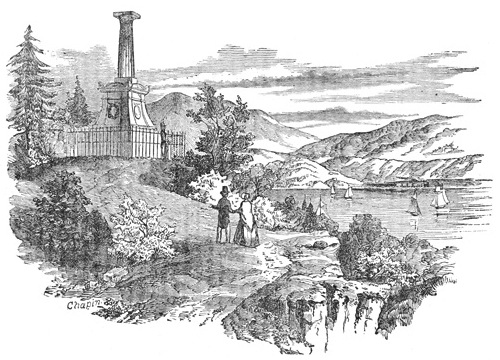
KOSKIUSKO’S MONUMENT.
His great power consisted in the confidence which his fellow-citizens reposed in him. The nephew of the king, once his general, served under him. Kosciusko had unlimited power in the republic, but he displayed the integrity of Washington, and the activity of Cæsar. He attended to procuring supplies, superintended the raising and payment of money, and prevented plundering and fraud, and was equally active in the council and the field. His days and nights, all his powers, were devoted to his country. He secured the administration of justice, abolished bondage, and finally restored to the nation, May 29, in the supreme national council which he established, the great power which had been delegated to him. Catharine at length decided the contest by an overwhelming superiority of numbers. Suwaroff defeated the Poles under Sierakowski at Brzec, in Volhynia, September 18th and 19th. Repnin penetrated through Lithuania, and formed a union with Suwaroff; general Fersen was to support them with 12,000 men. To prevent this, Kosciusko marched from Warsaw with 21,000 men. Poninski was to have supported him with his division; but the Russians intercepted the messenger. The united Russian armies under Fersen attacked the Poles, who were not more than one-third as strong as the Russians, October 10, at Macziewice (about 50 miles from Warsaw); they were three times repulsed, but, on the fourth attack, they broke through the Polish lines. Kosciusko fell from his horse covered with wounds, exclaiming ‘Finis Poloniæ’ and was made prisoner by the enemy. In losing him, his country lost all. Suwaroff stormed Praga November 4; Warsaw capitulated on the 9th; Madalinski left Great Poland; an Austrian army appeared before Lublin. But the noble efforts of the conquered had awakened the regard of Europe towards the unhappy country, and the dearest hopes of the nation—the restoration of their monarchy, with a free constitution—found a powerful support in public opinion. Catharine caused the hero and his noble colleagues, who were prisoners of war, to be thrown into a state prison. Paul I gave them their liberty, and distinguished Kosciusko by marks of his esteem. He presented his own sword to the general, who declined it with these words—‘I no longer need a sword, since I have no longer a country.’ To the day of his death, he never again wore a sword. Paul then presented him with 1,500 peasants, and his friend Niemcewicz, the poet, with 1,000. When on the Russian frontier, Kosciusko declined this present by a letter. He and his friend now went by the way of France and London, where Kosciusko was treated with distinction, to America (1797).
His fortune was very small. On his return to his native country after the war of the revolution, he had received a pension from America, and he now found there such a reception as he deserved. In 1798, he went to France. His countrymen in the Italian army presented to him the sabre of John Sobieski, which had been found (1799) at Loretto. Napoleon afterwards formed the plan of restoring Poland to its place among the nations, and thus, at the same time, injuring Russia, and extending his own power over the east of Europe. But Kosciusko would take no part in this struggle, which was conducted by Dombrowski, in 1807–8, being prevented less by ill health than by having given his word to Paul I never to serve against the Russians. To Napoleon’s proposals he answered, that ‘he would exert himself in the cause of Poland, when he saw the country possessed of its ancient territories, and having a free constitution.’ Fouche tried every means to carry him to Poland. An appeal to the Poles, which appeared under his name in the Moniteur of November 1, 1806, he declared to be spurious.
Having purchased an estate in the neighborhood of Fontainebleau, he lived there in retirement until 1814. April 9, 1814, he wrote to the emperor Alexander, to ask of him an amnesty for the Poles in foreign lands, and to request him to become king of Poland, and to give to the country a free constitution, like that of England. In 1815, he traveled with lord Stuart to Italy, and, in 1816, he settled at Soleure. In 1817, he abolished slavery on his estate of Siecnowicze, in Poland. He afterwards lived in retirement, enjoying the society of a few friends. Agriculture was his favorite occupation. A fall with his horse from a precipice, not far from Vevay, occasioned his death, October 16, 1817, at Soleure. He was never married. In 1818, prince Jablonowski, at the expense of the emperor Alexander, removed his body, which, at the request of the senate, the emperor allowed to be deposited in the tomb of the kings at Cracow. A monument was also erected to his memory, and the women went into mourning for his loss.
NATHANIEL GREENE.
Nathaniel Greene, a major-general in the American army, was born, May 22, 1742, near the town of Warwick in Rhode Island. His father was an anchor smith, and, at the same time, a Quaker preacher, whose ignorance, combined with the fanaticism of the times, made him pay little attention to the worldly learning of his children, though he was very careful of their moral and religious instruction. The fondness for knowledge, however, of young Greene was such, that he devoted all the time he could spare to its acquisition, and employed all his trifling gains in procuring books. His propensity for the life of a soldier was early evinced by his predilection for works on military subjects. He made considerable proficiency in the exact sciences; and, after he had attained his twentieth year, he added a tolerable stock of legal knowledge to his other acquisitions. In the year 1770, he was elected a member of the state legislature, and, in 1774, enrolled himself as a private in a company called the Kentish Guards. After the battle of Lexington, the state of Rhode Island raised what was termed an army of observation, in order to assist the forces collected in Massachusetts, for the purpose of confining the British within the limits of Boston, and chose Greene its commander, with the title of major-general. His elevation from the ranks to the head of three regiments, may give some idea of the estimation in which his military talents were held. June 6, 1775, he assumed his command before the lines of Boston; and, not long afterwards, General Washington arrived, to take the command in chief of the American forces. Between these two distinguished men an intimacy soon commenced, which was never interrupted. Greene accepted a commission from congress of brigadier-general, although, under the state, he held that of major-general; preferring the former, as it promised a larger sphere of action, and the pleasure of serving under the immediate command of Washington. When the American army had followed the enemy to New York, after the evacuation of Boston, they encamped, partly in New York and partly on Long Island. The division posted upon the island was under the orders of Greene; but, at the time of its unfortunate affair with the enemy, he was suffering under severe sickness, and General Sullivan was in command. When he had sufficiently recovered his health, he joined the retreating army, having previously been promoted to the rank of major-general, and was appointed to command the troops in New Jersey destined to watch the movements of a strong detachment of the British, which had been left in Staten Island. December 26, 1776, when Washington surprised the English at Trenton, Greene commanded the left wing of the American forces, which was the first that reached the town, and, having seized the enemy’s artillery, cut off their retreat to Princeton. Next summer, Sir William Howe having embarked with a large force at New York, for the purpose of landing on the eastern shore of the Chesapeake, and thence marching to Philadelphia, Washington hastened to oppose him; and, September 11, the battle of the Brandywine took place, in which the Americans were defeated. In this affair, Greene commanded the vanguard, together with Sullivan, and it became his duty to cover the retreat, in which he fully succeeded. After General Howe had obtained possession of Philadelphia, the British army, in consequence of this victory, encamped at Germantown, where an attack was made upon it by Washington, October 4, 1777, in which Greene commanded the left wing. The disastrous issue of this attempt is well known; but it has been asserted, that the left wing was the only part of the American army which had the good fortune to effect the service allotted it that day. The next service upon which General Greene was engaged, was that of endeavoring to prevent lord Cornwallis from collecting supplies, for which he had been detached into the Jerseys, with 3000 men; but, before Greene could bring him to an action, he had received reinforcements, which gave him so great a superiority, that the American general was recalled by the commander-in-chief. In March of the following year, Greene, at the solicitation of Washington, accepted the appointment of quarter-master-general, on two conditions; that he should retain his right of command in time of action, and that he should have the choice of two assistants. At the battle of Monmouth, in the ensuing month of June, he led the right wing of the second line, and mainly contributed to the partial success of the Americans. After this, he continued engaged in discharging the duties of his station until August, when he was sent to join Sullivan, who, with the forces under his command, aided by the French fleet under D’Estaing, was preparing to make an attempt upon Newport in Rhode Island, then in possession of the enemy. The command of the left wing of the troops was assigned to Greene. The enterprise, however, failed, in consequence of some misunderstanding between Sullivan and D’Estaign; and the consequent retreat of the American army was covered by Greene, who repulsed an attack of the enemy with half their number. When General Washington, alarmed for the safety of the garrisons on the North river, repaired to West Point, he left Greene in command of the army in New Jersey. The latter had not been long in that command, before he was attacked, near Springfield, by a force much superior to his, under Sir Henry Clinton; but the enemy were repulsed, though they burned the village. This affair happened June 23. October 6, he was appointed to succeed the traitor Arnold in the command at West Point. In this station, however, he continued only until the 14th of the same month, when he was chosen by General Washington to take the place of General Gates, in the chief direction of the southern army. From this moment, when he was placed in a situation where he could exercise his genius without control, dates the most brilliant portion of Greene’s career. The ability, prudence and firmness which he here displayed, have caused him to be ranked, in the scale of our revolutionary generals, second only to Washington. December 2, 1780, Greene arrived at the encampment of the American forces at Charlotte, and, on the 4th, assumed the command. After the battle of the Cowpens, gained by Morgan, January 17, 1781, he effected a junction with the victorious General, having previously been engaged in recruiting his army, which had been greatly thinned by death and desertion; but the numbers of Cornwallis were still so superior, that he was obliged to retreat into Virginia, which he did with a degree of skill that has been the theme of the highest eulogy. He, soon afterwards, however, returned to North Carolina, with an accession of force, and, March 15, encountered Cornwallis at Guilford court-house, where he was defeated; but the loss of the enemy was greater than his, and no advantages accrued to them from the victory. On the contrary, Cornwallis, a few days afterwards, commenced a retrograde movement towards Wilmington, leaving many of his wounded behind him, and was followed for some time by Greene. Desisting, however, from the pursuit, the latter marched into South Carolina, and a battle took place, April 25, between him and lord Rawdon, near Camden, in which he was again unsuccessful, though again the enemy were prevented by him from improving their victory, and, not long after, were obliged to retire. May 22, having previously reduced a number of the forts and garrisons in South Carolina, he commenced the siege of Ninety-Six, but in June the approach of lord Rawdon compelled him to raise it, and retreat to the extremity of the state. Expressing a determination ‘to recover South Carolina, or die in the attempt,’ he again advanced, when the British forces were divided, and lord Rawdon was pursued, in his turn, to his encampment at Orangeburg, where he was offered battle by his adversary, which was refused. September 8, Greene obtained a victory over the British forces under Colonel Stewart, at Eutaw Springs, which completely prostrated the power of the enemy in South Carolina. Greene was presented by congress with a British standard and a gold medal, as a testimony of their sense of his services on this occasion. This was the last action in which Greene was engaged. During the rest of the war, however, he continued in his command, struggling with the greatest difficulties, in consequence of the want of all kinds of supplies, and the mutinous disposition of some of his troops. When peace released him from his duties, he returned to Rhode Island; and his journey thither, almost at every step, was marked by some private or public testimonial of gratitude and regard. On his arrival at Princeton, where congress was then sitting, that body unanimously resolved, that ‘two pieces of field ordnance, taken from the British army at Cowpens, Augusta, or Eutaw,’ should be presented to him by the commander-in-chief. In October, 1785, Greene repaired, with his family, to Georgia, some valuable grants of lands near Savannah having been made to him by that state. He died June 19, 1786, in his 44th year, in consequence of an inflammation of the brain, contracted by exposure to the rays of an intense sun. General Greene possessed, in a great degree, not only the common quality of physical courage, but that fortitude and unbending firmness of mind, which are given to few, and which enabled him to bear up against the most cruel reverses, and struggle perseveringly with, and finally surmount, the most formidable difficulties. He was ever collected in the most trying situations, and prudence and judgment were distinguishing traits in his character. In his disposition, he was mild and benevolent; but when it was necessary, he was resolutely severe. No officer of the revolutionary army possessed a higher place in the confidence and affection of Washington, and, probably, none would have been so well calculated to succeed him, if death had deprived his country of his services during the revolutionary struggle.
FREDERIC WILLIAM AUGUSTUS STEUBEN.
Baron von Frederic William Augustus Steuben; a distinguished Prussian officer, who attached himself to the American cause in the revolution of 1776. He had been aid-de-camp to Frederic the Great, and had attained the rank of lieutenant-general in his army. Sacrificing his honors and emoluments in Europe, Steuben came to America in 1777, and tendered his services to congress, as a volunteer in their army, without claiming any rank or compensation. He received the thanks of that body, and joined the main army under the commander-in-chief at Valley Forge. Baron Steuben soon rendered himself particularly useful to the Americans, by disciplining the forces. On the recommendation of general Washington, congress, in May 1778, appointed the baron inspector-general of the army, with the rank of major-general. His efforts in this capacity were continued with remarkable diligence, until he had placed the troops in a situation to withstand the enemy. In the estimates of the war office, 5000 extra muskets were generally allowed for the waste and destruction in the army; but such was the exact order under the superintendence of Steuben, that in his inspection return, but three muskets were deficient, and those accounted for. A complete scheme of exercise and discipline, which he composed, was adopted in the army by the direction of congress. He possessed the right of command in the line, and at one period was at the head of a separate detachment in Virginia. At the battle of Monmouth he was engaged as a volunteer. When reviewing the troops, it was his constant custom to reward the disciplined soldier with praise, and to pass severe censure upon the negligent. Numerous anecdotes are related illustrative of the generosity, purity and kindness of his disposition. After the treacherous defection of Arnold, the baron held his name in the utmost abhorrence. One day, he was inspecting a regiment of light horse, when that name struck his ear. The man was ordered to the front, and presented an excellent appearance. Steuben told him that he was too respectable to bear the name of a traitor; and at his request the soldier adopted that of the baron, whose bounty he afterwards experienced, and brought up a son by the same name.
At the siege of Yorktown, baron Steuben was in the trenches at the head of a division, where he received the first offer of lord Cornwallis to capitulate. The marquis de Lafayette appeared to relieve him in the morning; but, adhering to the European etiquette, the baron would not quit his post until the surrender was completed or hostilities recommenced. The matter being referred to general Washington, the baron was suffered to remain in the trenches till the enemy’s flag was struck. After the capture of Cornwallis, when the superior American officers were paying every attention to their captives, Steuben sold his favorite horse in order to raise money to give an entertainment to the British officers, as the other major-generals had previously done. His watch he had previously disposed of to relieve the wants of a sick friend. On another occasion, when he desired to reciprocate the invitations of the French officers, he ordered his people to sell his silver spoons and forks saying it was anti-republican to make use of such things, and adding, that the gentlemen should have one good dinner if he ate his meals with a wooden spoon for ever after. Steuben continued in the army till the close of the war, perfecting its discipline. The silence and dexterity of his movements surprised the French allies. He possessed the particular esteem of general Washington, who took every proper opportunity to recommend him to congress; from which body he received several sums of money, that were chiefly expended in acts of charity, or in rewarding the good conduct of the soldiers.
Upon the disbandment of the continental army at Newburgh, many affectionate bonds, formed amidst the danger and hardships of a long and arduous service, were to be broken asunder for ever. At this season of distress, the benevolent Steuben exerted himself to alleviate the forlorn condition of many. He gave his last dollar to a wounded black, to procure him a passage home. Peace being established, the baron retired to a farm in the vicinity of New York, where, in the society of his friends, and the amusements of books and chess, he passed his time as comfortably as his exhausted purse would allow. The state of New Jersey had given him a small farm, and that of New York 16,000 acres of land in the country of Oneida. The exertions of colonel Hamilton and general Washington subsequently procured him an annuity of $2500, from the general government. He built a log house, and cleared 60 acres of his tract of land, a portion of which he partitioned out, on easy terms, to twenty or thirty tenants, and distributed nearly a tenth among his aid-de-camps and servants. In this situation he lived contentedly, until the year 1795, when an apoplectic attack put an end to his life, in his sixty-fifth year. An abstract of his system of military manœuvres was published in 1779. The year preceding his death, he published a letter on the established militia and military arrangements.
BARON DE KALB.
Baron De Kalb, a major-general in the American army, was born in Germany, about the year 1717. When young, he entered into the service of France, in which he continued for 42 years, and obtained the rank of brigadier-general. In 1757, during the war between England and France, he was sent, by the French government, to the American colonies, in order to learn the points in which they were most vulnerable, and how far the seeds of discontent might be sown in them towards the mother country. He was seized, while in the performance of this commission, as a suspected person, but escaped detection. He then went to Canada, where he remained until its conquest by the British, after which he returned to France. In 1777, during the war of the revolution, he came a second time to the U. States, and offered his services to congress. They were accepted, and he was soon after made a major-general. At first he was placed in the northern army, but when the danger which threatened Charleston from the formidable expedition under sir Henry Clinton, in 1778, rendered it necessary to reinforce the American troops in the south, a detachment was sent to them, consisting of the Maryland and Delaware lines, which were put under his command. Before he could arrive, however, at the scene of action, general Lincoln had been made prisoner, and the direction of the whole southern army in consequence devolved upon the baron, until the appointment of general Gates. August 15th, Gates was defeated near Camden by lord Rawdon, and in the battle, baron de Kalb, who commanded the right wing, fell, covered with wounds, while gallantly fighting on foot. A tomb was erected to his memory, by order of congress, in the cemetery of Camden.
RICHARD MONTGOMERY.
Richard Montgomery, a major-general in the army of the U. States, was born in 1737, in the north of Ireland. He embraced the profession of arms, and served under Wolfe, at Quebec, in 1759; but, on his return to England, he left his regiment, although his prospects for promotion were fair. He then removed to America, for which country he entertained a deep affection; he purchased an estate in New York, about 100 miles from the city, and married a daughter of judge Livingston. His feelings in favor of America were so well known, that, on the commencement of the revolutionary struggle, he was entrusted with the command of the continental forces in the northern department, in conjunction with general Schuyler. The latter, however, fell sick, and the chief command in consequence, devolved upon Montgomery, who, after various successes (the reduction of fort Chamblee, the capture of St. John’s, and of Montreal), proceeded to the siege of Quebec. This he commenced Dec. 1, 1775, after having formed a junction with colonel Arnold, at Point-aux-Trembles; but, as his artillery was not of sufficient calibre to make the requisite impression, he determined upon attempting the capture of the place by storm. He made all his arrangements, and advanced, at the head of the New York troops, along the St. Lawrence. He assisted, with his own hands, in pulling up the pickets that obstructed his approach to the second barrier, which he was resolved to force, when the only gun fired from the battery of the enemy killed him and his two aid-de-camps. The three fell at the same time, and rolled upon the ice formed on the river. The next day his body was brought into Quebec, and buried without any mark of distinction. Congress directed a monument, with an inscription, to be erected to his memory, and placed in front of St. Paul’s church, in New York, and, July 8, 1818, his remains were brought from Quebec, in consequence of a resolve of the state of New York, and interred near the monument. General Montgomery was gifted with fine abilities, and had received an excellent education. His military talents, especially, were great; his measures were taken with judgment, and executed with vigor The sorrow for his loss was heightened by the esteem which his amiable character had gained him. At the period of his death, he was only 38 years of age.
GILBERT MOTIER LAFAYETTE.
Gilbert Motier Lafayette, (formerly marquis de,) was born at Chavagnac, near Brioude, in Auvergne, Sept. 6, 1757, was educated in the college of Louis le Grand, in Paris, placed at court as an officer in one of the guards of honor, and, at the age of 17, was married to the granddaughter of the duke de Noailles. It was under these circumstances that the young marquis de Lafayette entered upon a career so little to be expected of a youth of vast fortune, of high rank, of powerful connections, at the most brilliant and fascinating court in the world. He left France secretly for America, in 1777, and arrived at Charleston, South Carolina, April 25, being then 19 years old. The state of this country, it is well known, was at that time most gloomy: a feeble army, without clothing or arms, was with difficulty kept together before a victorious enemy; the government was without resources or credit, and the American agents in Paris were actually obliged to confess that they could not furnish the young nobleman with a conveyance. ‘Then,’ said he, ‘I will fit out a vessel myself;’ and he did so. The sensation produced in this country, by his arrival, was very great: it encouraged the almost disheartened people to hope for succor and sympathy from one of the most powerful nations in Europe. Immediately on his arrival, Lafayette received the offer of a command in the continental army, but declined it, raised and equipped a body of men at his own expense, and then entered the service as a volunteer without pay. He lived in the family of the commander-in-chief, and won his full affection and confidence. He was appointed major-general in July, and, in September, was wounded at Brandywine. He was employed in Pennsylvania and Rhode Island in 1778, and, after receiving the thanks of his country for his important services, embarked at Boston, in January, 1779, for France, where it was thought that he could assist the cause more effectually for a time. The treaty concluded between France and America, about the same period, was, by his personal exertions, made effective in our favor, and he returned to America with the intelligence that a French force would soon be sent to this country. Immediately on his arrival, he entered the service, and received the command of a body of infantry of about 2000 men, which he clothed and equipped, in part, at his own expense. His forced march to Virginia, in December, 1780, raising 2000 guineas at Baltimore, on his own credit, to supply the wants of his troops; his rescue of Richmond; his long trial of generalship with Cornwallis, who boasted that ‘the boy could not escape him;’ the siege of Yorktown, and the storming of the redoubt, are proofs of his devotion to the cause of American independence. Desirous of serving that cause at home, he again returned to France for that purpose. Congress, which had already acknowledged his merits on former occasions, now passed new resolutions, Nov. 23, 1781, in which, besides the usual marks of approbation, they desired the American ministers to confer with him in their negotiations. In France, a brilliant reputation had preceded him, and he was received with the highest marks of public admiration. Still he urged upon his government the necessity of negotiating with a powerful force in America, and succeeded in obtaining orders to this effect. On his arrival in Cadiz, he found 49 ships with 20,000 men, ready to follow him to America, had not peace rendered it unnecessary. A letter from him communicated the first intelligence of that event to congress. The importance of his services in France may be seen by consulting his letters in the Correspondence of the American Revolution, (Boston, 1831.) He received pressing invitations, however, to revisit the country. Washington in particular, urged it strongly; and, for the third time, Lafayette landed in the United States, Aug. 4, 1784. After passing a few days at Mount Vernon, he visited Baltimore, Philadelphia, New York, Boston, etc., and was everywhere received with the greatest enthusiasm and delight. Previous to his return to France, congress appointed a deputation, consisting of one member from each state, ‘to take leave of him on behalf of the country, and assure him that these United States regard him with particular affection, and will not cease to feel an interest in whatever may concern his honor and prosperity.’ After his return, he was engaged in endeavoring to mitigate the condition of the Protestants in France, and to effect the abolition of slavery. In the assembly of the notables, in 1787, he proposed the suppression of lettres de cachet, and of the state-prisons, the emancipation of the Protestants, and the convocation of the representatives of the nation. When asked by the count D’Artois, since Charles X, if he demanded the states-general—‘Yes,’ was his reply, ‘and something better.’ Being elected a member of the states-general, which took the name of national assembly (1789), he proposed a declaration of rights, and the decree providing for the responsibility of the officers of the crown. Two days after the attack on the Bastile, he was appointed (July 15) commander-in-chief of the national guards of Paris. The court and national assembly were still at Versailles, and the populace of Paris, irritated at this, had already adopted, in sign of opposition, a blue and red cockade (being the colors of the city of Paris). July 26, Lafayette added to this cockade the white of the royal arms, declaring at the same time that the tri-color should go round the world. On the march of the populace to Versailles (October 5 and 6), the national guards clamored to be led thither. Lafayette refused to comply with their demand, until, having received orders in the afternoon, he set off, and arrived at 10 o’clock, after having been on horseback from before daylight. He requested that the interior posts of the chateau might be committed to him; but this request was refused, and the outer posts only were entrusted to the national guards. This was the night on which the assassins murdered two of the queen’s guards, and were proceeding to further acts of violence, when Lafayette, at the head of the national troops, put an end to the disorder, and saved the lives of the royal family. In the morning he accompanied them to Paris. On the establishment of the Jacobin club at Paris, he organized, with Bailly, then mayor of Paris, the opposing club of Feuillans. Jan. 20, 1790, he supported the motion for the abolition of titles of nobility, from which period he renounced his own, and has never since resumed it. The constitution of a representative monarchy, which was the object of his wishes, was now proposed, and July 13, 1790, was appointed for its acceptance by the king and the nation, and, in the name of 4,000,000 national guards, Lafayette swore fidelity to the constitution. Declining the dangerous power of constable of France, or generalissimo of the national guards of the kingdom, after having organized the national militia, and defended the king from the popular violence, he resigned all command, and retired to his estates. The first coalition against France (1792) soon called him from his retirement. Being appointed one of the three major-generals in the command of the French armies, he established discipline, and defeated the enemy at Philippeville, Maubeuge and Florennes, when his career of success was interrupted by the domestic factions of his country. Lafayette openly denounced the terrible Jacobins, in his letter of June 16, in which he declared that the enemies of the revolution, under the mask of popular leaders, were endeavoring to stifle liberty under the excesses of licentiousness. June 20, he appeared at the bar of the assembly, to vindicate his conduct, and demand the punishment of the guilty authors of the violence. But the Mountain had already overthrown the constitution, and nothing could be effected. Lafayette then offered to conduct the king and his family to Compiègne. This proffer being declined, he returned to the army, which he endeavored to rally round the constitution. June 30, he was burnt in effigy at the Palais-Royal, and Aug. 5, was accused of treason before the assembly. Still he declared himself openly against the proceedings of August 10; but, finding himself unsupported by his soldiers, he determined to leave the country, and take refuge in some neutral ground. Some persons have charged general Lafayette with a want of firmness at this period; but it is without a full understanding of the situation of things. Conscious that a price was set on his head at home, knowing that his troops would not support him against the principles which were triumphing in the clubs and the assembly, and sensible that, even if he were able to protract the contest with the victorious faction, the frontiers would be exposed to the invasions of the emigrants and their foreign allies, with whom he would have felt it treason against the nation to have negotiated, he had no alternative. Having been captured by an Austrian patrol, he was delivered to the Prussians, by whom he was again transferred to Austria. He was carried, with great secrecy, to Olmutz, where he was subjected to every privation and suffering, and cut off from all communication with his friends, who were not even able to discover the place of his confinement until late in 1794. An unsuccessful attempt was made to deliver him from prison by Dr. Bollman, a German, and colonel Huger, of Charleston, S. C. His wife and daughters, however, succeeded in obtaining admission to him, and remained with him nearly two years, till his release. Washington had written directly to the emperor of Austria on his behalf, without effect; but, after the memorable campaign of Bonaparte in Italy, the French government required that the prisoners at Olmutz should be released, which was done Aug. 25, 1797, after a negotiation that lasted three months. Refusing to take any part in the revolutions of the 18th Fructidor, or of the 18th Brumaire, he returned to his estate at La Grange, and, declining the dignity of senator, offered him by Bonaparte, he gave his vote against the consulate for life, and, taking no further part in public affairs, devoted himself to agricultural pursuits. On the restoration of the Bourbons, in 1814, he perceived that their principles of government were not such as France required, and he did not therefore leave his retirement. The 20th of March, 1815, again saw Napoleon on the imperial throne, and endeavoring to conciliate the nation by the profession of liberal principles Lafayette refused, though urged, through the medium of Joseph, to see him, protested against the acte additionnel of April 22, declined the peerage offered him by the emperor, but accepted the place of representative, to which the votes of his fellow-citizens called him. He first met Napoleon at the opening of the chambers: the emperor received him with great marks of kindness, to which, however, he did not respond; but, although he would take no part in the projects of Napoleon, he gave his vote for all necessary supplies, on the ground that France was invaded, and that it was the duty of all Frenchmen to defend their country. June 21, Napoleon returned from Waterloo, and it was understood that it was determined to dissolve the house of representatives, and establish a dictatorship. Two of his counselors informed Lafayette that in two hours the representative body would cease to exist. Immediately on the opening of the session, he ascended the tribune, and addressed the house as follows: ‘When, for the first time after an interval of many years, I raise a voice which all the old friends of liberty will still recognize, it is to speak of the dangers of the country, which you only can save. This, then, is the moment for us to rally round the old tri-colored standard, the standard of ‘89, of liberty, of equality, of public order, which we have now to defend against foreign violence, and domestic usurpation.’ He then moved that the house declare itself in permanent session, and all attempts to dissolve it high treason; that whoever should make such an attempt, should be considered a traitor, etc. In the evening, Napoleon sent Lucien to the house, to make one more effort in his favor. Lucien, in a strain of impassioned eloquence, conjured the house not to compromise the honor of the French nation by inconstancy to the emperor. At these words, Lafayette rose in his place, and, addressing himself directly to the orator, exclaimed, ‘Who dares accuse the French nation of inconstancy to the emperor? Through the sands of Egypt, and the wastes of Russia, over 50 fields of battle, this nation has followed him devotedly; and it is for this that we now mourn the blood of three millions of Frenchmen.’
This appeal had such an effect on the assembly, that Lucien resumed his seat without finishing his discourse. A deputation of five members from each house was then appointed to deliberate in committee with the council of ministers. Of this deputation, general Lafayette was a member, and he moved that a committee should be sent to the emperor to demand his abdication. The arch-chancellor refused to put the motion; but the emperor sent in his abdication the next morning (June 22). A provisional government was formed, and Lafayette was sent to demand a suspension of hostilities of the allies, which was refused. On his return, he found Paris in possession of the enemy; and, a few days after (July 8), the doors of the representatives’ chamber were closed, and guarded by Prussian troops. Lafayette conducted a number of the members to the house of Lanjuinais, the president, where they drew up a protest against this act of violence, and quietly separated. Lafayette now retired once more to La Grange, where he remained till 1818, when he was chosen member of the chamber of deputies. Here he continued to support his constitutional principles, by opposing the laws of exception, the establishment of the censorship of the press, the suspension of personal liberty, etc, and by advocating the cause of public instruction, the organization of a national militia, and the inviolability of the charter.
In August, 1824, he landed at New York, on a visit to the United States, upon the invitation of the president, and was received, in every part of the country, with the warmest expressions of delight and enthusiasm. He was proclaimed, by the popular voice, ‘the guest of the nation,’ and his presence was everywhere the signal for festivals and rejoicings. He passed through the 24 states of the Union in a sort of triumphal procession, in which all parties joined to forget their dissensions, in which the veterans of the war renewed their youth, and the young were carried back to the doings and sufferings of their fathers. Having celebrated, at Bunker hill, the anniversary of the first conflict of the revolution, and, at Yorktown, that of its closing scene, in which he himself had borne so conspicuous a part, and taken leave of the four ex-presidents of the United States, he received the farewell of the president in the name of the nation, and sailed from the capital in a frigate named, in compliment to him, the Brandywine, September 7, 1825, and arrived at Havre, where the citizens, having peaceably assembled to make some demonstration of their respect for his character, were dispersed by the gendarmerie. In December preceding, the congress of the United States made him a grant of $200,000, and a township of land, ‘in consideration of his important services and expenditures during the American revolution.’ The grant of money was in the shape of stock, bearing interest at six per cent., and redeemable December 31, 1834. In August, 1827, he attended the obsequies of Manuel, over whose body he pronounced a eulogy. In November, the chamber of deputies was dissolved. Lafayette was again returned a member by the new elections. Shortly before the revolution of 1830, he traveled to Lyons, etc., and was enthusiastically received—a striking contrast to the conduct of the ministers towards him, and an alarming symptom to the despotic government. During the revolution of July, 1830, he was appointed general-in-chief of the national guards of Paris, and, though not personally engaged in the fight, his activity and name were of the greatest service. To the Americans, Lafayette, the intimate friend of Washington, had appeared, in his late visit, almost like a great historical character returning from beyond the grave. In the eyes of the French, he was a man of the early days of their revolution—a man, moreover, who never changed side or principle. His undeviating consistency is acknowledged by all, even by those who do not allow him the possession of first rate talents. When the national guards were established throughout France, after the termination of the struggle, he was appointed their commander-in-chief, and his activity in this post was admirable. August 17, he was made marshal of France. His influence with the government seems to have been, for some time, great, but whether his principles were too decidedly republican to please the new authorities (a few days after the adoption of the new charter, he declared himself against hereditary peerage, and repeatedly called himself a pupil of the American school), or whether he was considered as the rallying point of the republican party, or whatever may have been the reason, he sent in his resignation in December, 1830, which was accepted, and count Lobau appointed chief of the national guards of Paris. Lafayette declared from the tribune, that he had acted thus in consequence of the distrust which the power accompanying his situation seemed to excite in some people. On the same occasion, he also expressed his disappprobation of the new law of election. Shortly before his resignation, he exerted himself most praiseworthily to maintain order during the trial of the ex-ministers. The Poles made him first grenadier of the Polish national guards. He died at Paris, May 18, 1834. Regnault-Warin’s Memoires sur le General Lafayette (Paris, 1824), contains many facts relative to his political life in France. His secretary, M. Levasseur, published an account of his tour in the United States (Paris, 1825), which has been translated in America.
ISRAEL PUTNAM.
Israel Putnam, a distinguished soldier in the French and English wars, and subsequently in that of the revolution, was born of English parents, at Salem, in the then province of Massachusetts, Jan. 7th, 1718. Being intended for a farmer, he received only a common education. He had a strong mind, vigorous constitution, great bodily strength, enterprise and activity, excelled in athletic exercises, and, while a stripling, was ambitious of performing the full labor of manhood. He married very young, and removed, in 1739, to Pomfret, in Connecticut, where he had purchased a tract of land. During his residence there, his flocks and those of his neighbors being terribly thinned by a monstrous she wolf, Putnam with a few associates, traced the ferocious animal to a deep cavern in a rock. Into this he crept alone, with a torch in one hand and a musket in the other, and, at the utmost personal risk, destroyed the creature. When the war of 1755 broke out between France and England, he was appointed, at the age of thirty-seven, commander of a company, enlisted the necessary number of recruits from the young men in his vicinity, and joined the army then commencing the campaign near Crown Point. His services as a partisan officer were unremitting and great, and caused him to be promoted, in 1757, to the rank of major, by the legislature of Connecticut. In 1758, he fell into the Indian ambuscade, and was taken prisoner, when returning to Fort Edward from an expedition to watch the enemy’s movements near Ticonderoga. The Indians were about to burn him to death, having already tied him to a tree and set fire to a circle of combustibles around him, when he was rescued by the interposition of their leader, Molang, a famous French partisan officer. He was then carried to Ticonderoga, where he underwent an examination before the Marquis De Montcalm, who ordered him to Montreal. There he found several fellow prisoners, among whom was colonel Peter Schuyler, who immediately visited, and found him almost destitute of clothing and dreadfully wounded and bruised. The colonel supplied him with money and, having clothed himself in a decent garb, he was immediately treated with the respect due his rank. An exchange of prisoners procured Putnam his liberty. He resumed his military duties, and, having been previously appointed a lieutenant-colonel, rendered especial service at the siege of Montreal by the British, in 1760. In 1762, after war had been declared between England and Spain, he accompanied the expedition, under Lord Albemarle, against the Havana. In 1764, having been appointed colonel, he marched, at the head of a regiment, with general Bradstreet, against the savages of the western frontier. On his return from this expedition, which resulted in a treaty between the contending parties, he betook himself, once more, to a country life, filled several offices in his native town, to represent it in the general assembly. In 1770, he went, with general Lyman and some others, to explore a grant of land on the Mississippi. General Lyman died there; but Putnam returned after having made some improvements on his tract. When hostilities commenced between England and the colonies (April 18th, 1775,) Putnam received the intelligence as he was plowing in the middle of a field; he left his plow there, unyoked his team, and, without changing his clothes, set off for the scene of action. Finding the British shut up and closely invested with a sufficient force in Boston, he returned to Connecticut, levied a regiment under colonial authority, and marched to Cambridge. His colony now appointed him a major-general on the provincial staff, and congress soon after confirmed to him the same rank on the continental. About this time the British offered him the rank of a major-general in his majesty’s army, with a pecuniary remuneration for his treason; but the temptation could not influence him. In the several preparatory operations for the battle of Bunker’s hill, he took an active part. After the commencement of the retreat at the battle of Bunker’s hill, Putnam arrived on the field with a reinforcement, and performed everything to be expected from a brave and experienced officer; the enemy pursued the retreating Americans to Winter hill, but Putnam halted there, and drove them back, under cover of their ships. On the evacuation of Boston, March 17th 1776, the greater part of the forces were dispatched to New York, and Putnam was, some time after, sent thither to take upon him the command. After the disastrous action on Long Island, and general Washington’s masterly retreat from thence, Putnam was nominated to the command of the right grand division of the army. He served some time in the vicinity of New York and was sent to the western side of the Hudson, and shortly after, to suprintend the fortifications of Philadelphia. After the battles of Trenton and Princeton, he was posted at Princeton, where he continued till the ensuing spring, with a very inferior force, guarding a considerable extent of frontier, curtailing and harrassing the enemy, without sustaining the least disaster. During his stay at Princeton, by attacking the foraging parties of the enemy and assemblages of the disaffected who infested his vicinity, he captured nearly a thousand prisoners.
In the spring of 1777, he was appointed to the command of a separate army in the highlands of New York. There was no regular enemy in this neighborhood, but the country around was filled with tories, and a species of banditti, called cow-boys, who committed shocking depredations. Many of the tories clandestinely traversed the country, with messages from one British army to another, and even on recruiting expeditions for the royal service. One of them, a lieutenant in the new tory levies, was detected in the American camp, and reclaimed by governor Tryon, his commander, with threats of vengeance in case of his punishment. He received this laconic answer from general Putnam: ‘Sir: Nathan Palmer, a lieutenant in your king’s service, was taken in my camp as a spy; he was tried as a spy; he was condemned as a spy; and you may rest assured, Sir, he shall be hanged as a spy.… P. S. Afternoon. He is hanged.’ After the capture of Fort Montgomery, Putnam selected West Point as the best calculated site for a fortress to protect the river. The reputation it afterwards attained, evinced the judiciousness of this selection. After the battle of Monmouth, Putnam was posted, for the winter, at Reading in Connecticut, that he might protect the country adjoining to the Sound, and the garrison at West Point. While he was on a visit to one of his outposts governor Tryon advanced upon him with 1500 men. Putnam had with him but 150 men and two field-pieces, with which he kept the enemy at bay some time. At length, seeing the enemy preparing to charge, he ordered his men to retire to a swamp, while he plunged down a precipice so steep as to have artificial steps, nearly one hundred in number, for the use of foot passengers. The enemy’s dragoons stopped short, afraid to venture, although within a sword’s length of him. While they went round the brow of the hill to gain the valley, he raised a force sufficiently strong to pursue Tryon on his retreat. In the campaign of 1779, he commanded the Maryland line, stationed near West Point. In the autumn of this year, the American army retired into winter quarters, at Morristown, and Putnam accompanied his family into Connecticut for a few weeks. At the commencement of his journey from thence to Morristown, while on the road between Pomfret and Hartford, he was seized with an extraordinary numbness of his right hand and foot, which crept gradually upon him, until his right side became, in a considerable degree, paralyzed. This severe affliction produced a transient depression of his mind; but he conquered his dejection, and resumed his naturally cheerful temper. He was still able to walk and ride moderately, and the faculties of his mind were unimpaired. In this situation he lived to see his country enjoying that independence of which he had been so able a champion, and died at Brookline, in Connecticut, May 29th 1790, aged seventy-two years.
STEPHEN DECATUR.
Stephen Decatur, a celebrated American naval officer, was born January 5, 1779, on the eastern shore of Maryland, whither his parents had retired while the British were in Philadelphia. He entered the American navy in March, 1798, and was soon promoted to the rank of first lieutenant. While at Syracuse, attached to the squadron of commodore Preble, he was first informed of the fate of the American frigate Philadelphia, which, in pursuing a Tripolitan corsair, ran on a rock about four and a half miles from Tripoli, and was taken by the Tripolitans, and towed into the harbor. Lieutenant Decatur conceived the project of attempting her recapture or destruction. He selected, for this purpose, a ketch, and manned her with 70 volunteers. February 16, 1804, at 7 o’clock at night, he entered the harbor of Tripoli, boarded the frigate, though she had all her guns mounted and charged, and was lying within half-gun shot of the bashaw’s castle and of his principal battery. Two Tripolitan cruisers were lying within two cables’ length, on the starboard quarter and several gun-boats within half-gun-shot on the starboard bow, and all the batteries upon the shore were opened upon the assailants. Decatur set fire to the frigate, and continued alongside until her destruction was certain. For this exploit, the American congress voted him thanks and a sword, and the president immediately sent him a captaincy. The next spring, it being resolved to make an attack upon Tripoli, commodore Preble equipped six gun-boats and two bombards, formed them into two divisions, and gave the command of one of them to captain Decatur. The enemy’s gun-boats were moored along the mouth of the harbor, under the batteries, and within musket-shot. Captain Decatur determined to board the enemy’s eastern division, consisting of nine. He boarded in his own boat, and carried two of the enemy’s boats in succession. When he boarded the second boat, he immediately attacked her commander, who was his superior in size and strength, and, his sword being broken, he seized the Turk, when a violent scuffle ensued. The Turk threw him, and drew a dirk for the purpose of stabbing him, when Decatur, having a small pistol in his right pocket, took hold of it, and, turning it as well as he could, so as to take effect upon his antagonist, cocked it, fired through his pocket, and killed him. When Commodore Preble was superseded in the command of the squadron, he gave the frigate Constitution to Decatur, who was afterwards removed to the Congress, and returned home in her when peace was concluded with Tripoli. He succeeded commodore Barron in the command of the Chesapeake, after the attack made upon her by the British man-of-war Leopard. He was afterwards transferred to the frigate United States. In the war between Great Britain and the United States, while commanding the frigate United States, he fell in, Oct. 25, 1812, with the Macedonian, mounting 49 carriage-guns, one of the finest of the British vessels of her class, and captured her after an engagement of an hour and a half. When captain Carden, the commander of the Macedonian, tendered him his sword, he observed that he could not think of taking the sword of an officer who had defended his ship so gallantly, but should be happy to take him by the hand. In a letter written five days after the capture, he says, “I need not tell you that I have done every thing in my power to soothe and console captain Carden; for, really, one half the pleasure of this little victory is destroyed in witnessing the mortification of a brave man, who deserved success quite as much as we did who obtained it.” In January, 1814, commodore Decatur, in the United States, with his prize the Macedonian, then equipped as an American frigate, was blockaded at New London by a British squadron greatly superior in force. A challenge which he sent to the commander of the British squadron, sir Thomas Hardy, offering to meet two of the British frigates with his two ships, was declined. In January, 1815, he attempted to set sail from New York, which was blockaded by four British ships; but the frigate under his command, the President, was injured in passing the bar, and was captured by the whole squadron, after having maintained a running fight of two hours and a half with one of the frigates, the Endymion, which was dismantled and silenced. After the conclusion of peace, he was restored to his country, in 1815. The conduct of the Barbary powers, and of Algiers in particular, having been insulting to the United States, on the ratification of peace with Great Britain, war was declared against Algiers, and a squadron was fitted out, under the command of commodore Decatur, for the purpose of obtaining redress. In the spring of 1815, he set sail, and, June 17, off cape de Gatt, captured an Algerine frigate, after a running fight of 25 minutes, in which the famous admiral Rais Hammida, who had long been the terror of the Mediterranean sea, fell. The American squadron arrived at Algiers June 28. In less than 48 hours, Decatur terrified the regency into his own terms, which were, mainly, that no tribute should ever be required, by Algiers, from the United States of America; that all Americans in slavery should be given up without ransom; that compensation should be made for American property seized; that all citizens of the United States, taken in war, should be treated as prisoners of war are by other nations, and not as slaves, but held subject to an exchange without ransom. After concluding this treaty, he proceeded to Tunis, where he obtained indemnity for the outrages exercised or permitted by the bashaw. Thence he went to Tripoli, where he made a similar demand with like success, and procured the release of 10 captives, Danes and Neapolitans. He arrived at the United States Nov. 12, 1815, was subsequently appointed one of the board of navy commissioners, and was residing at Washington, in that capacity, when he was killed in a duel with commodore Barron, March 22, 1820, occasioned by his animadversions on the conduct of the latter. Courage, sagacity, energy, self-possession, and a high sense of honor, were the characteristic traits of Decatur. From his boyhood, he was remarkable for the qualities which presage eminence in naval warfare. He enjoyed the sea as his element. He possessed an active, muscular frame, a quick and penetrating eye, and a bold, adventurous and ambitious spirit.
COMMODORE ISAAC HULL.
Commodore Isaac Hull, was born in Connecticut, March 9th 1775. His father was an officer in the American army during the whole of the revolutionary war, and was detained for a long time a prisoner in the Jersey prison-ship. Commodore Hull’s passion for the sea was very early displayed, and became stronger as he grew up. With the hope of diverting his attention to other pursuits, he was sent by his friends to his uncle, General William Hull, at Boston, where he went to school. The object desired, however, not having been accomplished, they consented to his making a voyage. This proved a disastrous one; the vessel in which he sailed being wrecked on the coast of Ireland. He nevertheless returned home fortified in his resolution of leading the life of a seaman, which his family no longer opposed. At the age of 19, he already commanded a ship to London. On the passage of a bill by Congress for the increase of the navy, he made application for a lieutenantcy in the U. S. service, and devoted himself assiduously, while awaiting the decision of the government in his case, to the studies necessary for the naval profession. He was commissioned as a lieutenant on the 9th of March 1798, the day on which he completed his 23d year. He was ordered to the frigate Constitution, then preparing for sea at Boston. For a period of about four years, he was occupied in cruising on the West India station, for the protection of American merchantmen going to or returning from the Windward Islands. In 1808, he distinguished himself by cutting out of the harbor of Port Platte, in the island of Hayti, the French letter of marque, the Sandwich; an enterprise executed with great gallantry and spirit, and without any loss to the assailants. On the return of the Constitution to Boston, Lieutenant Hull was directed to superintend the repairs of the ship; but before this service was completed, he was ordered to proceed as first lieutenant of the frigate Adams to the Mediterranean. He subsequently commanded the schooner Enterprise of 12 guns, and rendered in her effectual aid to Captain Rodgers in the John Adams, in capturing a large corsair before the harbor of Tripoli. The next vessel that he was appointed to command was the Argus of 16 guns, which was in 1804; in which year, also, he was promoted to the rank of a master-commandant. He was made a captain in 1806. In the Argus, he cruised for some time off the coast of Morocco to watch the movements of corsairs in the ports of that state; and after rejoining Commodore Preble’s squadron off Tripoli, he was ordered to the Bay of Naples, and charged with the protection of American property in the event of the French gaining possession of that city. The next office intrusted to him was the conveying, on board of his vessel, of General Eaton and his officers to Alexandria, in Egypt. He at length returned to the United States, after an absence of four years and three months, and was immediately ordered to superintend the construction of gun-boats, in pursuance of the system adopted during the administration of President Jefferson. He was successively appointed to the command of the Norfolk Navy-Yard, and gun-boats on that station; to the command of the frigate Chesapeake; to that of the Constitution, in which vessel he conveyed to France, Mr. Barlow, the American minister to Napoleon; and to that of the navy-yard and gun-boats in the harbor of New York. At the commencement of the war of 1812, Captain Hull was appointed once more to command the Constitution frigate. He sailed in her from Annapolis on the 12th of July; and in the course of a few days an opportunity was afforded him of exhibiting a specimen of skillful seamanship and naval manœuvring, of so extraordinary a nature as to excite the admiration even of the enemy. After a chase of nearly three days, and as many nights, he succeeded in effecting his escape from a British squadron consisting of the Africa 64 gun-ship, 4 frigates and a brig. On the 19th of the following month, he had the good fortune to encounter the Guerriere, one of the frigates of this squadron, single-handed. There is, perhaps, no instance on record of a greater execution having been performed by an equal force, and in an equal time, in naval warfare, than was done by the Constitution on the present occasion. Although there was an interval of about two hours between the firing of the first and the last shot, the battle was really won in a fourth part of that time. Of the Americans 14 only, of the British 79, were killed or wounded; and while the Constitution was so little injured as to be ready to engage another frigate immediately afterwards, had she been called upon to do so, the Guerriere was completely dismasted, and reduced to a mere wreck. On his return into port, Captain Hull gave up the command of the Constitution, ‘with a feeling,’ to use the words of Mr. Cooper, ‘that was highly creditable to him, in order to allow others an equal chance to distinguish themselves; there being unfortunately many more captains than vessels in the navy at that trying moment.’ He was then appointed to the command of the navy-yard at Boston, and about a year afterwards was transferred to that at Portsmouth, in New Hampshire, where he remained until he was selected to be one of the first Navy Commissioners. After holding this office for a few months only, he accepted once more the command of the Boston station, and remained there eight years. At the expiration of this time, he was sent, in the frigate United States, to command the American squadron in the Pacific Ocean. Returning home in three or four years, he was ordered to the command of the Washington Navy-Yard. There he spent seven years, and, having obtained leave of absence, went to Europe with his family, and continued abroad two years. Upon his return, he was employed on various courts-martial, and other duties, for about 12 months. He was then appointed to the command of the line-of-battle-ship Ohio, and of the Mediterranean squadron; which cruise lasted nearly three years. Commodore Hull, finding his health to have become seriously impaired by the unremitted and arduous duties which he had been called upon to perform, asked for, and had granted to him, an unconditional leave of absence from the naval service. He established himself in the city of Philadelphia in the month of October 1842. And he died here on the 13th of February 1843. He was ever exemplary in the performance of his private, as of his public duties; and the modesty, amiability, and courtesy, of his intercourse with others, as strikingly characterized him as did his self-possession and intrepidity in danger.
OLIVER HAZARD PERRY.
Oliver Hazard Perry, a distinguished American naval officer, was born at Newport, Rhode Island, in August, 1785. His father was an officer in the United States navy, and he was early destined to follow his father’s profession. In 1798, he entered the service as a midshipman on board the sloop of war General Greene, then commanded by his father; and, when that vessel went out of commission, he was transferred to a squadron destined to the Mediterranean. He served during the Tripolitan war, and, though debarred, by his extreme youth, from an opportunity of distinguishing himself, he acquired, by his conduct, the regard and favor of his superior officers, and the friendship and esteem of his associates. Continuing sedulously attentive to his profession, he rose with sure and regular steps. In 1810, he was attached, as lieutenant-commandant, to the squadron of commodore Rodgers, at New London, and employed in cruising in the sound, to enforce the embargo act. In the following spring, he had the misfortune to be wrecked on Watch Hill reef, opposite Stonington, in consequence of having become enveloped in a thick mist, which prevented all possibility of ascertaining his course. By his intrepidity and coolness, however, he succeeded, in a great measure, in saving the guns and property, and got off all his crew. He was examined before a court of inquiry, at his own request, in relation to the loss, and not merely acquitted of all blame, but highly applauded for his conduct. He also received a very complimentary letter, on the occasion, from the secretary of the navy, Mr. Hamilton. Soon after this event, he returned to Newport, where he married the daughter of doctor Mason.
In the beginning of 1812, he was promoted to the rank of master and commander, and ordered to the command of the flotilla of gun-boats stationed at the harbor of New York. After remaining there a year, he grew tired of the irksome and inglorious nature of this service, and solicited to be removed to another of a more active kind. His request was complied with; and, as he had mentioned the lakes, he was ordered to repair to Sacket’s Harbor, lake Ontario, with a body of mariners, to reinforce commodore Chauncey. Such was his popularity amongst the sailors under his command, that, as soon as the order was known, almost all of them volunteered to accompany him. The rivers being completely frozen at the time, he was obliged, at the head of a large number of chosen seamen, to perform the journey by land, which he safely accomplished. Not long after his arrival at Sacket’s Harbor, commodore Chauncey detached him to take command of the squadron on lake Erie, and superintend the building of additional vessels. He immediately applied to increase his armament, and, with extraordinary exertions, two brigs, of twenty guns each were soon launched at Erie, the American port on the lake. When he found himself in a condition to cope with the British force on the same waters, although the latter were still superior in men and guns, he sought the contest, and, on the morning of the 10th of September, 1813, he achieved the victory which has given his name a permanent place in the history of his country. The details of this famous action, the manner in which it was brought to a fortunate issue by the intrepidity of the commander, in exposing himself in a small boat, for the purpose of shifting his flag from a vessel no longer tenable to one in which he could continue the fight, and in which he did continue it until the enemy’s pennant was lowered, are matters of history familiar to all. The merit of Perry is greatly enhanced by the reflection, that, whilst no victory was ever more decidedly the result of the skill and valor of the commander, this was the first action of any kind he had ever seen. The moderation and courtesy which he displayed towards the enemy, after the termination of the contest, were worthy of the gallantry by which it was gained, and caused the British commander, who had lost the battle by no fault of his, to say that ‘the conduct of Perry towards the captive officers and men, was sufficient of itself to immortalize him.’ In testimony of his merit, Perry was promoted to the rank of captain, received the thanks of congress and a medal, and the like marks of honor from the senate of Pennsylvania.
After the evacuation of Malden by the enemy, Perry acted as a volunteer aid to general Harrison, in his pursuit of the British, and was present at the battle of Moraviantown, October 5. At the time of the invasion of Maryland and Virginia, he commanded a body of seamen and mariners on the Potomac. He was afterwards appointed to command the Java frigate, built at Baltimore, and, on the conclusion of peace with England, sailed, in 1815, in the squadron under commodore Decatur, despatched to the Mediterranean to settle affairs between the United States and Algiers. While in that sea, some difference arose between him and Mr. Heath, commandant of marines on board his ship. This produced a courtmartial, by which both were subjected to a private reprimand from commodore Chauncey; but the affair did not terminate until a hostile meeting had taken place. The duel was fought in New Jersey, opposite to New York, in the summer of 1818. Neither party was injured, Heath having missed his aim, and Perry having fired in the air. In June, 1819, commodore Perry sailed from Chesapeake in the United States ship John Adams, for the West Indies and a cruise, with sealed orders, and was subsequently joined by other vessels, the whole under his command. His term of service, however, was near its end. In August, 1820, he was attacked by the yellow fever, and, after a few days’ illness, expired on the twenty-third of the same month, just as the vessel in which he was entered Port Spain, Trinidad. He was buried the next day with due honor; and in his own country every tribute of respect was paid to his memory. Congress made a liberal provision for the maintenance and education of his family.
JOHN MARSHALL.
John Marshall, Chief Justice of the United States, was born in Fauquier county, Virginia, on the 24th of September 1755. He was the son of Colonel Thomas Marshall, a planter of a moderate fortune, who afterwards served with distinction in the American army, during the war of the Revolution; and he was the eldest of 15 children. Colonel Marshall had removed with his family to a place called ‘The Hollow’ in the mountains east of the Blue Ridge, and, from the want of schools in that neighborhood, became of necessity the first instructor of his son. Being a man of vigorous intellect, though of a comparatively limited education, he succeeded in efficiently training the opening faculties of the latter, and imbuing him with a taste for literature. At the age of 14, young Marshall was placed under the charge of a Mr. Campbell, a respectable clergyman, at the distance of 100 miles from home, and remained with him a year; and he then pursued his classical studies for another year, under the direction of a Scottish gentleman who resided in his father’s family, and had lately become the pastor of the parish to which he belonged. This was all the formal instruction which he received at this period of his life, as he was never at any college. On the breaking out of the revolutionary war, Mr. Marshall embraced with ardor the cause of his country, and was engaged in the action at the Great Bridge, where Lord Dunmore was defeated by the provincial militia. He was appointed a lieutenant in the continental army in July 1776, and promoted to the rank of a captain in May 1777. He was present at the battles of Brandywine, Germantown, and Monmouth, and continued to serve with distinction until the time of enlistment of the troops with which he served had expired, when he returned to Virginia. An interval of 9 or 10 months was now occupied by him in prosecuting the study of the law, which he had already previously entered upon. Having been admitted to the bar, he again joined the army in October 1780, and served under the orders of Baron Steuben, in the defense of Virginia from the invasion of a British force commanded by General Arnold. But before the renewed invasion of the State in the following year, there being more officers than was required by the Virginia line, he resigned his commission; and, on the reöpening of the courts of law after the surrender of Lord Cornwallis, he commenced the practice of his profession, in which he rose rapidly to distinction. In the course of the year 1782, Mr. Marshall was chosen first a member of the Legislature, and then of the Executive Council. On his resignation of the last-mentioned office in 1784, he was, though residing at the time in Richmond, elected a member of the Legislature from his native county of Fauquier; and in 1787, he represented the county of Henrico in the same body. We next find him, as one of the delegates to the convention of Virginia which met in June 1788 for the ratification of the constitution of the United States, ably defending against its adversaries the provisions of this instrument,—especially those relating to the powers of taxation, over the militia, and of the judiciary, granted by it to the general government. He was elected a member of the Legislature from the city of Richmond in 1789, 1790 and 1791. He declined a reëlection in 1792, and from this period until 1795, was occupied uninterruptedly in the practice of his profession. His friends were, however, unwilling in a season of great political excitement,—it was just after the conclusion of ‘Jay’s treaty,’—that he should remain abstracted from any participation in public affairs; and they, accordingly, elected him once more to the Legislature; where, if he did not succeed in preventing the adoption of resolutions approving of the votes of the senators from Virginia, against the ratification of the treaty, on the ground of its inexpediency,—to him at least it was in a great measure owing that they did not touch the constitutional objection, and that they disclaimed all intention to censure the motives of the President of the United States (General Washington) in ratifying it. The extraordinary ability displayed at this time by Mr. Marshall obtained for him a conspicuous position in every part of the country, and he came to be regarded as a proper person to fill the highest political offices. Accordingly, he was offered successively the appointments of attorney-general of the United States, and minister to France, (on the recall of Mr. Monroe, in 1796,) both of which he declined. He continued in the Legislature of Virginia, where, however, he participated in the discussions only on important questions of general policy, his attention being for the most part given to his professional business, which had now become very extensive and lucrative. On his refusal to accept of the embassy to France, General Pinckney was appointed in his stead. But the French government (the Directory) having refused to receive the latter, Mr. Adams, who was then the president, deemed it proper to make a last effort to preserve peace with France, by sending a special mission to that country. For this purpose, Mr. Marshall, in conjunction with General Pinckney and Mr. Gerry, was selected; and in the then existing critical posture of our foreign relations, he did not feel himself at liberty, as before, to decline the appointment tendered to him. The mission was unsuccessful, the American envoys not having been even received as such. Their letters, addressed to Talleyrand, the French minister of foreign affairs, are attributed to the pen of Mr. Marshall, and have been applauded as admirable specimens of diplomacy. In the summer of 1798, Mr. Marshall returned to the United States; in 1799, at the urgent request of General Washington, he became a candidate and was elected to Congress; and in 1800, he was appointed secretary of war, and then secretary of state. During the short period that he was in Congress, it is needless to say that he ranked among the ablest of that body, and on all constitutional questions above every other member. ‘When he discussed them,’ remarks Mr. Binney, in his Eulogy of Mr. Marshall, ‘he exhausted them; nothing more remained to be said, and the impression of his argument effaced that of every one else.’ The speech which he delivered on the surrender of the person of Jonathan Robbins, on the requisition of the British minister in this country, under a clause of the treaty with Great Britain, upon a charge of murder committed on board a British frigate,—which speech is believed to be the only one that he ever revised,—is thus characterized by the same gentleman: ‘It has all the merits, and nearly all the weight, of a judicial sentence. It is throughout inspired by the purest reason, and the most copious and accurate learning. It separates the executive from the judicial power by a line so distinct, and a discrimination so wise, that all can perceive and approve it. It demonstrated that the surrender was an act of political power which belonged to the executive; and by excluding all such power from the grant of the constitution to the judiciary, it prepared a pillow of repose for that department, where the success of the opposite argument would have planted thorns.’ It may be mentioned that, during his term of service in Congress, he voted for the repeal of the obnoxious section of the act commonly known by the name of the ‘Sedition Law,’ and evinced his superiority to mere considerations of party, by thus voting in opposition to all the members with whose political opinions his own generally corresponded. On the 31st of January 1800, Mr. Marshall became Chief Justice of the Supreme Court of the United States, an office which he filled with the highest honor to himself, and with the greatest advantage to his country, for upwards of 36 years. ‘The decision of the Supreme Court of the United States,’ we again quote the words of Mr. Binney, ‘have raised the renown of the country, not less than they have confirmed the constitution. In all parts of the world, its judgments are spoken of with respect. Its adjudications of prize law are a code for all future time. Upon commercial law it has brought us nearly to one system, befitting the probity and interest of a great commercial nation. Over its whole path, learning and intelligence and integrity have shed their combined lustre.’ Judge Marshall was a member of the convention which met in the year 1829, for revising the constitution of Virginia. He spoke with much power on both of the great questions which divided and agitated the parties composing that body, namely, the basis of representation and the tenure of judicial office; and while he contributed, by the sound sense and moderation of his views in reference to the former, to produce a compromise between the extreme opinions entertained concerning it, he was in no ordinary degree instrumental in causing the tenure of good behavior, for the judges of the Superior Courts, to be adopted in the proposed constitution, guarded ‘by a clause against the construction which had in one instance prevailed, that the repeal of the law establishing the court, and by a mere majority, should dissolve the tenure, and discharge the judge upon the world.’ Having been for some months in feeble health, he visited Philadelphia that he might have the benefit of the most skillful medical aid, and died in that city, on the 6th of July 1835. Judge Marshall published his ‘Life of Washington’ in 1805, in 5 volumes. It was greatly improved and compressed into 2 volumes, in a second edition which appeared in 1832. The first volume of the original work was published in a separate form in 1824, under the title of ‘The History of the American Colonies.’