AMERICAN ENCYCLOPEDIA (continued 29)
Reading edition
On the 28th some of the natives visited them, and though at first shy, a friendly intercourse was subsequently established. Captain Cook surveyed Dusky Bay, where in retired spots, he planted seeds, and left several geese. They also caught a number of seals, from which they procured a supply of oil. On the 11th May they quitted this place for Queen Charlotte’s Sound, and on the 17th it fell perfectly calm, and they had an opportunity of seeing no less than six waterspouts, one of which passed within fifty yards of the Resolution. The next day they made the Sound, where the Adventure had already arrived, and great was the joy of meeting. On the 4th June they celebrated the birthday of George III, and a chief and his family, consisting of ninety persons, were shown the gardens which had been made, which they promised to continue in cultivation. A male and female goat were put on shore on the east side of the Sound, and a boar and two sows near Cannibal Cove, which it was hoped would not be molested.
On the 17th June the ships sailed, and on the 29th July the crew of the Adventure manifested rather alarming symptoms of a sickly state. The cook died, and about twenty of her best men were incapable of duty through scurvy and flux; whilst at this period only three men were sick in the Resolution, and but one of these with the scurvy. The difference was attributed to the people of the former ship not having fed much upon celery, scurvy-grass, and other greens, whilst at Queen Charlotte’s Sound. On the 1st of August they were in the supposed position of Pitcairn’s Island, laid down by captain Carteret in 1767; but as its longitude was incorrectly stated, they did not see it, but must have passed it about fifteen leagues to the westward. August 6th, the ships got advantage of the trade-winds at south-east, being at that time in latitude 19 deg. 36 min. south, and longitude 131 deg. 32 min. west. The captain directed his course west-northwest, passed a number of islands and rocks, which he named the Dangerous Archipelago, and on the 15th of August came in sight of Osnaburgh Island, or Maitea, which had been discovered by captain Wallis, and sail was immediately made for Otaheite, which they saw the same evening.
On the 17th the ships anchored in Oaiti-piha Bay, and the natives immediately crowded on board with fruit and roots, which were exchanged for nails and beads; and presents of shirts, axes, etc., were made to several who called themselves chiefs. Their thieving propensities, however, could not be restrained; and some articles of value having been stolen, Captain Cook turned the whole of them out of the ship, and then fired musketry over their heads, to show them the hazard which they ran. It is worthy of remark, that though Tupia was well known to the islanders, yet very few inquired what had become of him; and those who did, on being informed that he was dead, expressed neither sorrow, suspicion, nor surprise; but every one anxiously asked for Mr. Banks and others who had accompanied Captain Cook in his former voyage. With respect to the Otaheitans, considerable changes had occurred. Toutaha, the regent of the great peninsula of that island, had been slain in the battle about five months before the Resolution’s arrival, and Otoo was now the reigning chief. Several others friendly to the English had fallen; but Otoo manifested much friendship for them. A few days subsequent to their anchoring in the bay, a marine died; the rest of the men, who labored under sickness and scorbutic weakness, very soon recovered, through the supplies of fresh meat and vegetables.
On the 24th the ships got under weigh, and the next evening anchored in Matavai Bay, where the decks became excessively crowded by natives, who had visited them the voyage previous. On the following day Captain Cook went to Oparre to see Otoo, whom he describes as a fine well-made man, six feet high, and about thirty years of age. He was not, however, very courageous, for he declined accompanying the captain on board the Resolution, as he was ‘afraid of the guns.’ The observatory was fitted up, the sick were landed, as well as a guard of marines, and the natives brought hogs and fruits to barter. Some disturbance that took place through two or three marines behaving rudely to the women, caused at the time considerable alarm; but the men were seized and punished, and tranquillity restored.
Everything being ready for sea, on the 1st of September the ships quitted Matavai Bay, and visited the other islands. At Owharre, the chief brought the presents he had received from Captain Cook on the previous voyage, to show that he had treasured them. He also behaved very generously, in sending the best fruits and vegetables that could be procured for the captain’s table. The intercourse with the natives was proceeding very quietly, when, on the 6th, without any provocation, a man assailed Captain Cook with a club at the landing-place; and Mr. Sparrman, who had gone into the woods to botanise, was stripped and beaten. The Indians expressed great contrition for this outrage; and the king, on being informed of it, not only wept aloud, but placed himself under the entire control of the English, and went with them in search of the stolen articles. His subjects endeavored to prevent this, but his sister encouraged him, and not meeting with success, Oree insisted on being taken on board the Resolution to remain as a hostage. He dined with Captain Cook, and was afterwards landed by that officer, to the great joy of the people, who brought in hogs and fruits, and soon filled two boats. The next day the ships unmoored, and put to sea for Huaheine, where they remained a short time, and received on board a native named Omai, who afterwards figured much in England.
The inhabitants of the Society Islands generally manifested great timidity; on some occasion they offered human sacrifices to a supreme being. The voyagers quitted this part of the world on the 17th, and sailed to the westward, and gave the name of Harvey’s Island to land they discovered on the 23d. It was in 19 degrees 18 minutes south, and 158 degrees 4 minutes west. By October 1st they reached Middleburg, and were welcomed with loud acclamations by the natives. Barter commenced; but the people ashore seemed more desirous to give than receive, and threw into the boats whole bales of cloth, without asking or waiting for anything in the return. After leaving some garden seeds, and other useful things, the ships proceeded to Amsterdam, where they met a similar reception; but Captain Cook putting a stop to the purchase of curiosities and cloth, the natives brought off pigs, fowls, and fruits in abundance, which they exchanged for spike nails. The island was extensively cultivated; there appeared to be not an inch of waste ground; and the fertility of the soil was excellent. Captain Cook paid a visit to the head chief, who was seated, and seemed to be in a sort of idiotic stupor, nor did he take the slightest notice of the captain or any one else. The inhabitants of these islands are described as being of good shape, regular features, brisk and lively; particularly the women, who were constantly merry and cheerful. Most of the people had lost one or both of their little fingers, but no reason could be gathered as to the cause of amputation.
The voyage was renewed on the 7th October, and on the 21st they came in sight of New Zealand, eight or ten leagues from Table Cape, when Captain Cook presented the chief with two boars, two sows, four hens, two cocks, and a great variety of seeds—wheat, peas, beans, cabbage, turnips, onions, &c., and a spike nail about ten inches in length, with which latter he seemed to be more delighted than with all the rest put together. After beating about the coast in a variety of tempestuous weather, the Resolution anchored in Ship Cove, Queen Charlotte’s Sound, on the 3d November; but the Adventure was separated from them in a heavy gale, and was never seen or heard of during the remainder of the voyage. In this place they made the best use of the means they possessed to repair the damage they had sustained, but, on examining the stock of bread, ascertained that 4992 pounds were totally unfit for use, and other 3000 pounds in such a state of decay that none but persons situated as our voyagers were could have eaten it. On inquiry after the animals left on the island by Captain Cook, most of them were preserved in a good condition, with the exception of two goats that a native had destroyed. The articles planted in the gardens were in a flourishing condition. To his former gifts the captain now added many others, and placed them in such situations that they were not likely to be disturbed. Whilst lying here, complaint was made that some of the Resolution’s men had plundered a native hut. The thief was discovered, tied up to a post, and flogged in the presence of the chiefs and their people, who expressed themselves satisfied with the punishment inflicted. It was a great principle with Cook to set an example of strict honesty.
In this second voyage the captain gained indisputable proofs that the New Zealanders were eaters of human flesh; but he firmly believed that it was the flesh of captives, or those who had been killed in battle.
Captain Cook quitted New Zealand on the 26th November, his ship’s company in good health and spirits, and nowise daunted at the prospects of hardships they were about to endure in again searching for a southern continent or islands in high latitudes. They were not long before they once more encountered fields and islands of ice, and when in latitude 67 degrees 5 minutes, they were nearly blocked up. On the 22d of December they attained the highest latitude they could venture—this was 67 degrees 31 minutes south, and in longitude 142 degrees 54 minutes west; but no land was discovered. The crew of the Resolution were attacked by slight fever, caused by colds, but on coming northward, it was cured in a few days; and on the 5th January 1774, when in 50 degrees south, there were not more than two or three persons on the sick list.
After traversing the ocean as far south as it was prudent to go, all the scientific men expressed their belief that ice surrounded the pole without any intervening land; the Resolution consequently returned to the northward to look for the island of Juan Fernandez. About this time Captain Cook was seized with a dangerous and distressing disease, and it was several days before the worst symptoms were removed. On his amending, there being no fresh provisions on board, and his stomach loathing the salt food, a favorite dog of Mr. Forster was killed and boiled, which afforded both broth and meat, and upon this fare he gained strength. The Resolution on the 11th March, came in sight of Easter Island, situated in 27 degrees 5 minutes south, and 109 degrees 46 minutes west, where they remained a few days, and found the inhabitants very similar in appearance and character to the people of the more western isles. The place, however, afforded scarcely any food or fuel, the anchorage was unsafe, and the only matters worthy of notice were some rudely-carved gigantic statues in the interior. Captain Cook left Easter Island to pursue a course for the Marquesas, and got sight of them on the 6th April. During the passage the captain had a recurrence of his disorder, but it was neither so violent nor so long in duration as before. The ship was anchored in Resolution Bay, at the island of St. Christina, where thievery was practiced equally as much as at the Society and other isles; and one of the natives was unfortunately killed whilst in the act of carrying away the iron stanchion of the gangway. They had now been nineteen weeks at sea, entirely on salt provisions; but still, owing to the anti-scorbutic articles and medicines, and the warmth and cleanliness preserved, scarcely a man was sick. Here they obtained fresh meat, fruits, yams, and plantains, but in small quantities; and the captain having corrected, by astronomical observations, the exact position of these islands, once more made sail for Otaheite. During the passage they passed several small islands, and discovered four others, which Cook named after his old commander, Sir Hugh Palliser. On the 22d April the anchor was again let go in Matavai Bay, where the usual process was gone through of erecting the observatory to try the rates of the watches; but no tent was required for the sick, as there was not a man ill on board.
During the stay of Captain Cook at this island, where refreshments of all kinds were readily obtained, and particularly in exchange for some red feathers that had been brought from Amsterdam, the old friendships were renewed with Otoo and other chiefs; there was a constant interchange of visits; and on one occasion the Otaheitans got up a grand naval review.
The large canoes in this part of the world are extremely graceful and handsome in display, particularly the double war canoes, with flags and streamers, paddling along with great swiftness, and performing their evolutions with considerable skill. No less than 160 of the largest double war canoes were assembled, fully equipped, and the chiefs and their men, habited in full war costume, appeared upon the fighting stages, with their clubs and other instruments of warfare ready for action. Besides these large vessels, there were 170 smaller double canoes, each of these last having a mast and sail, and a sort of hut or cabin on the deck. Captain Cook calculated that the number of men embarked in them could not be fewer than 7760, most of them armed with clubs, pikes, barbed spears, bows and arrows, and slings for throwing large stones; in fact, strongly resembling the representations of engagements with galleys in the Mediterranean described some centuries before. The spectacle at Otaheite was extremely imposing, and greatly surprised the English.
Whilst lying at Matavai Bay, one of the islanders was caught in the act of stealing a water-cask. Captain Cook had him secured and sent on board the Resolution, where he was put in irons, and in this degraded situation was seen by Otoo and other chiefs, who entreated that the man might be pardoned. But the captain would not comply with their requests; he told them that ‘any act of dishonesty amongst his own people was severely punished, and he was resolved to make an example of the thief he had caught.’ Accordingly, the culprit was taken ashore to the tents, the guard turned out, and the offender being tied to a post, received two dozen lashes, inflicted by a boatswain’s mate. Towha, one of the chiefs, then addressed the people, and recommended them to abstain from stealing in future. To make a further impression on them, the marines were ordered to go through their exercise, and load and fire with ball.
A few days afterwards one of the gunner’s mates attempted to desert, and it was soon ascertained that he had formed an attachment on shore, and if he had got away, the natives would have concealed him up the country. Indeed the temptations for remaining in this beautiful country were very great. Every requisite to sustain existence was abundant, the scenery splendid, the earth spontaneously fertile, the waters abounding with fish—in short, a few hours’ exertion was sufficient to obtain a week’s supply; and in a climate replete with health, a European might have rendered others subservient to his will, and lived without labor of any kind.
They next anchored in Owharre harbor, at Huaheine, and the former amicable intercourse was repeated. The stock of nails and articles of traffic being much reduced, the smiths were set to work to manufacture more. Whilst lying here, the voyagers had an opportunity of witnessing a theatrical representation, principally founded on an actual occurrence. A young girl had quitted Otaheite and her friends to accompany a seaman to Ulieta, and she was now present to see the drama. It described her as running away from her home, the grief of her parents, and a long string of adventures, which terminated in her return to her native place, where her reception was none of the most gentle that can be conceived. The poor girl could hardly be persuaded to wait for the conclusion, and she cried most bitterly.
They parted from the inhabitants with much regret, and having called at Ulieta, they sailed past Howe Island, and discovered another nearly surrounded with reefs, to which the name of Palmerston was given. On the 20th July fresh land was seen, on which they went ashore, but found the natives fierce and hostile. The firing of muskets did not deter them; and one came close enough to throw a spear at the captain, which passed over his shoulder. The captain presented his piece, but it missed fire, and the daring fellow was saved. They named this Savage Island. It lies in latitude 19 degrees 1 minute south, longitude 169 degrees 37 minutes west. From thence, after passing a number of small islets, they anchored on the 26th on the north side of Anamocka, Rotterdam, and commenced trade for provisions. But here, as at the other islands, frequent disputes and conflicts took place with the inhabitants on account of their thievish propensities. Here they ascertained that a chain of islands, some of which they could see, existed in the neighborhood, forming a group within the compass of three degrees of latitude, and two of longitude, and which Captain Cook named the Friendly Isles; which designation they certainly merited, for the social qualities and conduct of the natives.
Pursuing their course westward, they came, on the 1st July, to a small island, which, on account of the great number of turtle, was named after that amphibious creature; and on the 16th they saw high land; and after coasting it for two other days, they anchored in a harbor in the island of Mallecollo, to which the captain gave the name of Port Sandwich. At first the natives were hostile, but they were soon conciliated through the bland manners of Cook, and were found strictly honest in all their dealings. In fact, they are described as totally different to any they had yet visited. They were very dark, extremely ugly, and ill-proportioned, and their features strongly resembled those of a monkey.
Soon after getting to sea, various other islands were seen and named; and an affray took place with some of the natives, in which two of them were wounded. A promontory near where the skirmish occurred they called Traitor’s Head. After cruising about amongst the great number of islands in this locality, making observations and taking surveys, they steered towards New Zealand, to wood and water, previous to a renewal of their search southward; and on the 4th September discovered land, and entered a pleasant harbor on the following day, where they were well received. On the 13th they weighed again, and surveyed the coast, by which they ascertained that the island was very extensive; and, from certain peculiarities, Cook named it New Caledonia. Botany here received great accessions. Many plants were collected hitherto unknown: and both geography and natural history afforded much research to the scientific men. A small island, on which were growing some pine trees, received the name of Pine Island; and another was called Botany, from the great variety of specimens obtained.
The Resolution, in proceeding for New Zealand, touched at an uninhabited island, abounding with vegetation, which was named Norfolk Island, and on the 18th October anchored in Ship Cove, Queen Charlotte’s Sound, where she refitted and the captain completed his survey. Captain Cook had buried a bottle near the Cove when he was here before, and in digging now it was not to be found. It was therefore supposed that the Adventure had anchored here, and her people had removed it. On the 10th November they took their departure; and having sailed till the 27th in different degrees of latitude, from 43 degrees to 54 degrees 8 minutes south, Captain Cook gave up hopes of falling in with any more land in this ocean. He therefore resolved to steer for the west entrance of the Straits of Magellan, in order to coast along the south side of Terra del Fuego, round Cape Horn to the Straits of Le Maire. On the 17th December he reached his first destination, and here the scenery was very different from what they had before beheld. Lofty rocky mountains entirely destitute of vegetation, craggy summits, and horrible precipices; the whole aspect of the country barren and savage. Yet near every harbor they were enabled to procure fresh-water and fuel; and there were plenty of wild fowl and geese. The inhabitants were wretchedly poor and ignorant.
On the 25th January 1778, having coasted it as far as 60 degrees south, the land presenting the same uncouth appearance, covered with ice and snow, and the ship exposed to numerous storms, and the people to intense cold, the course was altered to look for Bouvet’s Land; but though they reached the spot where it was laid down on the charts, and sailed over and over it, yet no such place could be discovered; and after two days’ search more to the southward, Cook came to the conclusion that Bouvet had been deceived by the ice, and once more bent his thoughts towards home—especially as the ship stood in need of repairs, and her sails and rigging were nearly worn out—and consequently steered for the Cape of Good Hope, where he heard of the Adventure, and anchored in Table Bay on the 22d of March. From thence he sailed on the 27th of April, touched at St. Helena on the 15th of May, and remained till the 21st, and then got under weigh for Ascension, where he arrived on the 28th; and from thence shaped a course for the remarkable island Fernando de Noronha, which he reached on the 9th of June; and pursuing his way for the western islands, anchored in Fayal Roads on the 14th of July, where Mr. Wales the astronomer determined the position of the Azores by a series of observations. The Resolution ultimately entered Portsmouth on the 30th; and Captain Cook landed after an absence of three years and eighteen days, having sailed 20,000 leagues in various climates—from the extreme of heat to the extreme of cold. But so judicious had been the arrangements for preserving health, and so carefully had Captain Cook attended to the ventilation between decks, and the mode of promoting warmth, as well as the food, etc., of the people, that he lost only one man by sickness. It may naturally be supposed that the wear and tear of the ship was great, her rigging scarcely trustworthy, and her sails unfit to meet a fresh breeze; yet so careful were the officers of the masts and yards, that not a spar of any consequence was carried away during the whole voyage.
The fame of Captain Cook as a navigator, coupled with his marked humanity as a man, now exalted him in public estimation far beyond what he had before experienced; and the utmost anxiety prevailed to obtain intelligence relative to his discoveries, etc. The king, to testify his approbation, made him a post captain nine days subsequent to his arrival; and three days afterwards, a captaincy in Greenwich Hospital was conferred upon him, to afford an honorable and competent retirement from active service. On the 29th of February 1776, he was elected a member of the Royal Society, and in a short time he was honored with the gold medal; Sir John Pringle, in presenting it, uttering a well-merited eulogium on the worthy receiver. The account of his second voyage was written by Captain Cook himself, and manifests a plain manly style, giving facts rather than embellishments.
Cook’s Last Voyage. The discovery of a supposed north-west passage from the North Atlantic to the North Pacific oceans had for many years been ardently sought for both by the English and the Dutch. Frobisher in 1576 made the first attempt, and his example was in succeeding times followed by many others. But though much geographical information had been gained in the neighborhood of Hudson’s Bay, Davies’ Straits, Baffin’s Bay, and the coast of Greenland, yet no channel whatever was found. By act of parliament, £20,000 was offered to the successful individual. But though Captain Middleton in 1741, and Captains Smith and Moore in 1746, explored those seas and regions, the object remained unattained. The Honorable Captain Phipps (afterwards Earl Mulgrave) was sent out in the Racehorse, accompanied by Captain Lutwidge in the Carcase (Lord Nelson was a boy in this latter ship), to make observations, and to penetrate as far as it was practicable to do so. They sailed on the 2d of June 1773, and made Spitzbergen on the 28th; but after great exertions, they found the ice to the northward utterly impenetrable. Once they became closely jammed, and it was only with great difficulty they escaped destruction. On the 22d of August, finding it impossible to get further to the northward, eastward, or westward, they made sail, according to their instructions, for England, and arrived off Shetland on the 7th of September.
Notwithstanding these numerous failures, the idea of an existing passage was still cherished; and earl Sandwich continuing at the head of the Admiralty, resolved that a further trial should be made, and captain Cook offered his services to undertake it. They were gladly accepted, and on the 10th of February, 1776, he was appointed to command the expedition in his old but hardy ship, the Resolution, and captain Clerke, in the Discovery, was ordered to attend him. In this instance, however, the mode of experiment was to be reversed, and instead of attempting the former routes by Davis’ Straits or Baffin’s Bay, etc., Cook, at his own request, was instructed to proceed into the South Pacific, and thence to try the passage by the way of Behring’s Straits; and as it was necessary that the islands in the southern ocean should be revisited, cattle and sheep, with other animals, and all kinds of seeds, were shipped for the advantage of the natives.
Every preparation having been made, the Resolution quitted Plymouth on the 12th of July (the Discovery was to follow), taking Omai, the native brought from the Society Isles, with him. Having touched at Teneriffe, they crossed the equator September 1st, and reached the Cape on the 18th of October, where the Discovery joined them on the 10th of November. Whilst lying in Table Bay, the cattle were landed; and some dogs getting into the pens, worried and killed several of the sheep, and dispersed the rest. Two fine rams and two ewes were lost; but the two latter were recovered; the others could not be got back. Captain Cook here made an addition to his stock, and, besides other animals, purchased two young stallions and two mares.
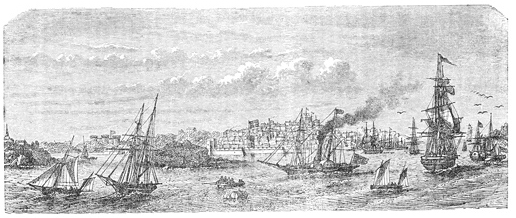
SYDNEY, N. S. WALES.
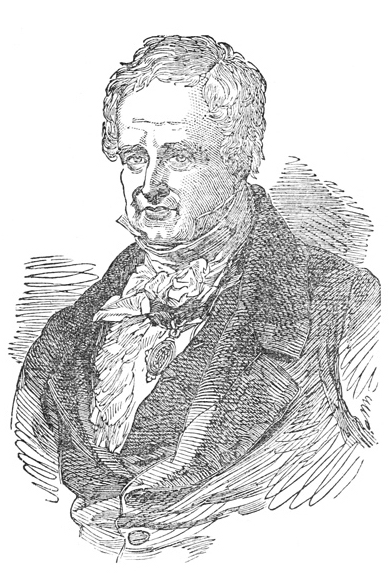
BARON VON HUMBOLDT.
November 30th the ships sailed again, and encountered heavy gales, in which several sheep and goats died. On the 12th of December they saw two large islands, which Cook named Prince Edward’s Islands; and three days afterwards several others were seen; but having reached Keguelen’s Land, they anchored in a convenient harbor on Christmas day. On the north side of this harbor one of the men found a quart bottle fastened to a projecting rock by stout wire, and on opening it, the bottle was found to contain a piece of parchment, on which was an inscription purporting that the land had been visited by a French vessel in 1772–3. To this Cook added a notice of his own visit; the parchment was then returned to the bottle, and the cork being secured with lead, was placed upon a pile of stones near to the place from which it had been removed. The whole country was extremely barren and desolate; and on the 30th they came to the eastern extremity of Kerguelen’s Land. To his great chagrin, whilst exploring the coast, captain Cook lost through the intense cold two young bulls, one heifer, two rams, and several of the goats.
On the 24th of January, 1777, they came in sight of Van Diemen’s Land, and on the 26th anchored in Adventure Bay, where intercourse was opened with the natives, and Omai took every opportunity of lauding his friends the English. Here they obtained plenty of grass for the remaining cattle, and a supply of fresh provisions for themselves. On the 30th they quitted their port, convinced that Van Diemen’s Land was the southern point of New Holland. Subsequent investigations, however, have proved this idea to be erroneous; Van Diemen’s Land being an island separated from the mainland of Australia by Bass’ Straits.
On the 12th of February captain Cook anchored at his old station in Queen Charlotte’s Sound, New Zealand; but the natives were very shy in approaching the ships, and none could be persuaded to come on board. The reason was, that on the former voyage, after parting with the Resolution, the Adventure had visited this place, and ten of her crew had been killed in an unpremeditated skirmish with the natives. It was the fear of retaliatory punishment that kept them aloof. Captain Cook, however, soon made them easy upon the subject, and their familiarity was renewed; but great caution was used, to be fully prepared for a similar attack, by keeping the men well armed on all occasions. Of the animals left at this island in the former voyages, many were thriving; and the gardens though left in a state of nature, were found to contain cabbages, onions, leeks, radishes, mustard, and a few potatoes. The captain was enabled to add to both. At the solicitation of Omai he received two New Zealand lads on board the Resolution, and by the 27th was clear of the coast.
After landing at a number of islands, and not finding adequate supplies, the ships sailed for Anamocka, and the Resolution was brought up in exactly the same anchorage that she had occupied three years before. The natives behaved in a most friendly manner, and but for their habits of stealing, quiet would have been uninterrupted. Nothing, however, could check this propensity, till captain Cook shaved the heads of all whom he caught practicing it. This rendered them an object of ridicule to their countrymen, and enabled the English to recognize and keep them at a distance. Most of the Friendly Isles were visited by the ships, and everywhere they met with a kind reception. On the 10th of June they reached Tongataboo, where the king offered captain Cook his house to reside in. Here he made a distribution of his animals amongst the chiefs, and the importance of preserving them was explained by Omai. A horse and mare, a bull and cow, several sheep and turkeys, were thus given away; but two kids and two turkey-cocks having been stolen, the captain seized three canoes, put a guard over the chiefs, and insisted that not only the kids and turkeys should be restored, but also everything that had been taken away since their arrival. This produced a good effect, and much of the plunder was returned.
Captain Cook remained at the Friendly Islands nearly three months, and lived almost entirely during that period upon fresh provisions, occasionally eating the produce of the seeds he had sown there in his former visits. On the 17th July they took their final leave of these hospitable people, and on the 12th August reached Otaheite, and took up a berth in Oaiti-piha Bay, which it was discovered had been visited by two Spanish ships since the Resolution had last been there.
Animals of various kinds had been left in the country by the Spaniards, and the islanders spoke of them with esteem and respect. On the 24th the ships went round to Matavai Bay, and Captain Cook presented to the king, Otoo, the remainder of his live stock. There were already at Otoo’s residence a remarkably fine bull and some goats that had been left by the Spaniards, and to these the captain added another bull, three cows, a horse and mare, and a number of sheep; also a peacock and hen, a turkey-cock and hen, one gander and three geese, a drake and four ducks. The geese and ducks began to breed before the English left the island.
They here witnessed a human sacrifice, to propitiate the favor of their gods in a battle they were about to undertake. The victim was generally some strolling vagabond, who was not aware of his fate till the moment arrived, and he received his death-blow from a club. For the purpose of showing the inhabitants the use of the horses, Captain Cook and Clerke rode into the country, to the great astonishment of the islanders; and though this exercise was continued every day by some of the Resolution’s people, yet the wonder of the natives never abated.
On the return of Omai to the land of his birth, the reception he met with was not very cordial; but the affection of his relatives was strong and ardent. Captain Cook obtained the grant of a piece of land for him on the west side of Owharre harbor, Huaheine. The carpenters of the ships built him a small house, to which a garden was attached, planted with shaddocks, vines, pine apples, melons, etc., and a variety of vegetables; the whole of which were thriving before Captain Cook quitted the island. When the house was finished, the presents Omai had received in England were carried ashore, with every article necessary for domestic purposes, as well as two muskets, a bayonet, a brace of pistols, etc.
The two lads brought from New Zealand were put on shore at this place, to form part of Omai’s family; but it was with great reluctance that they quitted the voyagers, who had behaved so kindly to them.
Whilst lying at Huaheine, a thief, who had caused them great trouble, not only had his head and beard shaved, but, in order to deter others, both his ears were cut off. On the 3d November the ships went to Ulietea, and here, decoyed by the natives, two or three desertions took place; and as others seemed inclined to follow the example, Captain Clerke pursued the fugitives with two armed boats and a party of marines; but without effect. Captain Cook experienced a similar failure: he therefore seized upon the persons of the chief’s son, daughter, and son-in-law, whom he placed under confinement till the people should be restored; which took place on the 28th, and the hostages were released. One of the deserters was a midshipman of the Discovery, and the son of a brave officer in the service. Schemes were projected by some of the natives to assassinate Captain Cook and Captain Clerke; but though in imminent danger, the murderous plans failed.
At Bolabola, Captain Cook succeeded in obtaining an anchor which had been left there by M. Bouganville, as he was very desirous of converting the iron into articles of traffic. They left this place on the 8th December, crossed the line, and on the 24th stopped at a small island, which he named Christmas Island, and where he planted cocoa-nuts, yams, and melon seeds, and left a bottle enclosing a suitable inscription.
On the 2d January, 1778, the ships resumed their voyage northward, to pursue the grand object in Behring’s Straits. They passed several islands, the inhabitants of which, though at an immense distance from Otaheite, spoke the same language. Those who came on board displayed the utmost astonishment at everything they beheld; and it was evident they had never seen a ship before. The disposition to steal was equally strong in these as in the other South Sea islanders, and a man was killed who tried to plunder the watering party; but this was not known to Captain Cook till after they had sailed. They also discovered that the practice of eating human flesh was prevalent. To a group of these islands (and they were generally found in clusters) Captain Cook gave the name of the Sandwich Islands, in honor of the noble earl at the head of the Admiralty.
The voyage to the northward was continued on the 2d February, and the long-looked-for coast of New Albion was made on the 7th March, the ships being then in latitude 44 degrees 83 minutes north; and after sailing along it till the 29th, they came to an anchor in a small cove lying in latitude 49 degrees 29 minutes north. A brisk trade commenced with the natives, who appeared to be well acquainted with the value of iron, for which they exchanged the skins of various animals, such as bears, wolves, foxes, deer, etc., both in their original state and made up into garments. But the most extraordinary articles were human skulls, and hands not quite stripped of the flesh, and which had the appearance of having been recently on the fire. Thieving was practiced at this place in a more scientific manner than they had before remarked; and the natives insisted upon being paid for the wood and other things supplied to the ships; with which Captain Cook scrupulously complied. This inlet was named King George’s Sound; but it was afterwards ascertained that the natives called it Nootka Sound. After making every requisite nautical observation, the ships being again ready for sea on the 26th, in the evening they departed, a severe gale of wind blowing them from the shore. From this period they examined the coast, under a hope of finding some communication with the Polar Sea; and one river they traced as high as latitude 61 degrees 30 minutes north, and which was afterwards named Cook’s River.
They left this place on the 6th June, notwithstanding all their watchfulness and vigilance, no passage could be found. The ships ranged across the mouth of the straits in about latitude 60 degrees, where the natives of the island by their manners, gave evident tokens of their being acquainted with Europeans—most probably Russian traders. They put in at Oonaalaska and other places, which were taken possession of in the name of the king of England. On the 3d August Mr. Anderson, surgeon of the Resolution, died from a lingering consumption, under which he had been suffering more than twelve months. He was a young man of considerable ability, and he possessed an amiable disposition.
Proceeding to the northward, Captain Cook ascertained the relative position of the two continents, Asia and America, whose extremities he observed. On the 18th they were close to a dense wall of ice, beyond which they could not penetrate, the latitude at this time being 70 degrees 44 minutes north. The ice here was from ten to twelve feet high, and seemed to rise higher in the distance. A prodigious number of sea-horses were crouching on the ice, some of which were procured for food. Captain Cook continued to traverse these icy seas till the 29th; he then explored the coasts in Behring’s Strait both in Asia and America; and on the 2d of October again anchored at Oonalaska to refit; and here they had communication with some Russians, who undertook to convey charts and maps, etc., to the English Admiralty; which they faithfully fulfilled. On the 26th the ships quitted the harbor of Samganoodah, and sailed for the Sandwich Islands; Captain Cook purposing to remain there a few months, and then to return to Kamschatka. In latitude 20 degrees 55 minutes, the island of Mowee was discovered on the 26th of November; and on the 30th they fell in with another, called by the natives Owhyhee; and being of large extent, the ships were occupied nearly seven weeks in sailing round it, and examining the coast; and they found the islanders more frank and free from suspicion than any they had yet had intercourse with; so that on the 16th January 1779, there were not fewer than a thousand canoes about the two ships, most of them crowded with people, and well laden with hogs and other productions of the place. A robbery having been committed, Captain Cook ordered a volley of musketry and four great guns to be fired over the canoe that contained the thief; but this seemed only to astonish the natives, without creating any great alarm. On the 17th the ships anchored in a bay called by the islanders Karakakooa. The natives constantly thronged to the ships, whose decks consequently, being at all times crowded, allowed of pilfering without fear of detection; and these practices, it is conjectured, were encouraged by the chiefs. A great number of the hogs purchased were killed and salted down so completely, that some of it was good at Christmas 1780. On the 26th Captain Cook had an interview with Terreeoboo, king of the island, in which great formality was observed, and an exchange of names. The natives were extremely respectful to Cook; in fact, they paid him a sort of adoration, prostrating themselves before him; and a society of priests furnished the ships with a constant supply of hogs and vegetables, without requiring any return. On the 3d February, the day previous to the ships sailing, the king presented them with an immense quantity of cloth, many boat-loads of vegetables, and a whole herd of hogs. The ships sailed on the following day, but on the 6th encountered a very heavy gale, in which, on the night of the 7th, the Resolution sprung the head of her foremast in such a dangerous manner, that they were forced to put back to Karakakooa Bay in order to get it repaired. Here they anchored on the morning of the 11th, and every thing for a time promised to go well in their intercourse with the natives. The friendliness manifested by the chiefs, however, was far from solid. They were savages at a low point of cultivation, and theft and murder were not considered by them in the light of crimes. Cook, aware of the nature of these barbarians, was anxious to avoid any collision, and it was with no small regret that he found that an affray had taken place betwen some seamen and the natives. The cause of the disturbance was the seizure of the cutter of the Discovery as it lay at anchor. The boats of both ships were sent in search of her, and Captain Cook went on shore to prosecute the inquiry, and if necessary, to seize the person of the king, who had sanctioned the theft.
The narrative of what ensued is affectingly tragical. Cook left the Resolution about seven o’clock, attended by the lieutenant of marines, a sergeant, a corporal, and seven private men. The pinnace’s crew were likewise armed, and under the command of Mr. Roberts; the launch was also ordered to assist his own boat. He landed with the marines at the upper end of the town of Kavoroah, where the natives received him with their accustomed tokens of respect, and not the smallest sign of hostility was evinced by any of them; and as the crowds increased, the chiefs employed themselves as before in keeping order. Captain Cook requested the king to go on board the Resolution with him, to which he offered few objections; but in a little time it was observed that the natives were arming themselves with long spears and daggers, and putting on the thick mats which they used by way of armor. This hostile appearance was increased by the arrival of a canoe from the opposite side of the bay, announcing that one of the chiefs had been killed by a shot from the Discovery’s boat. The women, who had been conversing familiarly with the English, immediately retired, and loud murmurs arose amongst the crowd. Captain Cook perceiving the tumultuous proceedings of the natives, ordered Lieutenant Middleton to march his marines down to the boats, to which the islanders offered no obstruction. The Captain followed with the king, attended by his wife, two sons, and several chiefs. One of the sons had already entered the pinnace, expecting his father to follow, when the king’s wife and others hung round his neck, and forced him to be seated near a double canoe, assuring him that he would be put to death if he went on board the ship.
Whilst matters were in this position, one of the chiefs was seen with a dagger partly concealed under his cloak lurking about Captain Cook, and the lieutenant of marines proposed to fire at him; but this the captain would not permit; but the chief closing upon them, the officer of marines struck him with his firelock. Another native grasping the sergeant’s musket, was forced to let it go by a blow from the lieutenant. Captain Cook, seeing the tumult was increasing, observed, that ‘if he were to force the king off, it could only be done by sacrificing the lives of many of his people;’ and was about to give orders to reëmbark, when a man flung a stone at him, which he returned by discharging small shot from one of the barrels of his piece. The man was but little hurt; and brandishing his spear, with threatenings to hurl it at the captain, the latter, unwilling to fire with ball, knocked the fellow down, and then warmly expostulated with the crowd for their hostile conduct. At this moment a man was observed behind a double canoe in the act of darting a spear at Captain Cook, who promptly fired, but killed another who was standing by his side. The sergeant of marines, however, instantly presented, and brought down the native whom the captain had missed. The impetuosity of the islanders was somewhat repressed; but being pushed on by those in the rear, who were ignorant of what was passing in front, a volley of stones was poured in amongst the marines, who, without waiting for orders, returned it with a general discharge of musketry, which was directly succeeded by a brisk fire from the boats. Captain Cook expressed much surprise and vexation: he waved his hand for the boats to cease firing, and to come on shore to embark the marines. The pinnace unhesitatingly obeyed; but the lieutenant in the launch, instead of pulling in to the assistance of his commander, rowed further off at the very moment that the services of himself and people were most required. Nor was this all the mischief that ensued; for, as it devolved upon the pinnace to receive the marines, she became so crowded, as to render the men incapable of using their firearms. The marines on shore, however, fired; but the moment their pieces were discharged, the islanders rushed en masse upon them, forced the party into the water, where four of them were killed, and the lieutenant wounded. At this critical period Captain Cook was left entirely alone upon a rock near the shore. He, however, hurried towards the pinnace, holding his left arm around the back of his head, to shield it from the stones, and carrying his musket under his right. An islander, armed with a club, was seen in a crouching posture cautiously following him, as if watching for an opportunity to spring forward upon his victim. This man was a relation of the king’s, and remarkably agile and quick. At length he jumped forward upon the captain, and struck him a heavy blow on the back of his head, and then turned and fled. The captain appeared to be somewhat stunned. He staggered a few paces, and, dropping his musket, fell on his hands and one knee; but whilst striving to recover his upright position, another islander rushed forward, and with an iron dagger stabbed him in the neck. He again made an effort to procceed, but fell into a small pool of water not more than knee-deep, and numbers instantly ran to the spot, and endeavored to keep him down; but by his struggles he was enabled to get his head above the surface, and casting a look towards the pinnace (then not more than five or six yards distant), seemed to be imploring assistance. It is asserted that, in consequence of the crowded state of the pinnace (through the withdrawal of the launch) the crew of that boat were unable to render any aid: but it is also probable that the emergency of this unexpected catastrophe deprived the English of that cool judgment which was requisite on such an occasion. The islanders, perceiving that no help was afforded, forced him under water again, but in a deeper place; yet his great muscular power once more enabled him to raise himself and cling to the rock. At this moment a forcible blow was given with a club, and he fell down lifeless. The savages then hauled his corpse upon the rock, and ferociously stabbed the body all over, snatching the dagger from each others’ hands to wreak their sanguinary vengeance on the slain. The body was left some time exposed upon the rock; and as the islanders gave way, through terror at their own act and the fire from the boats, it might have been recovered entire. But no attempt of the kind was made; and it was afterwards, together with the marines, cut up, and the parts distributed amongst the chiefs. The mutilated fragments were subsequently restored, and committed to the deep with all the honors due to the rank of the deceased. Thus (February 14, 1779) perished in an inglorious brawl with a set of savages, one of England’s greatest navigators, whose services to science have never been surpassed by any man belonging to his profession. It may almost be said that he fell a victim to his humanity; for if, instead of retreating before his barbarous pursuers with a view to spare their lives, he had turned revengefully upon them, his fate might have been very different.
The death of their commander was felt to be a heavy blow by the officers and seamen of the expedition. With deep sorrow the ships’ companies left Owhyhee, where the catastrophe had occurred, the command of the Resolution devolving on Captain Clerke, and Mr. Gore acting as commander of the Discovery. After making some further exploratory searches among the Sandwich Islands, the vessels visited Kamschatka, and Behring’s Straits. Here it was found impossible to penetrate through the ice either on the coast of America or that of Asia, so that they returned to the southward; and on the 22d August 1779, Captain Clerke died of Consumption, and was succeeded by Captain Gore, who in his turn gave Lieutenant King an acting order in the Discovery. After a second visit to Kamschatka, the two ships returned by way of China, remained some time at Canton, touched at the Cape, and arrived at the Nore, 4th October 1780, after an absence of four years, two months, and twenty-two days, during which the Resolution lost only five men by sickness, and the Discovery did not lose a single man.
By this, as well as the preceding voyages of Cook, a considerable addition was made to a knowledge of the earth’s surface. Besides clearing up doubts respecting the Southern Ocean, and making known many islands in the Pacific, the navigator did an inestimable service to his country in visiting the coasts of New South Wales, Van Diemen’s Land, New Zealand, and Norfolk Island—all now colonial possessions of Britain, and which promise at no distant day to become the seat of a large and flourishing nation of Anglo-Australians—the England of the southern hemisphere.
The intelligence of Captain Cook’s death was received with melancholy regrets in England. The king granted a pension of £200 per annum to his widow, and £25 per annum to each of the children; The Royal Society had a gold medal struck in commemoration of him; and various other honors at home and abroad were paid to his memory. ‘Thus, by his own persevering efforts,’ as has been well observed by the author of the Pursuit of Knowledge Under Difficulties, ‘did this great man raise himself from the lowest obscurity to a reputation wide as the world itself, and certain to last as long as the age in which he flourished shall be remembered by history.’ But better still than even all this fame—than either the honors which he received while living, or those which, when he was no more, his country and mankind bestowed upon his memory—he had exalted himself in the scale of moral and intellectual being; had won for himself, by his unwearied striving, a new and nobler nature, and taken a high place among the instructors and best benefactors of mankind.
CAPTAINS PORTLOCK AND DIXON.
This voyage was undertaken for the purposes of commerce; principally, indeed, for the fur-trade, on the north-west coast of America, which had been strongly recommended by Captains Cook and King in their last voyage. Two vessels were fitted out for this purpose, the King George and Queen Charlotte, by a society of merchants and others, the former commanded by Nathaniel Portlock, the latter by George Dixon, both of whom had been with Captain Cook; the King George having sixty men, the Queen Charlotte thirty.
September 20th, 1785, they quitted St. Helens, and, proceeding to Guernsey, left it on the 25th. October 16th saw the Canary Islands, and 24th the Cape de Verde group, anchoring for a short time in Port Praya Bay, in St. Jago. Proceeding south, they anchored in Port Egmont, Falkland’s Islands, January 5th, 1786, where, taking in water, they made sail for States Bay, in Terra del Fuego. Having made a good offing from Cape Horn, they had tolerable weather; and continuing their route without touching at any place, or meeting any thing worthy of notice, dropped anchor 26th May in Karakooa Bay, in Owhyhee, Sandwich Islands.
The natives crowded them very much, bartering a variety of articles; but were nevertheless extremely troublesome. It was the general opinion, that it would be impossible to water the vessels without a strong guard, which they could not well spare; while the people were probably jealous that these vessels had come to revenge the death of Captain Cook. Next day they stood out of the bay, lying-to three leagues off, to carry on trade for hogs, plantains, etc. etc., which proved so serviceable that the sick, of whom there were several, began rapidly to recover. June 1st anchored in a bay in Woahoo, another of the islands, and were received civilly by the inhabitants. They now stood for another of the islands, named Oneehow; and, on the 8th, anchored in Yam Bay, where supplies of fruit, vegetables, and pigs, were willingly afforded by the principal chief Abbenooe, who seemed strongly their friend, from recollecting Captain Portlock along with Cook. They took leave of him, with regret, on the 13th, standing for the coast of America.
July 19th made the entrance of Cook’s River; and, while looking for good anchorage, were astonished by the report of a great gun; when, soon afterwards, a party of Russians came on board, attended by some Indians; but none understanding the language of either, no satisfactory information could be gained from them. Most of the natives had fled from their huts, alarmed perhaps by the Russians; several bears were seen, but none near enough to fire at. Two veins of kennel-coal were found, which burned very well, and the place was, therefore, called Coal Harbor. An elderly chief paying Captain Dixon a visit, informed him that they had a battle with the Russians, in which the latter were worsted, and added, that from the difference of dress, he knew they were of a different nation.
Quitting this place, they tried for some time to get into Prince William’s Sound; but, by a series of unfavorable winds, failed in this pursuit. September 23d, they stood away for the Sandwich Islands to pass the winter, and return in the spring. November 14th saw the summit of the high mountain in Owhyhee covered with snow, and employed two or three following days in coasting it, the natives bringing off a variety of articles to barter for iron and trinkets. The first mate of the King George reporting, that a bay they intended to anchor in did not admit of good anchorage, this design was dropped. During the time they lay to, hogs, fowls, wild-geese, bread-fruit, plantains, and several other things were procured in considerable quantities; the natives dealing pretty fairly, but committing a variety of thefts, even before their faces, with a dexterity almost inimitable. For several days they continued lying to off the islands of Mowee and Morotoi, procuring refreshments and receiving visits till the 30th, when both ships bore away for King George’s Bay, in Whoaboo, where they anchored in safety, after experiencing a variety of winds from all points of the compass.
Here they found every thing tabooed, or forbidden, so that it became necessary to court the king’s favor; for which purpose a present was sent to him, and another to a priest, their acquaintance on the former occasion, who paid them a visit, handing up a fig and plantain, which in these islands are signs of friendship. This was soon followed by a visit from Taheeterre, the king, followed by all the chiefs, who took off the taboo. The priest was remarkable for drinking large quantities of the ava, or yava-juice, for which he had two men in constant attendance chewing the root, which, with their spittle, forms this singular and (to us) nauseous beverage. The yava is a root resembling liquorice in shape and color. None but the chiefs and priests have permission to use it, and these are never at the trouble of chewing it themselves; but, as above observed, employ servants; these begin with chewing a sufficient quantity, and when well masticated, it is put into a wooden bowl kept for the purpose, to which a small quantity of water is added; the whole is then strained through a cloth, and, like wine in Europe, it thus forms not merely the drink, but the delight of all parties, feasts, rejoicings, and, in short, every public assemblage of the leading people. Its effects, however, are very pernicious; it is partly intoxicating or rather stupifying; and, by its constant use, the old priest was exceedingly debilitated, and his body covered with a white scurf, resembling leprosy, which is a common symptom throughout the South Sea islands of its frequent use.
The taboo was again put on without any explanation being given, though several canoes nevertheless came off, but without any women, as had been formerly the case. Afterwards it was understood that one of them had been detected in the King George eating pork, which being a heinous offense, she was taken as soon as she came on shore, and offered a sacrifice to the gods: human sacrifices, it appears, are here, as in most parts of the South Sea islands, frequently presented, and it is unquestionably the most inhuman and barbarous custom among them.
December 19th weighed, and two days afterwards anchored between Attoui and Wyema, where, after paying and receiving some visits, their former friend Abbenooe came on board with two canoes loaded with provisions, and remained for two or three days, seemingly very well pleased with his new abode. The king also made his appearance; he was stout and well made, about forty-five years of age, and possessed of more understanding and good nature than any of his subjects. January 5th caught a shark in the King George, thirteen and a half feet long, eight and a half broad, and six feet in the liver; forty-eight young ones in her, about eight inches each in length; two whole turtles of sixty pounds each; several small pigs, and a quantity of bones; so that the numbers and the voracity of this fish may be conceived. From this time to the 10th they were employed in purchasing wood, water, provisions, curiosities, and every thing else they wanted; and now, quitting the anchorage, proceeded to yam Bay, in Oneehow, where, after making a few excursions, they departed once more for Wymoa Bay, Attoui.
On the 3d March weighed, and made sail for the coast of America, and on the 24th April saw Montager Island, coming to anchor in the harbor, where there is sufficient shelter from the prevailing winds. The weather continued very variable, several unsuccessful attempts being made to get into Prince William’s Sound, and only a single straggling inhabitant being seen now and then, so that there was no opportunity to trade.
Captain Dixon now made an excursion in his boats up the Sound, and receiving some hints from the natives of a vessel being there, continued his search for several days, and at length got on board a vessel called the Nootka, from Bengal, commanded by Mr. Meares, which had wintered in Snug-corner Cove. The scurvy had made dreadful havoc among them, nearly all the officers and many of the crew having died of this frightful disorder, so that at length the Captain was the only person on board able to walk the deck. Along with his first mate he soon afterwards visited the ships, met with a hearty reception, and received such assistance as he wanted and as the others could afford. From him they learned that few or no furs could be obtained here; that several vessels from India had been already on this coast for the purposes of trade; and that two or three were expected next month in the same pursuit, which immediately determined our voyagers to separate and push for different parts of the coast, in order to be before their expected rivals; the Queen Charlotte to proceed to King George’s Sound, and Messrs. Hayward and Hill to Cook’s River in the King George’s long-boat, the latter to remain where she was for the present.
On the 13th May several canoes visited them, in one of which was a chief of great consequence, named Sheenaawa, whose party, like most others, were determined thieves, exerting their ingenuity and tricks for this purpose in an extraordinary degree. They danced, sung, laughed, and diverted the attention of the seamen in every possible way, while slyly their hands were seizing every thing on the decks, so that literally they were smiling in their faces and robbing them at the same time. In the meantime the Queen Charlotte and the long-boat sailed, while the King George shifted to Hinchinbroke Cove. Some of the boats were sent out to trade, which were tolerably successful; but they also suffered from continual thefts, which were sometimes accompanied by menaces, if they attempted to resist the plunderers.
June 9th the Nootka left her former anchorage, where she had been frozen in, and came close to the King George, when the crew of the latter were partly employed in rendering her assistance. Two days afterwards the long-boat returned from Cook’s River with a very good cargo, and was again sent off with orders to return by the 20th of July. On the 19th the Nootka sailed. Next day the surgeon took the invalids on shore for an excursion, who, by the use of spruce-beer, which they now brewed in abundance, were rapidly recovering. In the evening observed two Indian boats and several canoes, in which were about twenty-five natives, who came alongside next morning. Their chief, named Taatucktellingnake, was paralytic on one side, had a long beard, and seemed about sixty years of age; his country was called Cheeneecock, situated towards the south-west part of the Sound. July 11th hauled the seine frequently, when not less than two thousand salmon were caught at each haul; and so great were their numbers, that ships prepared for the purpose might have obtained any quantity they wished. The long-boat returned on the 21st, though without so much success as formerly. On the 26th sailed from this place. The natives in general are short in stature, with flat faces and noses, ill-formed legs, but good teeth and eyes; they wear their hair, which is black and straight, very long, but cut it short on the death of a relation, this seeming their only method of mourning. They are attentive to their women, but jealous of them. Their thieving habits seem fixed, the most dexterous being most in esteem, and receiving the greatest applause for the exertion of his talents; he is also distinguished by a fantastical dress, which, while it excites the notice of the spectators, gives the owner additional opportunities of exerting his fingers at their expense.
By the 3d of August had made little progress, from the shifting of the wind. On the 8th, two large boats visited them, with twenty-five men, women, and children on, board, who, very different from their other visitors, seemed very honest, and who were invited to dinner in the cabin, when they relished the English cookery so well, that the dishes were quickly obliged to be replenished. These departed in the evening well pleased with their entertainment, promising to return with the means of trading with their new friends.
On the 11th a new tribe visited them from the eastward, with about the same number of persons as the last; four days after the long-boat returned, having had pretty good success, notwithstanding some acts of hostility which they had been compelled to retaliate upon the Indians. Another party, from the north-west, were extremely addicted to thieving, nothing could escape them; and, when detected, were very impudent, and often threatened those they robbed. The men were of the size of Europeans, of a fierce and savage aspect, using daggers and long spears, easily provoked and ready to indulge their anger.
August 22d weighed and made sail from this coast, having done as much as it seemed likely they could do in the way of trade. September 28th made Owhyhee, the principal of the Sandwich group, when several canoes came off, with whom a brisk trade for hogs and other refreshments was carried on. At Attoui they found the Nootka and Queen Charlotte had been there and left letters for the King George. After procuring what necessaries they wanted, Captain Portlock directed his course for China with his cargo of furs; on the 4th November saw Saypan and Tinian, two of the Ladrone Islands; and on the 21st anchored in Macao Roads, where Captain Dixon was found, whose transactions shall now be noticed.
After separating, the Queen Charlotte coasted it for some time, till, seeing an appearance of an inlet, a boat was despatched which found an excellent harbor, where she soon after anchored. Several canoes came off, from whom some skins were procured, but by no means so many as they had at first reason to expect. The number of inhabitants was about seventy; the harbor, which is good, was named Port Mulgrave, and is situated in 59 degrees 32 minutes north latitude; 140 degrees west longitude. The language of these people is quite different from that of Prince William’s Sound, or Cook’s River, being extremely uncouth and difficult to pronounce. The mode in which they dispose of their dead is remarkable; the head is separated from the body, and both are wrapped in furs, the former being put into a box, the latter into an oblong chest, which are afterwards preserved and disposed of in a fanciful way.
June 4th quitted this place, and kept beating to the southward; a harbor was perceived at a distance, which, upon examination by the boats, was found to extend to a considerable distance, with a number of coves here and there, very well calculated for anchorage; it was named Norfolk Sound. The people were at first civil and well-behaved; but soon became troublesome and thievish, like almost all their brethren on this coast. Trade here was not very brisk. July 1st saw an island, and were soon surrounded by Indians, who, after gratifying their curiosity in examining the vessel, began to trade, and soon parted with all their skins. Several fresh tribes visited them almost daily, who, delighted with European articles of barter, were content to leave their furs behind in exchange. The residence of one was strongly fortified, resembling a nippah or fortified place, in New Zealand; and, from some circumstances which transpired, Dixon was tempted also to believe they were also like the New Zealanders, cannibals. Proceeding to the eastward, eleven canoes came alongside on the 24th with one hundred and eighty persons; but curiosity was the prevailing motive, as they had nothing to sell; and, five days after, no less than two hundred men, women, and children, in eighteen canoes, came off to indulge their curiosity; a number that, on this coast, is rarely found in one community. Their chief had the most savage aspect of any yet seen, his whole appearance sufficiently marking him as the leader of a tribe of cannibals. His stature was above the common size, his body spare and thin, and, though seemingly lank and emaciated, his step was bold and firm, his limbs strong and muscular; his eyes, which were large and goggling, seemed ready to start from their sockets; his forehead deeply wrinkled, as well by age as an habitual frown, which, joined to a long visage, hollow cheeks, high cheek-bones, and natural ferocity of temper, rendered him a most formidable figure.
August 8th, made sail for the Sandwich Islands. September 2d made Owhyhee, and, after procuring refreshments, stood on for Whahoo, being visited the next day by Abbenooe and the king, by whose commands they received abundant supplies of wood, water, and provisions, of which they were in extreme want, several of the crew being nearly dead with the scurvy. Attoui was their next destination, where the chiefs inquired particularly after their friend Po-pote (Captain Portlocke,) and were desirous of contributing all in their power to the assistance of the ship, every one supplying the Captain with a liberality as unbounded as it was unexpected, but which did not go unrewarded; saws, hatchets, nails, and other iron instruments being given to the men, and buttons, beads, and a variety of ornaments to the women.
September 18th made sail for China, and anchored in Macao Roads the 9th November, where being joined as already noticed, by the King George, their meeting was extremely agreeable. Captain Portlock was very much surprised in Canton with his old friend Tiaana, from the Sandwich Islands, who was no less pleased at seeing him, embracing the Captain in the most cordial and affectionate manner.
During his stay, Tiaana was introduced to every place worthy of notice; he was usually dressed in a cloak and fine feather cap, and, to show that he was a person of consequence, carried a spear in his hand. Afterwards, at the persuasion of Mr. Ross, he wore a light satin waistcoat and a pair of trousers. He frequently attended places of public worship, behaving with the greatest decorum, and joining the congregation in the ceremonies of kneeling or standing, as if he had been all his life regularly accustomed to them. Some of the customs of the Chinese displeased him exceedingly, and, during the voyage, was nearly throwing the pilot overboard for some real or imaginary offense; he was, however, of a kind disposition, displaying frequent instances of humanity as well as generosity. Being once at an entertainment, given by one of the Captains at Macao, his compassion was strongly excited after dinner by seeing a number of poor people, in Sampans, crowding round the vessel and asking alms; he solicited his host’s permission to give them some food, remarking it was a great shame to let poor people want victuals, and that in his country there were no beggars. In compliance with his importunities, the broken meat was collected under his care, and he distributed it in the most equal and impartial manner. Tiaana was six feet two inches high, exceedingly well-made, but inclined to corpulency; he had a pleasing animated countenance, fine eyes, and otherwise expressive as well as agreeable features. He was universally liked, and, previous to his departure for Attoui, the gentlemen at Canton furnished him with bulls, cows, sheep, goats, rabbits, turkeys, etc. etc., besides all kinds of seeds which could be useful in his island, with directions how to rear and propagate them. The best skins of their cargoes were disposed of to the East India Company for fifty thousand dollars, while the inferior ones were sold to the Chinese, both vessels receiving in return cargoes of tea. February 6th, 1788, weighed and made sail down the river, quitting Macao finally a day or two afterwards. On the 20th saw the island of Pulo Sapata, four leagues distant; and, 25th, the islands of Aramba; three days afterwards Mr. Lander, surgeon of the Queen Charlotte, died, having been ill for some time, and attended by his brother surgeon, Mr. Hoggan, of the King George. On the 30th of March the ships agreed to separate, and make the best of their way to St. Helena, where the King George arrived the 13th June, and the Queen Charlotte on the 18th. The former at length reached England, without any occurrence worthy of remark, on the 22d August; and the latter the 17th September. Nor was the voyage unfortunate; for though no great gain was made, yet nothing was lost, which, in a new commercial speculation, is not an uncommon occurrence.
MONSIEUR DE LA PEROUSE.
France becoming jealous of the renown acquired by the English circumnavigators, determined to send out an expedition, which, in its scientific equipments, should vie with them in every respect. Two ships were appointed to this service, the Boussole and Astrolabe, the former commanded by La Perouse, the latter by M. de Langle, both captains in the navy, and men of considerable attainments, besides being assisted by men of science and artists. The voyage is interesting as far as it goes; but, unfortunately, the ships, after quitting Botany Bay, in 1788, have never since been heard of, to the regret of all lovers of science and humanity, on account not only of the acquirements but amiable character of the commanders.
On the first of August, 1785, they quitted Brest, and, on the 13th, reached Madeira; they saw Teneriffe on the 19th, and on the 16th of October, the island of Trinidada, barren, rocky, and with a violent surf breaking on the shores, where refreshments not being obtainable, the commander steered for St. Catharine’s on the Brazil coast.
This island is extremely fertile, producing all sorts of fruit, vegetables, and corn, almost spontaneously. It is covered with trees of everlasting green, but they are so curiously interwoven with plants and briars, that it is impossible to pass through the forests without opening a path with a hatchet; to add to the difficulty, danger is also to be apprehended from snakes whose bite is mortal. The habitations are bordering on the sea. The woods are delightfully fragrant, occasioned by the orange-trees, and other odoriferous plants and shrubs, which form a part of them.
On the 14th of January the navigators struck ground on the coast of Patagonia. On the 25th, La Perouse took bearings a league to the southward of Cape San Diego forming the west point of the straits of Lemaire. On the 9th of February, he was abreast of the straits of Magellan. Examining the quantity of provisions he had on board, La Perouse discovered he had very little flour and bread left in store; having been obliged to leave a hundred barrels at Brest. The worms had also taken possession of the biscuits, and consumed or rendered useless a fifth part of them. Under these circumstances, La Perouse preferred Conception to the island of Juan Fernandez. The Bay of Conception in Chili is a most excellent harbor; the water is smooth, and almost without any current, though the tide rises six feet three inches.
At daybreak, on the 15th of March, La Perouse made the signal to prepare to sail. On the 17th, about noon, a light breeze sprung up, with which he got under way. On the 8th of April, about noon, they saw Easter Island. The Indians were alarmed, except a few who had a kind of slight wooden club. Some of them assumed an apparent superiority over the others, which induced La Perouse to consider the former as chiefs, but he soon discovered that these selected persons were the most notorious offenders. Having but a few hours to remain upon the island, and wishing to employ his time to the best advantage, La Perouse left the care of the tent, and other particulars, to his first lieutenant M. d’Escures. A division was then made of the persons engaged in the Adventure; one part, under the command of M. de Langle, was to penetrate into the interior of the island to encourage and promote vegetation, by disseminating seed, etc., in a proper soil; and the other division undertook to visit the monuments, plantations, and habitations, within the compass of a league of the establishment. The largest of the rude busts upon one of the terraces is fourteen feet six inches in height, and the breadth and other particulars appeared to be proportionate.
Returning about noon to the tent, La Perouse found almost every man without hat or handkerchief; so much had forbearance encouraged the audacity of the thieves, that he also experienced a similar depredation. An Indian, who had assisted him in descending from a terrace, rewarded himself for his trouble by taking away his hat. Some of them had dived under water, cut the small cable of the Astrolabe’s boat, and taken away her grapnel. A sort of chief, to whom M. de Langle made a present of a male and female goat, received the animals with one hand, and robbed him of his handkerchief with the other.
On the 28th of May, they saw the mountains of Owhyhee, covered with snow, and afterwards those of Mowee, which are less elevated. About one hundred and fifty canoes were seen putting off from the shore, laden with fruit and hogs, which the Indians proposed to exchange for pieces of iron of the French navigators. Most of them came on board of one or the other of the vessels, but they proceeded so fast through the water that they filled along-side. The Indians were obliged to quit the ropes thrown them, and leaping into the sea, swam after their hogs, when taking them in their arms, they emptied their canoes of the water, and resumed their seats.
After having visited a village, M. de Langle gave orders that six soldiers, with a sergeant, should accompany him: the others were left upon the beach, under the command of M. de Pierrevert, the lieutenant; to them was committed the protection of the ship’s boats, from which not a single sailor had landed. The party reëmbarked at eleven o’clock in very good order, and arrived on board about noon, where M. de Clonard had received a visit from a chief, of whom he had purchased a cloak, and a helmet adorned with red feathers; he had also purchased a hundred hogs, a quantity of potatoes and bananas, plenty of stuffs, mats, and various other articles. On their arrival on board, the two frigates dragged their anchors; it blew fresh from the south-east, and they were driving down upon the island of Morokinne, which was, however, at a sufficient distance to give them time to hoist in their boats. La Perouse made the signal for weighing, but before they could purchase the anchor, he was obliged to make sail, and drag it till he had passed Morokinne, to hinder him from driving past the channel.
A fair wind accompanied the navigators on their departure from the Sandwich Islands. Whales and wild geese convinced them that they were approaching land. Early in the morning of the 23d they descried it; a sudden dispersion of the fog opened to them the view of a long chain of mountains covered with snow. They distinguished Behring’s Mount St. Elias, on the north-west coast of America. Having taken in as much wood and water as was required, the navigators esteemed themselves the most fortunate of men, in having arrived at such a distance from Europe without having a sick person among them, or any one afflicted with the scurvy; but a lamentable misfortune now awaited them. At the entrance of this harbor perished twenty brave seamen, in two boats, by the surf. On the 30th of July, at four in the afternoon, La Perouse got under way. This bay or harbor, to which he gave the name of Port des Français, is situated in 58 deg. 37 min. north latitude, and 139 deg. 50 min. west longitude. In different excursions, he says, he found the high-water mark to be fifteen feet above the surface of the sea. The climate of this coast is infinitely milder than that of Hudson’s Bay, in the same degree of latitude. Pines were seen of six feet in diameter, and one hundred and forty feet in height. Vegetation is vigorous during three or four months of the year. The men wear different small ornaments, pendant from the ears and nose, scarify their arms and breasts, and file their teeth close to their gums, using, for the last operation, a sand-stone, formed into a particular shape. They paint the face and body with soot, ochre, and plumbago, mixed with train-oil, making themselves most horrid figures. When completely dressed, their flowing hair is powdered, and plaited with the down of sea-birds; but, perhaps, only the chiefs of certain distinguished families are thus decorated. Their shoulders are covered with a skin, and on the head, is generally worn a little straw hat, plaited with great taste and ingenuity. Sometimes, indeed, the head is decorated with two horned bonnets of eagles’ feathers. Their head-dresses are extremely various, the grand object in view being only to render themselves terrible, that they may keep their enemies in awe. Some Indians have skirts of otters’ skins. A great chief wore a skirt composed of a tanned skin of the elk, bordered by a fringe of beaks of birds, which, when dancing, imitated the noise of a bell; a common dress among the savages of Canada, and other nations in the eastern parts of America. The passion of these Indians for gaming is astonishing, and they pursue it with great avidity. The sort of play to which they are most devoted, is a certain game of chance; out of thirty pieces of wood, each distinctly marked like the French dice, they hide seven: each plays in succession, and he who guesses nearest to the whole number marked upon the seven is the winner of the stake, which is usually a hatchet or a piece of iron.
At length, after a very long run, on the 11th of September, at three in the afternoon, the navigators got sight of Fort Monterey, and two three-masted vessels which lay in the road. The commander of these two ships having been informed, by the viceroy of Mexico, of the probable arrival of the two French frigates, sent them pilots in the course of the night. Loretto, the only presidency of Old California, is situated on the east coast of this peninsula and has a garrison of fifty-four troopers, who furnish detachments to fifteen missions; the duties of which are performed by Dominican friars. About four thousand Indians, converted and residing in these fifteen parishes, are the sole produce of the long labors of the different religious orders which have succeeded each other. A small navy was established by the Spanish government in this port, under the orders of the viceroy of Mexico, consisting of four corvettes of twelve guns, and one goletta. They are destined to supply with necessaries the presidencies of North California; and they are sometimes despatched as packet-boats to Manilla, when the orders of the court require the utmost expedition.
The company were received with all possible politeness and respect; the president of the missions, in his sacerdotal vestment, with the holy water in hand, waited to receive them at the entrance of the church, which was splendidly illuminated as on their highest festivals: he then conducted them to the foot of the high altar, where Te Deum was sung in thanksgivings for their arrival. Before they entered the church they passed a range of Indians: the parish church, though covered with straw, is neat, and decorated with paintings, copied from Italian originals. The Indians, as well as the missionaries, rise with the sun, and devote an hour to prayers and mass, during which time a species of boiled food is prepared for them: it consists of barley meal, the grain of which has been roasted previous to its being boiled. It is cooked in the centre of the square, in three large kettles. This repast is called atole by the Indians, who consider it as delicious: it is destitute of salt and butter, and must consequently be insipid. The women have little more to attend to than their housewifery, their children, and the roasting and grinding of several grains: the latter operation is long and laborious, as they employ no other means than that of crushing it in pieces with a cylinder upon a stone.
The Indians of the rancheries, or independent villages, are accustomed to paint their bodies red and black, when they are in mourning; but the missionaries have prohibited the former, though they tolerate the latter, these people being singularly attached to their friends. The ties of family are less regarded among them than those of friendship: the children show no filial respect to the father, having been obliged to quit his cabin as soon as they were able to procure their own subsistence.
CALIFORNIA.
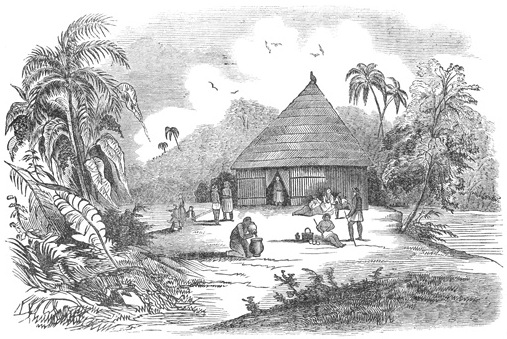
RANCHE.
POST OFFICE, SOFULA, TURON RIVER.
RIVER-BED CLAIM ON THE TURON.
REMOVING GOODS.
A Spanish commissary at Monterey, named M. Vincent Vassadre y Vega, brought orders to the governor to collect all the otter-skins of his missions and presidencies, government having reserved to itself the exclusive commerce of them; and M. Fages assured La Perouse that he could annually furnish twenty thousand of them. The Spaniards were ignorant of the importance of this valuable peltry till the publication of the voyages of Captain Cook; that excellent man has navigated for the general benefit of every nation; his own enjoys only the glory of the enterprise, and that of having given him birth.
New California, though extremely fertile, cannot boast of having a single settler; a few soldiers, married to Indian women, who dwell in the forts, or who are dispersed among the different missions, constituting the whole Spanish nation in this district of America. The Franciscan missionaries are principally Europeans; they have a convent in Mexico.
On the evening of the 22d every thing was on board, and leave had been taken of the governor and missionaries. On the morning of the 24th they sailed. On the 3d of November the frigates were surrounded with noddies, terns, and man-of-war birds; and on the 4th they made an island which bore west. This small island is little more than a rock of about five hundred toises in length. La Perouse named it Isle Necker. About an hour past one in the morning La Perouse saw breakers at two cables’ length ahead of the ship; the sea being so smooth, the sound of them was hardly heard; the Astrolabe perceived them at the same time, though at a greater distance than the Boussole; both frigates instantly hauled, with their heads to the south-east; La Perouse gave orders for sounding; they had nine fathoms rocky bottom; soon after ten and twelve fathoms, and in a quarter of an hour got no ground with sixty fathoms. They just escaped the most imminent danger to which navigators can be exposed.
The island of Assumption, to which the Jesuits have attributed six leagues of circumference, from the angles now taken, was reduced to half, and the highest point is about two hundred toises above the level of the sea. A more horrid place cannot be conceived. It was a perfect cone, as black as a coal, and very mortifying to behold, after having enjoyed, in imagination, the cocoa-nuts and turtles expected to be found in some one of the Marianne Islands. Having determined the position, he continued his course towards China; and on the 1st of January 1787, found bottom in sixty fathoms; a number of fishing-boats surrounded him the next day. On the 2d of January our navigators made the White Rock. In the evening they anchored to the north-ward of Ling-sing Island, and the following day in Macao Road. Macao, situated at the mouth of the Tigris, is capable of receiving a sixty-four gun-ship into its road, at the entrance of the Typa; and in its port, below the city, ships of seven hundred tons half laden.
The climate of the road of Typa is, at this season of the year, precarious; most of the crews were afflicted with colds, accompanied with a fever; which yielded to the salutary temperature of the island of Luconia, when they approached it on the 15th of February. Wanting wood, which he knew was dear at Manilla, La Perouse came to a resolution of remaining twenty-four hours at Marivella to procure some, and early the next morning all the carpenters of the two frigates were sent on shore with the long boats; the rest of the ship’s company, with the yawl, were reserved for a fishing-party; but they were unsuccessful, as they found nothing but rocks and very shallow water.
On the 28th the navigators came to an anchor in the port of Cavite, in three fathoms, at two cables’ length from the town. Cavite, situated three leagues to the south-west of Manilla, was formely a place of importance. Manilla is erected on the Bay which also bears its name, and lies at the mouth of a river, being one of the finest situations in the world: all the necessaries of life may be procured there in abundance, and on reasonable terms; but the cloths, and other manufactures of Europe, are extravagantly dear. La Perouse confidently asserts, that a great nation, without any other colony than the Philippines, which would establish a proper government there, might view all the European settlements in Africa and America without envy or regret. These islands contain about 3,000,000 of inhabitants, and that of Luconia consists of about a third of them. These people seem not inferior to Europeans; they cultivate the land with skill, and among them have ingenious goldsmiths, carpenters, joiners, masons, blacksmiths, etc. La Perouse says he has visited them at their villages, and found them affable, hospitable, and honest.
On the 9th of April, according to the French reckoning, and the 10th as the Manillese reckon, our navigators sailed and got to the northward of the island of Luconia. On the 21st they made the island of Formosa; and experienced, in the channel which divides it from that of Luconia, some very violent currents. On the 22d they set Lamy Island, at the south-west point of Formosa, about three leagues distant. The tack they then stood on conveyed them upon the coast of Formosa, near the entrance of the bay of Old Fort Zealand, where the city of Taywan, the capital of that island, is seated.
The whole of the next day a dead calm occurred, in mid channel, between the Bashee Islands, and those of Botol Tabacoxima. It is probable that vessels might provide themselves in this island with provision, wood, and water. La Perouse preserved the name of Kumi Island, which Father Gambil gives it in his chart. In the night of the 25th our navigators passed the strait of Corea, sounding very frequently, and as this coast appeared more eligible to follow than that of Japan, they approached within two leagues of it, and shaped a course parallel to its direction. On the 27th they made the signal to bear up, and steer east, and soon perceived, in the north-north-east, an Island not laid down upon any chart, at the distance of about twenty leagues from the coast of Corea. He named it Isle Dagelet, from the name of the astronomer who first discovered it. The circumference is about three leagues.
On the 30th of May, La Perouse shaped his course east towards Japan, and on the 2d of June saw two Japanese vessels, one of which passed within hail of him. It had a crew of twenty men, all habited in blue cassocks. This vessel was about one hundred tons burden, and had a single high mast stepped in the middle. The Astrolabe hailed her as she passed, but neither the question nor the answer was comprehended. At different times of the day seven Chinese vessels of a smaller construction were seen, which were better calculated to encounter bad weather.
During the seventy-five days since our navigators sailed from Manilla, they had run along the coasts of Quelpert Island, Corea, and Japan; but as these countries were inhabited by people inhospitable to strangers, they did not attempt to visit them. They were extremely impatient to reconnoitre this land, and it was the only part of the globe which had escaped the activity of Captain Cook. The geographers who had drawn the strait of Tessoy erroneously determined the limits of Jesso, of the Company’s land, and of Staten Island; it, therefore, became necessary to terminate the ancient discussions by indisputable facts. The latitude of Baie de Ternai was the same as that of Port Acqueis, though the description of it is very different. The plants which France produces carpeted the whole of this soil. Roses, lilies, and all European meadow-flowers were beheld at every step. Pine-trees embellished the tops of the mountains; and oaks, gradually diminishing in strength and size towards the sea, adorned the less elevated parts. Traces of men were frequently perceived by the havoc they had made. By these, and many other corroborating circumstances, the navigators were clearly of opinion, that the Tartars approach the borders of the sea, when invited thither by the season for fishing and hunting; that they assemble for these purposes along the rivers, and that the mass of people reside in the interior of the country, to attend to the multiplication of their flocks and herds. M. de Lange, with several other officers who had a passion for hunting, endeavored to pursue their sport, but without success, yet they imagined that by silence, perseverance, and posting themselves in ambush in the passes of the stags and bears, they might be able to procure some of them. This plan was determined on for the next day, but, with all their address and management it proved abortive. It was therefore generally acknowledged that fishing presented the greatest prospect of success. Each of the five creeks in the Baie de Ternai afforded a proper place for hauling the seine, and was rendered more convenient by a rivulet, near which they established their kitchen. They caught plenty of trout, salmon, cod-fish, harp-fish, plaice, and herrings.