AMERICAN ENCYCLOPEDIA (continued 27)
Reading edition
‘As soon as the sun arose, all their boats were manned and armed. They rowed towards the island with their colors displayed, with warlike music, and other martial pomp. As they approached the coast, they saw it covered with a multitude of people, whom the novelty of the spectacle had drawn together, whose attitudes and gestures expressed wonder and astonishment at the strange objects which presented themselves to their view. Columbus was the first European who set foot in the new world which he had discovered. He landed in a rich dress, and with a naked sword in his hand. His men followed, and kneeling down, they all kissed the ground which they had so long desired to see. They next erected a crucifix, and, prostrating themselves before it, returned thanks to God for conducting their voyage to such a happy issue. They then took solemn possession of the country for the crown of Castile and Leon, with all the formalities which the Portuguese were accustomed to observe in acts of this kind in their new discoveries.
‘The Spaniards, while thus employed, were surrounded by many of the natives, who gazed in silent admiration upon actions which they could not comprehend, and of which they did not foresee the consequences. The dress of the Spaniards, the whiteness of their skins, their beards, their arms, appeared strange and surprising. The vast machines in which they had traversed the ocean, that seemed to move upon the waters with wings, and uttered a dreadful sound resembling thunder, accompanied with lightning and smoke, struck them with such terror, that they began to respect their new guests as a superior order of beings, and concluded that they were children from the sun, who had descended to visit the earth.
‘The Europeans were hardly less amazed at the scene now before them. Every herb, and shrub, and tree, was different from those which flourished in Europe. The soil seemed to be rich, but bore few marks of cultivation. The climate, even to the Spaniards, felt warm, though extremely delightful. The inhabitants appeared in the simple innocence of nature—entirely naked. Their black hair, long and uncurled, floated upon their shoulders, or was bound in tresses around their heads. They had no beards, and every part of their bodies was perfectly smooth. Their complexion was of a dusky copper color; their features singular, rather than disagreeable; their aspect gentle and timid. Though not tall, they were well-shaped and active. Their faces, and several parts of their bodies, were fantastically painted with glaring colors. They were shy at first through fear, but soon became familiar with the Spaniards; and with transports of joy received from them hawks’ bells, glass beads, or other baubles, in return for which they gave such provisions as they had, and some cotton yarn, the only commodity of value that they could produce. Towards evening Columbus returned to his ship, accompanied by many of the islanders in their boats, which they called canoes; and though rudely formed out of the trunk of a tree, they rowed them with surprising dexterity. Thus, in the first interview between the inhabitants of the old and new worlds, everything was conducted amicably, and to their mutual satisfaction. The former, enlightened and ambitious, formed already vast ideas with respect to the advantages which they might derive from the regions that began to open to their view. The latter, simple and undiscerning, had no foresight to the calamities and desolation which were approaching their country.
‘Columbus, who now assumed the title and authority of admiral and viceroy, called the island which he had discovered San Salvador. It is better known by the name of Guanahani, which the natives gave to it, and is one of that large cluster of islands called the Lucaya or Bahama Isles. It is situated above three thousand miles to the west of Gomera, from which the squadron took its departure, and only four degrees to the south of it; so little had Columbus deviated from the westerly course which he had chosen as the most proper.’
Cruise in the West India Archipelago—Various Discoveries.—Columbus imagined that the island he had thus discovered, and others which could be seen from it, belonged to the Archipelago, which, according to Marco Polo, lay east of the Asiatic continent. He resolved, therefore, to remain no longer at San Salvador, but to sail in the direction in which he conceived the mainland to lie. When he asked the natives, by signs, where they obtained the gold, of which most of them wore thin plates attached to their nostrils by way of ornament, they invariably pointed to the south. To the south, therefore, he determined to prosecute his voyage, not doubting but that the region which the natives pointed to must be Cathay or Cipango. Accordingly, after spending one day at San Salvador, he directed his course through the midst of that multitudinous cluster of islands now called the Bahamas, convinced as he gazed at their green and luxuriant foliage, that these must be the ‘seven thousand four hundred and fifty-eight islands abounding with spices and odoriferous trees,’ which Marco Polo described as filling the Chinese sea. He landed at three of the largest, and gave them names. Here the appearance of the ships and the Spaniards produced the same astonishment among the natives as at San Salvador. Receiving to his inquiries after gold the same invariable answer, that it lay to the south, he pushed on through group after group of islands, and at last, on the 28th of October, came in sight of Cuba. The appearance of this noble island as he approached it, its high mountains, its spreading forests, its broad rivers, made him uncertain whether it might not be part of the great continent he was in search of. ‘He entered the mouth of a large river with his squadron, and all the inhabitants fled to the mountains as he approached the shore. But as he resolved to careen his ships in that place, he sent some Spaniards, together with one of the people of San Salvador, to view the interior part of the country. They having advanced above sixty miles from the shore, reported, upon their return, that the soil was richer and more cultivated than any they had hitherto discovered; that, besides many scattered cottages, they had found one village containing above a thousand inhabitants; that the people, though naked, seemed to be more intelligent than those of San Salvador, but had treated them with the same respectful attention, kissing their feet, and honoring them as sacred beings allied to heaven; that they had given them to eat a certain root, the taste of which resembled roasted chestnuts, and likewise a singular species of corn called maize, which, when roasted whole or ground into meal, was abundantly palatable; that there seemed to be no four-footed animals in the country but a species of dog, which could not bark, and a creature resembling a rabbit, but of a much smaller size; that they had observed some ornaments of gold among the people, but of no great value.’ Here also, for the first time, the Spaniards saw the use of tobacco.
Columbus was particularly anxious to ascertain whether the country he had now reached belonged to the Indian continent. From the rude civilization which he saw around him, the ill constructed huts, the want of clothing among the natives, etc., he knew that he was still at some distance from the territories of the great khan, covered with finely-built cities, and abounding in gold and spices; but he imagined that Cuba might be the extremity of that part of the continent where the expected territories lay. Full of this delusion, he eagerly seized on every little circumstance which seemed to confirm it. When the natives spoke of Cubanacan as the place where the gold was to be found, meaning by it the central district of Cuba, he fancied that they were speaking of the country of Kubla Khan, one of the great potentates mentioned by Marco Polo. At length, however, after cruising along the coast for nearly a fortnight without approaching the confines of the desired country, he altered his course to the east-south-east, intending to sail for an island called Hayti, to which the natives directed him as a place where gold was more plentiful than with them. The fleet left Cuba on the 12th of November, having on board some of the natives, who were to act as guides. On their way thither, ‘Martin Alonzo Pinzon, impatient to be the first who should take possession of the treasures which this country was supposed to contain, quitted his companions, regardless of all the admiral’s signals to slacken sail until they should come up with him. Columbus, retarded by contrary winds, did not reach Hayti till the 6th of December. He called the port where he first touched, St. Nicholas, and the island itself Espagnola, in honor of the kingdom by which he was employed; and it is the only country of those he had yet discovered which has retained the name that he gave it. As he could neither meet with the Pinta, nor have any intercourse with the inhabitants, who fled in great consternation towards the woods, he soon quitted St. Nicholas; and, sailing along the northern coast of the island, he entered another harbor, which he called Conception. Here he was more fortunate; his people overtook a woman who was flying from them, and, after treating her with great gentleness, dismissed her with a present of such toys as they knew were most valued in those regions. The description which she gave to her countrymen of the humanity and wonderful qualities of the strangers, their admiration of the trinkets, which she showed with exultation, and their eagerness to participate in the same favors, removed all their fears, and induced many of them to repair to the harbor. The strange objects which they beheld, and the baubles which Columbus bestowed upon them, amply gratified their curiosity and their wishes. They nearly resembled the people of Guanahani and Cuba. Like them, they were naked, ignorant, and simple; and seemed to be equally unacquainted with all the arts which appear most necessary in polished societies; but they were gentle, credulous, and timid, to a degree which rendered it easy to acquire the ascendency over them, especially as their excessive admiration led them into the same error with the people of the other islands, in believing the Spaniards to be more than mortals, and descended immediately from heaven. They possessed gold in greater abundance than their neighbors, which they readily exchanged for bells, beads, or pins; and in this unequal traffic both parties were highly pleased, each considering themselves as gainers by the transaction.’
The Spaniards remained at Hispaniola for the space of a month, during which time they explored a great part of the coast, and became familiar with the natives. Columbus had a keen sense of the beautiful in scenery, and his journal is full of enthusiastic description of Hispaniola, its deep groves, its clear skies, its tranquil bays, its soft and balmy atmosphere, its birds with their splendid plumage. ‘Tongue,’ he says, ‘cannot express the whole truth, nor pen describe it; and I have been so overwhelmed at the sight of so much beauty, that I have not known how to relate it. The people also seem to have made a deep impression on him by their gentle and confiding manners. ‘So loving, so tractable, so peaceable,’ he says, ‘are these people, that I swear to your majesties there is not in the world a better nation nor a better land. They love their neighbors as themselves; and their discourse is ever sweet and gentle, and accompanied with a smile; and though it is true that they are naked, yet their manners are decorous and praiseworthy.’ Such are the descriptions given of the island of Hayti by its discoverer—the first island doomed to experience the miseries produced by the cruelty and avarice of the invaders.
The part of Hayti which the fleet first touched at was its western extremity. As usual, one of the earliest inquiries made of the natives was where they obtained gold. The natives, in reply, pointed to a mountainous district to the eastward, which they named Cibao—a sound in which Columbus, still clinging to his original delusion, traced a resemblance to the Cipango of Marco Polo. Proceeding eastward, therefore, Columbus anchored his two vessels in a habor, to which he gave the name of St. Thomas.
While here he received a message from a chieftain called Guacanagari, one of the five caçiques or kings amongst whom the whole island was divided, requesting that he would come and visit him. Columbus resolved to do so. ‘He sailed for this purpose from St. Thomas on the 24th of December, with a fair wind, and the sea perfectly calm; and as, amongst the multiplicity of his occupations, he had not shut his eyes for two days, he retired at midnight in order to take some repose, having committed the helm to the pilot, with strict injunctions not to quit it for a moment. The pilot, dreading no danger, carelessly left the helm to an inexperienced cabin-boy, and the ship, carried away by the current, was dashed against a rock. The violence of the shock awakened Columbus. He ran up to the deck. There all was confusion and despair. He alone retained presence of mind. He ordered some of the sailors to take a boat, and carry out an anchor astern; but, instead of obeying, they made off towards the Nina, which was about half a league distant. He then commanded the masts to be cut down, in order to lighten the ship; but all his endeavors were too late; the vessel opened near the keel, and filled so fast with water, that its loss was inevitable. The smoothness of the sea, and the timely assistance of boats from the Nina, enabled the crew to save their lives.’ Hearing of the accident, Guacanagari hastened to the shore, and, by the assistance of the Indians with their canoes, everything of value was saved from the wreck. Nothing could exceed the kindness of the chieftain: he testified the utmost sorrow at the loss which had befallen his visitors, and offered his services to repair it. The loss was indeed a serious one to Columbus. He had as yet heard no tidings from the treacherous Pinta; his best ship was a total wreck; and there remained but one crazy little bark to carry so many men back to Europe.
In these circumstances he resolved to leave part of his men in Hispaniola, returning to Spain with the rest for fresh ships and stores. Although driven by necessity to this resolution, it was advisable on many other accounts. The island was one which it would be desirable to colonize at all events; and by leaving a number of men in it, the way would be prepared for a settlement; a quantity of gold would be collected, ready to be carried to Spain against the time he came back; and, by intercourse with the natives, much knowledge would be obtained, not only about Hayti itself, but about the other islands and lands in the Archipelago. Nor did he meet with any difficulty on the part of his men. On the contrary, when the proposal was made to them, many were delighted with the idea of remaining on an island where they would lead a life of such enjoyment. Nothing remained, therefore, but to obtain the permission of Guacanagari, or some other cacique. This was soon granted. It appeared that the island was often visited by a terrible race of people called the Caribs, represented by the Haytians as cannibals, who came from the east, and, penetrating inland, burned their villages, and carried many of them away captives. On the proposal, therefore, of Columbus to leave some of his men on the island, to protect it with their great guns against the incursions of these Caribs, Guacanagari and his people exhibited unbounded delight. The Spaniards immediately commenced building a fortress on a spot named by Columbus La Navidad; not omitting, at the same time, to improve the opportunity of obtaining as much gold as possible from the natives, to be shipped for Spain. Considerable quantities were obtained; the natives readily exchanging little lumps of the precious metal for any trinket offered them. The hawk’s bells of the Spaniards, however, delighted them most. Tying these toys to some part of their persons, they would dance and caper about with them in perfect ecstacies at the sounds they produced; and it is told of one Indian that, having obtained a hawk’s bell in exchange for a lump of gold of about four ounces in weight, he made off to the woods as fast as possible with his prize, lest the Spaniard should repent of his bad bargain, and demand back the bell.
The fortress was soon finished, and thirty-eight men chosen to remain on the island. ‘He intrusted the command of these to Diego de Arado, a gentleman of Cordova, investing him with the same powers which he himself had received from Ferdinand and Isabella; and furnished him with everything requisite for the subsistence or defense of this infant colony. He strictly enjoined them to maintain concord among themselves, to yield an unreserved obedience to their commander, to avoid giving offense to the natives by any violence or exaction, to cultivate the friendship of Guacanagari, but not to put themselves in his power by straggling in small parties, or marching too far from the fort. He promised to revisit them soon, with such a reinforcement of strength as might enable them to take full possession of the country, and to reap all the fruits of their discoveries. In the meantime he engaged to mention their names to the king and queen, and to place their merit and services in the most advantageous light.
‘Having thus taken every precaution for the security of the colony, he left Navidad on the 4th of January 1493, and steering towards the east, discovered and gave names to most of the harbors on the northern coast of the island. On the 6th he descried the Pinta, and soon came up with her, after a separation of more than six weeks. Pinzon endeavored to justify his conduct by pretending that he had been driven from his course by stress of weather, and prevented from returning by contrary winds. The admiral, though he still suspected his perfidious intentions, and knew well what he urged in his own defense to be frivolous as well as false, was so sensible that this was not a proper time for venturing upon any high strain of authority, and felt such satisfaction in this junction with his consort, which delivered him from many disquieting apprehensions, that, lame as Pinzon’s apology was, he admitted of it without difficulty, and restored him to favor. During his absence from the admiral, Pinzon had visited several harbors in the island, and acquired some gold by trafficking with the natives, but had made no discovery of any importance.
‘From the condition of his ships, as well as the temper of his men, Columbus now found it necessary to hasten his return to Europe. The former, having suffered much during a voyage of such unusual length, were extremely leaky; the latter expressed the utmost impatience to revisit their native country, from which they had been so long absent, and where they had things so wonderful and unheard-of to relate. Accordingly, on the 16th of January, he directed his course towards the northeast, and soon lost sight of land. He had on board some of the natives, whom he had taken from the different islands which he discovered; and besides the gold, which was the chief object of research, he had collected specimens of all the productions which were likely to become subjects of commerce in the several countries, as well as many unknown birds, and other natural curiosities, which might attract the attention of the learned, or excite the wonder of the people. The voyage was prosperous to the 14th of February; and he had advanced nearly five hundred leagues across the Atlantic Ocean, when the wind began to rise, and continued to blow with increasing rage, which terminated in a furious hurricane. Everything that the naval skill and experience of Columbus could devise was employed in order to save the ships. But it was impossible to withstand the violence of the storm, and, as they were still far from any land, destruction seemed inevitable. The sailors had recourse to prayers to Almighty God, to the invocation of saints, to vows and charms, to everything that religion dictates or superstition suggests to the affrighted mind of man. No prospect of deliverance appearing, they abandoned themselves to despair, and expected every moment to be swallowed up in the waves. Besides the passions which naturally agitate and alarm the human mind in such awful situations, when certain death, in one of its most terrible forms, is before it, Columbus had to endure feelings of distress peculiar to himself. He dreaded that all knowledge of the amazing discoveries which he had made was now to perish; mankind were to be deprived of every benefit that might have been derived from the happy success of his schemes; and his own name would descend to posterity as that of a rash, deluded adventurer, instead of being transmitted with the honor due to the author and conductor of the most noble enterprise that had ever been undertaken. These reflections extinguished all sense of his own personal danger. Less affected with the loss of life than solicitous to preserve the memory of what he had attempted and achieved, he retired to his cabin, and wrote upon parchment a short account of the voyage which he had made, of the course which he had taken, of the situation and riches of the countries which he had discovered, and of the colony that he had left there. Having wrapped up this in an oiled cloth, which he enclosed in a cake of wax, he put it into a cask carefully stopped up, and threw it into the sea, in hopes that some fortunate accident might preserve a deposit of so much importance to the world.’
The storm at length abated, and Columbus was able to reach the Azores. After being detained here for a short time by a dispute with the Portuguese governor of one of the islands, he continued his voyage, anxious to reach Spain before the Pinta, which had again parted company with him in the storm, with the design, he feared, of being the first to carry the news of his discovery to Spain. A second storm, however, obliged him to make for the coast of Portugal, and take refuge in the Tagus. Proceeding to Lisbon by the king’s invitation, he was received with the highest honors—having thus the satisfaction of announcing the success of his great scheme to the very persons who, fourteen years before, had scouted and rejected it. After remaining five days at Lisbon, he set out for Palos, having still heard no tidings of the Pinta. He reached the little Spanish seaport on the 15th of March, seven months and four days from the time of his departure from it. Great was the excitement among the inhabitants as they saw the little bark, which they instantly recognized, standing up the river. And when the news spread that the new world was discovered, that Columbus had returned with gold and specimens of the productions of the new lands, and, above all, with live natives on board his ship, the joy was indescribable. The bells were rung, the shops shut, all business was suspended, and the whole population hurried to the shore to receive the admiral with shouts and acclamations, such as usually attend the visits of royalty. Columbus’ first act on landing was to march with his people to church, to return thanks for the success of his voyage. On the evening of the day of his arrival, the missing Pinta likewise entered the harbor, having been driven far to the north by the violence of the storm. The commander, Martin Alonzo Pinzon, full of remorse and chagrin for his past conduct, took to his bed almost immediately on reaching Palos, and died in a few days.
After the first expressions of joy and admiration, Columbus departed for Seville. From this place he sent a message to Barcelona, where the king and queen at that time resided, to lay before them a brief account of his voyage, and to receive from them an indication of their royal will. His reception at Barcelona was particularly gratifying. He made a sort of triumphal entry, surrounded by knights and nobles, who emulated each other in their efforts to swell his praise. He was received publicly by the sovereigns, in a splendid saloon, seated on the throne, and encircled by a magnificent court. On his entrance, they rose to greet him, and would hardly allow him to kiss their hands, considering it too unworthy a mark of vassalage. Columbus then gave an account of his discoveries, and exhibited the different articles which he had brought home with him. He described the quantity of spices, the promise of gold, the fertility of the soil, the delicious climate, the never-fading verdure of the trees, the brilliant plumage of the birds, in the new regions which his own enterprise had acquired for his sovereigns. He then drew their attention to six natives of the new world, whom he had brought, and who were present, and described their manners and dispositions. He exhibited their dresses and ornaments, their rude utensils, their feeble arms; which corresponded with his description of them as naked and ignorant barbarians. To this he added, that he had observed no traces of idolatry or superstition among them, and that they all seemed to be convinced of the existence of a Supreme Being. The conclusion of his speech was in these words: ‘That God had reserved for the Spanish monarchs not only all the treasures of the new world, but a still greater treasure, of inestimable value, in the infinite number of souls destined to be brought over into the bosom of the Christian church.’
After he had finished his address, the whole assembly fell upon their knees, while an anthem was chanted by the choir of the royal chapel. With songs of praise the glory was given to God for the discovery of a new world. Columbus and his adventures were for many days the wonder and delight of the people and the court. The sovereigns admitted the admiral to their audience at all hours, and loaded him with every mark of favor and distinction. Men of the highest rank were proud of the honor of his company.
The news of the great discovery which had been made soon spread over Europe, and the name of Columbus at once became celebrated over the whole of the civilized world. As it was universally believed that the lands which he had discovered were what he supposed them to be—the extremity of the Asiatic continent—they were spoken of as the Indies; and hence, even after the error was found out, the name of West Indies still continued to be applied to them.
The Second Voyage—Colony Founded in Hispaniola.—No time was lost in fitting out a second expedition to the new world. On the morning of the 25th September, 1493, Columbus left the bay of Cadiz with three large ships and fourteen caravels, loaded with everything necessary to found a colony, and manned not with despondent sailors, as the first fleet had been, but with eager and joyous adventurers, with young and bold cavaliers. In the fleet were several enthusiastic priests, who embarked with the intention of spreading Christianity among the benighted heathens of the new lands.
Steering farther south than in his last voyage, the first land which Columbus made was one of the Caribbee, or Leeward Islands, to which he gave the name of Dominica. It was discovered on the 2d of November, 1493. After cruising for about three weeks among these islands, giving names to several of the largest, among which may be mentioned Porto Rico, and everywhere discovering traces of that savage and warlike disposition which the Haytians had attributed to the Caribs, he bent his course to the north-west, anxious to learn the fate of the little colony which he had left at Hispaniola. Anchoring off the coast of La Navidad, he was surprised and alarmed to find none of the Spaniards on the shore to welcome him, and to receive no return-signals to the shots which he fired announcing his arrival. He soon learned the dreadful truth. Not a man of the thirty-eight he had left remained alive—they had all fallen victims to their own imprudence and licentiousness. A mystery hung about their story which was never fully cleared up; but it appeared, from the accounts of the natives, that as soon as Columbus had departed the men had begun to range through the island, committing all sorts of crimes, and losing the respect of the Indians; that at length one of the five chieftains of the island, named Caonabo, had attacked the fort, and put them all to death; and that Guacanagari and many of his subjects had been wounded in trying to protect them. With this account Columbus was obliged to be content, although some of his officers questioned its truth, and suspected Guacanagari of having been concerned in the massacre of their countrymen.
A second colony was immediately founded under better auspices. The plan of a city was marked out; and in a short time the building was sufficiently far advanced to afford protection to all who intended to remain on the island. To this rising city, Columbus gave the name of Isabella, in honor of the queen of Castile. Even thus early in the history of the colony, however, symptoms of discontent broke out. Many of the Spaniards were attacked by the diseases incident to a new climate; others, and especially such as were of noble families, began to complain of the hard labor imposed upon them. They had imagined that, on reaching the new world, they would find lumps of gold lying on the soil ready to be gathered, and mines of diamonds which it would only be necessary to open, in order to grow rich; and when they found that what gold the island contained was only to be obtained by industry, and that the principal value of the new country consisted in the fertility of its soil, and its readiness to yield abundant produce to the patient cultivator, they could not conceal their disappointment and dislike to the ambitious foreigner, whose false representations, they said, had lured them from their homes. To banish these gloomy thoughts from the minds of the colonists, Columbus, as soon as the settlement of Isabella was in tolerable condition, employed himself and his men in expeditions into the interior of the island, especially to the mountainous district of Cibao, where gold was said to be obtained in large quantities.
Returning from a long expedition into the interior in the end of March 1492, Columbus found the colony of Isabella in a most flourishing condition. The only drawbacks to the satisfaction of Columbus were the illness of many of the colonists, their growing discontent, and the symptoms of ill-will which the natives began at length to manifest towards the Spaniards. Still, as there was no appearance of any interruption to the tranquillity of the colony, Columbus resolved to undertake a voyage of discovery through the Archipelago, with a view to reach the great Indian continent, of which his imagination was still full. Leaving, therefore, his brother Diego to govern the Island, with the assistance of a council of officers, and intrusting the command of a body of soldiers to Don Pedro Margarita, he sailed from Hayti on the 24th of April 1494. For five months he sailed in various directions through the West Indian Archipelago in quest of the imaginary Cathay or Cipango; discovering nothing of consequence, however, except the island of Jamaica. The weather was tempestuous; and it was only by incessant care on the part of the admiral that his fleet was kept afloat. At length, wearied out with his labors, he was attacked by a violent fever, which terminated in a sort of lethargy or paralysis of all his faculties; and his officers, despairing of his life, returned to Hispaniola in the month of September.
Here a joyful surprise awaited Columbus, which contributed greatly to his recovery. His brother Bartholomew, whom he had not seen for several years, had arrived in the island during his absence. Bartholomew, it will be remembered, had been despatched in 1488 to England, with offers of his brother’s project to Henry VIII; but had been captured by pirates on the way. Escaping at length, he was engaged in negotiations with the English monarch, when he learned that his brother had returned to Spain with the announcement of a new world. Ere he could reach Spain, however, Columbus had departed on his second voyage; but on arriving, he had been treated with great honor by the Spanish sovereigns, and intrusted with the command of a squadron which they were sending out to the colony with provisions. Bartholomew was a man of extraordinary vigor and talent, with less enthusiasm and genius than his brother the admiral, but his equal in decision and sagacity; and much superior to his other brother Diego, who, though a worthy and good man, was of a soft and yielding character.
During Columbus’ absence the colony had fallen into confusion. Besides the growing discontent of many of the colonists, the natives were in insurrection—provoked, as it appeared, by the ravages and cruelties of the whites. It was necessary, in the first place, to reduce the natives to obedience. Several months were spent in this wretched and bloody work; which was at length accomplished at the expense of the lives of some Spaniards and thousands of the natives. Many of the latter were also taken prisoners, and reduced to servitude; some of them being even shipped to Spain, to be sold in the slave market. The natives universally were compelled to pay tribute. ‘Each person above fourteen years of age, who lived in those districts where gold was found, was obliged to pay quarterly as much gold dust as filled a hawk’s bell; from those in other parts of the country twenty-five pounds of cotton were demanded.’ This was the first regular taxation of the Indians, and served as a precedent for exactions still more intolerable. Such an imposition was extremely contrary to those maxims which Columbus had hitherto inculcated with respect to the mode of treating them. But intrigues were carrying on in the court of Spain at this juncture, in order to undermine his power and discredit his operations, which constrained him to depart from his own system of administration. Several unfavorable accounts of his conduct, as well as of the countries discovered by him, had been transmitted to Spain. Columbus saw that there was but one method of supporting his own credit, and of silencing his adversaries. He must produce such a quantity of gold as would not only justify what he had reported with respect to the richness of the country, but encourage Ferdinand and Isabella to persevere in prosecuting his plans. The necessity of obtaining it forced him not only to impose a heavy tax upon the Indians, but to exact payment of it with extreme rigor; and may be pleaded in excuse for his deviating on this occasion from the mildness and humanity with which he uniformly treated that unhappy people.
The task of reducing the island to order occupied Columbus till towards the end of the year 1495. Meanwhile the representations of his enemies in Spain had gained such weight over the cold and jealous Ferdinand, and even over the generous soul of Isabella, that they resolved to send out a commissioner to investigate into his conduct. The person chosen for this office was Aguado, a groom of the king’s bed-chamber. On arriving in Hispaniola, Aguado’s behavior was so arrogant, and had such a bad effect upon the interests of the colony, that Columbus determined to proceed to Spain, and vindicate his conduct personally to the sovereigns. Accordingly, appointing his brother Bartholomew adelantado, or lieutenant-governor, of the island, and Francis Roldan chief-justice, he set sail in the spring of 1496, and arrived safely in Spain.
Third and Fourth Voyages—Ill-treatment of Columbus—Death. The appearance of Columbus in Spain, his manly and candid defense of his conduct, his glowing exposition of the value of his discoveries, and the best means of prosecuting them, had the effect of silencing his detractors for a time. A third expedition was fitted out at his solicitation. It was not, however, till the beginning of 1498 that all was in readiness. This delay arose partly from the dilatoriness of officials, and partly from the unwillingness of men to engage in an enterprise which did not now appear so captivating as it did at first. ‘To supply the want of voluntary recruits,’ a measure was adopted, at the suggestion of Columbus, which shows the desperate alternatives to which he was reduced by the great reaction of public sentiment. This was to commute the sentences of criminals condemned to banishment, to the galleys, or to the mines, into transportation to the new settlements, where they were to labor in the public service without pay. This pernicious measure, calculated to poison the population of an infant community at its very source, was a fruitful cause of trouble, and misery and detriment to the colony. It has been frequently adopted by various nations whose superior experience should have taught them better, and has proved the bane of many a rising settlement. It is assuredly as unnatural for a metropolis to cast forth its crimes and its vices upon its colonies, as it would be for a parent willingly to engraft disease upon his children.
On the 30th of May 1498, Columbus set sail on his third voyage, with a squadron of six vessels. Sailing much farther south in this voyage than he had done in the two former, he landed on the coast of Paria, in the South American continent. The circumstances of this third voyage, part of which lay within the tropics, and the appearance of the new coasts to which it conducted him, made a strong impression on the mind of Columbus, which had a natural bent for theorising upon every phenomenon presented to it. Among other theories which he started about this time, was one by which he attempted to explain the variation of the compass, and other extraordinary changes which occurred in passing from the old world to the new. According to this theory, he supposed that the earth, instead of being spherical, as hitherto imagined, was elongated or pear-shaped, with one end bulbous, and the other produced and tapering—a theory which, however absurd it may seem, was really a step in advance of the science of the day.
After coasting along the South American continent, acquiring information which he thought all tended to show that he was on the track of the long-desired Indies of Marco Polo, Columbus was obliged, by the shattered condition of his ships, to make for Hispaniola. Here he found all in confusion. Roldan, whom he had appointed chief justice, had rebelled against the authority of the adelantado, and was living in another part of the island as the head of a band of insurgents. Bartholomew had governed the colony vigorously and well; but being a foreigner, and not of high birth, he was unpopular with the Spaniards. It required all Columbus’ skill and command of temper to restore the semblance of order. By a seasonable proclamation, offering free pardon to such as should merit it by returning to their duty, he made impression upon some of the malcontents. By engaging to grant such as should desire it the liberty of returning to Spain, he allured all those unfortunate adventurers who, from sickness and disappointment, were disgusted with the country. By promising to reëstablish Roldan in his former office, he soothed his pride; and, by complying with most of his demands in behalf of his followers, he satisfied their avarice. Thus gradually, and without bloodshed, but after many negotiations, he dissolved this dangerous combination, which threatened the colony with ruin, and restored the appearance of order, regular government, and tranquillity.
Meanwhile Columbus’ enemies were again undermining his popularity in Spain. The accounts which Roldan and others sent home of the arrogance of Columbus and his brothers, received more credit than the admiral’s own despatches. Owing also to the cessation of labor in the colony, Columbus was unable to send home so much wealth as the sovereigns expected. Private adventurers were likewise fitting out expeditions of discovery to the new world; and Ferdinand began to be of opinion that it would be more for the interests of the crown to deprive Columbus of his great and exclusive privileges as his viceroy in the new world, and to place the colonial government on a new footing. Isabella alone seemed to befriend the admiral. At length, however, on the arrival of some ships from Hispaniola freighted with natives, whom Columbus had been forced to permit some of the refractory colonists to take with them on their return to Spain, to be sold in the slave market, her queenly soul, abhorring the idea of making wealth by the sale of human beings, took fire, and she indignantly exclaimed, ‘What right has the admiral to give away my vassals?’ She no longer opposed Ferdinand’s desire to send out a person to examine into the conduct of Columbus, and, if necessary, to order him home. The person chosen as commissioner was Don Francisco de Bovadilla, an officer of the royal household.
On arriving at Hispaniola, Bovadilla reversed the order of his written instructions. He superseded Columbus before investigating into his conduct. Entering the admiral’s residence at Isabella, he seized all his furniture, books, and papers; and by his orders Columbus, with his brothers Diego and Bartholomew, were put in irons. What a burlesque on national gratitude was this outrage! The man who had led Europeans to an acquaintance with America, actually put in manacles by a miserable instrument of the Spanish government! Overcome with emotion, Columbus was thus led on board a ship which waited to receive him. On arriving on board, an officer charged with the duty of attending on him and his brothers offered, with considerate humanity, to remove the irons from his prisoners; but the admiral refused, saying that they were put on by the command of their majesties, and should remain till removed by the same authority. These irons Columbus afterwards preserved as relics.
The rumor had no sooner circulated at Cadiz and Seville that Columbus and his brothers had arrived, loaded with chains, and condemned to death, than it gave rise to a burst of public indignation. The excitement was strong and universal; and messengers were immediately despatched to convey the intelligence to Ferdinand and Isabella. The sovereigns were moved by this exhibition of popular feeling, and were offended that their name and authority should have been used to sanction such dishonorable violence. They gave orders for the immediate liberation of the prisoners, and for their being escorted to Granada with the respect and honor they deserved. They annulled, without examination, all the processes against them, and promised an ample punishment for all their wrongs. At his first interview with the sovereigns after his arrival, Columbus was so overcome that he threw himself at their feet, where he remained for some minutes drowned in tears, and unable to speak from the violence of his sobbings.
Columbus, however, was not reäppointed to his command in Hispaniola. Bovadilla, it is true, was superseded; but his successor was Don Nicholas de Ovando, a Spanish cavalier. It was represented to Columbus that this appointment was only temporary, and that as soon as the colony was in an orderly condition, he would be reinstated in his privileges. In the meantime, he was to undertake a fourth voyage of discovery. In consequence of the knowledge which he had obtained on his previous voyages—as well as from the voyages of the numerous adventurers who followed him—of the extent of the American continent, connected with the announcement with which Europe was then ringing, of the final accomplishment of the great feat of the circumnavigation of Africa by Vasco de Gama in 1497, the genius of Columbus had conceived a new project, or rather a modification of his former one. This was the discovery of some strait lying somewhere between Honduras and Paria, in about the situation of what is now known as the Isthmus of Darien, and leading into the Indian Ocean. Having discovered this strait, he would sail through it, coast along the Indies to the shores of Arabia, and either sail up the Red Sea, and travel overland to Spain; or repeat Vasco de Gama’s feat the reverse way, and reach Spain after having circumnavigated the world. Such was the gigantic scheme with the thoughts of which the great old man regaled his declining years. We mistake the character of Columbus if we suppose him merely to have been a man of extraordinary courage, coupled with what we usually understand by the term intellect. He had perhaps one of the most daring and fanciful imaginations. He regarded himself as a personage expressly predestined by heaven to discover a new world, and prepare the way for the recovery of the holy sepulchre, and the conversion of the whole world to Christianity. These three events he conceived to be linked to each other by prophecy; and he considered that he was the instrument in God’s hands for bringing them all about.
On the 9th of May 1502, Columbus again set sail from Cadiz on a fourth voyage of discovery. During this expedition he touched at some parts of the South American continent, and also at some of the formerly-discovered islands; but he failed in making any important discoveries, in consequence of the bad state of his vessels, which were old, and unfit for sailing. With a squadron reduced to a single vessel he now returned to Spain, where he heard with regret of the death of his patron Isabella. This was a sad blow to his expectations of redress and remuneration. Ferdinand was jealous and ungrateful. He was weary of a man who had conferred so much glory on his kingdom, and unwilling to repay him with the honors and privileges his extraordinary services so richly merited. Columbus, therefore, sank into obscurity, and was reduced to such straitened circumstances, that according to his own account, he had no place to repair to except an inn, and very frequently had not wherewithal to pay his reckoning. Disgusted and mortified by the base conduct of Ferdinand, exhausted with the hardships which he had suffered, and oppressed with infirmities, Columbus closed his life at Valladolid on the 20th of May 1506. He died with a composure of mind suitable to the magnanimity which distinguished his character, and with sentiments of piety becoming that supreme respect for religion which he manifested in every occurrence of his life.
Columbus experienced the fate of most great men—little esteemed during his life, but almost deified after his decease. Fedinand, with a meanness which covers his memory with infamy, allowed this great man to pine and die, a victim of injustice and mortification; but no sooner was he dead, than he erected a splendid monument over his remains in one of the churches of Seville. The body of Columbus was not destined, however, to be indebted to Spain for even this posthumous honor; it was afterwards according to the will of the deceased, transferred to St. Domingo, and buried in the cathedral there; but on the cession of that island, to the French, in the year 1795, it was transferred to Havana, in the island of Cuba, where we hope it will rest in peace.
The discoveries of Columbus laid open a knowledge of what are now termed the West India Islands, and a small portion of the South American continent, which this great navigator, till the day of his death, believed to be a part of Asia or India. About ten years after his decease the real character of America and its islands became known to European navigators; and by a casual circumstance one of these adventurers, Amerigo Vespucii, a Florentine, had the honor of conferring the name America upon a division of the globe which ought, in justice, to have been called after the unfortunate Columbus.
MAGELLAN—FIRST VOYAGE ROUND THE WORLD.
Ferdinand Magellan was by birth a Portuguese, decended from a good family, and born towards the end of the fifteenth century. In consequence of certain services in the Indian Seas, he applied to the government for some recompense; but being treated with neglect, he left his own country to seek employment in a foreign land. In company with Ruy Falero, an eminent astronomer, and one of his associates, he traveled into Spain, and explained to Charles V, the reigning monarch, his project of making discoveries in distant seas. The court listened to the adventurer with favor, and consented to fit out an expedition.
Magellan’s little squadron consisted of five ships, manned with 237 men, and supplied with provisions, ammunition and stores, for two years. On the 1st of August, 1519, they left Seville, and on the 27th of September sailed from Sanlucar, steering for the Canaries. They refreshed at Teneriffe, and early in October passed the Cape de Verd Islands. Holding on their course, they bore along the coast of Africa, till they crossed the line, seventy days after their departure. In the beginning of December, they came to that part of Brazil which is now called the Bay of St. Lucia. They subsequently anchored at the mouth of a large river, supposed to be the Rio Janeiro, where they continued a fortnight. On their first landing, the inhabitants flocked to the beach in great numbers, beholding, as they imagined, five sea-monsters approaching the shore. When the boats put out from the ships, the natives set up a great shout, conceiving them to be young sea-monsters, the offspring of the others.
Proceeding along the South American Coast, the squadron arrived in April, 1520, at a large bay, now called by the name of St. Julian. Here they saw a wild, gigantic race, of great size and fierceness, who made a roaring not unlike that of bulls. One of them came on board the admiral’s ship, and was well pleased with his reception; but happening to cast his eyes on a looking-glass, he was so terrified, that starting backwards, he beat to the ground two men who stood behind him. Others subsequently came on board, and their behavior afforded great entertainment to the officers. One of these savages ate a basket full of ship-biscuits, and drank a cask of water at a meal. They wore sandals, or a kind of shoes, made of skins, and this caused their feet to appear like those of an animal. Magellan named them Patagonians, from the Spanish word pata, signifying a hoof, or paw.
Magellan determined to continue here till the return of spring, as it is winter in the southern hemisphere during our summer. He had ordered the allowance of provisions to be shortened, to meet this exigence, which caused much discontent among the crews. A mutiny soon followed, which was not quelled till one of the officers was hanged, and some others were sent on shore to be left among the Patagonians. Five dreary months were passed in the harbor of St. Julian, during which, every exertion was made to insure the successful prosecution of the voyage. On the 24th of August, the squadron again set sail, the weather being fine, and proceeded southward, till a violent gale from the east drove one of the vessels on shore, but the crew was happily saved. Coasting south with the four remaining ships, they approached a cape, near which an opening was discovered which was found afterwards to be a strait. Upon this, Magellan gave orders that all other ships should carefully examine the strait, promising to wait for them a certain number of days. While the three vessels were employed in this expedition, one of them was driven out of the strait by the reflux of the tide, when the crew, dissatisfied with their situation, rose on their captain, made him prisoner, and again set sail for Europe. After waiting several days beyond the time he had fixed, Magellan entered the strait or arm of the sea, which has ever since retained his name. The entrance lies in 52 degrees south latitude, and the strait, which is about 110 leagues in length, is very wide in some places, and in others not more than half a league from shore to shore. On both sides the land was high, and the mountains were covered with snow, on advancing about 50 leagues west from the entrance.
In about six weeks they found themselves again in an open sea, the coast terminating westward in a cape, and the shore of the continent taking a northerly direction. The sight of the Pacific Ocean gave Magellan the utmost joy, he being the first European who sailed upon it. Proceeding W.N.W. he arrived at the Ladrone Islands, to which he gave that name on account of the thievish disposition of the natives.
They sailed from the Ladrones on the 10th of March, 1521, and after visiting a number of islands, entered the port of Lebu on the 7th of April. From Lebu they sailed to the island of Mathan, which being governed by two kings, and one of them refusing to pay tribute to the king of Spain, Magellan prepared to reduce him. He marched into the interior of the island, accompanied by sixty Europeans. Here he was attacked by three distinct bodies of the islanders, whose united force amounted to upwards of six thousand. The battle was for some time doubtful, till Magellan’s impetuosity carrying him too far, he was killed by being wounded in the leg with a poisoned arrow, and stabbed through the body by a spear. Eight or nine of the Spaniards and fifteen of the Indians were also slain. After the death of the admiral, new commanders were chosen from among the surviving officers, and as the ships were now in a very bad condition, it was found necessary to make use of one to repair the other two.
Sailing W.S.W. they came to the rich island of Borneo. From this place they sailed to Cimbubon, where they were detained forty days in repairing their ships and taking in wood and water. Bending their course hence S.E. for the Moluccas, they came to anchor in the port of Tidore on the 8th of November. After remaining here some time, they set sail in one ship alone and with fifty-nine persons on board, for Europe. To double the Cape of Good Hope with the greater safety, they sailed as low as 42 degrees S. latitude, where they were obliged to wait seven weeks for a wind. On doubling the cape they were much distressed by hunger and sickness. For two months they held on their course to the N.W. without touching at any port, during which time they lost twenty-one persons, and the rest were on the point of starving.
In this situation they arrived at St. Jago, one of the Cape de Verd Islands. Finally on the 7th of September, they entered St. Lucar in Spain, with their number reduced to about eighteen persons. According to their reckoning, they had sailed 14,000 leagues, and crossed the equator six times, having been absent three years wanting fourteen days. This was the First Voyage Round the World that had ever been made.
SIR FRANCIS DRAKE.
Mr. Drake was first apprenticed to the master of a small vessel trading to France and Zealand; at the age of eighteen he went purser of a ship to the Bay of Biscay, and at twenty made a voyage to the coast of Guinea. Having obtained Queen Elizabeth’s permission for an expedition against the Spaniards, five ships were fitted out, having on board 164 able men and a large quantity of provisions. This fleet sailed out of Plymouth Sound on the 5th of November, 1577; but meeting with a violent storm, they were obliged to put back and refit. On the 13th of December they sailed again, and on the 25th passed Cape Cantin on the coast of Barbary. After visiting numerous islands and meeting with various adventures, having passed the line, they at length discovered the coast of Brazil on the 5th of April, it being fifty-four days since they saw land. As soon as the people on shore saw the ships, they made large fires in different parts, and performed ceremonies to prevail on the gods to sink the vessels, or at least to prevent their landing. Sailing southward, they anchored in fort St. Julian, where the admiral going on shore with six men, some of the natives slew the gunner, whose death was revenged by the commander, who killed the murderer with his own hand. At this place Magellan having executed one of his company who conspired against his life, Drake caused one of the crew named Doughty to be tried for the same offense against himself; and executed him on the same gibbet.
On the 20th of August, they fell in with the strait of Magellan, which they entered, but found so full of intricate windings, that the same wind which was sometimes in their favor, was at others against them. After several difficulties, they entered the South Sea on the 6th of September, and on the next day a violent storm drove them 200 leagues south of the strait, where they anchored among some islands, abounding in herbs and water. Being now arrived at the other mouth of the strait, they steered for the coast of Chili. On their course they met an Indian in a canoe, who informed them that at St. Jago there was a large ship laden for Peru. The admiral rewarded him for this information, whereupon he conducted them to the place where the ship lay at anchor. There were only eight Spaniards and three negroes on board, who mistaking them for friends, welcomed them, and invited them to drink Chili wine. Drake accepted the invitation, and going on board, put them under hatches; arriving on shore, he rifled the town and chapel, from which he took great quantities of silver and gold. Proceeding to sea, they arrived at the port of Tarapaxa, where some of them going on shore, found a Spaniard asleep, with eighteen bars of silver laying by his side, which they took without waking him.
Entering the port of Lima on the 13th of February, they found twelve sail of ships at anchor unguarded, the crews being all on shore. Examining these vessels they found much plate, together with rich silks and linens, which they took away; but having learned that a rich ship called the Cacafuego had lately sailed from that harbor for Taila, the admiral determined to follow her. Having come up with the chase, they gave her three shots, which brought away the mizzen-mast, whereupon they boarded her, and found thirteen chests full of rials of plate, eighty pounds-weight of gold, a quantity of jewels, and twenty-six tons of silver in bars.
They subsequently took several other rich prizes, and Drake having now revenged himself on the Spaniards, began to think of the best way of returning to England. To return by the straits of Magellan would be to throw himself into the hands of the Spaniards; he therefore determined to sail westward to the East Indies, and return by the Cape of Good Hope. But wanting wind, he sailed toward the north, and in 38 degrees N. latitude, discovered a country, which from its white cliffs he called New Albion, though it is now known by the name of California. Here they were received with much hospitality by the natives, and the king made Drake a solemn tender of his kingdom. Sailing hence, they saw the Ladrones on the 13th of October. The admiral held on his course without delay, and on the 4th of November, fell in with the Moluccas. Having arrived at a little island south of Celebes, they staid 26 days, in order to repair the ships. Setting sail hence, they ran among a number of small islands, and the wind shifting about suddenly, drove them upon a rock, on the evening of the 9th of January, 1579, where they stuck fast, till four in the afternoon of the next day. In this extremity they lightened the vessel by taking out eight pieces of ordnance and three tons of cloves. On the 18th of June, they doubled the Cape of Good Hope, and on the 22d of July arrived at Sierra Leone, where they found a great number of elephants. They staid here two days, and holding on their course for Plymouth, arrived there on Monday, September 26, 1580; but according to their own reckoning, on Sunday the 25th, having gone round the world in two years, ten months, and a few days. The honor of knighthood was conferred on Drake, and a chair was made from his ship, which is still shown as a curiosity at Oxford.
HENRY HUDSON.
The distinguished English naval discoverer, Henry Hudson, sailed from London in the year 1607, in a small vessel, for the purpose of discovering a north-east passage to China and Japan, with a crew of only ten men and a boy besides himself, and, proceeding beyond the 80th degree of latitude, returned to England in September. In a second voyage, the next year, he landed at Nova Zembla, but could proceed no farther eastward. In 1609, he undertook a third voyage, under the patronage of the Dutch East India Company. Being unsuccessful in his attempt to find a north-east passage, he sailed for Davis’ straits, but struck the continent of America in 44 deg. N. lat., and holding a southerly course, discovered the mouth of the river Hudson, which he ascended about fifty leagues in a boat. His last voyage was undertaken in 1610. He sailed, April 17th, in a barque named the Discovery, with a crew of twenty-three men, and came within sight of Greenland, June 4th. Proceeding westward he reached, in latitude 60 deg., the strait bearing his name. Through this he advanced along the coast of Labrador, to which he gave the name of Nova Brittannia, until it issued into the vast bay, which is also called after him. He resolved to winter in the most southern part of it, and the crew drew up the ship in a small creek, and endeavored to sustain the severity of that dismal climate, in which attempt they endured severe privations. Hudson, however, fitted up his shallop for farther discoveries; but, not being able to establish any communication with the natives, or to revictual his ship, with tears in his eyes he distributed his little remaining bread to his men, and prepared to return. Having a dissatisfied and mutinous crew, he imprudently uttered some threats of setting some of them on shore; upon which a body of them entered his cabin at night, tied his arms behind him, and put him in his own shallop, at the west end of the straits, with his son, John Hudson, and seven of the most infirm of the crew. They were then turned adrift, and were never more heard of. A small part of the crew, after enduring incredible hardships, arrived at Plymouth, in September, 1611.
LE MAIRE AND SCHOUTEN—FIRST VOYAGE ROUND CAPE HORN.
A belief that to the south of the strait of Magellan there would be found an open sea, or some other passage leading to the South Sea, had many years been gaining ground, when a company of Dutch merchants determined to make the experiment, which, if successful, would open to them, as they belived, the trade to India, by a new, instead of an interdicted passage, which the strait of Magellan then was.
Jacob le Maire was appointed principal merchant, and president of the ships; and Wilhelm Schouten, an able seamen, received the charge of patron or master mariner. The vessels fitted out were the Eendracht, a ship of three hundred and sixty tons, nineteen guns, and sixty-five men, and a galliot, named the Horne, of one hundred and ten tons, eight guns and twenty-two men. The president, Le Maire, and Patron Schouten, sailed in the former; the latter was commanded by Jan Schouten, brother to the patron, with Adrian Claesz as merchant.
June the 4th, 1615, they quitted the Texel, and in three days anchored in the Downs, where an English gunner was hired. On the 30th of August, dropped anchor in the road of Sierra Leone, where a stock of twenty-five thousand lemons was purchased from the natives, for a few beads. On the 5th of October, were in latitude four degrees seventeen minutes N. when a great noise was heard on board the Eendracht, and immediately after the sea around it became red with blood. Afterwards a piece of the horn of some sea animal was found sticking in the bottom of the ship, seven feet below the water line, having penetrated through the planking, and into one of the ribs: about the same length remained without; it was similar in shape and size to the end of an elephant’s tooth.
Having passed the line, they struck soundings in seventy-five fathoms depth, on the 4th of December, and two days after saw the American coast. On the 8th, anchored in Port Desire, where they took a large supply of birds, etc. On the 19th, the Horne caught fire, and was totally consumed. On the 13th of January, 1616, the Eendracht quitted Port Desire, and on the 20th, passed the latitude of the entrance of the straits of Magellan. On the 24th saw Terra del Fuego to the right, not more than a league off, and on the 29th passed to the north of some rocky islets: Terra del Fuego appeared to the W. N. W. and W., all hilly land covered with snow, with a sharp point which they called Cape Horne, in honor of the vessel which they had lost. On the 30th, having passed to the south of the Cape, steered west, encountering great waves with a current to the westward; and afterwards steered north. The ship continued to advance northward, and on the 1st of March, made the island of Juan Fernandez, and caught two tons of fish, but could find no anchorage. Steering for the East Indies they visited a number of small islands, and on the 5th of August came to the Isle of Goley, subject to the King of Tidore. Sailed again next day; and, after being much delayed by calms, met, September the 7th, with a ship of their own country, anchoring the same day at the Island of Ternate. They were kindly received by the people in power; the Eendracht had not lost one of her crew in her long cruisings, and they had discovered a new passage to the South Sea; yet these merits did not avail them, for on the arrival of the ship at Batavia, she was seized and condemned, on a supposed infringement of the rights of the Dutch East India Company, the officers and crew being put on board other ships, to be conveyed to Europe.
On the 31st of December, during the passage home, died the president, Jacob Le Maire, a victim to the unworthy treatment he had received—a worthy man and a skillful navigator; and on the 1st of July, 1617, his companions arrived at Holland, by the way of Good Hope, having been absent two years and seventeen days.
VOYAGE OF CAPTAIN JAMES, FOR THE DISCOVERY OF A NORTH-WEST PASSAGE.
In the year 1630, several wealthy merchants of Bristol united in fitting out a vessel for the purpose of accurately examining the whole northern coast of America. The command of this vessel, which was small, only of seventy tons burden, but one of the strongest ships of her size that had ever been built, was given to Captain James. She was provisioned for eighteen months, and manned with only twenty-two seamen, but these were all excellent sailors.
His stores having been all shipped, and the men on board, Captain James left Bristol in the month of April 1631. After passing the southern coast of Ireland, he sailed in a west-north-west-erly direction, and on the fourth of June discovered the coast of Greenland. Two days subsequently to this, his vessel was encompassed with ice, many immense pieces of which beat so violently against her that the captain was fearful she would have been staved and sunk. The boat that accompanied her was crushed to atoms. In one instance he was obliged to order the ship to be made fast to a great piece of the ice, and during a day and night to employ men incessantly in pushing off such masses of ice as floated against her; but in this labor all their poles were broken. The wind at length blew a perfect hurricane, and, though the broken ice on almost all sides rose higher than the decks, and the vessel was beaten about in a most alarming manner, she suffered no injury.
On the morning of the tenth of June, these hardy adventurers passed some masses of the ice that were as high as the topmost of their vessel, and left Cape Desolation, in Greenland, to the eastward. The weather was now so cold that at one time the sails and rigging were all frozen. On the twentieth, the ship reached the southern point of the island of Resolution, at the entrance of Hudson’s Strait, but she was several times carried round by the current, and floating ice, and was in imminent danger of being crushed to pieces before she could be brought to anchor. It now began to snow heavily, and the wind blew a storm from the westward. This drove the ice from the sea into the harbor where the vessel was stationed, until it was choked up. For some time the ice seemed to be perfectly firm and immovable, but it floated out again at the ebb of the tide. The various dangers to which the vessel was exposed in this harbor, of being thrown against the rocks, crushed to pieces in the ice, and sunk, were so great that the captain almost gave up all hope of being able to save her. He describes the thundering noise of the masses of ice beating against each other, the rushing of the water, and the fury of the current, to have been tremendous. After much difficulty and the most persevering exertions, however, she was navigated into a little cove or harbor, where, being made fast to the rocks, she was at length rendered tolerably secure.
Captain James landed on the island, but found that although the summer was far advanced, the ponds were yet frozen. The ground was rocky and barren, and no traces of animals were visible in the snow, though it was evident from some hearths and remains of fire-wood which were seen, that human beings had not long before visited the place. Captain James continued here two days, and then sailed westward; but the masses of ice were still almost impenetrable. They grated the sides of the vessel with such violence that it was feared they would burst through the planks. On looking out from the mast-head scarcely an acre of open sea was visible: nothing was to be seen but a continued and irregular range of ice, towering in different places to an immense height. The ship was thus surrounded till the twenty-seventh of June, when, by a gale from the south-east, the ice opened, and she was enabled to make some way.
Though exposed to incessant danger by the immense masses of ice, which floated on the surface of the ocean, Captain James and his associates proceeded still westward, and entered Hudson’s Strait about the beginning of July. On the fifteenth of that month, they arrived betwixt Digg’s Island and Nottingham Island, but the summer was so cold and unfavorable that it was now evident there would be no possibility of proceeding much further northward this year. About a fortnight afterwards, they were so fast enclosed in the ice, that notwithstanding the ship had all her sails set, and it blew a strong breeze, she was immovable and as firmly fixed as if she had been in a dry dock. On this, the captain and many of the men walked out of her to amuse themselves upon the ice. Several of the crew now began to murmur, and to express great alarm, lest they should not be able either to proceed or return; and lest their provisions, which were beginning to fall short, would soon wholly fail. The captain encouraged them as well as he was able, and though he was aware their murmuring was not without a reason, he affected to ridicule their fears. Among other contrivances to amuse them, he took a quantity of spirits upon the ice, and there drank the king’s health, although there was not a single man in the ship, and though she was at that time under all her sails. This was the twenty-eighth of July. On the thirtieth, they made some little way through the ice, part of the crew heaving the vessel along with their shoulders, whilst others at the same time, broke off the corners of the ice with mallets and iron crows, to clear the way. This labor was continued on the following day, and after much fatigue, they got the ship into thirty-five fathom water. All this time they were in latitude 58 deg. 45 minutes north, and a few days afterwards they were in an open sea free from ice. The Captain and his crew now joined in devout thanksgiving for their deliverance from the dangers to which they had been exposed.
A few days subsequently to this, whilst the ship was under sail, she struck upon some rocks that were concealed by the water, and received three such terrible blows, that the captain was fearful her masts would have been shivered to pieces, and he had no doubt that a hole had been beaten through her sides. But such was the strength of her timbers that she received little injury, and in a short time, was again out of danger.
On the twentieth of August, and in latitude 57 deg. north, they came within sight of land, part of the continent of North America, which the captain named New South Wales, in honor of Charles, Prince of Wales, afterwards King Charles the second: and on the third of September they passed a cape, to which he gave the name of Cape Henrietta Maria, after the Queen. In the ensuing evening, they encountered such a tempest of thunder, snow, rain, and wind, as none of the crew had ever before been exposed to. The sea washed completely over the decks, and the vessel rolled so tremendously, that it was not without great difficulty all things could be kept fast in the hold, and betwixt the decks.
As the winter was now approaching, Captain James began to look out for some harbor, where he and his companions could pass that cheerless season, with as little discomfort, and in as much security, as possible. Landing, on the third of October, upon an island, in the bay that has since been called James’ Bay, he found the tracks of deer, and saw some wild fowl; but not being able to discover a safe anchorage, he proceeded onward with the vessel, and two days afterwards moored the ship, in a place of tolerable security near the same island. It now snowed without intermission, and was so cold that the sails were frozen quite hard, and the cable was as thick with ice as a man’s body.
Several men were sent ashore to cut wood for fuel, and they collected as much as, it was estimated, would last two or three months. It was found inconvenient, particularly for some of the crew who were sick, to continue entirely in the vessel; a kind of house was, therefore, erected on shore, under the direction of the carpenter. In the meantime the captain and some of the men went into the woods to see whether they could discover any traces of human beings, that, in case they found such, they might be on their guard against attack. None were found. The topsails were now taken down from the vessel, thawed, and dried by great fires, and then folded up and secured from wet between the decks. The main-sail was carried on shore, to be used as a covering for the house. In about four days, the house was ready, and a portion of the crew slept in it every night, armed with muskets to defend themselves in case of attack, and guarded by two buck-hounds, which had been brought from England, for the hunting of deer. Such of the other rigging of the vessel as could be taken down, was now removed, and placed under the decks.
On the fourteenth of October, six of the men set out with the dogs, in the hope of killing some deer, the tracks of which they had previously seen. They wandered more than twenty miles over the snow, and returned the next day with one small and lean animal; having passed a cold and miserable night in the woods. Others went out a few days afterwards, and to a still greater distance; these were not only unsuccessful, but they lost one of their companions, who, on attempting to cross a small frozen lake, fell in and was drowned. The captain consequently gave directions that hunting to such distances should be no more attempted.
The crew at first brought beer ashore from the ship; but this, even in their house, and close by the fire, was frozen and spoiled in one night. After this they drank water, which they obtained from a well that they sunk near the house. Their time was chiefly passed in setting traps and hunting for foxes and other animals, and in such occupations as were requisite for their own preservation.
The winter was now so far advanced, that the ship appeared, from the shore, like a piece of ice in the form of a ship. The snow was frozen on every part, and her decks and sides were covered with ice. The captain began to despair of ever again getting her off. Every day the men were employed in beating the ice from the cables, and digging it out of the hawsers with a calking iron; and in these operations the water would freeze on their clothes and hands, so as very soon to render them unequal to almost any exertion.
The ship was found to beat so much, that the captain could devise no other means of preventing her from being shattered to pieces and destroyed, than by directing holes to be bored through her sides, and sinking her in shallow water; where, in the ensuing spring, he might have a chance of again raising her. This was a fearful expedient; but, after all the provisions and things requisite for use on shore had been taken out of her, it was adopted; although it was the general opinion of the crew that she could never be floated again. They, however, had so strong an attachment for their captain, and so much confidence in him, that, even in the midst of despair, they obeyed implicitly all his commands. With true Christian confidence, he exhorted them not to be dismayed. ‘If,’ said he, ‘we end our days here, we are as near heaven as in England; and we are much bound to God Almighty for having given us so large a time for repentance, and having thus, as it were, daily called upon us to prepare our souls for a better life in heaven. He does not, in the meantime, deny that we may use all proper means to save and prolong our lives; and in my judgment, we are not so far past hope of returning to our native country, but that I see a fair way by which we may effect it.’ He then said that there was timber enough in the island for them to build a pinnace or large boat, by which they might endeavor to effect their escape, in case their vessel should be destroyed. This was on the thirtieth of November.
The sufferings and the hardships which these brave men encountered for many successive months, it is impossible to describe. Happily, they had a tolerable store of provisions from their ship, and had not to depend upon the precarious subsistence to be obtained by hunting. Their liquids of every kind, wine, vinegar, oil, etc., were all frozen so hard, that they were obliged to cut them with hatchets, and then melt them over the fire for use.
In the beginning of January, the whole surface of the adjacent sea was so entirely frozen, that no water whatever was to be seen. Some of the men were obliged to be out of doors a considerable part of the day, in fetching timber, and in other necessary employments. Their shoes were all destroyed, except some that had been sunk in the ship, and which were now, of course, inaccessible. They were, consequently, reduced to the necessity of binding up their feet, as well as they could, in pieces of cloth. Their noses, cheeks, and hands, were sometimes frozen in blisters, which were as white as paper; and blisters as large as walnuts rose on different parts of their skin. Their mouths became sore, and their teeth loose.
Timber was cut down, according to the direction of the captain, and the carpenter and crew worked hard at the pinnace, till nearly the end of March, when the carpenter became so weak and ill, that it was necessary to lead him to his labor.
Though they were in the midst of a wood, yet when their fuel began to fail, they had great difficulty in obtaining more. Almost all the axes had been broken in felling timber for the pinnace, and it was peculiarly requisite that care should be taken of such cutting instruments as remained, lest there should be none left for finishing it. And, in felling the timber now, the trees were so hard frozen, that it was first requisite to light large fires around such as were to be cut, in order to thaw the wood, before the axes could make any impression upon them.
During all this season of distress, Captain James and his crew never omitted to perform their religious duties. They particularly solemnized Easter day, the 26th of April, 1632; and it was on this day, whilst they were sitting round their fire, that the captain proposed to attempt, on the first opening of the warm weather, to clear the ship of ice. This was considered by some of the crew impossible; because they believed her to be filled with one solid mass of ice. The attempt, however, was resolved upon; and the question was as to the implements with which it was to be made. These were brought into review, and were only two iron bars (one of which was broken), and four broken shovels, apparently very ineffectual instruments for such a labor.
The time passed miserably and slowly on, till the 16th of May, when they had a comfortable and sunny day. Some efforts were this day made to clear the decks of snow. From this period the vessel began to occupy much of the attention of the captain and his crew. The great cabin was found to be free both from ice and water, and a fire was lighted to clear and dry it. One of the anchors, which was supposed to have been lost, they found under the ice, and recovered. The rudder, which had been torn off by the ice, they were not able to find. By the 24th of May, they had labored so hard in clearing the vessel, that they came to a cask, and could perceive that there was some water in the hold. They pierced the cask, and found it full of good beer; which was a cause of great joy to them.
Their next object was to dig through the ice on the outside of the vessel, to the holes that had been cut for the purpose of sinking her. They succeeded in this operation; and, through the lowest of these, a considerable quantity of water flowed out. The holes were then prevented from admitting any more water, by having strong boards nailed on the outside. Five days afterwards the weather became much warmer than it had been. The water in the hold of the vessel tended to thaw the ice; and, by means of pumps, it was gradually cleared. Several butts of beer, one of cider, and another of wine, were found perfectly sound and good; as well as many barrels of salt beef and pork. A considerable store of shoes and clothing were now also found. These, when dried, were peculiarly acceptable. But it was a subject of sincere rejoicing, that, on examination of the vessel, no defect could be perceived in her; and sanguine hopes began to be entertained that she might still prove capable of performing the remainder of the voyage. Not long after this, the rudder was discovered and got up from beneath the ice.
The carpenter now died. He had been a man beloved by the whole crew, and, with the most exemplary patience, had endured a long illness, in the course of which, with great exertion, he had completed all the most difficult parts of the pinnace. Thus, although he was deeply lamented by his comrades, the loss of him was not so severely felt as it might otherwise have been. At this time nearly the whole crew were disabled, by illness, from working; nor did any of them recover until after the commencement of the warm weather.
From the elevated parts of the land, the open water was first seen on the 19th of June. Four days afterwards the provisions and other articles that were on shore, were carried on board. A cross was next erected; the king’s and queen’s pictures were tied to the top of it; and the island was named Charlton Island. The rigging of the ship was now set. On the 13th, the sea was clear of ice; and on the 2d of July, after the captain and his crew had all devoutly paid thanksgiving to the Almighty for their providential deliverance, they weighed anchor, and proceeded on their voyage.
Still, however, though in the open sea, they suffered great inconvenience from the beating of the floating ice against the ship. On the 22d of July, they again passed Cape Henrietta Maria. The ship had now become so leaky, that, for some time, it was found difficult to keep her clear of water by the pumps. After almost incredible exertions, they made their way northward, according to their estimate, as far as 69 deg. 35 min., when at length they came to an impenetrable mass of ice. It was the opinion of the whole crew, that in the present condition of the ship, the autumn now fast approaching, it would not only be imprudent, but wholly impracticable, to make any further attempt to discover the hoped-for passage of the sea to the north-west. The captain, therefore, with a sorrowful heart, consented to relinquish his object; and, on the 26th of August, determined on returing to England. In his passage homeward, the vessel encountered many difficulties from contrary winds and stormy weather; but, at length, safely arrived at the mouth of the Severn, October 22, 1632.
DAMPIER.
William Dampier was born in Somersetshire, England, in the year 1652. He lost both his parents when very young, and was bound apprentice to the master of a ship at Weymouth, with whom he made a voyage to France and another to New England. In 1673, he served in the Dutch war, and was afterwards an overseer to a plantation in Jamaica. He next visited the bay of Campeachy as a logwood cutter, and, after once more visiting England, engaged in a band of Buccaneers, as they called themselves, although in reality pirates, with whom he roved on the Peruvian coasts. He next visited Virginia, and engaged in an expedition against the Spanish settlements in the South Seas. They accordingly sailed in August, 1683, and, after taking several prizes on the coasts of Peru and Chili, the party experienced various fortune but no very signal success. Dampier, wishing to obtain some knowledge of the northern coast of Mexico, joined the crew of a captain Swan, who cruised in the hopes of meeting the annual royal Mannilla ship, which, however, escaped them. Swan and Dampier were resolved to steer for the East Indies, and they accordingly sailed to the Piscadores, to Bouton island, to New Holland and to Nicobar, where Dampier and others were left ashore to recover their health. Their numbers gave them hopes of being able to navigate a canoe to Achin, in which they succeeded, after encountering a tremendous storm, which threatened them with unavoidable destruction. After making several trading voyages with a Captain Weldon, Dampier entered, as a gunner, the English factory at Bencoolen. Upon this coast he remained until 1691, when he found means to return home, and, being in want of money, sold his property in a curiously painted or tattooed Indian prince, who was shown as a curiosity, and who ultimately died of the small pox at Oxford. Dampier is next heard of as a commander, in the king’s service, of a sloop of war of twelve guns and fifty men, probably fitted out for a voyage of discovery. After experiencing a variety of adventures with a discontented crew, this vessel foundered off the Isle of Ascension, his men with difficulty reaching land. They were released from this island by an East India ship, in which Dampier came to England. He afterwards commanded a ship in the South Seas, and accompanied the expedition of Captain Woodes Rogers as pilot.
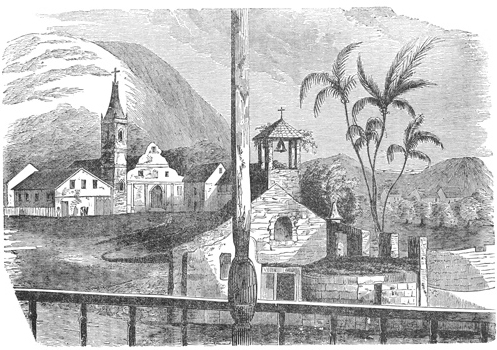
PANAMA.
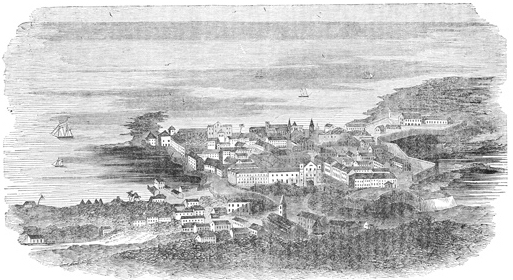
CITY OF PANAMA.
CAPTAIN WOODES ROGERS.
This voyage was undertaken chiefly by the merchants of Bristol, England. Captain Woodes Rogers was appointed commander in chief, and William Dampier first pilot of the expedition. They sailed from Kingroad, Bristol, on the 1st of August, 1708, their force consisting of the Duke, a ship of three hundred tons burden, thirty guns, and one hundred and seventy men, commanded by Rogers; and the Duchess of two hundred and seventy tons, twenty-six guns, and one hundred and fifty-one men, under the command of captain Courtney. They entered the harbor of Cork on the 6th of August, where they enlisted a number of seamen in the room of about forty fellows who had run away. They set sail on the 1st of September, with a very mixed crew, and on the morning of the 10th discovered a sail, to which they immediately gave chase. On coming up with her she proved to be a Swedish ship, and was permitted to proceed unmolested on her way. During the time the ship was in custody, a design had been privately formed on board the Duke, by four inferior officers, to make a prize of her; and when they found she was given up, they began to mutiny; but the boatsman, being displaced, and, with ten others, put in irons, and a severe whipping given to some of the leaders of the disturbance, all was quiet again. On the 14th, however, some of the ship’s company, headed by a daring fellow, came up to captain Rogers at the steerage-door, and demanded the boatswain out of irons. The captain gave them good words, and having taken the ringleader, as if to speak with him on the quarter-deck, had him suddenly seized by the help of the officers, and lashed by one of his own followers. On the 16th the captain released the prisoners from irons on their acknowledging their sorrow for what they had done.
On the 17th, gained sight of the peak of Teneriffe, and the next day took a Spanish bark of twenty-five tons. On the 25th of September passed the tropic, when about sixty of the crew, who had never been this course before, were ducked three times, by hoisting them up halfway the main-yard, with a rope to which they were made fast, and sousing them into the water. After visiting the Cape de Verd islands, where they took in water and provisions, the ships again set sail on the 8th of October, in the evening. On the 14th, they came within sight of Brazil, and soon after came to anchor before the island of Grande, in eleven fathoms water. While they lay here another quarrel arose on board the Duchess, and eight of the ringleaders were put in irons. On the 25th, two men deserted and made their escape into the woods; but, in the night, were so terrified by the noise made by the baboons and monkeys, that they ran back, plunged into the water, and prayed to be taken on board again.
The ships sailed out of the bay of Grande on the first of December, steering for Juan Fernandez, and on the 5th of January, encountered a violent storm, which drove such a quantity of water into the Duchess that they expected she would sink every moment. As the men were going to supper about nine o’clock at night, she shipped a sea at the poop, which beat in the bulkhead and all the cabin windows. On deck the yawl was staved in pieces and one or two of the men severely hurt. On the 17th, took an observation, by which they found they had got round Cape Horn and were to the northward of Cape Victoria. About this time the scurvy began to make great havoc among the crews. They now bore away for the island of Juan Fernandez, which appeared in sight on the last day of January. On going on shore here they discovered a man clothed in goat-skins, whose name was Alexander Selkirk. They remained at this island till the 14th of February, having fully refreshed themselves, when they weighed anchor, with a fair gale at south-east.
After taking a number of valuable prizes, on the 23d of April, captain Rogers with some of his men made a descent in boats and barks upon the town of Guyaquil, which they took with but little resistance and plundered of great quantities of money, jewels, and provisions. He then marched out of the town, and returned on board his own ship, where he was heartily greeted by those of his people whom he had left behind. They afterwards obtained a considerable sum as a ransom for the town, and bore away for the Gallapagos islands, with a strong gale at S. S. W.; discovered land on the 17th of May, but found it barren and destitute of water. Continuing on their voyage, they took several rich prizes, visited Gorgona and the Gallapagos, and sailing for the East Indies arrived at the islands of Serpana and Guam. They left the latter place on the 21st of March, and on the 25th of May, made Bouton. They sailed from this island on the 8th of June, and on the 23d of July, they hove down upon Horn Island to careen their vessels. Having supplied themselves with such necessaries as they wanted, they left Batavia on the 12th of October, and sailed for the Cape of Good Hope.