II Animal Superstitions
Reading edition
1. Mammals
Some years ago, a drinking fountain was erected at the Madras Museum, in which the water issued from the mouth of a lion. It entirely failed in its object, as the Native visitors would not use it, because the animal was represented in the act of vomiting.
“The acquisition,” he writes, “of such a curious taste may perhaps be explained by the following passage in a letter from the Amildar. It is a custom among the villagers here not to burn or bury the dead bodies of pregnant females, but to expose them in the neighbouring jungles to be eaten by vultures and wild beasts. The body is tied to a tree, in a sitting posture, and a pot of water is put close by. Not long ago some cowherd boys came across the dead body of a woman tied to a tree, and noticed the foot-prints of a tiger round it, but the body was untouched. The boys cut the rope binding the body, which fell to the ground, and the next day the corpse was found eaten away by the tiger.”
I once received an application for half a pound of tiger’s fat, presumably for medicinal purposes. The bones of tigers and leopards ground into powder, and mixed with their fat, gingelly (Sesamum) oil, and a finely powdered blue stone, make an ointment for the cure of syphilitic sores. The bones of a leopard or hyæna, ground into powder and made into a paste with ox-gall and musk, are said to be a useful ointment for application to rheumatic joints. The addition of the fat of tigers or leopards makes the ointment more effective. I am told that when, on one occasion, a European shot a tiger, the Natives were so keen on securing some of the fat, that the shikāris (hunters) came to him to decide as to the proper distribution among themselves and the camp servants.
The leopard is looked upon as in some way sacred by the hill Kondhs. They object to a dead leopard being carried through their villages, and oaths are taken on a leopard’s skin.
In connection with cats, there is a tradition that a Jōgi (Telugu mendicant) bridegroom, before tying the bottu (marriage badge) on his bride’s neck, had to tie it by means of a string dyed with turmeric round the neck of a female cat. People sometimes object to the catching of cats by Jōgis for food, as the detachment of a single hair from the body of a cat is considered a heinous offence. To overcome the objection, the Jōgi says that he wants the animal for a marriage ceremony. On one occasion, I saw a Mādiga (Telugu Pariah) carrying home a bag full of kittens, which he said he was going to eat. Some time ago, some prisoners, who called themselves Billaikāvus (cat-eaters), were confined in the Vizagapatam jail. I am informed that these people are Māla Paidis, who eat cat flesh.
The gun with which a wolf has been shot falls under some evil influence, and it is said not to shoot straight afterwards. Hence some shikāris (hunters) will not shoot at a wolf.
It is believed that the flesh or blood of some animals, which have certain organs largely developed, will cure disease of corresponding organs in the human subject. Thus, the flesh of the jackal, which is credited with the possession of very powerful lungs, is said to be a remedy for asthma.
There is a belief that the urine of wild dogs (Cyon dukhunensis) is extremely acrid, and that they sprinkle with it the bushes through which they drive their prey (deer and wild pigs), and then rush upon the latter, when blinded by the pungent fluid. According to another version, they jerk the urine into their victim’s eyes with their tails.
Tradition runs to the effect that, at the time of the separation of Rāmēsvaram island from the mainland, the cows became prisoners thereon. Not being able, like the cows of Cape Cod, which are fed on herrings’ heads, to adapt themselves to a fish diet, they became gradually converted into diminutive metamorphosed cows, which may still be seen grazing on the shore. The legend is based on the fancied resemblance of the horned coffer-fishes (Ostracion cornutus), which are frequently caught by the fishermen, to cattle. Portions of the skulls of cats and dogs, which are sometimes picked up on the beach, also bear a rude resemblance to the skull of a cow, the horns being represented by the zygoma.
A story is told at Cochin that the beautiful blue and white tiles from Canton, which adorn the floor of the synagogue of the White Jews, were originally intended for the Durbar hall of a former Rāja of Cochin. But a wily Jew declared that bullock’s blood must have been used in the preparation of the glaze, and offered to take them off the hands of the Rāja, who was only too glad to get rid of them.
The afterbirths (placentæ) of cattle are tied to a tree which yields a milky juice, in the belief that the cow will thereby give a better yield of milk.
There is a custom among the Tellis (Oriya oil-pressers) that, if a cow dies with a rope round its neck, or on the spot where it is tethered, the family is under pollution until purification has been effected by means of a pilgrimage, or by bathing in a sacred river. The Holodia section of the Tellis will not rear male calves, and do not castrate their bulls. Male calves are disposed of by sale as speedily as possible.
If the jungle Paliyans of Tinnevelly come across the carcase of a cow or buffalo near a stream, they will not go near it for a long time. They absolutely refuse to touch leather, and one of them declined to carry my camera box, because he detected that it had a leather strap.
The jungle Kādirs believe that their gods occasionally reside in the body of a “bison” (Bos gaurus), and have been known to worship a bull shot by a sportsman.
The goddess Gāngadēvi is worshipped by the Kēvutos (fishing caste) of Ganjam at the Dasara festival, and goats are sacrificed in her honour. In the neighbourhood of the Chilka lake, the goats are not sacrificed, but set at liberty, and allowed to graze on the Kālikadēvi hill. There is a belief that animals thus dedicated to the goddess do not putrify when they die, but dry up.
A Yānādi shikāri (hunter) has been known, when skinning a black buck (antelope) shot by a European, to cut out the testicles, and wrap them up in his loin-cloth, to be subsequently taken as an aphrodisiac. Antelope horn, when powdered and burnt, is said to drive away mosquitoes, and keep scorpions away. A paste made with antelope horn is used as an external application for sore throat. Antelope and chinkāra (Indian gazelle) horns, if kept in grain baskets, are said to prevent weevils from attacking the grain.
The Gadabas of Vizagapatam will not touch a horse, as they are palanquin-bearers, and have the same objection to the rival animal that a cab-driver has to a motor-car. In South Canara, none but the lowest Pariah will rub a horse down. If a Malai Vellāla of Coimbatore touches one of these animals, he has to perform a religious ceremonial for the purpose of purification.
When cholera breaks out in a Kondh village, all males and females smear their bodies from head to foot with pig’s fat liquefied by heat, and continue to do so until a few days after the disappearance of the dread disease. During this time they do not bathe, lest the smell of the fat should be washed away.
There is a tradition among the fishing folk of Rāmēsvaram island that a box of money was once found in the stomach of a dugong (Halicore dugong), and an official is consequently invited to be present at the examination of the stomach contents, so that the possessors of the carcase may not be punished under the Treasure Trove Act for concealing treasure. The fat of the dugong is believed to be efficacious in the treatment of dysentery, and is administered in the form of sweetmeats, or used instead of ghī (clarified butter) in the preparation of food.
2. Birds
The following story is current concerning the sacred vultures of Tirukazhukunram. The Ashtavasus, or eight gods who guard the eight points of the compass, did penance, and Siva appeared in person before them. But, becoming angry with them, he cursed them, and turned them into vultures. When they asked for forgiveness, Siva directed that they should remain at the temple of Vedagiri Iswara. One pair of these birds still survives, and come to the temple daily at noon for food. Two balls of rice cooked with ghī (clarified butter) and sugar, which have been previously offered to the deity, are placed at a particular spot on the hill. The vultures, arriving simultaneously, appropriate a ball apiece. The temple priests say that, every day, one of the birds goes on a pilgrimage to Benares, and the other to Rāmēsvaram. It is also said that the pair will never come together, if sinners are present at the temple.
When a person is ill, his family sometimes make a vow that they will ofter a few pounds of mutton to the Braāhmani kite (Haliastur indus, Garuda pakshi) on the patient’s recovery. It is believed that, should the offering be acceptable, the sick person will speedily get better, and the bird will come to demand its meat, making its presence known by sitting on a tree near the house, and crying plaintively. The shadow of a Braāhmani kite falling on a cobra is said to stupefy the snake. The Kondhs do not consider it a sin to kill this bird, which is held in veneration throughout Southern India. A Kondh will kill it for so slight an offence as carrying off his chickens.
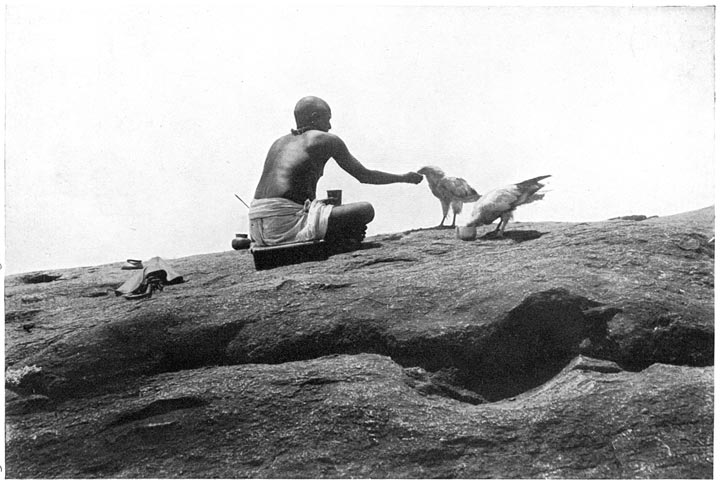
Sacred Vultures, Tirukazhukunram.
To face p. 86.
The crow is believed to possess only one eye, which moves from socket to socket as occasion demands. The belief is founded on the legend that an Asura, disguised as a crow, while Rāma was sleeping with his head on Sīta’s lap in the jungles of Dandaka, pecked at her breasts, so that blood issued therefrom. On waking, Rāma, observing the blood, and learning the cause of it, clipped a bit of straw, and, after infusing it with the Brahma astra (miraculous weapon), let it go against the crow Asura, who appealed to Rāma for mercy. Taking pity on it, Rāma told the Asura to offer one of its eyes to the weapon, and saved it from death. Since that time, crows are supposed to have only one eye. The Kondhs will not kill crows, as this would be a sin amounting to the killing of a friend. According to their legend, soon after the creation of the world, there was a family consisting of an aged man and woman, and four children, who died one after the other in quick succession. Their parents were too infirm to take the necessary steps for their cremation, so they threw the bodies away on the ground at some distance from their home. God appeared to them in their dreams one night, and promised that he would create the crow, so that it might devour the dead bodies. Some Koyis believe that hell is the abode of an iron crow, which feeds on all who go there. There is a legend in the Kavarathi Island of the Laccadives, that a Māppilla tangal (Muhammadan priest) once cursed the crows for dropping their excrement on his person, and now there is not a crow on the island.
It is believed that, if a young crow-pheasant is tied by an iron chain to a tree, the mother, as soon as she discovers the captive, will go and fetch a certain root, and by its aid break the chain, which, when it snaps, is converted into gold.
In some Kāpu (Telugu cultivator) houses, bundles of ears of rice may be seen hung up as food for sparrows, which are held in esteem. The hopping of sparrows is said to resemble the gait of a person confined in fetters, and there is a legend that the Kāpus were once in chains, and the sparrows set them at liberty, and took the bondage on themselves. Native physicians prescribe the flesh and bones of cock sparrows for those who have lost their virility. The birds are cleaned, and put in a mortar, together with other medicinal ingredients. They are pounded together for several hours, so that the artificial heat produced by the operation converts the mixture into a pulpy mass, which is taken in small doses. The flesh of quails and partridges is also believed to possess remedial properties.
A west coast housewife, when she buys a fowl, goes through a mystic ritual to prevent it from getting lost. She takes it thrice round the fireplace, saying to it: “Roam over the country and the forest, and come home safe again.” Some years ago, a rumour spread through the Koyi villages that an iron cock was abroad very early in the morning, and upon the first village in which it heard one or more cocks crow it would send a pestilence, and decimate the village. In one instance, at least, this led to the immediate extermination of all the cocks in the village.
The Indian roller (Coracias indica), commonly called the blue jay, is known as pāla-pitta or milk bird, because it is supposed that, when a cow gives little milk, the yield will be increased if a few of the feathers of this bird are chopped up, and given to it along with grass.
The fat of the peacock, which moves gracefully and easily, is supposed to cure stiff joints. Peacock’s feathers are sold in the bazaar, and the burnt ashes are used as a cure for vomiting.
The deposit of white magnesite in the “Chalk Hills” of the Salem district is believed to consist of the bones of the mythical bird Jatayu, which fought Rāvana, to rescue Sīta from his clutches.
3. Reptiles and Batrachians.
“The Coya (Koyi) people eat snakes. About forty years since a Brāhman saw a person cooking snakes for food, and, expressing great astonishment, was told by the forester that these were mere worms; that, if he wished to see a serpent, one should be shown him; but that, as for themselves, secured by the potent charms taught them by Ambikēsvarer, they feared no serpents. As the Brāhman desired to see this large serpent, a child was sent with a bundle of straw and a winnowing fan, who went, accompanied by the Brāhman, into the depths of the forest, and, putting the straw on the mouth of a hole, commenced winnowing, when smoke of continually varying colours arose, followed by bright flame, in the midst of which a monstrous serpent having seven heads was seen. The Brāhman was speechless with terror at the sight, and, being conducted back by the child, was dismissed with presents of fruits.”
Natives, when seeking for treasure, arm themselves with a staff made from one of the snake-wood trees, in the belief that the snakes which guard the treasure will retire before it.
The town of Nāgercoil in Travancore derives its name from the temple dedicated to the snake-god (nāga kovil), where many stone images of snakes are deposited. There is a belief that snake-bite is not fatal within a mile of the temple.
There is, in Malabar, a class of people called mantravādis (dealers in magical spells), who are believed to possess an hereditary power of removing the effects of snake poison by repeating mantrams, and performing certain rites. If a house is visited by snakes, they can expel them by reciting such mantrams on three small pebbles, and throwing them on to the roof. In cases of snake-bite, they recite mantrams and wave a cock over the patient’s body from the head towards the feet. Sometimes a number of cocks have to be sacrificed before the charm works. The patient is then taken to a tank (pond) or well, and a number of pots of water are emptied over his head, while the mantravādi utters mantrams. There are said to be certain revengeful snakes, which, after they have bitten a person, coil themselves round the branches of a tree, and render the efforts of the mantravādi ineffective. In such a case, he, through the aid of mantrams, sends ants and other insects to harass the snake, which comes down from the tree, and sucks the poison from the punctures which it has made.
The following note on a reputed cure for snake poisoning, used by the Oddēs (navvies), was communicated to me by Mr Gustav Haller.
“A young boy, who belonged to a gang of Oddēs, was catching rats, and put his hand into a bamboo bush, when a cobra bit him, and clung to his finger when he was drawing his hand out of the bush. I saw the dead snake, which was undoubtedly a cobra. I was told that the boy was in a dying condition, when a man of the same gang said that he would cure him. He applied a brown pill to the wound, to which it stuck without being tied. The man dipped a root into the water, and rubbed it on the lad’s arm from the shoulder downwards. The arm, which was benumbed, gradually became sensitive, and at last the fingers could move, and the pill dropped off. The moist root was rubbed on to the boy’s tongue, and into the corner of the eyes, before commencing operations. The man said that a used pill is quite efficacious, but should be well washed to get rid of the poison. In the manufacture of the pills, five leaves of a creeper are dried, and ground to powder. The pill must be inserted for nine days between the bark and cambium of a margosa tree (Melia Azadirachta) during the new moon, when the sap ascends.”
The creeper referred to is Tinospora cordifolia (gul bēl), and the roots are apparently those of the same climbing shrub. There is a widespread belief that gul bēl growing on a margosa tree is more efficacious as a medicine than that which is found on other kinds of trees.
The jungle Yānādis are fearless in catching cobras, which they draw out of their holes without any fear of their fangs. They claim to be under the protection of a charm, while so doing. A correspondent writes that a cobra was in his grounds, and his servant called in a Yānādi to dislodge it. The man caught it alive, and, before killing it, carefully removed the poison-sac with a knife, and swallowed it as a protection against snake-bite.
The Nāyādis of Malabar, when engaged in catching rats in their holes, wear round the wrist a snake-shaped metal ring, to render them safe against snakes which may be concealed in the hole.
“As soon as a person has been bitten, a snake-charmer is sent for, who allures the same or another cobra whose fangs have not been drawn to the vicinity of the victim, and causes it to bite him at as nearly as possible the same place as before. Should this be fulfilled, the bitten man will as surely recover as the snake will die. It is believed that, if a person should come across two cobras together, they will give him no quarter. To avoid being pursued by them, he takes to his heels, after throwing behind some garment, on which the snakes expend their wrath. When they have completed the work of destruction, the pieces to which the cloth has been reduced, are gathered together, and preserved as a panacea for future ills.”
The fragrant inflorescence of Pandanus fascicularis is believed to harbour a tiny snake, which is more deadly than the cobra. Incautious smelling of the flowers may, it is said, lead to death.
The earth-snake (Typhlops braminus) is known as the ear-snake, because it is supposed to enter the ear of a sleeper, and cause certain death.
The harmless tree-snake (Dendrophis pictus) is more dreaded than the cobra. It is believed that, after biting a human being, it ascends the nearest palmyra palm, where it waits until it sees the smoke ascending from the funeral pyre of the victim. The only chance of saving the life of a person who has been bitten is to have a mock funeral, whereat a straw effigy is burnt. Seeing the smoke, the deluded snake comes down from the tree, and the bitten person recovers.
For the following note on beliefs concerning the green tree-snake (Dryophis), I am indebted to Dr N. Annandale. A recipe for making a good curry, used by women who are bad cooks, is to take a tree-snake, and draw it through the hands before beginning to make the curry. To cure a headache, kill a tree-snake, and ram cotton seed and castor-oil down its throat, until the whole body is full. Then bury it, and allow the seeds to grow. Take the seeds of the plants that spring up, and separate the cotton from the castor seeds. Ram them down the throat of a second snake. Repeat the process on a third snake, and make a wick from the cotton of the plant that grows out of its body, and oil from the castor plants. If you light the wick in a lamp filled with the oil, and take it outside at night, you will see the whole place alive with green tree-snakes. Another way of performing the same experiment is to bore a hole in a ripe cocoanut, put in a live tree-snake, and stop the hole up. Then place the cocoanut beneath a cow in a cowshed for forty days, so that it is exposed to the action of the cow’s urine. A lamp fed with oil made from the cocoanut will enable you to see innumerable tree-snakes at night.
The bite of the sand-snake (Eryx Johnii) is believed to cause leprosy and twisting of the hands and feet. An earth-snake, which lives at Kodaikānal on the Palni hills, is credited with giving leprosy to any one whose skin it licks. In the treatment of leprosy, a Russell’s viper (Vipera russellii) is stuffed with rice, and put in an earthen pot, the mouth of which is sealed with clay. The pot is buried for forty days, and then exhumed. Chickens are fed with the rice, and the patient is subsequently fed on the chickens. The fat of the rat-snake (Zamenis mucosus) is used as an external application in the treatment of leprosy. An old woman, during an epidemic of cholera at Bezwāda, used to inject the patients hypodermically with an aqueous solution of cobra venom.
Mischievous children, and others, when they see two persons quarrelling, rub the nails of the fingers of one hand against those of the other, and repeat the words “Mungoose and snake, bite, bite,” in the hope that thereby the quarrel will be intensified, and grow more exciting from the spectator’s point of view.
When a friend was engaged in experiments on snake venom, some Dommaras (jugglers) asked for permission to unbury the corpses of the snakes and mungooses for the purpose of food.
If a snake becomes entangled in the net of a Bestha fisherman in Mysore when it is first used, the net is rejected, and burnt or otherwise disposed of.
There is a widespread belief among children in Malabar, that a lizard (Calotes versicolor) sucks the blood of those whom it looks at. As soon, therefore, as they catch sight of this creature, they apply saliva to the navel, from which it is believed that the blood is extracted.
A similar legend about another lizard is described as existing in Egypt. Dr Annandale further records that the Hindus and Muhammadans of Ramnād in the Ramnād district regard the chamæleon (Chamæleon calcaratus) as being possessed by an evil spirit, and will not touch it, lest the spirit should enter their own bodies. I have been told that the bite of a chamæleon is more deadly than that of a cobra.
It has already been noted (p. 73) that, when Savara children are emaciated from illness, offerings are made to monkeys. Blood-suckers are also said to be propitiated, because they have filamentous bodies. A blood-sucker is captured, small toy arrows are tied round its body, and a piece of cloth is tied round its head. Some drops of liquor are then poured into its mouth, and it is set at liberty.
4. Fishes
Some Natives will not eat the murrel fish (Ophiocephalus striatus), owing to its resemblance to a snake. Some Halēpaiks (Canarese toddy-drawers) avoid eating a fish called Srinivāsa, because they fancy that the streaks on the body bear a resemblance to the Vaishnavite sectarian mark (nāmam). Members of the Vamma gōtra of the Janappans (Telugu traders) abstain from eating the bombadai fish, because, when some of their ancestors went to fetch water in a marriage pot, they found a number of this fish in the water collected in the pot.
When a new net is used for the first time by the Besthas of Mysore, the first fish which is caught is cut, and the net is smeared with its blood. One of the meshes of the net is burnt, after incense has been thrown into the fire.
5. Invertebrates
A sweeper man, who had a mole on his back in shape somewhat resembling a scorpion, believed himself to be immune against scorpion sting, and would confidently insert the poison spine of a live scorpion into his skin. In a letter to a medical officer, a Native wrote, that, when a pregnant woman is stung by a scorpion, the child which is in the womb at the time of such stinging, when delivered, does not suffer from the sting of a scorpion, if ever it is stung during its lifetime. Some families keep in their homes small pots called thēlkodukku undi (scorpion sting vessels), and occasionally drop therein a copper coin, which is supposed to secure immunity against scorpion sting. The Sakuna Pakshi mendicants of Vizagapatam have a remedy for scorpion sting in the root of a plant called thēlla visari (scorpion antidote), which they carry about with them on their rounds. The root should be collected on a new-moon day which falls on a Sunday. On that day, the Sakuna Pakshi bathes, cuts off his loin-cloth, and goes stark-naked to a selected spot, where he gathers the roots. If a supply thereof is required, and the necessary combination of moon and day is not forthcoming, the roots should be collected on a Sunday or Wednesday. In cases of scorpion sting, Dommara medicine-men rub up patent boluses with human milk or juice of the milk-hedge plant (Euphorbia Tirucalli), and apply them to the parts. Among quaint remedies for scorpion sting may be noted, sitting with an iron crowbar in the mouth, and the application of chopped lizard over the puncture. The excrement of lizards fed on scorpions, and the undigested food in the stomach of a freshly killed goat, dried and reduced to powder, are also believed to be effective remedies. There is a belief that scorpions have the power of reviving, even after being completely crushed into pulp. We are, therefore, warned not to rest secure till the animal has actually been cremated.
The whip-scorpion Thelyphonus is believed to be venomous, some Natives stating that it stings like a scorpion, others that it ejects a slimy fluid which burns, and produces blisters. The caudal flagellum of Thelyphonus, of course, possesses no poison apparatus.
When the umbilical cord of a Kondh baby sloughs off, a spider is burnt in the fire, and its ashes are placed in a cocoanut shell, mixed with castor-oil, and applied by means of a fowl’s feather to the navel.
The eggs of red ants, boiled in margosa (Melia Azadirachta) oil, are said to be an invaluable remedy for children suffering from asthma.
The Oriya Haddis, on the evening of the tenth day after a death, proceed to some distance from the house, and place food and fruits on a cloth spread on the ground. They then call the dead man by his name, and eagerly wait till some insect settles on the cloth. As soon as this happens, the cloth is folded up, carried home, and shaken over the floor close to the spot where the household gods are kept, so that the insect falls on the sand spread on the floor. A light is then placed on the sanded floor, and covered with a new pot. After some time, the pot is removed, and the sand examined for any marks which may be left on it.
A devil, in the disguise of a dung-beetle of large size, is believed to haunt the house wherein a baby has been newly born, and the impact of the insect against the infant will bring about its instant death.
A perichæte earthworm was sent to me from Malabar as a specimen of vettila poochi, with a note to the effect that, when it is accidentally chewed, the chief symptom is drawing in of the tongue, and consequent death from suffocation. The antidote was said to be salt and water, and the leaves of the goa (guava) tree. From South Canara, Mr H. Latham sent me a planarian worm, about two inches in length, which is believed to be the vettila poochi. His camp boy told him of a case in which death was said to have resulted from eating one of these animals cooked with some jak fruit.
A few years ago, a scare arose in connection with an insect, which was said to have taken up its abode in imported German glass bangles, which compete with the indigenous industry of the Gāzula bangle-makers. The insect was reported to lie low in the bangle till it was purchased, when it would come out and nip the wearer, after warning her to get her affairs in order before succumbing. A specimen of a broken bangle, from which the insect was said to have burst forth, was sent to me. But the insect was not forthcoming.
As a further example of the way in which the opponents of a new industry avail themselves of the credulity of the Native, I may cite the recent official introduction of the chrome-tanning industry in Madras. In connection therewith, a rumour spread more or less throughout the Presidency that the wearing of chrome-tanned boots or sandals gave rise to leprosy, blood poisoning, and failure of the eyesight.