IV Snake Worship
Reading edition
Very closely connected with the subject of vows and votive offerings is that of the worship of snakes, to which vows are made and offerings dedicated.
“When a snake is seen inside, or in the neighbourhood of the house, great care is taken to catch it without giving it the least pain. Usually a stick is placed gently on its head, and the mouth of an earthenware pot is shown to it. When it is in, the pot is loosely covered with a cocoanut shell, to allow of free breathing. It is then taken to a secluded spot, the pot is destroyed, and the snake set at liberty. It is considered to be polluted by being caught in this way, and holy water is sometimes poured over it. Killing a snake is considered a grievous sin, and even to see a snake with its head bruised is believed to be a precursor of calamities. Pious Malayālis (natives of Malabar), when they see a snake killed in this way, have it burnt with the full solemnities attendant on the cremation of a high-caste Hindu. The carcase is covered with a piece of silk, and burnt in sandalwood. A Brāhman is hired to observe pollution for some days, and elaborate funeral oblations are offered to the dead snake.”
In Travancore there was formerly a judicial ordeal by snake-bite. The accused thrust his hand into a mantle, in which a cobra was wrapped up. If it bit him, he was declared guilty, if not innocent.
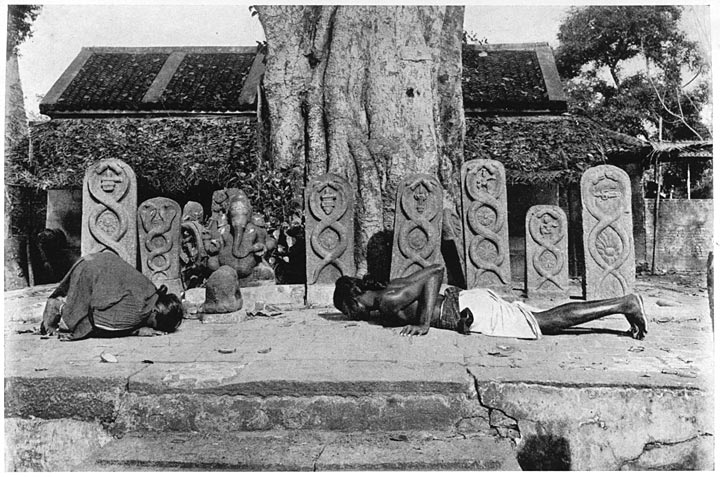
Praying for Offspring before Lingam, Snake-Stones, and Figure of Ganēsa.
To face p. 124.
Other marvellous stories of the way in which the snakes carry out their trust are narrated.
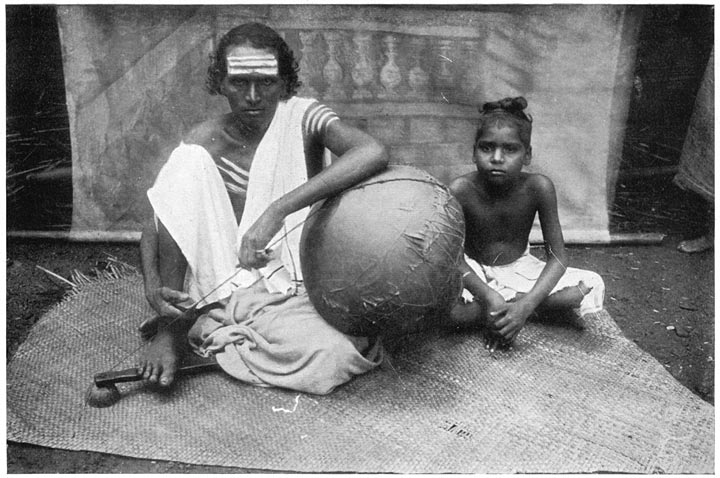
Pulluvan and Pot-Drum.
To face p. 129.
In many houses of the Tiyans of Malabar, offerings are made annually to a bygone personage named Kunnath Nāyar, and to his friend and disciple, Kunhi Rāyan, a Māppilla (Muhammadan). According to the legend, the Nāyar worshipped the kite until he obtained command and control over all the snakes in the land. There are Māppilla devotees of Kunnath Nāyar and Kunhi Rāyan, who exhibit snakes in a box, and collect alms for a snake mosque near Manarghāt at the foot of the Nīlgiri hills. A class of snake-charmers in Malabar, called Kuravan, go about the country exhibiting snakes. It is considered to be a great act of piety to purchase these animals, and set them at liberty. The vagrant Kakkalans of Travancore, who are said to be identical with the Kakka Kuravans, are unrivalled at a dance called pāmpātam (snake dance).
“A pandal (booth) supported by four poles driven into the ground is put up for the purpose, and the tops of the poles are connected with a network of strings, over which a silk or red cloth is spread to form a canopy. The pandal is well decorated, and the floor below it is slightly raised and smoothed. A hideous figure of the size of a big serpent is drawn in rice-flour, turmeric (Curcuma longa), kuvva(Curcuma angustifolia), powdered charcoal, and a green powder. These five powders are essential, for their colours are visible on the necks of serpents. Some rice is scattered on the floor and on the sides, and ripe and green cocoanuts are placed on a small quantity of rice and paddy (unhusked rice) on each side. A pūja for Ganapathi (the elephant god) is performed, to see that the whole ceremony terminates well. A good deal of frankincense is burned, and a lamp is placed on a plate, to add to the purity, sanctity, and solemnity of the occasion. The members of the house go round the pandal as a token of reverence, and take their seats close by. It often happens that the members of several neighbouring families take part in the ceremony. The women, from whom devils have to be cast out, bathe and take their seats on the western side, each with a flower-pod of the areca palm. The Pulluvan, with his wife or daughter, begins his shrill musical tunes (on serpents), vocal and instrumental alternately. As they sing, the young female members appear to be influenced by the modulation of the tunes and the smell of the perfumes. They gradually move their heads in a circle, which soon quickens, and the long locks of hair are soon let loose. These movements appear to keep time with the Pulluvan’s music. In their unconscious state, they beat upon the floor, and wipe off the figure drawn. As soon as this is done, they go to a serpent grove close by, where there may be a few stone images of serpents, before which they prostrate themselves. They now recover their consciousness, and take milk, water of the green cocoanut, and plantain fruits, and the ceremony is over.”
Sometimes, it is said, it may be considered necessary to rub away the figure as many as one hundred and one times, in which case the ceremony is prolonged over several weeks. Each time that the snake design is destroyed, one or two men, with torches in their hands, perform a dance, keeping step to the Pulluvan’s music. The family may eventually erect a small platform or shrine in a corner of their grounds, and worship at it annually. The snake deity will not, it is believed, manifest himself if any of the persons or articles required for the ceremony are impure, e.g., if the pot-drum has been polluted by the touch of a menstruating female. The Pulluvan, from whom a drum was purchased for the Madras Museum, was very reluctant to part with it, lest it should be touched by an impure woman. In addition to the pot-drum, the Pulluvans play on a lute with snakes painted on the reptile skin, which is used in lieu of parchment. The skin, in a specimen which I acquired, is apparently that of the big lizard Varanus bengalensis. The lute is played with a bow, to which a metal bell is attached.
“A vow is taken by childless wives to install a serpent (nāgapratishtai), if they are blessed with offspring. The ceremony consists in having a figure of a serpent cut in a stone slab, placing it in a well for six months, giving it life (prānapratishtai) by reciting mantrams and performing other ceremonies over it, and then setting it up under a pīpal tree (Ficus religiosa), which has been married to a margosa (Melia Azadirachta). Worship, which consists mainly in going round the tree 108 times, is then performed to it for the next forty-five days. Similar circumambulations will also bring good luck in a general way, if carried out subsequently.”
The famous temple of Subramanya in South Canara is said to have been in charge of the Subramanya Stānikas (temple servants), till it was wrested from them by the Shivalli Brāhmans. In former times, the privilege of sticking a golden ladle into a heap of food piled up in the temple on the Shasti day is said to have belonged to the Stānikas. They also brought earth from an ant-hill on the previous day. Food from the heap, and some of the earth, are received as sacred articles by devotees who visit the sacred shrine.
At the Smasanākollai festival in honour of the goddess Ankalamma at Malayanūr, some thousands of people congregate at the temple. In front of the stone idol is a large ant-hill, on which two copper idols are placed, and a brass vessel is placed at the base of the hill, to receive the various offerings.
At a wedding among the nomad Lambādis, the bride and bridegroom pour milk into an ant-hill, and offer cocoanuts, milk, etc., to the snake which lives therein. During the marriage ceremonies of the Dandāsis (village watchmen in Ganjam), a fowl is sacrificed at an ant-hill. At a Bēdar (Canarese cultivator) wedding, the earth from an ant-hill is spread near five water-pots, and on it are scattered some paddy (unhusked rice) and dhāl (Cajanus indicus) seeds. The spot is visited later on, and the seeds should have sprouted.