X Divination and Fortune-Telling
Reading edition
The Kaniyans are practically the guiding spirits in all the social and domestic concerns in Malabar, and even Christians and Muhammadans resort to them for advice. From the moment of the birth of an infant, which is noted by the Kaniyan for the purpose of casting its horoscope, to the moment of death, the services of the village astrologer are constantly in requisition. He is consulted as to the cause of all calamities, and the cautious answers that he gives satisfy the people. “Putro na putri,” which may either mean no son but a daughter, or no daughter but a son, is referred to as the type of a Kaniyan’s answer, when questioned about the sex of an unborn child.
“Far away in rural Malabar, I witnessed the ceremony in which the Velichchapād exhibited his quality. It was in the neighbourhood of a Nāyar house, to which thronged all the neighbours (Nāyar), men and women, boys and girls. The ceremony lasts about an hour. The Nāyar said it was the custom in his family to have it done once a year, but could give no account of how it originated; most probably in a vow, some ancestor having vowed that, if such or such benefit be received, he would for ever after have an annual performance of this ceremony in his house. It involved some expenditure, as the Velichchapād had to be paid, and the neighbours had to be fed. Somewhere about the middle of the little courtyard, the Velichchapād placed a lamp (of the Malabar pattern) having a lighted wick, a kalasam (brass vessel), some flowers, camphor, saffron (turmeric), and other paraphernalia. Bhagavati was the deity invoked, and the business involved offering flowers, and waving a lighted wick round the kalasam. The Velichchapād’s movements became quicker, and, suddenly seizing his sword, he ran round the courtyard (against the sun, as sailors say), shouting wildly. He is under the influence of the deity who has been introduced into him, and gives oracular utterances to the deity’s commands. What he said I know not, and no one else seemed to know, or care in the least, much interested though they were in the performance. As he ran, every now and then he cut his forehead with the sword, pressing it against the skin and sawing vertically up and down. The blood streamed all over his face. Presently he became wilder, and whizzed round the lamp, bending forward towards the kalasam. Evidently some deity, some spirit was present here, and spoke through the mouth of the Velichchapād. This, I think, undoubtedly represents the belief of all who were present. When he had done whizzing round the kalasam, he soon became a normal being, and stood before my camera. The fee for the self-inflicted laceration is one rupee, some rice, etc. I saw the Velichchapād about three days afterwards, going to perform elsewhere. The wound on his forehead had healed. The careful observer can always identify a Velichchapād by the triangular patch over the forehead, where the hair will not grow, and where the skin is somewhat indurated.”
The Kotas of the Nilgiris worship Māgāli, to whose influence outbreaks of cholera are attributed. When the dread disease breaks out among them, special sacrifices are performed with a view to propitiating the goddess, who is represented by an upright stone in a rude temple near Kotagiri. An annual ceremony takes place there, at which some man becomes possessed, and announces to the people that Māgāli has come. At the seed-sowing ceremony, a Kota priest sometimes becomes inspired, and gives expression to oracular utterances. At a Toda funeral, the men, congregating on the summit of a neighbouring hill, invoked the gods. Four of them, seized, apparently in imitation of the Kota dēvādi (priest), with divine frenzy, began to shiver and gesticulate wildly while running to and fro with closed eyes. They then began to talk in Malayālam, and offer an explanation of an extraordinary phenomenon, which had appeared in the form of a gigantic figure, which disappeared as suddenly as it appeared. The possession by some Todas of a smattering of Malayālam is explained by the fact that, when grazing their buffaloes on the western slopes of the Nīlgiris, they come in contact with Malayālam-speaking people from the neighbouring Malabar country.
“it is sacred to Siva, who assumed its form, and, at the feast of the Dasserah at Nagpore, one or more used to be liberated by the Rājah, amidst the firing of cannon and musketry, at a grand parade attended by all the officers of the station. Buchanan Hamilton also states that, before the Durga Puja, the Hindus of Calcutta purchase one of these birds, and, at the time when they throw the image of Durga into the river, set it at liberty. It is considered propitious to see it on this day, and those who cannot afford to buy one discharge their matchlocks to put it on the wing.”
A Sakuna Pakshi, before starting on a begging expedition, rises early, and has a cold meal. He then puts on the Vaishnava nāmam mark on his forehead, slings on his left shoulder a deer-skin pouch for the reception of the rice and other grain which will be given to him as alms, and takes up his little drum (gilaka or damaraka) made of frog’s skin.
Closely allied to the Sakuna Pakshis are the Budubudikēs or Budubudukalas, a class of beggars and fortune-tellers, whose name is derived from the drum (budbuki) which they use when engaged in predicting future events.
The principal tribal deity of the Kuruvikkāran beggars is Kāli or Durga, and each sept possesses a small metal plate with a figure of the goddess engraved on it, which is usually kept in the custody of the headman. It is, however, sometimes pledged, and money-lenders give considerable sums on the security of the idol, as the Kuruvikkārans would on no account fail to redeem it. At the annual festival of the goddess, while some cakes are being cooked in oil, a member of the tribe prays that the goddess will descend on him. Taking some of the cakes out of the boiling oil, he rubs the oil on his head with his palm. He is then questioned by those assembled, to whom he gives oracular replies, after sucking the blood from the cut throat of a goat.
The nomad Koravas or Yerukalas earn a livelihood partly by telling fortunes. The Telugu name Yerukala is said to mean fortune-teller, and, as the women go on their rounds through the streets, they call out “Yeruko, amma, yeruku” i.e., prophecies, mother, prophecies.
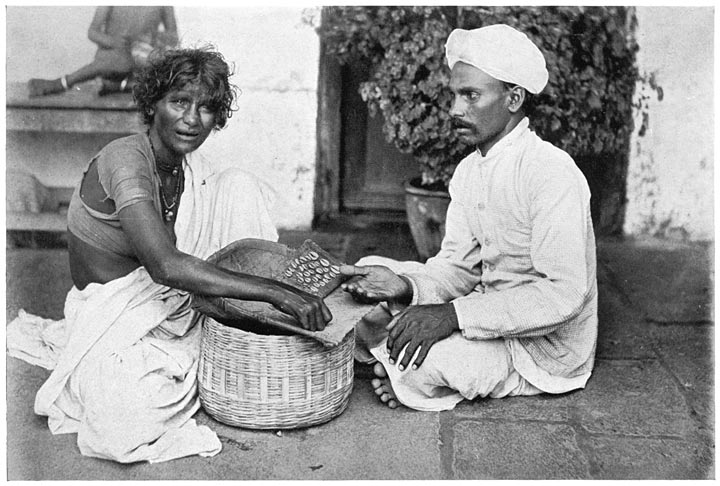
Korava Woman Telling Fortune with Cowry Shells in Tray.
To face p. 283.
The Irulas of the Tamil country, like the Yerukalas, are professional fortune-tellers. The Yerukala will carry out the work connected with her profession anywhere, at any time, and any number of times in a day. The Irula, on the contrary, remains at his home, and will only tell fortunes close to his hut, or near the hut where his gods are kept. In case of sickness, people of all classes come to consult the Irula fortune-teller, whose occupation is known as Kannimar varnithal. Taking up his drum, he warms it over the fire, or exposes it to the heat of the sun. When it is sufficiently dry to vibrate to his satisfaction, Kannimar is worshipped by breaking a cocoanut, and burning camphor and incense. Closing his eyes, the Irula beats the drum, and shakes his head about, while his wife, who stands near him, sprinkles turmeric water over him. After a few minutes, bells are tied to his right wrist. In about a quarter of an hour he begins to shiver, and breaks out in a profuse perspiration. This is a sure sign that he is inspired by the goddess. The shaking of his body becomes more violent, he breathes rapidly, and hisses like a snake. Gradually he becomes calmer, and addresses those around him as if he were the goddess, saying: “Oh! children, I have come down on my car, which is decorated with mango flowers, margosa, and jasmine. You need fear nothing so long as I exist, and you worship me. This country will be prosperous, and the people will continue to be happy. Ere long my precious car, immersed in the tank (pond) on the hill, will be taken out, and after that the country will become more prosperous,” and so on. Questions are generally put to the inspired man, not directly, but through his wife. Occasionally, even when no client has come to consult him, the Irula will take up his drum towards dusk, and chant the praises of Kannimar, sometimes for hours at a stretch, with a crowd of Irulas collected round him.
I gather, from a note by Mr. T. Ranga Rao, that the jungle Yānādis of the Telugu country pose as prophets of human destinies, and pretend to hold intercourse with gods and goddesses, and to intercede between god and man. Every village or circle has one or more soothsayers, who learn their art from experts under a rigid routine. The period of pupilage is a fortnight spent in retreat, on a dietary of milk and fruits. The god or goddess Venkatēswaralu, Subbaroyadu, Malakondroyadu, Ankamma, or Pōlēramma, appears like a shadow, and inspires the pupil, who, directly the period of probation has ceased, burns camphor and frankincense. He then sings in praise of the deity, takes a sea-bath with his master, gives a sumptuous feast, and becomes an independent soothsayer. The story runs that the ardent soothsayers of old wrought miracles by stirring boiling rice with his hand, which was proof against burn or hurt. His modern brother invokes the gods with burning charcoal in his folded hands, to the beat of a drum. People flock in large numbers to learn the truth. The soothsayer arranges the tribal deity Chenchu Dēvudu, and various local gods, in a god-house, which is always kept scrupulously clean, and where worship is regularly carried on. The auspicious days for soothsaying are Friday, Saturday, and Sunday. The chief soothsayer is a male. The applicant presents him with areca nuts, fruit, flowers, and money. The soothsayer bathes, and sits in front of his house smeared with black, white, red, and other colours. His wife, or some other female, kindles a fire, and throws frankincense into it. He beats his drum and sings, while a woman within repeats the chant in a shrill voice. The songs are in praise of the deity, at whose and the soothsayer’s feet the applicant prostrates himself, and invokes their aid. The soothsayer feels inspired, and addresses the suppliant thus:—“You have neglected me. You do not worship me. Propitiate me adequately, or ruin is yours.” The future is predicted in song, and the rural folk place great faith in the predictions.
“Valaiyan houses generally have an odiyan (Odina Wodier) tree in the backyard, wherein the devils are believed to live, and, among the Kallans, every street has a tree for their accommodation. They are propitiated at least once a year, the more virulent under the tree itself, and the rest in the house, generally on a Friday or Monday. Kallans attach importance to Friday in Ādi (July and August), the cattle Pongal day in Tai (January and February), and Kartigai day in the month Kartigai (November and December). A man, with his mouth covered with a cloth to indicate silence and purity, cooks rice in the backyard, and pours it out in front of the tree, mixed with milk and jaggery (crude sugar). Cocoanuts and toddy are also placed there. These are offered to the devils, represented in the form of bricks or mud images placed at the foot of the tree, and camphor is set alight. A sheep is then brought and slaughtered, and the devils are supposed to spring one after another from the tree into one of the bystanders. This man then becomes filled with the divine afflatus, works himself up into a kind of frenzy, becomes the mouthpiece of the spirits, pronounces their satisfaction or the reverse at the offerings, and gives utterance to cryptic phrases, which are held to foretell good or evil fortune to those in answer to whom they are made. When all the devils in turn have spoken and vanished, the man recovers his senses. The devils are worshipped in the same way in the house, except that no blood is shed.”
“A friend’s ayah had her blanket stolen. The native woman rejected the interference of the police, which her mistress proposed, but said she would send for one of her own diviners. He came, caused a fire to be lighted in an earthen vessel, then took a small basket-work grain-sifter used for winnowing rice. Having repeated certain prayers or incantations, the diviner stuck a pair of scissors into the deepest part of this tray, and, having done this, required the two assistants he brought with him each to put a finger beneath the holes in the scissors, and then hold the sifter suspended over the fire. The servants of the house were then all required, each in turn, to take a small quantity of uncooked rice in their hands, and drop it into the flame, between the fork formed by the scissors, the diviner all the time repeating some formula. All went very smoothly till the woman-servant, whom my friend had all along suspected of the theft, performed this ceremony, on which the grain-sifter commenced turning round rapidly. The culprit was convicted, and confessed the theft.”
“A Brāhmin is sent for, who writes down all the names of the people in the house, who are suspected. Next day he consecrates a piece of ground by covering it with cow-dung and water, over which he says a long prayer. The people then assemble on this spot in a line facing the Bra̱hmin, who has with him some dry rice, of which he delivers to each person the weight of a four-cornered rupee, or that quantity weighed with the sacred stone called Salagram, which is deposited in a leaf of the pippal or banyan tree. At the time of delivering it, the Brāhmin puts his right hand on each person’s head, and repeats a short prayer; and, when finished, he directs them all to chew the rice, which at a given time must be produced on the leaves masticated. The person or persons, whose rice is not thoroughly masticated, or exhibits any blood on it, is considered guilty. The faith they all have of the power of the Bra̱hmin, and a guilty conscience operating at the same time, suppresses the natural flow of saliva to the mouth, without which the hard particles of the rice bruise and cut the gums, causing them to bleed, which they themselves are sensible of, and in most instances confess the crime.”