VI Charms
Reading edition
Mantrams, or consecrated formulæ, are supposed to be very powerful, and by their aid even gods can be brought under control. They are, inter alia, believed to be efficacious in curing disease, in protecting children against devils, and women against miscarriage, in promoting development of the breasts, in bringing offspring to barren women, in warding off misfortune consequent on marriage with a girl who has an unlucky mark, in keeping wild pigs from the fields, and warding off cattle disease. For the last purpose, the magical formula is carved on a stone pillar, which is set up in the village. They are divided into four classes, viz., mantrasara, or the real essence of magic; yantrasara, or the science of cabalistic figures; prayogasara, or the method of using these for the attainment of any object; tantrasara, or the science of symbolical acts with or without words.
Yantrasara includes all cabalistic figures, the method of drawing and using them, and the objects to be attained by them. They are usually drawn on thin plates of gold, silver, copper, or lead. The efficacy of the figures, when drawn on gold, will, it is said, last for a century, while those drawn on the less precious metals will only be effective for six months or a year. Leaden plates are used when the yantrams are to be buried underground. The figures should possess the symbols of life, the eyes, tongue, eight cardinal points of the compass, and the five elements.
Prayogasara includes attraction or summoning by enchantment, driving out evil spirits, stupefaction, tempting or bringing a deity or evil spirits under control, and enticement for love, destruction, and the separation of friends.
The following are examples of cases in which a European, who, having been trained by a guru, was well versed in the theory and practice of native magic, was called in to administer to Natives, who were under the spell of devils. In the first case, a Telugu girl, about seventeen years old, had been for some time possessed by her sister’s husband, under whose influence she used to eat abnormal quantities of food, tear off her clothes, and use indecent language in a voice other than her own. When the European arrived in her room, the devil, speaking through the girl, threatened to kill her, or the European, or the individual who put it into her. Under the spell of a suitable mantram, the devil departed, and its return was prevented by the wearing of a yantram. The other case was that of a boy, who was possessed by a devil. He was found, on the occasion of the visit of the European, lying down in the courtyard of his house, clad in an ample loin-cloth, and with a high temperature. Suddenly, through some invisible agency, a corner of his loin-cloth caught fire, which was stamped out. It then caught fire in another place, and eventually was riddled with burnt holes. This was the way in which the devil manifested its influence, and sometimes the boy got burnt. A mantram was recited, with the result that the burning ceased, and the fever abated. An impromptu yantram was made out of vibhūti (sacred ashes), and tied round the boy’s neck. A religious mendicant came along a short time afterwards, and treated the boy for some ordinary sickness not connected with the devil, but the medicine did him no good. Finding the yantram round his neck, the mendicant asserted that it was the cause of his failure, and ordered its removal. This the boy’s relations refused to permit. But the holy man ripped it off. Whereon the boy instantly fell down comatose. In recording these two cases, I have reproduced my notes made on the occasion of an interview with the European.
“The charm consists of eighty-one squares, nine each way, within a border of tridents. Each square contains one or more Telugu letters, but these will not combine into any intelligible words. At the bottom of the stone are cut a lingam and two pairs of foot-prints. Some twelve years ago, it is said, the village suffered severely from cholera for three years in succession, and a Telugu mason, a foreigner who was in the village at the time, cut this charm on the stone to stop the disease. It was set up with much ceremony. The mason went round the village at night without a stitch of clothing on him, and with the entrails of a sheep hanging round his neck. Many cocoanuts were offered to the stone, and many sheep slain before it. The mason tossed a lamb in the air, caught it as it fell, tore its throat open with his teeth, and then bounded forward, and spat out the blood. More sheep and cocoanuts were offered, and then the slab was set up. The mason naturally demanded a substantial return for the benefit he had conferred on the inhabitants. When cholera now breaks out, the villagers subscribe together, and do pūja (worship) to the stone in accordance with directions left by him.”
“In several villages in the west of the district are magical slabs, which are supposed to cure cholera and cattle disease. On them, surrounded by a border of trisulas (the trident of Siva) are cut a series of little squares, in each of which is some Tamil letter. The villagers usually explain their existence by saying that, some forty years ago, an ascetic, whom they call the sangili (chain) sanyāsi from his predilection for wearing red-hot chains round his neck, came there when cholera and cattle disease were rife, and (for a consideration) put up these slabs to ward off his ills. He left directions that, when either disease reappeared, 108 pots of water were to be poured over the slab, 108 bilva (Ægle Marmelos) leaves tied to it and so on, and that men and animals were then to walk through the water which had been poured over it.”
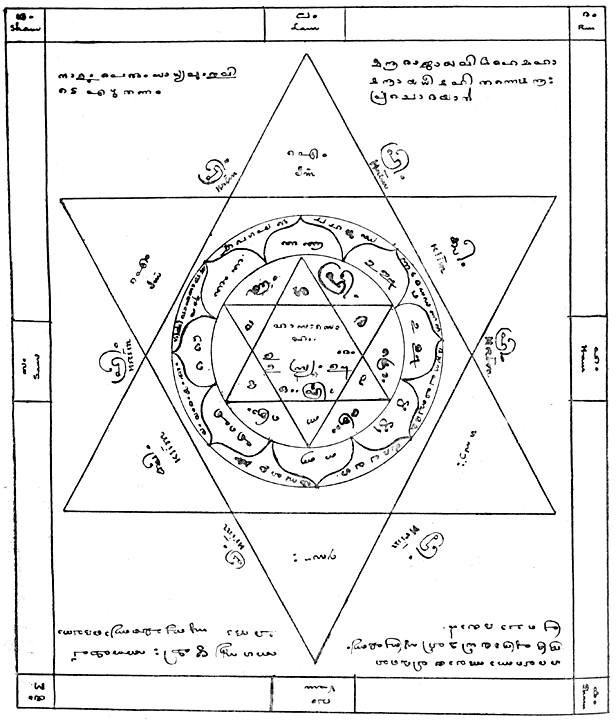
Subramaniya Yantkam, Malabar.
To face p. 185.
As examples of yantrams, the following, selected from a very large repertoire, may be cited:—
Ganapathi yantram should be drawn on metal, and worship performed. It is then enclosed in a metal cylinder, and tied by a thread round the neck of females, or the waist or arm of men. It will cure disease, conquer an enemy, or entice any one. If the sacred fire is kept up while the formula is being repeated, and dry cocoanut, plantain fruits, money, ghī (clarified butter), and sweet bread put into it, the owner will be blessed with wealth and prosperity.
Bhadrakāli yantram. The figure is drawn on the floor with flour or rice, turmeric, charcoal powder, and leaves of the castor-oil plant. If the deity is worshipped at night, it will lead to the acquisition of knowledge, strength, freedom from disease and impending calamities, wealth, and prosperity. If pūja (worship) is celebrated by a mantravādi for twelve days with the face turned towards the south, it will produce the death of an enemy.
Sudarsana yantram, when drawn on a sheet of metal, and enclosed in a cylinder worn round the neck or on the arm, will relieve those who are ill or possessed by devils. If it is drawn on butter spread on a plantain leaf, pūja performed, and the butter given to a barren woman, there will be no danger to herself or her future issue.
Suthakadosham yantram. Children under one year of age are supposed to be affected, if they are seen by a woman on the fourth day of menstruation with wet clothes and empty stomach after bathing. She may not even see her own baby or husband till she has changed her clothes, and taken food. To avert the evil, a waist-band, made of the bark of the arka plant (Calotropis gigantea), is worn.
Sarabha yantram will cure persons suffering from epilepsy or intermittent fever.
Subramaniya yantram, if regularly worshipped, will expel devils from those attacked by them, and from houses.
Hanumān yantram will protect those who are out on dark nights, and produce bodily strength and wisdom. If drawn on a sheet of gold, and pūja is performed to it every Saturday, it will bring prosperity, and help pregnant women during their confinement.
Pakshi yantram, if drawn on a sheet of lead, and kept in several places round a house, will keep snakes away.
Vatugabhairava yantram cures disease in those who are under eighteen years old, and drives out all kinds of evil spirits. If ashes are smeared on the face, and the mantram is uttered sixteen times, it will be very effective.
Varati yantram is very useful to any one who wishes to kill an enemy. He should sit in a retired spot at night, with his face turned towards the south, and repeat the mantram a thousand times for twenty days.
Prathingiri yantram is drawn on a sheet of lead, and buried at a spot over which a person, whose death is desired, will pass. It is then placed on the floor, on which the sacred fire is kindled. The mantram should be repeated eight hundred times for seven nights.
Chāmundi and Raktha Chāmundi yantrams are used for causing the death of enemies. The mantram should be written on a sheet of lead, and pūja, with the sacrifice of toddy and mutton, performed.
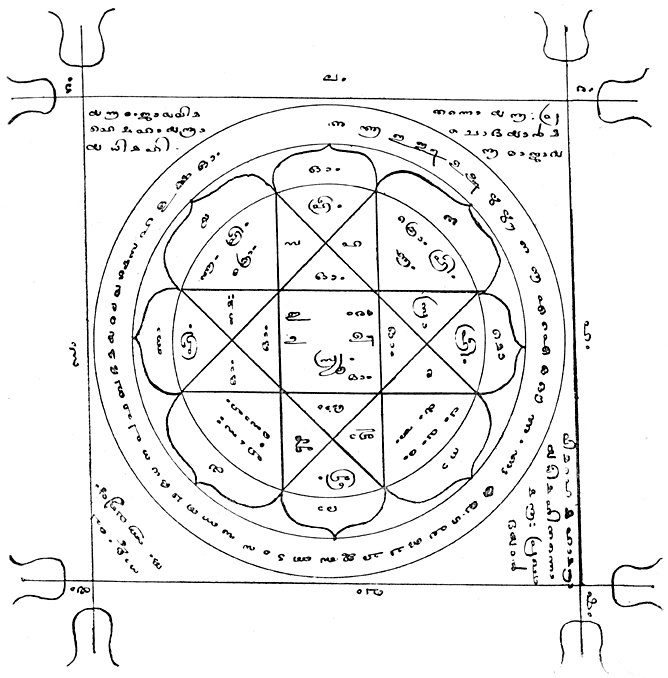
Hanumān Yantram, Malabar.
To face p. 186.
An inhabitant of Malabar presented Mr Fawcett with a yantram against the evil eye, which, if whispered over a piece of string, and tied round any part of the body affected, would work an instantaneous cure. A Cheruman at Calicut, who was wearing on his loin-string a copper cylinder containing a brass strip with mantrams, sold it to me for a rupee with the assurance that it would protect me from devils.
To produce an ulcer, which will cause the death of an enemy in ninety days, a mantram is written on a piece of cadjan (palm leaf), enclosed in an egg with a small quantity of earth on which he has urinated, and buried in an ant-hill. A fowl is killed, and its blood and some toddy are poured over the egg. To cure fever, the formula is written with the finger in water contained in a basin, and the appropriate words are repeated while the water is being drunk.
By some Muhammadans, on festival days, the names of holy persons, together with their sayings, are written on mango or palmyra leaves in ink made of charred rice. When the ink is dry, the leaves are washed in water, which is drunk. This is supposed to cure people of many obstinate diseases. A European official was informed by a Native magistrate in the Vizagapatam district that, when he wanted to tear up some old abkāri (liquor) licenses, a man implored him not to do so, as they had brought him life for a year, and were therefore worshipped. So the medicine was water, in which an old license had been dipped.
Metal bowls, engraved both on the outside and inside with texts from the Qurān, are taken or sent by Muhammadans to Mecca, where they are placed at the head of the tomb of the Prophet, and blessed. They are highly valued, and used in cases of sickness for the administration of medicine or nourishment.
It is on record that, at the battle of Seringapatam in 1799, an officer took from off the right arm of the dead body of Tīpu Sultān a talisman, which contained sewed up in pieces of fine flowered silk a charm made of a brittle metallic substance of the colour of silver, and some manuscripts in magic Arabic and Persian characters. A notorious Māppilla dacoit, who was shot by the police a few years ago, and whom his co-religionists tried to make a saint, was at the time of his death wearing five copper and silver charm cylinders round his waist.
In Malabar the tusks of a wild boar are, in cases of protracted labour, pressed over the abdomen of the woman from above downwards.
In Malabar, silver finger-rings with a piece of bristle from the tail of an elephant set in them, are worn as a charm.
In the Vizagapatam district, a most efficacious charm, supposed to render a man invulnerable to every ill, consists of a small piece of black wool, given to every one who takes a black sheep for the priest of a temple on the Bopelli ghāt. Another much valued charm in this district is called chemru mausa, which is described as being a small musk-rat only an inch and a half long, very scarce, and only found on rocky hills. It is worn in a gold or silver receptacle on the arm, and is supposed to render a man invulnerable against sword cuts and musket shots. In like manner, a mixture of gingelly (Sesamum) oil, the red dye which women use, and other ingredients, put into a small piece of hollow bamboo, and worn on the arm, are believed to protect a man against being shot with a bow or musket.
Many of the Kādir infants on the Ānaimalai hills have tied round the neck a charm, which takes the form of a dried tortoise foot; the tooth of a crocodile mimicking a phallus, and supposed to ward off attacks from a mythical water elephant which lives in the mountain streams, or wooden imitations of tiger’s claws.
Ring, in which an ānavarāhan coin is set. This is a very lucky ring. Spurious imitations are often set in rings, but it is the genuine one which brings good luck.
Gold case fastened to a string round the waist, and containing a figure written on a silver plate. The man had worn it for three years, having put it on because he used to feel hot during the cold season, and attributed his condition to the influence of an evil spirit.
Two cylinders, one of gold, the other of silver. In each were some chakrams (Travancore silver coins) and a gold leaf, on which a charm was inscribed. One of the charms was prepared by a Māppilla, the other by a Nambūtiri.
“One individual wore two rings made of an amalgamation of gold and copper, called tambāk on the ring-finger of the right hand for good luck. Tambāk rings are lucky rings. It is a good thing to wash the face with the hand, on which is a tambāk ring. Another wore two rings of the pattern called trilōham on the ring-finger of each hand. Each of these was made during an eclipse. An Akattu Charna Nāyar wore an amulet, to keep off the spirit of a Brāhman who died by drowning.”
As examples of charms worn by Bēdar men in the Canarese country, the following may be cited:—
String tied round right arm with metal box attached to it, to drive away devils. String round ankle for the same purpose.
Necklet of coral and ivory beads worn as a vow to the goddess Huligamma.
Necklets of ivory beads, and a gold disc with the Vishnupād (feet of Vishnu) engraved on it, purchased from a religious mendicant to bring good luck.
A metal charm-cylinder is sometimes attached to the sacred thread, which is worn by Dēvāngas (a weaving caste), who claim to be Dēvānga Brāhmans.
I have seen the child of a Kuruba (Canarese agriculturist) priest wearing a necklet with a copper ornament engraved with cabalistic devices, a silver plate bearing a figure of Hanumān (the monkey god), as all his other children had died, and a piece of pierced pottery from the burial-ground, to ward off whooping-cough. The Rev. S. Nicholson informs me that, if a Māla (Telugu Pariah) child grinds its teeth in its sleep, a piece of a broken pot is brought from a graveyard, and, after being smoked with incense, tied round the child’s neck with a piece of string rubbed with turmeric, or with a piece of gut. In the Tamil country, the bark of a tree on which any one has hanged himself, a cord with twenty-one knots, and the earth from a child’s grave, are hung round the neck, or tied to the waist-string as talismans.
A Kota woman at Kotagiri on the Nīlgiris, was wearing a glass necklet, with a charm pendant from it, consisting of the root of some tree rolled up in a ball of cloth. She put it on when her baby was quite young, to protect it against devils. The baby had a similar charm on its neck. By some jungle Chenchus pieces of stick strung on a thread, or seeds of Givotia rottleriformis are worn, to ward off various forms of pain.
By some Mēdaras of the Telugu country, a figure of Hanumān (the monkey god) is engraved on a thin plate of gold with cabalistic letters inscribed on it, and worn on the neck. On eclipse days, a piece of root of the arka plant (Calotropis gigantea) is worn on the neck of females, and on the waist or arm of males.
“Seeing a woman with several old coins strung on the tāli (marriage badge) string round the neck, I offered to buy them of her for a good price, but got only a torrent of abuse, since she, in her ignorance and superstition, supposed that Lutchmi, the goddess of fortune, would forsake her if she parted with the coins. In Tranquebar there lives a head mason, who always carries in his betel-nut bag a copper coin bearing the inscription of Konēri Rāyan, one of the later Pāndyans or early Nāyakars. The man would on no account part with this coin, for he believes that his success in business has improved since he came into possession of it, and that it will continue as long as he carries it with him. He says that he shall bequeath it to his family at his death, to hold in veneration almost amounting to worship. For dog bite, some Natives tie an old copper coin with a bandage over the wound, and wear it till it has healed. Others rub the coin against a copper vessel, using a few drops of the juice of the datura plant in order to form a paste, and apply the paste to the wound. Whooping-cough is believed to be caused by the displeasure of Bhairava, the dog-god, and the whooping is regarded as a sort of barking, under possession by the god. To appease his anger, an old coin is hammered into a flat round disc, a rude figure of a dog engraved on it, and suspended as a charm to the sick child’s waist. In the treatment of skin disease, dyspepsia, and leprosy, old copper coins are ground to dust, heated till the dust is like ashes, and administered medicinally. Soon after a Sonaga woman is delivered of a child, she is made to swallow a small old copper coin together with some water. Natives believe that, during delivery, the whole system is so irritated that strong counter-irritants must be administered to prevent tetanus.”
Mercury cups, said to be made of an amalgam of mercury and tin, are stated to possess the property of allowing mercury, when poured in, to ooze through them, and pass out. Milk preserved in such a cup for a few hours is said to turn into hard curd. Milk kept over night in one of these cups, or an amulet made from the cup materials, are believed to exercise a most potent influence over the male fertilising element. Such an amulet, applied to the neck of a chorister, is said to have increased his vocal powers three or four times. Piles, and other bodily ailments, are believed to be cured by wearing rings, in the composition of which mercury is one of the ingredients.
A friend once dismissed a servant for cheating and lying. A short time afterwards, he found nailed to a teapoy a paper scroll containing a jasmine flower tied up with coloured threads. On the scroll were inscribed in Tamil the mystic syllable, “Om,” and “Nāma Sīva R. U. Masthān Sāhibu avergal pādame thunai” (I seek for help at the feet of Masthān sāhib). Masthān is a Muhammad saint. The servant of a European police officer, who had been caught out in all sorts of malpractices, tried to win back the good-will of his master by means of a charm, for which he paid fifteen rupees, placed under his master’s pillow.
At the Tuticorin fishery in 1890, a scare was produced by a diver being bitten by a shark, but subsided as soon as a “wise woman” was employed. Her powers do not, however, seem to have been great, for more cases of shark-bite occurred, and the fishery had to be abandoned at a time when favourable breezes, clear water, plenty of boats, and oysters selling at a good price, indicated a successful financial result.