V Vows, Votive and other Offerings
Reading edition
Reference has been made (p. 137) to the offering of hair by devotees at the Palni shrine. When people are prevented from going to a temple at the proper time, hair is sometimes removed from their children’s head, sealed up in a vessel, and put into the receptacle for offerings when the visit to the temple is paid. In cases of dangerous sickness, the hair is sometimes cut off, and offered to a deity.
“The sacrifice of locks,” Mr A. Srinivasan writes, “is meant to propitiate deceased relations, and the deity which presides over life’s little joys and sorrows. It is a similar intention that has dictated the ugly disfigurement of widows. We meet with the identical fact and purpose in the habit of Telugu Brāhmans and non-Brāhmans in general, sacrificing their whole locks of hair to the goddess Ganga of Prayaga, to the god Venkatēsa of Tirupati, and other local gods. The Brāhman ladies of the south have more recently managed to please Ganga and other gods with just one or two locks of hair.”
A Toda who came to see me had his hair hanging down in long tails reaching below the shoulders. He had, he said, let it grow long because his wife, though married five years, had borne no child. A child had, however, recently been born, and he was going to sacrifice his locks as a thank-offering at the Nanjengōd temple. By the Badagas of the Nīlgiris, the fire-walking ceremony is celebrated to propitiate the deity Jeddayaswāmi, to whom vows are made. In token thereof, they grow one twist or plait of hair, which is finally cut off as an offering to Jeddayaswāmi.
The Bishop was told that the object of this ceremony is to enable the devotee to come to the shrine with a concentrated mind.
A common form of vow made to Māriamman at Pāppakkālpatti in the Trichinopoly district is a promise to stick little iron skewers into the body. In performance of vows, the Sēdans and Kaikōlans (weaver castes) pierce some part of the body with a spear. The latter thrust a spear through the muscles of the abdomen in honour of their god Sāhā-nayanar at Ratnagiri.
At the annual festival of the goddess Gangamma at Tirupati, a Kaikōlan devotee dances before the goddess, and, when he is worked up to the proper pitch of frenzy, a metal wire is passed through the middle of his tongue. It is believed that the operation causes no pain or bleeding, and the only remedy adopted is the chewing of margosa (Melia Azadirachta) leaves and some kunkumam (red powder) of the goddess. If, during a temple car procession, the car refuses to move, the Vīramushtis (Lingāyat mendicants), who are guardians of the idol, cut themselves with their swords until it is set in motion. There is a proverb that the Siva Brāhman (temple priest) eats well, whereas the Vīramushti hurts himself with the sword, and suffers much. The Vīramushtis are said, in former days, to have performed a ceremony called pāvadam. When an orthodox Lingāyat was insulted, he would swallow his lingam, and lie flat on the ground in front of the house of the offender, who had to collect some Lingāyats, and send for a Vīramushti. He had to arrive accompanied by a pregnant Vīramushti woman, priests of Draupadi, Pachaiamman, and Pothurāja temples, some individuals from the nearest Lingāyat mutt, and others. Arrived at the house, the pregnant woman would sit down in front of the person lying on the ground. With his sword the Vīramushti man then made cuts in his scalp and chest, and sprinkled the recumbent man with the blood. He would then rise, and the lingam would come out of his mouth. Mondi mendicants, when engaged in begging, cut the skin of the thighs with a knife, lie down and beat their chest with a stone, vomit, roll in the dust or mud, and throw ordure into the houses of those who will not contribute alms. It was noted, in a recent report of the Banganapalle State, that an inām (grant of rent-free land) was held on condition of the holder “ripping open his stomach” at a certain festival.
The annual festival at the temple of Karamadai in the Coimbatore district is visited by about forty or fifty thousand pilgrims, belonging for the most part to the lower classes. In case of sickness or other calamity, they take a vow to perform one of the following:—
(1) To pour water at the feet of the idol inside the temple. Each devotee is provided with a goat-skin bag, or a new earthen pot. He goes to the tank, and, after bathing, fills the receptacle with water, carries it to the temple, and empties it before the idol. This is repeated a number of times according to the nature of the vow. If the vow is a life-long one, it has to be performed every year until death.
(2) To give kavalam to Dāsaris (religious mendicants). Kavalam consists of plantain fruits cut up into small slices, and mixed with sugar, jaggery (crude sugar), fried grain, or beaten rice. The Dāsaris are attached to the temple, and wear short drawers, with strings of small brass bells tied to their wrists and ankles. They appear to be possessed, and move wildly about to the beating of drums. As they go about, the devotees put some of the kavalam into their mouths. The Dāsaris eat a little, and spit out the remainder into the hands of the devotees, who eat it. This is believed to cure all disease, and to give children to those who partake of it. In addition to kavalam, some put betel leaves in the mouths of the Dāsaris, who, after chewing them, spit them into the mouths of the devotees. At night the Dāsaris carry torches made of rags, on which the devotees pour ghī (clarified butter). Some people say that, many years ago, barren women used to take a vow to visit the temple at the time of the festival, and, after offering kavalam, have sexual intercourse with the Dāsaris. The temple authorities, however, profess ignorance of this practice.
On the last day of the Gangajatra festival at Tirupati, a figure is made of clay and straw, and placed in the tope (grove), where crowds of all classes, including Paraiyans, present food to it. Buffaloes, goats, sheep, and fowls are sacrificed, and it is said that Brāhmans, though they will not be present, send animals to be slaughtered. At the conclusion of the festivities, the image is burnt during the feast, which last over ten days, the lower orders of the people paint themselves, and indulge in much boisterous merriment. Those who have made a vow to Ganga fast for some days before the festival begins. They wear a structure made of bamboo in the form of a car, which is decorated with paper of different colours, and supported by iron nails pressed into the belly and back. They go about with this structure on their heads. Those who have been attacked by cholera, or other serious disease, make a vow to Ganga, and perform this ceremonial.
“there was once a Rishi (sage), who lived on the banks of the Periyapālayam river with his wife Bavāni. Every morning she used to bathe in the river, and bring back water for the use of the household. But she never took any vessel with her in which to bring the water home, for she was so chaste that she had acquired power to form a water-pot out of the dry river sand, and carry the water home in it. One day, while bathing, she saw the reflection of the face of the sky-god, Indra, in the water, and could not help admiring it. When she returned to the bank of the river, and tried to form her water-pot out of sand as usual, she could not do so, for her admiration of Indra had ruined her power, and she went home sadly to fetch a brass water-vessel. Her husband saw her carrying this to the river, and at once suspected her of unchastity, and, calling his son, ordered him to strike off her head with a sword. It was in vain that the son tried to avoid matricide. He had to obey, but he was so agitated by his feelings that, when at last he struck at his mother, he cut off not only her head, but that of a leather-dresser’s wife who was standing near. The two bodies lay side by side. The rishi was so pleased with his son’s obedience that he promised him any favour that he should ask, but he was very angry when the son at once begged that his mother might be restored to life. Being compelled to keep his word, he told the son that, if he put his mother’s head on her trunk, she would again live. The son tried to do so, but in his haste took up the head of the leather-dresser’s wife by mistake, and put it on Bavāni’s body. Leather-dressers are flesh-eaters, and so it comes about that, on days when her festival is celebrated, Bavāni—now a goddess—longs for meat, and thousands of sheep, goats, and fowls, must be slain at her shrine. This legend bears marks of Brāhmanic influence. Curiously enough, the priest of this Paraiya shrine is himself a Brāhman.”
The vows, which are performed at the festival at Periyapālayam, are as follows:—
(1) Wearing a garment of margosa (Melia Azadirachta) leaves, or wearing an ordinary garment, and carrying a lighted lamp made of rice-flour on the head.
(2) Carrying a pot decorated with flowers and margosa leaves round the temple.
(3) Going round the temple, rolling on the ground.
(4) Throwing a live fowl on to the top of the temple.
(5) Throwing a cocoanut in front, prostrating on the ground in salutation, going forward several paces and again throwing the cocoanut, and repeating the procedure till three circuits of the temple have been made.
(6) Giving offerings to the idol Parasurāma, cradle with baby made of clay or wood, etc., to bring offspring to the childless, success in a lawsuit or business transaction, and other good luck. In addition, pongal (boiled rice) has to be offered, and by some a sheep or goat is sacrificed. If a vow has been made on behalf of a sick cow, the animal is bathed in the river, clad in margosa leaves, and led round the temple. The leaf-wearing vow is resorted to by the large majority of the devotees, and performed by men, women and children. Those belonging to the more respectable classes go through it in the early morning, before the crowd has collected in its tens of thousands. The leafy garments are purchased from hawkers, who do a brisk trade in the sale thereof. The devotees have to pay a modest fee for admission to the temple precincts, and go round the shrine three or more times. Concerning the Periyapālayam festival, a recent writer observes that, “the distinctive feature is that the worshippers are clad in leaves. The devotees are bound to wear a garment made of fresh margosa twigs with their leaves. This garment is called vēpansilai. It consists of a string three or four yards long, from which depend, at intervals of two to three inches apart, twigs measuring about two feet in length, and forming a fringe of foliage. This string being wound several times round the waist, the fringe of leaves forms a kilt or short petticoat. Men are content to wear the kilt, but women also wear round their neck a similar garment, which forms a short cloak reaching to the waist. To impress on devotees the imperative obligation imposed on them to wear the leaf garment in worshipping the goddess, it is said that a young married woman, being without children, made a vow to the goddess that, on obtaining a son, she would go on a pilgrimage to Periyapālayam, and worship her in accordance with the ancient rite. Her prayer having been answered, she gave birth to a son, and went to Periyapālayam to fulfil her vow. When, however, it was time to undress and put on the vēpansilai, her modesty revolted. Unobserved by her party, she secretly tied a cloth round her waist before putting on the vēpansilai. So attired, she went to the temple to worship. On seeing her coming, the goddess detected her deceit, and, waxing wroth, set the woman’s dress all ablaze, and burnt her so severely that she died.”
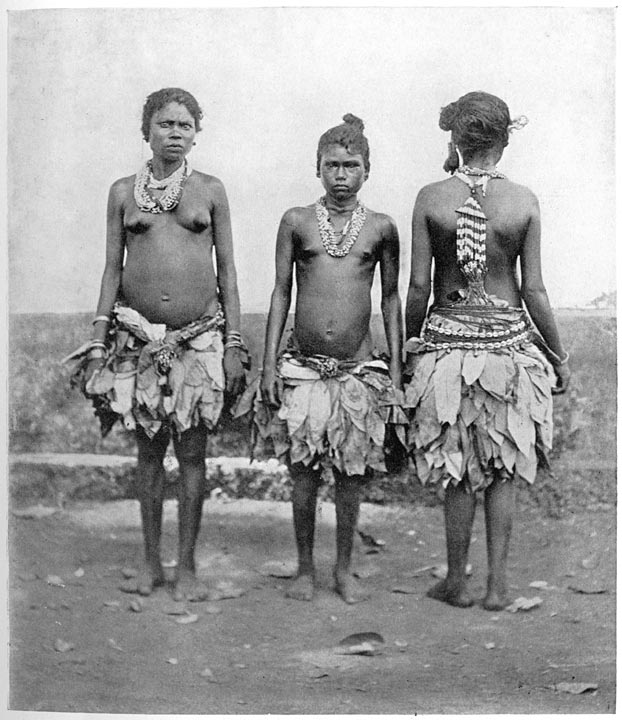
Vettuvans Wearing Leafy Garments.
To face p. 152.
“Sometimes,” a recent writer states, “a big chain hangs suspended from a tree, and the village panchāyats (tribunals) are held in the Aiyanar (or Sangali Karuppan) temple. The accused is made to submit to an ordeal in proof of innocence. The ordeal consists in his swearing on the chain, which he is made to touch. He has such a dread of this procedure, that, as soon as he touches the chain, he comes out with the truth, failure to speak the truth being punished by some calamity, which he believes will overtake him within a week. These chains are also suspended to the trees near the temples of village goddesses, and used by village panchāyats to swear the accused in any trial before them.”
At Diguvemetta in the Kurnool district, I came across a number of bells, both large and small, tied to the branches of a tamarind tree, beneath which were an image of the deity Malalamma, and a stone bull (Nandi). Suspended from a branch of the same tree was a thick rope, to which were attached heads, skulls, mandibles, thigh-bones, and feet of fowls, and the foot of a goat.
In order to present the slippers, they are allowed to enter the courtyard of the temple.
On the way leading up to the temple at Tirumala, small stones heaped up in the form of a hearth, and knots tied in the leaves of young date-palms may be seen. These are the work of virgins who accompany the parties of pilgrims. The knots are tied to ensure the tying of the marriage tāli string on their necks, and the heaping up of the stones is done with a view to ensuring the birth of children to them. If the girls revisit the hill after marriage and the birth of offspring, they untie the knot on a leaf, and disarrange one of the hearths. Men cause their name to be cut on rocks by the wayside, or on the stones with which the path leading to the temple is paved, in the belief that good luck will result if their name is trodden on by some pious man.
At Tirupati, a number of Balijas are engaged in the red sanders (Pterocarpus santalinus) wood-carving industry. Figures of deities, mythological figures, miniature temple cars, and domestic utensils, are among the articles turned out by them. Vessels made of red sanders wood carry no pollution, and can be used by women during the menstrual period, and taken back to the house without any purification ceremony. For the same reason, Sanyāsis (ascetics) use such vessels for performing worship. The carved figures are sold to pilgrims and others who visit Tirupati, and are also taken for sale to Conjeeveram, Madura, and other places, at times when important temple festivals are celebrated. Carved wooden figurines, male and female, represented in a state of nudity, are also manufactured at Tirupati, and sold to Hindus. Those who are childless perform on them the ear-boring ceremony, in the belief that, as the result thereof, issue will be born to them. Or, if there are grown-up boys or girls in a family, who remain unmarried, the parents celebrate the marriage ceremony between a pair of figurines, in the hope that the marriage of their children will speedily follow. They dress up the dolls in clothes and jewelry, and go through the ceremonial of a real marriage. Some there are who have spent as much money on a doll’s wedding as on a wedding in real life.
The simplest form of offerings consists of fruits, such as plantains and cocoanuts. Without an offering of fruit no orthodox Hindu would think of entering a temple, or coming into the presence of a Native of position. The procession of servants and retainers, each bringing a gift of a lime fruit, on New Year’s Day is familiar to Anglo-Indians. By the rules of Government, framed with a view to preventing bribery, the prohibition of the receipt of presents from Native Chiefs and others does not extend to the receipt of a few flowers or fruits, and articles of inappreciable value, although even such trifling presents should be discouraged.
As a thanksgiving for recovery from illness, votive offerings frequently take the form of silver or gold representations of the part of the body affected, which are deposited in a vessel kept for the purpose at the temple. They are kept for sale in the vicinity of the temple, and must be offered by the person who has taken the vow, or on whose behalf it has been taken. When a person has been ill all over, a silver human figure, or a thin silver wire of the same length as himself, and representing him, is sometimes offered.
Of silver offerings from temples in the Tamil country, the Madras Museum possesses an extensive collection, in which are included the face, hands, feet, buttocks, tongue, larynx, navel, nose, ears, eyes, breasts, genitalia, etc.; snakes offered to propitiate the anger of serpents, snakes coiled in coitu, sandals, flags, umbrellas, and cocoanuts strung on a pole.
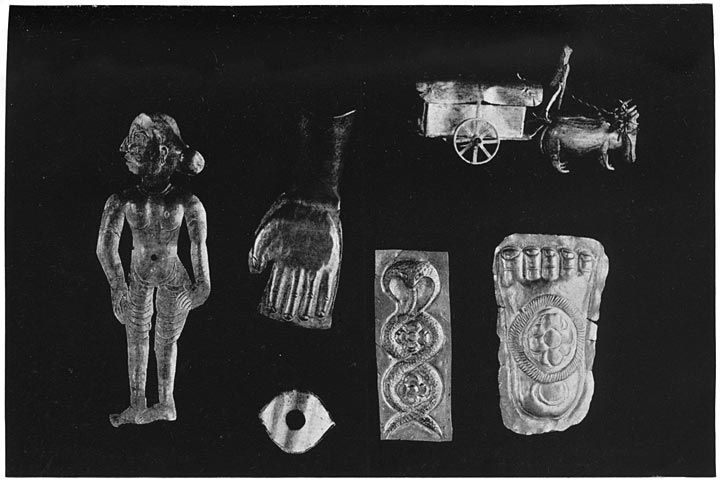
Silver Votive Offerings.
To face p. 160.
When litigation arises in Malabar in connection with the title to a house and compound (grounds) in which it stands, a vow is sometimes made to offer a silver model representing the property, if a favourable decree is obtained. Some time ago, a rich landlord offered at the temple a silver model representing the exact number of trees, house, well, etc., and costing several hundreds of rupees, when a suit was decided in his favour.
“I visited the festival on one occasion, and purchase was made of a few offerings such as are made to the temple in satisfaction of vows—a very rude representation of an infant in silver, a hand, a leg, an ulcer, a pair of eyes, and, most curious of all, a silver string which represents a man, the giver. Goldsmiths working in silver and gold are to be seen just outside the gate of the temple, ready to provide at a moment’s notice the object that any person intends to offer, in case he is not already in possession of his votive offering.”
A Nāyar examined by Mr Fawcett was wearing a silver ring as a vow, which was to be given up at the next festival at Kottiūr in North Malabar. Another was wearing a silver bangle. He had a wound in his arm which was long in healing, so he made a vow to the god at Tirupati (Tirumala) that, if his arm was healed, he would give up the bangle at the temple.
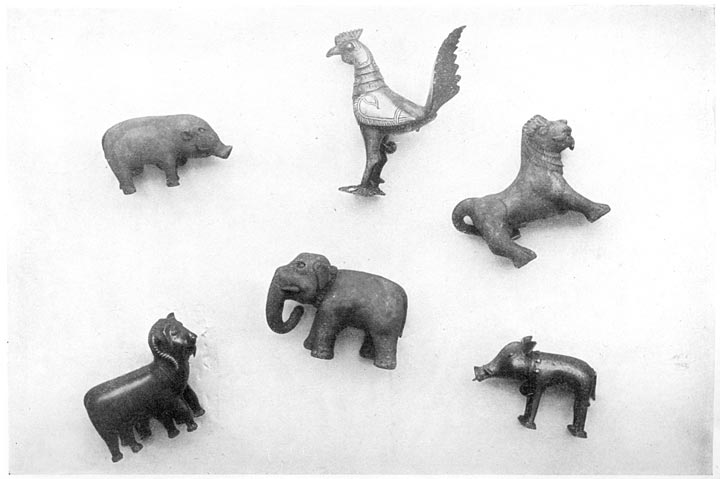
Clay and Metal Offerings, South Canara.
To face p. 162.
In Malabar, a Brāhman magician transfers the spirits of those who have died an unnatural death to images made of gold, silver, or wood, which are placed in a temple or special building erected for them. It is said by Mr F. Fawcett, “to be a sacred duty to a deceased Tiyan in Malabar, who was of importance, for example, the head of a family, to have a silver image of him made, and arrange for it being deposited in some temple, where it will receive its share of worship, and offerings of food and water. The temples at Tirunelli in Wynād and Tirunavayi, which are among the oldest in Malabar, were generally the resting-places of these images, but now some of the well-to-do deposit them much further afield, even at Benares and Rāmēsvaram. A silver image is presented to the local Siva temple, where, for a consideration, worship is done every new moon day. On each of these days, mantrams are supposed to be repeated a thousand times. When the image has been the object of these mantrams sixteen thousand times, it is supposed to have become eligible for final deposit at Tirunavayi or elsewhere.”
I am informed by Mr G. V. Ramamurthi Pantulu that the Savaras attend the markets or fairs held in the plains, or at the foot of the ghāts, to purchase salt and other articles. If a Savara is taken ill at the market or on his return thence, he attributes the illness to a spirit of the market called Biradi Sonum. The bulls which carry the goods of the Hindu merchants to the market are supposed to convey the spirit. In propitiating it, the Savara makes an image of a bull in straw, and, taking it out of his village, leaves it on the footpath, after a pig has been sacrificed. Owners of cattle take the animals when sick round the sacred hill at Tirukazhukunram in performance of a vow, in the belief that their health will be thus restored.
“A Brāhmini bull,” Mr A. Srinivasan writes, “is dedicated to the god Venkatēswara of Tirupati, for the benefit of the living in fulfilment of vows. The act of dedication and release is preceded by elaborate rituals of marriage, as among men and women. The bride, which should be a heifer that has not calved, is furnished by the father-in-law of the donor. The heifer is united in holy wedlock to the bullock, after formal chanting of mantrams, by the tying of the tāli and toe-rings to the neck. In this sham marriage, the profuse ornamentation of the couple with saffron (turmeric) and red powder, the pouring of rice on their heads, and a procession through the streets with music, are conspicuous features.”
I am told that, if the devotee cannot afford a live animal, a mimic representative is made in rice.
“Some, being devoutly disposed, will make the image of this god (Buddha) at their own charge. For the making whereof they must bountifully reward the Founder. Before the eyes are made, it is not accounted a god, but a lump of ordinary metal, and thrown about the shop with no more regard than anything else. But, when the eyes are to be made, the artificer is to have a good gratification, besides the first agreed upon reward. The eyes being formed, it is thenceforward a god. And then, being brought with honour from the workman’s shop, it is dedicated by solemnities and sacrifices, and carried with great state into the shrine or little house, which is before built and prepared for it.”
The most popular of the Muhammadan saints who are buried at Porto Novo, where a considerable number of Marakkāyars (Muhammadans) are engaged as sailors,
I once saw a Muhammadan at Tumkur in Mysore, whither he had journeyed from Hyderabad, who had a rupee tied round his arm in token of a vow that, if he returned safe from plague and other ills to his own country, he would give money in charity. When a Muhammadan falls ill, a rupee and a quarter is sometimes done up in a red cloth, and tied round the arm, to be given to the poor on recovery. Members of the poorer classes tie an anna and a quarter in like manner, after performing a fateha ceremony. Should the sickness of a Hindu be attributed to a god or goddess, a vow is made, in token whereof a copper or silver coin is wrapped up in a piece of cloth dipped in turmeric paste, and kept in the house, or tied to the neck or arm of the sick person. A cock may be waved round the head of the patient, and afterwards reared in the house, to be eventually offered up at the shrine of the deity. A Bēdar, whom I saw at Hospet in the Bellary district, had a quarter anna rolled up in cotton cloth, which he wore on the upper arm in performance of a vow.
“The goddess Kulanthal Amman has established for herself a useful reputation as a settler of debts. When a creditor cannot recover a debt, he writes down his claim on a scroll of palm-leaves, and offers the goddess a part of the debt, if it is paid. The palmyra scroll is hung up on an iron spear in the compound of the temple before the shrine. If the claim is just, and the debtor does not pay, it is believed that he will be afflicted with sickness and bad dreams. In his dreams he will be told to pay the debt at once, if he wishes to be freed from his misfortunes. If, however, the debtor disputes the claim, he draws up a counter-statement, and hangs it on the same spear. Then the deity decides which claim is true, and afflicts with sickness and bad dreams the man whose claim is false. When a claim is acknowledged, the debtor brings the money, and gives it to the pūjāri, who places it before the image of Kulanthal Amman, and sends word to the creditor. The whole amount is then handed over to the creditor, who pays the sum vowed to the goddess into the temple coffers in April or May. So great is the reputation of the goddess, that Hindus come from about ten miles round to seek her aid in recovering their debts. The goddess may sometimes make mistakes, but, at any rate, it is cheaper than an appeal to an ordinary court of law, and probably almost as effective as a means of securing justice. In former times, no written statements were presented; people simply came and represented their claims by word of mouth to the deity, promising to give her a share. The custom of presenting written claims sprang up about thirty years ago, doubtless through the influence of the Civil Courts. Apparently more debts have been collected since this was done, and more money has been gathered into the treasury.”
The story is told by Bishop Caldwell of a Shānar (toddy-drawer) who was sitting upon a leaf-stalk at the top of a palmyra palm in a high wind, when the stalk gave way, and he came down to the ground safely and quietly sitting on the leaf, which served the purpose of a natural parachute.
The festival of Ayudha Pūja (worship of tools or implements) is observed by all Hindu castes during the last three days of the Dasara or Navarathri in the month of Purattasi (September-October). It is a universal holiday for all Hindu workmen. Even the Brāhman takes part in this pūja. His tools, however, being books, it is called Saraswati pūja, or worship to the goddess or god of learning, who is either Saraswati or Hayagriva. Reading books and repetition of Vēdas must be done, and, for the purpose of worship, all the books in a house are piled up in a heap. Non-Brāhmans clean the various implements used by them in their daily work, and worship them. The Kammālans (artisans) clean their hammers, pincers, anvil, blowpipe, etc.; the Chettis (merchants) clean their scales and weights, and the box into which they put their money. The racket-marker at the Madras Club decorates the entrance to the scoring-box in which his rackets are kept, with a festoon of mango leaves. The weaving and agricultural classes will be seen to be busy with their looms and agricultural implements. Fishermen pile up their nets for worship. Even the bandywala (cart-driver) paints red and white stripes on the wheels and axles. I have myself been profusely garlanded when present as a guest at the elaborate tool-worshipping ceremony at the Madras School of Arts, where pūja was done to a bust of the late Bishop Gell set up on an improvised altar, with a cast of Saraswati above, and various members of the Hindu Pantheon around.
“the headman of the village gets a new earthenware pot, besmears it with turmeric and kunkuma (red powder), and puts inside it some clay bracelets, necklaces, and earrings, three pieces of charcoal, three pieces of turmeric, three pieces of incense, a piece of dried cocoanut, a woman’s cloth, and two annas worth of coppers—a strange collection of miscellaneous charms and offerings. The pot is then hung up on a tree near the image of the village deity, as a pledge that, if the epidemic disappears, the people will celebrate a festival.”
Between the Madras museum and the Government maternity hospital, a small municipal boundary stone has been set up by the side of the road. To this stone supernatural powers are attributed, and it is alleged that in a banyan tree in a private garden close by a Mūni lives, who presides over the welfare of the patients in the hospital, and must be propitiated if the pregnant woman is to get over her confinement without complications. Women vow that they will, if all goes well, give a cocoanut, betel, or flowers when they leave. Discharged patients can be seen daily, going to the stone and making offerings. On the day of their discharge, their friends bring camphor and other articles, and the whole family goes to the stone, where the camphor is burnt, a cocoanut broken, and perhaps some turmeric or flowers placed on it. The new-born child is placed on the bare ground in front of the stone, and the mother, kneeling down, bows before it. The foreheads of both mother and child are marked with the soots from the burning camphor. If her friends do not bring the requisite articles, the woman goes home, and returns with them to do pūja to the stone, or it is celebrated at a temple or her house. The offerings are removed by those who present them, or by passers-by on the road.
The Kudubi cutch (catechu) makers of South Canara, before the commencement of operations, select an Areca Catechu tree, and place a sword, an axe, and a cocoanut on the ground near it. They prostrate themselves before the tree, with hands uplifted, burn incense, and break cocoanuts. The success of the operations is believed to depend on the good-will of a deity named Siddēdēvaru. Before they commence work, the Kudubis make a vow that, if they are successful, they will offer a fowl.
Prehistoric stone cells, found in the bed of a river, are believed to be the thunderbolts of Vishnu, and are stacked as offerings by the Malaiālis of the Shevaroy hills in their shrines dedicated to Vignēswara the elephant god, who averts evil, or in little niches cut in rocks.
On one occasion, a man who had been presented with two annas as the fee for lending his body to me for measurement, offered it, with flowers and a cocoanut, at the shrine of the village goddess, and dedicated to her another coin of his own as a peace-offering, and to get rid of the pollution caused by my money.