VII Human Sacrifice
Reading edition
“The ceremonies attending the barbarous rite (Kondh human sacrifice) vary in different parts of the country. In the Māliahs of Goomsur, the sacrifice is offered annually to Thadha Pennoo, under the effigy of a bird intended to represent a peacock, with the view of propitiating the deity to grant favourable seasons and crops. The ceremony is performed at the expense of, and in rotation, by certain mootahs (districts) composing a community, and connected together from local circumstances. Besides these periodical sacrifices, others are made by single mootahs, and even by individuals, to avert any threatening calamity from sickness, murrain, or other causes. Grown men are the most esteemed (as victims), because the most costly. Children are purchased, and reared for years with the family of the person who ultimately devotes them to a cruel death, when circumstances are supposed to demand a sacrifice at his hands. They seem to be treated with kindness, and, if young, are kept under no constraint; but, when old enough to be sensible of the fate that awaits them, they are placed in fetters, and guarded. Most of those who were rescued had been sold by their parents or nearest relations, a practice which, from all we could learn, is very common. Persons of riper age are kidnapped by wretches who trade in human flesh. The victim must always be purchased. Criminals, or prisoners captured in war, are not considered fitting subjects. The price is paid indifferently in brass utensils, cattle, or coin. The zanee (or priest), who may be of any caste, officiates at the sacrifice, but he performs the poojah (offering of flowers, incense, etc.) to the idol through the medium of the Toomba, who must be a Khond child under seven years of age. This child is fed and clothed at the public expense, eats with no other person, and is subjected to no act deemed impure. For a month prior to the sacrifice, there is much feasting and intoxication, and dancing round the Meriah, who is adorned with garlands, etc., and, on the day before the performance of the barbarous rite, is stupefied with toddy, and made to sit, or, if necessary, is bound at the bottom of a post bearing the effigy above described. The assembled multitude then dance around to music, and, addressing the earth, say ‘Oh! God, we offer the sacrifice to you. Give us good crops, seasons, and health.’ After which they address the victim. ‘We bought you with a price, and did not seize you. Now we sacrifice you according to custom, and no sin rests with us.’ On the following day, the victim being again intoxicated, and anointed with oil, each individual present touches the anointed part, and wipes the oil on his own head. All then proceed in procession around the village and its boundaries, preceded by music, bearing the victim and a pole, to the top of which is attached a tuft of peacock’s feathers. On returning to the post, which is always placed near the village deity called Zakaree Pennoo, and represented by three stones, near which the brass effigy in the shape of the peacock is buried, they kill a pig in sacrifice, and, having allowed the blood to flow into a pit prepared for the purpose, the victim who, if it has been found possible, has been previously made senseless from intoxication, is seized and thrown in, and his face pressed down until he is suffocated in the bloody mire amid the noise of instruments. The Zanee then cuts a piece of the flesh from the body, and buries it with ceremony near the effigy and village idol, as an offering to the earth. All the rest afterwards go through the same form, and carry the bloody prize to their villages, where the same rites are performed, part being interred near the village idol, and little bits on the boundaries. The head and face remain untouched, and the bones, when bare, are buried with them in the pit. After this horrid ceremony has been completed, a buffalo calf is brought in front of the post, and, his forefeet having been cut off, is left there till the following day. Women, dressed in male attire, and armed as men, then drink, dance, and sing round the spot, the calf is killed and eaten, and the Zanee is dismissed with a present of rice, and a hog or calf.”
In the same year, Mr Arbuthnot, Collector of Vizagapatam, reported as follows:—
“Of the hill tribe Codooloo (Kondh), there are said to be two distinct classes, the Cotia Codooloo and Jathapoo Codooloo. The former class is that which is in the habit of offering human sacrifices to the god called Jenkery, with a view to secure good crops. This ceremony is generally performed on the Sunday preceding or following the Pongal feast. The victim is seldom carried by force, but procured by purchase, and there is a fixed price for each person, which consists of forty articles such as a bullock, a male buffalo, a cow, a goat, a piece of cloth, a silk cloth, a brass pot, a large plate, a bunch of plantains, etc. The man who is destined for the sacrifice is immediately carried before the god, and a small quantity of rice coloured with saffron (turmeric) is put upon his head. The influence of this is said to prevent his attempting to escape, even though set at liberty. It would appear, however, that, from the moment of his seizure till he is sacrificed, he is kept in a continued state of stupefaction or intoxication. He is allowed to wander about the village, to eat and drink anything he may take a fancy to, and even to have connection with any of the women whom he may meet. On the morning set apart for the sacrifice, he is carried before the idol in a state of intoxication. One of the villagers officiates as priest, who cuts a small hole in the stomach of the victim, and with the blood that flows from the wound the idol is besmeared. Then the crowds from the neighbouring villages rush forward, and he is literally cut into pieces. Each person who is so fortunate as to procure it carries away a morsel of the flesh, and presents it to the idol of his own village.”
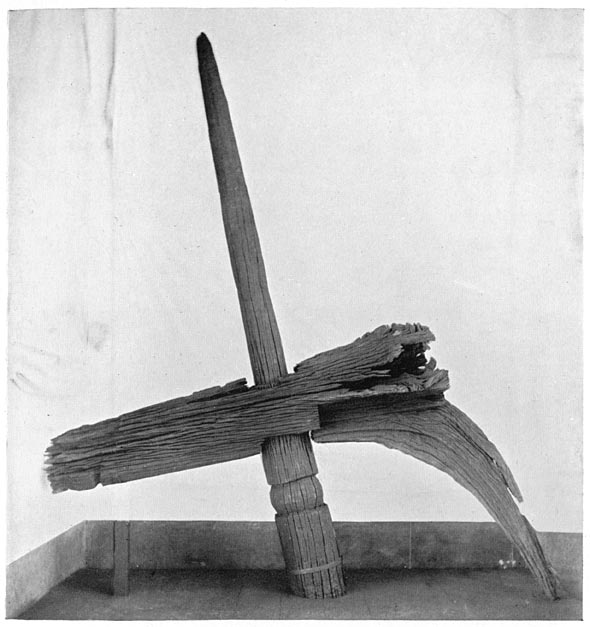
Meriah Sacrifice Post.
(Hatti mundo.)
To face p. 202.
“As the tears stream from thine eyes,
So may the rain pour down in August;
As the mucus trickles from thy nostrils,
So may it drizzle at intervals;
As thy blood gushes forth,
So may the vegetation sprout;
As thy gore falls in drops,
So may the grains of rice form.”
In another report, Colonel Campbell describes how the miserable victim is dragged along the fields, surrounded by a crowd of half intoxicated Kondhs who, shouting and screaming, rush upon him, and with their knives cut the flesh piecemeal from the bones, avoiding the head and bowels, till the living skeleton, dying from loss of blood, is relieved from torture, when its remains are burnt, and the ashes mixed with the new grain to preserve it from insects. Yet again, he describes a sacrifice which was peculiar to the Kondhs of Jeypore.
“It is,” he says, “always succeeded by the sacrifice of three human beings, two to the sun in the east and west of the village, and one in the centre, with the usual barbarities of the Meriah. A stout wooden post about six feet long is firmly fixed in the ground, at the foot of it a narrow grave is dug, and to the top of the post the victim is firmly fastened by the long hair of his head. Four assistants hold his outstretched arms and legs, the body being suspended horizontally over the grave, with the face toward the earth. The officiating Junna or priest, standing on the right side, repeats the following invocation, at intervals hacking with his sacrificing knife the back part of the shrieking victim’s neck. ‘Oh! mighty Manicksoro, this is your festal day. To the Khonds the offering is Meriah, to the kings Junna. On account of this sacrifice, you have given to kings kingdoms, guns, and swords. The sacrifice we now offer you must eat, and we pray that our battle-axes may be converted into swords, our bows and arrows into gunpowder and balls; and, if we have any quarrels with other tribes, give us the victory. Preserve us from the tyranny of kings and their officers.’ Then, addressing the victim, ‘That we may enjoy prosperity, we offer you as a sacrifice to our god Manicksoro, who will immediately eat you, so be not grieved at our slaying you. Your parents were aware, when we purchased you from them for sixty rupees, that we did so with intent to sacrifice you. There is, therefore, no sin on our heads, but on your parents. After you are dead, we shall perform your obsequies.’ The victim is then decapitated, the body thrown into the grave, and the head left suspended from the post till devoured by wild beasts. The knife remains fastened to the post till the three sacrifices have been performed, when it is removed with much ceremony.”
The Kondhs of Bara Mootah promised to relinquish the Meriah rite on condition, inter alia, that they should be at liberty to sacrifice buffaloes, monkeys, goats, etc., to their deities, with all the solemnities observed on occasions of human sacrifice; and that they should further be at liberty, upon all occasions, to denounce to their gods the Government, and some of its servants in particular, as the cause of their having relinquished the great rite. The last recorded Meriah sacrifice in the Ganjam Māliahs occurred in 1852, and there are still Kondhs alive, who were present at it. The veteran members of a party of Kondhs, who were brought to Madras for the purpose of performing their dances before the Prince and Princess of Wales in 1906, became widely excited when they came across the relic of their barbarous custom at the museum. Twenty-five descendants of persons who were rescued by Government officers, returned themselves as Meriah at the census, 1901.
Even so recently as 1902, a European magistrate in Ganjam received a petition, asking for permission to perform a human sacrifice, which was intended to give a rich colour to the turmeric crop.
The buffalo sacrifice is not unaccompanied by risk, as the animal, before dying, sometimes kills one or more of its tormentors. This was the case near Balliguda in 1899, when a buffalo killed the sacrificer. In the previous year, the desire of a village to intercept the bearer of the flesh from a neighbouring village led to a fight, in which two men were killed.
On the site of the old fort at Rāmagiri in the Vizagapatam district, a victim was formerly sacrificed every third year.
The nomad Koravas are said to have formerly performed human sacrifices, one effect of which was to increase the fertility of the soil. The following account of such a sacrifice was given to Mr C. Hayavadana Rao by an old inhabitant of the village of Asūr near Walajabad in the Chingleput district. A big gang of Koravas settled at the meeting point of three villages of Asūr, Mēlputtūr, and Avalūr, on an elevated spot commanding the surrounding country. They had with them their pack-bullocks, each headman of the gang owning about two hundred head. The cow-dung which accumulated daily attracted a good many of the villagers, on one of whom the headman fixed as their intended victim. They made themselves intimate with him, plied him with drink and tobacco, and gave him the monopoly of the cow-dung. Thus a week or ten days passed away, and the Koravas then fixed a day for the sacrifice. They invited the victim to visit them at dusk, and witness a great festival in honour of their caste goddess. At the appointed hour, the man went to the settlement, and was induced to drink freely. Meanwhile, a pit, large enough for a man to stand upright in, had been prepared. At about midnight, the victim was seized, and forced to stand in the pit, which was filled in up to his neck. This done, the women and children of the gang made off with their belongings. As soon as the last of them had quitted the settlement, the headmen brought a large quantity of fresh cow-dung, and placed a ball of it on the head of the victim. The ball served as a support for an earthen lamp, which was lighted. The man was by this time nearly dead, and the cattle were made to pass over his head. The headmen then made off, and, by daybreak, the whole gang had disappeared. The sacrificed man was found by the villagers, who have, since that time, scrupulously avoided the Koravas. The victim is said to have turned into a Munisvara, and for a long time troubled those who happened to go near the spot at noon or midnight. The Koravas are said to have performed the sacrifice, so as to insure their cattle against death from disease. The ground, on which they encamped, and on which they offered the human sacrifice, is stated to have been barren prior thereto, and, as the result thereof, to have become very fertile.
“When they wish to perform this horrible act, it is said, they secretly carry off the first person they meet. Having conducted the victim to some lonely spot, they dig a hole, in which they bury him up to the neck. While he is still alive, they make a sort of lamp of dough made of flour, which they place on his head. This they fill with oil, and light four wicks in it. Having done this, the men and women join hands, and, forming a circle, dance round their victim, singing and making a great noise, till he expires.”
It is suggested by Bishop Whitehead that the custom of thus burying a pig may be connected with the worship of an agricultural goddess, or a survival of a former custom of infanticide or human sacrifice, such as prevailed among the Lambādis.
The disguise of Ucchavēli is also assumed by the Malayans for the propitiation of the demon, when a human sacrifice is considered necessary. The Malayan who is to take the part puts on a cap made of strips of cocoanut leaf, and strips of the same leaves tied to a bent bamboo stick round his waist. His face and chest are daubed with yellow paint, and designs are drawn thereon in red or black. Strings are tied tightly round the left arm near the elbow and wrist, and the swollen area is pierced with a knife. The blood spouts out, and the performer waves the arm, so that his face is covered with blood. In the ceremony for propitiating the demon Nenaveli (bloody sacrifice), the Malayan smears the upper part of the body and face with a paste made of rice-flour reddened with turmeric powder and chunam (lime), to indicate a sacrifice. Before the paste dries, parched paddy (unhusked rice) grains, representing smallpox pustules, are sprinkled over it. Strips of young cocoanut leaves, strung together so as to form a petticoat, are tied round the waist, a ball of sacred ashes (vibhūthi) is fixed on the tip of the nose, and two strips of palm leaf are placed in the mouth to represent fangs. If it is thought that a human sacrifice is necessary to propitiate the devil, the man representing Nenaveli puts round his neck a kind of framework made of plantain leaf sheaths; and, after he has danced with it on, it is removed, and placed on the ground in front of him. A number of lighted wicks are stuck in the middle of the framework, which is sprinkled with the blood of a fowl, and then beaten and crushed. Sometimes this is not regarded as sufficient, and the performer is made to lie in a pit, which is covered over by a plank, and a fire kindled. A Malayan, who acted the part of Nenaveli before me, danced and gesticulated wildly, while a small boy, concealed behind him, sang songs in praises of the demon, to the accompaniment of a drum. At the end of the performance, he feigned extreme exhaustion, and laid on the ground in a state of apparent collapse, while he was drenched with water brought in pots from a neighbouring well.
“In Kirinadu and Koniucheri Grāmas,” he writes, “once every three years, in December and June, a human sacrifice used to be brought to Bhadra Kali, and, during the offering by the Panikas, the people exclaimed ‘Al Amma’ (a man, Oh mother), but once a devotee shouted ‘Al all Amma, Adu’ (not a man, oh mother, a goat), and since that time a he-goat without blemish has been sacrificed. Similarly, in Bellur, once a year, by turns from each house, a man was sacrificed by cutting off his head at the temple; but, when the turn came to a certain home, the devoted victim made his escape to the jungle. The villagers, after an unsuccessful search, returned to the temple, and said to the pūjāri (priest) ‘Kalak Adu,’ which has a double meaning, viz., Kalake next year, adu he will give, or adu a goat, and thenceforth only scapegoats were offered.”
Human sacrifice is considered efficacious in appeasing the earth spirit, and in warding off devils during the construction of a new railway or big bridge. To the influence of such evil spirits the death of several workmen by accident in a cutting on the railway, which was under construction at Cannanore in Malabar, was attributed. A legend is current at Anantapur that, on one occasion, the embankment of the big tank breached. Ganga, the goddess of water, entered the body of a woman, and explained through her that, if some one was thrown into the breach, she would cause no further damage. Accordingly, one Musalamma was thrown in, and buried within it. The spot is marked by several margosa (Melia Azadirachta) trees, and sheep, fowls, etc., are still occasionally offered to the girl who was thus sacrificed. When a tank bund (embankment) was under construction in Mysore, there was a panic among the workmen, owing to a rumour that three virgins were going to be sacrificed. When a mantapam or shrine was consecrated, a human sacrifice was formerly considered necessary, but a cocoanut is now sometimes used as a substitute. At Kalasapād in the Cuddapah district, a missionary told Bishop Whitehead that, when a new ward was opened at the mission dispensary in 1906, none would enter it, because the people believed that the first to enter would be offered as a sacrifice. Their fears were allayed by a religious service. During the building of a tower at the Madras Museum, just before the big granite blocks were placed in position, the coolies contented themselves with the sacrifice of a goat. On the completion of a new building, some castes on the west coast sacrifice a fowl or sheep, to drive away the devils, which are supposed to haunt it.
In a note on the Velamas of the Godāvari district, Mr F. R. Hemingway writes that they admit that they always arrange for a Māla (Telugu Pariah) couple to marry, before they have a marriage in their own houses, and that they provide the necessary funds for the Māla marriage. They explain the custom by a story to the effect that a Māla once allowed a Velama to sacrifice him in order to obtain a hidden treasure, and they say that this custom is observed out of gratitude for the discovery of the treasure which resulted. The Rev. J. Cain gives a similar custom among the Velamas of Bhadrāchalam in the Godāvari district, only in this case it is a Palli (fisherman) who has to be married. Some years ago, a Native of the west coast, believing that treasure was hidden on his property, took council with an astrologer, who recommended the performance of a human sacrifice, which happily was averted. On one occasion, a little Brāhman girl is said to have been decoyed when on her way to school, and murdered in the god’s room at a temple in Vellore, in which treasure was supposed to be concealed.
In 1901, a Native of the Bellary district was tried for the murder of his child, in the belief that hidden treasure would thereby be revealed to him. The man, whose story I heard from himself in the lock-up, had apparently implicit faith that the god would bring the child to life again. The case, as recorded in the judgment of the Sessions Judge, was as follows:—
“The prisoner has made two long statements to the Magistrate, in each of which he explains why he killed the child. From these statements it appears that he had been worshipping at the temple of Kona Irappa for six or seven years, and that, on one or more occasions, the god appeared to him, and said: ‘I am much pleased with your worship. There is wealth under me. To whom else should it be given but you?’ The god asked the prisoner to sacrifice sheep and buffaloes, and also said: ‘Give your son’s head. You know that a head should be given to the god who confers a boon. I shall raise up your son, and give you the wealth which is under me.’ At that time, the prisoner had only one son—the deceased boy was not then born. The prisoner said to the god: ‘I have only one son. How can I give him?’ The god replied: ‘A son will be born. Do not fear me. I shall revive the son, and give you wealth.’ Within one year, the deceased boy was born. This increased the prisoner’s faith in the god, and it is apparent from his own statement that he has for some time past been contemplating human sacrifice. He was advised not to sacrifice the son, and for a time was satisfied with sacrificing a buffalo and goats, but, as a result, did not succeed in getting the wealth that he was anxious to secure. The prisoner says he dug up some portion of the temple, but the temple people did not let him dig further. The boy was killed on a Sunday, because the prisoner says that the god informed him that the human sacrifice should be on the child’s birthday, which was a Sunday. The prisoner mentions in his statement how he took the child to the temple on the Sunday morning, and cut him with a sword. Having done so, he proceeded to worship, saying: ‘I offered a head to the bestower of boons. Give boons, resuscitate my son, and show me wealth.’ While the prisoner was worshipping the god, and waiting for the god to revive his son, the Reddi (headman) and the police came to the temple, and interrupted the worship. The prisoner believes that thereby the god was prevented from reviving the son.... The facts seem to be clear. The man’s mind is sound in every respect but as regards this religious delusion. On that point, it is unsound.”
A bad feature of the case, which was reckoned against the prisoner, was that he deferred the sacrifice until a second son was born, so that, in any case, he was not left without male issue. It was laid down by Manu that a man is perfect when he consists of three—himself, his wife, and his son. In the Rig Vēda it is laid down that, when a father sees the face of a living son, he pays a debt in him, and gains immortality. In Sanskrit works, Pūtra, or son, is defined as one who delivers a parent from a hell called put, into which those who have no son fall. Hence the anxiety of Hindus to marry, and beget male offspring.
A few years ago, in the Mysore Province, two men were charged with the kidnapping and murder of a female infant, and one was sentenced to transportation for life. The theory of the prosecution was that the child was killed, in order that it might be offered as a sacrifice with the object of securing hidden treasure, which was believed to be buried near the scene of the murder. A witness gave evidence to the effect that the second accused was the pūjāri (priest) of a Gangamma temple. He used to tell people that there was hidden treasure, and that, if a human sacrifice were offered, the treasure might be acquired. He used to make pūja, and tie yantrams (charms). He also made special pūjas, and exorcised devils. Another witness testified that her mother had buried some treasure during her lifetime, and she asked the pūjāri to discover it. He came to her house, made an earthen image, and did pūja to it. He dug the ground in three places, but no treasure was found. In dealing with the evidence in the Court of Appeal, the Judges stated that “it is well known that ignorant persons have various superstitions about the discovery of hidden treasure, and the facts that the second accused either shared such superstitious beliefs, or traded on the credulity of his neighbours by his pretensions of special occult power, and that a Sanyāsi (religious mendicant) had some four years ago given out that treasure might be discovered by means of a human sacrifice, cannot justify any inference that the second accused would have acted on the last suggestion, especially when the witnesses cannot even say that the second accused heard the Sanyāsi’s suggestion.”
The temple was searched, and the following articles were found:—three roots of the banyan tree having suralay (coil), a suralay of the banyan tree, round which two roots were entwined, a piece of banyan root, and a wheel (alada chakra) made of banyan root. Besides, there were a copper armlet, copper thyati (charm cylinder), nine copper plates, on which letters were engraved, a copper mokka mattoo (copper plate bearing figures of deities), a piece of thread coloured red, white and black, for tying yantrams, a tin case containing kappu (a black substance), a ball of human hair, and a pen-knife. There was also a dealwood box containing books and papers relating to bhūta vidya (black art).
A man was accused in 1907, in the Kurnool district, of stabbing a supposed wizard in the darkest hours of a new-moon night. In the course of his judgment, the Judge stated that “what may be taken as the facts of the case are very curious. The accused and his elder brother saw an ‘iguana’ (lizard) run from the foot of a hill. This is supposed to be one of the signs of buried treasure. They killed the animal (and ate it eventually), and dug, and found, where it had slept, treasure in the shape of a pot full of old-time pagodas (gold coins). Now a goddess (called here Shatti, i.e., Sakti) is supposed to guard such buried treasure, and the finder ought to sacrifice a cock to the goddess before receiving the treasure. The brother of the accused neglected to do so, and came to the deceased, who was supposed to be a warlock, though his wife represents him to be merely a worshipper of Vīra Brahma, and a distributor of holy water (thirtham) and holy ashes to people possessed with devils. The deceased gave holy water to Pedda Pichivadu to avert ill-luck, but the man suddenly died from running a thorn into his foot, and his leg swelling in consequence. About the same time, the accused’s younger brother got palsy in his head, and the deceased failed to cure him, though he made the attempt.”
The Pānos (hill weavers) of Ganjam are said, on more than one occasion, to have rifled the grave of a European, in the belief that buried treasure would be found.
A copper-plate grant, acquired a few years ago at Tirupati, and believed to be a forgery, records that a temple car was made for the goddess Kālikadēvi of Conjeeveram by certain Panchālans (members of the artisan classes). While it was being taken to the temple, a magician stopped it by means of incantations. The help of another magician was sought, and he cut off the head of his pregnant daughter, suspended it to the car, and performed certain rites. The car then moved, and the woman, whose head was cut off, was brought back to life. A somewhat similar legend is recorded in another copper-plate grant discovered in 1910 in the North Arcot district, which is also believed to be a forgery. It is there stated that the five castes of artisans made a bell-metal car for the Kāmākshiamman temple at Conjeeveram. Members of these five castes, belonging to the left-hand faction, commenced to drag it, but Seniyasingapuli, belonging to the right-hand faction, by means of magical powers, raised a thousand evil spirits against each wheel, and arrested its progress. A woman, named Mangammal, offered to sacrifice her son, and the artisans accordingly purchased the boy, saying that they would give her a head equal to that of a new-born child. Eventually, Mangammal herself laid down before the car. Her head was cut off, and hung at the top of the car. Her abdomen was torn open, and the fœtus removed therefrom, and dedicated to the evil spirit. The headless trunk was buried in the path of the wheels.