III The Evil Eye
Reading edition
A friend once rode accidentally into a weaver’s feast, and threw his shadow on their food, and trouble arose in consequence. On one occasion, when I was in camp at Coimbatore, the Oddēs (navvies) being afraid of my evil eye, refused to fire a new kiln of bricks for the new club chambers, until I had taken my departure. On another occasion, I caught hold of a ladle, to show my friend Dr Rivers what were the fragrant contents of a pot, in which an Oddē woman was cooking the evening meal. On returning from a walk, we heard a great noise proceeding from the Oddē men who had meanwhile returned from work, and found the woman seated apart on a rock, and sobbing. She had been excommunicated, not because I touched the ladle, but because she had afterwards touched the pot. After much arbitration, I paid up the necessary fine, and she was received back into her caste.
“Sir C. Trevelyan visited Walajapet many years ago. When there, he naturally asked to see the cloths, carpets, etc. (which are manufactured there). Soon after (owing to the railway of course), trade began to diminish, and to this day, I hear that even the well-to-do traders think it was owing to the visit, as they believe that, if a great man takes particular notice of a person or place, ill-luck will follow. A month ago, I was walking near Ranipet, and stopped for a minute to notice a good native house, and asked whose it was, etc. A few hours after, the house took fire (the owner, after his prayers upstairs, had left a light in his room), and the people in the town think that the fire was caused by my having noticed the house. So, when His Excellency drove through Walajapet last July, the bazaar people did not show their best cloths, fearing ill-luck would follow, but also because they thought he would introduce their trade in carpets, etc., into the Central Jail, Vellore, and so ruin them.”
In villages, strangers are not allowed to be present, when the cows are milked. Sudden failure of milk, or blood-stained milk, are attributed to the evil eye, to remove the influence of which the owner of the affected cow resorts to the magician. When the hill Kondhs are threshing the crop, strangers may not look on the crop, or speak to them, lest their evil eye should be cast on them. If a stranger is seen approaching the threshing-floor, the Kondhs keep him off by signalling with their hands, without speaking.
Many of the carved wooden images recall forcibly to mind the Horatian satire:—“Olim truncus eram.... Obscenoque ruber porrectus ab inguine palus.”
For the following note on the evil eye in Malabar, I am indebted to Mr S. Appadorai Iyer.
“It is not the eye alone that commits the mischief, but also the mind and tongue. Man is said to do good or evil through the mind, word and deed, i.e., manasa, vācha, and karmana. When a new house is being constructed, or a vegetable garden or rice-field are in a flourishing condition, the following precautions are taken to ward off the evil eye:—
”(a) In Buildings
“1. A pot with black and white marks on it is suspended mouth downwards.
“2. A wooden figure of a monkey, with pendulous testicles, is suspended.
“3. The figure of a Malayāli woman, with protuberant breasts, is suspended.
”(b) In Gardens and Fields
“1. A straw figure, covered with black cloth daubed with black and white dots, is placed on a long pole. If the figure represents a male, it has pendent testicles, and, if a female, well developed breasts. Sometimes, male and female figures are placed together in an embracing posture.
“2. Pots, as described above, are placed on bamboo poles.
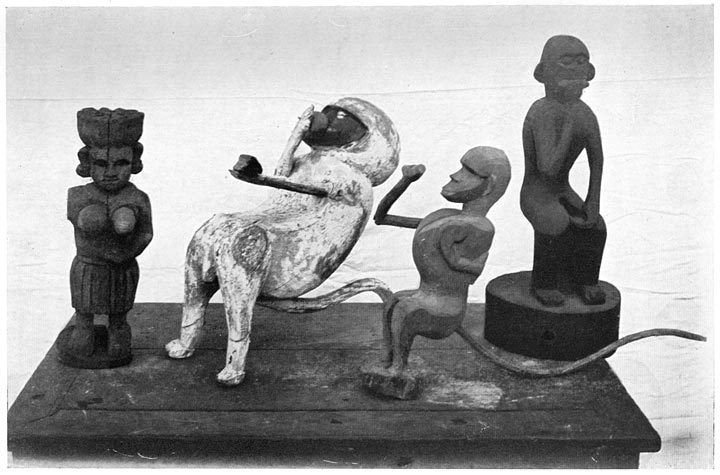
Evil Eye Figures, Malabar.
To face page 112.
“3. A portion of the skull of a bull, with horns attached, is set up on a long pole.
“The figures, pots, and skulls, are primarily intended to scare away crows, stray cattle, and other marauders, and secondly to ward off the evil eye. Instances are quoted, in which handsome buildings have fallen down, and ripe fruits and grain crops have withered through the influence of the eye, which has also been held responsible for the bursting of a woman’s breasts.”
“Charms, in the form of metal cylinders, are worn to avoid the baneful influence of the evil eye. To prevent this from affecting the crops, Paraiyans put up scarecrows in their fields. These are usually small broken earthen pots, whitewashed or covered with spots of whitewash, or even adorned with huge clay noses and ears, and made into grotesque faces. For the same reason, more elaborate figures, made of mud and twigs in human shape, are sometimes set up.”
The indecent figures carved on temple cars, are intended to avert the evil eye. During temple or marriage processions, two huge human figures, male and female, made of bamboo wicker-work, are carried in front for the same purpose. At the buffalo races in South Canara, which take place when the first crop has been gathered, there is a procession, which is sometimes headed by two dolls represented in coitu borne on a man’s head. At a race meeting near Mangalore, one of the devil-dancers had the genitalia represented by a long piece of cloth and enormous testicles.
Sometimes, in case of illness, a figure is made of rice-flour paste, and copper coins are stuck on the head, hands, and abdomen thereof. It is waved in front of the sick person, taken to a place where three roads or paths meet, and left there. At other times, a hole is made in a gourd (Benincasa cerifera or Lagenaria vulgaris), which is filled with turmeric and chunam, and waved round the patient. It is then taken to a place where three roads meet, and broken.
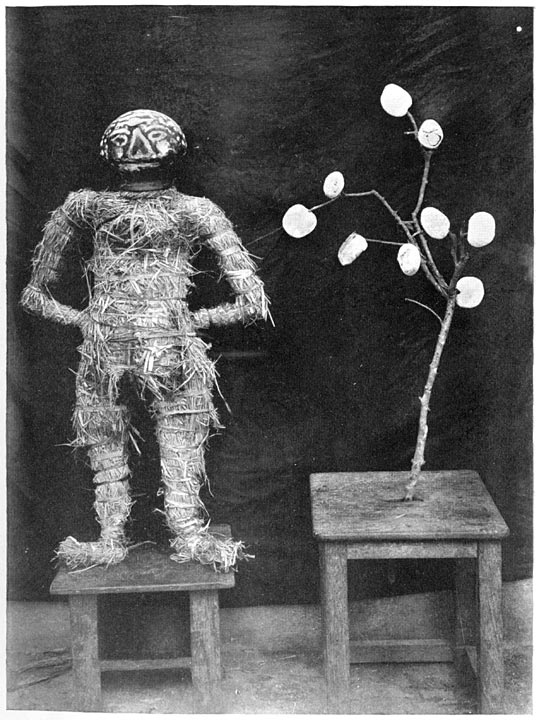
Evil Eye Figures Set Up in Fields.
To face p. 114.
At a ceremony performed in Travancore when epidemic disease prevails, an image of Bhadrakāli is drawn on the ground with powders of five colours, white, yellow, black, green, and red. At night, songs are sung in praise of that deity by a Tīyattunni and his followers. A member of the troupe then plays the part of Bhadrakāli in the act of murdering the demon Darika, and, in conclusion, waves a torch before the inmates of the house, to ward off the evil eye, which is the most important item in the whole ceremony. The torch is believed to be given by Siva, who is worshipped before the light is waved.
In cases of smallpox, a bunch of nīm (Melia Azadirachta) is sometimes moved from the head to the feet of the sick person, with certain incantations, and then twisted and thrown away.
The sudden illness of children is often attributed to the evil eye. In such cases, the following remedies are considered efficacious:—
(1) A few sticks from a new unused broom are set fire to, waved several times round the child, and placed in a corner. With some of the ashes the mother makes a mark on the child’s forehead. If the broom burns to ashes without making a noise, the women cry: “Look at it. It burns without the slightest noise. The creature’s eyes are really very bad.” Abuse is then heaped on the person whose eyes are supposed to have an evil influence.
(2) Some chillies, salt, human hair, nail-cuttings, and finely powered earth from the pit of the door-post are mixed together, waved three times in front of the child, and thrown onto the fire. Woe betide the possessor of the evil eye, if no pungent, suffocating smell arises when it is burning.
(3) A piece of burning camphor is waved in front of the child.
(4) Balls of cooked rice, painted red, black, and white (with curds), are waved before the child.
Loss of appetite in children is attributed by mothers to the visit of a supposed evil person to the house. On that person appearing again, the mother will take a little sand or dust from under the visitor’s foot, whirl it round the head of the child, and throw it on the hearth. If the suspected person is not likely to turn up again, a handful of cotton-seed, chillies, and dust from the middle of the street, is whirled round the child’s head, and thrown on the hearth. If the chillies produce a strong smell, the evil eye has been averted. If they do not do so, the suspect is roundly abused by the mother, and never again admitted to the house.
At the Sakalathi festival of the Badagas of the Nīlgiris, a cake is made, on which are placed a little rice and butter. Three wicks steeped in castor-oil are put in it, and lighted. The cake is then waved round the heads of all the children of the house, taken to a field, and thrown thereon with the words “Sakalathi has come.” At the Sūppidi ceremony, which every Nāttukōttai Chetti (Tamil banker) youth has to perform before marriage, the young man goes to the temple. On his return home, and at the entrance of Nāttukōttai houses which he passes, rice-lamps are waved before him.
At a Palli (Tamil cultivator) wedding, water coloured with turmeric and chunam (ārati) is waved round the bride and bridegroom. Later on, when the bride is about to enter the home of the bridegroom, coloured water and a cocoanut are waved in front of the newly married couple. At a marriage among the Pallans (Tamil cultivators), when the contracting couple sit on the dais, coloured water, or balls of coloured rice with lighted wicks, are waved round them. Water is poured into their hands from a vessel, and sprinkled over their heads. The vessel is then waved before them. During a Kōliyan (Tamil weaver) wedding coloured water, into which leaves of Bauhinia variegata are thrown, are waved. At a marriage among the Khatris (weavers), when the bridegroom arrives at the house of the bride, her mother comes out, and waves coloured water, and washes his eyes with water. At a Tangalān Paraiyan wedding, during a ceremony for removing the evil eye, a pīpal (Ficus religiosa) leaf is held over the foreheads of the bridal couple, with its tail downwards, and all the close relations pour milk over it, so that it trickles over their faces. During a marriage among the Sembadavans (Tamil fishermen), the bride and bridegroom go through a ceremony called sige kazhippu, with the object of warding off the evil eye, which consists in pouring a few drops of milk on their foreheads from a fig or betel leaf. At a Kāpu (Telugu cultivator) wedding, the Ganga idol, which is kept in the custody of a Tsākala (washerman), is brought to the marriage house. At the entrance thereto, red-coloured food, coloured water, and incense, are waved before it. During a marriage among the Balijas (Telugu traders), the bridegroom is stopped at the entrance to the room in which the marriage pots are kept by a number of married women, and has to pay a small sum for the ārati (coloured water), which is waved by the women. At a Bilimagga (weaver) wedding in South Canara, the bridegroom’s father waves incense in front of a cot and brass vessel, and lights and ārati water are waved before the bridegroom.
At a royal marriage in Travancore, in 1906, a bevy of Nāyar maidens, quaintly dressed, walked in front of the Rāni’s palanquin. They were intended as Drishti Pariharam, to ward off the evil eye.
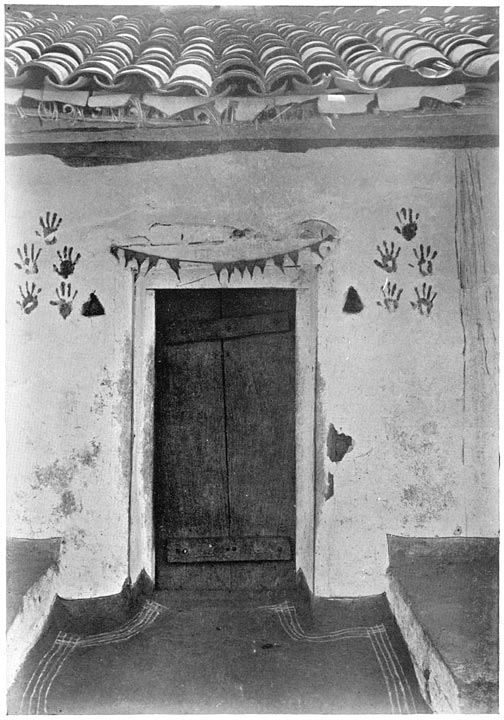
Impression of Hand on Wall of House.
To face p. 119.
During one of my tours, a gang of Yerukalas absolutely refused to sit on a chair, and I had perforce to measure their heads while they squatted on the ground. To get rid of my evil influence, they subsequently went through the ceremony of waving red-coloured water and sacrificing fowls.