VIII Magic and Human Life
Reading edition
Some of the cases here brought together serve as an illustration of the difficulty which frequently arises in arriving at a decision as to how far the taking of human life is justified as being carried out in accordance with a genuine superstitious belief, and when the act renders the perpetrator thereof liable to punishment under the Indian Penal Code.
Five persons were charged a few years ago at the Coimbatore sessions with the murder of a young woman. The theory put forward by the prosecution was that two of the accused practised sorcery, and were under the delusion that, if they could obtain the fœtus from the uterus of a woman who was carrying her first child, they would be able to work some wonderful spells with it. With this object, they entered into a conspiracy with the three other accused to murder a young married woman, aged about seventeen, who was seven months advanced in pregnancy, and brutally murdered her, cutting open the uterus, removing the fœtus contained therein, and stealing her jewels. The five accused persons (three men and two women) were all of different castes. Two of the men had been jointly practising sorcery for some years. It was proved that, about two years before, they had performed an incantation near a river with some raw beef, doing pūja (worship) near the water’s edge in a state of nature. Evidence was produced to prove that two of the accused decamped after the murder with a suspicious bundle, a few days before an eclipse of the moon, to Tiruchengōdu where there is a celebrated temple. It was suggested that the bundle contained the uterus, and was taken to Tiruchengōdu for the purpose of performing magical rites. When the quarters in which two of the accused lived were searched, three palm-leaf books were found containing mantrams regarding the pilli suniyam, a process of incantation by means of which sorcerers are supposed to be able to kill people. The record of the case states that “there can be little doubt that the first and fourth accused were taken into the conspiracy in order to decoy the deceased. The inducement offered to them was most probably immense wealth by the working of charms by the second and third accused with the aid of the fœtus. The medical evidence showed that the dead woman was pregnant, and that, after her throat had been cut, the uterus was taken out.”
In 1829, several Natives of Malabar were charged with having proceeded, in company with a Paraiyan magician, to the house of a pregnant woman, who was beaten and otherwise ill-treated, and with having taken the fœtus out of her uterus, and introduced in lieu thereof the skin of a calf and an earthen pot. The prisoners confessed before the police, but were acquitted mainly on the ground that the earthen pot was of a size which rendered it impossible to credit its introduction during life. The Paraiyas of Malabar and Cochin are celebrated for their magical powers, and the practice of odi.
In a case which was tried at the Malabar Sessions a few years ago, several witnesses for the prosecution deposed that a certain individual was killed by odi. One man gave the following account of the process. Shoot the victim in the nape of the neck with a blunt arrow, and bring him down. Proceed to beat him systematically all over the body with two sticks (resembling a policeman’s truncheon, and called odivaddi), laying him on his back and applying the sticks to his chest, and up and down the sides, breaking all the ribs and other bones. Then raise the person, and kick his sides. After this, force him to take an oath that he will never divulge the names of his torturer. All the witnesses agreed about the blunt arrow, and some bore testimony to the sticks.
“A Pānan, who is an adept in the black art, dresses in an unwashed cloth, and performs pūja to his deity, after which he goes in search of a kotuveli plant (Plumbago zeylanica). When he has found it, he goes round it three times every day, and continues to do so for ninety days, prostrating himself every day before it, and on the last night, which must be a new moon night, at midnight, he performs pūja to the plant, burning camphor and frankincense, and, after going round it three times, prostrates himself before it. He then thrusts three small candles on it, and advances twenty paces in front of it. With his mouth closed, he plucks the root, and buries it in the ashes on the cremation ground, after which he pours the water of seven green cocoanuts on it. He then goes round it twenty-one times, uttering all the while certain mantrams. This being over, he plunges himself in water, and stands erect until it extends to his mouth. He takes a mouthful of water which he empties on the spot, and takes the plant with the root which he believes to possess peculiar virtues. When it is taken to the closed door of a house, it has the power to entice a pregnant woman, and cause her to come out, when the fœtus is removed. It is all secretly done at midnight. The head, hands, and legs are cut off, and the trunk is taken to a dark-coloured rock, on which it is cut into nine pieces, which are burned until they are blackened. At this stage one piece boils, and it is placed in a new earthen pot, to which is added the water of nine green cocoanuts. The pot is removed to the burial ground, where the Pānan performs a pūja in honour of his favourite deity. He fixes two poles deep in the earth, at a distance of thirty feet from each other. The two poles are connected by a strong wire, from which is suspended the pot to be heated and boiled. Seven fireplaces are made beneath the wire, over the middle of which is the pot. The branches of bamboo, katalati (Achyranthes aspera), conga (Bauhinia variegata), cocoanut palm, jack tree (Artocarpus integrifolia), and pavatta (Pavetta indica), are used in forming a bright fire. The mixture in the pot soon boils and becomes oily, at which stage it is passed through a fine cloth. The oil is preserved, and a mark made with it on the forehead enables the possessor to realise anything which is thought of. The sorcerer must be in a state of vow for twenty-one days, and live on a diet of chama kanji (gruel). The deity whose aid is necessary is also propitiated by offerings.”
In 1908, the following case, relating to the birth of a monster, was tried before the Sessions Judge of South Canara. A young Gauda girl became pregnant by her brother-in-law. After three days’ labour, the child was born. The accused, who was the mother of the girl, was the midwife. Finding the delivery very difficult, she sent for a person to come and help her. The child was, as they thought, still-born. On its head was a red protuberance like a ball; round each of its forearms were two or three red bands; the eyes and ears were fixed very high in the head; and the eyes, nose, and mouth were abnormally large. The mother was carried out of the outhouse, lest the devil child should do her harm, or kill her. The accused summoned a Muhammadan, who was in the yard. He came in, and she showed him the child, and asked him to call the neighbours, to decide what to do. The child, she said, was a devil child, and must be cut and killed, lest it should devour the mother. While they were looking at the child, it began to move and roll its eyes about, and turn on the ground. It is a belief of the villagers that such a devil child, when brought in contact with the air, rapidly grows, and causes great trouble, usually killing the mother, and sometimes killing all the inmates of the house. The accused told the Muhammadan to cover the child with a vessel, which he did. Then there was a sound from inside the vessel, either of the child moving, or making a sound with its mouth. The accused then put her hand under the vessel, dragged the child half-way out, and, while the Muhammadan pressed the edge of the vessel on the abdomen of the child, took a knife, and cut the body in half. When the body was cut in two, there was no blood, but a mossy-green or black liquid oozed out. The accused got two areca leaves, and put one piece of the child on one, and one on the other, and told the Muhammadan to get a spade, and bury them. So they went to the jungle close to the house, and the Muhammadan dug two holes, one on one hillock, and one on another. In these holes, the two pieces of the child were buried. The object of this was to prevent the two pieces joining together again, in which case the united devil child would have come out of the grave, and gone to kill the mother.
Years ago, it was not unusual for people to come long distances for the purpose of engaging Paniyans of the Wynād (in Malabar) to help them in carrying out some more than usually desperate robbery or murder. Their mode of procedure, when engaged in an enterprise of this sort, is evidenced by two cases, which had in them a strong element of savagery. On both these occasions, the thatched homesteads were surrounded at dead of night by gangs of Paniyans carrying large bundles of rice straw. After carefully piling up the straw on all sides of the building marked for destruction, torches were at a given signal applied, and those of the inmates who attempted to escape were knocked on the head with clubs, and thrust into the fiery furnace. In 1904, some Paniyans were employed by a Māppilla (Muhammadan) to murder his mistress, who was pregnant, and threatened that she would noise abroad his responsibility for her condition. He brooded over the matter, and one day, meeting a Paniyan, promised him ten rupees if he would kill the woman. The Paniyan agreed to commit the crime, and went with his brothers to a place on a hill, where the Māppilla and the woman were in the habit of gratifying their passions. Thither the man and woman followed the Paniyans, of whom one ran out, and struck the victim on the head with a chopper. She was then gagged with a cloth, carried some distance, and killed.
In 1834, the inhabitants of several villages in Malabar attacked a village of Paraiyans on the alleged ground that deaths of people and cattle, and the protracted labour of a woman in childbed, had been caused by the practice of sorcery by the Paraiyans. They were beaten inhumanely with their hands tied behind their backs, so that several died. The villagers were driven, bound, into a river, immersed under water so as nearly to produce suffocation, and their own children were forced to rub sand into their wounds. Their settlement was then razed to the ground, and they were driven into banishment.
Some years ago, a Toda was found dead in a sitting posture on the top of a hill near a Badaga village, in which a party of Todas had gone to collect the tribute due to them. The body was cremated, and a report made to the police that the man had been murdered. On enquiry, it was ascertained that the dead man was supposed to have bewitched a little Badaga girl, who died in consequence, and the presumption was that he had been murdered by the Badagas out of spite.
In 1906, two men were found guilty of killing a man by shooting him with a gun in South Canara. It is recorded in the judgment that “the accused have a brother, who has been ill for a long time. They thought deceased, who was an astrologer and mantravādi, had bewitched him. They had spent fifty or sixty rupees on deceased for his treatment, but it did no good, and accused came to believe that deceased not only would not cure their brother himself, but would not allow other doctors to do so. Also, a certain theft having occurred some months ago, deceased professed by his magic arts to have discovered that accused and others were the thieves. In consequence of these things, accused had expressed various threats against deceased. One witness, who is a mantravādi in a small way, was consulted by one of the accused to find some counter-treatment for deceased’s bewitchment. Accused said that deceased refused to cure their brother, and would not let others do so, unless they gave him certain gold coins called Rāma Tanka, said to be in their possession. They desired this possession, so would not satisfy deceased. So their brother was dying by inches under deceased’s malign influence. This witness professed to have discovered that accused’s brother was being worried by one black devil and two malignant spirits of the dead. It is clear from the evidence that accused, who are ignorant men of a low type, really believed that deceased was by his magic wilfully and slowly killing their brother. They believed that the only way to save their brother’s life was to kill the magician.”
During an epidemic of smallpox in the Jeypore hill tracts, a man lost his wife and child. A local subscription had been organised for a sorcerer, on the understanding that he was to stay the course of the epidemic. The bereaved man charged him with being a fraud, and, in the course of a quarrel, split his skull open with a tangi (axe).
In 1906, a Kōmati woman died of cholera in a village in Ganjam. Her son sought the assistance of certain men of the “Reddika” caste in obtaining wood for the pyre, carrying the corpse to the burning-ground, and cremating it. The son set fire to the pyre, and withdrew, leaving the Reddikas on the spot. Among them was one, who is said to have learnt sorcery from a Bairāgi (religious mendicant), and to have been generally feared and hated in the village. To him the spread of cholera by letting loose the goddess of the cremation-ground, called Mashani Chendi, was attributed. Arrack (liquor) was passed round among those who were attending to the burning corpse, and they got more or less drunk. Two of them killed the sorcerer by severe blows on the neck with wood-choppers. His corpse was then placed on the burning pyre of the Kōmati woman, and cremated. The men who delivered the death blows were sentenced to transportation for life, as their intoxicated state and superstitious feeling were held to plead in mitigation of the punishment.
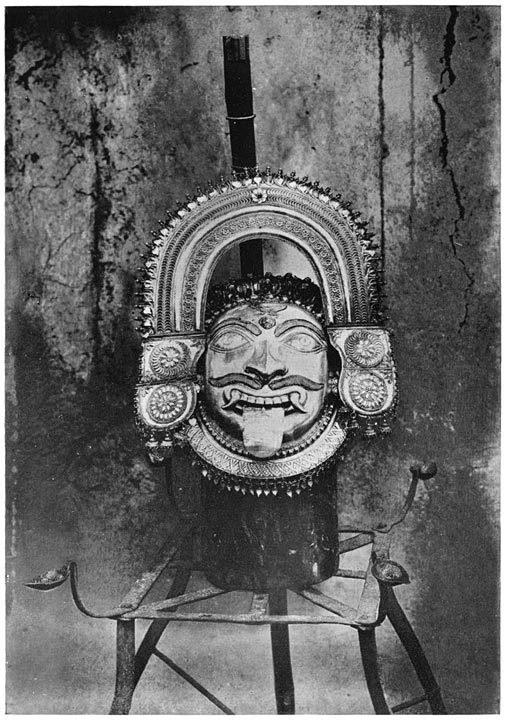
Jumadi Bhūtha, South Canara.
To face p. 237.